Extracting solitary solutions of the nonlinear Kaup–Kupershmidt (KK) equation by analytical method
-
Mohammed Shaaf Alharthi


Abstract
Finding analytical solutions for nonlinear partial differential equations is physically meaningful. The Kaup-Kupershmidt (KK) equation is studied in this article. The KK equation is of fifth order, such that several solitary solutions are obtained. In this article, however, the modified auxiliary function approach is applied to this model to find solitary solutions. These solutions are written in terms of Jacobi functions. Therefore, the obtained solutions can be implemented graphically to show different patterns for appropriate parameters.
1 Introduction
Nonlinear partial differential equations (NPDEs) govern transport phenomena that manifest in various physics and engineering scenarios. These partial differential equations can be used to model, for instance, solitary waves in fluid problems such as earthquakes and the hydromagnetic flux of a dusty liquid through a porous medium [1] or fluid dynamics such as Bona–Mahony equation [2–5], Benney-Luke equation, the modified Kortewege–de-Varies equation [6,7], heat transfer in thermoelectric fluid [8] and Benjamin–Bona–Mohaony equation [9,10]. Great attention has already been taken to the Kaup–Kupershmidt (KK) equation [11,12] and also to Sawada–Kotera model [13] that are fifth-order NPDEs.
In literature, the latter two equations are well documented even though they are of the same order and different. The KK model is more complex than the Sawada–Kotera model regarding integrability and mathematical solutions. However, the KK equation is still an active system as far as we know of which one would seek further soliton solutions. The KK equation can be applied to various applications in physics, such as nonlinear optics, fluid dynamics, and plasma physics [14]. In 1980, the famous classical KK equation is introduced by Kaup [15] and modified by Kupershmidt in 1994 [16]. Most recently, numerical approaches to the fractional-order KK equation have been implemented to seek nonlinear dispersive waves and capillary gravity waves [17]. For fractional-order differential equations model, readers who express interest in the topic are advised to consult these references [18–23].
In the literature, Kaup found numerically solitary solutions to the KK equation by using inverse scattering theory. Herman and Nusier [24] have computed two and three solutions, but, they did not provide a further sequence of soliton solutions. This brought motivation to investigate the existence of exact solutions with the aid of Mathematica software and several analytical methods. For instance, the modified auxiliary equation (MAE) method [25,26], the exponential expansion method [27], the tanh-based expansion method [28], the Jacobi elliptic functions method [29], the modified exponential rational method [30], the
The objective of this present manuscript is to investigate new traveling wave solutions to the problem under investigation. This includes exponential periodic hyperbolic [2–4] and rational [4,5] analytical solutions different from those exposed in the literature. The analytical method MAE is utilized to construct different analytical solutions for the KK equation using the well-known Jacobi functions. Further solitons solution is determined and analyzed upon any constraint conditions if they exist. Furthermore, the solutions are displayed graphically and classified according to the Soliton profiles.
The current manuscript is organized as follows: an overview of the methodology used herein in Section 2; in Section 3, we use the proposed approach to the KK equation; Section 4 is devoted to discussing the obtained solutions; and at the end of Section 5, the conclusion and further ideas are presented.
2 The method of MAE
Here, we give an overview of the modified auxiliary method [25,26]. Thus, consider the general form of the NPDEs as follows:
where
The outline of the method is presented as follows as:
Step 1: we apply the following transformation:
(2)where
(3)Step 2: Assuming the solution of Eq. (3) would be
(4)such that
(5)where
Case 1: If
Case 2: If
Case 3: If
Case 4: If
Case 5: If
Case 6: If
3 The solutions to the KK model
Here, the MAE will be used to solve the KK model. Thus, based on the study by Parker [11], the KK model is written as follows:
Then, let us apply the following transformation:
where
The principle of homogeneous balancing will be used in Eq. (8), we find
Therefore, by using Eq. (5) and substituting Eq. (9) into Eq. (8), one can vanish the coefficients
Set 1.
After replacing these values into Eq. (9), several cases of analytical solutions are constructed as follows:
Case 1. If
such that
This leads to the following equation:
when
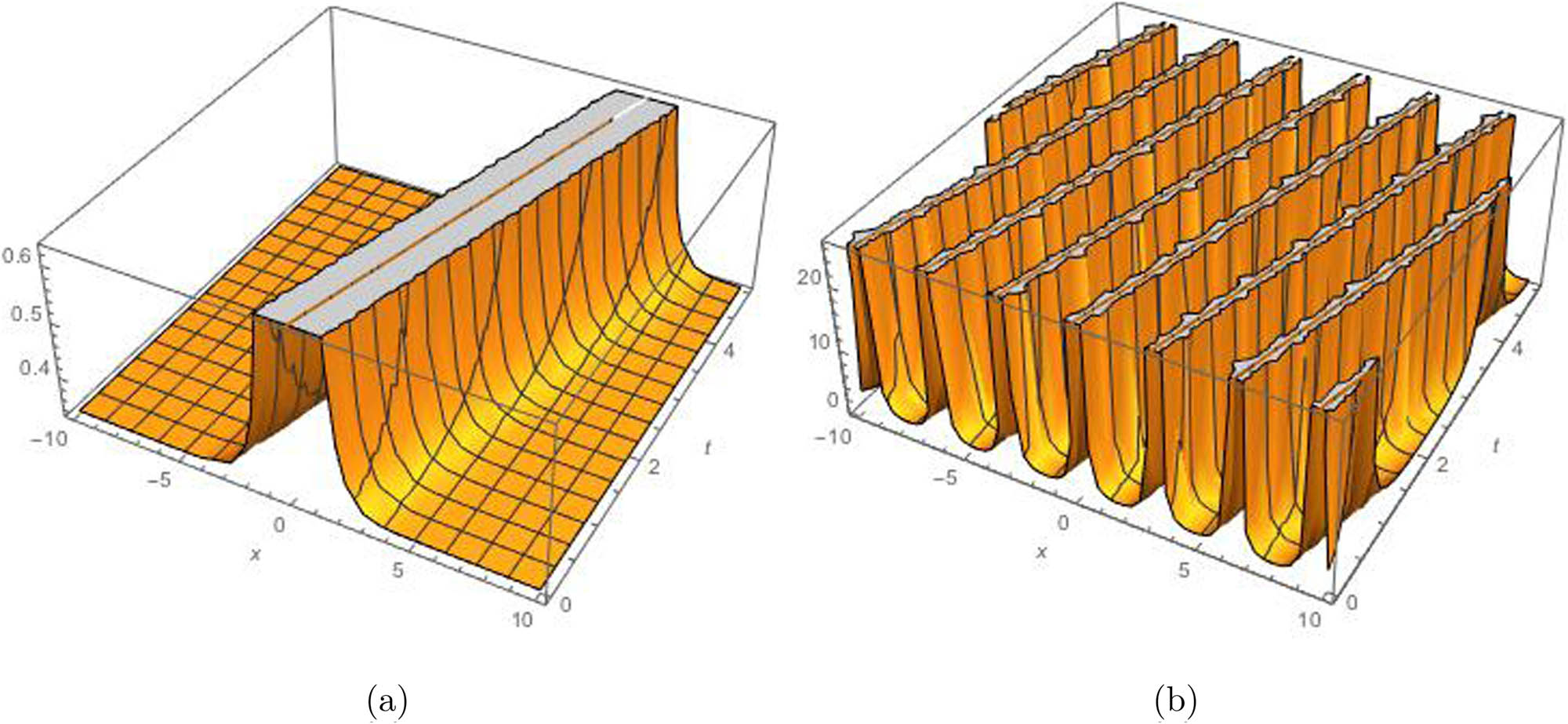
Case 2. If
Furthermore, Eq. (14) leads to the following solution:
when
Case 3. If
Case 4. If
Thus, the solution in Eq. (17) leads to the following equation:
when
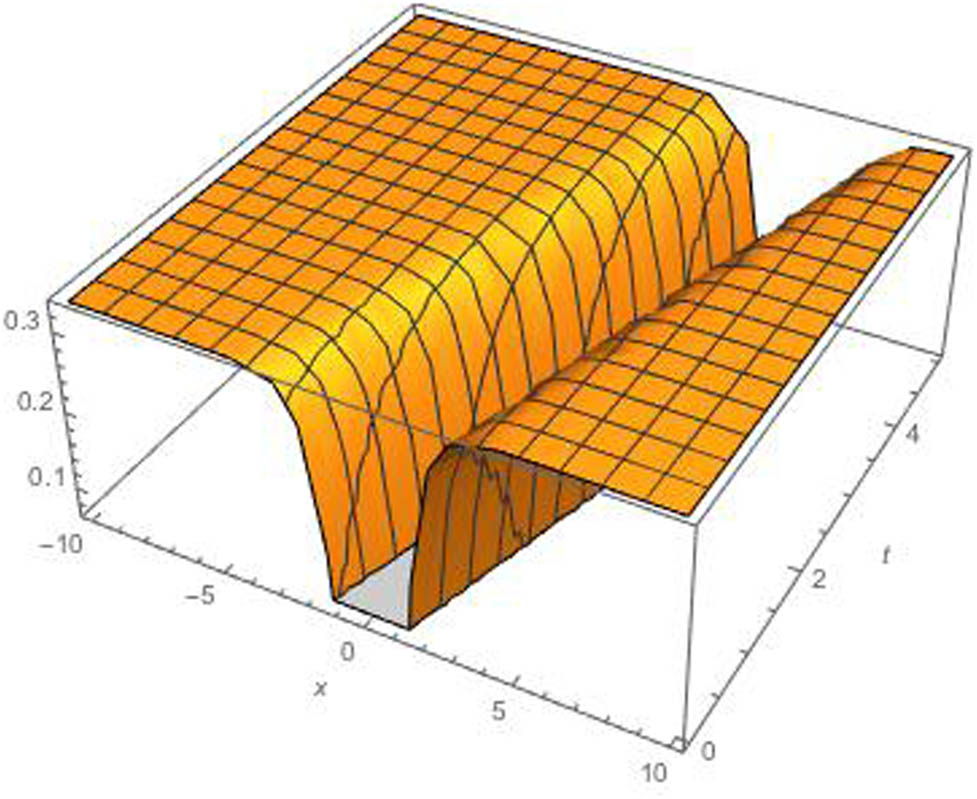
The 3D plot of the solutions (18) when
Case 5. If
which can be reduced to
when
Case 6. If
Furthermore, the determined solution above converts to:
as
Set 2.
By substituting previous values into Eq. (9), several cases of analytical solutions are constructed as follows:
Case 1. If
Furthermore, Eq. (24) leads to the following solution:
when
Case 2. If
Furthermore, Eq. (14) leads to the following solution:
when
Case 3. If
Case 4. If
Furthermore, Eq. (30) leads to the following form:
when
Case 5. If
which can be reduced to the following equation:
when
Case 6. If
Furthermore, the solution determined above transforms to the following equation:
as
Set 3.
By substituting previous values into Eq. (9), several cases of analytical solutions are constructed in the following form:
Case 1. If
Case 2. If
Furthermore, the form in Eq. (38) leads to the following solution:
when
Case 3. If
Case 4. If
Case 5. If
which can be reduced to the following form:
when
Case 6. If
Set 4.
By substituting previous values into Eq. (9), several cases of exact solutions are constructed in the following forms:
Case 1. If
Furthermore, Eq. (11) leads to following form:
when
Case 2. If
Case 3. If
Case 4. If
Case 5. If
which can be reduced to the following form:
when
Case 6. If
Set 5.
By substituting previous values into Eq. (9), several cases of the following exact solutions can be constructed:
Case 1. If
Case 2. If
Furthermore, Eq. (56) leads to the following form:
when
Case 3. If
Case 4. If
Case 5. If
that can be reduced to the following equation:
when
Case 6. If
Set 6.
By substituting previous values into Eq. (9), several cases of the following exact solutions are constructed:
Case 1. If
The solution in Eq. (24) leads to
when
Case 2. If
Case 3. If
Case 4. If
Case 5. If
which can be reduced to:
when
Case 6. If
4 Conclusion
In this manuscript, the KK equation has been studied to find new analytical solitary solutions. The MAE method has been utilized to obtain a variety of solutions to the problem under investigation. As far as we know, our solutions are new and different from those in the literature. The obtained solutions are written in terms of Jacobi functions that can be reduced to hyperbolic and trigonometric forms. All solutions obtained in the article have been verified through insertion into the primary equation. Some of the obtained solutions are plotted based on appropriate parameter values. In future work, the analytical methods MAE used in this article can be applied to other types of nonlinear equations for determining the solutions of a suitable model.
Acknowledgments
The author thanks the Dean of Scientific Research at Taif University, Taif, Saudi Arabia, for their support and funding for this work. Moreover, thanks to Dr. Althobaiti for taking the time to provide valuable comments on this article. His suggestions were helpful in accomplishing this work.
-
Funding information: This work was funded by the Dean of Scientific Research at Taif University, Taif, Saudi Arabia.
-
Author contributions: All authors have accepted responsibility for the entire content of this manuscript and approved its submission.
-
Conflict of interest: The author states no conflict of interest.
References
[1] Ezzat MA, El-Bary AA, Morsey MM. Space approach to the hydro-magnetic flow of a dusty fluid through a porous medium. Comput Math Appl. 2010 Apr 1;59(8):2868–79. 10.1016/j.camwa.2010.02.004Suche in Google Scholar
[2] Khater MM, Salama SA. Semi-analytical and numerical simulations of the modified Benjamin-Bona-Mahony model. J Ocean Eng Sci. 2022;7:264–71. 10.1016/j.joes.2021.08.008Suche in Google Scholar
[3] Khan K, Akbar MA, Islam SMR. Exact solution for (1+1)-dimensional nonlinear dispersive modified Benjamin-Bona- Mahony equation and coupled Klein-Gordon equations. Springer Plus. 2014;3, 724; Fractal Fract. 2022;6(399):11 of 11. Suche in Google Scholar
[4] Naher H, Abdullah FA. The modified Benjamin-Bona-Mahony equation via the extended generalized Riccati equation mapping method. Appl Math Sci. 2012;6:5495–512. Suche in Google Scholar
[5] Baskonus HM, Bulut H. Analytical studies on the (1+1)-dimensional nonlinear dispersive modified Benjamin-Bona-Mahony equation defined by seismic sea waves. Waves Random Complex Media. 2015;25:576–86. 10.1080/17455030.2015.1062577Suche in Google Scholar
[6] Che H, Yu-Lan W. Numerical solutions of variable-coefficient fractional-in-space KdV equation with the Caputo fractional derivative. Fractal Fract. 2022;6:207. 10.3390/fractalfract6040207Suche in Google Scholar
[7] Ullah H, Fiza M, Khan I, Alshammari N, Hamadneh NN, Islam S. Modification of the optimal auxiliary function method for solving fractional order KdV equations. Fractal Fract. 2022;6:288. 10.3390/fractalfract6060288Suche in Google Scholar
[8] Ezzat MA, El-Bary AA. Effects of variable thermal conductivity on Stokes’ flow of a thermoelectric fluid with fractional order of heat transfer. Int J Thermal Sci. 2016 Feb 1;100:305–15. 10.1016/j.ijthermalsci.2015.10.008Suche in Google Scholar
[9] Benjamin T, Bona J, Mahony J. Model equations for long waves in nonlinear dispersive systems. Philos Trans R Soc Lond Ser A. 1972;272:47. 10.1098/rsta.1972.0032Suche in Google Scholar
[10] Alotaibi T, Althobaiti A. Exact solutions of the nonlinear modified Benjamin-Bona-Mahony equation by an analytical method. Fractal Fract. 2022;6(7):399. 10.3390/fractalfract6070399Suche in Google Scholar
[11] Parker A. On soliton solutions of the Kaup-Kupershmidt equation. II. ‘Anomalous’ N-soliton solutions. Phys D Nonlinear Phenomena. 2000 Mar 1;137(1-2):34–48. 10.1016/S0167-2789(99)00167-0Suche in Google Scholar
[12] Prakasha DG, Malagi NS, Veeresha P, Prasannakumara BC. An efficient computational technique for time-fractional Kaup-Kupershmidt equation. Numer Meth Partial Differ Equ. 2021 Mar;37(2):1299–316. 10.1002/num.22580Suche in Google Scholar
[13] Sawada K, Kotera T., A method for finding N-soliton solutions of the KdV equation and KdV-like equation. Progress Theoretic Phys. 1974 May 1;51(5):1355–67. 10.1143/PTP.51.1355Suche in Google Scholar
[14] Inc M, Miah M, Akher Chowdhury SA, Rezazadeh H, Akinlar MA, Chu YM. New exact solutions for the Kaup-Kupershmidt equation, Aims Math. 2020 Jan 1;5(6):6726–38. 10.3934/math.2020432Suche in Google Scholar
[15] Kaup DJ. On the inverse scattering problem for cubic eigenvalue problems of the class ψxxx+6Qψx+6Rψ=λψ. Stud Appl Math. 1980 Jun;62(3):189–216. 10.1002/sapm1980623189Suche in Google Scholar
[16] Kupershmidt BA. A super Korteweg-de Vries equation: an integrable system. Phys Lett A. 1984 May 21;102(5–6):213–5. 10.1016/0375-9601(84)90693-5Suche in Google Scholar
[17] Shah NA, Hamed YS, Abualnaja KM, Chung JD, Shah R, Khan A. A comparative analyzis of fractional-order Kaup-Kupershmidt equation within different operators. Symmetry. 2022 May 11;14(5):986. 10.3390/sym14050986Suche in Google Scholar
[18] El-Sayed AA, Agarwal P. Numerical solution of multiterm variable-order fractional differential equations via shifted Legendre polynomials. Math Meth Appl Sci. 2019 Jul 30;42(11):3978–91. 10.1002/mma.5627Suche in Google Scholar
[19] El-Sayed AA, Baleanu D, Agarwal P. A novel Jacobi operational matrix for numerical solution of multi-term variable-order fractional differential equations. J Taibah Univ Sci. 2020 Jan 1;14(1):963–74. 10.1080/16583655.2020.1792681Suche in Google Scholar
[20] Rezapour S, Etemad S, Tellab B, Agarwal P, Garcia Guirao JL. Numerical solutions caused by DGJIM and ADM methods for multi-term fractional BVP involving the generalized ψ-RL-operators. Symmetry. 2021 Mar 25;13(4):532. 10.3390/sym13040532Suche in Google Scholar
[21] Agarwal P, Singh R, ul Rehman A. Numerical solution of hybrid mathematical model of dengue transmission with relapse and memory via Adam-Bashforth-Moulton predictor-corrector scheme. Chaos Solitons Fractals. 2021 Feb 1;143:110564. 10.1016/j.chaos.2020.110564Suche in Google Scholar
[22] Sunarto A, Agarwal P, Sulaiman J, Lung JC. Numerical investigation on the solution of a space-fractional via preconditioned SOR iterative method. Progress Fract Differ Appl. 2022;8(2):289–95. 10.18576/pfda/080208Suche in Google Scholar
[23] Seadawy AR, Rehman SU, Younis M, Rizvi ST, Althobaiti A. On solitons: propagation of shallow water waves for the fifth-order KdV hierarchy integrable equation. Open Physics. 2022 Jan 3;19(1):828–42. 10.1515/phys-2021-0089Suche in Google Scholar
[24] Hereman W, Nuseir A. Symbolic methods to construct exact solutions of nonlinear partial differential equations. Math Comput Simulat. 1997 Jan 1;43(1):13–27. 10.1016/S0378-4754(96)00053-5Suche in Google Scholar
[25] Mahak N, Akram G. The modified auxiliary equation method to investigate solutions of the perturbed nonlinear Schrodinger equation with Kerr law nonlinearity. Optik. 2020;207:164467. 10.1016/j.ijleo.2020.164467Suche in Google Scholar
[26] Althobaiti A. Travelling waves solutions of the KP equation in weakly dispersive media. Open Physics. 2022 Jul 22;20(1):715–23. 10.1515/phys-2022-0053Suche in Google Scholar
[27] Islam R, Alam MN, Hossain AK, Roshid HO, Akbar MA. Traveling wave solutions of nonlinear evolution equations via exp(−ϕ(η))-expansion method. Global J Sci Frontier Res. 2013;13(11):63–71. Suche in Google Scholar
[28] Raslan KR, Khalid KA, Shallal MA. The modified extended tanh method with the Riccati equation for solving the space-time fractional EW and MEW equations. Chaos Solitons Fractals. 2017;103:404–9. 10.1016/j.chaos.2017.06.029Suche in Google Scholar
[29] Gepreel KA, Nofal TA, Althobaiti AA. The modified rational Jacobi elliptic functions method for nonlinear differential difference equations. J Appl Math. 2012;2012:427479. 10.1155/2012/427479Suche in Google Scholar
[30] Althobaiti A, Althobaiti S, El-Rashidy K, Seadawy AR. Exact solutions for the nonlinear extended KdV equation in a stratified shear flow using modified exponential rational method. Results Phys. 2021;29:104723. 10.1016/j.rinp.2021.104723Suche in Google Scholar
[31] Kaewta S, Sirisubtaweee S, Koonprasert S, Sungnul S. Applications of the G’/G2-expansion method for solving certain nonlinear conformable evolution equations. Fractal Fract. 2021;5:88. 10.3390/fractalfract5030088Suche in Google Scholar
[32] Rezazadeh H, Ullah N, Akinyemi L, Shah A, Mirhosseini-Alizamin SM, Chu YM, et al. Optical soliton solutions of the generalized non-autonomous nonlinear Schrödinger equations by the new Kudryashov’s method. Results Phys. 2021;24:104179. 10.1016/j.rinp.2021.104179Suche in Google Scholar
[33] Gepreel KA, Althobaiti AA. Exact solutions of nonlinear partial fractional differential equations using fractional sub-equations method. Indian J Phys. 2014;88(3):293–300. 10.1007/s12648-013-0407-0Suche in Google Scholar
[34] Alotaibi T, Althobaiti A. Exact wave solutions of the nonlinear Rosenau equation using an analytical method. Open Physics. 2021 Dec 31;19(1):889–96. 10.1515/phys-2021-0103Suche in Google Scholar
[35] Banaja MA, Al Qarni AA, Bakodah HO, Zhou Q, Moshokoa SP, Biswas A. The investigate of optical solitons in cascaded system by improved adomian decomposition scheme. Optik. 2017;130:1107–14.10.1016/j.ijleo.2016.11.125Suche in Google Scholar
[36] Alqudah MA, Ashraf R, Rashid S, Singh J, Hammouch Z, Abdeljawad T. Novel numerical investigations of fuzzy Cauchy reaction-diffusion models via generalized fuzzy fractional derivative operators. Fract Fract. 2021;5:151. 10.3390/fractalfract5040151Suche in Google Scholar
[37] Shakhanda R, Goswami P, He J.-H, Althobaiti A. An approximate solution of the time-fractional two-mode coupled Burgers equations. Fract Fract. 2021;5:196. 10.3390/fractalfract5040196Suche in Google Scholar
© 2023 the author(s), published by De Gruyter
This work is licensed under the Creative Commons Attribution 4.0 International License.
Artikel in diesem Heft
- Regular Articles
- Dynamic properties of the attachment oscillator arising in the nanophysics
- Parametric simulation of stagnation point flow of motile microorganism hybrid nanofluid across a circular cylinder with sinusoidal radius
- Fractal-fractional advection–diffusion–reaction equations by Ritz approximation approach
- Behaviour and onset of low-dimensional chaos with a periodically varying loss in single-mode homogeneously broadened laser
- Ammonia gas-sensing behavior of uniform nanostructured PPy film prepared by simple-straightforward in situ chemical vapor oxidation
- Analysis of the working mechanism and detection sensitivity of a flash detector
- Flat and bent branes with inner structure in two-field mimetic gravity
- Heat transfer analysis of the MHD stagnation-point flow of third-grade fluid over a porous sheet with thermal radiation effect: An algorithmic approach
- Weighted survival functional entropy and its properties
- Bioconvection effect in the Carreau nanofluid with Cattaneo–Christov heat flux using stagnation point flow in the entropy generation: Micromachines level study
- Study on the impulse mechanism of optical films formed by laser plasma shock waves
- Analysis of sweeping jet and film composite cooling using the decoupled model
- Research on the influence of trapezoidal magnetization of bonded magnetic ring on cogging torque
- Tripartite entanglement and entanglement transfer in a hybrid cavity magnomechanical system
- Compounded Bell-G class of statistical models with applications to COVID-19 and actuarial data
- Degradation of Vibrio cholerae from drinking water by the underwater capillary discharge
- Multiple Lie symmetry solutions for effects of viscous on magnetohydrodynamic flow and heat transfer in non-Newtonian thin film
- Thermal characterization of heat source (sink) on hybridized (Cu–Ag/EG) nanofluid flow via solid stretchable sheet
- Optimizing condition monitoring of ball bearings: An integrated approach using decision tree and extreme learning machine for effective decision-making
- Study on the inter-porosity transfer rate and producing degree of matrix in fractured-porous gas reservoirs
- Interstellar radiation as a Maxwell field: Improved numerical scheme and application to the spectral energy density
- Numerical study of hybridized Williamson nanofluid flow with TC4 and Nichrome over an extending surface
- Controlling the physical field using the shape function technique
- Significance of heat and mass transport in peristaltic flow of Jeffrey material subject to chemical reaction and radiation phenomenon through a tapered channel
- Complex dynamics of a sub-quadratic Lorenz-like system
- Stability control in a helicoidal spin–orbit-coupled open Bose–Bose mixture
- Research on WPD and DBSCAN-L-ISOMAP for circuit fault feature extraction
- Simulation for formation process of atomic orbitals by the finite difference time domain method based on the eight-element Dirac equation
- A modified power-law model: Properties, estimation, and applications
- Bayesian and non-Bayesian estimation of dynamic cumulative residual Tsallis entropy for moment exponential distribution under progressive censored type II
- Computational analysis and biomechanical study of Oldroyd-B fluid with homogeneous and heterogeneous reactions through a vertical non-uniform channel
- Predictability of machine learning framework in cross-section data
- Chaotic characteristics and mixing performance of pseudoplastic fluids in a stirred tank
- Isomorphic shut form valuation for quantum field theory and biological population models
- Vibration sensitivity minimization of an ultra-stable optical reference cavity based on orthogonal experimental design
- Effect of dysprosium on the radiation-shielding features of SiO2–PbO–B2O3 glasses
- Asymptotic formulations of anti-plane problems in pre-stressed compressible elastic laminates
- A study on soliton, lump solutions to a generalized (3+1)-dimensional Hirota--Satsuma--Ito equation
- Tangential electrostatic field at metal surfaces
- Bioconvective gyrotactic microorganisms in third-grade nanofluid flow over a Riga surface with stratification: An approach to entropy minimization
- Infrared spectroscopy for ageing assessment of insulating oils via dielectric loss factor and interfacial tension
- Influence of cationic surfactants on the growth of gypsum crystals
- Study on instability mechanism of KCl/PHPA drilling waste fluid
- Analytical solutions of the extended Kadomtsev–Petviashvili equation in nonlinear media
- A novel compact highly sensitive non-invasive microwave antenna sensor for blood glucose monitoring
- Inspection of Couette and pressure-driven Poiseuille entropy-optimized dissipated flow in a suction/injection horizontal channel: Analytical solutions
- Conserved vectors and solutions of the two-dimensional potential KP equation
- The reciprocal linear effect, a new optical effect of the Sagnac type
- Optimal interatomic potentials using modified method of least squares: Optimal form of interatomic potentials
- The soliton solutions for stochastic Calogero–Bogoyavlenskii Schiff equation in plasma physics/fluid mechanics
- Research on absolute ranging technology of resampling phase comparison method based on FMCW
- Analysis of Cu and Zn contents in aluminum alloys by femtosecond laser-ablation spark-induced breakdown spectroscopy
- Nonsequential double ionization channels control of CO2 molecules with counter-rotating two-color circularly polarized laser field by laser wavelength
- Fractional-order modeling: Analysis of foam drainage and Fisher's equations
- Thermo-solutal Marangoni convective Darcy-Forchheimer bio-hybrid nanofluid flow over a permeable disk with activation energy: Analysis of interfacial nanolayer thickness
- Investigation on topology-optimized compressor piston by metal additive manufacturing technique: Analytical and numeric computational modeling using finite element analysis in ANSYS
- Breast cancer segmentation using a hybrid AttendSeg architecture combined with a gravitational clustering optimization algorithm using mathematical modelling
- On the localized and periodic solutions to the time-fractional Klein-Gordan equations: Optimal additive function method and new iterative method
- 3D thin-film nanofluid flow with heat transfer on an inclined disc by using HWCM
- Numerical study of static pressure on the sonochemistry characteristics of the gas bubble under acoustic excitation
- Optimal auxiliary function method for analyzing nonlinear system of coupled Schrödinger–KdV equation with Caputo operator
- Analysis of magnetized micropolar fluid subjected to generalized heat-mass transfer theories
- Does the Mott problem extend to Geiger counters?
- Stability analysis, phase plane analysis, and isolated soliton solution to the LGH equation in mathematical physics
- Effects of Joule heating and reaction mechanisms on couple stress fluid flow with peristalsis in the presence of a porous material through an inclined channel
- Bayesian and E-Bayesian estimation based on constant-stress partially accelerated life testing for inverted Topp–Leone distribution
- Dynamical and physical characteristics of soliton solutions to the (2+1)-dimensional Konopelchenko–Dubrovsky system
- Study of fractional variable order COVID-19 environmental transformation model
- Sisko nanofluid flow through exponential stretching sheet with swimming of motile gyrotactic microorganisms: An application to nanoengineering
- Influence of the regularization scheme in the QCD phase diagram in the PNJL model
- Fixed-point theory and numerical analysis of an epidemic model with fractional calculus: Exploring dynamical behavior
- Computational analysis of reconstructing current and sag of three-phase overhead line based on the TMR sensor array
- Investigation of tripled sine-Gordon equation: Localized modes in multi-stacked long Josephson junctions
- High-sensitivity on-chip temperature sensor based on cascaded microring resonators
- Pathological study on uncertain numbers and proposed solutions for discrete fuzzy fractional order calculus
- Bifurcation, chaotic behavior, and traveling wave solution of stochastic coupled Konno–Oono equation with multiplicative noise in the Stratonovich sense
- Thermal radiation and heat generation on three-dimensional Casson fluid motion via porous stretching surface with variable thermal conductivity
- Numerical simulation and analysis of Airy's-type equation
- A homotopy perturbation method with Elzaki transformation for solving the fractional Biswas–Milovic model
- Heat transfer performance of magnetohydrodynamic multiphase nanofluid flow of Cu–Al2O3/H2O over a stretching cylinder
- ΛCDM and the principle of equivalence
- Axisymmetric stagnation-point flow of non-Newtonian nanomaterial and heat transport over a lubricated surface: Hybrid homotopy analysis method simulations
- HAM simulation for bioconvective magnetohydrodynamic flow of Walters-B fluid containing nanoparticles and microorganisms past a stretching sheet with velocity slip and convective conditions
- Coupled heat and mass transfer mathematical study for lubricated non-Newtonian nanomaterial conveying oblique stagnation point flow: A comparison of viscous and viscoelastic nanofluid model
- Power Topp–Leone exponential negative family of distributions with numerical illustrations to engineering and biological data
- Extracting solitary solutions of the nonlinear Kaup–Kupershmidt (KK) equation by analytical method
- A case study on the environmental and economic impact of photovoltaic systems in wastewater treatment plants
- Application of IoT network for marine wildlife surveillance
- Non-similar modeling and numerical simulations of microploar hybrid nanofluid adjacent to isothermal sphere
- Joint optimization of two-dimensional warranty period and maintenance strategy considering availability and cost constraints
- Numerical investigation of the flow characteristics involving dissipation and slip effects in a convectively nanofluid within a porous medium
- Spectral uncertainty analysis of grassland and its camouflage materials based on land-based hyperspectral images
- Application of low-altitude wind shear recognition algorithm and laser wind radar in aviation meteorological services
- Investigation of different structures of screw extruders on the flow in direct ink writing SiC slurry based on LBM
- Harmonic current suppression method of virtual DC motor based on fuzzy sliding mode
- Micropolar flow and heat transfer within a permeable channel using the successive linearization method
- Different lump k-soliton solutions to (2+1)-dimensional KdV system using Hirota binary Bell polynomials
- Investigation of nanomaterials in flow of non-Newtonian liquid toward a stretchable surface
- Weak beat frequency extraction method for photon Doppler signal with low signal-to-noise ratio
- Electrokinetic energy conversion of nanofluids in porous microtubes with Green’s function
- Examining the role of activation energy and convective boundary conditions in nanofluid behavior of Couette-Poiseuille flow
- Review Article
- Effects of stretching on phase transformation of PVDF and its copolymers: A review
- Special Issue on Transport phenomena and thermal analysis in micro/nano-scale structure surfaces - Part IV
- Prediction and monitoring model for farmland environmental system using soil sensor and neural network algorithm
- Special Issue on Advanced Topics on the Modelling and Assessment of Complicated Physical Phenomena - Part III
- Some standard and nonstandard finite difference schemes for a reaction–diffusion–chemotaxis model
- Special Issue on Advanced Energy Materials - Part II
- Rapid productivity prediction method for frac hits affected wells based on gas reservoir numerical simulation and probability method
- Special Issue on Novel Numerical and Analytical Techniques for Fractional Nonlinear Schrodinger Type - Part III
- Adomian decomposition method for solution of fourteenth order boundary value problems
- New soliton solutions of modified (3+1)-D Wazwaz–Benjamin–Bona–Mahony and (2+1)-D cubic Klein–Gordon equations using first integral method
- On traveling wave solutions to Manakov model with variable coefficients
- Rational approximation for solving Fredholm integro-differential equations by new algorithm
- Special Issue on Predicting pattern alterations in nature - Part I
- Modeling the monkeypox infection using the Mittag–Leffler kernel
- Spectral analysis of variable-order multi-terms fractional differential equations
- Special Issue on Nanomaterial utilization and structural optimization - Part I
- Heat treatment and tensile test of 3D-printed parts manufactured at different build orientations
Artikel in diesem Heft
- Regular Articles
- Dynamic properties of the attachment oscillator arising in the nanophysics
- Parametric simulation of stagnation point flow of motile microorganism hybrid nanofluid across a circular cylinder with sinusoidal radius
- Fractal-fractional advection–diffusion–reaction equations by Ritz approximation approach
- Behaviour and onset of low-dimensional chaos with a periodically varying loss in single-mode homogeneously broadened laser
- Ammonia gas-sensing behavior of uniform nanostructured PPy film prepared by simple-straightforward in situ chemical vapor oxidation
- Analysis of the working mechanism and detection sensitivity of a flash detector
- Flat and bent branes with inner structure in two-field mimetic gravity
- Heat transfer analysis of the MHD stagnation-point flow of third-grade fluid over a porous sheet with thermal radiation effect: An algorithmic approach
- Weighted survival functional entropy and its properties
- Bioconvection effect in the Carreau nanofluid with Cattaneo–Christov heat flux using stagnation point flow in the entropy generation: Micromachines level study
- Study on the impulse mechanism of optical films formed by laser plasma shock waves
- Analysis of sweeping jet and film composite cooling using the decoupled model
- Research on the influence of trapezoidal magnetization of bonded magnetic ring on cogging torque
- Tripartite entanglement and entanglement transfer in a hybrid cavity magnomechanical system
- Compounded Bell-G class of statistical models with applications to COVID-19 and actuarial data
- Degradation of Vibrio cholerae from drinking water by the underwater capillary discharge
- Multiple Lie symmetry solutions for effects of viscous on magnetohydrodynamic flow and heat transfer in non-Newtonian thin film
- Thermal characterization of heat source (sink) on hybridized (Cu–Ag/EG) nanofluid flow via solid stretchable sheet
- Optimizing condition monitoring of ball bearings: An integrated approach using decision tree and extreme learning machine for effective decision-making
- Study on the inter-porosity transfer rate and producing degree of matrix in fractured-porous gas reservoirs
- Interstellar radiation as a Maxwell field: Improved numerical scheme and application to the spectral energy density
- Numerical study of hybridized Williamson nanofluid flow with TC4 and Nichrome over an extending surface
- Controlling the physical field using the shape function technique
- Significance of heat and mass transport in peristaltic flow of Jeffrey material subject to chemical reaction and radiation phenomenon through a tapered channel
- Complex dynamics of a sub-quadratic Lorenz-like system
- Stability control in a helicoidal spin–orbit-coupled open Bose–Bose mixture
- Research on WPD and DBSCAN-L-ISOMAP for circuit fault feature extraction
- Simulation for formation process of atomic orbitals by the finite difference time domain method based on the eight-element Dirac equation
- A modified power-law model: Properties, estimation, and applications
- Bayesian and non-Bayesian estimation of dynamic cumulative residual Tsallis entropy for moment exponential distribution under progressive censored type II
- Computational analysis and biomechanical study of Oldroyd-B fluid with homogeneous and heterogeneous reactions through a vertical non-uniform channel
- Predictability of machine learning framework in cross-section data
- Chaotic characteristics and mixing performance of pseudoplastic fluids in a stirred tank
- Isomorphic shut form valuation for quantum field theory and biological population models
- Vibration sensitivity minimization of an ultra-stable optical reference cavity based on orthogonal experimental design
- Effect of dysprosium on the radiation-shielding features of SiO2–PbO–B2O3 glasses
- Asymptotic formulations of anti-plane problems in pre-stressed compressible elastic laminates
- A study on soliton, lump solutions to a generalized (3+1)-dimensional Hirota--Satsuma--Ito equation
- Tangential electrostatic field at metal surfaces
- Bioconvective gyrotactic microorganisms in third-grade nanofluid flow over a Riga surface with stratification: An approach to entropy minimization
- Infrared spectroscopy for ageing assessment of insulating oils via dielectric loss factor and interfacial tension
- Influence of cationic surfactants on the growth of gypsum crystals
- Study on instability mechanism of KCl/PHPA drilling waste fluid
- Analytical solutions of the extended Kadomtsev–Petviashvili equation in nonlinear media
- A novel compact highly sensitive non-invasive microwave antenna sensor for blood glucose monitoring
- Inspection of Couette and pressure-driven Poiseuille entropy-optimized dissipated flow in a suction/injection horizontal channel: Analytical solutions
- Conserved vectors and solutions of the two-dimensional potential KP equation
- The reciprocal linear effect, a new optical effect of the Sagnac type
- Optimal interatomic potentials using modified method of least squares: Optimal form of interatomic potentials
- The soliton solutions for stochastic Calogero–Bogoyavlenskii Schiff equation in plasma physics/fluid mechanics
- Research on absolute ranging technology of resampling phase comparison method based on FMCW
- Analysis of Cu and Zn contents in aluminum alloys by femtosecond laser-ablation spark-induced breakdown spectroscopy
- Nonsequential double ionization channels control of CO2 molecules with counter-rotating two-color circularly polarized laser field by laser wavelength
- Fractional-order modeling: Analysis of foam drainage and Fisher's equations
- Thermo-solutal Marangoni convective Darcy-Forchheimer bio-hybrid nanofluid flow over a permeable disk with activation energy: Analysis of interfacial nanolayer thickness
- Investigation on topology-optimized compressor piston by metal additive manufacturing technique: Analytical and numeric computational modeling using finite element analysis in ANSYS
- Breast cancer segmentation using a hybrid AttendSeg architecture combined with a gravitational clustering optimization algorithm using mathematical modelling
- On the localized and periodic solutions to the time-fractional Klein-Gordan equations: Optimal additive function method and new iterative method
- 3D thin-film nanofluid flow with heat transfer on an inclined disc by using HWCM
- Numerical study of static pressure on the sonochemistry characteristics of the gas bubble under acoustic excitation
- Optimal auxiliary function method for analyzing nonlinear system of coupled Schrödinger–KdV equation with Caputo operator
- Analysis of magnetized micropolar fluid subjected to generalized heat-mass transfer theories
- Does the Mott problem extend to Geiger counters?
- Stability analysis, phase plane analysis, and isolated soliton solution to the LGH equation in mathematical physics
- Effects of Joule heating and reaction mechanisms on couple stress fluid flow with peristalsis in the presence of a porous material through an inclined channel
- Bayesian and E-Bayesian estimation based on constant-stress partially accelerated life testing for inverted Topp–Leone distribution
- Dynamical and physical characteristics of soliton solutions to the (2+1)-dimensional Konopelchenko–Dubrovsky system
- Study of fractional variable order COVID-19 environmental transformation model
- Sisko nanofluid flow through exponential stretching sheet with swimming of motile gyrotactic microorganisms: An application to nanoengineering
- Influence of the regularization scheme in the QCD phase diagram in the PNJL model
- Fixed-point theory and numerical analysis of an epidemic model with fractional calculus: Exploring dynamical behavior
- Computational analysis of reconstructing current and sag of three-phase overhead line based on the TMR sensor array
- Investigation of tripled sine-Gordon equation: Localized modes in multi-stacked long Josephson junctions
- High-sensitivity on-chip temperature sensor based on cascaded microring resonators
- Pathological study on uncertain numbers and proposed solutions for discrete fuzzy fractional order calculus
- Bifurcation, chaotic behavior, and traveling wave solution of stochastic coupled Konno–Oono equation with multiplicative noise in the Stratonovich sense
- Thermal radiation and heat generation on three-dimensional Casson fluid motion via porous stretching surface with variable thermal conductivity
- Numerical simulation and analysis of Airy's-type equation
- A homotopy perturbation method with Elzaki transformation for solving the fractional Biswas–Milovic model
- Heat transfer performance of magnetohydrodynamic multiphase nanofluid flow of Cu–Al2O3/H2O over a stretching cylinder
- ΛCDM and the principle of equivalence
- Axisymmetric stagnation-point flow of non-Newtonian nanomaterial and heat transport over a lubricated surface: Hybrid homotopy analysis method simulations
- HAM simulation for bioconvective magnetohydrodynamic flow of Walters-B fluid containing nanoparticles and microorganisms past a stretching sheet with velocity slip and convective conditions
- Coupled heat and mass transfer mathematical study for lubricated non-Newtonian nanomaterial conveying oblique stagnation point flow: A comparison of viscous and viscoelastic nanofluid model
- Power Topp–Leone exponential negative family of distributions with numerical illustrations to engineering and biological data
- Extracting solitary solutions of the nonlinear Kaup–Kupershmidt (KK) equation by analytical method
- A case study on the environmental and economic impact of photovoltaic systems in wastewater treatment plants
- Application of IoT network for marine wildlife surveillance
- Non-similar modeling and numerical simulations of microploar hybrid nanofluid adjacent to isothermal sphere
- Joint optimization of two-dimensional warranty period and maintenance strategy considering availability and cost constraints
- Numerical investigation of the flow characteristics involving dissipation and slip effects in a convectively nanofluid within a porous medium
- Spectral uncertainty analysis of grassland and its camouflage materials based on land-based hyperspectral images
- Application of low-altitude wind shear recognition algorithm and laser wind radar in aviation meteorological services
- Investigation of different structures of screw extruders on the flow in direct ink writing SiC slurry based on LBM
- Harmonic current suppression method of virtual DC motor based on fuzzy sliding mode
- Micropolar flow and heat transfer within a permeable channel using the successive linearization method
- Different lump k-soliton solutions to (2+1)-dimensional KdV system using Hirota binary Bell polynomials
- Investigation of nanomaterials in flow of non-Newtonian liquid toward a stretchable surface
- Weak beat frequency extraction method for photon Doppler signal with low signal-to-noise ratio
- Electrokinetic energy conversion of nanofluids in porous microtubes with Green’s function
- Examining the role of activation energy and convective boundary conditions in nanofluid behavior of Couette-Poiseuille flow
- Review Article
- Effects of stretching on phase transformation of PVDF and its copolymers: A review
- Special Issue on Transport phenomena and thermal analysis in micro/nano-scale structure surfaces - Part IV
- Prediction and monitoring model for farmland environmental system using soil sensor and neural network algorithm
- Special Issue on Advanced Topics on the Modelling and Assessment of Complicated Physical Phenomena - Part III
- Some standard and nonstandard finite difference schemes for a reaction–diffusion–chemotaxis model
- Special Issue on Advanced Energy Materials - Part II
- Rapid productivity prediction method for frac hits affected wells based on gas reservoir numerical simulation and probability method
- Special Issue on Novel Numerical and Analytical Techniques for Fractional Nonlinear Schrodinger Type - Part III
- Adomian decomposition method for solution of fourteenth order boundary value problems
- New soliton solutions of modified (3+1)-D Wazwaz–Benjamin–Bona–Mahony and (2+1)-D cubic Klein–Gordon equations using first integral method
- On traveling wave solutions to Manakov model with variable coefficients
- Rational approximation for solving Fredholm integro-differential equations by new algorithm
- Special Issue on Predicting pattern alterations in nature - Part I
- Modeling the monkeypox infection using the Mittag–Leffler kernel
- Spectral analysis of variable-order multi-terms fractional differential equations
- Special Issue on Nanomaterial utilization and structural optimization - Part I
- Heat treatment and tensile test of 3D-printed parts manufactured at different build orientations
