Analysis of the working mechanism and detection sensitivity of a flash detector
-
 ,
,

Abstract
Flash detectors are mainly used to detect the brief light flashing when projectiles are launched or exploded in the air. They can output trigger pulse signals in real time to start a test instrument and carry out data collection. Because flash detectors cannot work reliably under strong background light radiation, this work studied the flash detector mechanism. The influence of background light radiance, lens aperture, and detection distance on the effective signal was analyzed, a mathematical model of detection sensitivity based on the background radiation brightness control was proposed, a mathematical formula of the detection distance of the flash detector was deduced, and the optimal working conditions were obtained. The researched model was verified by simulation analysis and actual test experiments, in the same external circumstances, the limit detection distance of the optimal aperture compared to the maximum aperture increased by 20%, and the effective signal voltage amplitude was twice the amplitude at the maximum aperture, and the results showed the correctness of the analysis. The proposed detection sensitivity model can be applied for a dynamic photoelectric detection instrument, which broadens its potential application in the engineering field.
1 Introduction
The transient parameters that need to be measured when a projectile launched by a barrel weapon flies away from a muzzle or explodes in the air mainly include the distribution of the muzzle flow field, the flight attitude of the projectile in the semi confinement period, the impact pressure of the muzzle, the flight attitude in the air, and the three-dimensional coordinates of the explosion position [1]. These parameters are key technical indicators for evaluating the damage effectiveness of weapons with a large amount of test data and a short duration [2]. Due to the complex environment of the test site, dynamic test instruments, such as pulsed lasers, ultrahigh-speed cameras, pressure sensors, and light screen array sensors, are mainly used for measurement [3,4,5]. These instruments have limited data storage space, so it is necessary to start collecting the signal output by the sensor for a period of time after receiving a reliable trigger signal at a certain moment (such as the moment when the projectile is fired or the moment of an explosion in the air). For remote multipoint synchronous test experiments, test instruments at different locations also need to be triggered synchronously based on the same external signal. Therefore, a reliable and effective trigger signal is an important component to ensure the validity and accuracy of the test data [6,7].
There are three main methods for generating the trigger signal, including copper wire targets, acoustic detectors [8,9,10], and near-infrared detectors. In terms of the Copper wire target, the output trigger signal is generated by receiving the voltage change at the moment of disconnection of the copper wire, thus the method belongs to the contact measurement method, so it has poor security, and the signal transmission distance is short. For the acoustic wave detectors, the shock wave generated by the explosion of the projectile is detected by the use of a shock wave sensor, and a trigger signal is produced by the signal processing circuit. The detection distance is long but the detector is vulnerable to the wind, and it has poor reliability, besides, the speed of shock waves is slow, thus it has poor real-time performance. A near-infrared band flash detector can detect the flashing generated when an explosive is burned at the moment of projectile launch or when the projectile explodes in the air and outputs the trigger signal in real time based on the principle of photoelectric conversion [11]. It has the advantages of a long detection distance, short response delay, and easy on-site installation, so it has been widely used in weapons testing [12,13].
During field tests, it has been found that a photoelectric detection chip, the core component of the flash detector, can be easily affected by ambient background light, especially when working in a strong light environment. The PIN-type silicon-based infrared photodetector is easily affected by sunlight radiation and enters a working state of light saturation [14], causing the detection sensitivity of the detector to be sharply reduced so that it cannot effectively detect a brief light flashing, and fail to work [15]. Solar-blind UV detector performed in the wavelengths between200–280 nm [16,17], which is not affected by natural ambient light, but the response time of such devices is generally in the millisecond range, and the effective detection distance is no more than 10 m. Besides, the effective detection of photosensitive area is no more than 5 mm × 5 mm, and it cannot be applied to weapons testing with long-range (more than 20 m) effective detection of transient flame, and there are few commercially available low-cost detectors.
To address the above problems, a near-infrared band flash detector for the applications of weapons is analyzed. The research presented in this article is organized as follows: Section 2 introduced the working mechanism of a flash detector. In Section 3, the detection sensitivity model based on the adjustment of the aperture of lens contributions is proposed. In Section 4, the mathematical model of detection sensitivity for extreme detection distance is deduced. In Section 5, simulations and experiments are provided to validate the effectiveness of the method. Section 6 gives a conclusion of the proposed method and suggests some works in the future.
2 Analysis of the working mechanism of a flash detector
The instantaneous optical radiation energy generated when a projectile flies away from a muzzle or explodes in the air acts on the photoelectric detection chip inside a flash detector through the optical lens, and a weak current signal proportional to the light energy is received by the photodetector. The weak current signal is converted to a weak AC voltage signal, and the trigger pulse signal is finally output after amplification, filtering, and threshold triggering by the signal processing circuit. A photodiode is typically used as the core detection chip for the detection of the instantaneously changing optical signal.
The flash detector is mainly used in an outdoor environment. The photodiode receives the sky background light radiation in the normal state and the background light and the explosion flashing together through the optical lens to the photosensitive surface of the reverse-biased photodiode. When the photodiode works in a linear region, the output photocurrent has a good linear relationship with the received illuminance [18]. When the background radiation illuminance increases to a certain extent, the photodiode enters the saturation region, and its output photocurrent no longer increases with the increase in the illuminance, resulting in a photoelectric saturation effect [19]. In this case, the photodiode cannot respond to the received explosion flashing in time, resulting in the flash detector failing to work.
To ensure that the flash detector can respond effectively to the brief light flashing, it is necessary to adjust and change the lens aperture to ensure that the photodiode always works in the linear region. When the background light is strong, it is necessary to reduce the aperture of the lens in order to reduce the background light received by the photodiode, and adjust the photodiode from a saturated state to a linear working state [20]. However, a smaller lens aperture will weaken the radiant brightness of the flashing and reduce the detection sensitivity of the flash detector.
Figure 1 shows a schematic diagram of the working flow of the signal processing circuit of the flash detector. The photodiode receives both the explosion light and the background light. After the explosion light signal is amplified by AC, low-pass filtered and triggered by a threshold value, a trigger pulse signal is output; after the background light signal is amplified by DC and collected by voltage, the background light radiance voltage is displayed in real time through a digital tube, and the voltage value has a linear relationship with the radiance of the background light.

Workflow diagram of the signal processing circuit of the flash detector.
The output signal voltage amplitude of the flash detector caused by light radiation of the same energy is affected by the aperture of the detector lens and the detection distance, so the detection sensitivity of the flash detector can be described by the flashing signal voltage amplitude or the ultimate detection distance [21]. To effectively improve the detection sensitivity, the mathematical model of the detection sensitivity of the flash detector is proposed based on radiometry and photometry, and the aperture of the lens is adjusted according to the background light radiation brightness voltage, which effectively improves the ultimate detection distance of the flash detector.
3 Detection sensitivity model based on the lens aperture
When the flash detector detects a long-distance brief light flashing, the solid detection angle formed by the flashing to the detector
where
where
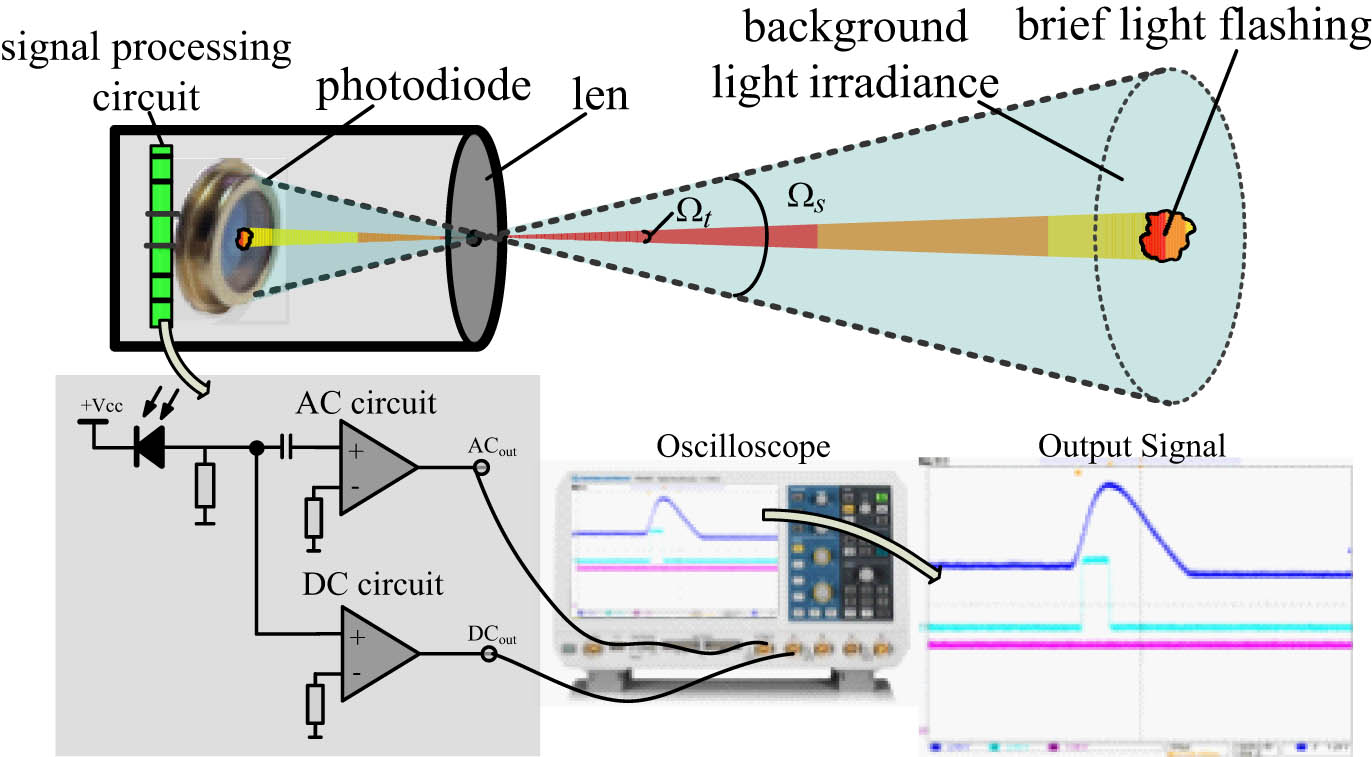
Schematic diagram of flash detector detection principle.
Therefore, the voltage amplitude of the brief light flashing signal output by the detection device
In Eq. (4), when
The lens aperture
4 Mathematical model of ultimate detection distance
The ultimate detection distance of the flash detector refers to the farthest distance that the flash detector can detect when the brightness of the explosion flashing is constant. At the test site, when the distance between the flash detector and the explosion point is greater than 20 m, it is considered to be the point target detection. Various factors affecting the detection sensitivity of the flash detector are analyzed according to the relevant theory of photometry and the law of photoelectric conversion. Combined with the theoretical model of the action distance of the point target detection system and the photoelectric detection mechanism, the detection distance formula of the flash detector is deduced. According to the law of photoelectric conversion, the specific detection rate of the photodiode used in the flash detector is deduced as
where
A comprehensive analysis of various factors affecting the detection sensitivity of the flash detector, combined with Eqs. (5), (8), and (9), deduced the detection distance equation of the flash detector, as shown in Eq. (10).
where
By analyzing Eq. (10), we find that the main factor affecting the ultimate detection distance of the flash detector is the radiance of the background light. And the higher the value of
5 Simulation and experiment
Based on the above theoretical analysis, combined with Eq. (7), the flash detector is simulated and calculated under different lens apertures, and the variation law of the output effective signal voltage amplitude with the background light radiation brightness voltage and the action distance is simulated, as shown in Figure 3. Figure 3(a)–(c) shows the corresponding voltage amplitudes of the output flashing signal when the lens aperture F is 1.4, 4, and 11, respectively. The voltage amplitudes of the output effective signal in the three conditions gradually decrease with the increase in the detection distance and gradually decrease with the increase in the voltage value of the background light brightness.
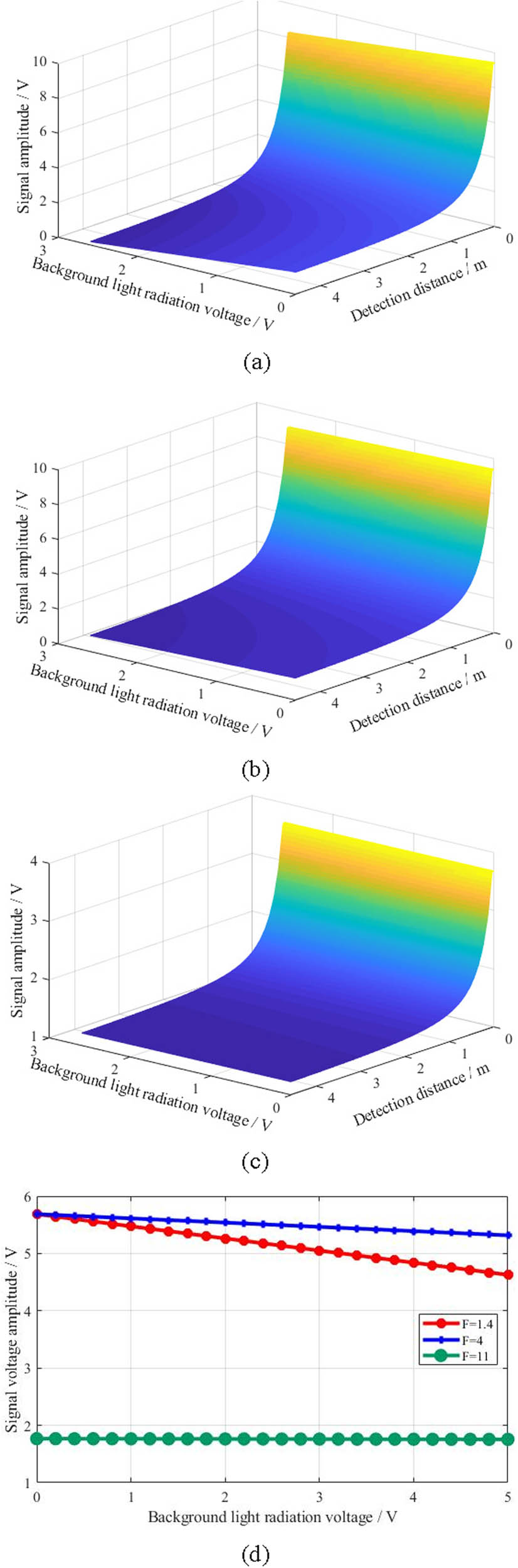
Detection sensitivity model of different lens apertures: (a) detection sensitivity model of F = 1.4, (b) detection sensitivity model of F = 4, (c) detection sensitivity model of F = 11, and (d) signal amplitude corresponding to different apertures in the same detection range.
Comparing F = 1.4 and F = 4, reducing the aperture of the lens mainly suppresses the brightness of the background light and has little effect on the radiant brightness of the flashing. When F = 11, the aperture of the lens is smaller, and the effective signal amplitude is not affected by the background light radiant brightness voltage. Figure 3(d) shows the corresponding relationship between the output signal amplitude and the background light radiant brightness voltage under three different apertures when the effective detection distance is 10 m, while
The effective detection field angle of the flash detector developed by the project team is 10°, and the photodiode is a Hamamatsu S3590-08, in which the sensitive area is 10 mm × 10 mm. The technical performance parameters of the photodiode are brought into Eq. (10) to simulate the corresponding relationship between the ultimate detection distance of the flash detector and the number of apertures of different lenses F (1.4, 2, 2.8, 4, 5.6, 8, 11, 16), as shown in Figure 4. As the aperture of the lens gradually decreases,

Relationship between the ultimate detection distance and brightness.
To verify the detection sensitivity model of the flash detector, tests were carried out. Ten L12170 infrared LEDs from the Hamamatsu Company are connected in parallel to form a brief light flashing source, and the luminous field of the light source is aligned with the flash detector. The peak emission wavelength of this type of LED is 870 nm, and the radiation flux is 80 mW. Under the control of the signal source, the synchronous output duration of LEDs is a 200 μs pulse flashing, simulating a brief light flashing. The distance between the flashing source and the flash detector is 20 m, and the background light radiation brightness measured by the luminance meter during the test is 7,500 cd/m2. By changing the F value, the background light radiation brightness entering the photodiode is changed, and the corresponding background light radiation brightness voltage value and the effective signal amplitude of the pulse light signal are changed. Table 1 shows the effective signal voltage amplitude under different F values, and the effective signal voltage amplitude at the optimal aperture F = 4 is twice the amplitude at the maximum aperture F = 1.4. Figure 5(a) shows the corresponding data curve, Figure 5(b) shows the signal waveforms detected by the oscilloscope when F = 2.8, where CH1 is the analog signal output by the flash detector, CH2 is the trigger pulse signal, CH3 is the background light radiation brightness voltage level, and Figure 5(c) shows the schematic diagram of flash detection.
Effective signal voltage amplitude under different lens aperture F values
| Lens aperture F | Background light radiance voltage (V) | Effective signal voltage amplitude (V) |
|---|---|---|
| 1.4 | 4.6 | 3.8 |
| 2 | 3.2 | 5.6 |
| 2.8 | 1.8 | 7.5 |
| 4 | 1.4 | 9.4 |
| 5.6 | 0.8 | 5 |
| 8 | 0.6 | 3 |
| 11 | 0.4 | 2 |
| 16 | 0.25 | 0.9 |

Correspondence between the signal amplitude and the lens aperture: (a) data curve of the light radiance and the effective signal, (b) signal waveform when F = 2.8, and (c) schematic diagram of flash detection.
To verify the ultimate detection distance model, the brief light flashing source is used, and the output analog signal amplitudes of the flash detector under different lens apertures are measured. Since the noise amplitude of the flash detector is less than 0.3 V, the trigger pulse signal threshold is set to 1.5 V to ensure the reliability of the output trigger signal. The distance between the brief light flashing source and the detector is gradually increased. When the trigger pulse signal is just no longer output, the corresponding distance is the ultimate detection distance of the flash detector. Table 2 shows the ultimate detection distance under different apertures during actual measurement, and the limit detection distance of the optimal aperture F = 4 compared to the maximum aperture F = 1.4 is increased by 20%. Figure 6(a) shows the corresponding signal waveform when F = 4 under a detection distance of 41.1 m. The flash detector can reliably output the trigger pulse signal, where CH1 is the analog signal output by the flash detector and CH2 is the corresponding trigger pulse signal. Figure 6(b) shows the signal waveform when F = 4 under a detection distance of 41.6 m, and it cannot output the trigger pulse signal.
Ultimate detection distance under different lens apertures F
| Lens aperture F | Signal noise amplitude (V) | Ultimate detection distance (m) |
|---|---|---|
| 1.4 | 0.32 | 32.6 |
| 2 | 0.30 | 35.5 |
| 2.8 | 0.26 | 37.2 |
| 4 | 0.25 | 41.1 |
| 5.6 | 0.22 | 31.3 |
| 8 | 0.22 | 24.5 |
| 11 | 0.22 | 17.5 |
| 16 | 0.22 | 12.1 |

Correspondence between the signal amplitude and the lens aperture: (a) data curve of the light radiance and the effective signal and (b) signal waveform when F = 2.8.
By analyzing the experimental data, the variation law of the flashing signal amplitude is found to be consistent with the proposed model. When the radiant brightness of the background light is higher, by setting the aperture of the lens to an appropriate value, the amplitude of the flashing signal can be effectively improved and the ultimate detection distance of the flash detector can be increased.
6 Conclusion
The flash detector studied in this work is mainly used to detect long-distance brief light flashing. To address the problem of trigger failure under the condition of strong background light radiation, the influencing factors of detection sensitivity are studied, and a detection sensitivity mathematics model based on the influence of the background light radiation brightness is constructed. Then, a mathematical expression of flashing signal amplitude and action distance is deduced. The optimal working state of the detector under different background light radiance conditions is determined, which can effectively improve the ultimate operating distance of the trigger. Simulation analysis and experimental verification of the researched measurement model in different states show the correctness of the research method. The results showed that in the same external circumstances, the limit detection distance of the optimal aperture compared to the maximum aperture increased by 20%, and the effective signal voltage amplitude is twice the amplitude at the maximum aperture.
-
Funding information: This work was supported by Natural Science Basic Research Program in Shaanxi Province of China (Grant No. 2023-JC-YB-513).
-
Author contributions: All authors have accepted responsibility for the entire content of this manuscript and approved its submission.
-
Conflict of interest: The authors state no conflict of interest.
References
[1] Chen K. Military object detection using multiple information extracted from hyperspectral imagery. International Conference on Progress in Informatics and Computing, 2017 Oct 27–29. Nanjing: IEEE; 2018.Search in Google Scholar
[2] Wang F, Ni JP, Tian H, Yang T. Light transmission characteristic analyses of a laser screen in clear water based on the Monte Carlo method. Appl Opt. 2020;59:6625–31.10.1364/AO.394947Search in Google Scholar PubMed
[3] Steward BJ, Perram GP, Gross KC. Modeling midwave infrared muzzle flash spectra from unsuppressed and flash-suppressed large caliber munitions. Infrared Phys Technol. 2012;55:246–55.10.1016/j.infrared.2012.04.005Search in Google Scholar
[4] Priedhorsky W, Bloch JJ. Optical detection of rapidly moving objects in space. Appl Opt. 2005;44:423–33.10.1364/AO.44.000423Search in Google Scholar PubMed
[5] Tong LM. Micro/nanofibre optical sensors: Challenges and prospects. Sensors. 2018;18(3):903.10.3390/s18030903Search in Google Scholar PubMed PubMed Central
[6] Li HS. Limited magnitude calculation method and optics detection performance in a photoelectric tracking system. Appl Opt. 2015;54:1612–7.10.1364/AO.54.001612Search in Google Scholar
[7] Kabessa Y, Eyal O, Bar-On O, Korouma V, Yagur-Kroll S, Belkin S, et al. Standoff detection of explosives and buried landmines using fluorescent bacterial sensor cells. Biosens Bioelectron. 2016;79:784–8.10.1016/j.bios.2016.01.011Search in Google Scholar PubMed
[8] Zhang ZJ, Wu L, Yu Z, Yuan Z, Sun XD. Detection performance improvement of chirped amplitude modulation ladar based on Gieger-mode avalanche photoelectric detector. Appl Opt. 2011;50(35):6522–5.10.1364/AO.50.006522Search in Google Scholar PubMed
[9] Lo KW. Curvilinear trajectory estimation of a supersonic bullet using ballistic shock wave arrivals at asynchronous acoustic sensor nodes. J Acoust Soc Am. 2017;141(6):4543–55.10.1121/1.4985442Search in Google Scholar PubMed
[10] Adrien D, Sylvain F, Matthias C, Winfried R, Thomas W, Pierre W, et al. Long-range acoustic localization of artillery shots using distributed synchronous acoustic sensors. J Acoust Soc Am. 2019;146(6):4860–72.10.1121/1.5138927Search in Google Scholar PubMed
[11] Luo BB, Yang WM, Hu XY, Lu HF, Shi SH, Zhao MF, et al. Study on vibration sensing performance of an equal strength cantilever beam based on an excessively tilted fiber grating. Appl Opt. 2018;57(9):2128–34.10.1364/AO.57.002128Search in Google Scholar PubMed
[12] Lo KW. A ballistic model-based method for ranging small arms fire using a single acoustic sensor node. J Acoust Soc Am. 2019;145(4):2409–17.10.1121/1.5098772Search in Google Scholar PubMed
[13] Chu WB, Zhao DG, Liu BW, Zhang B, Gui ZG. Research on target deviation measurement of projectile based on shadow imaging method in laser screen velocity measuring system. Sensors. 2020;20(2):554.10.3390/s20020554Search in Google Scholar PubMed PubMed Central
[14] Mazzillo M, Nagy F, Sanfilippo D, Valvo G, Carbone B, Piana A, et al. Silicon photomultiplier technology for low-light intensity detection. IEEE Sensors; 2013. p. 1–4.10.1109/ICSENS.2013.6688599Search in Google Scholar
[15] Gao FJ, Dong T, Tan LQ, Kai BS. Dual targets identification method for circular array photoelectric detection system. Appl Opt. 2021;42(1):125–30.10.5768/JAO202142.0103005Search in Google Scholar
[16] Girolami M, Serpente V, Mastellone M, Tardocchi M, Rebai M, Xiu QL, et al. Self-powered solar-blind ultrafast UV-C diamond detectors with asymmetric Schottky contacts. Carbon. 2022;189:27–36.10.1016/j.carbon.2021.12.050Search in Google Scholar
[17] Oshima T, Okuno T, Arai N, Suzuku N, Hino H, Fujita S. Flame detection by a β-Ga2O3-based sensor. Jpn J Appl Phys. 2009;48:011605.10.1143/JJAP.48.011605Search in Google Scholar
[18] Zhang JH, Fan RY, Zhang N, Cai L, Bai X. Electro-optic system detection ability to space-object in strong background. Infrared Laser Eng. 2014;43:212–6.Search in Google Scholar
[19] Zhong NB, Xin X, Liu H, Yu XY, Chang HX, Tang B, et al. Plastic optical fiber sensor for temperature-independent high-sensitivity detection of humidity. Appl Opt. 2020;59(19):5708–13.10.1364/AO.391090Search in Google Scholar PubMed
[20] Chen Y, Gao M, Hu XL. Laser-echo reduction method based on a multifocal lens array. Appl Opt. 2019;58(24):6629–37.10.1364/AO.58.006629Search in Google Scholar PubMed
[21] Zhang XQ, Li HS, Gao JC. Temporal and spatial domain detection model and method of infrared photoelectric detection target. Appl Opt. 2021;60(24):7437–45.10.1364/AO.427671Search in Google Scholar PubMed
© 2023 the author(s), published by De Gruyter
This work is licensed under the Creative Commons Attribution 4.0 International License.
Articles in the same Issue
- Regular Articles
- Dynamic properties of the attachment oscillator arising in the nanophysics
- Parametric simulation of stagnation point flow of motile microorganism hybrid nanofluid across a circular cylinder with sinusoidal radius
- Fractal-fractional advection–diffusion–reaction equations by Ritz approximation approach
- Behaviour and onset of low-dimensional chaos with a periodically varying loss in single-mode homogeneously broadened laser
- Ammonia gas-sensing behavior of uniform nanostructured PPy film prepared by simple-straightforward in situ chemical vapor oxidation
- Analysis of the working mechanism and detection sensitivity of a flash detector
- Flat and bent branes with inner structure in two-field mimetic gravity
- Heat transfer analysis of the MHD stagnation-point flow of third-grade fluid over a porous sheet with thermal radiation effect: An algorithmic approach
- Weighted survival functional entropy and its properties
- Bioconvection effect in the Carreau nanofluid with Cattaneo–Christov heat flux using stagnation point flow in the entropy generation: Micromachines level study
- Study on the impulse mechanism of optical films formed by laser plasma shock waves
- Analysis of sweeping jet and film composite cooling using the decoupled model
- Research on the influence of trapezoidal magnetization of bonded magnetic ring on cogging torque
- Tripartite entanglement and entanglement transfer in a hybrid cavity magnomechanical system
- Compounded Bell-G class of statistical models with applications to COVID-19 and actuarial data
- Degradation of Vibrio cholerae from drinking water by the underwater capillary discharge
- Multiple Lie symmetry solutions for effects of viscous on magnetohydrodynamic flow and heat transfer in non-Newtonian thin film
- Thermal characterization of heat source (sink) on hybridized (Cu–Ag/EG) nanofluid flow via solid stretchable sheet
- Optimizing condition monitoring of ball bearings: An integrated approach using decision tree and extreme learning machine for effective decision-making
- Study on the inter-porosity transfer rate and producing degree of matrix in fractured-porous gas reservoirs
- Interstellar radiation as a Maxwell field: Improved numerical scheme and application to the spectral energy density
- Numerical study of hybridized Williamson nanofluid flow with TC4 and Nichrome over an extending surface
- Controlling the physical field using the shape function technique
- Significance of heat and mass transport in peristaltic flow of Jeffrey material subject to chemical reaction and radiation phenomenon through a tapered channel
- Complex dynamics of a sub-quadratic Lorenz-like system
- Stability control in a helicoidal spin–orbit-coupled open Bose–Bose mixture
- Research on WPD and DBSCAN-L-ISOMAP for circuit fault feature extraction
- Simulation for formation process of atomic orbitals by the finite difference time domain method based on the eight-element Dirac equation
- A modified power-law model: Properties, estimation, and applications
- Bayesian and non-Bayesian estimation of dynamic cumulative residual Tsallis entropy for moment exponential distribution under progressive censored type II
- Computational analysis and biomechanical study of Oldroyd-B fluid with homogeneous and heterogeneous reactions through a vertical non-uniform channel
- Predictability of machine learning framework in cross-section data
- Chaotic characteristics and mixing performance of pseudoplastic fluids in a stirred tank
- Isomorphic shut form valuation for quantum field theory and biological population models
- Vibration sensitivity minimization of an ultra-stable optical reference cavity based on orthogonal experimental design
- Effect of dysprosium on the radiation-shielding features of SiO2–PbO–B2O3 glasses
- Asymptotic formulations of anti-plane problems in pre-stressed compressible elastic laminates
- A study on soliton, lump solutions to a generalized (3+1)-dimensional Hirota--Satsuma--Ito equation
- Tangential electrostatic field at metal surfaces
- Bioconvective gyrotactic microorganisms in third-grade nanofluid flow over a Riga surface with stratification: An approach to entropy minimization
- Infrared spectroscopy for ageing assessment of insulating oils via dielectric loss factor and interfacial tension
- Influence of cationic surfactants on the growth of gypsum crystals
- Study on instability mechanism of KCl/PHPA drilling waste fluid
- Analytical solutions of the extended Kadomtsev–Petviashvili equation in nonlinear media
- A novel compact highly sensitive non-invasive microwave antenna sensor for blood glucose monitoring
- Inspection of Couette and pressure-driven Poiseuille entropy-optimized dissipated flow in a suction/injection horizontal channel: Analytical solutions
- Conserved vectors and solutions of the two-dimensional potential KP equation
- The reciprocal linear effect, a new optical effect of the Sagnac type
- Optimal interatomic potentials using modified method of least squares: Optimal form of interatomic potentials
- The soliton solutions for stochastic Calogero–Bogoyavlenskii Schiff equation in plasma physics/fluid mechanics
- Research on absolute ranging technology of resampling phase comparison method based on FMCW
- Analysis of Cu and Zn contents in aluminum alloys by femtosecond laser-ablation spark-induced breakdown spectroscopy
- Nonsequential double ionization channels control of CO2 molecules with counter-rotating two-color circularly polarized laser field by laser wavelength
- Fractional-order modeling: Analysis of foam drainage and Fisher's equations
- Thermo-solutal Marangoni convective Darcy-Forchheimer bio-hybrid nanofluid flow over a permeable disk with activation energy: Analysis of interfacial nanolayer thickness
- Investigation on topology-optimized compressor piston by metal additive manufacturing technique: Analytical and numeric computational modeling using finite element analysis in ANSYS
- Breast cancer segmentation using a hybrid AttendSeg architecture combined with a gravitational clustering optimization algorithm using mathematical modelling
- On the localized and periodic solutions to the time-fractional Klein-Gordan equations: Optimal additive function method and new iterative method
- 3D thin-film nanofluid flow with heat transfer on an inclined disc by using HWCM
- Numerical study of static pressure on the sonochemistry characteristics of the gas bubble under acoustic excitation
- Optimal auxiliary function method for analyzing nonlinear system of coupled Schrödinger–KdV equation with Caputo operator
- Analysis of magnetized micropolar fluid subjected to generalized heat-mass transfer theories
- Does the Mott problem extend to Geiger counters?
- Stability analysis, phase plane analysis, and isolated soliton solution to the LGH equation in mathematical physics
- Effects of Joule heating and reaction mechanisms on couple stress fluid flow with peristalsis in the presence of a porous material through an inclined channel
- Bayesian and E-Bayesian estimation based on constant-stress partially accelerated life testing for inverted Topp–Leone distribution
- Dynamical and physical characteristics of soliton solutions to the (2+1)-dimensional Konopelchenko–Dubrovsky system
- Study of fractional variable order COVID-19 environmental transformation model
- Sisko nanofluid flow through exponential stretching sheet with swimming of motile gyrotactic microorganisms: An application to nanoengineering
- Influence of the regularization scheme in the QCD phase diagram in the PNJL model
- Fixed-point theory and numerical analysis of an epidemic model with fractional calculus: Exploring dynamical behavior
- Computational analysis of reconstructing current and sag of three-phase overhead line based on the TMR sensor array
- Investigation of tripled sine-Gordon equation: Localized modes in multi-stacked long Josephson junctions
- High-sensitivity on-chip temperature sensor based on cascaded microring resonators
- Pathological study on uncertain numbers and proposed solutions for discrete fuzzy fractional order calculus
- Bifurcation, chaotic behavior, and traveling wave solution of stochastic coupled Konno–Oono equation with multiplicative noise in the Stratonovich sense
- Thermal radiation and heat generation on three-dimensional Casson fluid motion via porous stretching surface with variable thermal conductivity
- Numerical simulation and analysis of Airy's-type equation
- A homotopy perturbation method with Elzaki transformation for solving the fractional Biswas–Milovic model
- Heat transfer performance of magnetohydrodynamic multiphase nanofluid flow of Cu–Al2O3/H2O over a stretching cylinder
- ΛCDM and the principle of equivalence
- Axisymmetric stagnation-point flow of non-Newtonian nanomaterial and heat transport over a lubricated surface: Hybrid homotopy analysis method simulations
- HAM simulation for bioconvective magnetohydrodynamic flow of Walters-B fluid containing nanoparticles and microorganisms past a stretching sheet with velocity slip and convective conditions
- Coupled heat and mass transfer mathematical study for lubricated non-Newtonian nanomaterial conveying oblique stagnation point flow: A comparison of viscous and viscoelastic nanofluid model
- Power Topp–Leone exponential negative family of distributions with numerical illustrations to engineering and biological data
- Extracting solitary solutions of the nonlinear Kaup–Kupershmidt (KK) equation by analytical method
- A case study on the environmental and economic impact of photovoltaic systems in wastewater treatment plants
- Application of IoT network for marine wildlife surveillance
- Non-similar modeling and numerical simulations of microploar hybrid nanofluid adjacent to isothermal sphere
- Joint optimization of two-dimensional warranty period and maintenance strategy considering availability and cost constraints
- Numerical investigation of the flow characteristics involving dissipation and slip effects in a convectively nanofluid within a porous medium
- Spectral uncertainty analysis of grassland and its camouflage materials based on land-based hyperspectral images
- Application of low-altitude wind shear recognition algorithm and laser wind radar in aviation meteorological services
- Investigation of different structures of screw extruders on the flow in direct ink writing SiC slurry based on LBM
- Harmonic current suppression method of virtual DC motor based on fuzzy sliding mode
- Micropolar flow and heat transfer within a permeable channel using the successive linearization method
- Different lump k-soliton solutions to (2+1)-dimensional KdV system using Hirota binary Bell polynomials
- Investigation of nanomaterials in flow of non-Newtonian liquid toward a stretchable surface
- Weak beat frequency extraction method for photon Doppler signal with low signal-to-noise ratio
- Electrokinetic energy conversion of nanofluids in porous microtubes with Green’s function
- Examining the role of activation energy and convective boundary conditions in nanofluid behavior of Couette-Poiseuille flow
- Review Article
- Effects of stretching on phase transformation of PVDF and its copolymers: A review
- Special Issue on Transport phenomena and thermal analysis in micro/nano-scale structure surfaces - Part IV
- Prediction and monitoring model for farmland environmental system using soil sensor and neural network algorithm
- Special Issue on Advanced Topics on the Modelling and Assessment of Complicated Physical Phenomena - Part III
- Some standard and nonstandard finite difference schemes for a reaction–diffusion–chemotaxis model
- Special Issue on Advanced Energy Materials - Part II
- Rapid productivity prediction method for frac hits affected wells based on gas reservoir numerical simulation and probability method
- Special Issue on Novel Numerical and Analytical Techniques for Fractional Nonlinear Schrodinger Type - Part III
- Adomian decomposition method for solution of fourteenth order boundary value problems
- New soliton solutions of modified (3+1)-D Wazwaz–Benjamin–Bona–Mahony and (2+1)-D cubic Klein–Gordon equations using first integral method
- On traveling wave solutions to Manakov model with variable coefficients
- Rational approximation for solving Fredholm integro-differential equations by new algorithm
- Special Issue on Predicting pattern alterations in nature - Part I
- Modeling the monkeypox infection using the Mittag–Leffler kernel
- Spectral analysis of variable-order multi-terms fractional differential equations
- Special Issue on Nanomaterial utilization and structural optimization - Part I
- Heat treatment and tensile test of 3D-printed parts manufactured at different build orientations
Articles in the same Issue
- Regular Articles
- Dynamic properties of the attachment oscillator arising in the nanophysics
- Parametric simulation of stagnation point flow of motile microorganism hybrid nanofluid across a circular cylinder with sinusoidal radius
- Fractal-fractional advection–diffusion–reaction equations by Ritz approximation approach
- Behaviour and onset of low-dimensional chaos with a periodically varying loss in single-mode homogeneously broadened laser
- Ammonia gas-sensing behavior of uniform nanostructured PPy film prepared by simple-straightforward in situ chemical vapor oxidation
- Analysis of the working mechanism and detection sensitivity of a flash detector
- Flat and bent branes with inner structure in two-field mimetic gravity
- Heat transfer analysis of the MHD stagnation-point flow of third-grade fluid over a porous sheet with thermal radiation effect: An algorithmic approach
- Weighted survival functional entropy and its properties
- Bioconvection effect in the Carreau nanofluid with Cattaneo–Christov heat flux using stagnation point flow in the entropy generation: Micromachines level study
- Study on the impulse mechanism of optical films formed by laser plasma shock waves
- Analysis of sweeping jet and film composite cooling using the decoupled model
- Research on the influence of trapezoidal magnetization of bonded magnetic ring on cogging torque
- Tripartite entanglement and entanglement transfer in a hybrid cavity magnomechanical system
- Compounded Bell-G class of statistical models with applications to COVID-19 and actuarial data
- Degradation of Vibrio cholerae from drinking water by the underwater capillary discharge
- Multiple Lie symmetry solutions for effects of viscous on magnetohydrodynamic flow and heat transfer in non-Newtonian thin film
- Thermal characterization of heat source (sink) on hybridized (Cu–Ag/EG) nanofluid flow via solid stretchable sheet
- Optimizing condition monitoring of ball bearings: An integrated approach using decision tree and extreme learning machine for effective decision-making
- Study on the inter-porosity transfer rate and producing degree of matrix in fractured-porous gas reservoirs
- Interstellar radiation as a Maxwell field: Improved numerical scheme and application to the spectral energy density
- Numerical study of hybridized Williamson nanofluid flow with TC4 and Nichrome over an extending surface
- Controlling the physical field using the shape function technique
- Significance of heat and mass transport in peristaltic flow of Jeffrey material subject to chemical reaction and radiation phenomenon through a tapered channel
- Complex dynamics of a sub-quadratic Lorenz-like system
- Stability control in a helicoidal spin–orbit-coupled open Bose–Bose mixture
- Research on WPD and DBSCAN-L-ISOMAP for circuit fault feature extraction
- Simulation for formation process of atomic orbitals by the finite difference time domain method based on the eight-element Dirac equation
- A modified power-law model: Properties, estimation, and applications
- Bayesian and non-Bayesian estimation of dynamic cumulative residual Tsallis entropy for moment exponential distribution under progressive censored type II
- Computational analysis and biomechanical study of Oldroyd-B fluid with homogeneous and heterogeneous reactions through a vertical non-uniform channel
- Predictability of machine learning framework in cross-section data
- Chaotic characteristics and mixing performance of pseudoplastic fluids in a stirred tank
- Isomorphic shut form valuation for quantum field theory and biological population models
- Vibration sensitivity minimization of an ultra-stable optical reference cavity based on orthogonal experimental design
- Effect of dysprosium on the radiation-shielding features of SiO2–PbO–B2O3 glasses
- Asymptotic formulations of anti-plane problems in pre-stressed compressible elastic laminates
- A study on soliton, lump solutions to a generalized (3+1)-dimensional Hirota--Satsuma--Ito equation
- Tangential electrostatic field at metal surfaces
- Bioconvective gyrotactic microorganisms in third-grade nanofluid flow over a Riga surface with stratification: An approach to entropy minimization
- Infrared spectroscopy for ageing assessment of insulating oils via dielectric loss factor and interfacial tension
- Influence of cationic surfactants on the growth of gypsum crystals
- Study on instability mechanism of KCl/PHPA drilling waste fluid
- Analytical solutions of the extended Kadomtsev–Petviashvili equation in nonlinear media
- A novel compact highly sensitive non-invasive microwave antenna sensor for blood glucose monitoring
- Inspection of Couette and pressure-driven Poiseuille entropy-optimized dissipated flow in a suction/injection horizontal channel: Analytical solutions
- Conserved vectors and solutions of the two-dimensional potential KP equation
- The reciprocal linear effect, a new optical effect of the Sagnac type
- Optimal interatomic potentials using modified method of least squares: Optimal form of interatomic potentials
- The soliton solutions for stochastic Calogero–Bogoyavlenskii Schiff equation in plasma physics/fluid mechanics
- Research on absolute ranging technology of resampling phase comparison method based on FMCW
- Analysis of Cu and Zn contents in aluminum alloys by femtosecond laser-ablation spark-induced breakdown spectroscopy
- Nonsequential double ionization channels control of CO2 molecules with counter-rotating two-color circularly polarized laser field by laser wavelength
- Fractional-order modeling: Analysis of foam drainage and Fisher's equations
- Thermo-solutal Marangoni convective Darcy-Forchheimer bio-hybrid nanofluid flow over a permeable disk with activation energy: Analysis of interfacial nanolayer thickness
- Investigation on topology-optimized compressor piston by metal additive manufacturing technique: Analytical and numeric computational modeling using finite element analysis in ANSYS
- Breast cancer segmentation using a hybrid AttendSeg architecture combined with a gravitational clustering optimization algorithm using mathematical modelling
- On the localized and periodic solutions to the time-fractional Klein-Gordan equations: Optimal additive function method and new iterative method
- 3D thin-film nanofluid flow with heat transfer on an inclined disc by using HWCM
- Numerical study of static pressure on the sonochemistry characteristics of the gas bubble under acoustic excitation
- Optimal auxiliary function method for analyzing nonlinear system of coupled Schrödinger–KdV equation with Caputo operator
- Analysis of magnetized micropolar fluid subjected to generalized heat-mass transfer theories
- Does the Mott problem extend to Geiger counters?
- Stability analysis, phase plane analysis, and isolated soliton solution to the LGH equation in mathematical physics
- Effects of Joule heating and reaction mechanisms on couple stress fluid flow with peristalsis in the presence of a porous material through an inclined channel
- Bayesian and E-Bayesian estimation based on constant-stress partially accelerated life testing for inverted Topp–Leone distribution
- Dynamical and physical characteristics of soliton solutions to the (2+1)-dimensional Konopelchenko–Dubrovsky system
- Study of fractional variable order COVID-19 environmental transformation model
- Sisko nanofluid flow through exponential stretching sheet with swimming of motile gyrotactic microorganisms: An application to nanoengineering
- Influence of the regularization scheme in the QCD phase diagram in the PNJL model
- Fixed-point theory and numerical analysis of an epidemic model with fractional calculus: Exploring dynamical behavior
- Computational analysis of reconstructing current and sag of three-phase overhead line based on the TMR sensor array
- Investigation of tripled sine-Gordon equation: Localized modes in multi-stacked long Josephson junctions
- High-sensitivity on-chip temperature sensor based on cascaded microring resonators
- Pathological study on uncertain numbers and proposed solutions for discrete fuzzy fractional order calculus
- Bifurcation, chaotic behavior, and traveling wave solution of stochastic coupled Konno–Oono equation with multiplicative noise in the Stratonovich sense
- Thermal radiation and heat generation on three-dimensional Casson fluid motion via porous stretching surface with variable thermal conductivity
- Numerical simulation and analysis of Airy's-type equation
- A homotopy perturbation method with Elzaki transformation for solving the fractional Biswas–Milovic model
- Heat transfer performance of magnetohydrodynamic multiphase nanofluid flow of Cu–Al2O3/H2O over a stretching cylinder
- ΛCDM and the principle of equivalence
- Axisymmetric stagnation-point flow of non-Newtonian nanomaterial and heat transport over a lubricated surface: Hybrid homotopy analysis method simulations
- HAM simulation for bioconvective magnetohydrodynamic flow of Walters-B fluid containing nanoparticles and microorganisms past a stretching sheet with velocity slip and convective conditions
- Coupled heat and mass transfer mathematical study for lubricated non-Newtonian nanomaterial conveying oblique stagnation point flow: A comparison of viscous and viscoelastic nanofluid model
- Power Topp–Leone exponential negative family of distributions with numerical illustrations to engineering and biological data
- Extracting solitary solutions of the nonlinear Kaup–Kupershmidt (KK) equation by analytical method
- A case study on the environmental and economic impact of photovoltaic systems in wastewater treatment plants
- Application of IoT network for marine wildlife surveillance
- Non-similar modeling and numerical simulations of microploar hybrid nanofluid adjacent to isothermal sphere
- Joint optimization of two-dimensional warranty period and maintenance strategy considering availability and cost constraints
- Numerical investigation of the flow characteristics involving dissipation and slip effects in a convectively nanofluid within a porous medium
- Spectral uncertainty analysis of grassland and its camouflage materials based on land-based hyperspectral images
- Application of low-altitude wind shear recognition algorithm and laser wind radar in aviation meteorological services
- Investigation of different structures of screw extruders on the flow in direct ink writing SiC slurry based on LBM
- Harmonic current suppression method of virtual DC motor based on fuzzy sliding mode
- Micropolar flow and heat transfer within a permeable channel using the successive linearization method
- Different lump k-soliton solutions to (2+1)-dimensional KdV system using Hirota binary Bell polynomials
- Investigation of nanomaterials in flow of non-Newtonian liquid toward a stretchable surface
- Weak beat frequency extraction method for photon Doppler signal with low signal-to-noise ratio
- Electrokinetic energy conversion of nanofluids in porous microtubes with Green’s function
- Examining the role of activation energy and convective boundary conditions in nanofluid behavior of Couette-Poiseuille flow
- Review Article
- Effects of stretching on phase transformation of PVDF and its copolymers: A review
- Special Issue on Transport phenomena and thermal analysis in micro/nano-scale structure surfaces - Part IV
- Prediction and monitoring model for farmland environmental system using soil sensor and neural network algorithm
- Special Issue on Advanced Topics on the Modelling and Assessment of Complicated Physical Phenomena - Part III
- Some standard and nonstandard finite difference schemes for a reaction–diffusion–chemotaxis model
- Special Issue on Advanced Energy Materials - Part II
- Rapid productivity prediction method for frac hits affected wells based on gas reservoir numerical simulation and probability method
- Special Issue on Novel Numerical and Analytical Techniques for Fractional Nonlinear Schrodinger Type - Part III
- Adomian decomposition method for solution of fourteenth order boundary value problems
- New soliton solutions of modified (3+1)-D Wazwaz–Benjamin–Bona–Mahony and (2+1)-D cubic Klein–Gordon equations using first integral method
- On traveling wave solutions to Manakov model with variable coefficients
- Rational approximation for solving Fredholm integro-differential equations by new algorithm
- Special Issue on Predicting pattern alterations in nature - Part I
- Modeling the monkeypox infection using the Mittag–Leffler kernel
- Spectral analysis of variable-order multi-terms fractional differential equations
- Special Issue on Nanomaterial utilization and structural optimization - Part I
- Heat treatment and tensile test of 3D-printed parts manufactured at different build orientations
