Effect of fish scales on fabrication of polyester composite material reinforcements
-
Balsam H. Abed


Abstract
Renewable resources are used to create useful, biologically sustainable materials. It has the potential to minimize waste while also challenging existing research and developments. Several researchers have concentrated their efforts on natural fiber composites. Natural fibers include plant, mineral, and animal fibers. In this project fish scales, a bio-waste, were used as a reinforcing agent in polyester/polystyrene for the fabrication of composite materials in the different weight fractions of 0, 6, 7, 9, and 11%, at a constant load of 1 N and temperature of 20 and 26°C. The hand layup technique was used to create the fabrication setup for composite materials. The creep behavior, modulus of elasticity, and stress were studied experimentally.
1 Introduction
Continued technological development, consumer expectations, the increasing demand for global resources, and the need for environmental sustainability led to the development of these resources. During the past few decades, the compounds of bio-fibers have undergone remarkable development. As new compounds were created, these materials became increasingly sufficient, and their research and development processes have become intensive and their applications wider [1]. There is an increasing global interest in natural fibers as they cost less, are environmentally friendly, and as their structural applications are increasing. Bio-fibers such as bird feathers and animal hair have recently drawn the attention of researchers. Fish are among the most abundant aquatic resources and their scales are considered waste. Available research on fish scales are relatively limited [2]. Recently, attention is being paid to composites based on natural fillers due to their many advantages [3,4,5,6,7]. Satapathy et al. [8] created a composite utilizing small flakes of fish scales and incorporated it into the resin of epoxy. The wear, curing, and corrosion properties of the manufactured composites were investigated, and it was discovered that these composites had lower porosity, improvement in hardness, less tensile strength, and a lesser likelihood of bending than pure polymer. Borah et al. [9] used the hand layup technique for the fabrication of composites and polymer composites reinforced with three weight proportions of fish scales (5, 10, 15 wt%). It was found that composites reinforced with fish scales have engineering applications that improve wear properties. Majhool et al. [10] studied the fortification of epoxy resins with natural hydroxyapatite composites extracted from fish scales, to achieve biocompatibility of the composites as well as to improve their mechanical properties. Flexural and impact tests were investigated and it was found that the optimum filler ratio of natural hydroxyapatite was 10 wt%. This gives the highest ratio of impact and flexural strength when compared to pure epoxy composites. Harahap et al. [11] studied the effect of fish scale powder as a reinforcement of acrylic resin using flexural strength. The results showed that adding 5 and 10% of fish scale powder reduced the acrylic resins’ flexural strength. Kumar et al. [12] studied the mechanical characterization of epoxy-based composites and hybrid bio-composite with epoxy resin (CY-230) reinforced with different weight ratios (wt%) of leftover powder (extracted from fish) and chicken feather fiber to enhance the physical and mechanical properties of epoxy composite. Nirmalraj et al. [13] designed and fabricated animal fibers, such as chicken feather and fish scales, and developed composites reinforced with random-oriented flakes obtained from chicken feather and fish scales, using the hand lay-up mechanism. The mechanical properties of the composites such as compression, strength, tensile strength, hardness, impact, and water absorption were studied.
In this article, the creep behavior of polystyrene (PS) composite materials reinforced with different weight fractions of fish scales is studied.
2 Experimental
The quality of the new composite materials depended mainly on the raw materials used as well as the processing techniques used to make them.
2.1 Fish scale
The fish scales (carp fish were obtained from local fish markets) were washed eight times with tap water to remove sticky dust, slippery coatings, and dissoluble surface impurities, and to remove the odor from the scales. The scales were dried by exposing them to sunlight for a period of 3 days to remove moisture permanently. After that, the dried scales were collected and placed in the oven until they became crispy. Then scissors were used to obtain small flakes (approximately 1 × 6–10 mm) from the fish scales as shown in Figure 1. The flowchart in Figure 2 explains the preparation of fish scale flakes, which were used as a reinforcement to PS in several weight fractions.

Fish scales and fish flakes.

Preparation of fish scale flakes.
2.2 Fabrication of composite
The hand layup technique was used to create the fabrication setup for composite materials, which is a widely used technique to fabricate composites and reinforce products. PS granules were dissolved by adding chloroform and mixed with a magnetic stirrer. Then PS was added to the polyester (UP) (mechanical properties of the clear cured casting for UP are given in Table 1) and mixed for 3 h (the ratio of UP to PS is 92:8) [14]. After that, the corresponding hardener (K-6) was added to the mixture in the ratio (10:1) as recommended and mixed for 15 min. The dry flakes of fish scales that were prepared earlier were placed in the mold in the weight fractions of 0, 6, 7, 9, and 11% in the longitudinal direction of the sample. After that, the PS/UP resin mixture is poured over it and left in the mold for 48 h. The molds were placed inside an oven at 50°C for 1 h to eliminate moisture. Figure 3 shows creep samples inside the mold.
Clear cured casting mechanical properties for UP
| Properties | Test value | Method |
|---|---|---|
| Barcol hardness | 40 | ASTM (D2583) |
| Tensile strength in (MPa) | 70 | ISO (527-2) |
| Breaking elongation | 4 | ISO (527-2) |
| Temperature of heat distortion (oC) | 78–82 | ISO (75-2) |
| Bending strength (MPa) | 110 | ISO (178) |

Creep samples inside the mold.
2.3 Creep test
After removing the samples from the mold, the appendages were removed as per the ASTM test methods of creep test (D2990). The creep test is mostly conducted using the creep testing instrument (WP600; Figure 4) at the different temperature ranges of 20 and 26°C during a static condition of load (1 N). The load is applied on the sample for 1 h, then it is lifted and readings are taken without it for another hour.

Creep testing instrument.
3 Results and discussion
Creep tests are needed to determine the (long-term) behavior of unidirectional composites; it is essential to provide (long-term) data to estimate the life of composites for design purposes. Five weight fractions of fish scales (0, 6, 7, 9, and 11%) were used as a reinforcement to UP/PS composites in this study at a constant load of 1 N and temperature of 20 and 26°C. The Maxwell approach was utilized to extract the stress and modulus of elasticity from the strain–time curve using curve-fitting techniques, as shown in Figure 5 (spring and dashpot in series) [15].
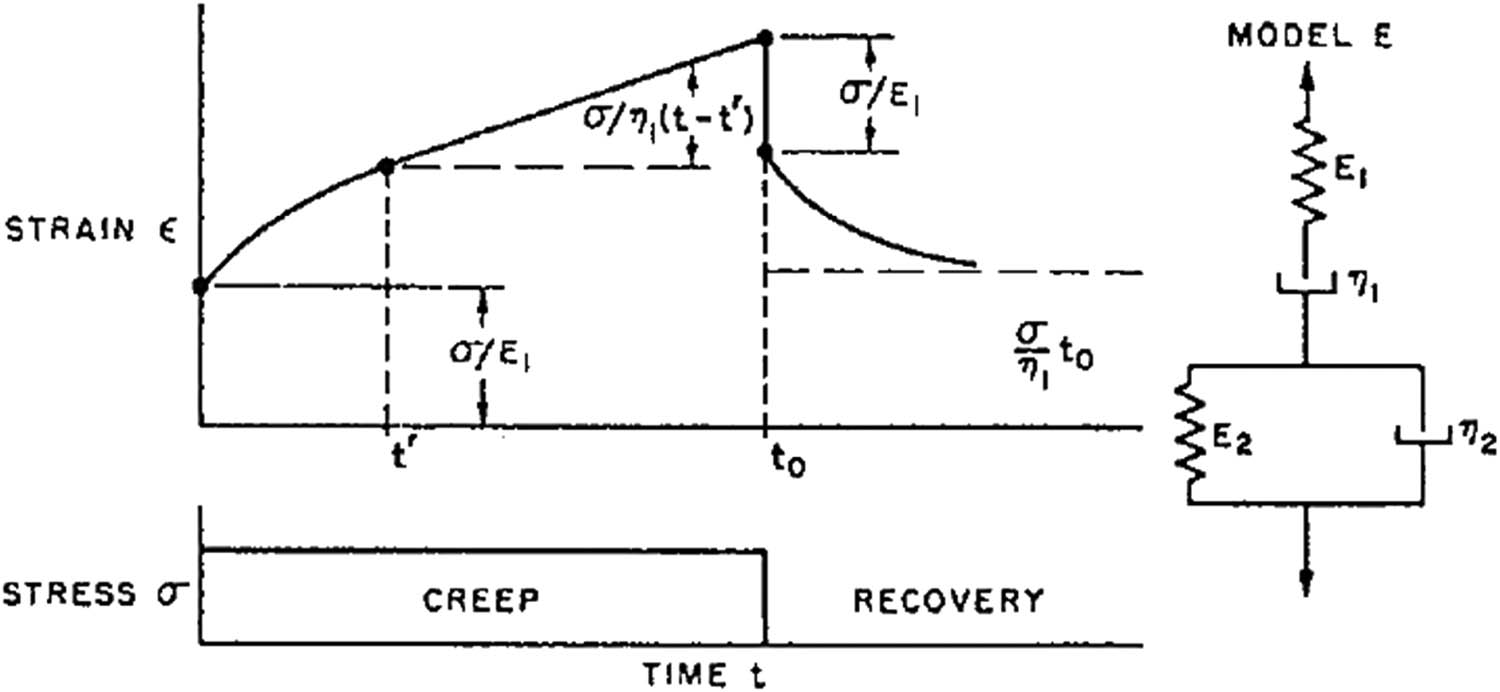
Maxwell approach (spring and dashpot in series).
Figures 6 and 7 illustrate creep behavior (strain vs time) for PS reinforced with different weight fractions of fish scales at temperature of 20 and 26°C, respectively. These figures showed creep failure time and strain.
With the increasing fish scale percentage, the modulus of elasticity increased significantly (Figures 8 and 9). The scale, shape, and interfacial adhesion between the filler’s surface and the matrix all play a role in the increase in elasticity. After this percentage, up to 7%, forces are weak. This is insufficient to form the necessary bond between the matrix and the filler. This may be attributed to a higher concentration of filler particles agglomerating. Therefore, the stress can easily be transferred between the reinforcement and the matrix polymer due to the weak bonds, as shown in Figures 10 and 11, for 20 and 26°C, respectively. At a temperature of 26oC, it was noticed that all samples reinforced with fish scales failed at different times as shown in Figure 12. Hence UP materials have high ductility, as shown in Figure 7. At a weight fraction of 0%, it has the highest strain, then it decreases at 7% and increases at the rates of 9 and 11% due to the effect of increasing temperature, which led to an increase in the strain in a homogeneous amount. Figure 13 represents a comparison between the strain parameters (where ε 1 is the instantaneous extensions [Maxwell element], and ε 2 is the creep Kelvin element that are shown in Figure 14) and the different weight fractions with temperature of 20 and 26oC. The significant effect of temperature on the strain parameters was observed in this figure, where the mixing rate of 0% recorded the highest strain parameters. Then these parameters decreased while the weight fraction increased until it reached 7%. Then it rose again at 11% when the percentage of fish scales was increased.

Strain versus time for UP/PS reinforced by different fish flakes weight fractions at 20°C.

Strain versus time for UP/PS reinforced by different fish flakes weight fractions at 26°C.

Modulus of elasticity for UP/PS reinforced with fish flakes for different weight fractions at 20°C.

Modulus of elasticity for UP/PS reinforced with fish flakes for different weight fractions at 26°C.

Stress versus time for UP/PS reinforced with fish flakes for different weight fractions at 20°C.

Stress versus time for UP/PS reinforced with fish with different weight fractions at 26°C.

Samples that failed at 26°C.

Comparison between 20 and 26°C of UP/PS creep behavior at different weight fractions.

Creep behavior of UP/PS at constant weight 1 N and 20°C.
4 Conclusion
The aim of this study is to look into the effects of the creep behavior of fish scale reinforcement on PS composites. A summary of this study’s conclusions is as follows.
The creep behavior of PS was enhanced and reinforced by the addition of appropriate percentages of fish scales.
Higher temperatures reduce PS’s tensile strength and speed up creep failure.
PS reinforced with fish scales had a high modulus of elasticity percentage.
The highest strain was obtained with a 7% weight fraction at 26°C and at 800 s.
The weight fraction of 11% fish scales at 26°C had the better ratio due to the homogeneity of strain parameters (ε 1, ε 2, ε max) and it has the highest stress and the lowest strain compared to other weight fractions.
-
Conflict of interest: Authors state no conflict of interest.
-
Data availability statement: The raw/processed data required to reproduce these findings cannot be shared at this time as the data also forms part of an ongoing study.
References
[1] Faruk O, Bledzki AK, Fink HP, Sain M. Biocomposites reinforced with natural fibers: 2000–2010. Prog Polym Sci. 2012:1552–96.10.1016/j.progpolymsci.2012.04.003Suche in Google Scholar
[2] Atefi R, Razmavar A, Teimoor F, Teimoori F. Mechanical characterization, fabrication and FTIR spectroscopic analysis of fish scale reinforced epoxy composites. Life Sci J. 2012;9(2):1080–2.Suche in Google Scholar
[3] Mochane MJ, Mokhena TC, Mokhothu TH, Mtibe A, Sadiku ER, Ray SS, et al. Recent progress on natural fiber hybrid composites for advanced applications: a review. Exp Polym Lets. 2019;13:159–98.10.3144/expresspolymlett.2019.15Suche in Google Scholar
[4] Shibata S, Cao Y, Fukumoto I. Press forming of short natural fiber-reinforced biodegradable resin: effects of fiber volume and length on flexural properties. Polym Test. 2005;24:1005–11.10.1016/j.polymertesting.2005.07.012Suche in Google Scholar
[5] Abdul Khalil HPS, Chong EWN, Owolabi FAT, Asniza M, Tye YY, Rizal S, et al. Enhancement of basic properties of polysaccharide-based composites with organic and inorganic fillers: a review. J Appl Polym Sci. 2019;136:47251.10.1002/app.47251Suche in Google Scholar
[6] Sivanjineyulu V, Chang YH, Chiu FC. Characterization of carbon nanotube-and organoclay-filled polypropylene/poly (butylene succinate) blend-based nanocomposites with enhanced rigidity and electrical conductivity. J Polym Res. 2017;24:130.10.1007/s10965-017-1289-1Suche in Google Scholar
[7] Reddy AB, Manjula B, Jayaramudu T, Sadiku ER, Anand Babu P, Periyar Selvam S, et al. 5-Fluorouracil loaded chitosan–PVA/Na + MMT nanocomposite films for drug release and antimicrobial activity. Nano-Micro Lett. 2016;8:260–9.10.1007/s40820-016-0086-4Suche in Google Scholar PubMed PubMed Central
[8] Satapathy A, Patnaik A, Pradhan MK. A study on processing, characterization and erosion behavior of fish (Labeo-rohita) scale filled epoxy matrix composites. Mater Des. 2009;30:2359–71.10.1016/j.matdes.2008.10.033Suche in Google Scholar
[9] Borah A, Suchiang D, Debnath K, Alam M, Muralidhar M. Studies on design and fabrication of polymer based composite materials with fish scale reinforcement. IOSR J Mech Civ Eng. 2016;2:6–11. e-ISSN: 2278-1684, p-ISSN: 2320–334X.10.9790/1684-15010020206-11Suche in Google Scholar
[10] Majhool AA, Zainol I, Azziz SSSA, Jaafar CNA, Jahil MM. Mechanical properties improvement of epoxy composites by natural hydroxyapatite from fish scales as a fillers. Int J Res Pharm Sci. 2019;10(2):1424–9.10.26452/ijrps.v10i2.708Suche in Google Scholar
[11] Harahap K, Andryas I. Effect of fish scale powder addition to flexural strength of heat cured acrylic resin. Advances in Health Science Research. Medan, Indonesia: Universitas Sumatera Utara; Vol 8; 2017.10.2991/idcsu-17.2018.41Suche in Google Scholar
[12] Kumar A, Bansal G. Characterization of mechanical strength of epoxy hybrid composite reinforced with chicken feather fiber and residue powder extracted from Rohu fish scale. Int J Eng Res & Technol (IJERT). 2019;8(4):498–504.Suche in Google Scholar
[13] Nirmalraj L, Arun L, Manikandan S, Manikanda Prabhu N, Manojkumar N. Investigation of mechanical properties in polymer based composite materials using fish scale and chicken feather reinforcement. Int J Sci Res & Dev. 2018;6(2):411.Suche in Google Scholar
[14] Fadhil MM. Enhancement of some mechanical properties of unsaturated polyester-polystyrene composites. A thesis submitted to the Material Engineering Technology Department Engineering Technical College/Middle Technical University in partial fulfillment of requirement for the Degree of Master of Technology in Material’s Engineering Technology; 2015.Suche in Google Scholar
[15] Standard test methods for tensile, compressive, and flexural creep and creep-rupture of plastics. D 2990 – 01. ASTM International, 100 Barr Harbor Drive, PO Box C700, West Conshohocken, PA 19428-2959, United States.Suche in Google Scholar
© 2021 Balsam H. Abed and Ali A. Battawi, published by De Gruyter
This work is licensed under the Creative Commons Attribution 4.0 International License.
Artikel in diesem Heft
- Regular Articles
- Electrochemical studies of the synergistic combination effect of thymus mastichina and illicium verum essential oil extracts on the corrosion inhibition of low carbon steel in dilute acid solution
- Adoption of Business Intelligence to Support Cost Accounting Based Financial Systems — Case Study of XYZ Company
- Techno-Economic Feasibility Analysis of a Hybrid Renewable Energy Supply Options for University Buildings in Saudi Arabia
- Optimized design of a semimetal gasket operating in flange-bolted joints
- Behavior of non-reinforced and reinforced green mortar with fibers
- Field measurement of contact forces on rollers for a large diameter pipe conveyor
- Development of Smartphone-Controlled Hand and Arm Exoskeleton for Persons with Disability
- Investigation of saturation flow rate using video camera at signalized intersections in Jordan
- The features of Ni2MnIn polycrystalline Heusler alloy thin films formation by pulsed laser deposition
- Selection of a workpiece clamping system for computer-aided subtractive manufacturing of geometrically complex medical models
- Development of Solar-Powered Water Pump with 3D Printed Impeller
- Identifying Innovative Reliable Criteria Governing the Selection of Infrastructures Construction Project Delivery Systems
- Kinetics of Carbothermal Reduction Process of Different Size Phosphate Rocks
- Plastic forming processes of transverse non-homogeneous composite metallic sheets
- Accelerated aging of WPCs Based on Polypropylene and Birch plywood Sanding Dust
- Effect of water flow and depth on fatigue crack growth rate of underwater wet welded low carbon steel SS400
- Non-invasive attempts to extinguish flames with the use of high-power acoustic extinguisher
- Filament wound composite fatigue mechanisms investigated with full field DIC strain monitoring
- Structural Timber In Compartment Fires – The Timber Charring and Heat Storage Model
- Technical and economic aspects of starting a selected power unit at low ambient temperatures
- Car braking effectiveness after adaptation for drivers with motor dysfunctions
- Adaptation to driver-assistance systems depending on experience
- A SIMULINK implementation of a vector shift relay with distributed synchronous generator for engineering classes
- Evaluation of measurement uncertainty in a static tensile test
- Errors in documenting the subsoil and their impact on the investment implementation: Case study
- Comparison between two calculation methods for designing a stand-alone PV system according to Mosul city basemap
- Reduction of transport-related air pollution. A case study based on the impact of the COVID-19 pandemic on the level of NOx emissions in the city of Krakow
- Driver intervention performance assessment as a key aspect of L3–L4 automated vehicles deployment
- A new method for solving quadratic fractional programming problem in neutrosophic environment
- Effect of fish scales on fabrication of polyester composite material reinforcements
- Impact of the operation of LNG trucks on the environment
- The effectiveness of the AEB system in the context of the safety of vulnerable road users
- Errors in controlling cars cause tragic accidents involving motorcyclists
- Deformation of designed steel plates: An optimisation of the side hull structure using the finite element approach
- Thermal-strength analysis of a cross-flow heat exchanger and its design improvement
- Effect of thermal collector configuration on the photovoltaic heat transfer performance with 3D CFD modeling
- Experimental identification of the subjective reception of external stimuli during wheelchair driving
- Failure analysis of motorcycle shock breakers
- Experimental analysis of nonlinear characteristics of absorbers with wire rope isolators
- Experimental tests of the antiresonance vibratory mill of a sectional movement trajectory
- Experimental and theoretical investigation of CVT rubber belt vibrations
- Is the cubic parabola really the best railway transition curve?
- Transport properties of the new vibratory conveyor at operations in the resonance zone
- Assessment of resistance to permanent deformations of asphalt mixes of low air void content
- COVID-19 lockdown impact on CERN seismic station ambient noise levels
- Review Articles
- FMEA method in operational reliability of forest harvesters
- Examination of preferences in the field of mobility of the city of Pila in terms of services provided by the Municipal Transport Company in Pila
- Enhancement stability and color fastness of natural dye: A review
- Special Issue: ICE-SEAM 2019 - Part II
- Lane Departure Warning Estimation Using Yaw Acceleration
- Analysis of EMG Signals during Stance and Swing Phases for Controlling Magnetorheological Brake applications
- Sensor Number Optimization Using Neural Network for Ankle Foot Orthosis Equipped with Magnetorheological Brake
- Special Issue: Recent Advances in Civil Engineering - Part II
- Comparison of STM’s reliability system on the example of selected element
- Technical analysis of the renovation works of the wooden palace floors
- Special Issue: TRANSPORT 2020
- Simulation assessment of the half-power bandwidth method in testing shock absorbers
- Predictive analysis of the impact of the time of day on road accidents in Poland
- User’s determination of a proper method for quantifying fuel consumption of a passenger car with compression ignition engine in specific operation conditions
- Analysis and assessment of defectiveness of regulations for the yellow signal at the intersection
- Streamlining possibility of transport-supply logistics when using chosen Operations Research techniques
- Permissible distance – safety system of vehicles in use
- Study of the population in terms of knowledge about the distance between vehicles in motion
- UAVs in rail damage image diagnostics supported by deep-learning networks
- Exhaust emissions of buses LNG and Diesel in RDE tests
- Measurements of urban traffic parameters before and after road reconstruction
- The use of deep recurrent neural networks to predict performance of photovoltaic system for charging electric vehicles
- Analysis of dangers in the operation of city buses at the intersections
- Psychological factors of the transfer of control in an automated vehicle
- Testing and evaluation of cold-start emissions from a gasoline engine in RDE test at two different ambient temperatures
- Age and experience in driving a vehicle and psychomotor skills in the context of automation
- Consumption of gasoline in vehicles equipped with an LPG retrofit system in real driving conditions
- Laboratory studies of the influence of the working position of the passenger vehicle air suspension on the vibration comfort of children transported in the child restraint system
- Route optimization for city cleaning vehicle
- Efficiency of electric vehicle interior heating systems at low ambient temperatures
- Model-based imputation of sound level data at thoroughfare using computational intelligence
- Research on the combustion process in the Fiat 1.3 Multijet engine fueled with rapeseed methyl esters
- Overview of the method and state of hydrogenization of road transport in the world and the resulting development prospects in Poland
- Tribological characteristics of polymer materials used for slide bearings
- Car reliability analysis based on periodic technical tests
- Special Issue: Terotechnology 2019 - Part II
- DOE Application for Analysis of Tribological Properties of the Al2O3/IF-WS2 Surface Layers
- The effect of the impurities spaces on the quality of structural steel working at variable loads
- Prediction of the parameters and the hot open die elongation forging process on an 80 MN hydraulic press
- Special Issue: AEVEC 2020
- Vocational Student's Attitude and Response Towards Experiential Learning in Mechanical Engineering
- Virtual Laboratory to Support a Practical Learning of Micro Power Generation in Indonesian Vocational High Schools
- The impacts of mediating the work environment on the mode choice in work trips
- Utilization of K-nearest neighbor algorithm for classification of white blood cells in AML M4, M5, and M7
- Car braking effectiveness after adaptation for drivers with motor dysfunctions
- Case study: Vocational student’s knowledge and awareness level toward renewable energy in Indonesia
- Contribution of collaborative skill toward construction drawing skill for developing vocational course
- Special Issue: Annual Engineering and Vocational Education Conference - Part II
- Vocational teachers’ perspective toward Technological Pedagogical Vocational Knowledge
- Special Issue: ICIMECE 2020 - Part I
- Profile of system and product certification as quality infrastructure in Indonesia
- Prediction Model of Magnetorheological (MR) Fluid Damper Hysteresis Loop using Extreme Learning Machine Algorithm
- A review on the fused deposition modeling (FDM) 3D printing: Filament processing, materials, and printing parameters
- Facile rheological route method for LiFePO4/C cathode material production
- Mosque design strategy for energy and water saving
- Epoxy resins thermosetting for mechanical engineering
- Estimating the potential of wind energy resources using Weibull parameters: A case study of the coastline region of Dar es Salaam, Tanzania
- Special Issue: CIRMARE 2020
- New trends in visual inspection of buildings and structures: Study for the use of drones
- Special Issue: ISERT 2021
- Alleviate the contending issues in network operating system courses: Psychomotor and troubleshooting skill development with Raspberry Pi
- Special Issue: Actual Trends in Logistics and Industrial Engineering - Part II
- The Physical Internet: A means towards achieving global logistics sustainability
- Special Issue: Modern Scientific Problems in Civil Engineering - Part I
- Construction work cost and duration analysis with the use of agent-based modelling and simulation
- Corrosion rate measurement for steel sheets of a fuel tank shell being in service
- The influence of external environment on workers on scaffolding illustrated by UTCI
- Allocation of risk factors for geodetic tasks in construction schedules
- Pedestrian fatality risk as a function of tram impact speed
- Technological and organizational problems in the construction of the radiation shielding concrete and suggestions to solve: A case study
- Finite element analysis of train speed effect on dynamic response of steel bridge
- New approach to analysis of railway track dynamics – Rail head vibrations
- Special Issue: Trends in Logistics and Production for the 21st Century - Part I
- Design of production lines and logistic flows in production
- The planning process of transport tasks for autonomous vans
- Modeling of the two shuttle box system within the internal logistics system using simulation software
- Implementation of the logistics train in the intralogistics system: A case study
- Assessment of investment in electric buses: A case study of a public transport company
- Assessment of a robot base production using CAM programming for the FANUC control system
- Proposal for the flow of material and adjustments to the storage system of an external service provider
- The use of numerical analysis of the injection process to select the material for the injection molding
- Economic aspect of combined transport
- Solution of a production process with the application of simulation: A case study
- Speedometer reliability in regard to road traffic sustainability
- Design and construction of a scanning stand for the PU mini-acoustic sensor
- Utilization of intelligent vehicle units for train set dispatching
- Special Issue: ICRTEEC - 2021 - Part I
- LVRT enhancement of DFIG-driven wind system using feed-forward neuro-sliding mode control
- Special Issue: Automation in Finland 2021 - Part I
- Prediction of future paths of mobile objects using path library
- Model predictive control for a multiple injection combustion model
- Model-based on-board post-injection control development for marine diesel engine
- Intelligent temporal analysis of coronavirus statistical data
Artikel in diesem Heft
- Regular Articles
- Electrochemical studies of the synergistic combination effect of thymus mastichina and illicium verum essential oil extracts on the corrosion inhibition of low carbon steel in dilute acid solution
- Adoption of Business Intelligence to Support Cost Accounting Based Financial Systems — Case Study of XYZ Company
- Techno-Economic Feasibility Analysis of a Hybrid Renewable Energy Supply Options for University Buildings in Saudi Arabia
- Optimized design of a semimetal gasket operating in flange-bolted joints
- Behavior of non-reinforced and reinforced green mortar with fibers
- Field measurement of contact forces on rollers for a large diameter pipe conveyor
- Development of Smartphone-Controlled Hand and Arm Exoskeleton for Persons with Disability
- Investigation of saturation flow rate using video camera at signalized intersections in Jordan
- The features of Ni2MnIn polycrystalline Heusler alloy thin films formation by pulsed laser deposition
- Selection of a workpiece clamping system for computer-aided subtractive manufacturing of geometrically complex medical models
- Development of Solar-Powered Water Pump with 3D Printed Impeller
- Identifying Innovative Reliable Criteria Governing the Selection of Infrastructures Construction Project Delivery Systems
- Kinetics of Carbothermal Reduction Process of Different Size Phosphate Rocks
- Plastic forming processes of transverse non-homogeneous composite metallic sheets
- Accelerated aging of WPCs Based on Polypropylene and Birch plywood Sanding Dust
- Effect of water flow and depth on fatigue crack growth rate of underwater wet welded low carbon steel SS400
- Non-invasive attempts to extinguish flames with the use of high-power acoustic extinguisher
- Filament wound composite fatigue mechanisms investigated with full field DIC strain monitoring
- Structural Timber In Compartment Fires – The Timber Charring and Heat Storage Model
- Technical and economic aspects of starting a selected power unit at low ambient temperatures
- Car braking effectiveness after adaptation for drivers with motor dysfunctions
- Adaptation to driver-assistance systems depending on experience
- A SIMULINK implementation of a vector shift relay with distributed synchronous generator for engineering classes
- Evaluation of measurement uncertainty in a static tensile test
- Errors in documenting the subsoil and their impact on the investment implementation: Case study
- Comparison between two calculation methods for designing a stand-alone PV system according to Mosul city basemap
- Reduction of transport-related air pollution. A case study based on the impact of the COVID-19 pandemic on the level of NOx emissions in the city of Krakow
- Driver intervention performance assessment as a key aspect of L3–L4 automated vehicles deployment
- A new method for solving quadratic fractional programming problem in neutrosophic environment
- Effect of fish scales on fabrication of polyester composite material reinforcements
- Impact of the operation of LNG trucks on the environment
- The effectiveness of the AEB system in the context of the safety of vulnerable road users
- Errors in controlling cars cause tragic accidents involving motorcyclists
- Deformation of designed steel plates: An optimisation of the side hull structure using the finite element approach
- Thermal-strength analysis of a cross-flow heat exchanger and its design improvement
- Effect of thermal collector configuration on the photovoltaic heat transfer performance with 3D CFD modeling
- Experimental identification of the subjective reception of external stimuli during wheelchair driving
- Failure analysis of motorcycle shock breakers
- Experimental analysis of nonlinear characteristics of absorbers with wire rope isolators
- Experimental tests of the antiresonance vibratory mill of a sectional movement trajectory
- Experimental and theoretical investigation of CVT rubber belt vibrations
- Is the cubic parabola really the best railway transition curve?
- Transport properties of the new vibratory conveyor at operations in the resonance zone
- Assessment of resistance to permanent deformations of asphalt mixes of low air void content
- COVID-19 lockdown impact on CERN seismic station ambient noise levels
- Review Articles
- FMEA method in operational reliability of forest harvesters
- Examination of preferences in the field of mobility of the city of Pila in terms of services provided by the Municipal Transport Company in Pila
- Enhancement stability and color fastness of natural dye: A review
- Special Issue: ICE-SEAM 2019 - Part II
- Lane Departure Warning Estimation Using Yaw Acceleration
- Analysis of EMG Signals during Stance and Swing Phases for Controlling Magnetorheological Brake applications
- Sensor Number Optimization Using Neural Network for Ankle Foot Orthosis Equipped with Magnetorheological Brake
- Special Issue: Recent Advances in Civil Engineering - Part II
- Comparison of STM’s reliability system on the example of selected element
- Technical analysis of the renovation works of the wooden palace floors
- Special Issue: TRANSPORT 2020
- Simulation assessment of the half-power bandwidth method in testing shock absorbers
- Predictive analysis of the impact of the time of day on road accidents in Poland
- User’s determination of a proper method for quantifying fuel consumption of a passenger car with compression ignition engine in specific operation conditions
- Analysis and assessment of defectiveness of regulations for the yellow signal at the intersection
- Streamlining possibility of transport-supply logistics when using chosen Operations Research techniques
- Permissible distance – safety system of vehicles in use
- Study of the population in terms of knowledge about the distance between vehicles in motion
- UAVs in rail damage image diagnostics supported by deep-learning networks
- Exhaust emissions of buses LNG and Diesel in RDE tests
- Measurements of urban traffic parameters before and after road reconstruction
- The use of deep recurrent neural networks to predict performance of photovoltaic system for charging electric vehicles
- Analysis of dangers in the operation of city buses at the intersections
- Psychological factors of the transfer of control in an automated vehicle
- Testing and evaluation of cold-start emissions from a gasoline engine in RDE test at two different ambient temperatures
- Age and experience in driving a vehicle and psychomotor skills in the context of automation
- Consumption of gasoline in vehicles equipped with an LPG retrofit system in real driving conditions
- Laboratory studies of the influence of the working position of the passenger vehicle air suspension on the vibration comfort of children transported in the child restraint system
- Route optimization for city cleaning vehicle
- Efficiency of electric vehicle interior heating systems at low ambient temperatures
- Model-based imputation of sound level data at thoroughfare using computational intelligence
- Research on the combustion process in the Fiat 1.3 Multijet engine fueled with rapeseed methyl esters
- Overview of the method and state of hydrogenization of road transport in the world and the resulting development prospects in Poland
- Tribological characteristics of polymer materials used for slide bearings
- Car reliability analysis based on periodic technical tests
- Special Issue: Terotechnology 2019 - Part II
- DOE Application for Analysis of Tribological Properties of the Al2O3/IF-WS2 Surface Layers
- The effect of the impurities spaces on the quality of structural steel working at variable loads
- Prediction of the parameters and the hot open die elongation forging process on an 80 MN hydraulic press
- Special Issue: AEVEC 2020
- Vocational Student's Attitude and Response Towards Experiential Learning in Mechanical Engineering
- Virtual Laboratory to Support a Practical Learning of Micro Power Generation in Indonesian Vocational High Schools
- The impacts of mediating the work environment on the mode choice in work trips
- Utilization of K-nearest neighbor algorithm for classification of white blood cells in AML M4, M5, and M7
- Car braking effectiveness after adaptation for drivers with motor dysfunctions
- Case study: Vocational student’s knowledge and awareness level toward renewable energy in Indonesia
- Contribution of collaborative skill toward construction drawing skill for developing vocational course
- Special Issue: Annual Engineering and Vocational Education Conference - Part II
- Vocational teachers’ perspective toward Technological Pedagogical Vocational Knowledge
- Special Issue: ICIMECE 2020 - Part I
- Profile of system and product certification as quality infrastructure in Indonesia
- Prediction Model of Magnetorheological (MR) Fluid Damper Hysteresis Loop using Extreme Learning Machine Algorithm
- A review on the fused deposition modeling (FDM) 3D printing: Filament processing, materials, and printing parameters
- Facile rheological route method for LiFePO4/C cathode material production
- Mosque design strategy for energy and water saving
- Epoxy resins thermosetting for mechanical engineering
- Estimating the potential of wind energy resources using Weibull parameters: A case study of the coastline region of Dar es Salaam, Tanzania
- Special Issue: CIRMARE 2020
- New trends in visual inspection of buildings and structures: Study for the use of drones
- Special Issue: ISERT 2021
- Alleviate the contending issues in network operating system courses: Psychomotor and troubleshooting skill development with Raspberry Pi
- Special Issue: Actual Trends in Logistics and Industrial Engineering - Part II
- The Physical Internet: A means towards achieving global logistics sustainability
- Special Issue: Modern Scientific Problems in Civil Engineering - Part I
- Construction work cost and duration analysis with the use of agent-based modelling and simulation
- Corrosion rate measurement for steel sheets of a fuel tank shell being in service
- The influence of external environment on workers on scaffolding illustrated by UTCI
- Allocation of risk factors for geodetic tasks in construction schedules
- Pedestrian fatality risk as a function of tram impact speed
- Technological and organizational problems in the construction of the radiation shielding concrete and suggestions to solve: A case study
- Finite element analysis of train speed effect on dynamic response of steel bridge
- New approach to analysis of railway track dynamics – Rail head vibrations
- Special Issue: Trends in Logistics and Production for the 21st Century - Part I
- Design of production lines and logistic flows in production
- The planning process of transport tasks for autonomous vans
- Modeling of the two shuttle box system within the internal logistics system using simulation software
- Implementation of the logistics train in the intralogistics system: A case study
- Assessment of investment in electric buses: A case study of a public transport company
- Assessment of a robot base production using CAM programming for the FANUC control system
- Proposal for the flow of material and adjustments to the storage system of an external service provider
- The use of numerical analysis of the injection process to select the material for the injection molding
- Economic aspect of combined transport
- Solution of a production process with the application of simulation: A case study
- Speedometer reliability in regard to road traffic sustainability
- Design and construction of a scanning stand for the PU mini-acoustic sensor
- Utilization of intelligent vehicle units for train set dispatching
- Special Issue: ICRTEEC - 2021 - Part I
- LVRT enhancement of DFIG-driven wind system using feed-forward neuro-sliding mode control
- Special Issue: Automation in Finland 2021 - Part I
- Prediction of future paths of mobile objects using path library
- Model predictive control for a multiple injection combustion model
- Model-based on-board post-injection control development for marine diesel engine
- Intelligent temporal analysis of coronavirus statistical data
