Toxicity evaluation of metsulfuron-methyl, nicosulfuron, and methoxyfenozide as pesticides in Indonesia
-
Wahyu Daradjat Natawigena
 ,
Muhammad Ilfadry Rifasta
,
Muhammad Ilfadry Rifasta

Abstract
Pesticides are substances widely used to control or eliminate pests, including weeds, insects, and other harmful organisms. Agricultural pesticides, in particular, must meet specific safety and quality standards before being marketed. In this study, the acute and chronic toxicity of metsulfuron-methyl, nicosulfuron, and methoxyfenozide were predicted using quantitative structure–activity relationship (QSAR) analysis through the EPI Suite program. Furthermore, in vivo testing was conducted to evaluate skin irritation, eye irritation, and skin sensitization based on modified OECD 404, OECD 405, and OECD 406 guidelines. The QSAR analysis indicated that all three pesticides have low acute and chronic toxicity profiles. In the skin irritation and skin sensitization tests, metsulfuron-methyl (100 mg), nicosulfuron (125 mg), and methoxyfenozide (150 mg) showed a primary irritation score of 0 and a sensitization score of 0, indicating no irritant or sensitization effects on rabbit and guinea pig skin. In the eye irritation test, metsulfuron-methyl caused mild conjunctival redness and eyelid swelling, with an average irritation score of 1.25, classifying it as a mild irritant (Category 2B). In contrast, nicosulfuron and methoxyfenozide did not cause any observable eye irritation, with an irritation score of 0. These findings suggest that while metsulfuron-methyl may cause mild eye irritation, all three pesticides are non-irritating to the skin and do not induce skin sensitization. This research provides essential toxicological data for regulatory safety evaluations and underscores the importance of integrating QSAR analysis with in vivo methods to assess pesticide safety comprehensively.
1 Introduction
Pesticides, including herbicides and insecticides, play a crucial role in modern agricultural practices by protecting crops from pests and weeds, thereby increasing yields and ensuring food security [1]. However, their extensive use raises significant concerns about environmental pollution and human health risks due to potential toxicity [2]. According to the World Health Organization (WHO), approximately 18.2 out of every 100,000 farmers worldwide experience pesticide poisoning, with more than 168,000 deaths occurring annually as a result of pesticide exposure [3]. These cases are predominantly reported in developing countries. Research conducted by Boedeker et al. estimates that 385 million cases of unintentional acute pesticide poisoning (UAPP) occur globally each year, resulting in approximately 11,000 deaths. Given that the global farming population is around 860 million, these figures indicate that approximately 44% of the farmers experience pesticide poisoning annually [4]. The highest number of UAPP cases is recorded in regions such as Southern Asia, Southeast Asia, and East Africa, where non-fatal poisonings are most prevalent.
Although botanical insecticides are considered to have fewer adverse effects on the environment, they decompose quickly, resulting in a shorter shelf life and slower efficacy compared to synthetic insecticides. Consequently, synthetic insecticides are more widely used due to their rapid action, ease of availability, and immediate effectiveness, despite posing a greater risk to environmental and human health [5]. Among the various herbicides and insecticides, metsulfuron-methyl, nicosulfuron, and methoxyfenozide are extensively used because of their effectiveness in controlling specific agricultural pests [5].
Metsulfuron-methyl is an active ingredient in a systemic herbicide that effectively suppresses the dry weight accumulation of broadleaf weeds and other weeds for up to 12 weeks after application. It is commonly used to control weeds in rice fields [6,7]. Nicosulfuron is a selective herbicide that targets a wide range of weeds, including grass, broadleaf, and sedge weeds [8,9]. Methoxyfenozide is an insect growth regulator (IGR) that functions as an ecdysone agonist, interfering with insect development and growth. It is particularly effective against Lepidoptera pests. Methoxyfenozide belongs to the diacylhydrazine class of insecticides, which bind with high affinity to the ecdysone receptor complex and act as strong agonists or mimics of the insect molting hormone, 20-hydroxyecdysone (20E) [10,11].
Despite their agricultural benefits, there is a critical need to assess the toxicity of these compounds to ensure human and environmental safety while meeting regulatory compliance standards. Previous research on metsulfuron-methyl and nicosulfuron has primarily focused on their herbicidal efficacy and environmental persistence [4]. Meanwhile, methoxyfenozide has been studied for its effects on insect development, but limited information is available regarding its potential for skin and eye irritation or sensitization risks [12,13]. Furthermore, there is a notable research gap in integrating quantitative structure–activity relationship (QSAR)-based predictions to complement traditional toxicity evaluations of these substances. By incorporating QSAR analysis, our study addresses this gap, providing a more comprehensive assessment of the acute and chronic effects of these pesticides.
The primary objective of this study was to evaluate the skin irritation, eye irritation, and skin sensitization potential of metsulfuron-methyl, nicosulfuron, and methoxyfenozide using in vivo methods in compliance with established OECD guidelines. To enhance the comprehensiveness of our findings, we also performed QSAR analysis using the EPI Suite program to predict their acute and chronic toxicity profiles. This integrated experimental and computational approach aims to provide a robust assessment of these pesticides’ safety, offering valuable insights for regulatory agencies and guiding future research.
2 Materials and methods
2.1 Chemicals and reagents
The pesticides used in this study and their purity are as follows:
MEVOR 20 WP (active ingredient: metsulfuron-methyl, 20%; provided by PT. Sari Kresna Kimia, Indonesia).
FURON 250 SC (active ingredient: nicosulfuron, 250 g/L; provided by PT. Sari Kresna Kimia, Indonesia).
METRICOR 300 SC (active ingredient: methoxyfenozide, 300 g/L; provided by PT. Sari Kresna Kimia, Indonesia).
All reagents used were of analytical grade and prepared according to OECD guidelines.
2.2 Computational analysis of environmental fate and toxicity estimation
The environmental fate and toxicity of three pesticides – metsulfuron-methyl, nicosulfuron, and methoxyfenozide – were evaluated using the United States Environmental Protection Agency’s (USEPA) EPI Suite™ version 4.11 (EPI = estimation program interface) [14]. This software estimates key physicochemical properties and environmental behaviors, including partition coefficients, biodegradability, aquatic toxicity, atmospheric degradation, and environmental distribution via a fugacity model [15,16,17,18].
2.2.1 Data input
For each pesticide, the analysis was performed by entering either the Chemical Abstract Service (CAS) number or the chemical structure. The CAS numbers used were as follows: metsulfuron-methyl (74223-64-6), nicosulfuron (111991-09-4), and methoxyfenozide (161050-58-4). The program automatically retrieved the molecular structures and relevant data from its internal database.
2.2.2 Parameter settings
To simulate environmental conditions specific to aquatic ecosystems, the following key environmental parameters were defined:
Wind velocity: 2 m/s for rivers and 1 m/s for lakes, representing average atmospheric conditions [21].
These parameters were selected based on environmental studies of Indonesian aquatic ecosystems to enhance the accuracy of the simulation.
2.2.3 Modules applied
The following EPI Suite modules were employed:
KOWWIN: estimates the octanol–water partition coefficient (log Kow).
BIOWIN: predicts the aerobic biodegradability using multiple models.
ECOSAR: estimates the acute and chronic aquatic toxicity to fish, daphnids, and algae.
HYDROWIN: calculates the hydrolysis rate under neutral pH conditions.
AEROWIN: predicts atmospheric oxidation and Henry’s law constant (HLC) for assessing volatilization.
BCFBAF: estimates the bioconcentration factor (BCF) to evaluate the bioaccumulation potential.
EQC (fugacity model): estimates the chemical distribution across environmental compartments (air, water, soil, and sediment) using a Level III fugacity model.
2.2.4 Output and data analyses
The results were exported to plain text (.txt) files for each pesticide. Key parameters, including log Kow, biodegradation potential, aquatic toxicity (LC50 and EC50 values), bioaccumulation factor, and atmospheric half-life, were extracted and analyzed. Additionally, the EQC model provided quantitative estimates of the percentage distribution in air, water, soil, and sediment, reflecting each pesticide’s environmental partitioning behavior [14]. The data were interpreted according to US EPA toxicity classification guidelines and compared across the three pesticides to assess their relative environmental impact and persistence.
2.3 In vivo toxicological studies
2.3.1 Animal model and ethical approval
The study used New Zealand albino rabbits for skin and eye irritation tests and Dunkin Hartley albino guinea pigs for the skin sensitization test. All animals were sourced from certified breeders, housed under controlled environmental conditions (22 ± 2°C, 55 ± 10% relative humidity, and 12-h light/dark cycle), and provided with food and water ad libitum.
-
Ethical approval: The study followed ethical guidelines for animal welfare and was approved by the Research Ethics Committee of Universitas Padjadjaran, Bandung (protocol code 582/UN6.KEP/EC/2023, approved on May 6, 2023).
2.3.2 Skin irritation tests
Skin irritation tests were conducted following the OECD guideline 404 [3]. New Zealand albino rabbits were used for the test, and their fur was shaved the day before the procedure. The test began with an initial assessment on one rabbit, where 0.5 g of solid samples or 0.5 mL of liquid samples were applied. The doses used for each pesticide were as follows: metsulfuron-methyl (100 mg), nicosulfuron (125 mg), and methoxyfenozide (150 mg). Three patches containing the test sample and one control patch (0.9% NaCl) were used. The patches were sequentially removed after 3 min, 1 h, and 4 h. The irritation response was evaluated at 24, 48, and 72 h after exposure, with further observations for reversibility conducted on days 7 and 14.
To confirm the initial findings, a confirmation test was performed using three additional rabbits. In this phase, two patches (one containing the sample and one containing control – 0.9% NaCl) were applied, and the sample patch was removed after 4 h. Similar to the initial test, the irritation response was assessed at 24, 48, and 72 h, with reversibility observed on days 7 and 14. Irritation responses were evaluated according to the Draize skin irritation test rating scale (Table 1) and classified based on the skin irritation classification criteria (Table 2) [3,23].
where A is the total score of edema and erythema during observation; B is the number of observation periods; C is the number of rabbits in the group.
| Skin reaction | Score |
|---|---|
| Erythema and eschar formation | |
| No erythema | 0 |
| Very slight erythema | 1 |
| Well-defined erythema | 2 |
| Moderate to severe erythema | 3 |
| Edema formation | |
| No edema | 0 |
| Very slight edema | 1 |
| Slight edema | 2 |
| Moderate edema | 3 |
2.3.3 Eye irritation tests
Eye irritation tests were conducted following the OECD guideline 405. New Zealand albino rabbits were used for the test. An initial test was performed using one rabbit per sample. The sample was applied to the left eye at a dose of 0.1 g for solid samples and 0.1 mL for liquid samples. The doses used for each pesticide were as follows: metsulfuron-methyl (20 mg), nicosulfuron (25 mg), and methoxyfenozide (30 mg). After 1 h of exposure, the treated eye was carefully rinsed with sterile saline solution. Observations were recorded at 1 h, 24 h, 48 h, 72 h, 7 days, 14 days, and 21 days after exposure. If no severe eye irritation was observed during the initial test, a confirmation test was performed using three additional rabbits to validate the results. All observations were evaluated using the Draize eye irritation test scoring system (Table 3) [25] and classified according to the eye irritation category (Table 4) [26].
| Endpoint | Description | Score range |
|---|---|---|
| Cornea | Degree of opacity and ulcerations | 0–4 |
| Iris | Swelling and hyperemia | 0–2 |
| Conjunctivae | Redness and vessel discernibility | 0–3 |
| Chemosis | Swelling and lids closed/open | 0–4 |
Category of eye irritation [26]
| Classification | GHS classification criteria |
|---|---|
| Category 1 (causes serious eye damage) |
|
| Category 2A (irritant) |
|
| Category 2B (mild irritant) |
|
2.3.4 Skin sensitization tests
The skin sensitization test was conducted following the OECD guideline 406 using Dunkin Hartley albino guinea pigs. The doses used for each pesticide were 100 mg of metsulfuron-methyl, 125 mg of nicosulfuron, and 150 mg of methoxyfenozide. To determine the appropriate concentration, an initial test was performed on one guinea pig for each pesticide, exposing it to concentrations of 25, 50, 75, and 100% of the respective dose for 6 h. In the main test, three guinea pigs were used and exposed to the highest concentration that did not cause erythema during the initial test. Exposure was carried out on days 0, 6, and 13, followed by a challenge test on day 27, with observations recorded at 24 and 48 h post-exposure. The skin reactions were evaluated using the Magnusson–Kligman scale (Table 5) [28].
3 Results
3.1 Predicted environmental partitioning and toxicity outcomes
The in silico analysis using EPI Suite provided comprehensive predictions regarding the environmental fate and toxicity of metsulfuron-methyl, nicosulfuron, and methoxyfenozide across several parameters (Table 6).
Predicted acute and chronic toxicity of metsulfuron-methyl, nicosulfuron, and methoxyfenozide using QSAR analysis (EPI Suite program)
| EPI Suite program | Parameter | Results | ||
|---|---|---|---|---|
| Metsulfuron-methyl | Nicosulfuron | Methoxyfenozide | ||
| ECOSAR | LC50 (fish) (mg/L) | 311.606 | 2.26 × 10⁵ | 14.303 |
| LC50 (daphnid) (mg/L) | 176.974 | 95,876.414 | 9.307 | |
| EC50 (green algae) (mg/L) | 131.960 | 21,484.348 | 12.179 | |
| BIOWIN | BIOWIN 3 | 2.1178 | 1.9076 | 1.8901 |
| BIOWIN 5 | 0.5896 | 0.2512 | −0.2077 | |
| KOWWIN | Log Kow | 2.0026 | −1.15 | 3.476 |
| BCFBAF | BCF (L/kg wet-wt.) | 3.996 | 3.162 | 128.3 |
| HYDROWIN | Half-life in pH = 4–5 (days) | Less than 1–20 | Less than 1–20 | 300+ |
| Half-life in pH = 7 (days) | 100–300+ | 100–300+ | 300+ | |
| Half-life in pH = 9 (days) | 100–300+ | 100–300+ | 300+ | |
| AEROWIN | HLC (atm-m3/mol) | 7.52 × 10⁻¹⁴ | 1.39 × 10⁻¹⁸ | 3.84 × 10⁻¹² |
| EQC (fugacity model) | Distribution | Soil | Soil | Soil |
In the ECOSAR module, the estimated acute toxicity (LC₅₀) for fish varied significantly across the three pesticides [30]. Metsulfuron-methyl showed a moderate toxicity value of 311.606 mg/L, while nicosulfuron displayed the lowest toxicity with a value of 2.26 × 10⁵ mg/L. In contrast, methoxyfenozide exhibited the highest toxicity to fish at 14.303 mg/L. A similar pattern was observed for daphnids, where metsulfuron-methyl had an LC₅₀ of 176.974 mg/L, nicosulfuron reached 95,876.414 mg/L, and methoxyfenozide showed the highest toxicity with 9.307 mg/L. Regarding green algae, metsulfuron-methyl demonstrated an EC₅₀ of 131.960 mg/L, nicosulfuron showed 21,484.348 mg/L, while methoxyfenozide exhibited the most potent toxicity at 12.179 mg/L.
The BIOWIN module estimated the biodegradability of the compounds [31]. For metsulfuron-methyl, the BIOWIN 3 and BIOWIN 5 scores were 2.1178 and 0.5896, respectively, indicating moderate biodegradability. Nicosulfuron presented slightly lower values at 1.9076 (BIOWIN 3) and 0.2512 (BIOWIN 5), suggesting a slower degradation rate. Methoxyfenozide showed the lowest biodegradability potential with BIOWIN 3 at 1.8901 and BIOWIN 5 at −0.2077, indicating higher environmental persistence.
According to KOWWIN results, the log Kow values varied, reflecting differences in hydrophobicity [32]. Metsulfuron-methyl had a log Kow of 2.0026, suggesting moderate lipophilicity, while nicosulfuron displayed a negative value (−1.15), indicating high hydrophilicity. Methoxyfenozide had the highest log Kow value of 3.476, implying greater potential for bioaccumulation.
The BCFBAF module estimated the BCF in aquatic organisms [33]. Metsulfuron-methyl and nicosulfuron demonstrated relatively low bioaccumulation potentials with BCF values of 3.996 L/kg wet-wt. and 3.162 L/kg wet-wt., respectively. Methoxyfenozide, however, displayed a significantly higher BCF of 128.3 L/kg wet-wt., suggesting a greater likelihood of bioaccumulation.
The HYDROWIN module predicted the hydrolysis rates under different pH conditions [34]. At pH 4–5, both metsulfuron-methyl and nicosulfuron exhibited a half-life of less than 1–20 days, suggesting rapid degradation. In contrast, methoxyfenozide showed a more extended half-life of 300+ days, indicating higher stability. At pH 7 and pH 9, all three pesticides exhibited extended degradation times, with half-lives ranging from 100 to 300+ days.
The AEROWIN module calculated the HLC, which indicates volatility [35]. Metsulfuron-methyl had an HLC value of 7.52 × 10⁻¹⁴ atm-m³/mol, while nicosulfuron displayed the lowest volatility at 1.39 × 10⁻¹⁸ atm-m³/mol. Methoxyfenozide exhibited the highest volatility among the three compounds with 3.84 × 10⁻¹² atm-m³/mol.
Finally, the EQC (fugacity model) results indicated that all three pesticides are predominantly distributed in the soil compartment under environmental conditions, suggesting limited mobility to other environmental matrices like air or water.
3.2 Skin irritation tests
In the initial skin irritation test for metsulfuron-methyl, nicosulfuron, and methoxyfenozide, no signs of irritation, such as erythema or edema, were observed at 3 min, 1, and 4 h after administration. Observations continued at 24, 48, and 72 h, during which time no irritation reactions were detected for any of the three samples, as shown in Table 7. Based on these initial findings, skin irritation was further assessed by calculating the primary irritation score.
Skin irritation initial test results
| Sample | Reaction | Score | ||||
|---|---|---|---|---|---|---|
| 0 h | 4 h | 24 h | 48 h | 72 h | ||
| Metsulfuron-methyl | Erythema and eschar formation | 0 | 0 | 0 | 0 | 0 |
| Edema formation | 0 | 0 | 0 | 0 | 0 | |
| Primary irritation score | 0 | |||||
| Nicosulfuron | Erythema and eschar formation | 0 | 0 | 0 | 0 | 0 |
| Edema formation | 0 | 0 | 0 | 0 | 0 | |
| Primary irritation score | 0 | |||||
| Methoxyfenozide | Erythema and eschar formation | 0 | 0 | 0 | 0 | 0 |
| Edema formation | 0 | 0 | 0 | 0 | 0 | |
| Primary irritation score | 0 | |||||
From the initial test data and the primary irritation score in Table 7, all three samples – metsulfuron-methyl, nicosulfuron, and methoxyfenozide – received a score of 0, indicating no irritation. An example of these results is shown in Figure 1. To confirm the initial findings, a confirmation test was performed. The confirmation test was conducted to verify the absence of irritation observed in the initial test. This phase involved three New Zealand albino rabbits, with exposure to the samples for 4 h. Observations were conducted at 24, 48, and 72 h to assess the irritation index and continued on days 7 and 14 to evaluate reversibility.
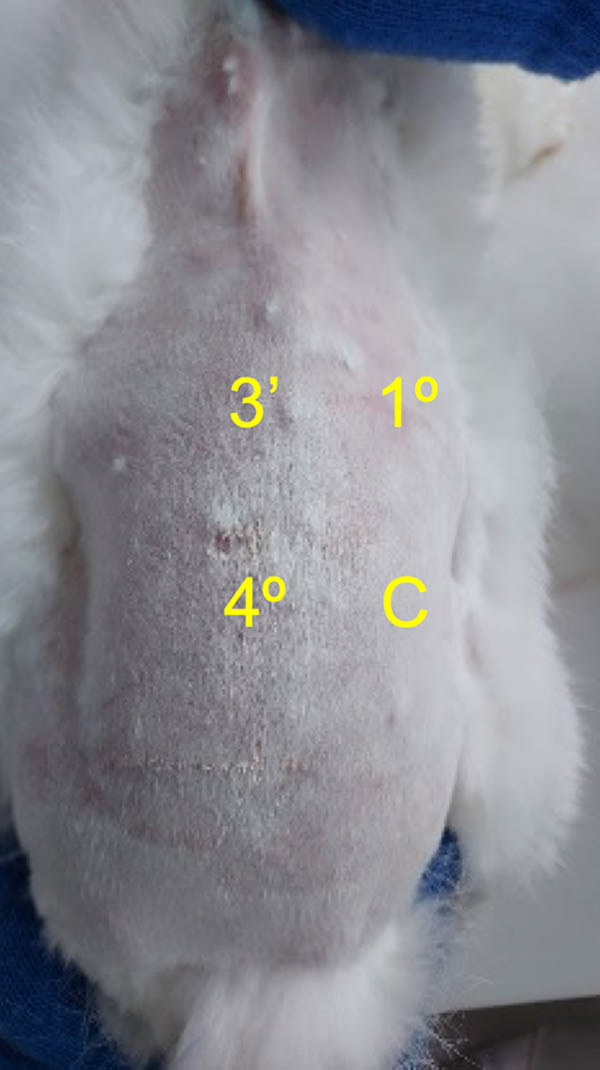
Example of the results of an initial test of skin irritation test that has been exposed for 4 h (3’: 3 min exposure; 1°: 1 h exposure; 4°: 4 h exposure; C: control area).
As shown in Table 8, the primary irritation score from the confirmation test for all three samples remained 0, indicating no skin irritation. Based on these results, metsulfuron-methyl, nicosulfuron, and methoxyfenozide were classified as non-irritants according to the Draize skin irritation test criteria.
Skin irritation confirmation test results
| Sample | Reaction | Score | |||||
|---|---|---|---|---|---|---|---|
| 0 h | 4 h | 24 h | 48 h | 72 h | |||
| Metsulfuron-methyl | x̄ 3 Rabbit | Erythema and eschar formation | 0 | 0 | 0 | 0 | 0 |
| Edema formation | 0 | 0 | 0 | 0 | 0 | ||
| Primary irritation score | 0 | ||||||
| Nicosulfuron | x̄ 3 Rabbit | Erythema and eschar formation | 0 | 0 | 0 | 0 | 0 |
| Edema formation | 0 | 0 | 0 | 0 | 0 | ||
| Primary irritation score | 0 | ||||||
| Methoxyfenozide | x̄ 3 Rabbit | Erythema and eschar formation | 0 | 0 | 0 | 0 | 0 |
| Edema formation | 0 | 0 | 0 | 0 | 0 | ||
| Primary irritation score | 0 | ||||||
No erythema or edema was observed 4 h after the test preparations were applied. Further observations at 24 h after patch removal revealed no signs of irritation. Monitoring continued until day 7, and no irritation symptoms were detected. By day 14, no erythema or edema was observed, and fur regrowth was noted at the test sites. Typically, complete fur regrowth in rabbits occurs within 30 days of testing. Throughout the observation period, no irritation responses were noted, and the skin fully recovered without signs of lasting damage. Based on these findings, it was concluded that metsulfuron-methyl, nicosulfuron, and methoxyfenozide do not cause skin irritation and are classified as non-irritants. An example of the results is shown in Figure 2.

Example of the results of a confirmation test of skin irritation test that has been exposed for 4 h (4°: 4 h exposure; C: control area).
3.3 Eye irritation test
In the initial eye irritation test, one New Zealand albino rabbit was used for each pesticide sample. Observations were conducted at 24, 48, and 72 h after exposure. If irritation was observed, further evaluations were carried out on days 7, 14, and 21 to assess the reversibility, healing time, or delayed onset of irritation. The severity of eye irritation was evaluated using the Draize eye irritation test scoring system, as outlined in Table 9.
Eye irritation initial test results
| Sample | Iritation reaction | Score | |||
|---|---|---|---|---|---|
| 1 h | 24 h | 48 h | 72 h | ||
| Metsulfuron-methyl | Cornea | 0 | 0 | 0 | 0 |
| Iris | 0 | 0 | 0 | 0 | |
| Conjunctivae | 1 | 1 | 0 | 0 | |
| Chemosis | 1 | 1 | 1 | 0 | |
| Nicosulfuron | Cornea | 0 | 0 | 0 | 0 |
| Iris | 0 | 0 | 0 | 0 | |
| Conjunctivae | 0 | 0 | 0 | 0 | |
| Chemosis | 0 | 0 | 0 | 0 | |
| Methoxyfenozide | Cornea | 0 | 0 | 0 | 0 |
| Iris | 0 | 0 | 0 | 0 | |
| Conjunctivae | 0 | 0 | 0 | 0 | |
| Chemosis | 0 | 0 | 0 | 0 | |
According to the initial eye irritation test results in Table 9, the metsulfuron-methyl sample caused chemosis, characterized by mild redness of the conjunctiva and slight swelling of the eyelids, with an average score of 1.25. However, by 72 h, and at subsequent observations on days 7, 14, and 21, complete healing was observed. In contrast, the nicosulfuron and methoxyfenozide samples did not produce any observable irritation. The treated eyes were identical to the control eyes, with no swelling of the iris or eyelids. Even during prolonged observation on days 7, 14, and 21, no irritation was detected, with a consistent score of 0. Based on these findings, metsulfuron-methyl was classified as a mild irritant, while nicosulfuron and methoxyfenozide were classified as non-irritants. An example of the initial test results is shown in Figure 3.

Comparison of the eye exposed to metsulfuron-methyl with the control eye in the first hour of the initial test: (a) eye exposed by metsulfuron-methyl; (b) control eye.
To confirm these findings, a confirmation eye irritation test was conducted using three additional New Zealand albino rabbits for each pesticide. The procedures mirrored those of the initial test, with observations performed at 24, 48, and 72 h, followed by evaluations on days 7, 14, and 21 to monitor the severity and reversibility of eye irritation. As shown in Table 10, rabbits exposed to the metsulfuron-methyl sample exhibited slight eyelid swelling compared to the control eye. However, the cornea remained clear, and the iris and conjunctiva appeared normal, resulting in an average irritation score of 0.325. By 48 h, and throughout subsequent observations until day 21, full recovery was observed. Based on these findings, metsulfuron-methyl is classified as a Category 2B (mild irritant) according to the OECD guidelines. The results of the confirmation test are shown in Figure 4. In contrast, the nicosulfuron and methoxyfenozide samples did not induce any observable irritation. At all observation points – 1, 24, 48, and 72 h – the treated eyes remained identical to the control eyes, with no swelling or other signs of irritation. Continued monitoring on days 7, 14, and 21 confirmed the absence of delayed irritation. Therefore, nicosulfuron and methoxyfenozide were classified as non-irritants.
Eye irritation confirmation test results
| Sample | Rabbit | Iritation reaction | Score | |||
|---|---|---|---|---|---|---|
| 1 h | 24 h | 48 h | 72 h | |||
| Metsulfuron-methyl | x̄ 3 Rabbit | Cornea | 0 | 0 | 0 | 0 |
| Iris | 0 | 0 | 0 | 0 | ||
| Conjunctivae | 0 | 0 | 0 | 0 | ||
| Chemosis | 1 | 0.3 | 0 | 0 | ||
| Nicosulfuron | x̄ 3 Rabbit | Cornea | 0 | 0 | 0 | 0 |
| Iris | 0 | 0 | 0 | 0 | ||
| Conjunctivae | 0 | 0 | 0 | 0 | ||
| Chemosis | 0 | 0 | 0 | 0 | ||
| Methoxyfenozide | x̄ 3 Rabbit | Cornea | 0 | 0 | 0 | 0 |
| Iris | 0 | 0 | 0 | 0 | ||
| Conjunctivae | 0 | 0 | 0 | 0 | ||
| Chemosis | 0 | 0 | 0 | 0 | ||

Comparison of the eye exposed to metsulfuron-methyl with the control eye in the first hour of confirmation test: (a) eye exposed by metsulfuron-methyl; (b) control eye.
3.4 Skin sensitization test
The concentration determination for the sensitization test was performed using one Dunkin Hartley albino guinea pig for each pesticide sample. The concentration used for induction exposure was the highest concentration that caused mild irritation, while the concentration for further exposure was the highest concentration that did not cause irritation. These concentrations were determined through preliminary tests using three test animals. The initial concentrations tested were 12.5, 25, 50, 75, and 100%, with each exposure lasting for 6 h, followed by observations at 24 and 48 h after the gauze was removed. The results were evaluated according to the Magnusson and Kligman Scale presented in Table 11.
Concentration determination results of the sensitization test based on the Magnusson–Kligman scale
| Sample | Concentration | Irritation reaction |
|---|---|---|
| Metsulfuron-methyl | Control | 0 |
| 12.5% | 0 | |
| 25% | 0 | |
| 50% | 0 | |
| 75% | 0 | |
| 100% | 0 | |
| Nicosulfuron | Control | 0 |
| 12.5% | 0 | |
| 25% | 0 | |
| 50% | 0 | |
| 75% | 0 | |
| 100% | 0 | |
| Methoxyfenozide | Control | 0 |
| 12.5% | 0 | |
| 25% | 0 | |
| 50% | 0 | |
| 75% | 0 | |
| 100% | 0 |
Based on the results in Table 11, guinea pigs exposed to metsulfuron-methyl at 100% concentration for 6 h did not show any signs of irritation when observed at 24 and 48 h after the gauze was removed, with a recorded irritation score of 0 across all concentrations. Similarly, nicosulfuron and methoxyfenozide samples, when applied at the highest concentration of 100%, also did not cause any irritation during the same observation period, with a score of 0 for both. As no irritation was observed in any of the samples, a 100% concentration was selected for use in the confirmation test. An example of the preliminary test results is shown in Figure 5.

Example of the results of concentration determination of the skin irritation test with 5 concentration variations and 1 control area that has been exposed for 6 h.
In the main sensitization test, three Dunkin Hartley albino guinea pigs were used for each pesticide sample. Each guinea pig was topically induced with a 100% concentration of metsulfuron-methyl, nicosulfuron, or methoxyfenozide on days 0, 6, and 13. This process was intended to trigger an immunological response that could lead to skin sensitization. On day 27, a challenge test was conducted to determine whether any observed reactions were due to sensitization rather than irritation.
The results presented in Table 12 indicated that none of the pesticide samples caused sensitization reactions. Metsulfuron-methyl, when applied at 100% concentration, did not produce any signs of skin sensitization at 24 and 48 h after the challenge test. The test area was compared with the control area exposed to 0.9% NaCl, and no differences were observed, with a recorded score of 0 across all samples. Similarly, nicosulfuron and methoxyfenozide did not produce any sensitization reactions, as the test areas remained indistinguishable from the control areas throughout the observation period.
Main test observation after the challenge test
| Sample | Guinea pig | Score | ||
|---|---|---|---|---|
| 6 h | 24 h | 48 h | ||
| Metsulfuron-methyl | Guinea pig A | 0 | 0 | 0 |
| Guinea pig B | 0 | 0 | 0 | |
| Guinea pig C | 0 | 0 | 0 | |
| Nicosulfuron | Guinea pig A | 0 | 0 | 0 |
| Guinea pig B | 0 | 0 | 0 | |
| Guinea pig C | 0 | 0 | 0 | |
| Methoxyfenozide | Guinea pig A | 0 | 0 | 0 |
| Guinea pig B | 0 | 0 | 0 | |
| Guinea pig C | 0 | 0 | 0 | |
Further analysis confirmed that metsulfuron-methyl, nicosulfuron, and methoxyfenozide did not induce any skin sensitization responses in Dunkin Hartley albino guinea pigs. Therefore, it can be concluded that these pesticides do not have potential to cause skin sensitization. According to the Magnusson and Kligman scale, metsulfuron-methyl, nicosulfuron, and methoxyfenozide are classified as non-sensitizers. An example of the sensitization test results is shown in Figure 6.

Example of the results of a challenge test of skin sensitization test that has been exposed for 6 h (S: sample area; C: control area).
4 Discussion
Pesticides must meet quality standards, demonstrate effectiveness, and be safe for humans and the environment. To obtain regulatory approval and product certification, comprehensive toxicological evaluations are required. These studies provide crucial data for risk assessment and clinical management, supporting policy decisions by regulatory agencies for pesticide approval and categorization. Moreover, limiting the availability of highly toxic pesticides through licensing and registration could significantly reduce poisoning incidents without compromising agricultural productivity [12,13].
One major concern regarding pesticide exposure is the potential to cause skin and eye irritation or skin sensitization. Improper use of pesticides, such as the absence of personal protective equipment (PPE) during spraying, increases the risk of exposure. This can lead to symptoms of skin irritation, including itching, redness, dryness, swelling, and blisters [36,37]. The inflammatory response caused by chemical exposure is characterized by erythema, edema, and warmth due to vasodilation and plasma leakage [38,39]. Skin sensitization, on the other hand, is an immunological reaction triggered by certain chemicals, manifesting as pruritis, erythema, or edema [40,41]. Pesticide exposure can also affect ocular tissues, causing inflammation, redness, and, in severe cases, vision impairment or chemosis [42,43,44].
Toxicological evaluation typically involves both in vivo and in vitro methods. While in vitro alternatives, such as OECD-validated assays, are increasingly used to reduce animal testing, in vivo methods remain the gold standard for assessing complex biological interactions and systemic toxicity [45]. In this study, the QSAR analysis using the EPI Suite program predicted that metsulfuron-methyl, nicosulfuron, and methoxyfenozide exhibit low acute and chronic toxicity, suggesting minimal potential for causing skin irritation, eye irritation, and skin sensitization. These computational predictions were validated through in vivo tests conducted according to modified OECD 404, OECD 405, and OECD 406 guidelines [46].
In the skin irritation test, herbicide samples containing metsulfuron-methyl (200 g/L) and nicosulfuron (250 g/L) and the insecticide containing methoxyfenozide (300 g/L) exhibited a primary irritation score of 0, indicating that these substances do not cause skin irritation in rabbits. This suggests that, when applied topically, these pesticides are unlikely to induce immediate or delayed skin reactions [11,47]. These findings align with the existing literature, which indicates low dermal toxicity for sulfonylurea herbicides and insecticides like methoxyfenozide [48,49,50]. This is particularly important for occupational safety, as skin contact is a common route of pesticide exposure among agricultural workers [51,52].
In the eye irritation test, metsulfuron-methyl caused mild conjunctival redness and eyelid swelling, with an average irritation score of 0.325, classifying it as a mild irritant (Category 2B). However, the symptoms were reversible by the 21st day of observation, indicating no long-term ocular damage. In contrast, nicosulfuron and methoxyfenozide did not cause any observable eye irritation throughout the observation period, with an irritation score of 0. This suggests that while metsulfuron-methyl poses a minor risk of temporary eye irritation, the other two pesticides are safer for ocular exposure under normal usage conditions.
The skin sensitization test revealed no erythema or edema reactions in guinea pigs exposed to the highest concentration (100%) of each pesticide. This indicates that metsulfuron-methyl, nicosulfuron, and methoxyfenozide do not induce skin sensitization, supporting their classification as non-sensitizing substances. These findings are consistent with previous studies, reporting low immunogenic potential for sulfonylurea herbicides and methoxyfenozide.
The consistency between QSAR predictions and in vivo findings in this study reinforces the reliability of computational models for preliminary toxicological assessments. This approach not only reduces the need for extensive animal testing but also provides rapid insights into potential health risks [53]. Furthermore, the data generated from this study contribute valuable toxicological information for regulatory safety evaluations and the assessment of occupational and environmental exposure risks.
Our findings are consistent with the existing literature on the safety of these pesticides. A study on methoxyfenozide’s environmental behavior and application in controlling litchi and longan pests reported low toxicity to non-target organisms, which aligns with our observations of its minimal skin and eye irritation potential [54]. For metsulfuron-methyl and nicosulfuron, while specific studies on their dermal and ocular effects are limited, previous research indicates that sulfonylurea herbicides exhibit low mammalian toxicity, supporting our findings of negligible skin irritation and sensitization [55,56]. These results are particularly relevant for regulatory safety evaluations, providing additional evidence to support the safe use of these pesticides when handled appropriately.
However, this study has some limitations. Notably, no positive control was used in the irritation and sensitization tests, as this study was intended as a preliminary assessment. The absence of a positive control, such as hexyl cinnamic aldehyde, limits the ability to benchmark the responses against known irritants or sensitizers. Future studies will incorporate positive controls to further validate these findings and provide a more comprehensive risk assessment. Additionally, while acute toxicity and immediate effects were evaluated, further research is needed to explore chronic toxicity, environmental impact, and the transformation products of these pesticides. Expanding the study to real-environment samples would provide more robust insights into human and ecological safety, addressing the complexities of pesticide exposure in agricultural and environmental contexts.
Moreover, this study serves as a foundation for future work that will incorporate modern in vitro methodologies for further verification and a more comprehensive assessment of the safety profiles of these pesticides. Future research should adopt OECD-accepted in vitro methods where applicable, aligning with the 3Rs principle (Replacement, Reduction, and Refinement) to minimize animal use while ensuring robust toxicological evaluations. This integrated approach will enhance both the accuracy and ethical standards of future toxicity studies.
5 Conclusions
This research evaluated the toxicity of herbicides containing metsulfuron-methyl (200 g/L), nicosulfuron (250 g/L), and the insecticide methoxyfenozide (300 g/L) through QSAR analysis and in vivo testing. QSAR analysis indicated that all three pesticides exhibit low acute and chronic toxicity, suggesting minimal risk for skin and eye irritation and skin sensitization. Consistent with these predictions, the skin irritation test showed a primary irritation score of 0 for all three samples, indicating no irritation to rabbit skin. In the eye irritation test, metsulfuron-methyl caused mild conjunctival redness and eyelid swelling, with an average irritation score of 0.325, classifying it as a mild irritant (Category 2B), while nicosulfuron and methoxyfenozide did not cause any observable eye irritation (score 0). The skin sensitization test revealed no erythema or edema reactions in guinea pigs exposed to the highest concentration (100%) of each pesticide, confirming that none of the samples caused skin sensitization. These findings provide essential toxicological data for regulatory safety evaluations, particularly for occupational and environmental exposure risks. Future research should explore chronic toxicity, long-term environmental impact, and transformation products of these pesticides, along with assessments in real-environment samples for more comprehensive safety insights.
Acknowledgments
We would like to thank the Rector of Universitas Padjadjaran for the Academic Leadership Grant (ALG) project No. 1408/UN6.3.1/PT00/2024 awarded to A.S. for funding the APC and PT. Sari Kresna Kimia for providing the sample.
-
Funding information: Authors state no funding involved.
-
Author contributions: All authors have accepted responsibility for the entire content of this manuscript and consented to its submission to the journal. All authors have read and agreed to the published version of the manuscript. Conceptualization and methodology: W.D.N., M.I.R., A.S., and G.W.; validation: G.W.; formal analysis: M.I.R. and G.W.; writing – original draft preparation: W.D.N. and M.I.R.; writing – review and editing: W.D.N., M.I.R., A.S., G.W., and C.S.; supervision, project administration, and funding acquisition: W.D.N., M.I.R., A.S., and G.W.
-
Conflict of interest: Authors state no conflict of interest.
-
Data availability statement: The datasets generated during and/or analyzed during the current study are available from the corresponding author on reasonable request.
References
[1] Bernardes MFF, Pazin M, Pereira LC, Dorta DJ. Impact of pesticides on environmental and human health. In Toxicology studies—cells, drugs and environment. London: IntechOpen; 2015. p. 195–233.10.5772/59710Suche in Google Scholar
[2] Vonk JA, Kraak MHS. Herbicide exposure and toxicity to aquatic primary producers. Rev Env Contam Toxicol. 2020;250:119–71.10.1007/398_2020_48Suche in Google Scholar PubMed
[3] OECD. Test No. 404: Acute dermal irritation/corrosion [Internet]. OECD; 2015. p. 1–8. (OECD Guidelines for the Testing of Chemicals, Section 4). https://www.oecd-ilibrary.org/environment/test-no-404-acute-dermal-irritation-corrosion_9789264242678-en.Suche in Google Scholar
[4] Boedeker W, Watts M, Clausing P, Marquez E. The global distribution of acute unintentional pesticide poisoning: Estimations based on a systematic review. BMC Public Health. 2020;20(1875):1–19.10.1186/s12889-020-09939-0Suche in Google Scholar PubMed PubMed Central
[5] Zhu Q, Yang Y, Zhong Y, Lao Z, O’Neill P, Hong D, et al. Synthesis, insecticidal activity, resistance, photodegradation and toxicity of pyrethroids (A review). Chemosphere. 2020 Sep;254:126779.10.1016/j.chemosphere.2020.126779Suche in Google Scholar PubMed
[6] de BARROS EC, Dangelo RAC, Sousa FF, Do Sacramento JAAS, Taube Júnior PS, Galúcio JMP, et al. Effects of the pesticides chlorpyriphos, metsulfuron-methyl, and thiamethoxam on ant communities in wheat crop. Biosci J. 2022 Feb;38:1–11.10.14393/BJ-v38n0a2022-55937Suche in Google Scholar
[7] Chaudhary A, Chhokar RS, Dhanda S, Kaushik P, Kaur S, Poonia TM, et al. Herbicide resistance to metsulfuron-methyl in Rumex dentatus L. in North-West India and its management perspectives for sustainable wheat production. Sustainability. 2021 Jun;13(12):6947.10.3390/su13126947Suche in Google Scholar
[8] Hassannejad S, Porheidar Ghafarbi S, Lotfi R. The effect of nicosulfuron and bentazon on photosynthetic performance of common cocklebur (Xanthium strumarium L.). Environ Sustainability Indic. 2020;6:100026.10.1016/j.indic.2020.100026Suche in Google Scholar
[9] Cara IG, Topa D, Calistru AE, Motrescu I, Bulgariu L, Jităreanu G. Agri-wastes as a low-cost adsorbent for nicosulfuron herbicide. Environ Eng Manag. 2020;19(2):335–43, http://www.eemj.icpm.tuiasi.ro/http://www.eemj.eu.10.30638/eemj.2020.031Suche in Google Scholar
[10] Cahayanti SR, Trisyono YA, Martono E. Sublethal effects of methoxyfenozide on nutrition performance of Helicoverpa Armigera. Agrosains. 2006;19:465–70.Suche in Google Scholar
[11] European Food Safety Authority. Conclusion on the peer review of the pesticide risk assessment of the active substance metsulfuron-methyl. EFSA J. 2015 Jan;13(1):3936.10.2903/j.efsa.2015.3936Suche in Google Scholar
[12] Gunnell D, Fernando R, Hewagama M, Priyangika WDD, Konradsen F, Eddleston M. The impact of pesticide regulations on suicide in Sri Lanka. Int J Epidemiol. 2007 Dec;36(6):1235–42.10.1093/ije/dym164Suche in Google Scholar PubMed PubMed Central
[13] Manuweera G, Eddleston M, Egodage S, Buckley NA. Do targeted bans of insecticides to prevent deaths from self-poisoning result in reduced agricultural output? Env Health Perspect. 2008 Apr;116(4):492–5.10.1289/ehp.11029Suche in Google Scholar PubMed PubMed Central
[14] EPA. USEPA (US. Estimation Programs Interface (EPI) SuiteTM for microsoft windows, v4.11 [Internet]. Washington, DC; 2023. https://www.epa.gov/tsca-screening-tools/epi-suitetm-estimation-program-interface.Suche in Google Scholar
[15] Pandey SK, Ojha PK, Roy K. Exploring QSAR models for assessment of acute fish toxicity of environmental transformation products of pesticides (ETPPs). Chemosphere. 2020;252:126508.10.1016/j.chemosphere.2020.126508Suche in Google Scholar PubMed
[16] Studziński W, Narloch I, Dąbrowski Ł. Determination of the efficiency of electrolyzed water devices for the removal of pesticides in aqueous solutions and the characteristics of the pesticide residues and their transformation products. J Water Process Eng. 2024;61:105372, https://www.sciencedirect.com/science/article/pii/S2214714424006044.10.1016/j.jwpe.2024.105372Suche in Google Scholar
[17] Mitra S, Saran RK, Srivastava S, Rensing C. Pesticides in the environment: Degradation routes, pesticide transformation products and ecotoxicological considerations. Sci Total Environ. 2024;935:173026, https://www.sciencedirect.com/science/article/pii/S0048969724031735.10.1016/j.scitotenv.2024.173026Suche in Google Scholar PubMed
[18] Ji C, Song Q, Chen Y, Zhou Z, Wang P, Liu J, et al. The potential endocrine disruption of pesticide transformation products (TPs): The blind spot of pesticide risk assessment. Env Int. 2020;137:105490.10.1016/j.envint.2020.105490Suche in Google Scholar PubMed
[19] Kurniadin N, Insanu KI, Fadlin F, Sutaji AAM. Studi Pemodelan Pola Arus dan Kedalaman Sungai Mahakam di Bawah Jembatan Mahakam Kembar Sebagai Upaya untuk Meningkatkan Keselamatan Pelayaran. Geoid. 2024;19(2):224–35.10.12962/geoid.v19i2.1257Suche in Google Scholar
[20] Witsqa Firmansyah Y, Setiani O, Hanani Darundiati Y, Kesehatan Lingkungan M, Kesehatan Masyarakat F, Diponegoro U, et al. Kondisi Sungai di Indonesia Ditinjau dari Daya Tampung Beban Pencemaran: Studi Literatur. Serambi Eng. 2021;VI(2):1879–90.10.32672/jse.v6i2.2889Suche in Google Scholar
[21] BMKG Indonesia. Klimatologi. 2025.Suche in Google Scholar
[22] Hanifa I, Setiyaningsih L, Aunurrahman A. Pola Arus dan Gelombang Air Laut di Sekitar Perairan Pulau Abang Besar, Kecamatan Galang, Kota Batam, Provinsi Kepulauan Riau. Indones J Oceanogr. 2024 Nov;6(4):383–93, https://ejournal2.undip.ac.id/index.php/ijoce/article/view/24843.10.14710/ijoce.v6i4.24843Suche in Google Scholar
[23] Shara M, Yasmin T, Kincaid AE, Limpach AL, Bartz J, Brenneman KA, et al. Safety and toxicological evaluation of a novel niacin-bound chromium (III) complex. J Inorg Biochem. 2005 Nov;99(11):2161–83.10.1016/j.jinorgbio.2005.07.017Suche in Google Scholar PubMed
[24] Mehanna MM, Abla KK, Elmaradny HA. Tailored limonene-based nanosized microemulsion: Formulation, physicochemical characterization and in-vivo skin irritation assessment. Adv Pharm Bull. 2020;11(2):274–85.10.34172/apb.2021.040Suche in Google Scholar PubMed PubMed Central
[25] OECD. Test No. 405: Acute eye irritation/corrosion [Internet]. OECD; 2023. p. 1–12. (OECD Guidelines for the Testing of Chemicals, Section 4) https://www.oecd-ilibrary.org/environment/test-no-405-acute-eye-irritation-corrosion_9789264185333-en.Suche in Google Scholar
[26] United Nation. Globally harmonized system of classification and labelling of chemicals (GHS). 10th. ChemSafetyPro. New York and Geneva: United Nation; 2023. p. 145–68.Suche in Google Scholar
[27] Li R, Jiang S, Liu D, Bi X, Wang F, Zhang Q, et al. A potential new therapeutic system for glaucoma: solid lipid nanoparticles containing methazolamide. J Microencapsul. 2011 Mar;28(2):134–41.10.3109/02652048.2010.539304Suche in Google Scholar PubMed
[28] OECD. Test No. 406: Skin sensitisation [Internet]. OECD; 2022. p. 1–10. (OECD Guidelines for the Testing of Chemicals, Section 4) https://www.oecd-ilibrary.org/environment/test-no-406-skin-sensitisation_9789264070660-en.Suche in Google Scholar
[29] Wang H, Zhao B, Liu C, Wang C, Tan X, Hu M. A comparison of biocompatibility of a titanium alloy fabricated by electron beam melting and selective laser melting. PLoS One. 2016 Jul;11(7):e0158513.10.1371/journal.pone.0158513Suche in Google Scholar PubMed PubMed Central
[30] Massarsky A, Donnell MT, de Gandiaga E, Kozal JS, Garnick L, Kubitz JA, et al. Critical evaluation of ECOSAR and E-FAST platforms to predict ecological risks of PFAS. Environ Adv. 2022;8:100221.10.1016/j.envadv.2022.100221Suche in Google Scholar
[31] Kılıç B, Çeçen F. Review of experimental biodegradation data on pharmaceuticals and comparison with predictive BIOWIN models. J Env Manage. 2023;344:118310.10.1016/j.jenvman.2023.118310Suche in Google Scholar PubMed
[32] Nikolova-Jeliazkova N, Jaworska J. An approach to determining applicability domains for QSAR group contribution models: An analysis of SRC KOWWIN. Altern Lab Anim. 2005;33(5):461–70.10.1177/026119290503300510Suche in Google Scholar PubMed
[33] Lombardo A, Roncaglioni A, Boriani E, Milan C, Benfenati E. Assessment and validation of the CAESAR predictive model for bioconcentration factor (BCF) in fish. Chem Cent J. 2010;4(Suppl 1):1–11.10.1186/1752-153X-4-S1-S1Suche in Google Scholar PubMed PubMed Central
[34] Lazare J, Tebes-Stevens C, Weber EJ. A multiple linear regression approach to the estimation of carboxylic acid ester and lactone alkaline hydrolysis rate constants. SAR QSAR Env Res. 2023;34(3):183–210.10.1080/1062936X.2023.2188608Suche in Google Scholar PubMed PubMed Central
[35] Mihçiokur H. Environmental risk assessment of commonly used anti-cancer drugs. Cumhur Sci J. 2021;42(2):310–20.10.17776/csj.866883Suche in Google Scholar
[36] Damalas CA, Koutroubas SD. Farmers’ exposure to pesticides: Toxicity types and ways of prevention. Vol. 4, Toxics. MDPI AG; 2016.10.3390/toxics4010001Suche in Google Scholar PubMed PubMed Central
[37] Lisi P, Caraffini S, Assalve D. Irritation and sensitization potential of pesticides*. Contact Dermat. 1987 Oct;17(4):212–8.10.1111/j.1600-0536.1987.tb02715.xSuche in Google Scholar PubMed
[38] Tovar R, Leikin JB. Irritants and corrosives. Emerg Med Clin North Am. 2015;33(1):117–31.10.1016/j.emc.2014.09.009Suche in Google Scholar PubMed
[39] Choksi NY, Truax J, Layton A, Matheson J, Mattie D, Varney T, et al. United States regulatory requirements for skin and eye irritation testing. Cutan Ocul Toxicol. 2019 Apr;38(2):141–55.10.1080/15569527.2018.1540494Suche in Google Scholar PubMed PubMed Central
[40] Krieger RI. Hayes’ handbook of pesticide toxicology. In Hayes’ handbook of pesticide toxicology. 3rd edn. San Diego, California, USA: Elsevier Inc; 2010.Suche in Google Scholar
[41] World Health Organization. Harmonization Project Document No. 5. Skin sensitization in chemical risk assessment. Genewa, Switzerland: World Health Organization; 2008.Suche in Google Scholar
[42] Rauchman SH, Locke B, Albert J, De Leon J, Peltier MR, Reiss AB. Toxic external exposure leading to ocular surface injury. Vis (Switz). 2023;7:32.10.3390/vision7020032Suche in Google Scholar PubMed PubMed Central
[43] Jiménez Barbosa IA, Rodríguez Alvarez MF, Bernal Bechara LC, Khuu SK. Impairment of visual and neurologic functions associated with agrochemical use. PLoS One. 2023;18(8 Aug):e0290263.10.1371/journal.pone.0290263Suche in Google Scholar PubMed PubMed Central
[44] Kempuraj D, Zhang E, Gupta S, Gupta RC, Sinha NR, Mohan RR. Carbofuran pesticide toxicity to the eye. Exp Eye Res. 2023;227:109355.10.1016/j.exer.2022.109355Suche in Google Scholar PubMed PubMed Central
[45] Edwards SW, Nelms M, Hench VK, Ponder J, Sullivan K. Mapping mechanistic pathways of acute oral systemic toxicity using chemical structure and bioactivity measurements. Front Toxicol. 2022;4:824094.10.3389/ftox.2022.824094Suche in Google Scholar PubMed PubMed Central
[46] Zwickl CM, Graham JC, Jolly RA, Bassan A, Ahlberg E, Amberg A, et al. Principles and procedures for assessment of acute toxicity incorporating in silico methods. Comput Toxicol. 2022;24:100237.10.1016/j.comtox.2022.100237Suche in Google Scholar PubMed PubMed Central
[47] Liu B, Qin Y, Cao M, Shi H, Li S, Sheng W, et al. A stable and sensitive enzyme‐linked immunosorbent assay (ELISA) for the determination of metsulfuron‐methyl residues in foods. J Food Sci. 2021 Jul;86(7):3176–87.10.1111/1750-3841.15683Suche in Google Scholar PubMed
[48] Wang L, Riaz M, Song B, Song X, Huang W, Bai X, et al. Study on phytotoxicity evaluation and physiological properties of nicosulfuron on sugar beet (Beta vulgaris L.). Front Plant Sci. 2022 Oct;13:998867.10.3389/fpls.2022.998867Suche in Google Scholar PubMed PubMed Central
[49] Zhang Y, Gao S, Hoang M, Wang Z, Ma X, Zhai Y, et al. Protective efficacy of phenoxyacetyl oxazolidine derivatives as safeners against nicosulfuron toxicity in maize. Pest Manag Sci. 2021 Jan;77(1):177–83.10.1002/ps.6005Suche in Google Scholar PubMed
[50] Carles L, Joly M, Bonnemoy F, Leremboure M, Donnadieu F, Batisson I, et al. Biodegradation and toxicity of a maize herbicide mixture: mesotrione, nicosulfuron and S-metolachlor. J Hazard Mater. 2018 Jul;354:42–53.10.1016/j.jhazmat.2018.04.045Suche in Google Scholar PubMed
[51] Ahmed FS, Helmy YS, Helmy WS. Toxicity and biochemical impact of methoxyfenozide/spinetoram mixture on susceptible and methoxyfenozide-selected strains of Spodoptera littoralis (Lepidoptera: Noctuidae). Sci Rep. 2022 Apr;12(1):6974.10.1038/s41598-022-10812-wSuche in Google Scholar PubMed PubMed Central
[52] Jiang Q, Lin Z, Peng M, Zhou B, Liu E, Li Z, et al. A nano-delivery system enhances the stomach toxicity of methoxyfenozide against Spodoptera litura by suppressing the synthesis of insect cuticle protein. ACS Appl Nano Mater. 2023 Jul;6(14):13524–32.10.1021/acsanm.3c02186Suche in Google Scholar
[53] Zang Q, Mansouri K, Williams AJ, Judson RS, Allen DG, Casey WM, et al. In silico prediction of physicochemical properties of environmental chemicals using molecular fingerprints and machine learning. J Chem Inf Model. 2017;57(1):36–49.10.1021/acs.jcim.6b00625Suche in Google Scholar PubMed PubMed Central
[54] Liu Y, Wang X, Wang S. Environmental fate and safety analysis of methoxyfenozide application to control litchi and longan pests. Environ Sci Pollut Res. 2024;31(25):37316–25. 10.1007/s11356-024-33677-0 Suche in Google Scholar PubMed PubMed Central
[55] Petric I, Karpouzas DG, Bru D, Udikovic-Kolic N, Kandeler E, Djuric S, et al. Nicosulfuron application in agricultural soils drives the selection towards NS-tolerant microorganisms harboring various levels of sensitivity to nicosulfuron. Environ Sci Pollut Res. 2016;23(5):4320–33.10.1007/s11356-015-5645-6Suche in Google Scholar PubMed
[56] de Santo FB, Ramos GA, Ricardo Filho AM, Marchioro CA, Niemeyer JC. Screening effects of metsulfuron-methyl to collembolans and earthworms: The role of adjuvant addition on ecotoxicity. Environ Sci Pollut Res. 2018;25(24):24143–9.10.1007/s11356-018-2481-5Suche in Google Scholar PubMed
© 2025 the author(s), published by De Gruyter
This work is licensed under the Creative Commons Attribution 4.0 International License.
Artikel in diesem Heft
- Research Articles
- Optimization of sustainable corn–cattle integration in Gorontalo Province using goal programming
- Competitiveness of Indonesia’s nutmeg in global market
- Toward sustainable bioproducts from lignocellulosic biomass: Influence of chemical pretreatments on liquefied walnut shells
- Efficacy of Betaproteobacteria-based insecticides for managing whitefly, Bemisia tabaci (Hemiptera: Aleyrodidae), on cucumber plants
- Assessment of nutrition status of pineapple plants during ratoon season using diagnosis and recommendation integrated system
- Nutritional value and consumer assessment of 12 avocado crosses between cvs. Hass × Pionero
- The lacked access to beef in the low-income region: An evidence from the eastern part of Indonesia
- Comparison of milk consumption habits across two European countries: Pilot study in Portugal and France
- Antioxidant responses of black glutinous rice to drought and salinity stresses at different growth stages
- Differential efficacy of salicylic acid-induced resistance against bacterial blight caused by Xanthomonas oryzae pv. oryzae in rice genotypes
- Yield and vegetation index of different maize varieties and nitrogen doses under normal irrigation
- Urbanization and forecast possibilities of land use changes by 2050: New evidence in Ho Chi Minh city, Vietnam
- Organizational-economic efficiency of raspberry farming – case study of Kosovo
- Application of nitrogen-fixing purple non-sulfur bacteria in improving nitrogen uptake, growth, and yield of rice grown on extremely saline soil under greenhouse conditions
- Digital motivation, knowledge, and skills: Pathways to adaptive millennial farmers
- Investigation of biological characteristics of fruit development and physiological disorders of Musang King durian (Durio zibethinus Murr.)
- Enhancing rice yield and farmer welfare: Overcoming barriers to IPB 3S rice adoption in Indonesia
- Simulation model to realize soybean self-sufficiency and food security in Indonesia: A system dynamic approach
- Gender, empowerment, and rural sustainable development: A case study of crab business integration
- Metagenomic and metabolomic analyses of bacterial communities in short mackerel (Rastrelliger brachysoma) under storage conditions and inoculation of the histamine-producing bacterium
- Fostering women’s engagement in good agricultural practices within oil palm smallholdings: Evaluating the role of partnerships
- Increasing nitrogen use efficiency by reducing ammonia and nitrate losses from tomato production in Kabul, Afghanistan
- Physiological activities and yield of yacon potato are affected by soil water availability
- Vulnerability context due to COVID-19 and El Nino: Case study of poultry farming in South Sulawesi, Indonesia
- Wheat freshness recognition leveraging Gramian angular field and attention-augmented resnet
- Suggestions for promoting SOC storage within the carbon farming framework: Analyzing the INFOSOLO database
- Optimization of hot foam applications for thermal weed control in perennial crops and open-field vegetables
- Toxicity evaluation of metsulfuron-methyl, nicosulfuron, and methoxyfenozide as pesticides in Indonesia
- Fermentation parameters and nutritional value of silages from fodder mallow (Malva verticillata L.), white sweet clover (Melilotus albus Medik.), and their mixtures
- Five models and ten predictors for energy costs on farms in the European Union
- Effect of silvopastoral systems with integrated forest species from the Peruvian tropics on the soil chemical properties
- Transforming food systems in Semarang City, Indonesia: A short food supply chain model
- Understanding farmers’ behavior toward risk management practices and financial access: Evidence from chili farms in West Java, Indonesia
- Optimization of mixed botanical insecticides from Azadirachta indica and Calophyllum soulattri against Spodoptera frugiperda using response surface methodology
- Mapping socio-economic vulnerability and conflict in oil palm cultivation: A case study from West Papua, Indonesia
- Exploring rice consumption patterns and carbohydrate source diversification among the Indonesian community in Hungary
- Determinants of rice consumer lexicographic preferences in South Sulawesi Province, Indonesia
- Effect on growth and meat quality of weaned piglets and finishing pigs when hops (Humulus lupulus) are added to their rations
- Healthy motivations for food consumption in 16 countries
- The agriculture specialization through the lens of PESTLE analysis
- Combined application of chitosan-boron and chitosan-silicon nano-fertilizers with soybean protein hydrolysate to enhance rice growth and yield
- Stability and adaptability analyses to identify suitable high-yielding maize hybrids using PBSTAT-GE
- Phosphate-solubilizing bacteria-mediated rock phosphate utilization with poultry manure enhances soil nutrient dynamics and maize growth in semi-arid soil
- Factors impacting on purchasing decision of organic food in developing countries: A systematic review
- Influence of flowering plants in maize crop on the interaction network of Tetragonula laeviceps colonies
- Bacillus subtilis 34 and water-retaining polymer reduce Meloidogyne javanica damage in tomato plants under water stress
- Vachellia tortilis leaf meal improves antioxidant activity and colour stability of broiler meat
- Evaluating the competitiveness of leading coffee-producing nations: A comparative advantage analysis across coffee product categories
- Application of Lactiplantibacillus plantarum LP5 in vacuum-packaged cooked ham as a bioprotective culture
- Evaluation of tomato hybrid lines adapted to lowland
- South African commercial livestock farmers’ adaptation and coping strategies for agricultural drought
- Spatial analysis of desertification-sensitive areas in arid conditions based on modified MEDALUS approach and geospatial techniques
- Meta-analysis of the effect garlic (Allium sativum) on productive performance, egg quality, and lipid profiles in laying quails
- Optimizing carrageenan–citric acid synergy in mango gummies using response surface methodology
- The strategic role of agricultural vocational training in sustainable local food systems
- Agricultural planning grounded in regional rainfall patterns in the Colombian Orinoquia: An essential step for advancing climate-adapted and sustainable agriculture
- Perspectives of master’s graduates on organic agriculture: A Portuguese case study
- Developing a behavioral model to predict eco-friendly packaging use among millennials
- Government support during COVID-19 for vulnerable households in Central Vietnam
- Citric acid–modified coconut shell biochar mitigates saline–alkaline stress in Solanum lycopersicum L. by modulating enzyme activity in the plant and soil
- Herbal extracts: For green control of citrus Huanglongbing
- Research on the impact of insurance policies on the welfare effects of pork producers and consumers: Evidence from China
- Investigating the susceptibility and resistance barley (Hordeum vulgare L.) cultivars against the Russian wheat aphid (Diuraphis noxia)
- Characterization of promising enterobacterial strains for silver nanoparticle synthesis and enhancement of product yields under optimal conditions
- Testing thawed rumen fluid to assess in vitro degradability and its link to phytochemical and fibre contents in selected herbs and spices
- Protein and iron enrichment on functional chicken sausage using plant-based natural resources
- Fruit and vegetable intake among Nigerian University students: patterns, preferences, and influencing factors
- Bioprospecting a plant growth-promoting and biocontrol bacterium isolated from wheat (Triticum turgidum subsp. durum) in the Yaqui Valley, Mexico: Paenibacillus sp. strain TSM33
- Quantifying urban expansion and agricultural land conversion using spatial indices: evidence from the Red River Delta, Vietnam
- LEADER approach and sustainability overview in European countries
- Influence of visible light wavelengths on bioactive compounds and GABA contents in barley sprouts
- Assessing Albania’s readiness for the European Union-aligned organic agriculture expansion: a mixed-methods SWOT analysis integrating policy, market, and farmer perspectives
- Genetically modified foods’ questionable contribution to food security: exploring South African consumers’ knowledge and familiarity
- The role of global actors in the sustainability of upstream–downstream integration in the silk agribusiness
- Multidimensional sustainability assessment of smallholder dairy cattle farming systems post-foot and mouth disease outbreak in East Java, Indonesia: a Rapdairy approach
- Enhancing azoxystrobin efficacy against Pythium aphanidermatum rot using agricultural adjuvants
- Review Articles
- Reference dietary patterns in Portugal: Mediterranean diet vs Atlantic diet
- Evaluating the nutritional, therapeutic, and economic potential of Tetragonia decumbens Mill.: A promising wild leafy vegetable for bio-saline agriculture in South Africa
- A review on apple cultivation in Morocco: Current situation and future prospects
- Quercus acorns as a component of human dietary patterns
- CRISPR/Cas-based detection systems – emerging tools for plant pathology
- Short Communications
- An analysis of consumer behavior regarding green product purchases in Semarang, Indonesia: The use of SEM-PLS and the AIDA model
- Effect of NaOH concentration on production of Na-CMC derived from pineapple waste collected from local society
Artikel in diesem Heft
- Research Articles
- Optimization of sustainable corn–cattle integration in Gorontalo Province using goal programming
- Competitiveness of Indonesia’s nutmeg in global market
- Toward sustainable bioproducts from lignocellulosic biomass: Influence of chemical pretreatments on liquefied walnut shells
- Efficacy of Betaproteobacteria-based insecticides for managing whitefly, Bemisia tabaci (Hemiptera: Aleyrodidae), on cucumber plants
- Assessment of nutrition status of pineapple plants during ratoon season using diagnosis and recommendation integrated system
- Nutritional value and consumer assessment of 12 avocado crosses between cvs. Hass × Pionero
- The lacked access to beef in the low-income region: An evidence from the eastern part of Indonesia
- Comparison of milk consumption habits across two European countries: Pilot study in Portugal and France
- Antioxidant responses of black glutinous rice to drought and salinity stresses at different growth stages
- Differential efficacy of salicylic acid-induced resistance against bacterial blight caused by Xanthomonas oryzae pv. oryzae in rice genotypes
- Yield and vegetation index of different maize varieties and nitrogen doses under normal irrigation
- Urbanization and forecast possibilities of land use changes by 2050: New evidence in Ho Chi Minh city, Vietnam
- Organizational-economic efficiency of raspberry farming – case study of Kosovo
- Application of nitrogen-fixing purple non-sulfur bacteria in improving nitrogen uptake, growth, and yield of rice grown on extremely saline soil under greenhouse conditions
- Digital motivation, knowledge, and skills: Pathways to adaptive millennial farmers
- Investigation of biological characteristics of fruit development and physiological disorders of Musang King durian (Durio zibethinus Murr.)
- Enhancing rice yield and farmer welfare: Overcoming barriers to IPB 3S rice adoption in Indonesia
- Simulation model to realize soybean self-sufficiency and food security in Indonesia: A system dynamic approach
- Gender, empowerment, and rural sustainable development: A case study of crab business integration
- Metagenomic and metabolomic analyses of bacterial communities in short mackerel (Rastrelliger brachysoma) under storage conditions and inoculation of the histamine-producing bacterium
- Fostering women’s engagement in good agricultural practices within oil palm smallholdings: Evaluating the role of partnerships
- Increasing nitrogen use efficiency by reducing ammonia and nitrate losses from tomato production in Kabul, Afghanistan
- Physiological activities and yield of yacon potato are affected by soil water availability
- Vulnerability context due to COVID-19 and El Nino: Case study of poultry farming in South Sulawesi, Indonesia
- Wheat freshness recognition leveraging Gramian angular field and attention-augmented resnet
- Suggestions for promoting SOC storage within the carbon farming framework: Analyzing the INFOSOLO database
- Optimization of hot foam applications for thermal weed control in perennial crops and open-field vegetables
- Toxicity evaluation of metsulfuron-methyl, nicosulfuron, and methoxyfenozide as pesticides in Indonesia
- Fermentation parameters and nutritional value of silages from fodder mallow (Malva verticillata L.), white sweet clover (Melilotus albus Medik.), and their mixtures
- Five models and ten predictors for energy costs on farms in the European Union
- Effect of silvopastoral systems with integrated forest species from the Peruvian tropics on the soil chemical properties
- Transforming food systems in Semarang City, Indonesia: A short food supply chain model
- Understanding farmers’ behavior toward risk management practices and financial access: Evidence from chili farms in West Java, Indonesia
- Optimization of mixed botanical insecticides from Azadirachta indica and Calophyllum soulattri against Spodoptera frugiperda using response surface methodology
- Mapping socio-economic vulnerability and conflict in oil palm cultivation: A case study from West Papua, Indonesia
- Exploring rice consumption patterns and carbohydrate source diversification among the Indonesian community in Hungary
- Determinants of rice consumer lexicographic preferences in South Sulawesi Province, Indonesia
- Effect on growth and meat quality of weaned piglets and finishing pigs when hops (Humulus lupulus) are added to their rations
- Healthy motivations for food consumption in 16 countries
- The agriculture specialization through the lens of PESTLE analysis
- Combined application of chitosan-boron and chitosan-silicon nano-fertilizers with soybean protein hydrolysate to enhance rice growth and yield
- Stability and adaptability analyses to identify suitable high-yielding maize hybrids using PBSTAT-GE
- Phosphate-solubilizing bacteria-mediated rock phosphate utilization with poultry manure enhances soil nutrient dynamics and maize growth in semi-arid soil
- Factors impacting on purchasing decision of organic food in developing countries: A systematic review
- Influence of flowering plants in maize crop on the interaction network of Tetragonula laeviceps colonies
- Bacillus subtilis 34 and water-retaining polymer reduce Meloidogyne javanica damage in tomato plants under water stress
- Vachellia tortilis leaf meal improves antioxidant activity and colour stability of broiler meat
- Evaluating the competitiveness of leading coffee-producing nations: A comparative advantage analysis across coffee product categories
- Application of Lactiplantibacillus plantarum LP5 in vacuum-packaged cooked ham as a bioprotective culture
- Evaluation of tomato hybrid lines adapted to lowland
- South African commercial livestock farmers’ adaptation and coping strategies for agricultural drought
- Spatial analysis of desertification-sensitive areas in arid conditions based on modified MEDALUS approach and geospatial techniques
- Meta-analysis of the effect garlic (Allium sativum) on productive performance, egg quality, and lipid profiles in laying quails
- Optimizing carrageenan–citric acid synergy in mango gummies using response surface methodology
- The strategic role of agricultural vocational training in sustainable local food systems
- Agricultural planning grounded in regional rainfall patterns in the Colombian Orinoquia: An essential step for advancing climate-adapted and sustainable agriculture
- Perspectives of master’s graduates on organic agriculture: A Portuguese case study
- Developing a behavioral model to predict eco-friendly packaging use among millennials
- Government support during COVID-19 for vulnerable households in Central Vietnam
- Citric acid–modified coconut shell biochar mitigates saline–alkaline stress in Solanum lycopersicum L. by modulating enzyme activity in the plant and soil
- Herbal extracts: For green control of citrus Huanglongbing
- Research on the impact of insurance policies on the welfare effects of pork producers and consumers: Evidence from China
- Investigating the susceptibility and resistance barley (Hordeum vulgare L.) cultivars against the Russian wheat aphid (Diuraphis noxia)
- Characterization of promising enterobacterial strains for silver nanoparticle synthesis and enhancement of product yields under optimal conditions
- Testing thawed rumen fluid to assess in vitro degradability and its link to phytochemical and fibre contents in selected herbs and spices
- Protein and iron enrichment on functional chicken sausage using plant-based natural resources
- Fruit and vegetable intake among Nigerian University students: patterns, preferences, and influencing factors
- Bioprospecting a plant growth-promoting and biocontrol bacterium isolated from wheat (Triticum turgidum subsp. durum) in the Yaqui Valley, Mexico: Paenibacillus sp. strain TSM33
- Quantifying urban expansion and agricultural land conversion using spatial indices: evidence from the Red River Delta, Vietnam
- LEADER approach and sustainability overview in European countries
- Influence of visible light wavelengths on bioactive compounds and GABA contents in barley sprouts
- Assessing Albania’s readiness for the European Union-aligned organic agriculture expansion: a mixed-methods SWOT analysis integrating policy, market, and farmer perspectives
- Genetically modified foods’ questionable contribution to food security: exploring South African consumers’ knowledge and familiarity
- The role of global actors in the sustainability of upstream–downstream integration in the silk agribusiness
- Multidimensional sustainability assessment of smallholder dairy cattle farming systems post-foot and mouth disease outbreak in East Java, Indonesia: a Rapdairy approach
- Enhancing azoxystrobin efficacy against Pythium aphanidermatum rot using agricultural adjuvants
- Review Articles
- Reference dietary patterns in Portugal: Mediterranean diet vs Atlantic diet
- Evaluating the nutritional, therapeutic, and economic potential of Tetragonia decumbens Mill.: A promising wild leafy vegetable for bio-saline agriculture in South Africa
- A review on apple cultivation in Morocco: Current situation and future prospects
- Quercus acorns as a component of human dietary patterns
- CRISPR/Cas-based detection systems – emerging tools for plant pathology
- Short Communications
- An analysis of consumer behavior regarding green product purchases in Semarang, Indonesia: The use of SEM-PLS and the AIDA model
- Effect of NaOH concentration on production of Na-CMC derived from pineapple waste collected from local society
