Phosphate-solubilizing bacteria-mediated rock phosphate utilization with poultry manure enhances soil nutrient dynamics and maize growth in semi-arid soil
-


Abstract
Nutrient deficiencies in semi-arid soils limit crop productivity and degrade soil health. This study evaluated the combined effects of rock phosphate (RP), poultry manure (PM), and phosphate-solubilizing bacteria (PSB) on soil nutrient dynamics and maize performance under field conditions. A factorial randomized complete block design with three replications was employed. Changes in soil properties, including pH, electrical conductivity (EC), soil organic matter (SOM), and nutrient dynamics, were assessed. The integration of RP and PM, particularly with PSB inoculation, significantly (p < 0.05) improved soil and plant nitrogen (N), phosphorus (P), and potassium (K) levels. The most pronounced improvements were in the treatment with 90-RP + 6-PM + PSB, which increased soil total N by 285%, available P by 79%, and available K by 51%. Plant total N, P, and K were enhanced by 53, 419, and 50%, respectively. Similarly, nutrient uptake improved, with N uptake increasing by 142%, P by 283%, and K by 149.6%. This treatment also increased soil EC and SOM by 43% and 77%, respectively, while soil pH decreased by 3.23%. Consequently, maize grain yield, biological yield, 1,000-grain weight, and plant height were increased by 9.5, 13.8, 263.3, and 42%, compared to the control. Principal component analysis and Pearson’s correlation analysis revealed strong positive relationships between soil and plant nutrient parameters, except for soil pH, which was negatively correlated. Overall, RP, PM, and PSB present a sustainable, scalable, and environmentally friendly strategy to enhance soil fertility and maize productivity in nutrient-deficient semi-arid soils.
1 Introduction
Sustainable food production is dependent on the fertility and health of soil. As the global population continues to expand, the imperative of ensuring sustainable food production takes center stage [1]. A vital aspect of this challenge is optimizing nutrient availability in soils to support the growth of crops like maize. In many regions, nutrient deficiency or imbalances in agricultural soils, particularly phosphorus (P), nitrogen (N), and potassium (K), have emerged as a primary constraint to achieving optimal crop yields [2–4]. Addressing the challenge of P deficiency has led to the global utilization of various P fertilizers [5]. Yet, a significant limitation of inorganic P fertilizer application lies in its efficiency, and only 25–30% is available for plant uptake, while the remaining converts into insoluble P forms [6]. Consequently, enhancing P efficiency within soil systems necessitates strategies such as organic fertilizer use, targeted P fertilizers, and cultivation of low-P requirement plants [7–9]. However, these approaches have inherent limitations in maximizing P utilization. Alternatively, introducing beneficial microbes to augment P solubility and use efficiency offers a promising avenue, potentially reducing reliance on synthetic fertilizers while positively impacting plant growth, a crucial factor in agricultural ecosystems that can mitigate soil and water pollution [10,11].
Similarly, N is one of the primary nutrients, and its soil deficiency restricts crop production. In the last half-century, crop yields have increased due to the widespread use of nitrogen-based fertilizers [12]. However, it is worth highlighting that, during the growing season, the average recovery rate of N in crops only hovers around 30–40% [13]. Any excess N not taken up by the crops can become fixed within the soil, leached into deeper soil layers, or released into the atmosphere as ammonia or nitrogen oxides [5]. Such N losses contribute to heightened agricultural production costs and hasten the degradation of the environment [13]. The optimization of N fertilizer application techniques presents an avenue to enhance N fertilizer utilization, resulting in more efficient usage. Developing novel crop cultivars with heightened N efficiency could achieve elevated yields with minimal N input, a pathway that encourages the sustainable advancement of agriculture [14,15]. After P and N, K is a vital macronutrient for sustainable crop production. Nevertheless, much K is lost or builds up in plant tissues. Consequently, the agricultural system faces a significant challenge in effectively recycling the K that accumulates within plant tissues and minimizing K losses from the soil [16].
Considering these factors, the importance of beneficial soil microorganisms, such as phosphate-solubilizing bacteria (PSB), thriving in the rhizosphere of most plants has gained significant attention for their positive effects in nutrient-depleted soils [17,18]. Given that a majority of soils in the arid and semi-arid regions of Pakistan are alkaline and carbonate-dominated, which obstructs the accessibility of essential nutrients such as P, N, and K for plant growth and uptake [19]. In such challenging conditions, PSB can be advantageous for plants through mechanisms such as the secretion of phenolic compounds, the release of protons [20], and the production of mineral acids [21] within the soil. These actions culminate in soil acidification [22], consequently aiding the liberation of P from compounds such as Ca3(PO4)2. Additionally, PSB can effectively chelate cations such as Ca2+, Al3+, and Fe3+ by exuding organic acids, thereby augmenting the bioavailability of P [23]. Utilizing PSB to enhance inorganic P solubilization and aid in the availability of other soil nutrients has shown remarkable improvement. PSB primarily lowers the pH of the rhizosphere by releasing organic acids, which can eventually increase the amount of inorganic P in the soil [24]. However, rhizobacteria can mineralize organic soil P by secreting phosphatase enzymes [25]. The conversion of organic P into inorganic (
Similarly, incorporating organic amendments such as poultry manure (PM) yields advantageous effects on soil fertility and physical attributes [32,33]. The application of PM mitigates the reliance on chemical fertilizers to a certain extent while fostering the production of polysaccharides by microorganisms, thereby enhancing soil conditions [34,35]. Furthermore, as an economically viable and ecologically friendly substitute for commercial P fertilizers, naturally occurring low-grade rock phosphate (RP) presents itself as an option [36]. The northwestern region of Pakistan boasts substantial recoverable RP deposits, offering a potentially economical source of P fertilizers to bolster the nation’s overall grain production. However, the direct utilization of low-grade RP as a P fertilizer necessitates specific amendments, particularly in alkaline soils, to amplify microbial RP solubilization [37]. Soil microorganisms play a pivotal role in rendering insoluble nutrients, including RP, bioavailable, thereby functioning as key facilitators in the biogeochemical cycling of nutrients, notably N and P [38,39].
Despite numerous laboratory and field-based studies exploring the individual effects of biofertilizers (e.g., PSB, AMF, cyanobacteria), organic amendments (e.g., PM, FYM), and RP, limited field research has investigated their synergistic impact on nutrient dynamics, soil health, and crop performance under semi-arid conditions. While the sole application of these amendments has been well documented, few studies have integrated them into a unified, practical strategy for improving nutrient availability and crop productivity. This study introduces a new field-based approach combining PSB, PM, and locally available low-grade RP to enhance nutrient availability and crop yield in nutrient-deficient semi-arid soils. The new aspect of this research lies in assessing the synergistic effects of these components on inorganic and organic phosphorus mobilization, soil chemical properties (pH, EC, soil organic matter [SOM]), and plant nutrient uptake – particularly under realistic field conditions. The main objectives of this study were to (i) evaluate the individual and combined effects of RP, PM, and PSB on key soil properties (pH, EC, SOM); (ii) assess their impact on the availability and uptake of N, P, and K nutrients in maize; and (iii) determine their influence on maize productivity under semi-arid field conditions.
2 Methodology
2.1 Experimental setup
During the summer of 2022, a field experiment was conducted at the New Developmental Farm of the University of Agriculture, Peshawar, Pakistan. The monthly meteorological data of the experimental site were obtained from the Pakistan Meteorological Department (https://cdpc.pmd.gov.pk/), which is graphically presented in Figure 1. From the obtained data, the monthly mean temperature for the month of March was 22.9°C, with a very low total precipitation of 5.2 millimeters (mm) and a vapor pressure of 9.4 millibars (mb). The experiment followed a three-factor factorial randomized complete block design with three replications. The main plot treatments included various sources of phosphorus sources, such as RP, PM, and their mixtures, along with PSB inoculation (inoculated vs. non-inoculated). The inoculums of PSB were obtained from the National Agriculture and Research Council, Islamabad, Pakistan. The PSB inoculums used in the experiment were analyzed for bacterial composition according to Bergey’s Manual of Systematic Bacteriology [40] and Bergey’s Manual of Determinative Bacteriology [41]. PSB was applied through seed treatment. The average population density of PSB in the maize inoculum was 1.73 × 10⁸ CFU mL−1. Further details regarding the characteristics, population, and composition of the applied PSB in this research study can be found in a prior report by Adnan et al. [23]. Maize seeds (obtained from University Research Farm) were inoculated with a maize-specific PSB inoculum containing 1.44 × 10⁷ CFU g−1 (wet weight). Seeds were soaked in a 10% sugar solution for 2 h to enhance adhesion, then treated with 8 g of PSB inoculum per 50 g of seeds, corresponding to a field application rate of 2 kg PSB inoculum per 25 kg of seeds per hectare, following the method of Alagawadi and Gaur [42]. Control seeds were soaked in distilled water and not inoculated. Seeds from both treatments were sown using line sowing, with a row spacing of 60–70 cm and a plant spacing of 20–25 cm. In addition, RP with a P content of 167 g P kg−1 was procured from the Nuclear Institute for Food and Agriculture, Peshawar, and analyzed for Olsen P. PM was sourced from the University of Agriculture’s poultry farm, properly dried, crushed, sieved, and analyzed for NPK contents before application (Table 1). RP was applied at the rates of 0, 60, and 90 kg ha−1 and PM at 0-, 4-, and 6 tons ha−1, both with and without the inoculation of PSB. The details of the specific treatments administered to the experimental plots can be found in Table 2. RP and PM were applied at rates sufficient to meet crop P requirements and to reduce P fixation commonly observed in the semi-arid soils of the study area. The selection of these amendments and their application rates was based on the need to address both residual and anticipated P deficiencies under the prevailing alkaline soil conditions, which limit P availability. RP served as a slow-release P source, while PM provided additional nutrients and organic matter to improve soil structure, microbial activity, and nutrient availability.

Monthly mean weather data for the year 2022.
NPK concentration in PM analyzed before application
| N (%) | P (%) | K (%) |
|---|---|---|
| 2.17 | 1.05 | 1.21 |
Details of the treatments along with their respective dosage applied during the experiment
| Treatments | RP P2O5 (kg ha−1) | PM (tons ha−1) | PSB |
|---|---|---|---|
| T1 | RP 0 | PM 0 | Without PSB |
| T2 | RP 0 | PM 0 | With PSB 1 |
| T3 | RP 0 | PM 4 | Without PSB |
| T4 | RP 0 | PM 4 | With PSB |
| T5 | RP 0 | PM 6 | Without PSB |
| T6 | RP 0 | PM 6 | With PSB |
| T7 | RP 60 | PM 0 | Without PSB |
| T8 | RP 60 | PM 0 | With PSB |
| T9 | RP 60 | PM 4 | Without PSB |
| T10 | RP 60 | PM 4 | With PSB |
| T11 | RP 60 | PM 6 | Without PSB |
| T12 | RP 60 | PM 6 | With PSB |
| T13 | RP 90 | PM 0 | Without PSB |
| T14 | RP 90 | PM 0 | With PSB |
| T15 | RP 90 | PM 4 | Without PSB |
| T16 | RP 90 | PM 4 | With PSB |
| T17 | RP 90 | PM 6 | Without PSB |
| T18 | RP 90 | PM 6 | With PSB |
Before initiating the experiment, a representative soil sample was obtained and subjected to laboratory analysis to assess the physical and chemical attributes of the soil within the experimental site. The results indicated that the soil had alkaline properties with a pH of 7.74 and was not saline, having an EC of 0.16 dS m−1. It had a silty clay loam texture. The soil contained a relatively low amount of organic matter (0.83%) and displayed deficiencies in extractable P (5.54 mg kg−1), K (78.8 mg kg−1), and N (0.077 mg kg−1), as outlined in Table 3. Following the experiment, soil samples were collected from 0–30 cm depth in the field, placed into sampling bags, and transported to the laboratory for further analysis. The soil samples underwent a drying process in the laboratory and were subsequently passed through a 2 mm sieve.
Description of the soil physicochemical properties in the experimental area
| Property | Unit | Values |
|---|---|---|
| Sand | % | 23.5 |
| Silt | % | 54.7 |
| Clay | % | 21.8 |
| Textural class | — | Silty clay loam |
| EC | d Sm−1 | 0.016 |
| pH | — | 7.74 |
| SOM content | % | 0.83 |
| Soil total N content | mg kg−1 | 0.077 |
| AB-DTPA extractable P content | mg kg−1 | 5.54 |
| AB-DTPA extractable K content | mg kg−1 | 78.8 |
2.2 Data collection on agronomic attributes of maize
Maize ears were harvested from each subplot to determine grain yield. The ears were dried, the husks removed, and the grains threshed. The grain yield was then recorded and converted into kilograms per hectare (kg ha−1). For the thousand-grain weight, a random sample of 1,000 grains was collected and weighed using a digital weighing balance. To estimate the biological yield, an area of 1 m2 was harvested from each treatment plot. The fresh biomass was weighed using a digital balance and then shade-dried for 4 days. After drying, the biomass was reweighed to determine the dry matter content, and the biological yield was also expressed in kg ha−1. Plant height was measured by randomly selecting ten plants per plot at physiological maturity. Each sub-plot’s average plant height was calculated using a meter rod to measure from the base to the tassel tip.
2.3 Data collection on soil attributes after maize harvest
Soil pH and EC were measured in a 1:5 soil-to-water suspension using a pH meter and EC meter, following the procedures described by Thomas [43] and Rhoades [44]. Soil N content was determined using the Kjeldahl method [45], according to the procedure outlined by Ryan and colleagues [20]. Available P was measured using the Olsen NaHCO3 extraction method with a spectrophotometer, as described by Olsen [46]. The K content was analyzed using a flame photometer, following the method of Soltanpour and Schwab [47]. Soil texture was determined using the hydrometer method described by Bahadur et al. [48], and SOM content was measured using the method of Nelson and Sommers [49].
2.4 Maize plant analysis using acid digestion
For plant analysis, the acid digestion method specified by Richards [50] was applied to determine the concentrations of N, P, and K. Plant N, P, and K uptake rates were calculated as the product of plant biomass and their respective concentrations in each pot, using the following formula:
2.5 Data analysis
Data related to soil and crop parameters were analyzed using a two-factor analysis of variance in Statistix 8.1 and Microsoft Excel. Treatment differences were assessed at a 5% significance level using the least significant difference test. Graphs and visual representations of the data were generated using Microsoft Excel. Additionally, to identify key components contributing to treatment variation, principal component analysis (PCA) was performed using the R-Studio environment.
3 Results
3.1 Effect of treatments on post-harvest soil pH, EC, and SOM
The highest ECe is shown in Figure 2, where the 90-RP + 6-PM + PSB exhibited the highest ECe (0.24 dS m−1), followed closely by 90-RP + 4-PM + PSB, surpassing the control. Although other treatments also increased ECe, their differences were not statistically significant. Conversely, 90-RP + 6-PM + PSB reduced soil pH from 7.74 (control) to 7.49, with 90-RP + 4-PM + PSB decreasing it more. Other treatments also resulted in a reduction in pH, although without statistically significant differences (Figure 2). The SOM was highest in the 90-RP + 6-PM + PSB treatment (0.83%), followed by 90-RP + 4-PM + PSB, both exceeding the control, as shown in Figure 2.

Effect of treatments on soil pH, EC, and organic matter. Bars on each column are the mean values of three replicates and contain a standard error of mean (n = 3). In each panel, bars with different letters differ significantly from each other at p < 0.05.
3.2 Effect of treatments on N, P, and K contents in the post-harvest soil
90-RP + 6-PM + PSB resulted in the highest increase in soil TN content (0.077%), followed by 90-RP + 4-PM + PSB, both significantly higher than the control (Figure 3). Similarly, the highest soil P content was observed in the 90-RP + 6-PM + PSB treatment (5.54 mg kg−1), closely followed by 90-RP + 4-PM + PSB, compared to the control treatments (Figure 3). The trend persisted for soil K, where the 90-RP + 6-PM + PSB treatment showed the highest value (78.8 mg kg−1), followed by 90-RP + 4-PM + PSB, both exceeding the control, as shown in Figure 3.

Effect of treatments on soil total N, extractable P and extractable K. Bars on each column are the mean values of three replicates and contain a standard error of mean (n = 3). In each panel, bars with different letters differ significantly from each other at p < 0.05.
3.3 Effect on plant TN, P, and K contents
The 90-RP + 6-PM + PSB treatment resulted in the highest plant TN content (1.28%), followed by 90-RP + 4-PM + PSB, both significantly higher than the control (Figure 4). Similarly, the highest P content was observed in the 90-RP + 6-PM + PSB treatment (0.92%), while the 90-RP + 4-PM without PSB inoculation recorded 0.85%, both exceeding the control (Figure 4). For K content, the 90-RP + 6-PM + PSB inoculation showed the maximum value (1.66%), followed closely by 60-RP + 6-PM + PSB, both surpassing the control, as can be seen in Figure 4. Although other treatments also enhanced plant TN, P, and K contents, the differences were not significantly different.

Effect of treatments on plant N, P, and K concentration. Bars on each column are the mean values of three replicates and contain a standard error of mean (n = 3). In each panel, bars with different letters differ significantly from each other at p < 0.05.
3.4 Effect of treatments on N, P, and K uptake by maize plants
In Figure 5, the 90-RP + 6-PM + PSB treatment exhibited the highest N uptake by maize plants (85.6 kg ha−1), followed by the 90-RP + 4-PM + PSB inoculation treatment, both exceeding the control. As shown in Figure 5, the highest P uptake (17.50 kg ha−1) was observed in the 90-RP + 6-PM + PSB treatment, followed closely by 90-RP + 4-PM + PSB. Both treatments exhibited higher uptake than the control. Similarly, in Figure 5, the 90-RP + 6-PM + PSB treatment recorded the maximum K uptake (69.92 kg ha−1), followed by the 90-RP + 4-PM + PSB treatment, exceeding the control.

Effect of treatments on N uptake, P uptake, and K uptake. Bars on each column are the mean values of three replicates and contain a standard error of mean (n = 3). In each panel, bars with different letters differ significantly at p < 0.05.
3.5 Effect of treatments on growth parameters of maize
In Figure 6, the 90-RP + 6-PM + PSB inoculation produced the highest grain yield (4,141 kg ha−1), followed by 90-RP + 4-PM + PSB treatment, both surpassing the control. As shown in Figure 6, the highest biological yield (9,939 kg ha−1) was also recorded in the 90-RP + 6-PM + PSB treatment, followed by the same treatment without PSB, both exceeding the control. According to Figure 6, the tallest plants (194 cm) were observed in the 90-RP + 4-PM + PSB treatment, followed by the 90-RP + 6-PM treatment without PSB inoculation. Both values were significantly higher than that in the control. Figure 6 shows that the highest thousand-grain weight (312 g) was obtained in the 90-RP + 6-PM + PSB treatment, followed closely by the 90-RP + 4-PM + PSB treatment, both exceeding the control treatment.

Effect of treatments on grain yield, biological yield, plant height, and 1,000-grain weight. Bars on each column are the mean values of three replicates and contain a standard error of mean (n = 3). In each panel, bars with different letters differ significantly from each other at p < 0.05.
3.6 Relationship between the studied variables
The relationship between soil properties (EC, pH, and SOM), NPK concentrations in both soil and plants, and their influence on NPK uptake by maize plants and maize growth was measured using Pearson’s correlation and PCA. The results are presented in Table 4 and Figure 7. Notably, soil pH exhibits a weak negative correlation with all the variables, indicating that the treatments significantly affect it. Soil pH is crucial in regulating macronutrient (N, P, and K) dynamics in the soil–plant system. Likewise, a strong positive correlation existed between soil and plant macronutrient concentrations, their uptake, and the morphological attributes of the maize crop. The PCA results confirmed that soil pH, macronutrient dynamics, and wheat productivity attributes were negatively associated. These results provide additional evidence that the concentration of macronutrients and their uptake by maize plants strongly correlate with their availability in the soil. The first principal components (PC1) and PC2 explained 81.90 and 2.81% of the total variation, respectively.
Details regarding the correlation analysis between different soil and plant parameters
| Variables | Soil pH | Soil EC | SOM | Soil N | Soil P | Soil K | Plant N | Plant P | Plant K | N uptake | P uptake | K uptake | Ph | TGW | GY | BY |
|---|---|---|---|---|---|---|---|---|---|---|---|---|---|---|---|---|
| Soil pH | 1.00 | |||||||||||||||
| Soil EC | −0.39 | 1.00 | ||||||||||||||
| SOM | −0.55 | 0.49 | 1.00 | |||||||||||||
| Soil N | −0.64 | 0.58 | 0.49 | 1.00 | ||||||||||||
| Soil P | −0.64 | 0.60 | 0.58 | 0.92 | 1.00 | |||||||||||
| Soil K | −0.60 | 0.63 | 0.60 | 0.93 | 0.92 | 1.00 | ||||||||||
| Plant N | −0.64 | 0.60 | 0.63 | 0.87 | 0.89 | 0.87 | 1.00 | |||||||||
| Plant P | −0.65 | 0.59 | 0.60 | 0.77 | 0.87 | 0.82 | 0.75 | 1.00 | ||||||||
| Plant K | −0.67 | 0.58 | 0.59 | 0.91 | 0.95 | 0.86 | 0.84 | 0.88 | 1.00 | |||||||
| N uptake | −0.55 | 0.53 | 0.58 | 0.97 | 0.92 | 0.93 | 0.82 | 0.78 | 0.91 | 1.00 | ||||||
| P uptake | −0.49 | 0.59 | 0.53 | 0.91 | 0.92 | 0.88 | 0.89 | 0.82 | 0.93 | 0.92 | 1.00 | |||||
| K uptake | −0.58 | 0.58 | 0.59 | 0.92 | 0.90 | 0.90 | 0.87 | 0.62 | 0.88 | 0.91 | 0.88 | 1.00 | ||||
| Ph | −0.31 | 0.59 | 0.58 | 0.82 | 0.87 | 0.84 | 0.74 | 0.84 | 0.88 | 0.88 | 0.92 | 0.78 | 1.00 | |||
| TGW | −0.39 | 0.60 | 0.59 | 0.89 | 0.92 | 0.90 | 0.88 | 0.79 | 0.87 | 0.91 | 0.95 | 0.89 | 0.93 | 1.00 | ||
| GY | −0.42 | 0.69 | 0.60 | 0.86 | 0.88 | 0.83 | 0.78 | 0.78 | 0.87 | 0.85 | 0.91 | 0.84 | 0.92 | 0.90 | 1.00 | |
| BY | −0.47 | 0.61 | 0.69 | 0.84 | 0.85 | 0.83 | 0.76 | 0.89 | 0.88 | 0.83 | 0.88 | 0.78 | 0.92 | 0.88 | 0.92 | 1.00 |
Two-tailed test of significance. TWG: 1,000-grain weight; GY: Grain yield; BY: Biological yield; ph: Plant height.
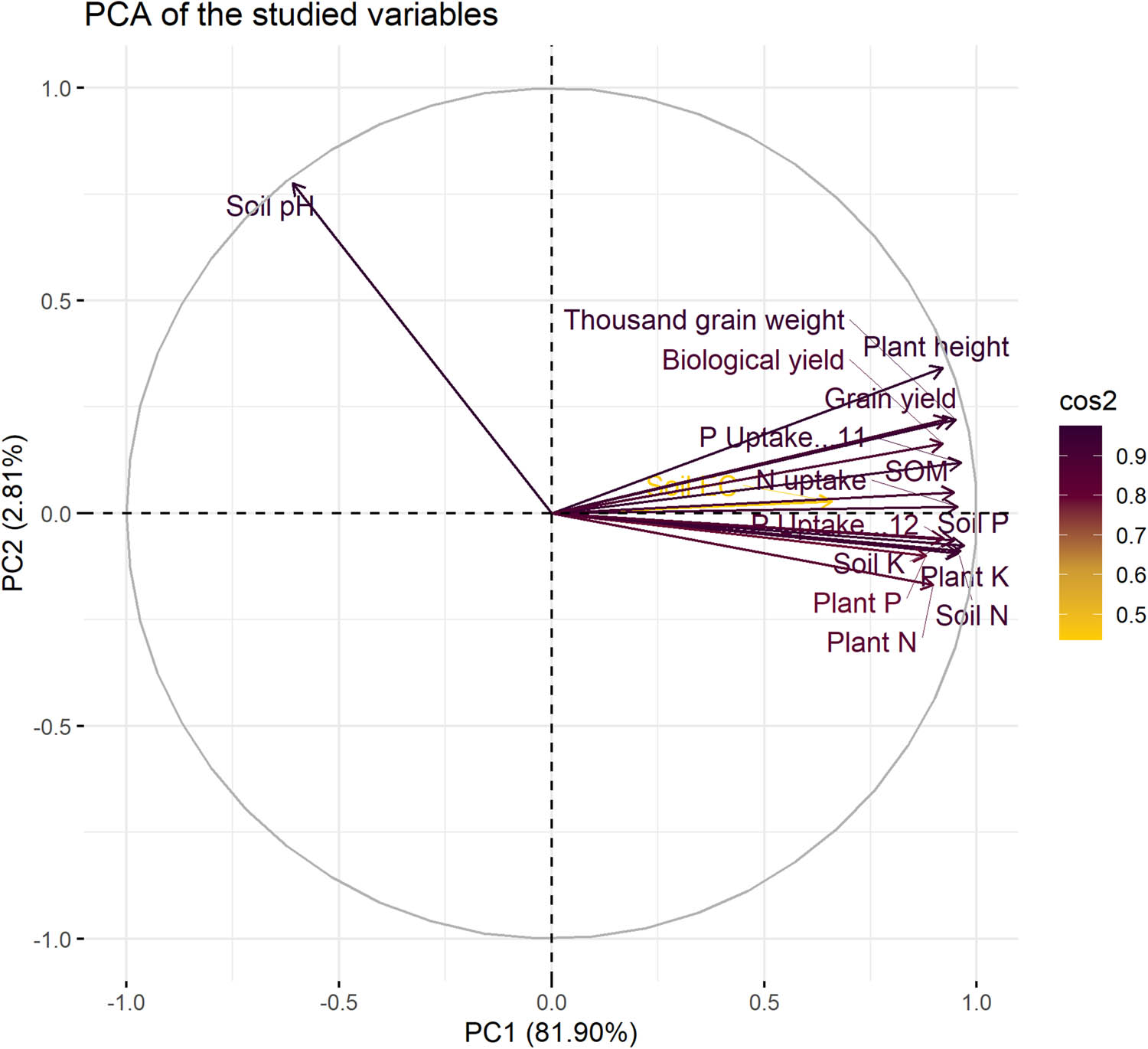
PCA among the soil and plant variables.
4 Discussion
The widespread and unregulated application of synthetic fertilizers has detrimental effects on soil quality, health, and agricultural productivity. To enhance crop production while reducing dependence on synthetic inputs, several sustainable approaches can be adopted, including the use of organic soil amendments and beneficial microorganisms such as PSB. Organic amendments improve not only the physical and chemical properties of soil but also stimulate microbial activity, which plays a crucial role in enhancing nutrient availability and crop yields [23]. In the present research, the inoculation of PSB with RP and PM resulted in a reduction in soil pH, an elevation in SOM content, and an increase in ECe in the soil. These results are in line with the previously conducted experiment where the soil pH was significantly reduced by the combined application of PSB and PM by H+ ions released in the soil, which also enhanced the availability of P in soil pools [51].
PSB is known to secrete various low molecular weight organic acids, such as gluconic, 2-keto gluconic, lactic, malic, acetic, oxalic, and succinic acids, which release H+ ions, thereby acidifying the soil environment and contributing to the reduction in pH [52,53]. These organic acids also facilitate the solubilization of mineral nutrients, particularly from RP, by chelating and releasing essential cations such as Ca2+ and Mg2+, contributing to an increase in soil EC [54,55]. While PSB alone may not significantly increase SOM, their integration with PM provides an additional source of organic carbon, which is vital for improving SOM content. This enhancement in SOM further stimulates microbial activity and supports the mineralization of essential nutrients [56]. Additionally, using PM and bio-slurry together has been proven to boost microbial activity and root colonization, contributing to increased soil organic carbon and improved soil fertility [57]. Besides interaction with organic and inorganic sources and their role in the solubilization of mineral P and other nutrients, PSB can also help in solubilizing mineral P already present in the soil. This was evidenced by Song and coworkers while studying insoluble phosphorus dissolution by Burkholderia cepacia DA23 [58]. Another study showed that Pseudomonas aeruginosa KR270346 also solubilizes phosphorus by secreting GA by direct oxidation pathway as the dominant acid for phosphorus solubilization [59].
Furthermore, the inoculation of PSB along with RP and PM has been shown to significantly improve post-harvest soil levels and plant concentrations of P, N, and K through synergistic interactions. PSB facilitates the solubilization of insoluble phosphorus from RP and native soil minerals by secreting organic acids that lower soil pH and mobilize bound P for plant uptake [53,60]. In the Khyber Pakhtunkhwa Province of Pakistan, huge reservoirs of RP with around 6.9 million tons as resource and 5.58 million tons PR serving as reserves are present [61,62]. However, scientists discourage the direct sole application of RP to the soil. Therefore, we find a new approach to applying RP with organic and bio-fertilizers to increase its solubility and P recovery in nutrient-poor alkaline soils. This claim is supported by the literature where the use of organic amendments (FYM, press-mud, PM, compost, etc.), acid treatment of PR (partially), use of phosphorus-solubilizing microorganisms (PSMs), etc. [63] can reduce the use of chemical fertilizers. Moreover, this approach can be viable, economical, and environmentally friendly in the agricultural context of Pakistan. In parallel, PM serves as a rich source of organic matter, enhancing microbial activity and contributing to P availability through mineralization processes [64]. During the study, the applied PM + RP sources along with PSB inoculation were assessed quantitatively. The results showed that the combination of these three amendments to alkaline calcareous soils released P levels similar to synthetic sources. Based on previous studies, similar results have been recorded by the application of bio-organic-based amendments on P availability and recovery from RP [65,66]. Several other studies have demonstrated that integrating bio-based amendments with RP can substantially improve macronutrient dynamics in soil, particularly P [67,68]. For example, Gangwal et al. [69] reported that PSB seed inoculation stimulates the release of root exudates and residues, further enriching the soil nutrient pool. Adeli et al. [70] observed increased residual NO3-N in soils treated with PM compared to those receiving only inorganic fertilizers. PSB inoculation also led to higher total nitrogen content in soil compared to untreated controls. Enhanced total nitrogen in plant tissues can also be attributed to the nutrient-rich nature of PM, which supports improved plant growth. Akanbi et al. [71] confirmed that the elevated nitrogen levels in PM-amended soils promote the vegetative development of various crops. The combined application of organic and inorganic fertilizers has been found to increase extractable post-harvest K levels compared to the sole use of inorganic fertilizers. This is primarily due to the high K content in PM, which makes it a suitable alternative to synthetic K fertilizers [72]. Moreover, high levels of plant-available potassium and phosphorus in PM-treated plots have been validated by multiple studies, which report greater concentrations of these nutrients compared to untreated soils [73]. Awaad et al. [74] also demonstrated that combining inorganic fertilizers with organic sources, such as farmyard manure, significantly enhances N, P, and K uptake in canola. Additionally, Emami et al. [75] found that co-application of PSB and endophytes improved phosphorus-use efficiency across different wheat cultivars. In sugarcane systems, even the sole application of PSB has been effective in enhancing phosphorus availability and uptake [76].
Soil moisture plays a critical role in sustaining viability and functional activity of PSB, especially under arid and semi-arid climatic conditions. Water availability governs microbial processes in three principal ways: serving as a vital resources, functioning as a solvent for biochemical reactions, and facilitating the transport of solutes and microorganisms within the soil matrix [77]. Enhancements in soil moisture and thermal regimes can stimulate microbial proliferation and enzymatic activity, thereby influencing long-term soil fertility and nutrient cycling [78]. Elevated water content creates a more favorable microenvironment for microbial survival during periods of water stress, which in turn promotes microbial metabolism, respiration, and biomass accumulation [79]. Our experimental findings indicate that co-application of PSB with RP and PM markedly increases nitrogen (N), phosphorus (P), and potassium (K) uptake in maize plants (Figure 4). The most pronounced N uptake occurred in treatments receiving both PM and RP, collaborating the results of Awaad et al. [74]. Similarly, the synergistic application of RP and PM led to substantial improvements in plant P acquisition, which is consistent with observations reported by Aisha and Taalab [80], who demonstrated enhanced N and P uptake with the integrated use of organic amendments and RP. Potassium uptake was also significantly augmented in plots treated with PSB in combination with organic and inorganic inputs. This effect may be attributed to the secretion of organic acids by PSBs, which not only mobilize phosphorus but also facilitate potassium release within the rhizosphere. Notably, amino acids exuded by the roots of crops such as sugar beet have been implicated in enhancing K solubilization from soil minerals [81]. Moreover, both PSB and PM contribute to lowering soil pH through the release of organic acids, thereby improving the solubility and bioavailability of both native and supplementary phosphorus forms [82,83]. Supporting this, previous studies have shown that combined inoculation of PSB strains (e.g., Pseudomonas spp., Azospirillum spp., and Agrobacterium spp.) with RP and PM significantly boosts phosphorus uptake and plant growth in chili, achieving comparable outcomes to those obtained using diammonium phosphate [66].
In addition to improvements in soil properties and nutrient uptake, the application of PSB with RP and PM also led to significant enhancements in various maize growth parameters, including grain yield, biological yield, 1,000-grain weight, and plant height. These findings align with the study by Han and Lee [84], which reported improved root development, shoot biomass, and overall crop yield following PSB inoculation. Further supporting our results, Sharma et al. [85] highlighted that PSB – classified as plant growth-promoting bacteria – stimulates plant growth through multiple mechanisms, notably the production of phytohormones, antibiotics, and siderophores. The release of phytohormones [86] and organic acids [87] by PSB plays a crucial role in enhancing phosphorus solubility, thereby promoting plant development and yield performance.
5 Conclusions
The integrated application of low-grade RP and PM, combined with PSB, significantly improved maize yield, plant growth attributes, and the availability and uptake of N, P, and K in the soil, especially under nutrient-deficient semi-arid conditions. The RP + PSB combination outperformed the sole use of RP, highlighting the potential of microbial inoculation in enhancing P solubility. Based on our findings, we recommend the use of PSB in conjunction with locally available PM and RP as a cost-effective and eco-friendly alternative to commercial P fertilizers. This integrated approach not only boosts crop productivity but also promotes long-term soil health, offering a scalable and sustainable solution for farmers. This approach can be validated as a sustainable soil health improvement in the following subsequent cropping years. Considering the large reserves of RP and substantial PM production in Pakistan, this strategy presents a viable pathway for policymakers and stakeholders aiming to enhance food security and environmental sustainability. We also encourage future studies across different agroecological zones and cropping systems to validate and optimize this approach.
Acknowledgments
The authors would like to acknowledge the University of Agriculture Peshawar, for providing facility to complete this study.
-
Funding information: Open Access funding provided by the Qatar National Library.
-
Author contributions: All authors have accepted responsibility for the entire content of this manuscript and consented to its submission to the journal. All authors have read and agreed to the final draft of the manuscript. KK and HUR: conceptualization, methodology, experimentation, data analysis, writing – original draft. IAM and KMD: investigation, writing – review and editing, validation. WA and JMA: writing – review and editing.
-
Conflict of interest: Authors state no conflict of interest.
-
Data availability statement: Datasets are available in the electronic supplementary materials.
References
[1] Rahim HU, Qaswar M, Uddin M, Giannini C, Herrera ML, Rea G. Nano-enable materials promoting sustainability and resilience in modern agriculture. Nanomaterials. 2021;11(8):2068. 10.3390/nano11082068.Search in Google Scholar PubMed PubMed Central
[2] White PJ, Brown P. Plant nutrition for sustainable development and global health. Ann Bot. 2010;105(7):1073–80. 10.1093/aob/mcq085.Search in Google Scholar PubMed PubMed Central
[3] Rahim HU, Ali W, Uddin M, Ahmad S, Khan K, Bibi H, et al. Abiotic stresses in soils, their effects on plants, and mitigation strategies: a literature review. Chem Ecol. 2024;41(4):552–85. 10.1080/02757540.2024.2439830.Search in Google Scholar
[4] Ahmad B, Rahim HU, Mian IA, Ali W. Synergistic biochar–nitrogen application enhances soil fertility and compensates for nutrient deficiency, improving wheat production in calcareous soil. Sustainability. 2025;17(5):2321. 10.3390/su17052321.Search in Google Scholar
[5] Ju XT, Xing GX, Chen XP, Zhang SL, Zhang LJ, Liu XJ, et al. Reducing environmental risk by improving N management in intensive Chinese agricultural systems. PNAS. 2009;106(9):3041–6. 10.1073/pnas.0813417106.Search in Google Scholar PubMed PubMed Central
[6] Penn CJ, Camberato JJ. A critical review on soil chemical processes that control how soil pH affects phosphorus availability to plants. Agriculture. 2019;9(6):1–18. 10.3390/agriculture9060120.Search in Google Scholar
[7] Qaswar M, Ahmed W, Huang J, Liu Kl, Zhang L, Han TF, et al. Interaction of soil microbial communities and phosphorus fractions under long-term fertilization in paddy soil. J Integr Agric. 2022;21(7):2134–44. 10.1016/S2095-3119(21)63733-4.Search in Google Scholar
[8] Du J, Liu K, Huang J, Han T, Zhang L, Anthonio CK, et al. Organic carbon distribution and soil aggregate stability in response to long-term phosphorus addition in different land-use types. Soil Tillage Res. 2022;215:1–12. 10.1016/j.still.2021.105195.Search in Google Scholar
[9] Ahmed W, Jing H, Kailou L, Ali S, Tianfu H, Geng S, et al. Impacts of long-term inorganic and organic fertilization on phosphorus adsorption and desorption characteristics in red paddies in southern China. PLoS One. 2021;16(1):1–16. 10.1371/journal.pone.0246428.Search in Google Scholar PubMed PubMed Central
[10] Yang J, Kloepper JW, Ryu C-M. Rhizosphere bacteria help plants tolerate abiotic stress. Trends Plant Sci. 2009;14(1):1–4.10.1016/j.tplants.2008.10.004Search in Google Scholar PubMed
[11] Weyens N, van der Lelie D, Taghavi S, Newman L, Vangronsveld J. Exploiting plant–microbe partnerships to improve biomass production and remediation. Trends Biotechnol. 2009;27(10):591–8.10.1016/j.tibtech.2009.07.006Search in Google Scholar PubMed
[12] Jiao X, Maimaitiyiming A, Salahou MK, Liu K, Guo W. Impact of groundwater level on nitrate nitrogen accumulation in the vadose zone beneath a cotton field. Water. 2017;9(3):1–19. 10.3390/w9030171.Search in Google Scholar
[13] Chen X, Cui Z, Fan M, Vitousek P, Zhao M, Ma W, et al. Producing more grain with lower environmental costs. Nature. 2014;514(7523):486–9. 10.1038/nature13609.Search in Google Scholar PubMed
[14] Lammerts van Bueren ET, Struik PC. Diverse concepts of breeding for nitrogen use efficiency. A review. Agron Sustain Dev. 2017;37:1–24. 10.1007/s13593-017-0457-3.Search in Google Scholar
[15] Lynch JP. Root phenotypes for improved nutrient capture: an underexploited opportunity for global agriculture. N Phytol. 2019;223(2):548–64. 10.1111/nph.15738.Search in Google Scholar PubMed
[16] Akbar WA, Ilyas M, Arif M, Rahim HU, Munsif F, Mudassir M, et al. Biochar from on-farm feedstocks for sustainable potassium management in soils. Sustainable agriculture reviews 61: Biochar to improve crop production and decrease plant stress under a changing climate. Cham: Springer; 2023. p. 219–29. 10.1007/978-3-031-26983-7_9.Search in Google Scholar
[17] Khan H, Akbar WA, Shah Z, Rahim HU, Taj A, Alatalo JM. Coupling phosphate-solubilizing bacteria (PSB) with inorganic phosphorus fertilizer improves mungbean (Vigna radiata) phosphorus acquisition, nitrogen fixation, and yield in alkaline-calcareous soil. Heliyon. 2022;8(3):1–10. 10.1016/j.jare.2021.08.014.Search in Google Scholar PubMed PubMed Central
[18] Elhaissoufi W, Ghoulam C, Barakat A, Zeroual Y, Bargaz A. Phosphate bacterial solubilization: A key rhizosphere driving force enabling higher P use efficiency and crop productivity. J Adv Res. 2022;38:13–28. 10.35495/ajab.2019.05.198.Search in Google Scholar
[19] Rahim HU, Mian IA, Arif M, Ahmad S, Khan Z. Soil fertility status as influenced by the carryover effect of biochar and summer legumes. Asian J Agric Biol. 2020;8(1):11–6. 10.35495/ajab.2019.05.198.Search in Google Scholar
[20] Ryan J, Estefan G, Rashid A. Soil and plant analysis laboratory manual. Aleppo, Syria: ICARDA. 2001.Search in Google Scholar
[21] He Z, Bian W, Zhu J. Screening and identification of microorganisms capable of utilizing phosphate adsorbed by goethite. Commun Soil Sci Plant Anal. 2002;33(5–6):647–63. 10.1081/CSS-120003057.Search in Google Scholar
[22] Jones DL. Organic acids in the rhizosphere–a critical review. Plant Soil. 1998;205:25–44.10.1023/A:1004356007312Search in Google Scholar
[23] Adnan M, Fahad S, Zamin M, Shah S, Mian IA, Danish S, et al. Coupling phosphate-solubilizing bacteria with phosphorus supplements improve maize phosphorus acquisition and growth under lime induced salinity stress. Plants. 2020;9(7):1–19. 10.3390/plants9070900.Search in Google Scholar PubMed PubMed Central
[24] Kalayu G. Phosphate solubilizing microorganisms: promising approach as biofertilizers. Int J Agron. 2019;2019(1):1–07. 10.1155/2019/4917256.Search in Google Scholar
[25] Shabaan M, Asghar HN, Zahir ZA, Zhang X, Sardar MF, Li H. Salt-tolerant PGPR confer salt tolerance to maize through enhanced soil biological health, enzymatic activities, nutrient uptake and antioxidant defense. Front Microbiol. 2022;13:1–13. 10.3389/fmicb.2022.901865.Search in Google Scholar PubMed PubMed Central
[26] Zhang Z, Zhu L, Li D, Wang N, Sun H, Zhang Y, et al. In situ root phenotypes of cotton seedlings under phosphorus stress revealed through RhizoPot. Front Plant Sci. 2021;12:1–15. 10.3389/fpls.2021.716691.Search in Google Scholar PubMed PubMed Central
[27] Liang JL, Liu J, Jia P, Yang TtZeng, Zhang QW, SC, et al. Novel phosphate-solubilizing bacteria enhance soil phosphorus cycling following ecological restoration of land degraded by mining. ISME J. 2020;14(6):1600–13. 10.1038/s41396-020-0632-4.Search in Google Scholar PubMed PubMed Central
[28] Neal AL, Blackwell M, Akkari E, Guyomar C, Clark I, Hirsch PR. Phylogenetic distribution, biogeography and the effects of land management upon bacterial non-specific Acid phosphatase Gene diversity and abundance. Plant Soil. 2018;427:175–89. 10.1007/s11104-017-3301-2.Search in Google Scholar PubMed PubMed Central
[29] Shrivastava M, Srivastava P, D’souza S. Phosphate-solubilizing microbes: diversity and phosphates solubilization mechanism. Role of rhizospheric microbes in soil: Volume 2: nutrient management and crop improvement. Singapore: Springer; 2018. p. 137–65. 10.1007/978-81-13-0044-8_5.Search in Google Scholar
[30] Dhuldhaj UP, Malik N. Global perspective of phosphate solubilizing microbes and phosphatase for improvement of soil, food and human health. Cell Mol Biomed Rep. 2022;2(3):173–86. 10.1007/978-81-13-0044-8_5.Search in Google Scholar
[31] Lin L, Li C, Ren Z, Qin Y, Wang R, Wang J, et al. Transcriptome profiling of genes regulated by phosphate-solubilizing bacteria Bacillus megaterium P68 in potato (Solanum tuberosum L.). Front Microbiol. 2023;14:1140752. 10.3389/fmicb.2023.1140752.Search in Google Scholar PubMed PubMed Central
[32] Hoitink HA, Grebus ME. Status of biological control of plant diseases with composts. Compost Sci Util. 1994;2(2):6–12. 10.1080/1065657X.1994.10771134.Search in Google Scholar
[33] Taj A, Bibi H, Akbar WA, Rahim HU, Iqbal M, Ullah S. Effect of poultry manure and NPK compound fertilizer on soil physicochemical parameters, NPK availability, and uptake by spring maize (Zea mays L.) in alkaline-calcareous soil. Gesunde Pflanz. 2023;75(2):393–403. 10.1007/s10343-022-00710-6.Search in Google Scholar
[34] Tandon HLS. Fertilisers, organic manures, recyclable wastes, and biofertilisers. New Delhi, India: Fertiliser Development and Consultation Organisation; 1992. p. 1–148.Search in Google Scholar
[35] Sharif M, Khattak R, Sarir M. Residual effect of humic acid and chemical fertilizers on maize yield and nutrient accumulation. Sarhad J Agric. 2003;19(4):543–50.Search in Google Scholar
[36] Bouyoucos GJ. Hydrometer method improved for making particle size analyses of soils1. Agron J. 1962;54(5):464–65. 10.2134/agronj1962.00021962005400050028x.Search in Google Scholar
[37] McLean E. Soil pH and lime requirement. Methods Soil Anal. 1983;9:199–224. 10.2134/agronmonogr9.2.2ed.c12.Search in Google Scholar
[38] Nelson DW, Sommers LE. Total carbon, organic carbon, and organic matter. Methods Soil Anal. 1983;9:539–79. 10.2134/agronmonogr9.2.2ed.c29.Search in Google Scholar
[39] Ul Haq J, Sharif M, Akbar WA, Ur Rahim H, Ahmad Mian I, Ahmad S, et al. Arbuscular mycorrhiza fungi integrated with single super phosphate improve wheat-nitrogen-phosphorus acquisition, yield, root infection activity, and spore density in alkaline-calcareous soil. Gesunde Pflanz. 2023;75(3):539–48. 10.1007/s10343-022-00718-y.Search in Google Scholar
[40] Krieg NR, Holt JG. Bergey’s manual of systematic bacteriology. Taiwan: Taipei Yi Hsien Publishing Co.; 1984.Search in Google Scholar
[41] Holt JG, Krieg NR, Sneath PH, Staley JT, Williams ST. Bergey’s manual of determinate bacteriology. Food and Agriculture Organization; 1994.Search in Google Scholar
[42] Alagawadi A, Gaur A. Associative effect of Rhizobium and phosphate-solubilizing bacteria on the yield and nutrient uptake of chickpea. Plant Soil. 1988;105:241–6.10.1007/BF02376788Search in Google Scholar
[43] Thomas GW. Soil pH and soil acidity. Methods of soil analysis: part 3 chemical methods. 1996;5:475–90. 10.2136/sssabookser5.3.c16.Search in Google Scholar
[44] Rhoades J. Salinity: Electrical conductivity and total dissolved solids. Methods Soil Analy. 1996;5:417–35.10.2136/sssabookser5.3.c14Search in Google Scholar
[45] Bremner J, Breitenbeck GA. A simple method for determination of ammonium in semimicro‐Kjeldahl analysis of soils and plant materials using a block digester. Commun Soil Sci Plant Anal. 1983;14(10):905–13. 10.1080/00103628309367418.Search in Google Scholar
[46] Olsen SR. Estimation of available phosphorus in soils by extraction with sodium bicarbonate. Washington, DC: USDA; 1954.Search in Google Scholar
[47] Soltanpour P, Schwab A. A new soil test for simultaneous extraction of macro‐and micro‐nutrients in alkaline soils. Commun Soil Sci Plant Anal. 1977;8(3):195–207. 10.1080/00103627709366714.Search in Google Scholar
[48] Bahadur L, Tiwari D, Mishra J, Gupta B. Effect of integrated nutrient management on yield, microbial population and changes in soil properties under rice-wheat cropping system in sodic soil. J Indian Soc Soil Sci. 2012;60(4):326–29.Search in Google Scholar
[49] Nelson DW, Sommers LE. Total carbon, organic carbon, and organic matter. Methods Soil Anal. 1996;5:961–1010. 10.2134/agronmonogr9.2.2ed.c29.Search in Google Scholar
[50] Richards LA. Diagnosis and improvement of saline and alkali soils. Washington, DC: US Government Printing Office; 1954.10.1097/00010694-195408000-00012Search in Google Scholar
[51] Alvarez R, Evans LA, Milham PJ, Wilson MA. Effects of humic material on the precipitation of calcium phosphate. Geoderma. 2004;118(3–4):245–60. 10.1016/S0016-7061(03)00207-6.Search in Google Scholar
[52] Namlı A, Mahmood A, Sevilir B, Özkır E. Effect of phosphorus solubilizing bacteria on some soil properties, wheat yield and nutrient contents. Eurasian J Soil Sci. 2017;6(3):249–58. 10.18393/ejss.293157.Search in Google Scholar
[53] Adnan M, Fahad S, Saleem MH, Ali B, Mussart M, Ullah R, et al. Comparative efficacy of phosphorous supplements with phosphate solubilizing bacteria for optimizing wheat yield in calcareous soils. Sci Rep. 2022;12(1):11997. 10.1038/s41598-022-16035-3.Search in Google Scholar PubMed PubMed Central
[54] Vignesh D, Senthilvalavan P, Manivannan R, Ravikumar C. Effect of different phosphorus sources applied with phosphate solubilizing bacteria on bio-geochemical properties and phosphorus release pattern in vertisol. J Appl Nat Sci. 2021;13(2):715–22. 10.1016/S0016-7061(03)00207-6.Search in Google Scholar
[55] Guéablé YKD, Bohoussou NDY, El Gharous M, El Mejahed K, Hafidi M. Using by-products for rehabilitating mine sites or degraded lands: systematic review and meta-analysis on phosphogypsum, phosphate sludge and sewage sludge. Front Environ Sci. 2025;13:1–14. 10.3389/fenvs.2025.1509156.Search in Google Scholar
[56] Singh L, Sukul P. Impact of vermicompost, farm yard manure, fly ash and inorganic fertilizers on growth and yield attributing characters of maize (Zea mays L.). Plant Arch. 2019;19(2):2193–200.Search in Google Scholar
[57] Nenobesi D, Mella W, Soetedjo P. Utilization of composted animal sludge to improve the environmental capability and biomass of mung bean (Vigna radiata L.) varieties. Bumi Lestari. 2017;17(1):69–81.Search in Google Scholar
[58] Song OR, Lee SJ, Lee YS, Lee SC, Kim KK, Choi YL. Solubilization of insoluble inorganic phosphate by Burkholderia cepacia DA23 isolated from cultivated soil. Braz J Microbiol. 2008;39:151–6. 10.1590/S1517-83822008000100030.Search in Google Scholar
[59] Linu M, Asok AK, Thampi M, Sreekumar J, Jisha M. Plant growth promoting traits of indigenous phosphate solubilizing Pseudomonas aeruginosa isolates from chilli (Capsicum annuum L.) rhizosphere. Commun Soil Sci Plant Anal. 2019;50(4):444–57. 10.1080/00103624.2019.1566469.Search in Google Scholar
[60] Kaleem Abbasi M, Manzoor M. Biosolubilization of phosphorus from rock phosphate and other P fertilizers in response to phosphate solubilizing bacteria and poultry manure in a silt loam calcareous soil. J Plant Nutr Soil Sci. 2018;181(3):345–56. 10.1002/jpln.201800012.Search in Google Scholar
[61] Sharif M, Burni T, Wahid F, Khan F, Khan S, Khan A, et al. Effect of rock phosphate composted with organic materials on yield and phosphorus uptake of wheat and mung bean crops. Pak J Bot. 2013;45(4):1349–56.Search in Google Scholar
[62] Naseer M, Muhammad D. Direct and residual effect of hazara rock phosphate (HRP) on wheat and succeeding maize in alkaline calcareous soils. Pak J Bot. 2014;46(5):1755–61.Search in Google Scholar
[63] Kumari K, Phogat V. Rock phosphate: Its availability and solubilization in the soil–A review. Agric Rev. 2008;29(2):108–16.Search in Google Scholar
[64] Adnan M, Fahad S, Khan IA, Saeed M, Ihsan MZ, Saud S, et al. Integration of poultry manure and phosphate solubilizing bacteria improved availability of Ca bound P in calcareous soils. 3 Biotech. 2019;9:1–10. 10.1007/s13205-019-1894-2.Search in Google Scholar PubMed PubMed Central
[65] Aria MM, Lakzian A, Haghnia GH, Berenji AR, Besharati H, Fotovat A. Effect of Thiobacillus, sulfur, and vermicompost on the water-soluble phosphorus of hard rock phosphate. Bioresour Technol. 2010;101(2):551–4. 10.1016/j.biortech.2009.07.093.Search in Google Scholar PubMed
[66] Abbasi M, Musa N, Manzoor M. Mineralization of soluble P fertilizers and insoluble rock phosphate in response to phosphate-solubilizing bacteria and poultry manure and their effect on the growth and P utilization efficiency of chilli (Capsicum annuum L.). Biogeosciences. 2015;12(15):4607–19. 10.5194/bg-12-4607-2015.Search in Google Scholar
[67] Agyarko K, Abunyewa AA, Asiedu EK, Emmanuel H. Dissolution of rock phosphate in animal manure soil amendment and lettuce growth. Eurasian J Soil Sci. 2016;5(2):84–8. 10.18393/ejss.2016.2.084-088.Search in Google Scholar
[68] Abbasi M, Musa N, Manzoor M. Phosphorus release capacity of soluble P fertilizers and insoluble rock phosphate in response to phosphate solubilizing bacteria and poultry manure and their effect on plant growth promotion and P utilization efficiency of chilli (Capsicum annuum L.). Biogeosci Discuss. 2015;12(2):1839–18. 10.5194/bgd-12-1839-2015.Search in Google Scholar
[69] Gangwal T, Patel M, Jadav N. Effect of phosphorus, sulphur and phosphate solubilising bacteria on yield, nutrient uptake and soil fertility after harvest of mustard. Indian J Agric Sci. 2011;7(8):32–40.Search in Google Scholar
[70] Adeli A, Tewolde H, Sistani K, Rowe D. Comparison of broiler litter and commercial fertilizer at equivalent N rates on soil properties. Commun Soil Sci Plant Anal. 2010;41(20):2432–47. 10.1080/00103624.2010.511374.Search in Google Scholar
[71] Akanbi W, Akande M, Adediran J. Suitability of composted maize straw and mineral nitrogen fertilizer for tomato production. J Veg Sci. 2005;11(1):57–65. 10.1300/J484v11n01_06.Search in Google Scholar
[72] Khan N, Asadullah Bano A. Rhizobacteria and abiotic stress management. Plant growth promoting rhizobacteria for sustainable stress management: volume 1: rhizobacteria in abiotic stress management. Microorganisms for sustainability. Singapore: Springer; 2019. p. 65–80. 10.1007/978-981-13-6536-2_4.Search in Google Scholar
[73] Whalen JK, Chang C, Clayton GW, Carefoot JP. Cattle manure amendments can increase the pH of acid soils. Soil Sci Soc Am J. 2000;64(3):962–6.10.2136/sssaj2000.643962xSearch in Google Scholar
[74] Awaad M, Rashad AA, Bayoumi M. Effect of farmyard manure combined with some phosphate sources on the productivity of canola plants grown on a sandy soil. Res J Agric Sci. 2009;5(6):1176–81.Search in Google Scholar
[75] Emami S, Alikhani HA, Pourbabaee AA, Etesami H, Motasharezadeh B, Sarmadian F. Consortium of endophyte and rhizosphere phosphate solubilizing bacteria improves phosphorous use efficiency in wheat cultivars in phosphorus deficient soils. Rhizosphere. 2020;14:1–08. 10.1016/j.rhisph.2020.100196.Search in Google Scholar
[76] Estrada-Bonilla GA, Durrer A, Cardoso EJ. Use of compost and phosphate-solubilizing bacteria affect sugarcane mineral nutrition, phosphorus availability, and the soil bacterial community. Appl Soil Ecol. 2021;157:103760. 10.1016/j.apsoil.2020.103760.Search in Google Scholar
[77] Tecon R, Or D. Biophysical processes supporting the diversity of microbial life in soil. FEMS Microbiol Rev. 2017;41(5):599–623. 10.1093/femsre/fux039.Search in Google Scholar PubMed PubMed Central
[78] Wang X, Wang G, Guo T, Xing Y, Mo F, Wang H, et al. Effects of plastic mulch and nitrogen fertilizer on the soil microbial community, enzymatic activity and yield performance in a dryland maize cropping system. Eur J Soil Sci. 2021;72(1):400–12. 10.1093/femsre/fux039.Search in Google Scholar
[79] Palansooriya KN, Wong JTF, Hashimoto Y, Huang L, Rinklebe J, Chang SX, et al. Response of microbial communities to biochar-amended soils: a critical review. Biochar. 2019;1:3–22. 10.1007/s42773-019-00009-2.Search in Google Scholar
[80] Aisha HA, Taalab A. Effect of natural and/or chemical potassium fertilizers on growth, bulbs yield and some physical and chemical constituents of onion (Allium cepa L.). Res J Agric Sci. 2008;4(3):228–37.Search in Google Scholar
[81] Rengel Z, Damon PM. Crops and genotypes differ in efficiency of potassium uptake and use. Physiol Plant. 2008;133(4):624–36. 10.1111/j.1399-3054.2008.01079.x.Search in Google Scholar PubMed
[82] Chen Y, Rekha P, Arun A, Shen F, Lai W-A, Young CC. Phosphate solubilizing bacteria from subtropical soil and their tricalcium phosphate solubilizing abilities. Appl Soil Ecol. 2006;34(1):33–41. 10.1016/j.apsoil.2005.12.002.Search in Google Scholar
[83] Nishanth D, Biswas D. Kinetics of phosphorus and potassium release from rock phosphate and waste mica enriched compost and their effect on yield and nutrient uptake by wheat (Triticum aestivum). Bioresour Technol. 2008;99(9):3342–53. 10.1016/j.biortech.2007.08.025.Search in Google Scholar PubMed
[84] Han H, Lee K. Phosphate and potassium solubilizing bacteria effect on mineral uptake, soil availability and growth of eggplant. Res J Agric Biol Sci. 2005;1(2):176–80.Search in Google Scholar
[85] Sharma G, Thakur R, Chouhan N, Keram K. Effect of integrated nutrient management on yield, nutrient uptake, protein content, soil fertility and economic performance of rice (Oryza sativa L.) in a Vertisol. J Indian Soc Soil Sci. 2015;63(3):320–6.10.5958/0974-0228.2015.00042.0Search in Google Scholar
[86] Islam MT, Hossain MM. Plant probiotics in phosphorus nutrition in crops, with special reference to rice. In: Maheshwari D, editor. Bacteria in Agrobiology: Plant Probiotics. Berlin, Heidelberg: Springer; 2012. p. 325–63. 10.1007/978-3-642-27515-9_18Search in Google Scholar
[87] Thakuria D, Talukdar N, Goswami C, Hazarika S, Boro R, Khan M. Characterization and screening of bacteria from rhizosphere of rice grown in acidic soils of Assam. Curr Sci. 2004;86(7):978–85.Search in Google Scholar
© 2025 the author(s), published by De Gruyter
This work is licensed under the Creative Commons Attribution 4.0 International License.
Articles in the same Issue
- Research Articles
- Optimization of sustainable corn–cattle integration in Gorontalo Province using goal programming
- Competitiveness of Indonesia’s nutmeg in global market
- Toward sustainable bioproducts from lignocellulosic biomass: Influence of chemical pretreatments on liquefied walnut shells
- Efficacy of Betaproteobacteria-based insecticides for managing whitefly, Bemisia tabaci (Hemiptera: Aleyrodidae), on cucumber plants
- Assessment of nutrition status of pineapple plants during ratoon season using diagnosis and recommendation integrated system
- Nutritional value and consumer assessment of 12 avocado crosses between cvs. Hass × Pionero
- The lacked access to beef in the low-income region: An evidence from the eastern part of Indonesia
- Comparison of milk consumption habits across two European countries: Pilot study in Portugal and France
- Antioxidant responses of black glutinous rice to drought and salinity stresses at different growth stages
- Differential efficacy of salicylic acid-induced resistance against bacterial blight caused by Xanthomonas oryzae pv. oryzae in rice genotypes
- Yield and vegetation index of different maize varieties and nitrogen doses under normal irrigation
- Urbanization and forecast possibilities of land use changes by 2050: New evidence in Ho Chi Minh city, Vietnam
- Organizational-economic efficiency of raspberry farming – case study of Kosovo
- Application of nitrogen-fixing purple non-sulfur bacteria in improving nitrogen uptake, growth, and yield of rice grown on extremely saline soil under greenhouse conditions
- Digital motivation, knowledge, and skills: Pathways to adaptive millennial farmers
- Investigation of biological characteristics of fruit development and physiological disorders of Musang King durian (Durio zibethinus Murr.)
- Enhancing rice yield and farmer welfare: Overcoming barriers to IPB 3S rice adoption in Indonesia
- Simulation model to realize soybean self-sufficiency and food security in Indonesia: A system dynamic approach
- Gender, empowerment, and rural sustainable development: A case study of crab business integration
- Metagenomic and metabolomic analyses of bacterial communities in short mackerel (Rastrelliger brachysoma) under storage conditions and inoculation of the histamine-producing bacterium
- Fostering women’s engagement in good agricultural practices within oil palm smallholdings: Evaluating the role of partnerships
- Increasing nitrogen use efficiency by reducing ammonia and nitrate losses from tomato production in Kabul, Afghanistan
- Physiological activities and yield of yacon potato are affected by soil water availability
- Vulnerability context due to COVID-19 and El Nino: Case study of poultry farming in South Sulawesi, Indonesia
- Wheat freshness recognition leveraging Gramian angular field and attention-augmented resnet
- Suggestions for promoting SOC storage within the carbon farming framework: Analyzing the INFOSOLO database
- Optimization of hot foam applications for thermal weed control in perennial crops and open-field vegetables
- Toxicity evaluation of metsulfuron-methyl, nicosulfuron, and methoxyfenozide as pesticides in Indonesia
- Fermentation parameters and nutritional value of silages from fodder mallow (Malva verticillata L.), white sweet clover (Melilotus albus Medik.), and their mixtures
- Five models and ten predictors for energy costs on farms in the European Union
- Effect of silvopastoral systems with integrated forest species from the Peruvian tropics on the soil chemical properties
- Transforming food systems in Semarang City, Indonesia: A short food supply chain model
- Understanding farmers’ behavior toward risk management practices and financial access: Evidence from chili farms in West Java, Indonesia
- Optimization of mixed botanical insecticides from Azadirachta indica and Calophyllum soulattri against Spodoptera frugiperda using response surface methodology
- Mapping socio-economic vulnerability and conflict in oil palm cultivation: A case study from West Papua, Indonesia
- Exploring rice consumption patterns and carbohydrate source diversification among the Indonesian community in Hungary
- Determinants of rice consumer lexicographic preferences in South Sulawesi Province, Indonesia
- Effect on growth and meat quality of weaned piglets and finishing pigs when hops (Humulus lupulus) are added to their rations
- Healthy motivations for food consumption in 16 countries
- The agriculture specialization through the lens of PESTLE analysis
- Combined application of chitosan-boron and chitosan-silicon nano-fertilizers with soybean protein hydrolysate to enhance rice growth and yield
- Stability and adaptability analyses to identify suitable high-yielding maize hybrids using PBSTAT-GE
- Phosphate-solubilizing bacteria-mediated rock phosphate utilization with poultry manure enhances soil nutrient dynamics and maize growth in semi-arid soil
- Factors impacting on purchasing decision of organic food in developing countries: A systematic review
- Influence of flowering plants in maize crop on the interaction network of Tetragonula laeviceps colonies
- Bacillus subtilis 34 and water-retaining polymer reduce Meloidogyne javanica damage in tomato plants under water stress
- Vachellia tortilis leaf meal improves antioxidant activity and colour stability of broiler meat
- Evaluating the competitiveness of leading coffee-producing nations: A comparative advantage analysis across coffee product categories
- Application of Lactiplantibacillus plantarum LP5 in vacuum-packaged cooked ham as a bioprotective culture
- Evaluation of tomato hybrid lines adapted to lowland
- South African commercial livestock farmers’ adaptation and coping strategies for agricultural drought
- Spatial analysis of desertification-sensitive areas in arid conditions based on modified MEDALUS approach and geospatial techniques
- Meta-analysis of the effect garlic (Allium sativum) on productive performance, egg quality, and lipid profiles in laying quails
- Optimizing carrageenan–citric acid synergy in mango gummies using response surface methodology
- The strategic role of agricultural vocational training in sustainable local food systems
- Agricultural planning grounded in regional rainfall patterns in the Colombian Orinoquia: An essential step for advancing climate-adapted and sustainable agriculture
- Perspectives of master’s graduates on organic agriculture: A Portuguese case study
- Developing a behavioral model to predict eco-friendly packaging use among millennials
- Government support during COVID-19 for vulnerable households in Central Vietnam
- Citric acid–modified coconut shell biochar mitigates saline–alkaline stress in Solanum lycopersicum L. by modulating enzyme activity in the plant and soil
- Herbal extracts: For green control of citrus Huanglongbing
- Research on the impact of insurance policies on the welfare effects of pork producers and consumers: Evidence from China
- Investigating the susceptibility and resistance barley (Hordeum vulgare L.) cultivars against the Russian wheat aphid (Diuraphis noxia)
- Characterization of promising enterobacterial strains for silver nanoparticle synthesis and enhancement of product yields under optimal conditions
- Testing thawed rumen fluid to assess in vitro degradability and its link to phytochemical and fibre contents in selected herbs and spices
- Protein and iron enrichment on functional chicken sausage using plant-based natural resources
- Fruit and vegetable intake among Nigerian University students: patterns, preferences, and influencing factors
- Bioprospecting a plant growth-promoting and biocontrol bacterium isolated from wheat (Triticum turgidum subsp. durum) in the Yaqui Valley, Mexico: Paenibacillus sp. strain TSM33
- Quantifying urban expansion and agricultural land conversion using spatial indices: evidence from the Red River Delta, Vietnam
- LEADER approach and sustainability overview in European countries
- Influence of visible light wavelengths on bioactive compounds and GABA contents in barley sprouts
- Assessing Albania’s readiness for the European Union-aligned organic agriculture expansion: a mixed-methods SWOT analysis integrating policy, market, and farmer perspectives
- Genetically modified foods’ questionable contribution to food security: exploring South African consumers’ knowledge and familiarity
- The role of global actors in the sustainability of upstream–downstream integration in the silk agribusiness
- Multidimensional sustainability assessment of smallholder dairy cattle farming systems post-foot and mouth disease outbreak in East Java, Indonesia: a Rapdairy approach
- Enhancing azoxystrobin efficacy against Pythium aphanidermatum rot using agricultural adjuvants
- Review Articles
- Reference dietary patterns in Portugal: Mediterranean diet vs Atlantic diet
- Evaluating the nutritional, therapeutic, and economic potential of Tetragonia decumbens Mill.: A promising wild leafy vegetable for bio-saline agriculture in South Africa
- A review on apple cultivation in Morocco: Current situation and future prospects
- Quercus acorns as a component of human dietary patterns
- CRISPR/Cas-based detection systems – emerging tools for plant pathology
- Short Communications
- An analysis of consumer behavior regarding green product purchases in Semarang, Indonesia: The use of SEM-PLS and the AIDA model
- Effect of NaOH concentration on production of Na-CMC derived from pineapple waste collected from local society
Articles in the same Issue
- Research Articles
- Optimization of sustainable corn–cattle integration in Gorontalo Province using goal programming
- Competitiveness of Indonesia’s nutmeg in global market
- Toward sustainable bioproducts from lignocellulosic biomass: Influence of chemical pretreatments on liquefied walnut shells
- Efficacy of Betaproteobacteria-based insecticides for managing whitefly, Bemisia tabaci (Hemiptera: Aleyrodidae), on cucumber plants
- Assessment of nutrition status of pineapple plants during ratoon season using diagnosis and recommendation integrated system
- Nutritional value and consumer assessment of 12 avocado crosses between cvs. Hass × Pionero
- The lacked access to beef in the low-income region: An evidence from the eastern part of Indonesia
- Comparison of milk consumption habits across two European countries: Pilot study in Portugal and France
- Antioxidant responses of black glutinous rice to drought and salinity stresses at different growth stages
- Differential efficacy of salicylic acid-induced resistance against bacterial blight caused by Xanthomonas oryzae pv. oryzae in rice genotypes
- Yield and vegetation index of different maize varieties and nitrogen doses under normal irrigation
- Urbanization and forecast possibilities of land use changes by 2050: New evidence in Ho Chi Minh city, Vietnam
- Organizational-economic efficiency of raspberry farming – case study of Kosovo
- Application of nitrogen-fixing purple non-sulfur bacteria in improving nitrogen uptake, growth, and yield of rice grown on extremely saline soil under greenhouse conditions
- Digital motivation, knowledge, and skills: Pathways to adaptive millennial farmers
- Investigation of biological characteristics of fruit development and physiological disorders of Musang King durian (Durio zibethinus Murr.)
- Enhancing rice yield and farmer welfare: Overcoming barriers to IPB 3S rice adoption in Indonesia
- Simulation model to realize soybean self-sufficiency and food security in Indonesia: A system dynamic approach
- Gender, empowerment, and rural sustainable development: A case study of crab business integration
- Metagenomic and metabolomic analyses of bacterial communities in short mackerel (Rastrelliger brachysoma) under storage conditions and inoculation of the histamine-producing bacterium
- Fostering women’s engagement in good agricultural practices within oil palm smallholdings: Evaluating the role of partnerships
- Increasing nitrogen use efficiency by reducing ammonia and nitrate losses from tomato production in Kabul, Afghanistan
- Physiological activities and yield of yacon potato are affected by soil water availability
- Vulnerability context due to COVID-19 and El Nino: Case study of poultry farming in South Sulawesi, Indonesia
- Wheat freshness recognition leveraging Gramian angular field and attention-augmented resnet
- Suggestions for promoting SOC storage within the carbon farming framework: Analyzing the INFOSOLO database
- Optimization of hot foam applications for thermal weed control in perennial crops and open-field vegetables
- Toxicity evaluation of metsulfuron-methyl, nicosulfuron, and methoxyfenozide as pesticides in Indonesia
- Fermentation parameters and nutritional value of silages from fodder mallow (Malva verticillata L.), white sweet clover (Melilotus albus Medik.), and their mixtures
- Five models and ten predictors for energy costs on farms in the European Union
- Effect of silvopastoral systems with integrated forest species from the Peruvian tropics on the soil chemical properties
- Transforming food systems in Semarang City, Indonesia: A short food supply chain model
- Understanding farmers’ behavior toward risk management practices and financial access: Evidence from chili farms in West Java, Indonesia
- Optimization of mixed botanical insecticides from Azadirachta indica and Calophyllum soulattri against Spodoptera frugiperda using response surface methodology
- Mapping socio-economic vulnerability and conflict in oil palm cultivation: A case study from West Papua, Indonesia
- Exploring rice consumption patterns and carbohydrate source diversification among the Indonesian community in Hungary
- Determinants of rice consumer lexicographic preferences in South Sulawesi Province, Indonesia
- Effect on growth and meat quality of weaned piglets and finishing pigs when hops (Humulus lupulus) are added to their rations
- Healthy motivations for food consumption in 16 countries
- The agriculture specialization through the lens of PESTLE analysis
- Combined application of chitosan-boron and chitosan-silicon nano-fertilizers with soybean protein hydrolysate to enhance rice growth and yield
- Stability and adaptability analyses to identify suitable high-yielding maize hybrids using PBSTAT-GE
- Phosphate-solubilizing bacteria-mediated rock phosphate utilization with poultry manure enhances soil nutrient dynamics and maize growth in semi-arid soil
- Factors impacting on purchasing decision of organic food in developing countries: A systematic review
- Influence of flowering plants in maize crop on the interaction network of Tetragonula laeviceps colonies
- Bacillus subtilis 34 and water-retaining polymer reduce Meloidogyne javanica damage in tomato plants under water stress
- Vachellia tortilis leaf meal improves antioxidant activity and colour stability of broiler meat
- Evaluating the competitiveness of leading coffee-producing nations: A comparative advantage analysis across coffee product categories
- Application of Lactiplantibacillus plantarum LP5 in vacuum-packaged cooked ham as a bioprotective culture
- Evaluation of tomato hybrid lines adapted to lowland
- South African commercial livestock farmers’ adaptation and coping strategies for agricultural drought
- Spatial analysis of desertification-sensitive areas in arid conditions based on modified MEDALUS approach and geospatial techniques
- Meta-analysis of the effect garlic (Allium sativum) on productive performance, egg quality, and lipid profiles in laying quails
- Optimizing carrageenan–citric acid synergy in mango gummies using response surface methodology
- The strategic role of agricultural vocational training in sustainable local food systems
- Agricultural planning grounded in regional rainfall patterns in the Colombian Orinoquia: An essential step for advancing climate-adapted and sustainable agriculture
- Perspectives of master’s graduates on organic agriculture: A Portuguese case study
- Developing a behavioral model to predict eco-friendly packaging use among millennials
- Government support during COVID-19 for vulnerable households in Central Vietnam
- Citric acid–modified coconut shell biochar mitigates saline–alkaline stress in Solanum lycopersicum L. by modulating enzyme activity in the plant and soil
- Herbal extracts: For green control of citrus Huanglongbing
- Research on the impact of insurance policies on the welfare effects of pork producers and consumers: Evidence from China
- Investigating the susceptibility and resistance barley (Hordeum vulgare L.) cultivars against the Russian wheat aphid (Diuraphis noxia)
- Characterization of promising enterobacterial strains for silver nanoparticle synthesis and enhancement of product yields under optimal conditions
- Testing thawed rumen fluid to assess in vitro degradability and its link to phytochemical and fibre contents in selected herbs and spices
- Protein and iron enrichment on functional chicken sausage using plant-based natural resources
- Fruit and vegetable intake among Nigerian University students: patterns, preferences, and influencing factors
- Bioprospecting a plant growth-promoting and biocontrol bacterium isolated from wheat (Triticum turgidum subsp. durum) in the Yaqui Valley, Mexico: Paenibacillus sp. strain TSM33
- Quantifying urban expansion and agricultural land conversion using spatial indices: evidence from the Red River Delta, Vietnam
- LEADER approach and sustainability overview in European countries
- Influence of visible light wavelengths on bioactive compounds and GABA contents in barley sprouts
- Assessing Albania’s readiness for the European Union-aligned organic agriculture expansion: a mixed-methods SWOT analysis integrating policy, market, and farmer perspectives
- Genetically modified foods’ questionable contribution to food security: exploring South African consumers’ knowledge and familiarity
- The role of global actors in the sustainability of upstream–downstream integration in the silk agribusiness
- Multidimensional sustainability assessment of smallholder dairy cattle farming systems post-foot and mouth disease outbreak in East Java, Indonesia: a Rapdairy approach
- Enhancing azoxystrobin efficacy against Pythium aphanidermatum rot using agricultural adjuvants
- Review Articles
- Reference dietary patterns in Portugal: Mediterranean diet vs Atlantic diet
- Evaluating the nutritional, therapeutic, and economic potential of Tetragonia decumbens Mill.: A promising wild leafy vegetable for bio-saline agriculture in South Africa
- A review on apple cultivation in Morocco: Current situation and future prospects
- Quercus acorns as a component of human dietary patterns
- CRISPR/Cas-based detection systems – emerging tools for plant pathology
- Short Communications
- An analysis of consumer behavior regarding green product purchases in Semarang, Indonesia: The use of SEM-PLS and the AIDA model
- Effect of NaOH concentration on production of Na-CMC derived from pineapple waste collected from local society
