The agriculture specialization through the lens of PESTLE analysis
-
Liana Khachatryan
 ,
Shogher Poghosyan
,
Shogher Poghosyan

Abstract
Economic specialization and diversification have long been central themes in spatial development studies. This article aims to evaluate the role of state policy in shaping the specialization of agricultural organizations (farms), using evidence from Armenia. Given Armenia’s diverse climatic conditions, it is essential to promote agricultural specialization that aligns with regional characteristics while ensuring maximum efficiency, minimal environmental impact, social benefits, and optimal resource use – principles that align with the United Nations Sustainable Development Goals. The article utilizes a mixed-method approach, combining political, economic, social, technological, legal, and environmental (PESTLE) analyses – a framework that considers PESTLE factors, with weighted scoring, a quantitative method used to assess and rank alternatives based on expert-defined criteria. Regional agricultural output data from 2018 to 2022, specifically in horticulture and animal husbandry, were analyzed to identify prevailing patterns of specialization across Armenian regions. Expert evaluations were conducted using a Likert scale to assess the potential impact of selected policy measures. Findings indicate that technological and economic factors (such as support programs for pedigree farms and agricultural insurance) exert the most significant influence on specialization outcomes. Notable regional disparities in land use and production emphasize the need for spatially informed, targeted policy interventions. This article not only identifies high-impact state measures but also offers practical policy recommendations aimed at enhancing resource efficiency, boosting agricultural productivity, and strengthening food security. The proposed methodological framework can be adapted for use in other regions or countries facing similar challenges in agricultural planning and specialization.
1 Introduction
Agriculture is a crucial sector in any nation, providing essential food and raw materials for the processing industry and playing a key role in shaping public health and quality of life. In Armenia, the significance of agriculture extends beyond just economic importance: it directly influences food security, the well-being of rural communities, and the overall socio-economic stability of the country. Armenia is strategically positioned to pursue the United Nations Sustainable Development Goals (SDGs) related to agriculture, because the country benefits from long growing seasons, favorable agro-climatic zones for early harvests, a rich agricultural heritage, and proximity between rural and urban areas. Despite these advantages, the agricultural sector faces significant challenges, including fragmented land ownership, inefficient resource use, outdated cultivation machinery and technologies, limited access to finance, and underdeveloped infrastructure. Additionally, a shortage of skilled professionals and effective agricultural solutions further hinders growth and modernization. As Armenia navigates its current socio-economic and political climate, the matter of ensuring economic security and prioritizing national interests has become more pressing than ever [1]. In this scope food security is a cornerstone of the population’s survival and welfare [2]. Given the central role of agriculture in Armenia’s economy, addressing challenges in this sector is essential for achieving long-term sustainable development.
Agricultural specialization plays a critical role in addressing these challenges. The efficient use of resources and the enhancement of commercial production are deeply tied to strategic agricultural specialization [3] and the rational combination of production branches [4]. Specialization allows farms and agricultural regions to focus on a narrower range of products based on comparative advantage, market demand, and environmental suitability. While the trend of shifting towards specialization has deep historical roots, it remains a dynamic process, shaped by technological advancements, market changes, and policy shifts. However, the lack of an in-depth understanding of the factors influencing agricultural specialization in Armenia presents a research gap that this study seeks to address.
This article aims to explore the key factors influencing agricultural specialization in Armenia and to assess the impact of these factors in promoting sustainable agricultural practices. Specifically, the article seeks to answer the following questions:
What are the current directions of agricultural specialization in the Armenian regions?
What are the key factors influencing agricultural specialization in Armenia?
What is the impact of the main factors of agricultural specialization in Armenia?
How can the significance of each factor influencing agricultural specialization be determined?
What measures can be developed to implement the key factors that influence agricultural specialization?
What potential changes in the agricultural sector can be forecasted based on the identified factors and their impacts?
The study uses the political, economic, social, technological, legal, and environmental (PESTLE) method to identify PESTLE factors influencing agricultural specialization, and through a weighted assessment by experts, determines the most important factors and assesses the potential impact of those factors on specialization. This mixed-method approach allows for a comprehensive understanding of both the macro-level factors and their practical applications in shaping agricultural policies and practices in Armenia. This study is important because it fills the literature gap by examining the specific factors that influence agricultural specialization in Armenia, a region with unique agricultural challenges and opportunities. While previous studies have addressed agriculture in broader terms, few have delved into the specific drivers and outcomes of specialization within the Armenian context. This study provides valuable insights for policymakers, farmers, and industry stakeholders working to enhance the sustainability and efficiency of the agricultural sector.
2 Literature review
According to Grigg [5], the Industrial Revolution and subsequent urbanization created a demand for more diverse agricultural products, prompting farmers to specialize in crops that were most profitable or best suited to their land. This period marked a pivotal transition from subsistence farming to market-oriented agriculture. Several economic theories underpin the rationale for agricultural specialization. The principle of comparative advantage, articulated by David Ricardo in the early 19th century, suggests that regions should specialize in producing goods for which they have a relative efficiency advantage. Supporting this theory, empirical studies by Johnson and Mellor [6] demonstrated that specialization can lead to increased productivity and income.
Agricultural specialization has distinct characteristics due to the unique nature of agriculture as an economic sector. Key influencing elements include climatic conditions, the biological aspects of production, seasonality in output and income, and challenges in transporting and storing agricultural products. Unlike other industries, specialization in agriculture cannot be overly narrow or homogeneous. It is often shaped by the rational use of land, labor, and resources, the presence of processing facilities, intra-farm demands for food and fodder, and spatial distribution. For example, narrow specialization in horticulture is considered agronomically unsound, as continuous cultivation of the same crop in a single area reduces soil fertility and yields, thus requiring crop rotation [7]. Studies have shown that diversified farms tend to offer greater environmental sustainability, albeit sometimes at the cost of lower economic efficiency compared to specialized farms [8].
Factors influencing agricultural specialization can be grouped according to:
The diversity of climatic conditions and spatial distribution of farms,
Availability of technical and labor resources,
The necessity of sustainable land use and soil fertility maintenance through crop rotation,
The development level of transportation infrastructure [9],
The capacity for adopting innovations, and
The self-sufficiency level of the population.
Incorporating a more modern approach, smart specialization in farms is increasingly seen as a means to enhance management efficiency. It involves reorienting agricultural enterprises toward strategically innovative diversification, focusing on niche markets, and achieving a balance between efficiency and sensitivity to market demands [10].
One of the leading scholars in agricultural specialization, Professor A. Antoine of René University in Western France, explored the evolution of specialization in European countries in his influential work, agricultural specialization and rural development patterns [11]. This research analyzed the historical shifts in production orientation, market dynamics, and rural management strategies, from early periods to the modern era. The study also highlighted the environmental and social implications of specialization. Monoculture practices, often associated with specialization, can lead to soil degradation, reduced biodiversity, and increased vulnerability to pests and diseases [12]. However, if managed sustainably, specialization can increase resource use efficiency and improve rural livelihoods.
The recent literature underscores the importance of strategic agricultural specialization that combines different production branches to enhance the efficiency and sustainability of land use [4]. Optimal specialization must balance productivity and profitability with factors such as labor security and effective management practices [13]. Rational choices in commodity specialization, particularly when aimed at maximizing output and the efficient use of labor and capital, are critical for improving overall production efficiency [3]. Various studies on farm efficiency across different countries and agricultural sub-sectors affirm that the degree and direction of specialization significantly impact productivity. For example, specialization in Ethiopia’s coffee sector has enhanced export revenues but simultaneously increased vulnerability to price fluctuations and climate variability [14]. New Zealand’s dairy industry illustrates successful specialization bolstered by supportive policies and innovation [15]. Research in potato farming demonstrates a strong correlation between specialization and technical efficiency, with geographic factors such as farm size, elevation, and location playing key roles [16]. Yet, recent micro-level studies suggest that specialization now exerts a stronger influence on production efficiency than geographic variables. Specializing in particular grape varieties [17] or specific production routes in pig breeding [18] has improved technical and operational efficiency. At the micro (farm) level, specialization yields multiple benefits that boost farm efficiency, including:
Lower unit costs due to production scale increases and added value generation,
Labor economization through repetitive task specialization, enhancing productivity, and reducing costs,
Enhanced competitiveness by leveraging comparative advantages,
Simpler organization and reduced material consumption from improved control over technological processes, and
Lower transaction costs and improved marketing effectiveness for agricultural products [8].
It is essential to recognize the broader political, ecological, and socio-economic influences on specialization. Government policies (through subsidies, trade frameworks, and innovation support) can either promote or hinder agricultural specialization. As Anderson [19] noted, reforms that facilitate market access and the adoption of technology are essential for effective specialization. State policies should aim not only to boost farm profitability but also to ensure food security and preserve ecosystem services [20,21,22].
This literature review highlights that agricultural specialization, when guided by knowledge-based strategies and smart specialization principles, can significantly enhance the productivity, efficiency, and sustainability of farming systems. By aligning specialization with innovation, ecological stewardship, and market responsiveness, farms can achieve more than just economic efficiency: they can contribute to broader development goals such as food security, poverty reduction, and environmental protection. This integrated approach is essential for advancing the sustainable development of agriculture, particularly in the context of the SDGs, where responsible production, climate resilience, and inclusive growth remain central priorities.
3 Methodology
In economic research, when analyzing entities such as a country, sector, branch, or company, qualitative assessment methods are frequently used to evaluate internal and external environments. Widely recognized analytical tools in this regard include SWOT, PEST, STEP, SLEPT, STEEPLE, and PESTLE. In this study, considering the multifaceted and cross-sectoral nature of agricultural specialization, we employed the PESTLE analysis. This approach provides a structured framework to capture the broad spectrum of external macro-environmental factors influencing agricultural specialization in Armenia.
The selection of the PESTLE method was not arbitrary. It enables the identification of critical factors shaping specialization patterns and supports the development of policies aligned with these influential elements [23]. For instance, Mihailova of the Institute of Agricultural Economics of the Sofia Agricultural Academy has applied this method in her study “The State of Agriculture in Bulgaria” highlighting its relevance in evaluating external strengths and weaknesses [24]. Likewise, PESTLE analysis is also utilized in crisis management studies, offering a systematic yet flexible way of analyzing complex dynamics, especially when traditional approaches struggle to bridge abstract research with real-world implications [25].
In this study within PESTLE analysis number of strategic policy measures were selected as influencing factors that shape specialization decisions at the farm level, such as choices related to the production direction or resource distribution. The selection of factors and policy measures aligns with the “2020–2030 Strategy of the Main Directions Ensuring the Economic Development of the Agricultural Sector of the Republic of Armenia” [26]. The six groups of PESTLE factors were compiled from policy initiatives, legal regulations, and strategic development plans (see Table 1). These measures were selected based on their anticipated impact on the agricultural sector and their ability to influence production trends and specialization over time. Table 1 provides a comprehensive categorization of relevant PESTLE factors, all drawn from national strategies and legislative initiatives.
The PESTLE factors of the study
| Political |
| Implementation of the registration system of agricultural enterprises (planned in the 2020–2030 strategy) |
| Funding of targeted places for agricultural professions by the Government |
| Management of pedigree animal cadastre (the law was approved in 2005) |
| Economic |
| Implementation of the agricultural insurance system (state support program from 2023) |
| Application of certification system for seeds and seedlings (the law was approved in 2022) |
| Implementation of support programs for non-commercial agricultural cooperatives (planned in the 2020–2030 strategy) |
| Social |
| Creation of a guarantee fund for agricultural loans |
| Development of primary agricultural infrastructure (planned in the 2020–2030 strategy) |
| Implementation of agrotourism support programs (support for tourism, 2022) |
| Technological |
| Implementation of support programs promoting drip irrigation |
| Implementation of pedigree farms support programs |
| Implementation of support programs aimed at agricultural zonal specialization |
| Environmental |
| Implementation of support programs aimed at organic agriculture |
| Implementation of alternative energy usage support programs in agriculture |
| Creation of a legal framework for appropriation of unused lands |
| Legal |
| Tax incentives for SMEs in agriculture |
| RA Law “On Agricultural Activities” |
| RA Law “On Leasing of Agricultural Machinery” |
*Composed by the authors.
The core methodology framework of this study is illustrated in Figure 1 and follows these successive stages:
Determination of regional specialization trends: the study began by identifying patterns of agricultural specialization across Armenian regions based on gross output data from two main branches (horticulture and animal husbandry) over the period 2018–2022. This provided a factual basis for analyzing how macro factors align with or influence existing specialization trends.
Identification and prioritization of external factors via PESTLE: a wide array of PESTLE factors was identified. From this broader set, priority factors were selected through detailed PESTLE analysis. These factors reflect those policy directions and macro-level measures that have the potential to significantly shape agricultural decision-making and resource allocation.
Initial impact assessment: each identified factor was initially evaluated by the authors using a simple 1–3 scale:
1 point was assigned to factors corresponding to measures not yet implemented.
2 points were given for moderate-impact or partially implemented initiatives.
3 points were attributed to those having strong, observable influence or full-scale implementation.
Expert evaluation of PESTLE factors: To enhance objectivity and depth, a panel of six experts was assembled to assess the same set of factors. These experts were selected to represent a broad spectrum of the agricultural sector (ranging from academia to field practitioners):
Expert 1: Vice-Rector for Science, Armenian National Agrarian University (ANAU), Doctor of Sciences (Economics).
Expert 2: Director of the Agrarian Policy and Economics Research Center (ANAU), PhD in Economics.
Expert 3: President of “Ekoradar” NGO, environmental expert, PhD in Economics.
Expert 4: Scientific Secretary of the Institute of Economics, NAS RA, PhD in Economics.
Expert 5: Leading farmer trained in the “Smart Farm” program.
Expert 6: Chief agronomist and consultant, PhD in Agricultural Sciences.
The evaluation process was conducted through face-to-face interviews. Each expert received an evaluation form and assessed the potential impact of each factor.
Use of Likert scale for expert evaluation: the experts’ assessments were performed using a Likert scale (1–5), a tool widely accepted in social science research for capturing subjective judgments [27]. Here, 1 indicated strong disagreement with the factor’s potential impact and 5 reflected strong agreement. This approach allowed for a nuanced, flexible assessment of each factor’s perceived influence.
Calculation of weighted coefficients: the results of expert evaluations were then used to calculate weighted coefficients for each factor. This allowed for a composite score reflecting both expert opinion and policy relevance. The calculation followed these formulas:
(1)(2)where
Ranking the factors and strategic recommendations: based on the calculated coefficients, each factor was ranked in terms of its influence on specialization. Higher weighted values indicated greater strategic importance. This ranking was then used to formulate specific recommendations for the development of agricultural specialization strategies in Armenia.
Forecasting and policy planning: the outcomes of the PESTLE evaluation were applied in a forward-looking context. For each key factor, targeted policy and implementation measures were proposed. The anticipated effects of these measures were then projected in terms of their potential to reshape agricultural specialization dynamics at the regional level.
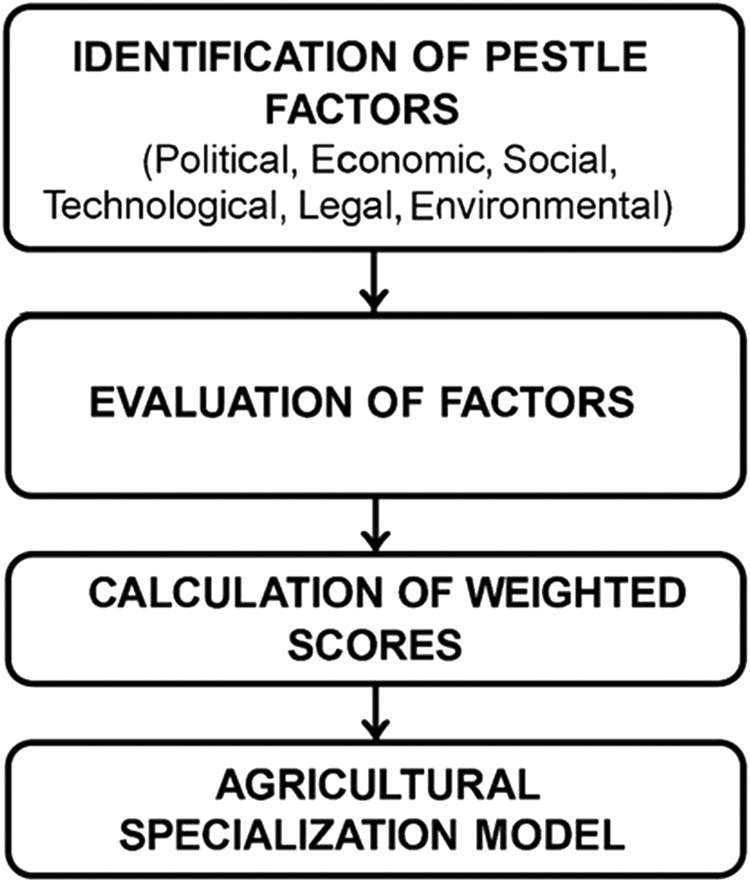
Methodology framework of the study.
The proposed approach integrates several research methods and analytical techniques to model agricultural specialization in Armenia and to forecast potential changes in the sector. Each stage of the methodological framework contributes to shaping a comprehensive view of agricultural specialization through the lens of PESTLE analysis. This approach is versatile and can be effectively applied to other countries and regions where specialization and agricultural policymaking are of strategic importance.
-
Informed consent: Permission to conduct the interviews for this research was obtained by all experts, who were fully informed about the purposes of the research and how their responses would be used and stored. Before participation, all experts gave their written consent.
4 The state of agriculture specialization in Armenia
Agriculture has a crucial role in the economic stability and food security of Armenia [28]. As of 2022, agriculture provides 10.4% of the GDP, the share of food products in the export volume is 23.9%, about 317 thousand farms operate in this sector, and 2042.4 thousand ha or 68.7% of the total area of Armenia are agricultural lands [29,30,31]. Despite these circumstances, the Global Food Safety Index of Armenia was 57.1, including 51.7 in terms of food availability, 66.2 in terms of accessibility, and 45.4 in terms of quality and safety [32]. In 2020, the Global Food Safety Index of Armenia was 59.4, including 64.9 for food availability, 55.4 for accessibility, and 65.1 for quality and safety. Even though the value of the Index has risen, the accessibility has dropped significantly, and the studies show that the overall state of food security in post-COVID Armenia has worsened [33,34,35]. The state of the agriculture specialization can be summarized in the following main points:
The dynamics of gross product per unit of land and per unit of labor are positive (with 65 and 193%, respectively). However, during the same period, the cultivated area of arable lands and the number of employed in agriculture were reduced by 25 and 45%, respectively.
According to data from the RA Statistical Committee, food products with high self-sufficiency are potatoes, fruits and vegetables, eggs, sheep, and goat meat (averaged data for 2017–2022). Conversely, the self-sufficiency level of wheat, vegetable oils, poultry, and legumes has decreased and is below average. However, it is noteworthy, that according to studies, Armenia has certain potential in regards to increasing the self-sufficiency of wheat, legumes, milk and dairy products, beef, pork, and poultry and that can be ensured through the implementation of sound state policy [35].
Despite low self-sufficiency in food products, the state of arable land use in Armenia is inadmissible. According to the RA Statistical Committee data, in 2022, the percent of cultivated arable land was 48.1% (212.4 thousand ha). In other words, 52.0% of the arable land is not utilized despite low self-sufficiency of strategic food products.
Due to Armenia’s climatic conditions and geographic characteristics, the agricultural distribution by regions is highly uneven. Studies reveal that, in 2022, 79.5% of the grain and legume production is concentrated in 5 regions (occupying 67.8% of the total arable land of the country): Shirak region – 26.0%, Aragatsotn and Syunik regions – 13.8% each, Lori region – 13.5%, and Gegharkunik region – 12.3%. The remaining five regions produced only 20.5% of the total grain. There is a big difference in the specialization of other food products between regions. For example, the Gegharkunik region is the undisputed leader in potato production, where 36.2% of the total potato was produced. The production of fruits, grapes, and vegetables is concentrated in Ararat and Armavir regions: 59.2, 88.5, and 85.9% of the total production, respectively (in 2022). As can be seen from Figure 2, the horticulture is mainly concentrated in the Armavir and Ararat regions.
It must be noted that compared to horticulture, animal husbandry has more even distribution (Figure 3), considering the production requirements of animal husbandry are more easily manageable. However, Figure 3 makes it apparent that mountainous regions (Syunik, Gegharkunik, Aragatsotn, and Shirak are frontrunners with animal husbandry output).
The availability of fodder crop cultivation, fodder production, grasslands, and pastures directly determines the distribution and specialization of animal husbandry subsectors in the Armenian regions. Studies revealed that beef livestock had had the following distribution: Gegharkunik region – 16.0%, Shirak region – 13.3%, Armavir region – 12.2%, Lori region – 12.1%, and Aragatsotn region – 10.6 %. These five regions account for 56.3% of the total pastures of Armenia. The Gegharkunik, Shirak, and Lori regions are the leaders in milk production, with 45.5% of the gross product (623.1 thousand tons in 2022). Armavir and Kotayk regions are specialized in egg production, and they account for 44.2% of the gross egg product (749.1 million units in 2022).

Gross product dynamics of horticulture according to individual regions of RA, at current prices, AMD. Source: The publications of RA Statistical Committee.

Gross product dynamics of animal husbandry according to individual regions of RA, at current prices, AMD. Source: The publications of RA Statistical Committee.
Climate change [36,37], the adverse effects of COVID-19, and the recent Russian–Ukrainian war [38] have exacerbated the issues of food security in Armenia. By possessing huge land, labor, material, and natural resources, the management of intensive agriculture becomes the primary force in the path of food security and sustainable development. The practicing of intensive agriculture, the effective use of resources, and the increase in production efficiency are largely determined by the choice of economically justified specialization of organizations and the rational spatial distribution of agriculture subsectors. The diversity of subsectors and agriproducts, the large set of applied production means and technologies, the consequences, and effects of climatic conditions, low profitability, and constantly changing market supply and demand make agricultural specialization difficult to model in Armenia. Under the impact of various socio-economic factors, the specialization of agricultural zones has changed noticeably [39]. The Government has put the problem of the rational combination of agricultural subsectors and the directions of specialization in regions as the basis of the long-term planning of agriculture and food security (the preferred directions of specialization of regions are outlined in the Government’s Decision No. 1476-N, dated 04.11.2010) [40]. In addition, the Government developed “the 2020–2030 strategy of the main directions for the economic development of the agricultural sector,” where a complex of measures is presented to solve the proposed problems and issues of increasing exports, human and institutional capacity development, transition to digital agriculture, and rural community development. The planned actions and measures will directly affect every economic activity of the agro-industrial complex. Studies show that agri-food products’ export is a driving force for further development and extended production [41]. Nevertheless, digitalization is another objective reality affecting rural development [42,43], structural changes in labor [44], etc. According to the implementation schedule, some of the measures have already been implemented and have a particular impact on the production activities of those engaged in agriculture, and others are in progress [45].
5 Results of expert evaluation of PESTLE factors
The evaluation and rating of PESTLE factors are presented in detail in Table 2.
The evaluation of PESTLE factors
| Factor | The actual effect of the factor, y 1 (1–3)* | The estimated impact of the measures in case of full implementation evaluated by the experts (1–5) | Arithmetic mean,
|
Weight-adjusted score,
|
|||||
|---|---|---|---|---|---|---|---|---|---|
| Expert 1, x 1 | Expert 2, x 2 | Expert 3, x 3 | Expert 4, x 4 | Expert 5, x 5 | Expert 6, x 6 | ||||
| Political factors | |||||||||
| Implementation of the registration system of agricultural enterprises (planned in the 2020–2030 strategy) | 1 | 4 | 5 | 3 | 3 | 2 | 1 | 3.00 | 0.12 |
| Funding of targeted places for agricultural professions by the Government | 1 | 5 | 5 | 2 | 3 | 3 | 4 | 3.67 | 0.15 |
| Management of pedigree animal cadaster (the law was approved in 2005) | 2 | 3 | 5 | 2 | 3 | 5 | 4 | 3.67 | 0.29 |
| Economic factors | |||||||||
| Implementation of the agricultural insurance system (state support program from 2023) | 2 | 3 | 5 | 3 | 5 | 5 | 5 | 4.33 | 0.35 |
| Application of certification system for seeds and seedlings (the law was approved in 2022) | 2 | 3 | 5 | 1 | 2 | 4 | 4 | 3.17 | 0.25 |
| Implementation of support programs for non-commercial agricultural cooperatives (planned in the 2020–2030 strategy) | 1 | 3 | 5 | 2 | 3 | 2 | 2 | 2.83 | 0.11 |
| Social factors | |||||||||
| Creation of a guarantee fund for agricultural loans | 1 | 3 | 5 | 2 | 4 | 4 | 5 | 3.83 | 0.15 |
| Development of primary agricultural infrastructure (planned in the 2020–2030 strategy) | 2 | 4 | 5 | 2 | 4 | 5 | 5 | 4.17 | 0.33 |
| Implementation of agrotourism support programs (support for tourism, 2022) | 1 | 3 | 3 | 3 | 5 | 3 | 4 | 3.50 | 0.14 |
| Technological factors | |||||||||
| Implementation of support programs promoting drip irrigation | 1 | 3 | 3 | 3 | 4 | 3 | 3 | 3.17 | 0.13 |
| Implementation of pedigree farms support programs | 3 | 4 | 5 | 2 | 4 | 5 | 5 | 4.17 | 0.50 |
| Implementation of support programs aimed at agricultural zonal specialization | 1 | 4 | 4 | 1 | 3 | 4 | 4 | 3.33 | 0.13 |
| Environmental factors | |||||||||
| Implementation of support programs aimed at organic agriculture | 1 | 2 | 3 | 3 | 5 | 2 | 3 | 3.00 | 0.12 |
| Implementation of alternative energy usage support programs in agriculture | 1 | 2 | 4 | 3 | 5 | 2 | 1 | 2.83 | 0.11 |
| Creation of a legal framework for appropriation of unused lands | 1 | 4 | 5 | 2 | 3 | 5 | 3 | 3.67 | 0.15 |
| Legal factors | |||||||||
| Tax incentives for SMEs in agriculture | 1 | 4 | 3 | 2 | 5 | 3 | 5 | 3.67 | 0.15 |
| RA Law “On Agricultural Activities” | 1 | 3 | 5 | 2 | 3 | 3 | 3 | 3.17 | 0.13 |
| RA Law “On Leasing of Agricultural Machinery” | 2 | 2 | 4 | 3 | 3 | 4 | 4 | 3.33 | 0.27 |
*The column represents the actual impact of measures on the farm activities, the impact is evaluated on a scale of 1–3 points. Measures with weak impact were rated with 1 point, those with average impact were rated 2 points, and factors with significant impact were rated 3 points.
As a result of the evaluation by experts and authors, weighted coefficients were calculated and the state measures were classified according to their impact and priority of implementation (Table 3).
The rating of the factors according to their weighted coefficient
| Political factors | Economic factors | Social factors | |||
|---|---|---|---|---|---|
| Management of pedigree animal cadastre (the law was approved in 2005) | 0.29 | Implementation of the agricultural insurance system (state support program from 2023) | 0.35 | Development of primary agricultural infrastructure (planned in the 2020–2030 strategy) | 0.33 |
| Funding of targeted places for agricultural professions by the Government | 0.15 | Application of certification system for seeds and seedlings (the law was approved in 2022) | 0.25 | Creation of a guarantee fund for agricultural loans | 0.15 |
| Implementation of the registration system of agricultural enterprises (planned in the 2020–2030 strategy) | 0.12 | Implementation of support programs for non-commercial agricultural cooperatives (planned in the 2020–2030 strategy) | 0.11 | Implementation of agrotourism support programs (support for tourism, 2022) | 0.14 |
| Technological factors | Legal factors | Environmental factors | |||
|---|---|---|---|---|---|
| Implementation of pedigree farms support programs | 0.50 | RA Law “On Leasing of Agricultural Machinery” | 0.27 | Creation of a legal framework for appropriation of unused lands | 0.15 |
| Implementation of support programs promoting drip irrigation | 0.13 | Tax incentives for SMEs in agriculture | 0.15 | Implementation of support programs aimed at organic agriculture | 0.12 |
| Implementation of support programs aimed at agricultural zonal specialization | 0.13 | RA Law “On agricultural activities” | 0.13 | Implementation of alternative energy usage support programs in agriculture | 0.11 |
6 Policy implications and recommendations
The practical policy implications of the results and agriculture specialization modeling for Armenia are summed up in Table 4, a sequence of measures was proposed for the factors according to their assessed priority, the implementation of which will ensure the results planned by the agricultural development strategy.
Implementation measures of the factors and their predicted impact
| Factors | Measures derived from factors | Expected outcome |
|---|---|---|
| Political | ||
| Management of pedigree animal cadastre (the law was approved in 2005) | Assessment of the conditions of clan farms, Bonitization and accounting of pedigree animals, their numbering, and data update annually | The competitiveness of the animal husbandry sub-sector will increase, and the production effectiveness of farms will improve |
| Funding of targeted places for agricultural professions by the Government | Compilation of the balance of labor resources in regions (demand and supply), Updating the educational curriculums of specializations producing specialists in the agricultural sector, allocation of targeted places by the state with full reimbursement of tuition fees | Targeted allocation and supply of labor resources, increasing the professional qualification of labor, connection of science and production |
| Implementation of the registration system of agricultural enterprises (planned in the 2020–2030 strategy) | Formation of professional data-collecting teams in regions, communities, assessment and accounting of resource and production potential of farms | A complete understanding of the agricultural resource potential, an electronic database, planning and forecasting of agricultural production, increasing the efficiency of the implementation of state-targeted programs |
| Economic | ||
| Implementation of the agricultural insurance system (state support program from 2023) | Risk assessment of horticulture and animal husbandry subsectors by regions, communities, pilot programs, testing and evaluation of insurance products, increase of membership to “National Agency of Agriculture Insurers” NGO | Mitigation of the risks of farms, compensation of losses of farms, insurance of cattle and other agriculture animals, an increase of insured plots, an increase of land utilization |
| Application of certification system for seeds and seedlings (the law was approved in 2022) | Organization of coordinated research activities of scientific centers, evaluation of the production process of farms (organizations) producing seed and planting material, state control of imported seeds and planting material, control of certificates issued by the state-authorized body, control of the storage and transportation of certified seeds, seedlings and planting material | Increasing the productivity and product quality of research centers and companies engaged in seed, seedling, and planting material production, increasing the competitiveness of the horticulture branch, and increasing the efficiency of the production process |
| Implementation of support programs for non-commercial agricultural cooperatives (planned in the 2020–2030 strategy) | Assessment of the volumes of the agricultural output of communities and processing capacities of processing organizations, state lobbying on the creation of consumer cooperatives, and unions | Development of the local market for agricultural products, increase in export volume, coordinated and collaborative activity of raw material producing and processing organizations, and increase in employment in agriculture |
| Social | ||
| Development of primary agricultural infrastructure (planned in the 2020–2030 strategy) | Improvement of fuel and energy system, water supply, improvement of road infrastructure, ICT penetration | Social development of rural areas, intensification of agriculture, development of communications |
| Creation of a guarantee fund for agricultural loans | On the initiative of the RA Government and the Central Bank, creation of a non-governmental organization with the participation of commercial banks for rural support, creation of a guarantee fund for agricultural loans | Provision of affordable loans, improvement of food security, use of unused agricultural resources, increase in agricultural production volumes, increase in rural employment |
| Implementation of agrotourism support programs (support for tourism, 2022) | Inventory of historical and cultural values of communities, development of agrotourism promoting measures, family business consulting, and promotion | Increasing the incomes of the rural population, mitigating the seasonality of labor demand |
| Technological | ||
| Implementation of pedigree farms support programs | Import of pedigree animals, organization of production of quality fodder, application of rational grazing systems, organization of extension on “ SMART” farms | Production intensification of the animal husbandry subsector, increase in the share of pedigree animals in total livestock, preservation of genetic characteristics of agricultural animal species, increase in the production volumes and processing of animal products, increase in the efficiency of production of the livestock sector |
| Implementation of support programs promoting drip irrigation | Consultation on the establishment of “intensive” orchards and drip irrigation, accounting of irrigation water | Effective use of water resources will increase the competitiveness of the agricultural sector, the crop yield, and the production efficiency of the horticulture |
| Implementation of support programs aimed at agricultural zonal specialization | Summarizing the climatic conditions and peculiarities of regions, and communities, and designing the specialization and distribution of production according to the food security requirements, according to the preferred direction of specialization | Stabilization of food security, economically justified use of agricultural resources, increase in the volume of agricultural production |
| Environmental | ||
| Creation of a legal framework for appropriation of unused lands | Summarizing the results of the accounting of farmers, updating, recording, and digitizing the data on the assessment of agricultural land and unused or non-purposely used land, improvement of highways and irrigation systems of unused land in the highlands, and development of the unused land market | Targeted and effective use of land resources, increase in the production volumes of agriculture, increase in economic efficiency |
| Implementation of support programs aimed at organic agriculture | Providing information to farmers and consumers on organic products and their production, organizing training on the production of organic products in rural areas, designing support programs promoting organic agriculture | Expansion of organic production, increasing the level of healthy food provision to the population, increasing recognition of Armenian organic products |
| Implementation of alternative energy usage support programs in agriculture | Provision of credit privileges to agriculture sector companies offering alternative energy, promotion of alternative energy production through leasing | Environmental protection, energy saving, cost saving, and cost efficiency |
| Legal | ||
| RA Law “On Leasing of Agricultural Machinery” | Legislative regulation of agricultural equipment purchases by leasing, design of special conditions in marginalized communities, design of a support program by the Central Bank to agriculture insurers, provision of credit privileges to organizations importing agricultural equipment | Increasing technical saturation and mechanization of agriculture, increasing production productivity, increasing economic efficiency |
| Tax incentives for SMEs in agriculture | Adoption of the law on small and medium-sized enterprises operating in agriculture, summarizing the results of the registration of farmers, organization of consulting for business projects in agriculture, development of primary agricultural infrastructures | The economic development of agriculture, increase in rural employment, mitigation of social disparity |
| RA Law “On Agricultural Activities” | Development of the law “On agricultural activities”, organization of discussions in the infrastructure of the agricultural sector, adoption of the law | The improvement of social safety employed in agriculture and improvement of state regulation of the sector |
7 Conclusion
This study investigates the key drivers of agricultural specialization in Armenia using the PESTLE framework combined with a weighted scoring approach. This methodology provides a systematic analysis of macro-environmental influences on regional specialization trends. The expert assessment adds depth to the analysis by incorporating sector-specific insights, enhancing both the credibility and policy relevance of the findings. The results show the strong influence of technological and economic factors, particularly in relation to pedigree farm support programs, agricultural insurance schemes, and quality seed certification. Beyond these dominant drivers, the study identifies legal and environmental elements, such as land registration, organic farming development, and the regulation of unused lands as areas with untapped potential to boost productivity and long-term sustainability. Although underutilized in Armenia, these factors could significantly contribute to more resilient agricultural systems. The study underscores the close link between agricultural specialization, national food balance, and economic security. Farm production structures are a key determinant of both.
While Armenia has introduced various support programs benefiting households and agribusinesses alike, specialization decisions are largely driven by market profitability. This often leads to the neglect of less profitable, yet strategically important, crops or livestock that are vital for national self-sufficiency. In this context, state policy must intervene to align market-driven specialization with broader food security and sustainability goals. A substantial amount of literature [46,47,48,49,50] affirms the critical role of public policy in guiding sustainable agricultural practices.
To address the discussed issues, the study proposes launching a “Support Program for Agricultural Zonal Specialization.” This initiative would provide targeted subsidies to promote production activities adapted to regional climatic conditions, as defined by Armenia’s Ministry of Economy. By encouraging the production of food products with low self-sufficiency and supporting underrepresented crops, the program would contribute to a more balanced national food portfolio. Tailoring specialization models to specific regions and ensuring implementation through state support would improve planning accuracy, forecasting, and overall food security. This model aims to enhance the diversity, quality, and quantity of agricultural outputs, improving Armenia’s competitiveness both locally and internationally. Aligning production with local environmental conditions ensures more efficient resource use, supports traditional farming branches, and contributes to the achievement of the SDGs.
The study also highlights the potential risks and trade-offs of specialization. While it can improve productivity, reduce costs, and boost competitiveness, it also introduces ecological and socio-economic vulnerabilities. Monocultures increase the risk of pest outbreaks, disease spread [51], and climate-related shocks [52]. Overdependence on a narrow range of outputs can undermine biodiversity, degrade soil quality [12], and expose producers to global market volatility. Specialization may also favor large-scale, capital-intensive farming, marginalizing smallholders [53] and deepening regional disparities [54]. Additionally, it can reduce farming system adaptability, making it harder to respond to shifting demands or environmental stressors [20,55]. Armenia’s susceptibility to external shocks, such as regional conflicts and disrupted trade routes, adds to these concerns. Therefore, while specialization offers significant benefits, it must be accompanied by robust risk management. Recommended strategies include crop rotation, diversification, and capacity-building at both farm and policy levels. Policymakers should strive for a balanced approach that encourages efficient specialization without compromising sectoral resilience, equity, or sustainability.
Several limitations of this study must be noted. First, the expert sample was limited to six individuals due to time and availability constraints. A broader pool would enhance the reliability of the results. Second, the analysis assumes full implementation of proposed policies, which may not reflect real-world institutional, financial, or administrative barriers. Third, the study does not model future disruptions such as climate shocks, geopolitical tensions, or global price volatility all of which could reshape specialization dynamics. Despite these constraints, the study provides a solid foundation for further research and policy formulation. Future research could build on this framework by incorporating community-level data or using simulation models to explore adaptive responses under different policy and uncertainty scenarios.
-
Funding information: Authors state no funding involved.
-
Author contributions: All authors have accepted responsibility for the entire content of this manuscript and consented to its submission to the journal.All authors have read and agreed to the published version of the manuscript. Conceptualization, L.K. and H.A.; methodology, M.M. and A.M.; software, H.A. and Sh.P.; validation, L.K. and H.A.; formal analysis, L.K.; investigation, A.M. and L.A.; resources, H.A. and L.A.; data curation, H.A.; writing-original draft preparation, Sh.P. and H.A.; translation, H.A.; writing-review and editing, H.A. and Ts.K.; supervision, H.A.; project administration, L.K. and M.M.
-
Conflict of interest: Authors state no conflict of interest.
-
Data availability statement: The datasets generated during and/or analyzed during the current study are available from the corresponding author upon reasonable request.
References
[1] Martirosyan D, Kroyan S. Development and determination of the methodology for assessing the level of food security in the RA. SUSh Sci Proc. 2023 Dec;2:122–32. 10.54151/27382559-23.2pa-122.Suche in Google Scholar
[2] Vardanyan T, Minasyan S. Food security issues of the Republic of Armenia. Messenger Armen State Univ Econ. 2022 Jan;6:60–74. 10.52174/1829-0280_2022.6-60.Suche in Google Scholar
[3] Holovanova H. Export orientation and combination of branches of agricultural production in agrarian enterprises. Ukrainian J Appl Econ Technol. 2019 Aug;4(3):317–23. 10.36887/2415-8453-2019-3-35.Suche in Google Scholar
[4] Yermolenko O, Seleznova H, Kovalova O, Ulianchenko N. Strategic directions increasing the efficiency of agricultural lands use in conditions of post-war reconstruction. Her Khmelnytskyi Natl Univ Econ Sci. 2023 Sep;322(5):16–20. 10.31891/2307-5740-2023-322-5-2.Suche in Google Scholar
[5] Grigg DB. The transformation of agriculture in the West. Oxford: Blackwell; 1992.Suche in Google Scholar
[6] Johnson DG, Mellor JW. The role of agriculture in economic development. Am Econ Rev. 1961;51(4):566–93.Suche in Google Scholar
[7] Jiang Y, Zhang J, Manuel DB, De Beeck MO, Shahbaz M, Chen Y, et al. Rotation cropping and organic fertilizer jointly promote soil health and crop production. J Environ Manag. 2022 May;315:115190. 10.1016/j.jenvman.2022.115190.Suche in Google Scholar PubMed
[8] Czyżewski A, Smędzik-Ambroży K. Specialization and diversification of agricultural production in the light of sustainable development. J Int Stud. 2015 Nov;8(2):63–73. 10.14254/2071-8330.2015/8-2/6.Suche in Google Scholar
[9] Qin Y, Zhang X. The road to specialization in agricultural production: evidence from Rural China. World Dev. 2015 Sep;77:1–16. 10.1016/j.worlddev.2015.08.007.Suche in Google Scholar
[10] Hutorov A, Gutorov O, Krasnorutskyy O, Groshev S, Yermolenko O. Smart-specialization development of farms. Bull Natl Acad Sci Repub Kaz. 2021 Jun;3(391):45–52. 10.32014/2021.2518-1467.97.Suche in Google Scholar
[11] Antoine A. Agricultural specialisation and rural patterns of development. Rural History in Europe (RURHE 12). Turnhout, Belgium: Brepols Publishers; 2016. p. 304.10.1484/M.RURHE-EB.5.106195Suche in Google Scholar
[12] Tilman D, Cassman KG, Matson PA, Naylor R, Polasky S. Agricultural sustainability and intensive production practices. Nature. 2002 Aug;418(6898):671–7. 10.1038/nature01014.Suche in Google Scholar PubMed
[13] Vlasenko T, Vlasovets V, Timofeev S, Кravets A. Specialization issues of production of agrarian enterprises. SHS Web of Conf. 2019 Jan;67:06056. 10.1051/shsconf/20196706056.Suche in Google Scholar
[14] Petit N. Ethiopia’s coffee sector: a bitter or better future? J Agrar Change. 2007 Feb;7(2):225–63. 10.1111/j.1471-0366.2007.00145.x.Suche in Google Scholar
[15] Roche JR, Berry DP, Kolver ES. Holstein-Friesian strain and feed effects on milk production, body weight, and body condition score profiles in grazing dairy cows. J Dairy Sci. 2006 Sep;89(9):3532–43. 10.3168/jds.s0022-0302(06)72393-1.Suche in Google Scholar
[16] Widanage R, Chan C, Tsang YP, Sipes B, Melakeberhan H, Sanchez-Perez A, et al. Enhancing technical efficiency and economic welfare: a case study of smallholder potato farming in the western highlands of Guatemala. Econ Agro-Aliment. 2022 Jun;24(1):1–25. 10.3280/ecag2022oa13227.Suche in Google Scholar
[17] Asatryan H, Aleksanyan V, Asatryan S, Manucharyan M. Analyzing commercial grape farm efficiency in Armavir region (Armenia) by using two-stage empirical approach. Stat J IAOS. 2024 Feb;40(1):149–60. 10.3233/sji-230064.Suche in Google Scholar
[18] Labajova K, Hansson H, Asmild M, Göransson L, Lagerkvist CJ, Neil M. Multidirectional analysis of technical efficiency for pig production systems: The case of Sweden. Livest Sci. 2016 Mar;187:168–80. 10.1016/j.livsci.2016.03.009.Suche in Google Scholar
[19] Anderson K. The political economy of agricultural price distortions. Cambridge, United Kingdom: Cambridge University Press; 2010.10.1017/CBO9780511778964Suche in Google Scholar
[20] Klasen S, Meyer KM, Dislich C, Euler M, Faust H, Gatto M, et al. Economic and ecological trade-offs of agricultural specialization at different spatial scales. Ecol Econ. 2016 Jan;122:111–20. 10.1016/j.ecolecon.2016.01.001.Suche in Google Scholar
[21] Abson DJ. The economic drivers and consequences of agricultural specialization. Amsterdam, Netherlands: Elsevier eBooks; 2018. p. 301–15. 10.1016/b978-0-12-811050-8.00019-4.Suche in Google Scholar
[22] Campi M, Dueñas M, Fagiolo G. How do countries specialize in agricultural production? A complex network analysis of the global agricultural product space. Environ Res Lett. 2020;15(12):124006.10.1088/1748-9326/abc2f6Suche in Google Scholar
[23] Aguilar FJ. Scanning the business environment. New York: MacMillan Co; 1967.Suche in Google Scholar
[24] Mihailova M. The state of agriculture in Bulgaria – PESTLE analysis. Bulg J Agric Sci. 2020;26(5):935–43, https://www.agrojournal.org/26/05-03.pdf.Suche in Google Scholar
[25] Tähtinen L, Toivonen S, Rashidfarokhi A. Landscape and domains of possible future threats from a societal point of view. J Conting Crisis Manag. 2024 Jan;32(1):e12529. 10.1111/1468-5973.12529.Suche in Google Scholar
[26] 2020-2030 Strategy of the Main Directions Ensuring the Economic Development of the Agricultural Sector of the Republic of Armenia. 2019. Government of the Republic of Armenia, Decision N 1886-L of December 19. https://mineconomy.am/media/10030/Razmavarutyun.pdf.Suche in Google Scholar
[27] Joshi A, Kale S, Chandel S, Pal D. Likert scale: explored and explained. Br J Appl Sci Technol. 2015 Jan;7(4):396–403. 10.9734/bjast/2015/14975.Suche in Google Scholar
[28] Ghukasyan A, Aleqsanyan V, Matinyan A, Merujan G, Matevosyan L. Basic issues in the development of grain production in the Republic of Armenia in the context of food security. E3S Web Conf. 2023 Jan;420:01004. 10.1051/e3sconf/202342001004.Suche in Google Scholar
[29] Statistical Committee of the Republic of Armenia. Marzes of the Republic of Armenia and Yerevan city in figures, January-September 2023. Yerevan: ArmStat; 2023 [cited 2025 Apr 14]. https://armstat.am/file/article/marzer_2023_3.pdf.Suche in Google Scholar
[30] Statistical Committee of the Republic of Armenia. Social and economic situation of the Republic of Armenia, January 2022. Yerevan: ArmStat; 2022 [cited 2025 Apr 14]. https://armstat.am/file/article/f_sec_4_2022_1.pdf.Suche in Google Scholar
[31] Statistical Committee of the Republic of Armenia. RA economic activity by kinds in 2021. Yerevan: ArmStat; 2022 [cited 2025 Apr 14]. https://armstat.am/file/article/eco_book_2021_2.pdf.Suche in Google Scholar
[32] SEO_AUTHOR_MINISTRY_OF_ECONOMIC. Ministry of Economy of the Republic of Armenia | Home. [cited 2025 Apr]. https://www.mineconomy.am/en/page/1333#:∼:text = In%202019%2C%20for%20the%20first,terms%20of%20quality%20and%20safety.Suche in Google Scholar
[33] Manucharyan MG. Food security issues in the economic security system of the Republic of Armenia. BIO Web Conf. 2021 Jan; 36: p. 08004. 10.1051/bioconf/20213608004.Suche in Google Scholar
[34] Manucharyan M. Econometric assessment of the level of wheat self-sufficiency in RA as a guideline for determining the priorities of state policy. Contemporary issues in socio-economic Development Republic Armenia; 2023 Dec. p. 116–27. 10.54503/1829-4324.2023.2-116.Suche in Google Scholar
[35] Asatryan HS, Manucharyan MG. The assessment of the import substitution potential of food products with low SEL-Sufficiency in RA. 2023 Jul. p. 167–80. 10.54503/1829-4324.2023.1-167.Suche in Google Scholar
[36] Pickson RB, Boateng E, Gui P, Chen A. The impacts of climatic conditions on cereal production: implications for food security in Africa. Environ Dev Sustain. 2023 May;26(7):18333–60. 10.1007/s10668-023-03391-x.Suche in Google Scholar PubMed PubMed Central
[37] Manucharyan M. Climate change impacts on sustainable agriculture: evidence from Armenia. Unconv Resour. 2025 Feb;6:100159. 10.1016/j.uncres.2025.100159.Suche in Google Scholar
[38] Poghosyan S, Asatryan H, Azatyan L, Manucharyan M, Poghosyan M. Assessing the impact of the Russian-Ukrainian conflict: Econometric case study of Armenian economy. Int J Innov Res Sci Stud. 2025 Mar;8(2):67–73. 10.53894/ijirss.v8i2.5095.Suche in Google Scholar
[39] Armenia - agriculture. International Trade Administration | Trade.gov. 2023 [cited 2025 Apr]. https://www.trade.gov/country-commercial-guides/armenia-agriculture.Suche in Google Scholar
[40] FAOLEX. [cited 2025 Apr 14]. https://www.fao.org/faolex/results/details/en/c/LEX-FAOC190701/.Suche in Google Scholar
[41] Arion FH, Khachatryan K, Aleksanyan V, Asatryan H. The econometric analysis of the exports and foreign exchange rates impact on wine production: The case of Armenian wine industry. Sci Pap Ser Manag Econ Eng Agric Rural Dev. 2023;23:65–74, https://managementjournal.usamv.ro/pdf/vol.23_4/Art6.pdf.Suche in Google Scholar
[42] Harutyunyan G, Manucharyan M, Muradyan M, Asatryan H. Digital literacy of the Armenian society: assessment and determinants. Cogent Soc Sci. 2024 Aug;10(1):2398652. 10.1080/23311886.2024.2398652.Suche in Google Scholar
[43] Arion FH, Harutyunyan G, Aleksanyan V, Muradyan M, Asatryan H, Manucharyan M. Determining digitalization issues (ICT adoption, digital literacy, and the digital divide) in rural areas by using sample surveys: the case of Armenia. Agriculture. 2024 Feb;14(2):249. 10.3390/agriculture14020249.Suche in Google Scholar
[44] Poghosyan S, Manucharyan M, Martirosyan G, Azatyan L, Asatryan H. Leslie matrix matching approach in labor market studies. Cogent Arts Humanit. 2024 Nov;11(1):2426364. 10.1080/23311983.2024.2426364.Suche in Google Scholar
[45] Ministry of economy of the Republic of Armenia. State support programs for agriculture [Internet]. https://mineconomy.am/en/page/1338.Suche in Google Scholar
[46] Yusuf MY, Fadhil R, Bahri TS, Maulana H. Comparison study of agricultural insurance government subsidy and farmers’ self-subsistent premium in Indonesia. Econ Agro-Aliment. 2021 Jul;2:1–24. 10.3280/ecag2-2021oa12184.Suche in Google Scholar
[47] Amato A, Castellotti T, Diglio G, D’Oronzio MA, Gaudio F, Suanno M. The efficiency of agricultural spending in Italy: A territorial analysis. Econ Agro-Aliment. 2023 Oct;25(2):69–96. 10.3280/ecag2023oa14940.Suche in Google Scholar
[48] Briamonte L, Vaccari S, Gaudio F, Amato A, Piatto P, Ievoli C. An overview of state subsidies in Italian agriculture in the period 2000-2019. Econ Agro-Aliment. 2023 Feb;24(3):1–15. 10.3280/ecag2022oa14237.Suche in Google Scholar
[49] Manganiello V, Banterle A, Canali G, Gios G, Branca G, Galeotti S, et al. Economic characterization of irrigated and livestock farms in The Po River Basin District. Econ Agro-Aliment. 2022 Jan;23(3):1–24. 10.3280/ecag2021oa12773.Suche in Google Scholar
[50] Asatryan H, Aleksanyan V, Azatyan L, Manucharyan M. Dynamics of the development of viticulture in RA: The econometric case study. Stat J IAOS. 2022 Nov;38(4):1461–71. 10.3233/sji-220948.Suche in Google Scholar
[51] Kumar P, Murali V. A review on soil and phytomicrobiome for plant disease management. Int J Environ Clim Change. 2023 Sep;13(10):2890–904. 10.9734/ijecc/2023/v13i102955.Suche in Google Scholar
[52] Altieri MA, Nicholls CI, Henao A, Lana MA. Agroecology and the design of climate change-resilient farming systems. Agron Sustain Dev. 2015 Apr;35(3):869–90. 10.1007/s13593-015-0285-2.Suche in Google Scholar
[53] Bellon MR, Kotu BH, Azzarri C, Caracciolo F. To diversify or not to diversify, that is the question. Pursuing agricultural development for smallholder farmers in marginal areas of Ghana. World Dev. 2019 Sep;125:104682. 10.1016/j.worlddev.2019.104682.Suche in Google Scholar PubMed PubMed Central
[54] Kemeny T, Storper M. Is specialization good for regional economic development? Reg Stud. 2014;49(6):1003–18. 10.1080/00343404.2014.899691.Suche in Google Scholar
[55] Campi M, Dueñas M, Fagiolo G. Specialization in food production affects global food security and food systems sustainability. World Dev. 2021 Feb;141:105411. 10.1016/j.worlddev.2021.105411.Suche in Google Scholar
© 2025 the author(s), published by De Gruyter
This work is licensed under the Creative Commons Attribution 4.0 International License.
Artikel in diesem Heft
- Research Articles
- Optimization of sustainable corn–cattle integration in Gorontalo Province using goal programming
- Competitiveness of Indonesia’s nutmeg in global market
- Toward sustainable bioproducts from lignocellulosic biomass: Influence of chemical pretreatments on liquefied walnut shells
- Efficacy of Betaproteobacteria-based insecticides for managing whitefly, Bemisia tabaci (Hemiptera: Aleyrodidae), on cucumber plants
- Assessment of nutrition status of pineapple plants during ratoon season using diagnosis and recommendation integrated system
- Nutritional value and consumer assessment of 12 avocado crosses between cvs. Hass × Pionero
- The lacked access to beef in the low-income region: An evidence from the eastern part of Indonesia
- Comparison of milk consumption habits across two European countries: Pilot study in Portugal and France
- Antioxidant responses of black glutinous rice to drought and salinity stresses at different growth stages
- Differential efficacy of salicylic acid-induced resistance against bacterial blight caused by Xanthomonas oryzae pv. oryzae in rice genotypes
- Yield and vegetation index of different maize varieties and nitrogen doses under normal irrigation
- Urbanization and forecast possibilities of land use changes by 2050: New evidence in Ho Chi Minh city, Vietnam
- Organizational-economic efficiency of raspberry farming – case study of Kosovo
- Application of nitrogen-fixing purple non-sulfur bacteria in improving nitrogen uptake, growth, and yield of rice grown on extremely saline soil under greenhouse conditions
- Digital motivation, knowledge, and skills: Pathways to adaptive millennial farmers
- Investigation of biological characteristics of fruit development and physiological disorders of Musang King durian (Durio zibethinus Murr.)
- Enhancing rice yield and farmer welfare: Overcoming barriers to IPB 3S rice adoption in Indonesia
- Simulation model to realize soybean self-sufficiency and food security in Indonesia: A system dynamic approach
- Gender, empowerment, and rural sustainable development: A case study of crab business integration
- Metagenomic and metabolomic analyses of bacterial communities in short mackerel (Rastrelliger brachysoma) under storage conditions and inoculation of the histamine-producing bacterium
- Fostering women’s engagement in good agricultural practices within oil palm smallholdings: Evaluating the role of partnerships
- Increasing nitrogen use efficiency by reducing ammonia and nitrate losses from tomato production in Kabul, Afghanistan
- Physiological activities and yield of yacon potato are affected by soil water availability
- Vulnerability context due to COVID-19 and El Nino: Case study of poultry farming in South Sulawesi, Indonesia
- Wheat freshness recognition leveraging Gramian angular field and attention-augmented resnet
- Suggestions for promoting SOC storage within the carbon farming framework: Analyzing the INFOSOLO database
- Optimization of hot foam applications for thermal weed control in perennial crops and open-field vegetables
- Toxicity evaluation of metsulfuron-methyl, nicosulfuron, and methoxyfenozide as pesticides in Indonesia
- Fermentation parameters and nutritional value of silages from fodder mallow (Malva verticillata L.), white sweet clover (Melilotus albus Medik.), and their mixtures
- Five models and ten predictors for energy costs on farms in the European Union
- Effect of silvopastoral systems with integrated forest species from the Peruvian tropics on the soil chemical properties
- Transforming food systems in Semarang City, Indonesia: A short food supply chain model
- Understanding farmers’ behavior toward risk management practices and financial access: Evidence from chili farms in West Java, Indonesia
- Optimization of mixed botanical insecticides from Azadirachta indica and Calophyllum soulattri against Spodoptera frugiperda using response surface methodology
- Mapping socio-economic vulnerability and conflict in oil palm cultivation: A case study from West Papua, Indonesia
- Exploring rice consumption patterns and carbohydrate source diversification among the Indonesian community in Hungary
- Determinants of rice consumer lexicographic preferences in South Sulawesi Province, Indonesia
- Effect on growth and meat quality of weaned piglets and finishing pigs when hops (Humulus lupulus) are added to their rations
- Healthy motivations for food consumption in 16 countries
- The agriculture specialization through the lens of PESTLE analysis
- Combined application of chitosan-boron and chitosan-silicon nano-fertilizers with soybean protein hydrolysate to enhance rice growth and yield
- Stability and adaptability analyses to identify suitable high-yielding maize hybrids using PBSTAT-GE
- Phosphate-solubilizing bacteria-mediated rock phosphate utilization with poultry manure enhances soil nutrient dynamics and maize growth in semi-arid soil
- Factors impacting on purchasing decision of organic food in developing countries: A systematic review
- Influence of flowering plants in maize crop on the interaction network of Tetragonula laeviceps colonies
- Bacillus subtilis 34 and water-retaining polymer reduce Meloidogyne javanica damage in tomato plants under water stress
- Vachellia tortilis leaf meal improves antioxidant activity and colour stability of broiler meat
- Evaluating the competitiveness of leading coffee-producing nations: A comparative advantage analysis across coffee product categories
- Application of Lactiplantibacillus plantarum LP5 in vacuum-packaged cooked ham as a bioprotective culture
- Evaluation of tomato hybrid lines adapted to lowland
- South African commercial livestock farmers’ adaptation and coping strategies for agricultural drought
- Spatial analysis of desertification-sensitive areas in arid conditions based on modified MEDALUS approach and geospatial techniques
- Meta-analysis of the effect garlic (Allium sativum) on productive performance, egg quality, and lipid profiles in laying quails
- Optimizing carrageenan–citric acid synergy in mango gummies using response surface methodology
- The strategic role of agricultural vocational training in sustainable local food systems
- Agricultural planning grounded in regional rainfall patterns in the Colombian Orinoquia: An essential step for advancing climate-adapted and sustainable agriculture
- Perspectives of master’s graduates on organic agriculture: A Portuguese case study
- Developing a behavioral model to predict eco-friendly packaging use among millennials
- Government support during COVID-19 for vulnerable households in Central Vietnam
- Citric acid–modified coconut shell biochar mitigates saline–alkaline stress in Solanum lycopersicum L. by modulating enzyme activity in the plant and soil
- Herbal extracts: For green control of citrus Huanglongbing
- Research on the impact of insurance policies on the welfare effects of pork producers and consumers: Evidence from China
- Investigating the susceptibility and resistance barley (Hordeum vulgare L.) cultivars against the Russian wheat aphid (Diuraphis noxia)
- Characterization of promising enterobacterial strains for silver nanoparticle synthesis and enhancement of product yields under optimal conditions
- Testing thawed rumen fluid to assess in vitro degradability and its link to phytochemical and fibre contents in selected herbs and spices
- Protein and iron enrichment on functional chicken sausage using plant-based natural resources
- Fruit and vegetable intake among Nigerian University students: patterns, preferences, and influencing factors
- Bioprospecting a plant growth-promoting and biocontrol bacterium isolated from wheat (Triticum turgidum subsp. durum) in the Yaqui Valley, Mexico: Paenibacillus sp. strain TSM33
- Quantifying urban expansion and agricultural land conversion using spatial indices: evidence from the Red River Delta, Vietnam
- LEADER approach and sustainability overview in European countries
- Influence of visible light wavelengths on bioactive compounds and GABA contents in barley sprouts
- Assessing Albania’s readiness for the European Union-aligned organic agriculture expansion: a mixed-methods SWOT analysis integrating policy, market, and farmer perspectives
- Genetically modified foods’ questionable contribution to food security: exploring South African consumers’ knowledge and familiarity
- The role of global actors in the sustainability of upstream–downstream integration in the silk agribusiness
- Multidimensional sustainability assessment of smallholder dairy cattle farming systems post-foot and mouth disease outbreak in East Java, Indonesia: a Rapdairy approach
- Enhancing azoxystrobin efficacy against Pythium aphanidermatum rot using agricultural adjuvants
- Review Articles
- Reference dietary patterns in Portugal: Mediterranean diet vs Atlantic diet
- Evaluating the nutritional, therapeutic, and economic potential of Tetragonia decumbens Mill.: A promising wild leafy vegetable for bio-saline agriculture in South Africa
- A review on apple cultivation in Morocco: Current situation and future prospects
- Quercus acorns as a component of human dietary patterns
- CRISPR/Cas-based detection systems – emerging tools for plant pathology
- Short Communications
- An analysis of consumer behavior regarding green product purchases in Semarang, Indonesia: The use of SEM-PLS and the AIDA model
- Effect of NaOH concentration on production of Na-CMC derived from pineapple waste collected from local society
Artikel in diesem Heft
- Research Articles
- Optimization of sustainable corn–cattle integration in Gorontalo Province using goal programming
- Competitiveness of Indonesia’s nutmeg in global market
- Toward sustainable bioproducts from lignocellulosic biomass: Influence of chemical pretreatments on liquefied walnut shells
- Efficacy of Betaproteobacteria-based insecticides for managing whitefly, Bemisia tabaci (Hemiptera: Aleyrodidae), on cucumber plants
- Assessment of nutrition status of pineapple plants during ratoon season using diagnosis and recommendation integrated system
- Nutritional value and consumer assessment of 12 avocado crosses between cvs. Hass × Pionero
- The lacked access to beef in the low-income region: An evidence from the eastern part of Indonesia
- Comparison of milk consumption habits across two European countries: Pilot study in Portugal and France
- Antioxidant responses of black glutinous rice to drought and salinity stresses at different growth stages
- Differential efficacy of salicylic acid-induced resistance against bacterial blight caused by Xanthomonas oryzae pv. oryzae in rice genotypes
- Yield and vegetation index of different maize varieties and nitrogen doses under normal irrigation
- Urbanization and forecast possibilities of land use changes by 2050: New evidence in Ho Chi Minh city, Vietnam
- Organizational-economic efficiency of raspberry farming – case study of Kosovo
- Application of nitrogen-fixing purple non-sulfur bacteria in improving nitrogen uptake, growth, and yield of rice grown on extremely saline soil under greenhouse conditions
- Digital motivation, knowledge, and skills: Pathways to adaptive millennial farmers
- Investigation of biological characteristics of fruit development and physiological disorders of Musang King durian (Durio zibethinus Murr.)
- Enhancing rice yield and farmer welfare: Overcoming barriers to IPB 3S rice adoption in Indonesia
- Simulation model to realize soybean self-sufficiency and food security in Indonesia: A system dynamic approach
- Gender, empowerment, and rural sustainable development: A case study of crab business integration
- Metagenomic and metabolomic analyses of bacterial communities in short mackerel (Rastrelliger brachysoma) under storage conditions and inoculation of the histamine-producing bacterium
- Fostering women’s engagement in good agricultural practices within oil palm smallholdings: Evaluating the role of partnerships
- Increasing nitrogen use efficiency by reducing ammonia and nitrate losses from tomato production in Kabul, Afghanistan
- Physiological activities and yield of yacon potato are affected by soil water availability
- Vulnerability context due to COVID-19 and El Nino: Case study of poultry farming in South Sulawesi, Indonesia
- Wheat freshness recognition leveraging Gramian angular field and attention-augmented resnet
- Suggestions for promoting SOC storage within the carbon farming framework: Analyzing the INFOSOLO database
- Optimization of hot foam applications for thermal weed control in perennial crops and open-field vegetables
- Toxicity evaluation of metsulfuron-methyl, nicosulfuron, and methoxyfenozide as pesticides in Indonesia
- Fermentation parameters and nutritional value of silages from fodder mallow (Malva verticillata L.), white sweet clover (Melilotus albus Medik.), and their mixtures
- Five models and ten predictors for energy costs on farms in the European Union
- Effect of silvopastoral systems with integrated forest species from the Peruvian tropics on the soil chemical properties
- Transforming food systems in Semarang City, Indonesia: A short food supply chain model
- Understanding farmers’ behavior toward risk management practices and financial access: Evidence from chili farms in West Java, Indonesia
- Optimization of mixed botanical insecticides from Azadirachta indica and Calophyllum soulattri against Spodoptera frugiperda using response surface methodology
- Mapping socio-economic vulnerability and conflict in oil palm cultivation: A case study from West Papua, Indonesia
- Exploring rice consumption patterns and carbohydrate source diversification among the Indonesian community in Hungary
- Determinants of rice consumer lexicographic preferences in South Sulawesi Province, Indonesia
- Effect on growth and meat quality of weaned piglets and finishing pigs when hops (Humulus lupulus) are added to their rations
- Healthy motivations for food consumption in 16 countries
- The agriculture specialization through the lens of PESTLE analysis
- Combined application of chitosan-boron and chitosan-silicon nano-fertilizers with soybean protein hydrolysate to enhance rice growth and yield
- Stability and adaptability analyses to identify suitable high-yielding maize hybrids using PBSTAT-GE
- Phosphate-solubilizing bacteria-mediated rock phosphate utilization with poultry manure enhances soil nutrient dynamics and maize growth in semi-arid soil
- Factors impacting on purchasing decision of organic food in developing countries: A systematic review
- Influence of flowering plants in maize crop on the interaction network of Tetragonula laeviceps colonies
- Bacillus subtilis 34 and water-retaining polymer reduce Meloidogyne javanica damage in tomato plants under water stress
- Vachellia tortilis leaf meal improves antioxidant activity and colour stability of broiler meat
- Evaluating the competitiveness of leading coffee-producing nations: A comparative advantage analysis across coffee product categories
- Application of Lactiplantibacillus plantarum LP5 in vacuum-packaged cooked ham as a bioprotective culture
- Evaluation of tomato hybrid lines adapted to lowland
- South African commercial livestock farmers’ adaptation and coping strategies for agricultural drought
- Spatial analysis of desertification-sensitive areas in arid conditions based on modified MEDALUS approach and geospatial techniques
- Meta-analysis of the effect garlic (Allium sativum) on productive performance, egg quality, and lipid profiles in laying quails
- Optimizing carrageenan–citric acid synergy in mango gummies using response surface methodology
- The strategic role of agricultural vocational training in sustainable local food systems
- Agricultural planning grounded in regional rainfall patterns in the Colombian Orinoquia: An essential step for advancing climate-adapted and sustainable agriculture
- Perspectives of master’s graduates on organic agriculture: A Portuguese case study
- Developing a behavioral model to predict eco-friendly packaging use among millennials
- Government support during COVID-19 for vulnerable households in Central Vietnam
- Citric acid–modified coconut shell biochar mitigates saline–alkaline stress in Solanum lycopersicum L. by modulating enzyme activity in the plant and soil
- Herbal extracts: For green control of citrus Huanglongbing
- Research on the impact of insurance policies on the welfare effects of pork producers and consumers: Evidence from China
- Investigating the susceptibility and resistance barley (Hordeum vulgare L.) cultivars against the Russian wheat aphid (Diuraphis noxia)
- Characterization of promising enterobacterial strains for silver nanoparticle synthesis and enhancement of product yields under optimal conditions
- Testing thawed rumen fluid to assess in vitro degradability and its link to phytochemical and fibre contents in selected herbs and spices
- Protein and iron enrichment on functional chicken sausage using plant-based natural resources
- Fruit and vegetable intake among Nigerian University students: patterns, preferences, and influencing factors
- Bioprospecting a plant growth-promoting and biocontrol bacterium isolated from wheat (Triticum turgidum subsp. durum) in the Yaqui Valley, Mexico: Paenibacillus sp. strain TSM33
- Quantifying urban expansion and agricultural land conversion using spatial indices: evidence from the Red River Delta, Vietnam
- LEADER approach and sustainability overview in European countries
- Influence of visible light wavelengths on bioactive compounds and GABA contents in barley sprouts
- Assessing Albania’s readiness for the European Union-aligned organic agriculture expansion: a mixed-methods SWOT analysis integrating policy, market, and farmer perspectives
- Genetically modified foods’ questionable contribution to food security: exploring South African consumers’ knowledge and familiarity
- The role of global actors in the sustainability of upstream–downstream integration in the silk agribusiness
- Multidimensional sustainability assessment of smallholder dairy cattle farming systems post-foot and mouth disease outbreak in East Java, Indonesia: a Rapdairy approach
- Enhancing azoxystrobin efficacy against Pythium aphanidermatum rot using agricultural adjuvants
- Review Articles
- Reference dietary patterns in Portugal: Mediterranean diet vs Atlantic diet
- Evaluating the nutritional, therapeutic, and economic potential of Tetragonia decumbens Mill.: A promising wild leafy vegetable for bio-saline agriculture in South Africa
- A review on apple cultivation in Morocco: Current situation and future prospects
- Quercus acorns as a component of human dietary patterns
- CRISPR/Cas-based detection systems – emerging tools for plant pathology
- Short Communications
- An analysis of consumer behavior regarding green product purchases in Semarang, Indonesia: The use of SEM-PLS and the AIDA model
- Effect of NaOH concentration on production of Na-CMC derived from pineapple waste collected from local society
