New methodology to reduce power by using smart street lighting system
-
Ameer Al-khaykan
 ,
Ali Saleh Aziz
,
Ali Saleh Aziz

Abstract
One of most important things now is to create smart street and smart lighting system to save enormous electrical energy. Especially Iraq is suffering shortage of electrical energy generation up to 45%. Because of this, Iraq needs to save a lot of electrical energy in the entire country so as to meet the electrical demand and reduce the large amount of CO2 emission. However, this work presents a very unique and economic control lighting system (CLS) for main streets and sidewalks, which can control the lighting system to give sufficient illumination to the drivers and the pedestrians simultaneously. And at the same time, the CLS system can reduce a lot of electrical energy consumption and the CO2 emissions together. However, by using these smart systems with the exciting illumination source in the streets, the CLS can minimize the electrical energy consumed for the lighting at the main roads and the footpath by about 60% and can use the surplus energies to fill the shortage of electricity in the country. Also, this system will increase the lifetime of the lighting system which means further decrease in cost. Finally, this work presents new type of illumination source, high-intensity discharge (HID), which can reduce the electrical consumption much more by up to 90%, when using the CLS with HID.
1 Introduction
Many countries suffer loss of large amount of money due to the increase in electricity consumption [1], which results from the excessive use of electricity in homes, shops, and other utilities that rely entirely on electrical appliances. This may cause a noticeable crisis in the electricity sector. This requires a number of ways to reduce the burden, the largest being the sources of electric power in the state, one of the simplest of these methods is the process of controlling the street lighting [2,3].
In the present, street lighting is required in all regions, whether rural or urban, so that people understand that street lighting is a viable option for ensuring the safety of road users during the night [4]. The regulation of street lights is relatively simple [5], but the number of streets has steadily grown as urbanization has progressed [6]. The on-off operation of conventional lighting of street lamps is dependent on the chronological period, which is ineffective and inflexible [7].
A timer and a photocell are utilized in the current street lighting control system [8]. The timer is set for 5 pm to 7 am to switch on the street light [9]. On the other hand, the presence of light or electromagnetic-energy triggers a reaction in the photocells. The photocells can switch on the street lights automatically, if it is raining or when the light intensity is minimal [10,11]. Since day and night conditions are unpredictable, this device is very inefficient. Sometimes at 7 pm the daylight is still there but the streetlights are already on. Conversely [12], at 7 am the streetlights are already off in spite of the day being still dark. As a result, this system is actually inefficient [13,14].
The street lighting system is built to address the needs of local residents, such as control of increasing road and sidewalk traffic [15]. To get good efficiency and performance, modernistic control systems of street lighting should be eligible to adjust the intensity of the light to achieve the best level of energy utilization. Nevertheless, if there is no utilizer or no vehicles utilize roads at midnight, particularly in rural areas, power would be wasted [16,17].
The proposed street lighting automation system is a smart system that gives a versatile and effective way to manage street lighting autonomously. Two sensors (infrared sensor and light-dependent-resistor sensor) control this system. Light-dependent-resistor sensor is utilized to sense darkness to operate the ON/OFF switch.
2 Existing systems
With the exponential development of industries and cities, the industry of street lighting systems is increasingly expanding and becoming more complex. In the current world of electronics and electrical-related technology, automation, power utilization, and cost-effectiveness are all significant considerations. Various streetlight management systems are designed to control and operate complicated street lighting systems more economically [18]. These systems utilize modern methods to reduce the energy usage of a city’s public lighting system. High-intensity discharge (HID) lamps are utilized in the current work. Currently, HID is utilized for urban streetlights and is built on the concept of gas discharge, so the intensity cannot be regulated by any voltage reduction system as the discharge path is broken [19]. HID lamps are a kind of electrical gas-discharge lamp that utilizes an electric arc among tungsten electrodes within a translucent or clear fused quartz or fused alumina arc tube to create illumination. Both gas and metal salts are present in this tube. The gas aids the initial strike of the arc [20]. As the arc is started, it heats up and evaporates the metal salts producing plasma, which significantly raises the arc’s light intensity and lowers its power consumption. HID lamps are a kind of arc lamp [21]. This causes reduction in power consumption in the street light system to about 90% compared with the traditional light system (high-pressure sodium vapor (HPS) lamp) and increases the lifespan of the lightning source by 4 times, which reduces the cost of maintenance, replacement, and electricity.
3 HPS vs HID
The street connecting the Najaf city and Karbala city has 1,800 street lighting poles. The distance between two lighting poles is 50 m. Every pole has two HPS lamps of 400 W. This study replaces the two HPS lamps of 800 W with two HID lamps of 200 W [22,23]. In this case, the consumption of electricity has already been reduced by 75%. Moreover, the 200 W HID lamps give the same illumination as that of 800 W HPS lamps or even better [24,25].
4 Methodology and assumption
In this work, since there is a large amount of unknown information or information not available, let us assume the numbers in highest range to keep the results trustable.
Number of lighting poles between center of Najaf city and center of Karbala City = 1,800 poles.
Distance between two lighting poles = 50 m.
Recent energy consumption for each lighting pole per hour = 400 W.
Average car speed = 100 km/h.
Time of turning ON of the lighting pole = 0.0299.
5 Operating conditions
The project can be summarized as follows.
When the wheel passes near the sensor no. 1, it senses the presence of the movement near the column no. 1 and thus equates to the Arduino system, the presence of a body near the column no. 1 is sensed by certain frequencies and in turn the frequencies are converted to electric energy to illuminate column nos. 1 and 2 (Figure 1). Next the arrival of the wheel near the sensor no. 2 allows the device of the Arduino to reach the wheel within the frequency of its role and the closest to the pillar near the light number (1-2-3) (Figure 2). Then, on the arrival of the wheel near the sensor no. 3, the same process, where the former senses the presence of the body near or arrival of the wheels and allows the Arduino to illuminate the columns 2, 3, and 4, is carried out and column no. 1 is turned off (Figure 3). Finally, when the wheel reaches the specified area of sensor no. 4, it senses the presence of the body near it and thus works to illuminate columns 3, 4, and 5 and turn off column no. 2 (Figure 4).

Switching ON the light column nos. 1 and 2, while 3, 4, and 5 are OFF.
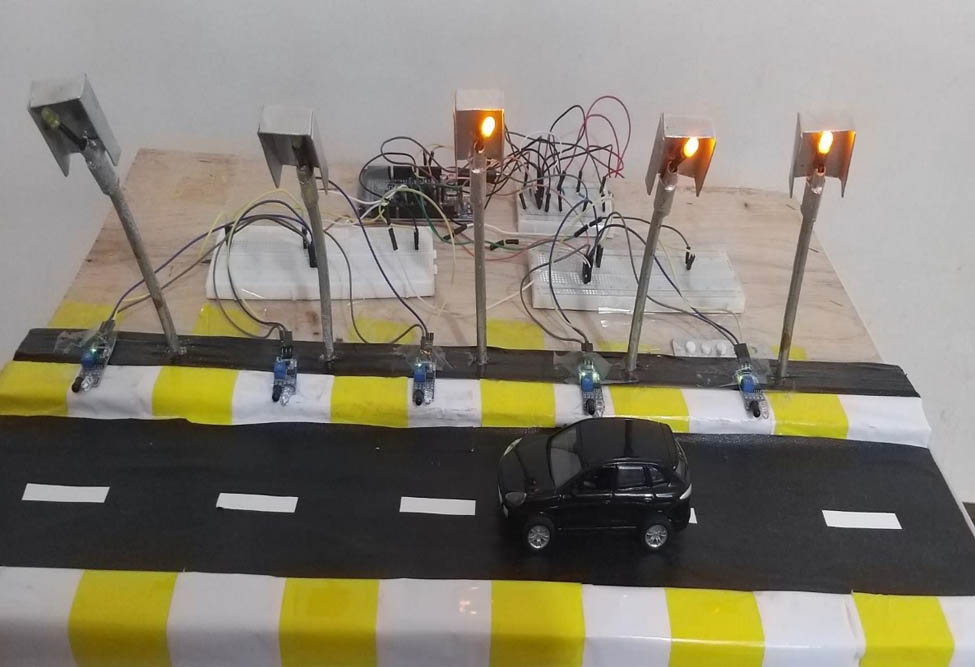
Switching ON of the light column nos. 1, 2, and 3, while 3 and 4 are OFF.

Switching ON of the light column nos. 2, 3, and 4 ON, while 1 and 5 are OFF.

Switching ON of the light column nos. 3, 4, and 5, while 1 and 2 are OFF.
6 Results
The exciting lighting method for 1,800 poles with HPS lighting source consumes electrical energy for 13 h as shown in the equation below
While the exciting lighting method with HID lighting source consumes electrical energy for 13 h as shown in the equation below
However, the consumption of the electrical energy will reduce by about 60% when using the control lighting system (CLS) in both type of illumination sources (HID and HPS) as shown in the efficiency equation below.
The total power used for lighting 1,800 poles by using CLS with HPS = 1828.8 kW. The efficiency of the new lighting system for this is
When applying the HID lighting source with CLS, the efficiency will be as shown in the equation below
The results show that the CLS will reduce power consumption by about 61% with any type of illumination source.
Efficiency of the new system with old lighting method.
Efficiency of the HID lighting system with CLS against the HPS lighting system as the lighting system exist recently shows as the equation below
(1828.8/18,720)*100% = 9.76%, reduced by about 90% of the total power consumption of normal lighting by using the HPS illumination source (Tables 1–3).
Total amount of the energy consumed per lighting pole in every 1 h during the lighting time and the total amount of energy consumed for full time lighting of all the 1,800 poles by using CLS lighting system and HID lighting source
| Time period | Avg. no. of cars per min | Time of turn-on of each lightning pole per min | Amount of electricity consumption for every light pole per min | Amount of electricity consumption of each light pole per hour (W) | The total amount of electrical consumption of all 1,800 lightning poles per hour (W) |
|---|---|---|---|---|---|
| 5 pm–6 pm | 33 | 0.9867 | 3.283 | 197 | 354,600 |
| 6 pm–7 pm | 33 | 0.9867 | 3.283 | 197 | 354,600 |
| 7 pm–8 pm | 30 | 0.897 | 2.987 | 179 | 322,200 |
| 8 pm–9pm | 25 | 0.747 | 2.487 | 149 | 268,200 |
| 9 pm–10 pm | 20 | 0.598 | 1.997 | 120 | 216,000 |
| 10 pm–11 pm | 10 | 0.299 | 0.995 | 60 | 108,000 |
| 11 pm–1 am | 3 | 0.0897 | 0.298 | 18 | 32,400 |
| 1 am–2 am | 1 | 0.0299 | 0.099 | 6 | 10,800 |
| 2 am–3 am | 1 | 0.0299 | 0.099 | 6 | 10,800 |
| 3 am–4 am | 1 | 0.0299 | 0.099 | 6 | 10,800 |
| 4 am–5 am | 3 | 0.0897 | 0.298 | 18 | 32,400 |
| 5 am–6 am | 10 | 0.299 | 0.995 | 60 | 108,000 |
| Total | 1828.8 kW |
Total amount of the energy consumed by each lighting pole in every 1 hour during the lighting time and the total amount of energy consumption for full time lighting for all the 1,800 poles by using CLS lighting system and HID lighting source
| Time period | Avg. no of cars per min | Time of turn-on of each lightning pole per min | Amount of electricity consumed by every light pole per min (W) | Amount of electricity consumed for every light pole per hour (W) |
|---|---|---|---|---|
| 5 pm–6 pm | 33 | 0.9867 | 788 | 197 |
| 6 pm–7 pm | 33 | 0.9867 | 788 | 197 |
| 7 pm–8 pm | 30 | 0.897 | 716 | 179 |
| 8 pm–9 pm | 25 | 0.747 | 596 | 149 |
| 9 pm–10 pm | 20 | 0.598 | 480 | 120 |
| 10 pm–11 pm | 10 | 0.299 | 240 | 60 |
| 11 pm–1 am | 3 | 0.0897 | 72 | 18 |
| 1 am–2 am | 1 | 0.0299 | 24 | 6 |
| 2 am–3 am | 1 | 0.0299 | 24 | 6 |
| 3 am–4 am | 1 | 0.0299 | 24 | 6 |
| 4 am–5 am | 3 | 0.0897 | 72 | 18 |
| 5 am–6 am | 10 | 0.299 | 240 | 60 |
| Total | 1,016 W |
Amount the energy consumption per pole for each hour by using the (CLS) methodology for HID lighting source
| Total Amount of electrical energy consumption for all (1,800) lighting poles per hour in W with new lighting method (HID) | Avg. no of cars per min |
|---|---|
| 354,600 | 1,418,400 |
| 354,600 | 1,418,400 |
| 322,200 | 1,288,800 |
| 268,200 | 1,072,800 |
| 216,000 | 864,000 |
| 108,000 | 432,000 |
| 32,400 | 129,600 |
| 10,800 | 43,200 |
| 10,800 | 43,200 |
| 10,800 | 43,200 |
| 32,400 | 129,600 |
| 108,000 | 432,000 |
| 1828.8 kW | 7315.2 |
7 Conclusion
Smart lighting is a lighting technology designed to save energy, where the control system is set up in light of the conditions such as having oriented parts. The smart lighting technology is designed to save energy and maintain resources and environment, where its system controls the lighting and modifies the controlling in accordance with certain circumstances and rules. The smart lighting term is based on the lighting technology that is increased in the process of increased energy and opening it by controlling the operation of the energy and opening it. The lighting of the lighting is available in the light of the energy and service and the construction of the domes in the lighting of the homes, restaurants and various facilities, In addition to the lighting streets, traffic lights, theaters and cinema, and other cities. The smart lighting technology is often reduced by the sophisticated lighting lamps that are usually composed of the "LED", which it has life time longer than the other types of lighting sources and does not produce heat and wasting much energy.
Smart control smart lighting technology based on intelligent control system controls the degree and timing of lighting the lamps, according to the signals that are taken by the light sensors in the place. The system works, for example, on lighting of a particular bulb in the way. If the person moves from one walk path to another, the system of the lighting will turn on for him.
The advantage of several highlights of smart lighting is 70% reduction in electricity consumed by lights in households, streets, and other facilities, without affecting the performance, ensuring their excellent productivity with current bases and standards. The smart lighting is changing lighting system in the streets and roads in the cities, in accordance with the traffic load, accidents and climate change, the ratio of lighting and raising safety rates. The most important features of smart lighting can be illustrated by the electricity is reduce electricity consumption, running cost, emission and the light lifetime. Finally, the system can reach efficiency more than 90% if the lighting type has been changed from HPS to HID.
Acknowledgment
This research was accomplished by cooperation group of researchers from Al-Mustaqbal University College, Iraq, Al-Husain University College, Iraq, and Liverpool John Moores University, UK. This project was funded by the Green Future company in Iraq. Many thanks to Al-Mustaqbal University College for all the financial supports to accomplish this research.
-
Funding information: The authors are grateful for the financial and technical support from Al-Mustaqbal University College (grant code: 0122).Many thanks to Headway to Green Future company for technical and information support.
-
Conflict of interest: Authors state no conflict of interest.
References
[1] Kokilavani MM, Malathi A. Smart street lighting system using IoT. Int J Adv Res Appl Sci Technol. 2017;3(11):8–11.Search in Google Scholar
[2] Smys S. Artificial neural network based power management for smart street lighting systems. J Artif Intell. 2020;2(1):42–52.10.36548/jaicn.2020.1.005Search in Google Scholar
[3] Rakotomalala LFF, Randriamanantany Z. HID lamps dimming in the public lighting installations dominated by magnetic ballasts. 2014 International Conference on Applied and Theoretical Electricity (ICATE); 2014. p. 1–5.10.1109/ICATE.2014.6972670Search in Google Scholar
[4] Hernández R, Kubota C. LEDs supplemental lighting for vegetable transplant production: Spectral evaluation and comparisons with HID technology. International Symposium on New Technologies for Environment Control, Energy-Saving and Crop Production in Greenhouse and Plant; 2014. p. 829–36.10.17660/ActaHortic.2014.1037.110Search in Google Scholar
[5] Satapathy SC, Bhateja V, Favorskaya MN, Adilakshmi T. Smart Intelligent Computing and Applications, Volume 2. vol. 283, 2022. p. 193–202. 10.1007/978-981-16-9705-0.Search in Google Scholar
[6] Escolar S, Carretero J, Marinescu M, Chessa S. Estimating energy savings in smart street lighting by using an adaptive control system. Int J Distrib Sens Netw. 2014;10(5):971587.10.1155/2014/971587Search in Google Scholar
[7] Balat M. Solar Technological Progress and Use of Solar Energy in the World. Energy Sources A: Recovery Util. Environ. Eff. 2017;28(10):979–94. 10.1080/009083190953409.Search in Google Scholar
[8] Chen S, Xiong G, Xu J, Han S, Wang F, Wang K. The smart street lighting system based on NB- IoT. 2018 Chinese Automation Congress (CAC). 1, 2018. p. 1–5.10.1109/CAC.2018.8623281Search in Google Scholar
[9] Chew I, Kalavally V, Win N, Parkkinen J. Design of an energy-saving controller for an intelligent LED lighting system. Energy Build. 2016;120:1–9. 10.1016/j.enbuild.2016.03.041.Search in Google Scholar
[10] Suseendran SC. Smart street lighting system department of computer science. 3rd International Conference on Communication Electronic System; 2018. p. 630–3.10.1109/CESYS.2018.8723949Search in Google Scholar
[11] Srivani B, Divya CL, Neelima KS, Akshiah V, Salman M, Kumar KK. Smart street light system with automated feedback. Int J Mod Dev Eng Sci. 2022;1(6):4–6.Search in Google Scholar
[12] Decker A, Decker A, Decker A, Decker A. IISTE Journals June 2013 Publications; June, 2013.Search in Google Scholar
[13] Prasad R. Energy efficient smart street lighting system in Nagpur smart city using IoT – A case study. 2020 Fifth International Conference on Fog and Mobile Edge Computing (FMEC); 2020. p. 100–3.10.1109/FMEC49853.2020.9144848Search in Google Scholar
[14] Ageed ZS, Zeebaree S, Sadeeq M, Abdulrazzaq MB, Salim BW, Salih AA, et al. A state of art survey for intelligent energy monitoring systems. Asian J Res Comput Sci. 2021;8(1):46–61.10.9734/ajrcos/2021/v8i130192Search in Google Scholar
[15] Mohamed SAE. Smart street lighting control and monitoring system for electrical power saving by using VANET. t'l J Commun Network Syst Sci. 2013;6(August):351–60.10.4236/ijcns.2013.68038Search in Google Scholar
[16] Yusoff YM, Rosli R, Kamaluddin MU, Samad M. Towards smart street lighting system in Malaysia. 2013;1:301–5.10.1109/ISWTA.2013.6688792Search in Google Scholar
[17] Dizon E, Pranggono B. Smart street lights in smart city: A case study of Sheffield. J Ambient Intell Humaniz Comput. 2022;13(4):2045–60.10.1007/s12652-021-02970-ySearch in Google Scholar
[18] Mohandas P, Sheebha J, Dhanaraj A, Gao X. Artificial neural network based smart and energy efficient street lighting system: A case study for residential area in Hosur. Sustain Cities Soc. March, 2019;48:101499. 10.1016/j.scs.2019.101499.Search in Google Scholar
[19] Jin D, Hannon C, Li Z, Cortes P, Ramaraju S, Burgess P, et al. Smart street lighting system: A platform for innovative smart city applications and a new frontier for cyber-security. Electr J. 2016;29(10):28–35. 10.1016/j.tej.2016.11.011.Search in Google Scholar
[20] Li Y, Shi R. An intelligent solar energy-harvesting system for wireless sensor networks. EURASIP J Wirel Commun Netw. 2015;2015:179. 10.1186/s13638-015-0414-2.Search in Google Scholar
[21] Mahboubi H, Masoudimansour W, Aghdam AG, Sayrafian-Pour K. Maximum lifetime strategy for target monitoring with controlled node mobility in sensor networks with obstacles. IEEE Trans Autom Contr. 2016;61(11):3493–3508. 10.1109/TAC.2016.2536800.Search in Google Scholar
[22] Velaga NR, Kumar A. Techno-economic evaluation of the feasibility of a smart street light system: A case study of Rural India. Procedia - Soc Behav Sci. 2012;62:1220–4. 10.1016/j.sbspro.2012.09.208.Search in Google Scholar
[23] Nasir T, Bukhari S, Raza S, Munir HM, Abrar M, Muqeet H, et al. Recent challenges and methodologies in smart grid demand side management: State-of-the-art literature review. Math Probl Eng. 2021;2021:2021–16.10.1155/2021/5821301Search in Google Scholar
[24] Huang BJ, Wu MS, Hsu PC, Chen JW, Chen KY. Development of high-performance solar LED lighting system. Energy Convers Manag. 2010;51(8):1669–75. 10.1016/j.enconman.2009.11.046.Search in Google Scholar
[25] Bhairi MN, Kangle SS, Edake MS, Madgundi BS. Design and implementation of smart solar LED street light. 2017 International Conference on Trends in Electronics and Informatics (ICEI); 2017. p. 509–12.10.1109/ICOEI.2017.8300980Search in Google Scholar
© 2022 the author(s), published by De Gruyter
This work is licensed under the Creative Commons Attribution 4.0 International License.
Articles in the same Issue
- Regular Articles
- Performance of a horizontal well in a bounded anisotropic reservoir: Part I: Mathematical analysis
- Key competences for Transport 4.0 – Educators’ and Practitioners’ opinions
- COVID-19 lockdown impact on CERN seismic station ambient noise levels
- Constraint evaluation and effects on selected fracture parameters for single-edge notched beam under four-point bending
- Minimizing form errors in additive manufacturing with part build orientation: An optimization method for continuous solution spaces
- The method of selecting adaptive devices for the needs of drivers with disabilities
- Control logic algorithm to create gaps for mixed traffic: A comprehensive evaluation
- Numerical prediction of cavitation phenomena on marine vessel: Effect of the water environment profile on the propulsion performance
- Boundary element analysis of rotating functionally graded anisotropic fiber-reinforced magneto-thermoelastic composites
- Effect of heat-treatment processes and high temperature variation of acid-chloride media on the corrosion resistance of B265 (Ti–6Al–4V) titanium alloy in acid-chloride solution
- Influence of selected physical parameters on vibroinsulation of base-exited vibratory conveyors
- System and eco-material design based on slow-release ferrate(vi) combined with ultrasound for ballast water treatment
- Experimental investigations on transmission of whole body vibration to the wheelchair user's body
- Determination of accident scenarios via freely available accident databases
- Elastic–plastic analysis of the plane strain under combined thermal and pressure loads with a new technique in the finite element method
- Design and development of the application monitoring the use of server resources for server maintenance
- The LBC-3 lightweight encryption algorithm
- Impact of the COVID-19 pandemic on road traffic accident forecasting in Poland and Slovakia
- Development and implementation of disaster recovery plan in stock exchange industry in Indonesia
- Pre-determination of prediction of yield-line pattern of slabs using Voronoi diagrams
- Urban air mobility and flying cars: Overview, examples, prospects, drawbacks, and solutions
- Stadiums based on curvilinear geometry: Approximation of the ellipsoid offset surface
- Driftwood blocking sensitivity on sluice gate flow
- Solar PV power forecasting at Yarmouk University using machine learning techniques
- 3D FE modeling of cable-stayed bridge according to ICE code
- Review Articles
- Partial discharge calibrator of a cavity inside high-voltage insulator
- Health issues using 5G frequencies from an engineering perspective: Current review
- Modern structures of military logistic bridges
- Retraction
- Retraction note: COVID-19 lockdown impact on CERN seismic station ambient noise levels
- Special Issue: Trends in Logistics and Production for the 21st Century - Part II
- Solving transportation externalities, economic approaches, and their risks
- Demand forecast for parking spaces and parking areas in Olomouc
- Rescue of persons in traffic accidents on roads
- Special Issue: ICRTEEC - 2021 - Part II
- Switching transient analysis for low voltage distribution cable
- Frequency amelioration of an interconnected microgrid system
- Wireless power transfer topology analysis for inkjet-printed coil
- Analysis and control strategy of standalone PV system with various reference frames
- Special Issue: AESMT
- Study of emitted gases from incinerator of Al-Sadr hospital in Najaf city
- Experimentally investigating comparison between the behavior of fibrous concrete slabs with steel stiffeners and reinforced concrete slabs under dynamic–static loads
- ANN-based model to predict groundwater salinity: A case study of West Najaf–Kerbala region
- Future short-term estimation of flowrate of the Euphrates river catchment located in Al-Najaf Governorate, Iraq through using weather data and statistical downscaling model
- Utilization of ANN technique to estimate the discharge coefficient for trapezoidal weir-gate
- Experimental study to enhance the productivity of single-slope single-basin solar still
- An empirical formula development to predict suspended sediment load for Khour Al-Zubair port, South of Iraq
- A model for variation with time of flexiblepavement temperature
- Analytical and numerical investigation of free vibration for stepped beam with different materials
- Identifying the reasons for the prolongation of school construction projects in Najaf
- Spatial mixture modeling for analyzing a rainfall pattern: A case study in Ireland
- Flow parameters effect on water hammer stability in hydraulic system by using state-space method
- Experimental study of the behaviour and failure modes of tapered castellated steel beams
- Water hammer phenomenon in pumping stations: A stability investigation based on root locus
- Mechanical properties and freeze-thaw resistance of lightweight aggregate concrete using artificial clay aggregate
- Compatibility between delay functions and highway capacity manual on Iraqi highways
- The effect of expanded polystyrene beads (EPS) on the physical and mechanical properties of aerated concrete
- The effect of cutoff angle on the head pressure underneath dams constructed on soils having rectangular void
- An experimental study on vibration isolation by open and in-filled trenches
- Designing a 3D virtual test platform for evaluating prosthetic knee joint performance during the walking cycle
- Special Issue: AESMT-2 - Part I
- Optimization process of resistance spot welding for high-strength low-alloy steel using Taguchi method
- Cyclic performance of moment connections with reduced beam sections using different cut-flange profiles
- Time overruns in the construction projects in Iraq: Case study on investigating and analyzing the root causes
- Contribution of lift-to-drag ratio on power coefficient of HAWT blade for different cross-sections
- Geotechnical correlations of soil properties in Hilla City – Iraq
- Improve the performance of solar thermal collectors by varying the concentration and nanoparticles diameter of silicon dioxide
- Enhancement of evaporative cooling system in a green-house by geothermal energy
- Destructive and nondestructive tests formulation for concrete containing polyolefin fibers
- Quantify distribution of topsoil erodibility factor for watersheds that feed the Al-Shewicha trough – Iraq using GIS
- Seamless geospatial data methodology for topographic map: A case study on Baghdad
- Mechanical properties investigation of composite FGM fabricated from Al/Zn
- Causes of change orders in the cycle of construction project: A case study in Al-Najaf province
- Optimum hydraulic investigation of pipe aqueduct by MATLAB software and Newton–Raphson method
- Numerical analysis of high-strength reinforcing steel with conventional strength in reinforced concrete beams under monotonic loading
- Deriving rainfall intensity–duration–frequency (IDF) curves and testing the best distribution using EasyFit software 5.5 for Kut city, Iraq
- Designing of a dual-functional XOR block in QCA technology
- Producing low-cost self-consolidation concrete using sustainable material
- Performance of the anaerobic baffled reactor for primary treatment of rural domestic wastewater in Iraq
- Enhancement isolation antenna to multi-port for wireless communication
- A comparative study of different coagulants used in treatment of turbid water
- Field tests of grouted ground anchors in the sandy soil of Najaf, Iraq
- New methodology to reduce power by using smart street lighting system
- Optimization of the synergistic effect of micro silica and fly ash on the behavior of concrete using response surface method
- Ergodic capacity of correlated multiple-input–multiple-output channel with impact of transmitter impairments
- Numerical studies of the simultaneous development of forced convective laminar flow with heat transfer inside a microtube at a uniform temperature
- Enhancement of heat transfer from solar thermal collector using nanofluid
- Improvement of permeable asphalt pavement by adding crumb rubber waste
- Study the effect of adding zirconia particles to nickel–phosphorus electroless coatings as product innovation on stainless steel substrate
- Waste aggregate concrete properties using waste tiles as coarse aggregate and modified with PC superplasticizer
- CuO–Cu/water hybrid nonofluid potentials in impingement jet
- Satellite vibration effects on communication quality of OISN system
- Special Issue: Annual Engineering and Vocational Education Conference - Part III
- Mechanical and thermal properties of recycled high-density polyethylene/bamboo with different fiber loadings
- Special Issue: Advanced Energy Storage
- Cu-foil modification for anode-free lithium-ion battery from electronic cable waste
- Review of various sulfide electrolyte types for solid-state lithium-ion batteries
- Optimization type of filler on electrochemical and thermal properties of gel polymer electrolytes membranes for safety lithium-ion batteries
- Pr-doped BiFeO3 thin films growth on quartz using chemical solution deposition
- An environmentally friendly hydrometallurgy process for the recovery and reuse of metals from spent lithium-ion batteries, using organic acid
- Production of nickel-rich LiNi0.89Co0.08Al0.03O2 cathode material for high capacity NCA/graphite secondary battery fabrication
- Special Issue: Sustainable Materials Production and Processes
- Corrosion polarization and passivation behavior of selected stainless steel alloys and Ti6Al4V titanium in elevated temperature acid-chloride electrolytes
- Special Issue: Modern Scientific Problems in Civil Engineering - Part II
- The modelling of railway subgrade strengthening foundation on weak soils
- Special Issue: Automation in Finland 2021 - Part II
- Manufacturing operations as services by robots with skills
- Foundations and case studies on the scalable intelligence in AIoT domains
- Safety risk sources of autonomous mobile machines
- Special Issue: 49th KKBN - Part I
- Residual magnetic field as a source of information about steel wire rope technical condition
- Monitoring the boundary of an adhesive coating to a steel substrate with an ultrasonic Rayleigh wave
- Detection of early stage of ductile and fatigue damage presented in Inconel 718 alloy using instrumented indentation technique
- Identification and characterization of the grinding burns by eddy current method
- Special Issue: ICIMECE 2020 - Part II
- Selection of MR damper model suitable for SMC applied to semi-active suspension system by using similarity measures
Articles in the same Issue
- Regular Articles
- Performance of a horizontal well in a bounded anisotropic reservoir: Part I: Mathematical analysis
- Key competences for Transport 4.0 – Educators’ and Practitioners’ opinions
- COVID-19 lockdown impact on CERN seismic station ambient noise levels
- Constraint evaluation and effects on selected fracture parameters for single-edge notched beam under four-point bending
- Minimizing form errors in additive manufacturing with part build orientation: An optimization method for continuous solution spaces
- The method of selecting adaptive devices for the needs of drivers with disabilities
- Control logic algorithm to create gaps for mixed traffic: A comprehensive evaluation
- Numerical prediction of cavitation phenomena on marine vessel: Effect of the water environment profile on the propulsion performance
- Boundary element analysis of rotating functionally graded anisotropic fiber-reinforced magneto-thermoelastic composites
- Effect of heat-treatment processes and high temperature variation of acid-chloride media on the corrosion resistance of B265 (Ti–6Al–4V) titanium alloy in acid-chloride solution
- Influence of selected physical parameters on vibroinsulation of base-exited vibratory conveyors
- System and eco-material design based on slow-release ferrate(vi) combined with ultrasound for ballast water treatment
- Experimental investigations on transmission of whole body vibration to the wheelchair user's body
- Determination of accident scenarios via freely available accident databases
- Elastic–plastic analysis of the plane strain under combined thermal and pressure loads with a new technique in the finite element method
- Design and development of the application monitoring the use of server resources for server maintenance
- The LBC-3 lightweight encryption algorithm
- Impact of the COVID-19 pandemic on road traffic accident forecasting in Poland and Slovakia
- Development and implementation of disaster recovery plan in stock exchange industry in Indonesia
- Pre-determination of prediction of yield-line pattern of slabs using Voronoi diagrams
- Urban air mobility and flying cars: Overview, examples, prospects, drawbacks, and solutions
- Stadiums based on curvilinear geometry: Approximation of the ellipsoid offset surface
- Driftwood blocking sensitivity on sluice gate flow
- Solar PV power forecasting at Yarmouk University using machine learning techniques
- 3D FE modeling of cable-stayed bridge according to ICE code
- Review Articles
- Partial discharge calibrator of a cavity inside high-voltage insulator
- Health issues using 5G frequencies from an engineering perspective: Current review
- Modern structures of military logistic bridges
- Retraction
- Retraction note: COVID-19 lockdown impact on CERN seismic station ambient noise levels
- Special Issue: Trends in Logistics and Production for the 21st Century - Part II
- Solving transportation externalities, economic approaches, and their risks
- Demand forecast for parking spaces and parking areas in Olomouc
- Rescue of persons in traffic accidents on roads
- Special Issue: ICRTEEC - 2021 - Part II
- Switching transient analysis for low voltage distribution cable
- Frequency amelioration of an interconnected microgrid system
- Wireless power transfer topology analysis for inkjet-printed coil
- Analysis and control strategy of standalone PV system with various reference frames
- Special Issue: AESMT
- Study of emitted gases from incinerator of Al-Sadr hospital in Najaf city
- Experimentally investigating comparison between the behavior of fibrous concrete slabs with steel stiffeners and reinforced concrete slabs under dynamic–static loads
- ANN-based model to predict groundwater salinity: A case study of West Najaf–Kerbala region
- Future short-term estimation of flowrate of the Euphrates river catchment located in Al-Najaf Governorate, Iraq through using weather data and statistical downscaling model
- Utilization of ANN technique to estimate the discharge coefficient for trapezoidal weir-gate
- Experimental study to enhance the productivity of single-slope single-basin solar still
- An empirical formula development to predict suspended sediment load for Khour Al-Zubair port, South of Iraq
- A model for variation with time of flexiblepavement temperature
- Analytical and numerical investigation of free vibration for stepped beam with different materials
- Identifying the reasons for the prolongation of school construction projects in Najaf
- Spatial mixture modeling for analyzing a rainfall pattern: A case study in Ireland
- Flow parameters effect on water hammer stability in hydraulic system by using state-space method
- Experimental study of the behaviour and failure modes of tapered castellated steel beams
- Water hammer phenomenon in pumping stations: A stability investigation based on root locus
- Mechanical properties and freeze-thaw resistance of lightweight aggregate concrete using artificial clay aggregate
- Compatibility between delay functions and highway capacity manual on Iraqi highways
- The effect of expanded polystyrene beads (EPS) on the physical and mechanical properties of aerated concrete
- The effect of cutoff angle on the head pressure underneath dams constructed on soils having rectangular void
- An experimental study on vibration isolation by open and in-filled trenches
- Designing a 3D virtual test platform for evaluating prosthetic knee joint performance during the walking cycle
- Special Issue: AESMT-2 - Part I
- Optimization process of resistance spot welding for high-strength low-alloy steel using Taguchi method
- Cyclic performance of moment connections with reduced beam sections using different cut-flange profiles
- Time overruns in the construction projects in Iraq: Case study on investigating and analyzing the root causes
- Contribution of lift-to-drag ratio on power coefficient of HAWT blade for different cross-sections
- Geotechnical correlations of soil properties in Hilla City – Iraq
- Improve the performance of solar thermal collectors by varying the concentration and nanoparticles diameter of silicon dioxide
- Enhancement of evaporative cooling system in a green-house by geothermal energy
- Destructive and nondestructive tests formulation for concrete containing polyolefin fibers
- Quantify distribution of topsoil erodibility factor for watersheds that feed the Al-Shewicha trough – Iraq using GIS
- Seamless geospatial data methodology for topographic map: A case study on Baghdad
- Mechanical properties investigation of composite FGM fabricated from Al/Zn
- Causes of change orders in the cycle of construction project: A case study in Al-Najaf province
- Optimum hydraulic investigation of pipe aqueduct by MATLAB software and Newton–Raphson method
- Numerical analysis of high-strength reinforcing steel with conventional strength in reinforced concrete beams under monotonic loading
- Deriving rainfall intensity–duration–frequency (IDF) curves and testing the best distribution using EasyFit software 5.5 for Kut city, Iraq
- Designing of a dual-functional XOR block in QCA technology
- Producing low-cost self-consolidation concrete using sustainable material
- Performance of the anaerobic baffled reactor for primary treatment of rural domestic wastewater in Iraq
- Enhancement isolation antenna to multi-port for wireless communication
- A comparative study of different coagulants used in treatment of turbid water
- Field tests of grouted ground anchors in the sandy soil of Najaf, Iraq
- New methodology to reduce power by using smart street lighting system
- Optimization of the synergistic effect of micro silica and fly ash on the behavior of concrete using response surface method
- Ergodic capacity of correlated multiple-input–multiple-output channel with impact of transmitter impairments
- Numerical studies of the simultaneous development of forced convective laminar flow with heat transfer inside a microtube at a uniform temperature
- Enhancement of heat transfer from solar thermal collector using nanofluid
- Improvement of permeable asphalt pavement by adding crumb rubber waste
- Study the effect of adding zirconia particles to nickel–phosphorus electroless coatings as product innovation on stainless steel substrate
- Waste aggregate concrete properties using waste tiles as coarse aggregate and modified with PC superplasticizer
- CuO–Cu/water hybrid nonofluid potentials in impingement jet
- Satellite vibration effects on communication quality of OISN system
- Special Issue: Annual Engineering and Vocational Education Conference - Part III
- Mechanical and thermal properties of recycled high-density polyethylene/bamboo with different fiber loadings
- Special Issue: Advanced Energy Storage
- Cu-foil modification for anode-free lithium-ion battery from electronic cable waste
- Review of various sulfide electrolyte types for solid-state lithium-ion batteries
- Optimization type of filler on electrochemical and thermal properties of gel polymer electrolytes membranes for safety lithium-ion batteries
- Pr-doped BiFeO3 thin films growth on quartz using chemical solution deposition
- An environmentally friendly hydrometallurgy process for the recovery and reuse of metals from spent lithium-ion batteries, using organic acid
- Production of nickel-rich LiNi0.89Co0.08Al0.03O2 cathode material for high capacity NCA/graphite secondary battery fabrication
- Special Issue: Sustainable Materials Production and Processes
- Corrosion polarization and passivation behavior of selected stainless steel alloys and Ti6Al4V titanium in elevated temperature acid-chloride electrolytes
- Special Issue: Modern Scientific Problems in Civil Engineering - Part II
- The modelling of railway subgrade strengthening foundation on weak soils
- Special Issue: Automation in Finland 2021 - Part II
- Manufacturing operations as services by robots with skills
- Foundations and case studies on the scalable intelligence in AIoT domains
- Safety risk sources of autonomous mobile machines
- Special Issue: 49th KKBN - Part I
- Residual magnetic field as a source of information about steel wire rope technical condition
- Monitoring the boundary of an adhesive coating to a steel substrate with an ultrasonic Rayleigh wave
- Detection of early stage of ductile and fatigue damage presented in Inconel 718 alloy using instrumented indentation technique
- Identification and characterization of the grinding burns by eddy current method
- Special Issue: ICIMECE 2020 - Part II
- Selection of MR damper model suitable for SMC applied to semi-active suspension system by using similarity measures
