Cyclic performance of moment connections with reduced beam sections using different cut-flange profiles
-
Muslim Abdul-Ameer Al-Kannoon
 and
Hayder Wafi Al-Thabhawee
and
Hayder Wafi Al-Thabhawee

Abstract
Reduced beam section (RBS) behaviours with various cut-flange configurations were investigated numerically in this study. A three-dimensional finite element model material non-linearity was built and validated experimentally, and the impacts of the cut--flange profile on the moment-rotation behaviour and ductility response of moment-resisting connections were investigated in a parametric form. Five-moment connections with various forms of decreasing beam flange were thus modelled using ABAQUS software and compared in terms of cyclic behaviour. RBS with circular, rectangular, trapezoidal, triangular, and drilled holes cut-flange configurations were adopted, and the finite element analysis results showed that radius cut RBS have uniform stress contours, while a re-entrant corner in rectangular, trapezoidal, or triangular cut-flange profiles’ connections may result in stress concentration, resulting in a fracture of the flange. In addition, the numerical testing showed that the RBS connection with a circular cut-flange profile offers a lower rupture index than other connections. Thus, the RBS created using circular cut-flange profiles dissipates more energy than other connections.
1 Introduction
Over recent decades, earthquakes have revealed several vulnerabilities in various steel moment-resisting frames. Within seismically active zones, steel frame construction had previously increased because it was thought to be sufficiently ductile for seismic loads. However, the Northridge and Kobe earthquakes in 1994 and 1995, respectively, revealed that brittle failures occur widely at welded beam-to-column connections where traditional fully welded configurations promote large strain demands at critical points such as weld access holes [1]. Despite not causing structural collapse, these failures have thus highlighted fundamental gaps in the current understanding of steel structures’ behaviours when subjected to seismic loading [2].
As a result of the 1994 Northridge earthquake, 150 steel structures failed due to brittle failure in beam-to-column connections. Such damage to connections was discovered in a wide range of buildings, both old to new and of all sizes. Initially, it was believed that these failures were due to poor workmanship; however, research initiated under the supplemental access control (SAC) protocol revealed a fundamental misunderstanding of the behaviours of welded moment connections during seismic loading. Such connections were thereby discovered to be incapable of dissipating energy effectively without causing significant damage to the building [3].
An extensive investigation was then undertaken by the SAC committee, which led to the publication of FEMA 350 [4]. During high-ductility demand, the two critical factors for failure are the tensions on the welded areas of the flange and web, and the connections. A common solution to this problem is to reduce ductility demands and related concentrations of tensions in these areas, and there have been several proposals for moment frame connections [4,5,6,7] to reduce the load on beam-column joints, many of which are sufficiently ductile in testing.
The reduced beam section (RBS) configuration is one of these in which the portions of the beam flange closest to the beam-to-column connection are removed. An RBS can also be viewed as a plastic hinge that occurs away from the joint, resulting in much of the ductility demand on such beams arising in the plastic hinge rather than the welded beam-to-column interface. There have been numerous experimental [8,9,10] and analytical [11,12,13] studies demonstrating the efficacy of this solution, and according to experimental results [14], polyline-shaped solutions have the lowest rotational capacity with curved RBS.
In terms of the location and reduction rate of RBSs, FEMA 350 [4] and FEMA 351 [15] recommend certain design parameters based on the performances of tested beam-column connections. The European Commission has also presented recommended designs of such types of connections in its EC8, Part 3 [16] in the vein of previous recommendations. Table 1 presents the proposals for flange cut radius from FEMA 350, AISC 358-05 [17], and EC8, Part 3.
Geometrical properties of RBS
| FEMA350-2000 ordinary moment frame, SMF [4] | EC8, Part 3 [16] | AISC 358-05 (IMF, SMF) |
|---|---|---|
| a = (0.5 to 0.75)b | a = 0.6 b, | a = (0.5 to 0.75)b |
| b = (0.65 to 0.85) d b | b = 0.75 d b | b = (0.65 to 0.85) d b |
| c ≤ 0.25b | g = c :S 0.25b, | O.l b,≤ c ≤ 0.25b |
| s = a+ b/2 | s = a+ b/2 | — |
| r = (4 c 2 + b 2 )/8 c | r = (4g 2 +b 2)/8g | — |
By optimising RBS cuts, the maximum plastic strain can be reduced to maximise the capacity for energy dissipation in the connection and reduce the fracture odds still further. Compared with the re-entrant angles seen on tapered or constant cuts, a review of tests conducted before 2000 [18] determined that radius cuts minimise stress concentration. Most studies conducted to date on cut-out optimisation have used pre-determined shapes [19]; however, a study by Pan et al. [20] examined the optimum shape for flanges under monotonic loads. The consideration of cyclic loads is, however, necessary for the seismic design.
The current paper thus presents numerical modelling results using the finite element analysis (FEA) implemented in ABAQUS [21] to validate the results for six sub-assemblies connected by RBS moments. This has several objectives: (1) to compare the ductility of all types of RBS connections; (2) to determine the effect of different types of RBS connections on the Von-Mises stress and equivalent plastic strain (PEEQ) at integration points in different zones; (3) to determine the effects of different forms of reduced flange sections on energy dissipation by the whole system; and (4) to examine exterior models for buckling behaviours.
2 Research methodology
For this analysis, the finite element method (FEM) was implemented in ABAQUS to obtain a more accurate and efficient solution. A numerical study was carried out on an exterior joint (T-shaped) model, which was considered an assemblage for this connection study.
Six RBS connections were thus modelled and analysed using ABAQUS, with the two samples tested experimentally by Pachoumis et al. [22] used to validate the ABAQUS results. After validation, four flange-cut geometry schemes were analysed: rectangular, trapezoidal, triangular, and drilled hole.
2.1 Design of specimens
The overall test setup and specimen geometry used by Pachoumis et al. [22] are shown in Figure 1. They investigated two specimens, designated as RBSa and RBSb, using an HE 300B column and HE 180 A beam for each sample. The authors used these sections with double web plates and continuity plates to produce a strong panel zone, equal in thickness to the beam’s flange thickness, at each column. In this way, the plastic hinge was formed in the weakening zone. Three-point bending coupon tests were then used to determine the material properties of the beams, and the following values were obtained: elasticity modulus E = 209,000 MPa, yield stress fy = 310 MPa, and ultimate stress fu = 430 MPa [22].
![Figure 1
Specimen installation [22].](/document/doi/10.1515/eng-2022-0354/asset/graphic/j_eng-2022-0354_fig_001.jpg)
Specimen installation [22].
The material properties of the weld were also considered. The other four specimens in this work are considered to have the same properties for the beam and column, with the only difference being the flange-cut pattern. Figure 2 shows the dimensions and flange-cut profiles for all specimens analysed in the current study.

Dimensions and flange-cut profiles of all specimens tested in the present study.
2.2 FEA
In this study, the non-linear FE program ABAQUS [21] was adopted to investigate the response of RBS connections with various flange-cut patterns subjected to cyclic loading. HE 300B was used as a column and HE 180 A as a beam, as shown in the study by Pachoumis et al. [22]. All components of the typical RBS connections were modelled using ABAQUS’s thin shell elements (S4R). Due to the symmetry of the models, only half of each specimen was modelled to reduce run time, as shown in Figure 3. The material properties were defined by their bilinear elastic–plastic strain–stress relationships. The materials used for columns, beams, continuity plates, doubler plates, and stiffeners follow the curves shown in Figure 4.
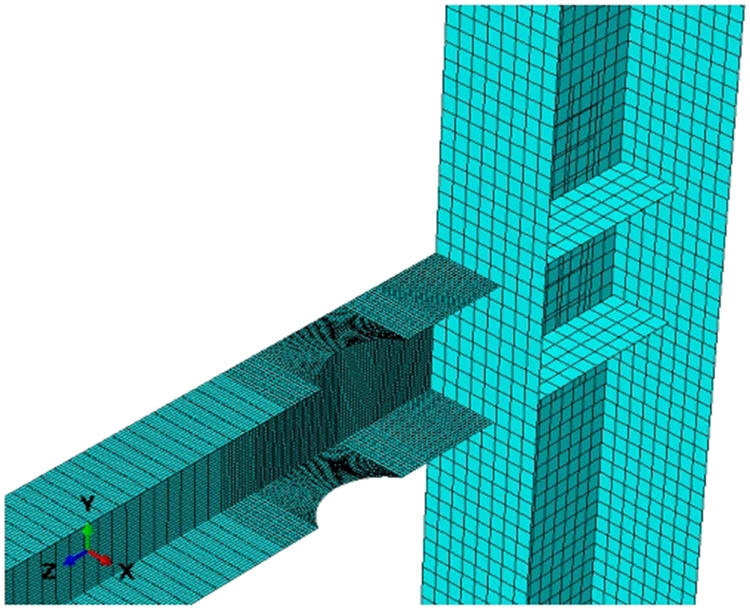
Finite element mesh of the RBS connection (element S4R).

The elastic–plastic stress–strain model used in the present study.
2.3 Loading conditions
From the face of the column and at a distance of 1,000 mm, cyclic variable amplitude displacement was applied at the top of the beam. Following the AISC Seismic Provisions (AISC 2002) [24], the cyclic displacement amplitude followed a specific loading protocol. The loading protocol that is shown in Figure 5 and Table 2 is used in ABAQUS. Here, δ y represents the first yield deformation obtained from the static analysis of the model.
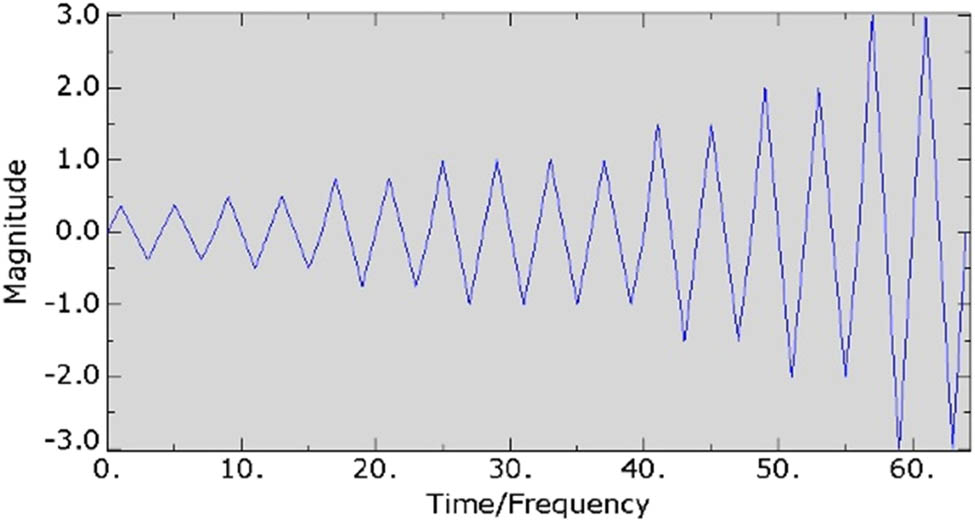
Loading protocol.
Loading protocol
| Load step | Peak deformation, δy | Number of cycles, n |
|---|---|---|
| 1 | 0.375 | 2 |
| 2 | 0.50 | 2 |
| 3 | 0.75 | 2 |
| 4 | 1.00 | 4 |
| 5 | 1.50 | 2 |
| 6 | 2.00 | 2 |
| 7 | 3.00 | 2 |
3 Results
3.1 Test verification
In this study, theFEM of RBS connections tested by Pachoumis et al. [22] has been used to verify the accuracy and applicability of a non-linear FEM. The properties and installation-tested specimens are shown in Figure 1. Figures 6 and 7 show the comparison of hysteretic curves of the current numerical results with the experimental results that are presented in ref. [22] for the two F specimens RBSa and RBSb, which indicates a good agreement between them. Therefore, the FEMs used in this study have a low error rate (a little over 6%).

Comparison of numerical and experimental results of RBSa.
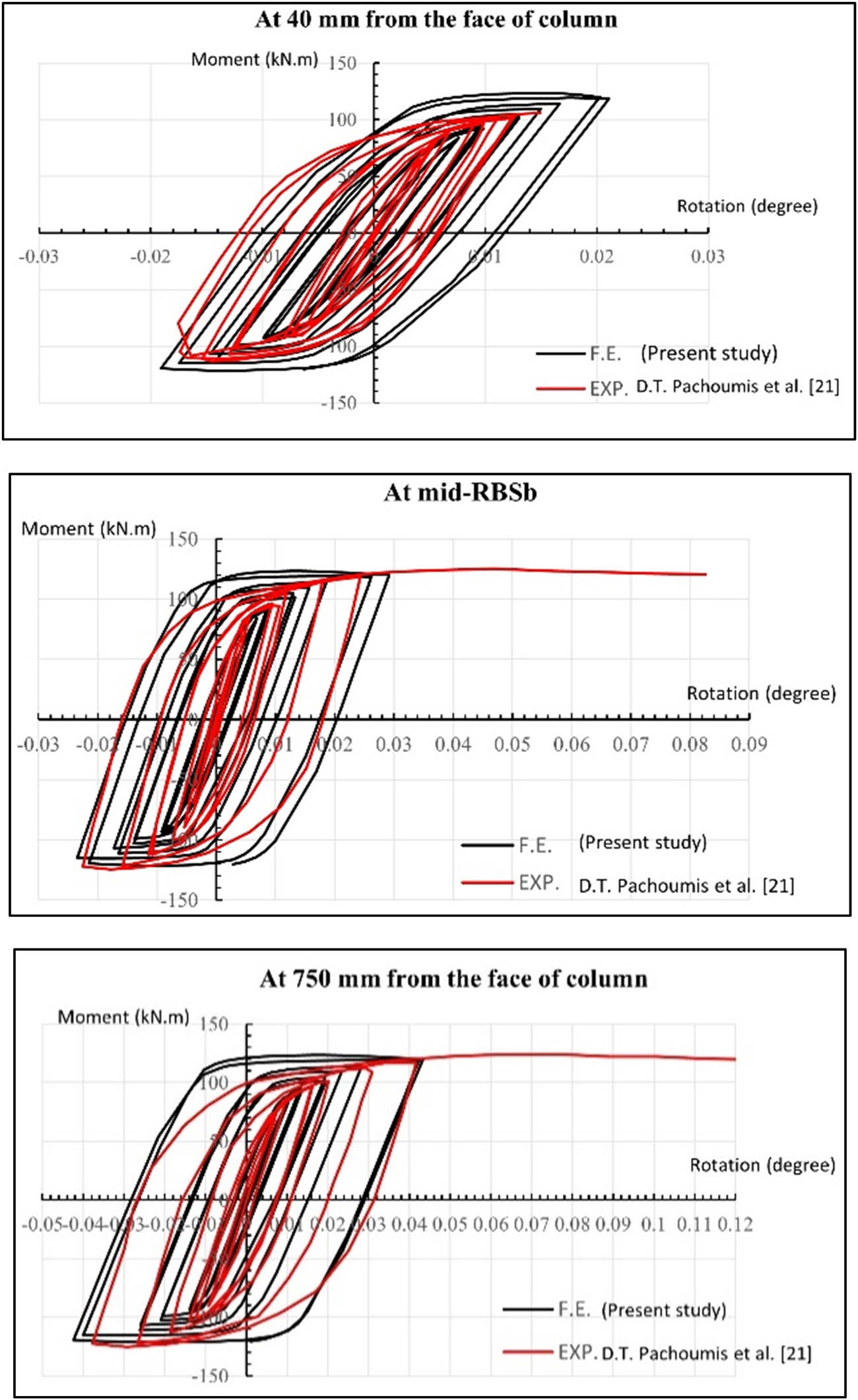
Comparison of numerical and experimental results of RBSb.
3.2 PEEQ and Von-Mises stress distribution
As illustrated in Figures 8 and 9, it was possible to calculate the PEEQ and Von Mises stress distributions for each specimen. An inelastic strain demand index (PEEQ) was used to measure the equivalent plastic-to-yield strain ratio.

PEEQ distributions on the last cycle (

Von-Mises stress distributions on the last cycle (
Comparing the RBSa with the other specimens, the analytical results show that it has a uniform Von-Mises stress distribution and a lower PEEQ value (0.685), indicating that it has a higher degree of ductility. The PEEQ index for specimen RBSrec was 46% higher compared to that of RBSa, and there was 60.5% increase for specimen RBStrap compared to RBSa, while those for RBStri and RBSdh were 65.5 and 105.5%, respectively. RBSa thus has a greater potential for better plastic hinge formation away from the connection area, leading to better behaviours of RBSa connections in comparison to other connections. In addition, for both RBSrect (rectangular cut-flange profile) and RBStrap (trapezoidal cut-flange profile) specimens, the concentration of stress at the corners of the entrance led to a fracture of the beam flange at the narrowest section, while the specimen with drilled holes (RBSdh) showed clearly visible PEEQ concentration zones at the beam flanges, as shown in Figure 8.
3.3 Hysteretic curves and rupture index
A hysteretic curve for the moment-rotations resulting from the FE analysis is shown in Figure 10 for the midpoint of the RBS connections for the RBSrec, RBStrap, RBStri, and REBdh specimens. The results showed no local buckling in the beam web or flange of all specimens, and hence, no strength reduction was observed for any specimen except the RBStri connection, where local buckling was noted in the beam flange at 0.02 rad, causing this connection to be weakened by buckling on the web and flange.

Cyclic moment-rotation and curves for tested specimens.
The numerical analysis results allowed the rupture index (RI) to be calculated to assess the effects of various parameters on the ductile fracture potential of models with different cut-flange configurations. RI refers to the ratio between the PEEQ index and the ductile fracture strain,
where q = Von-Mises stress and p = hydrostatic pressure, such that
and
The PEEQ is thus,
Based on FEA, Figure 11 shows the maximum values of RI for all tested specimens. These were developed to assess and compare the possibility of ductile fracture in finite element models at different places and between two distinct models at the same location. Hancock and MacKenzie [23] suggested that this criterion for determining the likelihood of a ductile fracture is accurate, and the RBS connection (RBSa) has a lower RI than the other specimens, as shown in Figure 11. The greater plastic stresses that form in the connecting zone along the column face are the source of the higher RI value in other specimens; however, in comparison to RBStrap, RBStri, and RBSdh, RBSrec has a lower minimum value of RI, as shown in Figure 11.

Effect of cut-flange type on RI.
4 Conclusions
Based on the results of modelling using ABAQUS, the following conclusions were drawn:
For all connections, the maximum Von Mises stress intensity was 310–430 MPa at
The rectangular cut-flange profile offers greater ductility and energy dissipation than the trapezoidal, triangular, and drilled hole profiles.
The RBS connection with a circular cut-flange profile offers a lower RI than other connections.
Radius cut RBS have uniform stress contours. Any re-entrant corner at the rectangular, trapezoidal, or triangular cut-flange profile connection may result in stress concentrations, however, leading to fracture of the flange.
The RI value was maximised in the RBS with drilled holes (RBSdh), which is thus less ductile than other tested connections in this study.
-
Conflict of interest: Authors state no conflict of interest.
References
[1] Brunesi E, Nascimbene R, Rassati GA. Seismic response of MRFs with partially-restrained bolted beam-to-column connections through FE analyses. J Constr Steel Res. 2015;107:37–49. 10.1016/j.jcsr.2014.12.022.Search in Google Scholar
[2] Gioncu V, Mazzolani F. Seismic design of steel structures. 1st Edition. London: CRC Press; 2013.10.1201/b16053Search in Google Scholar
[3] Mahin SA. Lessons from damage to steel buildings during the Northridge earthquake. Eng Struct. 1998;20(4–6):261–70. 10.1016/S0141-0296(97)00032-1.Search in Google Scholar
[4] FEMA 350, Recommended Seismic Design Criteria for New Steel Moment-Frame Buildings (FEMA 350), Washingt. (DC); 2000.Search in Google Scholar
[5] Engelhardt MD, Husain AS. Cyclic-loading performance of welded flange- bolted web connections. J Struct Eng. 1994;119(12):3537–50.10.1061/(ASCE)0733-9445(1993)119:12(3537)Search in Google Scholar
[6] Tsai KC, Wu S, Popov EP. Experimental performance of seismic steel beam–column moment joints. J Struct Eng. 1995;925–31.10.1061/(ASCE)0733-9445(1995)121:6(925)Search in Google Scholar
[7] Plumier A. Behaviour of connections. J Constr Steel Res. 1994;29(1–3):95–119. 10.1016/0143-974X(94)90058-2.Search in Google Scholar
[8] Engelhardt MD. The 1999 T. R. Higgins lecture: design of reduced beam section moment connections. 1999 North Am. Steel Constr. Conf; 1999. p. 1999.Search in Google Scholar
[9] Chen SJ, Chu JM, Chou ZL. Dynamic behaviour of steel frames with beam flanges shaved around connection. J Constr Steel Res. 1997;42(1):49–70. 10.1016/S0143-974X(97)00011-4.Search in Google Scholar
[10] Popov E, Blondet M, Stepanov L Application of dog bones for improvement of seismic behaviour of steel connections. Report no UCB/EERC 96/05. USA; 1996.Search in Google Scholar
[11] Anastasiadis A, Gioncu V. Influence of joint details on the local ductility ofsteel moment resisting frames. Proceedings of 3rd national Greek conference on steel structures; 1998. p. 311–19.Search in Google Scholar
[12] Anastasiadis A, Gioncu V, Mazzolani FM. New upgrading procedures to improve the ductility of steel MR-frames. XVII CTA Congress; 1999. p. 193–204.Search in Google Scholar
[13] Faggiano B, Landolfo R. Seismic analysis of steel MR frames with dog bone connections. Proceedings of 12th European conference on earthquake engineering; 2002. p. 309.Search in Google Scholar
[14] Engelhardt MD, Sabol TA. Seismic-resistant steel moment connections: developments since the 1994 Northridge earthquake. J Prog Struct Eng Mater. 1997;1(1):68–77.10.1002/pse.2260010112Search in Google Scholar
[15] FEMA 351. Recommended seismic evaluation and upgrade criteria for existing welded steel moment frame buildings. Washington (DC); 2000.Search in Google Scholar
[16] EC 8. Part 3: design of structures for earthquake resistance. Assessment and retrofitting of buildings. EN 1998-3; June 2005.Search in Google Scholar
[17] ANSI, A. AISC 358–05. Prequalified connections for special and intermediate steel moment frames for seismic applications. American Institute of Steel Construction Inc., Chicago; 2005.Search in Google Scholar
[18] Engelhardt MD, Fray GT, Venti M, Jones S, Holliday S. behaviour and design of radius cut, reduced beam section connections. Technical report. Sacramento (CA): SAC Joint Venture; 2000.Search in Google Scholar
[19] Jones SL, Fry GT, Engelhardt MD. Experimental evaluation of cyclically loaded reduced beam section moment connections. J Struct Eng. 2002;128(4):441–51.10.1061/(ASCE)0733-9445(2002)128:4(441)Search in Google Scholar
[20] Pan P, Ohsaki M, Tagawa H. Shape optimization of H-beam flange for maximum plastic energy dissipation. J Struct Eng ASCE. 2007;133(8):1176–9.10.1061/(ASCE)0733-9445(2007)133:8(1176)Search in Google Scholar
[21] ABAQUS/PRE, Users Manual, Hibbit, Karlsson and Sorensen Inc.; 1997.Search in Google Scholar
[22] Pachoumis DT, Galousis EG, Kalfas CN, Efthimiou IZ. Cyclic performance of steel moment-resisting connections-experimental analysis and finite element model simulation, J. Eng Struct. 2010;32:2683–92.10.1016/j.engstruct.2010.04.038Search in Google Scholar
[23] Hancock JW, MacKenzie AC. On the mechanisms of ductile failure in high-strength steels subjected to multi-axial stress-states. J Mech Phys Solids. 1976;24:147–69.10.1016/0022-5096(76)90024-7Search in Google Scholar
[24] American Institute of Steel Construction AISC. Seismic provisions for structural steel buildings. Chicago; 2002.Search in Google Scholar
© 2022 the author(s), published by De Gruyter
This work is licensed under the Creative Commons Attribution 4.0 International License.
Articles in the same Issue
- Regular Articles
- Performance of a horizontal well in a bounded anisotropic reservoir: Part I: Mathematical analysis
- Key competences for Transport 4.0 – Educators’ and Practitioners’ opinions
- COVID-19 lockdown impact on CERN seismic station ambient noise levels
- Constraint evaluation and effects on selected fracture parameters for single-edge notched beam under four-point bending
- Minimizing form errors in additive manufacturing with part build orientation: An optimization method for continuous solution spaces
- The method of selecting adaptive devices for the needs of drivers with disabilities
- Control logic algorithm to create gaps for mixed traffic: A comprehensive evaluation
- Numerical prediction of cavitation phenomena on marine vessel: Effect of the water environment profile on the propulsion performance
- Boundary element analysis of rotating functionally graded anisotropic fiber-reinforced magneto-thermoelastic composites
- Effect of heat-treatment processes and high temperature variation of acid-chloride media on the corrosion resistance of B265 (Ti–6Al–4V) titanium alloy in acid-chloride solution
- Influence of selected physical parameters on vibroinsulation of base-exited vibratory conveyors
- System and eco-material design based on slow-release ferrate(vi) combined with ultrasound for ballast water treatment
- Experimental investigations on transmission of whole body vibration to the wheelchair user's body
- Determination of accident scenarios via freely available accident databases
- Elastic–plastic analysis of the plane strain under combined thermal and pressure loads with a new technique in the finite element method
- Design and development of the application monitoring the use of server resources for server maintenance
- The LBC-3 lightweight encryption algorithm
- Impact of the COVID-19 pandemic on road traffic accident forecasting in Poland and Slovakia
- Development and implementation of disaster recovery plan in stock exchange industry in Indonesia
- Pre-determination of prediction of yield-line pattern of slabs using Voronoi diagrams
- Urban air mobility and flying cars: Overview, examples, prospects, drawbacks, and solutions
- Stadiums based on curvilinear geometry: Approximation of the ellipsoid offset surface
- Driftwood blocking sensitivity on sluice gate flow
- Solar PV power forecasting at Yarmouk University using machine learning techniques
- 3D FE modeling of cable-stayed bridge according to ICE code
- Review Articles
- Partial discharge calibrator of a cavity inside high-voltage insulator
- Health issues using 5G frequencies from an engineering perspective: Current review
- Modern structures of military logistic bridges
- Retraction
- Retraction note: COVID-19 lockdown impact on CERN seismic station ambient noise levels
- Special Issue: Trends in Logistics and Production for the 21st Century - Part II
- Solving transportation externalities, economic approaches, and their risks
- Demand forecast for parking spaces and parking areas in Olomouc
- Rescue of persons in traffic accidents on roads
- Special Issue: ICRTEEC - 2021 - Part II
- Switching transient analysis for low voltage distribution cable
- Frequency amelioration of an interconnected microgrid system
- Wireless power transfer topology analysis for inkjet-printed coil
- Analysis and control strategy of standalone PV system with various reference frames
- Special Issue: AESMT
- Study of emitted gases from incinerator of Al-Sadr hospital in Najaf city
- Experimentally investigating comparison between the behavior of fibrous concrete slabs with steel stiffeners and reinforced concrete slabs under dynamic–static loads
- ANN-based model to predict groundwater salinity: A case study of West Najaf–Kerbala region
- Future short-term estimation of flowrate of the Euphrates river catchment located in Al-Najaf Governorate, Iraq through using weather data and statistical downscaling model
- Utilization of ANN technique to estimate the discharge coefficient for trapezoidal weir-gate
- Experimental study to enhance the productivity of single-slope single-basin solar still
- An empirical formula development to predict suspended sediment load for Khour Al-Zubair port, South of Iraq
- A model for variation with time of flexiblepavement temperature
- Analytical and numerical investigation of free vibration for stepped beam with different materials
- Identifying the reasons for the prolongation of school construction projects in Najaf
- Spatial mixture modeling for analyzing a rainfall pattern: A case study in Ireland
- Flow parameters effect on water hammer stability in hydraulic system by using state-space method
- Experimental study of the behaviour and failure modes of tapered castellated steel beams
- Water hammer phenomenon in pumping stations: A stability investigation based on root locus
- Mechanical properties and freeze-thaw resistance of lightweight aggregate concrete using artificial clay aggregate
- Compatibility between delay functions and highway capacity manual on Iraqi highways
- The effect of expanded polystyrene beads (EPS) on the physical and mechanical properties of aerated concrete
- The effect of cutoff angle on the head pressure underneath dams constructed on soils having rectangular void
- An experimental study on vibration isolation by open and in-filled trenches
- Designing a 3D virtual test platform for evaluating prosthetic knee joint performance during the walking cycle
- Special Issue: AESMT-2 - Part I
- Optimization process of resistance spot welding for high-strength low-alloy steel using Taguchi method
- Cyclic performance of moment connections with reduced beam sections using different cut-flange profiles
- Time overruns in the construction projects in Iraq: Case study on investigating and analyzing the root causes
- Contribution of lift-to-drag ratio on power coefficient of HAWT blade for different cross-sections
- Geotechnical correlations of soil properties in Hilla City – Iraq
- Improve the performance of solar thermal collectors by varying the concentration and nanoparticles diameter of silicon dioxide
- Enhancement of evaporative cooling system in a green-house by geothermal energy
- Destructive and nondestructive tests formulation for concrete containing polyolefin fibers
- Quantify distribution of topsoil erodibility factor for watersheds that feed the Al-Shewicha trough – Iraq using GIS
- Seamless geospatial data methodology for topographic map: A case study on Baghdad
- Mechanical properties investigation of composite FGM fabricated from Al/Zn
- Causes of change orders in the cycle of construction project: A case study in Al-Najaf province
- Optimum hydraulic investigation of pipe aqueduct by MATLAB software and Newton–Raphson method
- Numerical analysis of high-strength reinforcing steel with conventional strength in reinforced concrete beams under monotonic loading
- Deriving rainfall intensity–duration–frequency (IDF) curves and testing the best distribution using EasyFit software 5.5 for Kut city, Iraq
- Designing of a dual-functional XOR block in QCA technology
- Producing low-cost self-consolidation concrete using sustainable material
- Performance of the anaerobic baffled reactor for primary treatment of rural domestic wastewater in Iraq
- Enhancement isolation antenna to multi-port for wireless communication
- A comparative study of different coagulants used in treatment of turbid water
- Field tests of grouted ground anchors in the sandy soil of Najaf, Iraq
- New methodology to reduce power by using smart street lighting system
- Optimization of the synergistic effect of micro silica and fly ash on the behavior of concrete using response surface method
- Ergodic capacity of correlated multiple-input–multiple-output channel with impact of transmitter impairments
- Numerical studies of the simultaneous development of forced convective laminar flow with heat transfer inside a microtube at a uniform temperature
- Enhancement of heat transfer from solar thermal collector using nanofluid
- Improvement of permeable asphalt pavement by adding crumb rubber waste
- Study the effect of adding zirconia particles to nickel–phosphorus electroless coatings as product innovation on stainless steel substrate
- Waste aggregate concrete properties using waste tiles as coarse aggregate and modified with PC superplasticizer
- CuO–Cu/water hybrid nonofluid potentials in impingement jet
- Satellite vibration effects on communication quality of OISN system
- Special Issue: Annual Engineering and Vocational Education Conference - Part III
- Mechanical and thermal properties of recycled high-density polyethylene/bamboo with different fiber loadings
- Special Issue: Advanced Energy Storage
- Cu-foil modification for anode-free lithium-ion battery from electronic cable waste
- Review of various sulfide electrolyte types for solid-state lithium-ion batteries
- Optimization type of filler on electrochemical and thermal properties of gel polymer electrolytes membranes for safety lithium-ion batteries
- Pr-doped BiFeO3 thin films growth on quartz using chemical solution deposition
- An environmentally friendly hydrometallurgy process for the recovery and reuse of metals from spent lithium-ion batteries, using organic acid
- Production of nickel-rich LiNi0.89Co0.08Al0.03O2 cathode material for high capacity NCA/graphite secondary battery fabrication
- Special Issue: Sustainable Materials Production and Processes
- Corrosion polarization and passivation behavior of selected stainless steel alloys and Ti6Al4V titanium in elevated temperature acid-chloride electrolytes
- Special Issue: Modern Scientific Problems in Civil Engineering - Part II
- The modelling of railway subgrade strengthening foundation on weak soils
- Special Issue: Automation in Finland 2021 - Part II
- Manufacturing operations as services by robots with skills
- Foundations and case studies on the scalable intelligence in AIoT domains
- Safety risk sources of autonomous mobile machines
- Special Issue: 49th KKBN - Part I
- Residual magnetic field as a source of information about steel wire rope technical condition
- Monitoring the boundary of an adhesive coating to a steel substrate with an ultrasonic Rayleigh wave
- Detection of early stage of ductile and fatigue damage presented in Inconel 718 alloy using instrumented indentation technique
- Identification and characterization of the grinding burns by eddy current method
- Special Issue: ICIMECE 2020 - Part II
- Selection of MR damper model suitable for SMC applied to semi-active suspension system by using similarity measures
Articles in the same Issue
- Regular Articles
- Performance of a horizontal well in a bounded anisotropic reservoir: Part I: Mathematical analysis
- Key competences for Transport 4.0 – Educators’ and Practitioners’ opinions
- COVID-19 lockdown impact on CERN seismic station ambient noise levels
- Constraint evaluation and effects on selected fracture parameters for single-edge notched beam under four-point bending
- Minimizing form errors in additive manufacturing with part build orientation: An optimization method for continuous solution spaces
- The method of selecting adaptive devices for the needs of drivers with disabilities
- Control logic algorithm to create gaps for mixed traffic: A comprehensive evaluation
- Numerical prediction of cavitation phenomena on marine vessel: Effect of the water environment profile on the propulsion performance
- Boundary element analysis of rotating functionally graded anisotropic fiber-reinforced magneto-thermoelastic composites
- Effect of heat-treatment processes and high temperature variation of acid-chloride media on the corrosion resistance of B265 (Ti–6Al–4V) titanium alloy in acid-chloride solution
- Influence of selected physical parameters on vibroinsulation of base-exited vibratory conveyors
- System and eco-material design based on slow-release ferrate(vi) combined with ultrasound for ballast water treatment
- Experimental investigations on transmission of whole body vibration to the wheelchair user's body
- Determination of accident scenarios via freely available accident databases
- Elastic–plastic analysis of the plane strain under combined thermal and pressure loads with a new technique in the finite element method
- Design and development of the application monitoring the use of server resources for server maintenance
- The LBC-3 lightweight encryption algorithm
- Impact of the COVID-19 pandemic on road traffic accident forecasting in Poland and Slovakia
- Development and implementation of disaster recovery plan in stock exchange industry in Indonesia
- Pre-determination of prediction of yield-line pattern of slabs using Voronoi diagrams
- Urban air mobility and flying cars: Overview, examples, prospects, drawbacks, and solutions
- Stadiums based on curvilinear geometry: Approximation of the ellipsoid offset surface
- Driftwood blocking sensitivity on sluice gate flow
- Solar PV power forecasting at Yarmouk University using machine learning techniques
- 3D FE modeling of cable-stayed bridge according to ICE code
- Review Articles
- Partial discharge calibrator of a cavity inside high-voltage insulator
- Health issues using 5G frequencies from an engineering perspective: Current review
- Modern structures of military logistic bridges
- Retraction
- Retraction note: COVID-19 lockdown impact on CERN seismic station ambient noise levels
- Special Issue: Trends in Logistics and Production for the 21st Century - Part II
- Solving transportation externalities, economic approaches, and their risks
- Demand forecast for parking spaces and parking areas in Olomouc
- Rescue of persons in traffic accidents on roads
- Special Issue: ICRTEEC - 2021 - Part II
- Switching transient analysis for low voltage distribution cable
- Frequency amelioration of an interconnected microgrid system
- Wireless power transfer topology analysis for inkjet-printed coil
- Analysis and control strategy of standalone PV system with various reference frames
- Special Issue: AESMT
- Study of emitted gases from incinerator of Al-Sadr hospital in Najaf city
- Experimentally investigating comparison between the behavior of fibrous concrete slabs with steel stiffeners and reinforced concrete slabs under dynamic–static loads
- ANN-based model to predict groundwater salinity: A case study of West Najaf–Kerbala region
- Future short-term estimation of flowrate of the Euphrates river catchment located in Al-Najaf Governorate, Iraq through using weather data and statistical downscaling model
- Utilization of ANN technique to estimate the discharge coefficient for trapezoidal weir-gate
- Experimental study to enhance the productivity of single-slope single-basin solar still
- An empirical formula development to predict suspended sediment load for Khour Al-Zubair port, South of Iraq
- A model for variation with time of flexiblepavement temperature
- Analytical and numerical investigation of free vibration for stepped beam with different materials
- Identifying the reasons for the prolongation of school construction projects in Najaf
- Spatial mixture modeling for analyzing a rainfall pattern: A case study in Ireland
- Flow parameters effect on water hammer stability in hydraulic system by using state-space method
- Experimental study of the behaviour and failure modes of tapered castellated steel beams
- Water hammer phenomenon in pumping stations: A stability investigation based on root locus
- Mechanical properties and freeze-thaw resistance of lightweight aggregate concrete using artificial clay aggregate
- Compatibility between delay functions and highway capacity manual on Iraqi highways
- The effect of expanded polystyrene beads (EPS) on the physical and mechanical properties of aerated concrete
- The effect of cutoff angle on the head pressure underneath dams constructed on soils having rectangular void
- An experimental study on vibration isolation by open and in-filled trenches
- Designing a 3D virtual test platform for evaluating prosthetic knee joint performance during the walking cycle
- Special Issue: AESMT-2 - Part I
- Optimization process of resistance spot welding for high-strength low-alloy steel using Taguchi method
- Cyclic performance of moment connections with reduced beam sections using different cut-flange profiles
- Time overruns in the construction projects in Iraq: Case study on investigating and analyzing the root causes
- Contribution of lift-to-drag ratio on power coefficient of HAWT blade for different cross-sections
- Geotechnical correlations of soil properties in Hilla City – Iraq
- Improve the performance of solar thermal collectors by varying the concentration and nanoparticles diameter of silicon dioxide
- Enhancement of evaporative cooling system in a green-house by geothermal energy
- Destructive and nondestructive tests formulation for concrete containing polyolefin fibers
- Quantify distribution of topsoil erodibility factor for watersheds that feed the Al-Shewicha trough – Iraq using GIS
- Seamless geospatial data methodology for topographic map: A case study on Baghdad
- Mechanical properties investigation of composite FGM fabricated from Al/Zn
- Causes of change orders in the cycle of construction project: A case study in Al-Najaf province
- Optimum hydraulic investigation of pipe aqueduct by MATLAB software and Newton–Raphson method
- Numerical analysis of high-strength reinforcing steel with conventional strength in reinforced concrete beams under monotonic loading
- Deriving rainfall intensity–duration–frequency (IDF) curves and testing the best distribution using EasyFit software 5.5 for Kut city, Iraq
- Designing of a dual-functional XOR block in QCA technology
- Producing low-cost self-consolidation concrete using sustainable material
- Performance of the anaerobic baffled reactor for primary treatment of rural domestic wastewater in Iraq
- Enhancement isolation antenna to multi-port for wireless communication
- A comparative study of different coagulants used in treatment of turbid water
- Field tests of grouted ground anchors in the sandy soil of Najaf, Iraq
- New methodology to reduce power by using smart street lighting system
- Optimization of the synergistic effect of micro silica and fly ash on the behavior of concrete using response surface method
- Ergodic capacity of correlated multiple-input–multiple-output channel with impact of transmitter impairments
- Numerical studies of the simultaneous development of forced convective laminar flow with heat transfer inside a microtube at a uniform temperature
- Enhancement of heat transfer from solar thermal collector using nanofluid
- Improvement of permeable asphalt pavement by adding crumb rubber waste
- Study the effect of adding zirconia particles to nickel–phosphorus electroless coatings as product innovation on stainless steel substrate
- Waste aggregate concrete properties using waste tiles as coarse aggregate and modified with PC superplasticizer
- CuO–Cu/water hybrid nonofluid potentials in impingement jet
- Satellite vibration effects on communication quality of OISN system
- Special Issue: Annual Engineering and Vocational Education Conference - Part III
- Mechanical and thermal properties of recycled high-density polyethylene/bamboo with different fiber loadings
- Special Issue: Advanced Energy Storage
- Cu-foil modification for anode-free lithium-ion battery from electronic cable waste
- Review of various sulfide electrolyte types for solid-state lithium-ion batteries
- Optimization type of filler on electrochemical and thermal properties of gel polymer electrolytes membranes for safety lithium-ion batteries
- Pr-doped BiFeO3 thin films growth on quartz using chemical solution deposition
- An environmentally friendly hydrometallurgy process for the recovery and reuse of metals from spent lithium-ion batteries, using organic acid
- Production of nickel-rich LiNi0.89Co0.08Al0.03O2 cathode material for high capacity NCA/graphite secondary battery fabrication
- Special Issue: Sustainable Materials Production and Processes
- Corrosion polarization and passivation behavior of selected stainless steel alloys and Ti6Al4V titanium in elevated temperature acid-chloride electrolytes
- Special Issue: Modern Scientific Problems in Civil Engineering - Part II
- The modelling of railway subgrade strengthening foundation on weak soils
- Special Issue: Automation in Finland 2021 - Part II
- Manufacturing operations as services by robots with skills
- Foundations and case studies on the scalable intelligence in AIoT domains
- Safety risk sources of autonomous mobile machines
- Special Issue: 49th KKBN - Part I
- Residual magnetic field as a source of information about steel wire rope technical condition
- Monitoring the boundary of an adhesive coating to a steel substrate with an ultrasonic Rayleigh wave
- Detection of early stage of ductile and fatigue damage presented in Inconel 718 alloy using instrumented indentation technique
- Identification and characterization of the grinding burns by eddy current method
- Special Issue: ICIMECE 2020 - Part II
- Selection of MR damper model suitable for SMC applied to semi-active suspension system by using similarity measures
