Magnetic iron oxide/clay nanocomposites for adsorption and catalytic oxidation in water treatment applications
-
Ganjar Fadillah
 und
Oki Muraza
und
Oki Muraza

Abstract
Physical and chemical methods have been developed for water and wastewater treatments. Adsorption is an attractive method due to its simplicity and low cost, and it has been widely employed in industrial treatment. In advanced schemes, chemical oxidation and photocatalytic oxidation have been recognized as effective methods for wastewater-containing organic compounds. The use of magnetic iron oxide in these methods has received much attention. Magnetic iron oxide nanocomposite adsorbents have been recognized as favorable materials due to their stability, high adsorption capacities, and recoverability, compared to conventional sorbents. Magnetic iron oxide nanocomposites have also been reported to be effective in photocatalytic and chemical oxidation processes. The current review has presented recent developments in techniques using magnetic iron oxide nanocomposites for water treatment applications. The review highlights the synthesis method and compares modifications for adsorbent, photocatalytic oxidation, and chemical oxidation processes. Future prospects for the use of nanocomposites have been presented.
1 Introduction
Water treatment has continued to be a required technology in many industries, because water contamination and pollution have become major environmental problems worldwide. This has created a great demand for an effective water treatment technology, and adsorption and photocatalysis are the most popular techniques due to their ease of handling. They are also more economical than other techniques. Research work in nanoscale science and engineering has suggested that nanomaterials have a great potential to improve the capability of these techniques to reduce water contaminants. Magnetic materials, especially iron oxide nanoparticles, have been known since ancient times to have characteristic properties for specified applications, including for water treatment [1]. Magnetite and maghemite (Fe3O4, γ-Fe2O3) are the most commonly studied materials due to the outstanding properties they exhibit on a nanometric scale, including high specific surface area, superparamagnetism, and so on [2,3,4]. The nanoscale dimensions of the materials can be developed by enhancing and functionalizing their surfaces for use in environmental and biomedical applications. In addition, magnetic nanocomposites have been developed for sensor, adsorption, catalytic, and photocatalytic environmental applications.
Magnetic iron oxide nanoparticles (MNPs) may be good candidates for use in the development of high-capacity adsorbents and photocatalysts. With their saturation magnetization, magnetic iron oxide-based nanocomposites provide a cost-effective approach for adsorption and photocatalysis through their reusability and ease of recovery. A material’s selectivity or affinity for a specified contaminant can be enhanced by modifying its surface and combining it with features of solid supports. By the scheme, and as conducted in biomedical and biological applications of MNPs, material properties can be tailored by setting synthesis parameters [4,5].
Some solid supports have been reported as magnetic nanoparticle supports, such as zeolite, MCM-41, biochar, carbon nanotube, and mesoporous silica. Among potential supports and materials that can be combined with magnetic properties and MNPs, clay and clay minerals have received interest. Clays have a high adsorption capacity, which corresponds to the high surface area resulting from their layer structure and a net negative charge on their structure, which attracts and holds cations, such as heavy metals and cationic molecules. There are three basic classes of clay, which are as follows: kaolinite, micas (for example, illite), and smectites (for example, montmorillonite) [6,7]. Clays, especially natural clays, are attractive and low-cost materials due to their porosity, high specific surface area, and capacity to adsorb organic molecules and ions. At the time of writing, increasing attention on the use of magnetic iron oxide/clay nanocomposites (MICNCs) was evident in the SCOPUS database (Figure 1).
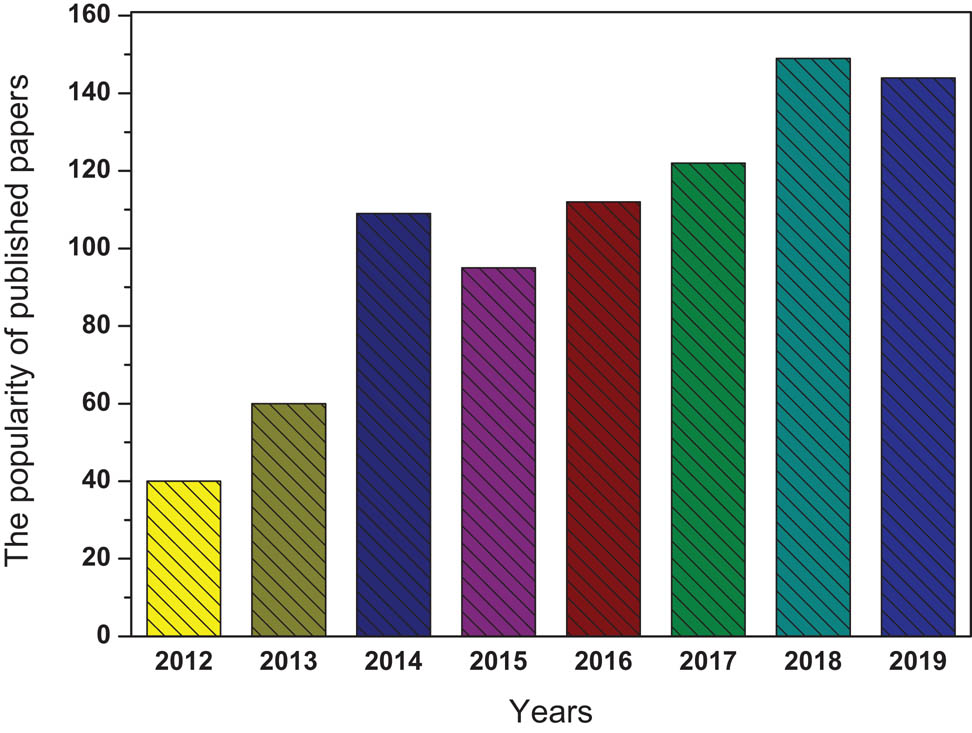
The popularity of using MICNCs for the photodegradation of organic molecules (keywords: magnetic iron oxide/clays; source: www.scopus.com, 2012–2019).
The physicochemical properties of MICNCs depend on their source, the kind of clay they contain, and the parameters governing their synthesis [8,9,10,11]. The layer silicate structure, cation exchange capacity, and pore size distribution of nanocomposites affect critical features for specified purposes in water treatment. To understand variability in nanocomposite formation and the implications for the use of nanocomposites as engineered materials, this review has presented an overview of our present knowledge regarding the influence of source material, synthesis method, and parameters in production technologies on MICNCs.
2 Synthesis of MICNCs
Clay minerals have been defined as hydrated phyllosilicates, which are abundant in sedimentary rocks. The basic unit of phyllosilicates, including clay minerals, is based on interconnected SiO44− tetrahedrons, with three apical oxygen atoms from each tetrahedron shared with another tetrahedron, making the fourth apical oxygen vertically positioned upon the sheet [12,13]. In this respect, the basic structure is Si2O52− with hexagonal symmetry. In some clays, the tetrahedral position can be occupied by aluminum atoms, which deform the tetrahedral sheet and decrease its symmetry to a level lower than hexagonal.
The tetrahedron forms sheets with X (O, OH)6 octahedrons, which share not only vertexes but also half of their edges. Octahedrons are tagged together by the octahedron plane perpendicularly to [001], so that three anions (O− or OH−) form a lower layer, and three anions are in the upper layer and in between the octahedral cations (X). The occupation of structural positions in the octahedral sheet generates trioctahedral sheet silicates in which each O or OH is surrounded by three divalent cations, like Fe(ii) or Mg(ii), and dioctahedral sheet silicates in which each O or OH ion is surrounded by two trivalent cations, mostly Al(iii). Clay can be divided into two major classes according to the combination of tetrahedral and octahedral sheets, type 1:1 (layers t-o) and type 2:1 (layers t-o-t).
Many combinations and substitutions of the layers affect the negative charges of the main structure. Clay minerals are classified according to the following criteria: (i) type of layer (1:1 or 2:1), (ii) type of interlayer (water or interlayer cation), (iii) layer charge, (iv) type of octahedral sheet (di- or trioctahedral), and (v) chemical composition. In an analogous structure, layered double hydroxides (LDHs) have been designated as “anionic clay” and have a general formula expressed as [M2+1−xM3+x(OH)2]x+Ax/nn−·mH2O, where M2+ and M3+ represent, respectively, di- and trivalent metal cations; An− represents a charge anion n; x represents the molar ratio between di- and trivalent cations M2+/(M2+ + M3+); and m represents the number of water molecules. These criteria affect the synthesis procedure and variables. Table 1 shows the clay minerals, specific procedures, and synthesis parameters of various MICNCs. In general, there are two main synthesis procedures, co-precipitation and the intercalation of MNPs into a clay structure.
Clay minerals, specific procedures, and synthesis parameters of MICNCs
| Clay mineral | MNP precursor | Method | Synthesis condition | Notes | Ref. |
|---|---|---|---|---|---|
| Natural bentonite from Slovakia | Not mentioned | Co-precipitation | Iron oxide is precipitated at 20°C and 85°C | Composites have a high specific surface area. The highest magnetization is 46.22 emu/g, present at a 1:1 ratio of bentonite to iron | [14] |
| Bentonite | FeCl3 and FeSO4 | Co-precipitation | Iron oxide precipitation is followed by drying at 100°C for 3 h in air | Composites have good adsorption of Cd, Zn, Cu, and Ni | [15] |
| Montmorillonite from Greece | FeCl3·6H2O | Co-precipitation and acetic acid treatment | Montmorillonite is mixed with FeCl3·6H2O and NaOH, followed by exposure to glacial acetic acid | Composites have a saturation magnetization of 4.1 emu/g and more basal spacing than montmorillonite d001 | [16] |
| Kaolin | Fe2+ and Fe3+ | Impregnation | Iron oxide nanoparticles are dispersed into a kaolin suspension in the presence of chitosan | Composites have a good adsorption capability for ciprofloxacin | [16] |
| Saponite and palygorskite | Fe3O4 | Impregnation | Fe3O4 slurry is adsorbed by saponite and palygorskite, followed by drying at 60–80°C | Composites have a good ability to adsorb the surfactant from water | [17] |
| Natural bentonite from Slovakia | FeSO4·7H2O and FeCl3·6H2O | Co-precipitation | Bentonite/iron oxide weight ratios of 1:1 and 5:1 with co-precipitation temperatures of 20°C and 85°C | Magnetic iron oxide/bentonite composites have a magnetization of about 35–42 emu/g, and iron oxide is formed as the γ-Fe2O3 phase | [14] |
| Natural bentonite from Shanghai | FeSO4–HNO3 | Pillarization–co-precipitation | Montmorillonite is pillared with Al, prior to MNP co-precipitation | [18] | |
| Natural bentonite from Ethiopia | FeCl3·6H2O–FeSO4·7H2O | Co-precipitation–oxidation | The FeCl3·6H2O–FeSO4·7H2O precursor solution is co-precipitated into activated bentonite, followed by drying at 100°C | [19] | |
| Fe3O4/activated montmorillonite | FeCl3·6H2O and FeCl2·4H2O | Co-precipitation | A 30% ammonia solution is added dropwise to the iron solution (nFe2+:nFe3+ = 1:1.8) at 363 K with constant stirring to adjust the pH to 9–10, so that Fe2+/Fe3+ ions are precipitated. Mt powder is then added, and the solution is stirred for 4 h | The material has significantly improved in the adsorptivity for MB | [20] |
| Diatomite | FeCl3·6H2O | Solvothermal | The MNP precursor is prepared by mixing FeCl3·6H2O with ethylene glycol, followed by the addition of CH3COONa·3H2O. The mixture is kept in an autoclave for 8 h at 200°C | Composites have a saturation magnetization of 26.89 emu/g | [21] |
| Illite | FeCl3·6H2O | Solvothermal | Composites have a saturation magnetization of 35.39 emu/g | [21] | |
| Natural bentonite from Slovakia | FeSO4·7H2O and FeCl3·6H2O (with the molar ratio of Fe3+/Fe2+ = 2) | Co-precipitation is followed by drying at 70°C | Iron oxide is in the γ-Fe2O3 phase | [22] | |
| Montmorillonite | FeCl3·6H2O–FeCl2·4H2O | Pillarization | The precursor of the oligomer of iron oxide is formed by mixing Fe(iii) and Fe(ii) solution with ammonia. Montmorillonite is intercalated by cetyltrimethylammonium ions in combination with tetraethyl orthosilicate | MNPs are homogeneously distributed and generally spherical in shape, and particle sizes are around 10–15 nm | [23] |
| Montmorillonite SWy-2 | FeCl2·4H2O | Pillarization–impregnation | Montmorillonite is pillared with Ti, followed by Fe impregnation | The specific saturation magnetization is influenced by the temperature of calcination | [24] |
| Natural bentonite from Argentina | Fe(NO3)2 | Pillarization | The intercalation of oligomer ferrous hydroxide is followed by calcination at 500°C | Increasing basal spacing d001 of bentonite was obtained significantly | [25] |
| Montmorillonite K10 | FeCl2·4H2O | Pillarization | The intercalation of oligomer ferrous hydroxide is followed by calcination at 400°C for 2 h | Increasing basal spacing d001 of montmorillonite from 1.25 to 1.5 Å was identified | [26] |
| Natural bentonite from East Java, Indonesia | FeCl3 | Pillarization | The intercalation of oligomer ferrous hydroxide is followed by calcination at 400°C for 4 h | The process increased the basal spacing d001 of montmorillonite from 1.49 to 1.69 Å | [27] |
| K10 montmorillonite | FeCl2·4H2O | Co-precipitation–hydrothermal | The precipitate is obtained by mixing montmorillonite suspension and FeCl2·4H2O–NH4OH and keeping the mixture in an autoclave at 140°C for 5 h | Dispersed spherical Fe3O4 nanoparticles in the 10–45 nm size range are coated on the surface of the montmorillonite | [28] |
| Montmorillonite | FeSO4·7H2O–FeCl3 | Co-precipitation–hydrogel formation | After magnetic iron oxide montmorillonite is obtained, the graft copolymerization of acrylamide is performed using potassium persulfate as a free radical initiator and N,N′-methylenebisacrylamide as a cross-linking agent | The magnetic nanocomposite has hydrophilicity and the ability to swell | [29] |
| Laponite | FeSO4·7H2O–FeCl3 | Co-precipitation–hydrogel formation | Fe3+:Fe2+ at a molar ratio of 2:1 is co-precipitated into a laponite suspension by the addition of NH4OH at 70°C for 2 h. Hydrogel is formed via a cross-linking reaction using ammonium persulfate and N,N,N′,N′-tetramethylethylenediamine | The magnetic nanocomposite has hydrophilicity and the ability to swell | [30] |
| Sepiolite | FeCl2·4H2O | Hydrothermal | The precursor of FeCl2·4H2O solution is heated in an autoclave at 140°C for 4 h in a mixture with NH4OH and sepiolite suspension. Then, the precipitate is dried at 60°C for 24 h | [31] | |
| Kaolin | FeCl3·6H2O–FeSO4·7H2O | Co-precipitation | The precursor of FeCl3·6H2O–FeSO4·7H2O solution is stirred at 70°C for 2 h in a mixture with NaOH and a suspension of kaolin. The precipitate is dried at 115°C | Composites have well-distributed Fe3O4 nanoparticles, ranging in size from 5.76 to 18.2 nm with a good adsorption capability | [32] |
| Kaolinite | FeSO4·7H2O | Co-precipitation–microwave irradiation | FeSO4·7H2O precursor solution is stirred in a mixture with NaOH and subjected to microwave irradiation (700 W, 2450 MHz) for 10 min. The formed FexOy NPs are mixed with a kaolinite suspension while stirring, and the mixture is dried completely at 40°C | FexOy phases–maghemite (γ-Fe2O3) in a mixture with magnetite (Fe3O4) phase are formed and anchored on the edges of the kaolinite | [33] |
| Kaolinite | FeCl3·6H2O and FeSO4·7H2O | Co-precipitation | FeCl3·6H2O: FeSO4·7H2O in a molar ratio of 2:1 is mixed with NH4OH and slowly added to kaolinite. The mixture is stirred for 5 h, followed by drying at 70°C for 24 h | [34] | |
| Haloysite | FeCl3·6H2O and FeSO4·7H2O | Co-precipitation | A suspension of HNT is mixed with FeCl3·6H2O–FeSO4·7H2O, followed by the dropwise addition of NH3H2O solution at 60°C in N2 | HNT–Fe3O4 has good magnetic properties with a saturation magnetization of 27.91 emu/g at a magnetic field of about 9,000 Oe | [35] |
| Pristine HNT | Fe(NO3)3⋅9H2O | Wet impregnation | A pristine HNT suspension is stirred with Fe(NO3)3⋅9H2O, followed by the rapid removal of the solvent at 80°C The preparation is calcined for 1 h at 200°C under high-purity argon flow | [36] | |
| Magnetic and anionic–cationic modified montmorillonite (Fe3O4–cetyltrimethylammonium chloride–sodium eicosenoate/CTMAC/SEIA-Mt) | FeCl3–FeCl2 | Co-precipitation–surfactant modification | Montmorillonite is intercalated using CTMA and SEIA, prior to co-precipitation using FeCl3–FeCl2 precursor solution | The material has a great adsorption capacity for the removal of the MB dye and a saturation magnetization of 19.84 emu/g | [37] |
The co-precipitation method is based on the chemical reaction used to produce magnetic nanoparticles in aqueous clay mineral dispersions, so the nucleation and growth of nanoparticles occur in situ in an aqueous dispersion of clay minerals, as described in Figure 2. The synthesis of nanocomposites by co-precipitation involves mixing clay mineral with MNP precursors under alkaline condition to form a sol–gel system. NH4OH and/or NaOH are commonly used to create the alkaline condition, which directly produces the precipitate of the composite [14,33,34]. The interaction between MNPs produced from clay minerals in a sol–gel system can be intensified using several methods, such as heating in a reflux system or microwave-irradiation. As the precipitate is created, drying or calcination can be conducted, which influences the iron oxide phase and magnetization properties through various processes. Synthesis using Slovakian bentonite has shown that a higher drying temperature (85°) successfully produces the γ-Fe2O3 phase with a magnetization of 35–42 emu/g, while at a lower temperature (20°C), iron oxide presents in the oxo-hydroxide phase (goethite) and has a low magnetization (8–15 emu/g). The combination of co-precipitation and oxidation can also be conducted to find a homogeneous MNP phase [18,38]. Instead of using iron salt as a precursor, an aqueous oxidation using NaNO3 as an oxidant has been used to form Fe3O4 nanoparticles (Fe3O4 NPs). The homogeneous phase of iron oxide can be obtained by conducting precipitation and oxidation under N2 flow and the use of ultrasound-irradiation for the intensification.
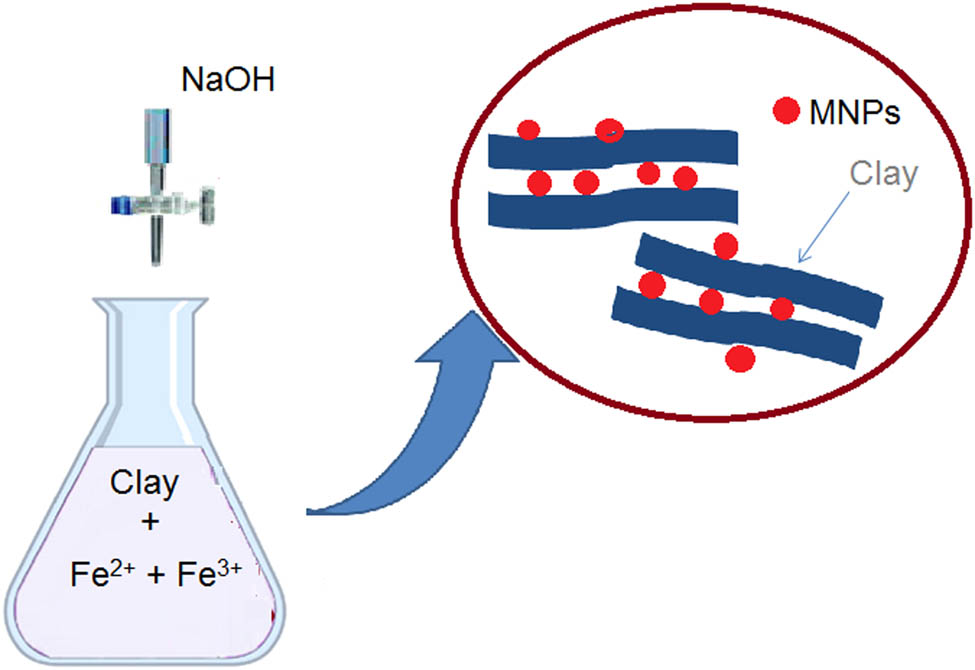
Schematic representation of the co-precipitation method.
Pillarization is another method of nanocomposite formation (Figure 3). In pillarization, MNPs are formed through the intercalation of polyoxocations or iron oxide oligomer precursors on to the interlayer structure of smectite clay, followed by calcination. For example, Tirelli reported the use of the oligomer trinuclear acetate–hydroxo iron(iii) nitrate, which was obtained through the slow titration of Fe(ii) in alkaline conditions as an MNP precursor [39]. As with the pillarization of other metal oxides, the intercalation of the oligomer into a clay suspension was conducted by stirring vigorously. Mixing iron salt with urea also creates oligomers [26]. The success of clay pillarization can be identified by determining the basal spacing d001, using the basal spacing d001 of smectite clay as a reference.
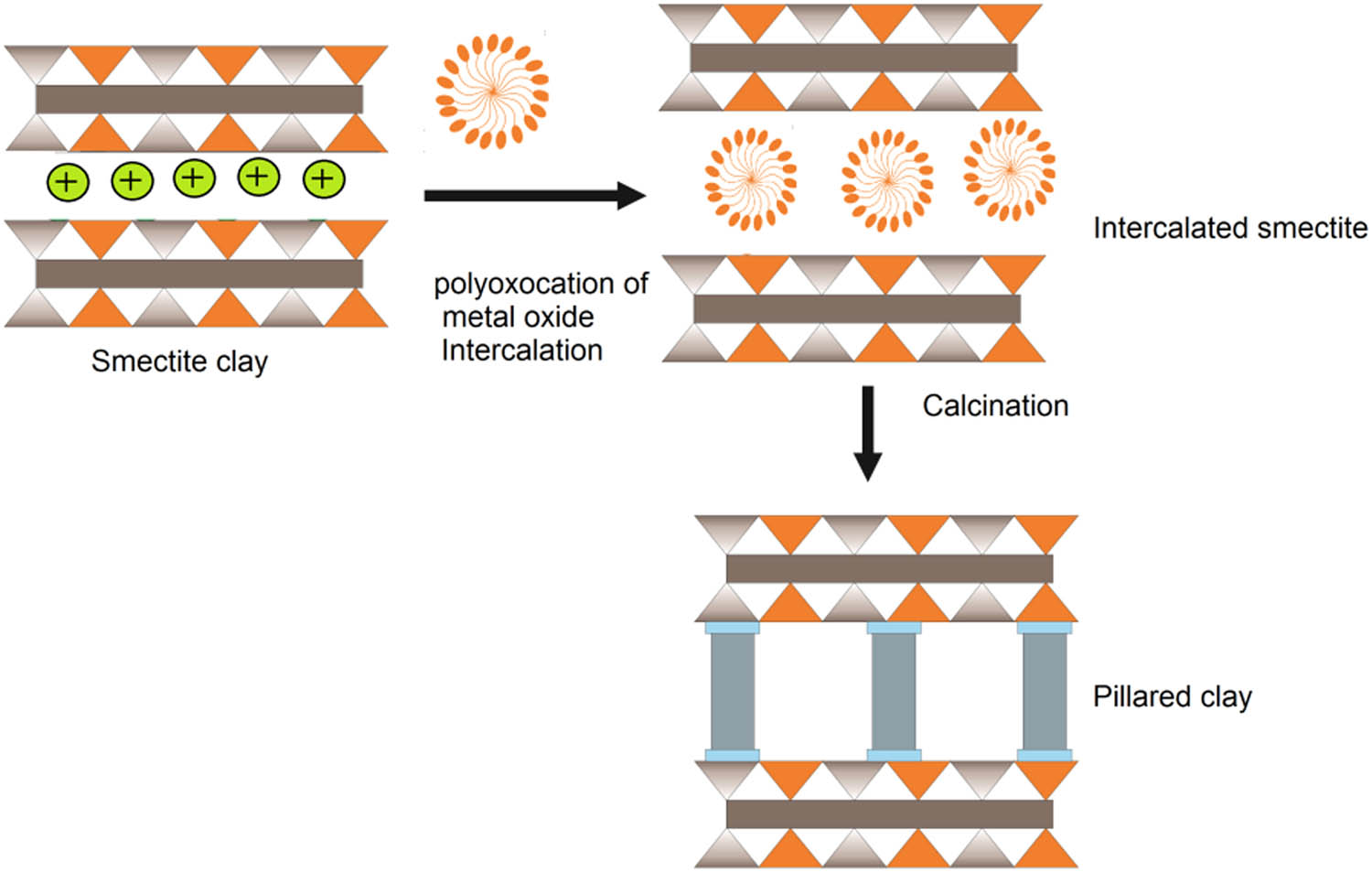
Schematic representation of clay pillarization.
The pillarization of smectite is advantageous, because it increases its basal spacing and pore distribution, bringing it from micro- to macroporosity. To facilitate the formation of MNPs in the clay structure, montmorillonite that has been pillared with another metal oxide, such as aluminum, silica, or titanium oxide, can be used [23,24,40]. Increasing the specific surface area and pore volume through pillarization using aluminum oxide facilitates the distribution of MNPs, which enhances the adsorption mechanism in contribution for the Photo-Fenton oxidation process of the dye. Measuring saturation magnetization has shown that decreasing the loading of Fe3O4 NPs decreases particle size and saturation magnetization. This trend is analogous with the relationship between the saturation magnetization and coercivity (Hc) of Fe3O4 NPs. A higher Fe3O4 nanoparticle size reflects a higher saturation magnetization and Hc. The low magnetization of materials with a smaller particle size is due to the formation of a magnetically disordered surface as a result of the large surface-to-volume ratio. However, the saturation magnetization values of these composites are still acceptable (23.5–81.2 emu/g), though they are less than those of Fe3O4 nanoparticles (82.7 emu/g). The magnetization, a higher specific surface area, and a resultant lower particle size of the composite for RhB decolorization enhance its adsorption capability and photocatalytic activity [18]. The composite’s iron loading, magnetization, and temperature of calcination significantly affect the size of MNPs [24,40]. In addition, the use of titanium-pillared montmorillonite as a support for MNPs has shown that increasing the temperature of calcination increases particle size and saturation magnetization [24].
Kaolinite is a 1:1 clay structure that has a small capacity for cation exchange and does not swell. Its structure has rarely been reported to involve the intercalation of metal oxides or their precursors. This different structure means that MNPs/kaolinite materials are mainly prepared using the co-precipitation method, which is also used in the production of halloysite, pristine halloysite, and halloysite nanotubes (HNTs), which are within the kaolin–serpentine class of clay. MNPs in the composite could be formed via a similar synthesis route as bentonite, which is produced by mixing precursors with a kaolinite suspension or preparing them separately before their dispersion into the suspension. The combination of co-precipitation and hydrothermal processes for nanoparticle formation has also been reported to produce homogeneously distributed nanoparticles. Different mechanisms of MNP growth have been reported, from impregnation methods to the use of pristine HNTs [36].
The structure of pristine HNTs consists of gibbsite octahedral sheet groups (Al–OH) on the internal surface and siloxane groups (Si–O–Si) on the external surface. This structure results in a negatively charged outer surface and a positively charged inner lumen in solutions with a pH of less than 8.5. The impregnation method applies a charged iron oxide precursor at the outer surface of HNTs. As the precursor on the outer surface is exposed to acetic acid vapor, iron acetate precursor species are formed. Calcination converts these species into smaller sized nanoparticles. Figure 3 shows the nanoparticle formation on the HNT surface.
LDHs are characterized as a porous clay with the potential to form nanocomposites, and their layers and ionic structures have different characteristics. The crystalline structure of LDHs consists of positively charged layers [M2+1−xM3+x(OH)2]x+ similar to the layered structure of brucite (Mg(OH)2) and an interlayered negative region composed of anions and water molecules, An−x/n·mH2O. As a result of this different ionic condition, magnetic nanocomposite formation with LDH usually involves anionic surfactants in the intercalation step [41]. Though the formation of magnetic nanocomposites with hydrotalcite (HT) can be identified by the increasing basal spacing of the interlayered structure, they are mostly synthesized using the co-precipitation method. The formation of magnetic HT reported by Miranda (2014), Lulu (2014), and Zolfaghar (2012) are examples of this method, as are hydrothermal and solvothermal syntheses [41,42,43,44].
Through the co-precipitation method, MNPs are dispersed in the interlayer space of the clay structure, but scanning electron microscope and transmission electron microscope analyses have shown that they are mostly distributed on to the clay surface. Generally, the pH, the temperature, and the concentration of the alkali and iron oxide precursors are critical factors in the synthesis. These factors significantly affect the nucleation and growth of particles. For example, MNPs will have different sizes and surface properties when synthesized from different iron-to-clay mass ratios and at different temperatures of nucleation.
Surface modification has been used to influence MICNCs’ ability to adapt to various pH conditions and hydrophobicities of the treated solution. The formation of hydrogels, hydrophobic magnetic nanocomposites, and surfactant-modified magnetic nanocomposites are three major techniques that have been widely reported. The hydrophobicity of MICNCs can be increased through the formation of Fe3O4–CTMAC/SEIA–Mt. In this process, prior to co-precipitation, montmorillonite is intercalated using cetyltrimethylammonium and sodium eicosenoate. The interlayer space was increased through the use of CTMA as a cationic surfactant. The electrostatic attraction of clay platelets may create an exfoliated composite system, meaning that the surfactant breaks the parallel arrangement. A multi-arrangement consists of monolayers, bilayers, and pseudo trilayers, and a paraffinic structure may be created. In addition, the use of CTMA as a cationic surfactant with SEIA as an anionic surfactant has been proposed as a way to stabilize the hydrophobic interaction of organic molecules at the surface [33].
The hydrogel formation of MICNCs from laponite and montmorillonite has been reportedly conducted by cross-linking the polymerization method [29,30]. As iron oxide/montmorillonite is produced, the hydrogel form is synthesized through the in situ graft copolymerization of acrylamide using potassium persulfate as a free radical initiator and N,N′-methylenebisacrylamide as a cross-linking agent. Polymerization agents were mixed with the nanocomposite suspension. Similarly, MNPs in laponite have been subjected to the cross-linking reaction through the use of ammonium persulfate as a radical initiator with N,N,N′,N′-tetramethylethylenediamine reagent to form poly(N-isopropylacrylamide) hydrogel. Hydrogels have a better solubility, pH stability, and mechanical and diffusion properties, which create a viscous, suspended treated solution with a highly concentrated contamination.
3 Application of MICNCs in water and wastewater treatments
In water treatment, MICNCs have been widely used for the removal of pollutants from aqueous solution, either by adsorption, photooxidation, or by chemical oxidation processes. The reduction and removal of contaminants, including chemical constituents, such as dye, heavy metals, and other organic pollutants from water, have been reported.
3.1 Adsorption
The use of MICNCs for the treatment of water and wastewater via adsorption is more dominant than photocatalysis and advanced oxidation processes (AOPs). The combination of the adsorptive properties of clay minerals with the magnetic properties of MNPs to produce novel MICNC adsorbents is a promising technique for the removal of pollutants from water. Table 2 shows various MICNCs along with their target contaminants and removal processes. The next section discusses each process in brief detail.
MICNCs used for adsorption
| MICNCs | Contaminant | Saturation magnetization/Ms (emu/g) | Isotherm of adsorption | Removal capacity | Ref. |
|---|---|---|---|---|---|
| Fe3O4/ZnAl–LDH | Cr(vi) | Not presented | Langmuir | 197.1 | [45] |
| MNPs/bentonite | La3+, Eu3+, and Yb3 | 14.0° | Langmuir | 18.4 mg/g for La(iii), 26.1 mg/g for Eu(iii), and 71.4 mg/g for Yb(iii) | [46] |
| Fe3O4/montmorillonite | Methylene blue (MB) | Not presented | Langmuir | 59.9 | [20] |
| Graphene/magnetite/montmorillonite | MB | 63.48 | Langmuir | 225.0 | [47] |
| Fe3O4/Al-pillared bentonite | Hg(ii) | 22.08 | Dubinin–Radushkevich (D–R) | 26.2 mg g−1 | [48] |
| Fe3O4 NPs/diatomite and Fe3O4 NPs/illite | PO43− | 35.39 | Langmuir | 11.9 mg/g for Fe3O4 NPs/diatomite and 5.48 mg/g for Fe3O4 NPs/illite | [21] |
| Fe3O4/bentonite | Enrofloxacin | 27.57 | Not presented | 180.0 mg/g | [49] |
| Chitosan/clay/magnetite | Cu(ii) and As(V) | Adsorption | Cu(ii) and As(v) of 17.2 and 5.9 mg g−1 in the initial concentration ranges of 16–656.0 and 17–336.0 mg L−1, respectively | [38] | |
| Fe2O3–palygorskite | Fenarimol | Adsorption | 27.8 mg/g | [50] | |
| Fe3O4–sepiolite | Bisphenol A | Photo-Fenton | Maximum removal of 12.0 mg/g at room temperature | [51] | |
| Di(2-thylhexly)phosphoric acid–immobilized magnetic GMZ bentonite | Eu(iii) | Adsorption | 40.5 mg/g | [52] | |
| Fe3O4/HNT | Methylene blue (MB), neutral red (NR), and methyl orange (MO) | 37.3, 30.6, and 2.5 mg/g for MB, NR, and MO, respectively | [35] | ||
| Sodium dodecyl sulfate-modified BiOBr/magnetic bentonite | Tetracycline and ciprofloxacin | Photocatalysis | 18.5 mg/g for TC and 34 mg/g for CP | [53] | |
| REC–Fe3O4 | MB and NR | Adsorption | 8.6 mg MB, 16.0 mg NR | [54] | |
| Fe3O4/sepiolite | Atrazine | 31.82 | Langmuir | 15.9 | [55] |
| Fe3O4/HNT | Cr(vi) | 29.53 | Not presented | 38.6 | [56] |
| Fe3O4/bentonite | Cr(iii) | Not presented | Langmuir | 11.7 | [57] |
| Fe3O4/saponite | Malachite green, Congo red, and indigo carmine, | Not presented | Langmuir | 159.1 mg/g for MG, 73.1 mg/g for CR, and 110.3 mg/g for IC | [58] |
| Magnetic bentonite/carboxymethyl chitosan/sodium alginate hydrogel beads | Cu(ii) | 18.86 emu/g | Langmuir | 56.8 mg/g | [59] |
| MnFe2O4/bentonite | Acid red | Not presented | Not presented | 23.5 mg/g | [60] |
| Fe3O4/kaolinite | Copper, lead, cadmium, chromium, and nickel | 38.2 | Langmuir | Cu2+ = 106.0 mg/g | [61] |
| Pb2+ = 98.0 mg/g | |||||
| Cd2+ = 100.0 mg/g | |||||
| Cr2+ = 97.0 mg/g | |||||
| Ni2+ = 95.2 mg/g | |||||
| Magnetic attapulgite–biochar composite (MABC) | Oxytetracycline | 31.46 | Langmuir | 33.3 mg/g | [62] |
| Fe3O4/bentonite | Cd(ii) | Not presented | Langmuir | 63.3 mg/g | [14] |
| Iron oxide–HT modified with the surfactant dodecyl sulfate (DS) and β-cyclodextrin (β-CD) | PHE, p-nitrophenol (PNP), and PCS | Not presented | Langmuir | PHE = 216.1 mg/g PNP = 255.6 mg/g PCS = 272.5 mg/g | [63] |
| γ-Fe2O3/halloysite | Ag nanoparticles | 18 | Langmuir | 67.9 mg/g | [64] |
| Magnetic and anionic–cationic modified montmorillonite (Fe3O4–CTMAC/SEIA–Mt) | Methylene blue | 19.84 | Langmuir | 211 mg/g | [37] |
| Fe3O4/halloysite | Naphthol green B | Not presented | Langmuir | 11.2 mg/g | [65] |
| Polyethylenimine functionalized magnetic montmorillonite clay (MMT–Fe3O4–PEI) | Cr(vi) | 59.81 | Langmuir | 62.9 mg/g | [28] |
| Fe3O4/sepiolite | Safranin | 31.8 | Langmuir | 18.5 mg/g | [66] |
| Magnetic core-shell dodecyl sulfate intercalated layered double hydroxide (Fe3O4@DS-LDH) | MB and MO | 25 | Freundlich | MB = 225.0 mg/g | [67] |
| MO = 221.0 mg/g | |||||
| CTAB-modified Fe3O4/montmorillonite | 2,6-Dichlorophenol and p-nitrophenol | 5.4 | Langmuir | 200 mg/g for 2,6-dichlorophenol and 125.0 mg/g for p-nitrophenol | [67] |
| Fe3O4/montmorillonite | MB | Not presented | Langmuir | 223.0 mg/g | [25] |
| Montmorillonite–Cu(ii)/Fe(iii) oxides | Humic acid | 3.9 | Langmuir | 98.0 mg/g | [68] |
| Clay/polyaniline/Fe3O4 | MB | 36.52 | Langmuir | 184.0 mg/g | [69] |
| O,O′-bis(2-aminopropyl)polypropyleneglycol-γ-Fe2O3/montmorillonite | MO | 26.7 | 9.8 mg/g | [70] | |
| Fe3O4/bentonite | Co(ii) | Not presented | Langmuir | 10.7 mg/g | [71] |
| Fe2O3/bentonite | Picloram | Not presented | Langmuir | [72] |
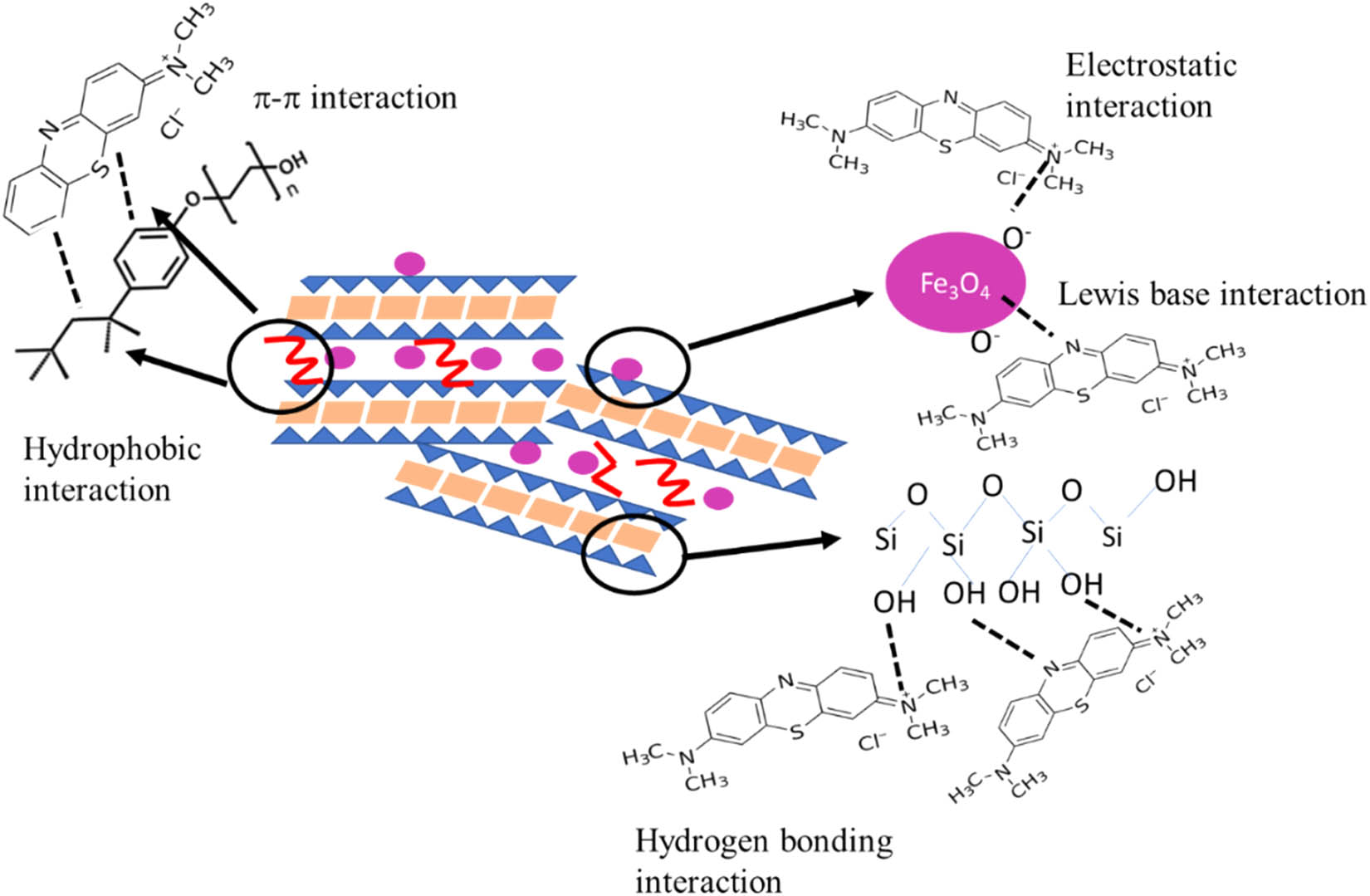
As seen in Table 2, many modifications have been attempted to enhance the adsorption capability of MICNCs, mainly through surface functionalization. The application of surfactants, polymers, and other compounds containing functional groups on to nanocomposites is effective for attracting the adsorbate. To describe the adsorption behavior, studies have adopted isotherm models, including the Langmuir, Freundlich, and Dubinin–Radushkevich models. As seen in Table 2, the Langmuir isotherm model is the most representative for almost all kinds of adsorbates. The Langmuir isotherm model represents the monolayer adsorption occurring on an energetically uniform surface, on which adsorbed molecules are not interactive. The equilibrium is attained once the monolayer is completely saturated. Contrary to Langmuir, the Freundlich model describes adsorption on an energetically heterogeneous surface, on which adsorbed molecules are interactive. In a different approach, the Dubinin–Radushkevich (D–R) model was constructed, based on the assumption that the adsorption performance is preferable when it occurs in micropores by pore-filling rather than layer-by-layer surface coverage. The D–R model can generally be applied to adsorption that occurs via a van der Waals interaction, for example, the adsorption of Hg(ii) by Fe3O4/Al-pillared bentonite [44]. Three main mechanisms for the adsorption of organic compounds have been identified, which are as follows:
a. π–π interactions are those that are available for surface-modified MICNCs, especially by the surfactant. In addition, hydrogen bond formation between MICNCs and double bonds of the adsorbate are usually both present together [37,62]. In a study on the adsorption of oxytetracycline by MABC, adsorption kinetics and Fourier-transform infrared spectroscopy revealed the π–π interaction mechanism. The enthalpy of adsorption at 12.50 kJ/mol represents the physical adsorption interaction dominantly. Moreover, positive values of ΔS° revealed an increasing randomness at the solid–solution interface during the adsorption process. Similarly, the hydrophobic interaction in phenol (PHE), CRE, and p-cresol (PCS) adsorption was presumably from the hydrogen bonds between the dodecyl sulfate/β-cyclodextrin (DS/β-CD) cavity contained in Fe/HT–dodecyl sulfate/β-cyclodextrin (DS/β-CD)Fe/HT–DS/β-CD and the phenolic compounds forming inclusion complexes, which promote selective adsorption.
b. Hydrogen bonding corresponds to the interaction between the hydrogen of the hydroxyl group (–C(O)–OH) in dyes or organic compounds and the oxygen atoms in the tetrahedral layer of the montmorillonite surface. Hydrogen bonding dominates when there is an adsorbate electrophilic element in the functional group, such as the nitrogen in, for example, –N(C2H5)2 or the oxygen atom.
c. Lewis interaction occurs when the nitrogen atom in the dye or organic molecule, which acts as the Lewis base, combines with the Al3+ and Fe3+ ions on the MICNC surface, which act as the Lewis acid. This molecular dynamic of this interaction is simulated by Ouachtak for the adsorption of rhodamine B and has also been found in the adsorption of picloram herbicide by pillared montmorillonite [73].
A schematic representation of the possible interaction between adsorbate and MICNCs is presented in Figure 5.
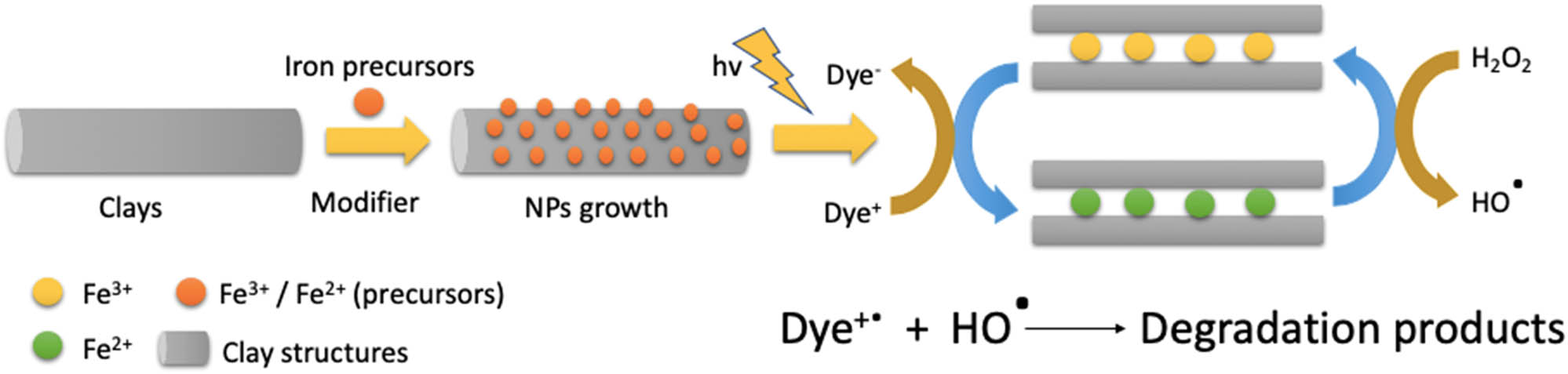
Schematic representation of the possible mechanism in adsorption using MICNCs.
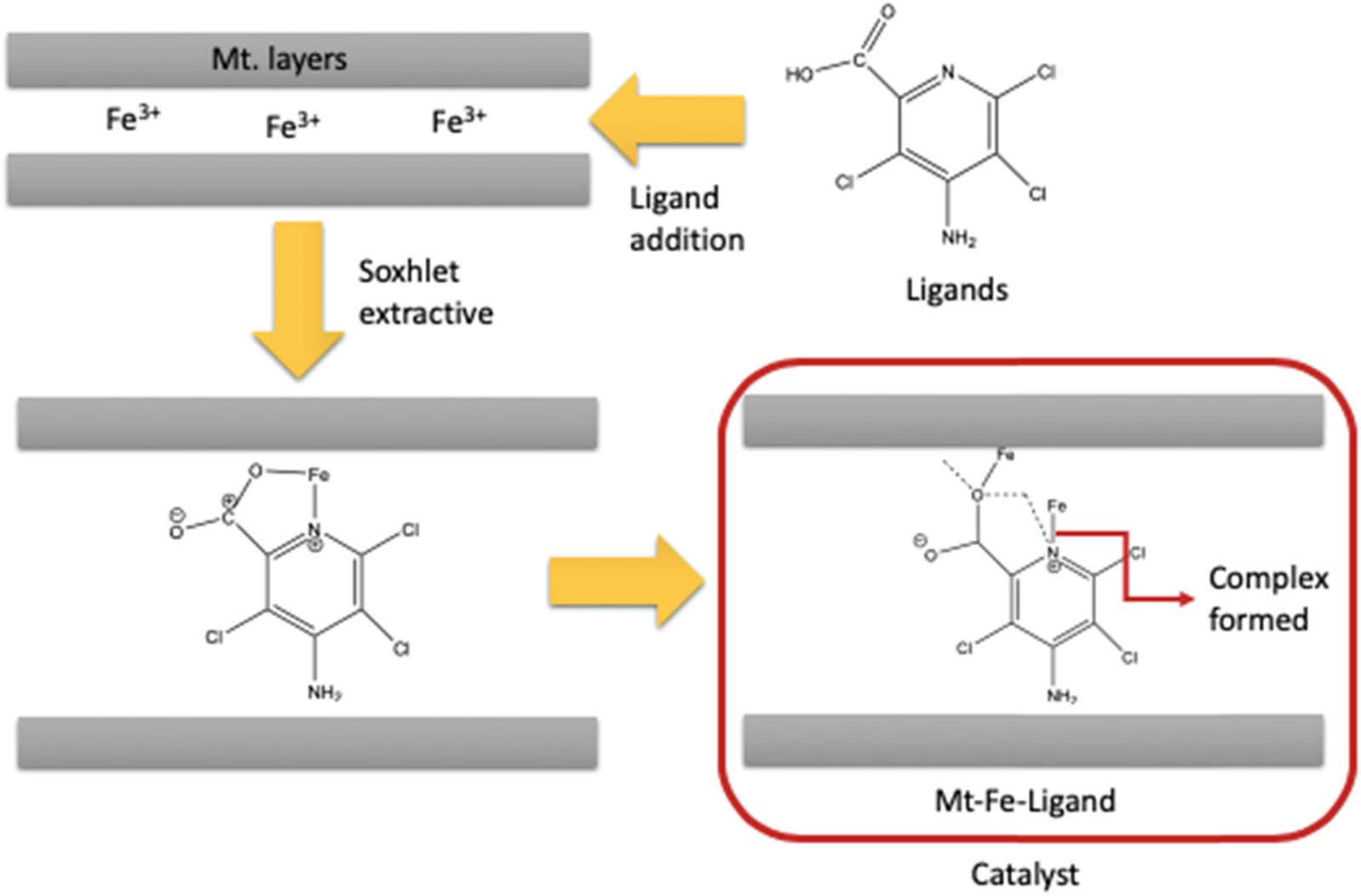
Montmorillonite (Mt.)-supported iron shifts base complexes as a catalyst.
In previous research work, FTIR analysis has revealed that the interaction between iron oxide and pillared montmorillonite occurs through the nitrogen of the pyridine ring as a result of the replacement of OH groups from the coordination sphere of iron. As shown in Figure 6, the interaction involves the formation of a bridge complex between COO− ions, nitrogen atoms in pyridine groups, and iron(iii) centers, such as those previously proposed [72].
Schematic representation of the photocatalysis mechanism over MNPs.
3.2 Photocatalytic and catalytic degradation of organic pollutants
MNPs are capable of oxidizing in AOPs. Traditional AOPs based on hydroxyl radicals (˙OH) and sulfate radicals (SO4˙−) produce strong oxidation radicals for the degradation of organic pollutants in water [74]. Electron excitation in MNPs activates the formation of radicals when MNPs are exposed to a small amount of energy, such as when undergoing thermal treatment. MICNCs are common catalyst carriers with high specific surface areas and good thermal stability and ion-exchange performance. They support the adsorption mechanism via oxidation over a heterogeneous catalyst. Zong et al. (2020) used magnetic clay with persulfate to degrade atrazine. In their study, Fe3O4 was loaded on sepiolite clay to catalyze potassium persulfate (K2S2O8) and hydrogen peroxide (H2O2), generating SO4˙2− and ˙OH for atrazine removal [75]. The composite maintained a good catalytic activity and stability during four consecutive runs. The quenching experiments showed that SO4˙2−/˙OH and ˙OH were the dominant radical species in the two systems.
The photocatalytic activity of MNPs arises from the semiconductor properties of Fe2O3 and Fe3O4. As semiconducting materials, both oxides are promising visible light-driven photocatalysts due to the band gap energy range. Moreover, iron oxides have a low cost and an excellent chemical stability, besides being easy to produce and environment-friendly. They also absorb most visible light. For example, γ-Fe2O3 absorbs light up to 600 nm, collects up to 40% of solar spectrum energy, and is one of the cheapest semiconductor materials. However, the stability of iron oxide photocatalysts is more or less at a pH of more than 3, and depending on the chemical environment, iron oxides may easily lose activity due to corrosion and aggregation.
MICNCs for the photocatalytic degradation of organic compounds
| Material | Ms | Process | Target compound | Degradation efficiency (%) | MNP size | Ref. |
|---|---|---|---|---|---|---|
| Sepiolite/Fe3O4 | Not given | AOP using K2S2O8 | Atrazine | 57.8 | [75] | |
| Fe3O4/rectorite | 30.28 | Wet peroxidation | p-Chlorophenol | 98 | [76] | |
| Magnetite/HNTs | Not given | AOP using NaIO4 | Pentachlorophenol | 89 | 15–30 | [36] |
| Fe3O4/montmorillonite | 27.57 | AOP using K2S2O8 | Enrofloxacin | 90 | 30–150 | [49] |
| Fe3O4/montmorillonite | 78 | AOP using permonosulfate | Bisphenol A (BPA) | 99.3 | 45–58 | [77] |
| TiO2/montmorillonite/Fe3O4 | 23.96 | Photocatalysis | MB | 94 | 45–60 | [78] |
| Fe3O4/montmorillonite | Not given | Photocatalysis | Brilliant orange X-GN | 79.1 (under visible light exposure) | Not given | [78] |
| Fe/montmorillonite | 41 emu/g | Photocatalysis | RhB | 79 | <10 | [79] |
| Fe3O4/palygorskite | 44.11 | Photocatalysis | Tetracycline | 72.9 | 20–50 | [80] |
| Sepiolite/Fe3O4 | Not given | Photocatalysis | Diuron | 92 | 5–20 | [81] |
| Sepiolite/Fe3O4 | Not given | Photocatalysis | BPA | 87 | 2–50 | [51] |
| Polypyrrole/HNTs/Fe3O4/Ag/Co nanocomposite | Not given | Photocatalysis | MB | 91 | 10–20 | [82] |
| Fe2O3–Fe3O4/montmorillonite | Not given | Photocatalysis | Methyl orange | 98.8 | 10–80 | [83] |
| Maghemite/montmorillonite | 45.61 | Photocatalysis | Phenol | 99 | 25–30 | [84] |
Drawbacks of using these oxides in photocatalysis arise from the recombination of separated photo-induced electron–hole pairs due to a low band gap energy. The formation of oxides in nanosize, in combination with the supporting form, has proven effective in improving the separation efficiency of photo-induced electron–hole pairs. According to the method given in Figure 7, as MNP and MICNC photocatalysts are exposed by photons, electrons are excited from the valence band (VB) to the conductance band (CB), leading to the formation of a hole (h+) in the VB. The interaction between h+ and e− in each CB and VB with OH and O2 from the reaction system or solvent produces radicals for further oxidation.

Mechanism of the photocatalytic degradation of organic molecules using iron oxide/clay nanocomposites.
Wang et al. (2017) reported that the formation of Fe2O3–Fe3O4 nanocomposites supported by montmorillonite increased the band gap energy [83]. Fe2O3–Fe3O4/Mt has a band gap energy of 2.85 eV, while pure Fe2O3–Fe3O4 has a band gap energy of 2.14 eV. Increasing the band gap energy increases the photocatalytic degradation of Fe2O3–Fe3O4/Mt by methyl orange which is higher compared to the pure one. The composite shows a 1.61-fold degradation rate, compared to pure Fe2O3–Fe3O4, and 98.8% recoverability by magnetic separation. Figure 4 shows a schematic representation of the photocatalytic degradation of organic molecules by MNP and MICNC photocatalysts.
Bledowski et al. reported that the redox potential of the CB of Fe2O3 is around 0.2 eV and that because the band gap energy of MICNCs is 2.85 eV, the VB is located at 3.15 eV. The CB has a lower redox potential than the formation of superoxide anion radicals (O2˙−) [E0(O2/O2˙−) = −0.33 eV. The spontaneous formation of O2˙− and HOO˙− arises, because O2 interacts with excited electrons. Moreover, the interaction of the electron hole with H2O to produce HO˙ occurs, because the VB has a higher potential reduction than the oxidation of water [E0 (H2O/˙OH) = 2.38 V] [86]. These generated radicals are effective oxidants for the degradation of dyes and organic compounds. A further oxidation reaction releases CO2, H2O, NO3−, and SO3− upon completion. In addition, fast degradation can be achieved through the addition of an oxidant, mainly H2O2. Interactions between H2O2 and the surface of MICNCs are mainly initiated by the following chain of reactions:
In addition, ˙OH, HO2˙/HO2˙− ions are generated through the reactions, which are responsible for the reversible conversion between Fe2+ and Fe3+. Furthermore, modifications on to iron oxide/clay have been reported concerning the catalyst and photocatalyst stabilization and surface modification to improve hydrophobicity.
Electronic features of dispersed Fe have been studied by Bao et al. [76], who showed that the amount and location of iron oxide nanoparticles in MICNCs are critical parameters in determining the shape, size, and crystal structure of nanoparticles, which correlate with their magnetization. It was concluded that the zero valence and large surface area of iron oxide nanoparticles create a high level of photocatalytic activity. The larger specific surface area facilitates an intensive interaction in the oxidation mechanism, and the calcination process creates a particle size uniformity and a strong interaction of iron oxide with the clay support. The strengthened interaction of iron oxide with a silica–alumina framework in the clay support reduces iron leaching, giving it a stable activity for consecutive usage as shown by the Fenton-like phenol degradation. Increasing calcination temperature increases particle size, and at certain temperatures, it affects iron oxide agglomeration and phase change [84].
Visible light sensitization is a popular and efficient photocatalysis mechanism that saves energy. The materials doping with Ag, Co, and TiO2 in small portions significantly enhance photocatalytic activity through the inhibition of electron recombination [78,82]. As photocatalysts have good capability in the visible light region, this photocatalytic process could be sunlight-driven.
4 Physicochemical character of MICNCs
Specific surface area and pore distribution are important parameters in adsorbent and photocatalyst applications for water treatment [60]. The higher specific surface area provides more adsorption sites for interacting with target molecules. The Brunauer–Emmett–Teller approach calculated from the N2 adsorption/desorption isotherm data is a generally acceptable method for this calculation. However, specific surface area and pore size distribution are not the most influential parameters for removal efficiency, as surface hydrophobicity and hydrophilicity also play roles in the interaction [27].
In practice, several factors influence intensive adsorption, such as pH, adsorbent/catalyst dosage, time of treatment, and so on. For example, pH determines the efficiency of surface–adsorbate bonding, which is an important step in adsorption, and it depends on the zeta potential of the adsorbent surface. The zeta potential is correlated with saturation magnetization. Measurements of zeta potential in solutions under the influence of magnetic fields have shown that increasing the field greatly influences the adsorption of dyes and metals, with larger field strengths creating more adsorption [25,49]. Magnetic fields exert much influence on the adsorption of dyes, as shown by their increase of removal and adsorption capacity. In addition, increasing nanoparticle size increases saturation magnetization [87]. Nanoparticle size analysis can be carried out using transmission electron microscopy (Table 3).
Szabo concluded that the lamellar sizes and cation exchange capacities of clay minerals affect MNP growth and magnetization. Comparing the formation of MNPs in laponite with their formation in montmorillonite showed that the size effect and greater amount of aggregation in laponite composites were related to the dominance of the maghemite phase due to the greater contribution of attractive dipolar interactions between magnetic nanocrystals [87]. Compared to laponite, montmorillonite sheets accommodated the formation of nanoparticles, while in the laponite, formed particles had the tendency to produce highly exfoliated clay lamellae. Thus, MNPs in laponite have a higher saturation magnetization than MNPs in montmorillonite. Saturation magnetization data have shown that the following factors significantly influence the properties of MICNCs:
a. MNP content and phase.
b. Average particle size of MNPs, size distribution, and aggregation state.
c. Specific surface area and the porous structure of clay.
d. Homogeneous/heterogeneous dispersion of iron oxide crystals in the clay matrix.
Figure 8 shows the effect of the iron content in iron oxide on montmorillonite-based MICNCs with saturation magnetization recapitulated from several references. In general, the higher the iron content in MICNCs, the higher the saturation magnetization. Higher particle sizes and the formation of more aggregates tend to give a higher saturation magnetization, and a higher calcination temperature enhances saturation magnetization [24,79]. The MNP size depends on the amount of iron precursors and the growth of iron oxide crystallite. As the growth of nanoparticles occurs in the layers of the clay structure, layer charge, and porous and surface structure are crucial factors that suppress nanoparticle formation. Nanoparticle formation is also controlled by temperature, especially in the synthesis of iron oxide-pillared clay, as a phase change from γ-Fe2O3 to α-Fe2O3 may occur, which affects magnetization properties. α-Fe2O3 decreases magnetization, while the presence of zerovalent iron (Fe0) in MICNCs increases magnetization [84,88].
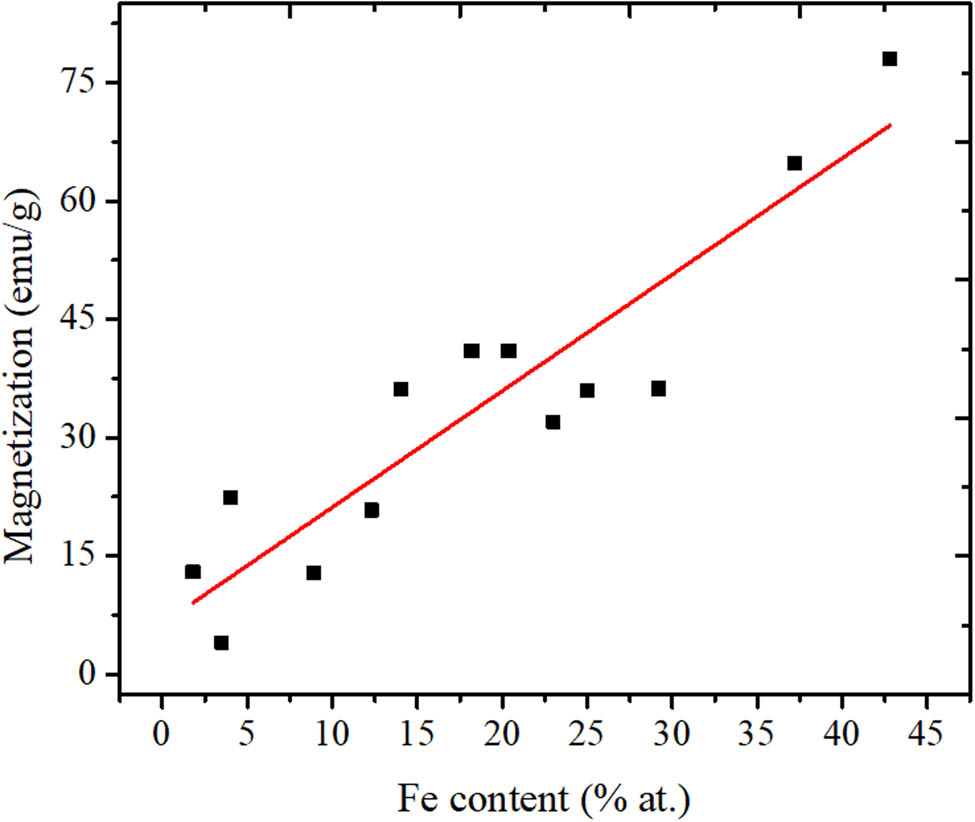
Effect of the iron content on saturation magnetization in montmorillonite-based MICNCs.
Surface characteristics, including hydrophobicity, pore distribution, pore radius, and nanoparticle distribution, are critical parameters in the proposed MICNC interactions in the adsorption mechanism. Theoretically, higher specific surface areas provide more space for adsorption. The data presented in Table 1 show that the insertion of MNPs into clay structure oxides changes the specific surface area of the composite. As with magnetization, iron content influences porous distribution and thus, the specific surface area of the composite. However, dispersion method, including pillarization, co-precipitation, and impregnation, is a more important factor than the iron content. The MNPs are distributed as metal oxide pillars in the pillarization method, while co-precipitation and impregnation position nanoparticles in the interlayer or at the edge of silica or alumina layers [27,88]. The cation exchange capacity and surface area of raw clay, as well as the layered structure, calcination temperature, and dispersion method, strongly influence the specific surface area of the composite. As there are so many additional factors, there is no strict relationship between magnetization and the specific surface area of MICNCs.
The terms recoverability and sustainability of the adsorbent and photocatalyst materials are proven by reusability. In most reported works, the durability of the materials until a minimum of five cycles with less reduction of removal activity has been presented. However, in photocatalytic applications, electronic transition may affect changes in the electronic state of MNPs in a nanocomposite. X-ray photoelectron spectroscopy is an effective method for predicting the change in speciation.
5 Future of MICNCs
MICNC syntheses and applications in water and wastewater treatments have been well studied and have been used in various ways to deal with pollutant-containing water. Research work has shown that incorporating functional MNPs into clay structures has resulted in stable adsorbent, catalyst, and photocatalyst materials, which have increased recoverability and sustainability in the treatment process. However, to our knowledge, research work has not addressed large-scale applications of this technology. Thus, we have recommended that researchers study large-scale production and implementation, including the following:
a. Research works should address the technical form of materials in large-scale processes. Although the adsorption capability of MICNCs has been discussed, findings have been limited to a laboratory setting. Modeling and simulation have shown that the performance of materials on a larger scale may vary from that on a smaller scale due to changes in material activity and the economic cost of the process.
b. Studies should recalculate the economic availability of technologies using MICNCs. The main factors for redesigning systems and technology in water and wastewater treatments are pH and the chemical and biological stability of the water treated.
c. Consideration should be given to potential secondary pollution and further treatment.
Conflict of interest: Authors declare no conflict of interest.
References
[1] Anderson NJ, Bolto BA, Dixon DR, Kolarik O, Priestley AJ, Raper WGC. Water and wastewater treatment with reusable magnetite nanoparticles. Water Sci Technol. 1982;14:1545–6.10.2166/wst.1982.0196Suche in Google Scholar
[2] Abdullah NH, Shameli K, Abdullah EC, Abdullah LC. Low cost and efficient synthesis of magnetic iron oxide/activated sericite nanocomposites for rapid removal of methylene blue and crystal violet dyes. Mater Charact. 2020;163:110275. 10.1016/j.matchar.2020.110275.Suche in Google Scholar
[3] Zhu N, Ji H, Yu P, Niu J, Farooq MU, Akram MW, et al. Surface modification of magnetic iron oxide nanoparticles. Nanomaterials. 2018;8:1–27. 10.3390/nano8100810.Suche in Google Scholar PubMed PubMed Central
[4] Abdullah NH, Shameli K, Abdullah EC, Abdullah LC. Solid matrices for fabrication of magnetic iron oxide nanocomposites: synthesis, properties, and application for the adsorption of heavy metal ions and dyes. Compos Part B Eng. 2019;162:538–68. 10.1016/j.compositesb.2018.12.075.Suche in Google Scholar
[5] Pereira MC, Oliveira LCA, Murad E. Iron oxide catalysts: fenton and fenton-like reactions – a review. Clays Clay Min. 2012;47:285–302.10.1180/claymin.2012.047.3.01Suche in Google Scholar
[6] Herney-Ramírez J, Madeira LM. Use of pillared clay-based catalysts for wastewater treatment through fenton-like processes. In: Gil A, Korili SA, Trujillano R, Vicente MA. Pillared clays and related catalysts. New York: Springer; 2010. 10.1007/978-1-4419-6670-4.Suche in Google Scholar
[7] Xu A, Yang M, Yao H, Du H, Sun C. Rectorite as catalyst for wet air oxidation of phenol. Appl Clay Sci. 2009;43:435–8. 10.1016/j.clay.2008.10.003.Suche in Google Scholar
[8] Zhou CH. An overview on strategies towards clay-based designer catalysts for green and sustainable catalysis. Appl Clay Sci. 2011;53:87–96. 10.1016/j.clay.2011.04.016.Suche in Google Scholar
[9] Abuzerr S, Darwish M, Mahvi AH. Simultaneous removal of cationic methylene blue and anionic reactive red 198 dyes using magnetic activated carbon nanoparticles: equilibrium, and kinetics analysis. Samer Abuzerr Maher Darwish Amir Hossein Mahvi. 2017;534–45. 10.2166/wst.2018.145.Suche in Google Scholar PubMed
[10] Hadjltaief HB, Da Costa P, Beaunier P, Gálvez ME, Zina MB. Fe-clay-plate as a heterogeneous catalyst in photo-Fenton oxidation of phenol as probe molecule for water treatment. Appl Clay Sci. 2014;91–92:46–54. 10.1016/j.clay.2014.01.020.Suche in Google Scholar
[11] Virkutyte J, Varma RS. Eco-friendly magnetic iron oxide-pillared montmorillonite for advanced catalytic degradation of dichlorophenol. ACS Sustainable Chem Eng. 2014;2:1545–50. 10.1021/sc5002512.Suche in Google Scholar
[12] Sanchis R, Cecilia JA, Soriano MD, Vázquez MI, Dejoz A, Nieto JL, et al. Porous clays heterostructures as supports of iron oxide for environmental catalysis. Chem Eng J. 2018;334:1159–68. 10.1016/j.cej.2017.11.060.Suche in Google Scholar
[13] Kalmakhanova MS, Diaz de Tuesta JL, Massalimova BK, Gomes HT, Kalmakhanova MS, de Tuesta JL, et al. Pillared clays from natural resources as catalysts for catalytic wet peroxide oxidation: characterization and kinetic insights. Environ Eng Res. 2019;25:186–96. 10.4491/eer.2018.402.Suche in Google Scholar
[14] Orolínová Z, Mockovčiaková A. Structural study of bentonite/iron oxide composites. Mater Chem Phys. 2009;114:956–61. 10.1016/j.matchemphys.2008.11.014.Suche in Google Scholar
[15] Oliveira LC, Rios RV, Fabris JD, Sapag K, Garg VK, Lago RM. Clay-iron oxide magnetic composites for the adsorption of contaminants in water. Appl Clay Sci. 2003;22:169–77. 10.1016/S0169-1317(02)00156-4.Suche in Google Scholar
[16] Bourlinos AB, Karakassides MA, Simopoulos A, Petridis D. Synthesis and characterization of magnetically modified composites. Chem Mater. 2000;12:2640–5. 10.1088/1742-6596/1091/1/012024.Suche in Google Scholar
[17] Makarchuk OV, Dontsova TA. Removal of anionic surfactants from wastewater by magnetic mineral sorbents. J Water Secur. 2016;2:1–9.Suche in Google Scholar
[18] Wan D, Li W, Wang G, Petridis D. Size-controllable synthesis of Fe3O4 nanoparticles through oxidation-precipitation method as heterogeneous fenton catalyst. J Mater Res. 2016;31:2608–16. 10.1557/jmr.2016.285.Suche in Google Scholar
[19] Belachew N, Bekele G. Synergy of magnetite intercalated bentonite for enhanced adsorption of congo red dye. Silicon. 2020;12:603–12. 10.1007/s12633-019-00152-2.Suche in Google Scholar
[20] Chang J, Ma J, Ma Q, Zhang D, Qiao N, Hu M, et al. Adsorption of methylene blue onto Fe3O4/activated montmorillonite nanocomposite. Appl Clay Sci. 2016;119:132–40. 10.1016/j.clay.2015.06.038.Suche in Google Scholar
[21] Chen J, Yan LG, Yu HQ, Li S, Qin LL, Liu GQ, et al. Efficient removal of phosphate by facile prepared magnetic diatomite and illite clay from aqueous solution. Chem Eng J. 2016;287:162–72. 10.1016/j.cej.2015.11.028.Suche in Google Scholar
[22] Danková Z, Fedorová E, Bekényiová A. Bentonite/iron oxide magnetic composites: characterization and application as Pb(ii) adsorbents. Arch Tech Sci. 2017;1:65–75. 10.7251/afts.2017.0916.065d.Suche in Google Scholar
[23] Çiftçi H, Ersoy B, Evcin A. Pillared magnetite/clay structures as a function of CTAB and TEOS concentration. Emerg Mater Res. 2020;9:1–7. 10.1680/jemmr.18.00148.Suche in Google Scholar
[24] Bachir C, Lan Y, Mereacre V, Powell AK, Koch CB, Weidler PG. Magnetic titanium-pillared clays (Ti-M-PILC): Magnetic studies and mössbauer spectroscopy. Clays Clay Min. 2009;57:433–43. 10.1346/CCMN.2009.0570404.Suche in Google Scholar
[25] Tireli AA, Marcos FCF, Oliveira LF, do Rosário Guimarães I, Guerreiro MC, Silva JP. Influence of magnetic field on the adsorption of organic compound by clays modified with iron. Appl Clay Sci. 2014;97–98:1–7. 10.1016/j.clay.2014.05.014.Suche in Google Scholar
[26] Virkutyte J, Varma RS. Eco-friendly magnetic iron oxide-pillared montmorillonite for advanced catalytic degradation of dichlorophenol. ACS Sustainable Chem Eng. 2014;2:1545–50. 10.1021/sc5002512.Suche in Google Scholar
[27] Fatimah I, Nurkholifah YY. Physicochemical and photocatalytic properties of Fe-pillared bentonite at various fe content. Bull Chem React Eng Catal. 2016;11; 10.9767/bcrec.11.3.456.398-405.Suche in Google Scholar
[28] Fayazi M, Ghanbarian M. One-pot hydrothermal synthesis of polyethylenimine functionalized magnetic clay for efficient removal of noxious Cr(vi) from aqueous solutions. Silicon. 2020;12:125–34. 10.1007/s12633-019-00105-9.Suche in Google Scholar
[29] Mahdavinia GR, Afzali A, Etemadi H, Hoseinzadeh H. Magnetic/pH-sensitive nanocomposite hydrogel based carboxymethyl cellulose-g-polyacrylamide/montmorillonite for colon targeted drug deliver. Nanomed Res J. 2017;2:111–22. 10.22034/NMRJ.2017.58964.1058.Suche in Google Scholar
[30] Goncharuk O, Samchenko Y, Sternik D, Kernosenko L, Poltorats'ka T, Partmurska N, et al. Thermosensitive hydrogel nanocomposites with magnetic laponite nanoparticles. Appl Nanosci. 2020. 10.1007/s13204-020-01388-w.Suche in Google Scholar
[31] Fayazi M. Chemistry facile hydrothermal synthesis of magnetic sepiolite clay for removal of Pb(ii). Anal Bioanal Chem Res. 2019;6(1):125–36. 10.22036/ABCR.2018.141470.1227.Suche in Google Scholar
[32] Magdy A, Fouad YO, Abdel-Aziz MH, Konsowa AH. Synthesis and characterization of Fe3O4/kaolin magnetic nanocomposite and its application in wastewater treatment. J Ind Eng Chem. 2017;56:299–311. 10.1016/j.jiec.2017.07.023.Suche in Google Scholar
[33] Tokarčíková M, Tokarský J, Kutláková KM, Seidlerová J. Testing the stability of magnetic iron oxides/kaolinite nanocomposite under various pH conditions. J Solid State Chem. 2017;253:329–35. 10.1016/j.jssc.2017.06.004.Suche in Google Scholar
[34] Zong P, Wang S, He C. Synthesis of kaolinite/iron oxide magnetic composites and their use in the removal of Cd(ii) from aqueous solutions. Water Sci Technol. 2013;67:1642–9. 10.2166/wst.2013.012.Suche in Google Scholar PubMed
[35] Xie Y, Qian D, Wu D, Ma X. Magnetic halloysite nanotubes/iron oxide composites for the adsorption of dyes. Chem Eng J. 2011;168:959–63. 10.1016/j.cej.2011.02.031.Suche in Google Scholar
[36] Tsoufis T, Katsaros F, Kooi BJ, Bletsa E, Papageorgiou S, Deligiannakis Y, et al. Halloysite nanotube-magnetic iron oxide nanoparticle hybrids for the rapid catalytic decomposition of pentachlorophenol. Chem Eng J. 2017;313:466–74. 10.1016/j.cej.2016.12.056.Suche in Google Scholar
[37] Rahmani S, Zeynizadeh B, Karami S. Removal of cationic methylene blue dye using magnetic and anionic-cationic modified montmorillonite: kinetic, isotherm and thermodynamic studies. Appl Clay Sci. 2020;184:105391. 10.1016/j.clay.2019.105391.Suche in Google Scholar
[38] Cho DW, Jeon BH, Chon CM, Kim Y, Schwartz FW, Lee ES, et al. A novel chitosan/clay/magnetite composite for adsorption of Cu(ii) and As(v). Chem Eng J. 2012;200–202:654–62. 10.1016/j.cej.2012.06.126.Suche in Google Scholar
[39] Tireli AA, do Rosário Guimarães I, de Souza Terra JC, da Silva RR, Guerreiro MC. Fenton-like processes and adsorption using iron oxide-pillared clay with magnetic properties for organic compound mitigation. Environ Sci Pollut Res. 2014;22:870–81. 10.1007/s11356-014-2973-x.Suche in Google Scholar PubMed
[40] Mao H, Liu X, Yang J, Li B, Yao C, Kong Y. Synthesis of magnetic FexOy@silica-pillared clay (SPC) composites via a novel sol-gel route for controlled drug release and targeting. Mater Sci Eng C. 2014;40:102–8. 10.1016/j.msec.2014.03.040.Suche in Google Scholar PubMed
[41] Rezvani Z, Sarkarat M. Synthesis and characterization of magnetic composites: intercalation of naproxen into Mg–Al layered double hydroxides coated on Fe3O4. Z Anorg Allg Chem. 2012;638:874–80. 10.1002/zaac.201100487.Suche in Google Scholar
[42] Miranda LD, Bellato CR, Milagres JL, Moura LG, Mounteer AH, de Almeida MF. Hydrotalcite-TiO2 magnetic iron oxide intercalated with the anionic surfactant dodecylsulfate in the photocatalytic degradation of methylene blue dye. J Env Manage. 2015;156:225–35. 10.1016/j.jenvman.2015.03.051.Suche in Google Scholar PubMed
[43] Miranda LD, Bellato CR, Fontes MP, Moura LG, Mounteer AH, de Almeida MF. Preparation and evaluation of hydrotalcite-iron oxide magnetic organocomposite intercalated with surfactants for cationic methylene blue dye removal. Chem Eng J. 2014;254:88–97. 10.1016/j.cej.2014.05.094.Suche in Google Scholar
[44] Lu L, Li J, Ng DH, Yang P, Song P, Zuo M. Synthesis of novel hierarchically porous Fe3O4@MgAl–LDH magnetic microspheres and its superb adsorption properties of dye from water. J Ind Eng Chem. 2017;46:315–23. 10.1016/j.jiec.2016.10.045.Suche in Google Scholar
[45] Zhao S, Wu M, Jing R, Liu X, Shao Y, Zhang Q, et al. One-pot formation of magnetic layered double hydroxide based on electrostatic self-assembly to remove Cr(vi) from wastewater. Appl Clay Sci. 2019;182:105297. 10.1016/j.clay.2019.105297.Suche in Google Scholar
[46] Wu D, Zhu C, Chen Y, Zhu B, Yang Y, Wang Q, et al. Preparation, characterization and adsorptive study of rare earth ions using magnetic GMZ bentonite. Appl Clay Sci. 2012;62–63:87–93. 10.1016/j.clay.2012.04.015.Suche in Google Scholar
[47] Zhang B, Zhang T, Zhang Z, Xie M. Hydrothermal synthesis of a graphene/magnetite/montmorillonite nanocomposite and its ultrasonically assisted methylene blue adsorption. J Mater Sci. 2019;54:11037–55. 10.1007/s10853-019-03659-6.Suche in Google Scholar
[48] Zou C, Liang J, Jiang W, Guan Y, Zhang Y. Adsorption behavior of magnetic bentonite for removing Hg(ii) from aqueous solutions. RSC Adv. 2018;8:27587–95. 10.1039/c8ra05247f.Suche in Google Scholar
[49] Peng G, Li T, Ai B, Yang S, Fu J, He Q, et al. Highly efficient removal of enrofloxacin by magnetic montmorillonite via adsorption and persulfate oxidation. Chem Eng J. 2019;360:1119–27. 10.1016/j.cej.2018.10.190.Suche in Google Scholar
[50] Ouali A, Belaroui LS, Bengueddach A, Galindo AL, Peña A. Fe2O3-palygorskite nanoparticles, efficient adsorbates for pesticide removal. Appl Clay Sci. 2015;115:67–75. 10.1016/j.clay.2015.07.026.Suche in Google Scholar
[51] Xu X, Chen W, Zong S, Ren X, Liu D. Magnetic clay as catalyst applied to organics degradation in a combined adsorption and fenton-like process. Chem Eng J. 2019;373:140–9. 10.1016/j.cej.2019.05.030.Suche in Google Scholar
[52] Chen Y, Zhu B, Wu D, Wang Q, Yang Y, Ye W, et al. Eu(iii) adsorption using di(2-thylhexly) phosphoric acid-immobilized magnetic GMZ bentonite. Chem Eng J. 2012;181–182:387–96. 10.1016/j.cej.2011.11.100Suche in Google Scholar
[53] Liu K, Tong Z, Muhammad Y, Huang G, Zhang H, Wang Z, et al. Synthesis of sodium dodecyl sulfate modified BiOBr/magnetic bentonite photocatalyst with Three-dimensional parterre like structure for the enhanced photodegradation of tetracycline and ciprofloxacin. Chem Eng J. 2020;388:124374. 10.1016/j.cej.2020.124374.Suche in Google Scholar
[54] Wu D, Zheng P, Chang PR, Ma X. Preparation and characterization of magnetic rectorite/iron oxide nanocomposites and its application for the removal of the dyes. Chem Eng J. 2011;174:489–94. 10.1016/j.cej.2011.09.029.Suche in Google Scholar
[55] Liu H, Chen W, Liu C, Liu Y, Dong C. Magnetic mesoporous clay adsorbent: preparation, characterization and adsorption capacity for atrazine. Microporous Mesoporous Mater. 2014;194:72–8. 10.1016/j.micromeso.2014.03.038Suche in Google Scholar
[56] Zhang R. Investigation of magnetic modified clay nano-adsorbents in removing micro-pollution from potable water. In: International Conference on Biological, Chemical & Environmental Sciences (BCES-2016). 2016; p. 6–11. 10.15242/iicbe.c0816201.Suche in Google Scholar
[57] Shah KH, Ali S, Shah F, Waseem M, Ismail B, Khan RA, et al. Magnetic oxide nanoparticles (Fe3O4) impregnated bentonite clay as a potential adsorbent for Cr(iii) adsorption. Mater Res Express. 2018;5:1. 10.1080/17425247.2018.1544616.Suche in Google Scholar PubMed
[58] Makarchuk OV, Dontsova TA, Astrelin IM. Magnetic clay sorbent for the removal of dyes from aquoeus solutions. XІMІЧHІ TEXHOЛOГІЇ. 2016;5:109–14.Suche in Google Scholar
[59] Zhang H, Omer AM, Hu Z, Yang LY, Ji C, Ouyang XK. Fabrication of magnetic bentonite/carboxymethyl chitosan/sodium alginate hydrogel beads for Cu(ii)adsorption. Int J Biol Macromol. 2019;135:490–500. 10.1016/j.ijbiomac.2019.05.185Suche in Google Scholar PubMed
[60] Hashemian S. MnFe2O4/bentonite nano composite as a novel magnetic material for adsorption of acid red 138. Afr J Biotechnol. 2010;9:8667–71. 10.5897/AJB09.1296Suche in Google Scholar
[61] Lasheen MR, El-Sherif IY, Sabry DY, El-Wakeel ST, El-Shahat MF. Adsorption of heavy metals from aqueous solution by magnetite nanoparticles and magnetite–kaolinite nanocomposite: equilibrium, isotherm and kinetic study. Desalin Water Treat. 2016;57:17421–9. 10.1080/19443994.2015.1085446.Suche in Google Scholar
[62] Wang Z, Yang X, Qin T, Liang G, Li Y, Xie X. Efficient removal of oxytetracycline from aqueous solution by a novel magnetic clay–biochar composite using natural attapulgite and cauliflower leaves. Environ Sci Pollut Res. 2019;26:7463–75. 10.1007/s11356-019-04172-8.Suche in Google Scholar PubMed
[63] Balbino TA, Bellato CR, da Silva AD, Neto JD, Ferreira SO. Preparation and evaluation of iron oxide/hydrotalcite intercalated with dodecylsulfate/β-cyclodextrin magnetic organocomposite for phenolic compounds removal. Appl Clay Sci. 2020;193:105659. 10.1016/j.clay.2020.105659.Suche in Google Scholar
[64] Janacek D, Kvitek L, Karlikova M, Pospiskova K, Safarik I. Removal of silver nanoparticles with native and magnetically modified halloysite. Appl Clay Sci. 2018;162:10–4. 10.1016/j.clay.2018.05.024.Suche in Google Scholar
[65] Riahi-Madvaar R, Taher MA, Fazelirad H. Synthesis and characterization of magnetic halloysite-iron oxide nanocomposite and its application for naphthol green B removal. Appl Clay Sci. 2017;137:101–6. 10.1016/j.clay.2016.12.019.Suche in Google Scholar
[66] Fayazi M, Afzali D, Taher MA, Pospiskova K, Safarik I. Removal of safranin dye from aqueous solution using magnetic mesoporous clay: optimization study. J Mol Liq. 2015;212:675–85. 10.1016/j.molliq.2015.09.045.Suche in Google Scholar
[67] Fayazi M, Afzali D, Taher MA, Mostafavi A, Gupta VK. A magnetic core-shell dodecyl sulfate intercalated layered double hydroxide nanocomposite for the adsorption of cationic and anionic organic dyes. Appl Clay Sci. 2019;183:105309. 10.1016/j.clay.2019.105309.Suche in Google Scholar
[68] Peng X, Luan Z, Zhang H. Montmorillonite-Cu(ii)/Fe(iii) oxides magnetic material as adsorbent for removal of humic acid and its thermal regeneration. Chemosphere. 2006;63:300–6. 10.1016/j.chemosphere.2005.07.019.Suche in Google Scholar PubMed
[69] Mu B, Tang J, Zhang L, Wang A. Preparation, characterization and application on dye adsorption of a well-defined two-dimensional superparamagnetic clay/polyaniline/Fe3O4 nanocomposite. Appl Clay Sci. 2016;132–133:7–16. 10.1016/j.clay.2016.06.005.Suche in Google Scholar
[70] Yu J, Yang Q-X. Magnetization improvement of Fe-pillared clay with application of polyetheramine. Appl Clay Sci. 2010;48:185–90. 10.1016/j.clay.2009.12.007.Suche in Google Scholar
[71] Chen L, Huang Y, Huang L, Liu B, Wang G, Yu S. Characterization of Co(ii) removal from aqueous solution using bentonite/iron oxide magnetic composites. J Radioanal Nucl Chem. 2011;290:675–84. 10.1007/s10967-011-1337-y.Suche in Google Scholar
[72] Marco-Brown JL, Barbosa-Lema CM, Sánchez RM, Mercader RC, dos Santos Afonso M. Adsorption of picloram herbicide on iron oxide pillared montmorillonite. Appl Clay Sci. 2012;58:25–33. 10.1016/j.clay.2012.01.004.Suche in Google Scholar
[73] Ouachtak H, El Haouti R, El Guerdaoui A, Haounati R, Amaterz E, Addi AA, et al. Experimental and molecular dynamics simulation study on the adsorption of Rhodamine B dye on magnetic montmorillonite composite γ-Fe2O3@Mt. J Mol Liq. 2020;309:113142. 10.1016/j.molliq.2020.113142.Suche in Google Scholar
[74] Galeano LA, Bravo PF, Luna CD, Vicente MÁ, Gil A. Removal of natural organic matter for drinking water production by Al/Fe-PILC-catalyzed wet peroxide oxidation: effect of the catalyst preparation from concentrated precursors. Appl Catal B Env. 2012;111–112:527–35. 10.1016/j.apcatb.2011.11.004.Suche in Google Scholar
[75] Zong S, Xu X, Ran G, Liu J. Comparative study of atrazine degradation by magnetic clay activated persulfate and H2O2. RSC Adv. 2020;10:11410–7. 10.1039/d0ra00345j.Suche in Google Scholar
[76] Bao T, Damtie MM, Wu K, Wei XL, Zhang Y, Chen J, et al. Rectorite-supported nano-Fe3O4 composite materials as catalyst for P-chlorophenol degradation: preparation, characterization, and mechanism. Appl Clay Sci. 2019;176:66–77. 10.1016/j.clay.2019.04.020.Suche in Google Scholar
[77] Yang S, Wu P, Liu J, Chen M, Ahmed Z, Zhu N. Efficient removal of bisphenol a by superoxide radical and singlet oxygen generated from peroxymonosulfate activated with Fe0-montmorillonite. Chem Eng J. 2018;350:484–95. 10.1016/j.cej.2018.04.175.Suche in Google Scholar
[78] Song XC, Qi YL, Zheng YF, Liu JN, Yin HY. Construction of magnetic Fe3O4@C@Ag3PO4 nanocomposites with excellent visible photocatalytic performance. J Nanosci Nanotechnol. 2017;17:1407–12. 10.1166/jnn.2017.12723.Suche in Google Scholar PubMed
[79] Son YH, Lee JK, Soong Y, Martello D, Chyu MK. Heterostructured zero valent iron-montmorillonite nanohybrid and their catalytic efficacy. Appl Clay Sci. 2012;62–63:21–6. 10.1016/j.clay.2012.04.003.Suche in Google Scholar
[80] Lian J, Ouyang Q, Tsang PE, Fang Z. Fenton-like catalytic degradation of tetracycline by magnetic palygorskite nanoparticles prepared from steel pickling waste liquor. Appl Clay Sci. 2019;182:105273. 10.1016/j.clay.2019.105273.Suche in Google Scholar
[81] Hou K, Wang G, Zhu Y, Ezzatahmadi N, Fu L, Tang A, et al. Sepiolite/Fe3O4 composite for effective degradation of diuron. Appl Clay Sci. 2019;181:105243. 10.1016/j.clay.2019.105243.Suche in Google Scholar
[82] Rouhi M, Babamoradi M, Hajizadeh Z, Maleki A, Maleki ST. Design and performance of polypyrrole/halloysite nanotubes/Fe3O4/Ag/Co nanocomposite for photocatalytic degradation of methylene blue under visible light irradiation. Opt (Stuttg). 2020;212:164721. 10.1016/j.ijleo.2020.164721.Suche in Google Scholar
[83] Wang J, Chen Y, Liu G, Cao Y. Synthesis, characterization and photocatalytic activity of inexpensive and non-toxic Fe2O3–Fe3O4 nano-composites supported by montmorillonite and modified by graphene. Compos Part B Eng. 2017;114:211–22. 10.1016/j.compositesb.2017.01.055.Suche in Google Scholar
[84] Jin M, Long M, Su H, Pan Y, Zhang Q, Wang J, et al. Magnetically separable maghemite/montmorillonite composite as an efficient heterogeneous fenton-like catalyst for phenol degradation. Environ Sci Pollut Res. 2017;24:1926–37. 10.1007/s11356-016-7866-8.Suche in Google Scholar PubMed
[85] Bledowski M, Wang L, Ramakrishnan A, Khavryuchenko OV, Khavryuchenko VD, Ricci PC, et al. Visible-light photocurrent response of TiO2-polyheptazine hybrids: evidence for interfacial charge-transfer absorption. Phys Chem Chem Phys. 2011;13:21511–9. 10.1039/c1cp22861g.Suche in Google Scholar PubMed
[86] Dong H, Zhang X, Li J, Zhou P, Yu S, Song N, et al. Construction of morphology-controlled nonmetal 2D/3D homojunction towards enhancing photocatalytic activity and mechanism insight. Appl Catal B. 2020;263:118270. 10.1016/j.apcatb.2019.118270.Suche in Google Scholar
[87] Siregar SH, Wijaya K, Kunarti ES, Syoufian A. Synthesis and characteristics of the magnetic properties of Fe3O4-(CTAB-montmorillonite) composites, based on variation in Fe3+/Fe2+ concentrations. Orient J Chem. 2018;34:716–22. 10.13005/ojc/340213.Suche in Google Scholar
[88] Nogueira FG, Lopes JH, Silva AC, Lago RM, Fabris JD, Oliveira LC. Catalysts based on clay and iron oxide for oxidation of toluene. Appl Clay Sci. 2011;51:385–9. 10.1016/j.clay.2010.12.007.Suche in Google Scholar
© 2020 Ganjar Fadillah et al., published by De Gruyter
This work is licensed under the Creative Commons Attribution 4.0 International License.
Artikel in diesem Heft
- Regular Articles
- Electrochemical antioxidant screening and evaluation based on guanine and chitosan immobilized MoS2 nanosheet modified glassy carbon electrode (guanine/CS/MoS2/GCE)
- Kinetic models of the extraction of vanillic acid from pumpkin seeds
- On the maximum ABC index of bipartite graphs without pendent vertices
- Estimation of the total antioxidant potential in the meat samples using thin-layer chromatography
- Molecular dynamics simulation of sI methane hydrate under compression and tension
- Spatial distribution and potential ecological risk assessment of some trace elements in sediments and grey mangrove (Avicennia marina) along the Arabian Gulf coast, Saudi Arabia
- Amino-functionalized graphene oxide for Cr(VI), Cu(II), Pb(II) and Cd(II) removal from industrial wastewater
- Chemical composition and in vitro activity of Origanum vulgare L., Satureja hortensis L., Thymus serpyllum L. and Thymus vulgaris L. essential oils towards oral isolates of Candida albicans and Candida glabrata
- Effect of excess Fluoride consumption on Urine-Serum Fluorides, Dental state and Thyroid Hormones among children in “Talab Sarai” Punjab Pakistan
- Design, Synthesis and Characterization of Novel Isoxazole Tagged Indole Hybrid Compounds
- Comparison of kinetic and enzymatic properties of intracellular phosphoserine aminotransferases from alkaliphilic and neutralophilic bacteria
- Green Organic Solvent-Free Oxidation of Alkylarenes with tert-Butyl Hydroperoxide Catalyzed by Water-Soluble Copper Complex
- Ducrosia ismaelis Asch. essential oil: chemical composition profile and anticancer, antimicrobial and antioxidant potential assessment
- DFT calculations as an efficient tool for prediction of Raman and infra-red spectra and activities of newly synthesized cathinones
- Influence of Chemical Osmosis on Solute Transport and Fluid Velocity in Clay Soils
- A New fatty acid and some triterpenoids from propolis of Nkambe (North-West Region, Cameroon) and evaluation of the antiradical scavenging activity of their extracts
- Antiplasmodial Activity of Stigmastane Steroids from Dryobalanops oblongifolia Stem Bark
- Rapid identification of direct-acting pancreatic protectants from Cyclocarya paliurus leaves tea by the method of serum pharmacochemistry combined with target cell extraction
- Immobilization of Pseudomonas aeruginosa static biomass on eggshell powder for on-line preconcentration and determination of Cr (VI)
- Assessment of methyl 2-({[(4,6-dimethoxypyrimidin-2-yl)carbamoyl] sulfamoyl}methyl)benzoate through biotic and abiotic degradation modes
- Stability of natural polyphenol fisetin in eye drops Stability of fisetin in eye drops
- Production of a bioflocculant by using activated sludge and its application in Pb(II) removal from aqueous solution
- Molecular Properties of Carbon Crystal Cubic Structures
- Synthesis and characterization of calcium carbonate whisker from yellow phosphorus slag
- Study on the interaction between catechin and cholesterol by the density functional theory
- Analysis of some pharmaceuticals in the presence of their synthetic impurities by applying hybrid micelle liquid chromatography
- Two mixed-ligand coordination polymers based on 2,5-thiophenedicarboxylic acid and flexible N-donor ligands: the protective effect on periodontitis via reducing the release of IL-1β and TNF-α
- Incorporation of silver stearate nanoparticles in methacrylate polymeric monoliths for hemeprotein isolation
- Development of ultrasound-assisted dispersive solid-phase microextraction based on mesoporous carbon coated with silica@iron oxide nanocomposite for preconcentration of Te and Tl in natural water systems
- N,N′-Bis[2-hydroxynaphthylidene]/[2-methoxybenzylidene]amino]oxamides and their divalent manganese complexes: Isolation, spectral characterization, morphology, antibacterial and cytotoxicity against leukemia cells
- Determination of the content of selected trace elements in Polish commercial fruit juices and health risk assessment
- Diorganotin(iv) benzyldithiocarbamate complexes: synthesis, characterization, and thermal and cytotoxicity study
- Keratin 17 is induced in prurigo nodularis lesions
- Anticancer, antioxidant, and acute toxicity studies of a Saudi polyherbal formulation, PHF5
- LaCoO3 perovskite-type catalysts in syngas conversion
- Comparative studies of two vegetal extracts from Stokesia laevis and Geranium pratense: polyphenol profile, cytotoxic effect and antiproliferative activity
- Fragmentation pattern of certain isatin–indole antiproliferative conjugates with application to identify their in vitro metabolic profiles in rat liver microsomes by liquid chromatography tandem mass spectrometry
- Investigation of polyphenol profile, antioxidant activity and hepatoprotective potential of Aconogonon alpinum (All.) Schur roots
- Lead discovery of a guanidinyl tryptophan derivative on amyloid cascade inhibition
- Physicochemical evaluation of the fruit pulp of Opuntia spp growing in the Mediterranean area under hard climate conditions
- Electronic structural properties of amino/hydroxyl functionalized imidazolium-based bromide ionic liquids
- New Schiff bases of 2-(quinolin-8-yloxy)acetohydrazide and their Cu(ii), and Zn(ii) metal complexes: their in vitro antimicrobial potentials and in silico physicochemical and pharmacokinetics properties
- Treatment of adhesions after Achilles tendon injury using focused ultrasound with targeted bFGF plasmid-loaded cationic microbubbles
- Synthesis of orotic acid derivatives and their effects on stem cell proliferation
- Chirality of β2-agonists. An overview of pharmacological activity, stereoselective analysis, and synthesis
- Fe3O4@urea/HITh-SO3H as an efficient and reusable catalyst for the solvent-free synthesis of 7-aryl-8H-benzo[h]indeno[1,2-b]quinoline-8-one and indeno[2′,1′:5,6]pyrido[2,3-d]pyrimidine derivatives
- Adsorption kinetic characteristics of molybdenum in yellow-brown soil in response to pH and phosphate
- Enhancement of thermal properties of bio-based microcapsules intended for textile applications
- Exploring the effect of khat (Catha edulis) chewing on the pharmacokinetics of the antiplatelet drug clopidogrel in rats using the newly developed LC-MS/MS technique
- A green strategy for obtaining anthraquinones from Rheum tanguticum by subcritical water
- Cadmium (Cd) chloride affects the nutrient uptake and Cd-resistant bacterium reduces the adsorption of Cd in muskmelon plants
- Removal of H2S by vermicompost biofilter and analysis on bacterial community
- Structural cytotoxicity relationship of 2-phenoxy(thiomethyl)pyridotriazolopyrimidines: Quantum chemical calculations and statistical analysis
- A self-breaking supramolecular plugging system as lost circulation material in oilfield
- Synthesis, characterization, and pharmacological evaluation of thiourea derivatives
- Application of drug–metal ion interaction principle in conductometric determination of imatinib, sorafenib, gefitinib and bosutinib
- Synthesis and characterization of a novel chitosan-grafted-polyorthoethylaniline biocomposite and utilization for dye removal from water
- Optimisation of urine sample preparation for shotgun proteomics
- DFT investigations on arylsulphonyl pyrazole derivatives as potential ligands of selected kinases
- Treatment of Parkinson’s disease using focused ultrasound with GDNF retrovirus-loaded microbubbles to open the blood–brain barrier
- New derivatives of a natural nordentatin
- Fluorescence biomarkers of malignant melanoma detectable in urine
- Study of the remediation effects of passivation materials on Pb-contaminated soil
- Saliva proteomic analysis reveals possible biomarkers of renal cell carcinoma
- Withania frutescens: Chemical characterization, analgesic, anti-inflammatory, and healing activities
- Design, synthesis and pharmacological profile of (−)-verbenone hydrazones
- Synthesis of magnesium carbonate hydrate from natural talc
- Stability-indicating HPLC-DAD assay for simultaneous quantification of hydrocortisone 21 acetate, dexamethasone, and fluocinolone acetonide in cosmetics
- A novel lactose biosensor based on electrochemically synthesized 3,4-ethylenedioxythiophene/thiophene (EDOT/Th) copolymer
- Citrullus colocynthis (L.) Schrad: Chemical characterization, scavenging and cytotoxic activities
- Development and validation of a high performance liquid chromatography/diode array detection method for estrogen determination: Application to residual analysis in meat products
- PCSK9 concentrations in different stages of subclinical atherosclerosis and their relationship with inflammation
- Development of trace analysis for alkyl methanesulfonates in the delgocitinib drug substance using GC-FID and liquid–liquid extraction with ionic liquid
- Electrochemical evaluation of the antioxidant capacity of natural compounds on glassy carbon electrode modified with guanine-, polythionine-, and nitrogen-doped graphene
- A Dy(iii)–organic framework as a fluorescent probe for highly selective detection of picric acid and treatment activity on human lung cancer cells
- A Zn(ii)–organic cage with semirigid ligand for solvent-free cyanosilylation and inhibitory effect on ovarian cancer cell migration and invasion ability via regulating mi-RNA16 expression
- Polyphenol content and antioxidant activities of Prunus padus L. and Prunus serotina L. leaves: Electrochemical and spectrophotometric approach and their antimicrobial properties
- The combined use of GC, PDSC and FT-IR techniques to characterize fat extracted from commercial complete dry pet food for adult cats
- MALDI-TOF MS profiling in the discovery and identification of salivary proteomic patterns of temporomandibular joint disorders
- Concentrations of dioxins, furans and dioxin-like PCBs in natural animal feed additives
- Structure and some physicochemical and functional properties of water treated under ammonia with low-temperature low-pressure glow plasma of low frequency
- Mesoscale nanoparticles encapsulated with emodin for targeting antifibrosis in animal models
- Amine-functionalized magnetic activated carbon as an adsorbent for preconcentration and determination of acidic drugs in environmental water samples using HPLC-DAD
- Antioxidant activity as a response to cadmium pollution in three durum wheat genotypes differing in salt-tolerance
- A promising naphthoquinone [8-hydroxy-2-(2-thienylcarbonyl)naphtho[2,3-b]thiophene-4,9-dione] exerts anti-colorectal cancer activity through ferroptosis and inhibition of MAPK signaling pathway based on RNA sequencing
- Synthesis and efficacy of herbicidal ionic liquids with chlorsulfuron as the anion
- Effect of isovalent substitution on the crystal structure and properties of two-slab indates BaLa2−xSmxIn2O7
- Synthesis, spectral and thermo-kinetics explorations of Schiff-base derived metal complexes
- An improved reduction method for phase stability testing in the single-phase region
- Comparative analysis of chemical composition of some commercially important fishes with an emphasis on various Malaysian diets
- Development of a solventless stir bar sorptive extraction/thermal desorption large volume injection capillary gas chromatographic-mass spectrometric method for ultra-trace determination of pyrethroids pesticides in river and tap water samples
- A turbidity sensor development based on NL-PI observers: Experimental application to the control of a Sinaloa’s River Spirulina maxima cultivation
- Deep desulfurization of sintering flue gas in iron and steel works based on low-temperature oxidation
- Investigations of metallic elements and phenolics in Chinese medicinal plants
- Influence of site-classification approach on geochemical background values
- Effects of ageing on the surface characteristics and Cu(ii) adsorption behaviour of rice husk biochar in soil
- Adsorption and sugarcane-bagasse-derived activated carbon-based mitigation of 1-[2-(2-chloroethoxy)phenyl]sulfonyl-3-(4-methoxy-6-methyl-1,3,5-triazin-2-yl) urea-contaminated soils
- Antimicrobial and antifungal activities of bifunctional cooper(ii) complexes with non-steroidal anti-inflammatory drugs, flufenamic, mefenamic and tolfenamic acids and 1,10-phenanthroline
- Application of selenium and silicon to alleviate short-term drought stress in French marigold (Tagetes patula L.) as a model plant species
- Screening and analysis of xanthine oxidase inhibitors in jute leaves and their protective effects against hydrogen peroxide-induced oxidative stress in cells
- Synthesis and physicochemical studies of a series of mixed-ligand transition metal complexes and their molecular docking investigations against Coronavirus main protease
- A study of in vitro metabolism and cytotoxicity of mephedrone and methoxetamine in human and pig liver models using GC/MS and LC/MS analyses
- A new phenyl alkyl ester and a new combretin triterpene derivative from Combretum fragrans F. Hoffm (Combretaceae) and antiproliferative activity
- Erratum
- Erratum to: A one-step incubation ELISA kit for rapid determination of dibutyl phthalate in water, beverage and liquor
- Review Articles
- Sinoporphyrin sodium, a novel sensitizer for photodynamic and sonodynamic therapy
- Natural products isolated from Casimiroa
- Plant description, phytochemical constituents and bioactivities of Syzygium genus: A review
- Evaluation of elastomeric heat shielding materials as insulators for solid propellant rocket motors: A short review
- Special Issue on Applied Biochemistry and Biotechnology 2019
- An overview of Monascus fermentation processes for monacolin K production
- Study on online soft sensor method of total sugar content in chlorotetracycline fermentation tank
- Studies on the Anti-Gouty Arthritis and Anti-hyperuricemia Properties of Astilbin in Animal Models
- Effects of organic fertilizer on water use, photosynthetic characteristics, and fruit quality of pear jujube in northern Shaanxi
- Characteristics of the root exudate release system of typical plants in plateau lakeside wetland under phosphorus stress conditions
- Characterization of soil water by the means of hydrogen and oxygen isotope ratio at dry-wet season under different soil layers in the dry-hot valley of Jinsha River
- Composition and diurnal variation of floral scent emission in Rosa rugosa Thunb. and Tulipa gesneriana L.
- Preparation of a novel ginkgolide B niosomal composite drug
- The degradation, biodegradability and toxicity evaluation of sulfamethazine antibiotics by gamma radiation
- Special issue on Monitoring, Risk Assessment and Sustainable Management for the Exposure to Environmental Toxins
- Insight into the cadmium and zinc binding potential of humic acids derived from composts by EEM spectra combined with PARAFAC analysis
- Source apportionment of soil contamination based on multivariate receptor and robust geostatistics in a typical rural–urban area, Wuhan city, middle China
- Special Issue on 13th JCC 2018
- The Role of H2C2O4 and Na2CO3 as Precipitating Agents on The Physichochemical Properties and Photocatalytic Activity of Bismuth Oxide
- Preparation of magnetite-silica–cetyltrimethylammonium for phenol removal based on adsolubilization
- Topical Issue on Agriculture
- Size-dependent growth kinetics of struvite crystals in wastewater with calcium ions
- The effect of silica-calcite sedimentary rock contained in the chicken broiler diet on the overall quality of chicken muscles
- Physicochemical properties of selected herbicidal products containing nicosulfuron as an active ingredient
- Lycopene in tomatoes and tomato products
- Fluorescence in the assessment of the share of a key component in the mixing of feed
- Sulfur application alleviates chromium stress in maize and wheat
- Effectiveness of removal of sulphur compounds from the air after 3 years of biofiltration with a mixture of compost soil, peat, coconut fibre and oak bark
- Special Issue on the 4th Green Chemistry 2018
- Study and fire test of banana fibre reinforced composites with flame retardance properties
- Special Issue on the International conference CosCI 2018
- Disintegration, In vitro Dissolution, and Drug Release Kinetics Profiles of k-Carrageenan-based Nutraceutical Hard-shell Capsules Containing Salicylamide
- Synthesis of amorphous aluminosilicate from impure Indonesian kaolin
- Special Issue on the International Conf on Science, Applied Science, Teaching and Education 2019
- Functionalization of Congo red dye as a light harvester on solar cell
- The effect of nitrite food preservatives added to se’i meat on the expression of wild-type p53 protein
- Biocompatibility and osteoconductivity of scaffold porous composite collagen–hydroxyapatite based coral for bone regeneration
- Special Issue on the Joint Science Congress of Materials and Polymers (ISCMP 2019)
- Effect of natural boron mineral use on the essential oil ratio and components of Musk Sage (Salvia sclarea L.)
- A theoretical and experimental study of the adsorptive removal of hexavalent chromium ions using graphene oxide as an adsorbent
- A study on the bacterial adhesion of Streptococcus mutans in various dental ceramics: In vitro study
- Corrosion study of copper in aqueous sulfuric acid solution in the presence of (2E,5E)-2,5-dibenzylidenecyclopentanone and (2E,5E)-bis[(4-dimethylamino)benzylidene]cyclopentanone: Experimental and theoretical study
- Special Issue on Chemistry Today for Tomorrow 2019
- Diabetes mellitus type 2: Exploratory data analysis based on clinical reading
- Multivariate analysis for the classification of copper–lead and copper–zinc glasses
- Special Issue on Advances in Chemistry and Polymers
- The spatial and temporal distribution of cationic and anionic radicals in early embryo implantation
- Special Issue on 3rd IC3PE 2020
- Magnetic iron oxide/clay nanocomposites for adsorption and catalytic oxidation in water treatment applications
- Special Issue on IC3PE 2018/2019 Conference
- Exergy analysis of conventional and hydrothermal liquefaction–esterification processes of microalgae for biodiesel production
- Advancing biodiesel production from microalgae Spirulina sp. by a simultaneous extraction–transesterification process using palm oil as a co-solvent of methanol
- Topical Issue on Applications of Mathematics in Chemistry
- Omega and the related counting polynomials of some chemical structures
- M-polynomial and topological indices of zigzag edge coronoid fused by starphene
Artikel in diesem Heft
- Regular Articles
- Electrochemical antioxidant screening and evaluation based on guanine and chitosan immobilized MoS2 nanosheet modified glassy carbon electrode (guanine/CS/MoS2/GCE)
- Kinetic models of the extraction of vanillic acid from pumpkin seeds
- On the maximum ABC index of bipartite graphs without pendent vertices
- Estimation of the total antioxidant potential in the meat samples using thin-layer chromatography
- Molecular dynamics simulation of sI methane hydrate under compression and tension
- Spatial distribution and potential ecological risk assessment of some trace elements in sediments and grey mangrove (Avicennia marina) along the Arabian Gulf coast, Saudi Arabia
- Amino-functionalized graphene oxide for Cr(VI), Cu(II), Pb(II) and Cd(II) removal from industrial wastewater
- Chemical composition and in vitro activity of Origanum vulgare L., Satureja hortensis L., Thymus serpyllum L. and Thymus vulgaris L. essential oils towards oral isolates of Candida albicans and Candida glabrata
- Effect of excess Fluoride consumption on Urine-Serum Fluorides, Dental state and Thyroid Hormones among children in “Talab Sarai” Punjab Pakistan
- Design, Synthesis and Characterization of Novel Isoxazole Tagged Indole Hybrid Compounds
- Comparison of kinetic and enzymatic properties of intracellular phosphoserine aminotransferases from alkaliphilic and neutralophilic bacteria
- Green Organic Solvent-Free Oxidation of Alkylarenes with tert-Butyl Hydroperoxide Catalyzed by Water-Soluble Copper Complex
- Ducrosia ismaelis Asch. essential oil: chemical composition profile and anticancer, antimicrobial and antioxidant potential assessment
- DFT calculations as an efficient tool for prediction of Raman and infra-red spectra and activities of newly synthesized cathinones
- Influence of Chemical Osmosis on Solute Transport and Fluid Velocity in Clay Soils
- A New fatty acid and some triterpenoids from propolis of Nkambe (North-West Region, Cameroon) and evaluation of the antiradical scavenging activity of their extracts
- Antiplasmodial Activity of Stigmastane Steroids from Dryobalanops oblongifolia Stem Bark
- Rapid identification of direct-acting pancreatic protectants from Cyclocarya paliurus leaves tea by the method of serum pharmacochemistry combined with target cell extraction
- Immobilization of Pseudomonas aeruginosa static biomass on eggshell powder for on-line preconcentration and determination of Cr (VI)
- Assessment of methyl 2-({[(4,6-dimethoxypyrimidin-2-yl)carbamoyl] sulfamoyl}methyl)benzoate through biotic and abiotic degradation modes
- Stability of natural polyphenol fisetin in eye drops Stability of fisetin in eye drops
- Production of a bioflocculant by using activated sludge and its application in Pb(II) removal from aqueous solution
- Molecular Properties of Carbon Crystal Cubic Structures
- Synthesis and characterization of calcium carbonate whisker from yellow phosphorus slag
- Study on the interaction between catechin and cholesterol by the density functional theory
- Analysis of some pharmaceuticals in the presence of their synthetic impurities by applying hybrid micelle liquid chromatography
- Two mixed-ligand coordination polymers based on 2,5-thiophenedicarboxylic acid and flexible N-donor ligands: the protective effect on periodontitis via reducing the release of IL-1β and TNF-α
- Incorporation of silver stearate nanoparticles in methacrylate polymeric monoliths for hemeprotein isolation
- Development of ultrasound-assisted dispersive solid-phase microextraction based on mesoporous carbon coated with silica@iron oxide nanocomposite for preconcentration of Te and Tl in natural water systems
- N,N′-Bis[2-hydroxynaphthylidene]/[2-methoxybenzylidene]amino]oxamides and their divalent manganese complexes: Isolation, spectral characterization, morphology, antibacterial and cytotoxicity against leukemia cells
- Determination of the content of selected trace elements in Polish commercial fruit juices and health risk assessment
- Diorganotin(iv) benzyldithiocarbamate complexes: synthesis, characterization, and thermal and cytotoxicity study
- Keratin 17 is induced in prurigo nodularis lesions
- Anticancer, antioxidant, and acute toxicity studies of a Saudi polyherbal formulation, PHF5
- LaCoO3 perovskite-type catalysts in syngas conversion
- Comparative studies of two vegetal extracts from Stokesia laevis and Geranium pratense: polyphenol profile, cytotoxic effect and antiproliferative activity
- Fragmentation pattern of certain isatin–indole antiproliferative conjugates with application to identify their in vitro metabolic profiles in rat liver microsomes by liquid chromatography tandem mass spectrometry
- Investigation of polyphenol profile, antioxidant activity and hepatoprotective potential of Aconogonon alpinum (All.) Schur roots
- Lead discovery of a guanidinyl tryptophan derivative on amyloid cascade inhibition
- Physicochemical evaluation of the fruit pulp of Opuntia spp growing in the Mediterranean area under hard climate conditions
- Electronic structural properties of amino/hydroxyl functionalized imidazolium-based bromide ionic liquids
- New Schiff bases of 2-(quinolin-8-yloxy)acetohydrazide and their Cu(ii), and Zn(ii) metal complexes: their in vitro antimicrobial potentials and in silico physicochemical and pharmacokinetics properties
- Treatment of adhesions after Achilles tendon injury using focused ultrasound with targeted bFGF plasmid-loaded cationic microbubbles
- Synthesis of orotic acid derivatives and their effects on stem cell proliferation
- Chirality of β2-agonists. An overview of pharmacological activity, stereoselective analysis, and synthesis
- Fe3O4@urea/HITh-SO3H as an efficient and reusable catalyst for the solvent-free synthesis of 7-aryl-8H-benzo[h]indeno[1,2-b]quinoline-8-one and indeno[2′,1′:5,6]pyrido[2,3-d]pyrimidine derivatives
- Adsorption kinetic characteristics of molybdenum in yellow-brown soil in response to pH and phosphate
- Enhancement of thermal properties of bio-based microcapsules intended for textile applications
- Exploring the effect of khat (Catha edulis) chewing on the pharmacokinetics of the antiplatelet drug clopidogrel in rats using the newly developed LC-MS/MS technique
- A green strategy for obtaining anthraquinones from Rheum tanguticum by subcritical water
- Cadmium (Cd) chloride affects the nutrient uptake and Cd-resistant bacterium reduces the adsorption of Cd in muskmelon plants
- Removal of H2S by vermicompost biofilter and analysis on bacterial community
- Structural cytotoxicity relationship of 2-phenoxy(thiomethyl)pyridotriazolopyrimidines: Quantum chemical calculations and statistical analysis
- A self-breaking supramolecular plugging system as lost circulation material in oilfield
- Synthesis, characterization, and pharmacological evaluation of thiourea derivatives
- Application of drug–metal ion interaction principle in conductometric determination of imatinib, sorafenib, gefitinib and bosutinib
- Synthesis and characterization of a novel chitosan-grafted-polyorthoethylaniline biocomposite and utilization for dye removal from water
- Optimisation of urine sample preparation for shotgun proteomics
- DFT investigations on arylsulphonyl pyrazole derivatives as potential ligands of selected kinases
- Treatment of Parkinson’s disease using focused ultrasound with GDNF retrovirus-loaded microbubbles to open the blood–brain barrier
- New derivatives of a natural nordentatin
- Fluorescence biomarkers of malignant melanoma detectable in urine
- Study of the remediation effects of passivation materials on Pb-contaminated soil
- Saliva proteomic analysis reveals possible biomarkers of renal cell carcinoma
- Withania frutescens: Chemical characterization, analgesic, anti-inflammatory, and healing activities
- Design, synthesis and pharmacological profile of (−)-verbenone hydrazones
- Synthesis of magnesium carbonate hydrate from natural talc
- Stability-indicating HPLC-DAD assay for simultaneous quantification of hydrocortisone 21 acetate, dexamethasone, and fluocinolone acetonide in cosmetics
- A novel lactose biosensor based on electrochemically synthesized 3,4-ethylenedioxythiophene/thiophene (EDOT/Th) copolymer
- Citrullus colocynthis (L.) Schrad: Chemical characterization, scavenging and cytotoxic activities
- Development and validation of a high performance liquid chromatography/diode array detection method for estrogen determination: Application to residual analysis in meat products
- PCSK9 concentrations in different stages of subclinical atherosclerosis and their relationship with inflammation
- Development of trace analysis for alkyl methanesulfonates in the delgocitinib drug substance using GC-FID and liquid–liquid extraction with ionic liquid
- Electrochemical evaluation of the antioxidant capacity of natural compounds on glassy carbon electrode modified with guanine-, polythionine-, and nitrogen-doped graphene
- A Dy(iii)–organic framework as a fluorescent probe for highly selective detection of picric acid and treatment activity on human lung cancer cells
- A Zn(ii)–organic cage with semirigid ligand for solvent-free cyanosilylation and inhibitory effect on ovarian cancer cell migration and invasion ability via regulating mi-RNA16 expression
- Polyphenol content and antioxidant activities of Prunus padus L. and Prunus serotina L. leaves: Electrochemical and spectrophotometric approach and their antimicrobial properties
- The combined use of GC, PDSC and FT-IR techniques to characterize fat extracted from commercial complete dry pet food for adult cats
- MALDI-TOF MS profiling in the discovery and identification of salivary proteomic patterns of temporomandibular joint disorders
- Concentrations of dioxins, furans and dioxin-like PCBs in natural animal feed additives
- Structure and some physicochemical and functional properties of water treated under ammonia with low-temperature low-pressure glow plasma of low frequency
- Mesoscale nanoparticles encapsulated with emodin for targeting antifibrosis in animal models
- Amine-functionalized magnetic activated carbon as an adsorbent for preconcentration and determination of acidic drugs in environmental water samples using HPLC-DAD
- Antioxidant activity as a response to cadmium pollution in three durum wheat genotypes differing in salt-tolerance
- A promising naphthoquinone [8-hydroxy-2-(2-thienylcarbonyl)naphtho[2,3-b]thiophene-4,9-dione] exerts anti-colorectal cancer activity through ferroptosis and inhibition of MAPK signaling pathway based on RNA sequencing
- Synthesis and efficacy of herbicidal ionic liquids with chlorsulfuron as the anion
- Effect of isovalent substitution on the crystal structure and properties of two-slab indates BaLa2−xSmxIn2O7
- Synthesis, spectral and thermo-kinetics explorations of Schiff-base derived metal complexes
- An improved reduction method for phase stability testing in the single-phase region
- Comparative analysis of chemical composition of some commercially important fishes with an emphasis on various Malaysian diets
- Development of a solventless stir bar sorptive extraction/thermal desorption large volume injection capillary gas chromatographic-mass spectrometric method for ultra-trace determination of pyrethroids pesticides in river and tap water samples
- A turbidity sensor development based on NL-PI observers: Experimental application to the control of a Sinaloa’s River Spirulina maxima cultivation
- Deep desulfurization of sintering flue gas in iron and steel works based on low-temperature oxidation
- Investigations of metallic elements and phenolics in Chinese medicinal plants
- Influence of site-classification approach on geochemical background values
- Effects of ageing on the surface characteristics and Cu(ii) adsorption behaviour of rice husk biochar in soil
- Adsorption and sugarcane-bagasse-derived activated carbon-based mitigation of 1-[2-(2-chloroethoxy)phenyl]sulfonyl-3-(4-methoxy-6-methyl-1,3,5-triazin-2-yl) urea-contaminated soils
- Antimicrobial and antifungal activities of bifunctional cooper(ii) complexes with non-steroidal anti-inflammatory drugs, flufenamic, mefenamic and tolfenamic acids and 1,10-phenanthroline
- Application of selenium and silicon to alleviate short-term drought stress in French marigold (Tagetes patula L.) as a model plant species
- Screening and analysis of xanthine oxidase inhibitors in jute leaves and their protective effects against hydrogen peroxide-induced oxidative stress in cells
- Synthesis and physicochemical studies of a series of mixed-ligand transition metal complexes and their molecular docking investigations against Coronavirus main protease
- A study of in vitro metabolism and cytotoxicity of mephedrone and methoxetamine in human and pig liver models using GC/MS and LC/MS analyses
- A new phenyl alkyl ester and a new combretin triterpene derivative from Combretum fragrans F. Hoffm (Combretaceae) and antiproliferative activity
- Erratum
- Erratum to: A one-step incubation ELISA kit for rapid determination of dibutyl phthalate in water, beverage and liquor
- Review Articles
- Sinoporphyrin sodium, a novel sensitizer for photodynamic and sonodynamic therapy
- Natural products isolated from Casimiroa
- Plant description, phytochemical constituents and bioactivities of Syzygium genus: A review
- Evaluation of elastomeric heat shielding materials as insulators for solid propellant rocket motors: A short review
- Special Issue on Applied Biochemistry and Biotechnology 2019
- An overview of Monascus fermentation processes for monacolin K production
- Study on online soft sensor method of total sugar content in chlorotetracycline fermentation tank
- Studies on the Anti-Gouty Arthritis and Anti-hyperuricemia Properties of Astilbin in Animal Models
- Effects of organic fertilizer on water use, photosynthetic characteristics, and fruit quality of pear jujube in northern Shaanxi
- Characteristics of the root exudate release system of typical plants in plateau lakeside wetland under phosphorus stress conditions
- Characterization of soil water by the means of hydrogen and oxygen isotope ratio at dry-wet season under different soil layers in the dry-hot valley of Jinsha River
- Composition and diurnal variation of floral scent emission in Rosa rugosa Thunb. and Tulipa gesneriana L.
- Preparation of a novel ginkgolide B niosomal composite drug
- The degradation, biodegradability and toxicity evaluation of sulfamethazine antibiotics by gamma radiation
- Special issue on Monitoring, Risk Assessment and Sustainable Management for the Exposure to Environmental Toxins
- Insight into the cadmium and zinc binding potential of humic acids derived from composts by EEM spectra combined with PARAFAC analysis
- Source apportionment of soil contamination based on multivariate receptor and robust geostatistics in a typical rural–urban area, Wuhan city, middle China
- Special Issue on 13th JCC 2018
- The Role of H2C2O4 and Na2CO3 as Precipitating Agents on The Physichochemical Properties and Photocatalytic Activity of Bismuth Oxide
- Preparation of magnetite-silica–cetyltrimethylammonium for phenol removal based on adsolubilization
- Topical Issue on Agriculture
- Size-dependent growth kinetics of struvite crystals in wastewater with calcium ions
- The effect of silica-calcite sedimentary rock contained in the chicken broiler diet on the overall quality of chicken muscles
- Physicochemical properties of selected herbicidal products containing nicosulfuron as an active ingredient
- Lycopene in tomatoes and tomato products
- Fluorescence in the assessment of the share of a key component in the mixing of feed
- Sulfur application alleviates chromium stress in maize and wheat
- Effectiveness of removal of sulphur compounds from the air after 3 years of biofiltration with a mixture of compost soil, peat, coconut fibre and oak bark
- Special Issue on the 4th Green Chemistry 2018
- Study and fire test of banana fibre reinforced composites with flame retardance properties
- Special Issue on the International conference CosCI 2018
- Disintegration, In vitro Dissolution, and Drug Release Kinetics Profiles of k-Carrageenan-based Nutraceutical Hard-shell Capsules Containing Salicylamide
- Synthesis of amorphous aluminosilicate from impure Indonesian kaolin
- Special Issue on the International Conf on Science, Applied Science, Teaching and Education 2019
- Functionalization of Congo red dye as a light harvester on solar cell
- The effect of nitrite food preservatives added to se’i meat on the expression of wild-type p53 protein
- Biocompatibility and osteoconductivity of scaffold porous composite collagen–hydroxyapatite based coral for bone regeneration
- Special Issue on the Joint Science Congress of Materials and Polymers (ISCMP 2019)
- Effect of natural boron mineral use on the essential oil ratio and components of Musk Sage (Salvia sclarea L.)
- A theoretical and experimental study of the adsorptive removal of hexavalent chromium ions using graphene oxide as an adsorbent
- A study on the bacterial adhesion of Streptococcus mutans in various dental ceramics: In vitro study
- Corrosion study of copper in aqueous sulfuric acid solution in the presence of (2E,5E)-2,5-dibenzylidenecyclopentanone and (2E,5E)-bis[(4-dimethylamino)benzylidene]cyclopentanone: Experimental and theoretical study
- Special Issue on Chemistry Today for Tomorrow 2019
- Diabetes mellitus type 2: Exploratory data analysis based on clinical reading
- Multivariate analysis for the classification of copper–lead and copper–zinc glasses
- Special Issue on Advances in Chemistry and Polymers
- The spatial and temporal distribution of cationic and anionic radicals in early embryo implantation
- Special Issue on 3rd IC3PE 2020
- Magnetic iron oxide/clay nanocomposites for adsorption and catalytic oxidation in water treatment applications
- Special Issue on IC3PE 2018/2019 Conference
- Exergy analysis of conventional and hydrothermal liquefaction–esterification processes of microalgae for biodiesel production
- Advancing biodiesel production from microalgae Spirulina sp. by a simultaneous extraction–transesterification process using palm oil as a co-solvent of methanol
- Topical Issue on Applications of Mathematics in Chemistry
- Omega and the related counting polynomials of some chemical structures
- M-polynomial and topological indices of zigzag edge coronoid fused by starphene
