Studies on the Anti-Gouty Arthritis and Anti-hyperuricemia Properties of Astilbin in Animal Models
-
Han Yan
 and
Zhiping Li
and
Zhiping Li

Abstract
The purpose of this study was to investigate potential anti-gouty effect of astilbin (AS) and its possible mechanisms. In mice with hyperuricemia induced by potassium oxonate (OXO) and yeast extract powder (YEP), AS and febuxostat (FB) reduced the serum uric acid (UA) and xanthine oxidase (XO). Moreover, AS and FB reduced the levels of reactive oxygen species and increased the content of superoxide dismutase (SOD), glutathione peroxidase and catalase present in the serum. In acute gouty arthritis rats induced by intraarticular monosodium urate crystal injection, AS and Colchicine (COL) alleviated the ankle joints swelling, and reduced the inflammatory cell infiltration. AS also reduced the levels of interleukin 1β, interleukin 6, tumor necrosis factor alpha and monocyte chemoattractant protein 1 in liver. The present study first confirmed the anti-gouty effect of AS in mice with hyperuricemia and rats with acute gouty arthritis, which provides the experimental evidence for further evaluation of AS as a candidate for gout treatment.
1 Introduction
As a common arthritis gout seriously affects the people`s normal life by causing pain, fatigue and high fever [1]. According to epidemiological studies, the morbidity of gout in Asia has increased, especially in China [2]. Monosodium urate (MSU) engulfing by macrophages promotes the release of interleukin 1β (IL-1β) responsible for the occurrence and amplification of an inflammatory response which is considered to be the pathogenesis of gouty arthritis [3, 4].
Hyperuricemia, defined as a level of serum uric acid (UA) higher than 6.8 mg/dL, is the basis of gouty arthritis [5, 6]. Excessive production of UA and obstruction of UA excretion can lead to hyperuricemia [7] which promotes the production of IL-1β. With the catalysis of xanthine oxidase (XO), purines were metabolized to UA which produces a lot of active oxygen molecules [8].
Based on the pathogenesis of gout there are two treatment strategies, 1) inhibiting inflammation, and 2) lowering serum UA level. The clinical agents for gouty arthritis treatment include colchicine (COL), corticosteroids and non-steroidal anti-inflammatory drugs [9, 10]. Allopurinol and febuxostat (FB) are the main clinical agents for treatment of hyperuricemia [11, 12], but show little effect on gouty arthritis [13]. However, the side-effects including liver damage, nephrotoxicity and bone marrow inhibition have been observed in clinics [11, 12], [14].
As a flavonoid compound, astilbin (AS) is widely distributed in Rhizoma Smilacis Glabrae [15] and its chemical structure is shown in Figure 1. AS was confirmed to show multifarious biological effects containing anti-inflammation [16], anti-oxidation [17] and immune regulation [18]. AS inhibited the expression of nitric oxide and inducible nitric oxide synthase by regulating phosphor C-Jun N-terminal kinase in lipopolysaccharide-treated RAW 264.7 cells [19] suggesting its anti-oxidative effects. AS improved liver injury by inhibiting the production of TNF-α [20], and stimulated IL-10 to show the effect of alleviating contact hypersensitivity [21]. However, the anti-gouty arthritis and anti-hyperuricemia effects of AS have not been reported yet.
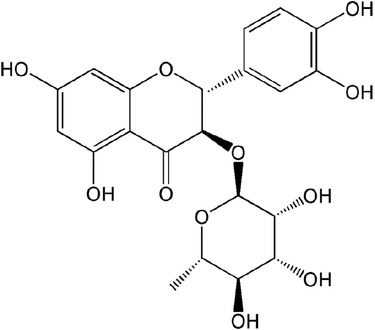
Chemical structure of astilbin.
In this study, the potassium oxonate (OXO) and yeast extract powder (YEP) treated hyperuricemia mice, and MSU injected rats with gouty arthritis were carried out to inspect the anti-gouty effects of AS and the possible mechanisms.
2 Materials and methods
2.1 Animal care
The animal protocol was approved by the Animal Ethics Committee of Jilin University (Reference NO. 2018SY0602). Forty-eight male BALB/c mice (8-weeks old) and forty-eight male wistar rats (8-weeks old) were used for the study which was performed by Liaoning Changsheng Biotechnology Co., Ltd., Liaoning, China (SCXK (Liao) 2015-0001). The animals were housed in plastic cages and maintained under standard laboratory conditions of 22°C ± 2°C, relative humidity of 55% and 12-hour light/dark cycle (lights on 07:00-19:00) during the study. All mice and rats were fed with double distilled water and adequate food was available throughout the study.
2.2 The establishment of mice with hyperuricemia and agent treatment process
All mice were randomly divided into four groups. The control mice (CTRL) (n=12) and the model mice (n=12) (YEP and OXO only treated mice) were administrated orally with normal saline for 8 days; meanwhile, the febuxostat (FB) (Jiangsu Wanbang Biochemical Pharmaceutical Group Co., Ltd., Jiangsu, China) treated mice (n=12) and astilbin (AS) (Shanghai Yuanye Biotechnology Co. Ltd., Shanghai, China) treated mice (n=12) were administrated orally with 6 mg/kg of FB and 15 mg/kg of AS for 8 days [22]. One hour before the normal saline, AS and FB gavage, except for CTRL mice, other mice were intragastrically (i.g.) treated with 20 g/kg of YEP for 8 days, and the intraperitoneally (i.p.) injected with OXO (300 mg/kg) (Sigma-Aldrich, USA) during the last 3 days. Control mice received oral administration of normal saline for 8 days, intraperitoneal injection of normal saline in the last 3 days. The last day, 6 hours after treatment , blood samples were collected from each mouse. After euthanizing by injection with 200 mg/kg of 1.5% pentobarbital, liver tissues were collected.
2.3 The establishment of rats with acute gouty arthritis and agent treatment process
All rats were randomly divided into four groups. The control rats (CTRL) (n=12) and the model rats (n=12) (MSU only treated rats) were administrated orally with normal saline for 7 days; meanwhile, the colchicine (COL) (Yunnan Phytopharmaceutical Co. Ltd, Yunnan, China) treated rats (n=12) and AS treated rats (n=12) were administrated orally with 0.3 mg/kg of COL and 10 mg/kg of AS for 7 days respectively. On the sixth day, rats were intraarticularly injected (i.i.) with 100 μg of MSU on the right ankle joint except for CTRL rats, which were injected with the same volume of 0.9% saline (i.i.). The right ankle circumference was measured with vernier caliper at 0, 4, 12, 24 and 48 hours after treatment. The circumference was computed based on the mean of long and short diameters of ankle joint multiplied by 3.14. The swelling ratio (%) is calculated following the formula:
Where Ct represents the circumference at different hours and C0 represents the circumference at 0 hours. The percentages of swelling ratio of other groups were calculated compared to the CTRL rats, which was considered to be 100%.
Blood was sampled from each rat after the measurement of ankle circumference at 48 hours. After euthanizing by injection with 200 mg/kg of 1.5% pentobarbital, liver tissues and right ankle joint were collected.
2.4 Biochemical assay
In hyperuricemia mice, the levels of serum UA (#MAK077; Sigma-Aldrich, USA), blood urine nitrogen (BUN) (#C013-2; Nanjing Jiancheng Bioengineering Institute, Nanjing, China) and hepatic XO (#MAK078; Sigma-Aldrich, USA) were determined by related commercialized kits base on manufacturer’s instructions. The serum levels of reactive oxygen species (ROS) (#43124), catalase (CAT) (#43356), superoxide dismutase (SOD) (#43125), glutathione peroxidase (GSH-Px) (#43390) and IL-1β (#42776) were detected by ELISA assay kit (Yuanye Bio-Technology Co. Ltd., Shanghai, China) based on instructions.
In the rats with acute gouty arthritis, the level of IL-1β (#43360), interleukin 6 (IL-6) (#41731), tumor necrosis factor alpha (TNF-α) (#41721) and monocyte chemoattractant protein 1 (MCP-1) (#41640) in serum and liver were detected with ELISA assay Kits (Yuanye Bio-Technology Co. Ltd, Shanghai, China) based on instructions.
2.5 Pathological examine of the ankle joint
The right ankle of each rat was collected. After decalcification and dehydration with 4% paraformaldehyde and 10% ethylenediaminetetraacetic acid, the samples were embedded in paraffin, sliced into 5 µm thickness sections and stained with hematoxylin and eosin (H&E). Histopathological slices of rat ankle joints were analyzed by microscope (200×), and histopathological slices of rat joint capsules analyzed by microscope (100×) under an inverted microscope CKX41 (Olympus, Japan).
2.6 Western Blot
Liver tissues collected from mice with hyperuricemia were extracted with RIPA buffer (Sigma-Aldrich, USA) containing a 1% protease inhibitor cocktail (Sigma-Aldrich, USA) and 2% phenylmethanesulfonyl fluoride (Sigma-Aldrich, USA). A BCA assay kit was used to detect the protein concentration of samples. 30 μg protein of each group sample was separated by the 10% SDS-PAGE and transferred onto PVDF membranes (0.45 μm, Merck Millipore, Germany). After incubated with 5% bovine serum albumin for 4 hours at 4°C, the membranes were incubated with XO (#bs-8552R, Bioss, Beijing, China) and GAPDH (E-ab-20059, Elabscience, Wuhan, China) antibodies (Diluting rate of 1:1000) for 12 hours at 4°C. After washing with tris-buffered saline (contains 0.1% Tween-20), the membranes were incubated with HRP-conjugated secondary antibodies (diluting rate of 1:2000) for 2 hours at room temperature. The enhanced chemilumenescent detection kit (Merck Millipore, Germany) was used to develop the protein bands, and the imaging system (BioSpectrum600, USA) was used to visualize the bands. The ImageJ software (National Institute of Health, USA) was used as the pixel density quantified tool.
2.7 Statistical analysis
Mean ± standard deviation (S.D.) was used for the representation of all data, and One-way analysis of variance (ANOVA) was used to perform the statistical analysis followed by post-hoc Dunn’s multiple comparisons test with SPSS 16.0 (Version 16.0) (IBM corporation, Armonk, USA). P<0.05 was considered to be statistically significant.
3 Results
3.1 The therapeutic effects of AS and FB on mice with hyperuricemia
The accumulation of serum UA promotes the production of sodium urate in the joint leading to severe and painful arthritis [23]. YEP and OXO administration caused a 33.44% enhancement on serum UA levels (P<0.05, Figure 2A), which were reduced 82.9% by FB (P<0.001, Figure 2A) and 70.38% by AS (P<0.001, Figure 2A). Compared with hyperuricemia mice, only AS, but not FB, strongly reduced the levels of IL-1β (P<0.05, Figure 2B) and BUN (P<0.001, Figure 2C).

The therapeutic effects of AS on mice with hyperuricemia. In mice with hyperuricemia established via intragastrical administration with 20 g/kg of YEP for 8 days, and the intraperitoneal injection with 300 mg/kg of OXO, AS strongly reduced the serum levels of (A) UA, (B) IL-1β, (C) BUN and (D) XO level of hepatic. (E) AS reduced the XO expression in liver. The data of quantified protein expressions are normalized by GAPDH, analyzed using a one-way ANOVA and expressed as mean ± S.D. (n = 12). #P<0.05 and ##P<0.01 vs. CTRL mice. *P<0.05, **P<0.01 and ***P<0.001 vs. vehicle treated mice with hyperuricemia. YEP, yeast extract powder; OXO, potassium oxonate; FB, febuxostat tablets; AS, astilbin; UA, uric acid; XO, xanthine oxidase; BUN, blood urine nitrogen.
XO, the critical enzyme ,plays an important role responsible for the purine disintegration and development of UA [24]. In hyperuricemia mice, the hyper-levels of XO were reduced by both FB and AS after an 8-day treatment as shown by ELISA (P<0.01, Figure 2D) and western blot (P<0.01, Figure 2E).
Since the production of UA is accompanied by the over-accumulation of ROS, and anti-oxidation is considered as a useful therapeutic regimen for hyperuricemia [25, 26]. In mice with hyperuricemia, the high amounts of ROS, and low amounts of SOD, GSH-Px and CAT in serum were noted (P<0.05, Table 1). AS resulted in 13.95% (P<0.01), 8.35% (P<0.05) and 12.27% (P<0.05) increase on SOD, GSH-Px and CAT, and 11.1% (P<0.05) reduction on ROS of serum levels of mice (Table 1). Comparatively, FB only enhanced the levels of SOD and CAT (P<0.05) in serum of mice with hyperuricemia (Table 1).
The effects of FB and AS on anti- and pro-oxidation cytokines in mice with hyperuricemia.
| CTRL | YEP+OXO | YEP+OXO+ FB (6 mg/kg) | YEP+OXO+ AS (15 mg/kg) | |
|---|---|---|---|---|
| SOD (U/mL) | 24.77±2.09 | 22.58±1.47# | 23.24±1.93* | 25.73±2.64** |
| GSH-Px (U/mL) | 39.41±3.69 | 35.2±2.03# | 36.26±4.15 | 38.14±3.17* |
| CAT (U/mL) | 5.26±0.33 | 4.89±0.28# | 5.27±0.25* | 5.49±0.51* |
| ROS (U/mL) | 13.03±0.8 | 14.42±1.62# | 13.11±1.64 | 12.1±1.65* |
Data are represented as mean±S.D. (n = 12). #P<0.05 vs. CTRL mice, *P<0.05 and **P<0.01 vs. vehicle treated mice with hyperuricemia. YEP, yeast extract powder; OXO, potassium oxonate; FB, febuxostat tablets; AS, astilbin; SOD, superoxide dismutase; GSH-Px, glutathione peroxidase; CAT, catalase; ROS, reactive oxygen species.
3.2 The anti-inflammation effects of AS on rats with acute gouty arthritis
Compared with CTRL rats, MSU caused significant swelling on the right ankle joints of rats (P<0.01, Figure 3A), which were suppressed by AS, especially at 4, 24 and 48 hours (P<0.05, Figure 3A). COL showed significant suppressing effect on the swelling at 4, 12 and 24 hours after MSU injection (P<0.01, Figure 3A). According to the histopathological examination, MSU injection caused an inflammatory cell infiltration in the ankle joints (Figure 3B) and joint capsules (Figure 3C), which were strongly prevented by AS and COL.
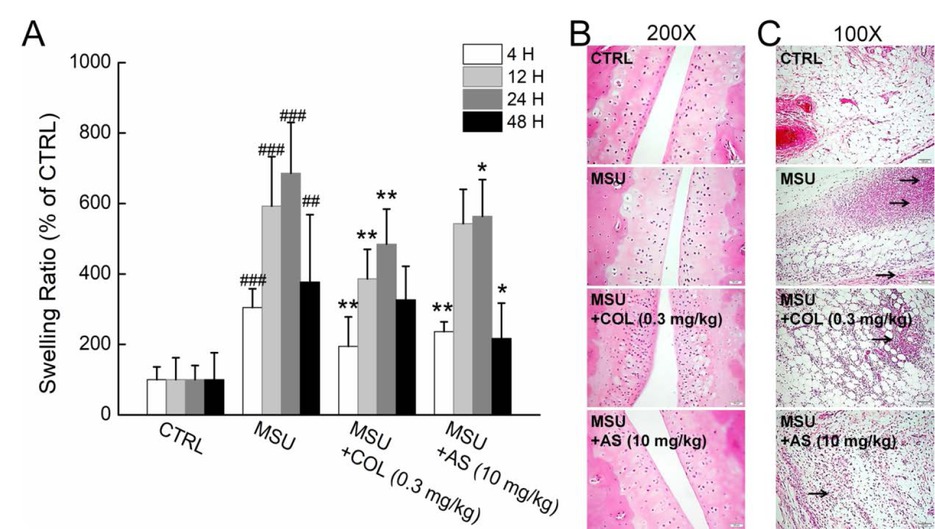
The anti-inflammation effects of AS on rats with acute gouty arthritis established via intraarticularly injection with 100 μg of MSU at the right ankle joint. (A) AS reduced the swelling ratio of ankle joints in rats. The percentage of swelling ratio of other groups were calculated compared with CTRL rats, which was considered to be 100%. Data are analyzed using a one-way ANOVA and expressed as mean ± S.D. (n = 12). ##P<0.01 and ###P<0.001 vs. CTRL rats. *P<0.05 and **P<0.01 vs. vehicle treated rats with acute gouty arthritis. AS prevented the inflammation of (B) ankle joints (200×) (Scale bar: 50 mm) and (C) joint capsules (100×) (Scale bar: 100 mm) detected via H&E staining. MSU, monosodium urate; COL, colchicine; AS, astilbin.
In gouty arthritis rats, the high levels of IL-1β, IL-6, TNF-α and MCP-1 in the liver and serum were noted (P<0.05) (Table 2), which were all strongly reduced by COL(P<0.05) (Table 2). Similar to COL, AS reduced 29.41% (P<0.001), 23.53% (P<0.01), 34.17% (P<0.001) and 47.52% (P<0.001) levels of IL-1β, IL-6, TNF-α and MCP-1 in the liver, respectively (Table 2). In the serum, AS reduced 14.74% (P<0.05) and 21.1% (P<0.001) levels of IL-1β and MCP-1, respectively (Table 2).
The effect of COL and AS on the the inflammation cytokines in rats with acute gouty arthritis.
| CTRL | MSU | MSU+ COL (0.3 mg/kg) | MSU+AS (10 mg/kg) | ||
|---|---|---|---|---|---|
| Serum | IL-1β (pg/ml) | 3.32±0.18 | 3.8±0.48# | 2.85±0.68* | 3.24±0.32* |
| IL-6 (pg/ml) | 15.83±1.85 | 17.52±0.82# | 15.12±1.24** | 16.32±0.67 | |
| TNF-α (pg/ml) | 26.77±1.12 | 28.77±0.84## | 27.02±1.46* | 27.21±0.74 | |
| MCP-1 (pg/ml) | 59.79±2.56 | 64.84±3.52## | 59.28±4.5** | 51.16±1.53*** | |
| Liver | IL-1β (pg/mg) | 0.51±0.07 | 0.68±0.08## | 0.49±0.06*** | 0.48±0.04*** |
| IL-6 (pg/ mg) | 1.7±0.2 | 2.38±0.37## | 1.96±0.14* | 1.82±0.33** | |
| TNF-α (pg/ mg) | 5.81±1.32 | 7.58±1.09## | 5.93±0.12** | 4.99±0.8** | |
| MCP-1 (pg/ mg) | 8.71±1.36 | 11.47±1.38### | 8.95±0.7*** | 6.02±1.06*** |
Data are represented as mean±S.D. (n = 12). #P<0.05, ##P<0.01 and ###P<0.001 vs. CTRL rats, *P<0.05, **P<0.01 and ***P<0.001 vs. vehicle treated rats with acute gouty arthritis. MSU, monosodium urate; COL, colchicine; AS, astilbin; IL-1β, interleukin 1β; IL-6, interleukin 6; TNF-α, tumor necrosis factor alpha; MCP-1, monocyte chemoattractant protein 1.
4 Discussion
By employing the mice model with hyperuricemia and the rats model with gouty arthritis, the anti-gout activity of AS was for the first time found in this study. AS both reduced the high serum UA in hyperuricemia mice, and also suppressed the swelling rates of ankle joints and regulated the inflammatory cytokines in rats with acute gouty arthritis.
The development of hyperuricemia accompanied by the increase of oxygen free radical production, promoted lipid peroxidation and even increased the level of pro-inflammatory cytokines [27, 28]. Natural flavonoids exhibit antioxidant activities via collecting free radicals [29, 30]. As a typical flavonoid, AS has been found to inhibit XO activity and enhance the anti-oxidative function in mice with hyperuricemia. AS enhanced the levels of anti-oxidative cytokines such as SOD, GSH-Px and CAT, and suppressed the pro-oxidative cytokines, especially ROS in serum of mice with hyperuricemia. As effective antioxidant enzymes, O2- and H2O2 could be transformed to H2O by SOD and GSH-Px catalysis [31, 32]. SOD and GSH-Px protect tissues from oxidative damage via scavenging ROS [33]. As reported, the over-accumulation of ROS helps the production of UA [25]. In the acute paraquat poisoning patients, the negative correlation between the levels of GSH-Px, SOD and XO activities has been confirmed [34]. As the key enzyme during the process in the catalytic reaction of xanthine and hypoxanthine to UA [35, 36], XO can regulate the production of ROS [25]. In brains of female rats treated with gamma-irradiation and carbon tetrachloride, the enhanced levels of SOD and GSH-Px by flaxseed oil can inhibit XO gene expression [37]. XO is the main source of the ROS productions in vivo [38]. AS suppressed the hyper-levels of UA in mice with hyperuricemia, at least partially, related to the inhibition on XO activity via adjusting the anti- and pro-oxidative cytokines.
Similar to COL, AS strongly suppressed the swelling of ankle joints and the cytokines including IL-1β, IL-6, TNF-α and MCP-1 of acute gouty arthritis rats. Through endocytosis, MSU can enter the cells and stimulates the production of IL-1β from synovial cells, monocyte macrophages and neutrophils [23, 39]. In gouty patients, extremely high levels of IL-1β can be found [40]. Due to the important roles of IL-1β on gout attack, researchers focus their study on IL-1β [41]. IL-1β is responsible for the release of keys cytokines including IL-6, TNF-α and MCP-1, which lead to the spread of gouty inflammation [42]. TNF-α and MCP-1 may prime and enhance maturing of monocytes to macrophages in inflammatory ocular diseases [43], and MCP-1 promotes the priming and trafficking of monocytes in gout [44]. Flavonoids from lotus plumule showed the significant anti-inflammatory activities by inhibiting the production of IL-1β and IL-6 [45]. Based on our present study, the suppression of the swelling of gouty arthritis rats ankle joints of AS may be related to its modulation on inflammatory cytokines, especially IL-1β.
There is still limitations in the present research. The detail mechanisms during AS-mediated anti-gouty activity still need systematical investigation via applying genomics or proteomics and the relationship between the anti-oxidation and anti-inflammation of AS will be studied in our group.
In conclusion, AS can reduce the UA levels of serum in hyperuricemia mice, and decreased the swelling of ankle joints in rats with acute gouty arthritis, which may be related to its regulation on XO activity and the levels of inflammatory cytokines via the anti-oxidative property. Our data provides the experimental evidence for further evaluation of AS as a candidate for gout treatment.
Acknowledgements
This work was supported by the National Key Research & Development Program of China (No. 2018YFE0107800), the Special Projects of Cooperation between Jilin University and Jilin Province in China (SXGJSF2017-1) and the “13th Five-year” Science and Technology Projects from Education Department in Jilin Province (JJKH20190108KJ).
Availability of data and materials: All data generated and analyzed during the present study are included in this published article.
Conflict of Interest: The authors have declared that there is no conflict of interest.
Reference
[1] Lan X, Chen, H Ralph S. Gout: An evidence-based review. J Clin Rheumatol. 2008;14(5 Suppl):55-62.10.1097/RHU.0b013e3181896921Search in Google Scholar
[2] Chaiamnuay P, Darmawan J, Muirden KD, Assawatanabodee P. Epidemiology of rheumatic disease in rural thailand: A who-ilar copcord study. Community oriented programme for the control of rheumatic disease. J Rheumatol. 1998;25(7):1382.Search in Google Scholar
[3] Cronstein BN, Terkeltaub R. The inflammatory process of gout and its treatment. Arthritis Res Ther. 2006;8 Suppl 1:S3.10.1186/ar1908Search in Google Scholar
[4] Martinon F, Petrilli V, Mayor A, Tardivel A, Tschopp J. Gout-associated uric acid crystals activate the nalp3 inflammasome. Nature. 2006;440(7081):237-241.10.1038/nature04516Search in Google Scholar
[5] Loeb JN. The influence of temperature on the solubility of monosodium urate. Arthritis Rheum. 1972;15(2):189-192.10.1002/art.1780150209Search in Google Scholar
[6] Kapoor N, Saxena S. Potential xanthine oxidase inhibitory activity of endophytic lasiodiplodia pseudotheobromae. Appl. Biochem. Biotechnol. 2014;173(6):1360-1374.10.1007/s12010-014-0927-xSearch in Google Scholar
[7] Ichida K, Matsuo H, Takada T, Nakayama A, Murakami K, Shimizu T, et al. Decreased extra-renal urate excretion is a common cause of hyperuricemia. Nat. Commun. 2012;3:7.10.1038/ncomms1756Search in Google Scholar
[8] Chambers DE, Parks DA, Patterson G, Roy R, McCord JM, Yoshida S, et al. Xanthine oxidase as a source of free radical damage in myocardial ischemia. Journal of molecular and cellular cardiology. 1985;17(2):145-152.10.1016/S0022-2828(85)80017-1Search in Google Scholar
[9] Terkeltaub RA. Colchicine update: 2008. Seminars in arthritis and rheumatism. 2009;38(6):411-419.10.1016/j.semarthrit.2008.08.006Search in Google Scholar
[10] Fam AG. Strategies and controversies in the treatment of gout and hyperuricaemia. Bailliere’s clinical rheumatology. 1990;4(2):177-192.10.1016/S0950-3579(05)80016-0Search in Google Scholar
[11] Terkeltaub R, Bushinsky DA, Becker MA. Recent developments in our understanding of the renal basis of hyperuricemia and the development of novel antihyperuricemic therapeutics. Arthritis Research & Therapy. 2006;8(Suppl 1):S4-S4.10.1186/ar1909Search in Google Scholar PubMed PubMed Central
[12] Fam AG. Difficult gout and new approaches for control of hyperuricemia in the allopurinol-allergic patient. Current rheumatology reports. 2001;3(1):29-35.10.1007/s11926-001-0048-8Search in Google Scholar PubMed
[13] Shen MN, Zhang JY, Qian K, Li CM, Xu WY, Gu BJ, et al. Febuxostat in the treatment of gout patients with low serum uric acid level: 1-year finding of efficacy and safety study. Clin. Rheumatol. 2018;37(11):3107-3113.10.1007/s10067-018-4283-zSearch in Google Scholar PubMed
[14] Fam AG. Treating acute gouty arthritis with selective cox 2 inhibitors. BMJ (Clinical research ed.). 2002;325(7371):980981.10.1136/bmj.325.7371.980Search in Google Scholar PubMed PubMed Central
[15] Yuan M, Yan Z, Liu Y, Chen D, Yang Z, He L, et al. Chemical profiles, antioxidant activity and acute toxicity of raw and sulfur-fumigated smilacis glabrae rhizoma. J Ethnopharmacol. 2019;234:76-84.10.1016/j.jep.2019.01.026Search in Google Scholar PubMed
[16] Chen F, Zhu X, Sun Z, Ma Y. Astilbin inhibits high glucose-induced inflammation and extracellular matrix accumulation by suppressing the tlr4/myd88/nf-kappab pathway in rat glomerular mesangial cells. Front Pharmacol. 2018;9:1187.10.3389/fphar.2018.01187Search in Google Scholar PubMed PubMed Central
[17] Zhang Q-F, Zhang Z-R, Cheung H-Y. Antioxidant activity of rhizoma smilacis glabrae extracts and its key constituent-astilbin. Food Chem. 2009;115(1):297-303.10.1016/j.foodchem.2008.11.053Search in Google Scholar
[18] Meng QF, Zhang Z, Wang YJ, Chen W, Li FF, Yue LT, et al. Astilbin ameliorates experimental autoimmune myasthenia gravis by decreased th17 cytokines and up-regulated t regulatory cells. J Neuroimmunol. 2016;298:138-145.10.1016/j.jneuroim.2016.07.016Search in Google Scholar PubMed
[19] Lu CL, Zhu YF, Hu MM, Wang DM, Xu XJ, Lu CJ, et al. Optimization of astilbin extraction from the rhizome of smilax glabra, and evaluation of its anti-inflammatory effect and probable underlying mechanism in lipopolysaccharide-induced raw264.7 macrophages. Molecules. 2015;20(1):625-644.10.3390/molecules20010625Search in Google Scholar PubMed PubMed Central
[20] Wang J, Zhao Y, Xu Q. Astilbin prevents concanavalin a-induced liver injury by reducing tnf-alpha production and t lymphocyte adhesion. J. Pharm. Pharmacol. 2004;56(4):495-502.10.1211/0022357023033Search in Google Scholar PubMed
[21] Fei MJ, Wu XF, Xu Q. Astilbin inhibits contact hypersensitivity through negative cytokine regulation distinct from cyclosporin a. J. Allergy Clin. Immunol. 2005;116(6):1350-1356.Search in Google Scholar
[22] Wang M, Zhao J, Zhang N, Chen JH. Astilbin improves potassium oxonate-induced hyperuricemia and kidney injury through regulating oxidative stress and inflammation response in mice. Biomed. Pharmacother. 2016;83:975-988.10.1016/j.biopha.2016.07.025Search in Google Scholar PubMed
[23] Sabina EP, Rasool M. An in vivo and in vitro potential of indian ayurvedic herbal formulation triphala on experimental gouty arthritis in mice. Vascul Pharmacol. 2008;48(1):14-20.10.1016/j.vph.2007.11.001Search in Google Scholar PubMed
[24] Merriman TR. An update on the genetic architecture of hyperuricemia and gout. Arthritis Res Ther. 2015;17:98.10.1186/s13075-015-0609-2Search in Google Scholar PubMed PubMed Central
[25] Oguz N, Kirca M, Cetin A, Yesilkaya A. Effect of uric acid on inflammatory cox-2 and ros pathways in vascular smooth muscle cells. Journal of receptor and signal transduction research. 2017;37(5):500-505.10.1080/10799893.2017.1360350Search in Google Scholar PubMed
[26] Tang L, Xu Y, Wei Y, He X. Uric acid induces the expression of tnfalpha via the rosmapknfkappab signaling pathway in rat vascular smooth muscle cells. Molecular medicine reports. 2017;16(5):6928-6933.10.3892/mmr.2017.7405Search in Google Scholar PubMed
[27] Singh M, Kalia AN, Sharma R, Balakumar P. Hyperuricemia: Is it a risk factor for vascular endothelial dysfunction and associated cardiovascular disorders? Current Hypertension Reviews. 2009;5(1):-.10.2174/157340209787314306Search in Google Scholar
[28] Billiet L, Doaty S, Katz JD, Velasquez MT. Review of hyperuricemia as new marker for metabolic syndrome. ISRN rheumatology. 2014;2014:852954.10.1155/2014/852954Search in Google Scholar PubMed PubMed Central
[29] Nickavar B, Kamalinejad M, Izadpanah H. In vitro free radical scavenging activity of five salvia species. Pakistan journal of pharmaceutical sciences. 2007;20(4):291-294.Search in Google Scholar
[30] Yao Y, Sang W, Zhou M, Ren G. Phenolic composition and antioxidant activities of 11 celery cultivars. Journal of food science. 2010;75(1):C9-13.10.1111/j.1750-3841.2009.01392.xSearch in Google Scholar PubMed
[31] Song Y, Driessens N, Costa M, De Deken X, Detours V, Corvilain B, et al. Roles of hydrogen peroxide in thyroid physiology and disease. The Journal of clinical endocrinology and metabolism. 2007;92(10):3764-3773.10.1210/jc.2007-0660Search in Google Scholar PubMed
[32] Poobathy R, Sinniah UR, Xavier R, Subramaniam S. Catalase and superoxide dismutase activities and the total protein content of protocorm-like bodies of dendrobium sonia-28 subjected to vitrification. Appl. Biochem. Biotechnol. 2013;170(5):1066-1079.10.1007/s12010-013-0241-zSearch in Google Scholar PubMed
[33] Taysi S, Tascan AS, Ugur MG, Demir M. Radicals, oxidative/ nitrosative stress and preeclampsia. Mini-Rev. Med. Chem. 2019;19(3):178-193.10.2174/1389557518666181015151350Search in Google Scholar PubMed
[34] Zhang J, Lv G, Zhao Y. The significance of serum xanthine oxidase and oxidation markers in acute paraquat poisoning in humans. Clin Biochem. 2011;44(2):221-225.10.1016/j.clinbiochem.2010.09.006Search in Google Scholar PubMed
[35] Ramallo IA, Zacchino SA, Furlan RL. A rapid tlc autographic method for the detection of xanthine oxidase inhibitors and superoxide scavengers. Phytochemical analysis : PCA. 2006;17(1):15-19.10.1002/pca.874Search in Google Scholar PubMed
[36] Unno T, Sugimoto A, Kakuda T. Xanthine oxidase inhibitors from the leaves of lagerstroemia speciosa (l.) pers. Journal of ethnopharmacology. 2004;93(2-3):391-395.10.1016/j.jep.2004.04.012Search in Google Scholar PubMed
[37] Ismail AFM, Salem AAM, Eassawy MMT. Modulation of gamma-irradiation and carbon tetrachloride induced oxidative stress in the brain of female rats by flaxseed oil. J Photochem Photobiol B. 2016;161:91-99.10.1016/j.jphotobiol.2016.04.031Search in Google Scholar PubMed
[38] Medow MS, Bamji N, Clarke D, Ocon AJ, Stewart JM. Reactive oxygen species (ros) from nadph and xanthine oxidase modulate the cutaneous local heating response in healthy humans. J. Appl. Physiol. 2011;111(1):20-26.10.1152/japplphysiol.01448.2010Search in Google Scholar PubMed PubMed Central
[39] Rock KL, Hiroshi K, Jiann-Jyh L. Uric acid as a danger signal in gout and its comorbidities. Nat Rev Rheumatol. 2012;9(1):13-23.10.1038/nrrheum.2012.143Search in Google Scholar PubMed PubMed Central
[40] Zeng M, Dang W, Chen B, Qing Y, Xie W, Zhao M, et al. Il-37 inhibits the production of pro-inflammatory cytokines in msu crystal-induced inflammatory response. Clin Rheumatol. 2016;35(9):2251-2258.10.1007/s10067-015-3109-5Search in Google Scholar PubMed
[41] Sabina EP, Nagar S, Rasool M. A role of piperine on monosodium urate crystal-induced inflammation--an experimental model of gouty arthritis. Inflammation. 2011;34(3):184-192.10.1007/s10753-010-9222-3Search in Google Scholar PubMed
[42] Jeong JH, Hong S, Kwon OC, Ghang B, Hwang I, Kim YG, et al. Cd14(+) cells with the phenotype of infiltrated monocytes consist of distinct populations characterized by anti-inflammatory as well as pro-inflammatory activity in gouty arthritis. Front Immunol. 2017;8:1260.10.3389/fimmu.2017.01260Search in Google Scholar PubMed PubMed Central
[43] Sharon Y, Schlesinger N. Beyond joints: A review of ocular abnormalities in gout and hyperuricemia. Curr. Rheumatol. Rep. 2016;18(6):8.10.1007/s11926-016-0586-8Search in Google Scholar PubMed
[44] Grainger R, McLaughlin RJ, Harrison AA, Harper JL. Hyperuricaemia elevates circulating ccl2 levels and primes monocyte trafficking in subjects with inter-critical gout. Rheumatology. 2013;52(6):1018-1021.10.1093/rheumatology/kes326Search in Google Scholar PubMed
[45] Chen GL, Fan MX, Wu JL, Li N, Guo MQ. Antioxidant and anti-inflammatory properties of flavonoids from lotus plumule. Food Chem. 2019;277:706-712.10.1016/j.foodchem.2018.11.040Search in Google Scholar PubMed
© 2020 Han Yan et al., published by De Gruyter
This work is licensed under the Creative Commons Attribution 4.0 International License.
Articles in the same Issue
- Regular Articles
- Electrochemical antioxidant screening and evaluation based on guanine and chitosan immobilized MoS2 nanosheet modified glassy carbon electrode (guanine/CS/MoS2/GCE)
- Kinetic models of the extraction of vanillic acid from pumpkin seeds
- On the maximum ABC index of bipartite graphs without pendent vertices
- Estimation of the total antioxidant potential in the meat samples using thin-layer chromatography
- Molecular dynamics simulation of sI methane hydrate under compression and tension
- Spatial distribution and potential ecological risk assessment of some trace elements in sediments and grey mangrove (Avicennia marina) along the Arabian Gulf coast, Saudi Arabia
- Amino-functionalized graphene oxide for Cr(VI), Cu(II), Pb(II) and Cd(II) removal from industrial wastewater
- Chemical composition and in vitro activity of Origanum vulgare L., Satureja hortensis L., Thymus serpyllum L. and Thymus vulgaris L. essential oils towards oral isolates of Candida albicans and Candida glabrata
- Effect of excess Fluoride consumption on Urine-Serum Fluorides, Dental state and Thyroid Hormones among children in “Talab Sarai” Punjab Pakistan
- Design, Synthesis and Characterization of Novel Isoxazole Tagged Indole Hybrid Compounds
- Comparison of kinetic and enzymatic properties of intracellular phosphoserine aminotransferases from alkaliphilic and neutralophilic bacteria
- Green Organic Solvent-Free Oxidation of Alkylarenes with tert-Butyl Hydroperoxide Catalyzed by Water-Soluble Copper Complex
- Ducrosia ismaelis Asch. essential oil: chemical composition profile and anticancer, antimicrobial and antioxidant potential assessment
- DFT calculations as an efficient tool for prediction of Raman and infra-red spectra and activities of newly synthesized cathinones
- Influence of Chemical Osmosis on Solute Transport and Fluid Velocity in Clay Soils
- A New fatty acid and some triterpenoids from propolis of Nkambe (North-West Region, Cameroon) and evaluation of the antiradical scavenging activity of their extracts
- Antiplasmodial Activity of Stigmastane Steroids from Dryobalanops oblongifolia Stem Bark
- Rapid identification of direct-acting pancreatic protectants from Cyclocarya paliurus leaves tea by the method of serum pharmacochemistry combined with target cell extraction
- Immobilization of Pseudomonas aeruginosa static biomass on eggshell powder for on-line preconcentration and determination of Cr (VI)
- Assessment of methyl 2-({[(4,6-dimethoxypyrimidin-2-yl)carbamoyl] sulfamoyl}methyl)benzoate through biotic and abiotic degradation modes
- Stability of natural polyphenol fisetin in eye drops Stability of fisetin in eye drops
- Production of a bioflocculant by using activated sludge and its application in Pb(II) removal from aqueous solution
- Molecular Properties of Carbon Crystal Cubic Structures
- Synthesis and characterization of calcium carbonate whisker from yellow phosphorus slag
- Study on the interaction between catechin and cholesterol by the density functional theory
- Analysis of some pharmaceuticals in the presence of their synthetic impurities by applying hybrid micelle liquid chromatography
- Two mixed-ligand coordination polymers based on 2,5-thiophenedicarboxylic acid and flexible N-donor ligands: the protective effect on periodontitis via reducing the release of IL-1β and TNF-α
- Incorporation of silver stearate nanoparticles in methacrylate polymeric monoliths for hemeprotein isolation
- Development of ultrasound-assisted dispersive solid-phase microextraction based on mesoporous carbon coated with silica@iron oxide nanocomposite for preconcentration of Te and Tl in natural water systems
- N,N′-Bis[2-hydroxynaphthylidene]/[2-methoxybenzylidene]amino]oxamides and their divalent manganese complexes: Isolation, spectral characterization, morphology, antibacterial and cytotoxicity against leukemia cells
- Determination of the content of selected trace elements in Polish commercial fruit juices and health risk assessment
- Diorganotin(iv) benzyldithiocarbamate complexes: synthesis, characterization, and thermal and cytotoxicity study
- Keratin 17 is induced in prurigo nodularis lesions
- Anticancer, antioxidant, and acute toxicity studies of a Saudi polyherbal formulation, PHF5
- LaCoO3 perovskite-type catalysts in syngas conversion
- Comparative studies of two vegetal extracts from Stokesia laevis and Geranium pratense: polyphenol profile, cytotoxic effect and antiproliferative activity
- Fragmentation pattern of certain isatin–indole antiproliferative conjugates with application to identify their in vitro metabolic profiles in rat liver microsomes by liquid chromatography tandem mass spectrometry
- Investigation of polyphenol profile, antioxidant activity and hepatoprotective potential of Aconogonon alpinum (All.) Schur roots
- Lead discovery of a guanidinyl tryptophan derivative on amyloid cascade inhibition
- Physicochemical evaluation of the fruit pulp of Opuntia spp growing in the Mediterranean area under hard climate conditions
- Electronic structural properties of amino/hydroxyl functionalized imidazolium-based bromide ionic liquids
- New Schiff bases of 2-(quinolin-8-yloxy)acetohydrazide and their Cu(ii), and Zn(ii) metal complexes: their in vitro antimicrobial potentials and in silico physicochemical and pharmacokinetics properties
- Treatment of adhesions after Achilles tendon injury using focused ultrasound with targeted bFGF plasmid-loaded cationic microbubbles
- Synthesis of orotic acid derivatives and their effects on stem cell proliferation
- Chirality of β2-agonists. An overview of pharmacological activity, stereoselective analysis, and synthesis
- Fe3O4@urea/HITh-SO3H as an efficient and reusable catalyst for the solvent-free synthesis of 7-aryl-8H-benzo[h]indeno[1,2-b]quinoline-8-one and indeno[2′,1′:5,6]pyrido[2,3-d]pyrimidine derivatives
- Adsorption kinetic characteristics of molybdenum in yellow-brown soil in response to pH and phosphate
- Enhancement of thermal properties of bio-based microcapsules intended for textile applications
- Exploring the effect of khat (Catha edulis) chewing on the pharmacokinetics of the antiplatelet drug clopidogrel in rats using the newly developed LC-MS/MS technique
- A green strategy for obtaining anthraquinones from Rheum tanguticum by subcritical water
- Cadmium (Cd) chloride affects the nutrient uptake and Cd-resistant bacterium reduces the adsorption of Cd in muskmelon plants
- Removal of H2S by vermicompost biofilter and analysis on bacterial community
- Structural cytotoxicity relationship of 2-phenoxy(thiomethyl)pyridotriazolopyrimidines: Quantum chemical calculations and statistical analysis
- A self-breaking supramolecular plugging system as lost circulation material in oilfield
- Synthesis, characterization, and pharmacological evaluation of thiourea derivatives
- Application of drug–metal ion interaction principle in conductometric determination of imatinib, sorafenib, gefitinib and bosutinib
- Synthesis and characterization of a novel chitosan-grafted-polyorthoethylaniline biocomposite and utilization for dye removal from water
- Optimisation of urine sample preparation for shotgun proteomics
- DFT investigations on arylsulphonyl pyrazole derivatives as potential ligands of selected kinases
- Treatment of Parkinson’s disease using focused ultrasound with GDNF retrovirus-loaded microbubbles to open the blood–brain barrier
- New derivatives of a natural nordentatin
- Fluorescence biomarkers of malignant melanoma detectable in urine
- Study of the remediation effects of passivation materials on Pb-contaminated soil
- Saliva proteomic analysis reveals possible biomarkers of renal cell carcinoma
- Withania frutescens: Chemical characterization, analgesic, anti-inflammatory, and healing activities
- Design, synthesis and pharmacological profile of (−)-verbenone hydrazones
- Synthesis of magnesium carbonate hydrate from natural talc
- Stability-indicating HPLC-DAD assay for simultaneous quantification of hydrocortisone 21 acetate, dexamethasone, and fluocinolone acetonide in cosmetics
- A novel lactose biosensor based on electrochemically synthesized 3,4-ethylenedioxythiophene/thiophene (EDOT/Th) copolymer
- Citrullus colocynthis (L.) Schrad: Chemical characterization, scavenging and cytotoxic activities
- Development and validation of a high performance liquid chromatography/diode array detection method for estrogen determination: Application to residual analysis in meat products
- PCSK9 concentrations in different stages of subclinical atherosclerosis and their relationship with inflammation
- Development of trace analysis for alkyl methanesulfonates in the delgocitinib drug substance using GC-FID and liquid–liquid extraction with ionic liquid
- Electrochemical evaluation of the antioxidant capacity of natural compounds on glassy carbon electrode modified with guanine-, polythionine-, and nitrogen-doped graphene
- A Dy(iii)–organic framework as a fluorescent probe for highly selective detection of picric acid and treatment activity on human lung cancer cells
- A Zn(ii)–organic cage with semirigid ligand for solvent-free cyanosilylation and inhibitory effect on ovarian cancer cell migration and invasion ability via regulating mi-RNA16 expression
- Polyphenol content and antioxidant activities of Prunus padus L. and Prunus serotina L. leaves: Electrochemical and spectrophotometric approach and their antimicrobial properties
- The combined use of GC, PDSC and FT-IR techniques to characterize fat extracted from commercial complete dry pet food for adult cats
- MALDI-TOF MS profiling in the discovery and identification of salivary proteomic patterns of temporomandibular joint disorders
- Concentrations of dioxins, furans and dioxin-like PCBs in natural animal feed additives
- Structure and some physicochemical and functional properties of water treated under ammonia with low-temperature low-pressure glow plasma of low frequency
- Mesoscale nanoparticles encapsulated with emodin for targeting antifibrosis in animal models
- Amine-functionalized magnetic activated carbon as an adsorbent for preconcentration and determination of acidic drugs in environmental water samples using HPLC-DAD
- Antioxidant activity as a response to cadmium pollution in three durum wheat genotypes differing in salt-tolerance
- A promising naphthoquinone [8-hydroxy-2-(2-thienylcarbonyl)naphtho[2,3-b]thiophene-4,9-dione] exerts anti-colorectal cancer activity through ferroptosis and inhibition of MAPK signaling pathway based on RNA sequencing
- Synthesis and efficacy of herbicidal ionic liquids with chlorsulfuron as the anion
- Effect of isovalent substitution on the crystal structure and properties of two-slab indates BaLa2−xSmxIn2O7
- Synthesis, spectral and thermo-kinetics explorations of Schiff-base derived metal complexes
- An improved reduction method for phase stability testing in the single-phase region
- Comparative analysis of chemical composition of some commercially important fishes with an emphasis on various Malaysian diets
- Development of a solventless stir bar sorptive extraction/thermal desorption large volume injection capillary gas chromatographic-mass spectrometric method for ultra-trace determination of pyrethroids pesticides in river and tap water samples
- A turbidity sensor development based on NL-PI observers: Experimental application to the control of a Sinaloa’s River Spirulina maxima cultivation
- Deep desulfurization of sintering flue gas in iron and steel works based on low-temperature oxidation
- Investigations of metallic elements and phenolics in Chinese medicinal plants
- Influence of site-classification approach on geochemical background values
- Effects of ageing on the surface characteristics and Cu(ii) adsorption behaviour of rice husk biochar in soil
- Adsorption and sugarcane-bagasse-derived activated carbon-based mitigation of 1-[2-(2-chloroethoxy)phenyl]sulfonyl-3-(4-methoxy-6-methyl-1,3,5-triazin-2-yl) urea-contaminated soils
- Antimicrobial and antifungal activities of bifunctional cooper(ii) complexes with non-steroidal anti-inflammatory drugs, flufenamic, mefenamic and tolfenamic acids and 1,10-phenanthroline
- Application of selenium and silicon to alleviate short-term drought stress in French marigold (Tagetes patula L.) as a model plant species
- Screening and analysis of xanthine oxidase inhibitors in jute leaves and their protective effects against hydrogen peroxide-induced oxidative stress in cells
- Synthesis and physicochemical studies of a series of mixed-ligand transition metal complexes and their molecular docking investigations against Coronavirus main protease
- A study of in vitro metabolism and cytotoxicity of mephedrone and methoxetamine in human and pig liver models using GC/MS and LC/MS analyses
- A new phenyl alkyl ester and a new combretin triterpene derivative from Combretum fragrans F. Hoffm (Combretaceae) and antiproliferative activity
- Erratum
- Erratum to: A one-step incubation ELISA kit for rapid determination of dibutyl phthalate in water, beverage and liquor
- Review Articles
- Sinoporphyrin sodium, a novel sensitizer for photodynamic and sonodynamic therapy
- Natural products isolated from Casimiroa
- Plant description, phytochemical constituents and bioactivities of Syzygium genus: A review
- Evaluation of elastomeric heat shielding materials as insulators for solid propellant rocket motors: A short review
- Special Issue on Applied Biochemistry and Biotechnology 2019
- An overview of Monascus fermentation processes for monacolin K production
- Study on online soft sensor method of total sugar content in chlorotetracycline fermentation tank
- Studies on the Anti-Gouty Arthritis and Anti-hyperuricemia Properties of Astilbin in Animal Models
- Effects of organic fertilizer on water use, photosynthetic characteristics, and fruit quality of pear jujube in northern Shaanxi
- Characteristics of the root exudate release system of typical plants in plateau lakeside wetland under phosphorus stress conditions
- Characterization of soil water by the means of hydrogen and oxygen isotope ratio at dry-wet season under different soil layers in the dry-hot valley of Jinsha River
- Composition and diurnal variation of floral scent emission in Rosa rugosa Thunb. and Tulipa gesneriana L.
- Preparation of a novel ginkgolide B niosomal composite drug
- The degradation, biodegradability and toxicity evaluation of sulfamethazine antibiotics by gamma radiation
- Special issue on Monitoring, Risk Assessment and Sustainable Management for the Exposure to Environmental Toxins
- Insight into the cadmium and zinc binding potential of humic acids derived from composts by EEM spectra combined with PARAFAC analysis
- Source apportionment of soil contamination based on multivariate receptor and robust geostatistics in a typical rural–urban area, Wuhan city, middle China
- Special Issue on 13th JCC 2018
- The Role of H2C2O4 and Na2CO3 as Precipitating Agents on The Physichochemical Properties and Photocatalytic Activity of Bismuth Oxide
- Preparation of magnetite-silica–cetyltrimethylammonium for phenol removal based on adsolubilization
- Topical Issue on Agriculture
- Size-dependent growth kinetics of struvite crystals in wastewater with calcium ions
- The effect of silica-calcite sedimentary rock contained in the chicken broiler diet on the overall quality of chicken muscles
- Physicochemical properties of selected herbicidal products containing nicosulfuron as an active ingredient
- Lycopene in tomatoes and tomato products
- Fluorescence in the assessment of the share of a key component in the mixing of feed
- Sulfur application alleviates chromium stress in maize and wheat
- Effectiveness of removal of sulphur compounds from the air after 3 years of biofiltration with a mixture of compost soil, peat, coconut fibre and oak bark
- Special Issue on the 4th Green Chemistry 2018
- Study and fire test of banana fibre reinforced composites with flame retardance properties
- Special Issue on the International conference CosCI 2018
- Disintegration, In vitro Dissolution, and Drug Release Kinetics Profiles of k-Carrageenan-based Nutraceutical Hard-shell Capsules Containing Salicylamide
- Synthesis of amorphous aluminosilicate from impure Indonesian kaolin
- Special Issue on the International Conf on Science, Applied Science, Teaching and Education 2019
- Functionalization of Congo red dye as a light harvester on solar cell
- The effect of nitrite food preservatives added to se’i meat on the expression of wild-type p53 protein
- Biocompatibility and osteoconductivity of scaffold porous composite collagen–hydroxyapatite based coral for bone regeneration
- Special Issue on the Joint Science Congress of Materials and Polymers (ISCMP 2019)
- Effect of natural boron mineral use on the essential oil ratio and components of Musk Sage (Salvia sclarea L.)
- A theoretical and experimental study of the adsorptive removal of hexavalent chromium ions using graphene oxide as an adsorbent
- A study on the bacterial adhesion of Streptococcus mutans in various dental ceramics: In vitro study
- Corrosion study of copper in aqueous sulfuric acid solution in the presence of (2E,5E)-2,5-dibenzylidenecyclopentanone and (2E,5E)-bis[(4-dimethylamino)benzylidene]cyclopentanone: Experimental and theoretical study
- Special Issue on Chemistry Today for Tomorrow 2019
- Diabetes mellitus type 2: Exploratory data analysis based on clinical reading
- Multivariate analysis for the classification of copper–lead and copper–zinc glasses
- Special Issue on Advances in Chemistry and Polymers
- The spatial and temporal distribution of cationic and anionic radicals in early embryo implantation
- Special Issue on 3rd IC3PE 2020
- Magnetic iron oxide/clay nanocomposites for adsorption and catalytic oxidation in water treatment applications
- Special Issue on IC3PE 2018/2019 Conference
- Exergy analysis of conventional and hydrothermal liquefaction–esterification processes of microalgae for biodiesel production
- Advancing biodiesel production from microalgae Spirulina sp. by a simultaneous extraction–transesterification process using palm oil as a co-solvent of methanol
- Topical Issue on Applications of Mathematics in Chemistry
- Omega and the related counting polynomials of some chemical structures
- M-polynomial and topological indices of zigzag edge coronoid fused by starphene
Articles in the same Issue
- Regular Articles
- Electrochemical antioxidant screening and evaluation based on guanine and chitosan immobilized MoS2 nanosheet modified glassy carbon electrode (guanine/CS/MoS2/GCE)
- Kinetic models of the extraction of vanillic acid from pumpkin seeds
- On the maximum ABC index of bipartite graphs without pendent vertices
- Estimation of the total antioxidant potential in the meat samples using thin-layer chromatography
- Molecular dynamics simulation of sI methane hydrate under compression and tension
- Spatial distribution and potential ecological risk assessment of some trace elements in sediments and grey mangrove (Avicennia marina) along the Arabian Gulf coast, Saudi Arabia
- Amino-functionalized graphene oxide for Cr(VI), Cu(II), Pb(II) and Cd(II) removal from industrial wastewater
- Chemical composition and in vitro activity of Origanum vulgare L., Satureja hortensis L., Thymus serpyllum L. and Thymus vulgaris L. essential oils towards oral isolates of Candida albicans and Candida glabrata
- Effect of excess Fluoride consumption on Urine-Serum Fluorides, Dental state and Thyroid Hormones among children in “Talab Sarai” Punjab Pakistan
- Design, Synthesis and Characterization of Novel Isoxazole Tagged Indole Hybrid Compounds
- Comparison of kinetic and enzymatic properties of intracellular phosphoserine aminotransferases from alkaliphilic and neutralophilic bacteria
- Green Organic Solvent-Free Oxidation of Alkylarenes with tert-Butyl Hydroperoxide Catalyzed by Water-Soluble Copper Complex
- Ducrosia ismaelis Asch. essential oil: chemical composition profile and anticancer, antimicrobial and antioxidant potential assessment
- DFT calculations as an efficient tool for prediction of Raman and infra-red spectra and activities of newly synthesized cathinones
- Influence of Chemical Osmosis on Solute Transport and Fluid Velocity in Clay Soils
- A New fatty acid and some triterpenoids from propolis of Nkambe (North-West Region, Cameroon) and evaluation of the antiradical scavenging activity of their extracts
- Antiplasmodial Activity of Stigmastane Steroids from Dryobalanops oblongifolia Stem Bark
- Rapid identification of direct-acting pancreatic protectants from Cyclocarya paliurus leaves tea by the method of serum pharmacochemistry combined with target cell extraction
- Immobilization of Pseudomonas aeruginosa static biomass on eggshell powder for on-line preconcentration and determination of Cr (VI)
- Assessment of methyl 2-({[(4,6-dimethoxypyrimidin-2-yl)carbamoyl] sulfamoyl}methyl)benzoate through biotic and abiotic degradation modes
- Stability of natural polyphenol fisetin in eye drops Stability of fisetin in eye drops
- Production of a bioflocculant by using activated sludge and its application in Pb(II) removal from aqueous solution
- Molecular Properties of Carbon Crystal Cubic Structures
- Synthesis and characterization of calcium carbonate whisker from yellow phosphorus slag
- Study on the interaction between catechin and cholesterol by the density functional theory
- Analysis of some pharmaceuticals in the presence of their synthetic impurities by applying hybrid micelle liquid chromatography
- Two mixed-ligand coordination polymers based on 2,5-thiophenedicarboxylic acid and flexible N-donor ligands: the protective effect on periodontitis via reducing the release of IL-1β and TNF-α
- Incorporation of silver stearate nanoparticles in methacrylate polymeric monoliths for hemeprotein isolation
- Development of ultrasound-assisted dispersive solid-phase microextraction based on mesoporous carbon coated with silica@iron oxide nanocomposite for preconcentration of Te and Tl in natural water systems
- N,N′-Bis[2-hydroxynaphthylidene]/[2-methoxybenzylidene]amino]oxamides and their divalent manganese complexes: Isolation, spectral characterization, morphology, antibacterial and cytotoxicity against leukemia cells
- Determination of the content of selected trace elements in Polish commercial fruit juices and health risk assessment
- Diorganotin(iv) benzyldithiocarbamate complexes: synthesis, characterization, and thermal and cytotoxicity study
- Keratin 17 is induced in prurigo nodularis lesions
- Anticancer, antioxidant, and acute toxicity studies of a Saudi polyherbal formulation, PHF5
- LaCoO3 perovskite-type catalysts in syngas conversion
- Comparative studies of two vegetal extracts from Stokesia laevis and Geranium pratense: polyphenol profile, cytotoxic effect and antiproliferative activity
- Fragmentation pattern of certain isatin–indole antiproliferative conjugates with application to identify their in vitro metabolic profiles in rat liver microsomes by liquid chromatography tandem mass spectrometry
- Investigation of polyphenol profile, antioxidant activity and hepatoprotective potential of Aconogonon alpinum (All.) Schur roots
- Lead discovery of a guanidinyl tryptophan derivative on amyloid cascade inhibition
- Physicochemical evaluation of the fruit pulp of Opuntia spp growing in the Mediterranean area under hard climate conditions
- Electronic structural properties of amino/hydroxyl functionalized imidazolium-based bromide ionic liquids
- New Schiff bases of 2-(quinolin-8-yloxy)acetohydrazide and their Cu(ii), and Zn(ii) metal complexes: their in vitro antimicrobial potentials and in silico physicochemical and pharmacokinetics properties
- Treatment of adhesions after Achilles tendon injury using focused ultrasound with targeted bFGF plasmid-loaded cationic microbubbles
- Synthesis of orotic acid derivatives and their effects on stem cell proliferation
- Chirality of β2-agonists. An overview of pharmacological activity, stereoselective analysis, and synthesis
- Fe3O4@urea/HITh-SO3H as an efficient and reusable catalyst for the solvent-free synthesis of 7-aryl-8H-benzo[h]indeno[1,2-b]quinoline-8-one and indeno[2′,1′:5,6]pyrido[2,3-d]pyrimidine derivatives
- Adsorption kinetic characteristics of molybdenum in yellow-brown soil in response to pH and phosphate
- Enhancement of thermal properties of bio-based microcapsules intended for textile applications
- Exploring the effect of khat (Catha edulis) chewing on the pharmacokinetics of the antiplatelet drug clopidogrel in rats using the newly developed LC-MS/MS technique
- A green strategy for obtaining anthraquinones from Rheum tanguticum by subcritical water
- Cadmium (Cd) chloride affects the nutrient uptake and Cd-resistant bacterium reduces the adsorption of Cd in muskmelon plants
- Removal of H2S by vermicompost biofilter and analysis on bacterial community
- Structural cytotoxicity relationship of 2-phenoxy(thiomethyl)pyridotriazolopyrimidines: Quantum chemical calculations and statistical analysis
- A self-breaking supramolecular plugging system as lost circulation material in oilfield
- Synthesis, characterization, and pharmacological evaluation of thiourea derivatives
- Application of drug–metal ion interaction principle in conductometric determination of imatinib, sorafenib, gefitinib and bosutinib
- Synthesis and characterization of a novel chitosan-grafted-polyorthoethylaniline biocomposite and utilization for dye removal from water
- Optimisation of urine sample preparation for shotgun proteomics
- DFT investigations on arylsulphonyl pyrazole derivatives as potential ligands of selected kinases
- Treatment of Parkinson’s disease using focused ultrasound with GDNF retrovirus-loaded microbubbles to open the blood–brain barrier
- New derivatives of a natural nordentatin
- Fluorescence biomarkers of malignant melanoma detectable in urine
- Study of the remediation effects of passivation materials on Pb-contaminated soil
- Saliva proteomic analysis reveals possible biomarkers of renal cell carcinoma
- Withania frutescens: Chemical characterization, analgesic, anti-inflammatory, and healing activities
- Design, synthesis and pharmacological profile of (−)-verbenone hydrazones
- Synthesis of magnesium carbonate hydrate from natural talc
- Stability-indicating HPLC-DAD assay for simultaneous quantification of hydrocortisone 21 acetate, dexamethasone, and fluocinolone acetonide in cosmetics
- A novel lactose biosensor based on electrochemically synthesized 3,4-ethylenedioxythiophene/thiophene (EDOT/Th) copolymer
- Citrullus colocynthis (L.) Schrad: Chemical characterization, scavenging and cytotoxic activities
- Development and validation of a high performance liquid chromatography/diode array detection method for estrogen determination: Application to residual analysis in meat products
- PCSK9 concentrations in different stages of subclinical atherosclerosis and their relationship with inflammation
- Development of trace analysis for alkyl methanesulfonates in the delgocitinib drug substance using GC-FID and liquid–liquid extraction with ionic liquid
- Electrochemical evaluation of the antioxidant capacity of natural compounds on glassy carbon electrode modified with guanine-, polythionine-, and nitrogen-doped graphene
- A Dy(iii)–organic framework as a fluorescent probe for highly selective detection of picric acid and treatment activity on human lung cancer cells
- A Zn(ii)–organic cage with semirigid ligand for solvent-free cyanosilylation and inhibitory effect on ovarian cancer cell migration and invasion ability via regulating mi-RNA16 expression
- Polyphenol content and antioxidant activities of Prunus padus L. and Prunus serotina L. leaves: Electrochemical and spectrophotometric approach and their antimicrobial properties
- The combined use of GC, PDSC and FT-IR techniques to characterize fat extracted from commercial complete dry pet food for adult cats
- MALDI-TOF MS profiling in the discovery and identification of salivary proteomic patterns of temporomandibular joint disorders
- Concentrations of dioxins, furans and dioxin-like PCBs in natural animal feed additives
- Structure and some physicochemical and functional properties of water treated under ammonia with low-temperature low-pressure glow plasma of low frequency
- Mesoscale nanoparticles encapsulated with emodin for targeting antifibrosis in animal models
- Amine-functionalized magnetic activated carbon as an adsorbent for preconcentration and determination of acidic drugs in environmental water samples using HPLC-DAD
- Antioxidant activity as a response to cadmium pollution in three durum wheat genotypes differing in salt-tolerance
- A promising naphthoquinone [8-hydroxy-2-(2-thienylcarbonyl)naphtho[2,3-b]thiophene-4,9-dione] exerts anti-colorectal cancer activity through ferroptosis and inhibition of MAPK signaling pathway based on RNA sequencing
- Synthesis and efficacy of herbicidal ionic liquids with chlorsulfuron as the anion
- Effect of isovalent substitution on the crystal structure and properties of two-slab indates BaLa2−xSmxIn2O7
- Synthesis, spectral and thermo-kinetics explorations of Schiff-base derived metal complexes
- An improved reduction method for phase stability testing in the single-phase region
- Comparative analysis of chemical composition of some commercially important fishes with an emphasis on various Malaysian diets
- Development of a solventless stir bar sorptive extraction/thermal desorption large volume injection capillary gas chromatographic-mass spectrometric method for ultra-trace determination of pyrethroids pesticides in river and tap water samples
- A turbidity sensor development based on NL-PI observers: Experimental application to the control of a Sinaloa’s River Spirulina maxima cultivation
- Deep desulfurization of sintering flue gas in iron and steel works based on low-temperature oxidation
- Investigations of metallic elements and phenolics in Chinese medicinal plants
- Influence of site-classification approach on geochemical background values
- Effects of ageing on the surface characteristics and Cu(ii) adsorption behaviour of rice husk biochar in soil
- Adsorption and sugarcane-bagasse-derived activated carbon-based mitigation of 1-[2-(2-chloroethoxy)phenyl]sulfonyl-3-(4-methoxy-6-methyl-1,3,5-triazin-2-yl) urea-contaminated soils
- Antimicrobial and antifungal activities of bifunctional cooper(ii) complexes with non-steroidal anti-inflammatory drugs, flufenamic, mefenamic and tolfenamic acids and 1,10-phenanthroline
- Application of selenium and silicon to alleviate short-term drought stress in French marigold (Tagetes patula L.) as a model plant species
- Screening and analysis of xanthine oxidase inhibitors in jute leaves and their protective effects against hydrogen peroxide-induced oxidative stress in cells
- Synthesis and physicochemical studies of a series of mixed-ligand transition metal complexes and their molecular docking investigations against Coronavirus main protease
- A study of in vitro metabolism and cytotoxicity of mephedrone and methoxetamine in human and pig liver models using GC/MS and LC/MS analyses
- A new phenyl alkyl ester and a new combretin triterpene derivative from Combretum fragrans F. Hoffm (Combretaceae) and antiproliferative activity
- Erratum
- Erratum to: A one-step incubation ELISA kit for rapid determination of dibutyl phthalate in water, beverage and liquor
- Review Articles
- Sinoporphyrin sodium, a novel sensitizer for photodynamic and sonodynamic therapy
- Natural products isolated from Casimiroa
- Plant description, phytochemical constituents and bioactivities of Syzygium genus: A review
- Evaluation of elastomeric heat shielding materials as insulators for solid propellant rocket motors: A short review
- Special Issue on Applied Biochemistry and Biotechnology 2019
- An overview of Monascus fermentation processes for monacolin K production
- Study on online soft sensor method of total sugar content in chlorotetracycline fermentation tank
- Studies on the Anti-Gouty Arthritis and Anti-hyperuricemia Properties of Astilbin in Animal Models
- Effects of organic fertilizer on water use, photosynthetic characteristics, and fruit quality of pear jujube in northern Shaanxi
- Characteristics of the root exudate release system of typical plants in plateau lakeside wetland under phosphorus stress conditions
- Characterization of soil water by the means of hydrogen and oxygen isotope ratio at dry-wet season under different soil layers in the dry-hot valley of Jinsha River
- Composition and diurnal variation of floral scent emission in Rosa rugosa Thunb. and Tulipa gesneriana L.
- Preparation of a novel ginkgolide B niosomal composite drug
- The degradation, biodegradability and toxicity evaluation of sulfamethazine antibiotics by gamma radiation
- Special issue on Monitoring, Risk Assessment and Sustainable Management for the Exposure to Environmental Toxins
- Insight into the cadmium and zinc binding potential of humic acids derived from composts by EEM spectra combined with PARAFAC analysis
- Source apportionment of soil contamination based on multivariate receptor and robust geostatistics in a typical rural–urban area, Wuhan city, middle China
- Special Issue on 13th JCC 2018
- The Role of H2C2O4 and Na2CO3 as Precipitating Agents on The Physichochemical Properties and Photocatalytic Activity of Bismuth Oxide
- Preparation of magnetite-silica–cetyltrimethylammonium for phenol removal based on adsolubilization
- Topical Issue on Agriculture
- Size-dependent growth kinetics of struvite crystals in wastewater with calcium ions
- The effect of silica-calcite sedimentary rock contained in the chicken broiler diet on the overall quality of chicken muscles
- Physicochemical properties of selected herbicidal products containing nicosulfuron as an active ingredient
- Lycopene in tomatoes and tomato products
- Fluorescence in the assessment of the share of a key component in the mixing of feed
- Sulfur application alleviates chromium stress in maize and wheat
- Effectiveness of removal of sulphur compounds from the air after 3 years of biofiltration with a mixture of compost soil, peat, coconut fibre and oak bark
- Special Issue on the 4th Green Chemistry 2018
- Study and fire test of banana fibre reinforced composites with flame retardance properties
- Special Issue on the International conference CosCI 2018
- Disintegration, In vitro Dissolution, and Drug Release Kinetics Profiles of k-Carrageenan-based Nutraceutical Hard-shell Capsules Containing Salicylamide
- Synthesis of amorphous aluminosilicate from impure Indonesian kaolin
- Special Issue on the International Conf on Science, Applied Science, Teaching and Education 2019
- Functionalization of Congo red dye as a light harvester on solar cell
- The effect of nitrite food preservatives added to se’i meat on the expression of wild-type p53 protein
- Biocompatibility and osteoconductivity of scaffold porous composite collagen–hydroxyapatite based coral for bone regeneration
- Special Issue on the Joint Science Congress of Materials and Polymers (ISCMP 2019)
- Effect of natural boron mineral use on the essential oil ratio and components of Musk Sage (Salvia sclarea L.)
- A theoretical and experimental study of the adsorptive removal of hexavalent chromium ions using graphene oxide as an adsorbent
- A study on the bacterial adhesion of Streptococcus mutans in various dental ceramics: In vitro study
- Corrosion study of copper in aqueous sulfuric acid solution in the presence of (2E,5E)-2,5-dibenzylidenecyclopentanone and (2E,5E)-bis[(4-dimethylamino)benzylidene]cyclopentanone: Experimental and theoretical study
- Special Issue on Chemistry Today for Tomorrow 2019
- Diabetes mellitus type 2: Exploratory data analysis based on clinical reading
- Multivariate analysis for the classification of copper–lead and copper–zinc glasses
- Special Issue on Advances in Chemistry and Polymers
- The spatial and temporal distribution of cationic and anionic radicals in early embryo implantation
- Special Issue on 3rd IC3PE 2020
- Magnetic iron oxide/clay nanocomposites for adsorption and catalytic oxidation in water treatment applications
- Special Issue on IC3PE 2018/2019 Conference
- Exergy analysis of conventional and hydrothermal liquefaction–esterification processes of microalgae for biodiesel production
- Advancing biodiesel production from microalgae Spirulina sp. by a simultaneous extraction–transesterification process using palm oil as a co-solvent of methanol
- Topical Issue on Applications of Mathematics in Chemistry
- Omega and the related counting polynomials of some chemical structures
- M-polynomial and topological indices of zigzag edge coronoid fused by starphene
