Modeling transportation routes of the pick-up system using location problem: a case study
-
Ondrej Stopka


Abstract
In today’s increasingly globalizing world, the demand for the transport of more and more specific kinds of goods is constantly growing. Greater diversity of the objects of transport extends the range of consignees and consignors, which implies the reduction of the number and volume of consignments. Modern enterprises are no longer interested in mass supplies of large quantities of the same material but strive for flexible supplies of smaller quantities of specific materials out of more suppliers. This manuscript deals with the streamlining of specific transport-logistics processes, including a detailed analysis of the existing pick-up system in relation to transport serviceability of the certain territory starting in the city of České Budějovice (Czech Republic) and a determination of more effective variants for supply. The primary objective will be to find and analyze specific options for streamlining the processes being optimized using the selected method of the graph theory, namely the location problem. In the context of optimization, a specific case study is elaborated with the aim to increase the efficiency of the current pickup system, i.e. serviceability of a particular territory.
1 Introduction
These days, customers expect the lowest price of postal services but still look forward to their wide availability, security and delivery of mail items on time. The most important matter in these services while generating the total costs is to deal with transport cost of postal items [5]. First of all, it is necessary to rebut the generally accepted assumption that logistics equals the transportation of goods from the place of dispatch to the destination. Logistics is a combination of a wide range of business processes addressing the flow of material and goods, energy, human resources, and information, thus creating the entire value-creating chain. Companies no longer purchase tens of pallets of material or goods but rather smaller quantities of more specific materials from a wider range of suppliers, which increases the demand for single-piece shipments. Single-piece shipments are mostly offered by various pick-up systems [20]. Pick-up system refers to a kind of transport where single-piece shipments are consolidated into one common transportation unit, thus sharing the transportation cost. Transportation cost depends on many factors; i.e. purchase price of the vehicle, labor cost of the drivers, cost of maintenance and repairs, fuel cost etc. Hence, it is so important to find organizational solutions that can reduce the cost associated with the transportation of postal shipments, thereby reducing the total cost of services. An excellent way for doing it is to minimize the distance of transportation routes, which means to define the shortest possible connections between post offices in the area being investigated [10].
Thanks to the shared costs and the related low purchasing prices of this service, this form of transportation is a highly sought alternative. From the provider’s perspective, this service has its drawbacks and risks. Therefore, it is necessary to use and manage the whole system properly and effectively. Freight forwarders operating at domestic or international level are the most common pick-up service providers. Planning of logistics centers deployment aimed at the optimization of the serviced area is one of the important decision-making problems. The choice of an appropriate location in the real network may affect a number of
other factors. Improper location in the given network can result in counterproductive serviceability of the rest of the network. Therefore, it is necessary to pay great attention to such a decision [21].
The paper presented is focused on the specific process in the context of supplying a given transport territory. These processes will be analyzed and the findings obtained will be further interpreted. If potential for increasing effectiveness in some of the processes examines is found by means of the analysis, a proposal of the process measures will be drawn in order to increase the effectiveness. The research problem of this contribution is to analyze the selected logistics process regarding the territory serviceability. Logistics processes, specifically the pick-up system, will be analyzed and evaluated, and a recommendation for streamlining the given process will be proposed on the basis of the acquired research results [6].
2 Literature review
Multi-criteria analysis is presented in detail in the studies dealing with the assessment of independent components when addressing decision-making problems [24], while comparative analysis is focused on the application of the TOPSIS method in the context of sustainable supplier selection for sourcing strategies [25, 34]. The application part of our manuscript was prepared on the basis of the international journal on safety and ergonomics and the article discussing the optimization of operation performance and safety [1]. The scientific article [35] deals with the examples of group evaluation that decide on a sustainable approach to supplier selection using the modified method TOPSIS at a Pythagorean-valued interval. Our paper is also based on the specific study addressing the application of automatic identification systems [29] and the application of RFID technology in logistics companies operating in the EU countries [3]. Finally, for the purposes of topic being examined, it was necessary to utilize the analysis of vehicle repair costs in a selected transport company, which is addressed in [17]. The scientific publications [9, 16] describe in detail research findings related to model supplier evaluation in terms of the factors in a real company, and the selection of places suitable for the allocation of a particular company.
The case studies focused on maritime transport [12, 14] deal with the rationalization of logistics processes in transport and in the view of deployment of transshipments and terminals in a certain territory. The article [18] is focused on the identification of objects in intermodal transport units’ transshipment. Logistics network in relation to resources harmonization is discussed in the manuscript [28]. The case study [32] describes in detail the optimization of transport routes, where the authors, by quantifying the transit service abilities of particular railway stations, forecast the overall transport time when applying specific Monte Carlo simulations, and determine two best-possible transport routes. The allocation of depots using the Operations Research techniques is a subject of the paper [2]. In [13], a similar problem of vehicle routing is outlined, which is directly related to the research analyzed in our contribution. The literatures [19, 22] point out the characteristics of transportation of goods in batches, which is an important aspect of flexibility in the logistics supply process, as also addressed in this case study.
The problem of routing shipments between two depots is described in the study [27]. Perishable goods in terms of vehicle routing problem represents another issue pointing to distribution (serviceability) [30], which has to be taken into account as another variable in time aspects of the research. The allocation of time window in the distribution and supply [33], as well as specification of vehicles’ daily circulation in regard to passengers’ transportation [15] are another relevant aspects being emphasized, and thus objectives which need to be rendered. As far as our research is concerned, even the technologies “Just-in-time” (JIT) and “Just-in-sequence” (JIS) constitute significant concepts associated with a fluent pick-up or distribution system; hence, the original transportation system being implemented could be replaced by an innovative and progressive type of supply system, specifically using the technology of automated logistics trains [8].
3 Materials and Methods
Processing large amounts of data requires the application of certain mathematical methods. In the contribution, they are used for the purpose of streamlining the current state of transport and logistics disciplines examined; i.e. the results of the method, specifically the location problem, served as a foundation for an own proposal of a solution. To this end, the mathematical method (location problem) was applied to the research issue. The procedure and methodology are described in detail in the following parts of the manuscript.
To streamline the selected sets of vertices, the authors implemented the specific location-allocation problem. Allocation refers to the initial depot determination in order to optimize the material flows in a given network. The output of the method will constitute the value of transport performance depending on the number of operators’ needed in individual vertices. For each set of vertices, a location problem will be elaborated considering the number and weight of shipments; i.e. for each set, two problems will be addressed, which will subsequently be evaluated properly. First of all, distance matrices of individual graph vertices will be compiled. As for the calculations, Formula 1 (see below) based on the graph theory – location-allocation problem will be used [26]:
Where: Dk – is a set of depots, v – is a vertex, u – is a node, d(u, v) – is a minimum distance between two graph vertices, w(u) – is a weight of the vertex served (number of requirements for service), in this contribution it refers to the number or weight of shipments.
In the event of supplying the network of pick-up system, it is not assumed that vehicles returns to the service depot, which means that, in the calculations, the constant “2” representing return journeys is omitted [20]. It will be either replaced by constant “1” or can be completely omitted from the formula. Subsequently, the optimal solution will be identified, which will require the lowest transport performance of all possible location combinations, in other words, it will represent the minimum according to Formula 2 [21]:
In the case of two or more service depots in the network, iterative algorithm can be used. Here, it is necessary to define the concept of catchment area in the graph. Catchment area in the graph refers to the area in which the selected service depot center operates; i.e. it is prime, which means it includes the closest vertices from the center and the allocated catchment area. If the central points are situated at the same distance from one vertex, the decision-maker will consider to which vertex the catchment area will be allocated. A design of optimal allocation of logistics centers in a given network represents an important discipline of decision-making problems. The choice of locations is influenced by a number of criteria, such as the distances and capacities of the centers, the amount of costs or density settlement, etc. The most frequently used criterion is distance; the actual problems, however, are much more complex and all the necessary criteria shall be taken into consideration in order to achieve the optimal design. The objective of location problems is to find a place of service central points so that the value of the given function is minimal [7].
4 Streamlining the supply activities – case study
First of all, the values of graph vertices will be determined. The values will be defined based on the number and weight of shipments to be delivered to the vertices.
4.1 Selecting a graph set
Another step consists in dividing the graph into relevant subsets according to the criteria described above. We will choose sets of vertices coming from the branches in Hof, Brno, and Kladno. If the graph was divided according to the current lines and applied location problems, the current state would not be changed by streamlining. On the basis of current dispositions and capacities of the examined branch in České Budějovice (starting point), a new line could be taken into account. To this end, a set of graph vertices, which is partly an intersection of the set from Brno and Hof directions, will be selected. The capacity of the Austrian branch Hörsching is comparable to the capacity of Brno and Hof branches. The defined set will be represented by a network graph (see Figure 1A below). The broken line marks the route České Budějovice – Hörsching planned by the authors.
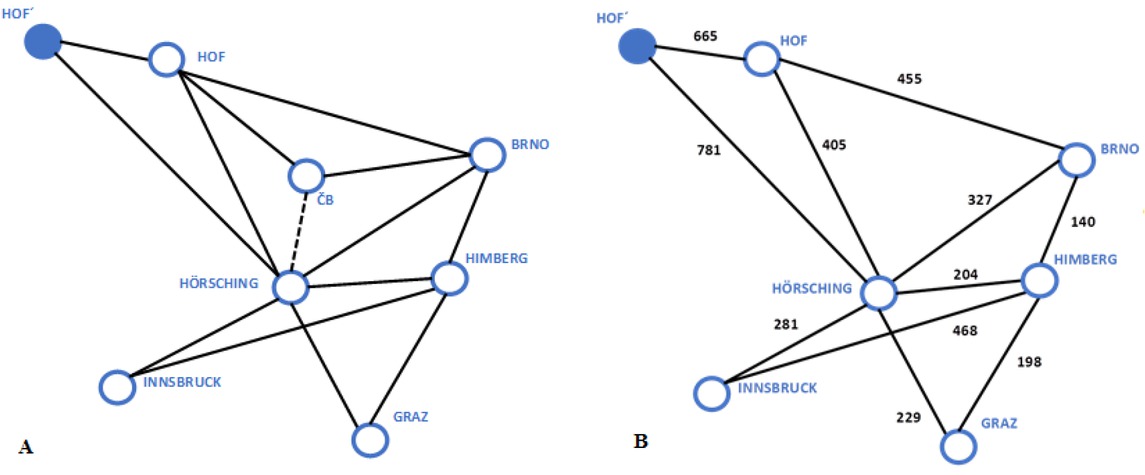
Selected (A) and modified (B) set for streamlining
The graph shows real edges (lines). The authors decided that the vertex Hof, which replaced a large number of graph vertices due to the fact that both from Hof in Germany and Hörsching in Austria have the same transport routes, will remain in the graph. This correction will not affect the results of this manuscript. The distances will be averaged and the value of the vertex will be quantified by summing the values of vertices replaced by vertex Hof. Since the branch České Budějovice is not deemed to be a graph vertex but only a source of shipments (starting supply point), it was removed from the graph. Figure 1B shows the graph modified by the authors, including its valued edges.
4.2 Determining values of examined set vertices
The basic data shall be used to compile a table of values of selected graph set vertices according to defined set of vertices. Table 1 shows the modified values of the selected set.
Values of vertices of the selected graph set. Source: authors
| Customer state code | Depot | Number of shipments (pcs) | Weight of shipment (kg) |
|---|---|---|---|
| AUT | Himberg | 57 | 9,088 |
| AUT | Hörsching | 68 | 7,869 |
| AUT | Graz | 21 | 1,977 |
| AUT | Innsbruck | 11 | 2,244 |
| DEU | Hof | 268 | 24,027 |
| DEU | Hof’ | 1,105 | 152,446 |
| CZ | Brno | 1,486 | 207,130 |
4.3 Minimum distance matrix
For the application of the location problem and calculation of transport work, it is imperative to identify individual values of the graph edges [23]. As aforementioned, the values will represent the individual real routes with the distances (in km) among the relevant branches according to the graph in Figure 1B (see Table 2 above).
The minimum distance matrix of the selected set of vertices
| km | Himberg | Hörsching | Graz | Innsbruck | Hof | Hof’ | Brno |
|---|---|---|---|---|---|---|---|
| Himberg | 0 | 204 | 198 | 468 | 609 | 985 | 140 |
| Hörsching | 204 | 0 | 229 | 281 | 405 | 781 | 327 |
| Graz | 198 | 229 | 0 | 510 | 634 | 1,010 | 338 |
| Innsbruck | 468 | 281 | 510 | 0 | 686 | 1,062 | 608 |
| Hof | 609 | 405 | 634 | 686 | 0 | 665 | 455 |
| Hof’ | 985 | 781 | 1,010 | 1,062 | 665 | 0 | 1,108 |
| Brno | 140 | 327 | 338 | 608 | 455 | 1,108 | 0 |
4.4 Application of location problem
The very application of location problem in the manuscript defines the third service vertex in the graph network in Figure 1B. Two current service centers are situated at the vertices “HOF” and “BRNO”,which, in this case, indicates the existence of actual regular routes from the branch in České Budějovice. These are very important service vertices.
The quality of final solution is influenced by selected combination of service vertices. In this problem, two service vertices are specified. When selecting service vertices, it is inevitable to realize which vertices being indicated represent the right choice by their nature. An expert estimate is that the vertices with the highest values within the pickup system network being the right choice. In the following part, the authors shall try to confirm this expert estimate [11].
Table 1 indicates that, according to the authors, it is possible to place the third service vertex in the vertex “HIMBERG” based on the weight requirements, and, in the vertex “HÖRSCHING”, on the basis of the requirement for the number of shipments. The particular question arises why the “HOF”’ central point is not taken into consideration. The reason is that this vertex represents a subset of vertices, which means it cannot be a single service vertex. This vertex is included for the purposes of this paper, since in the real network, the given subset of vertices can be supplied from the vertex “HÖRSCHING”, which was taken into account in the text.
The location problem will be applied for four assignments. The first one will consist in the selection of the third service depot at the vertex “HIMBERG”, the second one will represent the selection of a service depot at the vertex “HÖRSCHING”. Both problems will be addressed with the values corresponding to the number and, subsequently, the weight of shipments.
4.4.1 Third service depot in vertex “HIMBERG” – criterion: number of shipments
A set of three service depots is given as follows:
where: p – is an attribute of the set where the criterion is the number of shipments, HI – is an attribute of a set where the third service depot is HIMBERG,
and a set of vertices to be served N = {HOF’, HÖRSCHING, INNSBRUCK, GRAZ}; a value of transport work is to be calculated
Allocated catchment areas:
After substituting concrete values into the formula for calculating transport performance of a given subset, we get outcomes as follows:
The transport performance for the service vertices HOF, BRNO and HIMBERG when taking into account the criterion of the number of consignments is of 758,003 km.
4.4.2 Third service depot at the vertex “HIMBERG”– criterion: weight of shipments
A set of three service depots is given as follows:
where: m – is an attribute of the set where the criterion is the weight of shipments, HI – is an attribute of a set where the third service depot is HIMBERG and a set of vertices to be served N = {HOF’, HÖRSCHING, INNSBRUCK, GRAZ}; the value of transport work is to be calculated
Allocated catchment areas:
After substituting particular values into the formula for calculating transport performance of a given subset,we get results as follows:
The transport performance for the service vertices HOF, BRNO and HIMBERG when taking into account the criterion of the weight of consignments is of 104,423,504 km.
4.4.3 Third service depot at the vertex “HÖRSCHING” – criterion: number of shipments
A set of three service depots is given as follows:
where: p – is an attribute of the set where the criterion is the number of shipments, HO – is an attribute of the set where the third service depot is HÖRSCHING and a set of vertices to be serviced N = {HOF’, HIMBERG, INNSBRUCK, GRAZ}; the value of transport work is to be calculated
Allocated catchment area:
After substituting concrete values into the formula for calculating transport performance of a given subset, we get outcomes as follows:
The transport performance for the service vertices HOF,BRNOand HÖRSCHING when taking into account the criterion of the number of consignments is of 750,705 km.
4.4.4 Third service depot in vertex “HÖRSCHING” – criterion: weight of shipments
A set of three service depots is given as follows:
where: m – is an attribute of the set where the criterion is the weight of shipments, HO – is an attribute of the set where the third service depot is HÖRSCHING and a set of vertices to be served N = {HOF’, HIMBERG, INNSBRUCK, GRAZ}; the value of transport work is to be calculated
Allocated catchment areas:
After substituting particular values into the formula for calculating transport performance of a given subset, we get results as follows:
The transport performance for the service vertices HOF,BRNO and HÖRSCHING when taking into account the criterion of the weight of consignments is of 103,732,207 km.
Figure 2B shows the routes being examined in the context of the location problems above. The graphs are modified for the visualization of a sub-graph of serviceability in the event of selecting a service center (newly generated route is represented by a broken line). Route ČB – HÖRSCHING is shown in Figure 2A, second route is ČB – HIMBERG.
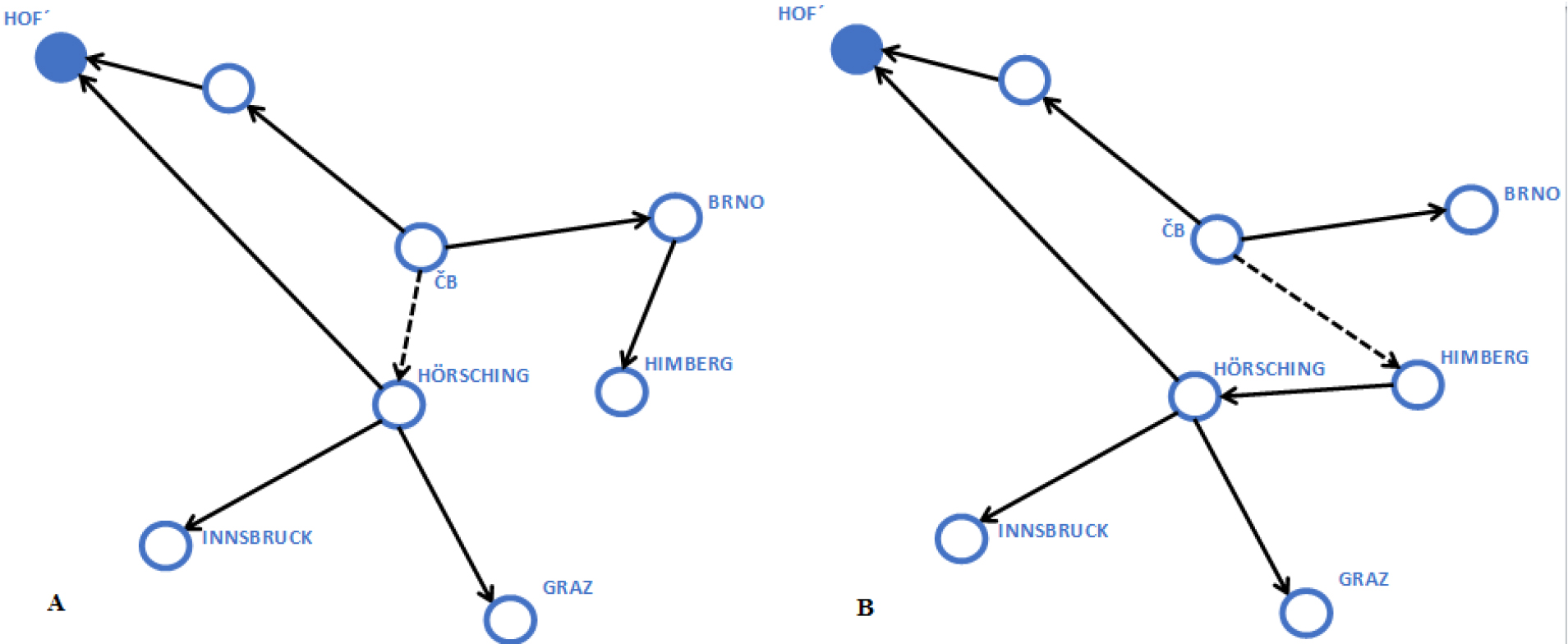
Graphical comparison of the results of third service depot location problem
5 Evaluation of results achieved
The location problem was used to determine the transport performance of the branches Himberg and Hörsching given that these branches would serve as the third service vertex from the graph in Figure 1B while applying the criteria of the serviceability required; i.e. the number and weight of shipments [31]. The specific findings are summarized in Table 3.
Outcome of the location problem
| Criterion – number of shipments (pcs) | Graz (km) | Innsbruck (km) | Hof (km) | Hof’ (km) | Brno (km) | Transport performance (km) |
|---|---|---|---|---|---|---|
| Himberg | 198 | 468 | 609 | 985 | 140 | 758,003 |
| Hörsching | 229 | 281 | 405 | 781 | 327 | 750,705 |
| Criterion – weight of shipments (kg) | Graz (km) | Innsbruck (km) | Hof (km) | Hof’ (km) | Brno (km) | Transport performance (km) |
| Himberg | 198 | 468 | 609 | 985 | 140 | 104,423,504 |
| Hörsching | 229 | 281 | 405 | 781 | 327 | 103,732,207 |
Table 3 compares the outputs of all tasks performed regarding the location problem. Furthermore, the table shows that when choosing the third service depot for the given graph in Figure 1B, the graph vertices (branches) will be supplied at lower transport performance for both criteria. The selection of the third service depot is described using the formula below [4]:
Where:
then:
The service depots were placed at the same location for both criteria, namely, in vertex Hörsching. The visual representation of the location problems solution is shown in Table 4 below.
Visual representation of the application of location problem
| Criterion – number of shipments (pcs) | Transport performance (km) | |
|---|---|---|
| Himberg | 758,003 | →MIN→750,705 |
| Hörsching | 750,705 | |
| Criterion – weight of shipments (kg) | Transport performance (km) | |
| Himberg | 104,423,504 | →MIN→103,732,207 |
| Hörsching | 103,732,207 | |
6 Conclusion
Based on examining the branch in České Budějovice and by application of the mathematical calculations using the location problem, the authors of the paper presented propose the introduction of a new supply (serviceability) route that will extend the existing networks of the pick-up system. The route České Budějovice (CR) – Hörsching (Austria) shall ensure the optimal serviceability of the catchment area of the depot in České Budějovice. Implementing the new route shall also positively affect the current utilization of the present České Budějovice routes and thus the entire supply system. The new route should relieve the existing load of the routes and extend the pick-up system network. Adding new supply route (graph edge) between the vertices ČB – HÖRSCHING enabled to omit other routes from the graph, more precisely the routes that are not imperative for ensuring the serviceability of the individual branches. The proposed solution would result in higher efficiency of the depot in the city of České Budějovice within the pick-up system as well as a more diversified distribution of shipments into a complex network of transport-logistics processes, which means a lower load of the network.
Application of the location problem on the investigated section actually enabled to determine the direction of the new route from České Budějovice (Czech Republic) to Hörsching (Austria). By adding a new edge into the selected graph, it was possible to optimize the performance of transport work and the number of transshipments compared to the original state. Both optimized quantities were assessed and confirmed for both criteria, namely for the number and weight of shipments (indicated in pieces and kilograms, respectively) that had to be delivered in the monitored period. Specifically, as far as service depots HOF, BRNO and HÖRSCHING are concerned when taking into account criterions of the number of consignments (in pcs) and the weight of consignments (in kg), the total transport performances of 750,705 pcs*km and 103,732,207 kg*km, respectively were quantified. And, in regard to service vertices HOF, BRNO and HIMBERG when taking into consideration the same criterions, the transport performances of 758,003 pcs*km and 104,423,504 kg*km, respectively were calculated. Hence, the quantification procedure has confirmed that it is reasonable to place the additional service point into the location of Hörsching.
As for the future efforts in the subject being discussed, it is recommended to address the actual rationalization of the current state, which could result in the optimization of the examined technical indicators, as well as the economic (financial) impact of the measures proposed.
Acknowledgement
This manuscript was supported within solving the research project entitled “Autonomous mobility in the context of regional development LTC19009” of the INTER-EXCELLENCE program, the VES 19 INTER-COST subprogram.
References
[1] Agarski B, Hadzistevic M, Budak I, Slobodan M, Djordje V. Comparison of approaches to weighting of multiple criteria for selecting equipment to optimize performance and safety. International Journal of Occupational Safety and Ergonomics. 2017;25(2):228-240.10.1080/10803548.2017.1341126Search in Google Scholar PubMed
[2] Averbakh I, Yu W. Multi-depot traveling salesmen location problems on networks with special structure. Annals of Operations Research. March 2020;286(1-2):635-648.10.1007/s10479-018-2812-4Search in Google Scholar
[3] Bach MP, Zoroja J, Loupis M. RFID usage in European enterprises and its relation to competitiveness: Cluster analysis approach. International Journal of Engineering Business Management. 2016;8.10.1177/1847979016685093Search in Google Scholar
[4] Bozhenyuk A, Belyakov S, Knyazeva M, Rozenberg I. Optimal allocation centers in second kind fuzzy graphs with the greatest base degree. Advances in Intelligent Systems and Computing Volume. 2018;679:312-321. DOI: 10.1007/978-3-319-68321-8_32.10.1007/978-3-319-68321-8_32Search in Google Scholar
[5] Corejova T, Bachanova PH, Mockova M. Industry and Business Study of Architecture in Terms of the Zilina Region. CERS Central European Conference in Regional Science. Kosice; 2015:125-135.Search in Google Scholar
[6] Corejova T, Bachanova PH, Mockova M. Industry and Business Study of Architecture in Terms of the Zilina Region. 5th Central European Conference in Regional Science (CERS). Kosice. Slovakia. 2017;125-135.Search in Google Scholar
[7] Costa MG, Captivo ME, Climaco J. Capacitated single allocation hub location problem – A bi-criteria approach. Computers and Operations Research. 2008;35(11):3671-3695.10.1016/j.cor.2007.04.005Search in Google Scholar
[8] Cujan Z, Fedorko G. Supplying of Assembly Lines Using Train of Trucks. Open Engineering. 2016;6:426-431. DOI: 10.1515/eng-2016-0057.10.1515/eng-2016-0057Search in Google Scholar
[9] Dockalikova I, Klozikova J. MCDM Methods in Practice: Localization Suitable Places for Company by the Utilization of AHP and WSA, TOPSIS Method. In: Proceedings of the 11th European Conference on Management Leadership and Governance. Military Academy. Lisbon. Portugal. 12-13. Nov. 2015;543-552. ISSN 2048-9021.Search in Google Scholar
[10] Droździel P, Wińska M, Madlenak R, Szumski P. Optimization of the position of the local distribution centre of the regional post logistics network. Transport Problems. 2017;12(3):42-50.10.20858/tp.2017.12.3.4Search in Google Scholar
[11] Farahani RZ, Hekmatfar M, Arabani AB. Nikbakhsh E. Hub location problems: A review of models, classification, solution techniques, and applications. Computers & Industrial Engineering. 2013;64:1096-1109. DOI: 10.1016/j.cie.2013.01.012.10.1016/j.cie.2013.01.012Search in Google Scholar
[12] Holm MB, Medbøen CAB, Fagerholt K, Schütz P. Shortsea liner network design with transhipments at sea: a case study from Western Norway. Flexible Services and Manufacturing Journal. 2019;31(3):598-619.10.1007/s10696-018-9317-ySearch in Google Scholar
[13] Hornstra RP, Silva A, Roodbergen KJ, Coelho LC. The vehicle routing problem with simultaneous pickup and delivery and handling costs. Computers and Operations Research. March 2020;115. DOI: 10.1016/j.cor.2019.10485810.1016/j.cor.2019.104858Search in Google Scholar
[14] Ivanić K, Hess M. Assessment of eflciency of the north Adriatic container terminals. Nase More. 2019;66(3):97-102.10.17818/NM/2019/3.1Search in Google Scholar
[15] Kampf R, Zeman K Beneš P. The determination of the optimal variant of public bus line transport vehicles in the daily circulation. Nase More. 2015;65:119-125. ISSN 0469-6255.10.17818/NM/2015/SI6Search in Google Scholar
[16] Ližbetin J, Černá L, Ľoch M. Model evaluation of suppliers in terms of real company for selected criteria. Nase More. 2015;65:147-152.10.17818/NM/2015/SI11Search in Google Scholar
[17] Ližbetinová L, Kampf R, Ližbetin J. Requirements of a transport system user. Communications: scientific letters of the University of Žilina. 2012;14(4):106-108. ISSN 1335-4205.10.26552/com.C.2012.4.106-108Search in Google Scholar
[18] Łubkowski P, Laskowski D. The Effective Identification of Objects in Selected Areas of Transport Transhipment. Journal of Konbin. 2019;49(1):7-30.10.2478/jok-2019-0001Search in Google Scholar
[19] Macrina G, Di Puglia Pugliese L, Guerriero F, Laporte G. Crowd-shipping with time windows and transshipment nodes. Computers and Operations Research. 2020;113.10.1016/j.cor.2019.104806Search in Google Scholar
[20] Madlenak R, Madlenakova L, Stefunko J, Keil R. Multiple approaches of solving allocation problems on postal transportation network in conditions of large countries. Transport and Telecommunication Journal. 2016;17(3):222-230. DOI: 10.1515/ttj-2016-0020.10.1515/ttj-2016-0020Search in Google Scholar
[21] Madlenakova L, Matuskova M, Hrudkay K. Intermodal Transport Terminals as Part of the Postal Transportation Network. In: 20th International Scientific Conference on Transport Means. Juod-krante, Lithuania; 2016:556-561.Search in Google Scholar
[22] Mamaghani EJ, Davari S. The bi-objective periodic closed loop network design problem. Expert Systems with Applications. 2020;144.10.1016/j.eswa.2019.113068Search in Google Scholar
[23] Nieoczym A, Caban J, Dudziak A, Stoma M. Autonomous vans - the planning process of transport tasks. Open Engineering. 2020;10(1):18-25. DOI: 10.1515/eng-2020-0006.10.1515/eng-2020-0006Search in Google Scholar
[24] Pelegrina GD, Duarte LT, Romano JMT. Application of independent component analysis and TOPSIS to deal with dependent criteria in multicriteria decision problems. Expert Systems with Applications. 2019;122:262-280.10.1016/j.eswa.2019.01.008Search in Google Scholar
[25] Rashidi K, Cullinane KA. Comparison of fuzzy DEA and fuzzy TOP-SIS in sustainable supplier selection: Implications for sourcing strategy. Expert Systems with Applications. 2019;121:266-81.10.1016/j.eswa.2018.12.025Search in Google Scholar
[26] Reihaneh M, Ghoniem A. A branch-and-price algorithm for a vehicle routing with demand allocation problem. European Journal of Operational Research. 2019;272(2):523-538. DOI: 10.1016/j.ejor.2018.06.049.10.1016/j.ejor.2018.06.049Search in Google Scholar
[27] Sadati MEH, Aksen D, Aras N. 2020. The r-interdiction selective multi-depot vehicle routing problem. International Transactions in Operational Research. 2020;27(2):835-866.10.1111/itor.12669Search in Google Scholar
[28] Stinga VG. Harmonization of resources and technologies of transport modes at the terminal level in a logistics network. IOP Conference Series: Materials Science and Engineering. 2019.10.1088/1757-899X/591/1/012114Search in Google Scholar
[29] Šeba J, Hruška R, Švadlenka L. Analysis of automatic identification and data capture systems use in logistics. Logi – Scientific Journal on Transport and Logistics. 2016;7(1):124-135. ISSN 1804-3216.Search in Google Scholar
[30] Tirkolaee EB, Hadian S, Weber GW, Mahdavi I. A robust green traflc-based routing problem for perishable products distribution. Computational Intelligence. 2020;36(1):80-101. DOI: 10.1111/coin.12240.10.1111/coin.12240Search in Google Scholar
[31] Vojtek M, Kendra M, Široký J, Magdechová K, Šipuš D. Supply Chain Simulation in Educational Process. LOGI – Scientific Journal on Transport and Logistics. 2019;10(1):72-78. DOI: 10.2478/logi-2019-0008.10.2478/logi-2019-0008Search in Google Scholar
[32] Wang Y, Lu X. Railway route optimisation from Romania to Poland based on an analysis of China’s ‘One Belt and One Road’ initiative. International Journal of Internet Manufacturing and Services. 2019;6(1):1-18. DOI: 10.1504/IJIMS.2019.096641.10.1504/IJIMS.2019.096641Search in Google Scholar
[33] Wang Y, Zhang S, Guan X, Peng S, Wang H, Liu Y, Xu M. Collaborative multi-depot logistics network design with time window assignment. Expert Systems with Applications. 2020;140.10.1016/j.eswa.2019.112910Search in Google Scholar
[34] Yu B. Cai M, Li, Q. A. -rough set model and its applications with TOPSIS method to decision making. Knowledge-Based Systems. 2019;165:420-431.10.1016/j.knosys.2018.12.013Search in Google Scholar
[35] Yu C, Shao Y, Wang K, Zhang L. A group decision making sustainable supplier selection approach using extended TOPSIS under interval-valued Pythagorean fuzzy environment. Expert Systems with Applications. 2019;121:1-17.10.1016/j.eswa.2018.12.010Search in Google Scholar
© 2020 O. Stopka et al., published by De Gruyter
This work is licensed under the Creative Commons Attribution 4.0 International License.
Articles in the same Issue
- Regular Articles
- Fabrication of aluminium covetic casts under different voltages and amperages of direct current
- Inhibition effect of the synergistic properties of 4-methyl-norvalin and 2-methoxy-4-formylphenol on the electrochemical deterioration of P4 low carbon mold steel
- Logistic regression in modeling and assessment of transport services
- Design and development of ultra-light front and rear axle of experimental vehicle
- Enhancement of cured cement using environmental waste: particleboards incorporating nano slag
- Evaluating ERP System Merging Success In Chemical Companies: System Quality, Information Quality, And Service Quality
- Accuracy of boundary layer treatments at different Reynolds scales
- Evaluation of stabiliser material using a waste additive mixture
- Optimisation of stress distribution in a highly loaded radial-axial gas microturbine using FEM
- Analysis of modern approaches for the prediction of electric energy consumption
- Surface Hardening of Aluminium Alloy with Addition of Zinc Particles by Friction Stir Processing
- Development and refinement of the Variational Method based on Polynomial Solutions of Schrödinger Equation
- Comparison of two methods for determining Q95 reference flow in the mouth of the surface catchment basin of the Meia Ponte river, state of Goiás, Brazil
- Applying Intelligent Portfolio Management to the Evaluation of Stalled Construction Projects
- Disjoint Sum of Products by Orthogonalizing Difference-Building ⴱ
- The Development of Information System with Strategic Planning for Integrated System in the Indonesian Pharmaceutical Company
- Simulation for Design and Material Selection of a Deep Placement Fertilizer Applicator for Soybean Cultivation
- Modeling transportation routes of the pick-up system using location problem: a case study
- Pinless friction stir spot welding of aluminium alloy with copper interlayer
- Roof Geometry in Building Design
- Review Articles
- Silicon-Germanium Dioxide and Aluminum Indium Gallium Arsenide-Based Acoustic Optic Modulators
- RZ Line Coding Scheme With Direct Laser Modulation for Upgrading Optical Transmission Systems
- LOGI Conference 2019
- Autonomous vans - the planning process of transport tasks
- Drivers ’reaction time research in the conditions in the real traffic
- Design and evaluation of a new intersection model to minimize congestions using VISSIM software
- Mathematical approaches for improving the efficiency of railway transport
- An experimental analysis of the driver’s attention during train driving
- Risks associated with Logistics 4.0 and their minimization using Blockchain
- Service quality of the urban public transport companies and sustainable city logistics
- Charging electric cars as a way to increase the use of energy produced from RES
- The impact of the truck loads on the braking efficiency assessment
- Application of virtual and augmented reality in automotive
- Dispatching policy evaluation for transport of ready mixed concrete
- Use of mathematical models and computer software for analysis of traffic noise
- New developments on EDR (Event Data Recorder) for automated vehicles
- General Application of Multiple Criteria Decision Making Methods for Finding the Optimal Solution in City Logistics
- The influence of the cargo weight and its position on the braking characteristics of light commercial vehicles
- Modeling the Delivery Routes Carried out by Automated Guided Vehicles when Using the Specific Mathematical Optimization Method
- Modelling of the system “driver - automation - autonomous vehicle - road”
- Limitations of the effectiveness of Weigh in Motion systems
- Long-term urban traffic monitoring based on wireless multi-sensor network
- The issue of addressing the lack of parking spaces for road freight transport in cities - a case study
- Simulation of the Use of the Material Handling Equipment in the Operation Process
- The use of simulation modelling for determining the capacity of railway lines in the Czech conditions
- Proposals for Using the NFC Technology in Regional Passenger Transport in the Slovak Republic
- Optimisation of Transport Capacity of a Railway Siding Through Construction-Reconstruction Measures
- Proposal of Methodology to Calculate Necessary Number of Autonomous Trucks for Trolleys and Efficiency Evaluation
- Special Issue: Automation in Finland
- 5G Based Machine Remote Operation Development Utilizing Digital Twin
- On-line moisture content estimation of saw dust via machine vision
- Data analysis of a paste thickener
- Programming and control for skill-based robots
- Using Digital Twin Technology in Engineering Education – Course Concept to Explore Benefits and Barriers
- Intelligent methods for root cause analysis behind the center line deviation of the steel strip
- Engaging Building Automation Data Visualisation Using Building Information Modelling and Progressive Web Application
- Real-time measurement system for determining metal concentrations in water-intensive processes
- A tool for finding inclusion clusters in steel SEM specimens
- An overview of current safety requirements for autonomous machines – review of standards
- Expertise and Uncertainty Processing with Nonlinear Scaling and Fuzzy Systems for Automation
- Towards online adaptation of digital twins
- Special Issue: ICE-SEAM 2019
- Fatigue Strength Analysis of S34MnV Steel by Accelerated Staircase Test
- The Effect of Discharge Current and Pulse-On Time on Biocompatible Zr-based BMG Sinking-EDM
- Dynamic characteristic of partially debonded sandwich of ferry ro-ro’s car deck: a numerical modeling
- Vibration-based damage identification for ship sandwich plate using finite element method
- Investigation of post-weld heat treatment (T6) and welding orientation on the strength of TIG-welded AL6061
- The effect of nozzle hole diameter of 3D printing on porosity and tensile strength parts using polylactic acid material
- Investigation of Meshing Strategy on Mechanical Behaviour of Hip Stem Implant Design Using FEA
- The effect of multi-stage modification on the performance of Savonius water turbines under the horizontal axis condition
- Special Issue: Recent Advances in Civil Engineering
- The effects of various parameters on the strengths of adhesives layer in a lightweight floor system
- Analysis of reliability of compressed masonry structures
- Estimation of Sport Facilities by Means of Technical-Economic Indicator
- Integral bridge and culvert design, Designer’s experience
- A FEM analysis of the settlement of a tall building situated on loess subsoil
- Behaviour of steel sheeting connections with self-drilling screws under variable loading
- Resistance of plug & play N type RHS truss connections
- Comparison of strength and stiffness parameters of purlins with different cross-sections of profiles
- Bearing capacity of floating geosynthetic encased columns (GEC) determined on the basis of CPTU penetration tests
- The effect of the stress distribution of anchorage and stress in the textured layer on the durability of new anchorages
- Analysis of tender procedure phases parameters for railroad construction works
- Special Issue: Terotechnology 2019
- The Use of Statistical Functions for the Selection of Laser Texturing Parameters
- Properties of Laser Additive Deposited Metallic Powder of Inconel 625
- Numerical Simulation of Laser Welding Dissimilar Low Carbon and Austenitic Steel Joint
- Assessment of Mechanical and Tribological Properties of Diamond-Like Carbon Coatings on the Ti13Nb13Zr Alloy
- Characteristics of selected measures of stress triaxiality near the crack tip for 145Cr6 steel - 3D issues for stationary cracks
- Assessment of technical risk in maintenance and improvement of a manufacturing process
- Experimental studies on the possibility of using a pulsed laser for spot welding of thin metallic foils
- Angular position control system of pneumatic artificial muscles
- The properties of lubricated friction pairs with diamond-like carbon coatings
- Effect of laser beam trajectory on pocket geometry in laser micromachining
- Special Issue: Annual Engineering and Vocational Education Conference
- The Employability Skills Needed To Face the Demands of Work in the Future: Systematic Literature Reviews
- Enhancing Higher-Order Thinking Skills in Vocational Education through Scaffolding-Problem Based Learning
- Technology-Integrated Project-Based Learning for Pre-Service Teacher Education: A Systematic Literature Review
- A Study on Water Absorption and Mechanical Properties in Epoxy-Bamboo Laminate Composite with Varying Immersion Temperatures
- Enhancing Students’ Ability in Learning Process of Programming Language using Adaptive Learning Systems: A Literature Review
- Topical Issue on Mathematical Modelling in Applied Sciences, III
- An innovative learning approach for solar power forecasting using genetic algorithm and artificial neural network
- Hands-on Learning In STEM: Revisiting Educational Robotics as a Learning Style Precursor
Articles in the same Issue
- Regular Articles
- Fabrication of aluminium covetic casts under different voltages and amperages of direct current
- Inhibition effect of the synergistic properties of 4-methyl-norvalin and 2-methoxy-4-formylphenol on the electrochemical deterioration of P4 low carbon mold steel
- Logistic regression in modeling and assessment of transport services
- Design and development of ultra-light front and rear axle of experimental vehicle
- Enhancement of cured cement using environmental waste: particleboards incorporating nano slag
- Evaluating ERP System Merging Success In Chemical Companies: System Quality, Information Quality, And Service Quality
- Accuracy of boundary layer treatments at different Reynolds scales
- Evaluation of stabiliser material using a waste additive mixture
- Optimisation of stress distribution in a highly loaded radial-axial gas microturbine using FEM
- Analysis of modern approaches for the prediction of electric energy consumption
- Surface Hardening of Aluminium Alloy with Addition of Zinc Particles by Friction Stir Processing
- Development and refinement of the Variational Method based on Polynomial Solutions of Schrödinger Equation
- Comparison of two methods for determining Q95 reference flow in the mouth of the surface catchment basin of the Meia Ponte river, state of Goiás, Brazil
- Applying Intelligent Portfolio Management to the Evaluation of Stalled Construction Projects
- Disjoint Sum of Products by Orthogonalizing Difference-Building ⴱ
- The Development of Information System with Strategic Planning for Integrated System in the Indonesian Pharmaceutical Company
- Simulation for Design and Material Selection of a Deep Placement Fertilizer Applicator for Soybean Cultivation
- Modeling transportation routes of the pick-up system using location problem: a case study
- Pinless friction stir spot welding of aluminium alloy with copper interlayer
- Roof Geometry in Building Design
- Review Articles
- Silicon-Germanium Dioxide and Aluminum Indium Gallium Arsenide-Based Acoustic Optic Modulators
- RZ Line Coding Scheme With Direct Laser Modulation for Upgrading Optical Transmission Systems
- LOGI Conference 2019
- Autonomous vans - the planning process of transport tasks
- Drivers ’reaction time research in the conditions in the real traffic
- Design and evaluation of a new intersection model to minimize congestions using VISSIM software
- Mathematical approaches for improving the efficiency of railway transport
- An experimental analysis of the driver’s attention during train driving
- Risks associated with Logistics 4.0 and their minimization using Blockchain
- Service quality of the urban public transport companies and sustainable city logistics
- Charging electric cars as a way to increase the use of energy produced from RES
- The impact of the truck loads on the braking efficiency assessment
- Application of virtual and augmented reality in automotive
- Dispatching policy evaluation for transport of ready mixed concrete
- Use of mathematical models and computer software for analysis of traffic noise
- New developments on EDR (Event Data Recorder) for automated vehicles
- General Application of Multiple Criteria Decision Making Methods for Finding the Optimal Solution in City Logistics
- The influence of the cargo weight and its position on the braking characteristics of light commercial vehicles
- Modeling the Delivery Routes Carried out by Automated Guided Vehicles when Using the Specific Mathematical Optimization Method
- Modelling of the system “driver - automation - autonomous vehicle - road”
- Limitations of the effectiveness of Weigh in Motion systems
- Long-term urban traffic monitoring based on wireless multi-sensor network
- The issue of addressing the lack of parking spaces for road freight transport in cities - a case study
- Simulation of the Use of the Material Handling Equipment in the Operation Process
- The use of simulation modelling for determining the capacity of railway lines in the Czech conditions
- Proposals for Using the NFC Technology in Regional Passenger Transport in the Slovak Republic
- Optimisation of Transport Capacity of a Railway Siding Through Construction-Reconstruction Measures
- Proposal of Methodology to Calculate Necessary Number of Autonomous Trucks for Trolleys and Efficiency Evaluation
- Special Issue: Automation in Finland
- 5G Based Machine Remote Operation Development Utilizing Digital Twin
- On-line moisture content estimation of saw dust via machine vision
- Data analysis of a paste thickener
- Programming and control for skill-based robots
- Using Digital Twin Technology in Engineering Education – Course Concept to Explore Benefits and Barriers
- Intelligent methods for root cause analysis behind the center line deviation of the steel strip
- Engaging Building Automation Data Visualisation Using Building Information Modelling and Progressive Web Application
- Real-time measurement system for determining metal concentrations in water-intensive processes
- A tool for finding inclusion clusters in steel SEM specimens
- An overview of current safety requirements for autonomous machines – review of standards
- Expertise and Uncertainty Processing with Nonlinear Scaling and Fuzzy Systems for Automation
- Towards online adaptation of digital twins
- Special Issue: ICE-SEAM 2019
- Fatigue Strength Analysis of S34MnV Steel by Accelerated Staircase Test
- The Effect of Discharge Current and Pulse-On Time on Biocompatible Zr-based BMG Sinking-EDM
- Dynamic characteristic of partially debonded sandwich of ferry ro-ro’s car deck: a numerical modeling
- Vibration-based damage identification for ship sandwich plate using finite element method
- Investigation of post-weld heat treatment (T6) and welding orientation on the strength of TIG-welded AL6061
- The effect of nozzle hole diameter of 3D printing on porosity and tensile strength parts using polylactic acid material
- Investigation of Meshing Strategy on Mechanical Behaviour of Hip Stem Implant Design Using FEA
- The effect of multi-stage modification on the performance of Savonius water turbines under the horizontal axis condition
- Special Issue: Recent Advances in Civil Engineering
- The effects of various parameters on the strengths of adhesives layer in a lightweight floor system
- Analysis of reliability of compressed masonry structures
- Estimation of Sport Facilities by Means of Technical-Economic Indicator
- Integral bridge and culvert design, Designer’s experience
- A FEM analysis of the settlement of a tall building situated on loess subsoil
- Behaviour of steel sheeting connections with self-drilling screws under variable loading
- Resistance of plug & play N type RHS truss connections
- Comparison of strength and stiffness parameters of purlins with different cross-sections of profiles
- Bearing capacity of floating geosynthetic encased columns (GEC) determined on the basis of CPTU penetration tests
- The effect of the stress distribution of anchorage and stress in the textured layer on the durability of new anchorages
- Analysis of tender procedure phases parameters for railroad construction works
- Special Issue: Terotechnology 2019
- The Use of Statistical Functions for the Selection of Laser Texturing Parameters
- Properties of Laser Additive Deposited Metallic Powder of Inconel 625
- Numerical Simulation of Laser Welding Dissimilar Low Carbon and Austenitic Steel Joint
- Assessment of Mechanical and Tribological Properties of Diamond-Like Carbon Coatings on the Ti13Nb13Zr Alloy
- Characteristics of selected measures of stress triaxiality near the crack tip for 145Cr6 steel - 3D issues for stationary cracks
- Assessment of technical risk in maintenance and improvement of a manufacturing process
- Experimental studies on the possibility of using a pulsed laser for spot welding of thin metallic foils
- Angular position control system of pneumatic artificial muscles
- The properties of lubricated friction pairs with diamond-like carbon coatings
- Effect of laser beam trajectory on pocket geometry in laser micromachining
- Special Issue: Annual Engineering and Vocational Education Conference
- The Employability Skills Needed To Face the Demands of Work in the Future: Systematic Literature Reviews
- Enhancing Higher-Order Thinking Skills in Vocational Education through Scaffolding-Problem Based Learning
- Technology-Integrated Project-Based Learning for Pre-Service Teacher Education: A Systematic Literature Review
- A Study on Water Absorption and Mechanical Properties in Epoxy-Bamboo Laminate Composite with Varying Immersion Temperatures
- Enhancing Students’ Ability in Learning Process of Programming Language using Adaptive Learning Systems: A Literature Review
- Topical Issue on Mathematical Modelling in Applied Sciences, III
- An innovative learning approach for solar power forecasting using genetic algorithm and artificial neural network
- Hands-on Learning In STEM: Revisiting Educational Robotics as a Learning Style Precursor
