
Design of geometric flower pattern for clothing based on deep learning and interactive genetic algorithm
-
Xu Cong
 und
Wenjia Zhang
und
Wenjia Zhang

Abstract
Geometric and floral models are an important part of clothing and have been used for thousands of years. Although the styles of geometric models and flower models have undergone changes over the centuries, they are still one of the important factors of clothing patterns, the important carrier of aesthetics, and the manifestation of people’s spiritual views and cultural needs. The development and application of digital printing technology have freed people from excessive dependence on sewing and embroidery processes. Therefore, while deeply studying the design of clothing patterns, this work sorted and analyzed the geometric flower models of clothing through interactive genetic algorithms, and optimized programming to enrich the models of clothing with geometric textures. The results showed that the deviation value of geometric flower pattern design was constantly decreasing, while the optimal strategy value was constantly increasing. The mean deviation value was 0.82, which was a decrease of 0.21 on the seventh day compared with the first day; the mean value of the optimal strategy value was 0.84, which was an increase of 0.19 on the seventh day compared with the first day. The visual effect and creativity of the clothing flower pattern design under the interactive genetic algorithm are better than the traditional flower pattern design, and the visual effect and creativity under the interactive genetic algorithm are 9% higher than the traditional one.
1 Introduction
With the advancement of time and the integration of cultures, various ideas on clothing design have gradually been integrated, resulting in people’s pursuit of clothing of the same style but with different floral texture patterns. Both geometric and floral patterns in clothing emphasize aesthetic expression, but the interpenetration of the overall aesthetic is one of the specific manifestations of this inclusive clothing pattern. Patterns play a very important role in the field of art design. At the same time, floral patterns are not only one of the most important and widely used design elements, but also one of the hot spots that people pay attention to.
The geometric patterns of clothing and floral patterns are the focus of attention. Mi and Ju used a 3D geometric modeling approach to generate basic patterns of various sizes and styles, where the geometry of the garment is divided into fit zones and fashion zones [1]. In order to find the minimum non-cutting path through a node from each cluster, Wang et al. classified the pattern features based on path optimization and gave the geometric representation of the contour of the cutting part, with the aim of studying the cutting path optimization problem of knitted slacks [2]. Zhi et al. proposed a parametric design method for 2D/3D models of warp knitted seamless garments and realized the online virtual display of 3D warp knitted seamless garments for the first time, laying the foundation for an online computer-aided warp knitted seamless garment design system [3]. Shafiq and Zhang achieved personalized comfort based on comfort-optimized values generated by fuzzy models related to different key body positions and different wearer movements, further improving the fit of the garment [4]. The elastic supports designed by Greder et al. were made by bending a flat elastic fabric pattern. For a given material, the different shaped planar patterns used to make the scaffold can have different biomechanical effects on the joint [5]. On the basis of the geometric pattern features, Lu et al. carried out an algorithmic research on the pattern generation method according to the mathematical principle of quasi-regular pattern and uniform random network + computer graphics technology [6]. Sun proposed two approaches for digital pattern design of custom clothing. Garment patterns were designed and studied through pattern design techniques of two-dimensional systems and flattening techniques of three-dimensional garment models [7]. The above studies have all described the importance of floral patterns in clothing design, but they have not applied interactive genetic algorithms to pattern design.
Deep learning, as a new type of algorithm, has many application fields. Hashimoto and Nakamoto developed a pattern design system based on pattern recognition and deep learning to determine the machining process information of the complex surface of the mold [8]. Li et al. proposed a new cumulative hidden layer supervised by a point-wise cumulative signal. With this cumulative hidden layer, the pattern design model can be learned indirectly by using adjacent flowers, alleviating the problem of sample imbalance [9]. Yang et al. proposed a biased learning algorithm to train the design of clothing floral patterns to further improve the detection accuracy with a small false alarm penalty [10]. Jiwen designed a multi-modal fusion layer by combining these features extracted from depth images and flower patterns through the network with a unified latent variable robust to noise. Two pattern networks are used to jointly optimize the fusion layer [11]. According to the similarity of flower patterns in the reconstruction stage, Li selected the minimum neighborhood sample set from a large number of samples, and then designed the patterns along time through deep learning algorithms in a recurrent neural network with long short-term memory units [12]. Manjon et al. introduced space-to-depth and reconstruction layers, allowing the processing of full volumes and enhancing the consistency of synthetic floral patterns. At the same time, the accuracy is improved due to the integrated 3D stereo pattern perception [13]. Long et al. proposed a new method for prefetching flower pattern design page through deep learning, showing that a powerful deep learning model can provide high accuracy for clothing pattern design prefetching [14]. The above studies have described the application of deep learning in geometric flower pattern design, but there are still many shortcomings.
At the inception of this research, the core premise was to explore and implement a novel method for designing clothing patterns, leveraging the advancements in deep learning and interactive genetic algorithms. This concept closely aligns with prior research into optimization and meta-heuristic studies, especially those employing genetic algorithms for a broad range of applications. Specifically, these studies have demonstrated the potential of algorithms inspired by natural and societal phenomena to solve complex engineering, computational, and design problems. For instance, Abdullah and Ahmed [15] proposed an optimizer inspired by the bee swarming reproductive process, showcasing the influence of natural phenomena on solving complex problems. Following this, Cheng and Jin [16] developed a competitive swarm optimizer, further expanding the domain by providing an effective solution strategy for large-scale optimization problems.
Zhao et al. [17] introduced the supply-demand-based optimization algorithm, and Shabani et al. [18] proposed the search and rescue optimization algorithm, both exploring different angles of applying complex socio-economic principles to optimization problems. These studies not only enrich the theoretical foundations of optimization algorithms but also offer new perspectives for various practical applications.
Building on this foundation, Das et al. [19] and Kaveh et al. [20] proposed the student psychology-based optimization algorithm and the billiards-inspired optimization algorithm, respectively. These innovative methodologies not only increase the diversity of optimization algorithms but also enhance the ability to solve specific types of problems. Moreover, Houssein Essam et al. [21] and Li et al. [22] explored new strategies in the stochastic optimization process by introducing the Lévy flight distribution and the Slime mould algorithms, reflecting the application of meta-heuristic algorithms in simulating natural phenomena.
Further, De Vasconcelos Segundo et al. [23] and Moosavi and Bardsiri [24] discussed the impact of engineering design and human societal behaviors on optimization strategies through the falcon optimization algorithm and the poor and rich optimization algorithm. These studies highlight the importance of interdisciplinary integration in developing novel optimization algorithms.
Subsequently, Sulaiman et al. [25] and Yapici and Cetinkaya [26] showcased the application potential of bio-inspired algorithms in solving engineering optimization problems through the Barnacles Mating Optimizer and the Pathfinder algorithm. The development of these algorithms reflects researchers’ continuous inspiration from the natural world in seeking new optimization methods.
Finally, Cao et al. [27] and Shayanfar and Gharehchopogh [28] demonstrated the wide applicability and effectiveness of optimization algorithms in engineering applications through the development of the owl search algorithm and the farmland fertility algorithm. Furthermore, Zhao et al. [29] and Kamboj et al. [30] introduced the manta ray foraging optimization and the Harris hawks optimizer, further proving the efficacy of optimization algorithms across engineering applications.
The comprehensive analysis of these references indicates that introducing optimization methods inspired by natural and societal phenomena can find effective and creative solutions in innovative fields such as clothing pattern design. This provides a solid theoretical foundation for our study, aiming to optimize clothing pattern design using deep learning and interactive genetic algorithms to create designs that are both trendy and meet individualized needs.
This study introduces a groundbreaking approach to clothing pattern design, blending the precision of deep learning with the adaptability of interactive genetic algorithms to forge novel geometric and floral patterns. This fusion represents a significant leap in the field, offering a fresh perspective on integrating technology with fashion design. The originality of the research lies in its unique methodology that employs advanced computational techniques to reinterpret traditional design elements, enabling the creation of intricate and customizable patterns that cater to the evolving aesthetic preferences and cultural trends. The main objective of this research is to revolutionize the way clothing patterns are conceived and developed, moving beyond conventional design constraints towards a more dynamic and responsive design process. By harnessing the power of deep learning, the aim of this study is to analyze and predict design trends, allowing for the generation of patterns that not only appeal to contemporary tastes but also anticipate future fashion directions. Meanwhile, the use of interactive genetic algorithms facilitates an iterative design process, where patterns evolve through cycles of selection and modification, mimicking the process of natural selection to optimize for aesthetic appeal and practicality. This approach not only enhances the creativity and efficiency of pattern design but also democratizes the design process, enabling designers to experiment with complex patterns without the need for extensive technical expertise. The integration of these technologies promises to expand the possibilities of textile design, offering a richer palette of patterns and textures that can be tailored to individual preferences and market demands. Ultimately, the aim of this research is to establish a new paradigm in clothing design, where the synergy between technology and creativity opens up new avenues for innovation and personal expression in fashion.
2 Elements of interaction design and interaction genetic algorithms
2.1 Basic elements of interaction design
In interaction design, there are generally five elements, as shown in Figure 1. The first is the user which is the main object of geometric floral design. Designers are users of geometric designs with floral patterns. The goal is to use an algorithm to generate a design that satisfies the needs and divide each pattern into a designer’s display unit [31]. The designer arbitrarily selects all matching geometric flower patterns through a pre-selection algorithm and then systematically replaces all elements in the pattern. Second, the interaction between designers and algorithms in the geometric interaction design system includes the role of the designer and the role of the algorithm. The designer expresses a satisfactory design scheme of the designer’s behavior by decomposing and storing individual graphics. Based on the initialization algorithm, the division and selection of the next generation of individuals by design and the training of learning neural network algorithms are all algorithmic behavioral roles. The third is the scene. The graphics in the geometric design process include the operating conditions of the algorithm, the entire database arbitrarily selected by the algorithm in the encoding process, and the designer’s score for the geometric flower pattern in the interaction process. The fourth is technology. Designers not only master traditional design theory knowledge and the functions on which design is based, but also master computer programming theory and technology related to interactive genetic algorithms. They can debug algorithms before developing other algorithms to ensure that the algorithms are working properly. The fifth is the product. The work quality of the geometric flower image interactive design system depends on whether the interactive activity itself can meet the needs of the designers. Patterns in interaction design are closely related to the designer’s technique, which can directly affect the practicality and effect of geometric floral patterns.

Basic elements of interaction design.
2.2 Theoretical basis of interactive genetic algorithm
The interactive genetic algorithm studies the characteristic mechanism of things through computer, and then develops and designs an artificial adaptive system to solve the geometric pattern optimization problem according to the results of data analysis. Computers are used to simulate the mechanisms and lifestyles of various biological traits [32]. When designing interactive genetic algorithms, the theories of mathematics, biology, and computer programming should be adopted. The main content and driving force of interactive genetic algorithm is to simulate the heredity, mutation, and evolution of natural organisms, mainly to solve mathematical and technical problems. In addition, the interactive coding methods of genetic algorithm include binary coding, physical coding, serial coding, tree structure coding, and so on. Compared with other methods, the interactive genetic algorithm has the advantage of being more intuitive and can solve a large number of optimization problems.
2.3 Problems in the design of geometric flower patterns
When designers design geometric clothing models, they evaluate the outcome of individual evolution by incorporating various subjective factors such as preference, experience, and emotion. Therefore, the interactive genetic algorithm in the program has a unique feature which is the ambiguity of individual adaptive semantic evaluation. Individual evaluations are difficult to maintain and optimize the evaluation process for individual interactions. Therefore, the interactive genetic algorithm has three flaws in flower geometry, as shown in Figure 2. First, the results lack authenticity. Interactive genetic algorithm is an algorithm that simulates the biological reproduction phenomenon in nature, which is calculated based on certain experiments and actual situations [33]. Second, interactive genetic algorithms have global search capabilities but do not include solutions for all points in the space. The last is the designer’s aesthetic fatigue. After the interactive behavior is introduced into the interactive genetic algorithm, the designer should individually evaluate the generated flower pattern to design the scheme, which can lead to the designer’s aesthetic fatigue on geometric flowers. With the development of algebra, the aesthetic fatigue of designers has become more and more obvious, which may directly affect the objective selection of subsequent plans.

Problems in geometric flower pattern design.
2.4 Optimization strategy for user fatigue in flower pattern design
In the interactive genetic algorithm simulation process, repeated user interaction evaluation increases user fatigue and directly affects the selection of simulation results. According to existing research on reducing interaction fatigue, two approaches are proposed to address users fatigue, as shown in Figure 3. The first is that the system randomly selects interacting objects, organizes interactions, and separates objects to score individuals. Designers of specific projects with high ratings can perform personal ratings before validating experimental results, significantly reducing designer fatigue and total computational time when interacting with algorithms and improving the efficiency of design activities [34]. Second, a neural network of radial basis functions is integrated into an interactive genetic algorithm, and the algorithm is trained to make it more intelligent. Through the study of the nonlinear structure function values of different types of model samples, the priority of structure functions is obtained, and an approximate linear fitness function is constructed to reduce the mutual fatigue of structure functions.

Optimization strategy of user fatigue in flower pattern design.
3 Garment geometric flower pattern design based on interactive genetic algorithm
3.1 Classification of geometric patterns of clothing
Clothing styles are classified from different perspectives and can be divided into two categories. One is the form of composition, and the other is the expression of content. In terms of structure, it can be divided into continuous structure and separate structure. In terms of themes, it can be divided into floral patterns and geometric patterns. From the overall shape of the garment to the model design, it generally includes the combination and separation of two forms of patterns, which are usually composed of two or more continuous shapes. In clothing design projects, personalized clothing models are usually designed according to the needs of clothing decoration. Appropriate clothing design can not only increase the artistic beauty of clothing and enrich the visual effect of clothing, but also can express the beauty of clothing according to the particularity of the fabric.
3.2 Arrangement rules of clothing geometry
According to the arrangement rules between figures, the basic rules of floral geometric patterns can be divided into three categories, as shown in Figure 4. The first is independence from each other. The geometric and colorful shapes of the fabric are spaced to maintain individual patterns. One part does not depend on the shape of another part. Although the two parts have the same material, the corresponding shapes of the respective patterns are preserved and formed into rich and harmonious clothing patterns [35]. The second is the interdependence between geometric floral patterns. Floral lines and geometric patterns are interdependent. Geometric patterns and floral patterns are two intersecting shapes that cannot be separated from each other and they depend on each other to form a complete garment pattern. The third is comprehensive sorting. The overall scheme represented by the clothing pattern can be represented by the same style. Therefore, designers often use comprehensive sorting in clothing design to create a more vivid style, which can give people a variety of visual effects. At the same time, it can more directly reflect the popular elements.
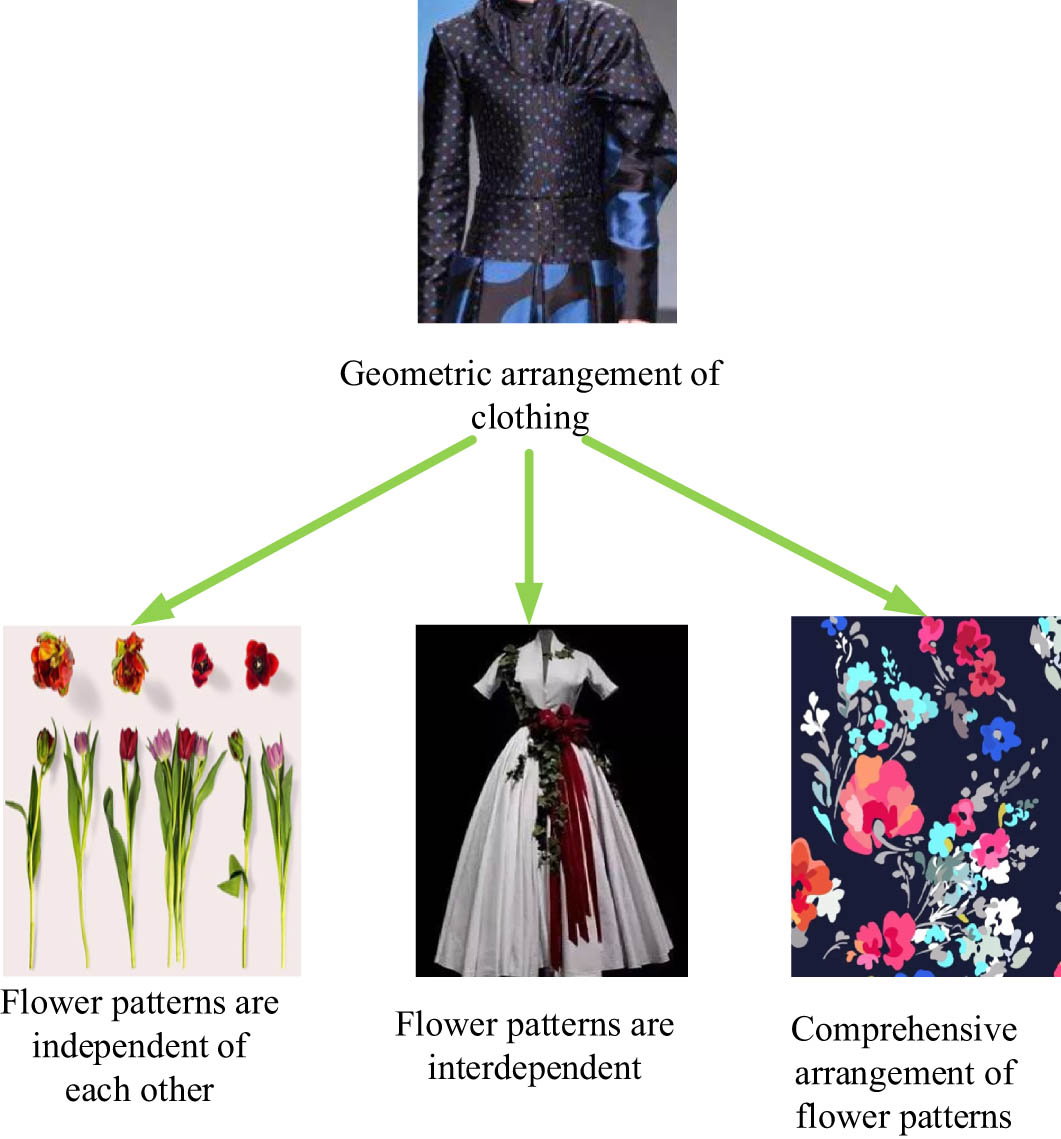
Arrangement rules of clothing geometry. Source: Raw data obtained from kaggle, https://www.kaggle.com/datasets/nguyngiabol/dress-pattern-dataset.
3.3 Design of geometric flower patterns based on interactive genetic algorithm
By the change in the vertical and horizontal arrangement of clothing geometric figures and floral patterns, general modularization rules are formulated, and clothing patterns are designed accordingly, as shown in Figure 5. The first is to establish a database to change the overall visual effect of clothing by adding patterns and textures of floral patterns, thereby enhancing the appeal of floral geometric patterns. In addition, it can also improve the artistic image and make the pattern easy to accept. The second is the selection. The algorithm requires model developers to individually evaluate geometric patterns as well as floral styles for selecting an appropriate geometric initialization system and flower model to ensure future variations and cross-uses. The third is adaptation assessment. The geometric texture chain is decoded by the program to obtain the style of the geometric texture. Then, according to the initial value chosen by the program, the designer subjectively evaluates the corresponding object value to calculate the objective function. The neuron model is used to adjust the size of the linear objective function of the geometric flower pattern to obtain the customized fitness of the object. The fourth is hybridization, which integrates the advantages of the first two geometric flowers into the next generation to form a flower pattern with the advantages of both sides, and the designer inherits the aesthetic painting [36]. Therefore, the new binary decoding mode has the style approved by the previous designers with its own characteristics, and it improves the adaptability of single-mode components. The fifth is mutation, the whole mutation process is controlled by the operator. The entire mutation process is controlled by mutation operators. In the interactive design of geometric color models of clothing, mutation operators are not the main force when building new geometric flower models. However, the mutation factor can effectively prevent the algorithm from accessing the flower geometry model prematurely and maintain the integrity of the search, ensuring that the algorithm is not trapped in local optimization.

Design of geometric flower pattern based on interactive genetic algorithm. Source: Original Data, https://data.world/crowdflower/categorization-dress-patterns.
4 Application of deep learning algorithm in the design of clothing flower patterns
In order to understand the effect of geometric pattern design of clothing, this study analyzed the design effect of geometric flower pattern of clothing through deep learning. First, by fitting the curve through deep learning, the minimum deviation sum of squares of the geometric flower pattern can be obtained as follows:
Formula (2) is the minimum weighted variance of the geometric pattern, and
where formula (4) is the least square sum of flower pattern deviation. According to the extreme value problem of deep learning, the conditions that formula (4) meet are
After Formula (5) is transformed by deep learning, the following can be obtained:
where Formulas (7) and (8) are the deviation coefficients of flower patterns, respectively. Then, the parameters in Formula (6) are genetically transformed to obtain the geometric approximation value of the flower pattern.
After analyzing the input and output relationship of geometric pattern design by interactive genetic algorithm, the relationship between input and output can be obtained as follows:
According to deep learning, the deviation degree of the nonlinear function of the pattern design can be obtained as follows:
The optimal policy value of the output function of the final floral geometric pattern is
5 Experiment in geometric floral design for clothing
In order to understand the design effect of geometric flower patterns of clothing, this study analyzed the effect of collection flower pattern design through deep learning and interactive genetic algorithm. First, the designers from three design companies in a certain area were selected to investigate their satisfaction with the geometric flower pattern design under the interactive genetic algorithm. There are 100 people in each design company, and the specific survey results are shown in Table 1.
Satisfaction of geometric flower pattern design under interactive genetic algorithm
| Satisfied | General | Dissatisfied | |
|---|---|---|---|
| Design company A | 86 | 6 | 8 |
| Design company B | 84 | 10 | 6 |
| Design company C | 88 | 8 | 4 |
It can be seen from Table 1 that most of the designers of the three design companies were satisfied with the geometric flower pattern design. Among the three companies, 86% were satisfied, 8% were general, and 6% were dissatisfied. Satisfied designers think that the interactive genetic algorithm’s geometric flower pattern design is very creative, and it can also be quickly crossed to produce more rich geometric patterns. They also think that hybrid genetics can create more new geometric flowers, which not only give the best visual experience, but also enrich the style of clothing. Dissatisfied people feel that the operation process is too cumbersome.
5.1 Floral curve fitting effect and layout effect of geometric flower pattern design of clothing
In order to understand the effect of the geometric flower pattern design under the interactive genetic algorithm, this study analyzed the curve fitting effect and layout effect of the geometric flower pattern. The specific analysis results are shown in Figure 6.

Flower curve fitting effect and layout effect of geometric flower pattern design of clothing.
As can be seen from the figure, the curve fitting effect and the layout effect under the interactive genetic algorithm are gradually increasing; the mean value of the curve fitting effect is 0.87, and on the seventh day, it is 0.11 higher than the first day; the average effect of the geometric flower pattern layout is 0.84, and on the seventh day, it is 0.24 higher than the first day. The increase in curve fitting shows that the outline of the geometric flower under the interactive genetic algorithm is consistent with the shape of the pattern, and the deviation is getting smaller and smaller. The layout effect of the flower pattern shows that there are certain rules in the overall ordering of the progeny of the hybrid mutation.
5.2 Experiment of deep learning in the design of geometric floral patterns in clothing
In order to understand the effect of geometric flower pattern design of clothing, this study analyzed the deviation degree and optimal strategy value of geometric flower pattern design through deep learning algorithm, as shown in Figure 7.

Experimental analysis of deep learning in garment geometric flower pattern design.
It can be seen from the figure that with the increase in time, the deviation value of geometric flower pattern design is continuously decreasing, while the optimal strategy value is constantly increasing. The mean deviation value is 0.82, which is a decrease of 0.21 on the seventh day compared with the first day; the mean value of the optimal strategy value is 0.84, which is an increase of 0.19 on the seventh day compared with the first day. The decrease in the deviation value of the flower pattern indicates that the contour curve of the clothing flower and the geometric pattern under the interactive genetic algorithm is almost consistent, and the mutation probability in the hybrid offspring is relatively stable. The increase in the optimal strategy value indicates that the design types of geometric flower patterns are gradually increasing.
5.3 Visual effects and creativity of geometric flower pattern design for clothing
In order to understand the overall design effect of the geometric pattern of clothing, this study compared and analyzed the visual effect and creativity of the traditional geometric flower pattern design. The specific analysis results are shown in Figure 8.
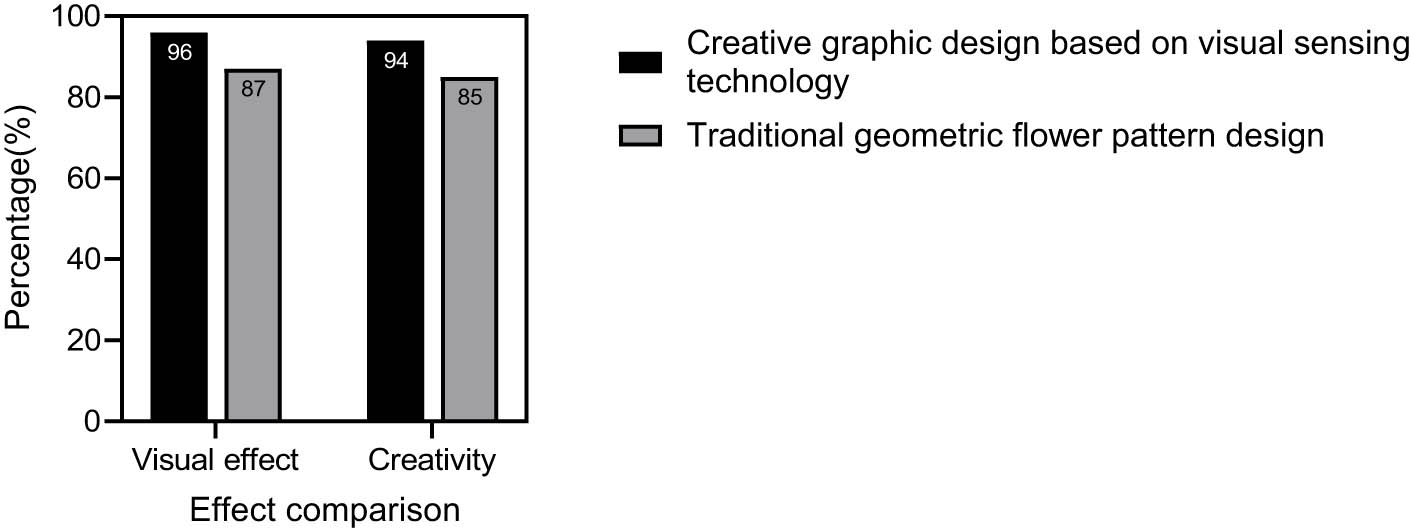
Experiment of deep learning in clothing geometric flower pattern design: analysis of visual effect and creativity of clothing geometric flower pattern design.
It can be seen from the figure that the visual effect and creativity of the clothing flower pattern design under the interactive genetic algorithm are better than the traditional flower pattern design; the visual effect and the creativity degree under the interactive genetic algorithm are both 9% higher than the traditional one. These all show that the design of clothing flowers under the interactive genetic algorithm can be recombined and arranged according to different arrangement orders to form new geometric flower patterns, which not only can save time, but also can enrich the types and styles of geometric flowers, so as to promote the creative development of clothing design.
To comprehensively compare the performance of different optimization algorithms, this study adopted non-parametric significance testing methods. Initially, the Friedman test was applied for a preliminary comparison of the algorithms. Subsequently, the post hoc Nemenyi test was used for an in-depth analysis of the specific performance differences between algorithms. This study considered a variety of algorithms, including the most advanced metaheuristic methods, especially the CMAES algorithm and the coyote algorithm. Through the comparison of these methods, we aim to identify the most effective algorithms in the field of designing geometric floral patterns. The results are as shown in Table 2.
Algorithm comparison
| Algorithm | Accuracy (%) | Precision (%) | Recall (%) | F1 Score (%) |
|---|---|---|---|---|
| CMAES | 92.5 | 91.2 | 93.1 | 92.1 |
| Coyote | 90.3 | 89.8 | 91.0 | 90.4 |
| GA | 88.1 | 87.0 | 89.2 | 88.1 |
| PSO | 89.7 | 88.5 | 90.4 | 89.4 |
| DE | 87.2 | 86.9 | 88.1 | 87.5 |
| CMAES | 93.0 | 92.0 | 94.2 | 93.1 |
| Coyote | 91.1 | 90.2 | 92.3 | 91.2 |
| GA | 88.5 | 87.5 | 89.0 | 88.2 |
| PSO | 90.0 | 89.2 | 90.8 | 89.9 |
| DE | 87.5 | 86.8 | 88.3 | 87.5 |
Table 2 compares several advanced optimization algorithms through non-parametric significance testing to evaluate their efficiency and creativity in designing geometric floral patterns. It can be seen that the CMAES algorithm excels in accuracy, with an average accuracy rate of 92.75%, demonstrating its effectiveness in identifying and implementing optimal design solutions; while the coyote algorithm also performs well, with an average accuracy rate of 90.7%, it is slightly lower than CMAES but still at a high level. The precision, recall, and F1 scores of these two algorithms are correspondingly high, with CMAES achieving the highest F1 score of 92.6%, indicating its superiority in balancing precision and recall. In contrast, traditional algorithms such as Genetic algorithm (GA), Particle swarm optimization (PSO), and Differential evolution (DE) perform moderately on these indicators, with accuracy rates of 88.3, 89.85, and 87.35%, respectively, indicating that the latest metaheuristic methods can provide more precise and reliable solutions for complex design tasks related to the theme of this study. This finding is consistent with the research results of Carrasco et al. [37] and Derrac et al. [38], emphasizing the importance of using statistical methods in the selection and application of algorithms. When choosing an optimization algorithm suitable for designing geometric floral patterns, considering the comprehensive performance of the algorithm is crucial, especially in scenarios pursuing high-quality design outputs, making CMAES and coyote algorithms the preferred choices due to their exceptional performance.
6 Conclusion
In this study, the structural law of clothing on fabric is studied by combining interactive genetic algorithm with geometric pattern model. The generated flower geometric model corresponds to the general arrangement rule of traditional flower model by the change in the parameters of the interactive genetic algorithm. In the interactive genetic algorithm, the geometric model of clothing flower can be effectively designed not only in the time aspect of the design of the clothing flower geometric model, but also in the output aspect of the clothing geometric model. The program can create a set of geometric models of clothing and colors from images in a database and provide mathematical methods for the design of clothing and flower models.
-
Funding information: There is no funding information for the work in this work.
-
Author contributions: Xu Cong designed the research study. Wenjia Zhang analyzed the data.
-
Conflict of interest: The authors declare that there is no conflict of interest regarding the publication of this work.
-
Data availability statement: The data related to this work can be obtained through email from the authors.
References
[1] Mi JC, Ju HP. A study on the fashion design by pattern deconstruction of tailored jacket. J Korean Soc Fash Des. 2018;18(1):57–76.10.18652/2018.18.1.4Suche in Google Scholar
[2] Wang W, Wei J, Wang F. Preference analysis of traditional handicraft brocade pattern in fashion art. J Phys: Conf Ser. 2021;1790(1):012028–34.10.1088/1742-6596/1790/1/012028Suche in Google Scholar
[3] Dong Z, Jiang G, Huang G, Cong H. A web-based 3D virtual display framework for warp-knitted seamless garment design. Int J Cloth Sci Technol. 2018;30(3):332–46.10.1108/IJCST-05-2017-0060Suche in Google Scholar
[4] Shafiq H, Zhang N. Eco-friendly concept: Female clothing design inspired by plastic bag’s pattern. Costume Guide. 2020;9(3):33–7.Suche in Google Scholar
[5] Greder KC, Pei J, Shin J. Design in 3D: A computational fashion design protocol. Int J Cloth Sci Technol. 2020;32(4):537–49.10.1108/IJCST-07-2019-0110Suche in Google Scholar
[6] Lu S, Mok PY, Jin X. A new design concept: 3D to 2D textile pattern design for garments. Comput Des. 2017;89(7):35–49.10.1016/j.cad.2017.03.002Suche in Google Scholar
[7] Sun YK. Development of pattern design and fashion cultural products fused with the Byeoljeon Motif. Korean Soc Sci Art. 2020;38(3):37–50.10.17548/ksaf.2020.06.30.37Suche in Google Scholar
[8] Hashimoto M, Nakamoto K. Process planning for die and mold machining based on pattern recognition and deep learning. J Adv Mech Des Syst Manuf. 2021;15(2):15–9.10.1299/jamdsm.2021jamdsm0015Suche in Google Scholar
[9] Li K, Xing J, Hu W. D2C: Deep cumulatively and comparatively learning for human age estimation. Pattern Recognit. 2017;66(4):95–105.10.1016/j.patcog.2017.01.007Suche in Google Scholar
[10] Yang H, Jing S, Yi Z. Layout hotspot detection with feature tensor generation and deep biased learning. IEEE Trans Comput Des Integr Circuits Syst. 2017;8(6):1175–87.10.1109/TCAD.2018.2837078Suche in Google Scholar
[11] Ren LL, Lu JW, Feng JJ, Zhou J. Multi-modal uniform deep learning for RGB-D person re-identification. Pattern Recognit: J Pattern Recognit Soc. 2017;72(4):446–57.10.1016/j.patcog.2017.06.037Suche in Google Scholar
[12] Li T, Zhao H, Zhou X. Method of short-circuit fault diagnosis in transmission line based on deep learning. Int J Pattern Recognit Artif Intell. 2022;36(5):64–6.10.1142/S0218001422520097Suche in Google Scholar
[13] Manjon JV, Romero JE, Coupe P. Deep learning based MRI contrast synthesis using full volume prediction. Biomed Phys Eng Express. 2022;8(1):015013–21.10.1088/2057-1976/ac3c64Suche in Google Scholar PubMed
[14] Long X, Gong X, Zhou H. Deep learning based data prefetching in CPU-GPU unified virtual memory. arXiv e-prints. 2022;5(6):41–2.Suche in Google Scholar
[15] Abdullah JM, Ahmed T. Fitness dependent optimizer: Inspired by the bee swarming reproductive process. IEEE Access. 2019;7:43473–86.10.1109/ACCESS.2019.2907012Suche in Google Scholar
[16] Cheng R, Jin Y. A competitive swarm optimizer for large scale optimization. IEEE Trans Cybern. 2014;45(2):191–204.10.1109/TCYB.2014.2322602Suche in Google Scholar PubMed
[17] Zhao W, Wang L, Zhang Z. Supply-demand-based optimization: A novel economics-inspired algorithm for global optimization. IEEE Access. 2019;7:73182–206.10.1109/ACCESS.2019.2918753Suche in Google Scholar
[18] Shabani A, Asgarian B, Salido M, Gharebaghi SA. Search and rescue optimization algorithm: A new optimization method for solving constrained engineering optimization problems. Expert Syst Appl. 2020;161:113698.10.1016/j.eswa.2020.113698Suche in Google Scholar
[19] Das B, Mukherjee V, Das D. Student psychology based optimization algorithm: A new population based optimization algorithm for solving optimization problems. Adv Eng Softw. 2020;146:102804.10.1016/j.advengsoft.2020.102804Suche in Google Scholar
[20] Kaveh A, Khanzadi M, Moghaddam MR. Billiards-inspired optimization algorithm; a new meta-heuristic method. Structures. 2020;1722–39.10.1016/j.istruc.2020.07.058Suche in Google Scholar
[21] Houssein Essam H, Saad MR, Hashim FA, Shaban H, Hassaballah M. Lévy flight distribution: A new metaheuristic algorithm for solving engineering optimization problems. Eng Appl Artif Intell. 2020;94:103731.10.1016/j.engappai.2020.103731Suche in Google Scholar
[22] Li S, Chen H, Wang M, Heidari AA, Mirjalili S. Slime mould algorithm: A new method for stochastic optimization. Future Gener Computer Syst. 2020;111:300–23.10.1016/j.future.2020.03.055Suche in Google Scholar
[23] De Vasconcelos Segundo EH, Mariani VC, Dos Santos Coelho L. Design of heat exchangers using falcon optimization algorithm. Appl Therm Eng. 2019;156:119–44.10.1016/j.applthermaleng.2019.04.038Suche in Google Scholar
[24] Moosavi SHS, Bardsiri VK. Poor and rich optimization algorithm: A new human-based and multi populations algorithm. Eng Appl Artif Intell. 2019;86:165–81.10.1016/j.engappai.2019.08.025Suche in Google Scholar
[25] Sulaiman MH, Mustaffa Z, Saari MM, Daniyal H. Barnacles mating optimizer: A new bio-inspired algorithm for solving engineering optimization problems. Eng Appl Artif Intell. 2020;87:103330.10.1016/j.engappai.2019.103330Suche in Google Scholar
[26] Yapici H, Cetinkaya N. A new meta-heuristic optimizer: Pathfinder algorithm. Appl Soft Comput. 2019;78:545–68.10.1016/j.asoc.2019.03.012Suche in Google Scholar
[27] Cao Y, Wang Q, Wang Z, Jermsittiparsert K, Shafiee M. A new optimized configuration for capacity and operation improvement of CCHP system based on developed owl search algorithm. Energy Rep. 2020;6:315–24.10.1016/j.egyr.2020.01.010Suche in Google Scholar
[28] Shayanfar H, Gharehchopogh FS. Farmland fertility: A new metaheuristic algorithm for solving continuous optimization problems. Appl Soft Comput. 2018;71:728–46.10.1016/j.asoc.2018.07.033Suche in Google Scholar
[29] Zhao W, Zhang Z, Wang L. Manta ray foraging optimization: An effective bio-inspired optimizer for engineering applications. Eng Appl Artif Intell. 2020;87:103300.10.1016/j.engappai.2019.103300Suche in Google Scholar
[30] Kamboj VK, Nandi A, Bhadoria A, Sehgal S. An intensify Harris Hawks optimizer for numerical and engineering optimization problems. Appl Soft Comput. 2020;89:106018.10.1016/j.asoc.2019.106018Suche in Google Scholar
[31] Rizkiah M, Widiaty I, Mulyanti B. Fashion pattern maker of software application development. IOP Conf Ser Mater Sci Eng. 2020;830(4):042096–9.10.1088/1757-899X/830/4/042096Suche in Google Scholar
[32] Souza BP, Pereira AC. Not all path is straight: Limits and possibilities for the sensibilization of fashion design students through pattern making teaching. Univ do Estado de St Catarina. 2020;4(2):237–42.10.5965/25944630422020237Suche in Google Scholar
[33] Tsolmonchimeg B, Ahn SJ. Fashion Jewelry Design Inspired by Batik Pattern. J Korean Tradit Costume. 2019;22(2):103–18.10.16885/jktc.2019.06.22.2.103Suche in Google Scholar
[34] Cagnoni S, Dobrazeniecki AB, Poli R. Genetic algorithm-based interactive segmentation of 3D medical images. Image Vis Comput. 2019;17(12):881–95.10.1016/S0262-8856(98)00166-8Suche in Google Scholar
[35] Brintrup AM, Ramsden J, Tiwari A. An interactive genetic algorithm-based framework for handling qualitative criteria in design optimization. Computers Ind. 2017;58(3):279–91.10.1016/j.compind.2006.06.004Suche in Google Scholar
[36] Xue X, Yang C, Mao G. Semi-automatic ontology matching based on interactive compact genetic algorithm. Int J Pattern Recognit Artif Intell. 2022;36(5):124–9.10.1142/S0218001422570026Suche in Google Scholar
[37] Carrasco J, García S, Rueda MM, Das S, Herrera F. Recent trends in the use of statistical tests for comparing swarm and evolutionary computing algorithms: Practical guidelines and a critical review. Swarm Evolut Comput. 2020;54:100665.10.1016/j.swevo.2020.100665Suche in Google Scholar
[38] Derrac J, García S, Hui S, Suganthan PN, Herrera F. Analyzing convergence performance of evolutionary algorithms: A statistical approach. Inf Sci. 2014;289:41–58.10.1016/j.ins.2014.06.009Suche in Google Scholar
© 2024 the author(s), published by De Gruyter
This work is licensed under the Creative Commons Attribution 4.0 International License.
Artikel in diesem Heft
- Research Articles
- A study on intelligent translation of English sentences by a semantic feature extractor
- Detecting surface defects of heritage buildings based on deep learning
- Combining bag of visual words-based features with CNN in image classification
- Online addiction analysis and identification of students by applying gd-LSTM algorithm to educational behaviour data
- Improving multilayer perceptron neural network using two enhanced moth-flame optimizers to forecast iron ore prices
- Sentiment analysis model for cryptocurrency tweets using different deep learning techniques
- Periodic analysis of scenic spot passenger flow based on combination neural network prediction model
- Analysis of short-term wind speed variation, trends and prediction: A case study of Tamil Nadu, India
- Cloud computing-based framework for heart disease classification using quantum machine learning approach
- Research on teaching quality evaluation of higher vocational architecture majors based on enterprise platform with spherical fuzzy MAGDM
- Detection of sickle cell disease using deep neural networks and explainable artificial intelligence
- Interval-valued T-spherical fuzzy extended power aggregation operators and their application in multi-criteria decision-making
- Characterization of neighborhood operators based on neighborhood relationships
- Real-time pose estimation and motion tracking for motion performance using deep learning models
- QoS prediction using EMD-BiLSTM for II-IoT-secure communication systems
- A novel framework for single-valued neutrosophic MADM and applications to English-blended teaching quality evaluation
- An intelligent error correction model for English grammar with hybrid attention mechanism and RNN algorithm
- Prediction mechanism of depression tendency among college students under computer intelligent systems
- Research on grammatical error correction algorithm in English translation via deep learning
- Microblog sentiment analysis method using BTCBMA model in Spark big data environment
- Application and research of English composition tangent model based on unsupervised semantic space
- 1D-CNN: Classification of normal delivery and cesarean section types using cardiotocography time-series signals
- Real-time segmentation of short videos under VR technology in dynamic scenes
- Application of emotion recognition technology in psychological counseling for college students
- Classical music recommendation algorithm on art market audience expansion under deep learning
- A robust segmentation method combined with classification algorithms for field-based diagnosis of maize plant phytosanitary state
- Integration effect of artificial intelligence and traditional animation creation technology
- Artificial intelligence-driven education evaluation and scoring: Comparative exploration of machine learning algorithms
- Intelligent multiple-attributes decision support for classroom teaching quality evaluation in dance aesthetic education based on the GRA and information entropy
- A study on the application of multidimensional feature fusion attention mechanism based on sight detection and emotion recognition in online teaching
- Blockchain-enabled intelligent toll management system
- A multi-weapon detection using ensembled learning
- Deep and hand-crafted features based on Weierstrass elliptic function for MRI brain tumor classification
- Design of geometric flower pattern for clothing based on deep learning and interactive genetic algorithm
- Mathematical media art protection and paper-cut animation design under blockchain technology
- Deep reinforcement learning enhances artistic creativity: The case study of program art students integrating computer deep learning
- Transition from machine intelligence to knowledge intelligence: A multi-agent simulation approach to technology transfer
- Research on the TF–IDF algorithm combined with semantics for automatic extraction of keywords from network news texts
- Enhanced Jaya optimization for improving multilayer perceptron neural network in urban air quality prediction
- Design of visual symbol-aided system based on wireless network sensor and embedded system
- Construction of a mental health risk model for college students with long and short-term memory networks and early warning indicators
- Personalized resource recommendation method of student online learning platform based on LSTM and collaborative filtering
- Employment management system for universities based on improved decision tree
- English grammar intelligent error correction technology based on the n-gram language model
- Speech recognition and intelligent translation under multimodal human–computer interaction system
- Enhancing data security using Laplacian of Gaussian and Chacha20 encryption algorithm
- Construction of GCNN-based intelligent recommendation model for answering teachers in online learning system
- Neural network big data fusion in remote sensing image processing technology
- Research on the construction and reform path of online and offline mixed English teaching model in the internet era
- Real-time semantic segmentation based on BiSeNetV2 for wild road
- Online English writing teaching method that enhances teacher–student interaction
- Construction of a painting image classification model based on AI stroke feature extraction
- Big data analysis technology in regional economic market planning and enterprise market value prediction
- Location strategy for logistics distribution centers utilizing improved whale optimization algorithm
- Research on agricultural environmental monitoring Internet of Things based on edge computing and deep learning
- The application of curriculum recommendation algorithm in the driving mechanism of industry–teaching integration in colleges and universities under the background of education reform
- Application of online teaching-based classroom behavior capture and analysis system in student management
- Evaluation of online teaching quality in colleges and universities based on digital monitoring technology
- Face detection method based on improved YOLO-v4 network and attention mechanism
- Study on the current situation and influencing factors of corn import trade in China – based on the trade gravity model
- Research on business English grammar detection system based on LSTM model
- Multi-source auxiliary information tourist attraction and route recommendation algorithm based on graph attention network
- Multi-attribute perceptual fuzzy information decision-making technology in investment risk assessment of green finance Projects
- Research on image compression technology based on improved SPIHT compression algorithm for power grid data
- Optimal design of linear and nonlinear PID controllers for speed control of an electric vehicle
- Traditional landscape painting and art image restoration methods based on structural information guidance
- Traceability and analysis method for measurement laboratory testing data based on intelligent Internet of Things and deep belief network
- A speech-based convolutional neural network for human body posture classification
- The role of the O2O blended teaching model in improving the teaching effectiveness of physical education classes
- Genetic algorithm-assisted fuzzy clustering framework to solve resource-constrained project problems
- Behavior recognition algorithm based on a dual-stream residual convolutional neural network
- Ensemble learning and deep learning-based defect detection in power generation plants
- Optimal design of neural network-based fuzzy predictive control model for recommending educational resources in the context of information technology
- An artificial intelligence-enabled consumables tracking system for medical laboratories
- Utilization of deep learning in ideological and political education
- Detection of abnormal tourist behavior in scenic spots based on optimized Gaussian model for background modeling
- RGB-to-hyperspectral conversion for accessible melanoma detection: A CNN-based approach
- Optimization of the road bump and pothole detection technology using convolutional neural network
- Comparative analysis of impact of classification algorithms on security and performance bug reports
- Cross-dataset micro-expression identification based on facial ROIs contribution quantification
- Demystifying multiple sclerosis diagnosis using interpretable and understandable artificial intelligence
- Unifying optimization forces: Harnessing the fine-structure constant in an electromagnetic-gravity optimization framework
- E-commerce big data processing based on an improved RBF model
- Analysis of youth sports physical health data based on cloud computing and gait awareness
- CCLCap-AE-AVSS: Cycle consistency loss based capsule autoencoders for audio–visual speech synthesis
- An efficient node selection algorithm in the context of IoT-based vehicular ad hoc network for emergency service
- Computer aided diagnoses for detecting the severity of Keratoconus
- Improved rapidly exploring random tree using salp swarm algorithm
- Network security framework for Internet of medical things applications: A survey
- Predicting DoS and DDoS attacks in network security scenarios using a hybrid deep learning model
- Enhancing 5G communication in business networks with an innovative secured narrowband IoT framework
- Quokka swarm optimization: A new nature-inspired metaheuristic optimization algorithm
- Digital forensics architecture for real-time automated evidence collection and centralization: Leveraging security lake and modern data architecture
- Image modeling algorithm for environment design based on augmented and virtual reality technologies
- Enhancing IoT device security: CNN-SVM hybrid approach for real-time detection of DoS and DDoS attacks
- High-resolution image processing and entity recognition algorithm based on artificial intelligence
- Review Articles
- Transformative insights: Image-based breast cancer detection and severity assessment through advanced AI techniques
- Network and cybersecurity applications of defense in adversarial attacks: A state-of-the-art using machine learning and deep learning methods
- Applications of integrating artificial intelligence and big data: A comprehensive analysis
- A systematic review of symbiotic organisms search algorithm for data clustering and predictive analysis
- Modelling Bitcoin networks in terms of anonymity and privacy in the metaverse application within Industry 5.0: Comprehensive taxonomy, unsolved issues and suggested solution
- Systematic literature review on intrusion detection systems: Research trends, algorithms, methods, datasets, and limitations
Artikel in diesem Heft
- Research Articles
- A study on intelligent translation of English sentences by a semantic feature extractor
- Detecting surface defects of heritage buildings based on deep learning
- Combining bag of visual words-based features with CNN in image classification
- Online addiction analysis and identification of students by applying gd-LSTM algorithm to educational behaviour data
- Improving multilayer perceptron neural network using two enhanced moth-flame optimizers to forecast iron ore prices
- Sentiment analysis model for cryptocurrency tweets using different deep learning techniques
- Periodic analysis of scenic spot passenger flow based on combination neural network prediction model
- Analysis of short-term wind speed variation, trends and prediction: A case study of Tamil Nadu, India
- Cloud computing-based framework for heart disease classification using quantum machine learning approach
- Research on teaching quality evaluation of higher vocational architecture majors based on enterprise platform with spherical fuzzy MAGDM
- Detection of sickle cell disease using deep neural networks and explainable artificial intelligence
- Interval-valued T-spherical fuzzy extended power aggregation operators and their application in multi-criteria decision-making
- Characterization of neighborhood operators based on neighborhood relationships
- Real-time pose estimation and motion tracking for motion performance using deep learning models
- QoS prediction using EMD-BiLSTM for II-IoT-secure communication systems
- A novel framework for single-valued neutrosophic MADM and applications to English-blended teaching quality evaluation
- An intelligent error correction model for English grammar with hybrid attention mechanism and RNN algorithm
- Prediction mechanism of depression tendency among college students under computer intelligent systems
- Research on grammatical error correction algorithm in English translation via deep learning
- Microblog sentiment analysis method using BTCBMA model in Spark big data environment
- Application and research of English composition tangent model based on unsupervised semantic space
- 1D-CNN: Classification of normal delivery and cesarean section types using cardiotocography time-series signals
- Real-time segmentation of short videos under VR technology in dynamic scenes
- Application of emotion recognition technology in psychological counseling for college students
- Classical music recommendation algorithm on art market audience expansion under deep learning
- A robust segmentation method combined with classification algorithms for field-based diagnosis of maize plant phytosanitary state
- Integration effect of artificial intelligence and traditional animation creation technology
- Artificial intelligence-driven education evaluation and scoring: Comparative exploration of machine learning algorithms
- Intelligent multiple-attributes decision support for classroom teaching quality evaluation in dance aesthetic education based on the GRA and information entropy
- A study on the application of multidimensional feature fusion attention mechanism based on sight detection and emotion recognition in online teaching
- Blockchain-enabled intelligent toll management system
- A multi-weapon detection using ensembled learning
- Deep and hand-crafted features based on Weierstrass elliptic function for MRI brain tumor classification
- Design of geometric flower pattern for clothing based on deep learning and interactive genetic algorithm
- Mathematical media art protection and paper-cut animation design under blockchain technology
- Deep reinforcement learning enhances artistic creativity: The case study of program art students integrating computer deep learning
- Transition from machine intelligence to knowledge intelligence: A multi-agent simulation approach to technology transfer
- Research on the TF–IDF algorithm combined with semantics for automatic extraction of keywords from network news texts
- Enhanced Jaya optimization for improving multilayer perceptron neural network in urban air quality prediction
- Design of visual symbol-aided system based on wireless network sensor and embedded system
- Construction of a mental health risk model for college students with long and short-term memory networks and early warning indicators
- Personalized resource recommendation method of student online learning platform based on LSTM and collaborative filtering
- Employment management system for universities based on improved decision tree
- English grammar intelligent error correction technology based on the n-gram language model
- Speech recognition and intelligent translation under multimodal human–computer interaction system
- Enhancing data security using Laplacian of Gaussian and Chacha20 encryption algorithm
- Construction of GCNN-based intelligent recommendation model for answering teachers in online learning system
- Neural network big data fusion in remote sensing image processing technology
- Research on the construction and reform path of online and offline mixed English teaching model in the internet era
- Real-time semantic segmentation based on BiSeNetV2 for wild road
- Online English writing teaching method that enhances teacher–student interaction
- Construction of a painting image classification model based on AI stroke feature extraction
- Big data analysis technology in regional economic market planning and enterprise market value prediction
- Location strategy for logistics distribution centers utilizing improved whale optimization algorithm
- Research on agricultural environmental monitoring Internet of Things based on edge computing and deep learning
- The application of curriculum recommendation algorithm in the driving mechanism of industry–teaching integration in colleges and universities under the background of education reform
- Application of online teaching-based classroom behavior capture and analysis system in student management
- Evaluation of online teaching quality in colleges and universities based on digital monitoring technology
- Face detection method based on improved YOLO-v4 network and attention mechanism
- Study on the current situation and influencing factors of corn import trade in China – based on the trade gravity model
- Research on business English grammar detection system based on LSTM model
- Multi-source auxiliary information tourist attraction and route recommendation algorithm based on graph attention network
- Multi-attribute perceptual fuzzy information decision-making technology in investment risk assessment of green finance Projects
- Research on image compression technology based on improved SPIHT compression algorithm for power grid data
- Optimal design of linear and nonlinear PID controllers for speed control of an electric vehicle
- Traditional landscape painting and art image restoration methods based on structural information guidance
- Traceability and analysis method for measurement laboratory testing data based on intelligent Internet of Things and deep belief network
- A speech-based convolutional neural network for human body posture classification
- The role of the O2O blended teaching model in improving the teaching effectiveness of physical education classes
- Genetic algorithm-assisted fuzzy clustering framework to solve resource-constrained project problems
- Behavior recognition algorithm based on a dual-stream residual convolutional neural network
- Ensemble learning and deep learning-based defect detection in power generation plants
- Optimal design of neural network-based fuzzy predictive control model for recommending educational resources in the context of information technology
- An artificial intelligence-enabled consumables tracking system for medical laboratories
- Utilization of deep learning in ideological and political education
- Detection of abnormal tourist behavior in scenic spots based on optimized Gaussian model for background modeling
- RGB-to-hyperspectral conversion for accessible melanoma detection: A CNN-based approach
- Optimization of the road bump and pothole detection technology using convolutional neural network
- Comparative analysis of impact of classification algorithms on security and performance bug reports
- Cross-dataset micro-expression identification based on facial ROIs contribution quantification
- Demystifying multiple sclerosis diagnosis using interpretable and understandable artificial intelligence
- Unifying optimization forces: Harnessing the fine-structure constant in an electromagnetic-gravity optimization framework
- E-commerce big data processing based on an improved RBF model
- Analysis of youth sports physical health data based on cloud computing and gait awareness
- CCLCap-AE-AVSS: Cycle consistency loss based capsule autoencoders for audio–visual speech synthesis
- An efficient node selection algorithm in the context of IoT-based vehicular ad hoc network for emergency service
- Computer aided diagnoses for detecting the severity of Keratoconus
- Improved rapidly exploring random tree using salp swarm algorithm
- Network security framework for Internet of medical things applications: A survey
- Predicting DoS and DDoS attacks in network security scenarios using a hybrid deep learning model
- Enhancing 5G communication in business networks with an innovative secured narrowband IoT framework
- Quokka swarm optimization: A new nature-inspired metaheuristic optimization algorithm
- Digital forensics architecture for real-time automated evidence collection and centralization: Leveraging security lake and modern data architecture
- Image modeling algorithm for environment design based on augmented and virtual reality technologies
- Enhancing IoT device security: CNN-SVM hybrid approach for real-time detection of DoS and DDoS attacks
- High-resolution image processing and entity recognition algorithm based on artificial intelligence
- Review Articles
- Transformative insights: Image-based breast cancer detection and severity assessment through advanced AI techniques
- Network and cybersecurity applications of defense in adversarial attacks: A state-of-the-art using machine learning and deep learning methods
- Applications of integrating artificial intelligence and big data: A comprehensive analysis
- A systematic review of symbiotic organisms search algorithm for data clustering and predictive analysis
- Modelling Bitcoin networks in terms of anonymity and privacy in the metaverse application within Industry 5.0: Comprehensive taxonomy, unsolved issues and suggested solution
- Systematic literature review on intrusion detection systems: Research trends, algorithms, methods, datasets, and limitations
