Investigation on the biaxial stretching deformation mechanism of PA6 film based on finite element method
-
Yuankang Li
 ,
Yuejun Liu
,
Bowen Li
,
Yuejun Liu
,
Bowen Li

Abstract
This study employed the finite element method to investigate the biaxial stretching deformation mechanism of polyamide 6 (PA6) Film. First, the PA6 film was subjected to biaxial stretching experiments under various conditions. Then, a three-dimensional finite element model of PA6 film was established. The biaxial stretching experiments of PA6 films under various conditions were simulated by the established finite element model. The results show that the biaxial stretching of the films under various conditions exhibited a transition from elastic deformation to plastic deformation. Meanwhile, as the stretching ratio increases, the more uniform stress and strain distribution on the film surface can be found in the stress and strain contour diagrams. The stress and strain distributions were found to be largely consistent under various annealing temperatures. However, lower stretching rates resulted in higher internal stress intensity, making the films more resistant to biaxial stretching. The findings of this study provide a theoretical reference for a deeper understanding of the deformation mechanisms of PA6 films during the biaxial stretching process.
1 Introduction
With the rapid development of materials science, polyamide 6 (PA6) films (1) have emerged as a crucial engineering material. Owing to their excellent mechanical, chemical, and thermal stability, PA6 films have found extensive applications in packaging, automotive, electronics, and other fields (2,3,4,5). However, the mechanical properties and deformation behaviors of PA6 films tend to exhibit complex nonlinear characteristics during biaxially oriented stretching (6), which makes it particularly difficult to accurately control their processing. Therefore, conducting an in-depth study of the biaxial stretching process of PA6 films is of significant importance for optimizing processing techniques and enhancing product quality.
In the field of material mechanics, finite element simulation, as a powerful numerical analysis tool, has been widely used in material processing, structural design, and performance analysis. Through finite element simulation, the mechanical properties and deformation behavior of materials can be accurately predicted to provide strong support for material processing and product design (7,8,9). Lu et al. (10) utilized finite element simulation techniques to investigate the quantitative relationships, both linear and nonlinear, between membrane flux and associated geometric parameters. Their research effectively addresses the challenge of enhancing the performance of porous structured membrane materials used in separation processes. Ban et al. (11) developed a finite element simulation model of polyimide films using the ANSYS software, they investigated the distribution of Mises stress and the location of weak zones in the films when the failure occurred predominantly in the form of fracture. Huang et al. (12) also discussed various parameters of the thin film vacuum gauge, simulated the changing trend under pressure by finite element simulation analysis, and optimized the design of the device dimensions and parameters. Mu et al. (13) derived the corresponding finite element equations based on the standard Galerkin method in their study and introduced the numerical scheme of the details. Based on the proposed mathematical model and numerical methods, the fundamental flow characteristics and variations in the parameters of polypropylene films during the casting process were studied. The results aligned well with the corresponding experimental data, successfully predicting the evolution of neck-in and edge bead phenomena. Additionally, the impact of processing conditions on the draw ratio and air gap length was further discussed.
However, in a review of the existing literature, it was found that few scholars have conducted finite element simulations on the stretching process of biaxially oriented films. Therefore, this study employs the finite element method (FEM) to simulate the biaxial stretching process of PA6 films. The stress–strain curves are fitted using the Marlow strain potential energy function, and the model is validated against experimental data. This approach provides a detailed analysis of the deformation mechanisms of PA6 films under various conditions. The aim of this study is to provide an in-depth understanding of the mechanical properties and deformation behavior of PA6 films during the biaxial stretching process. This research will offer theoretical support for optimizing processing techniques and enhancing product quality, and it will serve as a valuable reference for finite element simulation studies of similar materials.
2 Biaxial stretching experiments
The PA6 (UBE NYLON 6 1022B10, melting point: 215–225°C, density: 1.13 g·cm−3, Japan UBECo., Ltd) pellets were vacuum dried at 120°C for 8 h (vacuum drying oven, DHG101, Shanghai Runtai Automation Equipment Co., Ltd). Subsequently, the dried PA6 pellets were extruded into preformed films using an extrusion cast machine (FDHU35, Guangzhou Putong Experimental Analytical Instruments Co., Ltd). The temperatures set for the extrusion process were 250°C, 265°C, and 270°C in order, in which the temperature was kept at 270°C from the beginning of the second zone to the last zone, and the temperature of the last zone was adjusted to 255°C. The rotational speed of the screw of the extruder was set to 40 rpm, and by adjusting the speeds of the extruder and the casting rollers, the thicknesses of the precast films were controlled to be in the range of 230–280 µm (14,15). The preformed cast films were subjected to biaxial stretching experiments using a biaxial stretching machine. The stretching conditions are presented in Table 1.
Biaxially oriented stretching processing conditions
| Various stretching processes | Number | Tensile temperature (℃) | Setting temperature (℃) | Stretch rate (%) | Warm-up time (s) | Training time (s) | Stretch ratio |
|---|---|---|---|---|---|---|---|
| Various stretch ratios | 1 | 180 | 200 | 100 | 30 | 60 | 1.5 × 1.5 |
| 2 | 180 | 200 | 100 | 30 | 60 | 2 × 2 | |
| 3 | 180 | 200 | 100 | 30 | 60 | 2.5 × 2.5 | |
| 4 | 180 | 200 | 100 | 30 | 60 | 3 × 3 | |
| Various setting temperatures | 5 | 180 | 180 | 100 | 30 | 60 | 3 × 3 |
| 6 | 180 | 190 | 100 | 30 | 60 | 3 × 3 | |
| 7 | 180 | 210 | 100 | 30 | 60 | 3 × 3 | |
| Various stretching rates | 8 | 180 | 200 | 50 | 30 | 60 | 3 × 3 |
| 9 | 180 | 200 | 75 | 30 | 60 | 3 × 3 | |
| 10 | 180 | 200 | 125 | 30 | 60 | 3 × 3 |
After conducting biaxially oriented stretching experiments under various conditions (including various stretch ratios, various sizing temperatures, and various stretch rates), the load–time curves of PA6 films during stretching were obtained using a biaxially oriented stretching machine. Subsequently, the load–time curves were converted to stress–time curves. The elastic-plastic deformation behavior of PA6 films during stretching under various biaxially oriented stretching conditions was investigated.
Figure 1 shows the time-load curves under various stretching processes. From Figure 1(a), it can be observed that as the stretch ratio increases, the loads in both the machine direction (MD) and the transverse direction (TD) increase. However, the load in the MD direction is consistently higher than that in the TD direction, which can be attributed to the crystallinity and crystal orientation of the films (16). During the thermal setting stage, a relaxation–rebound–relaxation cycle is observed, with the frequency of this cycle increasing as the stretch ratio rises. Consequently, the higher stretch ratio results in an increased load on the film during the setting process.

Load–time curves of films with various biaxial stretching processes. (a) Various stretching ratios; (b) various setting temperatures; and (c) various stretching rates.
Figure 1(b) shows that the load in both the MD and the TD increases with the rise in setting temperature, with the load in the MD direction consistently higher than that in the TD direction. At the initial stage of the thermal setting, significant load relaxation is observed, followed by varying degrees of rebound, and then relaxation again. This cycle intensifies with increasing temperature, leading to a continuous relaxation state of the film at the 60 s second setting mark. Furthermore, once the setting is complete, the increase in temperature causes a reduction in load, indicating that the film structure may become more relaxed at higher temperatures.
Similar to Figure 1(a), Figure 1(b) and (c) indicates that the load in both the MD and TD directions increases with the rise in setting temperature, with the MD load consistently higher than the TD load. Initially, the load relaxes, then rebounds, and relaxes again during the setting process. At the 60 s setting mark, the film shows a relaxed state. As the stretching rate increases from 50% to 100%, the load decreases. However, at a stretching rate of 125%, the load sharply increases to a peak value, demonstrating a nonlinear effect of the stretching rate on the film structure.
The stress–strain curves obtained by calculating the load-displacement data during biaxial stretching are shown in Figure 2. From the results in Figure 2(a), it can be seen that the PA6 film exhibits obvious elastic-plastic deformation in both the MD and TD directions. The elastic deformation curves at different tensile ratios almost completely overlap, which indicates that the microstructure of the films remains basically unchanged during the elastic deformation stage. However, during the plastic deformation stage, the stress–strain curves in the MD and TD directions showed an obvious separation, which indicated that the molecular chains in the films experienced different degrees of microstructural changes. And with the increase in the stretching ratio, the degree of stress decrease in the setting stage gradually increases, which indicates that the higher the tensile ratio is, the more obvious the relaxation is.

Stress–strain curves of biaxially stretched PA6 films. (a) Various stretching ratios; (b) various setting temperatures; and (c) various stretching rates.
In the biaxial stretching experiments of PA6 films, the reasons for the changes in force and stress values for the same strain but different stretch ratios are mainly related to the chain segment orientation, stress relaxation, microstructural changes, and factors such as temperature and loading rate. As the tensile ratio increases, the orientation of the polymer chain segments increases, which enhances the effectiveness of stress transfer and leads to higher stress values. At the same time, the phenomenon of stress relaxation at high tensile ratios leads to an increase in material fluidity, which reduces the actual stress. In this process, the increase in crystallinity and the formation of microscopic defects also affect the stress distribution. In addition, experimental environments with different tensile ratios, such as temperature and loading rate, can significantly affect the motion and stress transfer characteristics of chain segments. Together, these factors lead to differences in the force and stress performance of PA6 films during biaxial stretching.
Figure 2(b) shows that PA6 films in both MD and TD directions exhibit significant elastic-plastic deformation. The elastic deformation curves under different sizing temperatures basically overlapped, indicating that the microstructure of the films basically remained unchanged during the elastic deformation stage. In the plastic deformation stage, the stress–strain curves in the MD and TD directions at different sizing temperatures show an obvious separation phenomenon. This indicates that the molecular chains in the PA6 films experienced different degrees of microstructural changes.
Figure 2(c) shows that both MD and TD oriented PA6 films exhibit significant elastic-plastic deformation. The elastic deformation curves of the films basically overlapped at different stretching rates and the elastic deformation lengths were approximately equal, indicating that their microstructures remained basically unchanged during the elastic deformation stage. However, in the plastic deformation stage, the stress–strain curves in the MD and TD directions show obvious separation at different tensile rates. This indicates that the molecular chains in the PA6 films have undergone different degrees of microstructural changes. And with the increase in the stretching rate, the tensile stress in the final setting stage decreases gradually, and the stress in the setting is the largest when the stretching rate is 50%. It shows that the smaller the stretching rate is, the larger the tensile stress is, and the more difficult the biaxial stretching is.
3 Finite element analysis (FEA) in the biaxially stretching process
3.1 Determination of finite element parameters
In FEA, nonlinear constitutive models are commonly used to simulate the deformation behavior of materials. Typical nonlinear constitutive models include Mooney-Rivlin, Neo-Hookean, Ogden, Marlow, Yeoh, and Arruda-Boyce models, each incorporating various strain energy potential functions (17,18,19,20). The experimentally measured nominal stress–strain data are input into computational software as material parameters. By fitting various strain energy functions, the optimal fitting curve is sought to determine the model parameters.
Stresses arising from deformation of a hyperelastic material:
where P is the first order Kirchhoff tensor (MPa); and F is the strain gradient tensor (MPa).
The Cauchy stress tensor and the Kirchhoff stress tensor should be satisfied:
where J is the F determinant, J = det(F); and
Compressible materials:
Incompressible materials:
Therefore, for hyperelastic materials, the stress–strain relationship can be determined as long as the strain potential function is determined.
The Marlow strain potential energy function is
where U is the total strain potential energy per unit volume; U dev is the bias portion; U vol is the volume portion; and J el is the elastic volume coefficient.
An in-depth study of the mechanical properties and constitutive models of PA6 films under biaxial stretching can provide critical information for packaging design and engineering applications (21,22). To fit various strain energy functions for nonlinear materials, the nominal stress and nominal strain data obtained from biaxial stretching experiments were input into the preprocessing module. Detailed parameters are listed in Table 2 and Figure 3 presents a comparison of the fits for various strain energy potential functions:
Experimental parameters for finite element simulation analysis
| Experimental conditions | Film thickness (mm) | Uniaxial displacement (mm) | Stretching time (s) | |
|---|---|---|---|---|
| Setting temperature (℃) | Stretch ratio | |||
| 200 | 1.5 × 1.5 | 0.257 | 25 | 0.5 |
| 200 | 2 × 2 | 0.26 | 50 | 1.05 |
| 200 | 2.5 × 2.5 | 0.255 | 75 | 1.56 |
| 200 | 3 × 3 | 0.25 | 100 | 2.04 |
| 180 | 3 × 3 | 0.260 | 100 | 2.04 |
| 190 | 3 × 3 | 0.265 | 100 | 2.04 |
| 210 | 3 × 3 | 0.263 | 100 | 2.04 |
| 200 | 3 × 3 | 0.258 | 100 | 4.05 |
| 200 | 3 × 3 | 0.256 | 100 | 2.7 |
| 200 | 3 × 3 | 0.25 | 100 | 1.56 |
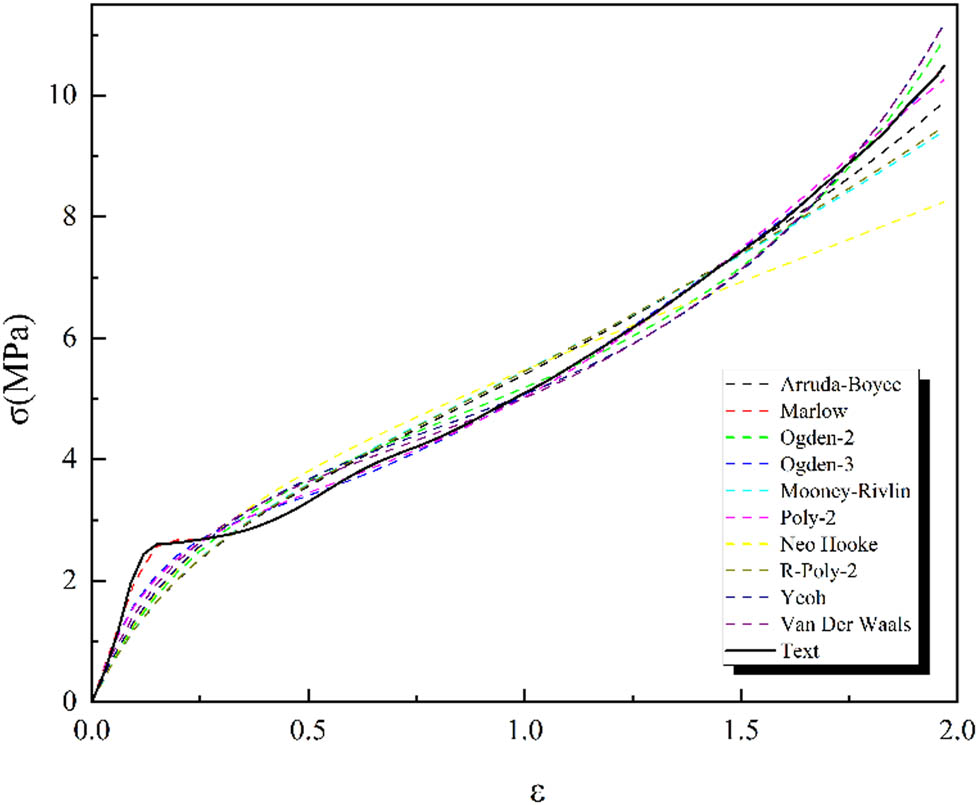
Comparison of test data with commonly used strain function model fits.
Comparing the fitting results, it is found that the Marlow strain potential energy function most accurately describes the stress–strain relationship of the film. The experimental data were also fitted to the Marlow model and the results are shown below.
After observing and analyzing Figures 4–6, it is found that the experimental data show a high degree of consistency with the fitting results. Based on this result, it can be determined that the Marlow strain potential energy function is suitable as an intrinsic model for constructing biaxially oriented tensile simulation experiments.

Fitting of stress–time curves of films with various stretch ratios using the Marlow model. (a) 1.5 × 1.5; (b) 2 × 2; (c) 2.5 × 2.5; and (d) 3 × 3.

Fitting of stress–time curves of films at various sizing temperatures using the Marlow model. (a) 180℃; (b) 190℃; (c) 200℃; and (d) 210℃.

Fitting of stress–time curves of films at various stretching rates using the Marlow model. (a) 50%; (b) 75%; (c) 100%; and (d) 125%.
3.2 Finite element modeling
In the finite element software, membrane elements were created to model the films, with dimensions identical to those used in the biaxial stretching experiments, namely, 10 cm by 10 cm square films. Definition of the material properties of the film: the density is set to 1.13 g·cm−³, and the hyperelastic material is selected; in the mechanics section, the experimental data are used as the material parameters to define the material to obtain the stress–strain relationship of the film in the biaxially oriented stretching process, and the Poisson’s ratio is set as the default; and the intrinsic model is selected to be the Marlow strain potential energy function. After completing the setting of material properties, the thickness of the film is set by the cross-section management tool, and the cross-section properties are applied to the film model using the cross-section assignment tool. Similarly, the fixture was modeled in the finite element software. Since the fixture acts as a fixation as well as a tensile in the whole experiment, it is defined as a rigid body in the modeling, which reduces the interference of the fixture in the tensile process. It should also be noted that the relationship between the fixture and the material is a binding constraint relationship.
After defining the material properties, the two main components were assembled. The fixture was assembled in the same way as the fixture is placed in the laboratory, and Figure 7 shows the comparison between the laboratory apparatus and the finite element simulation assembly diagram. Subsequently, the model is then meshed for simulation calculations and Figure 8 shows the model meshing.

Comparison of experimental apparatus and finite element simulation diagram. (a) Experimental apparatus; and (b) finite element assembly diagram.

Model meshing: (a) model (clip) meshing, (b) model (film) meshing; and (c) stretching simulation model.
In this study, we mainly use the Mises stress yielding criterion (23).
The contour diagram obtained from the test is shown in Figure 9. According to the calculation results, after biaxially oriented stretching, the stress is the highest in the middle part of the fixture; the strain contour diagram analysis shows that the strain in this region is also the highest. Second, the four corners of the film are also subjected to very high stresses and strains. It is worth noting that the middle part of the film is subjected to less stress and relatively small strain, and the contour diagram is uniform in color, indicating that it is more uniformly stressed. Compared with the experimental results, as shown in Figure 10, the shapes of the stress and strain contour diagrams are similar.

Finite element calculation contour of tests. (a) Stress contour and (b) strain contour.
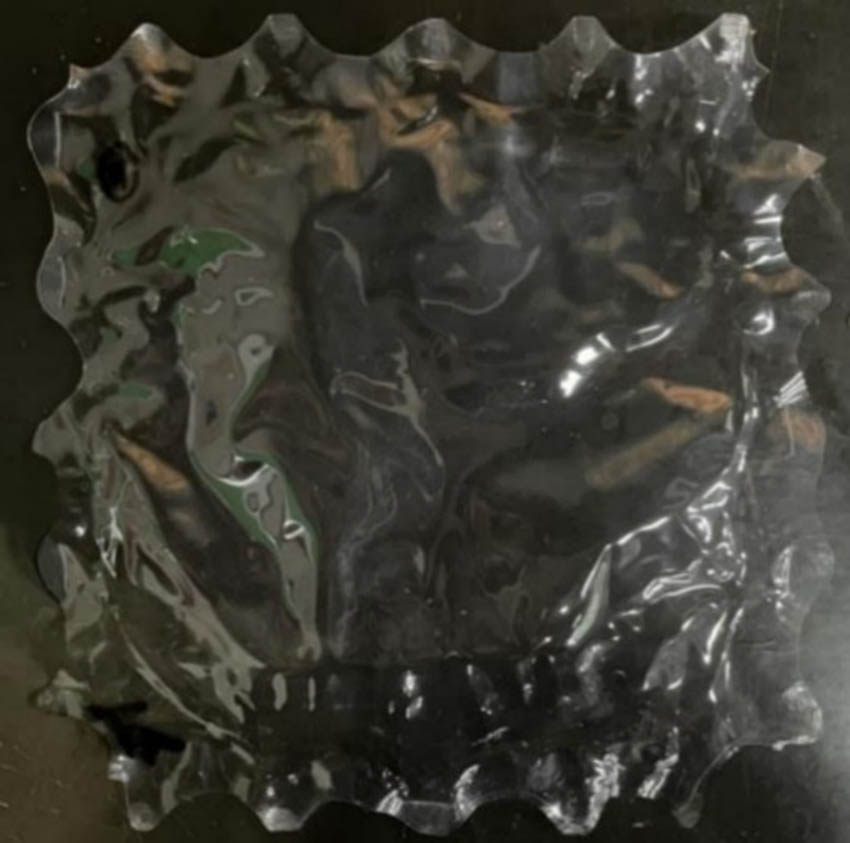
Schematic diagram of biaxial stretching experimental film.
Since the FEA cannot fully simulate the real situation and it is temporarily impossible to define the casting direction of the film, the data of MD direction will be used in this experiment to define the material and the finite element simulation analysis will be carried out. As can be seen from Figure 11, the finite element simulation results are consistent with the experimental results. By comparing the stress–strain contour and experimental data, it can be learned that the Marlow strain potential function accurately describes the mechanical behavior of the nonlinear film and verifies the accuracy of the FEA.

Comparison of experimental and FEA data.
3.3 Analysis of finite element simulation results
After constructing the model, the thickness of the films was varied. During the application of the load, the stretching speed and stretching ratio were adjusted by modifying the displacement and time, respectively.
From Figure 12, it can be seen that the film stress rises with the increase in stretch ratio, and the stress around the fixture increases. When the tensile ratio is small, the stress at the corners is small; when it increases, the stress at the corners increases. Under the large tensile ratio, the film in contact with the fixture is prone to radial stress bars, the middle part of the force is better. The force at the edge is concentrated and constrained by the fixture, and the tensile stress is concentrated at the edge, forming and transmitting radial stress bars to the corners.
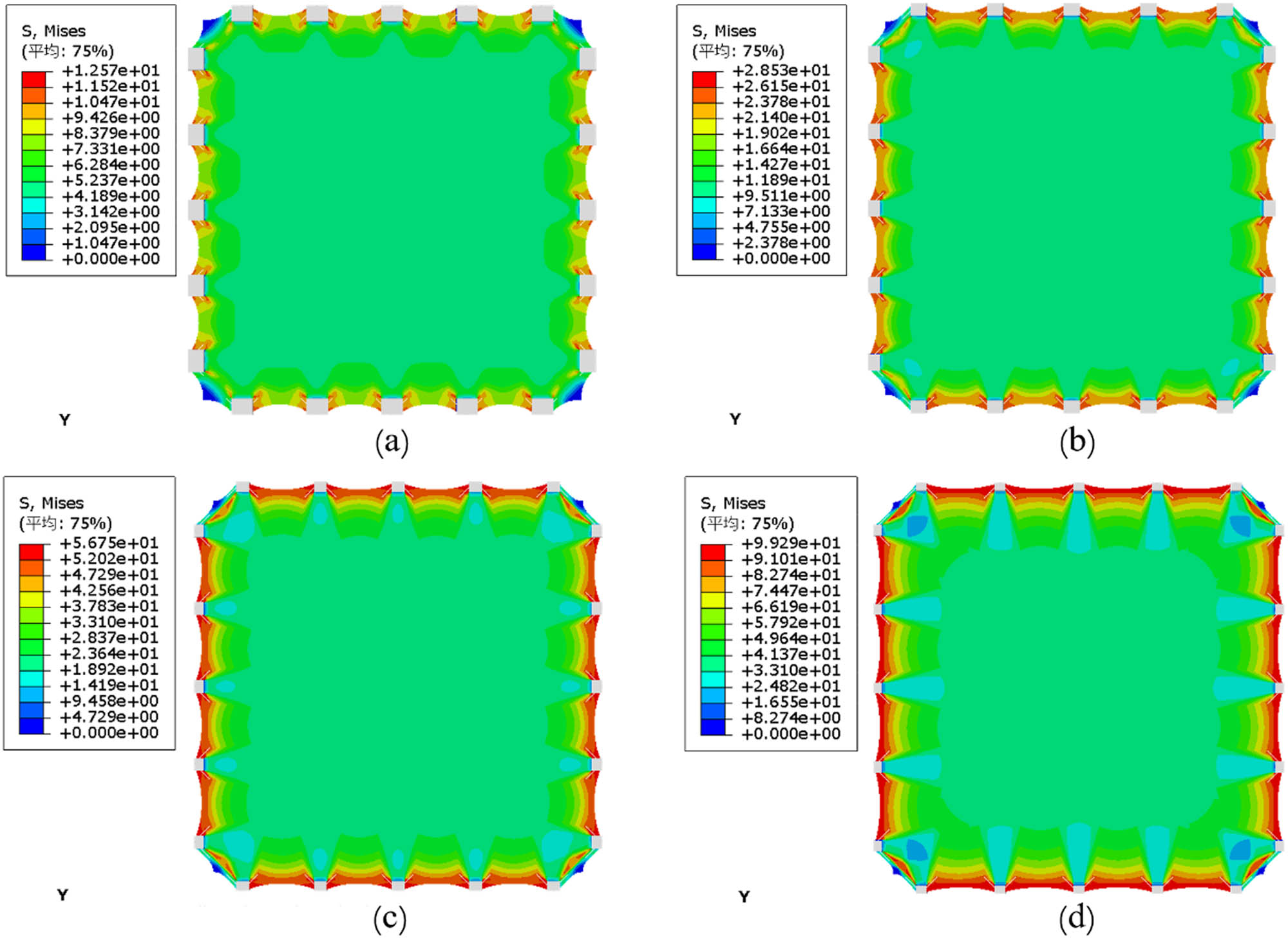
FEA stress contours of films at various stretch ratios. (a) 1.5 × 1.5; (b) 2 × 2; (c) 2.5 × 2.5; and (d) 3 × 3.
From the strain maps of the films at various tensile ratios in Figure 13, it can be found that the tensile ratio increases, the strain increases, and the strain around the fixture is significant. At small tensile ratios, the strain maps are uniform in color but small, indicating incomplete or uneven stretching. When the tensile ratio is increased to 2.5 × 2.5, the strain maps change from a uniform yellow-green color to a patterned yellow color, showing that the strain distribution is gradually uniform. When the tensile ratio reaches 3 × 3, the color of the strain map deepens, and the middle is all yellow, indicating that the stretching is more uniform; the edge does not change much, and combined with the stress map, it is presumed that the edge of the film has been shaped and stabilized at 2.5 × 2.5.

FEA strain contour of films at various tensile ratios. (a) 1.5 × 1.5; (b) 2 × 2; (c) 2.5 × 2.5; and (d) 3 × 3.
Figure 14 shows the stress–strain curves of the FEA of the film under various stretching ratios. From the figure, it can be seen that the PA6 film exhibits obvious elastic-plastic deformation characteristics. In the elastic deformation stage, the stress–strain curves of the films at various tensile ratios are the same, and the length of elastic deformation is similar, indicating that the microstructure of the film remains relatively stable. However, in the plastic deformation stage, the stress and strain of the films gradually increase with the increase in the tensile ratio, indicating a significant change in the stress situation, which is consistent with the conclusion of Figure 2(a).

FEA stress–strain curves of films at various tensile ratios.
According to the stress contour of the films at various sizing temperatures in Figure 15, it can be found that there is a slight change in the stress in its middle part. This is mainly due to the slight difference in thickness as well as various parts of the film during biaxially oriented stretching. Similarly, it can be found that the stress distribution under this condition is the same, which is very uniform in the middle portion, with concentrated stresses all around and large stresses at the four corners.

FEA stress contour of films at various sizing temperatures. (a) 180℃; (b) 190℃; (c) 200℃; and (d) 210℃.
From the FEA strain maps of various sizing temperatures in Figure 16, it can be found that the strain distribution is also basically the same. Combined with the stress contour diagrams, it can be seen that under this condition, the forces and changes in the stretching process are generally the same. The differences in the stress–strain values are mainly caused by small differences in the materials and various thicknesses.

FEA strain contour of films at various sizing temperatures. (a) 180℃; (b) 190℃; (c) 200℃; and (d) 210℃.
Figure 17 shows the stress–strain curves of the FEA of the films at various sizing temperatures. It can be found that the PA6 film exhibits obvious elastic-plastic deformation. The elastic deformation curves at various sizing temperatures coincide with each other, and the elastic deformation lengths are similar, which indicates that the microstructure of the film does not change significantly during the elastic deformation process. However, in the plastic deformation stage, the stress–strain curves showed significant separation with the change in sizing temperature. This phenomenon may be caused by the film thickness or the tensile data collected from various parts of the film, which is consistent with the conclusion of Figure 2(b) in Section 2.

FEA stress–strain curves of films at various sizing temperatures.
As can be seen from the stress contour diagrams of the films at various stretching rates in Figure 18, the color of the contour diagrams of the films gradually becomes lighter as the stretching rate increases. That is, with the increase in the stretching rate, the film in the biaxially oriented stretching process is subjected to greater stress, indicating that the smaller the stretching rate, the greater the stress generated by the biaxially oriented stretching, biaxially oriented stretching processing is more difficult. When the stretching rate reaches 50%, the stress reaches the peak and the stress map shows darker colors. The darker color in the middle of the film compared to the other maps indicates that the stress increases not only at the edges of the film, but also in the middle, but the color is more uniform. The reason for this phenomenon is that the smaller stretching rate makes the stress response of the material more significant and the film is more prone to stress concentration after being stressed. When the tensile rate is changed to 75%, as shown in Figure 18(b), although the stress decreases slightly, the area of the intermediate uniformly stressed region does not reach the size of that at a tensile rate of 50%. However, as the tensile rate increases to 100% and above, the stress contour is essentially the same. This indicates that when the stretching rate is greater than or equal to 100%, the stresses in the biaxially oriented stretching process of the film are the same.

FEA stress contour of films at various tensile rates. (a) 50%; (b) 75%; (c) 100%; and (d) 125%.
From Figure 19, the strain contour diagrams of the films at various stretching rates are found to be essentially the same. The main reason is that in the process of defining the material as isotropic, i.e., its mechanical properties are the same in all directions, then the strain response of the material may tend to be the same at various tensile rates. Figure 20 shows the stress–strain curves of the FEA of the films at various tensile rates. It can be found that the PA6 film exhibits obvious elastic-plastic deformation. The elastic deformation curves at various tensile rates overlap, and the elastic deformation lengths are similar, which indicates that there is no obvious change in the microstructure of the film during the elastic deformation process. However, in the plastic deformation stage, the stress–strain curves show obvious separation with the change in tensile rate. This phenomenon may be caused by the thickness of the film or the various tensile data collected from various parts of the film, or it may be related to the fitting error of the experimental data to the strain potential energy function, which is consistent with the conclusion of Figure 2(c).
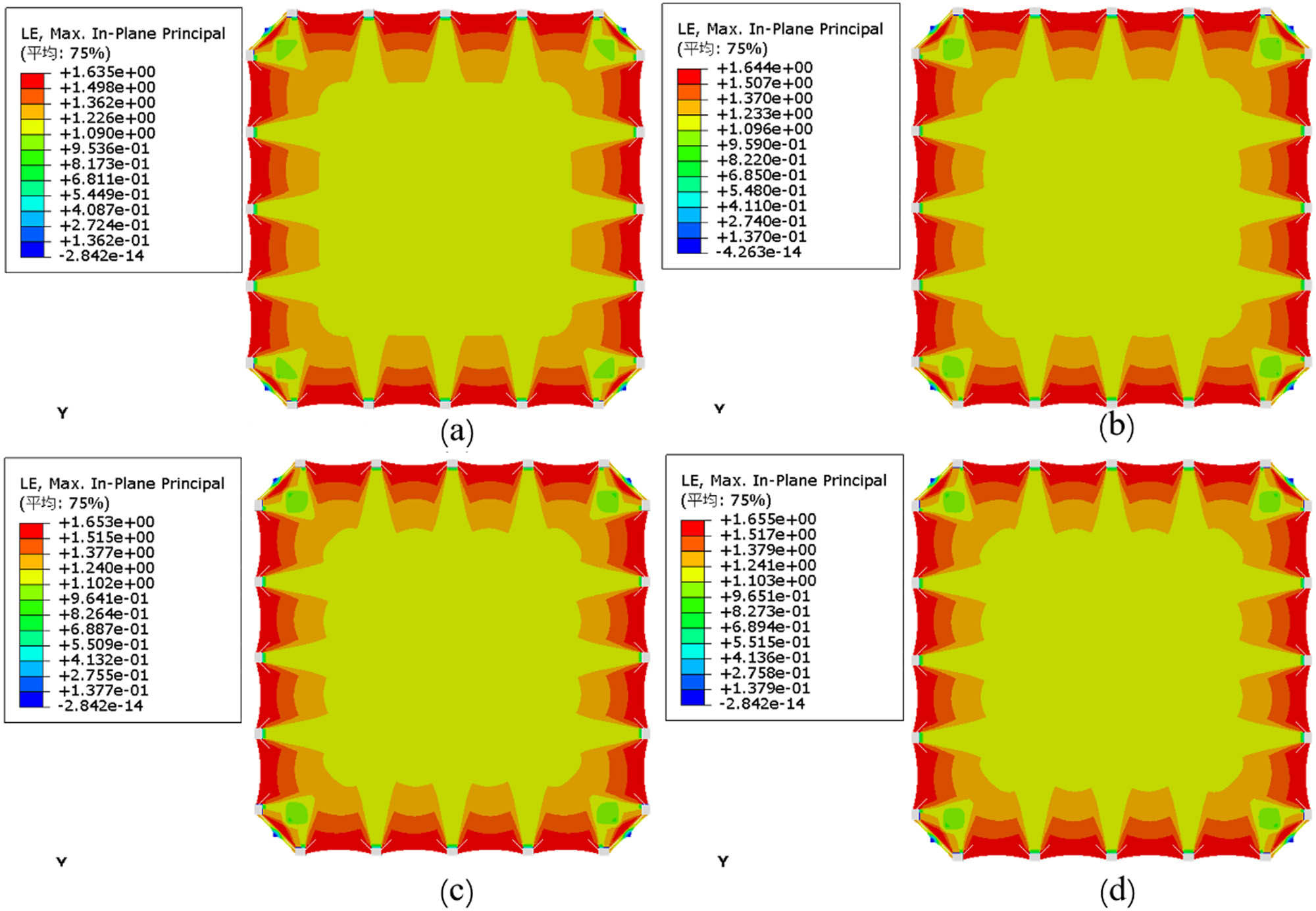
FEA strain contour of films at various tensile rates. (a) 50%; (b) 75%; (c) 100%; and (d) 125%.

FEA stress–strain curves of films at various tensile rates.
4 Conclusion
In this study, PA6 films were first prepared through experimental procedures, followed by biaxial stretching to obtain data on the film’s behavior during stretching, which provided a theoretical basis for subsequent FEA. An in-depth discussion on the finite element simulation analysis of biaxially stretched PA6 films was then conducted. The main conclusions are as follows:
Validation of the biaxial stretching finite element simulation was performed using experimental data. The results showed that the stress–strain curves obtained from FEA closely matched the experimental data. Additionally, the stress–strain contours of the biaxially stretched films were highly similar to the experimentally observed film morphologies.
Analysis of stress contours, strain contours, and stress–strain curves under various biaxial stretching conditions obtained from finite element simulations indicated that the films initially underwent elastic deformation, followed by plastic deformation during biaxial stretching across three various stretching processes. Under varying stretching ratios, as the ratio increased, the distribution of stress and strain during biaxial stretching became more uniform, with both stress and strain increasing as the stretching ratio increased. At various setting temperatures, the stress and strain distribution during biaxial stretching remained essentially the same. Under the same stretching ratio, lower stretching rates resulted in higher internal stress field intensity within the films, making biaxial stretching more challenging. The conclusions drawn from the finite element experiments were consistent with those of the second part of the study.
Acknowledgements
We would like to express our sincere gratitude to all those who contributed to this research. Their support and expertise were invaluable in the completion of this study.
-
Funding information: This work was supported by the National Natural Science Foundation of China (No. 11872179), the Natural Science Foundation of Hunan Province (Nos 2020JJ5136 and 2024JJ7134), the Hunan Provincial Education Department (No. 21B0535), and the Hunan provincial Innovation Foundation for Postgraduate (No. CX20240909).
-
Author contributions: Liao Guangkai conceived the project. Li Yuankang and Liu Jiaxin designed the experiment. Liu Jiaxin conducted experiments and analyzed the data. Liu Yeujun supervised the study. Li Yuankang, Liu Jiaxin, and Li Bowen wrote this article.
-
Conflict of interest: No conflict of interest.
-
Data availability statement: Not applicable.
References
(1) Li B, Liao G, Li Y, Yin H, Cui L, Cao K, et al. Investigation on the correlation between biaxial stretching process and macroscopic properties of BOPA6 film. Polymers. 2024;16:961. 10.3390/polym16070961.Search in Google Scholar PubMed PubMed Central
(2) Barikloo H, Ahmadi E, Ahmadi S. Evaluation of PE/POE/PA6 blends containing silica and clay toward nano composite packaging film. J Food Meas Charact. 2021;15:2297–308. 10.1007/s11694-020-00781-x.Search in Google Scholar
(3) Purkayastha S, Dutta A, Ghosh AK, Saha NC. Processability and performance property correlation for LDPE/PA6-based nanocomposite and its monolayer blown film for packaging application. Bull Mater Sci. 2022;45:47. 10.1007/s12034-021-02627-8.Search in Google Scholar
(4) Navik R, Tan H, Zhang H, Liu Z, Xiang Q, Shi L, et al. Scalable production of polyamide-6/graphene composites with enhanced electromagnetic shielding and thermal conductivity. Chem Eng J. 2023;471:144445. 10.1016/j.cej.2023.144445.Search in Google Scholar
(5) Ren Y, Ren L, Li J, Lv R, Wei L, An D, et al. Enhanced thermal conductivity in polyamide 6 composites based on the compatibilization effect of polyether-grafted graphene. Compos Sci Technol. 2020;199:108340. 10.1016/j.compscitech.2020.108340.Search in Google Scholar
(6) Ding S-J, Cui L-N, Liu Y-J. Robust biaxially stretchable polylactic acid films based on the highly oriented chain network and “nano-walls” containing zinc phenylphosphonate and calcium sulfate whisker: Superior mechanical, barrier, and optical properties. e-Polymers. 2024;24:0032. 10.1515/epoly-2024-0032.Search in Google Scholar
(7) Wada S, Zhang R, Mannava SR, Vasudevan VK, Qian D. Simulation-based prediction of cyclic failure in rubbery materials using nonlinear space-time finite element method coupled with continuum damage mechanics. Finite Elem Anal Des. 2018;138:21–30. 10.1016/j.finel.2017.10.003.Search in Google Scholar
(8) Rueda-Ruiz M, Herráez M, Sket F, Gálvez F, González C, Molina-Aldareguia JM. Study of the effect of strain rate on the in-plane shear and transverse compression response of a composite ply using computational micromechanics. Compos Part A: Appl Sci Manuf. 2023;168:107482. 10.1016/j.compositesa.2023.107482.Search in Google Scholar
(9) Feng W, Yurong M, Yaqiong J, Dan L, Haifei L. Published. Application of ansys finite element analysis in teaching of mechanics of materials. Proc. E3S Web of Conferences 198:01049: EDP Sciences; 2020.10.1051/e3sconf/202019801049Search in Google Scholar
(10) Lu W, Yang Y, Ding M. Study of influence of geometric parameters of hierarchically porous membranes on water flux by using finite element simulation method. J Jilin Univ. 2024;62:721–7. 10.13413/j.cnki.jdxblxb.2023485.Search in Google Scholar
(11) Ban J, Zhao Z, Han Y, Zhou Z, Wang F, Geng J. Fatigue life analysis of polyimide film in afterburner fuel distributor. Environ Technol. 2024;42:140–6. 10.3969/j.issn.1004-7204.2024.01.028.Search in Google Scholar
(12) QiLin H, MaHui X, WenTao S, YongJian F. Design and simulation date analysis of new MEMS capacitor thin film vacuum meter. Instrum Tech Sens. 2023;60:117–21. 10.3969/j.issn.1002-1841.2023.12.021.Search in Google Scholar
(13) Mu Y, Hang L, Zhao G, Wang X, Zhou Y, Cheng Z. Modeling and simulation for the investigation of polymer film casting process using finite element method. Math Comput Simul. 2020;169:88–102. 10.1016/j.matcom.2019.09.012.Search in Google Scholar
(14) XinTu L. The preparation and functionalization study of toughened biaxially stretched polyamide 6 films. Ph.D. dissertation. Hunan University of Technology; 2022.Search in Google Scholar
(15) Liu J, Liao G, Xie Z, Li B, Cui L, Liu Y. Investigation on the rheological behavior of PA6 film during biaxial stretching. Mater Today Commun. 2024;38:107616. 10.1016/j.mtcomm.2023.107616.Search in Google Scholar
(16) Glaesener RN, Bastek J-H, Gonon F, Kannan V, Telgen B, Spöttling B, et al. Viscoelastic truss metamaterials as time-dependent generalized continua. J Mech Phys Solids. 2021;156:104569. 10.1016/j.jmps.2021.104569.Search in Google Scholar
(17) Kim H-G. A comparative study of hyperelastic and hypoelastic material models with constant elastic moduli for large deformation problems. Acta Mech. 2016;227:1351–62. 10.1007/s00707-015-1554-5.Search in Google Scholar
(18) Xiao Y, Zhang Z, Wang J. Granular hyperelasticity with inherent and stress-induced anisotropy. Acta Geotech. 2020;15:671–80. 10.1007/s11440-019-00768-z.Search in Google Scholar
(19) QianHua K, GuoZheng K, Qiang X. Implementation of nonlinear constitutive models in ABAQUS. China, Beijin: Science Press; 2019.Search in Google Scholar
(20) GuoLin W, XiaoWei D, MeiLin Z, ShiZhou Y. Study on finite element simulation of tire building. Eng Mech. 2012;29:265–9. 10.6052/j.issn.1000-4750.2010.08.0599.Search in Google Scholar
(21) XiaoFeng S, Ping F, ZhongJun D, DeWei L, MingFei Y. Establishment and simulation analysis of tire finite element model based on Abaqus software. Chin Rubber Ind. 2019;66:121–7. 10.12136/j.issn.1000-890X.2019.02.0121.Search in Google Scholar
(22) WeiJun H, ZeJun C. Application of finite element simulation technology in the teaching of mechanical properties of materials. Chin Mod Educ Equip. 2022;25:96–8. 10.13492/j.cnki.cmee.2022.01.031.Search in Google Scholar
(23) Hirmukhe SS, Prasad KE, Singh I. Investigation of pressure sensitive plastic flow in nanoglasses from finite element simulations. Scr Materialia. 2020;180:45–50. 10.1016/j.scriptamat.2020.01.022.Search in Google Scholar
© 2024 the author(s), published by De Gruyter
This work is licensed under the Creative Commons Attribution 4.0 International License.
Articles in the same Issue
- Research Articles
- Flame-retardant thermoelectric responsive coating based on poly(3,4-ethylenedioxythiphene) modified metal–organic frameworks
- Highly stretchable, durable, and reversibly thermochromic wrapped yarns induced by Joule heating: With an emphasis on parametric study of elastane drafts
- Molecular dynamics simulation and experimental study on the mechanical properties of PET nanocomposites filled with CaCO3, SiO2, and POE-g-GMA
- Multifunctional hydrogel based on silk fibroin/thermosensitive polymers supporting implant biomaterials in osteomyelitis
- Marine antifouling coating based on fluorescent-modified poly(ethylene-co-tetrafluoroethylene) resin
- Preparation and application of profiled luminescent polyester fiber with reversible photochromism materials
- Determination of pesticide residue in soil samples by molecularly imprinted solid-phase extraction method
- The die swell eliminating mechanism of hot air assisted 3D printing of GF/PP and its influence on the product performance
- Rheological behavior of particle-filled polymer suspensions and its influence on surface structure of the coated electrodes
- The effects of property variation on the dripping behaviour of polymers during UL94 test simulated by particle finite element method
- Experimental evaluation on compression-after-impact behavior of perforated sandwich panel comprised of foam core and glass fiber reinforced epoxy hybrid facesheets
- Synthesis, characterization and evaluation of a pH-responsive molecular imprinted polymer for Matrine as an intelligent drug delivery system
- Twist-related parametric optimization of Joule heating-triggered highly stretchable thermochromic wrapped yarns using technique for order preference by similarity to ideal solution
- Comparative analysis of flow factors and crystallinity in conventional extrusion and gas-assisted extrusion
- Simulation approach to study kinetic heterogeneity of gadolinium catalytic system in the 1,4-cis-polyisoprene production
- Properties of kenaf fiber-reinforced polyamide 6 composites
- Cellulose acetate filter rods tuned by surface engineering modification for typical smoke components adsorption
- A blue fluorescent waterborne polyurethane-based Zn(ii) complex with antibacterial activity
- Experimental investigation on damage mechanism of GFRP laminates embedded with/without steel wire mesh under low-velocity-impact and post-impact tensile loading
- Preparation and application research of composites with low vacuum outgassing and excellent electromagnetic sealing performance
- Assessing the recycling potential of thermosetting polymer waste in high-density polyethylene composites for safety helmet applications
- Mesoscale mechanics investigation of multi-component solid propellant systems
- Preparation of HTV silicone rubber with hydrophobic–uvioresistant composite coating and the aging research
- Experimental investigation on tensile behavior of CFRP bolted joints subjected to hydrothermal aging
- Structure and transition behavior of crosslinked poly(2-(2-methoxyethoxy) ethylmethacrylate-co-(ethyleneglycol) methacrylate) gel film on cellulosic-based flat substrate
- Mechanical properties and thermal stability of high-temperature (cooking temperature)-resistant PP/HDPE/POE composites
- Preparation of itaconic acid-modified epoxy resins and comparative study on the properties of it and epoxy acrylates
- Synthesis and properties of novel degradable polyglycolide-based polyurethanes
- Fatigue life prediction method of carbon fiber-reinforced composites
- Thermal, morphological, and structural characterization of starch-based bio-polymers for melt spinnability
- Robust biaxially stretchable polylactic acid films based on the highly oriented chain network and “nano-walls” containing zinc phenylphosphonate and calcium sulfate whisker: Superior mechanical, barrier, and optical properties
- ARGET ATRP of styrene with low catalyst usage in bio-based solvent γ-valerolactone
- New PMMA-InP/ZnS nanohybrid coatings for improving the performance of c-Si photovoltaic cells
- Impacts of the calcinated clay on structure and gamma-ray shielding capacity of epoxy-based composites
- Preparation of cardanol-based curing agent for underwater drainage pipeline repairs
- Preparation of lightweight PBS foams with high ductility and impact toughness by foam injection molding
- Gamma-ray shielding investigation of nano- and microstructures of SnO on polyester resin composites: Experimental and theoretical study
- Experimental study on impact and flexural behaviors of CFRP/aluminum-honeycomb sandwich panel
- Normal-hexane treatment on PET-based waste fiber depolymerization process
- Effect of tannic acid chelating treatment on thermo-oxidative aging property of natural rubber
- Design, synthesis, and characterization of novel copolymer gel particles for water-plugging applications
- Influence of 1,1′-Azobis(cyclohexanezonitrile) on the thermo-oxidative aging performance of diolefin elastomers
- Characteristics of cellulose nanofibril films prepared by liquid- and gas-phase esterification processes
- Investigation on the biaxial stretching deformation mechanism of PA6 film based on finite element method
- Simultaneous effects of temperature and backbone length on static and dynamic properties of high-density polyethylene-1-butene copolymer melt: Equilibrium molecular dynamics approach
- Research on microscopic structure–activity relationship of AP particle–matrix interface in HTPB propellant
- Three-layered films enable efficient passive radiation cooling of buildings
- Electrospun nanofibers membranes of La(OH)3/PAN as a versatile adsorbent for fluoride remediation: Performance and mechanisms
- Preparation and characterization of biodegradable polyester fibers enhanced with antibacterial and antiviral organic composites
- Preparation of hydrophobic silicone rubber composite insulators and the research of anti-aging performance
- Surface modification of sepiolite and its application in one-component silicone potting adhesive
- Study on hydrophobicity and aging characteristics of epoxy resin modified with nano-MgO
- Optimization of baffle’s height in an asymmetric twin-screw extruder using the response surface model
- Effect of surface treatment of nickel-coated graphite on conductive rubber
- Experimental investigation on low-velocity impact and compression after impact behaviors of GFRP laminates with steel mesh reinforced
- Development and characterization of acetylated and acetylated surface-modified tapioca starches as a carrier material for linalool
- Investigation of the compaction density of electromagnetic moulding of poly(ether-ketone-ketone) polymer powder
- Experimental investigation on low-velocity-impact and post-impact-tension behaviors of GFRP T-joints after hydrothermal aging
- The repeated low-velocity impact response and damage accumulation of shape memory alloy hybrid composite laminates
- Exploring a new method for high-performance TPSiV preparation through innovative Si–H/Pt curing system in VSR/TPU blends
- Large-scale production of highly responsive, stretchable, and conductive wrapped yarns for wearable strain sensors
- Preparation of natural raw rubber and silica/NR composites with low generation heat through aqueous silane flocculation
- Molecular dynamics simulation of the interaction between polybutylene terephthalate and A3 during thermal-oxidative aging
- Crashworthiness of GFRP/aluminum hybrid square tubes under quasi-static compression and single/repeated impact
- Review Articles
- Recent advancements in multinuclear early transition metal catalysts for olefin polymerization through cooperative effects
- Impact of ionic liquids on the thermal properties of polymer composites
- Recent progress in properties and application of antibacterial food packaging materials based on polyvinyl alcohol
- Additive manufacturing (3D printing) technologies for fiber-reinforced polymer composite materials: A review on fabrication methods and process parameters
- Rapid Communication
- Design, synthesis, characterization, and adsorption capacities of novel superabsorbent polymers derived from poly (potato starch xanthate-graft-acrylamide)
- Special Issue: Biodegradable and bio-based polymers: Green approaches (Guest Editors: Kumaran Subramanian, A. Wilson Santhosh Kumar, and Venkatajothi Ramarao)
- Development of smart core–shell nanoparticles-based sensors for diagnostics of salivary alpha-amylase in biomedical and forensics
- Thermoplastic-polymer matrix composite of banana/betel nut husk fiber reinforcement: Physico-mechanical properties evaluation
- Special Issue: Electrospun Functional Materials
- Electrospun polyacrylonitrile/regenerated cellulose/citral nanofibers as active food packagings
Articles in the same Issue
- Research Articles
- Flame-retardant thermoelectric responsive coating based on poly(3,4-ethylenedioxythiphene) modified metal–organic frameworks
- Highly stretchable, durable, and reversibly thermochromic wrapped yarns induced by Joule heating: With an emphasis on parametric study of elastane drafts
- Molecular dynamics simulation and experimental study on the mechanical properties of PET nanocomposites filled with CaCO3, SiO2, and POE-g-GMA
- Multifunctional hydrogel based on silk fibroin/thermosensitive polymers supporting implant biomaterials in osteomyelitis
- Marine antifouling coating based on fluorescent-modified poly(ethylene-co-tetrafluoroethylene) resin
- Preparation and application of profiled luminescent polyester fiber with reversible photochromism materials
- Determination of pesticide residue in soil samples by molecularly imprinted solid-phase extraction method
- The die swell eliminating mechanism of hot air assisted 3D printing of GF/PP and its influence on the product performance
- Rheological behavior of particle-filled polymer suspensions and its influence on surface structure of the coated electrodes
- The effects of property variation on the dripping behaviour of polymers during UL94 test simulated by particle finite element method
- Experimental evaluation on compression-after-impact behavior of perforated sandwich panel comprised of foam core and glass fiber reinforced epoxy hybrid facesheets
- Synthesis, characterization and evaluation of a pH-responsive molecular imprinted polymer for Matrine as an intelligent drug delivery system
- Twist-related parametric optimization of Joule heating-triggered highly stretchable thermochromic wrapped yarns using technique for order preference by similarity to ideal solution
- Comparative analysis of flow factors and crystallinity in conventional extrusion and gas-assisted extrusion
- Simulation approach to study kinetic heterogeneity of gadolinium catalytic system in the 1,4-cis-polyisoprene production
- Properties of kenaf fiber-reinforced polyamide 6 composites
- Cellulose acetate filter rods tuned by surface engineering modification for typical smoke components adsorption
- A blue fluorescent waterborne polyurethane-based Zn(ii) complex with antibacterial activity
- Experimental investigation on damage mechanism of GFRP laminates embedded with/without steel wire mesh under low-velocity-impact and post-impact tensile loading
- Preparation and application research of composites with low vacuum outgassing and excellent electromagnetic sealing performance
- Assessing the recycling potential of thermosetting polymer waste in high-density polyethylene composites for safety helmet applications
- Mesoscale mechanics investigation of multi-component solid propellant systems
- Preparation of HTV silicone rubber with hydrophobic–uvioresistant composite coating and the aging research
- Experimental investigation on tensile behavior of CFRP bolted joints subjected to hydrothermal aging
- Structure and transition behavior of crosslinked poly(2-(2-methoxyethoxy) ethylmethacrylate-co-(ethyleneglycol) methacrylate) gel film on cellulosic-based flat substrate
- Mechanical properties and thermal stability of high-temperature (cooking temperature)-resistant PP/HDPE/POE composites
- Preparation of itaconic acid-modified epoxy resins and comparative study on the properties of it and epoxy acrylates
- Synthesis and properties of novel degradable polyglycolide-based polyurethanes
- Fatigue life prediction method of carbon fiber-reinforced composites
- Thermal, morphological, and structural characterization of starch-based bio-polymers for melt spinnability
- Robust biaxially stretchable polylactic acid films based on the highly oriented chain network and “nano-walls” containing zinc phenylphosphonate and calcium sulfate whisker: Superior mechanical, barrier, and optical properties
- ARGET ATRP of styrene with low catalyst usage in bio-based solvent γ-valerolactone
- New PMMA-InP/ZnS nanohybrid coatings for improving the performance of c-Si photovoltaic cells
- Impacts of the calcinated clay on structure and gamma-ray shielding capacity of epoxy-based composites
- Preparation of cardanol-based curing agent for underwater drainage pipeline repairs
- Preparation of lightweight PBS foams with high ductility and impact toughness by foam injection molding
- Gamma-ray shielding investigation of nano- and microstructures of SnO on polyester resin composites: Experimental and theoretical study
- Experimental study on impact and flexural behaviors of CFRP/aluminum-honeycomb sandwich panel
- Normal-hexane treatment on PET-based waste fiber depolymerization process
- Effect of tannic acid chelating treatment on thermo-oxidative aging property of natural rubber
- Design, synthesis, and characterization of novel copolymer gel particles for water-plugging applications
- Influence of 1,1′-Azobis(cyclohexanezonitrile) on the thermo-oxidative aging performance of diolefin elastomers
- Characteristics of cellulose nanofibril films prepared by liquid- and gas-phase esterification processes
- Investigation on the biaxial stretching deformation mechanism of PA6 film based on finite element method
- Simultaneous effects of temperature and backbone length on static and dynamic properties of high-density polyethylene-1-butene copolymer melt: Equilibrium molecular dynamics approach
- Research on microscopic structure–activity relationship of AP particle–matrix interface in HTPB propellant
- Three-layered films enable efficient passive radiation cooling of buildings
- Electrospun nanofibers membranes of La(OH)3/PAN as a versatile adsorbent for fluoride remediation: Performance and mechanisms
- Preparation and characterization of biodegradable polyester fibers enhanced with antibacterial and antiviral organic composites
- Preparation of hydrophobic silicone rubber composite insulators and the research of anti-aging performance
- Surface modification of sepiolite and its application in one-component silicone potting adhesive
- Study on hydrophobicity and aging characteristics of epoxy resin modified with nano-MgO
- Optimization of baffle’s height in an asymmetric twin-screw extruder using the response surface model
- Effect of surface treatment of nickel-coated graphite on conductive rubber
- Experimental investigation on low-velocity impact and compression after impact behaviors of GFRP laminates with steel mesh reinforced
- Development and characterization of acetylated and acetylated surface-modified tapioca starches as a carrier material for linalool
- Investigation of the compaction density of electromagnetic moulding of poly(ether-ketone-ketone) polymer powder
- Experimental investigation on low-velocity-impact and post-impact-tension behaviors of GFRP T-joints after hydrothermal aging
- The repeated low-velocity impact response and damage accumulation of shape memory alloy hybrid composite laminates
- Exploring a new method for high-performance TPSiV preparation through innovative Si–H/Pt curing system in VSR/TPU blends
- Large-scale production of highly responsive, stretchable, and conductive wrapped yarns for wearable strain sensors
- Preparation of natural raw rubber and silica/NR composites with low generation heat through aqueous silane flocculation
- Molecular dynamics simulation of the interaction between polybutylene terephthalate and A3 during thermal-oxidative aging
- Crashworthiness of GFRP/aluminum hybrid square tubes under quasi-static compression and single/repeated impact
- Review Articles
- Recent advancements in multinuclear early transition metal catalysts for olefin polymerization through cooperative effects
- Impact of ionic liquids on the thermal properties of polymer composites
- Recent progress in properties and application of antibacterial food packaging materials based on polyvinyl alcohol
- Additive manufacturing (3D printing) technologies for fiber-reinforced polymer composite materials: A review on fabrication methods and process parameters
- Rapid Communication
- Design, synthesis, characterization, and adsorption capacities of novel superabsorbent polymers derived from poly (potato starch xanthate-graft-acrylamide)
- Special Issue: Biodegradable and bio-based polymers: Green approaches (Guest Editors: Kumaran Subramanian, A. Wilson Santhosh Kumar, and Venkatajothi Ramarao)
- Development of smart core–shell nanoparticles-based sensors for diagnostics of salivary alpha-amylase in biomedical and forensics
- Thermoplastic-polymer matrix composite of banana/betel nut husk fiber reinforcement: Physico-mechanical properties evaluation
- Special Issue: Electrospun Functional Materials
- Electrospun polyacrylonitrile/regenerated cellulose/citral nanofibers as active food packagings
