
An intelligent error correction model for English grammar with hybrid attention mechanism and RNN algorithm
-
Shan Chen


Abstract
This article proposes an English grammar intelligent error correction model based on the attention mechanism and Recurrent Neural Network (RNN) algorithm. It aims to improve the accuracy and effectiveness of error correction by combining the powerful context-capturing ability of the attention mechanism with the sequential modeling ability of RNN. First, based on the improvement of recurrent neural networks, a bidirectional gated recurrent network is added to form a dual encoder structure. The encoder is responsible for reading and understanding the input text, while the decoder is responsible for generating the corrected text. Second, the attention mechanism is introduced into the decoder to convert the output of the encoder into the attention probability distribution for integration. This allows the model to focus on the relevant input word as it generates each corrected word. The results of the study showed that the model was 2.35% points higher than statistical machine translation–neural machine translation in the CoNLL-2014 test set, and only 1.24 points lower than the human assessment score, almost close to the human assessment level. The model proposed in this study not only created a new way of English grammar error correction based on the attention mechanism and RNN algorithm in theory but also effectively improved the accuracy and efficiency of English grammar error correction in practice. It further provides English learners with higher-quality intelligent error correction tools, which can help them learn and improve their English level more effectively.
1 Introduction
With the continuous development of social economy and information technology, English has become an important text carrier for information exchange [1]. Influenced by the language environment and the complexity of grammatical structure, learners from all occupations will inevitably make grammatical mistakes when using English [2]. English grammar intelligent error correction model plays an important role in the field of natural language processing and is widely used in various text processing and editing software to help improve grammar level as well as text quality and readability [3]. However, the traditional English grammar correction model often ignores contextual information and word order information, resulting in limited accuracy and efficiency of error correction [4]. To improve the accuracy of English expression and avoid the obstacles of foreign communication, this study proposes an English grammar intelligence error correction model that combines an attention mechanism and Recurrent Neural Network (RNN) algorithm. The aim is to improve the accuracy and efficiency of error correction by combining the powerful contextual capture capability of the attention mechanism with the excellent sequence modeling capability of RNN. This model not only broadens the research scope of English grammar correction methods but also enables English learners and text processing software to obtain higher-quality error correction results through this model, thus improving the effect of English learning and text processing. The error correction model based on the attention mechanism and RNN algorithm not only has a profound impact on the field of English grammar correction but also has a positive impact on other natural language processing tasks.
The research content includes five parts. The first part is the introduction, which describes the importance of the English grammar correction model to people’s language communication and text learning under the background of rapid development of information technology. The second part is a literature review, the realization of the English grammar correction model and deep learning algorithm in various fields, and the research status of many scholars on the English grammar correction model. The third part is the study of the English grammar intelligent error correction model based on the mixed attention mechanism and RNN algorithm. The first section is the study of English grammar correction framework based on converters, the second section is the study of encoder model structure based on RNN, and the third section is the study of decoder model structure based on attention mechanism. In the fourth part, the proposed English grammar error correction model is tested and analyzed. The fifth part is the summary and prospect of the research methods and results.
2 Related works
With the continuous development of network information technology, deep learning technology with RNN or attention mechanism as the core has been applied in many research fields and has attracted wide attention in the field of natural language processing. Zhang et al. proposed a hybrid generative model based on RNNs and generative adversarial networks. The model learned the two-dimensional morphological characteristics and spatial relationships of pores through two-dimensional slices and restored the complete three-dimensional structure layer by layer. The research results showed that the model exhibited accuracy, diversity, and stability in reconstruction experiments of homogeneous and heterogeneous porous media and fractured cores, and accurately retained statistical features, morphological features, and long-distance connectivity based on 2D input images [5]. Wu and Li proposed a new neural symbolic reasoning method, RNNCTP, which consisted of a relational selector and a predictor, and refiltered the knowledge selection of the conditional theorem prover. After efficient interpretability training, the entire model dynamically generated the knowledge required for the inference of the predictor. The research results showed that this method was competitive with traditional methods in link prediction tasks and was more applicable than CTP on some data sets [6]. Shahkarami et al. proposed a new network architecture that consisted of convolutional neural network encoders and one-way many-to-one vanilla RNNS working together to capture one set of channel damages while compensating for the shortcomings of the other set of channels. The results showed that the hybrid model achieved the lowest error probability in both receiver configurations, and the complexity was reduced by more than 50% [7]. Zhang et al. proposed a parallel non-Cartesian convolutional RNN approach for the reconstruction of dynamic parallel MR Data from under-sampled non-Cartesian abdomens. This method used redundant information in the space and time domain to achieve high data fidelity reconstruction of non-Cartesian parallel MR Data. The research results showed that the performance of the method in different acceleration rates, motion modes, and imaging applications was significantly improved [8]. Gao et al. proposed a wood-node defect recognition model of SE-ResNet18, which combined convolutional neural networks, attention mechanisms, and transfer learning. The model also effectively reduced the parameters of the fully connected layer by replacing the fully connected layer with the global average pooling layer. The research results showed that the accuracy of the model in the test set was as high as 98.85%, which provided a new and effective method for non-destructive testing of wood [9].
Combining the advantages of attention mechanism and RNN to intelligently correct English grammar errors has opened a new perspective for the development of natural language processing technology, and many scholars have studied it. Ranalli and Yamashita evaluated Grammarly’s automated written error correction feedback tool, which was based on complex error correction techniques and had the potential to discover and correct common errors in second languages. The research results indicated that the common types of errors in this model in a second language were ten times higher than those in the same student text corpus, which had practical significance for using written feedback tools in a second language environment [10]. Trappey et al. developed an intelligent summarization method that integrated natural language processing, text mining, and machine learning. The method used text analysis to automatically extract the basic specifications from it, and the K-means algorithm grouped the sentences for each specification. Research results showed that this system helped manufacturers improve complex product designs and improved cost estimation and quotation competitiveness [11]. Makwana et al. measured emotional intelligence using self-reported and performance tests and biases against various out-groups. The research highlighted the importance of emotional intelligence in interpersonal relationships, the key role of emotions in out-of-group bias, and the relationship between emotional intelligence and out-of-group bias. Results showed that those with stronger performance-based emotion management skills showed lower general racial prejudice and more positive attitudes toward immigrants and refugees [12]. Zhou and Liu proposed an English grammar error correction algorithm based on a classification model, analyzed the model architecture and model optimizer of the grammar error correction algorithm, and finally conducted a simulation experiment and analyzed the results. The research results showed that the proposed English grammar error correction algorithm based on the classification model continuously improved its classification accuracy, reduced processing time, saved storage space, and simplified processing flow [13]. Solyman et al. proposed rule-based statistical machine translation and neural machine translation. To overcome the exposure bias problem, a bidirectional regularization term utilizing Kullback–Leibler divergence was introduced into the training target to improve the consistency between right-to-left and left-to-right models. The results showed that compared with the existing Arab GEC system, the proposed model obtained the best F1 score [14]. The reference comparison table is shown in Table 1.
Comparison of references
| Author | Method proposed | Method description | Research results |
|---|---|---|---|
| Wu and Li | Neural symbolic reasoning method, RNNCTP | Consists of a relational selector and a predictor, and re-filters the knowledge selection of the conditional theorem prover | Competitive with traditional methods in link prediction tasks, and more applicable than CTP on some data sets [6] |
| Shahkarami et al. | New network architecture | Consists of convolutional neural network encoders and one-way many-to-one vanilla RNNS | Achieves the lowest error probability in both receiver configurations, and the complexity is reduced by more than 50% [7] |
| Zhang et al. | Parallel non-Cartesian convolutional recurrent neural network | Uses redundant information in space and time domain to achieve high data fidelity reconstruction of non-Cartesian parallel MR data | Performance has been significantly improved in different acceleration rates, motion modes, and imaging applications [8] |
| Gao et al. | Wood-node defect recognition model of SE-ResNet18 | Combines convolutional neural networks, attention mechanisms, and transfer learning | The accuracy of the model in the test set is as high as 98.85%, which provides a new and effective method for non-destructive testing of wood [9] |
| Trappey et al. | Intelligent summarization | Natural language processing, text mining, machine learning, K-means algorithm | System improves complex product designs and cost estimation and quotation competitiveness [11] |
| Makwana et al. | Emotional intelligence | Self-reported and performance tests | Those with stronger performance-based emotion management skills show lower general racial prejudice and more positive attitudes toward immigrants and refugees [12] |
| Zhou and Liu | English grammar error correction | Classification model algorithm | The proposed model improves classification accuracy, reduces processing time, saves storage space, and simplifies processing flow [13] |
| Solyman et al. | Rule-based statistical machine translation and neural machine translation | Bidirectional regularization term utilizing Kullback–Leibler divergence | The proposed model obtains the best F1 score compared to the existing Arab GEC system [14] |
In summary, with the development of deep learning technology and the continuous enrichment of training data, the English grammar intelligent error correction model integrating attention mechanism and RNN has significant application effects in various fields. Aiming at the problem of intelligent error correction in English grammar, this research method shows remarkable innovation compared with the traditional model. In this model, an attention mechanism is introduced to improve the ability of context capture, and RNN is used to optimize the processing of word order so that the accuracy and efficiency of the model are significantly improved compared with the traditional methods. However, the model still has room for improvement in dealing with advanced and complex grammatical structures. However, the model proposed in this study is a great progress in the field of English grammar intelligent error correction and provides a new direction for further research. By further optimizing the combination of attention mechanism and RNN algorithm, as well as the processing of advanced and complex grammatical structures, the model will be pushed forward to higher accuracy and wider application. It is expected to promote the further development of the field of English grammar correction and provide more efficient learning tools for English learners.
3 English grammar error correction model construction
3.1 Transformer-based English grammar error correction framework
Intelligent English grammar error correction refers to the automatically corrected grammatical errors that occur in English texts using computer programs. The mainstream approach is to transform the process of grammar error correction into the translation process according to the principle of machine translation, i.e., to re-translate the grammatically problematic sentences into correct ones through an algorithmic model [15,16]. Based on this, the study takes the Transformer model, which is more effective in machine translation, as the base model of the correction system, and achieves the correction of incorrect grammar in the text by improving the encoder and decoder. Figure 1 shows its overall flow chart.

Flow chart of grammar error correction model.
In Figure 1, the sentences need to be pre-processed and vectorized before text syntax error correction. The preprocessing process uses data augmentation methods to add tags to the sentences. Vectorization, on the other hand, uses the ALBERT algorithm to obtain information about the lexical and semantic aspects of the sentence [17,18]. Then, the Transformer model corrects errors and generates a set of candidate sentences. Finally, the correct results are filtered and output by Beam search [19]. In the English text preprocessing stage, this study uses a fluency-based data augmentation method [20,21]. The expression for calculating fluency is shown in equation (1).
In equation (1),
The candidate sentences obtained from the above operations were augmented with three corpora, ICNALE, NUCLE, and CLEC, respectively. The sentences are then fed into the Transformer model using the dynamic word vector representation of the ALBERT model trained by the NUCLE corpus. In Figure 2, the model includes an encoder and a decoder, and this study focuses on improving the encoder and decoder parts.
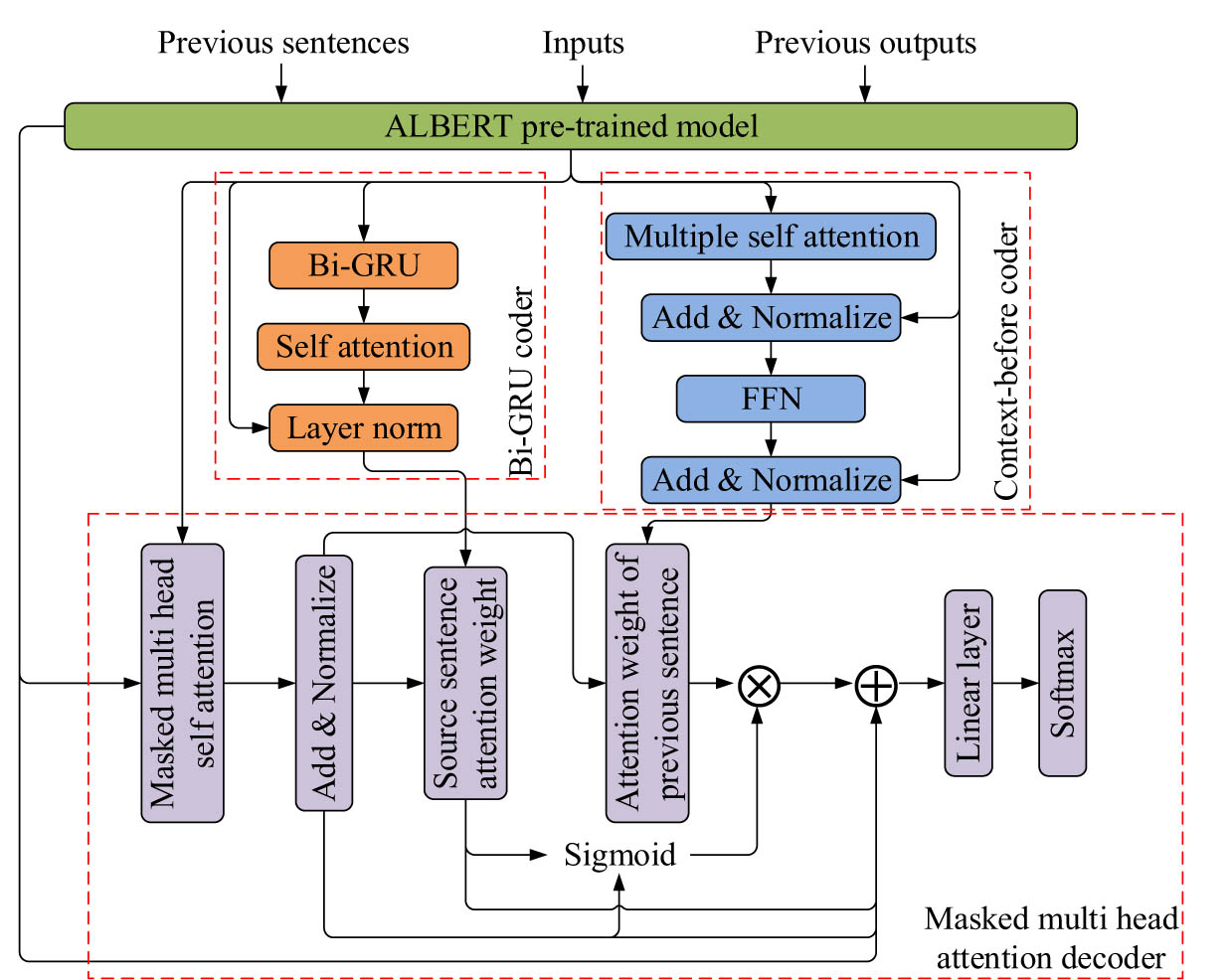
Improved Transformer model structure.
3.2 RNN-based encoder model architecture
A correct utterance expression not only requires accurate wording but also considers the logical relationships between utterances and the phrasing environment. Traditional encoders can only focus on the internal connections of individual sentences and cannot extract the information between sentences, which can affect the effectiveness of the application of grammar error correction models. Inspired by the auxiliary encoder proposed by Mohammad et al. [22], the study considers adding another RNN encoder to the encoding module of the Transformer model for the learning ability of the encoding module on the semantic relations between sentences. RNNs are more fundamental algorithmic models in deep learning algorithms, and their structure contains feedback connections that allow them to be cyclically passed through the network and retain unit states for processing and memorization of time sequences [23,24]. Sentences in natural language can be viewed as sequences of words formed in temporal order, so RNNs are commonly used in machine translation, speech recognition, etc. RNN includes one input, one output, and one hidden layer [25].
The RNN can transform the sequence
The earlier the sequence elements are input during the update process, the smaller their occupied weights are, and they exhibit temporal correlation. However, for long sequence input, the RNN model is prone to gradient disappearance and gradient explosion. When applied to the English grammar error correction model, it shows that the longer the sentence length is, the less information is retained and the worse the actual effect of the model is. The RNN-based Gated Recurrent Units (GRU) can solve this problem [26,27], and its structure is shown in Figure 3.
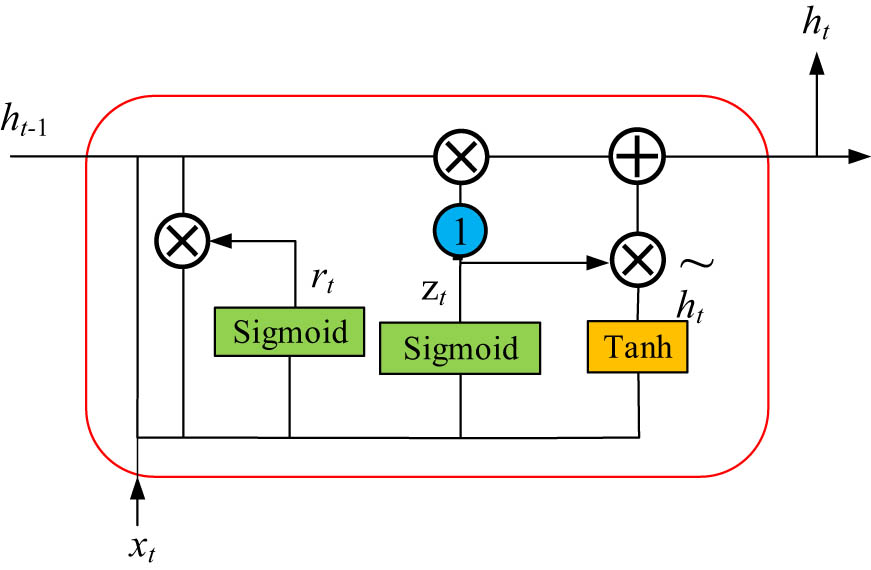
Structure of the gating cycle unit.
In Figure 3, according to the hidden state
The input information at
Since the hidden layer of the GRU model can only be passed in one direction, grammar error correction is the process of linking the preceding and following text information to determine whether the vocabulary is correct at that position. Therefore, a hidden layer in the opposite direction is added to the GRU structure to form a Bidirectional Gated Recurrent Unit (Bi-GRU); i.e., the hidden layers learn the preceding and following text information respectively [28]. The structure is shown in Figure 4.
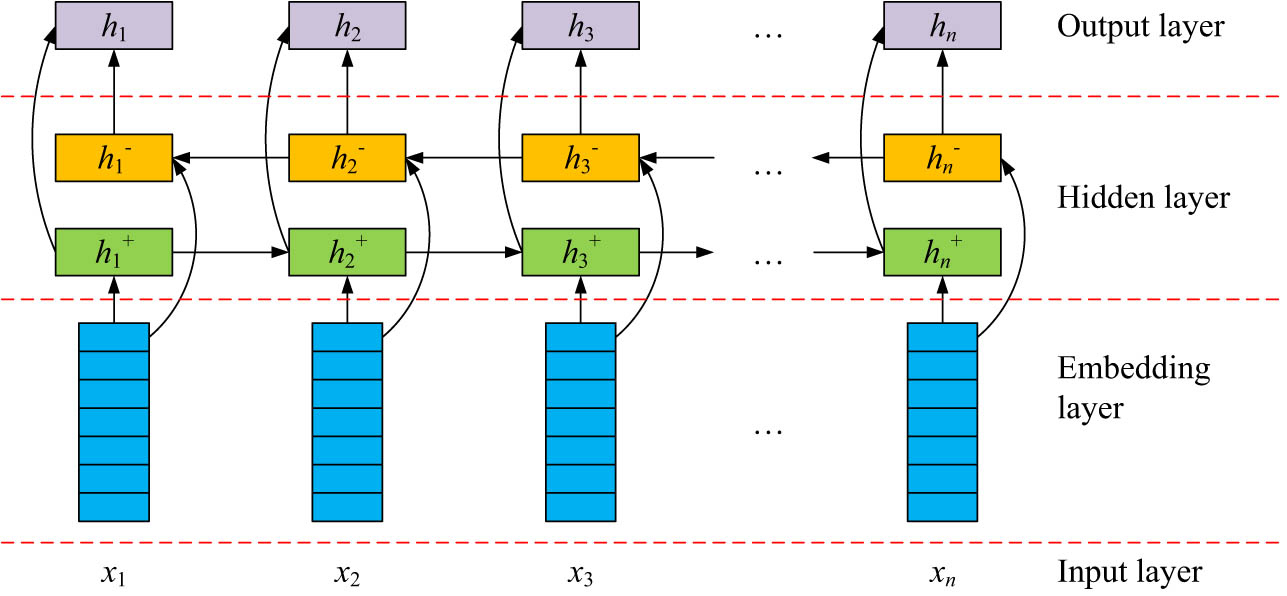
Diagram of Bi-GRU bi-directional operation.
In Figure 4,
If Bi-GRU has
where U and
In equation (6),
3.3 Decoder model architecture based on attention mechanism
The decoder can decode the result obtained by the encoder to obtain the corresponding sentence. Traditional decoders can only decode by semantic vectors and each word in the utterance has the same impact on the output at the same moment. This would result in the output at each moment not corresponding to the input content that is more associated with it, thus losing some information in the decoding stage. To change this situation, the study introduces an attention mechanism in the decoder that can focus on the words it decodes at each step of the decoding process, depending on the different components of the sentence. The algorithmic structure of the attention mechanism is shown below [29,30].
Specifically, to focus the attention on the decoder’s hidden state
To obtain more accurate results, the study uses a masked multi-head attention mechanism to focus and capture different information comprehensively. The multi-head attention mechanism combines the query weight matrix
In equation (10),
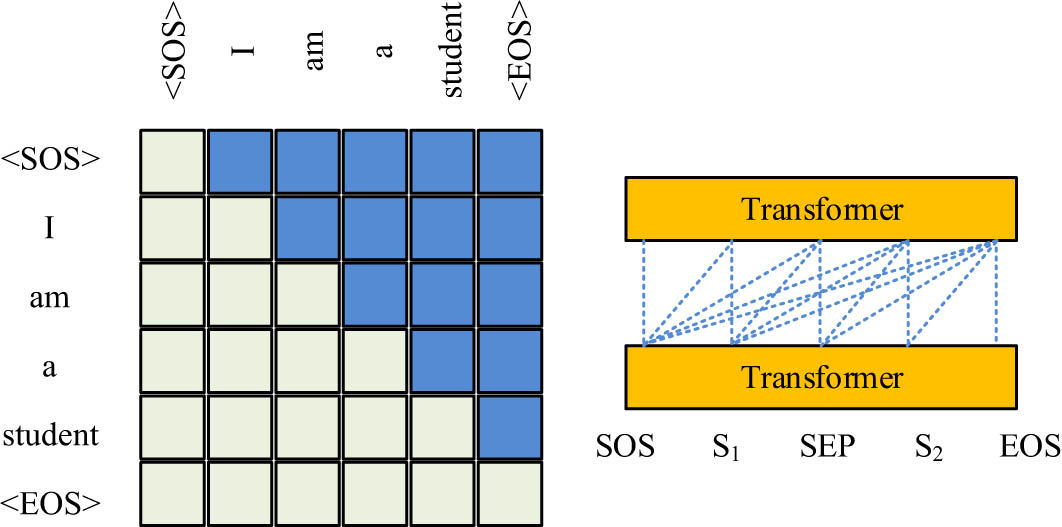
Casual masking process.
According to the previous Transformer model structure, it is known that a gating structure is set up after the residual concatenation and layer normalization of the results of the output of the masked multi-head attention mechanism. This structure is used to integrate the attention weights obtained by the two encoders. Assuming that the attention weights obtained by the Bi-GRU encoder are
In equation (11),
4 Performance evaluation of English grammar error correction model
To verify the effectiveness of the model, this study used three corpora, ICNALE, NUCLE, and partially CLEC, and trained the model using the CoNLL-2013 test set and JFLEG Dev set as validation sets. Then, the model was tested using the CoNLL-2014 test set, JFLEG test set, and partially untrained CLEC data set. The encoder includes a three-layer Bi GRU and a six-layer Transformer encoder, with a six-layer shielded multi-head attention layer set on the decoder side. The other related parameters are set in Table 2.
Model parameter settings
| Parameter type | Parameter settings | Parameter type | Parameter settings |
|---|---|---|---|
| Word vector dimension | 256 | Dropout of activation function | 0.1 |
| Model for generating word vectors | ALBERT | Ir | 0.01 |
| Dictionary size | 30K | Parameter optimization algorithm | Adam |
| Number of Transformer encoder hidden units | 512 | batch_size | 20 |
| Number of Bi-GRU hidden units | 256 | Epoch | 40 |
| Dropout of Bi-GRU | 0.2 | Maximum sentence length | 50 |
| Heads of multiple attention | 6 | Dynamic bundle search probability threshold | 0.90–0.99 |
| Number of neurons in feedforward neural network | 2,048 | Length penalty parameter | 0.6 |
| Activation function | Relu | — | — |
To ensure that the performance of the model is in an optimal state when tested, the experiments first screened the probability thresholds of the cluster search that affect the model greatly. The three metrics of accuracy, recall, and F1 score were tested on the training set, and the appropriate probability threshold was selected according to the F1 score shown in Figure 6.
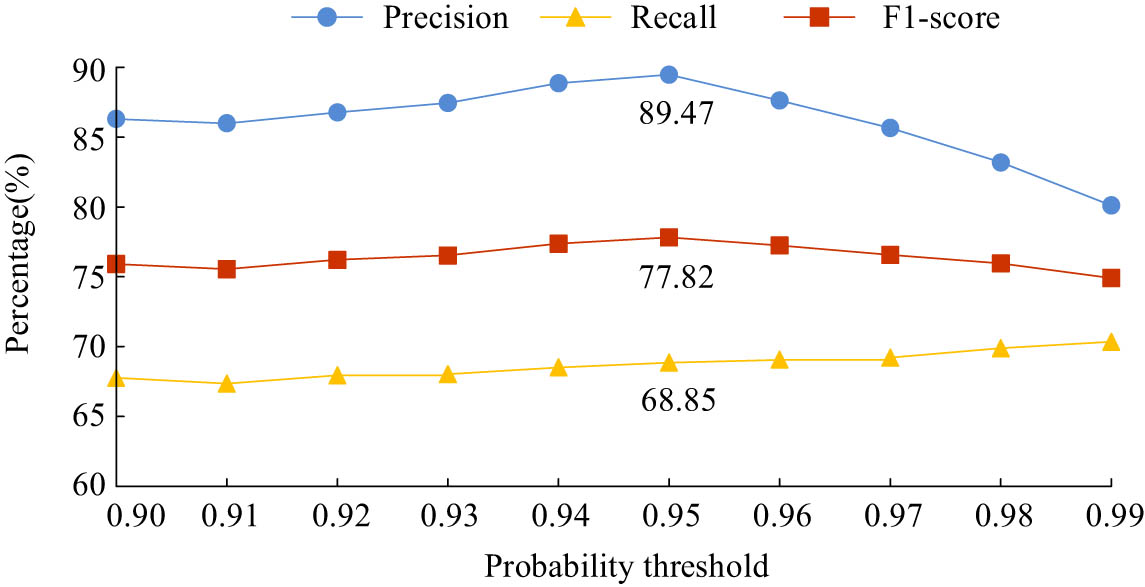
Evaluation index data of the model under different probability thresholds.
Figure 6 demonstrates that the model achieves its highest accuracy rate and F1 score of 89.47 and 77.82%, respectively, when the probability threshold is set at 0.95. This indicates optimal performance, with a high accuracy rate and more retained candidate results. Therefore, the probability threshold is established at 0.95. The results were further evaluated based on precision rate, recall rate, and F0.5 score using the CoNLL-2014 Test Set test, and compared to previously designed models such as Nested-GRU, MLConv (4 ens.)-EO, and SMT-NMT. Figure 7 illustrates the comparison results.
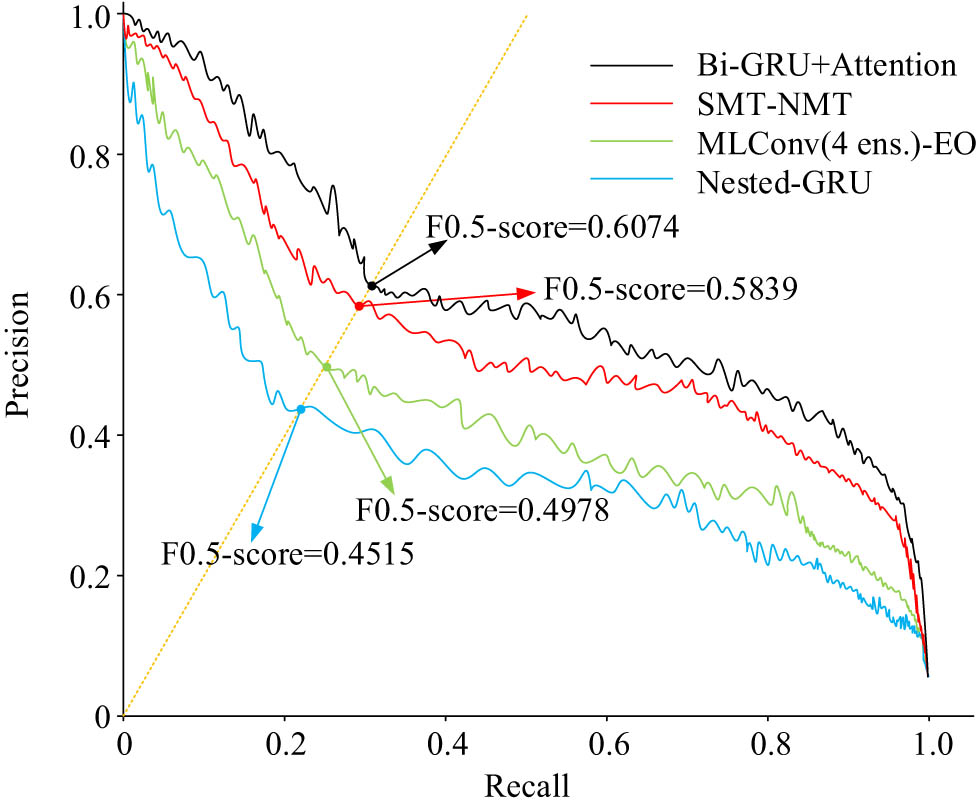
Plot of F0.5 scores of the model in CoNLL-2014 Test Set.
The test results showed that the Bi-GRU + Attention model proposed in this study had an accuracy of 71.28%, a recall of 38.16%, and an F0.5 of 60.74%. The F0.5 of the Nested-GRU, MLConv(4 ens.)-EO, and SMT-NMT models scores were 45.15, 49.78, and 58.39%, respectively. Comparing the curves in Figure 7 with the experimental data, the Bi-GRU + Attention model has made greater progress in grammar error correction. Among them, Nested-GRU also used an additional non-public corpus for training, and its F0.5 score was still six percentage points lower. The model also outperformed the more advanced SMT-NMT hybrid model by 2.35 percentage points in the F0.5 score compared to the more advanced SMT-NMT hybrid model. This indicates that the Bi-GRU + Attention model is effective in automatically correcting English grammatical errors. In addition, to evaluate adequacy and fluency, the experiment tested the GLUE value of the model on the JFLEG Test Set, which is a manual measurement used to check the degree of matching between machine error correction results and translation results of professional English users. Figure 8 shows the GLUE scores, and the GLUE value of Human performance is introduced here as a reference.
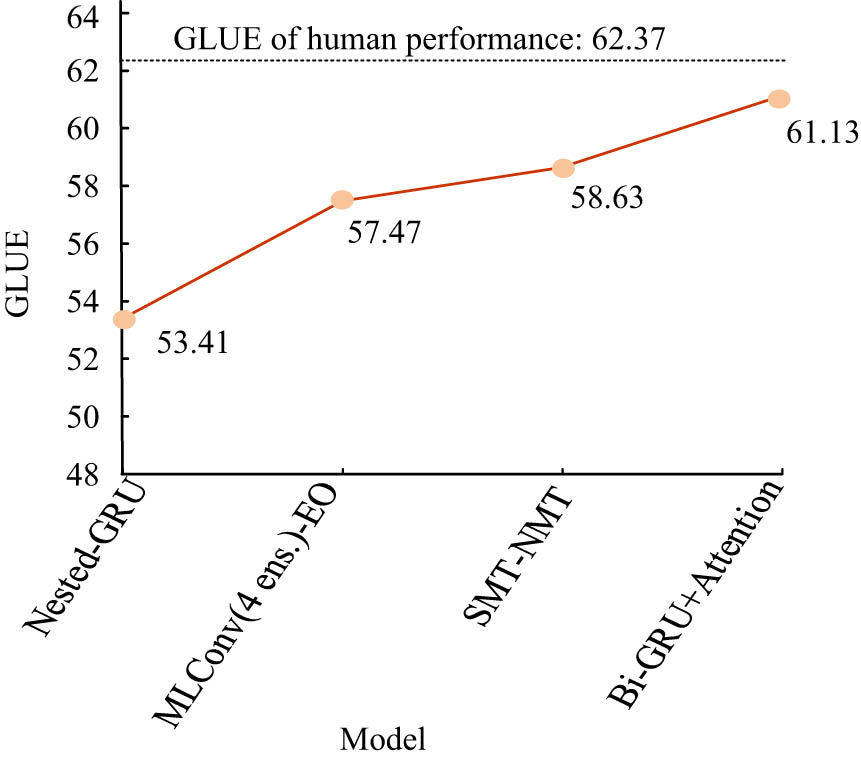
Comparison of GLUE values of models in JFLEG test set.
Comparing the GLUE values of Bi-GRU + Attention, Nested-GRU, MLConv (4 ens.)-EO, and SMT-NMT models, the Bi-GRU + Attention model had the highest GLUE score of 61.13. It was closer to the human assessment score of 62.37, which indicated that the model had better adequacy and fluency and was better for the application of English grammatical error correction. The analysis may be due to the introduction of a Bi-GRU encoder and Attention decoder on top of the Transformer model with powerful feature extraction ability, which enables the machine to extract a wider range of semantic information, thus enhancing the fluency of the utterance. The utility of the model was also explored in this study. The model was randomly selected from the untrained CLEC corpus with 1,000 essay tests of non-English majors under five headings for the fourth- and sixth-grade exams and segmented by 100, 200, 500, 800, and 1,000, and the error correction accuracy rate, recall rate, and F1 score at each stage are shown in Figure 9.
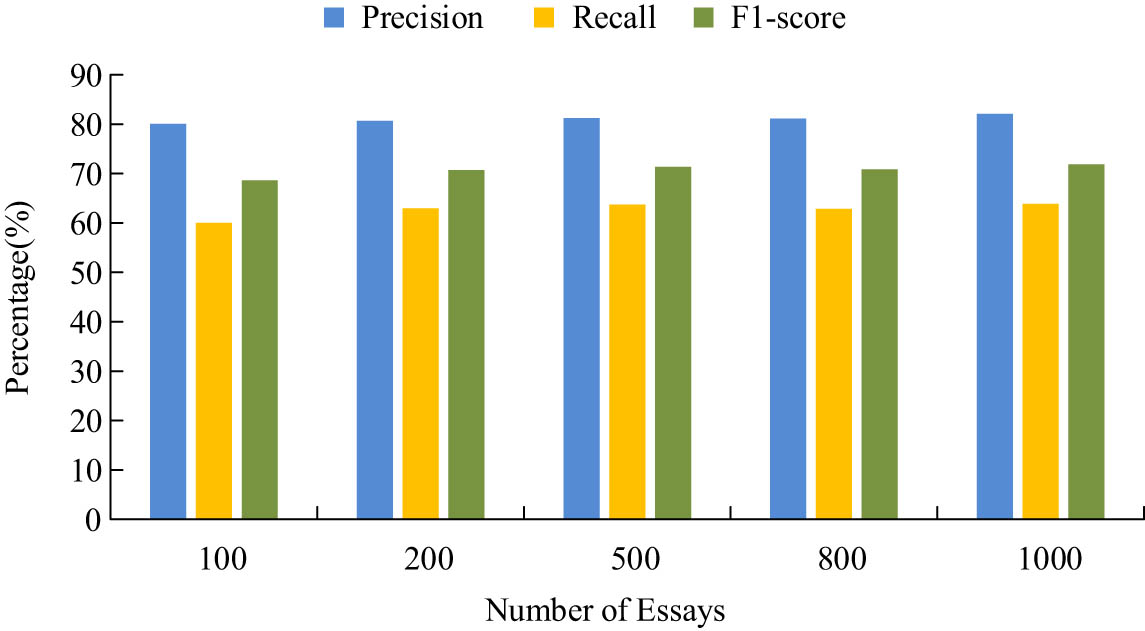
Model measurement at different number of articles.
In Figure 9, although there are small fluctuations in the accuracy rate, recall rate, and F1 score for grammatical error correction for different numbers of essays, the results do not differ much, indicating that the model error correction is less influenced by the number of texts and has better stability. Even in the case of one hundred texts, the model can maintain an 80% accuracy rate, probably because the model adopted a fluency-based data augmentation method and ALBERT-based dynamic word vector representation in the preprocessing stage, which made the model obtain more comprehensive information with less computational resources. In terms of the test results of 1,000 essays, the accuracy, recall, and F1 scores were 82.13, 63.85, and 71.85%, respectively, which were at a high level overall, indicating that the model had good practicality and effectively criticized students’ essays. The statistics of the above types of grammatical errors in English composition according to the CoNLL-2014 classification criteria are shown in Figure 10. The number of errors marked, detected, and corrected was represented by bar graphs, and the accuracy rate, recall rate, and F1 scores detected by the model are represented by line graphs.
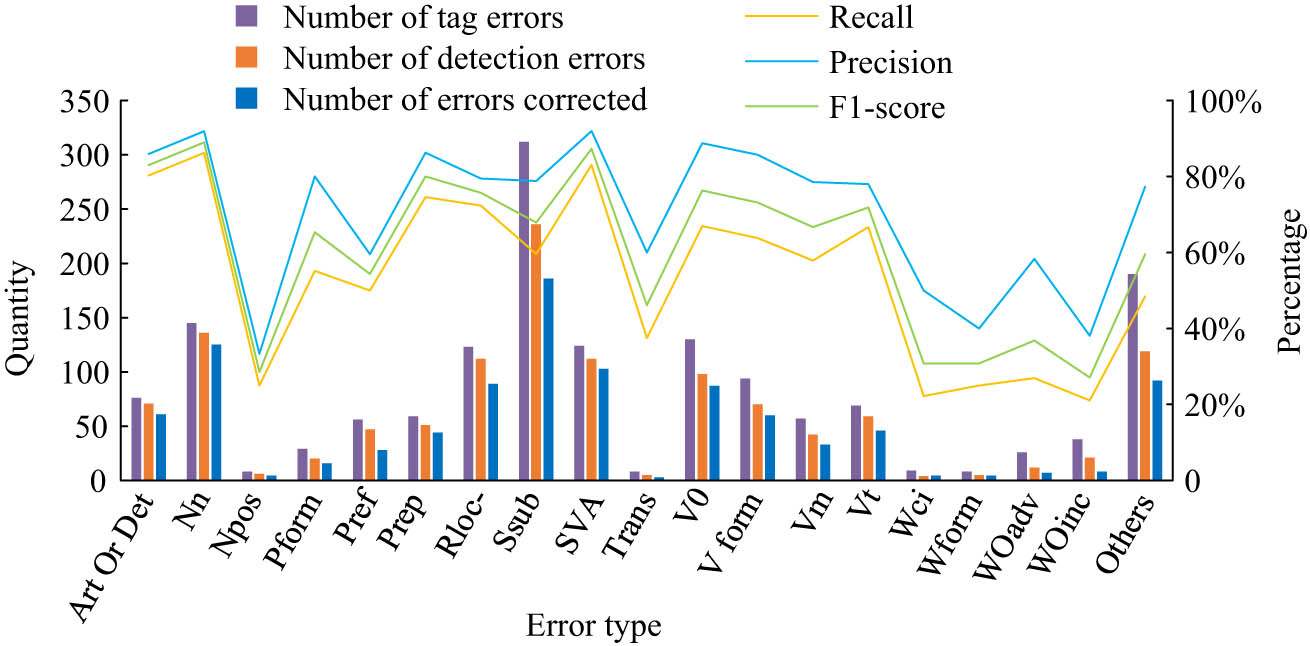
Results of model identification and correction of different grammatical errors.
In Figure 10, the model has a good correction effect for most grammatical error types, especially in correcting errors in the use of coronals and qualifiers, errors in the singular and plural forms of nouns, errors in the form of verbs, errors in the use of prepositions, subject–predicate inconsistency, and missing verbs, with accuracy rates above 80%. The correction effect for the six error types of Npos, Trans, Wci, Wform, WOadv, and WOinc was less effective, and their F1 scores did not exceed 50%. Combined with the corresponding number of grammatical errors in Figure 9, it is speculated that the reason may be that the number of samples for these six error types is small, and the relevant information available for model training is reduced, which reduces the correction effect. Based on the above results, the model was used to score English compositions, and the results were compared with manual scoring to evaluate its practical application. The results are shown in Figure 11, and the model is set to score an upper limit of thirty.
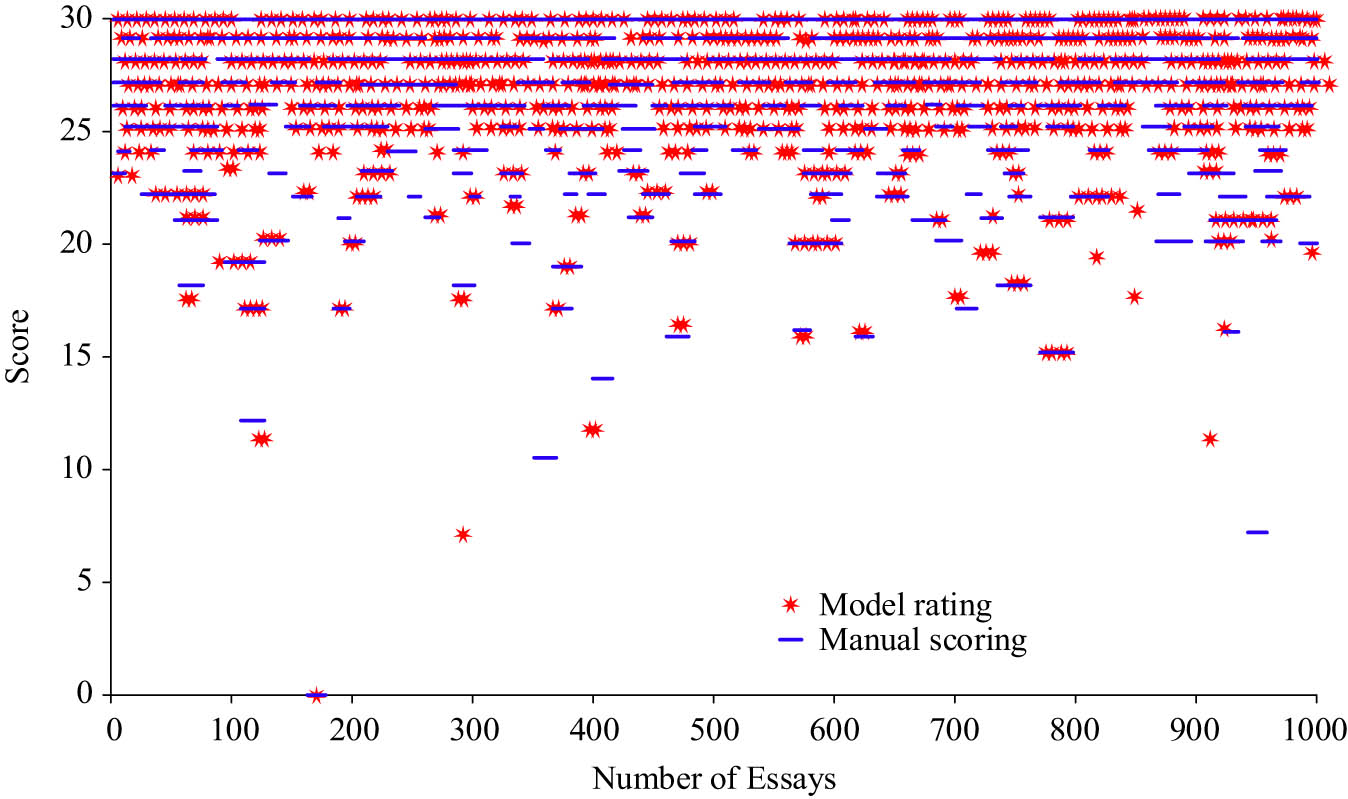
Comparison of model scoring and manual scoring.
The comparison between the model score and the manual score showed a high degree of overlap between the two scores, and the scores were very close. The data also showed that the average score was 26.14 points, and the average score for manual work was 25.66 points, with an error of only 1.9%. This indicated that the model could replace teachers in correcting English compositions within a certain range and has practical application value.
5 Conclusion
In recent years, with the wide use of English in the world, the mastery of English grammar is a challenge for learners of other languages, which makes the demand for intelligent error correction models of English grammar growing day by day. However, the traditional English grammar correction model is often unable to deal with complex grammar errors. To improve the accuracy and efficiency of English grammar correction, an English grammar intelligent error correction model based on mixed attention mechanism and RNN algorithm is proposed. The results showed that the F0.5 score of this model on the CoNLL-2014 test set was 60.74%, which was 2.35 percentage points higher than that of the more advanced SMT-NMT model, showing the advantage of this model in dealing with English grammar errors. On the JFLEG test set, the GLUE score of the model reached 61.13, which was only 1.24 points different from the human evaluation, which proved the ability of the model to process real text. In the CET-4 and CET-6 compositions for non-English majors, the F1 score was as high as 71.85%, and the average English composition score of the model was only 0.48 points different from that of the manual score, which verified the validity and accuracy of the model. The model has achieved remarkable results in improving the accuracy and efficiency of English grammar correction. However, there may still be some limitations in the processing of advanced and complex grammatical structures. In the future, it is still necessary to improve the processing of complex grammatical structures, further improve the accuracy and efficiency of English grammar correction, and provide English learners with higher-quality learning tools.
-
Funding information: The research is supported by Authorized by Hunan Province Office of Education, Research on Teaching Innovation in Railway ESP from the Perspective of the “the Belt and Road” Initiative (NO. ZJGY2021018).
-
Author contributions: All authors contributed to the study conception and design. Material preparation, data collection and analysis were performed by Shan Chen and Yingmei Xiao. The first draft of the manuscript was written by Shan Chen and all authors commented on previous versions of the manuscript. All authors read and approved the final manuscript.
-
Conflict of interest: The authors report there are no competing interests to declare.
-
Data availability statement: The datasets used and/or analysed during the current study are available from the corresponding author on reasonable request.
References
[1] Zhong Y, Yue X. On the correction of errors in English grammar by deep learning. J Intell Syst. 2022;31(1):260–70.10.1515/jisys-2022-0013Search in Google Scholar
[2] Qin M. A study on automatic correction of English grammar errors based on deep learning. J Intell Syst. 2022;31(1):672–80.10.1515/jisys-2022-0052Search in Google Scholar
[3] Nava E, Heshaam F. Grammatical and context-sensitive error correction using a statistical machine translation framework. Softw: Pract Exper. 2012;43(2):187–206.10.1002/spe.2110Search in Google Scholar
[4] Zhao Z, Wang H. MaskGEC: Improving neural grammatical error correction via dynamic masking. Proceedings of the AAAI Conference on Artificial Intelligence. Vol. 34, Issue 1; 2020. p. 1226–33.10.1609/aaai.v34i01.5476Search in Google Scholar
[5] Zhang F, He X, Teng Q, Wu X, Cui J, Dong X. PM-ARNN: 2D-TO-3D reconstruction paradigm for microstructure of porous media via adversarial recurrent neural network. Knowl Syst. 2023;264(15):2–16.10.1016/j.knosys.2023.110333Search in Google Scholar
[6] Wu YH, Li HB. RNNCTPs: A neural symbolic reasoning method using dynamic knowledge partitioning technology. Knowl Syst. 2023;268(23):2–9.10.1016/j.knosys.2023.110481Search in Google Scholar
[7] Shahkarami A, Yousefi M, Jaouen Y. Complexity reduction over Bi-RNN-based nonlinearity mitigation in dual-pol fiber-optic communications via a CRNN-based approach. Optical Fiber Technol. 2022;74(10):2–12.10.1016/j.yofte.2022.103072Search in Google Scholar
[8] Zhang Y, She H, Du YP. Dynamic MRI of the abdomen using parallel non-Cartesian convolutional recurrent neural networks. Magn Reson Med. 2021;86(2):964–73.10.1002/mrm.28774Search in Google Scholar PubMed
[9] Gao M, Wang F, Liu J, Song P, Chen J, Yang H, et al. Estimation of the convolutional neural network with attention mechanism and transfer learning on wood knot defect classification. J Appl Phys. 2022;131(23):2–10.10.1063/5.0087060Search in Google Scholar
[10] Ranalli J, Yamashita T. Automated written corrective feedback: Error-correction performance and timing of delivery. Lang Learn Technol. 2022;26(1):1–25.Search in Google Scholar
[11] Trappey AJC, Chang AC, Trappey CV, Chien JCC. Intelligent RFQ summarization using natural language processing, text mining, and machine learning techniques. J Glob Inf Manag. 2022;30(7):3193–218.10.4018/JGIM.309082Search in Google Scholar
[12] Makwana AP, Dhont K, Sancho EG, Berrocal PF. Are emotionally intelligent people less prejudiced The importance of emotion management skills for outgroup attitudes. J Appl Soc Psychol. 2021;51(6):98–127.10.1111/jasp.12798Search in Google Scholar
[13] Zhou S, Liu W. English grammar error correction algorithm based on classification model. Complexity. 2021;21(2):2–11.10.1155/2021/6687337Search in Google Scholar
[14] Solyman A, Wang Z, Tao Q, Rui Z, Zeinab M, Mohammed EAA. Automatic Arabic Grammatical Error Correction based on Expectation-Maximization routing and target-bidirectional agreement. Knowl Syst. 2022;241(6):2–13.10.1016/j.knosys.2022.108180Search in Google Scholar
[15] Zhan W, Chen Y. Application of machine learning and image target recognition in English learning task. J Intell Fuzzy Syst. 2020;39(4):5499–510.10.3233/JIFS-189032Search in Google Scholar
[16] Wang Y, Xu C, Hu H, Tao C, Wan S, Dras M, et al. Neural rule-execution tracking machine for transformer-based text generation. Adv Neural Inf Process Syst. 2021;34:16938–50.Search in Google Scholar
[17] Xu W, Carpuat M. EDITOR: An edit-based transformer with repositioning for neural machine translation with soft lexical constraints. Trans Assoc Comput Ling. 2021;9:311–28.10.1162/tacl_a_00368Search in Google Scholar
[18] Duran-Karaoz Z, Tavakoli P. Predicting L2 fluency from L1 fluency behavior: The case of L1 Turkish and L2 English speakers. Stud Second Lang Acquis. 2020;42(4):671–95.10.1017/S0272263119000755Search in Google Scholar
[19] Firat O, Cho K, Sankaran B, Vural YFT, Bengio Y. Multi-way, multilingual neural machine translation. Comput Speech Lang. 2017;45:236–52.10.1016/j.csl.2016.10.006Search in Google Scholar
[20] Ning K, Cai M, Xie D, Wu F. An attentive sequence to sequence translator for localizing video clips by natural language. IEEE Trans Multimed. 2020;22(9):2434–43.10.1109/TMM.2019.2957854Search in Google Scholar
[21] Wang D, Su J, Yu H. Feature extraction and analysis of natural language processing for deep learning English language. IEEE Access. 2020;8:46335–45.10.1109/ACCESS.2020.2974101Search in Google Scholar
[22] Mohammad EB, Shahla N, Moloud A, Erik C, Rajendra AU. ABCDM: An Attention-based bidirectional CNN-RNN deep model for sentiment analysis. Future Gener Comput Syst. 2021;115:279–94.10.1016/j.future.2020.08.005Search in Google Scholar
[23] Zhang B, Xiong D, Xie J, Su J. Neural machine translation with GRU-gated attention model. IEEE Trans Neural Netw Learn Syst. 2020;31(11):4688–98.10.1109/TNNLS.2019.2957276Search in Google Scholar PubMed
[24] Nicolson A, Paliwal KK. Masked multi-head self-attention for causal speech enhancement. Speech Commun. 2020;125:80–96.10.1016/j.specom.2020.10.004Search in Google Scholar
[25] Aguiar-Pérez JM, Pérez-Juárez MÁ. An insight of deep learning based demand forecasting in smart grids. Sensors. 2023;23(3):1467.10.3390/s23031467Search in Google Scholar PubMed PubMed Central
[26] Mclellan G. Practitioners respond to Icy Lee’s ‘Teacher written corrective feedback: Less is more’. Lang Teach. 2021;54(1):144–8.10.1017/S026144482000052XSearch in Google Scholar
[27] Jin L, Schwartz LO, Velez FD, Miller T. Depth-bounded statistical PCFG induction as a model of human grammar acquisition. Comput Linguist. 2021;47(1):181–216.10.1162/coli_a_00399Search in Google Scholar
[28] Yang S, Kong X, Wang Q, Li Z, Cheng H, Xu K. Deep multiple auto-encoder with attention mechanism network: A dynamic domain adaptation method for rotary machine fault diagnosis under different working conditions. Knowl Syst. 2022;249(5):2–17.10.1016/j.knosys.2022.108639Search in Google Scholar
[29] Niu D, Yu M, Sun L, Gao T, Wang K. Short-term multi-energy load forecasting for integrated energy systems based on CNN-BiGRU optimized by attention mechanism. Appl Energy. 2022;313(1):2–17.10.1016/j.apenergy.2022.118801Search in Google Scholar
[30] Hui T, Xu YL, Jarhinbek R. Detail texture detection based on Yolov4-tiny combined with attention mechanism and bicubic interpolation. IET Image Process. 2021;15(12):2736–48.10.1049/ipr2.12228Search in Google Scholar
[31] Sagnika S, Mishra BSP, Meher SK. An attention-based CNN-LSTM model for subjectivity detection in opinion-mining. Neural Computing and Applications. 2021;33(24):17425–38.10.1007/s00521-021-06328-5Search in Google Scholar
[32] He Z. English grammar error detection using recurrent neural networks. Sci Program. 2021;21(5):2–8.10.1155/2021/7058723Search in Google Scholar
© 2024 the author(s), published by De Gruyter
This work is licensed under the Creative Commons Attribution 4.0 International License.
Articles in the same Issue
- Research Articles
- A study on intelligent translation of English sentences by a semantic feature extractor
- Detecting surface defects of heritage buildings based on deep learning
- Combining bag of visual words-based features with CNN in image classification
- Online addiction analysis and identification of students by applying gd-LSTM algorithm to educational behaviour data
- Improving multilayer perceptron neural network using two enhanced moth-flame optimizers to forecast iron ore prices
- Sentiment analysis model for cryptocurrency tweets using different deep learning techniques
- Periodic analysis of scenic spot passenger flow based on combination neural network prediction model
- Analysis of short-term wind speed variation, trends and prediction: A case study of Tamil Nadu, India
- Cloud computing-based framework for heart disease classification using quantum machine learning approach
- Research on teaching quality evaluation of higher vocational architecture majors based on enterprise platform with spherical fuzzy MAGDM
- Detection of sickle cell disease using deep neural networks and explainable artificial intelligence
- Interval-valued T-spherical fuzzy extended power aggregation operators and their application in multi-criteria decision-making
- Characterization of neighborhood operators based on neighborhood relationships
- Real-time pose estimation and motion tracking for motion performance using deep learning models
- QoS prediction using EMD-BiLSTM for II-IoT-secure communication systems
- A novel framework for single-valued neutrosophic MADM and applications to English-blended teaching quality evaluation
- An intelligent error correction model for English grammar with hybrid attention mechanism and RNN algorithm
- Prediction mechanism of depression tendency among college students under computer intelligent systems
- Research on grammatical error correction algorithm in English translation via deep learning
- Microblog sentiment analysis method using BTCBMA model in Spark big data environment
- Application and research of English composition tangent model based on unsupervised semantic space
- 1D-CNN: Classification of normal delivery and cesarean section types using cardiotocography time-series signals
- Real-time segmentation of short videos under VR technology in dynamic scenes
- Application of emotion recognition technology in psychological counseling for college students
- Classical music recommendation algorithm on art market audience expansion under deep learning
- A robust segmentation method combined with classification algorithms for field-based diagnosis of maize plant phytosanitary state
- Integration effect of artificial intelligence and traditional animation creation technology
- Artificial intelligence-driven education evaluation and scoring: Comparative exploration of machine learning algorithms
- Intelligent multiple-attributes decision support for classroom teaching quality evaluation in dance aesthetic education based on the GRA and information entropy
- A study on the application of multidimensional feature fusion attention mechanism based on sight detection and emotion recognition in online teaching
- Blockchain-enabled intelligent toll management system
- A multi-weapon detection using ensembled learning
- Deep and hand-crafted features based on Weierstrass elliptic function for MRI brain tumor classification
- Design of geometric flower pattern for clothing based on deep learning and interactive genetic algorithm
- Mathematical media art protection and paper-cut animation design under blockchain technology
- Deep reinforcement learning enhances artistic creativity: The case study of program art students integrating computer deep learning
- Transition from machine intelligence to knowledge intelligence: A multi-agent simulation approach to technology transfer
- Research on the TF–IDF algorithm combined with semantics for automatic extraction of keywords from network news texts
- Enhanced Jaya optimization for improving multilayer perceptron neural network in urban air quality prediction
- Design of visual symbol-aided system based on wireless network sensor and embedded system
- Construction of a mental health risk model for college students with long and short-term memory networks and early warning indicators
- Personalized resource recommendation method of student online learning platform based on LSTM and collaborative filtering
- Employment management system for universities based on improved decision tree
- English grammar intelligent error correction technology based on the n-gram language model
- Speech recognition and intelligent translation under multimodal human–computer interaction system
- Enhancing data security using Laplacian of Gaussian and Chacha20 encryption algorithm
- Construction of GCNN-based intelligent recommendation model for answering teachers in online learning system
- Neural network big data fusion in remote sensing image processing technology
- Research on the construction and reform path of online and offline mixed English teaching model in the internet era
- Real-time semantic segmentation based on BiSeNetV2 for wild road
- Online English writing teaching method that enhances teacher–student interaction
- Construction of a painting image classification model based on AI stroke feature extraction
- Big data analysis technology in regional economic market planning and enterprise market value prediction
- Location strategy for logistics distribution centers utilizing improved whale optimization algorithm
- Research on agricultural environmental monitoring Internet of Things based on edge computing and deep learning
- The application of curriculum recommendation algorithm in the driving mechanism of industry–teaching integration in colleges and universities under the background of education reform
- Application of online teaching-based classroom behavior capture and analysis system in student management
- Evaluation of online teaching quality in colleges and universities based on digital monitoring technology
- Face detection method based on improved YOLO-v4 network and attention mechanism
- Study on the current situation and influencing factors of corn import trade in China – based on the trade gravity model
- Research on business English grammar detection system based on LSTM model
- Multi-source auxiliary information tourist attraction and route recommendation algorithm based on graph attention network
- Multi-attribute perceptual fuzzy information decision-making technology in investment risk assessment of green finance Projects
- Research on image compression technology based on improved SPIHT compression algorithm for power grid data
- Optimal design of linear and nonlinear PID controllers for speed control of an electric vehicle
- Traditional landscape painting and art image restoration methods based on structural information guidance
- Traceability and analysis method for measurement laboratory testing data based on intelligent Internet of Things and deep belief network
- A speech-based convolutional neural network for human body posture classification
- The role of the O2O blended teaching model in improving the teaching effectiveness of physical education classes
- Genetic algorithm-assisted fuzzy clustering framework to solve resource-constrained project problems
- Behavior recognition algorithm based on a dual-stream residual convolutional neural network
- Ensemble learning and deep learning-based defect detection in power generation plants
- Optimal design of neural network-based fuzzy predictive control model for recommending educational resources in the context of information technology
- An artificial intelligence-enabled consumables tracking system for medical laboratories
- Utilization of deep learning in ideological and political education
- Detection of abnormal tourist behavior in scenic spots based on optimized Gaussian model for background modeling
- RGB-to-hyperspectral conversion for accessible melanoma detection: A CNN-based approach
- Optimization of the road bump and pothole detection technology using convolutional neural network
- Comparative analysis of impact of classification algorithms on security and performance bug reports
- Cross-dataset micro-expression identification based on facial ROIs contribution quantification
- Demystifying multiple sclerosis diagnosis using interpretable and understandable artificial intelligence
- Unifying optimization forces: Harnessing the fine-structure constant in an electromagnetic-gravity optimization framework
- E-commerce big data processing based on an improved RBF model
- Analysis of youth sports physical health data based on cloud computing and gait awareness
- CCLCap-AE-AVSS: Cycle consistency loss based capsule autoencoders for audio–visual speech synthesis
- An efficient node selection algorithm in the context of IoT-based vehicular ad hoc network for emergency service
- Computer aided diagnoses for detecting the severity of Keratoconus
- Improved rapidly exploring random tree using salp swarm algorithm
- Network security framework for Internet of medical things applications: A survey
- Predicting DoS and DDoS attacks in network security scenarios using a hybrid deep learning model
- Enhancing 5G communication in business networks with an innovative secured narrowband IoT framework
- Quokka swarm optimization: A new nature-inspired metaheuristic optimization algorithm
- Digital forensics architecture for real-time automated evidence collection and centralization: Leveraging security lake and modern data architecture
- Image modeling algorithm for environment design based on augmented and virtual reality technologies
- Enhancing IoT device security: CNN-SVM hybrid approach for real-time detection of DoS and DDoS attacks
- High-resolution image processing and entity recognition algorithm based on artificial intelligence
- Review Articles
- Transformative insights: Image-based breast cancer detection and severity assessment through advanced AI techniques
- Network and cybersecurity applications of defense in adversarial attacks: A state-of-the-art using machine learning and deep learning methods
- Applications of integrating artificial intelligence and big data: A comprehensive analysis
- A systematic review of symbiotic organisms search algorithm for data clustering and predictive analysis
- Modelling Bitcoin networks in terms of anonymity and privacy in the metaverse application within Industry 5.0: Comprehensive taxonomy, unsolved issues and suggested solution
- Systematic literature review on intrusion detection systems: Research trends, algorithms, methods, datasets, and limitations
Articles in the same Issue
- Research Articles
- A study on intelligent translation of English sentences by a semantic feature extractor
- Detecting surface defects of heritage buildings based on deep learning
- Combining bag of visual words-based features with CNN in image classification
- Online addiction analysis and identification of students by applying gd-LSTM algorithm to educational behaviour data
- Improving multilayer perceptron neural network using two enhanced moth-flame optimizers to forecast iron ore prices
- Sentiment analysis model for cryptocurrency tweets using different deep learning techniques
- Periodic analysis of scenic spot passenger flow based on combination neural network prediction model
- Analysis of short-term wind speed variation, trends and prediction: A case study of Tamil Nadu, India
- Cloud computing-based framework for heart disease classification using quantum machine learning approach
- Research on teaching quality evaluation of higher vocational architecture majors based on enterprise platform with spherical fuzzy MAGDM
- Detection of sickle cell disease using deep neural networks and explainable artificial intelligence
- Interval-valued T-spherical fuzzy extended power aggregation operators and their application in multi-criteria decision-making
- Characterization of neighborhood operators based on neighborhood relationships
- Real-time pose estimation and motion tracking for motion performance using deep learning models
- QoS prediction using EMD-BiLSTM for II-IoT-secure communication systems
- A novel framework for single-valued neutrosophic MADM and applications to English-blended teaching quality evaluation
- An intelligent error correction model for English grammar with hybrid attention mechanism and RNN algorithm
- Prediction mechanism of depression tendency among college students under computer intelligent systems
- Research on grammatical error correction algorithm in English translation via deep learning
- Microblog sentiment analysis method using BTCBMA model in Spark big data environment
- Application and research of English composition tangent model based on unsupervised semantic space
- 1D-CNN: Classification of normal delivery and cesarean section types using cardiotocography time-series signals
- Real-time segmentation of short videos under VR technology in dynamic scenes
- Application of emotion recognition technology in psychological counseling for college students
- Classical music recommendation algorithm on art market audience expansion under deep learning
- A robust segmentation method combined with classification algorithms for field-based diagnosis of maize plant phytosanitary state
- Integration effect of artificial intelligence and traditional animation creation technology
- Artificial intelligence-driven education evaluation and scoring: Comparative exploration of machine learning algorithms
- Intelligent multiple-attributes decision support for classroom teaching quality evaluation in dance aesthetic education based on the GRA and information entropy
- A study on the application of multidimensional feature fusion attention mechanism based on sight detection and emotion recognition in online teaching
- Blockchain-enabled intelligent toll management system
- A multi-weapon detection using ensembled learning
- Deep and hand-crafted features based on Weierstrass elliptic function for MRI brain tumor classification
- Design of geometric flower pattern for clothing based on deep learning and interactive genetic algorithm
- Mathematical media art protection and paper-cut animation design under blockchain technology
- Deep reinforcement learning enhances artistic creativity: The case study of program art students integrating computer deep learning
- Transition from machine intelligence to knowledge intelligence: A multi-agent simulation approach to technology transfer
- Research on the TF–IDF algorithm combined with semantics for automatic extraction of keywords from network news texts
- Enhanced Jaya optimization for improving multilayer perceptron neural network in urban air quality prediction
- Design of visual symbol-aided system based on wireless network sensor and embedded system
- Construction of a mental health risk model for college students with long and short-term memory networks and early warning indicators
- Personalized resource recommendation method of student online learning platform based on LSTM and collaborative filtering
- Employment management system for universities based on improved decision tree
- English grammar intelligent error correction technology based on the n-gram language model
- Speech recognition and intelligent translation under multimodal human–computer interaction system
- Enhancing data security using Laplacian of Gaussian and Chacha20 encryption algorithm
- Construction of GCNN-based intelligent recommendation model for answering teachers in online learning system
- Neural network big data fusion in remote sensing image processing technology
- Research on the construction and reform path of online and offline mixed English teaching model in the internet era
- Real-time semantic segmentation based on BiSeNetV2 for wild road
- Online English writing teaching method that enhances teacher–student interaction
- Construction of a painting image classification model based on AI stroke feature extraction
- Big data analysis technology in regional economic market planning and enterprise market value prediction
- Location strategy for logistics distribution centers utilizing improved whale optimization algorithm
- Research on agricultural environmental monitoring Internet of Things based on edge computing and deep learning
- The application of curriculum recommendation algorithm in the driving mechanism of industry–teaching integration in colleges and universities under the background of education reform
- Application of online teaching-based classroom behavior capture and analysis system in student management
- Evaluation of online teaching quality in colleges and universities based on digital monitoring technology
- Face detection method based on improved YOLO-v4 network and attention mechanism
- Study on the current situation and influencing factors of corn import trade in China – based on the trade gravity model
- Research on business English grammar detection system based on LSTM model
- Multi-source auxiliary information tourist attraction and route recommendation algorithm based on graph attention network
- Multi-attribute perceptual fuzzy information decision-making technology in investment risk assessment of green finance Projects
- Research on image compression technology based on improved SPIHT compression algorithm for power grid data
- Optimal design of linear and nonlinear PID controllers for speed control of an electric vehicle
- Traditional landscape painting and art image restoration methods based on structural information guidance
- Traceability and analysis method for measurement laboratory testing data based on intelligent Internet of Things and deep belief network
- A speech-based convolutional neural network for human body posture classification
- The role of the O2O blended teaching model in improving the teaching effectiveness of physical education classes
- Genetic algorithm-assisted fuzzy clustering framework to solve resource-constrained project problems
- Behavior recognition algorithm based on a dual-stream residual convolutional neural network
- Ensemble learning and deep learning-based defect detection in power generation plants
- Optimal design of neural network-based fuzzy predictive control model for recommending educational resources in the context of information technology
- An artificial intelligence-enabled consumables tracking system for medical laboratories
- Utilization of deep learning in ideological and political education
- Detection of abnormal tourist behavior in scenic spots based on optimized Gaussian model for background modeling
- RGB-to-hyperspectral conversion for accessible melanoma detection: A CNN-based approach
- Optimization of the road bump and pothole detection technology using convolutional neural network
- Comparative analysis of impact of classification algorithms on security and performance bug reports
- Cross-dataset micro-expression identification based on facial ROIs contribution quantification
- Demystifying multiple sclerosis diagnosis using interpretable and understandable artificial intelligence
- Unifying optimization forces: Harnessing the fine-structure constant in an electromagnetic-gravity optimization framework
- E-commerce big data processing based on an improved RBF model
- Analysis of youth sports physical health data based on cloud computing and gait awareness
- CCLCap-AE-AVSS: Cycle consistency loss based capsule autoencoders for audio–visual speech synthesis
- An efficient node selection algorithm in the context of IoT-based vehicular ad hoc network for emergency service
- Computer aided diagnoses for detecting the severity of Keratoconus
- Improved rapidly exploring random tree using salp swarm algorithm
- Network security framework for Internet of medical things applications: A survey
- Predicting DoS and DDoS attacks in network security scenarios using a hybrid deep learning model
- Enhancing 5G communication in business networks with an innovative secured narrowband IoT framework
- Quokka swarm optimization: A new nature-inspired metaheuristic optimization algorithm
- Digital forensics architecture for real-time automated evidence collection and centralization: Leveraging security lake and modern data architecture
- Image modeling algorithm for environment design based on augmented and virtual reality technologies
- Enhancing IoT device security: CNN-SVM hybrid approach for real-time detection of DoS and DDoS attacks
- High-resolution image processing and entity recognition algorithm based on artificial intelligence
- Review Articles
- Transformative insights: Image-based breast cancer detection and severity assessment through advanced AI techniques
- Network and cybersecurity applications of defense in adversarial attacks: A state-of-the-art using machine learning and deep learning methods
- Applications of integrating artificial intelligence and big data: A comprehensive analysis
- A systematic review of symbiotic organisms search algorithm for data clustering and predictive analysis
- Modelling Bitcoin networks in terms of anonymity and privacy in the metaverse application within Industry 5.0: Comprehensive taxonomy, unsolved issues and suggested solution
- Systematic literature review on intrusion detection systems: Research trends, algorithms, methods, datasets, and limitations
