A comprehensive review: The impact of recycling polypropylene fiber on lightweight concrete performance
-
Abdeliazim Mustafa Mohamed
 ,
Bassam A. Tayeh
,
Bassam A. Tayeh

Abstract
In the pursuit of sustainable and durable building materials, this study delves into the potential application of polypropylene fiber (PPF) as a reinforcement material in lightweight concrete. With increasing emphasis on environmentally responsible construction, enhancing the mechanical performance of lightweight concrete is crucial. Although PPF is not a cementitious material, its integration into concrete mixtures has shown promise in improving properties such as compressive strength, flexural strength, and ductility. A detailed analysis of the chemical and physical characteristics of various PPF types was conducted to assess their influence on concrete behavior. In addition, a comprehensive literature review was undertaken to identify existing gaps and establish a foundation for further investigation. The study also evaluates the effects of PPF inclusion on failure modes, stress–strain behavior, and crack propagation in lightweight concrete. Results indicate that incorporating PPF significantly enhances toughness, crack resistance, and energy absorption capacity, contributing to a more ductile and resilient material. These improvements are particularly relevant for structural applications requiring both reduced weight and enhanced durability. However, the performance gains are closely related to the fiber type, dosage, and distribution, underscoring the need for careful mix design and optimization. By addressing limitations in previous studies and offering a nuanced understanding of PPF’s role in lightweight concrete, this research contributes valuable insights for the development of durable, sustainable building materials. The findings serve as a foundation for future research and practical applications, supporting the broader adoption of fiber-reinforced concrete in environmentally conscious construction.
1 Introduction
During the past two centuries of development, concrete materials have progressed from useful to essential in a wide variety of technical applications due to their unique features, low cost, and ease of preparation [1]. The strength of typical concrete is adequate to meet the ever-increasing demands placed on today’s buildings [2]. Despite its many benefits, including resistance to fire and high temperatures, ordinary concrete is quickly destroyed by tensile stress due to its extremely low tensile strength. Consequently, researchers are interested in concrete made with a wide variety of fibers [3,4].
Sustainable building materials should prioritize improving concrete’s energy efficiency, longevity, and low life-cycle cost. Considering that the production of 1 tonne of Portland cement leads to carbon dioxide (CO2) emissions [5], it is essential to broaden our supply of sustainable binder resource [6]. Geopolymer, an inorganic polymer, could be used instead of cement-based concrete to reduce greenhouse gas emissions [7]. Industrial byproducts, such fly ash [8,9], rice husk ash [10,11], and metakaolin [12,13], are being considered as viable alternatives to cement in the production of products and processes, which can potentially diminish the environmental impact of concrete production. Concurrently, the integration of nanomaterials introduces innovation to enhance concrete properties, such as metakaolin [14], SiC nanoparticles [15], perovskite nanomaterial [16], and nano-silicon carbide [17]. Merging geopolymer, nanomaterials [18,19], and industrial byproducts underscores sustainable practices and innovation in construction materials, aligning with carbon footprint reduction and improved performance goals [19].
Amidst rapid population growth and urbanization, the emergence of a substantial volume of construction trash has been a significant and formidable obstacle, yielding a slew of social and environmental predicaments [20]. Worldwide, scholars and engineers are resolutely engaged in devising effective strategies to curtail construction waste, leading to a compelling emphasis on the practical feasibility of repurposing such waste into secondary building materials. This dual-pronged approach targets the reduction of construction waste storage and the diminished reliance on natural building resources [21].
The increasing disposal of concrete waste and its enduring social and environmental consequences remain pressing concerns in the foreseeable future [22]. To address this issue, researchers worldwide are focusing on recycling and reclamation strategies [23], with particular attention to the substitution of natural sand and stones in concrete by employing recycled fine [24] and coarse aggregate [25]. Creating man-made aggregate from trash has many benefits. For example, by using recycled materials to create lightweight aggregate, we can save nonrenewable natural resources and save transportation costs [26].
Waste management is a serious issue worldwide. The construction industry frequently makes use of waste solids because they can be repurposed into useful components of buildings. Scientists have reverse-engineered certain solid wastes for use in creating artificial aggregates [27]. Green technology, such as the geopolymerization process, has the potential to lower the world’s carbon footprint. According to previous studies [28,29], the amount of CO2 emitted during the production of 1 metric ton of GPC is approximately 164 kg, which is roughly one-sixth of CO2 released during the production of OPC concrete; thus, it helps mitigate global warming. As an alternative to cement, industrial byproducts, such as fly ash, metakaolin, and waste agriculture, in addition to polypropylene fiber (PPF), can be used to supply the aluminosilicate needed for goods and processes [30,31], thereby reducing CO2 emissions [26].
Given its ease of production, low cost, and abundance of raw materials, concrete is one of the most used building materials worldwide. Its plasticity, durability, and versatility are ideal for ordinary construction [32]. By contrast, traditional concrete is problematic due to its high brittleness, low toughness, and low tensile strength. For these reasons, regular concrete is not fit for use in some projects and buildings, such as field prefabricated beams and bridge decks [33]. To achieve these criteria, a concrete composite with lower specific gravity and higher mechanical characteristics is needed [32].
Modern developments in lightweight cement concrete (LCC) have resulted in a material with desirable properties, including enough compressive strength [34], low density [35], good thermal resistance [34], durability, and impermeability [36]. An increasing number of people are starting to take notice of LCC because of its wide range of possible uses in onshore and offshore building projects. Concrete can be made lighter by adding air, bubbles, or lightweight materials or by omitting concrete fines; however, such incorporation greatly reduces its strength [37]. The specific strength of LCCs can be kept high through the incorporation of microlightweight particles into cement [38].
Lightweight concrete is a type of concrete characterized by its reduced density compared to conventional concrete, achieved by using lightweight aggregates such as expanded clay, shale, pumice, perlite, or by incorporating air-entraining agents [34]. The typical density of lightweight concrete ranges from 1,400 to 2,000 kg·m−3, significantly lower than that of normal weight concrete (approximately 2,400 kg·m−3) [35]. This reduced weight offers advantages in structural efficiency, thermal insulation, and seismic performance, making lightweight concrete a desirable choice in a variety of engineering and construction applications [39]. The mechanical properties of lightweight concrete, such as compressive strength, tensile strength, and modulus of elasticity, can vary based on the mix design, type of lightweight aggregate used, and curing conditions. In recent years, the incorporation of fiber reinforcements, such as PPFs, has further enhanced the performance of lightweight concrete by improving its tensile strength, ductility, and resistance to cracking.
The optimization of raw materials and advances in production technology have led to concrete’s increase in prominence as the primary construction material utilized in engineering construction. Lightweight [40], high-strength [41], environmentally friendly [42], and green sustainable development have become priorities in the construction industry as a whole in response to the increase of industrialization in the building and engineering sector. Given its many advantages [43], such as higher specific strength, lower density, better thermal insulation, improved durability, etc., lightweight aggregate concrete (LWC) is now commonly used in the building industry. However, the poor flexural tensile strength and brittleness of the material have restricted its use [44]. Fiber increases the impact resistance, flexural strength, and postcracking ductility of LWCs [45]. An analysis of publication trends of PPF and fiber-reinforced LWC from 2010 to 2024 reveals a significant increase in research on PPF-reinforced lightweight concrete, with publications rising from 2 in 2010 to an estimated 22 in 2024 (Figure 1).
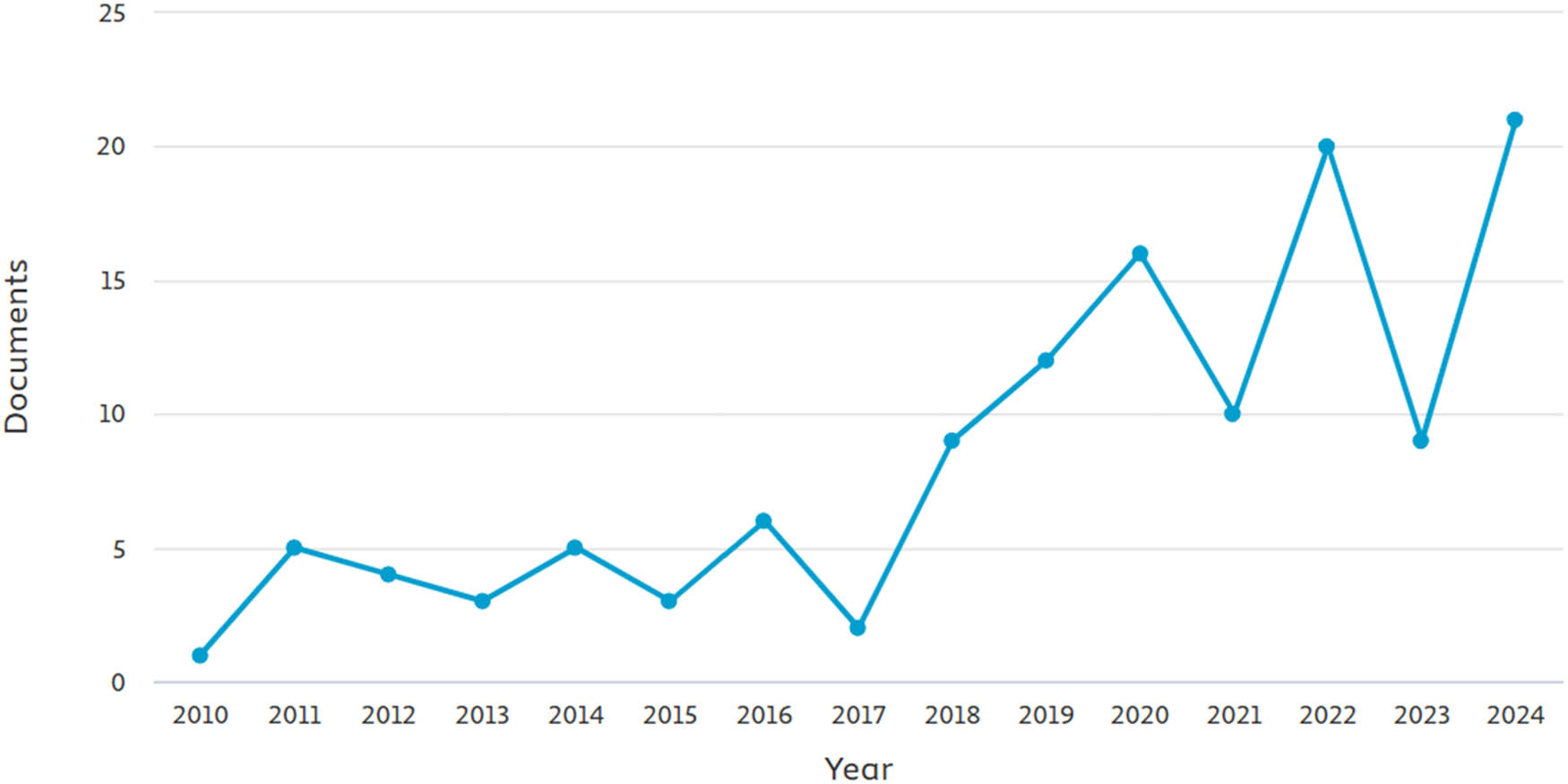
Number of studies on PPF and fiber-reinforced LWC (according to Scopus database 2010–2024).
Wall panels [46], masonry blocks [47], precast concrete units [48], lightweight floor fills [48], and so on are examples of LWC’s widespread application in the construction industry. These applications make use of LWC’s many benefits, such as low self-weight, high strength-to-weight ratio, cost effectiveness, and long service life. Porous lightweight aggregates are responsible for much of the concrete’s strength and low density, making them crucial to the success of LWC [49]. LWC shares the porous property of ceramsites, but it also has several shortcomings, such as brittleness texture and inferior workability [50,51,52], which severely limit its widespread usage in civil engineering.
The majority of PPF-based LWC studies focus on mechanical properties (40%), followed by durability (25%) and thermal performance (15%) (Figure 2). Numerous studies have explored the brittleness of LWA’s texture. Research has shown that adding the right amount of HPP to LWC enhances its fracture resistance, crack resistance, and toughness qualities. Previous studies have demonstrated that LWC is more brittle than regular concrete of the same mix proportions, and that this brittleness increases as LWC strength is enhanced [52]. To enhance its strength and reduce its susceptibility to damage, LWC has traditionally been reinforced with various types of fibers, such as steel, polyvinyl alcohol, and PPF, either alone or in combination. Numerous studies have explored the mechanical features of fiber-reinforced LWC, with the general consensus being that the addition of fiber expands its compressive, flexural strength, flexural toughness, and impact resistance [53,54].
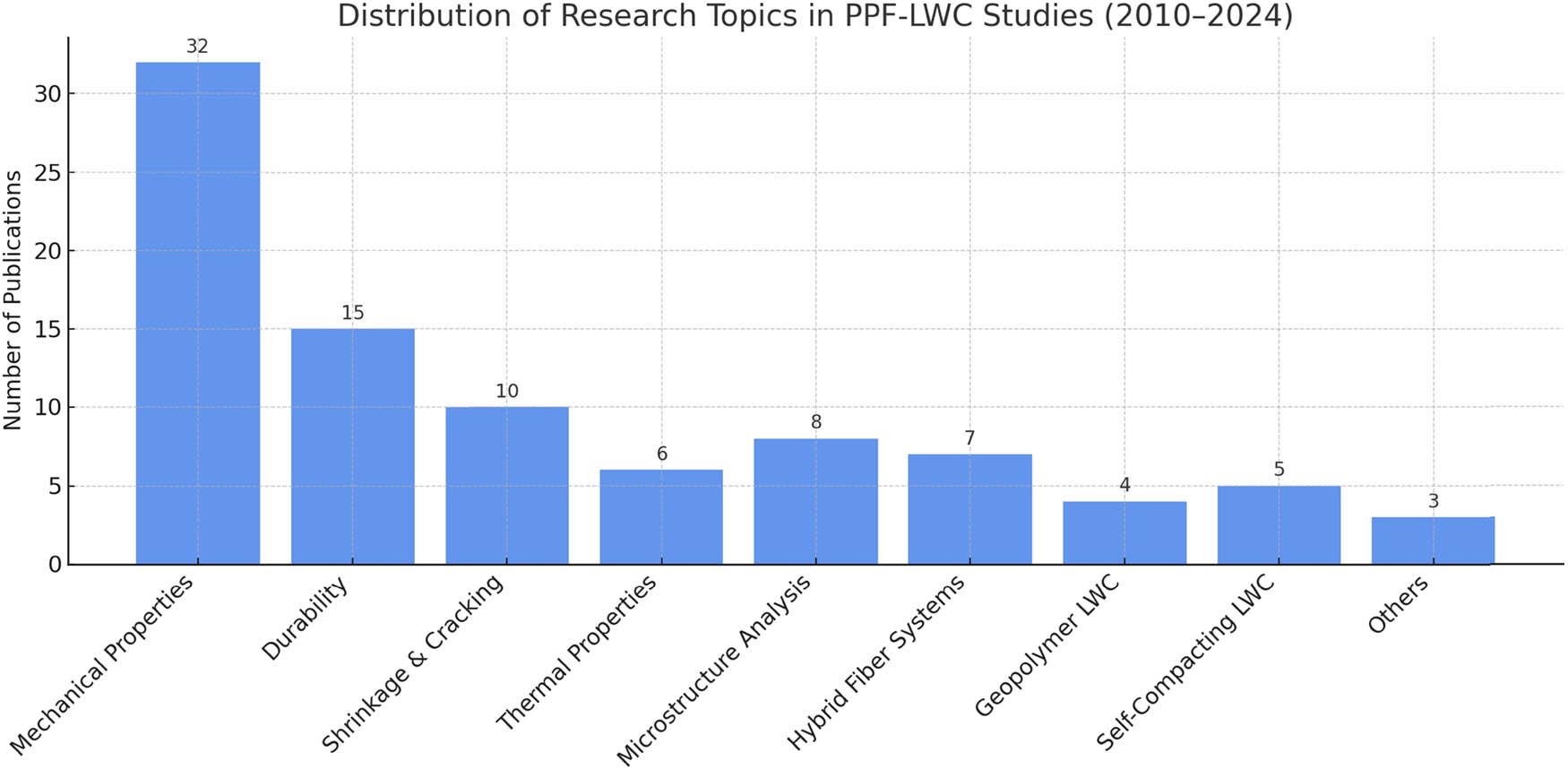
Distribution of research topics in PPF–LWC studies (according to Scopus database 2010–2024).
Given the numerous internal voids, LWAs can absorb considerably more water than regular aggregates. Given that LWAs are porous, they readily absorb the free water, drastically reducing the workability of fresh LWC if the LWAs are not sufficiently prewetted. Prewetting LWAs has been shown to vastly increase the workability and pumpability of fresh LWC in the engineering field. Prewetted LWAs, which might act as a water reservoir in the concrete, were also used to forestall cracking caused by autogenous shrinkage. At the same time, the density, freeze–thaw resistance, and thermal insulation of hardened LWC would be affected by the water-saturated state of LWA [55,56].
A new environmentally preferable binder called geopolymer has been launched as a substitute for Portland cement. Industrial waste that has a high content of silica and alumina, for instance, fly ash [47,57,58], bottom ash [59,60], slag [61], and rice husk ash [62,63], can be used to create the geopolymer material. In addition, geopolymer concrete applications [64] have made extensive use of PPF to boost flexural strength and durability. However, high PPF content may reduce workability and increase porosity [65]. According to Chindaprasirt et al. [66], the binding strength between the matrix and the fiber is improved by adding fiber at the optimal content with uniform dispersion [67].
Particularly for high-strength concrete, which is brittle, fiber can be added to the matrix to increase the material’s ductility [68]. LWC has been reported to be more fragile than regular concrete [51]. Many different fibers have been studied in published research. Lightweight concrete benefited greatly from the addition of steel fiber in terms of flexural strength and splitting strength. However, adding steel fiber to lightweight concrete makes it more substantial [69]. As a result, research on low-density fiber for use in lightweight concrete is warranted. Lightweight concrete reinforced with PPF has been shown to boost indirect tensile strength without considerably affecting compressive strength or modulus of elasticity, as demonstrated in the study of Liu et al. [69].
Fiber added to concrete increases its residual strength and bearing capacity when debonding, making the material less likely to collapse. Given their ability to lower corrosion and wear on mining equipment, PPF is gaining popularity [70]. Thus, contrary to what was found in a previous study, PPF was chosen in this study [71].
An overview of earlier research on fiber integration into lightweight concrete is presented in Table 1. Regular concrete has a number of disadvantages, such as an increased specific gravity, an increased level of brittleness, and a low degree of toughness. Due to these shortcomings, ordinary concrete is inappropriate for use in constructions, notably bridge decks and field-fabricated beams. Lightweight concrete is subject to cracking and flexural strains more than ordinary concrete because LWC fractures as a result of aggregate rupture. Newer LCC is quite low in density and exhibits sufficient compressive strength. A high specific strength can be achieved by adding microlightweight particles to cement. Lightweight concrete allows for the construction of smaller and lighter-weight structural members, which in turn reduces the dead load and increases the seismic resilience of structures. Several researchers are interested on how LWC might be used on ships and other floating structures. For the most part, lightweight concrete is no different from other cementitious materials in being a brittle substance. Reinforced concrete buildings have a shorter lifespan than expected because of steel reinforcement corrosion, which necessitates frequent and expensive maintenance. Lightweight concrete is an important component of green structures. PPF-reinforced lightweight concrete is gaining much interest because of its additional advantages [72]. By adding PPF to lightweight concrete, its load-carrying capacity is increased, making it closer in strength to normal weight concrete. The inclusion of fiber also helps control crack propagation and reduce crack width. Additionally, this type of concrete decreases deformation capacity, which results in more cost-effective solutions by reducing the weight of the concrete.
An overview of earlier research on fiber integration into lightweight concrete
| Ref. | Country | Field of use |
|---|---|---|
| Ghanim et al. [73] | KSA | PPE and glass fiber in LWC |
| Mohamed et al. [74] | KSA | Fiber-reinforced LWC |
| Aisheh et al. [75] | Jordan | Polypropylene and SF in geopolymer concrete |
| Zhu et al. [56] | China | LWC made with high-performance PPF |
| Ortiz et al. [71] | Chile | A lightweight approach utilizing fiber |
| Zeng and Tang [76] | China | Fibers made of basalt and polyacrylonitrile |
| Li et al. [45] | China | Reinforced LWC with high-performance PPF |
| Madandoust et al. [77] | Iran | LWC enhanced with PPF and steel fibers |
| Abdul-Rahman et al. [78] | Iraq | PPF-reinforced reactive powder concrete beams |
| Salehi et al. [79] | Iran | Lightweight concrete strengthened with PPF. |
| Srinivas et al. [80] | India | PPF lightweight concrete |
| Balgourinejad et al. [81] | Iran | PPF used in lightweight concrete, as well as incorporating metakaolin |
| Liu et al. [69] | China | Lightweight concrete created macro-polyfelin polymer fibers |
| Yew et al. [72] | Malaysia | Various types of PPFs on high-strength lightweight concrete |
| Jun Li et al. [82] | China | Fiber made of high-performance polypropylene |
| Altalabani et al. [83] | Iraq | Self-compacting LWC + PPF |
| Xie et al. [37] | China | LWC strengthened by PPFs |
| Tanyildizi [84] | Turkey | PPF concrete |
| Guler [85] | Turkey | Impact of polyamide fibers on structural lightweight concrete properties |
| Wang et al. [86] | UK | Geopolymer lightweight concrete properties, including PPFs. |
| Mehrab and Esfahani [87] | Iran | Role of PPF in the strength of LWC |
| Ghasemzadeh Mousavinejad and Shemshad Sara [88] | Iran | Hybrid fiber on the mechanical properties of LWC |
| Najaf et al. [89] | Iran | Impact of PF on the impact resistance and ductility of lightweight concrete |
| Ismael and Mohammed [90] | Iraq | Fiber-reinforced LWC |
| Loh et al. [91] | Malaysia | Synthetic PPF used on LWC |
| Srinivas et al. [80] | India | LWC made by using coconut shell and expanded polystyrene beads as coarse aggregate, and incorporating PPF |
| Zhou and Chen [92] | China | Using hybrid fiber on LWC |
| Xie et al. [37] | China | Using PPFs on lightweight concrete |
| Altalabani et al. [83] | Iraq | Using PPF on self-compacting LWC |
| Badogiannis et al. [93] | Greece | Steel and PPF concrete |
| Al Qubro and Saggaff [94] | Indonesia | Lightweight concrete made with PPF |
| Rasheed and Prakash [95] | India | Hybrid synthetic fiber reinforcement used in LWC under uniaxial tension |
| Yang et al. [96] | China | Use of fiber in LWC |
| Zhang et al. [32] | China | Effects of fibers on LWC |
| Cunha et al. [48] | Brazil | Concrete reinforced with fiber |
| Sun et al. [97] | Australia | Engineered cementitious composites reinforced with lightweight fiber |
| Shaiksha Vali and Bala Murugan [98] | India | Impact of artificial fiber aggregate on lightweight concrete |
| Karamloo et al. [99] | Iran | Effects of different quantities of polyolefin macrofiber on self-compacting LWC |
| Amin et al. [100] | Egypt | Lightweight fiber concrete used in high-temperature environments |
| Mastali et al. [46] | Finland | Slag foam concrete + fiber alkali activation |
| Ismael and Mohammed [90] | Iraq | Performance evaluation of lightweight concrete slabs reinforced with fiber |
| Hossain et al. [101] | Canada | Lightweight-SCC beams reinforced with fiber |
| Shafigh et al. [102] | Malaysia | Thermomechanical effectiveness of fiber-reinforced structural-LWC |
| Deifalla [103] | Egypt | Analysis of LWC beams + fiber |
| Manharawy et al. [104] | Egypt | Deep beams made of LWC and reinforced with SF |
| Christidis et al. [105] | Greece | Lightweight concrete with end-hooked steel fibers |
| Liu et al. [106] | China | Flexural cracking in LWC beams reinforced with steel fiber |
| Li et al. [107] | China | Lightweight concrete using fibers, self-compacting, and LWC |
| Xiong et al. [108] | China | Improvement of steel fiber LWC |
| Li et al. [109] | China | SCC-LWC reinforced with steel fiber |
| Salehi et al. [79] | Iran | Impact of microbiological stress on the properties of PPF LWC |
The main goal of this research is to fill in current knowledge gaps by thoroughly examining the use of PPF in LWC as a substitute for cement. By analyzing several PPF choices in terms of their chemical structure and physical features, this study aims to further the development of sustainable LWC. Additionally, the study seeks to assess the effects of PPF on the mechanical characteristics of LWC, concentrating on the characteristics of hardness, such as compressive and flexural strengths. Figure 3 presents the research flow chart of review logic and arrangement of different sections.
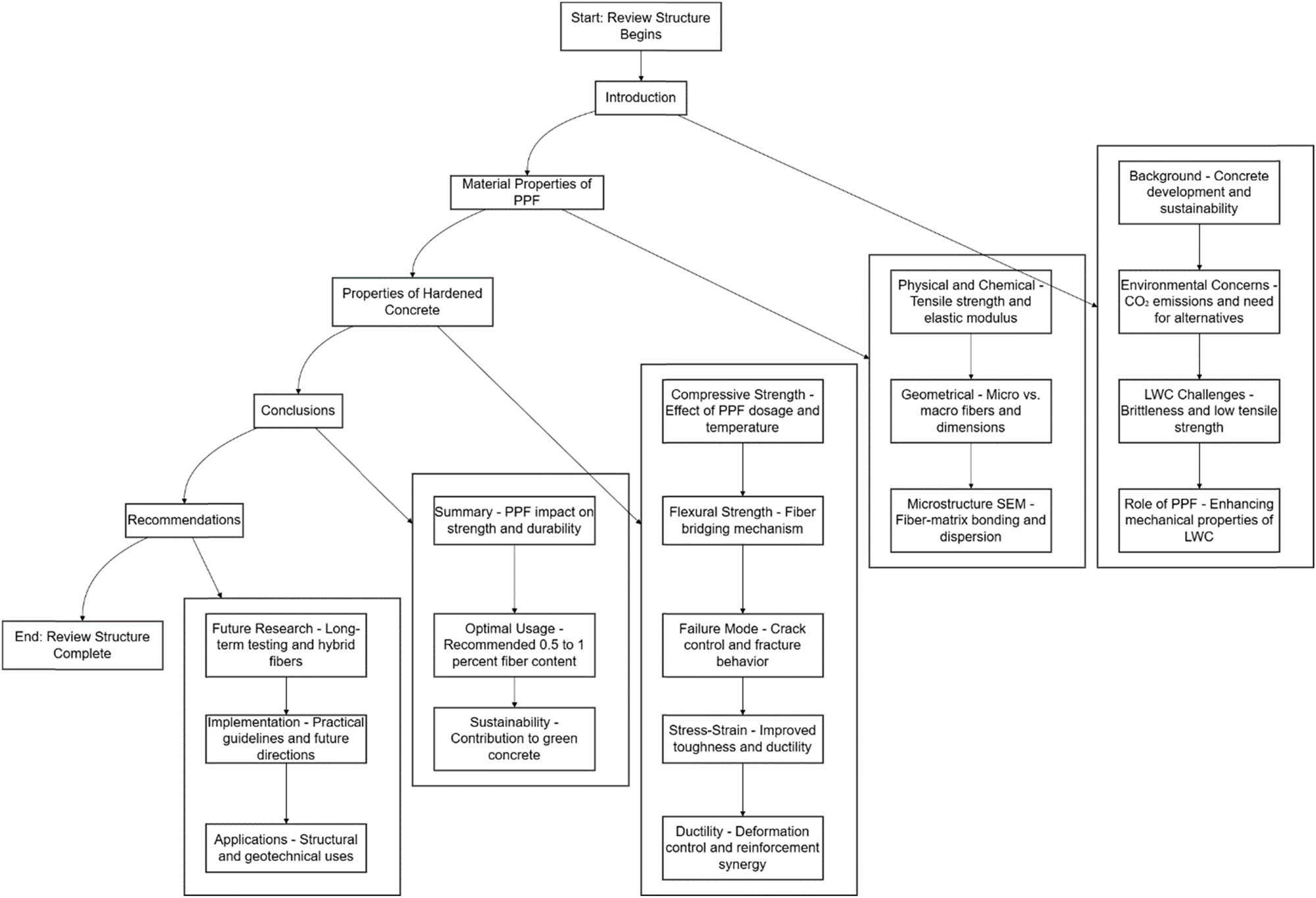
Research flow chart of this study.
This research endeavor also aims to explore the interplay between PPF and the durability of lightweight concrete. It delves into an array of pertinent properties, encompassing the failure mode of steel fiber–LWC, stress–strain behavior, and ductility. By amalgamating the study of PPF with the broader context of lightweight concrete performance, a more comprehensive understanding of the material’s behavior and potential advantages can be attained.
In essence, this study builds upon prior research limitations by offering a holistic examination of PPF’s effects on lightweight concrete. It not only enhances the existing body of knowledge by bridging these gaps but also provides nuanced insights into PPF’s behavior within the realm of lightweight concrete. This research does not just conclude with its findings but it paves the way for future inquiries by outlining areas of potential exploration. By shedding light on the properties and behavior of PPF in sustainable lightweight concrete, this study is poised to make a significant contribution to the field, driving further advancements and insights in this evolving domain.
2 Material properties of PPF
The current work offers a thorough analysis of all aspects that were addressed in earlier research on the incorporation of PPF into LWC’s physical and chemical characteristics. In order to contrast the characteristics and pinpoint the most crucial PPF elements, the article presents the properties in tables and figures. Additionally, research into the physical and chemical characteristics of materials is important because it helps us understand the significance of the material, how to use it, and where it can be used. A detailed assessment of the most significant and most recent findings on the chemical and physical properties of PPF is provided in the current work.
2.1 Physical and chemical properties
PPF is effective in keeping cracks to a minimum, as shown in Figure 4, to strengthen the concrete’s ability to resist heat loss. The concrete’s fibers also distribute the tension stresses throughout the material.
![Figure 4
PPF used in an investigation [111].](/document/doi/10.1515/rams-2025-0141/asset/graphic/j_rams-2025-0141_fig_004.jpg)
PPF used in an investigation [111].
Table 2 displays the PPF’s physicochemical characteristics [110], and Table 3 presents the geometrical properties of PPF [111]. The physicochemical attributes and geometrical properties of PPF play pivotal roles in improving concrete to be green concrete by utilizing PPF. The findings not only have direct implications for the development of durable and energy-efficient structures but also contribute to the broader discourse on sustainable building materials.
Physical properties of PPF [110]
| Physical properties with units | Values |
|---|---|
| Electric insulation | Excellent |
| Resistance to mildew, moth | Excellent |
| Elongation (%) tensile strength (kgf/den) | 40–100, 3.5–5.5 |
| Abrasion resistance | Good |
| Moisture absorption (%) | 0–0.05 |
| Softening point (C) | 140 |
| Relative density | 0.91 |
| Thermal conductivity | 6.0 (with air as 1.0) |
| Melting point (C) | 165 |
| Chemical resistance | Generally excellent |
Geometrical properties of PP fibers [111]
| Fiber type | Diameter (µm) | Specific density (g·cm−3) | Tensile strength (MPa) | Length (mm) | Aspect ratio | Elastic modulus (GPa) |
|---|---|---|---|---|---|---|
| PP | 40 | 0.91 | 450 | 12 | 300 | 5 |
For high-strength concrete, PPF was used as a reinforcing material [112]. These fibers are perfect for this application due to their high tensile strength, enhanced elongation, and low elastic modulus. Table 4 lists the physical attributes of the fiber in further detail.
Physical properties of PPF [112]
| Specification | Description |
|---|---|
| Length | 12 mm |
| Tensile strength | 600–700 MPa |
| Elastic modulus | 3,000–3,500 MPa |
| Density | 0.91 g·cm−3 |
Eidan et al. [113] developed PPFs with fibrillated shapes, as presented in Figure 5. Moreover, the characteristics of the fiber are presented in Table 5.
![Figure 5
Shape of PPFs [113].](/document/doi/10.1515/rams-2025-0141/asset/graphic/j_rams-2025-0141_fig_005.jpg)
Shape of PPFs [113].
Physical characteristics of PPF [113]
| Length, l (mm) | Diameter, d (mm) | Aspect ratio, l/d | Tensile strength (MPa) | Melting temperature (°C) | Specific gravity (g/cm3) |
|---|---|---|---|---|---|
| 6 | 0.078 | 77 | 300–400 | 162 | 0.91 |
| 12 | 0.078 | 154 | 300–400 | 162 | 0.91 |
The term “straight or distorted fragments of extruded, oriented, and cut polymer material” refers to a particular kind of polymer fiber.” PPF is of two different types: microfiber and macrofiber [113], as presented in Figure 6. Their length is the most distinguishing feature but they also serve distinct purposes in the poured material. Fibers increase LWC’s flexural tensile strength, impact resistance, and postcracking ductility [113].
![Figure 6
(a) Microfiber-PPF and (b) macro-PPF [114,115].](/document/doi/10.1515/rams-2025-0141/asset/graphic/j_rams-2025-0141_fig_006.jpg)
In this way, steel reinforcement can be made faster, reducing the initial outlay costs. Typically, they range in size from 30 to 50 mm. Microfibers are less than 30 mm in length, thus they cannot support weight [114,115].
Instead of using a mesh to prevent cracks, micro-PPF can be used. Either a single filament or a network of fibrils characterizes them. Melt spinning yields monofilaments, which are then used to create PPF, or one can use a sheet of polypropylene film to create fibrillated fiber [116]. According to calculations, micro-PPF has an elastic modulus of around 3.8–7.0 GPa and a tensile strength in the range of 300–450 MPa. At 400–760 MPa and 3,512.0 GPa, macro-PPF has a stronger tensile strength and elastic modulus [114].
Fiber hybridization, or incorporating fibers of different materials and/or lengths into the concrete to make HFRC, is described. It is a reliable method to regulate cracks of varying widths and depths over a range of cure times and loading conditions [117,118]. That is, when tiny cracks emerge in the concrete, short fibers can be used to patch them up. Given that they are greater in amount in the mixture, microfibers are more efficient than macrofibers. Thus, the concrete’s early tensile phase is characterized by an increase in strength. When the microscopic fissures join together and macrocracks form, the longer fibers become dynamic and work to slow down the crack expansion, thus increasing the ductility of the concrete and allowing them to withstand a greater load despite the ongoing deformations. For example, the efficacy of combining microfibers and macrofibers was confirmed by showing that after combining the toughness, compressive, tensile, and flexural strength of a material made from polypropylene microfibers and macrofibers increased, whereas drying shrank the material less [119]. A polyethylene/PPF blend improved the postcracking behavior of concrete, as shown in the study of Jongvivatsakul et al. [120].
To improve the mechanical properties of LWC, including its compressive and tensile strengths, without considerably increasing the related heat conductivity, Wang et al. [86] used PPF. Table 6 displays the mechanical properties of polyester fiber (PF), revealing that its tensile strength is pointedly greater than that of normal lightweight concrete. As a result, PF is a great option for enhancing the durability and strength of lightweight concrete.
Parameters of PPF [86]
| Density (g·cm−3) | Diameter (mm) | Modulus of elasticity (MPa) | Elongation at break (%) |
|---|---|---|---|
| 0.91 | 0.017 | 4987 | 19 |
Badogiannis et al. [93] used a synthetic (polypropylene) macrofiber and three steel fibers of varying total lengths (30, 36, and 60 mm) in the experiment. Steel fibers of 36 and 60 mm length were found to have the standard double-hooked end shape, but steel fibers of 30 mm length were found to have an opposite-hooked end shape. As shown in Figure 7, the fiber and pumice (8–16 mm) penetrate the concrete. Table 7 summarizes the geometrical and mechanical parameters of all fibers.
![Figure 7
Materials used in the concrete mixtures examined [93].](/document/doi/10.1515/rams-2025-0141/asset/graphic/j_rams-2025-0141_fig_007.jpg)
Materials used in the concrete mixtures examined [93].
Geometrical and mechanical characteristics of fibers [93]
| Material | Steel 1 | Steel 2 | Steel 3 | Polypropylene |
|---|---|---|---|---|
| Shape | Opposite-hook ended | Double-hook ended | Double-hook ended | Straight |
| Length, l (mm) | 30 | 36 | 60 | 52 |
| Tensile strength (MPa) | 1,100 | 1,100 | 1,100 | 613 |
| Modulus of elasticity (MPa) | 200,000 | 200,000 | 200,000 | 5,400 |
| Diameter, d (mm) | 0.55 | 0.63 | 0.92 | 0.46 |
| Aspect ratio, I/d | 55 | 57 | 65 | 113 |
In addition, Hussain et al. [121] reported that PPFs, steel fibers, and glass fibers, shown in Figure 8, provide a comparative perspective of fiber reinforcements. Table 8 details various characteristics of the fibers.
![Figure 8
(a) Steel fibers, (b) glass fibers, and (c) PPF [121].](/document/doi/10.1515/rams-2025-0141/asset/graphic/j_rams-2025-0141_fig_008.jpg)
(a) Steel fibers, (b) glass fibers, and (c) PPF [121].
Characteristics of the employed fiber reinforcements [121]
| Property | SF | GF | PPF |
|---|---|---|---|
| Length (mm) | 35 | 618 | 12 |
| Tensile strength (MPa) | 1,200 | 1,200 | 500 |
| Modulus of elasticity (GPa) | 200 | 1,500 | 5 |
| Diameter of filament (mm) | 0.9 | 0.015 | 0.03 |
| Aspect ratio of filament | 39 | 400 | 400 |
| Density (kg·m−3) | 7,750 | 2,600 | 900 |
SF: steel fiber; GF: glass fiber; PPF: polypropylene fiber.
To sum up, the three kinds of fibers that are most frequently utilized in LWC are PPF, steel fibers, and glass fibers. The geometrical and physical characteristics of these fibers are compared in Tables 2, 7, and 8. PPF is resistant to mildew and moths and provides great insulation from electricity. Glass fibers have a larger dimension ratio and a smaller density compared to steel and PPF fibers, while steel fibers have a greater tensile strength and elastic modulus compared to PPF fibers. The mechanical characteristics of various types of LWCs, such as those with and without PPF, are compared in Tables 3–6. They demonstrate that the inclusion of PPF can dramatically enhance the tensile and compressive strengths of LWC without significantly raising the associated heat conductivity. Although to a lesser extent than PPF fibers, steel and glass fibers can also enhance the mechanical qualities of lightweight concrete.
2.2 Microstructure properties
Jeyanthi and Revathi [110] stated that a comparison of the SEM images of PPF in Figure 9 reveals that the fibers are not sticky and have a shining surface, both of which indicate the presence of fibers within the concrete.
![Figure 9
SEM image of PPF: (a) 200 lm, (b) 100 lm, and (c) 50 lm [110].](/document/doi/10.1515/rams-2025-0141/asset/graphic/j_rams-2025-0141_fig_009.jpg)
SEM image of PPF: (a) 200 lm, (b) 100 lm, and (c) 50 lm [110].
Additionally, Givi et al. [122] stated that the great adhesive strength of fiber to the composite binder is evidenced by the fact that when breaking a fiber-reinforced concrete sample, cement paste fragments closely fitting microfiber fiber are plainly evident at a crack (Figure 10). Therefore, under all conditions, the composite binder (containing PPF) concrete has superior qualities over the Portland cement concrete.
![Figure 10
An example of the microstructure of the fiber’s interfacial transition zone in modified cement [122].](/document/doi/10.1515/rams-2025-0141/asset/graphic/j_rams-2025-0141_fig_010.jpg)
An example of the microstructure of the fiber’s interfacial transition zone in modified cement [122].
According to Ahmed et al. [112], given the high tensile strength, high elongation, and low modulus of elasticity of PPFs, they were utilized as reinforcing materials in high-strength concrete. Moreover, Yoosuk et al. [67] stated that the SEM images of the PPM samples shown in Figure 11 exhibited interfacial transition zones between fiber and matrices, which were produced by PPF [37]. Mixing became more challenging when the fiber content was higher than optimal. Consequently, the fiber began to ball up, resulting in the matrix developing large holes. In addition, the voids inside the matrix increased with the foam content (Fc). Thus, the fiber and geopolymer paste had less adhesion.
![Figure 11
SEM images of PPF reinforcement. Fc = 0%, and PPF content: (a) 0%, (b) 1.5%, (c) 2.5%, and (d) 3% [67].](/document/doi/10.1515/rams-2025-0141/asset/graphic/j_rams-2025-0141_fig_011.jpg)
SEM images of PPF reinforcement. Fc = 0%, and PPF content: (a) 0%, (b) 1.5%, (c) 2.5%, and (d) 3% [67].
According to Bentegri et al. [123], given their high tensile strength, fibrillated twist PPFs of 19 and 54 mm are designed to be utilized in reinforcing and precast concrete (689 MPa). However, PPFs that are 30 mm in diameter are less tensile and have a wave-like appearance (486 MPa). Additionally, in contrast to 19 and 54 mm fibers, this type of fiber is more flexible due to its high elastic modulus (6.9 and 5.75 GPa, respectively). Scanning electron microscopy (SEM) analyses reveal distinct differences in the fiber form (Figures 12 and 13).
![Figure 12
SEM images of the fibrillated twist PPF [123].](/document/doi/10.1515/rams-2025-0141/asset/graphic/j_rams-2025-0141_fig_012.jpg)
SEM images of the fibrillated twist PPF [123].
![Figure 13
SEM images of the wave PPF [123].](/document/doi/10.1515/rams-2025-0141/asset/graphic/j_rams-2025-0141_fig_013.jpg)
SEM images of the wave PPF [123].
Figure 14 displays the microscopic morphologies of PPF and cementitious materials, as reported by Chen et al. [124]. The fibers retain their morphology despite the attachment of a small quantity of cementitious elements to their surfaces. This result suggests that the fiber and cementitious components do not appear to react chemically. Alkali-activated composites demonstrated superior interfacial binding strength with various fiber types, as demonstrated by Bhutta et al. [125].
![Figure 14
SEM images of the PPFs [124].](/document/doi/10.1515/rams-2025-0141/asset/graphic/j_rams-2025-0141_fig_014.jpg)
SEM images of the PPFs [124].
Hydrophilic fiber, such as basalt fiber (BF), and hydrophobic fiber, such as PF, are described in the study of Jiang et al. [126]. The bonding performance between BF and the shotcrete matrix is considerably superior to that between PF and the shotcrete matrix owing to the alteration in physical and mechanical properties of BF and PF. Therefore, as shown in Figure 15, the BF has a shorter pull-out length than the PF. Consequently, the ductility, toughness, and rigidity of LWC shotcrete can be improved by a two-fiber material and can prevent the improvement of various cracks in the course of the lightweight aggregate fiber shotcrete (LAFS) impact test. Smaller fibers tend to prevent cracks from occurring, whereas larger fibers prevent cracks from spreading and penetrating at a macroscopic scale [127]. As a result, PF is more flexible and has less stiffness than BF. As an added advantage, PF has a substantially longer draw-out length than BF. After peak stress, ductile deformation in concrete is enhanced further by PF.
![Figure 15
Reflection of BF and PPF in the LAFS matrix: (a) BF and (b) PPF (PF) [126].](/document/doi/10.1515/rams-2025-0141/asset/graphic/j_rams-2025-0141_fig_015.jpg)
Reflection of BF and PPF in the LAFS matrix: (a) BF and (b) PPF (PF) [126].
SEM images for ultralightweight high-strength concrete (ULHSC) reinforced with PP fibers are shown in Figure 16. Large gaps are observed among the PP fibers and the cement matrix, suggesting that the PP fibers are only tenuously bound to the matrix [128]. Loose bonding and poor mechanical properties can be traced back to the hydrophobic nature of synthetic PP fibers. Matrix components of ULHSC-PP include Ca, Si, and O, with a lower Ca/Si ratio in ULHSC-PP compared to ULHSC-0. Only a slight increase in static mechanical characteristics was observed, and numerous PP fibers ruptured and broke due to their low tensile strength. The dynamic mechanical capabilities of the ULHSC reinforced with PP fibers were high, showing that the bonding strength between the fiber and matrix is not the only determinant of the dynamic qualities [128].
![Figure 16
SEM images of (a) and (b) ULHSC-0.5 PP- and (c) and (d) ULHSC-1.0 PP-reinforced ULHSCs [128].](/document/doi/10.1515/rams-2025-0141/asset/graphic/j_rams-2025-0141_fig_016.jpg)
SEM images of (a) and (b) ULHSC-0.5 PP- and (c) and (d) ULHSC-1.0 PP-reinforced ULHSCs [128].
3 Properties of hardened concrete
The physical and chemical characteristics of the raw materials and binder, the quantity of raw materials and binder utilized, the kind and quantity of coarse aggregate, the quality and quantity of fine aggregates, the proportion of aggregates to binder, the rate of mixing, the proportional of alkaline solution to binder, the curing process, and the testing criteria all have an impact on the concrete durability [129–131].
The present research evaluates the impact of adding or removing PPF in LWC and gives a thorough assessment of the most significant results pertaining to the hardness qualities.
3.1 Compressive strength
Badogiannis et al. [93] explored how the addition of PPF affected the mechanical properties (i.e., compressive strength) of lightweight concrete. A total of nine mixes (six containing steel fiber, two containing PPF, and one serving as a reference without fiber) were tested as part of the experimental inquiry. The data collected during the experiments revealed that the totaling of either type of fiber remarkably increased the compressive strength compared with plain concrete between 16 and 76%. Strong dependence on the term Vf*(l/d) was found for the magnitude of the compressive strength for steel and PPF. Compressive strength was assessed and found to be stronger in all mixes than in the plain concrete by as much as 110%. The term Vf*(l/d) was found to be dependent on compressive strength. Instead, postcrack behavior was substantially linked with the fiber type [93].
El Ouni et al. [132] mentioned that natural aggregate concrete (NC) and recycled aggregate concrete (RAC) saw different effects when a single PPF was added to the mix (RC). Compressive strength in NC and RC is reduced by 4–6% when single synthetic fiber (i.e., PPF) are used because PPF has a lower density than the plain concrete matrix. The difficulty in dispersing microfiber, which leads to buildup of fiber filaments, is another reason [133] for the detrimental effect of PPF on compressive strength. As a result, the concrete’s total porosity improves. Compressive strength was increased when hybrid SF and PPF were used. In high-strength (54 MPa) applications, RC with hybrid fiber can perform up to 94%, as well as plain NC. The compressive strength of RC is increased by 17.2 and 19.6%, respectively, while using 0.75% SF/0.25% PPF and 0.85% SF/0.15% PPF instead of plain RC. PPF reduced the compressive strength when applied alone, but adding SF would have a synergistic effect. Thus, the combined effect of polypropylene and SFs is more beneficial than the sum of the effects induced by individual fiber. By utilizing fiber of varying lengths and diameters, the fracture bridging limit of concrete can be increased, resulting in synergistic effects. When polypropylene and SF are combined, a more corrosion-resistant RC can be produced than when using only SF. In addition, compared with single-SF RC, hybrid fiber RC is lighter and less expensive. PPF can provide an effective hybrid fiber RC because it has a smaller carbon footprint and is less expensive than SF per unit volume [134].
Figure 17 depicts the compression failure of several fiber-containing and fiber-free concrete compositions. PPF-reinforced concrete is more robust than regular concrete, even if it has a low compressive strength because the fiber fills in the gaps caused by the macrocracks, preventing the concrete from breaking apart too easily once the maximum stress has been applied. The single SF-reinforced concrete and the hybrid fiber-reinforced concrete samples maintained a high compressive strength when the maximum load was applied [132].
![Figure 17
Patterns of compression failure in concrete with (a) no fiber (b) one SF, (c) a single PPF, and (d) an SF-PPF hybrid [132].](/document/doi/10.1515/rams-2025-0141/asset/graphic/j_rams-2025-0141_fig_017.jpg)
Patterns of compression failure in concrete with (a) no fiber (b) one SF, (c) a single PPF, and (d) an SF-PPF hybrid [132].
PF is a popular choice for reinforcing the strength of lightweight concrete [86] because it offers high-performance abrasion, corrosion, and fire resistance without considerably increasing the thermal conductivity of the concrete. While studies have shown that the addition of PF can enhance the compressive and tensile strengths of lightweight concrete, its effectiveness in increasing compressive strength is found to be less than that of its tensile strength. Therefore, PF can be an excellent option for enhancing the durability and strength of LWC, particularly when tensile strength is a priority. Furthermore, the selection of an appropriate fiber type and configuration for reinforcing lightweight concrete should be the result of the specific performance requirements of the concrete and the conditions in which it will be used.
Compressive strength of fiber with lengths of 3, 6, 9, 12, and 19 mm was reported to be raised by 57, 46, 57, 57, 71, and 6%, respectively, by Wang et al. [86] (Figure 18). The bridging action of the fiber at the crack face shows that its insertion can increase the compressive strength. An anisotropic sample was produced because disseminating the longer PPF uniformly was difficult. The improvement is less pronounced when the fiber length is more than 12 mm.
![Figure 18
Effects of fiber length on the compressive strength [86].](/document/doi/10.1515/rams-2025-0141/asset/graphic/j_rams-2025-0141_fig_018.jpg)
Effects of fiber length on the compressive strength [86].
According to Jeyanthi and Revathi [110], compressive strength is measured to determine the overall strength of composite concrete. Casted samples (0, 15, and 30% cenosphere with 0.5% PPF) were cured for 28 days before being put through their paces. The following is a summary of the findings based on the mean values of the strengths: The test may be conducted at day 28 because the minimum strength criteria will have been met by day 7. Levels of maximal strength might be from 0 to 30% (without any admixture) (18.503 and 17.96 MPa – 0 and 15% – on day 7, 25.09 and 23.17 MPa – 0 and 30% – on day 28).
Amran et al. [135] further reported that after 28 days, the composition’s compressive strength had reached 88.5 MPa, which was higher than the control nonreinforced composition (76%) and the reinforced composition (74%). This result proves that the fiber reduces the compressive strength, with the produced polymineral modifier providing majority of the effect. According to Ahmed et al. [112], several scientists have shown that adjusting the proportion of coarse recycled gravel to PPF considerably affects the concrete strength. However, Ahmed et al. [112] demonstrated the effect of PP fiber in concrete with silica fume and coarse recycled material (readily available due to the numerous demolished structures in the Mosul City research zone) on the basis of criteria, such as compressive strength. To achieve this goal, coarse RA concrete (at 0, 50, and 100% volume) is combined with varying percentages of PP fiber (at 0, 0.15, 0.3, 0.45, 0.6, 0.7, and 0.9% volume).
PPF played an important role by enhancing the test findings; its height fineness and length variation in the staple made a bridge action to prevent further construction of microfractures. Compressive strength was maximized at 0.6% PP fiber, with increases of 24.8 and 24.4% for 50 and 100% RA replacement.
According to Meena and Ramana [136], fiber boosted the compressive strength of the concrete. Compressive strength was enhanced by over 17% in comparison with regular concrete after 28 days due to an increase in the fiber content of 0.0–0.5%. The effectiveness of the PF and the concrete mix in stopping cracks from forming is one possible explanation for the concrete’s enhanced compressive strength. Nonlinear regression analysis is used to convert PPF content into an expression of compressive strength. Meena and Ramana [136] noted that up to a PPF concentration of 0.5%, the concrete’s compressive strength increased. Compared with regular concrete, the compressive strength of mixtures containing 0.5% PPF increased by 17% (Figure 19).
![Figure 19
Experimental compressive strength at various PPF contents [136].](/document/doi/10.1515/rams-2025-0141/asset/graphic/j_rams-2025-0141_fig_019.jpg)
Experimental compressive strength at various PPF contents [136].
Salehi et al. [79] reported that adding PPF to the control specimens had no appreciable effect on the size of their compressive strength. In contrast to the first group, the percentage of compressive strength increased when bacteria with 0.5% fiber were present. The 1% fiber group had a higher level of bacterial activity. The number of pores in the concrete increased with the fiber fraction.
For temperature effects, concrete with various PPF contents exhibited various compressive strengths both at room temperature and at higher temperatures [137]. After 28 days, the fiber dosage up to 0.5% polypropylene content increased the compressive strength at room temperature, achieving a peak increase of over 17% at 0.5% PPF, before starting to decline. At 200°C, concrete reinforced with PPF at doses of 0.20, 0.35, and 0.50% had compressive strengths that were, respectively, 2.87, 3.51, and 4.43% higher than those of concrete reinforced with PPF at ambient temperature. The compressive strength of concrete containing 0.75 and 1.00% PPF dropped by 3.8 and 4.61%, respectively, as compared to PPF concrete at 27°C [138]. All PPF mixes lost compressive strength at 400°C. In comparison to room temperature, the compressive strengths of PPF concrete mixtures with 0.20, 0.35, 0.50, 0.75, and 1.00% fiber dosage were 12.47, 13.50, 12.35, 15.51, and 17.38% lower, respectively [132,139].
To conclude, Wang et al. [86] showed that the maximal compressive strength of composite concrete can range from 0 to 30% (without any admixture), with mean values of 18.503 and 17.96 MPa for 0 and 15% fiber length, respectively, on day 7, and 25.09 and 23.17 MPa for 0 and 30% fiber length, respectively, on day 28. Wang et al. [86] also indicated that the compressive strength increases with increasing fiber length up to a certain point, beyond which the improvement is less pronounced. Fibers up to 12 mm enhanced strength significantly (up to 71%), but strength gains dropped for 19 mm fibers (only 6%). This can be attributed to dispersion challenges and agglomeration of longer fibers, leading to anisotropic behavior and poor bonding with the cement matrix. Therefore, the optimal fiber length for compressive strength improvement appears to lie between 6 and 12 mm, depending on the mix’s workability and compaction efficiency.
While Meena and Ramana [136] showed that the compressive strength of composite concrete increased with increasing mix content up to a certain point, beyond which the improvement was less pronounced. The optimal mix of content may depend on the specific application and desired strength requirements. It was also indicated that the compressive strength of mixtures containing 0.5% PPF increased by 17% compared with regular concrete. Similar patterns were observed in Surendranath and Ramana [138], where excessive fiber content (>0.6%) led to increased porosity and decreased strength, especially at elevated temperatures.
The hybrid use of steel and polypropylene fibers (SF + PPF) introduces a synergistic effect. According to El Ouni et al. [132], this combination improved compressive strength by enhancing both crack-bridging and toughness. For example, mixes with 0.75% SF + 0.25% PPF outperformed plain RAC by ∼17.2%, and the effect was attributed to better stress distribution and complementary mechanical performance of the fibers. While PPF alone may reduce compressive strength due to its lower modulus and dispersion issues, pairing it with SF can mitigate these drawbacks and yield a net improvement.
Table 9 provides a summary of previous studies on the compressive strength of PPF lightweight concrete. The table includes information on the field of use, mix proportion, PPF content, and compressive strength in MPa. By comparing the data in this table, we can see that the compressive strength of PPF lightweight concrete can vary widely depending on the specific application and mix proportion. For example, Hussein et al. [26] reported compressive strengths of 70 and 87 MPa for alkali-activated mortar with 0.5% PPF and 0.5% PPF + 1% NS, respectively. Qin et al. [3] reported compressive strengths ranging from 34.10 to 35.83 MPa for PPF fabric-reinforced concrete with different fiber contents and mix proportions. Yu et al. [140] reported compressive strengths of 28 and 90 MPa for PPF lightweight concrete used in different fields of application. These variations in compressive strength may be due to differences in the mix proportion, fiber content, curing time, and other factors. Overall, Table 9 highlights the importance of carefully selecting the mix proportion and fiber content to achieve the desired compressive strength for a given application.
Compressive strengths of PPF lightweight concrete according to previous studies
| Ref. | Field of use | Mix proportion | PPF | Compressive-strength (MPa) | ||
|---|---|---|---|---|---|---|
| 7 | 28 | 90 | ||||
| Hussein et al. [26] | Chemical resistance of alkali-activated mortar | — | 0.5% PPF | — | 70 | 87 |
| 0.5% PPF + 1% NS (nano silica) | — | 64 | 78 | |||
| Qin et al. [3] | PPF fabric-reinforced concrete | 0.75: 1: 3.62: 2.67 | 0.6 | — | 34.17 | 35.23 |
| 0.9 | — | 35.48 | 35.83 | |||
| 1.2 | — | 34.10 | 35.30 | |||
| 1.5 | — | 34.29 | 34.70 | |||
| Yu et al. [140] | Ultra-lightweight fiber-reinforced concrete | — | 0 | — | 11 | — |
| 0.2 long PF | — | 12.5 | — | |||
| 0.3 long PF | — | 13.5 | — | |||
| 0.05 long + 0.15 short PF | — | 12 | — | |||
| 0.6 long PF | — | 14.5 | — | |||
| 1.2 long PF | — | 13.75 | — | |||
| Vakili et al. [141] | Lightweight concrete beams reinforced with GFRP bars | 0.39: 1: 0.53: 0.80 | 0.8 PF | — | 36 | — |
| Orouji and Najaf [142] | PPFs on flexural and compressive strength | 0.30: 1: 2.78: 0 | 0 | 55.4 | 71.8 | 83.5 |
| 0.5 | 56.6 | 73.2 | 85.3 | |||
| 1 | 57.1 | 74.4 | 86.1 | |||
| 1.5 | 57.8 | 75.1 | 87.4 | |||
| Salehi et al. [79] | Lightweight concrete reinforced with PPF | 0.43: 1: 0.99: 1.19 | 0 | — | 28 | — |
| 0.5 | — | 33.5 | — | |||
| 1 | — | 29.5 | — | |||
| Meena and Ramana [137] | PPF reinforced concrete | — | 0 | — | 32.93 | — |
| 0.2 | — | 35.53 | — | |||
| 0.35 | — | 38.17 | — | |||
| 0.5 | — | 38.53 | — | |||
| 0.75 | — | 32.63 | — | |||
| 1 | — | 31.7 | — | |||
| Srinivas et al. [80] | Lightweight concrete with PPF | 0.45: 1: 1.41: 2.16 | 0.5 | 4.43 | 8.66 | |
| 1 | 5.9 | 9.93 | ||||
| 1.5 | 4.28 | 4.75 | ||||
| Ahmed et al. [112] | High-strength PPF concrete | — | 0 | — | 66.3 | — |
| 0.15 | — | 71.2 | — | |||
| 0.30 | — | 78.3 | — | |||
| 0.60 | — | 80.1 | — | |||
| 0.90 | — | 60.9 | — | |||
| Kakooei et al. [143] | PPFs on the properties of hardened lightweight self-compacting concrete | 0.32: 1: 0.80: 0.45 | 1.10 | 19 | 28 | — |
| 1.08 | 16.75 | 25 | — | |||
| 1.06 | 16 | 25.75 | — | |||
Overall, the inclusion of PPF in lightweight concrete demonstrates a variable yet generally positive impact on the compressive strength, with most studies identifying an optimal fiber content in the range of 0.5–1.0% (Table 9). Improvements up to 76% have been reported, particularly when PPF is used in hybrid systems or with optimized mix designs. The most significant gains occur around 0.5% PPF, where adequate fiber dispersion and bridging action at crack interfaces contribute to enhanced strength and toughness. However, discrepancies arise among studies due to differences in fiber dispersion, mix composition, and aggregate types. For instance, some studies report reductions in strength when PPF is used alone, citing issues such as fiber agglomeration, increased porosity, or poor compatibility with recycled aggregates. Others highlight the synergistic effect of combining PPF with steel fibers, resulting in improved mechanical performance and cost-effectiveness. Moreover, fiber length and aspect ratio (l/d) influence performance; overly long fibers may entangle, leading to anisotropy and reduced workability, while shorter fibers may inadequately bridge cracks. Environmental conditions (e.g., elevated temperatures) and additives (e.g., silica fume) also affect outcomes, further contributing to variability. Despite these inconsistencies, the weight of evidence suggests that carefully controlled PPF dosages between 0.5 and 1%, combined with appropriate mix designs and placement techniques, can reliably enhance the compressive strength of lightweight concrete in both conventional and recycled aggregate systems.
3.2 Flexural strength
The flexural strength of fiber cementitious composites is a crucial criterion in determining their tensile strength. Ductility increases with flexural strength [75,131]. The flexural strength of alkali-resistant PPF was found to decrease, whereas tensile strength increased [26,144]. The effectiveness of PPF and nanosilica in enhancing the flexural strength of concrete has been investigated in various studies. Comparisons have been made between mixes containing PPF and nanosilica, mixes with either PPF or nanosilica alone, and control mixes without either additive. PPF outperforms control mixes without fiber and nanosilica in enhancing the flexural strength. Furthermore, the combination of PPF and nanosilica has been found to offer even greater improvements in flexural strength. These findings highlight the potential benefits of using PPF and nanosilica as additives for improving the flexural strength of concrete, which can have important implications for the performance and durability of concrete structures. Furthermore, the specific mix design and conditions of use should be considered when selecting and optimizing the use of additives for concrete reinforcement. Fiber reinforcement is commonly used to boost the flexural characteristics and postpeak appearances of comparable composites by reducing the propagation of fractures under various mechanical loads [145].
When matched to other mixes, the ones containing 0.5% PPF demonstrate suitable and higher performance in terms of flexural tensile strength. Furthermore, when comparing the strength performance of test specimens with and without PPF, a difference of approximately 6.5 and 4.5 MPa can be observed when using alkali ratios of 2.5 and 1.5, respectively. Furthermore, when comparing 1% PPF specimens to 0.5% PPF specimens without nanosilica, the flexural tensile strength of the latter group is lower [26].
Amran et al. [135] observed that after 28 days, the flexural strength reaches 15.2 MPa, which is 217 percentage points more than the control nonreinforced composition and 111 percentage points higher than the control reinforced composition. This result proves that the improved flexural strength is due to a combination of the fiber itself and the created polymineral modifier. In addition, fibers have been shown to increase the flexural strength of concrete, as reported by Meena and Ramana [136]. Compared with regular concrete, the flexural strength of fiber-reinforced concrete is greater by over 7.53% after 28 days. Flexural strength is represented as PPF content using a nonlinear regression technique [146].
For flexural strength, the optimal percentage of PPF in the sample was found to be 2.5%. The consequence of fiber bridging across the cracks accounted for the increase in flexural strength shown with increasing PPF concentration up to 2.5%. Overshooting the optimal PPF level resulted in a steady decline in the flexural strength due to problems in mixing and a lack of uniform fiber distribution, which in turn reduced workability and increased porosity. For instance, the flexural strength of a sample with 8 M NaOH and 2% Fc was 1.27 MPa with 0% PPF, 1.47 MPa with 1% PPF, 1.88 MPa with 2% PPF, 2.19 MPa with 2.45% PPF, and 2.22 MPa with 3.0% PPF [67].
Transverse loads applied to a plain beam are used to measure the flexural strength of concrete. Flexural strength is determined using a three-point loading approach. Srinivas et al. [80] observed that the maximum flexure of lightweight concrete is obtained at 1% PP fiber, and with increasing fiber%, the strength decreased (Figure 20).
![Figure 20
Flexural strength of PF [80].](/document/doi/10.1515/rams-2025-0141/asset/graphic/j_rams-2025-0141_fig_020.jpg)
Flexural strength of PF [80].
According to Salehi et al. [79], the flexural strength and the postcracking behavior of LWC are enhanced when fiber is added. As a result, the bearing capacity is improved because the fiber stops the cracks from spreading and prevents them from breaking suddenly. The addition of 0.5% fiber improved the flexural strength. Given the balling phenomena that enhance porosity and heterogeneity in the concrete matrix, flexural strength might be expected to decrease if the percentage of fiber used is greater than the optimal amount.
Furthermore, Salehi et al. [79] reported that 0.5 and 1% fiber concentrations in bacterial specimens resulted in increased flexural strength. Increased bacterial activity in the fiber-containing group led to greater flexural strength.
When compared to ordinary concrete, all of the combinations tested showed considerably higher flexural strength values, ranging from 47 to 110%. Furthermore, the flexural strength was dependent on the expression Vf*(l/d). However, post-crack behavior was substantially linked with the fiber type. For comparable values of Vf*(l/d), the postcrack behavior appeared to be governed by the fiber form, even among steel fiber blends. Polypropylene blends with oppositely hooked fibers demonstrated similar post-crack behavior, as noted by Badogiannis et al. [93]. However, considerable postcrack strength and toughness values appeared to result from the use of all fiber kinds and shapes investigated.
As shown in Figure 21, flexural strength increases of 10.2 and 43.4% were reported for 7-day and 28-day bimaterial concrete, respectively, as compared with the standard mix with fibers [147]; the strength of the interface concrete increased by 13.1–45.9%. The primary function of the fiber is to strengthen the concrete’s resistance to cracks, and their “bridge action” in the presence of voids makes the material stronger than regular or bilayer mixes. Strength is reduced by 22.60% when the fiber mix is added to concrete, which is already rather strong. The creation of a void between conventional and bilayer concrete may account for some of the strength loss.
![Figure 21
Flexural strength of bimaterial concrete [147].](/document/doi/10.1515/rams-2025-0141/asset/graphic/j_rams-2025-0141_fig_021.jpg)
Flexural strength of bimaterial concrete [147].
Using bilayer fiber concrete led to remarkable results and increased flexural deflection strength. In plain concrete, a fracture appears immediately after a load increase, and it widens and deepens as the load decreases. Afterward, the load is increased again because of the fiber’s bridging effect [147]. The load-bearing capacity of the fiber is increased over a standard mix, preventing the matrix from splitting under the strain [148]. Shilkrot and Srolovitz [149] found that as the fiber level increases, the performance of the fiber deteriorates and becomes more challenging because they are no longer interacting with the cement matrix.
According to the findings of a flexural strength test conducted by Ramana et al. [147], the specimen’s strength increased in comparison with plain concrete but decreased in comparison with fiber filling the entire volume of the specimen. The creation of cracks could be the result of a weak connection between various materials.
Overall, the flexural strength performance of PPF-reinforced concrete shows considerable enhancement across various mix designs and testing conditions, though the optimal dosage varies between 0.5 and 1%, as presented in Table 10. Most studies reported a significant increase in flexural strength with PPF addition compared to control mixes, with maximum strength typically achieved at 0.5–1% PPF. For example, Meena and Ramana [137], Salehi et al. [79], and Xie et al. [37] observed the highest strength at 0.5% or 1% PPF, attributing the improvements to enhanced crack-bridging mechanisms and improved ductility. However, some studies reported peak flexural strength at higher fiber dosages, up to 2.5% [67], suggesting variability due to factors such as fiber dispersion, mix proportions, alkali content, and use of supplementary materials like nanosilica. Discrepancies, such as reduced strength at 0.9% or 1% PPF in certain mixes [112,137], were often attributed to poor workability, fiber balling, and increased porosity at higher dosages. The synergistic effect of combining PPF with nanosilica has also been found to enhance flexural strength beyond what is achievable with either additive alone [26]. Therefore, while 0.5–1% PPF generally offers optimal balance between strength gain and mix integrity, the variability across studies highlights the importance of considering mix design parameters, fiber geometry, and supplementary cementitious additives when optimizing for flexural performance.
Flexural strengths of PPF lightweight concrete according to previous studies
| Ref. | Field of use | Mix proportion | PPF % | Flexural strength (MPa at day 28) | ||
|---|---|---|---|---|---|---|
| Ahmed et al. [112] | High strength PPF concrete | — | 0 | — | 4.53 | — |
| 0.15 | — | 4.76 | — | |||
| 0.30 | — | 4.8 | — | |||
| 0.60 | — | 4.9 | — | |||
| 0.90 | — | 4.34 | — | |||
| Srinivas et al. [80] | Lightweight concrete with PPF | 0.45: 1: 1.41: 2.16 | 0.5 | 1.65 | 3.23 | — |
| 1 | 1.90 | 3.82 | — | |||
| 1.5 | 1.40 | 2.80 | — | |||
| Meena and Ramana [137] | PPF-reinforced concrete | — | 0 | — | 4.65 | — |
| 0.2 | — | 4.79 | — | |||
| 0.35 | — | 4.82 | — | |||
| 0.5 | — | 5 | — | |||
| 0.75 | — | 4.57 | — | |||
| 1 | — | 4.38 | — | |||
| Orouji and Najaf [142] | PPFs on flexural and compressive strengths | 0.30: 1: 2.78: 0 | 0 | — | 15.5 | — |
| 0.5 | — | 16.4 | — | |||
| 1 | — | 17.3 | — | |||
| 1.5 | — | 18.6 | — | |||
| Xie et al. [37] | Lightweight concrete reinforced with PPFs | — | 0 | — | 3.9 | — |
| 0.5 | — | 4.7 | — | |||
| 0.75 | — | 5.3 | — | |||
| 1 | — | 5.8 | — | |||
| Salehi et al. [79] | Lightweight concrete reinforced with PPF | 0.43: 1: 0.99: 1.19 | 0 | — | 3.55 | — |
| 0.5 | — | 4.25 | — | |||
| 1 | — | 4.02 | — | |||
| Qin et al. [3] | PPF fabric-reinforced concrete | 0.75: 1: 3.62: 2.67 | 0.6 | — | 5.72 | 5.78 |
| 0.9 | — | 5.90 | 5.99 | |||
| 1.2 | — | 5.53 | 5.76 | |||
| 1.5 | — | 5.07 | 5.38 | |||
| Hussein et al. [26] | Alkali-activated mortar | — | 0.5% PPF | — | 17.5 | — |
| 0.5% PPF + 1% NS (nanosilica) | — | 12.75 | — | |||
3.3 Failure mode of PF lightweight concrete
The toughness and failure morphology of a fracture specimen can be considerably altered by the inclusion of fiber, although these effects depend on the elastic modulus of the fiber and the method of incorporation. Yang et al. [96] found that low-modulus fiber aids in the management of microcracks, whereas high-modulus fiber aids in the management of macrocracks. In addition, Yang et al. [96] reported that when PPF is incorporated into the specimens for the type-I shear fracture test, the resulting crack is fine. All fiber-doped samples also retain their structural integrity after being fractured. By contrast, the initial fractures of most specimens for a type-II shear fracture test grow steadily along the reserved crack tips. The expansion path shifts, and the fracture type is a mixture of types I and II due to the varied fiber involved and the effect of type-I strain.
The addition of fiber to concrete has always been driven by the need to improve the material’s performance in finished constructions. Various types of fibers have been used in construction, but steel and polypropylene dominate. Steel fiber, for instance, is known to increase a material’s fracture energy, creep and shrinkage resistance [150,151], impact resistance, freeze–thaw resistance, abrasion resistance, and fatigue resistance, among other desirable properties. Steel fibers have limited application in concrete because they cannot prevent spalling even at high temperatures [152].
PPF has a low melting point; thus, when the temperature is beyond 170°C, the fiber melts and generates more pores in the concrete matrix, which allows the accumulated vapor to be evacuated more efficiently, resulting in lower pore pressure [153].
When polypropylene melts, the pore pressure of plain concrete always becomes larger than the pore pressure of similar concrete with the addition of PPF [152]. This benefit is crucial for high-risk buildings that could be destroyed by fire. Many experiments have shown that the presence of PPF degrades the residual mechanical qualities of concrete subjected to high temperatures [154]. Thus, most ongoing studies focus on hybrid fiber-reinforced concrete, which combines steel and PPF.
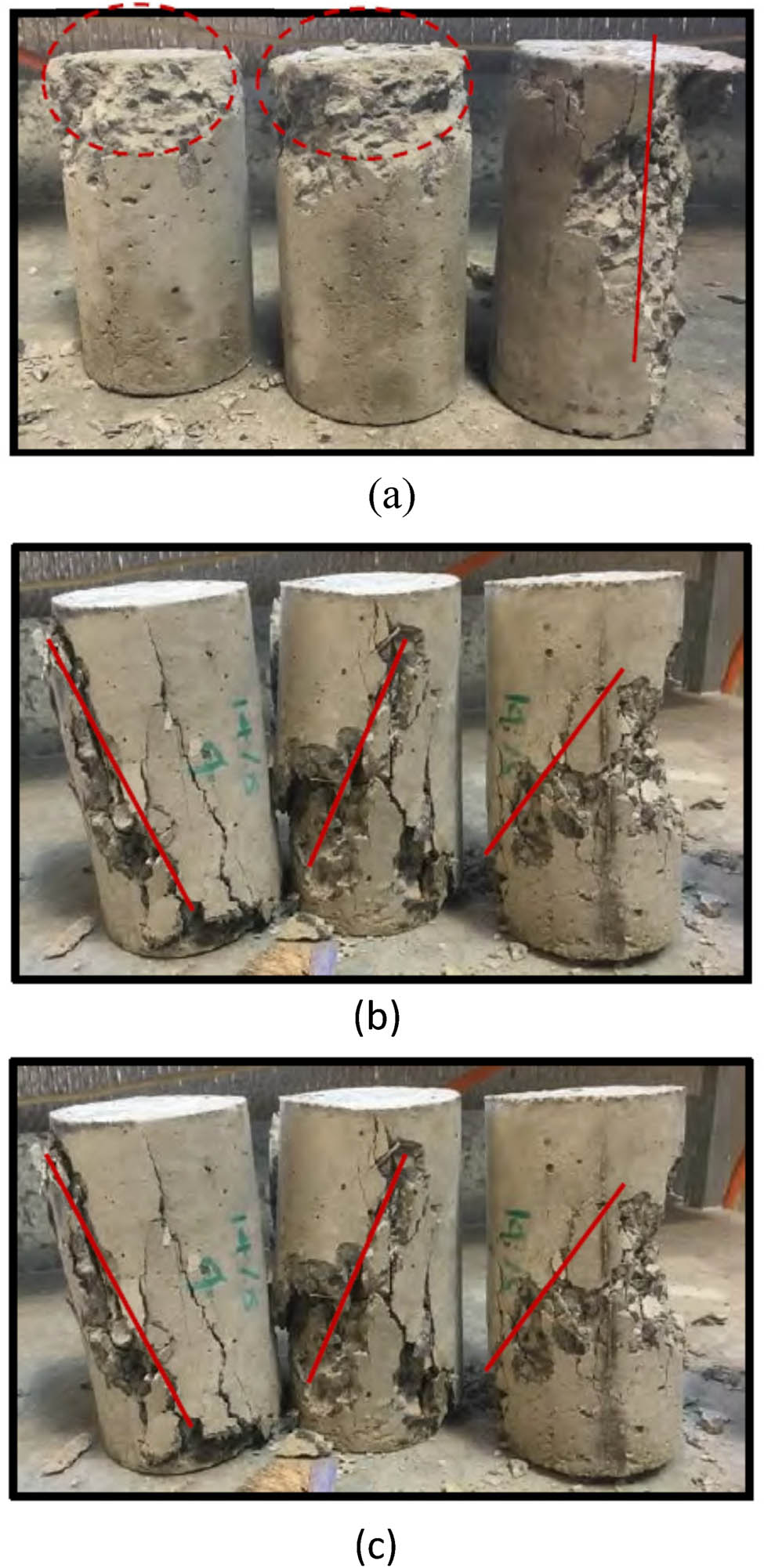
Fibers enhance flexural strength and substantially improve toughness. In trials with polypropylene–BF-reinforced concrete, the incorporation of fibers enhanced the material’s flexural strength [155]. Under bending stress, fibers significantly decreased fracture propagation, exhibited increased ductility, and hence enhanced the material’s toughness (Table 11). They also provide a convoluted fracture propagation pathway. This augments resistance to fracture propagation and improves the overall toughness of concrete. In contrast to traditional concrete, hybrid fiber concrete exhibits more uniform cracking, hence diminishing localized crack development and enhancing energy dissipation. Test findings indicate that hybrid fibers can markedly improve the fracture toughness of concrete.
| Fiber concentration | Crack pattern |
|---|---|
| Without fiber and PPF-based specimens (compressive strength): |
 |
|
|
| Hybrid fiber (PPF + steel): |
 |
|
|
| Hybrid fiber (PPF + steel after flexural strength test) |
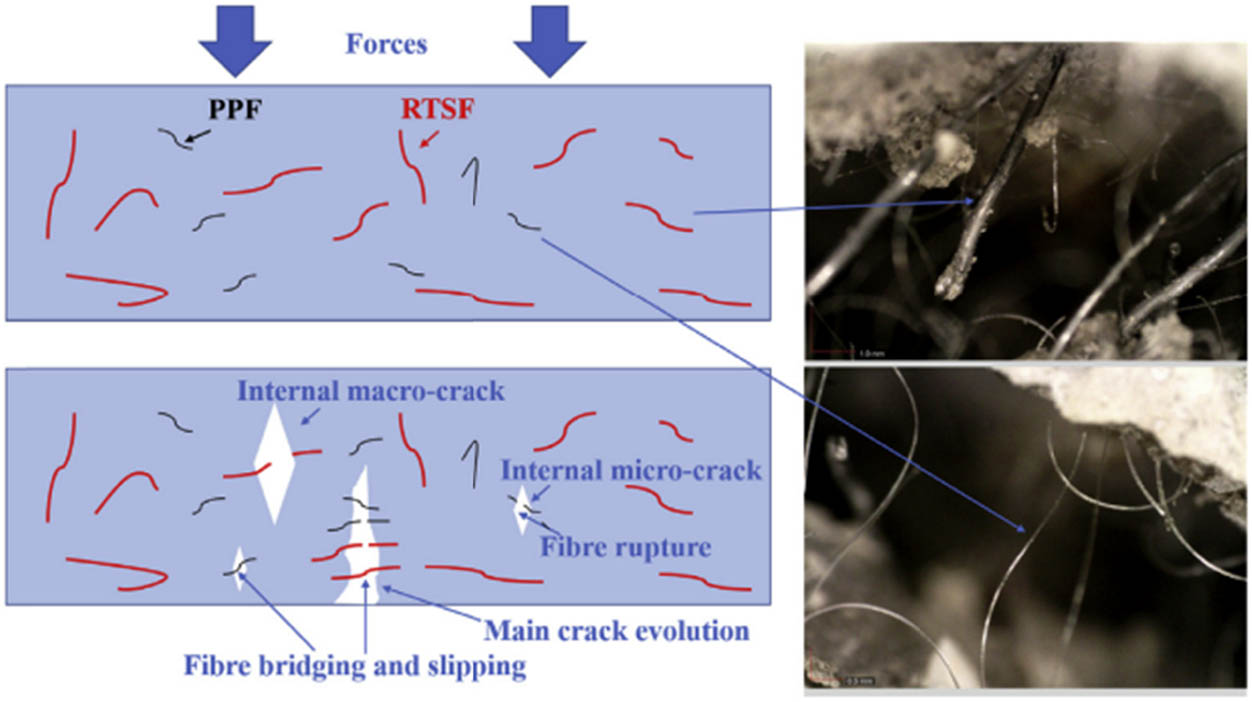 |
The flexural schematic diagram in Table 11 illustrates the primary fiber bridging process of hybrid fiber-reinforced concrete under flexural loading: Initial loading causes interior micro or macro fractures due to inherent flaws and shrinking, but no outward major cracks form [156]. Randomly dispersed fibers can bridge cracks and relieve matrix tension. Due to its poorer matrix contact and lower tensile characteristics, PPF can only withstand the formation of tiny microcracks, resulting in lower pull-out loads. Loading causes the primary fracture to propagate, while fiber bridging enhances flexural behavior. Fiber sliding and de-bonding may occur at the PPF–matrix interface due to minimal contact between fiber and the matrix. Fiber rupture occurs when stress exceeds the reinforcing limit and the fiber is strongly attached to the matrix (e.g., at the steel fiber–matrix contact). Both approaches can improve post-cracking performance, particularly energy absorption capacity. However, energy absorption depends on parameters like fiber quantity and spacing surrounding the fracture. Overall, fiber behavior significantly improves FRC flexural behavior, with greater enhancement when more fibers align perpendicular to the loading direction.
3.4 Stress–strain behavior
Wu et al. [159] suggested that the ductility of core concrete can be increased through a combination of transverse reinforcement and fiber-reinforced lightweight concrete. Ductility refers to the ability of a material to deform under stress without breaking. In the case of concrete columns, ductility is important because it allows the column to absorb energy during an earthquake or other severe loading event without collapsing. Wu et al. [159] also noted that columns reinforced with fibers saw a 50% increase in ductility when the spiral spacing was reduced from 45 mm to 30 mm. This decrease suggests that the use of fiber-reinforced concrete can be an effective method for increasing the ductility of concrete columns. The reduction in spiral spacing likely contributed to the increased ductility by increasing the amount of transverse reinforcement in the column. However, Wu et al. [159] also noted that unreinforced columns saw almost no benefit from the change of spiral spacing. This finding highlights the importance of reinforcement in increasing the ductility of concrete columns. Without reinforcement, the concrete may not be able to withstand the forces acting on it during a severe loading event. Finally, no remarkable increase in peak stress in the column was observed due to the reduction in spiral spacing. This consideration is crucial because excessive stress can lead to the failure of the column. The fact that the difference between the two tie spaces was negligible suggests that the reduction in spiral spacing did not considerably increase the stress on the column. Overall, Wu et al. [159] suggested that a combination of transverse reinforcement and fiber-reinforced lightweight concrete can be an effective method for increasing the ductility of concrete columns. However, it also highlights the importance of proper reinforcement and the need to avoid excessive stress on the column.
Libre et al. [44] concluded that PP fiber did not affect concrete compressive strength. PP fiber slightly improved the concrete’s energy absorption and durability under compression. Moreover, Libre et al. [44] highlighted that the primary objective of adding fiber to LWC is to enhance its ductility and postpeak behavior. In this regard, PP and steel fiber can expand the ductility and postpeak behavior of the concrete. The descending part of stress–strain curves in concrete, which represents the postpeak behavior, is mainly affected by the addition of steel fiber. However, the ascending part of the curve, which represents the elastic behavior of the concrete, is less influenced by the addition of steel fiber. In summary, Libre et al. [44] suggested that the addition of fiber can remarkably develop the compressive strength, ductility, and postpeak behavior of LWC. Although PP fiber have a relatively minor effect on the compressive strength of the concrete, they can enhance its energy absorption and toughness characteristics.
An increase in the foam agent content reduces mass loss and increases compressive and flexural strengths of foam concrete when the material is subjected to high temperatures, cooled by air and water [160]. High temperature has less of an effect on foam concrete because of the enhanced porosity made possible by the improved foam agent content. Cement content has a considerable effect on the compressive and flexural strengths of foam concrete, with more cement content resulting in lower mass loss and higher strengths across the board. However, Gencel et al. [160] stated that a higher proportion of PPF increases the mass loss of foam concrete. Cracks and interconnected pores can be seen in SEM images of samples after they have been heated to high temperatures and subjected to thermal stresses caused by the breakdown of calcium silicate phases.
PPF fabric-reinforced concrete had a uniaxial compressive constitutive model, which was established by Qin et al. [3]. The correlation coefficients b, αa, λ, β, and αd for PPF-reinforced concrete at varying ages and fabric contents were calculated using the constitutive equation for uniaxial compression (Figure 22). The stress–strain curve of PPF fabric-reinforced concrete was also investigated, as reported by Qin et al. [3]. The falling part of the stress–strain curve was more affected by the fabric dosage and curing age than the growing half. This result is a direct result of the fact that as fabric percentage increases, the material’s toughness and the value of d drops increase, and the steepness of the curve’s decline is mitigated. As the curing age of a material increases, its internal water content drops, its brittleness grows, its αd value increases, and the slope of the corresponding descending section of the curve steepens.
![Figure 22
Diagram illustrating the constitutive relationship that is impacted by the age and amount of fabric and fiber [3].](/document/doi/10.1515/rams-2025-0141/asset/graphic/j_rams-2025-0141_fig_022.jpg)
Diagram illustrating the constitutive relationship that is impacted by the age and amount of fabric and fiber [3].
3.5 Ductility
Orouji and Najaf [142] found that the glass fiber-reinforced plastic (GFRP) rebars had lower flexural strength than steel rebars, which resulted in lower ductility and overall strength in specimens reinforced with GFRP rebars. However, the addition of fiber proved to be beneficial in compensating for this weakness. By increasing the amount of fibers used, the ductility of hybrid beams was enhanced. For example, using 1.5% fiber in combination with GFRP rebars resulted in a fully ductile beam that exhibited flexural strength similar to that of specimens reinforced solely with fiber but without any rebars.
Orouji and Najaf [142] highlighted the importance of carefully considering the properties of different reinforcement materials and how they interact with one another. While GFRP rebars may have certain advantages over traditional steel rebars, their lower flexural strength can affect the overall performance of a reinforced structure. However, by using a combination of materials and adjusting the amount of fibers used, a balanced and effective reinforcement system can be achieved.
Fiber reinforcement is a commonly used method to enhance the properties of lightweight concrete, such as its flexural capacity, toughness, post-failure ductility, and crack control. Among the different types of fiber available, PPF is often preferred for its effectiveness in providing thermal insulation and improving ductility. PPF is also popular due to its affordability and excellent resistance to environmental factors [86,161].
Wang et al. [86] mentioned that the addition of fiber to lightweight concrete can help mitigate the inherent weaknesses of this material, such as its low tensile strength and brittle behavior. IN particular, PPF can improve the toughness of the concrete by absorbing energy during deformation and preventing the propagation of cracks. This improvement can lead to a more ductile behavior, which is desirable in many applications, including earthquake-resistant construction. In summary, fiber reinforcement, especially using the PP fiber, is a widely recognized and effective method for improving the properties of lightweight concrete. Its cost effectiveness, resistance to environmental factors, and ability to enhance ductility and crack control make it a popular choice in the construction industry.
Numerous parameters, including high-performance PPF content, stirrup ratio, and shear span to depth ratio, can affect the failure mechanism of LWC beams, according to Xiang et al. [162]. It has been proven that adding more high-performance PPF to the concrete mix will effectively halt the spread of diagonal fractures. By altering the fiber content and stirrup ratio, the specimen’s failure mode can also be changed. When specimens break under diagonal tension with evident brittleness, they can change from shear compression failure to shear bending failure with enhanced ductility. This change demonstrates how fiber and stirrups may help a design achieve a less brittle failure mode, which is frequently desired in structural engineering.
Ekanayake et al. [163] reported that fiber added to concrete can boost the material’s strength and flexibility. To this end, this research looked into the outcomes of reinforcing concrete beams with either macrosynthetic polypropylene (MSPP) fiber, PPF, or both. Findings revealed that the addition of MSPP fiber enhanced beam load capacity by 13%, the addition of MSPP and PPF raised it by 6%, and the addition of PPF alone increased it by 5%. In addition to enhancing the initial stiffness by 3% and the ductility by 12%, MSPP fiber was added to the beam to make it stronger than the fiber-reinforced concrete alternative. However, PP fiber had only a moderate effect on the beam’s ductility and initial stiffness.
The beams’ failure mode varied depending on the length of the lap splices. Failure occurred before the expected performance was reached when the lap splice length was insufficient (20ϕ or 0.5 lb). However, when a sufficient amount of lap splice (40ϕ or 1.0 lb) was used, the beams did not fail in the middle even when subjected to a displacement of 130 mm. The beams in this instance behaved ductilely. Overall, Ekanayake et al. [163] demonstrated that the addition of MSPP and PP fiber can improve the load capacity and ductility of concrete beams. However, the effect of PP fiber on the ductility and initial stiffness was found to be limited. Additionally, providing sufficient lap splice length is crucial to ensuring the desired performance of the beams.
4 Fabrication techniques and the preparation process of PPF-reinforced lightweight concrete
The fabrication of PPF-reinforced lightweight concrete involves a series of controlled procedures aimed at ensuring homogeneity, workability, and optimal performance of the final composite. The process generally comprises the following stages.
The primary constituents include OPC, lightweight aggregates (such as expanded shale or perlite), PPFs, water, and chemical admixtures as needed [48]. Expanded clay, shale, perlite, or pumice are selected for their low density and adequate strength. The moisture content and absorption characteristics of these aggregates must be accounted for during mix design. The characteristics of PPF, such as the length, aspect ratio, and tensile strength, are selected based on the specific mechanical and durability requirements of the application. PPFs are used in dosages typically ranging from 0.1 to 1.0% by volume of concrete. The length of the fibers (commonly 6–19 mm) and their aspect ratio significantly influence the mechanical performance.
To ensure uniform distribution of the PPFs and to prevent clumping or balling, a sequential mixing method is typically adopted. Initially, the dry components, cement and lightweight aggregates, are thoroughly mixed. PPFs are then gradually introduced and blended until a uniform fiber distribution is observed. Subsequently, water and any required admixtures (e.g., superplasticizers or air-entraining agents) are added to achieve the desired consistency and workability.
The freshly mixed concrete is cast into molds of standard geometry. Due to the presence of lightweight aggregates and fibers, care must be taken during placement to avoid segregation. Gentle vibration or tamping may be employed to facilitate proper compaction and eliminate entrapped air.
Curing is a critical phase to ensure adequate hydration and microstructural development. Specimens are typically cured under moist conditions or water-immersed environments at ambient temperatures for periods ranging from 7 to 28 days, depending on the intended mechanical testing schedule or application.
It is imperative that each step of the preparation process is rigorously controlled to ensure the reproducibility and performance reliability of PPF-reinforced lightweight concrete. Proper integration of fibers within the matrix contributes significantly to enhanced crack resistance, improved ductility, and overall durability of the concrete composite.
5 Conclusions
The physicochemical and microstructural properties of PPF have been analyzed in the present work. The following are the key conclusions after reviewing sustainability, strengths, and other properties that affect PF:
A form of reinforcing material called PPF can be utilized to improve the concrete’s mechanical qualities. Microfiber and macrofiber PPF come in two varieties with various lengths and uses. Macrofibers can replace traditional reinforcing in the form of steel bars and transmit loads acting on the structure, while microfibers can be employed in place of mesh to avoid cracks. PPF can also improve concrete’s ductility and post-cracking performance, allowing it to withstand a greater load, despite ongoing deformations. Overall, PPF is a superb material to reinforce the mechanical characteristics of lightweight concrete without remarkably increasing its corresponding thermal conductivity.
The nonsticky nature of the fiber and the presence of voids in the matrix can lead to weak bonding and poor mechanical properties. Fibrillated twist PPF with a larger diameter has higher tensile strength but is less flexible than fibers with a smaller diameter. BF has better bonding performance with shotcrete matrices than PPF. Additionally, smaller fibers tend to prevent cracks from starting, whereas larger fibers prevent cracks from spreading and penetrating at a macroscopic scale.
ULHSC reinforced with PPF showed good dynamic mechanical capabilities, despite weak bonding between the fiber and matrix. Overall, selecting the appropriate fiber type and optimizing the fiber content is crucial to achieving the desired mechanical properties of fiber-reinforced concrete.
Based on the results that were presented, the flexural and compressive strength values of using PPF into LWC showed that the compressive values increased by the addition of PPF and that the best values were achieved by using a percentage of PPF in lightweight concrete that ranged between 0.5 and 1%. The findings also indicated that the flexural values were increased by adding PPF, and the best values were obtained by using a percentage of PPF ranging between 0.5 and 1%, which reflected excellent results on compressive and flexural values after 28 days. These findings were reflected by the excellent results.
PPF–LWC displays a ductile failure mode due to the improved toughness and crack resistance provided by the fiber. The addition of PPF also enhances the material’s ability to manage microcracks, which improve its overall durability and resistance to various forms of damage in relation to stress–strain and ductility behavior. However, the residual mechanical properties of PF lightweight concrete may be reduced when exposed to high temperatures.
In conclusion, fiber reinforcement, particularly the use of PPF, is an operational technique for enhancing the ductility behavior of lightweight concrete. The addition of fiber can enhance the toughness and crack control of the material, resulting in a more ductile behavior. Increasing the amount of fiber and stirrup ratio can also transform the failure mode of specimens from brittle diagonal tension failure to more ductile shear bending failure. The properties of different reinforcement materials and their interactions with one another must be carefully considered to achieve a balanced and effective reinforcement system for lightweight concrete structures.
6 Recommendations
The use of PPF in LWC is likely, according to the previous studies. The following are recommendations and suggested directions for future research:
Conduct research on the long-term behavior of PF lightweight concrete under various environmental conditions, including freeze–thaw cycles, corrosion, and exposure to chemicals.
Assess the PF lightweight concrete’s resilience and sustainability, as well as its capacity to lower environmental impact and increase energy efficiency.
Examine how different fiber types – such as synthetic, natural, and hybrid – and their combinations with PF affect the characteristics and functionality of lightweight concrete.
Perform a life cycle cost study to assess the affordability of employing PF lightweight concrete vs other traditional materials and find areas for cost- and profit-saving potential.
Create guidelines and standards, including suggestions for mix design, quality assurance, and performance testing, for the manufacture, testing, and use of PF lightweight concrete.
Analyze the possible uses of PF–LWC in a variety of industries, such as geotechnical engineering, construction, and infrastructure, and assess its viability for large-scale projects.
Acknowledgments
The authors extend their appreciation to Prince Sattam bin Abdulaziz University for funding this research work through the project number (PSAU/2024/01/31676).
-
Funding information: This study was supported by the Prince Sattam bin Abdulaziz University (project number 2024/01/31676).
-
Author contributions: All authors have accepted responsibility for the entire content of this manuscript and approved its submission.
-
Conflict of interest: The authors state no conflict of interest.
-
Data availability statement: Data sharing is not applicable to this article as no datasets were generated or analyzed during the current study.
References
[1] Sadeghi-Nik, A., J. Berenjian, A. Bahari, A. S. Safaei, and M. Dehestani. Modification of microstructure and mechanical properties of cement by nanoparticles through a sustainable development approach. Construction and Building Materials, Vol. 155, 2017, pp. 880–891.10.1016/j.conbuildmat.2017.08.107Search in Google Scholar
[2] Cai, J., J. Pan, G. Li, and M. Elchalakani. Behaviors of eccentrically loaded ECC-encased CFST columns after fire exposure. Engineering Structures, Vol. 289, 2023, id. 116258.10.1016/j.engstruct.2023.116258Search in Google Scholar
[3] Qin, Y., Y. Li, X. Zhang, and H. Zhou. Constitutive model of polypropylene-fiber-fabric-reinforced concrete under uniaxial compression and index conversion of mechanical properties. Construction and Building Materials, Vol. 347, 2022, id. 128508.10.1016/j.conbuildmat.2022.128508Search in Google Scholar
[4] Hossain, M. A., S. D. Datta, A. S. M. Akid, M. H. R. Sobuz, and M. S. Islam. Exploring the synergistic effect of fly ash and jute fiber on the fresh, mechanical and non-destructive characteristics of sustainable concrete. Heliyon, Vol. 9, No. 11, 2023, id. e21708.10.1016/j.heliyon.2023.e21708Search in Google Scholar PubMed PubMed Central
[5] Hafizyar, R. and M. H. Dheyaaldin. Concrete technology and sustainable development from past to future, sustainable structures and materials. An International Journal, Vol. 2, No. 1, 2019, pp. 1–13.Search in Google Scholar
[6] Zhou, S., C. Lu, X. Zhu, and F. Li. Preparation and characterization of high-strength geopolymer based on BH-1 lunar soil simulant with low alkali content. Engineering, Vol. 7, No. 11, 2021, pp. 1631–1645.10.1016/j.eng.2020.10.016Search in Google Scholar
[7] Shi, T., Y. Liu, Z. Hu, M. Cen, C. Zeng, J. Xu, et al. Deformation performance and fracture toughness of carbon nanofiber-modified cement-based materials. ACI Materials Journal, Vol. 119, No. 5, 2022, pp. 119–128.10.14359/51735976Search in Google Scholar
[8] Haq, I., S. D. Datta, M. H. R. Sobuz, F. S. Aditto, M. S. Abdullah, F. M. T. Rahman, et al. Synergistic effect of fly ash and stone dust on foam concrete under saline environment: Mechanical, non-destructive and machine learning approaches. Advances in Concrete Construction, Vol. 18, No. 4, 2024, id. 237.Search in Google Scholar
[9] Li, Z., M. Gao, Z. Lei, L. Tong, J. Sun, Y. Wang, et al. Ternary cementless composite based on red mud, ultra-fine fly ash, and GGBS: Synergistic utilization and geopolymerization mechanism. Case Studies in Construction Materials, Vol. 19, 2023, id. e02410.10.1016/j.cscm.2023.e02410Search in Google Scholar
[10] Tayeh, B. A., R. Alyousef, H. Alabduljabbar, and A. Alaskar. Recycling of rice husk waste for a sustainable concrete: A critical review. Journal of Cleaner Production, Vol. 312, 2021, id. 127734.10.1016/j.jclepro.2021.127734Search in Google Scholar
[11] Faried, A. S., S. A. Mostafa, B. A. Tayeh, and T. A. Tawfik. The effect of using nano rice husk ash of different burning degrees on ultra-high-performance concrete properties. Construction and Building Materials, Vol. 290, 2021, id. 123279.10.1016/j.conbuildmat.2021.123279Search in Google Scholar
[12] Naik, T. R. Sustainability of cement and concrete industries. Proceedings of the International Conference on Achieving Sustainability in Construction, Citeseer, 2005, pp. 141–150.10.1680/asic.34044.0017Search in Google Scholar
[13] Shahidan, S., B. A. Tayeh, A. Jamaludin, N. Bahari, S. Mohd, N. Z. Ali, et al. Physical and mechanical properties of self-compacting concrete containing superplasticizer and metakaolin. IOP Conference Series: Materials Science and Engineering, IOP Publishing, 2017, id. 012004.10.1088/1757-899X/271/1/012004Search in Google Scholar
[14] Tawfik, T. A., D. M. AlSaffar, B. A. Tayeh, K. A. Metwally, and I. M. ElKattan. Role of expanded clay aggregate, metakaolin and silica fume on the of modified lightweight concrete properties. Geosystem Engineering, Vol. 24, No. 3, 2021, pp. 145–156.10.1080/12269328.2021.1887002Search in Google Scholar
[15] Bahari, A., J. Berenjian, and A. Sadeghi-Nik. Modification of Portland cement with nano SiC. Proceedings of the National Academy of Sciences, India Section A: Physical Sciences, Vol. 86, No. 3, 2016, pp. 323–331.10.1007/s40010-015-0244-ySearch in Google Scholar
[16] Bahari, A., A. Sadeghi-Nik, F. U. A. Shaikh, A. Sadeghi-Nik, E. Cerro-Prada, E. Mirshafiei, et al. Experimental studies on rheological, mechanical, and microstructure properties of self-compacting concrete containing perovskite nanomaterial. Structural Concrete, Vol. 23, No. 1, 2022, pp. 564–578.10.1002/suco.202000548Search in Google Scholar
[17] Pezzotti, G. and M. Sakai. Effect of a silicon carbide “nano‐dispersion” on the mechanical properties of silicon nitride. Journal of the American Ceramic Society, Vol. 77, No. 11, 1994, pp. 3039–3041.10.1111/j.1151-2916.1994.tb04545.xSearch in Google Scholar
[18] Beigi, M. H., J. Berenjian, O. Lotfi Omran, A. Sadeghi Nik, and I. M. Nikbin. An experimental survey on combined effects of fibers and nanosilica on the mechanical, rheological, and durability properties of self-compacting concrete. Materials & Design, Vol. 50, 2013, pp. 1019–1029.10.1016/j.matdes.2013.03.046Search in Google Scholar
[19] Tayeh, B. A., B. Bayrak, A. M. Zeyad, G. Kaplan, A. Öz, and A. C. Aydın. Effect of hybrid fibers and high temperatures on the properties of geopolymer composites based on slag, metakaolin, and natural zeolite. Construction and Building Materials, Vol. 451, 2024, id. 138898.10.1016/j.conbuildmat.2024.138898Search in Google Scholar
[20] Carpio, M., J. Roldán-Fontana, R. Pacheco-Torres, and J. Ordóñez. Construction waste estimation depending on urban planning options in the design stage of residential buildings. Construction and Building Materials, Vol. 113, 2016, pp. 561–570.10.1016/j.conbuildmat.2016.03.061Search in Google Scholar
[21] Datta, S. D., R. M. Jewel, A. M. Nafe, M. N. Jahan, and S. Ahmed. Investigation on the generation of construction wastes in Bangladesh. International Journal of Construction Management, Vol. 23, No. 13, 2023, pp. 2260–2269.10.1080/15623599.2022.2050977Search in Google Scholar
[22] Wu, H., J. Xu, D. Yang, and Z. Ma. Utilizing thermal activation treatment to improve the properties of waste cementitious powder and its newmade cementitious materials. Journal of Cleaner Production, Vol. 322, 2021, id. 129074.10.1016/j.jclepro.2021.129074Search in Google Scholar
[23] Datta, S. D., M. H. R. Sobuz, N. M. Sutan, and S. Islam. Structural sustainable recycled aggregate concrete production under environmental conditions. International Journal of Integrated Engineering, Vol. 15, No. 6, 2023, pp. 64–71.10.30880/ijie.2023.15.06.007Search in Google Scholar
[24] Nedeljković, M., J. Visser, B. Šavija, S. Valcke, and E. Schlangen. Use of fine recycled concrete aggregates in concrete: A critical review. Journal of Building Engineering, Vol. 38, 2021, id. 102196.10.1016/j.jobe.2021.102196Search in Google Scholar
[25] Datta, S. D., M. H. R. Sobuz, A. S. M. Akid, and S. Islam. Influence of coarse aggregate size and content on the properties of recycled aggregate concrete using non-destructive testing methods. Journal of Building Engineering, Vol. 61, 2022, id. 105249.10.1016/j.jobe.2022.105249Search in Google Scholar
[26] Hussein, T. A., M. H. Dheyaaldin, M. A. Mosaberpanah, Y. M. Ahmed, H. A. Mohammed, R. R. Omer, et al. Chemical resistance of alkali-activated mortar with nano silica and polypropylene fiber. Construction and Building Materials, Vol. 363, 2023, id. 129847.10.1016/j.conbuildmat.2022.129847Search in Google Scholar
[27] Cheeseman, C., A. Makinde, and S. Bethanis. Properties of lightweight aggregate produced by rapid sintering of incinerator bottom ash. Resources, Conservation and Recycling, Vol. 43, No. 2, 2005, pp. 147–162.10.1016/j.resconrec.2004.05.004Search in Google Scholar
[28] Singh, B., G. Ishwarya, M. Gupta, and S. Bhattacharyya. Geopolymer concrete: A review of some recent developments. Construction and Building Materials, Vol. 85, 2015, pp. 78–90.10.1016/j.conbuildmat.2015.03.036Search in Google Scholar
[29] Davidovits, J. Geopolymer chemistry and applications, 5th edn, J. Davidovits.–Saint-Quentin, Geopolymer Institute, L-Saint-Quentin, France (Issue January 2008), 2020.Search in Google Scholar
[30] Robayo-Salazar, R., J. Mejía-Arcila, R. M. de Gutiérrez, and E. Martínez. Life cycle assessment (LCA) of an alkali-activated binary concrete based on natural volcanic pozzolan: A comparative analysis to OPC concrete. Construction and Building Materials, Vol. 176, 2018, pp. 103–111.10.1016/j.conbuildmat.2018.05.017Search in Google Scholar
[31] Akbar, A., F. Farooq, M. Shafique, F. Aslam, R. Alyousef, and H. Alabduljabbar. Sugarcane bagasse ash-based engineered geopolymer mortar incorporating propylene fibers. Journal of Building Engineering, Vol. 33, 2021, id. 101492.10.1016/j.jobe.2020.101492Search in Google Scholar
[32] Zhang, B., Y. Feng, J. Xie, J. He, T. Yu, C. Cai, et al. Compressive behaviours, splitting properties, and workability of lightweight cement concrete: The role of fibres. Construction and Building Materials, Vol. 320, 2022, id. 126237.10.1016/j.conbuildmat.2021.126237Search in Google Scholar
[33] Vickers, N. J. Animal communication: When i’m calling you, will you answer too? Current biology, Vol. 27, No. 14, 2017, pp. R713–R715.10.1016/j.cub.2017.05.064Search in Google Scholar PubMed
[34] Maglad, A. M., M. A. Othuman Mydin, S. Dip Datta, and B. A. Tayeh. Assessing the mechanical, durability, thermal and microstructural properties of sea shell ash based lightweight foamed concrete. Construction and Building Materials, Vol. 402, 2023, id. 133018.10.1016/j.conbuildmat.2023.133018Search in Google Scholar
[35] Maglad, A. M., M. A. O. Mydin, S. D. Datta, I. S. Abbood, and B. A. Tayeh. Impact of anionic surfactant-based foaming agents on the properties of lightweight foamed concrete. Construction and Building Materials, Vol. 438, 2024, id. 137119.10.1016/j.conbuildmat.2024.137119Search in Google Scholar
[36] Adhikary, S. K., Ž. Rudžionis, and D. Vaičiukynienė. Development of flowable ultra-lightweight concrete using expanded glass aggregate, silica aerogel, and prefabricated plastic bubbles. Journal of Building Engineering, Vol. 31, 2020, id. 101399.10.1016/j.jobe.2020.101399Search in Google Scholar
[37] Xie, J., J. Liu, F. Liu, J. Wang, and P. Huang. Investigation of a new lightweight green concrete containing sludge ceramsite and recycled fine aggregates. Journal of Cleaner Production, Vol. 235, 2019, pp. 1240–1254.10.1016/j.jclepro.2019.07.012Search in Google Scholar
[38] Yan, J.-B., J.-Y. Wang, J. R. Liew, and X. Qian. Applications of ultra-lightweight cement composite in flat slabs and double skin composite structures. Construction and Building Materials, Vol. 111, 2016, pp. 774–793.10.1016/j.conbuildmat.2016.02.122Search in Google Scholar
[39] Datta, S. D., A. S. Nirjona, M. R. Azam, M. S. Shah, and M. S. Abdullah. Evaluating the properties of mussel sea shell lightweight foam concrete: Emphasizing sustainability and waste reduction, AIP Publishing, Melville, New York, USA.Search in Google Scholar
[40] Aaron, G. H., M. A. O. Mydin, D. E. Tobbala, P. Jagadesh, Y. O. Özkılıç, S. D. Datta, et al. Experimental and machine learning approaches to investigate the properties of foamed concrete made with surkhi and dolomitic limestone as cement replacements. Multiscale and Multidisciplinary Modeling, Experiments and Design, Vol. 8, No. 2, 2025, id. 151.10.1007/s41939-025-00730-5Search in Google Scholar
[41] Sobuz, M. H., S. D. Datta, A. S. Akid, V. W. Tam, S. Islam, M. J. Rana, et al. Evaluating the effects of recycled concrete aggregate size and concentration on properties of high-strength sustainable concrete. Journal of King Saud University - Engineering Sciences, Vol. 36, No. 3, 2024, pp. 216–227.Search in Google Scholar
[42] Mottakin, M., S. D. Datta, M. M. Hossain, M. H. R. Sobuz, S. M. A. Rahman, and M. Alharthai. Evaluation of textile effluent treatment plant sludge as supplementary cementitious material in concrete using experimental and machine learning approaches. Journal of Building Engineering, Vol. 96, 2024, id. 110627.10.1016/j.jobe.2024.110627Search in Google Scholar
[43] Ma, H., C. Cui, X. Li, and S. Hu. Study on mechanical properties of steel fiber reinforced autoclaved lightweight shell-aggregate concrete. Materials & Design (1980-2015), Vol. 52, 2013, pp. 565–571.10.1016/j.matdes.2013.05.086Search in Google Scholar
[44] Libre, N. A., M. Shekarchi, M. Mahoutian, and P. Soroushian. Mechanical properties of hybrid fiber reinforced lightweight aggregate concrete made with natural pumice. Construction and Building Materials, Vol. 25, No. 5, 2011, pp. 2458–2464.10.1016/j.conbuildmat.2010.11.058Search in Google Scholar
[45] Li, J., J. Niu, C. Wan, X. Liu, and Z. Jin. Comparison of flexural property between high performance polypropylene fiber reinforced lightweight aggregate concrete and steel fiber reinforced lightweight aggregate concrete. Construction and Building Materials, Vol. 157, 2017, pp. 729–736.10.1016/j.conbuildmat.2017.09.149Search in Google Scholar
[46] Mastali, M., P. Kinnunen, H. Isomoisio, M. Karhu, and M. Illikainen. Mechanical and acoustic properties of fiber-reinforced alkali-activated slag foam concretes containing lightweight structural aggregates. Construction and Building Materials, Vol. 187, 2018, pp. 371–381.10.1016/j.conbuildmat.2018.07.228Search in Google Scholar
[47] Posi, P., C. Teerachanwit, C. Tanutong, S. Limkamoltip, S. Lertnimoolchai, V. Sata, et al. Lightweight geopolymer concrete containing aggregate from recycle lightweight block. Materials & Design (1980-2015), Vol. 52, 2013, pp. 580–586.10.1016/j.matdes.2013.06.001Search in Google Scholar
[48] Cunha, F. G., Z. L. M. Sampaio, and A. E. Martinelli. Fiber-reinforced lightweight concrete formulated using multiple residues. Construction and Building Materials, Vol. 308, 2021, id. 125035.10.1016/j.conbuildmat.2021.125035Search in Google Scholar
[49] Sari, D. and A. Pasamehmetoglu. The effects of gradation and admixture on the pumice lightweight aggregate concrete. Cement and Concrete Research, Vol. 35, No. 5, 2005, pp. 936–942.10.1016/j.cemconres.2004.04.020Search in Google Scholar
[50] Domagała, L. Modification of properties of structural lightweight concrete with steel fibres. Journal of Civil Engineering and Management, Vol. 17, No. 1, 2011, pp. 36–44.10.3846/13923730.2011.553923Search in Google Scholar
[51] Campione, G. and L. La Mendola. Behavior in compression of lightweight fiber reinforced concrete confined with transverse steel reinforcement. Cement and Concrete Composites, Vol. 26, No. 6, 2004, pp. 645–656.10.1016/S0958-9465(03)00047-7Search in Google Scholar
[52] Chen, B. and J. Liu. Contribution of hybrid fibers on the properties of the high-strength lightweight concrete having good workability. Cement and Concrete Research, Vol. 35, No. 5, 2005, pp. 913–917.10.1016/j.cemconres.2004.07.035Search in Google Scholar
[53] Güneyisi, E., M. Gesoglu, T. Özturan, and S. İpek. Fracture behavior and mechanical properties of concrete with artificial lightweight aggregate and steel fiber. Construction and Building Materials, Vol. 84, 2015, pp. 156–168.10.1016/j.conbuildmat.2015.03.054Search in Google Scholar
[54] Grabois, T. M., G. C. Cordeiro, and R. D. Toledo Filho. Fresh and hardened-state properties of self-compacting lightweight concrete reinforced with steel fibers. Construction and Building Materials, Vol. 104, 2016, pp. 284–292.10.1016/j.conbuildmat.2015.12.060Search in Google Scholar
[55] Nadesan, M. S. and P. Dinakar. Structural concrete using sintered flyash lightweight aggregate: A review. Construction and Building Materials, Vol. 154, 2017, pp. 928–944.10.1016/j.conbuildmat.2017.08.005Search in Google Scholar
[56] Zhu, C., J. Niu, J. Li, C. Wan, and J. Peng. Effect of aggregate saturation degree on the freeze–thaw resistance of high performance polypropylene fiber lightweight aggregate concrete. Construction and Building Materials, Vol. 145, 2017, pp. 367–375.10.1016/j.conbuildmat.2017.04.039Search in Google Scholar
[57] Suksiripattanapong, C., S. Horpibulsuk, P. Chanprasert, P. Sukmak, and A. Arulrajah. Compressive strength development in fly ash geopolymer masonry units manufactured from water treatment sludge. Construction and Building Materials, Vol. 82, 2015, pp. 20–30.10.1016/j.conbuildmat.2015.02.040Search in Google Scholar
[58] Suksiripattanapong, C., T. Srijumpa, S. Horpibulsuk, P. Sukmak, A. Arulrajah, and Y. J. Du. Compressive strengths of water treatment sludge-fly ash geopolymer at various compression energies. Lowland Technology International, Vol. 17, No. 3, 2015, pp. 147–156.10.14247/lti.17.3_147Search in Google Scholar
[59] Xie, T. and T. Ozbakkaloglu. Behavior of low-calcium fly and bottom ash-based geopolymer concrete cured at ambient temperature. Ceramics International, Vol. 41, No. 4, 2015, pp. 5945–5958.10.1016/j.ceramint.2015.01.031Search in Google Scholar
[60] Suksiripattanapong, C., K. Krosoongnern, J. Thumrongvut, P. Sukontasukkul, S. Horpibulsuk, and P. Chindaprasirt. Properties of cellular lightweight high calcium bottom ash-portland cement geopolymer mortar. Case Studies in Construction Materials, Vol. 12, 2020, id. e00337.10.1016/j.cscm.2020.e00337Search in Google Scholar
[61] Ismail, I., S. A. Bernal, J. L. Provis, R. San Nicolas, S. Hamdan, and J. S. van Deventer. Modification of phase evolution in alkali-activated blast furnace slag by the incorporation of fly ash. Cement and Concrete Composites, Vol. 45, 2014, pp. 125–135.10.1016/j.cemconcomp.2013.09.006Search in Google Scholar
[62] Kazmi, S. M., S. Abbas, M. A. Saleem, M. J. Munir, and A. Khitab. Manufacturing of sustainable clay bricks: Utilization of waste sugarcane bagasse and rice husk ashes. Construction and Building Materials, Vol. 120, 2016, pp. 29–41.10.1016/j.conbuildmat.2016.05.084Search in Google Scholar
[63] Suksiripattanapong, C., R. Sakdinakorn, S. Tiyasangthong, N. Wonglakorn, C. Phetchuay, and W. Tabyang. Properties of soft Bangkok clay stabilized with cement and fly ash geopolymer for deep mixing application. Case Studies in Construction Materials, Vol. 16, 2022, id. e01081.10.1016/j.cscm.2022.e01081Search in Google Scholar
[64] Ranjbar, N., S. Talebian, M. Mehrali, C. Kuenzel, H. S. C. Metselaar, and M. Z. Jumaat. Mechanisms of interfacial bond in steel and polypropylene fiber reinforced geopolymer composites. Composites Science and Technology, Vol. 122, 2016, pp. 73–81.10.1016/j.compscitech.2015.11.009Search in Google Scholar
[65] Sukontasukkul, P., P. Pongsopha, P. Chindaprasirt, and S. Songpiriyakij. Flexural performance and toughness of hybrid steel and polypropylene fibre reinforced geopolymer. Construction and Building Materials, Vol. 161, 2018, pp. 37–44.10.1016/j.conbuildmat.2017.11.122Search in Google Scholar
[66] Chindaprasirt, P., T. Boonbamrung, A. Poolsong, and W. Kroehong. Effect of elevated temperature on polypropylene fiber reinforced alkali-activated high calcium fly ash paste. Case Studies in Construction Materials, Vol. 15, 2021, id. e00554.10.1016/j.cscm.2021.e00554Search in Google Scholar
[67] Yoosuk, P., C. Suksiripattanapong, P. Sukontasukkul, and P. Chindaprasirt. Properties of polypropylene fiber reinforced cellular lightweight high calcium fly ash geopolymer mortar. Case Studies in Construction Materials, Vol. 15, 2021, id. e00730.10.1016/j.cscm.2021.e00730Search in Google Scholar
[68] Afroughsabet, V., L. Biolzi, and T. Ozbakkaloglu. High-performance fiber-reinforced concrete: a review. Journal of Materials Science, Vol. 51, No. 14, 2016, pp. 6517–6551.10.1007/s10853-016-9917-4Search in Google Scholar
[69] Liu, H., M. Elchalakani, A. Karrech, S. Yehia, and B. Yang. High strength flowable lightweight concrete incorporating low C3A cement, silica fume, stalite and macro-polyfelin polymer fibres. Construction and Building Materials, Vol. 281, 2021, id. 122410.10.1016/j.conbuildmat.2021.122410Search in Google Scholar
[70] Massone, L. M. and F. Nazar. Analytical and experimental evaluation of the use of fibers as partial reinforcement in shotcrete for tunnels in Chile. Tunnelling and Underground Space Technology, Vol. 77, 2018, pp. 13–25.10.1016/j.tust.2018.03.027Search in Google Scholar
[71] Ortiz, C., P. Lillo, and M. Lopez. A lightweight fiber-based approach to reduce the risk of concrete detachment in shotcrete fortified tunnels. Construction and Building Materials, Vol. 270, 2021, id. 121453.10.1016/j.conbuildmat.2020.121453Search in Google Scholar
[72] Yew, M. K., H. B. Mahmud, B. C. Ang, and M. C. Yew. Influence of different types of polypropylene fibre on the mechanical properties of high-strength oil palm shell lightweight concrete. Construction and Building Materials, Vol. 90, 2015, pp. 36–43.10.1016/j.conbuildmat.2015.04.024Search in Google Scholar
[73] Ghanim, A. A. J., M. Amin, A. M. Zeyad, B. A. Tayeh, I. S. Agwa, and Y. Elsakhawy. Effect of polypropylene and glass fiber on properties of lightweight concrete exposed to high temperature. Advances in Concrete Construction, Vol. 15, No. 3, 2023, pp. 179–190.Search in Google Scholar
[74] Mohamed, A. M., B. A. Tayeh, Y. I. A. Aisheh, and M. N. A. Salih. Exploring the performance of steel fiber reinforced lightweight concrete: A case study review. Case Studies in Construction Materials, Vol. 18, 2023, id. e01968.10.1016/j.cscm.2023.e01968Search in Google Scholar
[75] Aisheh, Y. I. A., D. S. Atrushi, M. H. Akeed, S. Qaidi, and B. A. Tayeh. Influence of polypropylene and steel fibers on the mechanical properties of ultra-high-performance fiber-reinforced geopolymer concrete. Case Studies in Construction Materials, Vol. 17, 2022, id. e01234.10.1016/j.cscm.2022.e01234Search in Google Scholar
[76] Zeng, Y. and A. Tang. Comparison of effects of basalt and polyacrylonitrile fibers on toughness behaviors of lightweight aggregate concrete. Construction and Building Materials, Vol. 282, 2021, id. 122572.10.1016/j.conbuildmat.2021.122572Search in Google Scholar
[77] Madandoust, R., M. Kazemi, P. K. Talebi, and J. de Brito. Effect of the curing type on the mechanical properties of lightweight concrete with polypropylene and steel fibres. Construction and Building Materials, Vol. 223, 2019, pp. 1038–1052.10.1016/j.conbuildmat.2019.08.006Search in Google Scholar
[78] Abdul-Rahman, M., A. A. Al-Attar, H. M. Hamada, and B. Tayeh. Microstructure and structural analysis of polypropylene fibre reinforced reactive powder concrete beams exposed to elevated temperature. Journal of Building Engineering, Vol. 29, 2020, id. 101167.10.1016/j.jobe.2019.101167Search in Google Scholar
[79] Salehi, P., H. Dabbagh, and M. Ashengroph. Effects of microbial strains on the mechanical and durability properties of lightweight concrete reinforced with polypropylene fiber. Construction and Building Materials, Vol. 322, 2022, id. 126519.10.1016/j.conbuildmat.2022.126519Search in Google Scholar
[80] Srinivas, K., K. R. Akula, and V. Mahesh. Experimental investigation on lightweight concrete by replacing the coarse aggregate with coconut shell and expanded polystyrene beads and using polypropylene fiber. Materials Today: Proceedings, Vol. 46, 2021, pp. 838–842.10.1016/j.matpr.2020.12.834Search in Google Scholar
[81] Balgourinejad, N., M. Haghighifar, R. Madandoust, and S. Charkhtab. Experimental study on mechanical properties, microstructural of lightweight concrete incorporating polypropylene fibers and metakaolin at high temperatures. Journal of Materials Research and Technology, Vol. 18, 2022, pp. 5238–5256.10.1016/j.jmrt.2022.04.005Search in Google Scholar
[82] jun Li, J., J. gang Niu, C. jun Wan, B. Jin, and Y. liu Yin. Investigation on mechanical properties and microstructure of high performance polypropylene fiber reinforced lightweight aggregate concrete. Construction and Building Materials, Vol. 118, 2016, pp. 27–35.10.1016/j.conbuildmat.2016.04.116Search in Google Scholar
[83] Altalabani, D., D. K. Bzeni, and S. Linsel. Mechanical properties and load deflection relationship of polypropylene fiber reinforced self-compacting lightweight concrete. Construction and Building Materials, Vol. 252, 2020, id. 119084.10.1016/j.conbuildmat.2020.119084Search in Google Scholar
[84] Tanyildizi, H. Statistical analysis for mechanical properties of polypropylene fiber reinforced lightweight concrete containing silica fume exposed to high temperature. Materials & Design, Vol. 30, No. 8, 2009, pp. 3252–3258.10.1016/j.matdes.2008.11.032Search in Google Scholar
[85] Guler, S. The effect of polyamide fibers on the strength and toughness properties of structural lightweight aggregate concrete. Construction and Building Materials, Vol. 173, 2018, pp. 394–402.10.1016/j.conbuildmat.2018.03.212Search in Google Scholar
[86] Wang, Y., T. Zheng, X. Zheng, Y. Liu, J. Darkwa, and G. Zhou. Thermo-mechanical and moisture absorption properties of fly ash-based lightweight geopolymer concrete reinforced by polypropylene fibers. Construction and Building Materials, Vol. 251, 2020, id. 118960.10.1016/j.conbuildmat.2020.118960Search in Google Scholar
[87] Mehrab, A. H. and M. R. Esfahani. Experimental study on size effect and fracture properties of polypropylene fiber reinforced lightweight aggregate concrete. Periodica Polytechnica Civil Engineering, Vol. 66, No. 4, 2022, pp. 1278–1293.Search in Google Scholar
[88] Ghasemzadeh Mousavinejad, S. H. and Y. G. Shemshad Sara. Experimental study effect of silica fume and hybrid fiber on mechanical properties lightweight concrete. Iranian Journal of Science and Technology, Transactions of Civil Engineering, Vol. 43, No. 2, 2019, pp. 263–271.10.1007/s40996-018-0137-9Search in Google Scholar
[89] Najaf, E., H. Abbasi, and S. M. Zahrai. Effect of waste glass powder, microsilica and polypropylene fibers on ductility, flexural and impact strengths of lightweight concrete. International Journal of Structural Integrity, Vol. 13, No. 3, 2022, pp. 511–533.10.1108/IJSI-03-2022-0039Search in Google Scholar
[90] Ismael, T. and S. Mohammed. Structural performance of fiber-reinforced lightweight concrete slabs with expanded clay aggregate. Materials Today: Proceedings, Vol. 42, 2021, pp. 2901–2908.10.1016/j.matpr.2020.12.746Search in Google Scholar
[91] Loh, L. T., M. K. Yew, M. C. Yew, J. H. Beh, F. W. Lee, S. K. Lim, et al. Mechanical and thermal properties of synthetic polypropylene fiber–reinforced renewable oil palm shell lightweight concrete. Materials, Vol. 14, No. 9, 2021, id. 2337.10.3390/ma14092337Search in Google Scholar PubMed PubMed Central
[92] Zhou, Y. and M.-G. Chen. Static and dynamic compression performances of hybrid fiber-reinforced lightweight aggregate concrete. Advances in Civil Engineering, Vol. 2022, 2022, id. 6045514.10.1155/2022/6045514Search in Google Scholar
[93] Badogiannis, E., K. Christidis, and G. Tzanetatos. Evaluation of the mechanical behavior of pumice lightweight concrete reinforced with steel and polypropylene fibers. Construction and Building Materials, Vol. 196, 2019, pp. 443–456.10.1016/j.conbuildmat.2018.11.109Search in Google Scholar
[94] Al Qubro, K. and A. Saggaff. The compressive strength of fly ash foamed concrete with polypropylene fiber, International Journal of Progressive Sciences and Technologies (IJPSAT), Vol. 29, 2021, pp. 447-453.Search in Google Scholar
[95] Rasheed, M. A. and S. S. Prakash. Behavior of hybrid-synthetic fiber reinforced cellular lightweight concrete under uniaxial tension – Experimental and analytical studies. Construction and Building Materials, Vol. 162, 2018, pp. 857–870.10.1016/j.conbuildmat.2017.12.095Search in Google Scholar
[96] Yang, J., C. Song, and Q. Wang. Comparative analysis of the effects of aggregates and fibres on the fracture performance of lightweight aggregate concrete based on types I and II fracture test methods. Theoretical and Applied Fracture Mechanics, Vol. 117, 2022, id. 103202.10.1016/j.tafmec.2021.103202Search in Google Scholar
[97] Sun, J., F. Aslani, J. Lu, L. Wang, Y. Huang, and G. Ma. Fibre-reinforced lightweight engineered cementitious composites for 3D concrete printing. Ceramics International, Vol. 47, No. 19, 2021, pp. 27107–27121.10.1016/j.ceramint.2021.06.124Search in Google Scholar
[98] Shaiksha Vali, K. and S. Bala Murugan. Impact of manufactured fiber aggregate in the production of lightweight concrete. Materials Today: Proceedings, Vol. 65, 2022, pp. 1690–1696.10.1016/j.matpr.2022.04.712Search in Google Scholar
[99] Karamloo, M., O. Afzali-Naniz, and A. Doostmohamadi. Impact of using different amounts of polyolefin macro fibers on fracture behavior, size effect, and mechanical properties of self-compacting lightweight concrete. Construction and Building Materials, Vol. 250, 2020, id. 118856.10.1016/j.conbuildmat.2020.118856Search in Google Scholar
[100] Amin, M., B. A. Tayeh, and I.S. Agwa. , Investigating the mechanical and microstructure properties of fibre-reinforced lightweight concrete under elevated temperatures. Case Studies in Construction Materials, Vol. 13, 2020, id. e00459.Search in Google Scholar
[101] Hossain, K. M. A., M. A. Hossain, and T. Manzur. Structural performance of fiber reinforced lightweight self-compacting concrete beams subjected to accelerated corrosion. Journal of Building Engineering, Vol. 30, 2020, id. 101291.10.1016/j.jobe.2020.101291Search in Google Scholar
[102] Shafigh, P., Z. C. Muda, S. Beddu, A.a Zakaria, and Z. Almkahal. Thermo-mechanical efficiency of fibre-reinforced structural lightweight aggregate concrete. Journal of Building Engineering, Vol. 60, 2022, id. 105111.10.1016/j.jobe.2022.105111Search in Google Scholar
[103] Deifalla, A. Torsion design of lightweight concrete beams without or with fibers: A comparative study and a refined cracking torque formula. Structures, Vol. 28, 2020, pp. 786–802.10.1016/j.istruc.2020.09.004Search in Google Scholar
[104] Manharawy, M. S., A. A. Mahmoud, O. O. El-Mahdy, and M. H. El-Diasity. Experimental and numerical investigation of lightweight foamed reinforced concrete deep beams with steel fibers. Engineering Structures, Vol. 260, 2022, id. 114202.10.1016/j.engstruct.2022.114202Search in Google Scholar
[105] Christidis, K. I., E. G. Badogiannis, and C. Mintzoli. Flexural behaviour of pumice lightweight concrete reinforced with end-hooked steel fibres. Structures, Vol. 33, 2021, pp. 3835–3847.10.1016/j.istruc.2021.06.090Search in Google Scholar
[106] Liu, X., Y. Sun, T. Wu, and Y. Liu. Flexural cracks in steel fiber-reinforced lightweight aggregate concrete beams reinforced with FRP bars. Composite Structures, Vol. 253, 2020, id. 112752.10.1016/j.compstruct.2020.112752Search in Google Scholar
[107] Li, J., J. Chen, C. Wan, and J. Niu. Flexural toughness and evaluation method of steel fiber reinforced self-compacting lightweight aggregate concrete. Construction and Building Materials, Vol. 277, 2021, id. 122297.10.1016/j.conbuildmat.2021.122297Search in Google Scholar
[108] Xiong, G., C. Wang, S. Zhou, and Y. Zheng. Study on dispersion uniformity and performance improvement of steel fibre reinforced lightweight aggregate concrete by vibrational mixing. Case Studies in Construction Materials, Vol. 16, 2022, id. e01093.10.1016/j.cscm.2022.e01093Search in Google Scholar
[109] Li, J., E. Zhao, J. Niu, and C. Wan. Study on mixture design method and mechanical properties of steel fiber reinforced self-compacting lightweight aggregate concrete. Construction and Building Materials, Vol. 267, 2021, id. 121019.10.1016/j.conbuildmat.2020.121019Search in Google Scholar
[110] Jeyanthi, J. and S. Revathi. Study of light weight composite concrete incorporated with Polypropylene fiber and Cenosphere. Materials Today: Proceedings, Vol. 56, 2022, pp. 4303–4309.10.1016/j.matpr.2022.04.804Search in Google Scholar
[111] Humur, G. and A. Çevik. Effects of hybrid fibers and nanosilica on mechanical and durability properties of lightweight engineered geopolymer composites subjected to cyclic loading and heating–cooling cycles. Construction and Building Materials, Vol. 326, 2022, id. 126846.10.1016/j.conbuildmat.2022.126846Search in Google Scholar
[112] Ahmed, T. W., A. A. M. Ali, and R. S. Zidan. Properties of high strength polypropylene fiber concrete containing recycled aggregate. Construction and Building Materials, Vol. 241, 2020, id. 118010.10.1016/j.conbuildmat.2020.118010Search in Google Scholar
[113] Eidan, J., I. Rasoolan, A. Rezaeian, and D. Poorveis. Residual mechanical properties of polypropylene fiber-reinforced concrete after heating. Construction and Building Materials, Vol. 198, 2019, pp. 195–206.10.1016/j.conbuildmat.2018.11.209Search in Google Scholar
[114] Blazy, J. and R. Blazy. Polypropylene fiber reinforced concrete and its application in creating architectural forms of public spaces. Case Studies in Construction Materials, Vol. 14, 2021, id. e00549.10.1016/j.cscm.2021.e00549Search in Google Scholar
[115] Liang, Y., Y. Cheng, H. Fu, X. Li, B. Li, and Y. Chen. Research into the mechanical properties of wet-sprayed polypropylene fibre-reinforced concrete. Magazine of Concrete Research, Vol. 72, No. 18, 2020, pp. 948–962.10.1680/jmacr.18.00025Search in Google Scholar
[116] Yin, S., R. Tuladhar, F. Shi, M. Combe, T. Collister, and N. Sivakugan. Use of macro plastic fibres in concrete: A review. Construction and Building Materials, Vol. 93, 2015, pp. 180–188.10.1016/j.conbuildmat.2015.05.105Search in Google Scholar
[117] Blunt, J. D. and C. P. Ostertag. Deflection hardening and workability of hybrid fiber composites. ACI Materials Journal, Vol. 106, No. 3, 2009, id. 265.10.14359/56551Search in Google Scholar
[118] Sivakumar, A. and M. Santhanam. Mechanical properties of high strength concrete reinforced with metallic and non-metallic fibres. Cement and Concrete Composites, Vol. 29, No. 8, 2007, pp. 603–608.10.1016/j.cemconcomp.2007.03.006Search in Google Scholar
[119] Hsie, M., C. Tu, and P. Song. Mechanical properties of polypropylene hybrid fiber-reinforced concrete. Materials Science and Engineering: A, Vol. 494, No. 1–2, 2008, pp. 153–157.10.1016/j.msea.2008.05.037Search in Google Scholar
[120] Jongvivatsakul, P., T. Ramdit, T. P. Ngo, and S. Likitlersuang. Experimental investigation on mechanical properties of geosynthetic cementitious composite mat (GCCM). Construction and Building Materials, Vol. 166, 2018, pp. 956–965.10.1016/j.conbuildmat.2018.01.185Search in Google Scholar
[121] Hussain, I., B. Ali, T. Akhtar, M. S. Jameel, and S. S. Raza. Comparison of mechanical properties of concrete and design thickness of pavement with different types of fiber-reinforcements (steel, glass, and polypropylene). Case studies in construction materials, Vol. 13, 2020, id. e00429.10.1016/j.cscm.2020.e00429Search in Google Scholar
[122] Givi, A. N., S. A. Rashid, F. N. A. Aziz, and M. A. M. Salleh. Assessment of the effects of rice husk ash particle size on strength, water permeability and workability of binary blended concrete. Construction and Building Materials, Vol. 24, No. 11, 2010, pp. 2145–2150.10.1016/j.conbuildmat.2010.04.045Search in Google Scholar
[123] Bentegri, I., O. Boukendakdji, E. Kadri, T. Ngo, and H. Soualhi. Rheological and tribological behaviors of polypropylene fiber reinforced concrete. Construction and Building Materials, Vol. 261, 2020, id. 119962.10.1016/j.conbuildmat.2020.119962Search in Google Scholar
[124] Chen, P., Z. Wang, S. Cao, X. Rong, Z. Shi, and H. Wang. Study on axial compressive stress-strain relationship of alkali-activated slag lightweight aggregate concrete. Construction and Building Materials, Vol. 364, 2023, id. 129991.10.1016/j.conbuildmat.2022.129991Search in Google Scholar
[125] Bhutta, A., M. Farooq, C. Zanotti, and N. Banthia. Pull-out behavior of different fibers in geopolymer mortars: effects of alkaline solution concentration and curing. Materials and Structures, Vol. 50, No. 1, 2017, pp. 1–13.10.1617/s11527-016-0889-2Search in Google Scholar
[126] Jiang, P., Z. Zhang, H. Wang, J. Huang, X. Luo, and F. Xu. Experimental research on mechanical and impact properties of lightweight aggregate fiber shotcrete. Construction and Building Materials, Vol. 333, 2022, id. 127402.10.1016/j.conbuildmat.2022.127402Search in Google Scholar
[127] Yang, Y., Q. Zhou, Y. Deng, and J. Lin. Reinforcement effects of multi-scale hybrid fiber on flexural and fracture behaviors of ultra-low-weight foamed cement-based composites. Cement and Concrete Composites, Vol. 108, 2020, id. 103509.10.1016/j.cemconcomp.2019.103509Search in Google Scholar
[128] Zhang, B., Y. Feng, J. Xie, J. He, Y. Zhang, C. Cai, et al. Effects of fibres on ultra-lightweight high strength concrete: Dynamic behaviour and microstructures. Cement and Concrete Composites, Vol. 128, 2022, id. 104417.10.1016/j.cemconcomp.2022.104417Search in Google Scholar
[129] Youssf, O., R. Hassanli, M. Elchalakani, J. E. Mills, B. A. Tayeh, and I. S. Agwaa. Punching shear behaviour and repair efficiency of reinforced eco-friendly lightweight concrete slabs. Engineering Structures, Vol. 281, 2023, id. 115805.10.1016/j.engstruct.2023.115805Search in Google Scholar
[130] Amin, M. and B. A. Tayeh. Investigating the mechanical and microstructure properties of fibre-reinforced lightweight concrete under elevated temperatures. Case Studies in Construction Materials, Vol. 13, 2020, id. e00459.10.1016/j.cscm.2020.e00459Search in Google Scholar
[131] Zeyad, A. M., A. H. Khan, and B. A. Tayeh. Durability and strength characteristics of high-strength concrete incorporated with volcanic pumice powder and polypropylene fibers. Journal of Materials Research and Technology, Vol. 9, No. 1, 2020, pp. 806–818.10.1016/j.jmrt.2019.11.021Search in Google Scholar
[132] El Ouni, M. H., S. H. Shah, A. Ali, S. Muhammad, M. S. Mahmood, B. Ali, et al. Mechanical performance, water and chloride permeability of hybrid steel-polypropylene fiber-reinforced recycled aggregate concrete. Case Studies in Construction Materials, Vol. 16, 2022, id. e00831.10.1016/j.cscm.2021.e00831Search in Google Scholar
[133] Das, C. S., T. Dey, R. Dandapat, B. B. Mukharjee, and J. Kumar. Performance evaluation of polypropylene fibre reinforced recycled aggregate concrete. Construction and Building Materials, Vol. 189, 2018, pp. 649–659.10.1016/j.conbuildmat.2018.09.036Search in Google Scholar
[134] Xu, C., M. Miao, X. Jiang, and X. Wang. Thermal conductive composites reinforced via advanced boron nitride nanomaterials, Composites. Communications, Vol. 10, 2018, pp. 103–109.10.1016/j.coco.2018.08.002Search in Google Scholar
[135] Amran, M., V. Lesovik, A. Tolstoy, R. Fediuk, R. Rusinov, N. Rusinova, et al. Properties and performance of polypropylene fibered high-strength concrete with an improved composite binders. Case Studies in Construction Materials, Vol. 17, 2022, id. e01621.10.1016/j.cscm.2022.e01621Search in Google Scholar
[136] Meena, A. and P. Ramana. Mechanical characteristics appraisal for polypropylene fiber concrete via mathematical models. Materials Today: Proceedings, Vol. 56, 2022, pp. 1720–1725.10.1016/j.matpr.2022.05.268Search in Google Scholar
[137] Meena, A. and P. V. Ramana. Evaluation of mechanical characteristics of polypropylene fiber reinforced concrete at elevated temperature. Materials Today: Proceedings, Vol. 65, 2022, pp. 3328–3332.10.1016/j.matpr.2022.05.407Search in Google Scholar
[138] Surendranath, A. and P. Ramana. Interpretation of bi-material interface through the mechanical and microstructural possessions. Materials Today: Proceedings, Vol. 46, 2021, pp. 1543–1548.Search in Google Scholar
[139] Bayraktar, O. Y., S. S. T. Eshtewı, A. Benli, G. Kaplan, K. Toklu, and F. Gunek. The impact of RCA and fly ash on the mechanical and durability properties of polypropylene fibre-reinforced concrete exposed to freeze-thaw cycles and MgSO4 with ANN modeling. Construction and Building Materials, Vol. 313, 2021, id. 125508.10.1016/j.conbuildmat.2021.125508Search in Google Scholar
[140] Yu, R., D. Van Onna, P. Spiesz, Q. Yu, and H. Brouwers. Development of ultra-lightweight fibre reinforced concrete applying expanded waste glass. Journal of Cleaner Production, Vol. 112, 2016, pp. 690–701.10.1016/j.jclepro.2015.07.082Search in Google Scholar
[141] Vakili, S. E., P. Homami, and M. R. Esfahani. Effect of fibers and hybrid fibers on the shear strength of lightweight concrete beams reinforced with GFRP bars. Structures, Elsevier, Amsterdam, Netherlands, 2019, pp. 290–297.10.1016/j.istruc.2019.04.006Search in Google Scholar
[142] Orouji, M. and E. Najaf. Effect of GFRP rebars and polypropylene fibers on flexural strength in high-performance concrete beams with glass powder and microsilica. Case Studies in Construction Materials, Vol. 18, 2023, id. e01769.10.1016/j.cscm.2022.e01769Search in Google Scholar
[143] Kakooei, S., H. M. Akil, M. Jamshidi, and J. Rouhi. The effects of polypropylene fibers on the properties of reinforced concrete structures. Construction and Building Materials, Vol. 27, No. 1, 2012, pp. 73–77.10.1016/j.conbuildmat.2011.08.015Search in Google Scholar
[144] Su, Z., L. Guo, Z. Zhang, and P. Duan. Influence of different fibers on properties of thermal insulation composites based on geopolymer blended with glazed hollow bead. Construction and Building Materials, Vol. 203, 2019, pp. 525–540.10.1016/j.conbuildmat.2019.01.121Search in Google Scholar
[145] Lee, G., J. H. Park, K. V. Pham, C. H. Lee, and K. Lee. Experimental investigation of traditional clay brick and lime mortar intended for restoration of cultural heritage sites. Applied Sciences, Vol. 11, No. 13, 2021, id. 6228.10.3390/app11136228Search in Google Scholar
[146] Suiffi, H., A. El Maliki, O. Cherkaoui, and M. Dalal. Study of the durability of concrete mixed with polypropylene fibers. Procedia Structural Integrity, Vol. 33, 2021, pp. 229–236.10.1016/j.prostr.2021.10.028Search in Google Scholar
[147] Ramana, P., A. Surendranath, A. Agnihotri, and K. Bisht. Functioning of bi-material interface intended for polypropylene fibre concrete. Materials Today: Proceedings, Vol. 38, 2021, pp. 3397–3404.10.1016/j.matpr.2020.10.733Search in Google Scholar
[148] Li, V. C. and Y. M. Lim. Trapping mechanism of interface crack at concrete/engineered cementitious composite bimaterial, University of Michigan, Ann Arbor, Michigan, USA, 1997.Search in Google Scholar
[149] Shilkrot, L. and D. Srolovitz. Elastic analysis of finite stiffness bimaterial interfaces: application to dislocation–interface interactions. Acta materialia, Vol. 46, No. 9, 1998, pp. 3063–3075.10.1016/S1359-6454(97)00495-3Search in Google Scholar
[150] Novak, J. and A. Kohoutkova. Mechanical properties of concrete composites subject to elevated temperature. Fire Safety Journal, Vol. 95, 2018, pp. 66–76.10.1016/j.firesaf.2017.10.010Search in Google Scholar
[151] Zhao, Q., J. Yu, G. Geng, J. Jiang, and X. Liu. Effect of fiber types on creep behavior of concrete. Construction and Building Materials, Vol. 105, 2016, pp. 416–422.10.1016/j.conbuildmat.2015.12.149Search in Google Scholar
[152] Müller, P., J. Novák, and J. Holan. Destructive and non-destructive experimental investigation of polypropylene fibre reinforced concrete subjected to high temperature. Journal of Building Engineering, Vol. 26, 2019, id. 100906.10.1016/j.jobe.2019.100906Search in Google Scholar
[153] Kalifa, P., G. Chene, and C. Galle. High-temperature behaviour of HPC with polypropylene fibres: From spalling to microstructure. Cement and concrete research, Vol. 31, No. 10, 2001, pp. 1487–1499.10.1016/S0008-8846(01)00596-8Search in Google Scholar
[154] Khaliq, W. and V. Kodur. Thermal and mechanical properties of fiber reinforced high performance self-consolidating concrete at elevated temperatures. Cement and Concrete Research, Vol. 41, No. 11, 2011, pp. 1112–1122.10.1016/j.cemconres.2011.06.012Search in Google Scholar
[155] Liu, J., W. Xu, G. Li, B. Chen, Y. Xiao, H. Huang, et al. Performance and applications of polymer fiber rubber-reinforced concrete in civil engineering: A state-of-the-art review. Polymers, Vol. 17, No. 7, 2025, id. 970.10.3390/polym17070970Search in Google Scholar PubMed PubMed Central
[156] Zhong, H. and M. Zhang. Experimental study on engineering properties of concrete reinforced with hybrid recycled tyre steel and polypropylene fibres. Journal of Cleaner Production, Vol. 259, 2020, id. 120914.10.1016/j.jclepro.2020.120914Search in Google Scholar
[157] Ahmad, J., D. D. Burduhos-Nergis, M. M. Arbili, S. M. Alogla, A. Majdi, and A. F. Deifalla. A review on failure modes and cracking behaviors of polypropylene fibers reinforced concrete. Buildings, Vol. 12, No. 11, 2022, id. 1951.10.3390/buildings12111951Search in Google Scholar
[158] Liu, X., T. Wu, X. Yang, and H. Wei. Properties of self-compacting lightweight concrete reinforced with steel and polypropylene fibers. Construction and Building Materials, Vol. 226, 2019, pp. 388–398.10.1016/j.conbuildmat.2019.07.306Search in Google Scholar
[159] Wu, T., L. Sun, H. Wei, and X. Liu. Uniaxial performance of circular hybrid fibre-reinforced lightweight aggregate concrete columns. Engineering Structures, Vol. 238, 2021, id. 112263.10.1016/j.engstruct.2021.112263Search in Google Scholar
[160] Gencel, O., S. M. Kazmi, M. J. Munir, G. Kaplan, O. Y. Bayraktar, D. O. Yarar, et al. Influence of bottom ash and polypropylene fibers on the physico-mechanical, durability and thermal performance of foam concrete: An experimental investigation. Construction and Building Materials, Vol. 306, 2021, id. 124887.10.1016/j.conbuildmat.2021.124887Search in Google Scholar
[161] Hassanpour, M., P. Shafigh, and H. B. Mahmud. Lightweight aggregate concrete fiber reinforcement–A review. Construction and Building Materials, Vol. 37, 2012, pp. 452–461.10.1016/j.conbuildmat.2012.07.071Search in Google Scholar
[162] Xiang, Z., J. Zhou, J. Niu, X. Feng, and J. Wang. Study on shear behavior of high-performance polypropylene fiber-reinforced lightweight aggregate concrete beams. Case Studies in Construction Materials, Vol. 17, 2022, id. e01594.10.1016/j.cscm.2022.e01594Search in Google Scholar
[163] Ekanayake, I., D. Meddage, and U. Rathnayake. A novel approach to explain the black-box nature of machine learning in compressive strength predictions of concrete using Shapley additive explanations (SHAP). Case studies in construction materials, Vol. 16, 2022, id. e01059.10.1016/j.cscm.2022.e01059Search in Google Scholar
© 2025 the author(s), published by De Gruyter
This work is licensed under the Creative Commons Attribution 4.0 International License.
Articles in the same Issue
- Review Articles
- Utilization of steel slag in concrete: A review on durability and microstructure analysis
- Technical development of modified emulsion asphalt: A review on the preparation, performance, and applications
- Recent developments in ultrasonic welding of similar and dissimilar joints of carbon fiber reinforcement thermoplastics with and without interlayer: A state-of-the-art review
- Unveiling the crucial factors and coating mitigation of solid particle erosion in steam turbine blade failures: A review
- From magnesium oxide, magnesium oxide concrete to magnesium oxide concrete dams
- Properties and potential applications of polymer composites containing secondary fillers
- A scientometric review on the utilization of copper slag as a substitute constituent of ordinary Portland cement concrete
- Advancement of additive manufacturing technology in the development of personalized in vivo and in vitro prosthetic implants
- Recent advance of MOFs in Fenton-like reaction
- A review of defect formation, detection, and effect on mechanical properties of three-dimensional braided composites
- Non-conventional approaches to producing biochars for environmental and energy applications
- Review of the development and application of aluminum alloys in the nuclear industry
- Advances in the development and characterization of combustible cartridge cases and propellants: Preparation, performance, and future prospects
- Recent trends in rubberized and non-rubberized ultra-high performance geopolymer concrete for sustainable construction: A review
- Cement-based materials for radiative cooling: Potential, material and structural design, and future prospects
- A comprehensive review: The impact of recycling polypropylene fiber on lightweight concrete performance
- A comprehensive review of preheating temperature effects on reclaimed asphalt pavement in the hot center plant recycling
- Exploring the potential applications of semi-flexible pavement: A comprehensive review
- A critical review of alkali-activated metakaolin/blast furnace slag-based cementitious materials: Reaction evolution and mechanism
- Dispersibility of graphene-family materials and their impact on the properties of cement-based materials: Application challenges and prospects
- Research progress on rubidium and cesium separation and extraction
- A step towards sustainable concrete with the utilization of M-sand in concrete production: A review
- Studying the effect of nanofillers in civil applications: A review
- Studies on the anticorrosive effect of phytochemicals on mild steel, carbon steel, and stainless-steel surfaces in acid and alkali medium: A review
- Nanotechnology for calcium aluminate cement: thematic analysis
- Towards sustainable concrete pavements: a critical review on fly ash as a supplementary cementitious material
- Optimizing rice husk ash for ultra-high-performance concrete: a comprehensive review of mechanical properties, durability, and environmental benefits
- Research Articles
- Investigation of the corrosion performance of HVOF-sprayed WC-CoCr coatings applied on offshore hydraulic equipment
- A systematic review of metakaolin-based alkali-activated and geopolymer concrete: A step toward green concrete
- Evaluation of color matching of three single-shade composites employing simulated 3D printed cavities with different thicknesses using CIELAB and CIEDE2000 color difference formulae
- Novel approaches in prediction of tensile strain capacity of engineered cementitious composites using interpretable approaches
- Effect of TiB2 particles on the compressive, hardness, and water absorption responses of Kulkual fiber-reinforced epoxy composites
- Analyzing the compressive strength, eco-strength, and cost–strength ratio of agro-waste-derived concrete using advanced machine learning methods
- Tensile behavior evaluation of two-stage concrete using an innovative model optimization approach
- Tailoring the mechanical and degradation properties of 3DP PLA/PCL scaffolds for biomedical applications
- Optimizing compressive strength prediction in glass powder-modified concrete: A comprehensive study on silicon dioxide and calcium oxide influence across varied sample dimensions and strength ranges
- Experimental study on solid particle erosion of protective aircraft coatings at different impact angles
- Compatibility between polyurea resin modifier and asphalt binder based on segregation and rheological parameters
- Fe-containing nominal wollastonite (CaSiO3)–Na2O glass-ceramic: Characterization and biocompatibility
- Relevance of pore network connectivity in tannin-derived carbons for rapid detection of BTEX traces in indoor air
- A life cycle and environmental impact analysis of sustainable concrete incorporating date palm ash and eggshell powder as supplementary cementitious materials
- Eco-friendly utilisation of agricultural waste: Assessing mixture performance and physical properties of asphalt modified with peanut husk ash using response surface methodology
- Benefits and limitations of N2 addition with Ar as shielding gas on microstructure change and their effect on hardness and corrosion resistance of duplex stainless steel weldments
- Effect of selective laser sintering processing parameters on the mechanical properties of peanut shell powder/polyether sulfone composite
- Impact and mechanism of improving the UV aging resistance performance of modified asphalt binder
- AI-based prediction for the strength, cost, and sustainability of eggshell and date palm ash-blended concrete
- Investigating the sulfonated ZnO–PVA membrane for improved MFC performance
- Strontium coupling with sulphur in mouse bone apatites
- Transforming waste into value: Advancing sustainable construction materials with treated plastic waste and foundry sand in lightweight foamed concrete for a greener future
- Evaluating the use of recycled sawdust in porous foam mortar for improved performance
- Improvement and predictive modeling of the mechanical performance of waste fire clay blended concrete
- Polyvinyl alcohol/alginate/gelatin hydrogel-based CaSiO3 designed for accelerating wound healing
- Research on assembly stress and deformation of thin-walled composite material power cabin fairings
- Effect of volcanic pumice powder on the properties of fiber-reinforced cement mortars in aggressive environments
- Analyzing the compressive performance of lightweight foamcrete and parameter interdependencies using machine intelligence strategies
- Selected materials techniques for evaluation of attributes of sourdough bread with Kombucha SCOBY
- Establishing strength prediction models for low-carbon rubberized cementitious mortar using advanced AI tools
- Investigating the strength performance of 3D printed fiber-reinforced concrete using applicable predictive models
- An eco-friendly synthesis of ZnO nanoparticles with jamun seed extract and their multi-applications
- The application of convolutional neural networks, LF-NMR, and texture for microparticle analysis in assessing the quality of fruit powders: Case study – blackcurrant powders
- Study of feasibility of using copper mining tailings in mortar production
- Shear and flexural performance of reinforced concrete beams with recycled concrete aggregates
- Advancing GGBS geopolymer concrete with nano-alumina: A study on strength and durability in aggressive environments
- Leveraging waste-based additives and machine learning for sustainable mortar development in construction
- Study on the modification effects and mechanisms of organic–inorganic composite anti-aging agents on asphalt across multiple scales
- Morphological and microstructural analysis of sustainable concrete with crumb rubber and SCMs
- Structural, physical, and luminescence properties of sodium–aluminum–zinc borophosphate glass embedded with Nd3+ ions for optical applications
- Eco-friendly waste plastic-based mortar incorporating industrial waste powders: Interpretable models for flexural strength
- Bioactive potential of marine Aspergillus niger AMG31: Metabolite profiling and green synthesis of copper/zinc oxide nanocomposites – An insight into biomedical applications
- Preparation of geopolymer cementitious materials by combining industrial waste and municipal dewatering sludge: Stabilization, microscopic analysis and water seepage
- Seismic behavior and shear capacity calculation of a new type of self-centering steel-concrete composite joint
- Sustainable utilization of aluminum waste in geopolymer concrete: Influence of alkaline activation on microstructure and mechanical properties
- Optimization of oil palm boiler ash waste and zinc oxide as antibacterial fabric coating
- Tailoring ZX30 alloy’s microstructural evolution, electrochemical and mechanical behavior via ECAP processing parameters
- Comparative study on the effect of natural and synthetic fibers on the production of sustainable concrete
- Microemulsion synthesis of zinc-containing mesoporous bioactive silicate glass nanoparticles: In vitro bioactivity and drug release studies
- On the interaction of shear bands with nanoparticles in ZrCu-based metallic glass: In situ TEM investigation
- Developing low carbon molybdenum tailing self-consolidating concrete: Workability, shrinkage, strength, and pore structure
- Experimental and computational analyses of eco-friendly concrete using recycled crushed brick
- High-performance WC–Co coatings via HVOF: Mechanical properties of steel surfaces
- Mechanical properties and fatigue analysis of rubber concrete under uniaxial compression modified by a combination of mineral admixture
- Experimental study of flexural performance of solid wood beams strengthened with CFRP fibers
- Eco-friendly green synthesis of silver nanoparticles with Syzygium aromaticum extract: characterization and evaluation against Schistosoma haematobium
- Predictive modeling assessment of advanced concrete materials incorporating plastic waste as sand replacement
- Self-compacting mortar overlays using expanded polystyrene beads for thermal performance and energy efficiency in buildings
- Enhancing frost resistance of alkali-activated slag concrete using surfactants: sodium dodecyl sulfate, sodium abietate, and triterpenoid saponins
- Equation-driven strength prediction of GGBS concrete: a symbolic machine learning approach for sustainable development
- Empowering 3D printed concrete: discovering the impact of steel fiber reinforcement on mechanical performance
- Advanced hybrid machine learning models for estimating chloride penetration resistance of concrete structures for durability assessment: optimization and hyperparameter tuning
- Influence of diamine structure on the properties of colorless and transparent polyimides
- Post-heating strength prediction in concrete with Wadi Gyada Alkharj fine aggregate using thermal conductivity and ultrasonic pulse velocity
- Experimental and RSM-based optimization of sustainable concrete properties using glass powder and rubber fine aggregates as partial replacements
- Special Issue on Recent Advancement in Low-carbon Cement-based Materials - Part II
- Investigating the effect of locally available volcanic ash on mechanical and microstructure properties of concrete
- Flexural performance evaluation using computational tools for plastic-derived mortar modified with blends of industrial waste powders
- Foamed geopolymers as low carbon materials for fire-resistant and lightweight applications in construction: A review
- Autogenous shrinkage of cementitious composites incorporating red mud
- Mechanical, durability, and microstructure analysis of concrete made with metakaolin and copper slag for sustainable construction
- Special Issue on AI-Driven Advances for Nano-Enhanced Sustainable Construction Materials
- Advanced explainable models for strength evaluation of self-compacting concrete modified with supplementary glass and marble powders
- Analyzing the viability of agro-waste for sustainable concrete: Expression-based formulation and validation of predictive models for strength performance
- Special Issue on Advanced Materials for Energy Storage and Conversion
- Innovative optimization of seashell ash-based lightweight foamed concrete: Enhancing physicomechanical properties through ANN-GA hybrid approach
- Production of novel reinforcing rods of waste polyester, polypropylene, and cotton as alternatives to reinforcement steel rods
Articles in the same Issue
- Review Articles
- Utilization of steel slag in concrete: A review on durability and microstructure analysis
- Technical development of modified emulsion asphalt: A review on the preparation, performance, and applications
- Recent developments in ultrasonic welding of similar and dissimilar joints of carbon fiber reinforcement thermoplastics with and without interlayer: A state-of-the-art review
- Unveiling the crucial factors and coating mitigation of solid particle erosion in steam turbine blade failures: A review
- From magnesium oxide, magnesium oxide concrete to magnesium oxide concrete dams
- Properties and potential applications of polymer composites containing secondary fillers
- A scientometric review on the utilization of copper slag as a substitute constituent of ordinary Portland cement concrete
- Advancement of additive manufacturing technology in the development of personalized in vivo and in vitro prosthetic implants
- Recent advance of MOFs in Fenton-like reaction
- A review of defect formation, detection, and effect on mechanical properties of three-dimensional braided composites
- Non-conventional approaches to producing biochars for environmental and energy applications
- Review of the development and application of aluminum alloys in the nuclear industry
- Advances in the development and characterization of combustible cartridge cases and propellants: Preparation, performance, and future prospects
- Recent trends in rubberized and non-rubberized ultra-high performance geopolymer concrete for sustainable construction: A review
- Cement-based materials for radiative cooling: Potential, material and structural design, and future prospects
- A comprehensive review: The impact of recycling polypropylene fiber on lightweight concrete performance
- A comprehensive review of preheating temperature effects on reclaimed asphalt pavement in the hot center plant recycling
- Exploring the potential applications of semi-flexible pavement: A comprehensive review
- A critical review of alkali-activated metakaolin/blast furnace slag-based cementitious materials: Reaction evolution and mechanism
- Dispersibility of graphene-family materials and their impact on the properties of cement-based materials: Application challenges and prospects
- Research progress on rubidium and cesium separation and extraction
- A step towards sustainable concrete with the utilization of M-sand in concrete production: A review
- Studying the effect of nanofillers in civil applications: A review
- Studies on the anticorrosive effect of phytochemicals on mild steel, carbon steel, and stainless-steel surfaces in acid and alkali medium: A review
- Nanotechnology for calcium aluminate cement: thematic analysis
- Towards sustainable concrete pavements: a critical review on fly ash as a supplementary cementitious material
- Optimizing rice husk ash for ultra-high-performance concrete: a comprehensive review of mechanical properties, durability, and environmental benefits
- Research Articles
- Investigation of the corrosion performance of HVOF-sprayed WC-CoCr coatings applied on offshore hydraulic equipment
- A systematic review of metakaolin-based alkali-activated and geopolymer concrete: A step toward green concrete
- Evaluation of color matching of three single-shade composites employing simulated 3D printed cavities with different thicknesses using CIELAB and CIEDE2000 color difference formulae
- Novel approaches in prediction of tensile strain capacity of engineered cementitious composites using interpretable approaches
- Effect of TiB2 particles on the compressive, hardness, and water absorption responses of Kulkual fiber-reinforced epoxy composites
- Analyzing the compressive strength, eco-strength, and cost–strength ratio of agro-waste-derived concrete using advanced machine learning methods
- Tensile behavior evaluation of two-stage concrete using an innovative model optimization approach
- Tailoring the mechanical and degradation properties of 3DP PLA/PCL scaffolds for biomedical applications
- Optimizing compressive strength prediction in glass powder-modified concrete: A comprehensive study on silicon dioxide and calcium oxide influence across varied sample dimensions and strength ranges
- Experimental study on solid particle erosion of protective aircraft coatings at different impact angles
- Compatibility between polyurea resin modifier and asphalt binder based on segregation and rheological parameters
- Fe-containing nominal wollastonite (CaSiO3)–Na2O glass-ceramic: Characterization and biocompatibility
- Relevance of pore network connectivity in tannin-derived carbons for rapid detection of BTEX traces in indoor air
- A life cycle and environmental impact analysis of sustainable concrete incorporating date palm ash and eggshell powder as supplementary cementitious materials
- Eco-friendly utilisation of agricultural waste: Assessing mixture performance and physical properties of asphalt modified with peanut husk ash using response surface methodology
- Benefits and limitations of N2 addition with Ar as shielding gas on microstructure change and their effect on hardness and corrosion resistance of duplex stainless steel weldments
- Effect of selective laser sintering processing parameters on the mechanical properties of peanut shell powder/polyether sulfone composite
- Impact and mechanism of improving the UV aging resistance performance of modified asphalt binder
- AI-based prediction for the strength, cost, and sustainability of eggshell and date palm ash-blended concrete
- Investigating the sulfonated ZnO–PVA membrane for improved MFC performance
- Strontium coupling with sulphur in mouse bone apatites
- Transforming waste into value: Advancing sustainable construction materials with treated plastic waste and foundry sand in lightweight foamed concrete for a greener future
- Evaluating the use of recycled sawdust in porous foam mortar for improved performance
- Improvement and predictive modeling of the mechanical performance of waste fire clay blended concrete
- Polyvinyl alcohol/alginate/gelatin hydrogel-based CaSiO3 designed for accelerating wound healing
- Research on assembly stress and deformation of thin-walled composite material power cabin fairings
- Effect of volcanic pumice powder on the properties of fiber-reinforced cement mortars in aggressive environments
- Analyzing the compressive performance of lightweight foamcrete and parameter interdependencies using machine intelligence strategies
- Selected materials techniques for evaluation of attributes of sourdough bread with Kombucha SCOBY
- Establishing strength prediction models for low-carbon rubberized cementitious mortar using advanced AI tools
- Investigating the strength performance of 3D printed fiber-reinforced concrete using applicable predictive models
- An eco-friendly synthesis of ZnO nanoparticles with jamun seed extract and their multi-applications
- The application of convolutional neural networks, LF-NMR, and texture for microparticle analysis in assessing the quality of fruit powders: Case study – blackcurrant powders
- Study of feasibility of using copper mining tailings in mortar production
- Shear and flexural performance of reinforced concrete beams with recycled concrete aggregates
- Advancing GGBS geopolymer concrete with nano-alumina: A study on strength and durability in aggressive environments
- Leveraging waste-based additives and machine learning for sustainable mortar development in construction
- Study on the modification effects and mechanisms of organic–inorganic composite anti-aging agents on asphalt across multiple scales
- Morphological and microstructural analysis of sustainable concrete with crumb rubber and SCMs
- Structural, physical, and luminescence properties of sodium–aluminum–zinc borophosphate glass embedded with Nd3+ ions for optical applications
- Eco-friendly waste plastic-based mortar incorporating industrial waste powders: Interpretable models for flexural strength
- Bioactive potential of marine Aspergillus niger AMG31: Metabolite profiling and green synthesis of copper/zinc oxide nanocomposites – An insight into biomedical applications
- Preparation of geopolymer cementitious materials by combining industrial waste and municipal dewatering sludge: Stabilization, microscopic analysis and water seepage
- Seismic behavior and shear capacity calculation of a new type of self-centering steel-concrete composite joint
- Sustainable utilization of aluminum waste in geopolymer concrete: Influence of alkaline activation on microstructure and mechanical properties
- Optimization of oil palm boiler ash waste and zinc oxide as antibacterial fabric coating
- Tailoring ZX30 alloy’s microstructural evolution, electrochemical and mechanical behavior via ECAP processing parameters
- Comparative study on the effect of natural and synthetic fibers on the production of sustainable concrete
- Microemulsion synthesis of zinc-containing mesoporous bioactive silicate glass nanoparticles: In vitro bioactivity and drug release studies
- On the interaction of shear bands with nanoparticles in ZrCu-based metallic glass: In situ TEM investigation
- Developing low carbon molybdenum tailing self-consolidating concrete: Workability, shrinkage, strength, and pore structure
- Experimental and computational analyses of eco-friendly concrete using recycled crushed brick
- High-performance WC–Co coatings via HVOF: Mechanical properties of steel surfaces
- Mechanical properties and fatigue analysis of rubber concrete under uniaxial compression modified by a combination of mineral admixture
- Experimental study of flexural performance of solid wood beams strengthened with CFRP fibers
- Eco-friendly green synthesis of silver nanoparticles with Syzygium aromaticum extract: characterization and evaluation against Schistosoma haematobium
- Predictive modeling assessment of advanced concrete materials incorporating plastic waste as sand replacement
- Self-compacting mortar overlays using expanded polystyrene beads for thermal performance and energy efficiency in buildings
- Enhancing frost resistance of alkali-activated slag concrete using surfactants: sodium dodecyl sulfate, sodium abietate, and triterpenoid saponins
- Equation-driven strength prediction of GGBS concrete: a symbolic machine learning approach for sustainable development
- Empowering 3D printed concrete: discovering the impact of steel fiber reinforcement on mechanical performance
- Advanced hybrid machine learning models for estimating chloride penetration resistance of concrete structures for durability assessment: optimization and hyperparameter tuning
- Influence of diamine structure on the properties of colorless and transparent polyimides
- Post-heating strength prediction in concrete with Wadi Gyada Alkharj fine aggregate using thermal conductivity and ultrasonic pulse velocity
- Experimental and RSM-based optimization of sustainable concrete properties using glass powder and rubber fine aggregates as partial replacements
- Special Issue on Recent Advancement in Low-carbon Cement-based Materials - Part II
- Investigating the effect of locally available volcanic ash on mechanical and microstructure properties of concrete
- Flexural performance evaluation using computational tools for plastic-derived mortar modified with blends of industrial waste powders
- Foamed geopolymers as low carbon materials for fire-resistant and lightweight applications in construction: A review
- Autogenous shrinkage of cementitious composites incorporating red mud
- Mechanical, durability, and microstructure analysis of concrete made with metakaolin and copper slag for sustainable construction
- Special Issue on AI-Driven Advances for Nano-Enhanced Sustainable Construction Materials
- Advanced explainable models for strength evaluation of self-compacting concrete modified with supplementary glass and marble powders
- Analyzing the viability of agro-waste for sustainable concrete: Expression-based formulation and validation of predictive models for strength performance
- Special Issue on Advanced Materials for Energy Storage and Conversion
- Innovative optimization of seashell ash-based lightweight foamed concrete: Enhancing physicomechanical properties through ANN-GA hybrid approach
- Production of novel reinforcing rods of waste polyester, polypropylene, and cotton as alternatives to reinforcement steel rods
