Decision trees in environmental justice research — a case study on the floods of 2001 and 2010 in Hungary
-
Gyula Nagy
 ,
György Vida
,
György Vida

Abstract
Environmental justice is a normative framework for the analysis of environmental impacts on the wellbeing of individuals and social groups. According to the framework, the deprived social groups and ethnic minorities are often more exposed to environmental risks and hazards due to their disadvantaged situation, and due to the lack of representation and political power. To manage the impacts of injustices and to include the citizen in the decision-making processes, proper information is needed on local attitudes and decision-making processes. Therefore, this study sought to (i) identify the main factors shaping the attitudes towards environmental injustices and (ii) to analyse the attitudes and perception of the various social groups and (iii) to identify the main factors which are shaping the attitudes and actions of those who were affected by the floods of 2001 and 2010 through the use of decision tree method. The data for the predictive model was acquired from a questionnaire survey conducted in two disadvantaged and flood-hit Hungarian regions. Based on the survey data, a principal component analysis (PCA) was conducted, which resulted in three principal components; fear, social change, and change in the built environment. The study focused only on the elements of the “fear principal component”, due to the decision tree tool homogenous groups identified in relation to this component. Our analysis showed that ethnicity has a determinative role in the emergence and the level of fear from floods; the Roma respondents expressed a significantly higher level of fear than others.
1 Introduction
In the last decades, there has been a growing interest in environmental justice. The studies are based on the theory of social justice and have usually focused on the uneven distribution of resources, risks, decision-making possibilities and the social consequences of these inequalities [1]. The evolution of environmental justice research has been linked to the civil rights movements that unfolded in the 1960s – thus the papers are often linked to political activism. The term “environmental justice” itself refers to the struggles against the inequalities in the distribution of environmental risks and possibilities [2]. The uneven impacts of climate change also highlighted the importance of environmental justice research [3, 4, 5]. Climate change has a significant effect on the probability of environmental injustices in the East-Central European region especially since the rapid increase in the frequency of extreme weather events. For example, floods and drought can occur simultaneously – but in different areas. These natural disasters processes have wide-ranging impacts on ecosystems, economic sectors, the built environment and on human health. Due to a limitation of research focusing on environmental justice in a post-socialist context, little is known on the attitudes and perceptions of the population affected by environmental injustices [6].
The fundamental idea behind the environmental injustice research is to highlight the necessity and right of a liveable and healthy environment (built and natural) for everyone, in the same, good quality, not only today but also for future generations. If these requirements are not fulfilled, it is necessary (at least) to try to ensure that the injustices experienced in the environment are fairly distributed amongst the people. This raises several criticisms, two of which are highlighted in this study. Firstly, the assessment of the injustices is very much related to the subjective judgment of the individuals, secondly, the assessment of the individuals is done in numerous ways of a different logic, such as the evaluation of the actors trying to eliminate unfair situations. This may result in discrepancies within the assessment of unjust situations which can lead to various forms of continual and further unfair, unequal situations, environmental injustices.
Different environmental justice approach analyses the above-mentioned unequal situations from several aspects, [24] approach focuses on the inequality of different social groups, founding his claims on statistical evidence. [61] doubts the legitimacy of statistically-proven inequality and highlights the importance of a dynamic and more qualitative approach. Both of them can be considered right and wrong since environmental justice is a normative framework which helps to explore the injustices caused by the uneven distribution of environmental resources, risks, harms, and procedures. Environmental injustices are often based on certain decision-making processes (locational decisions of waste sites, transport infrastructure, industrial facilities and types of economic activities) [7]. From this aspect, environmental injustices are understood as the right to a healthy environment, where the concepts and definitions require a context-based approach. Since understanding unjust situations are human-related and highly contextual, the participation and involvement of the stakeholders are essential to recognize, manage and eliminate injustice.
The present study analyses environmental justice from the side of individual decisions and the perception of unjust events. The research focuses on two Hungarian areas which were hit by major floods in 2001 and 2010. To gain a better understanding of the decisions and preferences of various groups of the affected local population, decision trees were applied in our analysis. To adapt this predictive modeling tool in environmental injustice research some minor modifications were made to the usual, widely accepted method, due to a smaller sample the parent node growth limit was set to the minimum, which is 10 and child nodes were defined in 5 cases. Our study aims to gain information on local attitudes and perceptions after in flood-hit areas and to distinguish different groups by the means of their answer given in the questionnaire survey. The paper analyses different decision trees determined by different questions, answers, and attributes. Through the use of the decision tree, this paper sought to answer two fundamental research questions: (i) is there a difference in perception of environmental injustices within different social groups according to their answers given in the questionary, are these groups relate to specific attributes, and (ii) do these groups – if there are any – find the utilitarian approach to justice just acceptable for all, or only those who were affected by the natural disasters? Answering these questions the paper can offer insights to some methodological considerations for the management of future environmental justices.
2 Environmental justice – approaches and interpretations
As it was stated before the sources and forms of environmental injustices are highly diverse which is reflected in the published papers. In the last decades several aspects were highlighted such as health damage, caused by environmental degradation or various investments, waste incinerators [8, 9, 10], landfills [11], farms and agricultural activity [12, 13, 14], industrial facilities, mines [15, 16, 17], urban brownfields [58], access to and lack of access to resources [18, 19]. These studies have found that environmental injustices most often affect the poorest, most vulnerable, minority social groups and deprived people [20, 21, 22, 23, 24]. North American researchers highlighted, that these impacts often affect black, Hispanic or indigenous people the hardest, thus they often referred to as the manifestations of environmental racism [25, 26].
Although there are numerous/various forms of justice that have been identified in the research field of environmental justice, this paper focuses on three major justices: procedural, distributive and recognition of justice. Procedural environmental justice refers to the decision-making where potential stakeholders are involved (or have the chance to be involved) in the decision-making processes in relation to polluting or environmentally hazardous facilities. Distributive justice focuses on the effects of hazardous facilities. As mentioned above, several studies found that disadvantaged and ethnic minority communities are more likely to be exposed to the negative impacts of those facilities. Environmental justice as recognition means that the differences between stakeholders are accepted, and their identity is respected. Thus, the disadvantaged social groups’ attitudes and values are respected [7].
The judgment of justice and injustice, good and bad as a ‘general truth’ or ‘general rule’ is the result of a social process, an impression of a given socio-economic state and power-relation. The truth defined by law may differ from what is considered socially fair by the local community affected by an environmental injustice [27, 28, 29]. Moreover, the above mentioned ‘general rules’ defined by the environmental and social policy can often be interpreted differently in the ‘environmental periphery’, the less developed areas, since local definitions of ‘general truths’ can develop.
Based on previous research [27, 28], the viewpoint that the legal environment and spatial inequalities are interlinked has become increasingly accepted. The law and legal practice are shaping our environment, certain places, and spaces with the legal environment and the process of legislation involved in the production of space [29]. Therefore, it is increasingly important to clarify what is necessarily or fairly accepted as the definition of justice, and what is the path to reach it [30]. The revealed environmental injustice is to be interpreted as the beginning of the social discourse, in which our concepts and definitions are based on mutually accepted, socially legitimate values on the given context.
The assessment of Force Majeure situations (such as flood, drought, earthquake) and the interventions made are determined by what information is considered important and what is ignored during the evaluation process [31]. Generally, such a situation will be examined by the stakeholders to determine the most favorable intervention techniques to the local population. During post-environmental catastrophe interventions, professionals usually produce cost-benefit analyses based on the traditional utilitarian approach and evaluate processes. The focal point of this approach is to increase utility and social welfare through interventions. The main axiom of the utilitarian approach is that the marginal utility of money is infinite, as any number of goods can be purchased. The evaluation should be based on real income and intervention accorded to financial benefits as an approximate measure of utility [32]. So, if after a post-catastrophe intervention the aggregate wellbeing of the affected group increases, the process for the local group and the society is considered desirable. In this utilitarian approach, the logical framework of the intervention corresponds to the input-output – result linear structure, which is essentially in line with the found – tool – target canonical economic development logic [33, 34].
However, such intervention logic is characterized by several deficiencies. Firstly, for example, the different personal preferences, mental states, and the interpersonal differences are not taken into consideration. This moves in line with the traditional economics view that the underlying partial factors and determinants beyond the possessions are indifferent, but many studies emphasize the opposite. For example, we can state that happiness is not linearly related to real income, as it is determined by other factors (e.g. mental state, relative financial situation, genetics, informal dependencies) [35]. Some study shows that people who live in poorer conditions are said to have better living circumstance than those who lived in a more developed city and had a higher income [36]. This is a phenomenon of relative deprivation when the own situation is judged to be worse than the ‘real’ financial situation., which highlights the importance of reference groups and context.
Secondly, another difficulty in measuring and researching environmental injustices – alongside with the above mentioned relative deprivation – is that the indicators and the research methodology selected for the evaluation and analysis is influences scales which modify the data results. Shin and Angew’s [37] study has found that, despite the global correlation and regression of indicators, the results of spatial autocorrelation and geographically weighted regression can produce different results. This proves that the above-mentioned traditional, tool-oriented economic theoretical model is not suitable for evaluating environmental injustices and to ground the post-catastrophe interventions. Therefore there is a need for understanding first the spatial differences, the socioeconomic factors, which are also shaped by the underlying relationships between the indicators. Therefore, environmental factors are increasingly involved in the assessment of environmental injustice measurement indicators [38].
Thirdly, another criticism of the tool-oriented intervention, which proves the ‘imperfection’ of utilitarianism, is the Kaldor-Hickey criterion. According to this theory, the ‘winners’ (beneficiaries) can compensate ‘losers’ (disadvantaged groups or individuals) for their losses from the profits gained [39], but this is almost never realized.
In the 1970s, John Rawls, as a critique of this approach, formulated his theory of justice, stating that individuals consider different things important and they are influenced by their original position which is hardly similar. In the so-called ‘libertarian’ approach, the primary assets, such as the right to live must be guaranteed to all people [40]. The theory of justice was criticized for its naïve and positivist approach to decision making, disregarding the individual’s capability and knowledge.
Amartya Sen’s capability approach has been developed as a critique and complement to the ideas outlined above. In his opinion, development is a process of increasing freedom enjoyed by people [41, 42]. It focuses on the extent of freedom and choice, in his view, both objective well-being and subjective well-being are necessary for development. Traditional decision-making focuses on traditional development tools (such as real income, exploiting ecosystem services, market or non-market based products and services) which strengthens interpersonal and cultural differences, and reproduces conflicts within communities. Sen points out the discrepancy between real happiness and the benefits of utilitarian tool-oriented concepts. He also sets up the five criteria of freedom and justice, which should be applied in post-environmental catastrophe interventions: (1) political freedoms, (2) economic conditions, (3) social opportunities, (4) transparency and (5) security [42, 43, 44].According to Elekes andBajmócy [45], the complete elimination of the uncertainty which is arising during the intervention is impossible, therefore it is necessary to formulate solutions for accepting the necessary existence of uncertainty. Therefore, the decision-maker does not differ from other stakeholders, because the knowledge is shared by the local groups, but the decision-making position will strengthen its role. Thus, the active involvement of the local population will expand the opportunities and capabilities of the local in the post-catastrophic intervention process.
Various forms of interventions can take place after the emergence of environmental injustices, in order to restore original positions or compensate those who were exposed to the unjust situation. International organizations, state, and community-based initiatives all have the ability to be the actors of change.
State intervention is one of the most common intervention types, in Hungary, following environmental injustices – this is certainly true in the case of floods since the state is perceived as the main responsible actor for the management of floods [1]. The interventions during and after catastrophic events, are carried out for socio-economic wellbeing and political benefits but should never result from the restriction of rights. The former standpoints and views about social compensation or certain technologies [46, 47], may change during the intervention, because of the unique and complex nature of society and economy or the post-catastrophic interventions. It is important to understand that the process of recognizing justice or injustice are subjective – may it be based on expected or real environmental hazards and risks.
Environmental catastrophes are unique environmental-socio-economic Force Majeure where the active involvement of the local community is limited, but not impossible – mainly due to the extent of the damage and lack of local resources. Similar to the present study, the transfer of information between local and national actors is a crucial element when designing and implementing interventions. In this study, we use the decision tree method that can foster the process of involvement and support information transfer between decision-making levels. Previously, this method was mainly used for traditional economic analysis and cost-benefit studies. In this research, the decision-trees are used to explore opinions, attitudes and help to understand decision-making and grouping in society.
3 Methods
During a post-catastrophe intervention management information is needed. Researchers often aim to evaluate the impacts of catastrophic events using statistical models or remote sensing data [48, 49, 50, 51]. Our study has a similar aim; gain information on local attitudes and perceptions after in flood-hit areas.
This research is based on a questionnaire survey that took place in two sample areas, whichwere defined according to GIS Query [60] of natural disaster statistical data (Figure 1). One of the sample areas is in Szabolcs-Szatmár-Bereg county which is between the state border and the Tisza river. Bereg was hit by a flood in 2001, where severe damages were experienced, houses were demolished, infrastructure was damaged. The second sample area is in Borsod-Abaúj-Zemplén county and the area was affected by the floods of the rivers Hernád, Sajó and Bódva in 2010. The two sample areas are the most underdeveloped areas in the country and are highly disadvantaged based on socio-economic and infrastructural indicators. Additionally, based on the ethnic composition of both sample areas, the Roma population is higher than the national average [52, 53], which can be associated with environmental injustices affecting minorities.
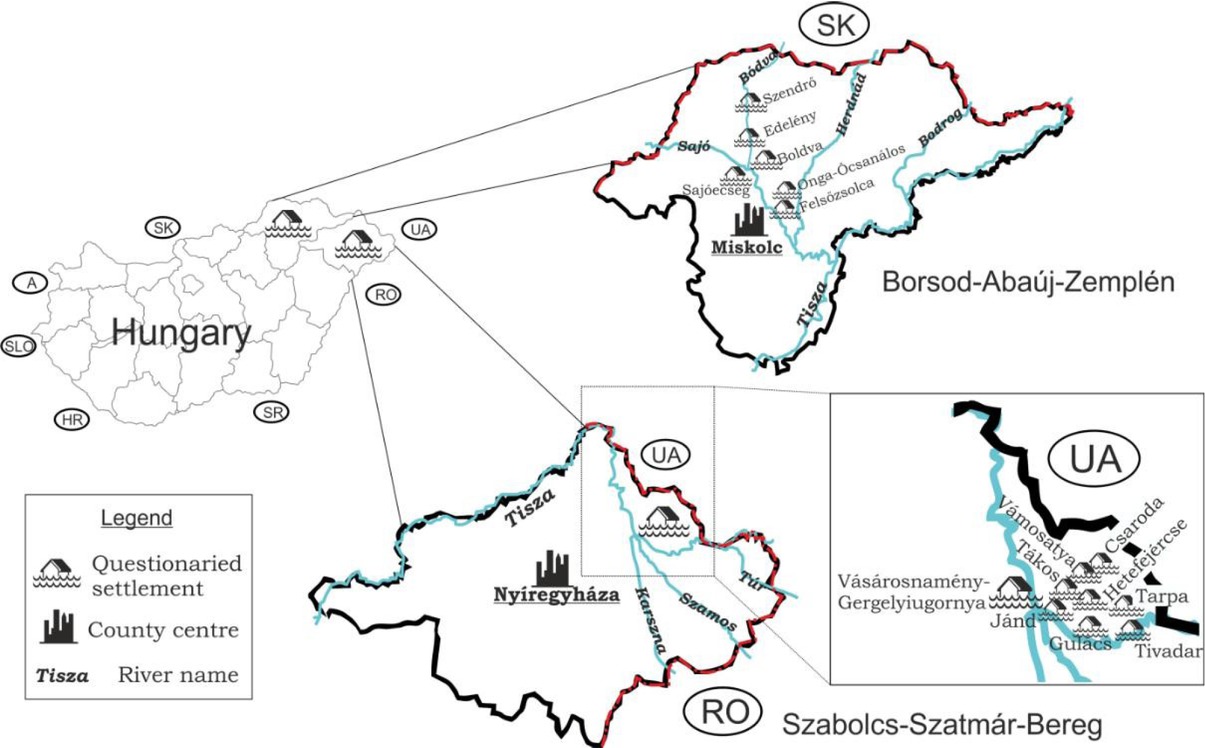
The sample area of the research. Source: edited by the authors
The nonprobability sampling procedure was applied, the unit of the questionnaire survey was the household. At least 1% of the population for both samples and at least 10% of households were questioned. A total of 854 households were surveyed, which represented 2512 people.
The population of disaster-stricken areas, in general, afraid, or living in fear from a possible recurrence of another catastrophe. The negative externalities of these events are incorporated into their everyday lives. As first, from the questionnaire data, we have created three principal components to reveal the attitudes and perception of locals. The principal components were the following: fear, social change, and change in the built environment. In this paper, we analyze further the composition of fear principle component since it is strongly related to the security element of freedom and justice [42]. The decisive elements of the fear principal component are 5 statements.
Secondly, decision trees were generated to understand the attitudes and opinion about the perceived natural disasters, since multi-criteria decision analysis used in various research fields [59]. Usually, this statistical method is used by the financial sector for credit assessment [54], but it seems to be a relevant method for our research as it reveals the differences of opinion based on general value-based judgment. Decision trees offer a clear, tree-like structure, with easily interpreted rules – thus facilitates the determination of rules and logic in complex situations and facilitates the identification of homogenous groups [55, 56].
In defining dependent and independent input variables, the aim was to find out the differences in opinions and their causal relationships. Therefore, from the available data, we built an unattended learning type [57], a mapping decision tree. Chi-square-based CHAID and the regression-based CRT are frequently used to differentiate the variables [54]. Through the nominal (yes-no) type input variables, which can be interpreted as dummy variables, we created a CRT-based decision tree.
Since there were deficiencies in the responses received from the questionnaire (do not know, do not respond), it was necessary to exclude them in the first round.We made relatively small depth decision trees whereby the parental and child nodes were determined for 25 and 15 people, respectively. However, because of the size of the whole sample, these element numbers provided an appropriate source to demonstrate differences between different social groups.
4 Results: decision trees in environmental justice research
For measuring the sense of fear of the population of the research area, sub-components were placed in the principal component, which was related to the sense of danger of their own and their family, the fear of the degradation of the environment and, the flood as a potential source of danger. We built up the main component from five statements, queried people responded on an ordinal scale with four options.
People are exposed and vulnerable due to the floods
Floods are potential threats for everyone in the region
Flood is a huge problem in the region
I fear the health of my family due to floods
I fear the degradation of the environment of my neighborhood
We hypothesised that flooding is a threat to the people of the research area and as a result, it defines people’s everyday lives. Therefore we expected that people will confirm the fear principle component.
Based on the statistical analysis, the hypothesis was overthrown, since major groups could be determined within the sample. Measurable differences were shown amongst the population affected and unaffected by the disaster. Confirmation and rejection of the principal component of fear are in connection with the involvement and affection by the flood (Table 1). On the basis of these, it is generally confirmed that the directly affected stakeholders significantly confirm the principal component of fear, while those indirectly affected by the disaster reject it. This may justify the assumptions that environmental injustice among those who are directly affected over the longer term may fear more the floods and fear for their lives. This resulted in long-term stamps on their mental and physical well-being.
The difference in the experienced fear according to flood affection. Source: edited by the authors
| Were you or your household affected by floods? | N | Mean | Difference of mean t-value | ||
|---|---|---|---|---|---|
| The principal | Flooded | Yes | 639 | 0.0649 | 3.965 |
| component of fear | sample area | No | 138 | −0.3040 | |
Due to the high number of settlements that were affected by the flood, we decided to separate the settlements into different groups on a territorial basis for easier comparison. Therefore, Bereg (case study area 1 – CSA1) and Borsod (case study area 2 – CSA2) subsample areas were created (Table 2). In the case of the subsample areas, the previously measured difference of means decreased between the two CSA 1 and 2. Furthermore, there is a fault-line between the respondents in the two subsample areas. In the case of the CSA1 settlements, the respondents reject the principal component of fear from the flood, while the respondents in CSA2 confirm it.
The difference of experienced fear in the subsample areas. Source: edited by the authors
| Subsample area | N | Mean | Difference of mean t-value | |
|---|---|---|---|---|
| Principal component of fear | Bereg | 332 | −0.090 | 2.443 |
| Borsod | 408 | 0.090 |
However, both confirmation and rejection rates are insignificant. This is due, on the one hand, to the extinguishing effect of the different responses of the chosen settlements. On the other hand, the time has particular importance in the case of decisions and experiences. The Bereg sample area was flooded in the early 2000s, whereas the sampling occurred in 2011 which means more than a decade had passed after the flood. This means that its memories/impacts are much lighter and less harsh in the memories of the people as compared to the Borsod subsample area as the survey was conducted a year after the flood. Therefore, the importance of the time factor described in the literature is confirmed by the perception and ex-post evaluation of disaster situations.
The strongest rejection of the fear principal component was in Tivadar and Csarod, both in Bereg, which means people questioned mainly do not fear from floods. In the case of Tivadar, the affected settlements were completely renewed after the natural disaster Moreover, the high rejection value may be caused by the low number of respondents on the mentioned settlements number. The principal component of fear was confirmed in the settlements of Onga-Ócsanálos, Szendrő, Tákos, and Hetefejércse. The first two of these settlements are from CSA2 and the latter two are from CSA1. Thus, it can be seen that the rejection of confirmation of the component of fear cannot be clearly linked to the subsample areas and the time of the catastrophe. Among these settlements, Tákos was almost completely destroyed and then rebuilt, despite, it is confirming the fear component, so the people questioned still mostly fear of a flood.
In order to further analysis the above findings, we made a decision tree where we examined the ethnicity, the involvement with the flood and the sample area in order to present the relationship with the principal component of fear. The first branch of the decision tree was made by ethnicity, after which the impact by the natural disaster was a junction, finally, the subsample area was examined (Figure 2).
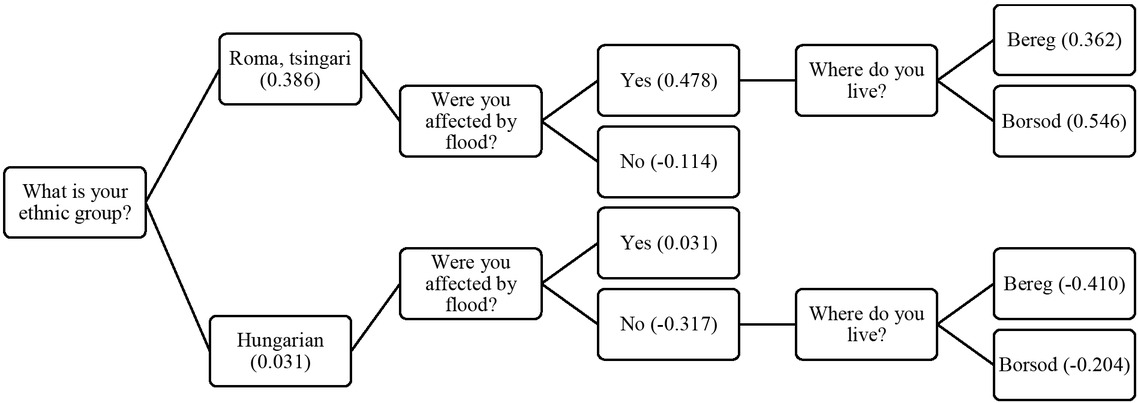
Three-node depth decision tree of flood affection, ethnicity, and subsample area. Source: edited by the authors
In the flooded areas, ethnic-based segregation and disadvantaged position were concluded in the case of the principal component of fear when preparing the decision tree. The examined sample was divided into two groups based on ethnicity: Roma and Hungarians. While the Hungarians, albeit slightly, rejected the principle component of fear, the Roma people confirmed it, those who have not been harmed, nor their house was damaged, however, reject the fear-component. The perception and damage caused by the floods caused stronger fear than amongst the Roma population in comparision to the Hungarian population. This can also be traced back to the unequal compensation process.
Our former hypothesis was extended, with the proviso that only the flood-affected Roma confirm the principle component of fear. The further branching of the decision tree examined territoriality and aimed to reveal whether there was any difference between the individual subsample areas. If the respondents are further divided no difference was detected along the two subsample areas between the Hungarian and the minority respondents. The Hungarians rejected irrespectively of flood affection or damage, while the Roma confirmed the principle component of fear in both case study areas.
In the case of the Roma in CSA2,where the catastrophe was closer to the time of the survey and the settlements are inhabited by the Roma in a larger proportion, therefore the fear was stronger amongst the Roma. Probably due to the longer time passed after the disaster, among the Hungarian population, those who have not been hit by the floods in the CSA1 lower level of fear towards floods was detected (Figure 3).
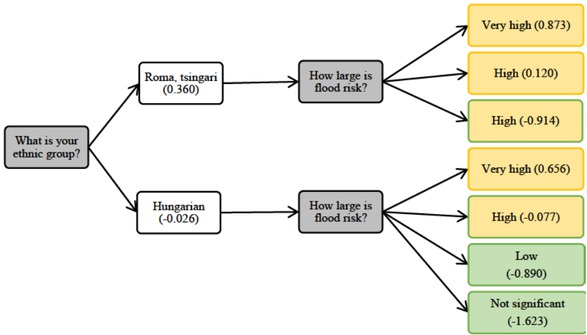
Two-node depth decision tree of fear perception through ethnicity and flood risk assessment. Source: edited by the authors
During the research, we also drew further decision trees, but an appreciable end result with an adequate amount of responses was only created for the aspects of ethnicity and flood risks and dangers. Thus, the first branch of the tree is ethnicity, and the second is the risk of flooding, depending on the principle component of fear. Based on ethnicity, the Roma were confirming, while the Hungarians rejecting the fear factor.
The risk was assessed by respondents on a four-grade scale, with very high, high, low and not significant values. In the case of Roma respondents, there were no respondents who did not consider the risks to be significant or low. Respondents who believed that the risk of flooding was very high in the region had a significant confirmation on the fear component, while those who considered the risks to be high were less confirming the component of fear. There is an interesting contradiction in the opinion of respondents who have identified the flood as a high risk, but their feeling of fear is low, the principal component is strongly rejected. This may be due to the fact that these respondents were not directly affected by the flood. Although they are aware of the dangers of flooding, they felt they are personally not in danger not threatened. Among the Hungarian population, all four possible responses to the assessment of risk were chosen, which formed separate groups of opinions with different principal component scores. The process observed in the case of the Roma can be identified in the case of the Hungarian population, those who assess the risk of floods as very high, strongly confirm the principal component. Those who chose the high, the low and the non-significant answer on risk assessment reject the principle component of fear.
5 Discussion and conclusions
As we presented in the study, the main objective and subject of environmental justice research have been transformed over the past decades. Decision-making is becoming more and more important to reveal the causes and process of the procedural injustice, which is the result of the power imbalance and of the different opinions of several interest groups, who can be identified as stakeholders of environmental injustices. The aim of the research was twofold: on one hand, to examine the possibility of the use of an economic analyzing tool and the decision tree, and on the other, to identify separate groups of opinions within the population affected by environmental injustices with this method.
The benefit of this method in social research can be that different groups are formed according to the individual responses given by the questioned population but not according to groups selected by the researchers. The disadvantage of this method is that it can only be used to make small depth decision trees, as the number of sampling elements limits the size of the parental and child branches, which was determined in 25-15 in our study. Based on these, the decision tree method has certain limitations, but it can be applied to explore the social aspects of environmental injustices.
As a result, firstly, it can be summarized that the score of the principal component is markedly different in the case of those who were affected and those who were not affected by the flood, while the former confirms it, the latter rejects the fear principle component.,Secondly, the study also examined the differences between the Roma and the Hungarian population. Considering the issue of affection by floods the decision trees show different views of the minority population. Thirdly, the research examined the differences between two study subsample areas, it can be concluded, that there are no differences along with the geographical position, but the ethnicity and the affection by flood is decisive grouping factor.
Our research highlights the importance of the context and individual positions in the perception and evaluation of environmental injustices and risk. The paper examines the differences of opinions in relation to the management of injustices. Results shows, being Roma results in a higher level of fear. This should be taken into account in the future environmental justice research in post-socialist countries. Furthermore, the results of the research on environmental racism should be incorporated into future research to reveal the similarities and differences between the East-Central European (i.e. post-socialist) and North American institutional, historical and cultural contexts.
As a conclusion, the results of the decision tree methods, confirm the possibility of use of this tool in environmental justice research and decision-making process afterward. In a post-catastrophic situation, the traditional intervention and a tool-based input-output-result type of evaluation disregards the different local opinions. These seem to be indifferent to the intervention and rehabilitation process, and usually only discovered after the intervention – if they were discovered at all. However, it would be favorable to involve the population affected by the disaster before and during the intervention and recovery process. So that relevant information that has a significant impact on the development process can be discovered, which can facilitate expert decision-making while emphasizing community involvement in post-catastrophic interventions.
Acknowledgement
This research was supported by the Ministry of Human Capacities, Hungary grant 20391-3/2018/FEKUSTRAT
References
[1] Begg, C., Power, responsibility, and justice: a review of local stakeholder participation in European flood risk management. Local Environment, 2018, 23(4), 383-39710.1080/13549839.2017.1422119Suche in Google Scholar
[2] Martinez-Alier, J., Global Environmental Justice and the Environmentalism of the Poor. In: Gabrielson, T., Hall, C., Meyer, J.M., Schlosberg, D. (eds.), The Oxford Handbook of Environmental Political Theory, Oxford, Oxford University Press, 2016, 547-56210.1093/oxfordhb/9780199685271.013.25Suche in Google Scholar
[3] Cousins, J. J., Of floods and droughts: The uneven politics of stormwater in Los Angeles. Political Geography, 2017, 60, 34-4610.1016/j.polgeo.2017.04.002Suche in Google Scholar
[4] Douglas, E.M., Kirshen, P.H., Paolisso, M., Watson, C., Wiggin, J., Enrici, A., Ruth, M., Coastal flooding, climate change, and environmental justice: identifying obstacles and incentives for adaptation in two Boston, Massachusetts communities. Mitigation and Adaptation Strategies for Global Change, 2012, 17(5), 537–56210.1007/s11027-011-9340-8Suche in Google Scholar
[5] Wilson, S. M. Richard, R. J. A., Williams, E. M., Climate change, environmental justice, and vulnerability: an exploratory analysis. Environmental Justice, 2010, 3(1), 13–1910.1089/env.2009.0035Suche in Google Scholar
[6] Špirić, J., Ecological distribution conflicts and sustainability: lessons from the post-socialist European semi-periphery. Sustainability Science, 2017, 13(3), 661-67610.1007/s11625-017-0505-6Suche in Google Scholar
[7] Clough, E., Environmental justice and fracking: a review. Current Opinion in Environmental Science & Health, 2018, 3, 14-1810.1016/j.coesh.2018.02.005Suche in Google Scholar
[8] Davies, A. R., Environmental justice as subtext or omission: Examining discourses of anti-incineration campaigning in Ireland. Geoforum, 2006, 37, 708–72410.1016/j.geoforum.2005.06.005Suche in Google Scholar
[9] Nixon, J. D., Wright, D. G., Dey, P. K., Ghosh, S. K., Davies, P. A., A comparative assessment of waste incinerators in the UK. Waste Management, 2013, 33(11), 2234-224410.1016/j.wasman.2013.08.001Suche in Google Scholar
[10] Stewart J. A., Mitchell, M.A., Edgerton, V.S., VanCott, R., Environmental Justice and Health Effects of Urban Air Pollution Journal of the National Medical Association, 2015, 107(1), 50-5810.1016/S0027-9684(15)30009-2Suche in Google Scholar
[11] Higgs, G., Langford, M., GIS science, environmental justice and estimating populations at risk: the case of landfills in Wales. Applied Geography, 2009, 29(1), 63-7910.1016/j.apgeog.2008.07.006Suche in Google Scholar
[12] Bullers, S., Environmental Stressors, Perceived Control, and Health: The Case of Residents Near Large-Scale Hog Farms in Eastern North Carolina. Human Ecology, 2005, 33(1), 1–1610.1007/s10745-005-1653-3Suche in Google Scholar
[13] McClintock, N., Assessing soil lead contamination at multiple scales in Oakland, California: implications for urban agriculture and environmental justice. Applied Geography, 2012, 35, 460-473.10.1016/j.apgeog.2012.10.001Suche in Google Scholar
[14] Malin, S. A., Teigen DeMaster, K., A Devil’s Bargain: Rural Environmental Injustices and Hydraulic Fracturing on Pennsylvania’s Farms. Journal of Rural Studies, 2016, 47(A), 278–29010.1016/j.jrurstud.2015.12.015Suche in Google Scholar
[15] Man, P., Wan, J., Environmental justices and injustices of large-scale gold mining in Ghana: A study of three communities near Obuasi. The Extractive Industries and Society, 2014, 1(1), 38-4710.1016/j.exis.2013.12.001Suche in Google Scholar
[16] Boone, M.D., Bishop, C.A., Boswell, L.A., Brodman, R.D., Burger, J., Davidson, C., Gochfeld, M., Hoverman, J.T., Meiman-Lee, L.A., Relyea, R.A., Rohr, J.A., Salice, C., Semlitsch, R.D, Sparling, D., Weir, S., Pesticide Regulation amid the Influence of Industry. BioScience, 2014. 64(10), 917– 92210.1093/biosci/biu138Suche in Google Scholar
[17] Oskarsson, P., Bedi, H. P., Extracting environmental justice: Countering technical renditions of pollution in India’s coal industry. The Extractive Industries and Society, 2018, 5(3), 340-34710.1016/j.exis.2018.05.003Suche in Google Scholar
[18] Chaudhary, S., McGregor, A., Houston, D., Chettri, N., Environmental justice and ecosystem services: A disaggregated analysis of community access to forest benefits in Nepal. Ecosystem Services, 2018, 29, 99-11510.1016/j.ecoser.2017.10.020Suche in Google Scholar
[19] Schnegg, M., Kiaka, D., Subsidized elephants: Community-based resource governance and environmental (in)justice in Namibia. Geoforum, 2018, 93, 105-11510.1016/j.geoforum.2018.05.010Suche in Google Scholar
[20] Braubach M., Environmental Health Inequalities in Europe. World Health Organization, European Office, Bonn 2011Suche in Google Scholar
[21] Braubach, M., Fairburn, J., Social inequities in environmental risks associated with housing and residential location – a review of evidence. European Journal of Public Health, 2010, 20(1), 36-4210.1093/eurpub/ckp221Suche in Google Scholar PubMed
[22] Newton, D. E., Environmental Justice. ABC Clio, Oxford, 2009Suche in Google Scholar
[23] Bullard, R. D. (ed.), Unequal Protection: Environmental Justice and Communities of Color. Sierra Club Books, San Francisco, 1994Suche in Google Scholar
[24] Bullard, R. D., Dumping in Dixie: Race, Class and Environmental Quality. Westview Press, San Francisco, 1990Suche in Google Scholar
[25] Pulido, L., A critical review of the methodology of environmental racism research. Antipode, 1996, 28(2) 142–5910.1111/j.1467-8330.1996.tb00519.xSuche in Google Scholar
[26] Pulido, L., Rethinking environmental racism: White privilege and urban development in Southern California. Annals of the Association of American Geographers, 2000, 90(1) 12–4010.4324/9781315256351-17Suche in Google Scholar
[27] Blacksell, M. Watkins, C., Economides, K., Human geography and law: a case of separate development in social science In: Progress in human Geography, 1986, 10(3), 371-39610.1177/030913258601000303Suche in Google Scholar
[28] Blomley, N.K. 1994: Law, space and the geographies of power. New York and London: Guilford PressSuche in Google Scholar
[29] Butler, C., Critical Legal Studies and the Politics of Space. Social & Legal Studies, 2009, 18(3), 313–332.10.1177/0964663909339084Suche in Google Scholar
[30] Heffron R.J., Mccauley D., What is the ’Just Transition’? Geoforum, 2018, 88, 74-7710.1007/978-3-030-89460-3_2Suche in Google Scholar
[31] Pataki Gy., Bölcs „laikusok” Társadalmi részvételi technikák a demokrácia szolgálatában. Civil Szemle, 2007, 4(3-4),144-156Suche in Google Scholar
[32] Stiglitz, J. E. A kormányzati szektor gazdaságtana KJK-Kerszöv Jogi és Üzleti Kiadó Kft, Budapest, 2000Suche in Google Scholar
[33] Lengyel I., Regionális gazdaságfejlesztés Akadémiai Kiadó, Budapest, 2010Suche in Google Scholar
[34] Bajmócy Z., Bevezetés a helyi gazdaságfejlesztésbe. JATEpress, Szeged, 2011Suche in Google Scholar
[35] Layard, R., Boldogság - Fejezetek egy új tudományból. Lexecon Kiadó, Budapest, 2004Suche in Google Scholar
[36] Szirmai V. (ed.), A várostérségi versenyképesség társadalmi tényezői. Dialóg Campus, Budapest – Pécs, 2009Suche in Google Scholar
[37] Shin, M., Agnew, J., Spatial Regression for Electoral Studies: The Case of the Italian Lega Nord. In. Warf, B., Leib, J. (eds.), Revitalizing Electoral Geography. Ashgate Publishing Company, Burlington, 2011, 59-74.Suche in Google Scholar
[38] Stiglitz, J. E., Sen, A., Fitoussi, J. P., Report by the Commision on the Measurement of Economic Performance and Social Progress, 2009Suche in Google Scholar
[39] Bajmócy Z., Gébert J., Arguments for deliberative participation in local economics development. Acta Oeconomica, 2014, 64(3), 313-33410.1556/aoecon.64.2014.3.3Suche in Google Scholar
[40] Rawls, J., A., Theory of Justice. Cambridge, Harvard University Press, 197110.4159/9780674042605Suche in Google Scholar
[41] Sen, A. K., Capability and Well-Being. In: Nussbaum, M., Sen, A. K. (eds.), The Quality of Life Oxford University Press, Oxford, 199310.1093/0198287976.003.0003Suche in Google Scholar
[42] Sen, A. K., Development as freedom. Oxford University Press, New York, 1999Suche in Google Scholar
[43] Lengyel I., Regionális növekedés, fejlődés, területi tőke és versenyképesség. In: Bajmócy Z., Lengyel I., Málovics Gy. (eds.), Regionális innovációs képesség, versenyképesség és fenntarthatóság. JATEPress, Szeged, 2012, 151-174Suche in Google Scholar
[44] Robeyns, I., The Capability Approach: a teoretical survey. Journal of Human Development and Capabilities, 2005, 6(1), 93-11710.1080/146498805200034266Suche in Google Scholar
[45] Elekes Z., Bajmócy Z., Regionális innovációpolitika és szakpolitikai tanulás a komplex rendszerek elméletének szemszögéből. In: Inzelt A., Bajmócy Z. (eds.), Innovációs rendszerek – Szereplők, kapcsolatok és intézmények. JATEPress, Szeged, 2013, 244-262Suche in Google Scholar
[46] Weston H. B. 2008: Climate Change and Intergenerational Justice: Foundational Reflections. Vermont Journal of Environmental Law, 2008. 9(3), 1-5010.2307/vermjenvilaw.9.3.375Suche in Google Scholar
[47] Becchi, P. (2012): Our Responsibility Towards Future Generations In: Mathis, K. (ed.), Efficiency, Sustainability, and Justice to Future Generations, Springer, pp. 77-9610.1007/978-94-007-1869-2_4Suche in Google Scholar
[48] Yang, X., Xie, Z., Ling, F., Luo, X., Zhong, M., Post-Earthquake People Loss Evaluation Based on Seismic Multi-Level Hybrid Grid: A Case Study on Yushu Ms 7.1 Earthquake in China. Open Geosciences, 2016, 8(1), 639-64910.1515/geo-2016-0051Suche in Google Scholar
[49] Trásy, B., Garamhegyi, T., Lackó-Dobos, P., Kovács, J., Hatvani, I. G., Geostatistical screening of flood events in the groundwater levels of the diverted inner delta of the Danube River: implications for river bed clogging. Open Geosciences, 2018, 10(1), 64-7810.1515/geo-2018-0006Suche in Google Scholar
[50] Nwaogu C., Okeke O J., Fadipe O. O., Bashiru K. A., Pechanec V., Is Nigeria losing its natural vegetation and landscape? Assessing the landuse-landcover change trajectories and effects in Onitsha using remote sensing and GIS, Open Geosciences, 2017, 9 (1), 707-718.10.1515/geo-2017-0053Suche in Google Scholar
[51] Plavša J., Petrović M., Radovanović M., Gajić T., Modelling of carrying capacity in National Park - Fruška Gora (Serbia) case study, Open Geosciences, 2017, 9 (1), 61-7210.1515/geo-2017-0005Suche in Google Scholar
[52] Kocsis, K.; Kovács, Z., A cigány népesség társadalomföldrajza. In: Kemény, I. (ed.), A cigányok Magyarországon. Budapest, Magyarország: Magyar Tudományos Akadémia, 1999, 13-19Suche in Google Scholar
[53] Pénzes J., Pásztor I.Z., Jász, E., Gypsy population in Hungary - databases and their background. In: Polgár I., Horga, I.,Brie, M. (eds.), Migration and European Integration of Minorities. Lambert Academic Publishing, Saarbrücken, 2017, 37-5Suche in Google Scholar
[54] Jánosa A., Adatelemzés SPSS használatával. ComputerBooks, Budapest, 2011Suche in Google Scholar
[55] Khosravi, K., Pham, B.T., Chapi, K., Shirzadi, A., Shahabi, H. Revhaug, I., Prakash, I., Bui, D.T. A comparative assessment of decision trees algorithms for flash flood susceptibility modeling at Haraz watershed, northern Iran. Science of the Total Environment, 2018, 627, 744-75510.1016/j.scitotenv.2018.01.266Suche in Google Scholar PubMed
[56] Valjavec, M. B., Ciglič, R., Oštir K., Ribeiro D., Modelling habitats in karst landscape by integrating remote sensing and topography data, Open Geosciences, 2018, 10 (1), 137-15610.1515/geo-2018-0011Suche in Google Scholar
[57] Hámori G., A CHAID alapú döntési fák jellemzői. Statisztikai Szemle, 2001 79(8), 703-710Suche in Google Scholar
[58] Morar C„ Nagy G., Dulca M., Boros L., Sehida K. (2019), Aspects Regarding the Military Cultural-Historical Heritage in the City of Oradea, Romania, in ANNALES – Annals for Istrian and Mediterranean Studies – Series Historia et Sociologia, Issue 2/2019Suche in Google Scholar
[59] Vujičić D. M., Vasiljević D. A., Hose T.A., Tasić N., Morar C., Ðurić A., Marković S. B. (2018), A multi-criteria decision analysis with special reference to loess and archaeological sites in Serbia (Could geosciences and archaeology cohabitate?), Open Geo-sciences, Vol. 10, Issue 110.1515/geo-2018-0026Suche in Google Scholar
[60] Kostrikov S., Niemets L., Sehida K., Niemets K., Morar C. (2018), Geoinformation Approach to Urban Geographic System Research (Case Studies of Kharkiv region, Ukraine) Visnyk of V. N. Karazin Kharkiv National University, series "Geology. Geography. Ecology", Issue 49Suche in Google Scholar
[61] Bowen W., (2002), An analytical review of environmental justice research: what do we really know? Environmental Mannagement, Vol. 29. Issue 1. 3-1510.1007/s00267-001-0037-8Suche in Google Scholar PubMed
© 2019 G. Nagy et al., published by De Gruyter
This work is licensed under the Creative Commons Attribution 4.0 Public License.
Artikel in diesem Heft
- Regular Articles
- 2D Seismic Interpretation of the Meyal Area, Northern Potwar Deform Zone, Potwar Basin, Pakistan
- A new method of lithologic identification and distribution characteristics of fine - grained sediments: A case study in southwest of Ordos Basin, China
- Modified Gompertz sigmoidal model removing fine-ending of grain-size distribution
- Diagenesis and its influence on reservoir quality and oil-water relative permeability: A case study in the Yanchang Formation Chang 8 tight sandstone oil reservoir, Ordos Basin, China
- Evaluation of AHRS algorithms for Foot-Mounted Inertial-based Indoor Navigation Systems
- Identification and evaluation of land use vulnerability in a coal mining area under the coupled human-environment
- Hydrocarbon Generation Potential of Chia Gara Formation in Three Selected Wells, Northern Iraq
- Source Analysis of Silicon and Uranium in uranium-rich shale in the Xiuwu Basin, Southern China
- Lithologic heterogeneity of lacustrine shale and its geological significance for shale hydrocarbon-a case study of Zhangjiatan Shale
- Characterization of soil permeability in the former Lake Texcoco, Mexico
- Detrital zircon trace elements from the Mesozoic Jiyuan Basin, central China and its implication on tectonic transition of the Qinling Orogenic Belt
- Turkey OpenStreetMap Dataset - Spatial Analysis of Development and Growth Proxies
- Morphological Changes of the Lower Ping and Chao Phraya Rivers, North and Central Thailand: Flood and Coastal Equilibrium Analyses
- Landscape Transformations in Rapidly Developing Peri-urban Areas of Accra, Ghana: Results of 30 years
- Division of shale sequences and prediction of the favorable shale gas intervals: an example of the Lower Cambrian of Yangtze Region in Xiuwu Basin
- Fractal characteristics of nanopores in lacustrine shales of the Triassic Yanchang Formation, Ordos Basin, NW China
- Selected components of geological structures and numerical modelling of slope stability
- Spatial data quality and uncertainty publication patterns and trends by bibliometric analysis
- Application of microstructure classification for the assessment of the variability of geological-engineering and pore space properties in clay soils
- Shear failure modes and AE characteristics of sandstone and marble fractures
- Ice Age theory: a correspondence between Milutin Milanković and Vojislav Mišković
- Are Serbian tourists worried? The effect of psychological factors on tourists’ behavior based on the perceived risk
- Real-Time Map Matching: A New Algorithm Integrating Spatio-Temporal Proximity and Improved Weighted Circle
- Characteristics and hysteresis of saturated-unsaturated seepage of soil landslides in the Three Gorges Reservoir Area, China
- Petrographical and geophysical investigation of the Ecca Group between Fort Beaufort and Grahamstown, in the Eastern Cape Province, South Africa
- Ecological risk assessment of geohazards in Natural World Heritage Sites: an empirical analysis of Bogda, Tianshan
- Integrated Subsurface Temperature Modeling beneath Mt. Lawu and Mt. Muriah in The Northeast Java Basin, Indonesia
- Go social for your own safety! Review of social networks use on natural disasters – case studies from worldwide
- Forestry Aridity Index in Vojvodina, North Serbia
- Natural Disasters vs Hotel Industry Resilience: An Exploratory Study among Hotel Managers from Europe
- Using Monarch Butterfly Optimization to Solve the Emergency Vehicle Routing Problem with Relief Materials in Sudden Disasters
- Potential influence of meteorological variables on forest fire risk in Serbia during the period 2000-2017
- Controlling factors on the geochemistry of Al-Shuaiba and Al-Mejarma coastal lagoons, Red Sea, Saudi Arabia
- The Influence of Kaolinite - Illite toward mechanical properties of Claystone
- Two critical books in the history of loess investigation: ‘Charakteristik der Felsarten’ by Karl Caesar von Leonhard and ‘Principles of Geology’ by Charles Lyell
- The Mechanism and Control Technology of Strong Strata Behavior in Extra-Thick Coal Seam Mining Influenced by Overlying Coal Pillar
- Shared Aerial Drone Videos — Prospects and Problems for Volunteered Geographic Information Research
- Stable isotopes of C and H in methane fermentation of agriculture substrates at different temperature conditions
- Prediction of Compression and Swelling Index Parameters of Quaternary Sediments from Index Tests at Mersin District
- Detection of old scattered windthrow using low cost resources. The case of Storm Xynthia in the Vosges Mountains, 28 February 2010
- Remediation of Copper and Zinc from wastewater by modified clay in Asir region southwest of Saudi Arabia
- Sedimentary facies of Paleogene lacustrine dolomicrite and implications for petroleum reservoirs in the southern Qianjiang Depression, China
- Correlation between ore particle flow pattern and velocity field through multiple drawpoints under the influence of a flexible barrier
- Atmospheric refractivity estimation from AIS signal power using the quantum-behaved particle swarm optimization algorithm
- A geophysical and hydro physico-chemical study of the contaminant impact of a solid waste landfill (swl) in King Williams’ Town, Eastern Cape, South Africa
- Landscape characterization using photographs from crowdsourced platforms: content analysis of social media photographs
- A Study on Transient Electromagnetic Interpretation Method Based on the Seismic Wave Impedance Inversion Model
- Stratigraphy of Architectural Elements of a Buried Monogenetic Volcanic System
- Variable secondary porosity modeling of carbonate rocks based on μ-CT images
- Traditional versus modern settlement on torrential alluvial fans considering the danger of debris flows: a case study of the Upper Sava Valley (NW Slovenia)
- The Influence of Gangue Particle size and Gangue Feeding Rate on Safety and Service Life of the Suspended Buffer’s Spring
- Research on the Transition Section Length of the Mixed Workface Using Gangue Backfilling Method and Caving Method
- Rainfall erosivity and extreme precipitation in the Pannonian basin
- Structure of the Sediment and Crust in the Northeast North China Craton from Improved Sequential H-k Stacking Method
- Planning Activities Improvements Responding Local Interests Change through Participatory Approach
- GIS-based landslide susceptibility mapping using bivariate statistical methods in North-western Tunisia
- Uncertainty based multi-step seismic analysis for near-surface imaging
- Deformation monitoring and prediction for residential areas in the Panji mining area based on an InSAR time series analysis and the GM-SVR model
- Statistical and expert-based landslide susceptibility modeling on a national scale applied to North Macedonia
- Natural hazards and their impact on rural settlements in NE Romania – A cartographical approach
- Rock fracture initiation and propagation by mechanical and hydraulic impact
- Influence of Rapid Transit on Accessibility Pattern and Economic Linkage at Urban Agglomeration Scale in China
- Near Infrared Spectroscopic Study of Trioctahedral Chlorites and Its Remote Sensing Application
- Problems with collapsible soils: Particle types and inter-particle bonding
- Unification of data from various seismic catalogues to study seismic activity in the Carpathians Mountain arc
- Quality assessment of DEM derived from topographic maps for geomorphometric purposes
- Remote Sensing Monitoring of Soil Moisture in the Daliuta Coal Mine Based on SPOT 5/6 and Worldview-2
- Utilizing Maximum Entropy Spectral Analysis (MESA) to identify Milankovitch cycles in Lower Member of Miocene Zhujiang Formation in north slope of Baiyun Sag, Pearl River Mouth Basin, South China Sea
- Stability Analysis of a Slurry Trench in Cohesive-Frictional Soils
- Integrating Landsat 7 and 8 data to improve basalt formation classification: A case study at Buon Ma Thuot region, Central Highland, Vietnam
- Assessment of the hydrocarbon potentiality of the Late Jurassic formations of NW Iraq: A case study based on TOC and Rock-Eval pyrolysis in selected oil-wells
- Rare earth element geochemistry of sediments from the southern Okinawa Trough since 3 ka: Implications for river-sea processes and sediment source
- Effect of gas adsorption-induced pore radius and effective stress on shale gas permeability in slip flow: New Insights
- Development of the Narva-Jõesuu beach, mineral composition of beach deposits and destruction of the pier, southeastern coast of the Gulf of Finland
- Selecting fracturing interval for the exploitation of tight oil reservoirs from logs: a case study
- A comprehensive scheme for lithological mapping using Sentinel-2A and ASTER GDEM in weathered and vegetated coastal zone, Southern China
- Sedimentary model of K-Successions Sandstones in H21 Area of Huizhou Depression, Pearl River Mouth Basin, South China Sea
- A non-uniform dip slip formula to calculate the coseismic deformation: Case study of Tohoku Mw9.0 Earthquake
- Decision trees in environmental justice research — a case study on the floods of 2001 and 2010 in Hungary
- The Impacts of Climate Change on Maximum Daily Discharge in the Payab Jamash Watershed, Iran
- Mass tourism in protected areas – underestimated threat? Polish National Parks case study
- Decadal variations of total organic carbon production in the inner-shelf of the South China Sea and East China Sea
- Hydrogeothermal potentials of Rogozna mountain and possibility of their valorization
- Postglacial talus slope development imaged by the ERT method: comparison of slopes from SW Spitsbergen, Norway and Tatra Mountains, Poland
- Seismotectonics of Malatya Fault, Eastern Turkey
- Investigating of soil features and landslide risk in Western-Atakent (İstanbul) using resistivity, MASW, Microtremor and boreholes methods
- Assessment of Aquifer Vulnerability Using Integrated Geophysical Approach in Weathered Terrains of South China
- An integrated analysis of mineralogical and microstructural characteristics and petrophysical properties of carbonate rocks in the lower Indus Basin, Pakistan
- Applicability of Hydrological Models for Flash Flood Simulation in Small Catchments of Hilly Area in China
- Heterogeneity analysis of shale reservoir based on multi-stage pumping data
Artikel in diesem Heft
- Regular Articles
- 2D Seismic Interpretation of the Meyal Area, Northern Potwar Deform Zone, Potwar Basin, Pakistan
- A new method of lithologic identification and distribution characteristics of fine - grained sediments: A case study in southwest of Ordos Basin, China
- Modified Gompertz sigmoidal model removing fine-ending of grain-size distribution
- Diagenesis and its influence on reservoir quality and oil-water relative permeability: A case study in the Yanchang Formation Chang 8 tight sandstone oil reservoir, Ordos Basin, China
- Evaluation of AHRS algorithms for Foot-Mounted Inertial-based Indoor Navigation Systems
- Identification and evaluation of land use vulnerability in a coal mining area under the coupled human-environment
- Hydrocarbon Generation Potential of Chia Gara Formation in Three Selected Wells, Northern Iraq
- Source Analysis of Silicon and Uranium in uranium-rich shale in the Xiuwu Basin, Southern China
- Lithologic heterogeneity of lacustrine shale and its geological significance for shale hydrocarbon-a case study of Zhangjiatan Shale
- Characterization of soil permeability in the former Lake Texcoco, Mexico
- Detrital zircon trace elements from the Mesozoic Jiyuan Basin, central China and its implication on tectonic transition of the Qinling Orogenic Belt
- Turkey OpenStreetMap Dataset - Spatial Analysis of Development and Growth Proxies
- Morphological Changes of the Lower Ping and Chao Phraya Rivers, North and Central Thailand: Flood and Coastal Equilibrium Analyses
- Landscape Transformations in Rapidly Developing Peri-urban Areas of Accra, Ghana: Results of 30 years
- Division of shale sequences and prediction of the favorable shale gas intervals: an example of the Lower Cambrian of Yangtze Region in Xiuwu Basin
- Fractal characteristics of nanopores in lacustrine shales of the Triassic Yanchang Formation, Ordos Basin, NW China
- Selected components of geological structures and numerical modelling of slope stability
- Spatial data quality and uncertainty publication patterns and trends by bibliometric analysis
- Application of microstructure classification for the assessment of the variability of geological-engineering and pore space properties in clay soils
- Shear failure modes and AE characteristics of sandstone and marble fractures
- Ice Age theory: a correspondence between Milutin Milanković and Vojislav Mišković
- Are Serbian tourists worried? The effect of psychological factors on tourists’ behavior based on the perceived risk
- Real-Time Map Matching: A New Algorithm Integrating Spatio-Temporal Proximity and Improved Weighted Circle
- Characteristics and hysteresis of saturated-unsaturated seepage of soil landslides in the Three Gorges Reservoir Area, China
- Petrographical and geophysical investigation of the Ecca Group between Fort Beaufort and Grahamstown, in the Eastern Cape Province, South Africa
- Ecological risk assessment of geohazards in Natural World Heritage Sites: an empirical analysis of Bogda, Tianshan
- Integrated Subsurface Temperature Modeling beneath Mt. Lawu and Mt. Muriah in The Northeast Java Basin, Indonesia
- Go social for your own safety! Review of social networks use on natural disasters – case studies from worldwide
- Forestry Aridity Index in Vojvodina, North Serbia
- Natural Disasters vs Hotel Industry Resilience: An Exploratory Study among Hotel Managers from Europe
- Using Monarch Butterfly Optimization to Solve the Emergency Vehicle Routing Problem with Relief Materials in Sudden Disasters
- Potential influence of meteorological variables on forest fire risk in Serbia during the period 2000-2017
- Controlling factors on the geochemistry of Al-Shuaiba and Al-Mejarma coastal lagoons, Red Sea, Saudi Arabia
- The Influence of Kaolinite - Illite toward mechanical properties of Claystone
- Two critical books in the history of loess investigation: ‘Charakteristik der Felsarten’ by Karl Caesar von Leonhard and ‘Principles of Geology’ by Charles Lyell
- The Mechanism and Control Technology of Strong Strata Behavior in Extra-Thick Coal Seam Mining Influenced by Overlying Coal Pillar
- Shared Aerial Drone Videos — Prospects and Problems for Volunteered Geographic Information Research
- Stable isotopes of C and H in methane fermentation of agriculture substrates at different temperature conditions
- Prediction of Compression and Swelling Index Parameters of Quaternary Sediments from Index Tests at Mersin District
- Detection of old scattered windthrow using low cost resources. The case of Storm Xynthia in the Vosges Mountains, 28 February 2010
- Remediation of Copper and Zinc from wastewater by modified clay in Asir region southwest of Saudi Arabia
- Sedimentary facies of Paleogene lacustrine dolomicrite and implications for petroleum reservoirs in the southern Qianjiang Depression, China
- Correlation between ore particle flow pattern and velocity field through multiple drawpoints under the influence of a flexible barrier
- Atmospheric refractivity estimation from AIS signal power using the quantum-behaved particle swarm optimization algorithm
- A geophysical and hydro physico-chemical study of the contaminant impact of a solid waste landfill (swl) in King Williams’ Town, Eastern Cape, South Africa
- Landscape characterization using photographs from crowdsourced platforms: content analysis of social media photographs
- A Study on Transient Electromagnetic Interpretation Method Based on the Seismic Wave Impedance Inversion Model
- Stratigraphy of Architectural Elements of a Buried Monogenetic Volcanic System
- Variable secondary porosity modeling of carbonate rocks based on μ-CT images
- Traditional versus modern settlement on torrential alluvial fans considering the danger of debris flows: a case study of the Upper Sava Valley (NW Slovenia)
- The Influence of Gangue Particle size and Gangue Feeding Rate on Safety and Service Life of the Suspended Buffer’s Spring
- Research on the Transition Section Length of the Mixed Workface Using Gangue Backfilling Method and Caving Method
- Rainfall erosivity and extreme precipitation in the Pannonian basin
- Structure of the Sediment and Crust in the Northeast North China Craton from Improved Sequential H-k Stacking Method
- Planning Activities Improvements Responding Local Interests Change through Participatory Approach
- GIS-based landslide susceptibility mapping using bivariate statistical methods in North-western Tunisia
- Uncertainty based multi-step seismic analysis for near-surface imaging
- Deformation monitoring and prediction for residential areas in the Panji mining area based on an InSAR time series analysis and the GM-SVR model
- Statistical and expert-based landslide susceptibility modeling on a national scale applied to North Macedonia
- Natural hazards and their impact on rural settlements in NE Romania – A cartographical approach
- Rock fracture initiation and propagation by mechanical and hydraulic impact
- Influence of Rapid Transit on Accessibility Pattern and Economic Linkage at Urban Agglomeration Scale in China
- Near Infrared Spectroscopic Study of Trioctahedral Chlorites and Its Remote Sensing Application
- Problems with collapsible soils: Particle types and inter-particle bonding
- Unification of data from various seismic catalogues to study seismic activity in the Carpathians Mountain arc
- Quality assessment of DEM derived from topographic maps for geomorphometric purposes
- Remote Sensing Monitoring of Soil Moisture in the Daliuta Coal Mine Based on SPOT 5/6 and Worldview-2
- Utilizing Maximum Entropy Spectral Analysis (MESA) to identify Milankovitch cycles in Lower Member of Miocene Zhujiang Formation in north slope of Baiyun Sag, Pearl River Mouth Basin, South China Sea
- Stability Analysis of a Slurry Trench in Cohesive-Frictional Soils
- Integrating Landsat 7 and 8 data to improve basalt formation classification: A case study at Buon Ma Thuot region, Central Highland, Vietnam
- Assessment of the hydrocarbon potentiality of the Late Jurassic formations of NW Iraq: A case study based on TOC and Rock-Eval pyrolysis in selected oil-wells
- Rare earth element geochemistry of sediments from the southern Okinawa Trough since 3 ka: Implications for river-sea processes and sediment source
- Effect of gas adsorption-induced pore radius and effective stress on shale gas permeability in slip flow: New Insights
- Development of the Narva-Jõesuu beach, mineral composition of beach deposits and destruction of the pier, southeastern coast of the Gulf of Finland
- Selecting fracturing interval for the exploitation of tight oil reservoirs from logs: a case study
- A comprehensive scheme for lithological mapping using Sentinel-2A and ASTER GDEM in weathered and vegetated coastal zone, Southern China
- Sedimentary model of K-Successions Sandstones in H21 Area of Huizhou Depression, Pearl River Mouth Basin, South China Sea
- A non-uniform dip slip formula to calculate the coseismic deformation: Case study of Tohoku Mw9.0 Earthquake
- Decision trees in environmental justice research — a case study on the floods of 2001 and 2010 in Hungary
- The Impacts of Climate Change on Maximum Daily Discharge in the Payab Jamash Watershed, Iran
- Mass tourism in protected areas – underestimated threat? Polish National Parks case study
- Decadal variations of total organic carbon production in the inner-shelf of the South China Sea and East China Sea
- Hydrogeothermal potentials of Rogozna mountain and possibility of their valorization
- Postglacial talus slope development imaged by the ERT method: comparison of slopes from SW Spitsbergen, Norway and Tatra Mountains, Poland
- Seismotectonics of Malatya Fault, Eastern Turkey
- Investigating of soil features and landslide risk in Western-Atakent (İstanbul) using resistivity, MASW, Microtremor and boreholes methods
- Assessment of Aquifer Vulnerability Using Integrated Geophysical Approach in Weathered Terrains of South China
- An integrated analysis of mineralogical and microstructural characteristics and petrophysical properties of carbonate rocks in the lower Indus Basin, Pakistan
- Applicability of Hydrological Models for Flash Flood Simulation in Small Catchments of Hilly Area in China
- Heterogeneity analysis of shale reservoir based on multi-stage pumping data
