Simple function to find base pressure under triangular and trapezoidal footing with two eccentric loads
-
Mohammed Qasim Shaaban
 ,
Adnan Sadiq Al-kuaity
,
Adnan Sadiq Al-kuaity

Abstract
The purpose of this article is to create a simple general function to find the maximum base pressure of biaxial eccentric loads under a trapezoidal and triangular footing. Base pressure is the load per unit area below the foundation. The first step is to derive a function linking variables to the specific status by determining what variables can be observed in it and which variables are expected to be extracted from it. This research will focus on a specific status in foundation science and, thereafter, will produce a factor named k that is multiplied by the load divided by the area to find the maximum base pressure.
1 Introduction
Footings are structural components that transfer column or wall loads to the supporting soil of the structure. Footings are designed to transfer these loads to the soil without exceeding its safe bearing capacity, to keep the structure from settling at its limit, to reduce differential settlement, and to keep it from sliding and overturning. The depth at which the bearing stratum is located, the soil condition, and the type of superstructure all influence the appropriate type of foundation. The foundations are divided into shallow and deep types, each with significant changes in terms of shape, soil behavior, structural functionality, and structural systems [1]. The design of superficial solution is carried out for the following load cases:
The foundations subjected to concentric axial load.
The foundations subjected to moment in one direction and axial load (uniaxial bending).
Isolated footing, combined footing, strip footing, and mat foundations are examples of different types of superficial foundations depending on their function [1]. A combined footing is a longitudinal footing that supports two or more columns in one row (usually two). In terms of plan, the combined footing can be rectangular, trapezoidal, or T-shaped. When one of the footing’s projections is constrained or the width of the footing is restricted, a rectangular footing is used. When one column load is significantly greater than the other, a trapezoidal or T-shaped footing is used. As a result, the footing’s projections beyond the faces of the columns will be limited [5].
As a function of soil type, relative rigidity of the soil and footing (both of which are important), and depth of foundation at the point of contact between footing and soil, soil pressure distribution under a foundation is determined. It is expected that the pressure distribution on a concrete footing on sand will be similar to that shown in Figure 1(a). The pressure distribution of a concrete footing on clay will be similar to that seen in Figure 1(b). In response to the load applied to a footing, the earth beneath the footing deflects into a bowl-shaped depression, therefore relieving pressure beneath the middle of the footing. It is usual practice to presume that soil pressure is linearly distributed for the purposes of design. It is possible to have a uniform pressure distribution if, as illustrated in Figure 1(c), the centroid of the footing corresponds with the resultant of all of the applied loads [1].

Pressure distribution under foundation: (a) foundation on sandy soil; (b) foundation on clay soil; (c) uniform distribution equivalent.
Due to the following considerations, it may be necessary to use only one footing for two or more columns during construction:
The proximity of the columns (e.g., around elevator shafts and escalators).
The size of footings along the property line may be limited because of the restrictions imposed by the property line. The eccentricity of a column on the edge of a footing can be compensated for by attaching the footing to the column’s interior.
The rigid technique, which is the conventional way of designing coupled footings, makes the assumption that [1,2,3,4]:
The footing or mat is infinitely rigid, and as a result, the deflection of the footing or mat has no effect on the distribution of pressure.
Soil pressure is linearly distributed if the centroid of the footing is in line with the resultant of the applied loads acting on the foundations, or if the pressure distribution is uniform.
Because the soil is incapable of withstanding tensile pressures, the base minimum stress should be equal to or greater than one hundred percent.
The maximum stress must be equal to or less than the permissible capacity, which is the highest amount of stress that the soil can withstand.
The most important parameter, bearing pressure, defines the interaction between the footing and the soil support. It refers to the contact force per unit area along the foundation’s bottom [6].
In order to categorize footings subjected to high eccentricity, the pressure region’s shape is taken into consideration. It is then used to base stress calculations using Löser’s formulation for the design of rectangular columns under biaxial bending. Since the location of the neutral axis is initially uncertain, a series of approximations is employed [7,8].
The main objective of the project is to compute the maximum base pressure of biaxial eccentric loads under a trapezoidal and triangular footing from a simple general function, which is concluded in this research, because it is not found in foundation analysis and design book.
2 STAAD-Pro program
STAAD.Pro is the most widely used structural engineering software tool for the creation of 3D models, the analysis of those models, and the design of multi-material structures. It includes an intuitive, user-friendly graphical user interface (GUI), visualization tools, comprehensive analysis and design capabilities, and it integrates seamlessly with a number of other modeling and design software packages.
Although the STAAD input can be constructed using the Modeling mode, it is necessary to be familiar with the command language in order to use it effectively. Given an understanding of this language, it is simple to comprehend the problem and to contribute or comment on data as needed. If possible, in general, the order in which commands should be written in an input file should be the same as the order in which they are written in the previous section. The commands are performed in the order in which they were entered. As a result, the data required for the proper execution of a command must be provided before the command is issued (e.g. Print results after Perform Analysis). Otherwise, the commands can be provided in any order, with the exception of the ones listed below:
All design-related information can only be provided once the analysis command has been issued.
It is necessary to supply all load cases and load combinations in the same package, with the exception of circumstances in which the CHANGE and RESTORE commands are utilized. In the latter section of the input, it is possible to include additional load situations.
The application stores all of the information submitted as input. Within an existing data file, new data can be added, existing data can be deleted, and existing data can be updated.
STAAD-PRO program is used to analyze a footing above soil with (two-dimensional samples) and solved it to predict the maximum base pressure below it that will produce due to applying load. This program is one of many programs which were used for the analysis of the structures such as (ANSYS, SAP, ROPOT, etc.) [9].
Analysis using plate/shell finite elements, solid finite elements, and a surface element (entity) were included in STAAD.
2.1 Plate/shell element
The hybrid element formulation serves as the foundation for the Plate/Shell finite element. The element can have three nodes (triangular) or four nodes (rectangular, quadrilateral). If the four nodes of a quadrilateral element do not all lie on the same plane, it is preferable to model them as triangular elements rather than quadrilateral elements. There may be variations in the thickness of the element from one node to the next.
With finite elements, it is possible to model “surface structures” such as wall, slab, plate, and shell constructions. A MESH GENERATION capability is available for the convenience of those who need to generate a finer mesh of plate/shell elements over a vast amount of space.
The element may also be used solely for PLANE STRESS action (i.e., membrane/in-plane stiffness) if the user so desires. This should be accomplished through the use of the ELEMENT PLANE STRESS command.
2.2 Geometry modeling considerations
When modeling with the plate/shell element, it is important to remember the following geometry-related modeling rules:
Automatic generation of a fictional fifth node “O” (central node) at the center of the element by the software is performed.
It is critical that when assigning nodes to an element in the input data, the nodes be specified in either a clockwise or counterclockwise direction. In order to maximize efficiency, related elements should be numbered in the same order.
The aspect ratio of the elements should not be too high. They should be on the order of 1:3, and preferably less than 1:4, when compared to one another.
Individual pieces must not be altered in any way. Angles between two adjacent element sides should not be considerably greater than 90 degrees and should never be greater than 180 degrees, for example.
2.3 Load specification for plate elements
There are several load specifications available, including the ones listed below:
Joint loads at element nodes in global directions.
Loads are concentrated at any point within the element that has been specified by the user in either global or local directions.
Consistent pressure is applied to the element surface in either global or local directions.
Uniform partial pressure is applied to a user-specified section of the element surface in either global or local directions.
Pressure on the element surface is linearly variable in local directions.
Temperature stress is caused by a rise or decrease in temperature that is uniform.
Temperature load resulting from a temperature differential between the top and bottom surfaces of the element [10].
Dams, retaining walls, turbine foundations, culverts, and other embedded structures are some of the applications for STAAD.Pro in the building industry. Other applications include bridges and highway structures as well as industrial and chemical plant structures and commercial and industrial-related buildings [11]. The main goal of this work is to find this parameter “k.” After that, pressure is obtained under the trapezoidal and triangular foundation.
3 Formulation of the new models and case study
This research will take care of a specific phenomenon in foundation engineering science; it is to find the maximum base pressure under a triangular and trapezoidal footing for eccentric loads. So to study this phenomenon, we first have to identify the variables that are used to get the equation that gives the maximum base pressure and therefore including them. The variables are in that function as follows [12,13,14,15,16,17]:
maximum Base Pressure under Footing (q);
applied Loads (P);
area of footing (A);
factor as a function to Nx and NY (k);
the largest dimension of the base (b1);
the smaller dimension of the base (b2);
the length of the foundation (L);
the coordinate of applied load toward x (X);
the coordinate of applied load toward y (Y);
the number of element toward x direction (N x );
the number of element toward y direction (N y ).
Combining these variables in an equation gives:
where
K is a parameter that depends on the number of elements toward x- and y-axes. To find out the maximum base pressure under a trapezoidal and triangular footing equation (1) is used. It works without any eccentric loads from the center of the area of the footing, and the “Finite Elements” theory of the foundation was used to calculate it by using a software program, that is, Staad-pro Structural Analysis v8i.
3.1 Assumption
Homogeneous materials along the footing.
Modulus of elasticity in tension and compression zones are equal
Plain section before loading remains plain.
The plane of loading must contain a principal axis of the footing cross section, and the load must be perpendicular to the longitudinal axis of the footing.
One type of load was studied its constructed load.
The number of elements is constant in this research.
3.2 Case study
The case studied by this work was started by a rectangular shape of (2 × 2) m dimensions, and the dimensions were decreased gradually in the one-dimensional even to form a triangle and in between them is a trapezoidal. So, a thickness that is taken of 0.5 m. The applied concentrated load is (100 kN) and this force starts from the biggest edge even narrowed edge units (m) as in the following format (Figure 2):

Footing model with starting axis.
These dimensions which are b1 and b2 shall be varied depending upon the trapezoidal shape studied until reaching a zero value of b2 to create a triangular shape. The study of the number of elements toward x is taken to be 20 elements in this case study, and their function depends on the coordinates of constrained loads that moved toward (x) direction and the length of the foundation are as follows (Figure 3):
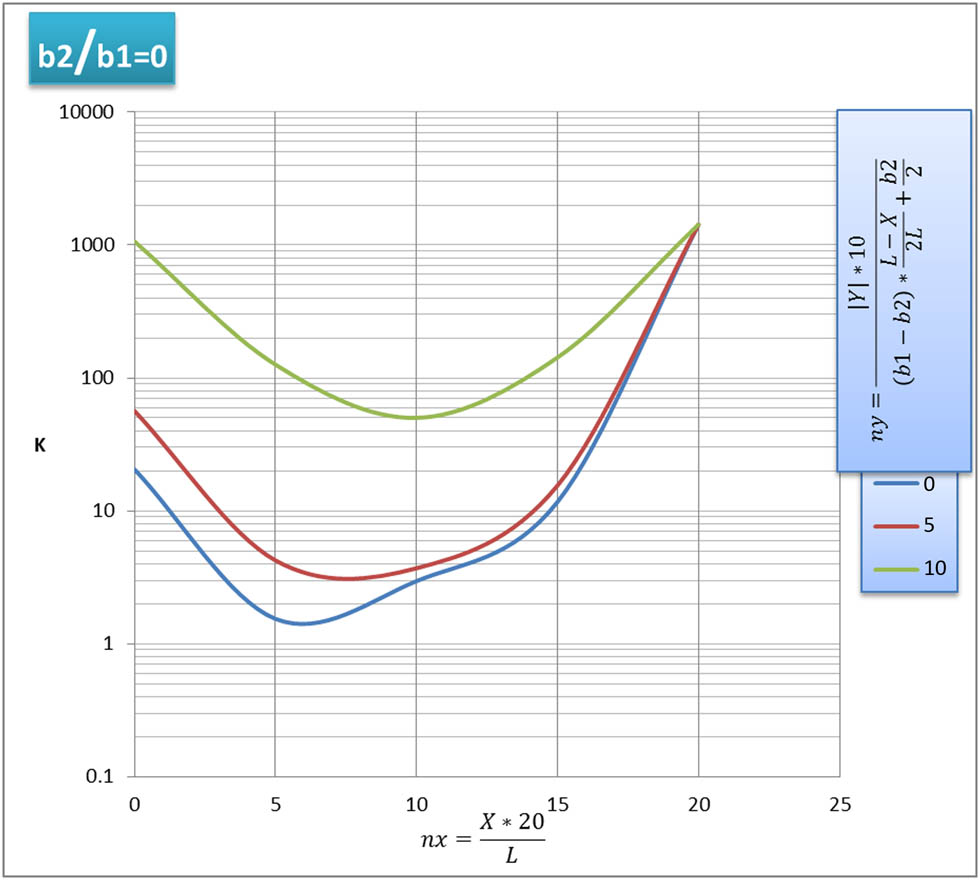
Coefficients (k) with ratio b2/b1 = 0.
Therefore, to study the number of elements toward (y), ten elements were taken for this case study, and the function was derived based on the coordinate loads in the direction of x and y, and the length of the foundation, in addition to the largest dimension b1 and the smaller dimension b2, as follows (Figure 4):

Coefficients (k) with ratio b2/b1 = 0.2.
These variables have been made from the curves that change between the maximum stress values along the change (ny). The resulting curve represents on the vertical axis a coefficient named (K), and the horizontal axis represents the percentage of (nx; Figure 5).

Coefficients (k) with ratio b2/b1 = 0.4.
It was a study of the change of footing dimension from a rectangle shape to a triangle, passing through the trapezoidal between b1 and b2 as a rate of b2/b1 as the amount of change that will make this parameter (K) include any after being smaller than b1 (Figure 6).

Coefficients (k) with ratio b2/b1 = 0.6.
4 Results and discussion
The result of this research was to find the coefficients (k) from these curves. Where (K) was drawn on the vertical axis, against nx and ny besides the b2/b1 variation in each curve and as shown in the following graphics charts (Figures 3–8):

Coefficients (k) with ratio b2/b1 = 0.8.
To verify the use of equation (1) and to find the coefficient k, an example was taken, which is a rectangular footing and the force is subjected at the center of the shape. Therefore, the maximum pressure below the base will be the force divided by the area directly. So, when the magnitude of the force is 100 kN and the rectangle has dimensions of 2 m width and 4 m length, the calculation of the pressure under the foundation is 12.5 kN/m2.
When using the above graphs that it is varied from triangular to rectangular with in between trapezoidal, for the same example, we go to Figure 8 where b2/b1 = 1, then get the value of k equal to 1, and thus multiply by dividing the force by the area through the use of equation (1) and governed the same pressure is 12.5 kN/m2 (Figure 9).

Coefficients (k) with ratio b2/b1 = 1.

How to use chart.
5 Conclusions
The study concludes that an equation had been derived to calculate the maximum base pressure for the applied load for both trapezoidal and triangular footing systems with an eccentricity in both directions. This derived equation would be so helpful tool in practical engineering. The process of this equation involves a simple multiplication of the extracted coefficient K and the total load and then divides it by the footing area of the system.
6 Recommendations and limitations
The case studied in the present work was concentrated load. The future work must take into consideration other types of loads. So, this is another direction for the development of research that is to check whether the value of the coefficient (K) will be modified or not.
Another direction for the development of research is that the number of elements in each direction has not changed, so it can be changed to investigate coefficient (K).
-
Conflict of interest: The authors state no conflict of interest.
-
Data availability statement: Most datasets generated and analyzed in this study are comprised in this submitted manuscript. The other datasets are available on reasonable request from the corresponding author with the attached information.
References
[1] Bowles JE. Foundation analysis and design; 1988. trid.trb.org.Search in Google Scholar
[2] Das BM, Sivakugan N. Principles of foundation engineering. Cengage Learning; 2018.Search in Google Scholar
[3] McCormac JC, Brown RH. Design of Reinforced Concrete. John Wiley & Sons; 2015.Search in Google Scholar
[4] González-Cuevas O. y Robles-Fernández-Villegas. F, Asp Fundam del concreto Reforz Limusa, México; 2005.Search in Google Scholar
[5] Punmia BC, Jain AK, Jain AK, Jain AK, Jain AK. Limit state design of reinforced concrete. Firewall Media; 2007.Search in Google Scholar
[6] Coduto DP, Kitch WA, Yeung MR. Foundation design: principles and practices. Vol. 2. USA: Prentice Hall; 2001.Search in Google Scholar
[7] Özmen G. Determination of base stresses in rectangular footings under biaxial bending. Tek Dergi. 2011;22(110):1519–35.Search in Google Scholar
[8] Agrawal R, Hora MS. Nonlinear interaction behaviour of infilled frame-isolated footings-soil system subjected to seismic loading. Struct Eng Mech An Int J. 2012;44(1):85–107.10.12989/sem.2012.44.1.085Search in Google Scholar
[9] www.bentley.com/products/product- line/structural-analysis-software/staadpro.Search in Google Scholar
[10] Wannas AA, Hadi AS, Hamza NH. Elastic–plastic analysis of the plane strain under combined thermal and pressure loads with a new technique in the finite element method. Open Eng. 2022;12(1):477–84. 10.1515/eng-2022-0049.Search in Google Scholar
[11] Al-Taie E, Al-Ansari N, Knutsson S. Effect of bearing capacity on designing foundations in iraq using STAAD Pro-v8i. Engineering. 2014;6(6):292–303. 10.4236/eng.2014.66033.Search in Google Scholar
[12] Dixit MS, Patil KA. Experimental estimate of Nγ values and corresponding settlements for square footings on finite layer of sand. Geomech Eng. 2013;5(4):363–77.10.12989/gae.2013.5.4.363Search in Google Scholar
[13] Rojas AL. A mathematical model for dimensioning of footings rectangular. ICIC express Lett Part B, Appl an Int J Res Surv. 2013;4(2):269–74.Search in Google Scholar
[14] Luevanos-Rojas A, Barquero-Cabrero JD, Lopez-Chavarria S, Medina Elizondo M. A comparative study for design of boundary combined footings of trapezoidal and rectangular forms using new models. Coupled Syst Mech. 2017;6(4):417–37.Search in Google Scholar
[15] ACI. (American Concrete Institute), “ACI 318-14. Building code requirements for structural concrete. MI, USA: ACI Farmington Hills; 2014.Search in Google Scholar
[16] Nimnim HT, Shaaban MQ. Structural Behavior of Composite Steel Truss-Concrete Vierendeel Beams. In: 2021 4th International Iraqi Conference on Engineering Technology and Their Applications (IICETA); 2021. p. 283–9.10.1109/IICETA51758.2021.9717466Search in Google Scholar
[17] Nimnim HT, Shaaban MQ. Effect of concrete strength on the flexural behavior of vierendeel steel and concrete composite beams. Int J Sci Technol Res. 2018;7(5):1–7.Search in Google Scholar
© 2023 the author(s), published by De Gruyter
This work is licensed under the Creative Commons Attribution 4.0 International License.
Articles in the same Issue
- Regular Articles
- Design optimization of a 4-bar exoskeleton with natural trajectories using unique gait-based synthesis approach
- Technical review of supervised machine learning studies and potential implementation to identify herbal plant dataset
- Effect of ECAP die angle and route type on the experimental evolution, crystallographic texture, and mechanical properties of pure magnesium
- Design and characteristics of two-dimensional piezoelectric nanogenerators
- Hybrid and cognitive digital twins for the process industry
- Discharge predicted in compound channels using adaptive neuro-fuzzy inference system (ANFIS)
- Human factors in aviation: Fatigue management in ramp workers
- LLDPE matrix with LDPE and UV stabilizer additive to evaluate the interface adhesion impact on the thermal and mechanical degradation
- Dislocated time sequences – deep neural network for broken bearing diagnosis
- Estimation method of corrosion current density of RC elements
- A computational iterative design method for bend-twist deformation in composite ship propeller blades for thrusters
- Compressive forces influence on the vibrations of double beams
- Research on dynamical properties of a three-wheeled electric vehicle from the point of view of driving safety
- Risk management based on the best value approach and its application in conditions of the Czech Republic
- Effect of openings on simply supported reinforced concrete skew slabs using finite element method
- Experimental and simulation study on a rooftop vertical-axis wind turbine
- Rehabilitation of overload-damaged reinforced concrete columns using ultra-high-performance fiber-reinforced concrete
- Performance of a horizontal well in a bounded anisotropic reservoir: Part II: Performance analysis of well length and reservoir geometry
- Effect of chloride concentration on the corrosion resistance of pure Zn metal in a 0.0626 M H2SO4 solution
- Numerical and experimental analysis of the heat transfer process in a railway disc brake tested on a dynamometer stand
- Design parameters and mechanical efficiency of jet wind turbine under high wind speed conditions
- Architectural modeling of data warehouse and analytic business intelligence for Bedstead manufacturers
- Influence of nano chromium addition on the corrosion and erosion–corrosion behavior of cupronickel 70/30 alloy in seawater
- Evaluating hydraulic parameters in clays based on in situ tests
- Optimization of railway entry and exit transition curves
- Daily load curve prediction for Jordan based on statistical techniques
- Review Articles
- A review of rutting in asphalt concrete pavement
- Powered education based on Metaverse: Pre- and post-COVID comprehensive review
- A review of safety test methods for new car assessment program in Southeast Asian countries
- Communication
- StarCrete: A starch-based biocomposite for off-world construction
- Special Issue: Transport 2022 - Part I
- Analysis and assessment of the human factor as a cause of occurrence of selected railway accidents and incidents
- Testing the way of driving a vehicle in real road conditions
- Research of dynamic phenomena in a model engine stand
- Testing the relationship between the technical condition of motorcycle shock absorbers determined on the diagnostic line and their characteristics
- Retrospective analysis of the data concerning inspections of vehicles with adaptive devices
- Analysis of the operating parameters of electric, hybrid, and conventional vehicles on different types of roads
- Special Issue: 49th KKBN - Part II
- Influence of a thin dielectric layer on resonance frequencies of square SRR metasurface operating in THz band
- Influence of the presence of a nitrided layer on changes in the ultrasonic wave parameters
- Special Issue: ICRTEEC - 2021 - Part III
- Reverse droop control strategy with virtual resistance for low-voltage microgrid with multiple distributed generation sources
- Special Issue: AESMT-2 - Part II
- Waste ceramic as partial replacement for sand in integral waterproof concrete: The durability against sulfate attack of certain properties
- Assessment of Manning coefficient for Dujila Canal, Wasit/-Iraq
- Special Issue: AESMT-3 - Part I
- Modulation and performance of synchronous demodulation for speech signal detection and dialect intelligibility
- Seismic evaluation cylindrical concrete shells
- Investigating the role of different stabilizers of PVCs by using a torque rheometer
- Investigation of high-turbidity tap water problem in Najaf governorate/middle of Iraq
- Experimental and numerical evaluation of tire rubber powder effectiveness for reducing seepage rate in earth dams
- Enhancement of air conditioning system using direct evaporative cooling: Experimental and theoretical investigation
- Assessment for behavior of axially loaded reinforced concrete columns strengthened by different patterns of steel-framed jacket
- Novel graph for an appropriate cross section and length for cantilever RC beams
- Discharge coefficient and energy dissipation on stepped weir
- Numerical study of the fluid flow and heat transfer in a finned heat sink using Ansys Icepak
- Integration of numerical models to simulate 2D hydrodynamic/water quality model of contaminant concentration in Shatt Al-Arab River with WRDB calibration tools
- Study of the behavior of reactive powder concrete RC deep beams by strengthening shear using near-surface mounted CFRP bars
- The nonlinear analysis of reactive powder concrete effectiveness in shear for reinforced concrete deep beams
- Activated carbon from sugarcane as an efficient adsorbent for phenol from petroleum refinery wastewater: Equilibrium, kinetic, and thermodynamic study
- Structural behavior of concrete filled double-skin PVC tubular columns confined by plain PVC sockets
- Probabilistic derivation of droplet velocity using quadrature method of moments
- A study of characteristics of man-made lightweight aggregate and lightweight concrete made from expanded polystyrene (eps) and cement mortar
- Effect of waste materials on soil properties
- Experimental investigation of electrode wear assessment in the EDM process using image processing technique
- Punching shear of reinforced concrete slabs bonded with reactive powder after exposure to fire
- Deep learning model for intrusion detection system utilizing convolution neural network
- Improvement of CBR of gypsum subgrade soil by cement kiln dust and granulated blast-furnace slag
- Investigation of effect lengths and angles of the control devices below the hydraulic structure
- Finite element analysis for built-up steel beam with extended plate connected by bolts
- Finite element analysis and retrofit of the existing reinforced concrete columns in Iraqi schools by using CFRP as confining technique
- Performing laboratory study of the behavior of reactive powder concrete on the shear of RC deep beams by the drilling core test
- Special Issue: AESMT-4 - Part I
- Depletion zones of groundwater resources in the Southwest Desert of Iraq
- A case study of T-beams with hybrid section shear characteristics of reactive powder concrete
- Feasibility studies and their effects on the success or failure of investment projects. “Najaf governorate as a model”
- Optimizing and coordinating the location of raw material suitable for cement manufacturing in Wasit Governorate, Iraq
- Effect of the 40-PPI copper foam layer height on the solar cooker performance
- Identification and investigation of corrosion behavior of electroless composite coating on steel substrate
- Improvement in the California bearing ratio of subbase soil by recycled asphalt pavement and cement
- Some properties of thermal insulating cement mortar using Ponza aggregate
- Assessment of the impacts of land use/land cover change on water resources in the Diyala River, Iraq
- Effect of varied waste concrete ratios on the mechanical properties of polymer concrete
- Effect of adverse slope on performance of USBR II stilling basin
- Shear capacity of reinforced concrete beams with recycled steel fibers
- Extracting oil from oil shale using internal distillation (in situ retorting)
- Influence of recycling waste hardened mortar and ceramic rubbish on the properties of flowable fill material
- Rehabilitation of reinforced concrete deep beams by near-surface-mounted steel reinforcement
- Impact of waste materials (glass powder and silica fume) on features of high-strength concrete
- Studying pandemic effects and mitigation measures on management of construction projects: Najaf City as a case study
- Design and implementation of a frequency reconfigurable antenna using PIN switch for sub-6 GHz applications
- Average monthly recharge, surface runoff, and actual evapotranspiration estimation using WetSpass-M model in Low Folded Zone, Iraq
- Simple function to find base pressure under triangular and trapezoidal footing with two eccentric loads
- Assessment of ALINEA method performance at different loop detector locations using field data and micro-simulation modeling via AIMSUN
- Special Issue: AESMT-5 - Part I
- Experimental and theoretical investigation of the structural behavior of reinforced glulam wooden members by NSM steel bars and shear reinforcement CFRP sheet
- Improving the fatigue life of composite by using multiwall carbon nanotubes
- A comparative study to solve fractional initial value problems in discrete domain
- Assessing strength properties of stabilized soils using dynamic cone penetrometer test
- Investigating traffic characteristics for merging sections in Iraq
- Enhancement of flexural behavior of hybrid flat slab by using SIFCON
- The main impacts of a managed aquifer recharge using AHP-weighted overlay analysis based on GIS in the eastern Wasit province, Iraq
Articles in the same Issue
- Regular Articles
- Design optimization of a 4-bar exoskeleton with natural trajectories using unique gait-based synthesis approach
- Technical review of supervised machine learning studies and potential implementation to identify herbal plant dataset
- Effect of ECAP die angle and route type on the experimental evolution, crystallographic texture, and mechanical properties of pure magnesium
- Design and characteristics of two-dimensional piezoelectric nanogenerators
- Hybrid and cognitive digital twins for the process industry
- Discharge predicted in compound channels using adaptive neuro-fuzzy inference system (ANFIS)
- Human factors in aviation: Fatigue management in ramp workers
- LLDPE matrix with LDPE and UV stabilizer additive to evaluate the interface adhesion impact on the thermal and mechanical degradation
- Dislocated time sequences – deep neural network for broken bearing diagnosis
- Estimation method of corrosion current density of RC elements
- A computational iterative design method for bend-twist deformation in composite ship propeller blades for thrusters
- Compressive forces influence on the vibrations of double beams
- Research on dynamical properties of a three-wheeled electric vehicle from the point of view of driving safety
- Risk management based on the best value approach and its application in conditions of the Czech Republic
- Effect of openings on simply supported reinforced concrete skew slabs using finite element method
- Experimental and simulation study on a rooftop vertical-axis wind turbine
- Rehabilitation of overload-damaged reinforced concrete columns using ultra-high-performance fiber-reinforced concrete
- Performance of a horizontal well in a bounded anisotropic reservoir: Part II: Performance analysis of well length and reservoir geometry
- Effect of chloride concentration on the corrosion resistance of pure Zn metal in a 0.0626 M H2SO4 solution
- Numerical and experimental analysis of the heat transfer process in a railway disc brake tested on a dynamometer stand
- Design parameters and mechanical efficiency of jet wind turbine under high wind speed conditions
- Architectural modeling of data warehouse and analytic business intelligence for Bedstead manufacturers
- Influence of nano chromium addition on the corrosion and erosion–corrosion behavior of cupronickel 70/30 alloy in seawater
- Evaluating hydraulic parameters in clays based on in situ tests
- Optimization of railway entry and exit transition curves
- Daily load curve prediction for Jordan based on statistical techniques
- Review Articles
- A review of rutting in asphalt concrete pavement
- Powered education based on Metaverse: Pre- and post-COVID comprehensive review
- A review of safety test methods for new car assessment program in Southeast Asian countries
- Communication
- StarCrete: A starch-based biocomposite for off-world construction
- Special Issue: Transport 2022 - Part I
- Analysis and assessment of the human factor as a cause of occurrence of selected railway accidents and incidents
- Testing the way of driving a vehicle in real road conditions
- Research of dynamic phenomena in a model engine stand
- Testing the relationship between the technical condition of motorcycle shock absorbers determined on the diagnostic line and their characteristics
- Retrospective analysis of the data concerning inspections of vehicles with adaptive devices
- Analysis of the operating parameters of electric, hybrid, and conventional vehicles on different types of roads
- Special Issue: 49th KKBN - Part II
- Influence of a thin dielectric layer on resonance frequencies of square SRR metasurface operating in THz band
- Influence of the presence of a nitrided layer on changes in the ultrasonic wave parameters
- Special Issue: ICRTEEC - 2021 - Part III
- Reverse droop control strategy with virtual resistance for low-voltage microgrid with multiple distributed generation sources
- Special Issue: AESMT-2 - Part II
- Waste ceramic as partial replacement for sand in integral waterproof concrete: The durability against sulfate attack of certain properties
- Assessment of Manning coefficient for Dujila Canal, Wasit/-Iraq
- Special Issue: AESMT-3 - Part I
- Modulation and performance of synchronous demodulation for speech signal detection and dialect intelligibility
- Seismic evaluation cylindrical concrete shells
- Investigating the role of different stabilizers of PVCs by using a torque rheometer
- Investigation of high-turbidity tap water problem in Najaf governorate/middle of Iraq
- Experimental and numerical evaluation of tire rubber powder effectiveness for reducing seepage rate in earth dams
- Enhancement of air conditioning system using direct evaporative cooling: Experimental and theoretical investigation
- Assessment for behavior of axially loaded reinforced concrete columns strengthened by different patterns of steel-framed jacket
- Novel graph for an appropriate cross section and length for cantilever RC beams
- Discharge coefficient and energy dissipation on stepped weir
- Numerical study of the fluid flow and heat transfer in a finned heat sink using Ansys Icepak
- Integration of numerical models to simulate 2D hydrodynamic/water quality model of contaminant concentration in Shatt Al-Arab River with WRDB calibration tools
- Study of the behavior of reactive powder concrete RC deep beams by strengthening shear using near-surface mounted CFRP bars
- The nonlinear analysis of reactive powder concrete effectiveness in shear for reinforced concrete deep beams
- Activated carbon from sugarcane as an efficient adsorbent for phenol from petroleum refinery wastewater: Equilibrium, kinetic, and thermodynamic study
- Structural behavior of concrete filled double-skin PVC tubular columns confined by plain PVC sockets
- Probabilistic derivation of droplet velocity using quadrature method of moments
- A study of characteristics of man-made lightweight aggregate and lightweight concrete made from expanded polystyrene (eps) and cement mortar
- Effect of waste materials on soil properties
- Experimental investigation of electrode wear assessment in the EDM process using image processing technique
- Punching shear of reinforced concrete slabs bonded with reactive powder after exposure to fire
- Deep learning model for intrusion detection system utilizing convolution neural network
- Improvement of CBR of gypsum subgrade soil by cement kiln dust and granulated blast-furnace slag
- Investigation of effect lengths and angles of the control devices below the hydraulic structure
- Finite element analysis for built-up steel beam with extended plate connected by bolts
- Finite element analysis and retrofit of the existing reinforced concrete columns in Iraqi schools by using CFRP as confining technique
- Performing laboratory study of the behavior of reactive powder concrete on the shear of RC deep beams by the drilling core test
- Special Issue: AESMT-4 - Part I
- Depletion zones of groundwater resources in the Southwest Desert of Iraq
- A case study of T-beams with hybrid section shear characteristics of reactive powder concrete
- Feasibility studies and their effects on the success or failure of investment projects. “Najaf governorate as a model”
- Optimizing and coordinating the location of raw material suitable for cement manufacturing in Wasit Governorate, Iraq
- Effect of the 40-PPI copper foam layer height on the solar cooker performance
- Identification and investigation of corrosion behavior of electroless composite coating on steel substrate
- Improvement in the California bearing ratio of subbase soil by recycled asphalt pavement and cement
- Some properties of thermal insulating cement mortar using Ponza aggregate
- Assessment of the impacts of land use/land cover change on water resources in the Diyala River, Iraq
- Effect of varied waste concrete ratios on the mechanical properties of polymer concrete
- Effect of adverse slope on performance of USBR II stilling basin
- Shear capacity of reinforced concrete beams with recycled steel fibers
- Extracting oil from oil shale using internal distillation (in situ retorting)
- Influence of recycling waste hardened mortar and ceramic rubbish on the properties of flowable fill material
- Rehabilitation of reinforced concrete deep beams by near-surface-mounted steel reinforcement
- Impact of waste materials (glass powder and silica fume) on features of high-strength concrete
- Studying pandemic effects and mitigation measures on management of construction projects: Najaf City as a case study
- Design and implementation of a frequency reconfigurable antenna using PIN switch for sub-6 GHz applications
- Average monthly recharge, surface runoff, and actual evapotranspiration estimation using WetSpass-M model in Low Folded Zone, Iraq
- Simple function to find base pressure under triangular and trapezoidal footing with two eccentric loads
- Assessment of ALINEA method performance at different loop detector locations using field data and micro-simulation modeling via AIMSUN
- Special Issue: AESMT-5 - Part I
- Experimental and theoretical investigation of the structural behavior of reinforced glulam wooden members by NSM steel bars and shear reinforcement CFRP sheet
- Improving the fatigue life of composite by using multiwall carbon nanotubes
- A comparative study to solve fractional initial value problems in discrete domain
- Assessing strength properties of stabilized soils using dynamic cone penetrometer test
- Investigating traffic characteristics for merging sections in Iraq
- Enhancement of flexural behavior of hybrid flat slab by using SIFCON
- The main impacts of a managed aquifer recharge using AHP-weighted overlay analysis based on GIS in the eastern Wasit province, Iraq
