Analysis of the operating parameters of electric, hybrid, and conventional vehicles on different types of roads
-
Adriana Skuza
 ,
Rafał Jurecki
,
Rafał Jurecki

Abstract
Vehicles, regardless of the type of drive, move on different types of roads. The operational characteristics of the highway will be different than those of the urban road. The aim of this article is to compare the performance of electric, hybrid, and conventional vehicles on different roads. For simulation studies in the AVL Cruise program, speed profiles determined on the highway, expressway, suburban, and urban roads were used. The article presents the course of energy consumption of an electric and hybrid vehicle, the amount of energy recovered by these vehicles, and the state of battery charge after the routes. The fuel consumption and emissions of harmful exhaust components of hybrid and conventional vehicles are also described. Based on the collected data, it was determined what is the cost of driving each of the routes by the tested vehicles. The results showed that the operational characteristics of the vehicles on each route are different. Driving speed, vehicle load, or duration of the journey significantly affects energy consumption, fuel, and costs. Such a comparison allows you to adjust the choice of vehicle by the driver, who, knowing his daily route, can decide on a vehicle with a specific type of drive.
1 Introduction
Electric and hybrid vehicles are gaining an increasingly strong position on the automotive market in Poland. Polish Association of the Automotive Industry, on the basis of data from the Central Register of Vehicles, prepared a report on the registration of passenger vehicles (Figure 1). It shows that in 2019, the number of registered battery electric vehicles and plug-in hybrid vehicles amounted to 2.7 thousand units, while in 2020, it was 8.1 thousand units. In the case of hybrid vehicles, it was 41.9 thousand units in 2019 and 61.9 thousand in 2020. This means that the increase was much smaller, at the level of 47.9%. For comparison, the number of conventionally powered vehicles has decreased. For gasoline-powered vehicles, this number fell from 391,900 units in 2019 to 268,000 the following year. Registration of new diesel vehicles decreased from 110,600 units to 80,900 in the indicated period [1].

Number of newly registered passenger vehicles by type of power supply.
Conventional, hybrid, and electric vehicles have both a number of advantages and disadvantages. The occurrence of both positive and negative aspects of the use of the aforementioned vehicles is related, among other things, to their operation on different types of roads. This applies, for example, to energy recovery based on regenerative braking of electric and hybrid vehicles [2]. When driving on an urban road, regenerative braking energy is high due to the driving conditions. This is due to frequent braking [3]. The increase in regenerative braking energy depends not only on the type of road, but also on the inclination [4].
The type of road on which the vehicle travels has an impact on the electricity or fuel consumption of the test vehicles [5,6]. Helms et al. [7] present the energy and fuel consumption when driving on urban roads, suburban roads, and highways. It is evident that in urban traffic, electric and hybrid vehicles consume the least energy, while conventional vehicles use the most fuel. The opposite is true when driving on the highway. Wang et al. [8] showed that conventional vehicles can consume up to 35% more fuel under certain conditions than hybrid vehicles. In suburban areas and on the highway, it was the hybrid that consumed more fuel. Pielecha et al. [9] compared the point of view of pollutant emissions and energy consumption. The results showed that the energy intensity of an electric vehicle is the highest on the highway and the lowest in the city. For a hybrid vehicle, the most energy-consuming route turned out to be a suburban road, and for a conventional one, an urban one. At the same time, it was pointed out that a conventional vehicle emits more harmful exhaust components than a hybrid vehicle.
Vehicles with different power sources were also compared from the point of view of emissions of harmful exhaust components [10–12]. The study by Taymaz and Benli [13] presents results on the fuel consumption and
In the literature, we can also find comparative analyses of vehicles in terms of economy and analyses of the total cost of ownership [15–17]. Granovskii et al. [12] compared hybrid, electric, conventional, and fuel cell vehicles. Three scenarios for the production of electricity were assumed. In the first, electricity comes exclusively from renewable energy sources; in the second, 50% of energy is generated as in the first scenario, with the remaining 50% from natural gas, and in the third, 100% of energy is generated from natural gas. The results show that in the first variant, electric and hybrid vehicles are unrivalled from both an ecological and economic point of view.
The aim of this study is to compare the operational efficiency of an electric, hybrid, and conventional vehicle on four types of roads. Analyses of energy consumption, fuel consumption, and exhaust emissions were carried out for this vehicle with different drive systems under different driving conditions. In addition, the costs of overcoming each route were calculated. In terms of the energy or fuel used by the vehicles, the preliminary results are described in this article. The simulations contain only the velocity profile without taking into account additional factors affecting energy consumption (e.g. related to the environment).
2 Methodology
2.1 Determination of the characteristics of the analysed routes
To carry out the simulation study, actual velocity profiles of four routes were determined: highway, expressway (fast dual carriageway), suburban road, and urban road. The data were recorded using a Corrsys Datron S-350® Aqua optoelectronic sensor, a TAA® three-axis acceleration sensor, a Datron uEEP12® data acquisition station, and a control tablet with ARMS® software. The measuring devices were mounted on a Ford Transit research vehicle. Based on the recorded data, velocity profiles were drawn up for each route (Figure 2). Aspects related to the environment (temperature and inclination) were omitted at this stage of research.

Velocity profiles on the routes studied: highway, expressway, suburban road, and urban road.
Analysing the speed profiles, it is visible that their courses differ significantly from each other. When driving on a highway (Figure 2(a)), there are no stops, and the braking causes only a slight reduction in velocity. The passage of the vehicle on the expressway (Figure 2(b)) is similar to the speed profile for the highway. However, there are more frequent braking with a greater difference in speed. On a suburban road (Figure 2(c)), the vehicle braked much more often, and the difference between the speed at which the vehicle began braking and the velocity at which it ended was very large. A similar relationship is also due to acceleration. No arrests were reported on the expressway and highway. The most diverse speed profile is shown in Figure 2(d) for a city road. This is the result of traffic conditions typical for the city, i.e. the need to stop in connection with traffic lights, the occurrence of traffic jams, or the appearance of road infrastructure elements forcing a reduction in speed (roundabouts and speed bumps). The vehicle on the city route repeatedly braked and accelerated, and in addition, it often stopped.
Table 1 provides information on the length of each of the selected routes, travel time, and average and maximum velocities. The length of the journeys was comparable, but it is necessary that the time of overcoming the route of this highway was the shortest. At that time, there was also the highest average velocity of 111.8 km/h and a maximum of 130 km/h, which resulted from the restrictions imposed by road regulations. Covering the suburban route took twice as long as the express route. The longest journey took place on the city road. The characteristics of traffic in the city and significant velocity limits meant that the average and maximum velocity are much lower than in the case of other crossings.
Parameters of journeys on the tested types of roads
| Highway | Expressway | Suburban | Urban | |
|---|---|---|---|---|
| Time (s) | 628 | 669 | 1,203 | 2,925 |
| Distance (km) | 19.5 | 18.3 | 18.9 | 17.3 |
| Average speed (km/h) | 111.8 | 98.5 | 56.6 | 21.3 |
| Max speed (km/h) | 130 | 116 | 95.5 | 80.5 |
2.2 Simulation studies
Simulation studies were conducted using the AVL Cruise software. The speed profiles discussed in Section 2.1 are used in simulations. The software gives a number of possibilities for analysing vehicles with different types of powertrains. In the dialog box of the program, it is possible to use both ready-made vehicle models, as well as to configure the model yourself from the available elements. The user can use a conventional, hybrid, and electric vehicle for simulation. After selecting the vehicle, you need to specify the type of cycle. For this purpose, you can enter your own data that form the basis of the cycle, among others, travel time, vehicle speed, length of the route travelled. It is also possible to use standardized cycles included in the software, such as New European Driving Cycle (NEDC), Worldwide Harmonized Light Vehicle Test Procedure or the Highway Fuel Economy Test. In addition, it is possible to change such parameters as vehicle load, ambient temperature, inclination of the terrain, or the initial state of charge (SOC) of the battery. Carrying out the simulation allows one to obtain parameters typical for the operation of the tested vehicle in the indicated conditions. These include, inter alia, exhaust emissions, fuel consumption, the value of energy consumed and energy recovered as a result of braking, power flow, and changes in voltage and current in the battery or engine load. The use of the AVL Cruise gives the opportunity to obtain information about the operation of the vehicle in situations where it is not possible to perform tests in real-world conditions. In addition, it is possible to optimize certain technological solutions in order to obtain better results related to, e.g. exhaust emissions or vehicle efficiency [18].
The AVL Cruise is widely used by scientists to evaluate the effectiveness of vehicles with different types of powertrain. Pielecha and Pielecha [19] used the software to analyse the energy consumption of an electric vehicle in standardised tests the Worldwide harmonized Light vehicles Test Cycles (WLTC), NEDC and compared to the Real Driving Emissions (RDE) test. Cioroianu et al. [20] conducted a simulation aimed at determining what the operating parameters of an electric vehicle are in the WLTC cycle. In the study by Grabowski et al. [21], the AVL Cruise was used to create a model of a city bus. On the basis of the created model, a simulation was carried out under the conditions of the SORT 2 cycle, which allowed to determine the operating parameters of the vehicle. The AVL Cruise was also used to research the structural aspects of the vehicle. Du et al. [22] used the capabilities of the software to create new design variants of the powertrain. Based on the obtained parameters, it has been shown that it is possible to optimize the costs associated with research on motor vehicles. Velocity profiles described in Section 2.1 were used in the simulation.
2.3 Characteristic of the vehicles used in the simulation
Three types of vehicles were used in the simulation studies: conventionally powered (Figure 3(a)), hybrid (Figure 3(b)) and electric (Figure 3(c)). There were models included in AVL Cruise.

Vehicle model in the simulation programme: (a) conventionally powered, (b) hybrid powered, and (c) electric powered.
Electric and hybrid vehicles have front-wheel drive, while a conventional vehicle has a rear-wheel drive. Basic parameters related to the vehicles selected for simulation are presented in Table 2.
Basic parameters of the tested vehicles
| Vehicle | Conventional | Hybrid | Electric |
|---|---|---|---|
| Weight (kg) | 1,100 | 1,300 | 1,200 |
| Drag coefficient | 0.33 | 0.3 | 0.28 |
| Frontal area (
|
1.72 | 2.15 | 1.97 |
| Nominal voltage (V) | — | 160 | 320 |
| Initial SOC (%) | — | 95 | 95 |
| Maximum torque (Nm) | 90 | 130 | 240 |
| Maximum power (kW) | 50 | 60 | 80 |
3 Results
Based on the tests and simulations carried out, results were obtained showing the operational characteristics of the vehicles on each route. Thanks to the AVL Cruise, it was possible to compare parameters such as: the initial SOC of the battery for an electric and hybrid vehicle, energy consumption, fuel consumption of a hybrid and conventional vehicle, or exhaust emissions from vehicles with an internal combustion engine.
3.1 Analysis of the energy efficiency of the tested vehicles
Hybrid and electric vehicles have different energy consumption on each of the routes analysed. The driving characteristics when driving on the highway are quite different than in the case of a city road, manifested, for example, by numbers, brakes or stopping time. Figure 4 shows the SOC of the battery after each route has been covered by an electric and hybrid vehicle. In the case of an electric vehicle, the energy level in the battery is the lowest after driving the route of the highway. The electric vehicle recorded the lowest degree of battery discharge on a suburban route. The difference is relatively about 13%. It should be noted that very similar values of the level of energy remaining in the battery were recorded after journeys in urban and suburban driving conditions. The result is that on urban and suburban roads, the vehicle often braked, which contributed to energy recovery. In the city, the vehicle often stopped, which means that the energy consumption was slightly higher.

SOC of the battery after the hybrid and electric vehicles have travelled each route.
In the case of a hybrid vehicle, the lowest degree of battery discharge was recorded after driving along the highway and expressway. The highest degree of battery discharge took place during the passage in urban driving conditions. In this case, the reason is the recharging of the battery by the internal combustion engine and regenerative braking.
Figure 5 shows the total output and input energy in the selected runs. Output energy means the energy that has been used to cover each of the routes. The input energy reflects the energy recovered from regenerative braking and, in the case of a hybrid vehicle, the value of the energy that the battery has been recharged by the internal combustion engine (Figure 6).

Total output energy after the hybrid and electric vehicles travelled the routes tested.

Total input energy after the hybrid and electric vehicles travelled the routes tested.
As can be seen in Figure 5, the energy consumption of an electric vehicle is completely opposite to that of a hybrid vehicle. On the highway, it was the electric vehicle that consumed the most energy of all the routes analysed, while the hybrid vehicle consumed the least. When driving on the highway, the electric vehicle consumed 42% more energy than when driving on a suburban route. In the case of a hybrid vehicle, the vehicle consumed the least energy while driving on the highway, and the most while driving in urban driving conditions, which was 5 times more energy consumed. Analysing the graph, it is visible that the amount of energy consumed from the battery by the hybrid vehicle on the tested routes is small. This is due to the fact that it moves using not only electricity from the battery but also energy from the combustion of fuel in the internal combustion engine.
In the case of input energy, i.e. recovered as a result of regenerative braking, the characteristics for both vehicles are similar (Figure 6). The vehicle recovered the least energy on the highway and the most on the city road. This is influenced by the specificity of traffic conditions, i.e. the frequency and braking force during the entire route. A hybrid vehicle recovered 91% more energy in the city than on the highway, and an electric vehicle recovered 94%. It is worth noting that for highways and expressways, the characteristics of energy consumption and recovery are very similar.
In both hybrid and conventional vehicles, the main source of energy is the internal combustion engine. Although the hybrid vehicle moves using both energy from the battery, the main source of energy is the internal combustion engine, powered by energy obtained as a result of burning fuel. Figure 7 shows the fuel consumption of a hybrid and conventional vehicle in several stages of traffic: idling, acceleration, braking, and constant velocity.
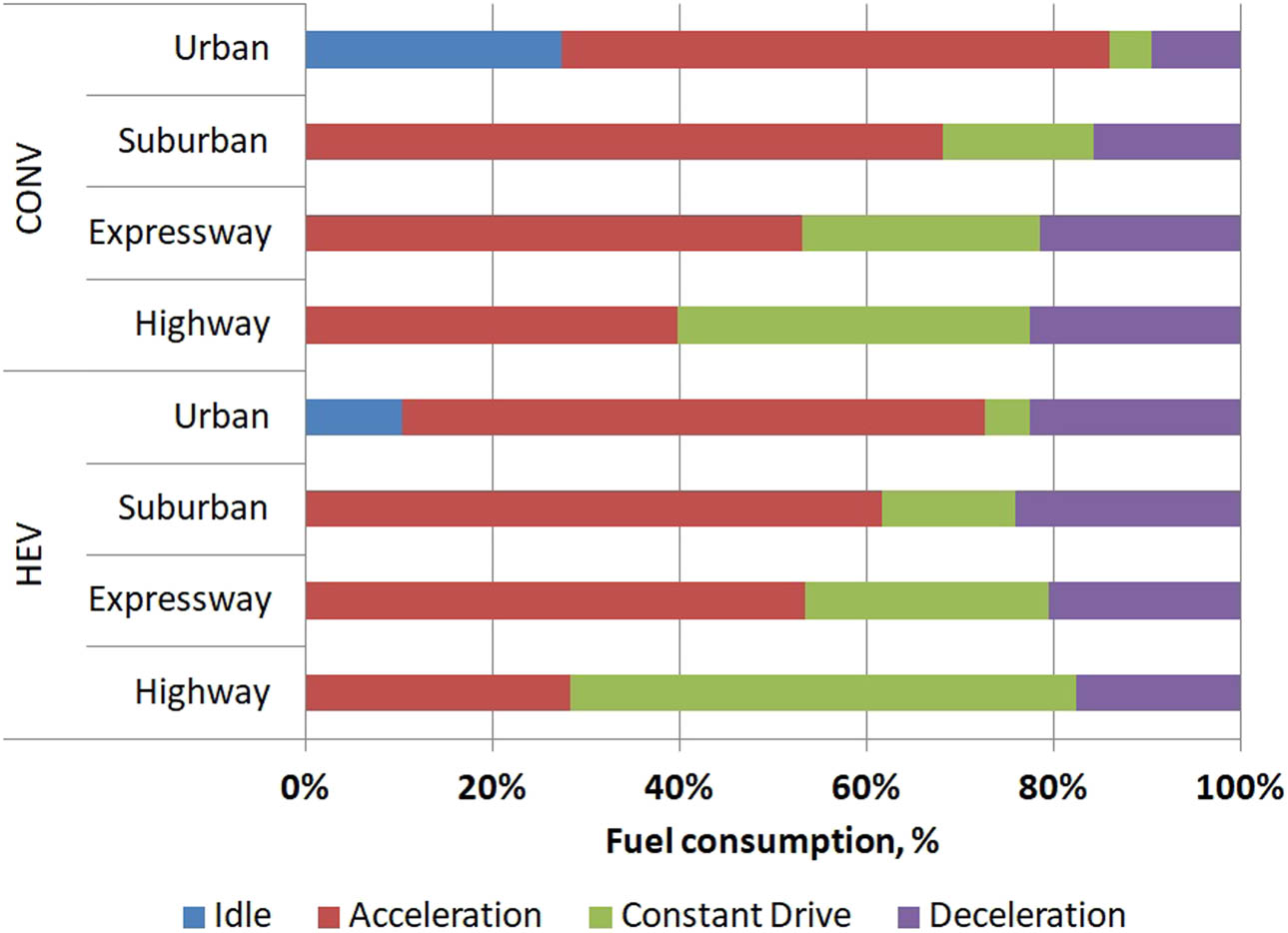
Fuel consumption of the hybrid and conventional vehicles on the routes studied at different driving modes.
Figure 7 shows that idling occurred only in the city due to the specificity of traffic, forcing stopping at traffic lights, in traffic jams or before intersections. A conventional vehicle consumes almost four times more fuel at idle than a hybrid vehicle. In the case of acceleration, fuel consumption is qualitatively similar for both types of vehicles. Vehicles used the least fuel to accelerate on the highway, then on the expressway, suburban road, and the most in the city. At that time, a conventional vehicle also consumed more fuel than a hybrid vehicle. The difference between the highest (urban road) and lowest (highway) fuel consumption during acceleration for a hybrid vehicle was 65%, and for a conventional vehicle, it was 49%. Similarly, when driving at a constant speed. On the highway, a hybrid vehicle consumes the least fuel for braking, whereas on the urban one, the most. For a conventional vehicle, the relationship is the opposite. Comparing fuel consumption, a hybrid vehicle consumes 44% less fuel on the highway, 31% less on the expressway, 18% more on the suburban road, and 40% more on the city road.
The total fuel consumption is shown in Figure 8. On the expressway and highway, the fuel consumption for a hybrid vehicle is very similar. On these routes, there is the lowest fuel consumption. A similar relationship for these types of roads results from a vehicle with a conventional drive. The highest fuel consumption for both types of vehicles was recorded during the journey on the urban route. At that time, a conventional vehicle consumed 30% more fuel than a hybrid one. On the highway, the difference in fuel consumption obtained by these vehicles was 21%.

Total fuel consumption of the hybrid and conventional vehicles on the routes studied.
Analysing the energy consumed by the tested vehicles (Figure 9), it is visible that the highest value of energy was recorded during journeys on highways and expressways, while the least was recorded in urban driving conditions. The value of energy consumed obtained by an electric vehicle is much lower than that of a hybrid vehicle. The amount of energy consumed by an electric vehicle is much less than that of a hybrid vehicle. For hybrid and conventional vehicles, the differences are much smaller.

Energy consumption of vehicles on the routes studied.
3.2 Emissions of hybrid and conventional vehicle
Analysing the emissions of harmful exhaust components emitted by the vehicles tested (Figure 10), it can be seen that the hybrid vehicle emits far fewer of these than a conventional vehicle. The main harmful components of exhaust gases are nitrogen oxides, carbon monoxide, carbon dioxide, and hydrocarbons.

Emissions of harmful components of the exhaust gas emitted by hybrid and conventional vehicles on the routes studied: (a) nitrogen oxides, (b) carbon monoxide, (c) hydrocarbons, and (d) carbon dioxide.
In the case of nitrogen oxides (Figure 10(a)), the highest level of emissions was recorded during a highway crossing for both hybrid and conventional vehicles. The lowest emission value recorded by the vehicles analysed took place on a suburban road. This is due to the fact that expressways force a higher load on the internal combustion engine, which translates into higher energy demand and thus increases emissions. In addition, high emissions are characterized by driving in urban conditions. In all road conditions, the conventional vehicle recorded higher carbon monoxide emission values. In particular, large differences were noted when driving on the urban route. At that time, a conventional vehicle recorded 45% higher CO emissions than a hybrid vehicle. The obtained emission values of carbon dioxide are similar on the expressway and suburban road for both types of analysed vehicles. A conventionally powered vehicle emits 37% more
The highest level of hydrocarbon (HC) emissions was recorded during journeys in urban conditions. What is more, under these driving conditions, the hybrid vehicle recorded 23% higher emissions than a conventional vehicle. The lowest HC emissions of both vehicles analysed were recorded during a journey on a suburban road.
3.3 Cost of fuel or electric energy
In the further part of the article, costs of electric energy or fuel in various traffic conditions of electric, hybrid, and conventional vehicles were analysed. To determine the travel costs of each vehicle, the cost of 1 kWh of electricity and the price of fuel were determined. According to the Polish Organization of Petroleum Industry and Trade, the average retail price for gasoline after the first half of 2022 amounted to EUR 1.40 (PLN 6.54) per litre [23,24]. This price includes all taxes and fees that are added before the sale. In the case of electricity, according to the Rachuneo portal, the price for 1 kWh after the first half of the year ranges from EUR 0.15 (PLN 0.72) to EUR 0.17 (PLN 0.80). This price includes reduced VAT, the sale price of energy and its distribution. The calculation assumed a value of PLN 0.16 (PLN 0.76) for 1 kWh of energy [25]. The price of electricity for households is higher than at charging stations. This is due to monthly fees depending on the amount of energy used or the subscription. The presented prices for fuel and electricity apply directly to users of refuelling stations or vehicle charging stations.
Figure 11 shows the cost of fuel or electricity used to cover each of the tested routes covered by an electric, hybrid, and conventional vehicle. In each of the analysed journeys, the highest cost of fuel consumed is characterized by conventional vehicles, especially when driving on a city road. This is associated with high fuel consumption in urban traffic conditions (Figure 9). The lowest costs are characterized by an electric vehicle. Under the analysed traffic conditions, the electric vehicle achieved the highest mileage for the vehicle on the highway and expressway, and the smallest for the passage around the city. Moreover, the difference between the costs for an electric vehicle and for other vehicles is significant. Adverting an electric vehicle along the tested routes is cheaper in the range of 37–73% for a hybrid vehicle. Compared to a conventionally powered vehicle, it ranges from 52 to 80%.
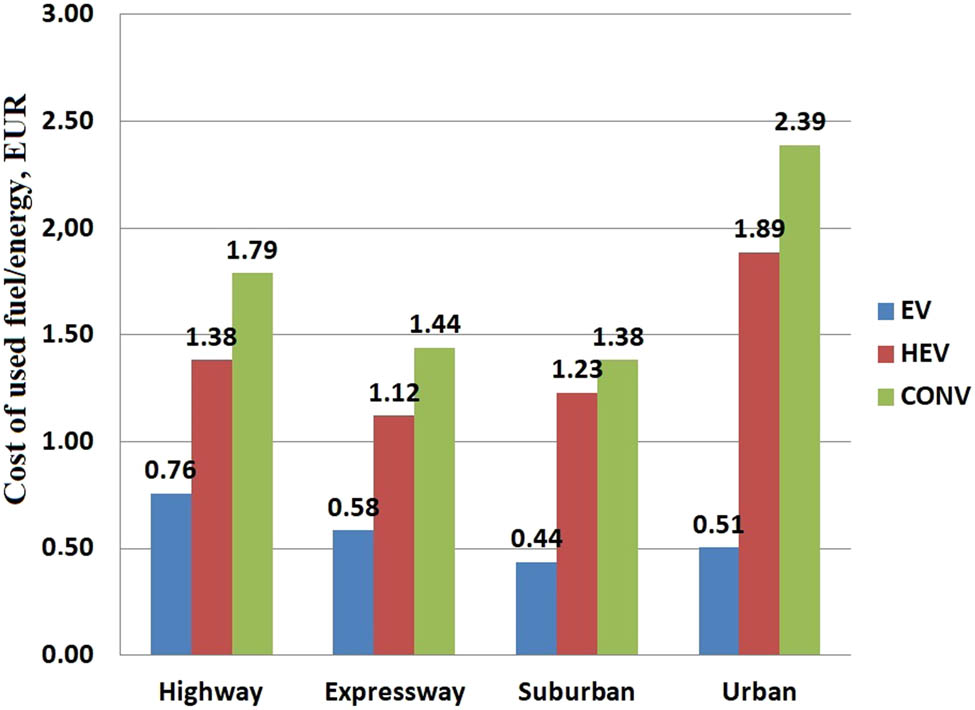
Costs of fuel or electric energy on the routes studied by electric, hybrid and conventional vehicles.
Table 3 shows a relative comparison of electric vehicle (EV) and hybrid electric vehicle (HEV) fuel and electricity costs in relation to conventional vehicle (CONV). Differences are presented as percentages. The reference point is the fuel cost of a conventional vehicle, which was the highest on each route. The cost of fuel used by a conventional vehicle was defined as 100%. The percentage difference is shown in the table. This means by what percentage the cost of the fuel or energy used was less than in the case of a conventional vehicle.
Percentage difference of fuel or electricity consumption cost (CONV = 100%)
| EV (%) | HEV (%) | |
|---|---|---|
| Highway | 58 | 23 |
| Expressway | 59 | 22 |
| Suburban | 68 | 11 |
| Urban | 79 | 21 |
4 Discussion
Comparing the results obtained in this article, it is clear that they coincide with the results obtained in the literature. Huang et al. [26] showed that a hybrid vehicle can consume from 23% to 49% less fuel than a conventional vehicle. In this article, this value is 28–30%, depending on the type of route. In addition, the authors obtained higher HC emissions from the hybrid vehicle than from the conventional one. This is consistent with the results obtained from the AVL Cruise program.
Pielecha et al. [9] obtained results that indicate the energy consumption of electric vehicles on different road types. The results confirm that the highway’s energy consumption is the highest. The smallest, however, occurs on a city road. The differences amounted to 17% in relation to the suburban road and 31% in relation to the urban road. In this study, the differences were slightly larger and amounted to 43% and 33%, respectively. Donkers et al. [27] showed that the type of route affects energy consumption. Choosing a route can reduce energy consumption by 35–50%. Orrechini et al. [28] also obtained similar results.
5 Conclusion
The article analysed the operational characteristics of vehicles with electric, hybrid, and conventional drives on four types of roads: highway, expressway, suburban, and urban. On the basis of data on energy consumption, fuel consumption, emissions of harmful exhaust components, or the cost of travel on each route, the following conclusions were defined.
In the case of an electric vehicle, higher energy consumption occurred due to the higher travel velocity and operating load of the vehicle. The most energy-consuming route for an electric vehicle turned out to be a highway, while for a hybrid one, it was an urban road. In contrast, the energy recovery of vehicles had a similar course. The least of it was recovered on the highway, and the most in urban driving conditions. The fuel consumption of the hybrid and conventional vehicles was the highest in the city. A conventional vehicle consumed the least fuel on a suburban road, while a hybrid vehicle consumed the most fuel on an expressway.
Analysing the journeys, it is visible that the emission of carbon monoxide, carbon dioxide, and nitrogen oxides is higher for a conventional vehicle. A higher load on the vehicle increases the emission of harmful exhaust gas components, which can be seen in relation to driving on the highway. It is worth noting that in the city, emissions are higher than on the expressway or suburban road for both tested vehicles. This is due to the need for frequent braking, stops, and the duration of the journey. The emission of hydrocarbons is an exception, because in the city, it was the electric vehicle that emitted more of them during the cycle.
Both the values of energy and fuel consumed influenced the distribution of the costs of driving each of the routes. The costs are related only to the price of fuel. The price of the vehicle, its operation, or the cost of ownership were not taken into account. Driving the same length of route on the highway was much more expensive for a conventional vehicle than for an electric vehicle. The difference is more than double. Pcrossing the expressway and suburban roads cost almost the same for a hybrid and conventional vehicle. The cost of driving an electric vehicle was the highest for a highway and the lowest for urban driving. The cost of driving a conventionally powered vehicle in the city is five times higher than in the case of an electric vehicle.
From the point of view of drivers who travel more than one type of road during the day, such an issue is extremely important. It allows you to choose a vehicle so that its use is the most economical and ecological. This is especially true for electric vehicles, whose range is limited. By comparing operation on different types of roads and determining the level of energy consumption, it is visible on which routes the electric vehicle performs best.
In subsequent studies, simulations taking into account additional factors influencing energy or fuel consumption by vehicles will be undertaken. It is planned to take into account the slope of the terrain, the use of additional devices, or different traffic conditions. It will allow for a more accurate mapping of the differences in the presented operating parameters of the vehicle.
-
Conflict of interest: Authors state no conflict of interest.
References
[1] Raport. Automotive Industry Report 2021/2022, Polski Zwia̧zek Przemysłu Motoryzacyjnego. Search in Google Scholar
[2] Dong H, Fu J, Zhao Z, Liu Q, Li Y, Liu J. A comparative study on the energy flow of a conventional gasoline-powered vehicle and a new dual clutch parallel-series plug-in hybrid electric vehicle under NEDC. Energy Convers Manag. 2020;218:113019. 10.1016/j.enconman.2020.113019. Search in Google Scholar
[3] Kropiwnicki J, Furmanek M. Analysis of the regenerative braking process for the urban traffic conditions. Combustion Engines. 2019;3(178):203–7. 10.19206/CE-2019-335. Search in Google Scholar
[4] Björnsson L, Karlsson S. The potential for brake energy regeneration under Swedish conditions. Appl Energy. 2016;168:75–84. 10.1016/j.apenergy.2016.01.051. Search in Google Scholar
[5] Nanaki EA, Koroneos CJ. Comparative economic and environmental analysis of conventional, hybrid and electric vehicles - the case study of Greece. J Cleaner Production. 2013;53:261–6. 10.1016/j.jclepro.2013.04.010. Search in Google Scholar
[6] Szumska E, Jurecki R. The effect of aggressive driving on vehicle parameters. Energies. 2020;13:6675. 10.3390/en13246675. Search in Google Scholar
[7] Helms H, Pehnt M, Lambrecht U, Liebich A. Electric vehicle and plug-in hybrid energy efficiency and life cycle emissions. In: Proceedings of the 18th International Symposium Transport and Air Pollution Session 3: Electro and Hybrid Vehicles. Heidelberg, Germany: Institut fü r Energie- und Umweltforschung; 2010. Search in Google Scholar
[8] Wang Y, Hao C, Ge Y, Hao L, Tan J, Wang X, et al. Fuel consumption and emission performance from light-duty conventional/hybrid-electric vehicles over different cycles and real driving tests. Fuel. 2020;278:118340. 10.1016/j.fuel.2020.118340. Search in Google Scholar
[9] Pielecha J, Skobiej K, Kurtyka K. Exhaust emissions and energy consumption analysis of conventional, hybrid and electric vehicles in real driving cycles. Energies. 2020;13(23):6423. 10.3390/en13236423. Search in Google Scholar
[10] Szumska E. Comparative life cycle analysis of hybrid and conventional drive vehicles in various driving conditions. Communications - Scientific Letters of the University of Zilina. 2021;23(4):D34–41. 10.26552/com.C.2021.4.D34-D41. Search in Google Scholar
[11] Gis M, Bednarski M. Comparative studies of harmful exhaust emission from a hybrid vehicle and a vehicle powered by spark ignition engine. In: IOP Conference Series: Materials Science and Engineering. Vol. 421; 2018. p. 042022. 10.1088/1757-899X/421/4/042022. Search in Google Scholar
[12] Granovskii M, Dincer I, Rosen MA. Economic and environmental comparison of conventional, hybrid, electric and hydrogen fuel cell vehicles. J Power Sources. 2006;159(2):1186–93. https://doi.org/10.1016/j.jpowsour.2005.11.086. Search in Google Scholar
[13] Taymaz I, Benli M. Emissions and fuel economy for a hybrid vehicle. Fuel. 2014;114:812–7. 10.1016/j.fuel.2013.04.045. Search in Google Scholar
[14] Al-Samari A. Study of emissions and fuel economy for parallel hybrid versus conventional vehicles on real World and standard driving cycles. Alexandr Eng J. 2017;56(4):721–6. 10.1016/j.aej.2017.04.010. Search in Google Scholar
[15] Szumska E, Jurecki R, Pawełczyk M. Assessment of Total costs of ownership for midsize passenger cars with conventional and alternative driver trains, Communications - Scientific Letters of the University of Zilina. 2019;21(3):21–7. 10.26552/com.C.2019.3.21-27. Search in Google Scholar
[16] Mitropoulos LK, Prevedouros PD, Kopelias P. Total costs of ownership and externalities of conventional, hybrid and electric vehicle. Transport Res Procedia. 2017;24:267–74. 10.1016/j.trpro.2017.05.117. Search in Google Scholar
[17] Palmer K, Tate JE, Wiadud Z, Nellthorp J. Total cost of ownership and market share for hybrid and electric vehicles in the UK, US and Japan. Appl Energy. 2018;209:108–19. 10.1016/j.apenergy.2017.10.089. Search in Google Scholar
[18] https://www.avl.com/cruise. Search in Google Scholar
[19] Pielecha I, Pielecha J. Simulation analysis of electric vehicles energy consumption in driving test. Eksploatacja i Niezawodnosc - Maintenance and Reliability. 2020;22(1):130–7. 10.17531/ein.2020.1.15. Search in Google Scholar
[20] Cioroianu CC, Marinescu DG, Iorga A, Sibiceanu AR. Simulation of an electric vehicle model on the new WLTC test cycle using AVL Cruise software. In: IOP Conference Series: Materials Science and Engineering. Vol. 252; 2017. p. 012060. 10.1088/1757-899X/252/1/012060. Search in Google Scholar
[21] Grabowski Ł, Gȩca M, Biały M. The city bus model in AVL Cruise software. Combustion Engines. 2015;54(3):457–79. Search in Google Scholar
[22] Du F, Guan ZW, Liu CH, Wan YS. Matching research between engine and transmission of vehicle based on AVL-Cruise. In: Proceedings of the 2015 International Conference on Power Electronics and Energy Engineering, Advances in Engineering Research. 2015. p. 89–92. 10.2991/peee-15.2015.24. Search in Google Scholar
[23] https://popihn.pl/struktura-cen-detalicznych-po-6-miesiacach-2022/ [available 18.08.2022]. Search in Google Scholar
[24] https://www.nbp.pl/home.aspx?f=/kursy/kursyc.html [available 18.08.2022]. Search in Google Scholar
[25] https://www.rachuneo.pl/cena-pradu [available at 08.09.2022] [available 18.08.2022]. Search in Google Scholar
[26] Huang Y, Surawski NC, Organ B, Zhou JL, Tang O, Chan E. Fuel consumption and emissions performance under real driving: Comparison between hybrid and conventional vehicles. Sci Total Environ. 2019;659:275–82. 10.1016/j.scitotenv.2018.12.349. Search in Google Scholar PubMed
[27] Donkers A, Yang D, Viktorović M. Influence of driving style, infrastructure, weather and traffic on electric vehicle performance. Transport Res D. 2020;88:102569. 10.1016/j.trd.2020.102569. Search in Google Scholar
[28] Orrechini F, Santiangeli A, Zuccari F, Ortenzi F, Genovese A, Spazzafumo G, et al. Energy consumption of a last generation full hybrid vehicle compared with a conventional vehicle in real drive conditions. Energy Procedia. 2018;148:289–96. 10.1016/j.egypro.2018.08.080. Search in Google Scholar
© 2023 the author(s), published by De Gruyter
This work is licensed under the Creative Commons Attribution 4.0 International License.
Articles in the same Issue
- Regular Articles
- Design optimization of a 4-bar exoskeleton with natural trajectories using unique gait-based synthesis approach
- Technical review of supervised machine learning studies and potential implementation to identify herbal plant dataset
- Effect of ECAP die angle and route type on the experimental evolution, crystallographic texture, and mechanical properties of pure magnesium
- Design and characteristics of two-dimensional piezoelectric nanogenerators
- Hybrid and cognitive digital twins for the process industry
- Discharge predicted in compound channels using adaptive neuro-fuzzy inference system (ANFIS)
- Human factors in aviation: Fatigue management in ramp workers
- LLDPE matrix with LDPE and UV stabilizer additive to evaluate the interface adhesion impact on the thermal and mechanical degradation
- Dislocated time sequences – deep neural network for broken bearing diagnosis
- Estimation method of corrosion current density of RC elements
- A computational iterative design method for bend-twist deformation in composite ship propeller blades for thrusters
- Compressive forces influence on the vibrations of double beams
- Research on dynamical properties of a three-wheeled electric vehicle from the point of view of driving safety
- Risk management based on the best value approach and its application in conditions of the Czech Republic
- Effect of openings on simply supported reinforced concrete skew slabs using finite element method
- Experimental and simulation study on a rooftop vertical-axis wind turbine
- Rehabilitation of overload-damaged reinforced concrete columns using ultra-high-performance fiber-reinforced concrete
- Performance of a horizontal well in a bounded anisotropic reservoir: Part II: Performance analysis of well length and reservoir geometry
- Effect of chloride concentration on the corrosion resistance of pure Zn metal in a 0.0626 M H2SO4 solution
- Numerical and experimental analysis of the heat transfer process in a railway disc brake tested on a dynamometer stand
- Design parameters and mechanical efficiency of jet wind turbine under high wind speed conditions
- Architectural modeling of data warehouse and analytic business intelligence for Bedstead manufacturers
- Influence of nano chromium addition on the corrosion and erosion–corrosion behavior of cupronickel 70/30 alloy in seawater
- Evaluating hydraulic parameters in clays based on in situ tests
- Optimization of railway entry and exit transition curves
- Daily load curve prediction for Jordan based on statistical techniques
- Review Articles
- A review of rutting in asphalt concrete pavement
- Powered education based on Metaverse: Pre- and post-COVID comprehensive review
- A review of safety test methods for new car assessment program in Southeast Asian countries
- Communication
- StarCrete: A starch-based biocomposite for off-world construction
- Special Issue: Transport 2022 - Part I
- Analysis and assessment of the human factor as a cause of occurrence of selected railway accidents and incidents
- Testing the way of driving a vehicle in real road conditions
- Research of dynamic phenomena in a model engine stand
- Testing the relationship between the technical condition of motorcycle shock absorbers determined on the diagnostic line and their characteristics
- Retrospective analysis of the data concerning inspections of vehicles with adaptive devices
- Analysis of the operating parameters of electric, hybrid, and conventional vehicles on different types of roads
- Special Issue: 49th KKBN - Part II
- Influence of a thin dielectric layer on resonance frequencies of square SRR metasurface operating in THz band
- Influence of the presence of a nitrided layer on changes in the ultrasonic wave parameters
- Special Issue: ICRTEEC - 2021 - Part III
- Reverse droop control strategy with virtual resistance for low-voltage microgrid with multiple distributed generation sources
- Special Issue: AESMT-2 - Part II
- Waste ceramic as partial replacement for sand in integral waterproof concrete: The durability against sulfate attack of certain properties
- Assessment of Manning coefficient for Dujila Canal, Wasit/-Iraq
- Special Issue: AESMT-3 - Part I
- Modulation and performance of synchronous demodulation for speech signal detection and dialect intelligibility
- Seismic evaluation cylindrical concrete shells
- Investigating the role of different stabilizers of PVCs by using a torque rheometer
- Investigation of high-turbidity tap water problem in Najaf governorate/middle of Iraq
- Experimental and numerical evaluation of tire rubber powder effectiveness for reducing seepage rate in earth dams
- Enhancement of air conditioning system using direct evaporative cooling: Experimental and theoretical investigation
- Assessment for behavior of axially loaded reinforced concrete columns strengthened by different patterns of steel-framed jacket
- Novel graph for an appropriate cross section and length for cantilever RC beams
- Discharge coefficient and energy dissipation on stepped weir
- Numerical study of the fluid flow and heat transfer in a finned heat sink using Ansys Icepak
- Integration of numerical models to simulate 2D hydrodynamic/water quality model of contaminant concentration in Shatt Al-Arab River with WRDB calibration tools
- Study of the behavior of reactive powder concrete RC deep beams by strengthening shear using near-surface mounted CFRP bars
- The nonlinear analysis of reactive powder concrete effectiveness in shear for reinforced concrete deep beams
- Activated carbon from sugarcane as an efficient adsorbent for phenol from petroleum refinery wastewater: Equilibrium, kinetic, and thermodynamic study
- Structural behavior of concrete filled double-skin PVC tubular columns confined by plain PVC sockets
- Probabilistic derivation of droplet velocity using quadrature method of moments
- A study of characteristics of man-made lightweight aggregate and lightweight concrete made from expanded polystyrene (eps) and cement mortar
- Effect of waste materials on soil properties
- Experimental investigation of electrode wear assessment in the EDM process using image processing technique
- Punching shear of reinforced concrete slabs bonded with reactive powder after exposure to fire
- Deep learning model for intrusion detection system utilizing convolution neural network
- Improvement of CBR of gypsum subgrade soil by cement kiln dust and granulated blast-furnace slag
- Investigation of effect lengths and angles of the control devices below the hydraulic structure
- Finite element analysis for built-up steel beam with extended plate connected by bolts
- Finite element analysis and retrofit of the existing reinforced concrete columns in Iraqi schools by using CFRP as confining technique
- Performing laboratory study of the behavior of reactive powder concrete on the shear of RC deep beams by the drilling core test
- Special Issue: AESMT-4 - Part I
- Depletion zones of groundwater resources in the Southwest Desert of Iraq
- A case study of T-beams with hybrid section shear characteristics of reactive powder concrete
- Feasibility studies and their effects on the success or failure of investment projects. “Najaf governorate as a model”
- Optimizing and coordinating the location of raw material suitable for cement manufacturing in Wasit Governorate, Iraq
- Effect of the 40-PPI copper foam layer height on the solar cooker performance
- Identification and investigation of corrosion behavior of electroless composite coating on steel substrate
- Improvement in the California bearing ratio of subbase soil by recycled asphalt pavement and cement
- Some properties of thermal insulating cement mortar using Ponza aggregate
- Assessment of the impacts of land use/land cover change on water resources in the Diyala River, Iraq
- Effect of varied waste concrete ratios on the mechanical properties of polymer concrete
- Effect of adverse slope on performance of USBR II stilling basin
- Shear capacity of reinforced concrete beams with recycled steel fibers
- Extracting oil from oil shale using internal distillation (in situ retorting)
- Influence of recycling waste hardened mortar and ceramic rubbish on the properties of flowable fill material
- Rehabilitation of reinforced concrete deep beams by near-surface-mounted steel reinforcement
- Impact of waste materials (glass powder and silica fume) on features of high-strength concrete
- Studying pandemic effects and mitigation measures on management of construction projects: Najaf City as a case study
- Design and implementation of a frequency reconfigurable antenna using PIN switch for sub-6 GHz applications
- Average monthly recharge, surface runoff, and actual evapotranspiration estimation using WetSpass-M model in Low Folded Zone, Iraq
- Simple function to find base pressure under triangular and trapezoidal footing with two eccentric loads
- Assessment of ALINEA method performance at different loop detector locations using field data and micro-simulation modeling via AIMSUN
- Special Issue: AESMT-5 - Part I
- Experimental and theoretical investigation of the structural behavior of reinforced glulam wooden members by NSM steel bars and shear reinforcement CFRP sheet
- Improving the fatigue life of composite by using multiwall carbon nanotubes
- A comparative study to solve fractional initial value problems in discrete domain
- Assessing strength properties of stabilized soils using dynamic cone penetrometer test
- Investigating traffic characteristics for merging sections in Iraq
- Enhancement of flexural behavior of hybrid flat slab by using SIFCON
- The main impacts of a managed aquifer recharge using AHP-weighted overlay analysis based on GIS in the eastern Wasit province, Iraq
Articles in the same Issue
- Regular Articles
- Design optimization of a 4-bar exoskeleton with natural trajectories using unique gait-based synthesis approach
- Technical review of supervised machine learning studies and potential implementation to identify herbal plant dataset
- Effect of ECAP die angle and route type on the experimental evolution, crystallographic texture, and mechanical properties of pure magnesium
- Design and characteristics of two-dimensional piezoelectric nanogenerators
- Hybrid and cognitive digital twins for the process industry
- Discharge predicted in compound channels using adaptive neuro-fuzzy inference system (ANFIS)
- Human factors in aviation: Fatigue management in ramp workers
- LLDPE matrix with LDPE and UV stabilizer additive to evaluate the interface adhesion impact on the thermal and mechanical degradation
- Dislocated time sequences – deep neural network for broken bearing diagnosis
- Estimation method of corrosion current density of RC elements
- A computational iterative design method for bend-twist deformation in composite ship propeller blades for thrusters
- Compressive forces influence on the vibrations of double beams
- Research on dynamical properties of a three-wheeled electric vehicle from the point of view of driving safety
- Risk management based on the best value approach and its application in conditions of the Czech Republic
- Effect of openings on simply supported reinforced concrete skew slabs using finite element method
- Experimental and simulation study on a rooftop vertical-axis wind turbine
- Rehabilitation of overload-damaged reinforced concrete columns using ultra-high-performance fiber-reinforced concrete
- Performance of a horizontal well in a bounded anisotropic reservoir: Part II: Performance analysis of well length and reservoir geometry
- Effect of chloride concentration on the corrosion resistance of pure Zn metal in a 0.0626 M H2SO4 solution
- Numerical and experimental analysis of the heat transfer process in a railway disc brake tested on a dynamometer stand
- Design parameters and mechanical efficiency of jet wind turbine under high wind speed conditions
- Architectural modeling of data warehouse and analytic business intelligence for Bedstead manufacturers
- Influence of nano chromium addition on the corrosion and erosion–corrosion behavior of cupronickel 70/30 alloy in seawater
- Evaluating hydraulic parameters in clays based on in situ tests
- Optimization of railway entry and exit transition curves
- Daily load curve prediction for Jordan based on statistical techniques
- Review Articles
- A review of rutting in asphalt concrete pavement
- Powered education based on Metaverse: Pre- and post-COVID comprehensive review
- A review of safety test methods for new car assessment program in Southeast Asian countries
- Communication
- StarCrete: A starch-based biocomposite for off-world construction
- Special Issue: Transport 2022 - Part I
- Analysis and assessment of the human factor as a cause of occurrence of selected railway accidents and incidents
- Testing the way of driving a vehicle in real road conditions
- Research of dynamic phenomena in a model engine stand
- Testing the relationship between the technical condition of motorcycle shock absorbers determined on the diagnostic line and their characteristics
- Retrospective analysis of the data concerning inspections of vehicles with adaptive devices
- Analysis of the operating parameters of electric, hybrid, and conventional vehicles on different types of roads
- Special Issue: 49th KKBN - Part II
- Influence of a thin dielectric layer on resonance frequencies of square SRR metasurface operating in THz band
- Influence of the presence of a nitrided layer on changes in the ultrasonic wave parameters
- Special Issue: ICRTEEC - 2021 - Part III
- Reverse droop control strategy with virtual resistance for low-voltage microgrid with multiple distributed generation sources
- Special Issue: AESMT-2 - Part II
- Waste ceramic as partial replacement for sand in integral waterproof concrete: The durability against sulfate attack of certain properties
- Assessment of Manning coefficient for Dujila Canal, Wasit/-Iraq
- Special Issue: AESMT-3 - Part I
- Modulation and performance of synchronous demodulation for speech signal detection and dialect intelligibility
- Seismic evaluation cylindrical concrete shells
- Investigating the role of different stabilizers of PVCs by using a torque rheometer
- Investigation of high-turbidity tap water problem in Najaf governorate/middle of Iraq
- Experimental and numerical evaluation of tire rubber powder effectiveness for reducing seepage rate in earth dams
- Enhancement of air conditioning system using direct evaporative cooling: Experimental and theoretical investigation
- Assessment for behavior of axially loaded reinforced concrete columns strengthened by different patterns of steel-framed jacket
- Novel graph for an appropriate cross section and length for cantilever RC beams
- Discharge coefficient and energy dissipation on stepped weir
- Numerical study of the fluid flow and heat transfer in a finned heat sink using Ansys Icepak
- Integration of numerical models to simulate 2D hydrodynamic/water quality model of contaminant concentration in Shatt Al-Arab River with WRDB calibration tools
- Study of the behavior of reactive powder concrete RC deep beams by strengthening shear using near-surface mounted CFRP bars
- The nonlinear analysis of reactive powder concrete effectiveness in shear for reinforced concrete deep beams
- Activated carbon from sugarcane as an efficient adsorbent for phenol from petroleum refinery wastewater: Equilibrium, kinetic, and thermodynamic study
- Structural behavior of concrete filled double-skin PVC tubular columns confined by plain PVC sockets
- Probabilistic derivation of droplet velocity using quadrature method of moments
- A study of characteristics of man-made lightweight aggregate and lightweight concrete made from expanded polystyrene (eps) and cement mortar
- Effect of waste materials on soil properties
- Experimental investigation of electrode wear assessment in the EDM process using image processing technique
- Punching shear of reinforced concrete slabs bonded with reactive powder after exposure to fire
- Deep learning model for intrusion detection system utilizing convolution neural network
- Improvement of CBR of gypsum subgrade soil by cement kiln dust and granulated blast-furnace slag
- Investigation of effect lengths and angles of the control devices below the hydraulic structure
- Finite element analysis for built-up steel beam with extended plate connected by bolts
- Finite element analysis and retrofit of the existing reinforced concrete columns in Iraqi schools by using CFRP as confining technique
- Performing laboratory study of the behavior of reactive powder concrete on the shear of RC deep beams by the drilling core test
- Special Issue: AESMT-4 - Part I
- Depletion zones of groundwater resources in the Southwest Desert of Iraq
- A case study of T-beams with hybrid section shear characteristics of reactive powder concrete
- Feasibility studies and their effects on the success or failure of investment projects. “Najaf governorate as a model”
- Optimizing and coordinating the location of raw material suitable for cement manufacturing in Wasit Governorate, Iraq
- Effect of the 40-PPI copper foam layer height on the solar cooker performance
- Identification and investigation of corrosion behavior of electroless composite coating on steel substrate
- Improvement in the California bearing ratio of subbase soil by recycled asphalt pavement and cement
- Some properties of thermal insulating cement mortar using Ponza aggregate
- Assessment of the impacts of land use/land cover change on water resources in the Diyala River, Iraq
- Effect of varied waste concrete ratios on the mechanical properties of polymer concrete
- Effect of adverse slope on performance of USBR II stilling basin
- Shear capacity of reinforced concrete beams with recycled steel fibers
- Extracting oil from oil shale using internal distillation (in situ retorting)
- Influence of recycling waste hardened mortar and ceramic rubbish on the properties of flowable fill material
- Rehabilitation of reinforced concrete deep beams by near-surface-mounted steel reinforcement
- Impact of waste materials (glass powder and silica fume) on features of high-strength concrete
- Studying pandemic effects and mitigation measures on management of construction projects: Najaf City as a case study
- Design and implementation of a frequency reconfigurable antenna using PIN switch for sub-6 GHz applications
- Average monthly recharge, surface runoff, and actual evapotranspiration estimation using WetSpass-M model in Low Folded Zone, Iraq
- Simple function to find base pressure under triangular and trapezoidal footing with two eccentric loads
- Assessment of ALINEA method performance at different loop detector locations using field data and micro-simulation modeling via AIMSUN
- Special Issue: AESMT-5 - Part I
- Experimental and theoretical investigation of the structural behavior of reinforced glulam wooden members by NSM steel bars and shear reinforcement CFRP sheet
- Improving the fatigue life of composite by using multiwall carbon nanotubes
- A comparative study to solve fractional initial value problems in discrete domain
- Assessing strength properties of stabilized soils using dynamic cone penetrometer test
- Investigating traffic characteristics for merging sections in Iraq
- Enhancement of flexural behavior of hybrid flat slab by using SIFCON
- The main impacts of a managed aquifer recharge using AHP-weighted overlay analysis based on GIS in the eastern Wasit province, Iraq
