Characterization and antioxidant activity of pectin from lemon peels
-
Anathi Dambuza
 ,
Pamela Rungqu
,
Pamela Rungqu

Abstract
The current study explores some of the physicochemical characteristics of pectin extracted from Citrus limon cultivated in Fort Beaufort (FBP) and Peddie (PP) regions in South Africa and in different years (2023 and 2024). Pectin was extracted from the lemon peels. Differential scanning calorimetry was used for thermal analysis. The colour analysis of pectin showed that commercial P had a shade (brightness L* = 69.96), which suggests a preference for colours in food products, whereas PP 2024 had a darker shade (brightness L* = 61.03). Moreover, FBP 2023 exhibited a yellow hue (chromaticity C* = 24.50); in contrast, PP 2023 had a lower chromaticity. The ¹³C nuclear magnetic resonance spectra of pectin revealed structural features like aliphatic carbons, methoxyl groups, and arabinose. The energy-dispersive X-ray analysis showed that all pectin samples had key elements carbon, hydrogen, and oxygen. Additionally, the reducing power of pectin samples revealed their potential antioxidant properties; however, ascorbic acid exhibited the highest reducing capacity. These results indicate that pectin possesses antioxidant properties. These findings help to provide a thorough understanding of pectin’s thermal, compositional, and functional attributes, enhancing its application potential in food, pharmaceuticals, and other industries.
1 Introduction
Citrus limon, commonly known as the lemon tree, is a small evergreen tree that bears edible fruits [1]. The fruits are oval-shaped, yellow in colour at maturity, and are renowned for their unique sour taste resulting from their citric acid content [2]. The lemon tree is an important species in the Citrus genus, a member of the subfamily Furnariidae within the family Rutaceous and the order Sapindales [3]. Taxonomists believe that citron (Citrus medica) contributed to the origin of lemon (C. limon) [3]. Most studies suggest that the main area where citrus originated is in South and Southeast Asia [4]. Many medicinal essential characteristics have been assigned to C. limon. Scientific research has demonstrated that lemon exhibits significant properties, such as anticancer, antioxidant, antihaemorrhoidal, and anti-lipid peroxidation [5]. However, lemon oil possesses anti-carcinogenic and healing attributes, and research indicates that lemon peel oil can be used in cosmetic industries for skin and as a body lotion [6]. Lemon as a fruit is notably rich in potassium, facilitating the elimination of toxins. Its disinfectant attributes contribute to curing infections in the urinary system [7]. This lemon is a rich source of many natural ingredients, one of which is pectin, a biopolymer found in the cell walls of higher plants. According to scientific reports, pectin is a complex heteropolysaccharide whose main structure is composed of homogalacturonan, rhamnogalacturonan I, rhamnogalacturonan II, and other neutral sugars [8]. The literature indicates that the components of homogalacturonan are 1,4 bonds of α-d-galacturonic acid residues. The functional properties of pectin are significantly impacted by certain carboxyl groups, such as methyl-esterified and certain OH groups, that are acetylated partially at O-2 and/or O-3 [9]. This pectin biopolymer has been linked with many medicinal benefits. Research studies have demonstrated that pectin has anti-inflammatory properties [10]. Moreover, pectin significantly influences the synthesis of malondialdehyde and superoxide dismutase, crucial for reducing oxidative stress and limiting excessive lipid buildup in hepatic cells [11]. Pectin polysaccharide has also been proven to possess anti-Alzheimer’s disease activity, impacting Aβ42, a key molecule implicated in Alzheimer’s disease development [12]. Another biological potential of pectin includes anti-kidney and anti-liver disease activity [13,14]. The quality of pectin has been reported to play a crucial role in its biological properties [16]. There is, therefore, the need to evaluate the thermal stability of pectin for comprehensive details on the thermal behaviour, modification effects, water interactions, and degradation processes of pectin [15]. This knowledge is essential for assuring quality control in producing pectin and optimizing its functional qualities in food applications [16]. Another remarkable parameter is the colour property of pectin. This property provides insight into the purity of pectin or any pigmentation the sample contains [17]. Therefore, this study aims to explore pectin extracted from Fort Beaufort (FBP) and Peddie (PP) lemon peels during 2023 and 2024. This research will focus on examining its structural characteristics as well, as its colour properties and thermal behaviour alongside its antioxidant qualities when compared to commercially available pectin. This holistic regional investigation provides insights into the variability of pectin’s properties based on location and time (season), which is less common in the existing literature. This study will inform citrus lemon growers for production of pectin that various factors, beyond just the cultivation process, significantly influence the pectin yield, structure, and other key parameters.
2 Materials and methods
2.1 Raw materials
The lemon peels were harvested from two farms, FBP and PP, for 2 consecutive years (2023 and 2024). Commercial pectin (Commercial P) was obtained from Sigma-Aldrich (Pty) Ltd. and Merck (Pty) Ltd. in Johannesburg, South Africa, via Shalom Laboratories and Supplies, South Africa, an authorized local distributor.
2.2 Extraction of pectin
The pectin extraction process was done using a conventional method proposed by Zhang et al. [20] (Figure 1). Lemon peels (albedo) were blanched in boiling water to deactivate the enzymes, dried in a tray dryer, and later ground into a powder. A 1 g:30 mL ratio of lemon peel powder and water was added in a conical flask and mixed. The pH was lowered to 2.0 by adding 2 M HCl, and the mixture was heated in a water bath at 70°C for 45 min. The acidified extract was then filtered through a cheesecloth, and pectin was precipitated by the addition of 99.1% ethanol. The mixture was left at 4°C for 3 h, after which the coagulated material was collected by filtration, rinsed with a 1:1 mixture of 75% ethanol, and later dried and ground into powder.
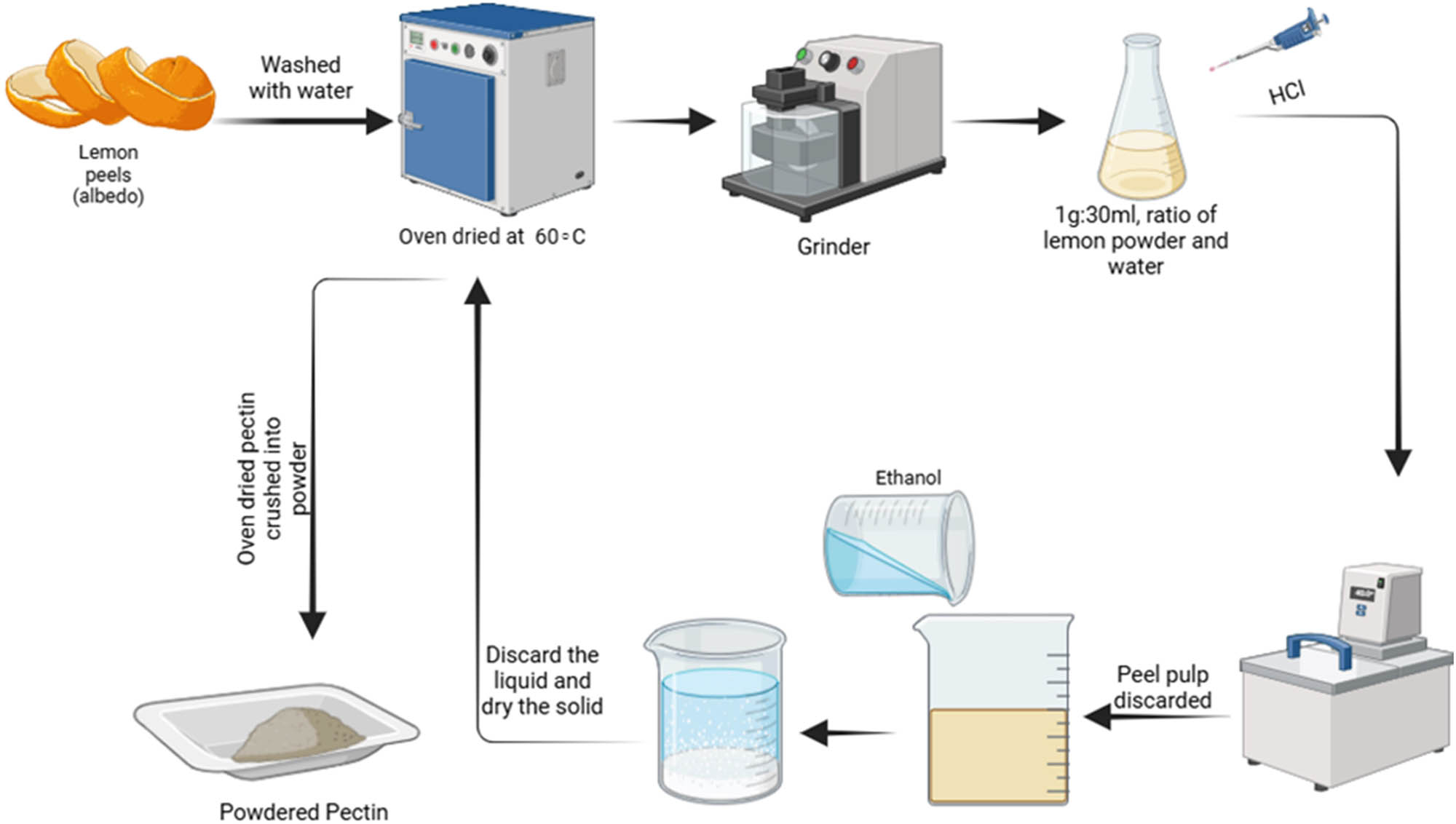
Extraction of pectin.
2.3 Differential scanning calorimetry (DSC) analysis
DSC Q200 V24.11 Build 124 was used to study the thermal characteristics of the extracted pectin according to the method of Wani and Uppaluri [18] with minor modifications. A sample of 2.41 mg of dried pectin was placed in a standard aluminium crucible and properly sealed. The heating range on a crucible was set from 25 to 315°C at a rate of 10°C/min in a dynamic inert nitrogen atmosphere (50 mL/min). Additionally, an empty standard aluminium crucible was used as a reference during the whole process. TA universal Analysis software was used to determine the enthalpy of melting (ΔH m), melting temperature (T m), enthalpy of degradation (ΔH d), and degradation temperature (T d).
2.4 Colour analysis of pectin
The colour and colour difference of pectin were determined using a chroma meter (CR-400 Narich) based on the CIE-Lab system with L* (lightness), a* (redness), and b* (yellowness) values [19].
2.5 Energy-dispersive X-ray (EDX) spectroscopy analysis of pectin
Elemental analysis was performed using an EDX spectrometer, Thermo Electron Corporation, NORAN System Six, model 6733B-IUUS-SN, Madison, WI, USA.
2.6 1D 13C cross-polarization (CP) and non-quadrature spectroscopy (NQS) magic angle spinning nuclear magnetic resonance (MAS NMR) analyses
1D 13C CP and NQS MAS experiments were performed on Bruker Avance III HD and Avance 500 MHz (13C, 125 MHz) spectrometers equipped with a 4.0 mm double resonance MAS probe. Samples were packed into 4 mm (outer diameter) zirconia rotors. 13C π/2 pulse lengths were 3.5 μs. The CP contact time was 2.0 ms. Heteronuclear decoupling using SPINAL64 with a 1H pulse duration of 6 μs was applied for an acquisition time of 27 ms. A total of 4,096 transients were co-added using relaxation delay times of 2 and 10 s for the CP/MAS and NQS/MAS experiments, respectively. A dephasing delay of 26 μs was additionally applied for the NQS experiments.
2.7 Reducing power of pectin
The reducing power of pectin was evaluated following the method of Zhang et al. [20]. About 2.5 mL of phosphate buffer (200 mM, pH 6.6), 2.5 mL of 1% potassium ferricyanide, and 1 mL of pectin solution (ranging from 0 to 2,500 mg/mL) were incubated at 50°C for 20 min. After cooling, 2.5 mL of 10% (w/v) trichloroacetic acid (TCA) was added to the mixture. Subsequently, 2.5 mL of the supernatant was collected and mixed with 2.4 mL of distilled water followed by 1.0 mL of 0.1% (w/v) FeCl3 in a test tube and allowed to react for 10 min. The same protocol was followed by ascorbic acid (AA) which was used as a positive control. The absorbance of all samples was measured at 700 nm using a DR6000 UV-Vis spectrophotometer.
2.8 Statistical analysis
Each pectin experiment was conducted in triplicate. IBM SPSS was used to do statistical analysis (version 29.0). To ascertain the statistical difference between the samples, analysis of variance and the Duncan multiple range test (DMRT) were employed. At p < 0.05, the difference was deemed statistically significant. The DMRT was used to compare the findings presented as mean ± SD.
3 Results and discussion
3.1 DSC analysis
The area under this first endothermic peak is known as ΔH m, which represents the heat absorbed during the evaporation of moisture from the pectin sample. TA Universal Analysis software was used to determine the ΔH m and T m. Both an endothermic and an exothermic peak were seen in the DSC thermograms (Figure 2) of the pectin sample. The initial endothermic peak observed between 72.03 and 94.85°C is primarily attributed to water evaporation [21,22]. This peak provides important information about the moisture content, hydration properties, and potential gel formation tendencies of pectin in different applications [23,24,25]. The second peak, an exothermic peak occurring between 249 and 255.5°C, indicates the thermal degradation of pectin [26]. This peak marks the onset of decomposition and heat release during this process. The area under this degradation peak is called the ΔH d, reflecting the heat emitted during the thermal breakdown of pectin. This parameter provides insights into the thermal stability and behaviour of pectin at high temperatures [27].

DSC thermograms of pectin samples.
The TA Universal Analysis software was also used to determine the ΔH d and T d. As shown in Table 1, the commercial P sample exhibited the highest ΔH m (400.2 J/g), indicating strong intermolecular interactions. This suggested that it was more stable and required more energy to transition from solid to liquid. The FBP 2023 and FBP 2024 samples displayed moderate ΔH m’s (248.2 and 318.0 J/g, respectively). Meanwhile, the PP 2023 and PP 2024 samples showed the lowest ΔH m’s (106.4 and 147.4 J/g, respectively), suggesting that they were more amorphous. The T m’s varied across the samples, with commercial P having the highest T m (94.85°C). This aligned with its high ΔH m, indicating it remained stable at higher temperatures before melting. The FBP 2023 sample had the lowest T m (73.11°C), which might suggest it was less thermally stable and could melt at lower processing temperatures. FBP 2024 recorded a T m of 75.00°C. The PP samples (2023 and 2024) exhibited T m’s around 72.03 and 75.5°C, respectively, indicating they were also less stable than commercial P but slightly more stable than FBP 2023. The ΔH d is an important parameter that indicated the energy required for the degradation of the pectin samples. Commercial P again showed the highest ΔH d (79.12 J/g), suggesting it had a more robust structure that required more energy to break down. The FBP 2023 and FBP 2024 samples had similar ΔH d’s (72.08 and 61.58 J/g), respectively, indicating that they might degrade more easily than commercial P. In contrast, the PP samples (2023 and 2024) showed the lowest ΔH d’s (52.93 and 45.16 J/g), respectively, suggesting that they are more susceptible to thermal degradation, which could limit their application in high-temperature processes. The T d’s were relatively close across the samples, with FBP 2024 having the highest T d (255.63°C), indicating that it might have better thermal stability than the others. The PP 2023 sample had the lowest T d (248.86°C), which aligned with its lower ΔH d, suggesting that it might start to degrade at lower temperatures. Therefore, commercial P, followed by FBP 2024, would be the most preferred samples in the food and pharmaceutical industries due to their superior thermal stability, enabling them to withstand high processing temperatures without degrading [28].
Thermal parameters of pectin samples as determined by DSC
| Pectin type | Endothermic peak | Exothermic peak | ||
|---|---|---|---|---|
| ΔH m (J/g) | T m (°C) | ΔH d (J/g) | T d (°C) | |
| Commercial P | 400.2 | 94.85 | 79.12 | 251.54 |
| FBP 2023 | 248.2 | 73.11 | 72.08 | 252.21 |
| FBP 2024 | 318.0 | 75.00 | 61.58 | 255.63 |
| PP 2023 | 106.4 | 72.03 | 52.93 | 248.86 |
| PP 2024 | 147.4 | 75.50 | 45.16 | 252.16 |
ΔH m (J/g), enthalpy of melting; T m (°C), melting temperature; ΔH d (J/g), enthalpy of degradation; T d (°C), degradation temperature.
3.2 Colour analysis
The colour of pectin is essential because it affects the visual appeal of the resulting solution or gel, which influences the overall look of the food product in which it is used, so some food industries have special colour preferences [29]. The L* values ranged from 61.03 (PP 2024) to 69.96 (commercial P), with higher values of L* indicating lighter colours and lower values suggesting darker colours. According to Table 2, the commercial P sample had the highest lightness, indicating that it was the lightest in colour, which is preferred in industries that want lighter pectin. In contrast, the PP 2024 sample had the lowest lightness, indicating a darker colour, which could be attributed to the presence of polyphenols [30]. The a* values ranged from 0.53 (PP 2023) to 2.21 (commercial P), with positive values indicating a tendency towards red and negative values towards green. The commercial P sample had the highest a* value, which suggests a slight red hue that could enhance its visual appeal. On the other hand, the PP 2023 sample had the lowest a* value, indicating a more neutral colour with less red influence.
Colour parameters of pectin samples
| Pectin samples | L* | a* | b* | C* |
|---|---|---|---|---|
| Commercial P | (69.96 ± 0.06)e | (2.21 ± 0.03)e | (21.41 ± 0.05)b | (21.52 ± 0.03)e |
| PP 2023 | (68.18 ± 0.09)d | (0.53 ± 0.02)a | (20.27 ± 0.02)a | (20.28 ± 0.02)a |
| PP 2024 | (61.03 ± 0.03)a | (1.33 ± 0.02)b | (20.29 ± 0.01)a | (20.33 ± 0.03)b |
| FBP 2023 | (63.39 ± 0.05)b | (2.11 ± 0.02)c | (24.41 ± 0.01)d | (24.50 ± 0.02)e |
| FBP 2024 | (64.61 ± 0.30)c | (2.15 ± 0.01)d | (22.30 ± 0.03)c | (22.50 ± 0.02)d |
Data are expressed as mean ± standard deviation; different letters (a–e) in the same column indicate significant differences among samples (p < 0.05), n = 3.
The b* values ranged from 20.27 (PP 2023) to 24.41 (FBP 2023), with positive values indicating yellow hues and negative values indicating blue. All samples exhibited positive b* values. The FBP 2023 sample had the highest b* value, suggesting a more pronounced yellow colour. The presence of a striking yellow hue in all pectin samples was possibly due to the presence of carotenoids [31]. The C* values ranged from 20.28 (PP 2023) to 24.50 (FBP 2023), with higher values indicating more vivid colours. The FBP 2023 sample had the highest chroma, making it the most saturated and visually striking, which could be appealing in food applications. Conversely, the PP 2023 sample had the lowest chroma, suggesting a more muted colour that might be less visually appealing. More comparable results were also reported by La Cava et al. [32], when a conventional heating method was employed to extract pectin from white grapefruits. The significant difference in the extracted pectin samples (PP 2023, PP 2024, FBP 2023, and FBP 2024) is due to differences in climate conditions (in 2023 and 2024, potentially affecting pigmentation) and soil composition (variations in nutrients and soil type) that can influence crop growth and pigmentation, considering the two different farms, FBP and PP. Hence, our pectin samples had different colour properties. Consequently, the difference in commercial pectin might be attributed to the source in which the pectin was extracted.
3.3 EDX analysis
The elemental composition of the pectin samples is presented in Figure 3. Commercial P had a composition of carbon (C): 36.54%, oxygen (O): 56.02%, sodium (Na): 1.18%, aluminium (Al): 0.99%, potassium (K): 0.91%, calcium (Ca): 1.15%, manganese (Mn): 0.62%, and silicon (Si): 2.59%. It was noted that the high percentages of carbon and oxygen indicated a polysaccharide composition typical of pectin. The presence of Na, K, Ca, and Al in this pectin may have originated from a source rich in these minerals [33].

EDX spectra of pectin samples. (a) Pectin extracted from FBP lemons in 2023, (b) pectin extracted from PP lemons in 2023, (c) pectin extracted from FBP lemons in 2024, (d) pectin extracted from PP lemons in 2024, and (e) commercial pectin.
FBP 2023 exhibited the composition of 37.89% C and 62.11% O, indicating a higher oxygen content compared to commercial P. This difference may imply a distinct structural composition or hydration level. Conversely, FBP 2024 had a composition of 36.08% C and 63.92% O, showing a similar high oxygen content but with a lower carbon percentage, potentially indicating variations in molecular structure.
Then PP 2023, its elemental composition included 41.45% C, 53.91% O, and 4.64% Cl. The higher carbon content suggested a carbon-rich structure, possibly due to different sourcing or processing methods. The presence of Cl is attributed to HCl, which was used during extraction.
Finally, PP 2024 had a composition of 37.17% C and 62.83% O, resembling the high oxygen content seen in FBP samples. The absence of additional elements indicated a relatively pure form of pectin. Our results regarding the composition range of carbon and oxygen in all pectin samples align with the findings of Arora et al. when the microwave green extraction method was employed to extract pectin from Citrus maxima.
3.4 NMR results
The peaks observed in the ¹³C NMR spectra of pectin samples recorded using CP and NQS MAS techniques can be attributed to specific structural features of pectin. Figure 4 shows peaks at 52–70 ppm which suggest methoxyl groups (–OCH3) attached to carboxyl groups of galacturonic acid. The presence of these signals suggests a degree of methylation, which is crucial for the gelling properties of pectin [35]. The signal at 110–112 ppm in the 13C spectrum is associated with arabinose anomeric resonances [36]. The signal at 170 ppm in all pectin samples is attributed to C-6 of the carboxyl group of the galacturonic acid units in esterified form [37]. Furthermore, the consistency in chemical shifts across the samples suggests they may exhibit similar chemical characteristics. However, the slight variations in chemical shifts could also indicate differences in the degree of esterification and the presence of side chains.

Stacked NQS NMR spectra of commercial pectin and four isolated pectin samples.
3.5 Reducing power determination
The higher absorbance in the reducing power assay signifies more potent reducing power, leading to enhanced antioxidant activity. Consequently, evaluating the reducing capacity of pectin can indirectly assess its antioxidant capability [38]. Figure 5 illustrates a comparison of the reducing capacity of pectin samples with AA. The results indicate that AA exhibits the highest reducing capacity, followed by PP 2023, PP 2024, FBP 2024, and FBP 2023, which showed the lowest reducing capacity among the pectin samples. The experimental principle involves reducing Fe3+ in potassium ferricyanide to Fe2+ and subsequent reaction with ferric chloride to produce Prussian blue [39]. Reductones present in the samples are known to disrupt free radical chains by donating hydrogen atoms, which play a crucial role in preventing peroxide formation [40]. Thus, these findings suggest that pectin possesses antioxidant properties due to the presence of reductones.

Reducing power of pectin samples in comparison with AA.
4 Conclusion
The study described pectin that was extracted from C. limon from two geographic regions (Beaufort and PP) in South Africa and at different times (2023 and 2024). The comprehensive analysis of pectin samples through DSC, reducing power assays, EDX, and chromameter evaluations revealed a significant insight into their structural and functional properties. The DSC results indicate varying thermal stability and degradation characteristics among the pectin samples, suggesting differences in molecular structure and composition. The reducing power assays highlight the antioxidant potential of pectin, with commercial pectin demonstrating stronger reducing capacities, which correlates with their ability to scavenge free radicals and mitigate oxidative stress. NMR confirmed the significant features of the galacturonan backbone. EDX analysis confirms the elemental composition, showing a typical polysaccharide profile with variations in mineral content that may influence pectin’s functional properties. Finally, chromameter assessments indicate differences in colour attributes, which can affect the visual appeal of pectin, especially in food applications. Collectively, these findings underscore the potential of pectin as a valuable ingredient in food and pharmaceutical industries, emphasizing its antioxidant properties and structural diversity.
Acknowledgments
The authors wish to express their gratitude to the University of Fort Hare (Department of Chemistry) and Walter Sisulu University (Department of Chemical and Physical Sciences) for providing an accelerating research space, as well as the NRF SASOL for financial assistance.
-
Funding information: This study was funded by the NRF (Sasol Foundation), grant numbers PMDS22060619395 and SRUG22052715195.
-
Author contributions: A.D. wrote the manuscript and conducted methodological evaluations. O.O.O., P.R., G.M., A.O.O., Y.S.H., and A.O.O. are all the supervisors of the author above. This manuscript has been read by all authors and agreed for it to be published.
-
Conflict of interest: The authors declare no conflicts of interest.
-
Ethical approval: The conducted research is not related to either human or animal use.
-
Data availability statement: The datasets generated during and/or analysed during the current study are available from the corresponding author on reasonable request.
References
[1] Ollitrault P, Curk F, Krueger R. Chapter 4 - Citrus taxonomy. In: Talon M, Caruso M, Gmitter FG, editors. The genus citrus. Cambridge, United Kingdom: Woodhead Publishing; 2020. p. 57–81. 10.1016/B978-0-12-812163-4.00004-8.Search in Google Scholar
[2] Sharma N, Kumar R. The boon of nature - citrus: An overview. Int J Farm Sci. 2023;13:111–6. 10.5958/2250-0499.2023.00065.4.Search in Google Scholar
[3] Barbhuiya AR, Khan ML, Dayanandan S. Genetic structure and diversity of natural and domesticated populations of Citrus medica L. in the Eastern Himalayan region of Northeast India. Ecol Evol. 2016;6:3898–911. 10.1002/ece3.2174.Search in Google Scholar PubMed PubMed Central
[4] Gyawali R, Kunwar RM, Bussmann RW, Paniagua-Zambrana NY. Citrus medica L. Rutaceae. In: Kunwar RM, Sher H, Bussmann RW, editors. Ethnobotany of the Himalayas. Cham: Springer International Publishing; 2021. p. 567–81. 10.1007/978-3-030-57408-6_59.Search in Google Scholar
[5] Klimek-szczykutowicz M, Szopa A, Ekiert H. Citrus limon (Lemon) phenomenon – a review of the chemistry, pharmacological properties, applications in the modern pharmaceutical, food, and cosmetics industries, and biotechnological studies. Plants. 2020;9:119. 10.3390/plants9010119.Search in Google Scholar PubMed PubMed Central
[6] Perpetua OI, Shadrack CUU. Essential oil from lemon peel (Citrus lumion) and application in skin-care lotion. Chem Sci Int J. 2021;30(9):30–8. 10.9734/csji/2021/v30i930252.Search in Google Scholar
[7] Nodola P, Miya GM, Mazwi V, Oriola AO, Oyedeji OO, Hosu YS, et al. Citrus limon wastes from part of the Eastern Cape Province in South Africa: Medicinal, sustainable agricultural, and bio-resource potential. Molecules. 2024;29:1675. 10.3390/molecules29071675.Search in Google Scholar PubMed PubMed Central
[8] Willats WGT, Orfila C, Limberg G, Buchholt HC, Van Alebeek GJWM, Voragen AGJ, et al. Modulation of the degree and pattern of methyl-esterification of pectic homogalacturonan in plant cell walls: Implications for pectin methyl esterase action, matrix properties, and cell adhesion. J Biol Chem. 2001;276:19404–13. 10.1074/jbc.M011242200.Search in Google Scholar PubMed
[9] Vincken J-P, Schols HA, Oomen RJFJ, Beldman G, Visser RGF, Voragen AGJ. Pectin – the Hairy Thing. In: Voragen F, Schols H, Visser R, editors. Advances in pectin and pectinase research. Dordrecht: Springer Netherlands; 2003. p. 47–59. 10.1007/978-94-017-0331-4_4.Search in Google Scholar
[10] Hu S, Kuwabara R, Beukema M, Ferrari M, de Haan BJ, Walvoort MTC, et al. Low methyl-esterified pectin protects pancreatic β-cells against diabetes-induced oxidative and inflammatory stress via galectin-3. Carbohydr Polym. 2020;249:116863. 10.1016/j.carbpol.2020.116863.Search in Google Scholar PubMed
[11] Xu Y, Chen J, Shi S, Gao W, Wu J, Gong H, et al. Structure characterization of pectin from the pollen of Typha angustifolia L. and the inhibition activity of lipid accumulation in oleic acid induced L02 cells. Carbohydr Polym. 2023;303:120452. 10.1016/j.carbpol.2022.120452.Search in Google Scholar PubMed
[12] Zeng H, Li P, Zhou L, Ding K. A novel pectin from Polygala tenuifolia blocks Aβ42 aggregation and production by enhancing insulin-degradation enzyme and neprilysin. Int J Biol Macromol. 2020;161:35–43. 10.1016/j.ijbiomac.2020.05.212.Search in Google Scholar PubMed
[13] Koriem KMM, Arbid MS, Emam KR. Therapeutic effect of pectin on octylphenol induced kidney dysfunction, oxidative stress and apoptosis in rats. Env Toxicol Pharmacol. 2014;38:14–23. 10.1016/j.etap.2014.04.029.Search in Google Scholar PubMed
[14] Houron C, Ciocan D, Trainel N, Mercier-Nomé F, Hugot C, Spatz M, et al. Gut microbiota reshaped by pectin treatment improves liver steatosis in obese mice. Nutrients. 2021;13:3725. 10.3390/nu13113725.Search in Google Scholar PubMed PubMed Central
[15] Li X, Bi J, Jin X, Li X, Wu X, Lyu J. Characterization of water binding properties of apple pectin modified by instant controlled pressure drop drying (DIC) by LF-NMR and DSC methods. Food Bioproc Tech. 2020;13:265–74. 10.1007/s11947-019-02387-8.Search in Google Scholar
[16] Al-Amoudi RH, Taylan O, Kutlu G, Can AM, Sagdic O, Dertli E, et al. Characterization of chemical, molecular, thermal and rheological properties of medlar pectin extracted at optimum conditions as determined by Box-Behnken and ANFIS models. Food Chem. 2019;271:650–62. 10.1016/j.foodchem.2018.07.211.Search in Google Scholar PubMed
[17] Antonić B, Jančíková S, Dordević D, Tremlová B. Grape pomace valorization: A systematic review and meta-analysis. Foods. 2020;9:1627. 10.3390/foods9111627.Search in Google Scholar PubMed PubMed Central
[18] Wani KM, Uppaluri RVS. Characterization of pectin extracted from pomelo peel using pulsed ultrasound assisted extraction and acidic hot water extraction process. Appl Food Res. 2023;3:100345. 10.1016/j.afres.2023.100345.Search in Google Scholar
[19] Guo Z, Zuo H, Ling H, Yu Q, Gou Q, Yang L. A novel colorimetric indicator film based on watermelon peel pectin and anthocyanins from purple cabbage for monitoring mutton freshness. Food Chem. 2022;383:131915. 10.1016/j.foodchem.2021.131915.Search in Google Scholar PubMed
[20] Zhang T, Zhang H, Wei M, Zhu C. Effects of enzymatic treatment on the physicochemical properties and antioxidant activity of hawthorn pectin. Mater Today Commun. 2022;30:103225. 10.1016/j.mtcomm.2022.103225.Search in Google Scholar
[21] Ezzati S, Ayaseh A, Ghanbarzadeh B, Heshmati MK. Pectin from sunflower by-product: Optimization of ultrasound-assisted extraction, characterization, and functional analysis. Int J Biol Macromol. 2020;165:776–86. 10.1016/j.ijbiomac.2020.09.205.Search in Google Scholar PubMed
[22] Einhorn-Stoll U, Kunzek H, Dongowski G. Thermal analysis of chemically and mechanically modified pectins. Food Hydrocoll. 2007;21:1101–12. 10.1016/j.foodhyd.2006.08.004.Search in Google Scholar
[23] Vityazev FV, Khramova DS, Saveliev NY, Ipatova EA, Burkov AA, Beloserov VS, et al. Pectin–glycerol gel beads: Preparation, characterization and swelling behaviour. Carbohydr Polym. 2020;238:116166. 10.1016/j.carbpol.2020.116166.Search in Google Scholar PubMed
[24] Zhang Y, Zhao X, Bao X, Xiao J, Liu H. Effects of pectin and heat-moisture treatment on structural characteristics and physicochemical properties of corn starch. Food Hydrocoll. 2021;117:106664. 10.1016/j.foodhyd.2021.106664.Search in Google Scholar
[25] Spinei M, Oroian M. Structural, functional and physicochemical properties of pectin from grape pomace as affected by different extraction techniques. Int J Biol Macromol. 2023;224:739–53. 10.1016/j.ijbiomac.2022.10.162.Search in Google Scholar PubMed
[26] Spinei M, Oroian M. Microwave-assisted extraction of pectin from grape pomace. Sci Rep. 2022;12:12722. 10.1038/s41598-022-16858-0.Search in Google Scholar PubMed PubMed Central
[27] Hu W, Chen S, Wu D, Zhu K, Ye X. Manosonication assisted extraction and characterization of pectin from different citrus peel wastes. Food Hydrocoll. 2021;121:106952. 10.1016/j.foodhyd.2021.106952.Search in Google Scholar
[28] Hosseini SS, Khodaiyan F, Kazemi M, Najari Z. Optimization and characterization of pectin extracted from sour orange peel by ultrasound assisted method. Int J Biol Macromol. 2019;125:621–9. 10.1016/j.ijbiomac.2018.12.096.Search in Google Scholar PubMed
[29] Grassino AN, Brnčić M, Vikić-Topić D, Roca S, Dent M, Brnčić SR. Ultrasound assisted extraction and characterization of pectin from tomato waste. Food Chem. 2016;198:93–100. 10.1016/j.foodchem.2015.11.095.Search in Google Scholar PubMed
[30] Wang M, Huang B, Fan C, Zhao K, Hu H, Xu X, et al. Characterization and functional properties of mango peel pectin extracted by ultrasound assisted citric acid. Int J Biol Macromol. 2016;91:794–803. 10.1016/j.ijbiomac.2016.06.011.Search in Google Scholar PubMed
[31] Morales-Soriano E, Panozzo A, Ugás R, Grauwet T, Van Loey A, Hendrickx M. Carotenoid profile and basic structural indicators of native Peruvian chili peppers. Eur Food Res Technol. 2019;245:717–32. 10.1007/s00217-018-3193-2.Search in Google Scholar
[32] La Cava EL, Gerbino E, Sgroppo SC, Gómez-Zavaglia A. Characterization of Pectins Extracted from Different Varieties of Pink/Red and White Grapefruits [Citrus Paradisi (Macf.)] by Thermal Treatment and Thermosonication. J Food Sci. 2018;83:1613–21. 10.1111/1750-3841.14183.Search in Google Scholar PubMed
[33] Salima B, Seloua D, Djamel F, Samir M. Structure of pumpkin pectin and its effect on its technological properties. Appl Rheol. 2022;32:34–55. 10.1515/arh-2022-0124.Search in Google Scholar
[34] Arora S, Kataria P, Ahmad W, Mishra R, Upadhyay S, Dobhal A, et al. Microwave assisted green extraction of pectin from Citrus maxima albedo and flavedo, process optimization, characterisation and comparison with commercial pectin. Food Anal Methods. 2024;17:105–18. 10.1007/s12161-023-02547-9.Search in Google Scholar
[35] Zhu X, Liu B, Zheng S, Gao Y. Quantitative and structure analysis of pectin in tobacco by 13C CP/MAS NMR spectroscopy. Anal Methods. 2014;6:6407–13. 10.1039/c4ay01156b.Search in Google Scholar
[36] Hotchkiss AT, Chau HK, Strahan GD, Nuñez A, Simon S, White AK, et al. Structural characterization of red beet fiber and pectin. Food Hydrocoll. 2022;129:107549. 10.1016/j.foodhyd.2022.107549.Search in Google Scholar
[37] Muhidinov ZK, Ikromi KI, Jonmurodov AS, Nasriddinov AS, Usmanova SR, Bobokalonov JT, et al. Structural characterization of pectin obtained by different purification methods. Int J Biol Macromol. 2021;183:2227–37. 10.1016/j.ijbiomac.2021.05.094.Search in Google Scholar PubMed
[38] Liu Y, Huang G, Hu J. Extraction, characterisation and antioxidant activity of polysaccharides from Chinese watermelon. Int J Biol Macromol. 2018;111:1304–7. 10.1016/j.ijbiomac.2018.01.088.Search in Google Scholar PubMed
[39] Hassan F, Mir H, Shafi A, Khanday FA. In vitro antioxidant potential of hippophae rhamnoides protects DNA against H2O2 induced oxidative damage. Arab J Sci Eng. 2024;49:77–85. 10.1007/s13369-023-08097-w.Search in Google Scholar
[40] Kolar FR, Gogi CL, Khudavand MM, Choudhari MS, Patil SB. Phytochemical and antioxidant properties of some Cassia species. Nat Prod Res 2018;32:1324–8. 10.1080/14786419.2017.1342085.Search in Google Scholar PubMed
© 2025 the author(s), published by De Gruyter
This work is licensed under the Creative Commons Attribution 4.0 International License.
Articles in the same Issue
- Research Articles
- Phytochemical investigation and evaluation of antioxidant and antidiabetic activities in aqueous extracts of Cedrus atlantica
- Influence of B4C addition on the tribological properties of bronze matrix brake pad materials
- Discovery of the bacterial HslV protease activators as lead molecules with novel mode of action
- Characterization of volatile flavor compounds of cigar with different aging conditions by headspace–gas chromatography–ion mobility spectrometry
- Effective remediation of organic pollutant using Musa acuminata peel extract-assisted iron oxide nanoparticles
- Analysis and health risk assessment of toxic elements in traditional herbal tea infusions
- Cadmium exposure in marine crabs from Jiaxing City, China: Insights into health risk assessment
- Green-synthesized silver nanoparticles of Cinnamomum zeylanicum and their biological activities
- Tetraclinis articulata (Vahl) Mast., Mentha pulegium L., and Thymus zygis L. essential oils: Chemical composition, antioxidant and antifungal properties against postharvest fungal diseases of apple, and in vitro, in vivo, and in silico investigation
- Exploration of plant alkaloids as potential inhibitors of HIV–CD4 binding: Insight into comprehensive in silico approaches
- Recovery of phenylethyl alcohol from aqueous solution by batch adsorption
- Electrochemical approach for monitoring the catalytic action of immobilized catalase
- Green synthesis of ZIF-8 for selective adsorption of dyes in water purification
- Optimization of the conditions for the preparation of povidone iodine using the response surface methodology
- A case study on the influence of soil amendment on ginger oil’s physicochemical properties, mineral contents, microbial load, and HPLC determination of its vitamin level
- Removal of antiviral favipiravir from wastewater using biochar produced from hazelnut shells
- Effect of biochar and soil amendment on bacterial community composition in the root soil and fruit of tomato under greenhouse conditions
- Bioremediation of malachite green dye using Sargassum wightii seaweed and its biological and physicochemical characterization
- Evaluation of natural compounds as folate biosynthesis inhibitors in Mycobacterium leprae using docking, ADMET analysis, and molecular dynamics simulation
- Novel insecticidal properties of bioactive zoochemicals extracted from sea urchin Salmacis virgulata
- Elevational gradients shape total phenolic content and bioactive potential of sweet marjoram (Origanum majorana L.): A comparative study across altitudinal zones
- Study on the CO2 absorption performance of deep eutectic solvents formed by superbase DBN and weak acid diethylene glycol
- Preparation and wastewater treatment performance of zeolite-modified ecological concrete
- Multifunctional chitosan nanoparticles: Zn2+ adsorption, antimicrobial activity, and promotion of aquatic health
- Comparative analysis of nutritional composition and bioactive properties of Chlorella vulgaris and Arthrospira platensis: Implications for functional foods and dietary supplements
- Growth kinetics and mechanical characterization of boride layers formed on Ti6Al4V
- Enhancement of water absorption properties of potassium polyacrylate-based hydrogels in CaCl2-rich soils using potassium di- and tri-carboxylate salts
- Electrochemical and microbiological effects of dumpsite leachates on soil and air quality
- Modeling benzene physicochemical properties using Zagreb upsilon indices
- Characterization and ecological risk assessment of toxic metals in mangrove sediments near Langen Village in Tieshan Bay of Beibu Gulf, China
- Protective effect of Helicteres isora, an efficient candidate on hepatorenal toxicity and management of diabetes in animal models
- Valorization of Juglans regia L. (Walnut) green husk from Jordan: Analysis of fatty acids, phenolics, antioxidant, and cytotoxic activities
- Molecular docking and dynamics simulations of bioactive terpenes from Catharanthus roseus essential oil targeting breast cancer
- Selection of a dam site by using AHP and VIKOR: The Sakarya Basin
- Characterization and modeling of kidney bean shell biochar as adsorbent for caffeine removal from aquatic environments
- The effects of short-term and long-term 2100 MHz radiofrequency radiation on adult rat auditory brainstem response
- Biochemical insights into the anthelmintic and anti-inflammatory potential of sea cucumber extract: In vitro and in silico approaches
- Resveratrol-derived MDM2 inhibitors: Synthesis, characterization, and biological evaluation against MDM2 and HCT-116 cells
- Phytochemical constituents, in vitro antibacterial activity, and computational studies of Sudanese Musa acuminate Colla fruit peel hydro-ethanol extract
- Chemical composition of essential oils reviewed from the height of Cajuput (Melaleuca leucadendron) plantations in Buru Island and Seram Island, Maluku, Indonesia
- Phytochemical analysis and antioxidant activity of Azadirachta indica A. Juss from the Republic of Chad: in vitro and in silico studies
- Stability studies of titanium–carboxylate complexes: A multi-method computational approach
- Efficient adsorption performance of an alginate-based dental material for uranium(vi) removal
- Synthesis and characterization of the Co(ii), Ni(ii), and Cu(ii) complexes with a 1,2,4-triazine derivative ligand
- Evaluation of the impact of music on antioxidant mechanisms and survival in salt-stressed goldfish
- Optimization and validation of UPLC method for dapagliflozin and candesartan cilexetil in an on-demand formulation: Analytical quality by design approach
- Biomass-based cellulose hydroxyapatite nanocomposites for the efficient sequestration of dyes: Kinetics, response surface methodology optimization, and reusability
- Multifunctional nitrogen and boron co-doped carbon dots: A fluorescent probe for Hg2+ and biothiol detection with bioimaging and antifungal applications
- Separation of sulphonamides on a C12-diol mixed-mode HPLC column and investigation of their retention mechanism
- Characterization and antioxidant activity of pectin from lemon peels
- Fast PFAS determination in honey by direct probe electrospray ionization tandem mass spectrometry: A health risk assessment insight
- Correlation study between GC–MS analysis of cigarette aroma compounds and sensory evaluation
- Synthesis, biological evaluation, and molecular docking studies of substituted chromone-2-carboxamide derivatives as anti-breast cancer agents
- The influence of feed space velocity and pressure on the cold flow properties of diesel fuel
- Acid etching behavior and mechanism in acid solution of iron components in basalt fibers
- Protective effect of green synthesized nanoceria on retinal oxidative stress and inflammation in streptozotocin-induced diabetic rat
- Evaluation of the antianxiety activity of green zinc nanoparticles mediated by Boswellia thurifera in albino mice by following the plus maze and light and dark exploration tests
- Yeast as an efficient and eco-friendly bifunctional porogen for biomass-derived nitrogen-doped carbon catalysts in the oxygen reduction reaction
- Novel descriptors for the prediction of molecular properties
- Synthesis and characterization of surfactants derived from phenolphthalein: In vivo and in silico studies of their antihyperlipidemic effect
- Turmeric oil-fortified nutraceutical-SNEDDS: An approach to boost therapeutic effectiveness of dapagliflozin during treatment of diabetic patients
- Analysis and study on volatile flavor compounds of three Yunnan cultivated cigars based on headspace-gas chromatography-ion mobility spectrometry
- Near-infrared IR780 dye-loaded poloxamer 407 micelles: Preparation and in vitro assessment of anticancer activity
- Study on the influence of the viscosity reducer solution on percolation capacity of thin oil in ultra-low permeability reservoir
- Detection method of Aristolochic acid I based on magnetic carrier Fe3O4 and gold nanoclusters
- Juglone’s apoptotic impact against eimeriosis-induced infection: a bioinformatics, in-silico, and in vivo approach
- Potential anticancer agents from genus Aerva based on tubulin targets: an in-silico integration of quantitative structure activity relationship (QSAR), molecular docking, simulation, drug-likeness, and density functional theory (DFT) analysis
- Hepatoprotective and PXR-modulating effects of Erodium guttatum extract in propiconazole-induced toxicity
- Studies on chemical composition of medicinal plants collected in natural locations in Ecuador
- A study of different pre-treatment methods for cigarettes and their aroma differences
- Cytotoxicity and molecular mechanisms of quercetin, gallic acid, and pinocembrin in Caco-2 cells: insights from cell viability assays, network pharmacology, and molecular docking
- Choline-based deep eutectic solvents for green extraction of oil from sour cherry seeds
- Green-synthesis of chromium (III) nanoparticles using garden fern and evaluation of its antibacterial and anticholinesterase activities
- Innovative functional mayonnaise formulations with watermelon seeds oil: evaluation of quality parameters and storage stability
- Molecular insights and biological evaluation of compounds isolated from Ferula oopoda against diabetes, advanced glycation end products and inflammation in diabetics
- Removal of cytotoxic tamoxifen from aqueous solutions using a geopolymer-based nepheline–cordierite adsorbent
- Unravelling the therapeutic effect of naturally occurring Bauhinia flavonoids against breast cancer: an integrated computational approach
- Characterization of organic arsenic residues in livestock and poultry meat and offal and consumption risks
- Synthesis and characterization of zinc sulfide nanoparticles and their genotoxic and cytotoxic effects on acute myeloid leukemia cells
- Activity of Coriandrum sativum methanolic leaf extracts against Eimeria papillata: a combined in vitro and in silico approach
- Special Issue on Advancing Sustainable Chemistry for a Greener Future
- One-pot fabrication of highly porous morphology of ferric oxide-ferric oxychloride/poly-O-chloroaniline nanocomposite seeded on poly-1H pyrrole: Photocathode for green hydrogen generation from natural and artificial seawater
- High-efficiency photocathode for green hydrogen generation from sanitation water using bismuthyl chloride/poly-o-chlorobenzeneamine nanocomposite
- Innovative synthesis of cobalt-based catalysts using ionic liquids and deep eutectic solvents: A minireview on electrocatalytic water splitting
- Special Issue on Phytochemicals, Biological and Toxicological Analysis of Plants
- Comparative analysis of fruit quality parameters and volatile compounds in commercially grown citrus cultivars
- Total phenolic, flavonoid, flavonol, and tannin contents as well as antioxidant and antiparasitic activities of aqueous methanol extract of Alhagi graecorum plant used in traditional medicine: Collected in Riyadh, Saudi Arabia
- Study on the pharmacological effects and active compounds of Apocynum venetum L.
- Chemical profile of Senna italica and Senna velutina seed and their pharmacological properties
- Essential oils from Brazilian plants: A literature analysis of anti-inflammatory and antimalarial properties and in silico validation
- Toxicological effects of green tea catechin extract on rat liver: Delineating safe and harmful doses
- Unlocking the potential of Trigonella foenum-graecum L. plant leaf extracts against diabetes-associated hypertension: A proof of concept by in silico studies
Articles in the same Issue
- Research Articles
- Phytochemical investigation and evaluation of antioxidant and antidiabetic activities in aqueous extracts of Cedrus atlantica
- Influence of B4C addition on the tribological properties of bronze matrix brake pad materials
- Discovery of the bacterial HslV protease activators as lead molecules with novel mode of action
- Characterization of volatile flavor compounds of cigar with different aging conditions by headspace–gas chromatography–ion mobility spectrometry
- Effective remediation of organic pollutant using Musa acuminata peel extract-assisted iron oxide nanoparticles
- Analysis and health risk assessment of toxic elements in traditional herbal tea infusions
- Cadmium exposure in marine crabs from Jiaxing City, China: Insights into health risk assessment
- Green-synthesized silver nanoparticles of Cinnamomum zeylanicum and their biological activities
- Tetraclinis articulata (Vahl) Mast., Mentha pulegium L., and Thymus zygis L. essential oils: Chemical composition, antioxidant and antifungal properties against postharvest fungal diseases of apple, and in vitro, in vivo, and in silico investigation
- Exploration of plant alkaloids as potential inhibitors of HIV–CD4 binding: Insight into comprehensive in silico approaches
- Recovery of phenylethyl alcohol from aqueous solution by batch adsorption
- Electrochemical approach for monitoring the catalytic action of immobilized catalase
- Green synthesis of ZIF-8 for selective adsorption of dyes in water purification
- Optimization of the conditions for the preparation of povidone iodine using the response surface methodology
- A case study on the influence of soil amendment on ginger oil’s physicochemical properties, mineral contents, microbial load, and HPLC determination of its vitamin level
- Removal of antiviral favipiravir from wastewater using biochar produced from hazelnut shells
- Effect of biochar and soil amendment on bacterial community composition in the root soil and fruit of tomato under greenhouse conditions
- Bioremediation of malachite green dye using Sargassum wightii seaweed and its biological and physicochemical characterization
- Evaluation of natural compounds as folate biosynthesis inhibitors in Mycobacterium leprae using docking, ADMET analysis, and molecular dynamics simulation
- Novel insecticidal properties of bioactive zoochemicals extracted from sea urchin Salmacis virgulata
- Elevational gradients shape total phenolic content and bioactive potential of sweet marjoram (Origanum majorana L.): A comparative study across altitudinal zones
- Study on the CO2 absorption performance of deep eutectic solvents formed by superbase DBN and weak acid diethylene glycol
- Preparation and wastewater treatment performance of zeolite-modified ecological concrete
- Multifunctional chitosan nanoparticles: Zn2+ adsorption, antimicrobial activity, and promotion of aquatic health
- Comparative analysis of nutritional composition and bioactive properties of Chlorella vulgaris and Arthrospira platensis: Implications for functional foods and dietary supplements
- Growth kinetics and mechanical characterization of boride layers formed on Ti6Al4V
- Enhancement of water absorption properties of potassium polyacrylate-based hydrogels in CaCl2-rich soils using potassium di- and tri-carboxylate salts
- Electrochemical and microbiological effects of dumpsite leachates on soil and air quality
- Modeling benzene physicochemical properties using Zagreb upsilon indices
- Characterization and ecological risk assessment of toxic metals in mangrove sediments near Langen Village in Tieshan Bay of Beibu Gulf, China
- Protective effect of Helicteres isora, an efficient candidate on hepatorenal toxicity and management of diabetes in animal models
- Valorization of Juglans regia L. (Walnut) green husk from Jordan: Analysis of fatty acids, phenolics, antioxidant, and cytotoxic activities
- Molecular docking and dynamics simulations of bioactive terpenes from Catharanthus roseus essential oil targeting breast cancer
- Selection of a dam site by using AHP and VIKOR: The Sakarya Basin
- Characterization and modeling of kidney bean shell biochar as adsorbent for caffeine removal from aquatic environments
- The effects of short-term and long-term 2100 MHz radiofrequency radiation on adult rat auditory brainstem response
- Biochemical insights into the anthelmintic and anti-inflammatory potential of sea cucumber extract: In vitro and in silico approaches
- Resveratrol-derived MDM2 inhibitors: Synthesis, characterization, and biological evaluation against MDM2 and HCT-116 cells
- Phytochemical constituents, in vitro antibacterial activity, and computational studies of Sudanese Musa acuminate Colla fruit peel hydro-ethanol extract
- Chemical composition of essential oils reviewed from the height of Cajuput (Melaleuca leucadendron) plantations in Buru Island and Seram Island, Maluku, Indonesia
- Phytochemical analysis and antioxidant activity of Azadirachta indica A. Juss from the Republic of Chad: in vitro and in silico studies
- Stability studies of titanium–carboxylate complexes: A multi-method computational approach
- Efficient adsorption performance of an alginate-based dental material for uranium(vi) removal
- Synthesis and characterization of the Co(ii), Ni(ii), and Cu(ii) complexes with a 1,2,4-triazine derivative ligand
- Evaluation of the impact of music on antioxidant mechanisms and survival in salt-stressed goldfish
- Optimization and validation of UPLC method for dapagliflozin and candesartan cilexetil in an on-demand formulation: Analytical quality by design approach
- Biomass-based cellulose hydroxyapatite nanocomposites for the efficient sequestration of dyes: Kinetics, response surface methodology optimization, and reusability
- Multifunctional nitrogen and boron co-doped carbon dots: A fluorescent probe for Hg2+ and biothiol detection with bioimaging and antifungal applications
- Separation of sulphonamides on a C12-diol mixed-mode HPLC column and investigation of their retention mechanism
- Characterization and antioxidant activity of pectin from lemon peels
- Fast PFAS determination in honey by direct probe electrospray ionization tandem mass spectrometry: A health risk assessment insight
- Correlation study between GC–MS analysis of cigarette aroma compounds and sensory evaluation
- Synthesis, biological evaluation, and molecular docking studies of substituted chromone-2-carboxamide derivatives as anti-breast cancer agents
- The influence of feed space velocity and pressure on the cold flow properties of diesel fuel
- Acid etching behavior and mechanism in acid solution of iron components in basalt fibers
- Protective effect of green synthesized nanoceria on retinal oxidative stress and inflammation in streptozotocin-induced diabetic rat
- Evaluation of the antianxiety activity of green zinc nanoparticles mediated by Boswellia thurifera in albino mice by following the plus maze and light and dark exploration tests
- Yeast as an efficient and eco-friendly bifunctional porogen for biomass-derived nitrogen-doped carbon catalysts in the oxygen reduction reaction
- Novel descriptors for the prediction of molecular properties
- Synthesis and characterization of surfactants derived from phenolphthalein: In vivo and in silico studies of their antihyperlipidemic effect
- Turmeric oil-fortified nutraceutical-SNEDDS: An approach to boost therapeutic effectiveness of dapagliflozin during treatment of diabetic patients
- Analysis and study on volatile flavor compounds of three Yunnan cultivated cigars based on headspace-gas chromatography-ion mobility spectrometry
- Near-infrared IR780 dye-loaded poloxamer 407 micelles: Preparation and in vitro assessment of anticancer activity
- Study on the influence of the viscosity reducer solution on percolation capacity of thin oil in ultra-low permeability reservoir
- Detection method of Aristolochic acid I based on magnetic carrier Fe3O4 and gold nanoclusters
- Juglone’s apoptotic impact against eimeriosis-induced infection: a bioinformatics, in-silico, and in vivo approach
- Potential anticancer agents from genus Aerva based on tubulin targets: an in-silico integration of quantitative structure activity relationship (QSAR), molecular docking, simulation, drug-likeness, and density functional theory (DFT) analysis
- Hepatoprotective and PXR-modulating effects of Erodium guttatum extract in propiconazole-induced toxicity
- Studies on chemical composition of medicinal plants collected in natural locations in Ecuador
- A study of different pre-treatment methods for cigarettes and their aroma differences
- Cytotoxicity and molecular mechanisms of quercetin, gallic acid, and pinocembrin in Caco-2 cells: insights from cell viability assays, network pharmacology, and molecular docking
- Choline-based deep eutectic solvents for green extraction of oil from sour cherry seeds
- Green-synthesis of chromium (III) nanoparticles using garden fern and evaluation of its antibacterial and anticholinesterase activities
- Innovative functional mayonnaise formulations with watermelon seeds oil: evaluation of quality parameters and storage stability
- Molecular insights and biological evaluation of compounds isolated from Ferula oopoda against diabetes, advanced glycation end products and inflammation in diabetics
- Removal of cytotoxic tamoxifen from aqueous solutions using a geopolymer-based nepheline–cordierite adsorbent
- Unravelling the therapeutic effect of naturally occurring Bauhinia flavonoids against breast cancer: an integrated computational approach
- Characterization of organic arsenic residues in livestock and poultry meat and offal and consumption risks
- Synthesis and characterization of zinc sulfide nanoparticles and their genotoxic and cytotoxic effects on acute myeloid leukemia cells
- Activity of Coriandrum sativum methanolic leaf extracts against Eimeria papillata: a combined in vitro and in silico approach
- Special Issue on Advancing Sustainable Chemistry for a Greener Future
- One-pot fabrication of highly porous morphology of ferric oxide-ferric oxychloride/poly-O-chloroaniline nanocomposite seeded on poly-1H pyrrole: Photocathode for green hydrogen generation from natural and artificial seawater
- High-efficiency photocathode for green hydrogen generation from sanitation water using bismuthyl chloride/poly-o-chlorobenzeneamine nanocomposite
- Innovative synthesis of cobalt-based catalysts using ionic liquids and deep eutectic solvents: A minireview on electrocatalytic water splitting
- Special Issue on Phytochemicals, Biological and Toxicological Analysis of Plants
- Comparative analysis of fruit quality parameters and volatile compounds in commercially grown citrus cultivars
- Total phenolic, flavonoid, flavonol, and tannin contents as well as antioxidant and antiparasitic activities of aqueous methanol extract of Alhagi graecorum plant used in traditional medicine: Collected in Riyadh, Saudi Arabia
- Study on the pharmacological effects and active compounds of Apocynum venetum L.
- Chemical profile of Senna italica and Senna velutina seed and their pharmacological properties
- Essential oils from Brazilian plants: A literature analysis of anti-inflammatory and antimalarial properties and in silico validation
- Toxicological effects of green tea catechin extract on rat liver: Delineating safe and harmful doses
- Unlocking the potential of Trigonella foenum-graecum L. plant leaf extracts against diabetes-associated hypertension: A proof of concept by in silico studies
