Electrochemical and microbiological effects of dumpsite leachates on soil and air quality
-
Sarah Alharthi
 ,
Benjamin E. Idisi
,
Benjamin E. Idisi

Abstract
This study investigated the environmental impact and health challenges of poorly managed solid waste materials. During this study, soil specimens were sampled at five spatial points (within a radius of 250 m) from the active and passive unlined dumpsites. Thereafter, the electrical properties and microbiology levels of the heavy metals, cadmium (Cd), lead (Pb), nickel (Ni), and arsenic (As) sampled specimens were evaluated in accordance with approved International standards. Also, the environmental air quality was measured using a portable gas detector. The results obtained revealed that the dumpsite activities substantially increased the soil’s heavy metal concentration, while the total bacterial count in the contaminated soils ranged from 7.54 × 10⁶ to 128.30 × 10⁶ cfu/g. Likewise, the soil’s electrical conductivity and electrical resistivity varied from 21.31 to 76.02 mS/m and 7.61 to 17.23 Ω m, respectively. Exceptionally, the SO2, NOx, and NH3 levels around the active dumpsite vicinity were greater than the level approved by the World Health Organization. Furthermore, the contamination factor and pollution load index results indicated that the dumpsite neighborhood soils were contaminated with toxic metals. The findings of this study have highlighted the necessity of proper waste management approaches to avoid toxic metal toxicity, epidemic diseases, and disruption of telecommunication services.
1 Introduction
Environmental public health has emerged as a significant yet intricate and multi-faceted issue on the public policy agendas of states and international organizations. In most developing nations, there is a waste management (WM) crisis, leading to poorly managed solid waste dumpsites [1,2]. Poor municipal solid WM has unprecedented ecological and human-related consequences. Due to inadequate urban and rural regional planning, waste materials are dumped indiscriminately in lowland and undeveloped areas, which pose significant environmental risks [3]. These anthropogenic issues profoundly contaminate the landform and groundwater with harmful substances and are becoming a major global challenge [4,5]. Effluent discharge from poorly managed solid wastes has lethal consequences on the ecosystems. This creates an alteration of the vegetation, soil, and sediment qualities; thereby, leading to a reduction in crop productivity and widespread diseases [6,7,8].
High concentration of potentially toxic metals (PTMs) is a major contributor to ecological pollution, leading to serious public health issues. Primarily, this can be linked to the doggedness and toxicity nature of these potentially toxic elements (metals), which result in their substantial accumulation in the environment [9,10]. These PTMs, chromium (Cr), cadmium (Cd), nickel (Ni), lead (Pb), mercury (Hg), arsenic (As), and cobalt (Co), are not required for the human body performance, even in trace quantity; hence their prevalence in the food chain becomes lethal to humanity [7,11,12]. Impressively, previous studies [13,14] stated in their observations that metallic toxicity is associated with the activities of active or passive dumpsites, and this action is exacerbated by erosion, weathering, and leaching processes.
Poor WM approaches considerably influence soil’s electrical properties. Leachate from solid and liquid waste contains significant amount of heavy metals and other ionic compounds, which tends to alter the soil’s electrical and electromagnetic properties [15,16]. These effluents primarily alter the soil's moisture content and ionic concentration; thus, they have detrimental consequences on the soil electrical attributes and engineering applications. Leachate from waste materials is rich in both biological and inorganic impurities, and their accumulation in the soil leads to changes to the soil's electrical conductivity (EC) and dielectric properties. Soil’s dielectric properties, which are essential parameters used to evaluate the soil’s capability to retain and conduct electromagnetic energy, are severely impacted by effluents from solid waste [17,18,19]. Basic components found in waste product leachate include volatile organic compounds (VOCs), chlorides, heavy metals, sulfates, phosphates, ammonia, and nitrates [20]. These contaminants have the capability of elevating the soil’s EC levels and, consequently, decreasing the soil’s electrical resistivity [19]. It has been recorded that high soil EC and lower resistivity facilitate rapid corrosion processes of metallic electric and electronic devices and, hence, compromise the integrity and durability of these engineering components [21,22,23].
Numerous scientific investigations have been carried out to appraise the negative consequences of improper WM procedures on the ecosystems, engineering infrastructure, and the atmosphere [18,24,25,26,27]. Strikingly, another group of researchers [5,28] verified that inadequate WM systems lead to the accumulation of deadly gases, virulent compounds, and zoonotic diseases in the environment. Although the abovementioned studies have investigated numerous potential harmful consequences, associated with poor WM, their observations were mainly based on either single or dual factors (areas of concentration). Therefore, there is still lack of information on the impact of dumpsite emissions on multiple factors, such as electrochemical, air quality, and microbiological parameters; hence, it has become foremost to scientifically investigate the effect of mismanaged unlined dumpsites on the environmental and engineering structures. Hence, the aim of this research is to evaluate the effect of improper WM on the air quality and soil’s pathogenic microbial performance, toxic metals levels, and electrical properties, with a special focus on southern Nigeria. The outcomes of this study will enhance proper management of both active and passive dumpsites, elude heavy metal poisoning, maintain reliable telecommunications, and prevent prevalence of illness caused by pathogens.
2 Materials and methods
2.1 Description of the study area
The study was conducted within the Anambra, Delta, and Bayelsa states of Nigeria, as displayed in Figure 1. Delta and Bayelsa states are located in the Niger Delta wetlands of south-southern Nigeria [29]. Similarly, Anambra state is a major commercial hub in Nigeria, which is situated in the south-eastern region of Nigeria, with weakly consolidated subsoils prone to gully erosion [30]. The studied region’s climate can be categorized into wet “rainy” and dry seasons. According to the estimates of the National Population Commission, Anambra, Delta, and Bayelsa states have populations of about 5.7 million, 6.1 million, and 2.4 million, respectively [29,31]. Table 1 presents the prevailing climatic and environmental conditions of the dumpsites locations.
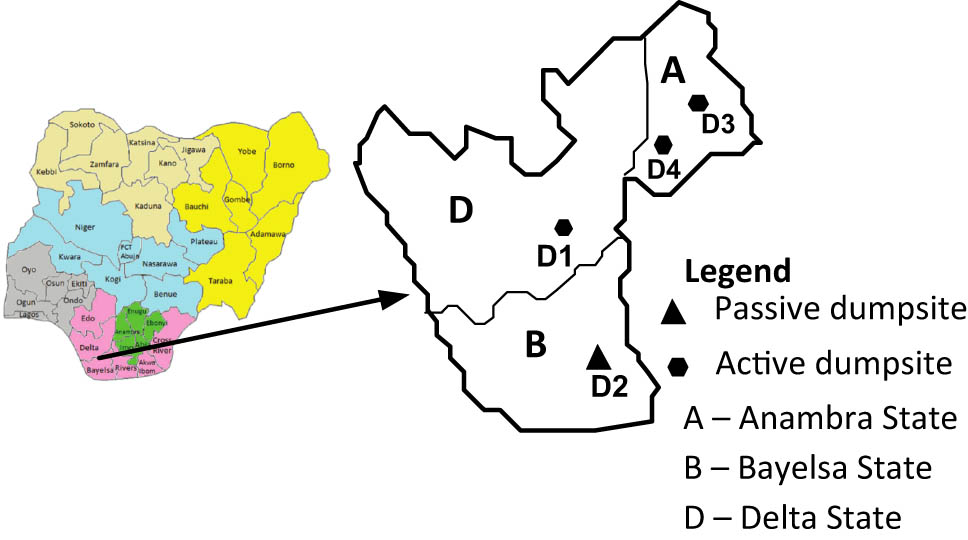
The map of the study area showing the respective dumpsites (D1 – dumpsite 1, D2 – dumpsite 2, D3 – dumpsite 3, D4 – dumpsite 4).
| Parameter | D1 | D2 | D3 | D4 |
|---|---|---|---|---|
| Rainfall (mm per annual) | 2,200 | 2,800 | 1,800 | 1,800 |
| Temperature (°C) | 23–38 | 21–35 | 21–33 | 22–37 |
| Wind direction | SW | SW | SW | SW |
| Wind speed (m/s) | 1.96 | 1.74 | 2.18 | 2.25 |
| Prevailing soil texture | Sandy clay, loam, alluvial soil | Alluvial soil, silty clay | Sandy loam | Sandy loam |
| Groundwater level | Moderate | High | Low | Low |
| Soil drainage | Moderate | Poor | Well-drained | Well-drained |
| Terrain | Gentle | Gentle and flood basins | Rough | Rough |
| Soil infiltration rate | Moderate | Low | High | High |
SW – southwest.
Additionally, there are few government-monitored solid waste disposal and management structures (dumpsites) in the region. These dumpsites receive their municipal/domestic waste materials, mainly through private sector partnerships, that facilitate the collection of these wastes from the individuals/parastatals and convey them in trucks to the dumping point. These dumpsites are poorly managed, leading to the acute emission of offensive odor, poisonous gases, and pathogenic microorganisms into the environment [33]. Remarkably, dumpsites are predisposed to wildfires, particularly during dry seasons, releasing large volume of toxic substances into the atmosphere [25,26].
2.2 Sample collection and preparation
Subsoil (0.4 m depth) samples were carefully sampled from five spatial locations within the vicinity of an unlined dumpsite for the four unlined dumpsites evaluated in this current research. Four spatial points were situated approximately 250 m north, south, east, and west from the epicenter of the dumpsite, while the fifth point was located at the center of each dumpsite. The four unlined dumpsites used to achieve the aim of this study include three active sites and one passive site. Active sites are those dumpsites that are still receiving waste materials, while passive sites are those dumpsites that are nonfunctioning (not receiving waste materials again). Typically, government tends to shut down (reallocate) active dumpsites, primarily due to rapid urban expansion and ecological issues. These passive dumpsites rely heavily on natural remediation to clear the environment [33]. This has resulted in toxic compounds and pathogens persistence, within the proximity of passive dumpsites. Remarkably, the passive site chosen in this research was closed down approximately 2 years ago by the government.
Furthermore, the Delta state site (dumpsite) received approximately 150,000 tons of waste weekly, while each of the Anambra state sites received roughly 200,000 tons of municipal solid waste weekly. The larger volume of waste generated at Anambra state can be attributed to the high daily influx of people into the state due to its high socio-commercial activities [31]. Specifically, the active dumpsites were more than 15 years old, and each covers an area of 30,000 m2. The wastes received by these sites consist mostly of domestic, medical, industrial, and electronic wastes [33]. These dumpsites lack proper waste sorting and recycling structures; hence, their dumpsites and landfills are littered with organic and inorganic materials.
In order to define the pollution level and pollution index of the dumpsite on the environment, a reference point (control) 3 km upland from the dumpsite was selected. The control location (reference point) had no documented records of the presence of a waste yard for the past decade. The soil samples were located from the designated points by using a soil auger, poured into sterilized containers, labeled accordingly, and transported to the laboratory.
2.3 Laboratory analyses
Table 2 shows the recap of the specimens, factors tested, and the testing techniques adopted to accomplish the research goals.
Summary of the testing procedures
| Sample nature | Sampling tool | Sample quantity | Parameters tested | Testing standard | |
|---|---|---|---|---|---|
| 1 | Soil | Soil auger | 24 | PTM (Pb, Cd, Ni, As) | ASTM methods using AAS (atomic absorption spectrophotometry). |
| 2 | Soil | Soil auger | 24 | Dielectric constant, EC, and electrical resistivity | Dielectric constant – ASTM D150 approach, EC – conductivity meter according to ASTM D1125 approach, and electrical resistivity – ASTM method |
| 3 | Soil | Soil auger | 24 | Microbial load | APHA 9215 standard |
| 4 | Air | Gas detector | 6 | Toxic gases (CO, CH₄, NH₃ NOx, VOCs, and SO₂) | National Institute for Occupational Safety and Health methods by using a gas monitor |
2.4 Air quality determination
The air quality at the various dumpsites was measured by using a portable gas detector (model GC310, Henan Chicheng Electric Co., Ltd, China) at a height of 2 m above the ground level, and sampling duration of 1 h per sampling time. Sampling was done at three defined periods of 7–8 a.m., 12–1 p.m., and 6–7 p.m. for all locations. CO (carbon (ii) oxide), CH₄ (methane), NH₃ (ammonia), NOx (nitrogen oxide), VOCs, and SO₂ (sulfur dioxide) were measured in ppm and converted to μg/m3, with a conversion factor of 1,000 [26].
2.5 Heavy metal analysis
The specimens were air-dried in the research laboratory, crumpled, and sifted using a 1 mm sieve. Two grams of the sifted dried soil were digested in 10 mL of concentrated acids (trioxonitrate(v) acid, hydrochloric acid, and tetraoxosulfate(vi) acid) in a mixture ratio of 4:1:1, at a temperature of 90°C to achieve a transparent solution. The digested product was strained using a standard filter paper (Grade 42) into a volumetric bottle and diluted to 100 mL using deionized water. Thereafter, the As, Pb, Ni and Cd levels in the solution were measured by atomic adsorption spectrometry, and the results are presented in mg/kg (ppm) [11].
3 Electrical property analysis
3.1 Dielectric constant and EC
The dielectric constant (ɛʹ) of each soil specimen was determined in agreement with ASTM D150 approved guidelines at a constant frequency of 10.0 GHz. Additionally, the soil EC level, which is the measure of the amount of salt ions in the soil, was determined following standard guidelines [34,35,36].
3.2 Electrical resistivity
The electrical resistivity level of the soil was measured in harmony with the standard procedures explained in previous studies [36,37], as shown in Figure 2. Thereafter, the soil resistance (R) and resistivity (ρ) were computed using equations (1) and (2), respectively:
where A is the soil column area and L is the soil column length.
![Figure 2
Structural diagram of the testing unit [36].](/document/doi/10.1515/chem-2025-0158/asset/graphic/j_chem-2025-0158_fig_002.jpg)
Structural diagram of the testing unit [36].
3.3 Microbial analysis of the soil
The plate count method was used to measure the total bacterial count (TBC) of each sample by plating serial dilutions of 5 g of the soil specimen, in agreement with the processes explained by Frączek et al. [38]. TBC was then quantified as colony-forming units per gram (cfu/g). Thereafter, the population of Staphylococcus aureus, Escherichia coli, Pseudomonas spp., Bacillus spp., Arthrobacter spp., and Streptococcus spp. in the soil samples was determined by using the culture-based methods. S. aureus was evaluated using the mannitol salt agar, E. coli was determined using the eosin methylene blue agar, Pseudomonas spp. was evaluated using the Cetrimide agar, Bacillus spp. was measured using the nutrient agar (spore-forming), Arthrobacter spp. was evaluated using the Actinomycetes isolation agar, and Streptococcus spp. was determined using the blood agar [7,38].
3.4 Evaluation of pollution indices
The pollution level of HMs was determined using the contamination factor and pollution load index (PLI).
3.5 Contamination factor (CF)
This pollution evaluation index was calculated using equation (3).
where X 1 and X 2 are the concentrations of HMs at the dumpsite and control point, respectively.
Soil CF is classified as follows: low – Cf < 1, moderate – Cf > 1 < 3, considerable – Cf > 3 < 6, and very high – Cf ≥ 6 [33].
3.6 PLI
The PLI was computed using equation (4):
PLI is classified as follows: PLI > 1 indicates a polluted condition, and PLI < 1 specifies nonpolluted situation [33].
3.7 Health hazard assessment
3.7.1 Daily intake dose (EDI)
The EDI values of toxic metals are computed using equation (5):
where C is the metal concentration, IR is the ingestion rate (∼200 mg/person/day for children and 100 mg/person/day for adults), BW is the individual body weight (∼30 kg for children and 75 kg for adults), and CF is the conversion factor (∼ ×106) [4,7].
3.7.2 Non-carcinogenic health hazards
The hazard quotient (HQ) and hazard index (HI) values of toxic metals are calculated using equations (6) and (7):
where RfD is the reference dose. Cd, Pb, Ni, and As have standard approved RfD values of 0.001, 0.0014, 0.02, and 0.0003 mg kg−1 day−1, respectively [4,26].
3.7.3 Carcinogenic hazards
The carcinogenic risk values are calculated using equations (8) and (9) [7]:
where CSF is the cancer slope factor. Cd, Pb, Ni, and As have verified CSF values of 0.38, 0.0085, 0.84, and 1.5, respectively [4].
3.8 Statistical analysis
The relationship between the parameters investigated and sampling locations was evaluated using the SPSS software (version 20.0, Chicago, IL, USA). The analysis of variance was used to evaluate the significant effects on the dumpsite activities, soil PTMs, and microbial and electrical properties status (levels). The average values were separated by Duncan’s multiple range test (DMRT) at a 95% confidence level. Additionally, apart from the air quality measurement, most of the tests were repeated three times, and the average documented.
4 Results and discussion
4.1 Air quality assessment
The results of the air quality of the dumpsites regions in comparison to the reference points are presented in Table 3. In the three active dumpsites (D1, D3, and D4) investigated, tt was highlighted that the average SO2, NOx, NH3, VOC, CO, and CH4 concentrations ranged from 99.50 to 242.20 μg/m3, 60.60 to 85.60 μg/m3, 1376.80 to 1812.20 μg/m3, 10663.30 to 18097.90 μg/m3, 32.40 to 73.00 μg/m3, and 3365.40 to 3823.30 μg/m3, respectively. Remarkably, the results revealed that the volume and concentration of gaseous emission around the dumpsite locality were considerably greater than the results verified at the reference points. This confirmed previous findings that emissions from decomposing organic and inorganic materials are loaded with hazardous compounds [25]. According to Uguru et al. [26], substances released from ineffectively managed dumpsites contain large percentages of CO, methane, ammonia, and VOCs. Interestingly, the results indicated that the high concentrations of SO3 and NOx recorded around the active dumpsites (1, 3, and 4) exceeded the maximum allowable limits approved by World Health Organization (WHO, 2024) for residential areas.
Air quality level within the dumpsites and control regions (μg/m3)
| Region | SO2 | NOx | NH3 | CO | CH4 | VOCs | |
|---|---|---|---|---|---|---|---|
| D1 | Vicinity | 99.50a ± 47.71 | 60.60a ± 35.92 | 1376.80a ± 402.79 | 73.00b ± 30.78 | 3823.30a ± 1244.34 | 10663.30a ± 3180.73 |
| Control | 8.20 ± 5.07 | 10.80 ± 5.87 | 86.20 ± 45.80 | 23.50 ± 10.67 | 650.80 ± 138.11 | 1242.00 ± 377.63 | |
| D3 | Vicinity | 125.60a ± 107.87 | 73.60b ± 38.54 | 1424.70a ± 596.69 | 32.40a ± 12.06 | 3365.40a ± 1250.46 | 13394.30a ± 4321.83 |
| Control | 5.10 ± 3.07 | 20.60 ± 8.09 | 24.50 ± 19.78 | 25.30 ± 9.04 | 672.50 ± 190.47 | 1045.40 ± 306.37 | |
| D4 | Vicinity | 242.20b ± 55.23 | 85.60c ± 26.51 | 1812.20a ± 702.42 | 39.30a ± 9.91 | 3544.80a ± 757.08 | 18097.90b ± 4497.01 |
| Control | 8.80 ± 4.57 | 23.40 ± 8.16 | 69.80 ± 12.93 | 10.90 ± 3.57 | 626.10 ± 192.15 | 1686.10 ± 417.32 | |
| WHO* | 40 | 25 | 25 | 4000 |
Mean ± standard deviation; D1 – dumpsite 1; D4 – dumpsite 3; D4 –∼ dumpsite 4; *WHO [41]; n = 10; within the vicinity of each dumpsite, rows with the same common letter (superscript) indicate that they are not significantly different at p ≤ 0.05 using DMRT.
Furthermore, the elevated concentrations of VOCs, CH4, and NH3 detected around D1, D3, and D4 vicinity can be primarily attributed to emissions from degrading (decomposing or burning) organic materials, paints, tyres, petroleum-based materials, and pesticides [26]. These findings aligned with the previous observations made by researchers in previous studies [25,39,40], where activities correlated with dumpsites released significant amount of toxic compounds and greenhouses gases into the ecosystems. Distinctively, considerable SO2, NOx, NH4 and CH4 levels, documented at the reference point, can be linked to the emissions from other anthropogenic activities with the control point’s locality. High SO2, NH3, and NOx concentrations are highly lethal, posing significant health challenges to human survival. Some health challenges linked to higher levels of SO2, NOx, NH3, CO, CH4, and VOCs in the atmosphere include respiratory issues and cardiovascular diseases [26,39].
4.2 Heavy metal parameters
The results of the effect of the dumpsite leachate on the subsoil heavy metal content are shown in Table 4. Table 4 shows that D1–D4 actions had significant effect (p ≤ 0.05) on the Ni, Pb, Cd, and As concentrations in the subsoil. This indicates negative implications of solid waste effluents on public health and human safety. At dumpsite 1, it was observed that the subsoil specimens had mean Cd, Pb, Ni, and As concentrations that ranged from 0.66 to 1.86 mg/kg, 35.30 to 72.53 mg/kg, 8.65 to 20.13 mg/kg, and 1.33 to 7.67 µg/kg, respectively. In dumpsite 2, the samples recorded average Cd, Pb, Ni, and As concentrations that varied from 0.04 to 0.1 mg/kg, 31.87 to 76.73 mg/kg, 3.91 to 7.12 mg/kg, and BDL to 6.33 µg/kg, respectively. Then, at dumpsite 3, it was noted that the subsoil had mean Cd, Pb, Ni and As contents that ranged from 0.46 to 1.70 mg/kg, 26.56 to 66.08 mg/kg, 0.74 to 5.24 mg/kg, and BDL to 6.67 µg/kg, respectively. Additionally, at dumpsite 4, the average Cd, Pb, Ni, and As concentrations ranged from 0.24 to 2.75 mg/kg, 17.01 to 75.48 mg/kg, 15.51 to 34.26 mg/kg, and 3.33 to 233.33 µg/kg, respectively. The wide HM concentration difference observed among D1–D4 can be attributed to several factors, such as the soil's geotechnical properties, the region’s topography, and the soil’s hydraulic conductivity [7,42].
PTM concentration in soils
| Location | Spatial point | Cd (mg/kg) | Pb (mg/kg) | Ni (mg/kg) | As (µg/kg) |
|---|---|---|---|---|---|
| Dumpsite 1 | Central | 1.86c ± 0.08 | 72.53a ± 6.00 | 20.13b ± 1.68 | 7.67a ± 3.51 |
| 1 | 1.01c ± 0.39 | 35.79a ± 11.03 | 12.05b ± 2.23 | 2.00a ± 2.00 | |
| 2 | 1.56c ± 0.41 | 35.30a ± 14.52 | 12.46b ± 1.63 | 1.67a ± 2.89 | |
| 3 | 0.69c ± 0.28 | 37.29a ± 6.17 | 8.65b ± 2.13 | 1.33a ± 1.53 | |
| 4 | 0.66c ± 0.35 | 38.54a ± 6.85 | 11.95b ± 2.47 | 2.33a ± 2.08 | |
| Control | 0.22 ± 0.17 | 19.71 ± 2.16 | 7.95 ± 1.72 | 0.33 ± 0.58 | |
| Dumpsite 2 | Central | 0.10a ± 0.04 | 76.63b ± 7.03 | 7.12a ± 0.37 | 6.33a ± 2.08 |
| 1 | 0.04a ± 0.04 | 63.99b ± 10.27 | 5.35a ± 1.11 | 1.67a ± 2.08 | |
| 2 | 0.06a ± 0.03 | 51.23b ± 3.83 | 5.75a ± 1.67 | BDL | |
| 3 | 0.10a ± 0.04 | 75.23b ± 4.70 | 4.21a ± 1.18 | 3.33a ± 2.08 | |
| 4 | 0.04a ± 0.03 | 31.87b ± 3.00 | 3.91a ± 1.27 | 1.33a ± 2.31 | |
| Control | 0.04 ± 0.07 | 29.80 ± 9.02 | 1.96 ± 0.97 | 0.67 ± 0.58 | |
| Dumpsite 3 | Central | 1.70b ± 0.31 | 32.80a ± 0.95 | 5.24a ± 2.47 | 6.67a ± 3.79 |
| 1 | 0.91b ± 0.16 | 26.56a ± 3.65 | 0.74a ± 0.76 | 1.67a ± 2.89 | |
| 2 | 0.58b ± 0.13 | 46.97a ± 2.72 | 4.76a ± 1.08 | 2.00a ± 1.73 | |
| 3 | 0.79b ± 0.29 | 66.08a ± 3.54 | 2.62a ± 0.79 | 1.00a ± 1.73 | |
| 4 | 0.46b ± 0.15 | 52.59a ± 7.31 | 2.08a ± 0.23 | BDL | |
| Control | 0.02 ± 0.03 | 21.16 ± 7.10 | 0.32 ± 0.52 | 1.00 ± 1.73 | |
| Dumpsite 4 | Central | 2.75c ± 0.57 | 75.48a ± 7.24 | 34.26c ± 7.84 | 233.33b ± 92.92 |
| 1 | 1.13c ± 0.18 | 54.92a ± 8.67 | 22.88c ± 5.82 | 33.33b ± 30.55 | |
| 2 | 0.57c ± 0.35 | 45.06a ± 7.37 | 20.89c ± 2.57 | 3.33b ± 5.77 | |
| 3 | 1.37c ± 0.42 | 54.15a ± 13.07 | 16.99c ± 4.71 | 50.00b ± 43.59 | |
| 4 | 0.24c ± 0.14 | 17.01a ± 4.85 | 15.51c ± 12.02 | 76.67b ± 30.55 | |
| Control | 0.02 ± 0.03 | 20.89 ± 9.21 | 0.48 ± 0.75 | 3.33 ± 5.77 | |
| WHO/FAO | 0.8 | 70.00 | 100.00 | 20.0 |
Mean ± standard deviation; BDL = below detection level; n = 3; within the vicinity of each dumpsite, rows with the same common letter (superscript) indicate that they are not significantly different at p ≤ 0.05 using DMRT.
Furthermore, the results indicated that the PTM – cadmium, nickel, lead and arsenic – levels in the dumpsite locality soils were significantly greater than those in the control location. Notably, the PTM concentrations verified at the passive dumpsite (D2) were considerably lower than those recorded in the active dumpsites (Dumpsites 1, 3, and 4). This buttressed earlier reports, which stated that solid waste effluent tends to contribute immensely to heavy metal pollution and its associated health issues [43,44]. Hosseini Beinabaj et al. [14] gave a concise view that there is strong correlation between PTM level, dumpsite age, and dumpsite volume. Additionally, bioremediation activities occurring in D2 greatly help in weakening the PTM concentration, consequently, leading to overall lower metal concentrations [45].
The elevated concentrations of the PTMs recorded at the dumpsite center could be attributed to the significant amount and concentration of leachate, emitted from the metallic and non-metallic wastes deposited in the localities [7,33]. When metallic objects corrode, they emit harmful minerals, including toxic metals, into the environment leading to ecological contamination; this further elevates the PTM toxicity of the ecosystems [10]. Peculiarly, Cd and Ni levels in this study were lower than those recorded by Abd-Elhalim et al. [44] for soils located around waste yard vicinities; on the contrary, the Pb and Cd levels in this study were greater than those found in previous studies [42,44]. Correspondingly, the Cd levels documented in this research were less than that (2.31 mg/kg) obtained for other region's dumpsites’ soils [46]. The mean Ni concentrations found here were greater than those of Magaji et al. [47] but aligned with observations made by Uguru et al. [7]. Notably, the Cd concentrations in the D2 and D3 subregions were substantially lower than those in previous studies [48,49]. However, the Cd and Pb values found here were confirmed to be greater than those reported by Omo-Irabor et al. [43] for an unlined landfill.
It is interesting to note that the PTM levels around the dumpsite neighborhood soils were below the maximum acceptable concentrations values, approved by WHO and European Union for human safety. However, their elevated concentrations present considerable risks to food safety and electrical installations. Toxic metal pollutants have the ability of causing numerous diseases in humans by their accumulation in the food chain and food web [14,43]. Food poisoning resulting from PTM toxicity is a leading cause of human mortality, as it poses a severe hazard to humanity [44]. PTMs have the potential of accumulating in the soil, vegetation, and human bodies, resulting in chronic health issues such as system failures, memory loss, nervous disorders, and cancer diseases [7,50]. Cadmium primarily enters in the environment through leachates from electroplated materials and electronic components [7]; while leachate from battery circuit boards and semiconductors are significant contributors to nickel pollution in the soil [14]. Anthropogenic sources such as leachate from paint materials, pesticides, batteries, and tires are the major contributors of Pb contamination in the environment [51]; while industrial chemicals, electronic waste, batteries, and photovoltaic cells are the major sources of arsenic in the soil [7].
Based on the impact of these dumpsite actions on engineering infrastructures, the high PTM concentrations in the soil can significantly impact the functionality of telecommunication facilities [53]. According to ref. [21], metallic ions facilitate corrosion, thereby diminishing the material proficiency in numerous electrical and electronic components. PTMs (mostly Pb and Cd) have the ability of increasing the soil moisture’s salinity level, leading to corrosion of metallic circuits and connectors, which in turn undermines the electrical integrity of the system [52]. Corrosion is enhanced by high soil EC, resulting in interference with signals and energy transmission. This subsequently leads to telecommunication and grounding system interruptions and failures [53,54]. These conditions are associated with signal degradation, leading to deprived connectivity and service consistency.
4.3 Microbial analysis
Table 5 presents the microbiological analysis of the dumpsite and its environmental soil samples. The average TBC in the dumpsites regions varied between 7.54 × 10⁶ and 128.30 × 10⁶ cfu/g, while the load of S. aureus ranged from 1.76 × 10³ to 15.26 × 10³ cfu/g. The population of E. coli was between 7.25 × 10³ and 33.92 × 10³ cfu/g. whereas the count of Pseudomonas spp. fluctuated from 5.55 × 10³ to 45.74 × 10³ cfu/g. Likewise, the mean Bacillus spp. load was between 6.91 × 10³ and 91.02 × 10³ cfu/g, while the Arthrobacter spp. population varied from 3.66 × 10³ to 28.12 × 10³ cfu/g. Finally, the mean population of Streptococcus spp. ranged from 1.59 × 10³ to 8.77 × 10³ cfu/g. The results revealed that the bacteria population at the central area and in the vicinity of the dumpsites were significantly highly than the results obtained from the reference points. This is an indication that leachates from the waste materials immensely lead to microbial infestation of the environment.
Microbial concentrations at the dumpsites (n = 3)
| Loc. | SP | TBC (×106 cfu/g) | Staph (×103 cfu/g) | E. coli (×103 cfu/g) | Pseu (×103 cfu/g) | Strep (×103 cfu/g) | Bac (×103 cfu/g) | Arth (×103 cfu/g) |
|---|---|---|---|---|---|---|---|---|
| D1 | Ce | 72.62a ± 3.47 | 6.83a ± 0.24 | 26.32c ± 1.01 | 20.61b ± 1.10 | 4.90a ± 0.04 | 59.03b ± 1.94 | 22.32c ± 0.72 |
| 1 | 19.07a ± 0.47 | 4.51a ± 0.46 | 19.09c ± 1.47 | 11.43b ± 0.79 | 3.21a ± 0.07 | 35.96b ± 5.15 | 12.52c ± 1.91 | |
| 2 | 26.52a ± 0.62 | 2.80a ± 0.24 | 10.02c ± 1.11 | 12.88b ± 1.71 | 3.01a ± 0.03 | 25.89b ± 0.50 | 8.21c ± 0.82 | |
| 3 | 9.50a ± 0.85 | 3.46a ± 0.51 | 9.83c ± 0.99 | 7.02b ± 1.19 | 3.43a ± 0.36 | 22.93b ± 2.13 | 10.41c ± 1.60 | |
| 4 | 15.29a ± 1.24 | 3.26a ± 0.34 | 15.51c ± 1.03 | 10.29b ± 0.77 | 1.59a ± 0.23 | 29.66b ± 3.55 | 11.38c ± 0.71 | |
| Co | 12.22 ± 0.54 | 0.79 ± 0.18 | 2.40 ± 0.48 | 1.51 ± 0.37 | 0.58 ± 0.10 | 8.29 ± 1.60 | 3.12 ± 0.73 | |
| D2 | Ce | 53.08a ± 1.93 | 5.14a ± 0.81 | 20.63a ± 1.09 | 15.14a ± 1.30 | 8.02b ± 0.60 | 91.02c ± 6.03 | 28.12b ± 2.42 |
| 1 | 27.52a ± 3.11 | 3.51a ± 0.28 | 6.26a ± 0.80 | 8.95a ± 0.24 | 2.38b ± 0.19 | 33.49c ± 2.18 | 10.48b ± 1.06 | |
| 2 | 7.54a ± 1.01 | 2.46a ± 0.35 | 8.88a ± 0.83 | 5.65a ± 0.29 | 3.87b ± 0.31 | 53.4c ± 2.84 | 4.57b ± 0.60 | |
| 3 | 29.32a ± 1.37 | 1.76a ± 0.29 | 14.34a ± 1.20 | 5.55a ± 0.60 | 2.66b ± 0.10 | 28.13c ± 3.22 | 3.66b ± 0.17 | |
| 4 | 12.95a ± 0.51 | 3.99a ± 0.37 | 10.71a ± 1.25 | 16.79a ± 0.77 | 3.19b ± 0.25 | 30.64c ± 0.73 | 7.47b ± 1.91 | |
| Co | 9.73 ± 1.23 | 0.63 ± 0.20 | 2.35 ± 0.46 | 1.94a ± 0.10 | 1.17 ± 0.09 | 5.91 ± 0.22 | 0.62b ± 0.21 | |
| D3 | Ce | 65.78b ± 2.06 | 10.42b ± 0.55 | 26.53b ± 1.13 | 19.60b ± 1.15 | 8.77c ± 0.39 | 20.71a ± 2.21 | 15.39a ± 0.48 |
| 1 | 6.78b ± 0.94 | 7.60b ± 0.68 | 7.25b ± 0.53 | 8.65b ± 0.28 | 5.79c ± 0.35 | 6.91a ± 0.36 | 8.35a ± 0.56 | |
| 2 | 35.23b ± 3.75 | 3.72b ± 0.60 | 12.03b ± 1.46 | 9.31b ± 1.07 | 2.79c ± 0.24 | 15.94a ± 1.10 | 8.08a ± 0.44 | |
| 3 | 11.93b ± 1.34 | 6.57b ± 0.35 | 8.53b ± 0.54 | 11.20b ± 0.65 | 4.62c ± 0.48 | 11.35a ± 0.83 | 7.94a ± 0.22 | |
| 4 | 40.49b ± 0.87 | 5.80b ± 0.35 | 12.35b ± 1.81 | 8.65b ± 0.96 | 3.18c ± 0.11 | 9.43a ± 0.37 | 3.27a ± 0.32 | |
| Co | 12.23 ± 1.64 | 1.57 ± 0.42 | 4.11 ± 0.23 | 3.08 ± 0.12 | 0.87 ± 0.14 | 1.35 ± 0.29 | 0.92 ± 0.20 | |
| D4 | Ce | 128.30c ± 13.7 | 15.26b ± 4.73 | 33.92c ± 2.71 | 45.74c ± 3.33 | 6.15b ± 0.98 | 82.82d ± 8.07 | 19.99d ± 3.80 |
| 1 | 40.12c ± 2.45 | 9.04b ± 0.46 | 20.78 ± 2.09 | 6.01c ± 1.95 | 2.92b ± 0.25 | 49.34d ± 7.52 | 10.30d ± 3.01 | |
| 2 | 76.59c ± 3.13 | 4.24b ± 0.09 | 6.37 ± 0.65 | 3.78c ± 0.25 | 5.43b ± 0.57 | 40.01d ± 2.05 | 13.42d ± 2.40 | |
| 3 | 25.59c ± 7.20 | 2.73b ± 0.28 | 3.68 ± 0.53 | 23.74c ± 2.82 | 4.54b ± 0.44 | 13.67d ± 5.14 | 7.39d ± 1.01 | |
| 4 | 36.21c ± 3.83 | 5.71b ± 0.81 | 19.88 ± 2.52 | 19.85c ± 2.61 | 2.13b ± 0.05 | 68.29d ± 6.64 | 22.51d ± 0.51 | |
| Co | 11.57 ± 3.07 | 0.68 ± 0.24 | 1.24 ± 0.47 | 1.96 ± 0.19 | 0.79 ± 0.15 | 8.74 ± 1.17 | 1.39 ± 0.47 |
Loc – location; D – dumpsite; SP - spatial point; Ce – central; Co – control; TBC - total bacterial count; Staph – Staphylococcus, Pseu – Pseudomonas spp.; Strep – Streptococcus; Arth - Arthrobacter spp.; Bac - Bacillus spp.; within the vicinity of each dumpsite, rows with the same common letter (superscript) indicate that they are not significantly different at p ≤ 0.05 using DMRT.
Remarkably, out of the six bacteria isolated from the dumpsite soil samples, Bacillus spp., Pseudomonas spp., and E. coli have the highest prevalence, regardless of the sampling location and dumpsite. At D3, Streptococcus recorded the highest frequency of isolation, while Bacillus spp. was dominant in dumpsite 2. The Pseudomonas spp. population at D4 was significantly greatest compared to the populations observed at Dumpsites 1–3, while Arthrobacter spp. and E. coli had the highest isolation frequency at dumpsites 4 and 1, respectively. The high bacteria prevalence in the dumpsite soils portrayed the harmful impact of inappropriate WM practices on the ecosystems. These findings are consistent with the observations previously made in Refs [55,56], where it was noted that the organic material effluent has extremely large population of Streptococcus spp., Bacillus spp., E. coli, and Pseudomonas spp., subsequently causing massive environmental pollution. Uguru et al. [26] critically observed during their investigation into public health that a strong correlation existed between emissions from organic waste and microbial contamination of the environment.
The findings in this study highlighted that the non-active dumpsite typically had the lowest bacteria population. This could be linked to the favorable bacteria habitat conditions created by decomposition solid waste residues. Pseudomonas spp., Bacillus spp., and Arthrobacter spp. are heavy metal-resistant pathogens, while Staphylococcus and Pseudomonas spp. are biofilm-forming bacteria. Therefore, these microorganisms can thrive successfully in contaminated environmental conditions [33,57,58]. Additionally, the variation observed in microbial loads both within and among dumpsite neighborhoods can be correlated with the composition of the waste materials. Waste type (organic, inorganic, or toxic), environmental conditions (temperature, moisture, pH, and oxygen levels), as well as the remediation processes, tend to influence microbial reproduction and survival in the soil [56,59]. The outflow from organic materials tends to enhance the survival and performance of microorganisms [26,60]. On the contrary, seepages from synthetic or hazardous sources tend to hinder microbial growth and favorability [26,60].
Despite the pathogenic nature of Bacillus spp. and Pseudomonas spp., these bacteria can play bioremediation roles, mainly due to their resilience to degrading toxic compounds [58,61]. E. coli, Bacillus spp., and Pseudomonas spp. dominance in the polluted soils depicts colossal microbial diversity alteration. This context can be correlated with potential response to environmental stressors, which is caused by the waste materials’ seepage into the landscape [62]. The significant bacteria population recorded at the control points could be attributed to activities associated with anthropogenic actions, such as agricultural production and domestic activities [26].
4.4 Electrical property parameters
The results of the electrical properties of the soil samples are presented in Table 6. The results highlighted that the subsoil’s EC values at dumpsites 1, 2, 3, and 4 varied from 26.06 to 70.15 mS/m, 22.93 to 46.57 mS/m, to 21.31 to 65.06 mS/m, and 32.57 to 76.02 mS/m, respectively; while their ρ varied between 7.61 and 12.04 Ω m, 12.25 and 17.23 Ω m, 9.08 and 15.26, 8.64 Ω m and 15.31 Ω m, respectively. Likewise, their ɛʹ values at dumpsites 1, 2, 3, and 4 ranged from 2.46 to 3.54, 2.64 to 3.23, 2.75 to 3.64, and 2.58 to 3.32, respectively. Generally, the results revealed that the soils around the dumpsites had higher EC values, along with decreased ɛʹ and resistivity values compared to the soil samples at the reference points. This is an indication that leachate actions successfully initiate an increment in the soil’s ability to conduct electrons and electrical charges throughout the soil mass. This action can be linked to the presence of large amount of HMs in the soil, performing the function of electron transporters, thereby facilitating the electron mobility and increasing EC of the soil in the process [17].
Electrical properties of the dumpsite soils
| Location | Spatial point | EC (mS/m) | ρ (Ω m) | Dielectric constant |
|---|---|---|---|---|
| Dumpsite 1 | Central | 70.15a ± 2.70 | 8.95a ± 1.97 | 2.46b ± 0.16 |
| 1 | 26.95a ± 1.74 | 12.04a ± 1.65 | 3.54b ± 0.32 | |
| 2 | 32.48a ± 0.57 | 8.99a ± 1.19 | 3.46b ± 0.39 | |
| 3 | 26.06a ± 0.64 | 7.61a ± 2.05 | 3.15b ± 0.15 | |
| 4 | 30.01a ± 1.14 | 10.54a ± 2.14 | 3.06b ± 0.25 | |
| Control | 9.66 ± 1.56 | 22.02 ± 1.29 | 3.89 ± 0.12 | |
| Dumpsite 2 | Central | 46.57a ± 3.81 | 12.25b ± 5.06 | 2.64a ± 0.11 |
| 1 | 33.49a ± 2.11 | 17.23b ± 2.68 | 3.12a ± 0.13 | |
| 2 | 22.93a ± 2.41 | 10.96b ± 3.69 | 2.73a ± 0.14 | |
| 3 | 27.68a ± 2.61 | 11.85b ± 4.49 | 3.08a ± 0.11 | |
| 4 | 41.31a ± 2.94 | 12.70b ± 3.42 | 3.23a ± 0.19 | |
| Control | 14.12 ± 3.22 | 27.45 ± 1.76 | 3.85 ± 0.08 | |
| Dumpsite 3 | Central | 65.06a ± 8.64 | 9.08b ± 3.43 | 2.75ab ± 0.13 |
| 1 | 21.31a ± 2.21 | 13.14b ± 0.97 | 3.00ab ± 0.20 | |
| 2 | 39.11a ± 3.84 | 13.06b ± 3.46 | 3.64ab ± 0.25 | |
| 3 | 37.48a ± 10.33 | 15.26b ± 1.11 | 3.08ab ± 0.23 | |
| 4 | 26.75a ± 2.12 | 13.09b ± 3.11 | 3.04ab ± 0.21 | |
| Control | 14.34 ± 1.57 | 20.76 ± 6.80 | 3.88 ± 0.10 | |
| Dumpsite 4 | Central | 76.02b ± 7.59 | 8.64ab ± 1.67 | 2.58a ± 0.18 |
| 1 | 50.59b ± 5.94 | 12.74ab ± 1.87 | 2.66a ± 0.29 | |
| 2 | 32.57b ± 2.69 | 11.03ab ± 1.49 | 3.32a ± 0.43 | |
| 3 | 48.87b ± 3.58 | 12.96ab ± 3.40 | 3.08a ± 0.09 | |
| 4 | 41.16b ± 7.05 | 15.31ab ± 1.22 | 3.16a ± 0.20 | |
| Control | 41.14 ± 7.31 | 21.17 ± 3.46 | 3.83 ± 0.20 |
EC = electrical resistivity; ρ = electrical resistivity; mean ± standard deviation; n = 3; rows with the same common letter at the dumpsite vicinity indicate that they are not significantly different at p ≤ 0.05 using DMRT.
Furthermore, the results show that anthropogenic activities – leachate from the waste products – interfere with the soil's ρ values, which is similar to the findings of ref. [19]. High metallic concentrations of the soil tends to improve electrons’ conductive routes, hence reducing the soil’s electrical resistivity [62]. These findings highlighted that the dumpsite discharge reduces the soil’s insulating capability, thereby creating conductive bridges within the soil mass. Depreciation of the soil ρ, particularly around the dumpsite surroundings, will adversely affect the electrical earthing performance of electrical installations constructed in these areas. These conditions result in a higher occurrence of electrical faults and electrical accessories/systems malfunctions [37].
The smaller ɛʹ values documented at the dumpsite neighborhood, compared to the reference point, can be attributed to the higher PTM levels recorded within the dumpsite area. Heavy metal pollution has the potential to cause significant alteration in the soil structure and moisture retention ability. Consequently, this will lead to an increase in the soil’s ion concentration, causing substantial reduction in the ɛʹ rates [64,65]. Notably, the high EC levels detected in the soils around the waste yards could foster corrosive conditions, which accelerate rapid deterioration of electrical and mechanical installations.
4.5 Heavy metal health hazards
4.5.1 Non-carcinogenic and carcinogenic risks
The results of the non-carcinogenic risks (EDI, HQ, and HI) and carcinogenic risks (CR and TCR) of the PTMs are presented in Table 7 and Figures 3 and 4. It was observed that the EDI values for Cd, Pb, Ni, and As were found as follows: 8.51 × 10⁻⁷ – 1.07 × 10⁻⁵ mg/kg/day, 1.26 × 10⁻⁶ – 1.11 × 10⁻⁴ mg/kg/day, 8.28 × 10⁻⁶ – 7.22 × 10⁻⁵ mg/kg/day, and 2.90 × 10⁻⁸ – 7.33 × 10⁻⁷ mg/kg/day, respectively. Basically, the EDI values obtained at the center of the dumpsites were greater than those found around the vicinity of the dumpsites. This reflects the emissions from the waste materials dumped at these waste yards; this builds on previous investigation of ref, [7], which identified the detrimental impact of emissions from waste materials on the environment. According to the results, the HQs of the Cd, Pb, Ni, and As varied from 8.51 × 10⁻⁴ to 1.07 × 10⁻², 3.60 × 10⁻³ to 3.17 × 10⁻², 4.14 × 10⁻⁴ to 3.61 × 10⁻³, and 9.67 × 10⁻⁵ to 4.90 × 10⁻⁴, respectively. Likewise, the HI values for the PTMs revealed varied levels of risk, depending on the age group and contamination point. At the dumpsite center, the HI values were 4.85 × 10⁻² for children and 9.72 × 10⁻³ for adults; within the dumpsites’ neighborhood soils, the documented HI values were 2.48 × 10⁻² and 4.96 × 10⁻³ for the children and adult age categories, respectively (Figure 3). These results show that though the HI values were considerably high, they did not exceed the threshold (HI ≥ 1), which is associated with non-carcinogenic health risks linked to prolong exposure to heavy metal assimilation. Typically, an HI value less than 1 is an indication that prolonged exposure to these harmful PTMs will not pose any significant non-carcinogenic health risk to humans [7].
Non-carcinogenic and carcinogenic risks of PTMs
| PTM | Location | EDI (mg/kg/day) | HQ | CR | |||
|---|---|---|---|---|---|---|---|
| Children | Adults | Children | Adults | Children | Adults | ||
| Cd | Central | 1.07 × 10⁻⁵ | 2.14 × 10⁻⁶ | 1.07 × 10⁻² | 2.14 × 10⁻³ | 4.07 × 10⁻⁶ | 8.13 × 10⁻⁷ |
| Locality | 4.25 × 10⁻⁶ | 8.51 × 10⁻⁷ | 4.25 × 10⁻³ | 8.51 × 10⁻⁴ | 1.62 × 10⁻⁶ | 3.23 × 10⁻⁷ | |
| Pb | Central | 1.11 × 10⁻⁴ | 2.23 × 10⁻⁵ | 3.17 × 10⁻² | 6.37 × 10⁻³ | 9.44 × 10⁻⁷ | 1.90 × 10⁻⁷ |
| Locality | 6.29 × 10⁻⁵ | 1.26 × 10⁻⁵ | 1.80 × 10⁻² | 3.60 × 10⁻³ | 5.35 × 10⁻⁷ | 1.07 × 10⁻⁷ | |
| Ni | Central | 7.22 × 10⁻⁵ | 1.44 × 10⁻⁵ | 3.61 × 10⁻³ | 7.20 × 10⁻⁴ | 6.06 × 10⁻⁵ | 1.21 × 10⁻⁵ |
| Locality | 4.14 × 10⁻⁵ | 8.28 × 10⁻⁶ | 2.07 × 10⁻³ | 4.14 × 10⁻⁴ | 3.48 × 10⁻⁵ | 6.96 × 10⁻⁶ | |
| As | Central | 7.33 × 10⁻⁷ | 1.47 × 10⁻⁷ | 2.44 × 10⁻³ | 4.90 × 10⁻⁴ | 1.10 × 10⁻⁶ | 2.21 × 10⁻⁷ |
| Locality | 1.45 × 10⁻⁷ | 2.90 × 10⁻⁸ | 4.83 × 10⁻⁴ | 9.67 × 10⁻⁵ | 2.18 × 10⁻⁷ | 4.35 × 10⁻⁸ | |

The HI values of PTMs.

The TCR values of PTMs.
Furthermore, the carcinogenic risks results for Cd, Pb, Ni, and As were observed to be within the following ranges: 3.23 × 10⁻⁷ to 4.07 × 10⁻⁶, 1.07 × 10⁻⁷ to 9.44 × 10⁻⁷, 6.96 × 10⁻⁶ to 6.06 × 10⁻⁵, and 4.35 × 10⁻⁸ to 1.10 × 10⁻⁶, respectively. The results further highlighted that children and the center of the dumpsites had higher CR values compared to the adults and soils sampled from the vicinity of the dumpsites. This finding is in conformity with previous observations reported by Hu et al. [69] and Uguru et al, [7]. Additionally, the TCR results (Figure 4) show that at the dumpsite center, the TCR values for children and adult were 6.67 × 10⁻⁵ and 1.33 × 10⁻⁵, respectively, while within the dumpsite locality, the TCR values were 3.72 × 10⁻⁵ and 7.43 × 10⁻⁶ for children and adults, respectively. Based on the health safety standard, the TCR values obtained in this study, regardless of the sampling point and age category, do not exceed the minimum allowable limit of 1 × 10⁻⁴, as stipulated by the USEPA for metropolitan areas [66]. Interestingly, the TCR results portrayed that there are no carcinogenic health hazards, which can be linked to prolong exposure to the pollutants (PTMs) emitted in the form of leachate from both the active and passive dumpsites studied. This depicted a relatively lower environmental and health concern, related to PTM lethality from poorly managed dumpsites.
4.6 Evaluation of the pollution rate
4.6.1 Contamination factor and PLI
The CF and PLI values of the soil samples are presented in Table 8. It is observed that the cadmium CF values ranged from 0.75 (low level) to 60.60 (very high pollution degree). With regard to the Pb contamination, the soil had moderate degree of contamination across all the dumpsite localities. In terms of Ni and As pollution, the contaminant factor values ranged from 1.64 to 46.05 for Ni and 2.4 to 25.8 for As. These outcomes depicted that the dumpsite regions have high contamination levels of cadmium and arsenic. These findings buttressed the previous observations made in ref. [7], which stated that dumpsite activities have hazardous impact on the ecosystems. The high contamination factor observed in this research indicates that anthropogenic sources, likely the waste yard, were responsible for the contamination of the environment [50]. According to the experimental findings of Ogbaran and Uguru [33], in a scenario where the CF value is lower than 1.5, there are high possibilities that the PTM contamination mainly resulted from natural sources. However when the CF levels are higher than 1.5, their strong correlation that the pollution result from primarily anthropogenic sources.
Pollution indices of the dumpsite soils
| Location | CR | PLI | |||
|---|---|---|---|---|---|
| Cd | Pb | Ni | As | ||
| Dumpsite 1 | 5.78 | 2.29 | 1.64 | 10 | 3.86 |
| Dumpsite 2 | 0.75 | 2.01 | 2.83 | 3.43 | 1.96 |
| Dumpsite 3 | 44.40 | 2.13 | 9.65 | 2.4 | 6.84 |
| Dumpsite 4 | 60.60 | 2.36 | 46.05 | 25.8 | 20.30 |
Besides, the PLI of the soil samples indicates that the PLI values ranged from 1.96 to 20.30, indicating that dumpsites and their neighborhoods were polluted (PLI > 1). As shown in Table 6, the pollution rates fluctuated among the dumpsites, with dumpsite 4 having a highest PLI value of 20.30, and point 2 having the lowest PLI value (1.96). High accumulation of toxic elements in the body can lead to nervous system disorders [67]. The Agency for Toxic Substances and Disease Registry (ATSDR) stated that persistent contact to Cd and Pb can result in carcinogenic hazards, neurological disorder, and cardiovascular and kidney diseases [67]. The high environmental pollution rates noted in this study, which are similar to the findings in previous studies [14,38], could be attributed to the unlined nature of these dumpsites investigated. This facilitates rapid percolation of the toxic waste effluents into the adjacent soils. Liners, which are typically made of water-resistant materials, are designed to provide an impermeable barrier at the bottom of landfills and dumpsites; consequently, retarding seepage of effluent produced by the decomposing waste materials into the surrounding soil and atmosphere [68].
5 Conclusion
Environmental pollution resulting from poor solid WM has become a major public concern. This is basically due to the neurotoxic, mutagenic, and carcinogenic effects, linked to poorly managed waste. This research was carried out to evaluate the effect of the gaseous emissions and leachate from solid waste on the air quality as well as the soil’s heavy metal content, dielectric parameters, and microbial population. Soil sampled from active and passive dumpsites were subjected to laboratory analyses using approved ASTM International techniques. The results obtained show that the dumpsite effluent had significant effect on the environment (P ≤ 0.05). The soil’s arsenic, lead, nickel, and cadmium concentrations recorded within the dumpsite’s vicinity were considerably greater than those documented at the reference points. Likewise, the dumpsite activities caused significant increment in the soil EC, but a decline in the soil’s dielectric constant and electrical resistivity. It was noted that regardless of the dumpsite status, the dumpsite anthropogenic action enhanced the reproduction and survival of microorganisms. Furthermore, the outdoor air around the active dumpsites was of lower air quality, containing considerable amount of toxic compounds. This study’s outcomes depicted that even after discontinuation of the dumpsite usage (passive dumpsite), the region still remains pathogenic microorganisms hotspot, which can pose latent health and ecological risks. The findings of this research and pollution indices highlighted the importance of environmental protection agencies to engage in proper solid WM approaches to prevent the occurrence of pathogenic-borne diseases, reduce heavy metals toxicity, and maintain telecommunication integrity.
Acknowledgments
The authors extend their appreciation to Taif University, Saudi Arabia, for supporting this work (project number TU-DSPP-2024-10).
-
Funding information: This research was funded by Taif University, Saudi Arabia (Project No. TU-DSPP-2024-10).
-
Author contributions: S.A. and B.E.I. designed the experiment; H.U. and S.H. analyzed the results; D.N.A. and O.I.A. wrote the first draft; R.S. and R.H.K. edited the manuscript and helped in sample collection; A.M.A. facilitated data curation, writing – review and editing, M.H. and O.A. helped in supervision and project administration. All authors have read and agreed to the published version of the manuscript.
-
Conflict of interest: The authors declare no conflict of interest.
-
Ethical approval: The conducted research is not related to either human or animal use.
-
Data availability statement: All data analyzed during this study are included in this published article.
References
[1] Ferronato N, Torretta V. Waste mismanagement in developing countries: a review of global issues. Int J Environ Res Public Health. 2019 Jun;16(6):1060. 10.3390/ijerph16061060.Search in Google Scholar PubMed PubMed Central
[2] Ichipi EB, Senekane MF. An evaluation of the impact of illegal dumping of solid waste on public health in nigeria: a case study of Lagos State. Int J Environ Res public health. 2023;20(22):7069. 10.3390/ijerph20227069.Search in Google Scholar PubMed PubMed Central
[3] Ngalo N, Thondhlana G. Illegal solid-waste dumping in a low-income neighbourhood in south africa: prevalence and perceptions. Int J Environ Res public health. 2023;20(18):6750. 10.3390/ijerph20186750.Search in Google Scholar PubMed PubMed Central
[4] Miletić A, Lučić M, Onji A. Exposure factors in health risk assessment of heavy metal(loid)s in soil and sediment. Metals. 2023;13(7):1266.10.3390/met13071266Search in Google Scholar
[5] Gebrekidan TK, Weldemariam NG, Hidru HD, Gebremedhin GG, Weldemariam AK. Impact of improper municipal solid waste management on fostering One Health approach in Ethiopia — challenges and opportunities: a systematic review. Sci One Health. 2024;3:100081. 10.1016/j.soh.2024.100081.Search in Google Scholar PubMed PubMed Central
[6] Parvin F, Tareq SM. Impact of landfill leachate contamination on surface and groundwater of Bangladesh: a systematic review and possible public health risks assessment. Appl Water Sci. 2021;11(6):100. 10.1007/s13201-021-01431-3.Search in Google Scholar PubMed PubMed Central
[7] Uguru H, Essaghah AE, Akwenuke OM, Akpokodje OI, Sami R, Helal M, et al. Environmental Impact of wasteyard leachate pollution, it’s health risks with some microbial and ecological implications. J Biobased Mater Bioenergy. 2023 Jun;17(3):270–85. 10.1166/jbmb.2023.2282.Search in Google Scholar
[8] Taye A, Assefa E, Simane B. Analysis of practices and factors of solid waste management among urban households of Addis Ababa city, Ethiopia. Environ Challenges. 2023;14:100811.10.1016/j.envc.2023.100811Search in Google Scholar
[9] Das S, Sultana KW, Ndhlala AR, Mondal M, Chandra I. Heavy metal pollution in the environment and its impact on health: exploring green technology for remediation. Environ Health Insights. 2023 Jan;17:201.10.1177/11786302231201259Search in Google Scholar PubMed PubMed Central
[10] Jaishankar M, Tseten T, Anbalagan N, Mathew BB, Beeregowda KN. Toxicity, mechanism and health effects of some heavy metals. Interdiscip Toxicol. 2014;7(2):60–72. 10.2478/intox-2014-0009.Search in Google Scholar PubMed PubMed Central
[11] Akpomrere OR, Uguru H. Uptake of heavy metals by native plants growing around an abandon crude oil refining site in southern Nigeria: A case study of African stargrass. Direct Res J Public Health Environ Technol. 2020;5(2):19–27.Search in Google Scholar
[12] Mitra S, Chakraborty AJ, Tareq AM, Emran TB, Nainu F, Khusro A, et al. Impact of heavy metals on the environment and human health: Novel therapeutic insights to counter the toxicity. J King Saud Univ - Sci. 2022 Apr;34(3):101865. 10.1016/j.jksus.2022.101865.Search in Google Scholar
[13] Cai Z, Lei S, Zhao Y, Gong C, Wang W, Du C. Spatial distribution and migration characteristics of heavy metals in grassland open-pit coal mine dump soil interface. Int J Environ Res public health. 2022;19(8):4441. 10.3390/ijerph19084441.Search in Google Scholar PubMed PubMed Central
[14] Hosseini Beinabaj SM, Heydariyan H, Mohammad Aleii H, Hosseinzadeh A. Concentration of heavy metals in leachate, soil, and plants in Tehran's landfill: Investigation of the effect of landfill age on the intensity of pollution. Heliyon. 2023;9(1):e13017. 10.1016/j.heliyon.2023.e13017.Search in Google Scholar PubMed PubMed Central
[15] Dauda G, Ali AM. Delineating leachate-groundwater interaction at Gyadi-Gyadi dumpsite, Kano, using natural electromagnetic (EM) field detector and Vertical Electrical Sounding (VES). Geosyst Geoenviron. 2024;3(4):100303. 10.1016/j.geogeo.2024.100303.Search in Google Scholar
[16] Haghighizadeh A, Rajabi O, Nezarat A, Hajyani Z, Haghmohammadi M, Hedayatikhah S, et al. Comprehensive analysis of heavy metal soil contamination in mining Environments: Impacts, monitoring Techniques, and remediation strategies. Arab J Chem. 2024 Jun;17(6):105777.10.1016/j.arabjc.2024.105777Search in Google Scholar
[17] Asadi A, Shariatmadari N, Moayedi H, Huat BBK. Effect of MSW leachate on soil consistency under influence of electrochemical forces induced by soil particles. Int J Electrochem Sci. 2011;6(7):2344–51.10.1016/S1452-3981(23)18189-2Search in Google Scholar
[18] Chihi F, Varga G, Kopecskó K. Long-term effects of municipal solid waste leachate on soil hydraulic properties. Geotechnics. 2025 Feb 19;5(1):14–26.10.3390/geotechnics5010014Search in Google Scholar
[19] Obukoeroro J, Uguru HE. Evaluating the geotechnical and electrical properties of soil samples around Delta State Polytechnic, Ozoro, Nigeria. Appl J Phys Sci. 2021;3(1):21–7.10.31248/AJPS2021.042Search in Google Scholar
[20] Lindamulla L, Nanayakkara N, Othman M, Jinadasa S, Herath G, Jegatheesan V. Municipal solid waste landfill leachate characteristics and their treatment options in tropical countries. Curr Pollut Rep. 2022;8(3):273–87. 10.1007/s40726-022-00222-x.Search in Google Scholar
[21] Vimala JS, Natesan M, Rajendran S. Corrosion and protection of electronic components in different environmental conditions - an overview. Open Corros J. 2009;2(1):105–13. 10.2174/1876503300902010105.Search in Google Scholar
[22] Cosoli G, Mobili A, Tittarelli F, Revel GM, Chiariotti P. Electrical resistivity and electrical impedance measurement in mortar and concrete elements: a systematic review. Appl Sci. 2020;10(24):9152. 10.3390/app10249152.Search in Google Scholar
[23] Melchers RE, Wells T. Correlation between soil electrical resistivity, polarisation resistance and corrosion of steel. Corros Eng, Sci Technol. 2018;53(7):524–30. 10.1080/1478422x.2018.1511325.Search in Google Scholar
[24] Abdel-Shafy HI, Mansour MSM. Solid waste issue: Sources, composition, disposal, recycling, and valorization. Egypt J Pet. 2018;27(4):1275–90. 10.1016/j.ejpe.2018.07.003.Search in Google Scholar
[25] Adeniran JA, Aremu AS, Abdulraheem KA. Modelling of air emissions from open burning of municipal waste in Ilorin Metropolis. North Central Nigeria Environ Qual Manag. 2023;33(4):795–808.10.1002/tqem.22156Search in Google Scholar
[26] Uguru H, Essaghah AF, Akpokodje OI, Sami R, Baakdah F, Pareek S. Exposure to airborne pollutants in urban and rural areas: levels of metals and microorganisms in PM10 and gaseous pollutants in ambient air. Air Qual Atmos Health. 2024 Sep;18(2):317–32. 10.1007/s11869-024-01644-w.Search in Google Scholar
[27] Kitole FA, Ojo TO, Emenike CU, Khumalo NZ, Elhindi KM, Kassem HS. The Impact of poor waste management on public health initiatives in shanty Towns in Tanzania. Sustainability. 2024 Dec;16(24):10873. 10.3390/su162410873.Search in Google Scholar
[28] Chaturvedi S, Aradhana K. Solid Wastes: characteristics, composition and adverse effects on environment and public health. Asian J Adv Res Rep. 2022;16(7):9–30.10.9734/ajarr/2022/v16i730483Search in Google Scholar
[29] Uguru H, Akpokodje OI, Agbi GG. Assessment of compressive strength variations of concrete poured in-site of residential buildings in Isoko District, Delta State, Nigeria. Turkish J Agric Eng Res. 2022;3(2):311–27. 10.46592/turkager.1128061.Search in Google Scholar
[30] Ocheli A, Ogbe OB, Aigbadon GO. Geology and geotechnical investigations of part of the Anambra Basin, Southeastern Nigeria: implication for gully erosion hazards. Environ Syst Res. 2021 Mar;10(1):324.10.1186/s40068-021-00228-2Search in Google Scholar
[31] Ezeudu OB, Ezeudu TS, Ugochukwu UC, Agunwamba JC, Oraelosi TC. Enablers and barriers to implementation of circular economy in solid waste valorization: The case of urban markets in Anambra, Southeast Nigeria. Environ Sustainability Indic. 2021 Dec;12:100150. 10.1016/j.indic.2021.100150.Search in Google Scholar
[32] Ifediegwu SI, Nnebedum DO, Nwatarali AN. Identification of groundwater potential zones in the hard and soft rock terrains of Kogi State, North Central Nigeria: an integrated GIS and remote sensing techniques. SN Appl. Sci. 2019 Sep;1(10):173.10.1007/s42452-019-1181-1Search in Google Scholar
[33] Ogbaran N, Uguru H. Assessment of groundwater quality around an active dumpsite using pollution index. Civil Eng Res J. 2021 Mar;11(3):266. 10.19080/cerj.2021.11.555814.Search in Google Scholar
[34] ASTM D150. Standard test methods for AC loss characteristics and permittivity (Dielectric Constant) of solid electrical insulation. USA: ASTM; 2020. https://store.astm.org/d0150-22.html.Search in Google Scholar
[35] Shah P, Singh D. A simple methodology for determining electrical conductivity of soils. J ASTM Int. 2004;1(5):1–11. 10.1520/jai12128.Search in Google Scholar
[36] Ebisine EE, Okieke UJ, Oghogho I, Oyubu A, Eyenubo OJ, Kevin AG. Measurement and analysis of the electrical properties of remediated crude oil impacted soil. Int J Eng Sci Technol. 2023;7(3):66–75. 10.29121/ijoest.v7.i3.2023.509.Search in Google Scholar
[37] Odoh FE, Asibeluo UN, Akpokodje OI. Electrical and geotechnical properties of soils around electrical power transformers. Int J Adv Acad Res. 2023;9(4):1–13.Search in Google Scholar
[38] Frączek K, Ropek DR, Kozdrój J. Spatial distribution of salmonella in soil near municipal waste Landfill Site. Agriculture. 2022;12(11):1933. 10.3390/agriculture12111933.Search in Google Scholar
[39] Ipeaiyeda AR, Falusi BA. Monitoring of SO2, NOx and NH3 emission from burning of solid wastes at Awotan and Lapite dumpsites, Ibadan, Nigeria. South Afr J Chem. 2018;71:166–73. 10.17159/0379-4350/2018/v71a22.Search in Google Scholar
[40] Daffi RE, Chaimang AN, Alfa MI. Environmental impact of open burning of municipal solid wastes dumps in parts of Jos Metropolis, Nigeria. J Eng Res Rep. 2020;12(3):30–43. 10.9734/jerr/2020/v12i317083.Search in Google Scholar
[41] WHO - What are the WHO Air quality guidelines? 2024, https://www.who.int/newsroom/feature-stories/detail/what-are-the-who-air-quality-guidelines.Search in Google Scholar
[42] Alam R, Ahmed Z, Howladar MF. Evaluation of heavy metal contamination in water, soil and plant around the open landfill site Mogla Bazar in Sylhet, Bangladesh. Groundwater Sustainability Dev. 2020;10:100311. 10.1016/j.gsd.2019.100311.Search in Google Scholar
[43] Omo-irabor O, Ovie IE, Oludare AI. Assessment of heavy metals contamination in soil due to leachate migration from open dumpsites in agbor area, delta state. Niger Pac Int J. 2018;1(4):199–204. 10.55014/pij.v1i4.76.Search in Google Scholar
[44] Abd-Elhalim BT, Gideon M, Anton K, Boyi MO. Impact of dumpsite compost on heavy metal accumulation in some cultivated plants. BMC Res Notes. 2025 Jan;18(1):327. 10.1186/s13104-025-07083-9.Search in Google Scholar PubMed PubMed Central
[45] Saha P, Kumar Saikia K, Kumar M, Handique S. Assessment of health risk and pollution load for heavy and toxic metal contamination from leachate in soil and groundwater in the vicinity of dumping site in Mid-Brahmaputra Valley, India. Total Environ Res Themes. 2023;8:100076. 10.1016/j.totert.2023.100076.Search in Google Scholar
[46] Emumejakpor SI, Adewumi AJ. Comparative analysis of heavy metal concentrations and potential health risks across varied land-use zones in ado-ekiti, southwest nigeria. Acadlore Trans Geosci. 2023;2(2):113–31. 10.56578/atg020205.Search in Google Scholar
[47] Magaji BL, Danbature W, Shehu ZM, Sani MM, Sani A, Abubakar A. Evaluation of some heavy metals in soils around major parks in Gombe Town, Nigeria. Asian J Appl Chem Res. 2020 Feb 1;1:1–5. 10.9734/ajacr/2019/v4i430118.Search in Google Scholar
[48] Ogidi OA, Umar M, Bakari K. Determination of heavy metals in soils at Gombe Town, Gombe, North Eastern Nigeria. Int J Sci Res Publ. 2020;10(9):644–9. 10.29322/ijsrp.10.09.2020.p10575.Search in Google Scholar
[49] Aendo P, Netvichian R, Thiendedsakul P, Khaodhiar S, Tulayakul P. Carcinogenic risk of Pb, Cd, Ni, and Cr and critical ecological risk of Cd and Cu in soil and groundwater around the municipal solid waste open dump in Central Thailand. J Environ Public Health. 2022;2022:3062215.10.1155/2022/3062215Search in Google Scholar PubMed PubMed Central
[50] Sha’Ato R, Benibo AG, Itodo AU, Wuana RA. Evaluation of bottom sediment qualities in Ihetutu Minefield, Ishiagu, Nigeria. J Geosci Environ Prot. 2020;8:125–42.10.4236/gep.2020.84009Search in Google Scholar
[51] Moghimi Dehkordi M, Pournuroz Nodeh Z, Soleimani Dehkordi K, Salmanvandi H, Rasouli Khorjestan R, Ghaffarzadeh M. Soil, air, and water pollution from mining and industrial activities: Sources of pollution, environmental impacts, and prevention and control methods. Results Eng. 2024 Sep;23:102729.10.1016/j.rineng.2024.102729Search in Google Scholar
[52] Song J, Wang L, Zibart A, Koch C. Corrosion protection of electrically conductive surfaces. Metals. 2012;2(4):450–77. 10.3390/met2040450.Search in Google Scholar
[53] Zhao J, Meng X, Ren X, Li S, Zhang F, Yang X, et al. Review on soil corrosion and protection of grounding grids. Materials. 2024;17(2):507.10.3390/ma17020507Search in Google Scholar PubMed PubMed Central
[54] Wang C, Qin G. Corrosion of underground infrastructures under metro-induced stray current: A review. Corros Commun. 2024;14:23–38. 10.1016/j.corcom.2023.08.005.Search in Google Scholar
[55] Ikon GM, Nelson AV, Ekere AA. Microbiological assessment of waste dump site at Obo market, Obong Ntak, Etim Ekpo LGA, Akwa Ibom State. J Adv Microbiol Res. 2022;3(2):56–8.Search in Google Scholar
[56] Olusolape AFI, Olukole KM, Olayiwola FO, Osobamiro TM, Aluko AA, Oke AO, et al. Microbiological analysis of a municipal dumpsite and it's environ in Lagos State. Niger J Exp Res. 2023;2(3):170–82.Search in Google Scholar
[57] Muhammad MH, Idris AL, Fan X, Guo Y, Yu Y, Jin X, et al. Beyond risk: bacterial biofilms and their regulating approaches. Front Microbiol. 2020 May;11:928. 10.3389/fmicb.2020.00928.Search in Google Scholar PubMed PubMed Central
[58] Wróbel M, Śliwakowski W, Kowalczyk P, Kramkowski K, Dobrzyński J. Bioremediation of heavy metals by the genus bacillus. Int J Environ Res public health. 2023;20(6):4964. 10.3390/ijerph20064964.Search in Google Scholar PubMed PubMed Central
[59] Simon-Oke IA, Oladele OO, Dada OE. Microorganisms in soil and groundwater of epe and laje solid waste dumpsites in ondo town, Nigeria. J Appl Sci Environ Manag. 2023;27(2):217–322. 10.4314/jasem.v27i2.19.Search in Google Scholar
[60] Atasoy M, Álvarez Ordóñez A, Cenian A, Djukić-Vuković A, Lund PA, Ozogul F, et al. Exploitation of microbial activities at low pH to enhance planetary health. FEMS Microbiol Rev. 2023 Nov;48(1):62. 10.1093/femsre/fuad062.Search in Google Scholar PubMed PubMed Central
[61] Gyasi SF, Donkoh ET, Asamoah A, Raji AS, Adu RO, Essumang D, et al. Isolation and assessment of Pseudomonas aeruginosa and Bacillus cereus as PCB-degrading bacteria in environmental bioremediation. Sci Afr. 2024 Mar;23:e02083. 10.1016/j.sciaf.2024.e02083.Search in Google Scholar
[62] Adetunji AI, Oberholster PJ, Erasmus M. From garbage to treasure: A review on biorefinery of organic solid wastes into valuable biobased products. Bioresour Technol Rep. 2023;24:101610. 10.1016/j.biteb.2023.101610.Search in Google Scholar
[63] Dafalla MA, AlFouzan FA. Influence of physical parameters and soil chemical composition on electrical resistivity: a guide for geotechnical soil profiles. Int J Electrochem Sci. 2012;7(4):3191–204. 10.1016/s1452-3981(23)13946-0.Search in Google Scholar
[64] Santalunai S, Pakprom J, Charoensiri W, Thongsopa C, Thosdeekoraphat T, Janpangngern P, et al. Determination of dielectric properties of lead-contaminated soils: Potential application to soil remediation. Heliyon. 2024 Aug;10(16):e35787. 10.1016/j.heliyon.2024.e35787.Search in Google Scholar PubMed PubMed Central
[65] Xie X, Li D, Yan J, Pei J, Wu W, Liu Z, et al. Complex resistivity spectrum of pollutant soils with low-concentration heavy metals. Heliyon. 2023;9(10):e20541. 10.1016/j.heliyon.2023.e20541.Search in Google Scholar PubMed PubMed Central
[66] Gnonsoro UP, Assi YED, Sangare NS, Kouakou YU, Trokourey A. Health risk assessment of heavy metals (Pb, Cd, Hg) in hydroalcoholic gels of Abidjan, Côte d’Ivoire. Biol Trace Elem Res. 2022;200:2510–8.10.1007/s12011-021-02822-ySearch in Google Scholar PubMed PubMed Central
[67] Genchi G, Carocci A, Lauria G, Sinicropi MS, Catalano A. Nickel: human health and environmental toxicology. Int J Environ Res Public Health. 2020;17(3):679. 10.3390/ijerph17030679.Search in Google Scholar PubMed PubMed Central
[68] Liu Y, Lu H, Wang C, Liu Y, Ma J, Liu M. Mechanical strength, water seepage and microstructure of a novel landfill solidified sludge liner material. Processes. 2022;10(8):1641. 10.3390/pr10081641.Search in Google Scholar
[69] Hu B, Jia X, Hu J, Xu D, Xia F, Li Y Assessment of heavy metal pollution and health risks in the soil-plant-human system in the Yangtze river delta, China. Int J Environ Res Public Health. 2017;14:1042–57.10.3390/ijerph14091042Search in Google Scholar PubMed PubMed Central
© 2025 the author(s), published by De Gruyter
This work is licensed under the Creative Commons Attribution 4.0 International License.
Articles in the same Issue
- Research Articles
- Phytochemical investigation and evaluation of antioxidant and antidiabetic activities in aqueous extracts of Cedrus atlantica
- Influence of B4C addition on the tribological properties of bronze matrix brake pad materials
- Discovery of the bacterial HslV protease activators as lead molecules with novel mode of action
- Characterization of volatile flavor compounds of cigar with different aging conditions by headspace–gas chromatography–ion mobility spectrometry
- Effective remediation of organic pollutant using Musa acuminata peel extract-assisted iron oxide nanoparticles
- Analysis and health risk assessment of toxic elements in traditional herbal tea infusions
- Cadmium exposure in marine crabs from Jiaxing City, China: Insights into health risk assessment
- Green-synthesized silver nanoparticles of Cinnamomum zeylanicum and their biological activities
- Tetraclinis articulata (Vahl) Mast., Mentha pulegium L., and Thymus zygis L. essential oils: Chemical composition, antioxidant and antifungal properties against postharvest fungal diseases of apple, and in vitro, in vivo, and in silico investigation
- Exploration of plant alkaloids as potential inhibitors of HIV–CD4 binding: Insight into comprehensive in silico approaches
- Recovery of phenylethyl alcohol from aqueous solution by batch adsorption
- Electrochemical approach for monitoring the catalytic action of immobilized catalase
- Green synthesis of ZIF-8 for selective adsorption of dyes in water purification
- Optimization of the conditions for the preparation of povidone iodine using the response surface methodology
- A case study on the influence of soil amendment on ginger oil’s physicochemical properties, mineral contents, microbial load, and HPLC determination of its vitamin level
- Removal of antiviral favipiravir from wastewater using biochar produced from hazelnut shells
- Effect of biochar and soil amendment on bacterial community composition in the root soil and fruit of tomato under greenhouse conditions
- Bioremediation of malachite green dye using Sargassum wightii seaweed and its biological and physicochemical characterization
- Evaluation of natural compounds as folate biosynthesis inhibitors in Mycobacterium leprae using docking, ADMET analysis, and molecular dynamics simulation
- Novel insecticidal properties of bioactive zoochemicals extracted from sea urchin Salmacis virgulata
- Elevational gradients shape total phenolic content and bioactive potential of sweet marjoram (Origanum majorana L.): A comparative study across altitudinal zones
- Study on the CO2 absorption performance of deep eutectic solvents formed by superbase DBN and weak acid diethylene glycol
- Preparation and wastewater treatment performance of zeolite-modified ecological concrete
- Multifunctional chitosan nanoparticles: Zn2+ adsorption, antimicrobial activity, and promotion of aquatic health
- Comparative analysis of nutritional composition and bioactive properties of Chlorella vulgaris and Arthrospira platensis: Implications for functional foods and dietary supplements
- Growth kinetics and mechanical characterization of boride layers formed on Ti6Al4V
- Enhancement of water absorption properties of potassium polyacrylate-based hydrogels in CaCl2-rich soils using potassium di- and tri-carboxylate salts
- Electrochemical and microbiological effects of dumpsite leachates on soil and air quality
- Modeling benzene physicochemical properties using Zagreb upsilon indices
- Characterization and ecological risk assessment of toxic metals in mangrove sediments near Langen Village in Tieshan Bay of Beibu Gulf, China
- Protective effect of Helicteres isora, an efficient candidate on hepatorenal toxicity and management of diabetes in animal models
- Valorization of Juglans regia L. (Walnut) green husk from Jordan: Analysis of fatty acids, phenolics, antioxidant, and cytotoxic activities
- Molecular docking and dynamics simulations of bioactive terpenes from Catharanthus roseus essential oil targeting breast cancer
- Selection of a dam site by using AHP and VIKOR: The Sakarya Basin
- Characterization and modeling of kidney bean shell biochar as adsorbent for caffeine removal from aquatic environments
- The effects of short-term and long-term 2100 MHz radiofrequency radiation on adult rat auditory brainstem response
- Biochemical insights into the anthelmintic and anti-inflammatory potential of sea cucumber extract: In vitro and in silico approaches
- Resveratrol-derived MDM2 inhibitors: Synthesis, characterization, and biological evaluation against MDM2 and HCT-116 cells
- Phytochemical constituents, in vitro antibacterial activity, and computational studies of Sudanese Musa acuminate Colla fruit peel hydro-ethanol extract
- Chemical composition of essential oils reviewed from the height of Cajuput (Melaleuca leucadendron) plantations in Buru Island and Seram Island, Maluku, Indonesia
- Phytochemical analysis and antioxidant activity of Azadirachta indica A. Juss from the Republic of Chad: in vitro and in silico studies
- Stability studies of titanium–carboxylate complexes: A multi-method computational approach
- Efficient adsorption performance of an alginate-based dental material for uranium(vi) removal
- Synthesis and characterization of the Co(ii), Ni(ii), and Cu(ii) complexes with a 1,2,4-triazine derivative ligand
- Evaluation of the impact of music on antioxidant mechanisms and survival in salt-stressed goldfish
- Optimization and validation of UPLC method for dapagliflozin and candesartan cilexetil in an on-demand formulation: Analytical quality by design approach
- Biomass-based cellulose hydroxyapatite nanocomposites for the efficient sequestration of dyes: Kinetics, response surface methodology optimization, and reusability
- Multifunctional nitrogen and boron co-doped carbon dots: A fluorescent probe for Hg2+ and biothiol detection with bioimaging and antifungal applications
- Separation of sulphonamides on a C12-diol mixed-mode HPLC column and investigation of their retention mechanism
- Characterization and antioxidant activity of pectin from lemon peels
- Fast PFAS determination in honey by direct probe electrospray ionization tandem mass spectrometry: A health risk assessment insight
- Correlation study between GC–MS analysis of cigarette aroma compounds and sensory evaluation
- Synthesis, biological evaluation, and molecular docking studies of substituted chromone-2-carboxamide derivatives as anti-breast cancer agents
- The influence of feed space velocity and pressure on the cold flow properties of diesel fuel
- Acid etching behavior and mechanism in acid solution of iron components in basalt fibers
- Protective effect of green synthesized nanoceria on retinal oxidative stress and inflammation in streptozotocin-induced diabetic rat
- Evaluation of the antianxiety activity of green zinc nanoparticles mediated by Boswellia thurifera in albino mice by following the plus maze and light and dark exploration tests
- Yeast as an efficient and eco-friendly bifunctional porogen for biomass-derived nitrogen-doped carbon catalysts in the oxygen reduction reaction
- Novel descriptors for the prediction of molecular properties
- Synthesis and characterization of surfactants derived from phenolphthalein: In vivo and in silico studies of their antihyperlipidemic effect
- Turmeric oil-fortified nutraceutical-SNEDDS: An approach to boost therapeutic effectiveness of dapagliflozin during treatment of diabetic patients
- Analysis and study on volatile flavor compounds of three Yunnan cultivated cigars based on headspace-gas chromatography-ion mobility spectrometry
- Near-infrared IR780 dye-loaded poloxamer 407 micelles: Preparation and in vitro assessment of anticancer activity
- Study on the influence of the viscosity reducer solution on percolation capacity of thin oil in ultra-low permeability reservoir
- Detection method of Aristolochic acid I based on magnetic carrier Fe3O4 and gold nanoclusters
- Juglone’s apoptotic impact against eimeriosis-induced infection: a bioinformatics, in-silico, and in vivo approach
- Potential anticancer agents from genus Aerva based on tubulin targets: an in-silico integration of quantitative structure activity relationship (QSAR), molecular docking, simulation, drug-likeness, and density functional theory (DFT) analysis
- Hepatoprotective and PXR-modulating effects of Erodium guttatum extract in propiconazole-induced toxicity
- Studies on chemical composition of medicinal plants collected in natural locations in Ecuador
- A study of different pre-treatment methods for cigarettes and their aroma differences
- Cytotoxicity and molecular mechanisms of quercetin, gallic acid, and pinocembrin in Caco-2 cells: insights from cell viability assays, network pharmacology, and molecular docking
- Choline-based deep eutectic solvents for green extraction of oil from sour cherry seeds
- Green-synthesis of chromium (III) nanoparticles using garden fern and evaluation of its antibacterial and anticholinesterase activities
- Innovative functional mayonnaise formulations with watermelon seeds oil: evaluation of quality parameters and storage stability
- Molecular insights and biological evaluation of compounds isolated from Ferula oopoda against diabetes, advanced glycation end products and inflammation in diabetics
- Removal of cytotoxic tamoxifen from aqueous solutions using a geopolymer-based nepheline–cordierite adsorbent
- Unravelling the therapeutic effect of naturally occurring Bauhinia flavonoids against breast cancer: an integrated computational approach
- Characterization of organic arsenic residues in livestock and poultry meat and offal and consumption risks
- Synthesis and characterization of zinc sulfide nanoparticles and their genotoxic and cytotoxic effects on acute myeloid leukemia cells
- Activity of Coriandrum sativum methanolic leaf extracts against Eimeria papillata: a combined in vitro and in silico approach
- Special Issue on Advancing Sustainable Chemistry for a Greener Future
- One-pot fabrication of highly porous morphology of ferric oxide-ferric oxychloride/poly-O-chloroaniline nanocomposite seeded on poly-1H pyrrole: Photocathode for green hydrogen generation from natural and artificial seawater
- High-efficiency photocathode for green hydrogen generation from sanitation water using bismuthyl chloride/poly-o-chlorobenzeneamine nanocomposite
- Innovative synthesis of cobalt-based catalysts using ionic liquids and deep eutectic solvents: A minireview on electrocatalytic water splitting
- Special Issue on Phytochemicals, Biological and Toxicological Analysis of Plants
- Comparative analysis of fruit quality parameters and volatile compounds in commercially grown citrus cultivars
- Total phenolic, flavonoid, flavonol, and tannin contents as well as antioxidant and antiparasitic activities of aqueous methanol extract of Alhagi graecorum plant used in traditional medicine: Collected in Riyadh, Saudi Arabia
- Study on the pharmacological effects and active compounds of Apocynum venetum L.
- Chemical profile of Senna italica and Senna velutina seed and their pharmacological properties
- Essential oils from Brazilian plants: A literature analysis of anti-inflammatory and antimalarial properties and in silico validation
- Toxicological effects of green tea catechin extract on rat liver: Delineating safe and harmful doses
- Unlocking the potential of Trigonella foenum-graecum L. plant leaf extracts against diabetes-associated hypertension: A proof of concept by in silico studies
Articles in the same Issue
- Research Articles
- Phytochemical investigation and evaluation of antioxidant and antidiabetic activities in aqueous extracts of Cedrus atlantica
- Influence of B4C addition on the tribological properties of bronze matrix brake pad materials
- Discovery of the bacterial HslV protease activators as lead molecules with novel mode of action
- Characterization of volatile flavor compounds of cigar with different aging conditions by headspace–gas chromatography–ion mobility spectrometry
- Effective remediation of organic pollutant using Musa acuminata peel extract-assisted iron oxide nanoparticles
- Analysis and health risk assessment of toxic elements in traditional herbal tea infusions
- Cadmium exposure in marine crabs from Jiaxing City, China: Insights into health risk assessment
- Green-synthesized silver nanoparticles of Cinnamomum zeylanicum and their biological activities
- Tetraclinis articulata (Vahl) Mast., Mentha pulegium L., and Thymus zygis L. essential oils: Chemical composition, antioxidant and antifungal properties against postharvest fungal diseases of apple, and in vitro, in vivo, and in silico investigation
- Exploration of plant alkaloids as potential inhibitors of HIV–CD4 binding: Insight into comprehensive in silico approaches
- Recovery of phenylethyl alcohol from aqueous solution by batch adsorption
- Electrochemical approach for monitoring the catalytic action of immobilized catalase
- Green synthesis of ZIF-8 for selective adsorption of dyes in water purification
- Optimization of the conditions for the preparation of povidone iodine using the response surface methodology
- A case study on the influence of soil amendment on ginger oil’s physicochemical properties, mineral contents, microbial load, and HPLC determination of its vitamin level
- Removal of antiviral favipiravir from wastewater using biochar produced from hazelnut shells
- Effect of biochar and soil amendment on bacterial community composition in the root soil and fruit of tomato under greenhouse conditions
- Bioremediation of malachite green dye using Sargassum wightii seaweed and its biological and physicochemical characterization
- Evaluation of natural compounds as folate biosynthesis inhibitors in Mycobacterium leprae using docking, ADMET analysis, and molecular dynamics simulation
- Novel insecticidal properties of bioactive zoochemicals extracted from sea urchin Salmacis virgulata
- Elevational gradients shape total phenolic content and bioactive potential of sweet marjoram (Origanum majorana L.): A comparative study across altitudinal zones
- Study on the CO2 absorption performance of deep eutectic solvents formed by superbase DBN and weak acid diethylene glycol
- Preparation and wastewater treatment performance of zeolite-modified ecological concrete
- Multifunctional chitosan nanoparticles: Zn2+ adsorption, antimicrobial activity, and promotion of aquatic health
- Comparative analysis of nutritional composition and bioactive properties of Chlorella vulgaris and Arthrospira platensis: Implications for functional foods and dietary supplements
- Growth kinetics and mechanical characterization of boride layers formed on Ti6Al4V
- Enhancement of water absorption properties of potassium polyacrylate-based hydrogels in CaCl2-rich soils using potassium di- and tri-carboxylate salts
- Electrochemical and microbiological effects of dumpsite leachates on soil and air quality
- Modeling benzene physicochemical properties using Zagreb upsilon indices
- Characterization and ecological risk assessment of toxic metals in mangrove sediments near Langen Village in Tieshan Bay of Beibu Gulf, China
- Protective effect of Helicteres isora, an efficient candidate on hepatorenal toxicity and management of diabetes in animal models
- Valorization of Juglans regia L. (Walnut) green husk from Jordan: Analysis of fatty acids, phenolics, antioxidant, and cytotoxic activities
- Molecular docking and dynamics simulations of bioactive terpenes from Catharanthus roseus essential oil targeting breast cancer
- Selection of a dam site by using AHP and VIKOR: The Sakarya Basin
- Characterization and modeling of kidney bean shell biochar as adsorbent for caffeine removal from aquatic environments
- The effects of short-term and long-term 2100 MHz radiofrequency radiation on adult rat auditory brainstem response
- Biochemical insights into the anthelmintic and anti-inflammatory potential of sea cucumber extract: In vitro and in silico approaches
- Resveratrol-derived MDM2 inhibitors: Synthesis, characterization, and biological evaluation against MDM2 and HCT-116 cells
- Phytochemical constituents, in vitro antibacterial activity, and computational studies of Sudanese Musa acuminate Colla fruit peel hydro-ethanol extract
- Chemical composition of essential oils reviewed from the height of Cajuput (Melaleuca leucadendron) plantations in Buru Island and Seram Island, Maluku, Indonesia
- Phytochemical analysis and antioxidant activity of Azadirachta indica A. Juss from the Republic of Chad: in vitro and in silico studies
- Stability studies of titanium–carboxylate complexes: A multi-method computational approach
- Efficient adsorption performance of an alginate-based dental material for uranium(vi) removal
- Synthesis and characterization of the Co(ii), Ni(ii), and Cu(ii) complexes with a 1,2,4-triazine derivative ligand
- Evaluation of the impact of music on antioxidant mechanisms and survival in salt-stressed goldfish
- Optimization and validation of UPLC method for dapagliflozin and candesartan cilexetil in an on-demand formulation: Analytical quality by design approach
- Biomass-based cellulose hydroxyapatite nanocomposites for the efficient sequestration of dyes: Kinetics, response surface methodology optimization, and reusability
- Multifunctional nitrogen and boron co-doped carbon dots: A fluorescent probe for Hg2+ and biothiol detection with bioimaging and antifungal applications
- Separation of sulphonamides on a C12-diol mixed-mode HPLC column and investigation of their retention mechanism
- Characterization and antioxidant activity of pectin from lemon peels
- Fast PFAS determination in honey by direct probe electrospray ionization tandem mass spectrometry: A health risk assessment insight
- Correlation study between GC–MS analysis of cigarette aroma compounds and sensory evaluation
- Synthesis, biological evaluation, and molecular docking studies of substituted chromone-2-carboxamide derivatives as anti-breast cancer agents
- The influence of feed space velocity and pressure on the cold flow properties of diesel fuel
- Acid etching behavior and mechanism in acid solution of iron components in basalt fibers
- Protective effect of green synthesized nanoceria on retinal oxidative stress and inflammation in streptozotocin-induced diabetic rat
- Evaluation of the antianxiety activity of green zinc nanoparticles mediated by Boswellia thurifera in albino mice by following the plus maze and light and dark exploration tests
- Yeast as an efficient and eco-friendly bifunctional porogen for biomass-derived nitrogen-doped carbon catalysts in the oxygen reduction reaction
- Novel descriptors for the prediction of molecular properties
- Synthesis and characterization of surfactants derived from phenolphthalein: In vivo and in silico studies of their antihyperlipidemic effect
- Turmeric oil-fortified nutraceutical-SNEDDS: An approach to boost therapeutic effectiveness of dapagliflozin during treatment of diabetic patients
- Analysis and study on volatile flavor compounds of three Yunnan cultivated cigars based on headspace-gas chromatography-ion mobility spectrometry
- Near-infrared IR780 dye-loaded poloxamer 407 micelles: Preparation and in vitro assessment of anticancer activity
- Study on the influence of the viscosity reducer solution on percolation capacity of thin oil in ultra-low permeability reservoir
- Detection method of Aristolochic acid I based on magnetic carrier Fe3O4 and gold nanoclusters
- Juglone’s apoptotic impact against eimeriosis-induced infection: a bioinformatics, in-silico, and in vivo approach
- Potential anticancer agents from genus Aerva based on tubulin targets: an in-silico integration of quantitative structure activity relationship (QSAR), molecular docking, simulation, drug-likeness, and density functional theory (DFT) analysis
- Hepatoprotective and PXR-modulating effects of Erodium guttatum extract in propiconazole-induced toxicity
- Studies on chemical composition of medicinal plants collected in natural locations in Ecuador
- A study of different pre-treatment methods for cigarettes and their aroma differences
- Cytotoxicity and molecular mechanisms of quercetin, gallic acid, and pinocembrin in Caco-2 cells: insights from cell viability assays, network pharmacology, and molecular docking
- Choline-based deep eutectic solvents for green extraction of oil from sour cherry seeds
- Green-synthesis of chromium (III) nanoparticles using garden fern and evaluation of its antibacterial and anticholinesterase activities
- Innovative functional mayonnaise formulations with watermelon seeds oil: evaluation of quality parameters and storage stability
- Molecular insights and biological evaluation of compounds isolated from Ferula oopoda against diabetes, advanced glycation end products and inflammation in diabetics
- Removal of cytotoxic tamoxifen from aqueous solutions using a geopolymer-based nepheline–cordierite adsorbent
- Unravelling the therapeutic effect of naturally occurring Bauhinia flavonoids against breast cancer: an integrated computational approach
- Characterization of organic arsenic residues in livestock and poultry meat and offal and consumption risks
- Synthesis and characterization of zinc sulfide nanoparticles and their genotoxic and cytotoxic effects on acute myeloid leukemia cells
- Activity of Coriandrum sativum methanolic leaf extracts against Eimeria papillata: a combined in vitro and in silico approach
- Special Issue on Advancing Sustainable Chemistry for a Greener Future
- One-pot fabrication of highly porous morphology of ferric oxide-ferric oxychloride/poly-O-chloroaniline nanocomposite seeded on poly-1H pyrrole: Photocathode for green hydrogen generation from natural and artificial seawater
- High-efficiency photocathode for green hydrogen generation from sanitation water using bismuthyl chloride/poly-o-chlorobenzeneamine nanocomposite
- Innovative synthesis of cobalt-based catalysts using ionic liquids and deep eutectic solvents: A minireview on electrocatalytic water splitting
- Special Issue on Phytochemicals, Biological and Toxicological Analysis of Plants
- Comparative analysis of fruit quality parameters and volatile compounds in commercially grown citrus cultivars
- Total phenolic, flavonoid, flavonol, and tannin contents as well as antioxidant and antiparasitic activities of aqueous methanol extract of Alhagi graecorum plant used in traditional medicine: Collected in Riyadh, Saudi Arabia
- Study on the pharmacological effects and active compounds of Apocynum venetum L.
- Chemical profile of Senna italica and Senna velutina seed and their pharmacological properties
- Essential oils from Brazilian plants: A literature analysis of anti-inflammatory and antimalarial properties and in silico validation
- Toxicological effects of green tea catechin extract on rat liver: Delineating safe and harmful doses
- Unlocking the potential of Trigonella foenum-graecum L. plant leaf extracts against diabetes-associated hypertension: A proof of concept by in silico studies
