Radiative nanofluid flow over a slender stretching Riga plate under the impact of exponential heat source/sink
-
Abdul Hamid Ganie
 ,
Muhammad Bilal
,
Muhammad Bilal

Abstract
Recognizing the flow behaviours across a Riga plate can reveal information about the aerodynamic efficiency of aircraft, heat propagation, vehicles, and other structures. These data are critical for optimizing design and lowering drag. Therefore, the purpose of the current analysis is to examine the energy and mass transfer across the mixed convective nanofluid flows over an extending Riga plate. The fluid flow is deliberated under the influences of viscous dissipation, exponential heat source/sink, activation energy, and thermal radiation. The Buongiorno’s concept is utilized for the thermophoretic effect and Brownian motion along with the convective conditions. The modelled are simplified into the lowest order by using similarity transformation. The obtained set of non-dimensional ordinary differential equations is then numerically solved through the parametric continuation method. For accuracy and validation of the outcomes, the results are compared to the existing studies. From the graphical analysis, it can be observed that the fluid velocity boosts with the rising values of the divider thickness parameter. The fluid temperature also improves with the effect of Biot number, Eckert number, and heat source factor. Furthermore, the effect of heat source sink factor drops the fluid temperature.
Nomenclature
-
-
surface temperature
-
-
sheet thickness
-
-
thermal diffusivity
-
-
Brownian diffusion
-
-
thermal gradients factor
- E a
-
activation energy
- Kr
-
chemical reaction
-
-
specific heat
- Nt
-
thermophoresis term
-
-
fixation lightness factor
-
-
dimensionless term
-
-
heat source/sink factor
- Q
-
modified Hartman number
- Ec
-
Eckert number
- VD
-
viscous dissipation
-
-
shear stress
-
-
uniform velocity of Riga plate
- 2D
-
two-dimensional
-
-
kinematic viscosity
-
-
surface concentration
-
-
thermal conductivity
-
-
thermal capacity
-
-
current density
-
-
thermophoresis diffusion
-
-
lightness parameter
-
-
concentration expansion factor
-
-
factor of chemical reaction
- Sc
-
Schmidt number
- Bi
-
Biot number
- Nb
-
Brownian constant
-
-
Sherwood number
1 Introduction
The study of the fluid flow over a Riga plate contributes to the development of techniques for controlling boundary layer disparity, which is critical for enhancing the efficiency of multiple engineering systems and reducing drag force. Recognizing the flow behaviours across a Riga plate can reveal information about the aerodynamic efficiency of aircraft, vehicles, and other structures. These data are critical for optimizing design and lowering drag. Researchers may enhance heat conduction and thermal proficiency by analyzing the heat exchange features of fluid flow across a Riga plate [1,2,3]. Abdul Hakeem et al. [4] numerically simulated the three-dimensional (3D) flow of nanofluids containing aluminium oxide (Al2O3) and magnetite (Fe3O4) nanoparticles through a Riga plate. It was found that the radiation parameter increases the efficiency of energy transportation. Ishtiaq et al. [5] investigated the rate-type fluid under the effect of heat radiation on passing within a Riga plate and concluded that arising Prandtl numbers decrease the temperature curve, whereas higher radiation factor increases the temperature curve. Asogwa et al. [6] assessed the mass and energy transportation phenomena caused by the parabolic fluid flow on an upward extending Riga surface. The Hartmann number has a momentous impression on fluid flow, as observed with the involvement of the Riga sheet. Adnan et al. [7] studied the thermal features of a water-based nano liquid containing oxide and metallic nanoparticles (SiO2, Au, MoS2) through a cylinder under combined convection. The study found that increasing the quantity of MoS2 tiny particles from 0.1 to 0.5%, as well as the Eckert number, significantly improved the fluidity of the functional fluid. Bani-Fwaz et al. [8] evaluated the nanofluid thermal transfer characteristics within a channel generated by expanding and contracting walls. The velocity of stretching walls is measured at its maximum in the channel centre. Waqas et al. [9] and Hamad et al. [10] reported the mass and energy transference within nano liquid flow across a tilted prolonging sheet, under the upshot of magnetic fields and chemical reactions. The fluid velocity was found to increase with the change of the Tangent fluid parameter and Richardson numbers. Some further results are reported by refs. [11–14].
Thermal radiation pertains to the mechanism of heat transfer via electromagnetic waves emitted by a fluid due to its temperature. When a fluid (like a liquid or a gas) is heated, its molecules gain energy and move more rapidly. As a result, these molecules emit electromagnetic radiation, primarily in the form of infrared radiation. This thermal radiation process is one of the ways heat is conveyed from a fluid to its ambiance or from one part of the fluid to another. It is crucial to observe that while thermal radiation can occur in a fluid, it is not exclusive to fluids and can also happen in solids and a vacuum [15]. Jamshed et al. [16] conducted an in-depth exploration of the time-dependent nanoliquid focusing on its entropy characteristics and thermal transport. Abbas et al. [17] focused on investigating heat transference and fluid motion across an inclined movable surface particularly examining the Sakiadis flow, while their analysis included factors like changing density, thermal radiation, and magnetization. Yu and Wang [18] presented the dynamics of heat and fluid flow between two spinning and stretching disks submerged in a water-based fluid containing carbon nanotubes, and their findings indicated that elevated Reynolds number (Re) values result in a diminution in the velocity near the disk surfaces considering thermal radiation as well. Sneha et al. [19] and Salawu et al. [20] scrutinized the impact of hydromagnetic flow consisting of CNTs. The study unveiled that enhancing the volume fraction of hybrid nanoparticles contributes to improved energy optimization of the system. Some prominent and recent literature regarding thermal radiation effects have been highlighted in refs. [21–26].
Exponential heat sources/sinks (EHSS) are widely used in heat transport analysis to simulate a variety of physical phenomena. EHSS can be used in thermal management, geothermal energy systems, nuclear reactor design, and environmental studies [27,28,29]. Elangovan et al. [30] debated the impact of HSS on the fluid flow across a channel with an irregular wall temperature. The results show that the electromagnetic radiation factor reduces temperature, while the higher Brinkman number causes temperature to increase. Nabwey et al. [31] and Maranna et al. [32] evaluated the impacts of EHSS on the 2D flow of Walter’s B and second-grade ternary nanofluids across a porous reducing the flat substrate. Hussain et al. [33] assessed the HSS, buoyancy impacts, and heat transport through an upward flat surface in a Darcy porous media. The results showed that the boundary effect speeds up because of the superior effect of the permeation variable. Adnan et al. [34] proposed a nanofluid model based on ZnO-SAE50, the nano-lubricant, with the additional impacts of thermal radiations, EHSS, and resistive heating and magnetic field. The results show that employing ZnO-SAE50 nano-lubricant maximizes heat transportation, whereas traditional SAE50 fails to accomplish the ideal heat exchange rate. Some valuable updated results are presented by refs. [35–39].
The objective of the current analysis is to examine the energy and mass transfer across the mixed convective nanofluid flows over an extending Riga plate. By recognizing the flow behaviours across a Riga plate can reveal information about the aerodynamic efficiency of aircraft, heat propagation, vehicles, and other structures. These data are critical for optimizing design and lowering drag. The fluid flow is studied under the influences of viscous dissipation, EHSS, activation energy, and thermal radiation. The modelled are simplified into the lowest order by using similarity transformation, which is numerically solved through the parametric continuation method (PCM). For accuracy and validation of the outcomes, the outcomes are equated to the existing studies. In the next portion, the problem is mathematically designed and solved
2 Mathematical formulation
The 2D incompressible fluid flow across a vertical heated Riga plate is considered. The permanent alternating anodes and magnetization are employed by the Riga plate towards the x-axis as demonstrated in Figure 1. The flow is induced by the stretching plate along the y-axis. The plate is supposed to be moving with uniform velocity
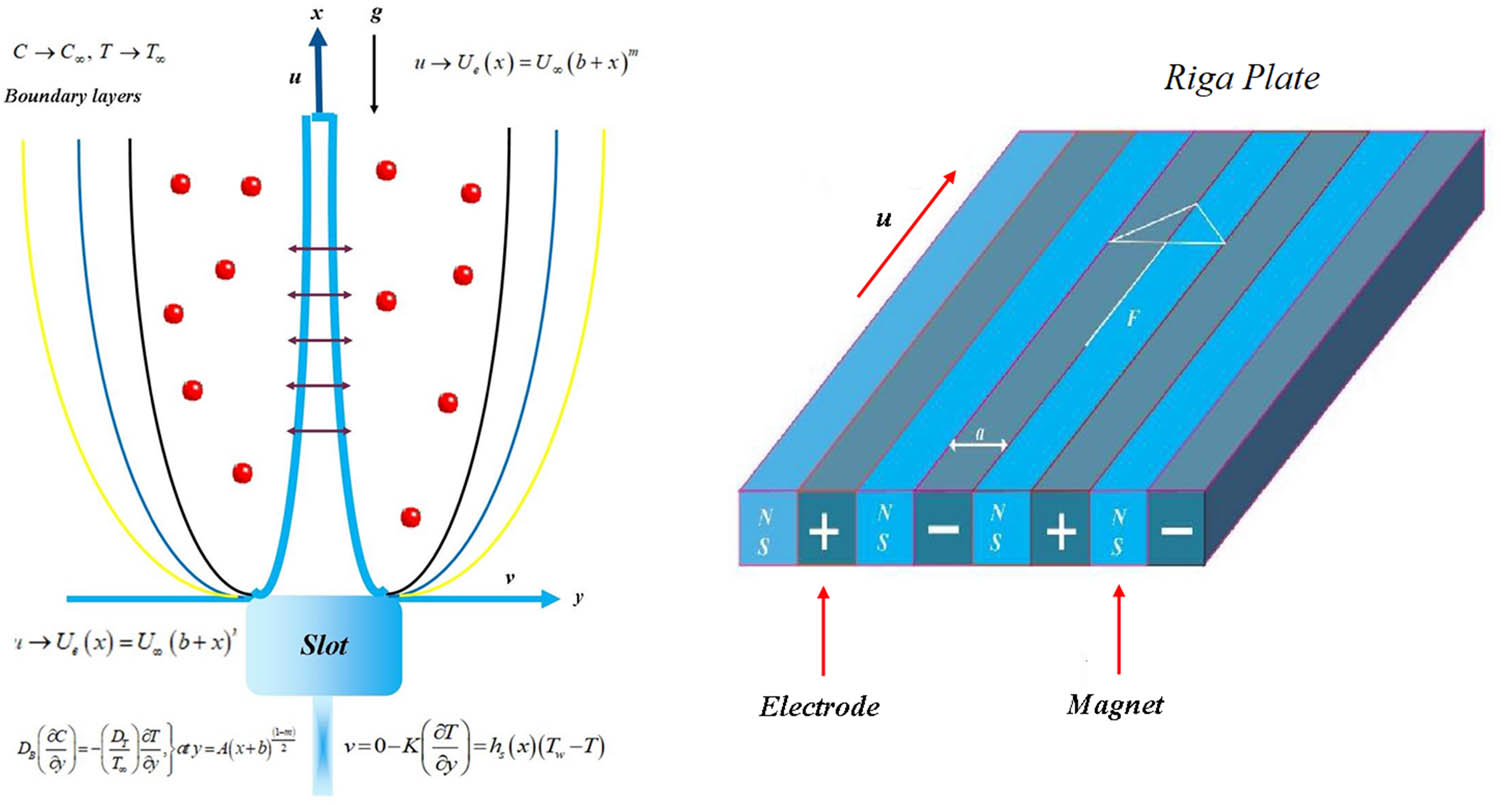
Physical illustration of stretching sheet and Riga plate.
The boundary conditions (BCs) are as follows:
The variable magnetization, changing width of magnets and electrodes, and heat transfer are stated as follows:
The non-dimensional variables are expressed as follows [43]:
The velocity and stream function components are as follows:
The insertion of Eqs. (7) and (8) in Eqs. (1)–(5) are stated as follows:
The BCs for the reduced system of ODEs are follows:
The non-dimensional parameters obtained from Eqs. (9)–(11) are defined in the following table.
| Parameters | Symbols | Expression |
|---|---|---|
| Thermal Grashof number |
|
|
| Mass Grashof number |
|
|
| Thermophoresis factor | Nt |
|
| Schmidt number | Sc |
|
| Heat source/sink parameter |
|
|
| Dimensionless constant |
|
|
| Eckert number | Ec |
|
| Chemical reaction factor |
|
|
| Thermal radiation factor | Rd |
|
| Brownian motion | Nb |
|
| Divider thickness term |
|
|
| Modified Hartman number | Q |
|
| Biot number | Bi |
|
Further, we are introducing
The final BCs are given as follows:
The shear stress
where
The dimensionless form of Eq. (17) is obtained as follows:
3 Numerical solution
The PCM is a numerical method, which can be applied to almost all sorts of complex problems, such as problems of nonlinear mechanics, thermo-fluids, Newtonian and Non-Newtonian fluids models, and inverse problems [44,45,46]. The detailed steps of PCM are defined as follows:
Step 1: In this step, the system of ODEs is reduced to its lowest order.
By placing Eq. (18) in Eqs. (13)–(15), we obtain:
The BCs for the first-order ODEs are as follows:
Step 2: Presenting parameter p in Eqs. (20)–(22):
Step 3: By applying the numerical implicit scheme.
Finally, we obtain the iterative form as follows:
Further, the discretized form is numerically solved through Matlab software.
Table 1 reveals the evaluation of the present work with the existing studies. It has been perceived from Table 1 that the PCM outcomes are reliable and accurate.
Validation of the present results with published studies
| A | m | Vaidya et al. [43] | Fang et al. [47] | Prasad et al. [48] | Present results |
|---|---|---|---|---|---|
| 0.2 | −0.3 | 0.0689 | 0.0723 | 0.0812 | 0.08124245 |
| −0.2 | 0.3011 | 0.5000 | 0.5000 | 0.5000021 | |
| 1.0 | 1.0511 | 1.0614 | 1.0524 | 1.0524468 | |
| 3.0 | 1.1003 | 1.0905 | 1.0905 | 1.0905843 | |
| 4.0 | 1.1166 | 1.1176 | 1.1166 | 1.1166686 | |
| 0.4 | −0.4 | 1.1645 | 1.1647 | 1.1645 | 1.1645123 |
| −0.2 | 1.0000 | 1.0000 | 1.0000 | 1.0000986 | |
| 1.0 | 1.0134 | 1.0214 | 1.0214 | 1.0214543 | |
| 2.0 | 1.0358 | 1.0359 | 1.0358 | 1.0358086 | |
| 4.0 | 1.0486 | 1.0466 | 1.0466 | 1.0466432 |
4 Results and discussion
The energy and mass transfer across the mixed convective nanofluid flows over an extending Riga plate is reported in the current analysis. The fluid flow is studied under the influences of viscous dissipation, EHSS, activation energy, and thermal radiation. The Buongiorno’s concept is utilized for the thermophoretic effect and Brownian motion. The results obtained through PCM are presented through figures.
Figures 2–6 display the behaviour of velocity curve

Velocity profile against divider thickness factor a.
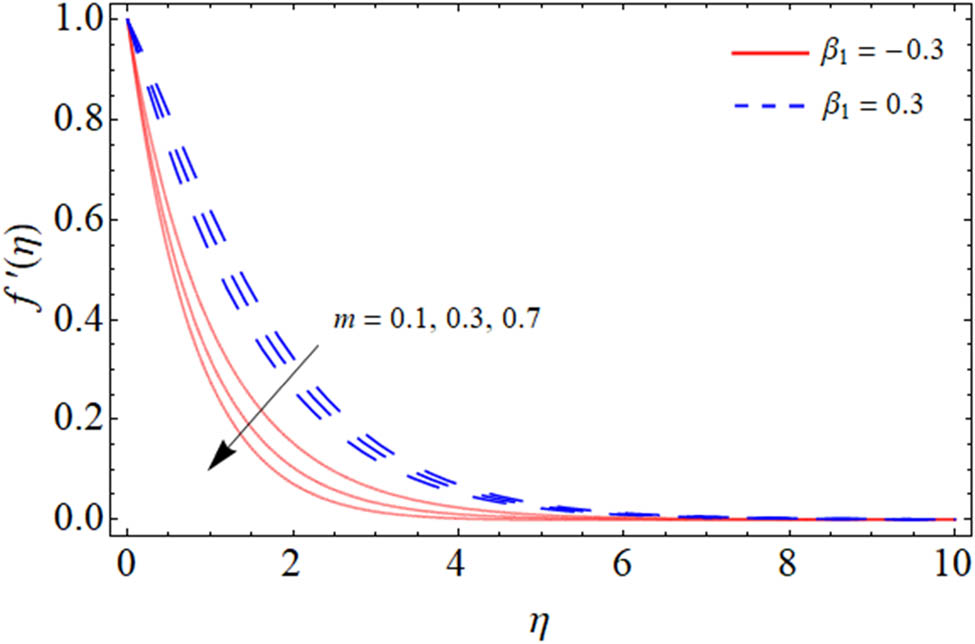
Velocity profile against power index m.

Velocity profile against modified Hartmann number Q.

Velocity profile against

Velocity profile against
Figures 7–11 depict the nature of Rd, Bi, Eckert number Ec, Nt, and Q
e, respectively, on the

Thermal profile against heat radiation Rd.
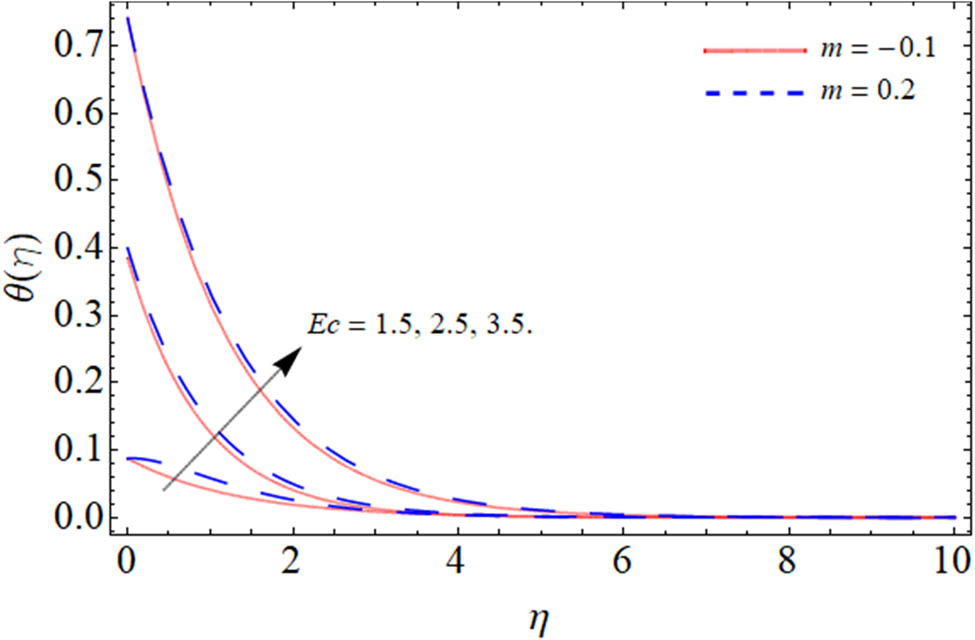
Thermal profile against Eckert number Ec.

Thermal profile against Biot number Bi.

Thermal profile against thermophoresis Nt.
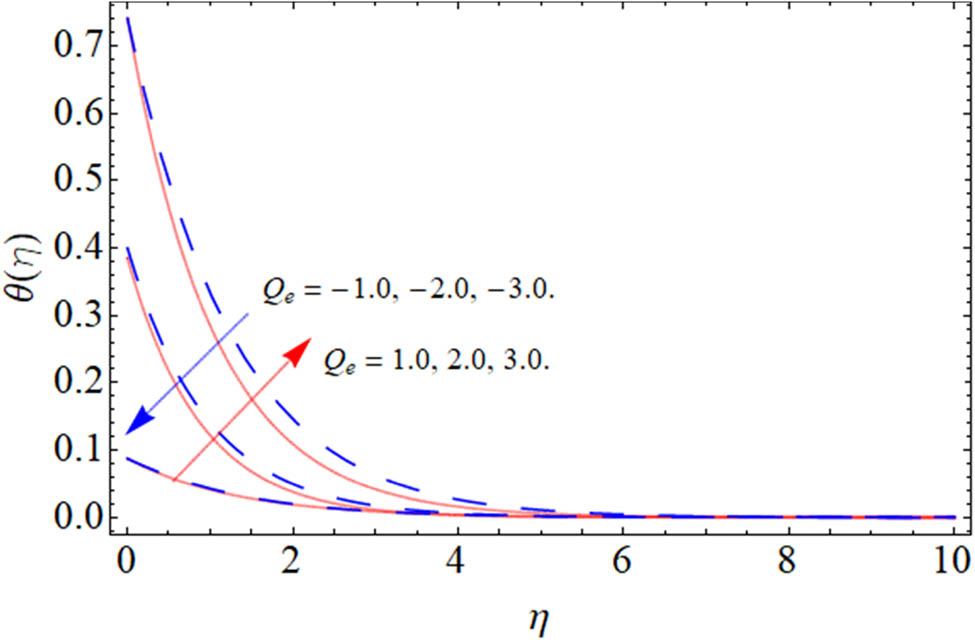
Thermal profile against heat source/sink Q e.
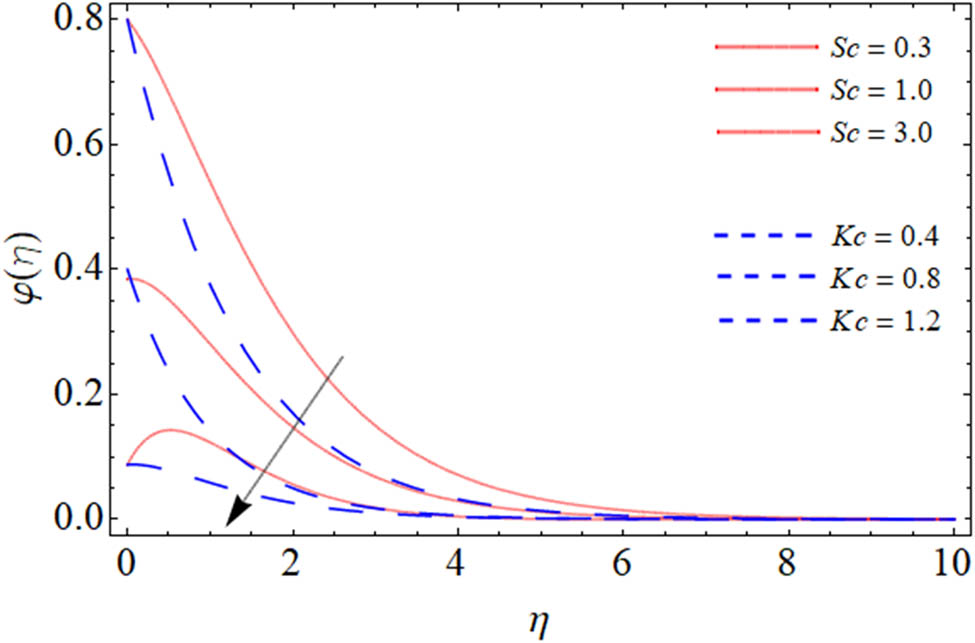
Mass curve against chemical reaction Kc and Schmidth number Sc.
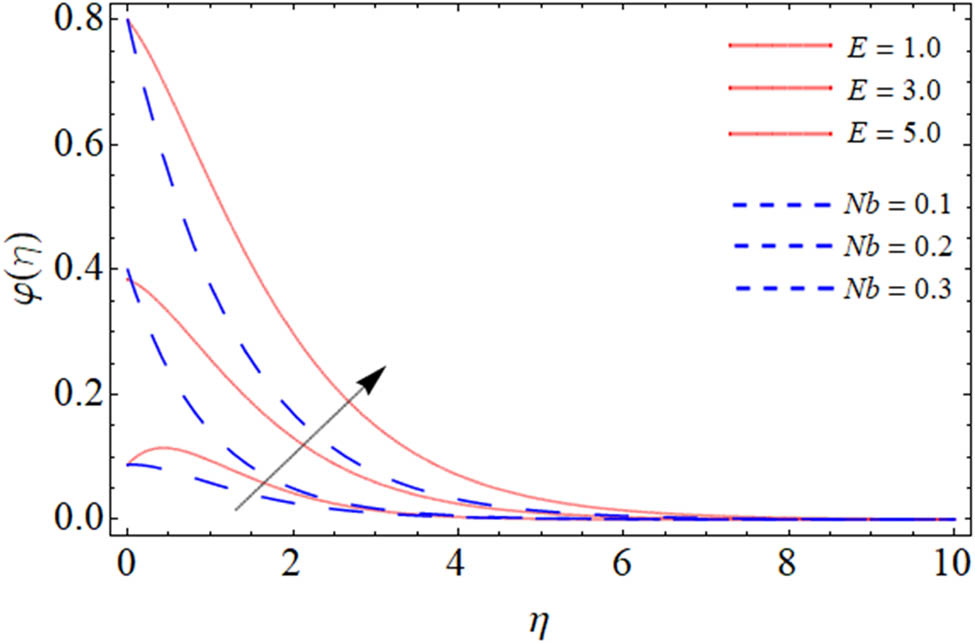
Mass curve against Brownian motion Nb and Activation energy E.
Table 2 discloses the numerical outcomes for shear stress, Nusselt number, and Sherwood number. It can be remarked that the intensifying values of Kr and Pr augment the rate of energy and velocity transmission. The Ec has the similar behaviour as Kr and Pr, though drops the mass conveyance rate.
Numerical outcomes for Sherwood number, skin friction, and Nusselt
| Pr | Kc | Nt | Nb | Ec |
|
|
Q | m |
|
|
|
|---|---|---|---|---|---|---|---|---|---|---|---|
| 1.0 | 0.3 | 0.5 | 0.5 | 0.1 | 0.2 | 0.1 | 0.1 | 0.4 | 0.028864 | 0.425904 | 0.622742 |
| 0,8 | 0.788763 | 0.336135 | 0.562264 | ||||||||
| 1.2 | 1.078124 | 0.324863 | 0.523164 | ||||||||
| 0.1 | 0.4 | 0.311535 | 0.141774 | 0.336641 | |||||||
| 0.4 | 0.164165 | 0.173934 | 0.260790 | ||||||||
| 0.7 | 0.025644 | 0.196313 | 0.285187 | ||||||||
| 0.1 | 1.009531 | 0.316645 | 0.216600 | ||||||||
| 0.1 | 0.749540 | 0.325513 | 0.524064 | ||||||||
| 0.2 | 0.687721 | 0.331676 | 0.431635 | ||||||||
| 0.2 | 0.3 | 0.792933 | 0.322143 | 0.322124 | |||||||
| 0.4 | 1.001235 | 0.323735 | 0.324013 | ||||||||
| 0.6 | 1.010136 | 0.326832 | 0.229975 | ||||||||
| 0.1 | 0.2 | 0.621246 | 0.031698 | 0.037974 | |||||||
| 0.3 | 0.604724 | 0.033932 | 0.032035 | ||||||||
| 0.5 | 0.589085 | 0.031012 | 0.019921 | ||||||||
| 0.5 | 0.1 | 1.001336 | 0.323746 | 0.414074 | |||||||
| 1.0 | 0.795237 | 0.324243 | 0.141287 | ||||||||
| 1.5 | 0.790535 | 0.326112 | 0.056989 | ||||||||
| 0.5 | 0.5 | 0.794236 | 0.324236 | 0.141212 | |||||||
| 1.0 | 1.006163 | 0.321051 | 0.483309 | ||||||||
| 1.5 | 1.006037 | 0.321809 | 1.025121 | ||||||||
| 0.3 | 0.5 | 0.685524 | 0.322121 | 0.522273 | |||||||
| 0.5 | 0.888634 | 0.320843 | 0.520836 | ||||||||
| 0.7 | 0.785025 | 0.320154 | 0.521085 | ||||||||
| 1.0 | 0.3 | 0.783963 | 0.282465 | 0.588897 | |||||||
| 2.0 | 0.788782 | 0.221309 | 0.621282 | ||||||||
| 3.0 | 0.792801 | 0.309810 | 0.546144 |
5 Conclusions
The fluid flow across a Riga plate has several applications in the field of aerodynamic efficiency of aircraft, automobiles, and heat propagation. Therefore, the energy and mass transfer across the mixed convective nanofluid flows over an extending Riga plate are reported in the current analysis. The fluid flow is studied under the influences of viscous dissipation, EHSS, activation energy, and thermal radiation. The modelled are simplified into lowest order by using similarity transformation, which are numerically solved through the PCM. From the graphical analysis, the following findings are deducted:
The fluid velocity boosts with the mounting values of divider thickness parameter a.
The fluid velocity declines with the variation of m, although evolving with the impact of Q.
The positive variation of
The thermal radiation variable enhances fluid temperature by transferring thermal energy via electromagnetic radiation generated by the fluid.
The effect of heat source sink parameter drops the energy field.
The impacts of Kr and Sc lessen the mass profile.
The effect of Nb and activation energy enhances the mass profile.
The fluid temperature also improves with the effect of Biot number, Eckert number, and heat source factor.
The current study can be expanded in the future to include more complexity and variables. Some possible directions for future studies may involve:
Including more realistic BCs.
Scrutinizing different sorts of nano-particulates.
Observing the influence of other external factor.
Reconnoitering different heat source/sink profiles.
Acknowledgments
The authors thank the KKU research unit for the financial and administrative support under grant number 593 for year 44.
-
Funding information: The KKU research unit for the financial and administrative support under grant number 593 for year 44.
-
Author contributions: All authors have accepted responsibility for the entire content of this manuscript and approved its submission.
-
Conflict of interest: The authors state no conflict of interest.
-
Data availability statement: All data generated or analysed during this study are included in this published article.
References
[1] Adnan. Heat transfer inspection in [(ZnO-MWCNTs)/water-EG (50: 50)] hnf with thermal radiation ray and convective condition over a Riga surface. Waves in Random and Complex Media. 2022;1–15.10.1080/17455030.2022.2119300Search in Google Scholar
[2] Algehyne EA, Saeed A, Arif M, Bilal M, Kumam P, Galal AM. Gyrotactic microorganism hybrid nanofluid over a Riga plate subject to activation energy and heat source: Numerical approach. Sci Rep. 2023;13(1):13675.10.1038/s41598-023-27562-ySearch in Google Scholar PubMed PubMed Central
[3] Ali L, Ali B, Asogwa KK, Apsari R. Transient rotating three-dimensional flow of micropolar fluid induced by Riga plate: Finite element approach. Numer Heat Transfer Part A: Appl. 2023;1–14.10.1080/10407782.2023.2212861Search in Google Scholar
[4] Abdul Hakeem AK, Ragupathi P, Saranya S, Ganga B. Three dimensional non-linear radiative nanofluid flow over a Riga plate. J Appl Comput Mech. 2020;6(4):1012–29.Search in Google Scholar
[5] Ishtiaq B, Nadeem S, Abbas N. Theoretical study of two-dimensional unsteady Maxwell fluid flow over a vertical Riga plate under radiation effects. Sci Iran. 2022;29(6):3072–83.Search in Google Scholar
[6] Asogwa KK, Kumar KT, Goud BS, Chohan JS. Significance of nanoparticle shape factor and buoyancy effects on a parabolic motion of EMHD convective nanofluid past a Riga plate with ramped wall temperature. Eur Phys J Plus. 2023;138(6):1–13.10.1140/epjp/s13360-023-04170-3Search in Google Scholar
[7] Adnan, Abbas W, Said NM, Mishra NK, Mahmood Z, Bilal M. Significance of coupled effects of resistive heating and perpendicular magnetic field on heat transfer process of mixed convective flow of ternary nanofluid. J Therm Anal Calorim. 2024;149(2):879–92.10.1007/s10973-023-12723-ySearch in Google Scholar
[8] Bani-Fwaz MZ, Adnan A, Mahmood Z, Bilal M, EI-Zahhar AA, Khan I, et al. Computational Investigation of Thermal Process in Radiated Nanofluid Modulation Influenced by Nanoparticles (Al2O3) and Molecular (H2O) Diameters. J Comput Des Eng. 2024;qwae011.10.1093/jcde/qwae011Search in Google Scholar
[9] Waqas M, Almutiri MR, Yagoob B, Ahmad H, Bilal M. Numerical analysis of MHD tangent hyperbolic nanofluid flow over a stretching surface subject to heat source/sink. Pramana. 2024;98(1):27.10.1007/s12043-023-02702-1Search in Google Scholar
[10] Hamad NH, Bilal M, Ali A, Eldin SM, Sharaf M, Rahman MU. Energy transfer through third‐grade fluid flow across an inclined stretching sheet subject to thermal radiation and Lorentz force. Sci Rep. 2023;13(1):19643.10.1038/s41598-023-46428-xSearch in Google Scholar PubMed PubMed Central
[11] Asogwa KK, Goud BS, Shah NA, Yook SJ. Rheology of electromagnetohydrodynamic tangent hyperbolic nanofluid over a stretching riga surface featuring dufour effect and activation energy. Sci Rep. 2022;12(1):14602.10.1038/s41598-022-18998-9Search in Google Scholar PubMed PubMed Central
[12] Asogwa KK, Khan I. Radiating and electromagnetic nanofluids flow over an exponentially accelerated Riga plate with heat sink. Waves in Random and Complex Media. 2023;1–22.10.1080/17455030.2023.2265493Search in Google Scholar
[13] Faisal M, Asogwa KK, Mabood F, Badruddin IA. Darcy–Forchheimer dynamics of hybrid nanofluid due to a porous Riga surface capitalizing Cattaneo–Christov theory. Numer Heat Transfer Part A Appl. 2023;1–17.10.1080/10407782.2023.2238891Search in Google Scholar
[14] Asghar A, Vrinceanu N, Ying TY, Lund LA, Shah Z, Tirth V. Dual solutions of convective rotating flow of three-dimensional hybrid nanofluid across the linear stretching/shrinking sheet. Alex Eng J. 2023;75:297–312.10.1016/j.aej.2023.05.089Search in Google Scholar
[15] Wakif A, Chamkha A, Thumma T, Animasaun IL, Sehaqui R. Thermal radiation and surface roughness effects on the thermo-magneto-hydrodynamic stability of alumina–copper oxide hybrid nanofluids utilizing the generalized Buongiorno’s nanofluid model. J Therm Anal Calorim. 2021;143:1201–20.10.1007/s10973-020-09488-zSearch in Google Scholar
[16] Jamshed W, Goodarzi M, Prakash M, Nisar KS, Zakarya M, Abdel-Aty AH. Evaluating the unsteady Casson nanofluid over a stretching sheet with solar thermal radiation: An optimal case study. Case Stud Therm Eng. 2021;26:101160.10.1016/j.csite.2021.101160Search in Google Scholar
[17] Abbas A, Ijaz I, Ashraf M, Ahmad H. Combined effects of variable density and thermal radiation on MHD Sakiadis flow. Case Stud Therm Eng. 2021;28:101640.10.1016/j.csite.2021.101640Search in Google Scholar
[18] Yu D, Wang R. An optimal investigation of convective fluid flow suspended by carbon nanotubes and thermal radiation impact. Mathematics. 2022;10(9):1542.10.3390/math10091542Search in Google Scholar
[19] Sneha KN, Mahabaleshwar US, Sharifpur M, Ahmadi MH, Al-Bahrani M. Entropy analysis in MHD CNTS flow due to a stretching surface with thermal radiation and heat source/sink. Mathematics. 2022;10(18):3404.10.3390/math10183404Search in Google Scholar
[20] Salawu SO, Obalalu AM, Shamshuddin MD. Nonlinear solar thermal radiation efficiency and energy optimization for magnetized hybrid Prandtl–Eyring nanoliquid in aircraft. Arab J Sci Eng. 2023;48(3):3061–72.10.1007/s13369-022-07080-1Search in Google Scholar
[21] Faisal M, Mabood F, Asogwa KK, Badruddin IA. On convective heat and mass transport of radiative double diffusive Williamson hybrid nanofluid by a Riga surface. Int J Mod Phys C. 2023;34(8):2350111.10.1142/S0129183123501115Search in Google Scholar
[22] Asogwa KK, Prasad KR, Kumar R, Murtugudde G, Gowda RP. Transient electromagnetohydrodynamic Nanofluid flow traveling through a moving Riga plate subject to radiation and heat absorption. Int J Mod Phys B. 2023;37(17):22350168.10.1142/S0217979223501680Search in Google Scholar
[23] Asghar A, Ying TY, Zaimi WMKAW. Two-dimensional mixed convection and radiative Al2O3-Cu/H2O hybrid nanofluid flow over a vertical exponentially shrinking sheet with partial slip conditions. CFD Lett. 2022;14(3):22–38.10.37934/cfdl.14.3.2238Search in Google Scholar
[24] Asghar A, Lund LA, Shah Z, Vrinceanu N, Deebani W, Shutaywi M. Effect of thermal radiation on three-dimensional magnetized rotating flow of a hybrid nanofluid. Nanomaterials. 2022;12(9):1566.10.3390/nano12091566Search in Google Scholar PubMed PubMed Central
[25] Dolui S, Bhaumik B, De S. Combined effect of induced magnetic field and thermal radiation on ternary hybrid nanofluid flow through an inclined catheterized artery with multiple stenosis. Chem Phys Lett. 2023;811:140209.10.1016/j.cplett.2022.140209Search in Google Scholar
[26] Asghar A, Ying TY, Zaimi K. Two-dimensional magnetized mixed convection hybrid nanofluid over a vertical exponentially shrinking sheet by thermal radiation, joule heating, velocity and thermal slip conditions. J Adv Res Fluid Mech Therm Sci. 2022;95(2):159–79.10.37934/arfmts.95.2.159179Search in Google Scholar
[27] Haq I, Bilal M, Ahammad NA, Ghoneim ME, Ali A, Weera W. Mixed convection nanofluid flow with heat source and chemical reaction over an inclined irregular surface. ACS Omega. 2022;7(34):30477–85.10.1021/acsomega.2c03919Search in Google Scholar PubMed PubMed Central
[28] Ali U, Gul T, Khan H, Bilal M, Usman M, Shuaib M, et al. Motile microorganisms hybrid nanoliquid flow with the influence of activation energy and heat source over a rotating disc. Nanotechnology. 2023;34(42):425404.10.1088/1361-6528/ace912Search in Google Scholar PubMed
[29] Raizah Z, Alrabaiah H, Bilal M, Junsawang P, Galal AM. Numerical study of non-Darcy hybrid nanofluid flow with the effect of heat source and hall current over a slender extending sheet. Sci Rep. 2022;12(1):16280.10.1038/s41598-022-20583-zSearch in Google Scholar PubMed PubMed Central
[30] Elangovan K, Subbarao K, Gangadhar K. Entropy minimization for variable viscous couple stress fluid flow over a channel with thermal radiation and heat source/sink. J Therm Anal Calorim. 2022;147(23):13499–507.10.1007/s10973-022-11510-5Search in Google Scholar
[31] Nabwey HA, Rashad AM, Mahdy AEN, Shaaban SM. Thermal conductivity and thermophoretic impacts of micropolar fluid flow by a horizontal absorbent isothermal porous wall with heat source/sink. Mathematics. 2022;10(9):1514.10.3390/math10091514Search in Google Scholar
[32] Maranna T, Mahabaleshwar US, Perez LM, Manca O. Flow of viscoelastic ternary nanofluid over a shrinking porous medium with heat Source/Sink and radiation. Therm Sci Eng Prog. 2023;40:101791.10.1016/j.tsep.2023.101791Search in Google Scholar
[33] Hussain SM, Khan U, Zaib A, Ishak A, Sarris IE. Numerical computation of mixed convective entropy optimized in Darcy-Forchheimer flow of cross nanofluids through a vertical flat plate with irregular heat source/sink. Tribol Int. 2023;187:108757.10.1016/j.triboint.2023.108757Search in Google Scholar
[34] Adnan, AlBaidani MM, Mishra NK, Ahmad Z, Eldin SM, Haq EU. Numerical study of thermal enhancement in ZnO-SAE50 nanolubricant over a spherical magnetized surface influenced by Newtonian heating and thermal radiation. Case Stud Therm Eng. 2023;45:102917.10.1016/j.csite.2023.102917Search in Google Scholar
[35] Rasool G, Xinhua W, Lund LA, Yashkun U, Wakif A, Asghar A. Dual solutions of unsteady flow of copper-alumina/water based hybrid nanofluid with acute magnetic force and slip condition. Heliyon. 2023;9(12).10.1016/j.heliyon.2023.e22737Search in Google Scholar PubMed PubMed Central
[36] Teh YY, Ashgar A. Three dimensional MHD hybrid nanofluid Flow with rotating stretching/shrinking sheet and Joule heating. CFD Lett. 2021;13(8):1–19.10.37934/cfdl.13.8.119Search in Google Scholar
[37] Yasir M, Khan M. Heat source/sink effect in radiative flow of hybrid nanofluid subject to noninertial frame. Numer Heat Transfer Part A: Appl. 2023;1–14.10.1080/10407782.2023.2238887Search in Google Scholar
[38] Yaseen M, Rawat SK, Khan U, Sarris IE, Khan H, Negi AS, et al. Computational analysis of heat and mass transfer flow of wall jet hybrid nanofluid with irregular heat source/sink effects and waste discharge concentration. J Magn Magn Mater. 2023;588:171434.10.1016/j.jmmm.2023.171434Search in Google Scholar
[39] Lund LA, Asghar A, Rasool G, Yashkun U. Magnetized casson SA-hybrid nanofluid flow over a permeable moving surface with thermal radiation and Joule heating effect. Case Stud Therm Eng. 2023;50:103510.10.1016/j.csite.2023.103510Search in Google Scholar
[40] Nayak MK, Hakeem AA, Makinde OD. Influence of Catteneo-Christov heat flux model on mixed convection flow of third grade nanofluid over an inclined stretched Riga plate. Defect Diffus. 2018;121–34.10.4028/www.scientific.net/DDF.387.121Search in Google Scholar
[41] Nayak M, Shaw S, Makinde O, Chamkha AJ. Effects of homogenous–heterogeneous reactions on radiative NaCl-CNP nanofluid flow past a convectively heated vertical Riga plate. J Nanofluids. 2018;7:657–67.10.1166/jon.2018.1501Search in Google Scholar
[42] Nayak M, Shaw S, Makinde O, Chamkha AJ. Investigation of partial slip and viscous dissipation effects on the radiative tangent hyperbolic nanofluid flow past a vertical permeable Riga plate with internal heating: Bungiorno model. J Nanofluids. 2019;8:51–62.10.1166/jon.2019.1576Search in Google Scholar
[43] Vaidya H, Prasad K, Tlili I, Makinde O, Rajashekhar C, Khan SU, et al. Mixed convective nanofluid flow over a non linearly stretched Riga plate. Case Stud Therm Eng. 2021;24:100828.10.1016/j.csite.2020.100828Search in Google Scholar
[44] Shuaib M, Shah RA, Durrani I, Bilal M. Electrokinetic viscous rotating disk flow of Poisson-Nernst-Planck equation for ion transport. J Mol Liq. 2020;313:113412.10.1016/j.molliq.2020.113412Search in Google Scholar
[45] Alrabaiah H, Bilal M, Khan MA, Muhammad T, Legas EY. Parametric estimation of gyrotactic microorganism hybrid nanofluid flow between the conical gap of spinning disk-cone apparatus. Sci Rep. 2022;12:1–14.10.1038/s41598-021-03077-2Search in Google Scholar PubMed PubMed Central
[46] Assiri TA, Aziz Elsebaee FA, Alqahtani AM, Bilal M, Ali A, Eldin SM. Numerical simulation of energy transfer in radiative hybrid nanofluids flow influenced by second-order chemical reaction and magnetic field. AIP Adv. 2023;13.10.1063/5.0141532Search in Google Scholar
[47] Fang T, Zhang J, Zhong Y. Boundary layer flow over a stretching sheet with variable thickness. Appl Math Comput. 2012;218:7241–52.10.1016/j.amc.2011.12.094Search in Google Scholar
[48] Prasad K, Vaidya H, Vajravelu K. MHD mixed convection heat transfer over a non-linear slender elastic sheet with variable fluid properties. AMNS. 2017;2:351–66.10.21042/AMNS.2017.2.00000Search in Google Scholar
© 2024 the author(s), published by De Gruyter
This work is licensed under the Creative Commons Attribution 4.0 International License.
Articles in the same Issue
- Regular Articles
- Numerical study of flow and heat transfer in the channel of panel-type radiator with semi-detached inclined trapezoidal wing vortex generators
- Homogeneous–heterogeneous reactions in the colloidal investigation of Casson fluid
- High-speed mid-infrared Mach–Zehnder electro-optical modulators in lithium niobate thin film on sapphire
- Numerical analysis of dengue transmission model using Caputo–Fabrizio fractional derivative
- Mononuclear nanofluids undergoing convective heating across a stretching sheet and undergoing MHD flow in three dimensions: Potential industrial applications
- Heat transfer characteristics of cobalt ferrite nanoparticles scattered in sodium alginate-based non-Newtonian nanofluid over a stretching/shrinking horizontal plane surface
- The electrically conducting water-based nanofluid flow containing titanium and aluminum alloys over a rotating disk surface with nonlinear thermal radiation: A numerical analysis
- Growth, characterization, and anti-bacterial activity of l-methionine supplemented with sulphamic acid single crystals
- A numerical analysis of the blood-based Casson hybrid nanofluid flow past a convectively heated surface embedded in a porous medium
- Optoelectronic–thermomagnetic effect of a microelongated non-local rotating semiconductor heated by pulsed laser with varying thermal conductivity
- Thermal proficiency of magnetized and radiative cross-ternary hybrid nanofluid flow induced by a vertical cylinder
- Enhanced heat transfer and fluid motion in 3D nanofluid with anisotropic slip and magnetic field
- Numerical analysis of thermophoretic particle deposition on 3D Casson nanofluid: Artificial neural networks-based Levenberg–Marquardt algorithm
- Analyzing fuzzy fractional Degasperis–Procesi and Camassa–Holm equations with the Atangana–Baleanu operator
- Bayesian estimation of equipment reliability with normal-type life distribution based on multiple batch tests
- Chaotic control problem of BEC system based on Hartree–Fock mean field theory
- Optimized framework numerical solution for swirling hybrid nanofluid flow with silver/gold nanoparticles on a stretching cylinder with heat source/sink and reactive agents
- Stability analysis and numerical results for some schemes discretising 2D nonconstant coefficient advection–diffusion equations
- Convective flow of a magnetohydrodynamic second-grade fluid past a stretching surface with Cattaneo–Christov heat and mass flux model
- Analysis of the heat transfer enhancement in water-based micropolar hybrid nanofluid flow over a vertical flat surface
- Microscopic seepage simulation of gas and water in shale pores and slits based on VOF
- Model of conversion of flow from confined to unconfined aquifers with stochastic approach
- Study of fractional variable-order lymphatic filariasis infection model
- Soliton, quasi-soliton, and their interaction solutions of a nonlinear (2 + 1)-dimensional ZK–mZK–BBM equation for gravity waves
- Application of conserved quantities using the formal Lagrangian of a nonlinear integro partial differential equation through optimal system of one-dimensional subalgebras in physics and engineering
- Nonlinear fractional-order differential equations: New closed-form traveling-wave solutions
- Sixth-kind Chebyshev polynomials technique to numerically treat the dissipative viscoelastic fluid flow in the rheology of Cattaneo–Christov model
- Some transforms, Riemann–Liouville fractional operators, and applications of newly extended M–L (p, s, k) function
- Magnetohydrodynamic water-based hybrid nanofluid flow comprising diamond and copper nanoparticles on a stretching sheet with slips constraints
- Super-resolution reconstruction method of the optical synthetic aperture image using generative adversarial network
- A two-stage framework for predicting the remaining useful life of bearings
- Influence of variable fluid properties on mixed convective Darcy–Forchheimer flow relation over a surface with Soret and Dufour spectacle
- Inclined surface mixed convection flow of viscous fluid with porous medium and Soret effects
- Exact solutions to vorticity of the fractional nonuniform Poiseuille flows
- In silico modified UV spectrophotometric approaches to resolve overlapped spectra for quality control of rosuvastatin and teneligliptin formulation
- Numerical simulations for fractional Hirota–Satsuma coupled Korteweg–de Vries systems
- Substituent effect on the electronic and optical properties of newly designed pyrrole derivatives using density functional theory
- A comparative analysis of shielding effectiveness in glass and concrete containers
- Numerical analysis of the MHD Williamson nanofluid flow over a nonlinear stretching sheet through a Darcy porous medium: Modeling and simulation
- Analytical and numerical investigation for viscoelastic fluid with heat transfer analysis during rollover-web coating phenomena
- Influence of variable viscosity on existing sheet thickness in the calendering of non-isothermal viscoelastic materials
- Analysis of nonlinear fractional-order Fisher equation using two reliable techniques
- Comparison of plan quality and robustness using VMAT and IMRT for breast cancer
- Radiative nanofluid flow over a slender stretching Riga plate under the impact of exponential heat source/sink
- Numerical investigation of acoustic streaming vortices in cylindrical tube arrays
- Numerical study of blood-based MHD tangent hyperbolic hybrid nanofluid flow over a permeable stretching sheet with variable thermal conductivity and cross-diffusion
- Fractional view analytical analysis of generalized regularized long wave equation
- Dynamic simulation of non-Newtonian boundary layer flow: An enhanced exponential time integrator approach with spatially and temporally variable heat sources
- Inclined magnetized infinite shear rate viscosity of non-Newtonian tetra hybrid nanofluid in stenosed artery with non-uniform heat sink/source
- Estimation of monotone α-quantile of past lifetime function with application
- Numerical simulation for the slip impacts on the radiative nanofluid flow over a stretched surface with nonuniform heat generation and viscous dissipation
- Study of fractional telegraph equation via Shehu homotopy perturbation method
- An investigation into the impact of thermal radiation and chemical reactions on the flow through porous media of a Casson hybrid nanofluid including unstable mixed convection with stretched sheet in the presence of thermophoresis and Brownian motion
- Establishing breather and N-soliton solutions for conformable Klein–Gordon equation
- An electro-optic half subtractor from a silicon-based hybrid surface plasmon polariton waveguide
- CFD analysis of particle shape and Reynolds number on heat transfer characteristics of nanofluid in heated tube
- Abundant exact traveling wave solutions and modulation instability analysis to the generalized Hirota–Satsuma–Ito equation
- A short report on a probability-based interpretation of quantum mechanics
- Study on cavitation and pulsation characteristics of a novel rotor-radial groove hydrodynamic cavitation reactor
- Optimizing heat transport in a permeable cavity with an isothermal solid block: Influence of nanoparticles volume fraction and wall velocity ratio
- Linear instability of the vertical throughflow in a porous layer saturated by a power-law fluid with variable gravity effect
- Thermal analysis of generalized Cattaneo–Christov theories in Burgers nanofluid in the presence of thermo-diffusion effects and variable thermal conductivity
- A new benchmark for camouflaged object detection: RGB-D camouflaged object detection dataset
- Effect of electron temperature and concentration on production of hydroxyl radical and nitric oxide in atmospheric pressure low-temperature helium plasma jet: Swarm analysis and global model investigation
- Double diffusion convection of Maxwell–Cattaneo fluids in a vertical slot
- Thermal analysis of extended surfaces using deep neural networks
- Steady-state thermodynamic process in multilayered heterogeneous cylinder
- Multiresponse optimisation and process capability analysis of chemical vapour jet machining for the acrylonitrile butadiene styrene polymer: Unveiling the morphology
- Modeling monkeypox virus transmission: Stability analysis and comparison of analytical techniques
- Fourier spectral method for the fractional-in-space coupled Whitham–Broer–Kaup equations on unbounded domain
- The chaotic behavior and traveling wave solutions of the conformable extended Korteweg–de-Vries model
- Research on optimization of combustor liner structure based on arc-shaped slot hole
- Construction of M-shaped solitons for a modified regularized long-wave equation via Hirota's bilinear method
- Effectiveness of microwave ablation using two simultaneous antennas for liver malignancy treatment
- Discussion on optical solitons, sensitivity and qualitative analysis to a fractional model of ion sound and Langmuir waves with Atangana Baleanu derivatives
- Reliability of two-dimensional steady magnetized Jeffery fluid over shrinking sheet with chemical effect
- Generalized model of thermoelasticity associated with fractional time-derivative operators and its applications to non-simple elastic materials
- Migration of two rigid spheres translating within an infinite couple stress fluid under the impact of magnetic field
- A comparative investigation of neutron and gamma radiation interaction properties of zircaloy-2 and zircaloy-4 with consideration of mechanical properties
- New optical stochastic solutions for the Schrödinger equation with multiplicative Wiener process/random variable coefficients using two different methods
- Physical aspects of quantile residual lifetime sequence
- Synthesis, structure, I–V characteristics, and optical properties of chromium oxide thin films for optoelectronic applications
- Smart mathematically filtered UV spectroscopic methods for quality assurance of rosuvastatin and valsartan from formulation
- A novel investigation into time-fractional multi-dimensional Navier–Stokes equations within Aboodh transform
- Homotopic dynamic solution of hydrodynamic nonlinear natural convection containing superhydrophobicity and isothermally heated parallel plate with hybrid nanoparticles
- A novel tetra hybrid bio-nanofluid model with stenosed artery
- Propagation of traveling wave solution of the strain wave equation in microcrystalline materials
- Innovative analysis to the time-fractional q-deformed tanh-Gordon equation via modified double Laplace transform method
- A new investigation of the extended Sakovich equation for abundant soliton solution in industrial engineering via two efficient techniques
- New soliton solutions of the conformable time fractional Drinfel'd–Sokolov–Wilson equation based on the complete discriminant system method
- Irradiation of hydrophilic acrylic intraocular lenses by a 365 nm UV lamp
- Inflation and the principle of equivalence
- The use of a supercontinuum light source for the characterization of passive fiber optic components
- Optical solitons to the fractional Kundu–Mukherjee–Naskar equation with time-dependent coefficients
- A promising photocathode for green hydrogen generation from sanitation water without external sacrificing agent: silver-silver oxide/poly(1H-pyrrole) dendritic nanocomposite seeded on poly-1H pyrrole film
- Photon balance in the fiber laser model
- Propagation of optical spatial solitons in nematic liquid crystals with quadruple power law of nonlinearity appears in fluid mechanics
- Theoretical investigation and sensitivity analysis of non-Newtonian fluid during roll coating process by response surface methodology
- Utilizing slip conditions on transport phenomena of heat energy with dust and tiny nanoparticles over a wedge
- Bismuthyl chloride/poly(m-toluidine) nanocomposite seeded on poly-1H pyrrole: Photocathode for green hydrogen generation
- Infrared thermography based fault diagnosis of diesel engines using convolutional neural network and image enhancement
- On some solitary wave solutions of the Estevez--Mansfield--Clarkson equation with conformable fractional derivatives in time
- Impact of permeability and fluid parameters in couple stress media on rotating eccentric spheres
- Review Article
- Transformer-based intelligent fault diagnosis methods of mechanical equipment: A survey
- Special Issue on Predicting pattern alterations in nature - Part II
- A comparative study of Bagley–Torvik equation under nonsingular kernel derivatives using Weeks method
- On the existence and numerical simulation of Cholera epidemic model
- Numerical solutions of generalized Atangana–Baleanu time-fractional FitzHugh–Nagumo equation using cubic B-spline functions
- Dynamic properties of the multimalware attacks in wireless sensor networks: Fractional derivative analysis of wireless sensor networks
- Prediction of COVID-19 spread with models in different patterns: A case study of Russia
- Study of chronic myeloid leukemia with T-cell under fractal-fractional order model
- Accumulation process in the environment for a generalized mass transport system
- Analysis of a generalized proportional fractional stochastic differential equation incorporating Carathéodory's approximation and applications
- Special Issue on Nanomaterial utilization and structural optimization - Part II
- Numerical study on flow and heat transfer performance of a spiral-wound heat exchanger for natural gas
- Study of ultrasonic influence on heat transfer and resistance performance of round tube with twisted belt
- Numerical study on bionic airfoil fins used in printed circuit plate heat exchanger
- Improving heat transfer efficiency via optimization and sensitivity assessment in hybrid nanofluid flow with variable magnetism using the Yamada–Ota model
- Special Issue on Nanofluids: Synthesis, Characterization, and Applications
- Exact solutions of a class of generalized nanofluidic models
- Stability enhancement of Al2O3, ZnO, and TiO2 binary nanofluids for heat transfer applications
- Thermal transport energy performance on tangent hyperbolic hybrid nanofluids and their implementation in concentrated solar aircraft wings
- Studying nonlinear vibration analysis of nanoelectro-mechanical resonators via analytical computational method
- Numerical analysis of non-linear radiative Casson fluids containing CNTs having length and radius over permeable moving plate
- Two-phase numerical simulation of thermal and solutal transport exploration of a non-Newtonian nanomaterial flow past a stretching surface with chemical reaction
- Natural convection and flow patterns of Cu–water nanofluids in hexagonal cavity: A novel thermal case study
- Solitonic solutions and study of nonlinear wave dynamics in a Murnaghan hyperelastic circular pipe
- Comparative study of couple stress fluid flow using OHAM and NIM
- Utilization of OHAM to investigate entropy generation with a temperature-dependent thermal conductivity model in hybrid nanofluid using the radiation phenomenon
- Slip effects on magnetized radiatively hybridized ferrofluid flow with acute magnetic force over shrinking/stretching surface
- Significance of 3D rectangular closed domain filled with charged particles and nanoparticles engaging finite element methodology
- Robustness and dynamical features of fractional difference spacecraft model with Mittag–Leffler stability
- Characterizing magnetohydrodynamic effects on developed nanofluid flow in an obstructed vertical duct under constant pressure gradient
- Study on dynamic and static tensile and puncture-resistant mechanical properties of impregnated STF multi-dimensional structure Kevlar fiber reinforced composites
- Thermosolutal Marangoni convective flow of MHD tangent hyperbolic hybrid nanofluids with elastic deformation and heat source
- Investigation of convective heat transport in a Carreau hybrid nanofluid between two stretchable rotatory disks
- Single-channel cooling system design by using perforated porous insert and modeling with POD for double conductive panel
- Special Issue on Fundamental Physics from Atoms to Cosmos - Part I
- Pulsed excitation of a quantum oscillator: A model accounting for damping
- Review of recent analytical advances in the spectroscopy of hydrogenic lines in plasmas
- Heavy mesons mass spectroscopy under a spin-dependent Cornell potential within the framework of the spinless Salpeter equation
- Coherent manipulation of bright and dark solitons of reflection and transmission pulses through sodium atomic medium
- Effect of the gravitational field strength on the rate of chemical reactions
- The kinetic relativity theory – hiding in plain sight
- Special Issue on Advanced Energy Materials - Part III
- Eco-friendly graphitic carbon nitride–poly(1H pyrrole) nanocomposite: A photocathode for green hydrogen production, paving the way for commercial applications
Articles in the same Issue
- Regular Articles
- Numerical study of flow and heat transfer in the channel of panel-type radiator with semi-detached inclined trapezoidal wing vortex generators
- Homogeneous–heterogeneous reactions in the colloidal investigation of Casson fluid
- High-speed mid-infrared Mach–Zehnder electro-optical modulators in lithium niobate thin film on sapphire
- Numerical analysis of dengue transmission model using Caputo–Fabrizio fractional derivative
- Mononuclear nanofluids undergoing convective heating across a stretching sheet and undergoing MHD flow in three dimensions: Potential industrial applications
- Heat transfer characteristics of cobalt ferrite nanoparticles scattered in sodium alginate-based non-Newtonian nanofluid over a stretching/shrinking horizontal plane surface
- The electrically conducting water-based nanofluid flow containing titanium and aluminum alloys over a rotating disk surface with nonlinear thermal radiation: A numerical analysis
- Growth, characterization, and anti-bacterial activity of l-methionine supplemented with sulphamic acid single crystals
- A numerical analysis of the blood-based Casson hybrid nanofluid flow past a convectively heated surface embedded in a porous medium
- Optoelectronic–thermomagnetic effect of a microelongated non-local rotating semiconductor heated by pulsed laser with varying thermal conductivity
- Thermal proficiency of magnetized and radiative cross-ternary hybrid nanofluid flow induced by a vertical cylinder
- Enhanced heat transfer and fluid motion in 3D nanofluid with anisotropic slip and magnetic field
- Numerical analysis of thermophoretic particle deposition on 3D Casson nanofluid: Artificial neural networks-based Levenberg–Marquardt algorithm
- Analyzing fuzzy fractional Degasperis–Procesi and Camassa–Holm equations with the Atangana–Baleanu operator
- Bayesian estimation of equipment reliability with normal-type life distribution based on multiple batch tests
- Chaotic control problem of BEC system based on Hartree–Fock mean field theory
- Optimized framework numerical solution for swirling hybrid nanofluid flow with silver/gold nanoparticles on a stretching cylinder with heat source/sink and reactive agents
- Stability analysis and numerical results for some schemes discretising 2D nonconstant coefficient advection–diffusion equations
- Convective flow of a magnetohydrodynamic second-grade fluid past a stretching surface with Cattaneo–Christov heat and mass flux model
- Analysis of the heat transfer enhancement in water-based micropolar hybrid nanofluid flow over a vertical flat surface
- Microscopic seepage simulation of gas and water in shale pores and slits based on VOF
- Model of conversion of flow from confined to unconfined aquifers with stochastic approach
- Study of fractional variable-order lymphatic filariasis infection model
- Soliton, quasi-soliton, and their interaction solutions of a nonlinear (2 + 1)-dimensional ZK–mZK–BBM equation for gravity waves
- Application of conserved quantities using the formal Lagrangian of a nonlinear integro partial differential equation through optimal system of one-dimensional subalgebras in physics and engineering
- Nonlinear fractional-order differential equations: New closed-form traveling-wave solutions
- Sixth-kind Chebyshev polynomials technique to numerically treat the dissipative viscoelastic fluid flow in the rheology of Cattaneo–Christov model
- Some transforms, Riemann–Liouville fractional operators, and applications of newly extended M–L (p, s, k) function
- Magnetohydrodynamic water-based hybrid nanofluid flow comprising diamond and copper nanoparticles on a stretching sheet with slips constraints
- Super-resolution reconstruction method of the optical synthetic aperture image using generative adversarial network
- A two-stage framework for predicting the remaining useful life of bearings
- Influence of variable fluid properties on mixed convective Darcy–Forchheimer flow relation over a surface with Soret and Dufour spectacle
- Inclined surface mixed convection flow of viscous fluid with porous medium and Soret effects
- Exact solutions to vorticity of the fractional nonuniform Poiseuille flows
- In silico modified UV spectrophotometric approaches to resolve overlapped spectra for quality control of rosuvastatin and teneligliptin formulation
- Numerical simulations for fractional Hirota–Satsuma coupled Korteweg–de Vries systems
- Substituent effect on the electronic and optical properties of newly designed pyrrole derivatives using density functional theory
- A comparative analysis of shielding effectiveness in glass and concrete containers
- Numerical analysis of the MHD Williamson nanofluid flow over a nonlinear stretching sheet through a Darcy porous medium: Modeling and simulation
- Analytical and numerical investigation for viscoelastic fluid with heat transfer analysis during rollover-web coating phenomena
- Influence of variable viscosity on existing sheet thickness in the calendering of non-isothermal viscoelastic materials
- Analysis of nonlinear fractional-order Fisher equation using two reliable techniques
- Comparison of plan quality and robustness using VMAT and IMRT for breast cancer
- Radiative nanofluid flow over a slender stretching Riga plate under the impact of exponential heat source/sink
- Numerical investigation of acoustic streaming vortices in cylindrical tube arrays
- Numerical study of blood-based MHD tangent hyperbolic hybrid nanofluid flow over a permeable stretching sheet with variable thermal conductivity and cross-diffusion
- Fractional view analytical analysis of generalized regularized long wave equation
- Dynamic simulation of non-Newtonian boundary layer flow: An enhanced exponential time integrator approach with spatially and temporally variable heat sources
- Inclined magnetized infinite shear rate viscosity of non-Newtonian tetra hybrid nanofluid in stenosed artery with non-uniform heat sink/source
- Estimation of monotone α-quantile of past lifetime function with application
- Numerical simulation for the slip impacts on the radiative nanofluid flow over a stretched surface with nonuniform heat generation and viscous dissipation
- Study of fractional telegraph equation via Shehu homotopy perturbation method
- An investigation into the impact of thermal radiation and chemical reactions on the flow through porous media of a Casson hybrid nanofluid including unstable mixed convection with stretched sheet in the presence of thermophoresis and Brownian motion
- Establishing breather and N-soliton solutions for conformable Klein–Gordon equation
- An electro-optic half subtractor from a silicon-based hybrid surface plasmon polariton waveguide
- CFD analysis of particle shape and Reynolds number on heat transfer characteristics of nanofluid in heated tube
- Abundant exact traveling wave solutions and modulation instability analysis to the generalized Hirota–Satsuma–Ito equation
- A short report on a probability-based interpretation of quantum mechanics
- Study on cavitation and pulsation characteristics of a novel rotor-radial groove hydrodynamic cavitation reactor
- Optimizing heat transport in a permeable cavity with an isothermal solid block: Influence of nanoparticles volume fraction and wall velocity ratio
- Linear instability of the vertical throughflow in a porous layer saturated by a power-law fluid with variable gravity effect
- Thermal analysis of generalized Cattaneo–Christov theories in Burgers nanofluid in the presence of thermo-diffusion effects and variable thermal conductivity
- A new benchmark for camouflaged object detection: RGB-D camouflaged object detection dataset
- Effect of electron temperature and concentration on production of hydroxyl radical and nitric oxide in atmospheric pressure low-temperature helium plasma jet: Swarm analysis and global model investigation
- Double diffusion convection of Maxwell–Cattaneo fluids in a vertical slot
- Thermal analysis of extended surfaces using deep neural networks
- Steady-state thermodynamic process in multilayered heterogeneous cylinder
- Multiresponse optimisation and process capability analysis of chemical vapour jet machining for the acrylonitrile butadiene styrene polymer: Unveiling the morphology
- Modeling monkeypox virus transmission: Stability analysis and comparison of analytical techniques
- Fourier spectral method for the fractional-in-space coupled Whitham–Broer–Kaup equations on unbounded domain
- The chaotic behavior and traveling wave solutions of the conformable extended Korteweg–de-Vries model
- Research on optimization of combustor liner structure based on arc-shaped slot hole
- Construction of M-shaped solitons for a modified regularized long-wave equation via Hirota's bilinear method
- Effectiveness of microwave ablation using two simultaneous antennas for liver malignancy treatment
- Discussion on optical solitons, sensitivity and qualitative analysis to a fractional model of ion sound and Langmuir waves with Atangana Baleanu derivatives
- Reliability of two-dimensional steady magnetized Jeffery fluid over shrinking sheet with chemical effect
- Generalized model of thermoelasticity associated with fractional time-derivative operators and its applications to non-simple elastic materials
- Migration of two rigid spheres translating within an infinite couple stress fluid under the impact of magnetic field
- A comparative investigation of neutron and gamma radiation interaction properties of zircaloy-2 and zircaloy-4 with consideration of mechanical properties
- New optical stochastic solutions for the Schrödinger equation with multiplicative Wiener process/random variable coefficients using two different methods
- Physical aspects of quantile residual lifetime sequence
- Synthesis, structure, I–V characteristics, and optical properties of chromium oxide thin films for optoelectronic applications
- Smart mathematically filtered UV spectroscopic methods for quality assurance of rosuvastatin and valsartan from formulation
- A novel investigation into time-fractional multi-dimensional Navier–Stokes equations within Aboodh transform
- Homotopic dynamic solution of hydrodynamic nonlinear natural convection containing superhydrophobicity and isothermally heated parallel plate with hybrid nanoparticles
- A novel tetra hybrid bio-nanofluid model with stenosed artery
- Propagation of traveling wave solution of the strain wave equation in microcrystalline materials
- Innovative analysis to the time-fractional q-deformed tanh-Gordon equation via modified double Laplace transform method
- A new investigation of the extended Sakovich equation for abundant soliton solution in industrial engineering via two efficient techniques
- New soliton solutions of the conformable time fractional Drinfel'd–Sokolov–Wilson equation based on the complete discriminant system method
- Irradiation of hydrophilic acrylic intraocular lenses by a 365 nm UV lamp
- Inflation and the principle of equivalence
- The use of a supercontinuum light source for the characterization of passive fiber optic components
- Optical solitons to the fractional Kundu–Mukherjee–Naskar equation with time-dependent coefficients
- A promising photocathode for green hydrogen generation from sanitation water without external sacrificing agent: silver-silver oxide/poly(1H-pyrrole) dendritic nanocomposite seeded on poly-1H pyrrole film
- Photon balance in the fiber laser model
- Propagation of optical spatial solitons in nematic liquid crystals with quadruple power law of nonlinearity appears in fluid mechanics
- Theoretical investigation and sensitivity analysis of non-Newtonian fluid during roll coating process by response surface methodology
- Utilizing slip conditions on transport phenomena of heat energy with dust and tiny nanoparticles over a wedge
- Bismuthyl chloride/poly(m-toluidine) nanocomposite seeded on poly-1H pyrrole: Photocathode for green hydrogen generation
- Infrared thermography based fault diagnosis of diesel engines using convolutional neural network and image enhancement
- On some solitary wave solutions of the Estevez--Mansfield--Clarkson equation with conformable fractional derivatives in time
- Impact of permeability and fluid parameters in couple stress media on rotating eccentric spheres
- Review Article
- Transformer-based intelligent fault diagnosis methods of mechanical equipment: A survey
- Special Issue on Predicting pattern alterations in nature - Part II
- A comparative study of Bagley–Torvik equation under nonsingular kernel derivatives using Weeks method
- On the existence and numerical simulation of Cholera epidemic model
- Numerical solutions of generalized Atangana–Baleanu time-fractional FitzHugh–Nagumo equation using cubic B-spline functions
- Dynamic properties of the multimalware attacks in wireless sensor networks: Fractional derivative analysis of wireless sensor networks
- Prediction of COVID-19 spread with models in different patterns: A case study of Russia
- Study of chronic myeloid leukemia with T-cell under fractal-fractional order model
- Accumulation process in the environment for a generalized mass transport system
- Analysis of a generalized proportional fractional stochastic differential equation incorporating Carathéodory's approximation and applications
- Special Issue on Nanomaterial utilization and structural optimization - Part II
- Numerical study on flow and heat transfer performance of a spiral-wound heat exchanger for natural gas
- Study of ultrasonic influence on heat transfer and resistance performance of round tube with twisted belt
- Numerical study on bionic airfoil fins used in printed circuit plate heat exchanger
- Improving heat transfer efficiency via optimization and sensitivity assessment in hybrid nanofluid flow with variable magnetism using the Yamada–Ota model
- Special Issue on Nanofluids: Synthesis, Characterization, and Applications
- Exact solutions of a class of generalized nanofluidic models
- Stability enhancement of Al2O3, ZnO, and TiO2 binary nanofluids for heat transfer applications
- Thermal transport energy performance on tangent hyperbolic hybrid nanofluids and their implementation in concentrated solar aircraft wings
- Studying nonlinear vibration analysis of nanoelectro-mechanical resonators via analytical computational method
- Numerical analysis of non-linear radiative Casson fluids containing CNTs having length and radius over permeable moving plate
- Two-phase numerical simulation of thermal and solutal transport exploration of a non-Newtonian nanomaterial flow past a stretching surface with chemical reaction
- Natural convection and flow patterns of Cu–water nanofluids in hexagonal cavity: A novel thermal case study
- Solitonic solutions and study of nonlinear wave dynamics in a Murnaghan hyperelastic circular pipe
- Comparative study of couple stress fluid flow using OHAM and NIM
- Utilization of OHAM to investigate entropy generation with a temperature-dependent thermal conductivity model in hybrid nanofluid using the radiation phenomenon
- Slip effects on magnetized radiatively hybridized ferrofluid flow with acute magnetic force over shrinking/stretching surface
- Significance of 3D rectangular closed domain filled with charged particles and nanoparticles engaging finite element methodology
- Robustness and dynamical features of fractional difference spacecraft model with Mittag–Leffler stability
- Characterizing magnetohydrodynamic effects on developed nanofluid flow in an obstructed vertical duct under constant pressure gradient
- Study on dynamic and static tensile and puncture-resistant mechanical properties of impregnated STF multi-dimensional structure Kevlar fiber reinforced composites
- Thermosolutal Marangoni convective flow of MHD tangent hyperbolic hybrid nanofluids with elastic deformation and heat source
- Investigation of convective heat transport in a Carreau hybrid nanofluid between two stretchable rotatory disks
- Single-channel cooling system design by using perforated porous insert and modeling with POD for double conductive panel
- Special Issue on Fundamental Physics from Atoms to Cosmos - Part I
- Pulsed excitation of a quantum oscillator: A model accounting for damping
- Review of recent analytical advances in the spectroscopy of hydrogenic lines in plasmas
- Heavy mesons mass spectroscopy under a spin-dependent Cornell potential within the framework of the spinless Salpeter equation
- Coherent manipulation of bright and dark solitons of reflection and transmission pulses through sodium atomic medium
- Effect of the gravitational field strength on the rate of chemical reactions
- The kinetic relativity theory – hiding in plain sight
- Special Issue on Advanced Energy Materials - Part III
- Eco-friendly graphitic carbon nitride–poly(1H pyrrole) nanocomposite: A photocathode for green hydrogen production, paving the way for commercial applications
