An electro-optic half subtractor from a silicon-based hybrid surface plasmon polariton waveguide
-
 ,
,
,
,

Abstract
In order to solve the problems of low transmission rate and large device size of electro-optical modulator, an electro-optic half subtractor based on silicon-based hybrid surface plasmon polariton waveguide is proposed in this study. The proposed device utilizes three units metal-oxide-semiconductor capacitor structure to achieve the half subtractor logic function of electro-optic control, improving the transmission rate of the electro-optic half subtractor while also reducing the device size using surface plasmon polariton technology, with a size of only 32 μm × 4.3 μm. At the same time, the use of hybrid silicon waveguides reduces the sharp Ohmic attenuation caused by surface plasmon polaritons and reduces optical insertion losses (ILs). The simulation results show that when the electro-optic half subtractor operates at the wavelength of 1,550 nm, the IL difference is 1.0 dB in each state, the transmission rate of the device is 0.75 Tbit/s, and the energy consumption is 12.69 fj/bit.
1 Introduction
With the continuous development and widespread application of artificial intelligence technology in various fields, from deep learning to reinforcement learning, from computer vision to natural language processing, a large amount of computing resources and storage space are needed to support model training and data processing, including training and testing data [1,2,3,4,5]. These data need to be stored in the memory of high-performance computers for quick access and processing, in order to quickly update model parameters [6,7,8,9,10,11]. As a key component of the computing unit, the performance of optical logic devices directly affects the ability of optical logic operations. Products that have been widely used in optical communication are those that utilize the nonlinear effects of nonlinear media, such as semiconductor optical amplifiers, optical fibers, electric absorption modulators (EAMs), optical waveguide devices, photonic crystals, and other nonlinear media, to achieve all simple all optical logic operations. These products are technically mature, reliable, and easy to manufacture [12,13,14,15], but their drawback is that it is difficult to achieve silicon-based optoelectronic integration due to high power consumption and large volume. Kolli and Talabattula proposed a novel integrated optical serially coupled micro resonator based mechanical pressure sensor [16]. The device utilizes the method of heating the micro ring to achieve a specific wavelength of optical signal resonator, achieving the guidance of optical signals and realizing logical functions. Zhang et al. proposed an electro-optic half adder based on graphene and silicon-based hybrid integrated optical waveguides. This half adder exhibits excellent performance [17], with an extinction ratio greater than 41.05 dB, insertion loss (IL) less than 0.11 dB, and a data transmission rate of 10Gbit/s. Rezaei and Zarifkar proposed another electro-optic half adder and subtractor based on silicon-based hybrid integrated optical waveguides [18]. The device model structure was improved, and the performance was further improved. The sizes of the subtractor and adder were 0.31 and 0.64 μm2, respectively, thereby achieving miniaturization of the device. The logic device composed of micro ring resonators has poor thermal stability, low transmission rate, and large device volume due to the need to heat the device [19,20,21,22,23]. Although the electro-optic half adder based on a mixture of graphene and silicon-based materials has excellent performance and small device volume, the production process of graphene materials is complex and difficult to produce [23,24,25]. The all optical logic devices made using nonlinear effects, although achieve all optical logic operations, require higher pump light source signals to cause nonlinear phenomena in nonlinear media [26,27,28,29,30,31,32,33], resulting in high power consumption. Therefore, this study proposes an electro-optic half subtractor from a silicon-based hybrid surface plasmon polariton waveguide. The device size is compact, and each size in the model structure exceeds 10 nm, manufacturability. 3D-FDTD software is adopted for simulation, various size parameters in the device model were optimized, and the performance of each parameter of the device was finally solved. The detailed process of device principle, model design, and simulation verification are given further in this work.
2 The proposed model of half subtractor
The proposed model, as shown in Figure 1, has one optical input port and two output ports, Di and Bo, respectively. Silicon dioxide is the substrate, and silicon waveguides are etched on it. Three logic control units are set on top of the silicon waveguides. The optical signal is input from waveguide c, and two optical path control units are installed on waveguide b. The other end of waveguide a is connected to a Y-splitter, and one end of the Y-splitter is the Di output of the electro-optic half subtractor. One end of the Y-splitter and two waveguides form a logic control unit that controls the output of Bo. The optical signal is transmitted within the silicon waveguide, and the logic function of the electro-optic half subtractor is completed by applying voltage to control the three logic control units.
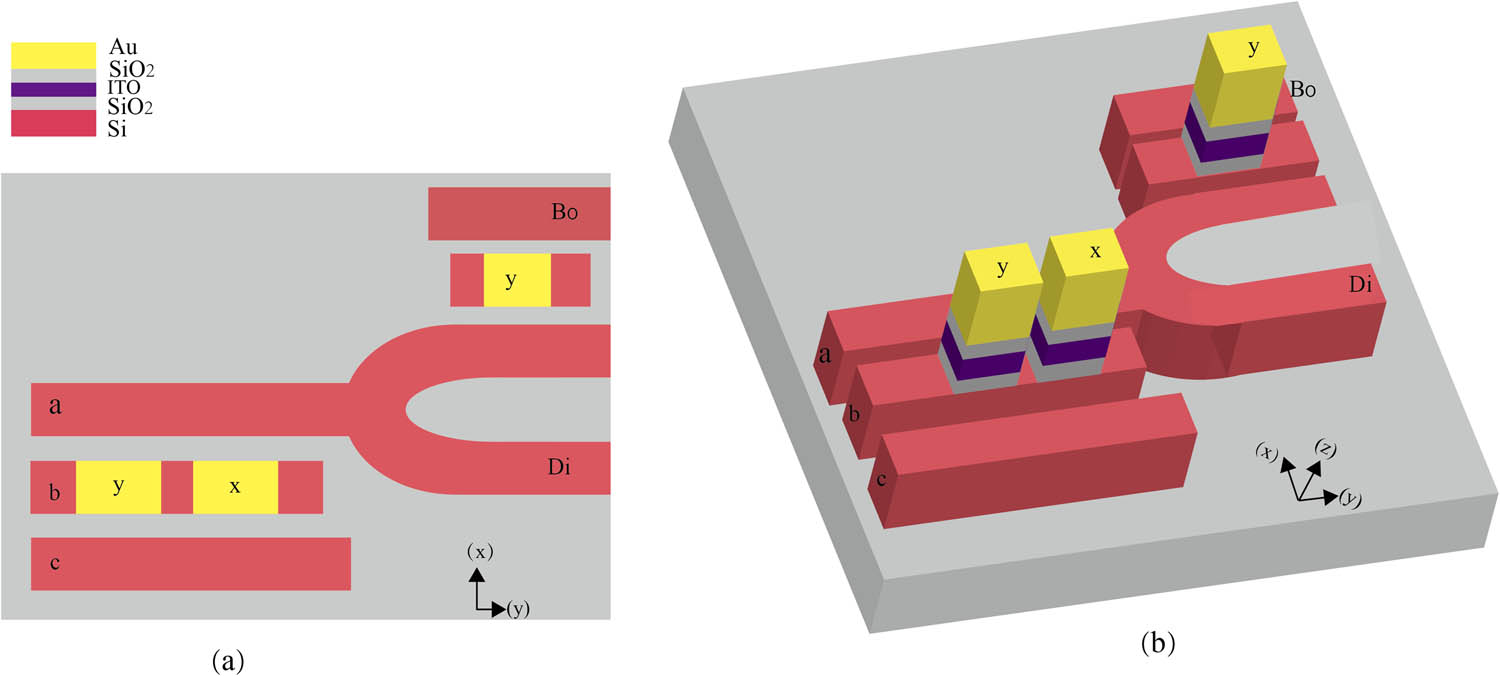
Model of the half subtractor: (a) top view of the half subtractor model and (b) 3D view of the half subtractor model.
Referring to our previous research [21], the waveguide size and gap of the half subtractor, as well as the Indium–Tin–Oxide (ITO) film size settings in the control area, are shown in Table 1(a), with the
Parameters of the device model
| Parameter | Values (nm) |
|---|---|
|
|
15 |
|
|
14 |
| Gap | 140 |
|
|
500 |
| Height of Si waveguide | 340 |
| Width of middle Si waveguide | 275 |
| Width of side Si waveguide | 400 |
3 Methods
The Y-splitter and logic control unit have a high IL and extinction ratio on the entire half subtractor, so the logic control unit and Y-splitter are key components of the half subtractor. The theoretical minimum IL of a Y-splitter is 3 dB, but in reality, in a structure with a size of a few micrometers, the theoretical IL of a Y-splitter will exceed 3 dB. Therefore, the study of Y-splitters in the half subtractor needs to be focused on.
The half subtractor consists of three basic logic control units, which are composed of three waveguides, as shown in Figure 2. A control area is set on the middle waveguide, and metal-oxide-semiconductor (MOS) structure capacitance is achieved through ITO film sandwiched between SiO2 insulation interlayer. The voltage is applied between the silicon waveguide and ITO thin film, and an appropriate voltage is applied to obtain the near zero state of the dielectric constant of the TCO material, thereby achieving EAM. Its dielectric constant conforms to the Drude model [26]:
where the

Logic control unit of the half subtractor. (a) Top view of logic control unit with added electrodes, (b) 3D view of logic control unit with electrodes, (c) electromagnetic field distribution of logic control unit without voltage applied, and (d) electromagnetic field distribution of logic control unit with voltage applied.
In order to calculate the variation in ITO carrier concentration by the voltage controlled, according to Kocakulah [27], this work used the following simple model for calculation:
According to Wang et al. [28],

Characteristics of ITO film when applying voltage to the model. (a) Applied voltage model, (b) model equivalent circuit, (c) model equivalent circuit simplification, (d) changes in carrier concentration on applying voltage of 0–4 V, and (e) the composite dielectric constant of ITO varies with voltage.
The transmission rate is a key parameter indicator for measuring the performance of a half subtractor. The voltage control method in Figure 2(a) can be equivalent to the circuit shown in Figure 2(b), and finally can be simplified to the simplified circuit shown in Figure 2(c). According to Zhao et al. [26], the transmission rate of the half subtractor designed in this study can be calculated according to the MOS structure junction transmission rate, which is expressed by Eq. (3).
In the above equation, according to the definition of capacitor C, it can be represented as
where,
where
According to Zhao et al. [26], the power consumption required to transmit 1 bit can be calculated based on the charging energy of the capacitor (discharge does not require energy consumption), which can be expressed as
where
In addition, according to the definition of IL, the following equation can be used to represent the IL:
where
4 Simulation and analysis
FDTD software is used to simulate and study the logic control unit as shown in Figure 2. In Figure 2(a), the optical signal of TM mode is input from port 1. According to the electrodes of the logic control unit in Figure 2(b), under the condition of applying 2.35 V voltage or not applying voltage, the logic control unit operates in both bar and cross states, and the electromagnetic field strength of the optical signals of port 2 and port 3 is detected.
Figure 5 shows that the logic control unit operates in a bar state under applied voltage, and a TM mode wave with a wavelength of 1,400–1,600 nm and a gain of 1 is injected from the port 1. The electromagnetic field strengths of port 2 and port 3 are observed from the transmittance in Figure 4. The average normalized electromagnetic field strength of port 1 is 0.36, and the average normalized electromagnetic field strength of port 2 is 0.22. The light transmittance is the best at the wavelength of 1,425 nm, exceeding 0.7. Due to the dispersion characteristics of optical materials, the transmittance varies periodically with wavelength. From the perspective of transmittance alone, at a wavelength of 1,550 nm, the average normalized electromagnetic field intensity of port 1 is 0.27, port 2 is 0.16, and port 3 is close to 0. Similarly, Figure 5 shows that the logic control unit operates in a cross state without applying voltage. A TM mode wave with a wavelength of 1,400–1,600 nm and a gain of 1 is injected from the port 1, and the optical signal electromagnetic field strengths of ports 2 and 3 are detected. At a wavelength of 1,550 nm, the average normalized electromagnetic field strength of port 1 is 0.59, the normalized electromagnetic field strength of port 2 is 0.05, and the normalized electromagnetic field strength of port 3 is 0.33.

(a) Electromagnetic field intensity of ports 1–3 when the logic control unit operates in bar state and (b) electromagnetic field intensity of ports 1–3 when the logic control unit operates in the cross state.

IL in cross and bar states.
The above is a study and analysis of the performance of a half subtractor from the perspective of transmittance. In order to further analyze the performance of a half subtractor, it is necessary to analyze the IL of optical devices. According to Eq. (7), the transmittance data of the cross and bar operating states can be calculated, and the ILs of the two states can be obtained separately. The results are plotted in Figure 5. From the figure, it can be seen that when the half subtractor operates in the cross state, the IL of the half subtractor decreases with the increase in wavelength. When the half subtractor operates in a bar state, the IL of the half subtractor increases with the increase in wavelength. Therefore, the IL of the device needs to balance the IL of the two states, and the average value can be taken to obtain the optimal IL. When the operating wavelength is about 1,580 nm, the minimum average IL is 1.3 dB. When the working wavelength is the common optical communication wavelength of 1,550 nm, the average IL is 1.7 dB. Among them, when the half attenuator operates in the cross and bar states, the IL is 1.0 and 2.3 dB, respectively.
In order to match the size of the entire device, we kept the silicon waveguide size of the Y-splitter consistent with the silicon waveguide size next to the logic control unit. At the same time, we fixed the y-span size of the Y-splitter to 4,000 nm, and the x-span size varied from 1,000 to 3,000 nm. We simulated the optical performance of the Y-splitter, and the results are plotted in Figure 6. From Figure 6(c), it can be seen that the x-span size should not be set too large or too small, and the curvature of the bent waveguide should be set within a reasonable range to minimize IL. From Figure 6(c), it can be seen that when the y-span size of the Y-splitter is fixed at 4,000 nm, it is advisable to set the x-span size to around 2,000 nm, and the IL of the Y-splitter is 3.11 dB.

Performance analysis of Y-splitter with half subtractor. (a) Top view of Y-splitter, (b) 3D diagram of Y-splitter, (c) performance analysis of IL with x-span variation, and (d) electromagnetic field distribution diagram of Y-splitter in working state.
FDTD software was used to simulate the entire half subtractor. The voltages were applied to the logic control unit in four states: 00, 01, 10, and 11. The detector was used to observe the distribution of electromagnetic fields in the Z direction. The simulation experiment results are shown in Figure 7. Figure 7(a)–(d), respectively, show the corresponding voltages applied to the logic control unit in four states: 00, 01, 10, and 11, The output ports of the half reducer BO and Di obtained four results: 00, 11, 01, and 00, respectively, verifying the correct logic of the half subtractor.
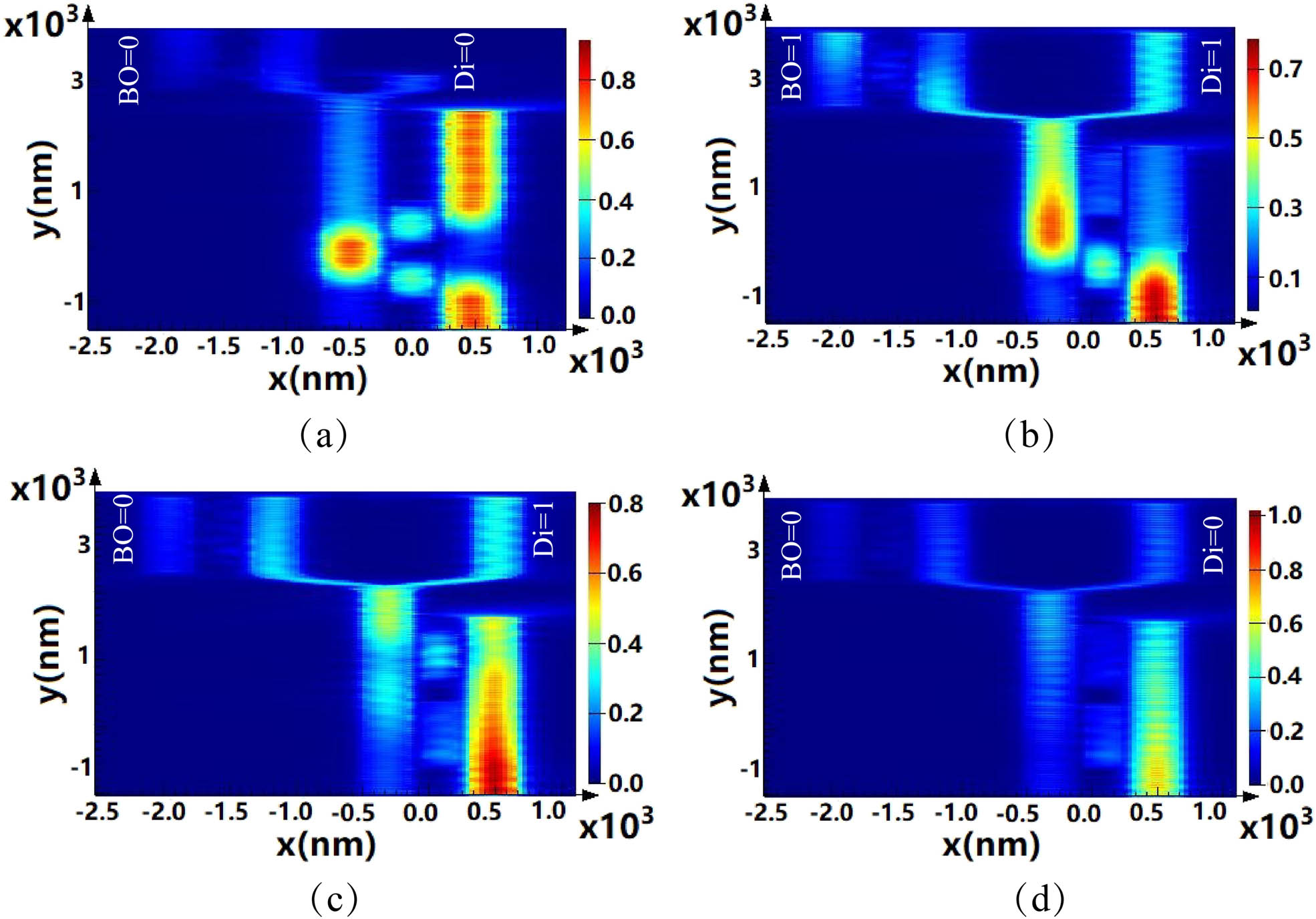
Electromagnetic field distribution during the operation of the half subtractor. (a)–(d) The electromagnetic field distribution of the half subtractor operating at 00, 01, 10, and 11 state, respectively.
The above studies were conducted on a single logic control unit and a Y-splitter, respectively, to obtain the IL during the operation of the logic control unit and Y-type splitter. By calculation, when the half attenuator operates at a wavelength of 1,550 nm, the IL of BO and Di at the output port of the half device are 7.41 and 6.41 dB, respectively, when it operates at 01 state. When it operates at 10 state, the IL of Di at the output port is 6.41 dB, and the difference in IL is 1.0 dB.
5 Conclusion
In this study, based on the hybrid waveguide surface plasmon polariton technology, we Proposed an electro-optic hybrid half attenuator, with a size of only 32 μm × 4.3 μm, featuring ultra-compact dimensions. After we modeling, calculation, and analysis, we find that the transmission rate of the device is high. By modeling and analyzing the logic control unit and Y-splitter, the principles for optical IL and Y-splitter size setting were obtained. The optical IL of the device differs by 1.0 dB, but the overall IL of the device is still relatively large, which is a problem that we need to solve in our future research work.
Acknowledgments
This work was supported by the Guangxi Natural Science Foundation Joint Funding Project (2021GXNSFBA220023), and in part by Hechi University high-level talents research project (No. 2022GCC010) and Research Basic Ability Improvement Project for Young and Middle-aged Teachers of Guangxi Universities (2023KY0633).
-
Funding information: This work was supported by the Guangxi Natural Science Foundation Joint Funding Project 2021GXNSFBA220023, in part by Key scientific research projects of Hechi University in 2021 (No. 2021XJZD001), and in part by Hechi University high-level talents research project (No. 2022GCC010) and Research Basic Ability Improvement Project for Young and Middle-aged Teachers of Guangxi Universities (2023KY0633).
-
Author contributions: All authors have accepted responsibility for the entire content of this manuscript and approved its submission.
-
Conflict of interest: The authors state no conflict of interest.
-
Data availability statement: All data generated or analyzed during this study are included in this published article.
References
[1] Rehioui H, Cuissart B, Ouali A, Lepailleur A, Lamotte JL, Bureau R, et al. New pharmacophore fingerprints and weight-matrix learning for virtual screening application to Bcr-Abl data. Mol Inform. 2023;42(1):e2200210.10.1002/minf.202200210Search in Google Scholar PubMed
[2] Long X, Gong X, Zhang B, Zhou H. Deep learning based data prefetching in CPU-GPU unified virtual memory. J Parallel Distrib Comput. 2023;174:19–31.10.1016/j.jpdc.2022.12.004Search in Google Scholar
[3] Liu X, Song P. Virtual label guided multi-view non-negative matrix factorization for data clustering. Digit Signal Process. 2023;133:103888.10.1016/j.dsp.2022.103888Search in Google Scholar
[4] Wei W, Zhang T, Yang J, Qian Y, Dong Y. Global virtual data space for unified data access across supercomputing centers. IEEE Trans Cloud Comput. 2023;11:1822–39.10.1109/TCC.2022.3164251Search in Google Scholar
[5] Wang N, Zhou R, Han L, Chen H, Li Z. Online scheduling of distributed machine learning jobs for incentivizing sharing in multi-tenant systems. IEEE Trans Comput. 2022;72(3):653–7.10.1109/TC.2022.3174566Search in Google Scholar
[6] Aghapour Z, Sharifian S, Taheri H. Task offloading and resource allocation algorithm based on deep reinforcement learning for distributed AI execution tasks in IoT edge computing environments. Comput Netw. 2023;223:109577.10.1016/j.comnet.2023.109577Search in Google Scholar
[7] Talib MA, Majzoub S, Nasir Q, Jamal D. A systematic literature review on hardware implementation of artificial intelligence algorithms. J Supercomput. 2021;77:1897–938.10.1007/s11227-020-03325-8Search in Google Scholar
[8] Fernández Pérez I, Prieta FD, Rodríguez-González S, Corchado JM, Prieto J. Quantum AI: Achievements and challenges in the interplay of quantum computing and artificial intelligence. International Symposium on Ambient Intelligence; 2023.10.1007/978-3-031-22356-3_15Search in Google Scholar
[9] Khanal B, Orduz J, Rivas P, Baker E. Supercomputing leverages quantum machine learning and Grover’s algorithm. J Supercomput. 2023;79:6918–40.10.1007/s11227-022-04923-4Search in Google Scholar
[10] Kang JB, Shen AZ, Gurajala S, Nathan A, Rumker L, Aguiar V, et al. Integrated artificial intelligence and predictive maintenance of electric vehicle components with optical and quantum enhancements. Opt Quantum Electron. 2023;55(10):855–2268.10.1007/s11082-023-05135-7Search in Google Scholar
[11] Wang L, Wang Y, Qian M, Dong Y. Logical model design and controllability verification based on graphene oxide and metal ions. J Electron Inf Technol. 2020;42(6):1410–9.Search in Google Scholar
[12] Cheng J, Jiang X, Zhou H, DongJian JI. Advances and challenges of optoelectronic intelligent computing. Chin J Lasers. 2022;49(12):1219001–13.10.3788/CJL202249.1219001Search in Google Scholar
[13] Granpayeh A, Habibiyan H, Parvin P. Photonic crystal directional coupler for all-optical switching, tunable multi/demultiplexing and beam splitting applications. J Mod Opt. 2019;66(4):359–66.10.1080/09500340.2018.1511859Search in Google Scholar
[14] Janani K, Rajesh A, Shankar T. Design of an optical half-adder using cohesive twin-structured PCRR. J Comput Electron. 2018;17(2):837–44.10.1007/s10825-018-1161-5Search in Google Scholar
[15] Xu W, Li Y, Cui Q, Zhang H, Xia C, Guo H, et al. All-optical generation, detection, and manipulation of picosecond acoustic pulses in 2D semiconductor/dielectric heterostructures. Photonics Res. 2023;11(12):2000.10.1364/PRJ.491805Search in Google Scholar
[16] Kolli VR, Talabattula S. An optimized integrated optical coupled micro ring resonator for low pressure sensing. IEEE Sens J. 2022;22:16016–26.10.1109/JSEN.2022.3188873Search in Google Scholar
[17] Zhang J, Li S.-Q., Ding J, Wang P.-J, Chen WW. Design of an electro-optical half-adder based on silicon-graphene waveguides. J Optoelectron·Laser. 2018;29(8):805–10 (in Chinese).Search in Google Scholar
[18] Rezaei MH, Zarifkar A. Subwavelength electro-optical half-subtractor and half-adder based on graphene plasmonic waveguides. Plasmonics. 2019;14(6):1939–47.10.1007/s11468-019-00997-8Search in Google Scholar
[19] Dong G, Wang Y, Zhang X. High-contrast and low-power all-optical switch using Fano resonance based on a silicon nanobeam cavity. Opt Lett. 2018;43(24):5977–80.10.1364/OL.43.005977Search in Google Scholar PubMed
[20] Sun S, Narayana VK, Sarpkaya I, Crandall J, Soref RA, Dalir H, et al. Hybrid photonic-plasmonic nonblocking broadband 5 × 5 router for optical networks. IEEE Photonics J. 2017;10(2):1–12.10.1109/JPHOT.2017.2766087Search in Google Scholar
[21] Zhixun L, Yunying S, Yunfei Y, Yuanyuan F, Lvqing B. Electro-optic hybrid logic gate derived from a silicon-based hybrid surface plasmon polariton waveguide. J Nanoelectron Optoelectron. 2022;17:298–304.Search in Google Scholar
[22] Yahya MR, Wu N, Yan G, Ge F, Ahmed T. RoR: A low insertion loss design of rearrangeable hybrid photonic-plasmonic 6 × 6 non-blocking router for ONoCs. IEICE Electron Express. 2019;16:20190346.10.1587/elex.16.20190346Search in Google Scholar
[23] Bai Y, Yu M, Lu L, Zhang D, Zhu L. Quantized photonic neural network modeling method based on micro ring modulators. Opt Eng. 2022;61(6):061409.10.1117/1.OE.61.6.061409Search in Google Scholar
[24] Mahmud MT, Zhai D, Sandler N. Topological flat bands in strained graphene: substrate engineering and optical control. Nano Lett. 2023;23(16):7725–32.10.1021/acs.nanolett.3c02513Search in Google Scholar PubMed
[25] Tannaz S, Moradkhani M, Taherzade M, Rezaei MH. Ultracompact, high-extinction ratio XOR, OR, and Feynman logic gates based on plasmonic metal-insulator-metal directional couplers. Appl Opt. 2023;62:644–53.10.1364/AO.478011Search in Google Scholar PubMed
[26] Zhao Y, Xing G, Zhao Y, Yu C, Liu Q, Zhao C, et al. Graphene aerogel modified with a vanadium nitride film by a sputtering method for use in high-performance supercapacitors. Mater Lett. 2020;261:127085.10.1016/j.matlet.2019.127085Search in Google Scholar
[27] Kocakulah G. Comparison of electro-optical and dielectric properties of cobalt(ii) phthalocyanine doped cholesteric liquid crystals. Opt Mater. 2023;141:113949.10.1016/j.optmat.2023.113949Search in Google Scholar
[28] Wang L, Dong Y, Gao S, Chen KY, Fang FC, Jin GY. Research progress of perovskite materials in the field of lasers. China Opt. 2019;12(5):993–1014.10.3788/co.20191205.0993Search in Google Scholar
[29] Alok K, Sarang M. All optical NOR and NAND gates using four circular cavities created in 2D nonlinear photonic crystal. Opt Laser Technol. 2020;123:105910.10.1016/j.optlastec.2019.105910Search in Google Scholar
[30] Chen X, Li Z, Zhao R, He Y, He Y, Liang Z, et al. Flexible one-dimensional photonic crystal films composed of chalcogenide glass and water-soluble polymer for curvature sensing. Chin Opt Lett. 2024;22(1):021601.10.3788/COL202422.021601Search in Google Scholar
[31] Abouelmagd EI, Awad ME, Elzayat EMA, Abbas IA. Reduction the secular solution to periodic solution in the generalized restricted three-body problem. Astrophys Space Sci. 2014;350(2):495–505.10.1007/s10509-013-1756-zSearch in Google Scholar
[32] Abbas I, Saeed T, Alhothuali M. Hyperbolic two-temperature photo-thermal interaction in a semiconductor medium with a cylindrical cavity. Silicon. 2021;13(6):1871–8.10.1007/s12633-020-00570-7Search in Google Scholar
[33] Du B, Lu S, Liu Y. Periodic Solution for neutral-type neural networks in critical case. Neural Process Lett. 2016;44(3):765–77.10.1007/s11063-015-9493-7Search in Google Scholar
[34] Zhixun L, Yunying S, Yunfei Y, Yuanyuan F, Lvqing B. Electro-optic hybrid logic gate derived from a silicon-based hybrid surface plasmon polariton waveguide. J Nanoelectron Optoelectron. 2022;17(2):298–304.10.1166/jno.2022.3197Search in Google Scholar
© 2024 the author(s), published by De Gruyter
This work is licensed under the Creative Commons Attribution 4.0 International License.
Articles in the same Issue
- Regular Articles
- Numerical study of flow and heat transfer in the channel of panel-type radiator with semi-detached inclined trapezoidal wing vortex generators
- Homogeneous–heterogeneous reactions in the colloidal investigation of Casson fluid
- High-speed mid-infrared Mach–Zehnder electro-optical modulators in lithium niobate thin film on sapphire
- Numerical analysis of dengue transmission model using Caputo–Fabrizio fractional derivative
- Mononuclear nanofluids undergoing convective heating across a stretching sheet and undergoing MHD flow in three dimensions: Potential industrial applications
- Heat transfer characteristics of cobalt ferrite nanoparticles scattered in sodium alginate-based non-Newtonian nanofluid over a stretching/shrinking horizontal plane surface
- The electrically conducting water-based nanofluid flow containing titanium and aluminum alloys over a rotating disk surface with nonlinear thermal radiation: A numerical analysis
- Growth, characterization, and anti-bacterial activity of l-methionine supplemented with sulphamic acid single crystals
- A numerical analysis of the blood-based Casson hybrid nanofluid flow past a convectively heated surface embedded in a porous medium
- Optoelectronic–thermomagnetic effect of a microelongated non-local rotating semiconductor heated by pulsed laser with varying thermal conductivity
- Thermal proficiency of magnetized and radiative cross-ternary hybrid nanofluid flow induced by a vertical cylinder
- Enhanced heat transfer and fluid motion in 3D nanofluid with anisotropic slip and magnetic field
- Numerical analysis of thermophoretic particle deposition on 3D Casson nanofluid: Artificial neural networks-based Levenberg–Marquardt algorithm
- Analyzing fuzzy fractional Degasperis–Procesi and Camassa–Holm equations with the Atangana–Baleanu operator
- Bayesian estimation of equipment reliability with normal-type life distribution based on multiple batch tests
- Chaotic control problem of BEC system based on Hartree–Fock mean field theory
- Optimized framework numerical solution for swirling hybrid nanofluid flow with silver/gold nanoparticles on a stretching cylinder with heat source/sink and reactive agents
- Stability analysis and numerical results for some schemes discretising 2D nonconstant coefficient advection–diffusion equations
- Convective flow of a magnetohydrodynamic second-grade fluid past a stretching surface with Cattaneo–Christov heat and mass flux model
- Analysis of the heat transfer enhancement in water-based micropolar hybrid nanofluid flow over a vertical flat surface
- Microscopic seepage simulation of gas and water in shale pores and slits based on VOF
- Model of conversion of flow from confined to unconfined aquifers with stochastic approach
- Study of fractional variable-order lymphatic filariasis infection model
- Soliton, quasi-soliton, and their interaction solutions of a nonlinear (2 + 1)-dimensional ZK–mZK–BBM equation for gravity waves
- Application of conserved quantities using the formal Lagrangian of a nonlinear integro partial differential equation through optimal system of one-dimensional subalgebras in physics and engineering
- Nonlinear fractional-order differential equations: New closed-form traveling-wave solutions
- Sixth-kind Chebyshev polynomials technique to numerically treat the dissipative viscoelastic fluid flow in the rheology of Cattaneo–Christov model
- Some transforms, Riemann–Liouville fractional operators, and applications of newly extended M–L (p, s, k) function
- Magnetohydrodynamic water-based hybrid nanofluid flow comprising diamond and copper nanoparticles on a stretching sheet with slips constraints
- Super-resolution reconstruction method of the optical synthetic aperture image using generative adversarial network
- A two-stage framework for predicting the remaining useful life of bearings
- Influence of variable fluid properties on mixed convective Darcy–Forchheimer flow relation over a surface with Soret and Dufour spectacle
- Inclined surface mixed convection flow of viscous fluid with porous medium and Soret effects
- Exact solutions to vorticity of the fractional nonuniform Poiseuille flows
- In silico modified UV spectrophotometric approaches to resolve overlapped spectra for quality control of rosuvastatin and teneligliptin formulation
- Numerical simulations for fractional Hirota–Satsuma coupled Korteweg–de Vries systems
- Substituent effect on the electronic and optical properties of newly designed pyrrole derivatives using density functional theory
- A comparative analysis of shielding effectiveness in glass and concrete containers
- Numerical analysis of the MHD Williamson nanofluid flow over a nonlinear stretching sheet through a Darcy porous medium: Modeling and simulation
- Analytical and numerical investigation for viscoelastic fluid with heat transfer analysis during rollover-web coating phenomena
- Influence of variable viscosity on existing sheet thickness in the calendering of non-isothermal viscoelastic materials
- Analysis of nonlinear fractional-order Fisher equation using two reliable techniques
- Comparison of plan quality and robustness using VMAT and IMRT for breast cancer
- Radiative nanofluid flow over a slender stretching Riga plate under the impact of exponential heat source/sink
- Numerical investigation of acoustic streaming vortices in cylindrical tube arrays
- Numerical study of blood-based MHD tangent hyperbolic hybrid nanofluid flow over a permeable stretching sheet with variable thermal conductivity and cross-diffusion
- Fractional view analytical analysis of generalized regularized long wave equation
- Dynamic simulation of non-Newtonian boundary layer flow: An enhanced exponential time integrator approach with spatially and temporally variable heat sources
- Inclined magnetized infinite shear rate viscosity of non-Newtonian tetra hybrid nanofluid in stenosed artery with non-uniform heat sink/source
- Estimation of monotone α-quantile of past lifetime function with application
- Numerical simulation for the slip impacts on the radiative nanofluid flow over a stretched surface with nonuniform heat generation and viscous dissipation
- Study of fractional telegraph equation via Shehu homotopy perturbation method
- An investigation into the impact of thermal radiation and chemical reactions on the flow through porous media of a Casson hybrid nanofluid including unstable mixed convection with stretched sheet in the presence of thermophoresis and Brownian motion
- Establishing breather and N-soliton solutions for conformable Klein–Gordon equation
- An electro-optic half subtractor from a silicon-based hybrid surface plasmon polariton waveguide
- CFD analysis of particle shape and Reynolds number on heat transfer characteristics of nanofluid in heated tube
- Abundant exact traveling wave solutions and modulation instability analysis to the generalized Hirota–Satsuma–Ito equation
- A short report on a probability-based interpretation of quantum mechanics
- Study on cavitation and pulsation characteristics of a novel rotor-radial groove hydrodynamic cavitation reactor
- Optimizing heat transport in a permeable cavity with an isothermal solid block: Influence of nanoparticles volume fraction and wall velocity ratio
- Linear instability of the vertical throughflow in a porous layer saturated by a power-law fluid with variable gravity effect
- Thermal analysis of generalized Cattaneo–Christov theories in Burgers nanofluid in the presence of thermo-diffusion effects and variable thermal conductivity
- A new benchmark for camouflaged object detection: RGB-D camouflaged object detection dataset
- Effect of electron temperature and concentration on production of hydroxyl radical and nitric oxide in atmospheric pressure low-temperature helium plasma jet: Swarm analysis and global model investigation
- Double diffusion convection of Maxwell–Cattaneo fluids in a vertical slot
- Thermal analysis of extended surfaces using deep neural networks
- Steady-state thermodynamic process in multilayered heterogeneous cylinder
- Multiresponse optimisation and process capability analysis of chemical vapour jet machining for the acrylonitrile butadiene styrene polymer: Unveiling the morphology
- Modeling monkeypox virus transmission: Stability analysis and comparison of analytical techniques
- Fourier spectral method for the fractional-in-space coupled Whitham–Broer–Kaup equations on unbounded domain
- The chaotic behavior and traveling wave solutions of the conformable extended Korteweg–de-Vries model
- Research on optimization of combustor liner structure based on arc-shaped slot hole
- Construction of M-shaped solitons for a modified regularized long-wave equation via Hirota's bilinear method
- Effectiveness of microwave ablation using two simultaneous antennas for liver malignancy treatment
- Discussion on optical solitons, sensitivity and qualitative analysis to a fractional model of ion sound and Langmuir waves with Atangana Baleanu derivatives
- Reliability of two-dimensional steady magnetized Jeffery fluid over shrinking sheet with chemical effect
- Generalized model of thermoelasticity associated with fractional time-derivative operators and its applications to non-simple elastic materials
- Migration of two rigid spheres translating within an infinite couple stress fluid under the impact of magnetic field
- A comparative investigation of neutron and gamma radiation interaction properties of zircaloy-2 and zircaloy-4 with consideration of mechanical properties
- New optical stochastic solutions for the Schrödinger equation with multiplicative Wiener process/random variable coefficients using two different methods
- Physical aspects of quantile residual lifetime sequence
- Synthesis, structure, I–V characteristics, and optical properties of chromium oxide thin films for optoelectronic applications
- Smart mathematically filtered UV spectroscopic methods for quality assurance of rosuvastatin and valsartan from formulation
- A novel investigation into time-fractional multi-dimensional Navier–Stokes equations within Aboodh transform
- Homotopic dynamic solution of hydrodynamic nonlinear natural convection containing superhydrophobicity and isothermally heated parallel plate with hybrid nanoparticles
- A novel tetra hybrid bio-nanofluid model with stenosed artery
- Propagation of traveling wave solution of the strain wave equation in microcrystalline materials
- Innovative analysis to the time-fractional q-deformed tanh-Gordon equation via modified double Laplace transform method
- A new investigation of the extended Sakovich equation for abundant soliton solution in industrial engineering via two efficient techniques
- New soliton solutions of the conformable time fractional Drinfel'd–Sokolov–Wilson equation based on the complete discriminant system method
- Irradiation of hydrophilic acrylic intraocular lenses by a 365 nm UV lamp
- Inflation and the principle of equivalence
- The use of a supercontinuum light source for the characterization of passive fiber optic components
- Optical solitons to the fractional Kundu–Mukherjee–Naskar equation with time-dependent coefficients
- A promising photocathode for green hydrogen generation from sanitation water without external sacrificing agent: silver-silver oxide/poly(1H-pyrrole) dendritic nanocomposite seeded on poly-1H pyrrole film
- Photon balance in the fiber laser model
- Propagation of optical spatial solitons in nematic liquid crystals with quadruple power law of nonlinearity appears in fluid mechanics
- Theoretical investigation and sensitivity analysis of non-Newtonian fluid during roll coating process by response surface methodology
- Utilizing slip conditions on transport phenomena of heat energy with dust and tiny nanoparticles over a wedge
- Bismuthyl chloride/poly(m-toluidine) nanocomposite seeded on poly-1H pyrrole: Photocathode for green hydrogen generation
- Infrared thermography based fault diagnosis of diesel engines using convolutional neural network and image enhancement
- On some solitary wave solutions of the Estevez--Mansfield--Clarkson equation with conformable fractional derivatives in time
- Impact of permeability and fluid parameters in couple stress media on rotating eccentric spheres
- Review Article
- Transformer-based intelligent fault diagnosis methods of mechanical equipment: A survey
- Special Issue on Predicting pattern alterations in nature - Part II
- A comparative study of Bagley–Torvik equation under nonsingular kernel derivatives using Weeks method
- On the existence and numerical simulation of Cholera epidemic model
- Numerical solutions of generalized Atangana–Baleanu time-fractional FitzHugh–Nagumo equation using cubic B-spline functions
- Dynamic properties of the multimalware attacks in wireless sensor networks: Fractional derivative analysis of wireless sensor networks
- Prediction of COVID-19 spread with models in different patterns: A case study of Russia
- Study of chronic myeloid leukemia with T-cell under fractal-fractional order model
- Accumulation process in the environment for a generalized mass transport system
- Analysis of a generalized proportional fractional stochastic differential equation incorporating Carathéodory's approximation and applications
- Special Issue on Nanomaterial utilization and structural optimization - Part II
- Numerical study on flow and heat transfer performance of a spiral-wound heat exchanger for natural gas
- Study of ultrasonic influence on heat transfer and resistance performance of round tube with twisted belt
- Numerical study on bionic airfoil fins used in printed circuit plate heat exchanger
- Improving heat transfer efficiency via optimization and sensitivity assessment in hybrid nanofluid flow with variable magnetism using the Yamada–Ota model
- Special Issue on Nanofluids: Synthesis, Characterization, and Applications
- Exact solutions of a class of generalized nanofluidic models
- Stability enhancement of Al2O3, ZnO, and TiO2 binary nanofluids for heat transfer applications
- Thermal transport energy performance on tangent hyperbolic hybrid nanofluids and their implementation in concentrated solar aircraft wings
- Studying nonlinear vibration analysis of nanoelectro-mechanical resonators via analytical computational method
- Numerical analysis of non-linear radiative Casson fluids containing CNTs having length and radius over permeable moving plate
- Two-phase numerical simulation of thermal and solutal transport exploration of a non-Newtonian nanomaterial flow past a stretching surface with chemical reaction
- Natural convection and flow patterns of Cu–water nanofluids in hexagonal cavity: A novel thermal case study
- Solitonic solutions and study of nonlinear wave dynamics in a Murnaghan hyperelastic circular pipe
- Comparative study of couple stress fluid flow using OHAM and NIM
- Utilization of OHAM to investigate entropy generation with a temperature-dependent thermal conductivity model in hybrid nanofluid using the radiation phenomenon
- Slip effects on magnetized radiatively hybridized ferrofluid flow with acute magnetic force over shrinking/stretching surface
- Significance of 3D rectangular closed domain filled with charged particles and nanoparticles engaging finite element methodology
- Robustness and dynamical features of fractional difference spacecraft model with Mittag–Leffler stability
- Characterizing magnetohydrodynamic effects on developed nanofluid flow in an obstructed vertical duct under constant pressure gradient
- Study on dynamic and static tensile and puncture-resistant mechanical properties of impregnated STF multi-dimensional structure Kevlar fiber reinforced composites
- Thermosolutal Marangoni convective flow of MHD tangent hyperbolic hybrid nanofluids with elastic deformation and heat source
- Investigation of convective heat transport in a Carreau hybrid nanofluid between two stretchable rotatory disks
- Single-channel cooling system design by using perforated porous insert and modeling with POD for double conductive panel
- Special Issue on Fundamental Physics from Atoms to Cosmos - Part I
- Pulsed excitation of a quantum oscillator: A model accounting for damping
- Review of recent analytical advances in the spectroscopy of hydrogenic lines in plasmas
- Heavy mesons mass spectroscopy under a spin-dependent Cornell potential within the framework of the spinless Salpeter equation
- Coherent manipulation of bright and dark solitons of reflection and transmission pulses through sodium atomic medium
- Effect of the gravitational field strength on the rate of chemical reactions
- The kinetic relativity theory – hiding in plain sight
- Special Issue on Advanced Energy Materials - Part III
- Eco-friendly graphitic carbon nitride–poly(1H pyrrole) nanocomposite: A photocathode for green hydrogen production, paving the way for commercial applications
Articles in the same Issue
- Regular Articles
- Numerical study of flow and heat transfer in the channel of panel-type radiator with semi-detached inclined trapezoidal wing vortex generators
- Homogeneous–heterogeneous reactions in the colloidal investigation of Casson fluid
- High-speed mid-infrared Mach–Zehnder electro-optical modulators in lithium niobate thin film on sapphire
- Numerical analysis of dengue transmission model using Caputo–Fabrizio fractional derivative
- Mononuclear nanofluids undergoing convective heating across a stretching sheet and undergoing MHD flow in three dimensions: Potential industrial applications
- Heat transfer characteristics of cobalt ferrite nanoparticles scattered in sodium alginate-based non-Newtonian nanofluid over a stretching/shrinking horizontal plane surface
- The electrically conducting water-based nanofluid flow containing titanium and aluminum alloys over a rotating disk surface with nonlinear thermal radiation: A numerical analysis
- Growth, characterization, and anti-bacterial activity of l-methionine supplemented with sulphamic acid single crystals
- A numerical analysis of the blood-based Casson hybrid nanofluid flow past a convectively heated surface embedded in a porous medium
- Optoelectronic–thermomagnetic effect of a microelongated non-local rotating semiconductor heated by pulsed laser with varying thermal conductivity
- Thermal proficiency of magnetized and radiative cross-ternary hybrid nanofluid flow induced by a vertical cylinder
- Enhanced heat transfer and fluid motion in 3D nanofluid with anisotropic slip and magnetic field
- Numerical analysis of thermophoretic particle deposition on 3D Casson nanofluid: Artificial neural networks-based Levenberg–Marquardt algorithm
- Analyzing fuzzy fractional Degasperis–Procesi and Camassa–Holm equations with the Atangana–Baleanu operator
- Bayesian estimation of equipment reliability with normal-type life distribution based on multiple batch tests
- Chaotic control problem of BEC system based on Hartree–Fock mean field theory
- Optimized framework numerical solution for swirling hybrid nanofluid flow with silver/gold nanoparticles on a stretching cylinder with heat source/sink and reactive agents
- Stability analysis and numerical results for some schemes discretising 2D nonconstant coefficient advection–diffusion equations
- Convective flow of a magnetohydrodynamic second-grade fluid past a stretching surface with Cattaneo–Christov heat and mass flux model
- Analysis of the heat transfer enhancement in water-based micropolar hybrid nanofluid flow over a vertical flat surface
- Microscopic seepage simulation of gas and water in shale pores and slits based on VOF
- Model of conversion of flow from confined to unconfined aquifers with stochastic approach
- Study of fractional variable-order lymphatic filariasis infection model
- Soliton, quasi-soliton, and their interaction solutions of a nonlinear (2 + 1)-dimensional ZK–mZK–BBM equation for gravity waves
- Application of conserved quantities using the formal Lagrangian of a nonlinear integro partial differential equation through optimal system of one-dimensional subalgebras in physics and engineering
- Nonlinear fractional-order differential equations: New closed-form traveling-wave solutions
- Sixth-kind Chebyshev polynomials technique to numerically treat the dissipative viscoelastic fluid flow in the rheology of Cattaneo–Christov model
- Some transforms, Riemann–Liouville fractional operators, and applications of newly extended M–L (p, s, k) function
- Magnetohydrodynamic water-based hybrid nanofluid flow comprising diamond and copper nanoparticles on a stretching sheet with slips constraints
- Super-resolution reconstruction method of the optical synthetic aperture image using generative adversarial network
- A two-stage framework for predicting the remaining useful life of bearings
- Influence of variable fluid properties on mixed convective Darcy–Forchheimer flow relation over a surface with Soret and Dufour spectacle
- Inclined surface mixed convection flow of viscous fluid with porous medium and Soret effects
- Exact solutions to vorticity of the fractional nonuniform Poiseuille flows
- In silico modified UV spectrophotometric approaches to resolve overlapped spectra for quality control of rosuvastatin and teneligliptin formulation
- Numerical simulations for fractional Hirota–Satsuma coupled Korteweg–de Vries systems
- Substituent effect on the electronic and optical properties of newly designed pyrrole derivatives using density functional theory
- A comparative analysis of shielding effectiveness in glass and concrete containers
- Numerical analysis of the MHD Williamson nanofluid flow over a nonlinear stretching sheet through a Darcy porous medium: Modeling and simulation
- Analytical and numerical investigation for viscoelastic fluid with heat transfer analysis during rollover-web coating phenomena
- Influence of variable viscosity on existing sheet thickness in the calendering of non-isothermal viscoelastic materials
- Analysis of nonlinear fractional-order Fisher equation using two reliable techniques
- Comparison of plan quality and robustness using VMAT and IMRT for breast cancer
- Radiative nanofluid flow over a slender stretching Riga plate under the impact of exponential heat source/sink
- Numerical investigation of acoustic streaming vortices in cylindrical tube arrays
- Numerical study of blood-based MHD tangent hyperbolic hybrid nanofluid flow over a permeable stretching sheet with variable thermal conductivity and cross-diffusion
- Fractional view analytical analysis of generalized regularized long wave equation
- Dynamic simulation of non-Newtonian boundary layer flow: An enhanced exponential time integrator approach with spatially and temporally variable heat sources
- Inclined magnetized infinite shear rate viscosity of non-Newtonian tetra hybrid nanofluid in stenosed artery with non-uniform heat sink/source
- Estimation of monotone α-quantile of past lifetime function with application
- Numerical simulation for the slip impacts on the radiative nanofluid flow over a stretched surface with nonuniform heat generation and viscous dissipation
- Study of fractional telegraph equation via Shehu homotopy perturbation method
- An investigation into the impact of thermal radiation and chemical reactions on the flow through porous media of a Casson hybrid nanofluid including unstable mixed convection with stretched sheet in the presence of thermophoresis and Brownian motion
- Establishing breather and N-soliton solutions for conformable Klein–Gordon equation
- An electro-optic half subtractor from a silicon-based hybrid surface plasmon polariton waveguide
- CFD analysis of particle shape and Reynolds number on heat transfer characteristics of nanofluid in heated tube
- Abundant exact traveling wave solutions and modulation instability analysis to the generalized Hirota–Satsuma–Ito equation
- A short report on a probability-based interpretation of quantum mechanics
- Study on cavitation and pulsation characteristics of a novel rotor-radial groove hydrodynamic cavitation reactor
- Optimizing heat transport in a permeable cavity with an isothermal solid block: Influence of nanoparticles volume fraction and wall velocity ratio
- Linear instability of the vertical throughflow in a porous layer saturated by a power-law fluid with variable gravity effect
- Thermal analysis of generalized Cattaneo–Christov theories in Burgers nanofluid in the presence of thermo-diffusion effects and variable thermal conductivity
- A new benchmark for camouflaged object detection: RGB-D camouflaged object detection dataset
- Effect of electron temperature and concentration on production of hydroxyl radical and nitric oxide in atmospheric pressure low-temperature helium plasma jet: Swarm analysis and global model investigation
- Double diffusion convection of Maxwell–Cattaneo fluids in a vertical slot
- Thermal analysis of extended surfaces using deep neural networks
- Steady-state thermodynamic process in multilayered heterogeneous cylinder
- Multiresponse optimisation and process capability analysis of chemical vapour jet machining for the acrylonitrile butadiene styrene polymer: Unveiling the morphology
- Modeling monkeypox virus transmission: Stability analysis and comparison of analytical techniques
- Fourier spectral method for the fractional-in-space coupled Whitham–Broer–Kaup equations on unbounded domain
- The chaotic behavior and traveling wave solutions of the conformable extended Korteweg–de-Vries model
- Research on optimization of combustor liner structure based on arc-shaped slot hole
- Construction of M-shaped solitons for a modified regularized long-wave equation via Hirota's bilinear method
- Effectiveness of microwave ablation using two simultaneous antennas for liver malignancy treatment
- Discussion on optical solitons, sensitivity and qualitative analysis to a fractional model of ion sound and Langmuir waves with Atangana Baleanu derivatives
- Reliability of two-dimensional steady magnetized Jeffery fluid over shrinking sheet with chemical effect
- Generalized model of thermoelasticity associated with fractional time-derivative operators and its applications to non-simple elastic materials
- Migration of two rigid spheres translating within an infinite couple stress fluid under the impact of magnetic field
- A comparative investigation of neutron and gamma radiation interaction properties of zircaloy-2 and zircaloy-4 with consideration of mechanical properties
- New optical stochastic solutions for the Schrödinger equation with multiplicative Wiener process/random variable coefficients using two different methods
- Physical aspects of quantile residual lifetime sequence
- Synthesis, structure, I–V characteristics, and optical properties of chromium oxide thin films for optoelectronic applications
- Smart mathematically filtered UV spectroscopic methods for quality assurance of rosuvastatin and valsartan from formulation
- A novel investigation into time-fractional multi-dimensional Navier–Stokes equations within Aboodh transform
- Homotopic dynamic solution of hydrodynamic nonlinear natural convection containing superhydrophobicity and isothermally heated parallel plate with hybrid nanoparticles
- A novel tetra hybrid bio-nanofluid model with stenosed artery
- Propagation of traveling wave solution of the strain wave equation in microcrystalline materials
- Innovative analysis to the time-fractional q-deformed tanh-Gordon equation via modified double Laplace transform method
- A new investigation of the extended Sakovich equation for abundant soliton solution in industrial engineering via two efficient techniques
- New soliton solutions of the conformable time fractional Drinfel'd–Sokolov–Wilson equation based on the complete discriminant system method
- Irradiation of hydrophilic acrylic intraocular lenses by a 365 nm UV lamp
- Inflation and the principle of equivalence
- The use of a supercontinuum light source for the characterization of passive fiber optic components
- Optical solitons to the fractional Kundu–Mukherjee–Naskar equation with time-dependent coefficients
- A promising photocathode for green hydrogen generation from sanitation water without external sacrificing agent: silver-silver oxide/poly(1H-pyrrole) dendritic nanocomposite seeded on poly-1H pyrrole film
- Photon balance in the fiber laser model
- Propagation of optical spatial solitons in nematic liquid crystals with quadruple power law of nonlinearity appears in fluid mechanics
- Theoretical investigation and sensitivity analysis of non-Newtonian fluid during roll coating process by response surface methodology
- Utilizing slip conditions on transport phenomena of heat energy with dust and tiny nanoparticles over a wedge
- Bismuthyl chloride/poly(m-toluidine) nanocomposite seeded on poly-1H pyrrole: Photocathode for green hydrogen generation
- Infrared thermography based fault diagnosis of diesel engines using convolutional neural network and image enhancement
- On some solitary wave solutions of the Estevez--Mansfield--Clarkson equation with conformable fractional derivatives in time
- Impact of permeability and fluid parameters in couple stress media on rotating eccentric spheres
- Review Article
- Transformer-based intelligent fault diagnosis methods of mechanical equipment: A survey
- Special Issue on Predicting pattern alterations in nature - Part II
- A comparative study of Bagley–Torvik equation under nonsingular kernel derivatives using Weeks method
- On the existence and numerical simulation of Cholera epidemic model
- Numerical solutions of generalized Atangana–Baleanu time-fractional FitzHugh–Nagumo equation using cubic B-spline functions
- Dynamic properties of the multimalware attacks in wireless sensor networks: Fractional derivative analysis of wireless sensor networks
- Prediction of COVID-19 spread with models in different patterns: A case study of Russia
- Study of chronic myeloid leukemia with T-cell under fractal-fractional order model
- Accumulation process in the environment for a generalized mass transport system
- Analysis of a generalized proportional fractional stochastic differential equation incorporating Carathéodory's approximation and applications
- Special Issue on Nanomaterial utilization and structural optimization - Part II
- Numerical study on flow and heat transfer performance of a spiral-wound heat exchanger for natural gas
- Study of ultrasonic influence on heat transfer and resistance performance of round tube with twisted belt
- Numerical study on bionic airfoil fins used in printed circuit plate heat exchanger
- Improving heat transfer efficiency via optimization and sensitivity assessment in hybrid nanofluid flow with variable magnetism using the Yamada–Ota model
- Special Issue on Nanofluids: Synthesis, Characterization, and Applications
- Exact solutions of a class of generalized nanofluidic models
- Stability enhancement of Al2O3, ZnO, and TiO2 binary nanofluids for heat transfer applications
- Thermal transport energy performance on tangent hyperbolic hybrid nanofluids and their implementation in concentrated solar aircraft wings
- Studying nonlinear vibration analysis of nanoelectro-mechanical resonators via analytical computational method
- Numerical analysis of non-linear radiative Casson fluids containing CNTs having length and radius over permeable moving plate
- Two-phase numerical simulation of thermal and solutal transport exploration of a non-Newtonian nanomaterial flow past a stretching surface with chemical reaction
- Natural convection and flow patterns of Cu–water nanofluids in hexagonal cavity: A novel thermal case study
- Solitonic solutions and study of nonlinear wave dynamics in a Murnaghan hyperelastic circular pipe
- Comparative study of couple stress fluid flow using OHAM and NIM
- Utilization of OHAM to investigate entropy generation with a temperature-dependent thermal conductivity model in hybrid nanofluid using the radiation phenomenon
- Slip effects on magnetized radiatively hybridized ferrofluid flow with acute magnetic force over shrinking/stretching surface
- Significance of 3D rectangular closed domain filled with charged particles and nanoparticles engaging finite element methodology
- Robustness and dynamical features of fractional difference spacecraft model with Mittag–Leffler stability
- Characterizing magnetohydrodynamic effects on developed nanofluid flow in an obstructed vertical duct under constant pressure gradient
- Study on dynamic and static tensile and puncture-resistant mechanical properties of impregnated STF multi-dimensional structure Kevlar fiber reinforced composites
- Thermosolutal Marangoni convective flow of MHD tangent hyperbolic hybrid nanofluids with elastic deformation and heat source
- Investigation of convective heat transport in a Carreau hybrid nanofluid between two stretchable rotatory disks
- Single-channel cooling system design by using perforated porous insert and modeling with POD for double conductive panel
- Special Issue on Fundamental Physics from Atoms to Cosmos - Part I
- Pulsed excitation of a quantum oscillator: A model accounting for damping
- Review of recent analytical advances in the spectroscopy of hydrogenic lines in plasmas
- Heavy mesons mass spectroscopy under a spin-dependent Cornell potential within the framework of the spinless Salpeter equation
- Coherent manipulation of bright and dark solitons of reflection and transmission pulses through sodium atomic medium
- Effect of the gravitational field strength on the rate of chemical reactions
- The kinetic relativity theory – hiding in plain sight
- Special Issue on Advanced Energy Materials - Part III
- Eco-friendly graphitic carbon nitride–poly(1H pyrrole) nanocomposite: A photocathode for green hydrogen production, paving the way for commercial applications
