Generalized model of thermoelasticity associated with fractional time-derivative operators and its applications to non-simple elastic materials
-
Adam Zakria

 ,
Doaa Atta
,
Doaa Atta

Abstract
This study proposes a comprehensive heat conduction model that incorporates fractional time derivatives and two-phase lags to describe the behavior of non-simple thermoelastic materials accurately. Generalized fractional differential operators with non-singular kernels are introduced. This type of fractional derivative includes the Caputo–Fabrizio and the Atangana–Baleanu fractional derivatives. The model also consists of the two-temperature idea, which considers the effect of microstructure through a two-stage delay approach. Interactions of a thermoelastic nature caused by the rapid heating of an isotropic substance under the influence of an external body force were studied as a practical application of the new concept. There has been some discussion about the effect of the discrepancy index and fractional differential operators. Finally, the graphical representations obtained from the numerical simulations were used to explain the behavior of the studied physical fields. The generalized fractional heat transfer model is demonstrated to be capable of producing a temperature forecast that is in close agreement with experimental data. As a result, the proposed model may be useful for solving difficulties in heat transfer, anomalous transport, and other branches of engineering analysis.
Nomenclature
-
-
-
-
-
-
-
-
-
-
-
-
-
-
-
-
-
-
-
-
-
-
-
-
-
-
-
-
-
-
-
-
instant time
-
-
-
-
-
-
-
-
phase deley of conductive temperature
-
-
-
-
-
-
-
-
1 Introduction
Generalized thermoelasticity is a subfield of continuum mechanics that builds on the traditional theory of thermoelasticity to include more realistic and complicated responses from materials. In the field of conventional thermoelasticity, the prevailing assumption is that heat transmission occurs immediately. However, in the context of extended thermoelasticity, this assumption is loosened. The present theory considers a limited thermal wave velocity, a factor that holds significance in specific materials and circumstances [1]. The concept of generalized thermoelasticity has found use in various fields, including investigating heat propagation in semiconductors, examining thermal shock, and modeling and simulating biological tissues.
In contrast to conventional thermoelasticity, which assumes instantaneous heat transfer as described by the parabolic heat transfer equation, extensional thermoelasticity involves hyperbolic heat transfer models. These models often include thermal delays, measuring the amount of time required for temperature changes to propagate through a given material [2]. Lord and Shulman [3] proposed a comprehensive theory of thermoelasticity that incorporates a single relaxation period. Consequently, the governing system for the heat equation has transformed into a hyperbolic form. In their study, Green and Lindsay [4] put forward an alternative model that incorporates two distinct relaxation phases. In their research, Tzou [5,6] introduced a thermoelastic model incorporating the dual-phase-lag (DPL) approach to both the heat flow vector and the temperature gradient. In his work, Choudhuri [7] expanded the DPL model to derive the equation for heat conduction’s three-phase lags (TPLs). This model allows for the estimation of TPL based on the heat flow component, temperature gradient, and thermal displacement, as opposed to relying on the classical Fourier transform law of heat transfer. The theories proposed by Green and Naghdi [8–10] encompass the fundamental principles of thermoelasticity, including both dissipative and non-dissipative systems. The aforementioned models introduce significant fundamental modifications to the constitutive equations, allowing the solution of a much wider range of heat flow problems, which can be classified as types I, II, and III. In recent times, several endeavors have been undertaken to alter the conventional heat transfer rule. Abouelregal et al. [11–15] made significant contributions by introducing generalized versions of heat conduction that incorporate higher-order time-derivative terms.
The two-temperature theory (2TT) approach is employed in examining thermal and heat transport processes in specific materials, necessitating the differentiation between two separate temperatures. This theory is especially relevant in materials where the movement of charge carriers, such as electrons, significantly affects the heat conduction process and where there may be a significant temperature difference between these carriers and the lattice or crystalline structure. Numerous researchers have investigated the linearized form of the two-temperature theory (2TT), focusing on two separate temperatures, namely, the conductive and thermodynamic temperatures [16–18]. The conductive temperature is a parameter linked to the heat conduction rate within a certain material. It refers to the local temperature at which heat conduction occurs. In the classical thermoelasticity, the temperature referred to is equivalent to the thermodynamic temperature, and heat conduction is believed to occur instantaneously [19]. Nevertheless, in the context of generalized thermoelasticity, the conductor may exhibit discrepancies with thermodynamics as a result of the limited velocity of heat conduction. This implies that the temperature associated with heat conduction, which is conductive, shows a delay in the thermodynamic temperature throughout the heat transfer process inside the material. The thermodynamic temperature refers to the typical temperature concept that is often employed in the field of thermodynamics. The parameter in question denotes the state of thermal equilibrium for a given substance and is the temperature variable utilized in equations of state and thermodynamic relationships. In the context of classical thermoelasticity, the thermodynamic temperature is employed to represent the temperature distribution inside the material [20]. Quintanilla [21] has engaged in a discussion over the existence, structural stability, and spatial behavior of the solution within the context of the 2TT model. Lesan [22] has proposed and proven the theorems of uniqueness and reciprocity in the context of the 2TT thermoelastic model. The two-temperature theory finds utility in several domains, such as investigating the dynamics of ultrafast laser interactions with materials, simulating semiconductor devices, and examining the response of materials under the influence of strong electromagnetic radiation. This facilitates a more precise characterization of temperature dynamics in such materials, wherein the electron temperature exhibits fast fluctuations in response to external influences.
Fractional derivatives are an extension of conventional derivatives, which are typically defined for integer orders to encompass non-integer orders. The concept of derivatives offers a means to quantify the rate of change of a function at a certain point or over a given interval, encompassing non-integer orders. The idea of fractional derivatives holds significant importance within the fractional calculus. Using integral operators commonly establishes fractional derivatives [23,24]. The Riemann–Liouville (RF) fractional and Caputo (C) fractional derivatives are widely recognized as the two most prevalent definitions in the field. The selection of a definition is contingent upon the particular problem under consideration. Fractional derivatives have been shown to have several applications in a wide range of disciplines, such as physics, engineering, economics, biology, and control theory. These models represent and examine phenomena characterized by intricate dynamics and memory effects, including, but not limited to, anomalous diffusion, viscoelasticity, and fractional Brownian motion [25,26].
Fractional derivatives involving non-singular kernels can be considered an extension of classical derivatives. In classical calculus, derivatives characterize the rate of change of a function at a certain location, typically denoted by integer-order derivatives. The definition of fractional derivatives expands the notion of differentiation to include non-integer orders, with a notable feature being the utilization of non-singular (or non-local) kernels. Researchers have recognized the significance of discovering novel fractional derivatives utilizing distinct unique or non-singular kernels to address the requirement for effectively simulating real-world phenomena across several disciplines, including hydrodynamics, viscoelasticity, physics, biological sciences, and mechanical engineering [27]. Non-singular kernels sometimes incorporate transcendental functions such as gamma, exponential, or more intricate functions such as Mittag–Leffler functions. The selection of these kernels is based on ensuring that the fractional derivatives exhibit well-defined mathematical features and hold practical importance in many applications.
Caputo and Fabrizio [28] proposed a solution to deal with the single kernel problem that occurs in Liouville–Caputo and RL fractional derivative definitions of fractional-order derivatives, among others. The solution is provided through the use of an exponential function. Nevertheless, this particular operator had some challenges, one of which pertains to its non-local nature. Furthermore, it should be noted that the integral corresponding to the fractional-order derivative is not a fractional integral. Atangana and Baleanu [29] successfully addressed these challenges. Two fractional derivatives, namely, the Liouville–Caputo and RL derivatives, were presented. These derivatives are defined using the extended Mittag–Leffler function. A comprehensive formulation encompassing all previously established fractional derivative operators featuring non-singular kernels was recently introduced in the study by Hattaf [30]. The definitions discussed earlier have been included in various physical and engineering models [31–52].
In the fields of material science and continuum mechanics, the idea of fractional thermoelasticity with phase delays and two temperatures is relatively new. The new aspect of this method is that it can help us better understand the thermal processes occurring within materials, even ones with complex and non-local behavior. Non-local and memory-dependent impacts, which standard models of thermoelasticity do not capture, can be modeled using this framework thanks to the introduction of fractional derivatives. To accurately characterize the dynamic behavior of materials, it is necessary to account for the time lag between the application of a thermal stimulus and the resulting mechanical response, and this can be done by integrating phase delays. The accuracy of temperature forecasts and thermal analysis can be improved by considering two temperatures, a technique known as dual-phase-lag modeling. This allows for a more accurate description of the thermal interactions between distinct components or phases inside a material. The evaluation of the suggested model involves the utilization of fractional derivatives, incorporating both singular and non-singular kernels. This proposed approach also allows extracting some previous cases from the thermoelasticity model, whether with one temperature or two temperatures, both when fractional differentiation is present and when it is not.
The current work utilizes the newly developed model to investigate a thermoelasticity problem involving two temperatures. Specifically, the thermodynamic response of a one-dimensional elastic medium with a surface free from traction under the influence of thermal shock and a decreasing external force is examined. Discussions were conducted to determine the effect of temperature difference coefficients, phase delay coefficients, and fractional factors on the propagation behavior of thermal and mechanical waves within the material. The numerical results in this study were compared with those in previous literature and were determined to be comparable and consistent. In addition, the results and observations showed a high degree of agreement between the analytical solutions and their numerical counterparts.
2 Derivation of the fractional thermoelasticity model
Fourier’s law holds significant importance within heat conduction, serving as a foundational concept for comprehending the mechanisms by which heat is transmitted across solid and liquid mediums. This statement elucidates the correlation between heat flux
The laws of energy conservation are essential notions within the fields of physics and engineering. These concepts articulate the fundamental law that energy is conserved, meaning it cannot be generated or destroyed. Instead, energy can only transform or be moved between other systems. The aforementioned concepts are encompassed under the laws of thermodynamics, which are widely recognized as fundamental and firmly established principles in physics. The equations that follow may be obtained using the increment in entropy denoted by
We may obtain the energy equation using Eqs. (2) and (3) as follows:
The following has changed the conventional form of Fourier’s law (1), according to Quintanilla [21]:
Chen and Gurtin [17] and Chen et al. [18,19] developed the theory of heat transfer in flexible structures. This theory depends on two different temperatures: the conductive temperature,
where
Tzou [5,6] included the influence of microstructural influences on the delayed temporal response in the macroscopic formulation. This was achieved by considering the delayed rise in lattice temperature resulting from phonon–electron interactions at the macroscopic scale. A macroscopic lagging, or delayed, reaction between the temperature gradient and the heat flow vector seems like it could happen because of interactions that happen over time.
In this case, the usual Fourier law is replaced by a rough approximation that uses a changed version of the law. This approximation has two separate phase lags for the heat flow vector (
In order to obtain a close approximation of the modified heat transfer rule, the Taylor series expansion of Eq. (7) is utilized at a specific position
According to Quintanilla [21], if
The fractional heat equation is a partial differential equation (PDE) that extends the traditional heat equation by incorporating fractional derivatives. The given sentence explains how the temperature of a substance changes over time when non-local or fractional-order diffusion phenomena are considered. The fractional heat equation represents the heat conduction in materials with intricate characteristics and behavior.
The fractional heat equation is a mathematical model that describes the phenomenon of heat conduction, in which the local temperature gradient and previous temperature behavior in the surrounding area both impact the heat transfer rate at a given location. This phenomenon has special significance in materials characterized by fractal or multifractal features, as well as materials that display anomalous diffusion or sub-diffusion.
The established formulation for the C time-fractional derivative is expressed as follows:
The representation of the fractional derivative of fractional order
The investigation into the development of fractional differentiation in latex has also brought to light the notion that the derivative introduced by Caputo and Fabrizio can be considered a filter rather than a true fractional derivative. This conclusion is based on the observation that the employed kernel is localized and may not adequately capture the intricate dynamics of the heat flow process. The idea of elasticity can be characterized by employing a non-local framework, exemplified by the extended Mittag–Leffler function.
The mathematical expression for the Atangana–Baleanu (AB) fractional time derivative is given by the following formula [29]:
The function
By substituting a derivative of fractional order in place of the time derivative in Eq. (8), we may convert the Fourier law (8) into an improved formula of fractional order as
By performing the divergence operation on both sides of Eq. (4), the resulting equation may be obtained:
By combining Eq. (9) with the energy Eq. (4), we obtain the fractional two-temperature heat transfer equation:
The fractional heat equation has utility in several domains, such as the representation of heat propagation in intricate substances, including fractal media, porous materials, biological tissues, and polymers. Also, understanding heat transport in systems that display phenomena outside the scope of conventional diffusion models has considerable importance.
Furthermore, the stress–strain–temperature, the relationships describing the material properties, and the relation between strain and displacement for thermoelastic isotropic materials at a constant ambient temperature
In this article, we define the equilibrium point and give stability concepts and accompanying conclusions for fractional-order systems. Now, let us look at a generic kind of fractional differential equation that uses the AB fractional time derivative
where
The equilibrium point
3 Special cases
Three previous models of thermal elasticity with one temperature can be derived without the discrepancy coefficient and fractional derivatives (
4 Problem formulation
In order to assess the precision of the suggested model, its utilization in the context of a thermoelastic problem is being examined. This study will discuss the thermoelastic behavior of a half-space with infinite area (

Representation diagram of an infinite half-space.
The expression for the displacement components can be described as follows:
Also, the expression for the only non-zero strain is provided by
In mechanics and physics, external body forces are those that come from outside of a body as opposed to those that come from internal tensions or interactions within the body. The forces in question may possess diverse components contingent upon the particular problem and the underlying physical phenomena at play. Forces can be considered to be exponentially fading with time in several different physical systems. In the present study, the selection of the components of the external body force can be determined as
where the parameter
Eqs. (6), (15), (16), and (18) can therefore be reduced to the following forms:
In physical and mathematical modeling, dimensionless quantities are essential for simplifying and comparing systems or circumstances. The subsequent dimensionless amounts are introduced to streamline the resolution of the problem at hand:
where
Eqs. (22)–(25) can be rewritten in non-dimensional forms by utilizing Eq. (26) while disregarding the primes
where
The initial conditions, along with the conditions of regularity, are provided by
Since the upper part of the medium is not subjected to traction and is loaded with heat, the following boundary conditions are applicable:
where
where
5 Methodology used to solve the problem
The Laplace transform is a useful mathematical tool for analyzing and solving differential equations in various scientific and engineering disciplines, especially for time-varying linear systems. This method allows complex systems to be solved by transferring them from the space–time domain to the space domain only. The integral representation for the Laplace transforms of a function
Transforming Eqs. (23)–(26), we obtain
where
Eqs. (38) and (39) can be rewritten as
where
By eliminating the variable
where
The solution of Eq. (44) that is guaranteed to remain finite as
where
Moreover, the coefficients
By substituting the value of (46) into Eqs. (36) and (42), we can obtain the following expressions:
By substituting Eq. (48) into Eq. (20), the resulting expression yields the converted displacement:
Furthermore, by substituting Eqs. (46) and (48) into Eq. (37), we obtain
In Eqs. (32) and (33), the Laplace transform is employed to obtain the modified boundary conditions as
By substituting the expressions for
6 Numerical methods for Laplace transform inversions
The inverse Laplace transform is employed to obtain the initial function from its corresponding Laplace transform. Numerical methods for Laplace transform inversions are used to approximate the inverse Laplace transform of a given function. There exist multiple techniques for quantitatively comparing the inverse Laplace transform. When conducting numerical inversions of Laplace transforms, it is crucial to consider the selection of numerical methods, the desired level of precision, and the processing resources at hand. The choice of a suitable methodology is contingent upon the particular situation and the characteristics exhibited by the function that has undergone the Laplace transformation.
The Bromwich integral is a widely used technique employed in the numerical inversion of Laplace transforms. The process encompasses the utilization of contour integration inside the complicated plane. The inverse Laplace transform can be approximated by picking a suitable contour and employing numerical integration algorithms. Further information regarding these strategies can be located in the work of Honig and Hirdes [54].
7 Numerical results
The present section aims to present a realistic illustration to substantiate the precision of the existing fractional thermoelastic model incorporating phase lags and two temperatures. In order to facilitate numerical analyses, we have adopted the copper material coefficients as the values to be utilized [55]:
We provide a selection of illustrations to illustrate and enhance our understanding of observable physical events. To analyze the effect of phase lag and the coefficient of variation of the two temperatures on measurable thermophysical quantities in the range of
Case I: The effect of the temperature discrepancy
Thermoelasticity with dual temperatures represents a non-classical framework within the field of thermo-mechanics, specifically addressing the behavior of elastic solids. The main difference between this theory and the traditional model is its dependence on temperature. This analysis will examine the impact of temperature discrepancies on the thermo-physical variables under study. In this particular scenario, the utilization of a FDPL thermoelastic model is employed, which incorporates the AB fractional derivative operator. It should be noted that the value of

Influence of discrepancy index

Influence of discrepancy index
Influence of discrepancy index

Influence of discrepancy index
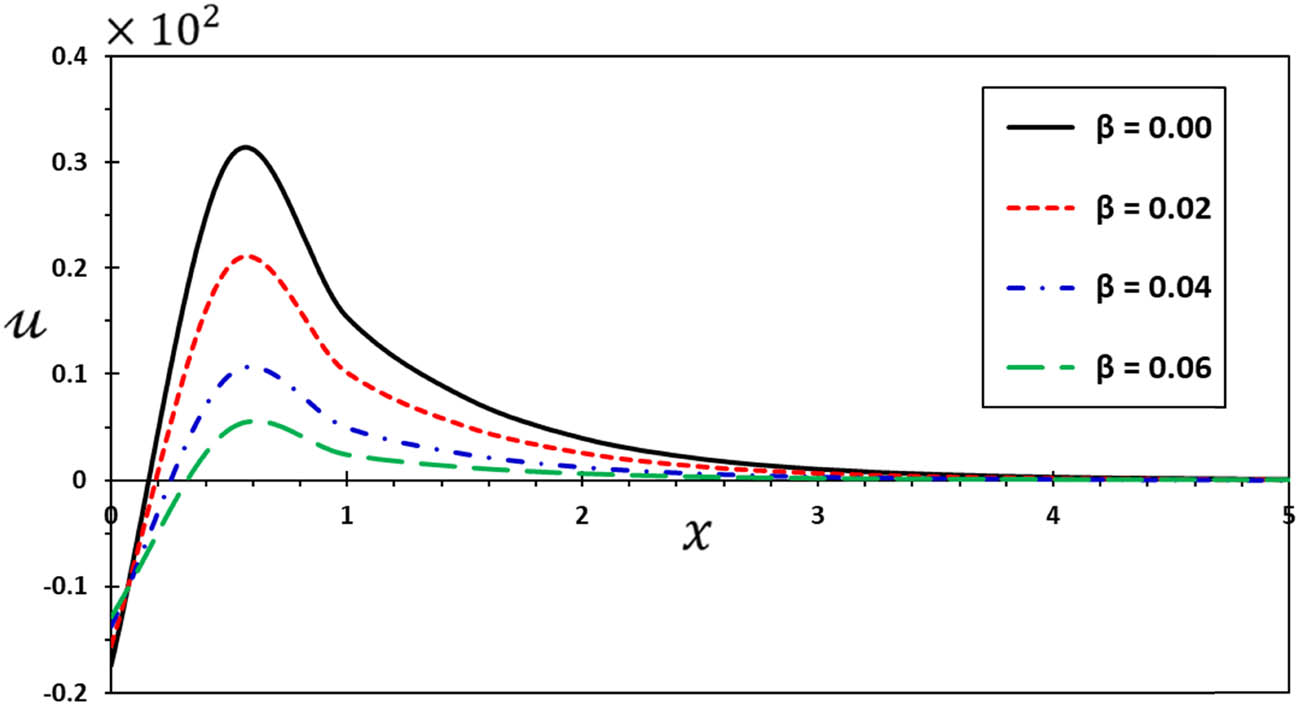
The observation of limited transmission of wave speeds can be deduced from the analysis of tables and figures. Furthermore, it can be observed from the presented tables and figures that the various models exhibit notable variations in values close to the surface borders. These discrepancies gradually diminish as the distance from the boundaries increases. This trend can be attributed to the influence of thermal shock exerted on the stress-free boundary. The conductive temperature pattern exhibits a peak value at the surface
Figure 2 shows a constant decreasing trend of the field
Figure 3 shows the effect of the two temperature difference indexes on the thermodynamic temperature change
Figure 4 depicts the graphical representations of the displacement
Figure 4 illustrates the fluctuation of the stress
Case II: Comparison of fractional differentiation operators
Various mathematical strategies are employed to solve non-integer-order models of PDEs in mathematical analysis. The mathematical theory of fractional calculus deals with nonlocal integration and differentiation. Fractional calculus has found extensive application in mathematical modeling and several physical phenomena. Numerous scholars have recently addressed thermoelastic difficulties in heat transmission under diverse mechanical and thermal circumstances by utilizing fractional C derivatives and Riemann–Liouville (RL) fractional derivatives. The AB time-fractional derivative is a recent and adapted version of the Caputo–Fabrizio (CF) technique. It possesses desirable characteristics such as non-singularity, non-locality of the kernel, prominent memory influences, and transmission effects.
This study introduces a thermal conductivity model incorporating fractional differential operators
The new FDPL thermoelastic model appears to improve the temperature field, as shown in Table 1. This improvement can be attributed to the incorporation of fractional operators, which effectively decrease thermal diffusion within the medium. This observation aligns with both experimental findings and established physical facts.
It was found that the two-temperature thermoelastic C fractional model with phase delays (2TFDPL-C) has much higher thermodynamic and conductive temperatures as the fractional parameter is raised. This is in contrast to the CF fractional model (2TFDPL-CF) and the AB fractional model (2TFDPL-AB).
It is imperative to acknowledge that the transmission of thermal and mechanical waves within an elastic medium is contingent upon the specific fractional-order derivative operator utilized. Hence, it can be inferred that the fractional arrangement considers the variability of the elastic medium, as each operator and fractional order signifies a distinct characteristic of elasticity.
The aforementioned theoretical findings possess potential utility in addressing some practical issues. Based on the theoretical findings and empirical evidence, selecting a fractional mathematical model that exhibits congruence between the experimental findings and theoretical outcomes is possible.
Tables 1–4 showcase the empirical results, which suggest that the power-law kernel exhibits a resilient memory effect in long-term historical data. On the other hand, non-singular kernels may be more suitable for describing relaxation or diffusion processes characterized by exceptionally strong memory.
It is demonstrated that the decay rate of the model with a stretched exponential kernel, which is of the CF type, is much quicker than that of the model with a power-law kernel. This indicates that a CF-type derivative model with a stretched exponential kernel, as opposed to one with a power-law kernel, may be used to describe a wider variety of relaxation events.
It is important to acknowledge that a mathematical model employing the AB-type derivative with a stretched Mittag–Leffler function kernel exhibits a slower diffusive motion compared to a model utilizing an exponential kernel.
Furthermore, it is highly anticipated that the novel fractional derivatives of AB and CF will significantly contribute to investigating the macroscopic characteristics of particular materials associated with nonlocal exchanges. These exchanges predominantly govern the properties of these materials.
Dynamic temperature distribution under the influence of different fractional differential operators
|
|
2TDPL | 2TFDPL-C | 2TFDPL-CF | 2TFDPL-AB | |||
|---|---|---|---|---|---|---|---|
|
|
|
|
|
|
|
|
|
| 0.0 | 0.826009 | 0.792505 | 0.7609570 | 0.731233 | 0.703209 | 0.676771 | 0.651815 |
| 0.5 | 0.423119 | 0.405957 | 0.3897960 | 0.374570 | 0.360215 | 0.346673 | 0.333889 |
| 1.0 | 0.215114 | 0.206389 | 0.1981730 | 0.190432 | 0.183134 | 0.176249 | 0.169750 |
| 1.5 | 0.109364 | 0.104928 | 0.1007510 | 0.096816 | 0.093105 | 0.089605 | 0.086301 |
| 2.0 | 0.055601 | 0.053346 | 0.0512222 | 0.049222 | 0.047335 | 0.045556 | 0.043876 |
| 2.5 | 0.028268 | 0.027122 | 0.0260421 | 0.025025 | 0.024066 | 0.023161 | 0.022307 |
| 3.0 | 0.014373 | 0.013790 | 0.0132407 | 0.012724 | 0.012236 | 0.011776 | 0.011342 |
| 3.5 | 0.007308 | 0.007012 | 0.00673259 | 0.006470 | 0.006222 | 0.005988 | 0.005767 |
| 4.0 | 0.003716 | 0.003566 | 0.00342388 | 0.003290 | 0.003164 | 0.003045 | 0.002933 |
| 4.5 | 0.001890 | 0.001814 | 0.00174174 | 0.001674 | 0.001610 | 0.001549 | 0.001492 |
| 5.0 | 0.000962 | 0.000923 | 0.000886547 | 0.000852 | 0.000819 | 0.000789 | 0.000760 |
Conductive temperature distribution under the influence of different fractional differential operators
|
|
2TDPL | 2TFDPL-C | 2TFDPL-CF | 2TFDPL-AB | |||
|---|---|---|---|---|---|---|---|
|
|
|
|
|
|
|
|
|
| 0.0 | 0.874464 | 0.838995 | 0.8055960 | 0.774128 | 0.744460 | 0.716472 | 0.690051 |
| 0.5 | 0.443852 | 0.425848 | 0.4088960 | 0.392924 | 0.377866 | 0.363660 | 0.350249 |
| 1.0 | 0.225652 | 0.216499 | 0.2078810 | 0.199761 | 0.192105 | 0.184883 | 0.178065 |
| 1.5 | 0.114721 | 0.110068 | 0.1056860 | 0.101558 | 0.097666 | 0.093994 | 0.090528 |
| 2.0 | 0.058325 | 0.055959 | 0.0537314 | 0.051633 | 0.049654 | 0.047787 | 0.046025 |
| 2.5 | 0.029653 | 0.028450 | 0.0273178 | 0.026251 | 0.025245 | 0.024296 | 0.023400 |
| 3.0 | 0.015076 | 0.014465 | 0.0138893 | 0.013347 | 0.012835 | 0.012353 | 0.011898 |
| 3.5 | 0.007666 | 0.007355 | 0.00706229 | 0.006787 | 0.006527 | 0.006281 | 0.006050 |
| 4.0 | 0.003898 | 0.003740 | 0.00359149 | 0.003451 | 0.003319 | 0.003194 | 0.003077 |
| 4.5 | 0.001983 | 0.001903 | 0.00182696 | 0.001756 | 0.001688 | 0.001625 | 0.001565 |
| 5.0 | 0.001009 | 0.000968 | 0.00092987 | 0.000894 | 0.000859 | 0.000827 | 0.000797 |
Displacement distribution under the influence of different fractional differential operators
|
|
2TDPL | 2TFDPL-C | 2TFDPL-CF | 2TFDPL-AB | |||
|---|---|---|---|---|---|---|---|
|
|
|
|
|
|
|
|
|
| 0.0 | −0.12601 | −0.12505 | −0.1095700 | −0.091230 | −0.08032 | −0.06768 | −0.05182 |
| 0.5 | 0.379483 | 0.364091 | 0.3495980 | 0.335943 | 0.323068 | 0.310923 | 0.299458 |
| 1.0 | 0.193224 | 0.185387 | 0.1780080 | 0.171055 | 0.164500 | 0.158316 | 0.152478 |
| 1.5 | 0.098241 | 0.094256 | 0.0905047 | 0.086970 | 0.083637 | 0.080494 | 0.077526 |
| 2.0 | 0.049951 | 0.047926 | 0.0460186 | 0.044222 | 0.042527 | 0.040929 | 0.039420 |
| 2.5 | 0.025402 | 0.024372 | 0.0234020 | 0.022488 | 0.021627 | 0.020815 | 0.020048 |
| 3.0 | 0.012920 | 0.012397 | 0.0119039 | 0.011439 | 0.011002 | 0.010588 | 0.010199 |
| 3.5 | 0.006575 | 0.006309 | 0.0060583 | 0.005822 | 0.005600 | 0.005390 | 0.005191 |
| 4.0 | 0.003349 | 0.003214 | 0.00308639 | 0.002966 | 0.002853 | 0.002746 | 0.002646 |
| 4.5 | 0.001709 | 0.001640 | 0.00157544 | 0.001514 | 0.001457 | 0.001403 | 0.001351 |
| 5.0 | 0.000875 | 0.000840 | 0.000807237 | 0.000776 | 0.000747 | 0.000719 | 0.000693 |
Thermal stress distribution under the influence of different fractional differential operators
|
|
2TDPL | 2TFDPL-C | 2TFDPL-CF | 2TFDPL-AB | |||
|---|---|---|---|---|---|---|---|
|
|
|
|
|
|
|
|
|
| 0.0 | 0 | 0 | 0 | 0 | 0 | 0 | 0 |
| 0.5 | −0.4218 | −0.40469 | −0.388578 | −0.37340 | −0.35909 | −0.34559 | −0.33285 |
| 1.0 | −0.21474 | −0.20603 | −0.197825 | −0.19010 | −0.18281 | −0.17594 | −0.16945 |
| 1.5 | −0.10918 | −0.10475 | −0.100580 | −0.09665 | −0.09295 | −0.08945 | −0.08616 |
| 2.0 | −0.05551 | −0.05326 | −0.0511408 | −0.04914 | −0.04726 | −0.04548 | −0.04381 |
| 2.5 | −0.02823 | −0.02708 | −0.0260063 | −0.02499 | −0.02403 | −0.02313 | −0.02228 |
| 3.0 | −0.01436 | −0.01378 | −0.0132280 | −0.01271 | −0.01223 | −0.01177 | −0.01133 |
| 3.5 | −0.00731 | −0.00701 | −0.00673156 | −0.00647 | −0.00622 | −0.00599 | −0.00577 |
| 4.0 | −0.00372 | −0.00357 | −0.00342877 | −0.00330 | −0.00317 | −0.00305 | −0.00294 |
| 4.5 | −0.0019 | −0.00182 | −0.00174961 | −0.00168 | −0.00162 | −0.00156 | −0.00150 |
| 5.0 | −0.00097 | −0.00093 | −0.000895892 | −0.00086 | −0.00083 | −0.00080 | −0.00077 |
8 Conclusions
The physical aspects of relaxation and thermoelastic heat transfer models are studied in this work. It focuses on the newly introduced temporal derivative that uses a non-power function kernel. The use of analytical analysis shows that the C-type derivative idea, when combined with a power function kernel, is not good at describing the non-exponential changes that are often seen in asymmetrical heat conduction. Because of this, a new version of the thermoelasticity theory has been made that includes two temperatures, two separate phase delays, and fractional-order differential operators that are not in a single position. The revised definition’s primary benefit is replacing the singular power-law kernel with a Mittag–Leffler function and a non-singular exponential kernel. This replacement facilitates using the revised definition in theoretical analysis, numerical calculations, practical scenarios, and real-world applications.
The results show that the field variables, such as temperature, displacement, and thermal stress, are affected by the two-temperature parameter (
The AB and CF fractional operators offer reliable mathematical frameworks for comprehensively capturing nonlocal interactions inside materials. These operators empower researchers to construct advanced models that account for the impact of remote events on the macroscopic features of the material. By integrating these fractional operators into the governing equations, scholars are able to adequately consider the long-range correlations and spatial dependencies that are inherent in materials with nonlocal interactions. This enables a more precise depiction of their macroscopic behavior.
-
Funding information: The authors express their gratitude to the Deanship of Scientific Research at Jouf University for providing financial support for this study through research grant No. (DSR-2021-03-03172).
-
Author contributions: All authors have accepted responsibility for the entire content of this manuscript and approved its submission.
-
Conflict of interest: The authors state no conflict of interest.
-
Data availability statement: All data generated or analysed during this study are included in this published article.
References
[1] Banik S, Kanoria M. Effects of three-phase-lag on two-temperature generalized thermoelasticity for infinite medium with spherical cavity. Appl Math Mech. 2012;33:483–98.10.1007/s10483-012-1565-8Search in Google Scholar
[2] Abouelregal AE, Khalil KM, Mohammed FA, Nasr ME, Zakaria A, Ahmed I-E. A generalized heat conduction model of higher-order time derivatives and three-phase-lags for non-simple thermoelastic materials. Sci Rep. 2020;10(1):13625.10.1038/s41598-020-70388-1Search in Google Scholar PubMed PubMed Central
[3] Lord HW, Shulman Y. A generalized dynamical theory of thermoelasticity. J Mech Phys Solids. 1967;15(5):299–309.10.1016/0022-5096(67)90024-5Search in Google Scholar
[4] Green AE, Lindsay KA. Thermoelasticity. J Elast. 1972;2(1):1–7.10.1007/BF00045689Search in Google Scholar
[5] Tzou DY. The generalized lagging response in small-scale and high-rate heating. Int J Heat Mass Trans. 1995;38(17):3231–40.10.1016/0017-9310(95)00052-BSearch in Google Scholar
[6] Tzou DY. Experimental support for the lagging behavior in heat propagation. J Thermophy Heat Trans. 1995;9(4):686–93.10.2514/3.725Search in Google Scholar
[7] Choudhuri SKR. On a thermoelastic three-phase-lag model. J Therm Stress. 2007;30(3):231–8.10.1080/01495730601130919Search in Google Scholar
[8] Green AE, Naghdi PM. A reexamination of the basic results of thermomechanics. Proc R Soci Lond Ser A. 1991;432:171–94.10.1098/rspa.1991.0012Search in Google Scholar
[9] Green AE, Naghdi PM. On undamped heat waves in an elastic solid. J Therm Stress. 1992;15:252–64.10.1080/01495739208946136Search in Google Scholar
[10] Green AE, Naghdi PM. Thermoelasticity without energy dissipation. J Elast. 1993;31:189–208.10.1007/BF00044969Search in Google Scholar
[11] Askar SS, Abouelregal AE, Foul A, Sedighi HM. Pulsed excitation heating of semiconductor material and its thermomagnetic response on the basis of fourth-order MGT photothermal model. Acta Mech. 2023;234:4977–95.10.1007/s00707-023-03639-7Search in Google Scholar
[12] Abouelregal AE, Sedighi HM, Megahid SF. Photothermal-induced interactions in a semiconductor solid with a cylindrical gap due to laser pulse duration using a fractional MGT heat conduction model. Arch Appl Mech. 2023;93:2287–305.10.1007/s00419-023-02383-7Search in Google Scholar
[13] Abouelregal AE, Nasr ME, Moaaz O, Sedighi HM. Thermo-magnetic interaction in a viscoelastic micropolar medium by considering a higher-order two-phase-delay thermoelastic model. Acta Mech. 2023;234:2519–41.10.1007/s00707-023-03513-6Search in Google Scholar
[14] Abouelregal AE, Moaaz O, Khalil KM, Abouhawwash M, Nasr ME. Micropolar thermoelastic plane waves in microscopic materials caused by Hall-current effects in a two-temperature heat conduction model with higher-order time derivatives. Arch Appl Mech. 2023;93(5):1901–24.10.1007/s00419-023-02362-ySearch in Google Scholar
[15] Atta D, Abouelregal AE, Sedighi HM, Alharb RA. Thermodiffusion interactions in a homogeneous spherical shell based on the modified Moore-Gibson-Thompson theory with two time delays. Mech Time-Depend Mater. 2024;28:617–38.10.1007/s11043-023-09598-9Search in Google Scholar
[16] Gurtin ME, Williams WO. On the Clausius-Duhem inequality. Zeitschrift für angewandte Mathematik und Physik ZAMP. 1966;17(5):626–33.10.1007/BF01597243Search in Google Scholar
[17] Chen PJ, Gurtin ME. On a theory of heat conduction involving two temperatures. J Appl Math Phys ZAMP. 1968;19(4):614–27.10.1007/BF01594969Search in Google Scholar
[18] Chen PJ, Gurtin ME, Williams WO. A note on non-simple heat conduction. J Appl Math Phys ZAMP. 1968;19(4):969–70.10.1007/BF01602278Search in Google Scholar
[19] Chen PJ, Gurtin ME, Williams WO. On the thermodynamics of non-simple elastic materials with two temperatures. J Appl Math Phys ZAMP. 1969;20(1):107–12.10.1007/BF01591120Search in Google Scholar
[20] Warren WE, Chen PJ. Wave propagation in the two temperature theory of thermoelasticity. Acta Mech. 1973;16(1–2):21–33.10.1007/BF01177123Search in Google Scholar
[21] Quintanilla R. On existence, structural stability, convergence and spatial behavior in thermoelasticity with two temperatures. Acta Mech. 2004;168(1–2):61–73.10.1007/s00707-004-0073-6Search in Google Scholar
[22] Lesan D. On the thermodynamics of non-simple elastic materials with two temperatures. J Appl Math Phys ZAMP. 1970;21:583–91.Search in Google Scholar
[23] Samko SG, Kilbas AA, Marichev OI. Fractional integrals and derivatives: Theory and applications. Yverdon: Gordon and Breach; 1993.Search in Google Scholar
[24] Miller KS, Ross B. An introduction to the fractional calculus and fractional differential equations. New York: John Wiley and Sons; 1993.Search in Google Scholar
[25] Oldman KB, Spanier J. The fractional calculus. San Diego: Academic Press; 1974.Search in Google Scholar
[26] Podlubny I. Fractional differential equations: an introduction to fractional derivatives, fractional differential equations, to methods of their solution and some of their applications. Elsevier; 1998.Search in Google Scholar
[27] Saad KM. New fractional derivative with non-singular kernel for deriving Legendre spectral collocation method. Alex Eng J. 2020;59(4):1909–17.10.1016/j.aej.2019.11.017Search in Google Scholar
[28] Caputo M, Fabrizio M. A new definition of fractional derivative without singular kernel. Prog Fract Diff Appl. 2015;1(2):73–85.Search in Google Scholar
[29] Atangana A, Baleanu D. New fractional derivatives with nonlocal and non-singular kernel: theory and application to heat transfer model. Therm Sci. 2016;20(2):763–9.10.2298/TSCI160111018ASearch in Google Scholar
[30] Hattaf K. A new generalized definition of fractional derivative with non-singular kernel. Computation. 2020;8(2):49.10.3390/computation8020049Search in Google Scholar
[31] Ghanbari B, Kumar S, Kumar R. A study of behaviour for immune and tumor cells in immunogenetic tumour model with non-singular fractional derivative. Chaos Solit Fract. 2020;133:109619.10.1016/j.chaos.2020.109619Search in Google Scholar
[32] Al-Refai M, Abdeljawad T. Analysis of the fractional diffusion equations with fractional derivative of non-singular kernel. Adv Diff Equ. 2017;2017:1–12.10.1186/s13662-017-1356-2Search in Google Scholar
[33] Kamal R, Kamran Rahmat G, Ahmadian A, Arshad NI, Salahshour S. Approximation of linear one dimensional partial differential equations including fractional derivative with non-singular kernel. Adv Diff Equ. 2021;2021:1–15.10.1186/s13662-021-03472-zSearch in Google Scholar
[34] Ghanbari B. A new model for investigating the transmission of infectious diseases in a prey‐predator system using a non‐singular fractional derivative. Math Methods Appl Sci. 2023;46(7):8106–25.10.1002/mma.7412Search in Google Scholar
[35] Zitane H, Torres DF. A class of fractional differential equations via power non-local and non-singular kernels: Existence, uniqueness and numerical approximations. Phys D: Nonlinear Phenom. 2024;457:133951.10.1016/j.physd.2023.133951Search in Google Scholar
[36] Slimane I, Nazir G, Nieto JJ, Yaqoob F. Mathematical analysis of Hepatitis C Virus infection model in the framework of non-local and non-singular kernel fractional derivative. Int J Biomath. 2023;16(1):2250064.10.1142/S1793524522500644Search in Google Scholar
[37] Tiwari R, Mukhopadhyay S. On harmonic plane wave propagation under fractional order thermoelasticity: an analysis of fractional order heat conduction equation. Math Mech Solids. 2017;22(4):782–97.10.1177/1081286515612528Search in Google Scholar
[38] Dokuyucu MA, Dutta H, Yildirim C. Application of non‐local and non‐singular kernel to an epidemiological model with fractional order Math. Meth Appl Sci. 2021;44(5):3468–84.10.1002/mma.6954Search in Google Scholar
[39] Abouelregal AE, Alanazi R, Sedighi HM. Thermal plane waves in unbounded non-local medium exposed to a moving heat source with a non-singular kernel and higher order time derivatives. Eng Anal Bound Elem. 2022;140:464–75.10.1016/j.enganabound.2022.04.032Search in Google Scholar
[40] Atangana A, Araz Sİ. Extension of Atangana-Seda numerical method to partial differential equations with integer and non-integer order. Alex Eng J. 2020;59(4):2355–70.10.1016/j.aej.2020.02.031Search in Google Scholar
[41] Subaşi M, Araz SI. Numerical regularization of optimal control for the coefficient function in a wave equation. Iran J Sci Tech Trans A: Sci. 2019;43:2325–33.10.1007/s40995-019-00690-9Search in Google Scholar
[42] Araz SI. A fractional optimal control problem with final observation governed by wave equation. Chaos: An Interdiscip Nonlinear Sci. 2019;29(2):023115.10.1063/1.5086043Search in Google Scholar PubMed
[43] Padder A, Almutairi L, Qureshi S, Soomro A, Afroz A, Hincal E, et al. Dynamical analysis of generalized tumor model with caputo fractional-order derivative. Fract Fract. 2023;7(3):258.10.3390/fractalfract7030258Search in Google Scholar
[44] Mehmet Y, Thabet A. On a new integral transformation applied to fractional derivative with Mittag-Leffler nonsingular kernel. Electron Res Archive. 2020;28(1):481–95.Search in Google Scholar
[45] Hattaf K. A new class of generalized fractal and fractal-fractional derivatives with non-singular kernels. Fract Fract. 2023;7(5):395.10.3390/fractalfract7050395Search in Google Scholar
[46] Cui T, Liu P, Din A, Ali F. Theoretical and numerical analysis of COVID-19 pandemic model with non-local and non-singular kernels. Sci Rep. 2022;12(1):18178.10.1038/s41598-022-21372-4Search in Google Scholar PubMed PubMed Central
[47] Atangana A, Qureshi S. Modeling attractors of chaotic dynamical systems with fractal–fractional operators. Chaos solit fract. 2019;123:320–37.10.1016/j.chaos.2019.04.020Search in Google Scholar
[48] Farman M, Batool M, Nisar KS, Ghaffari AS, Ahmad A. Controllability and analysis of sustainable approach for cancer treatment with chemotherapy by using the fractional operator. Res Phys. 2023;51:106630.10.1016/j.rinp.2023.106630Search in Google Scholar
[49] Nisar KS, Farman M, Abdel-Aty M, Cao J. A review on epidemic models in sight of fractional calculus. Alex Eng J. 2023;75:81–113.10.1016/j.aej.2023.05.071Search in Google Scholar
[50] Maghsoudi-Khouzani S, Kurt A. New semi-analytical solution of fractional Newell–Whitehead–Segel equation arising in nonlinear optics with non-singular and non-local kernel derivative. Opt Quant Elect. 2024;56(4):576.10.1007/s11082-023-06126-4Search in Google Scholar
[51] Dineshkumar C, Udhayakumar R, Vijayakumar V, Shukla A, Nisar KS. Discussion on the approximate controllability of nonlocal fractional derivative by Mittag-Leffler kernel to stochastic differential systems. Qual Theo Dyn Sys. 2023;22(1):27.10.1007/s12346-022-00725-4Search in Google Scholar
[52] Farman M, Sarwar R, Akgul A. Modeling and analysis of sustainable approach for dynamics of infections in plant virus with fractal fractional operator. Chaos Solit Fract. 2023;170:113373.10.1016/j.chaos.2023.113373Search in Google Scholar
[53] Guo Z, Wang FB, Zou X. Threshold dynamics of an infective disease model with a fixed latent period and non-local infections. J Math Biol. 2012;65(6–7):1387–410.10.1007/s00285-011-0500-ySearch in Google Scholar PubMed
[54] Honig G, Hirdes U. A method for the numerical inversion of the Laplace transform. J Comput Appl Math. 1984;10:113–32.10.1016/0377-0427(84)90075-XSearch in Google Scholar
[55] Abouelregal AE. A comparative study of a thermoelastic problem for an infinite rigid cylinder with thermal properties using a new heat conduction model including fractional operators without non-singular kernels. Arch Appl Mech. 2022;92(11):3141–61.10.1007/s00419-022-02228-9Search in Google Scholar PubMed PubMed Central
[56] Abouelregal AE. Two-temperature thermoelastic model without energy dissipation including higher order time-derivatives and two phase-lags. Mater Res Exp. 2019;6(11):116535.10.1088/2053-1591/ab447fSearch in Google Scholar
[57] Kumar R, Prasad R, Kumar R. Thermoelastic interactions on hyperbolic two-temperature generalized thermoelasticity in an infinite medium with a cylindrical cavity. Eur J Mech-A/Solids. 2020;82:104007.10.1016/j.euromechsol.2020.104007Search in Google Scholar
[58] Deswal S, Kalkal KK, Sheoran SS. Axi-symmetric generalized thermoelastic diffusion problem with two-temperature and initial stress under fractional order heat conduction. Phys B: Cond Matt. 2016;496:57–68.10.1016/j.physb.2016.05.008Search in Google Scholar
© 2024 the author(s), published by De Gruyter
This work is licensed under the Creative Commons Attribution 4.0 International License.
Articles in the same Issue
- Regular Articles
- Numerical study of flow and heat transfer in the channel of panel-type radiator with semi-detached inclined trapezoidal wing vortex generators
- Homogeneous–heterogeneous reactions in the colloidal investigation of Casson fluid
- High-speed mid-infrared Mach–Zehnder electro-optical modulators in lithium niobate thin film on sapphire
- Numerical analysis of dengue transmission model using Caputo–Fabrizio fractional derivative
- Mononuclear nanofluids undergoing convective heating across a stretching sheet and undergoing MHD flow in three dimensions: Potential industrial applications
- Heat transfer characteristics of cobalt ferrite nanoparticles scattered in sodium alginate-based non-Newtonian nanofluid over a stretching/shrinking horizontal plane surface
- The electrically conducting water-based nanofluid flow containing titanium and aluminum alloys over a rotating disk surface with nonlinear thermal radiation: A numerical analysis
- Growth, characterization, and anti-bacterial activity of l-methionine supplemented with sulphamic acid single crystals
- A numerical analysis of the blood-based Casson hybrid nanofluid flow past a convectively heated surface embedded in a porous medium
- Optoelectronic–thermomagnetic effect of a microelongated non-local rotating semiconductor heated by pulsed laser with varying thermal conductivity
- Thermal proficiency of magnetized and radiative cross-ternary hybrid nanofluid flow induced by a vertical cylinder
- Enhanced heat transfer and fluid motion in 3D nanofluid with anisotropic slip and magnetic field
- Numerical analysis of thermophoretic particle deposition on 3D Casson nanofluid: Artificial neural networks-based Levenberg–Marquardt algorithm
- Analyzing fuzzy fractional Degasperis–Procesi and Camassa–Holm equations with the Atangana–Baleanu operator
- Bayesian estimation of equipment reliability with normal-type life distribution based on multiple batch tests
- Chaotic control problem of BEC system based on Hartree–Fock mean field theory
- Optimized framework numerical solution for swirling hybrid nanofluid flow with silver/gold nanoparticles on a stretching cylinder with heat source/sink and reactive agents
- Stability analysis and numerical results for some schemes discretising 2D nonconstant coefficient advection–diffusion equations
- Convective flow of a magnetohydrodynamic second-grade fluid past a stretching surface with Cattaneo–Christov heat and mass flux model
- Analysis of the heat transfer enhancement in water-based micropolar hybrid nanofluid flow over a vertical flat surface
- Microscopic seepage simulation of gas and water in shale pores and slits based on VOF
- Model of conversion of flow from confined to unconfined aquifers with stochastic approach
- Study of fractional variable-order lymphatic filariasis infection model
- Soliton, quasi-soliton, and their interaction solutions of a nonlinear (2 + 1)-dimensional ZK–mZK–BBM equation for gravity waves
- Application of conserved quantities using the formal Lagrangian of a nonlinear integro partial differential equation through optimal system of one-dimensional subalgebras in physics and engineering
- Nonlinear fractional-order differential equations: New closed-form traveling-wave solutions
- Sixth-kind Chebyshev polynomials technique to numerically treat the dissipative viscoelastic fluid flow in the rheology of Cattaneo–Christov model
- Some transforms, Riemann–Liouville fractional operators, and applications of newly extended M–L (p, s, k) function
- Magnetohydrodynamic water-based hybrid nanofluid flow comprising diamond and copper nanoparticles on a stretching sheet with slips constraints
- Super-resolution reconstruction method of the optical synthetic aperture image using generative adversarial network
- A two-stage framework for predicting the remaining useful life of bearings
- Influence of variable fluid properties on mixed convective Darcy–Forchheimer flow relation over a surface with Soret and Dufour spectacle
- Inclined surface mixed convection flow of viscous fluid with porous medium and Soret effects
- Exact solutions to vorticity of the fractional nonuniform Poiseuille flows
- In silico modified UV spectrophotometric approaches to resolve overlapped spectra for quality control of rosuvastatin and teneligliptin formulation
- Numerical simulations for fractional Hirota–Satsuma coupled Korteweg–de Vries systems
- Substituent effect on the electronic and optical properties of newly designed pyrrole derivatives using density functional theory
- A comparative analysis of shielding effectiveness in glass and concrete containers
- Numerical analysis of the MHD Williamson nanofluid flow over a nonlinear stretching sheet through a Darcy porous medium: Modeling and simulation
- Analytical and numerical investigation for viscoelastic fluid with heat transfer analysis during rollover-web coating phenomena
- Influence of variable viscosity on existing sheet thickness in the calendering of non-isothermal viscoelastic materials
- Analysis of nonlinear fractional-order Fisher equation using two reliable techniques
- Comparison of plan quality and robustness using VMAT and IMRT for breast cancer
- Radiative nanofluid flow over a slender stretching Riga plate under the impact of exponential heat source/sink
- Numerical investigation of acoustic streaming vortices in cylindrical tube arrays
- Numerical study of blood-based MHD tangent hyperbolic hybrid nanofluid flow over a permeable stretching sheet with variable thermal conductivity and cross-diffusion
- Fractional view analytical analysis of generalized regularized long wave equation
- Dynamic simulation of non-Newtonian boundary layer flow: An enhanced exponential time integrator approach with spatially and temporally variable heat sources
- Inclined magnetized infinite shear rate viscosity of non-Newtonian tetra hybrid nanofluid in stenosed artery with non-uniform heat sink/source
- Estimation of monotone α-quantile of past lifetime function with application
- Numerical simulation for the slip impacts on the radiative nanofluid flow over a stretched surface with nonuniform heat generation and viscous dissipation
- Study of fractional telegraph equation via Shehu homotopy perturbation method
- An investigation into the impact of thermal radiation and chemical reactions on the flow through porous media of a Casson hybrid nanofluid including unstable mixed convection with stretched sheet in the presence of thermophoresis and Brownian motion
- Establishing breather and N-soliton solutions for conformable Klein–Gordon equation
- An electro-optic half subtractor from a silicon-based hybrid surface plasmon polariton waveguide
- CFD analysis of particle shape and Reynolds number on heat transfer characteristics of nanofluid in heated tube
- Abundant exact traveling wave solutions and modulation instability analysis to the generalized Hirota–Satsuma–Ito equation
- A short report on a probability-based interpretation of quantum mechanics
- Study on cavitation and pulsation characteristics of a novel rotor-radial groove hydrodynamic cavitation reactor
- Optimizing heat transport in a permeable cavity with an isothermal solid block: Influence of nanoparticles volume fraction and wall velocity ratio
- Linear instability of the vertical throughflow in a porous layer saturated by a power-law fluid with variable gravity effect
- Thermal analysis of generalized Cattaneo–Christov theories in Burgers nanofluid in the presence of thermo-diffusion effects and variable thermal conductivity
- A new benchmark for camouflaged object detection: RGB-D camouflaged object detection dataset
- Effect of electron temperature and concentration on production of hydroxyl radical and nitric oxide in atmospheric pressure low-temperature helium plasma jet: Swarm analysis and global model investigation
- Double diffusion convection of Maxwell–Cattaneo fluids in a vertical slot
- Thermal analysis of extended surfaces using deep neural networks
- Steady-state thermodynamic process in multilayered heterogeneous cylinder
- Multiresponse optimisation and process capability analysis of chemical vapour jet machining for the acrylonitrile butadiene styrene polymer: Unveiling the morphology
- Modeling monkeypox virus transmission: Stability analysis and comparison of analytical techniques
- Fourier spectral method for the fractional-in-space coupled Whitham–Broer–Kaup equations on unbounded domain
- The chaotic behavior and traveling wave solutions of the conformable extended Korteweg–de-Vries model
- Research on optimization of combustor liner structure based on arc-shaped slot hole
- Construction of M-shaped solitons for a modified regularized long-wave equation via Hirota's bilinear method
- Effectiveness of microwave ablation using two simultaneous antennas for liver malignancy treatment
- Discussion on optical solitons, sensitivity and qualitative analysis to a fractional model of ion sound and Langmuir waves with Atangana Baleanu derivatives
- Reliability of two-dimensional steady magnetized Jeffery fluid over shrinking sheet with chemical effect
- Generalized model of thermoelasticity associated with fractional time-derivative operators and its applications to non-simple elastic materials
- Migration of two rigid spheres translating within an infinite couple stress fluid under the impact of magnetic field
- A comparative investigation of neutron and gamma radiation interaction properties of zircaloy-2 and zircaloy-4 with consideration of mechanical properties
- New optical stochastic solutions for the Schrödinger equation with multiplicative Wiener process/random variable coefficients using two different methods
- Physical aspects of quantile residual lifetime sequence
- Synthesis, structure, I–V characteristics, and optical properties of chromium oxide thin films for optoelectronic applications
- Smart mathematically filtered UV spectroscopic methods for quality assurance of rosuvastatin and valsartan from formulation
- A novel investigation into time-fractional multi-dimensional Navier–Stokes equations within Aboodh transform
- Homotopic dynamic solution of hydrodynamic nonlinear natural convection containing superhydrophobicity and isothermally heated parallel plate with hybrid nanoparticles
- A novel tetra hybrid bio-nanofluid model with stenosed artery
- Propagation of traveling wave solution of the strain wave equation in microcrystalline materials
- Innovative analysis to the time-fractional q-deformed tanh-Gordon equation via modified double Laplace transform method
- A new investigation of the extended Sakovich equation for abundant soliton solution in industrial engineering via two efficient techniques
- New soliton solutions of the conformable time fractional Drinfel'd–Sokolov–Wilson equation based on the complete discriminant system method
- Irradiation of hydrophilic acrylic intraocular lenses by a 365 nm UV lamp
- Inflation and the principle of equivalence
- The use of a supercontinuum light source for the characterization of passive fiber optic components
- Optical solitons to the fractional Kundu–Mukherjee–Naskar equation with time-dependent coefficients
- A promising photocathode for green hydrogen generation from sanitation water without external sacrificing agent: silver-silver oxide/poly(1H-pyrrole) dendritic nanocomposite seeded on poly-1H pyrrole film
- Photon balance in the fiber laser model
- Propagation of optical spatial solitons in nematic liquid crystals with quadruple power law of nonlinearity appears in fluid mechanics
- Theoretical investigation and sensitivity analysis of non-Newtonian fluid during roll coating process by response surface methodology
- Utilizing slip conditions on transport phenomena of heat energy with dust and tiny nanoparticles over a wedge
- Bismuthyl chloride/poly(m-toluidine) nanocomposite seeded on poly-1H pyrrole: Photocathode for green hydrogen generation
- Infrared thermography based fault diagnosis of diesel engines using convolutional neural network and image enhancement
- On some solitary wave solutions of the Estevez--Mansfield--Clarkson equation with conformable fractional derivatives in time
- Impact of permeability and fluid parameters in couple stress media on rotating eccentric spheres
- Review Article
- Transformer-based intelligent fault diagnosis methods of mechanical equipment: A survey
- Special Issue on Predicting pattern alterations in nature - Part II
- A comparative study of Bagley–Torvik equation under nonsingular kernel derivatives using Weeks method
- On the existence and numerical simulation of Cholera epidemic model
- Numerical solutions of generalized Atangana–Baleanu time-fractional FitzHugh–Nagumo equation using cubic B-spline functions
- Dynamic properties of the multimalware attacks in wireless sensor networks: Fractional derivative analysis of wireless sensor networks
- Prediction of COVID-19 spread with models in different patterns: A case study of Russia
- Study of chronic myeloid leukemia with T-cell under fractal-fractional order model
- Accumulation process in the environment for a generalized mass transport system
- Analysis of a generalized proportional fractional stochastic differential equation incorporating Carathéodory's approximation and applications
- Special Issue on Nanomaterial utilization and structural optimization - Part II
- Numerical study on flow and heat transfer performance of a spiral-wound heat exchanger for natural gas
- Study of ultrasonic influence on heat transfer and resistance performance of round tube with twisted belt
- Numerical study on bionic airfoil fins used in printed circuit plate heat exchanger
- Improving heat transfer efficiency via optimization and sensitivity assessment in hybrid nanofluid flow with variable magnetism using the Yamada–Ota model
- Special Issue on Nanofluids: Synthesis, Characterization, and Applications
- Exact solutions of a class of generalized nanofluidic models
- Stability enhancement of Al2O3, ZnO, and TiO2 binary nanofluids for heat transfer applications
- Thermal transport energy performance on tangent hyperbolic hybrid nanofluids and their implementation in concentrated solar aircraft wings
- Studying nonlinear vibration analysis of nanoelectro-mechanical resonators via analytical computational method
- Numerical analysis of non-linear radiative Casson fluids containing CNTs having length and radius over permeable moving plate
- Two-phase numerical simulation of thermal and solutal transport exploration of a non-Newtonian nanomaterial flow past a stretching surface with chemical reaction
- Natural convection and flow patterns of Cu–water nanofluids in hexagonal cavity: A novel thermal case study
- Solitonic solutions and study of nonlinear wave dynamics in a Murnaghan hyperelastic circular pipe
- Comparative study of couple stress fluid flow using OHAM and NIM
- Utilization of OHAM to investigate entropy generation with a temperature-dependent thermal conductivity model in hybrid nanofluid using the radiation phenomenon
- Slip effects on magnetized radiatively hybridized ferrofluid flow with acute magnetic force over shrinking/stretching surface
- Significance of 3D rectangular closed domain filled with charged particles and nanoparticles engaging finite element methodology
- Robustness and dynamical features of fractional difference spacecraft model with Mittag–Leffler stability
- Characterizing magnetohydrodynamic effects on developed nanofluid flow in an obstructed vertical duct under constant pressure gradient
- Study on dynamic and static tensile and puncture-resistant mechanical properties of impregnated STF multi-dimensional structure Kevlar fiber reinforced composites
- Thermosolutal Marangoni convective flow of MHD tangent hyperbolic hybrid nanofluids with elastic deformation and heat source
- Investigation of convective heat transport in a Carreau hybrid nanofluid between two stretchable rotatory disks
- Single-channel cooling system design by using perforated porous insert and modeling with POD for double conductive panel
- Special Issue on Fundamental Physics from Atoms to Cosmos - Part I
- Pulsed excitation of a quantum oscillator: A model accounting for damping
- Review of recent analytical advances in the spectroscopy of hydrogenic lines in plasmas
- Heavy mesons mass spectroscopy under a spin-dependent Cornell potential within the framework of the spinless Salpeter equation
- Coherent manipulation of bright and dark solitons of reflection and transmission pulses through sodium atomic medium
- Effect of the gravitational field strength on the rate of chemical reactions
- The kinetic relativity theory – hiding in plain sight
- Special Issue on Advanced Energy Materials - Part III
- Eco-friendly graphitic carbon nitride–poly(1H pyrrole) nanocomposite: A photocathode for green hydrogen production, paving the way for commercial applications
Articles in the same Issue
- Regular Articles
- Numerical study of flow and heat transfer in the channel of panel-type radiator with semi-detached inclined trapezoidal wing vortex generators
- Homogeneous–heterogeneous reactions in the colloidal investigation of Casson fluid
- High-speed mid-infrared Mach–Zehnder electro-optical modulators in lithium niobate thin film on sapphire
- Numerical analysis of dengue transmission model using Caputo–Fabrizio fractional derivative
- Mononuclear nanofluids undergoing convective heating across a stretching sheet and undergoing MHD flow in three dimensions: Potential industrial applications
- Heat transfer characteristics of cobalt ferrite nanoparticles scattered in sodium alginate-based non-Newtonian nanofluid over a stretching/shrinking horizontal plane surface
- The electrically conducting water-based nanofluid flow containing titanium and aluminum alloys over a rotating disk surface with nonlinear thermal radiation: A numerical analysis
- Growth, characterization, and anti-bacterial activity of l-methionine supplemented with sulphamic acid single crystals
- A numerical analysis of the blood-based Casson hybrid nanofluid flow past a convectively heated surface embedded in a porous medium
- Optoelectronic–thermomagnetic effect of a microelongated non-local rotating semiconductor heated by pulsed laser with varying thermal conductivity
- Thermal proficiency of magnetized and radiative cross-ternary hybrid nanofluid flow induced by a vertical cylinder
- Enhanced heat transfer and fluid motion in 3D nanofluid with anisotropic slip and magnetic field
- Numerical analysis of thermophoretic particle deposition on 3D Casson nanofluid: Artificial neural networks-based Levenberg–Marquardt algorithm
- Analyzing fuzzy fractional Degasperis–Procesi and Camassa–Holm equations with the Atangana–Baleanu operator
- Bayesian estimation of equipment reliability with normal-type life distribution based on multiple batch tests
- Chaotic control problem of BEC system based on Hartree–Fock mean field theory
- Optimized framework numerical solution for swirling hybrid nanofluid flow with silver/gold nanoparticles on a stretching cylinder with heat source/sink and reactive agents
- Stability analysis and numerical results for some schemes discretising 2D nonconstant coefficient advection–diffusion equations
- Convective flow of a magnetohydrodynamic second-grade fluid past a stretching surface with Cattaneo–Christov heat and mass flux model
- Analysis of the heat transfer enhancement in water-based micropolar hybrid nanofluid flow over a vertical flat surface
- Microscopic seepage simulation of gas and water in shale pores and slits based on VOF
- Model of conversion of flow from confined to unconfined aquifers with stochastic approach
- Study of fractional variable-order lymphatic filariasis infection model
- Soliton, quasi-soliton, and their interaction solutions of a nonlinear (2 + 1)-dimensional ZK–mZK–BBM equation for gravity waves
- Application of conserved quantities using the formal Lagrangian of a nonlinear integro partial differential equation through optimal system of one-dimensional subalgebras in physics and engineering
- Nonlinear fractional-order differential equations: New closed-form traveling-wave solutions
- Sixth-kind Chebyshev polynomials technique to numerically treat the dissipative viscoelastic fluid flow in the rheology of Cattaneo–Christov model
- Some transforms, Riemann–Liouville fractional operators, and applications of newly extended M–L (p, s, k) function
- Magnetohydrodynamic water-based hybrid nanofluid flow comprising diamond and copper nanoparticles on a stretching sheet with slips constraints
- Super-resolution reconstruction method of the optical synthetic aperture image using generative adversarial network
- A two-stage framework for predicting the remaining useful life of bearings
- Influence of variable fluid properties on mixed convective Darcy–Forchheimer flow relation over a surface with Soret and Dufour spectacle
- Inclined surface mixed convection flow of viscous fluid with porous medium and Soret effects
- Exact solutions to vorticity of the fractional nonuniform Poiseuille flows
- In silico modified UV spectrophotometric approaches to resolve overlapped spectra for quality control of rosuvastatin and teneligliptin formulation
- Numerical simulations for fractional Hirota–Satsuma coupled Korteweg–de Vries systems
- Substituent effect on the electronic and optical properties of newly designed pyrrole derivatives using density functional theory
- A comparative analysis of shielding effectiveness in glass and concrete containers
- Numerical analysis of the MHD Williamson nanofluid flow over a nonlinear stretching sheet through a Darcy porous medium: Modeling and simulation
- Analytical and numerical investigation for viscoelastic fluid with heat transfer analysis during rollover-web coating phenomena
- Influence of variable viscosity on existing sheet thickness in the calendering of non-isothermal viscoelastic materials
- Analysis of nonlinear fractional-order Fisher equation using two reliable techniques
- Comparison of plan quality and robustness using VMAT and IMRT for breast cancer
- Radiative nanofluid flow over a slender stretching Riga plate under the impact of exponential heat source/sink
- Numerical investigation of acoustic streaming vortices in cylindrical tube arrays
- Numerical study of blood-based MHD tangent hyperbolic hybrid nanofluid flow over a permeable stretching sheet with variable thermal conductivity and cross-diffusion
- Fractional view analytical analysis of generalized regularized long wave equation
- Dynamic simulation of non-Newtonian boundary layer flow: An enhanced exponential time integrator approach with spatially and temporally variable heat sources
- Inclined magnetized infinite shear rate viscosity of non-Newtonian tetra hybrid nanofluid in stenosed artery with non-uniform heat sink/source
- Estimation of monotone α-quantile of past lifetime function with application
- Numerical simulation for the slip impacts on the radiative nanofluid flow over a stretched surface with nonuniform heat generation and viscous dissipation
- Study of fractional telegraph equation via Shehu homotopy perturbation method
- An investigation into the impact of thermal radiation and chemical reactions on the flow through porous media of a Casson hybrid nanofluid including unstable mixed convection with stretched sheet in the presence of thermophoresis and Brownian motion
- Establishing breather and N-soliton solutions for conformable Klein–Gordon equation
- An electro-optic half subtractor from a silicon-based hybrid surface plasmon polariton waveguide
- CFD analysis of particle shape and Reynolds number on heat transfer characteristics of nanofluid in heated tube
- Abundant exact traveling wave solutions and modulation instability analysis to the generalized Hirota–Satsuma–Ito equation
- A short report on a probability-based interpretation of quantum mechanics
- Study on cavitation and pulsation characteristics of a novel rotor-radial groove hydrodynamic cavitation reactor
- Optimizing heat transport in a permeable cavity with an isothermal solid block: Influence of nanoparticles volume fraction and wall velocity ratio
- Linear instability of the vertical throughflow in a porous layer saturated by a power-law fluid with variable gravity effect
- Thermal analysis of generalized Cattaneo–Christov theories in Burgers nanofluid in the presence of thermo-diffusion effects and variable thermal conductivity
- A new benchmark for camouflaged object detection: RGB-D camouflaged object detection dataset
- Effect of electron temperature and concentration on production of hydroxyl radical and nitric oxide in atmospheric pressure low-temperature helium plasma jet: Swarm analysis and global model investigation
- Double diffusion convection of Maxwell–Cattaneo fluids in a vertical slot
- Thermal analysis of extended surfaces using deep neural networks
- Steady-state thermodynamic process in multilayered heterogeneous cylinder
- Multiresponse optimisation and process capability analysis of chemical vapour jet machining for the acrylonitrile butadiene styrene polymer: Unveiling the morphology
- Modeling monkeypox virus transmission: Stability analysis and comparison of analytical techniques
- Fourier spectral method for the fractional-in-space coupled Whitham–Broer–Kaup equations on unbounded domain
- The chaotic behavior and traveling wave solutions of the conformable extended Korteweg–de-Vries model
- Research on optimization of combustor liner structure based on arc-shaped slot hole
- Construction of M-shaped solitons for a modified regularized long-wave equation via Hirota's bilinear method
- Effectiveness of microwave ablation using two simultaneous antennas for liver malignancy treatment
- Discussion on optical solitons, sensitivity and qualitative analysis to a fractional model of ion sound and Langmuir waves with Atangana Baleanu derivatives
- Reliability of two-dimensional steady magnetized Jeffery fluid over shrinking sheet with chemical effect
- Generalized model of thermoelasticity associated with fractional time-derivative operators and its applications to non-simple elastic materials
- Migration of two rigid spheres translating within an infinite couple stress fluid under the impact of magnetic field
- A comparative investigation of neutron and gamma radiation interaction properties of zircaloy-2 and zircaloy-4 with consideration of mechanical properties
- New optical stochastic solutions for the Schrödinger equation with multiplicative Wiener process/random variable coefficients using two different methods
- Physical aspects of quantile residual lifetime sequence
- Synthesis, structure, I–V characteristics, and optical properties of chromium oxide thin films for optoelectronic applications
- Smart mathematically filtered UV spectroscopic methods for quality assurance of rosuvastatin and valsartan from formulation
- A novel investigation into time-fractional multi-dimensional Navier–Stokes equations within Aboodh transform
- Homotopic dynamic solution of hydrodynamic nonlinear natural convection containing superhydrophobicity and isothermally heated parallel plate with hybrid nanoparticles
- A novel tetra hybrid bio-nanofluid model with stenosed artery
- Propagation of traveling wave solution of the strain wave equation in microcrystalline materials
- Innovative analysis to the time-fractional q-deformed tanh-Gordon equation via modified double Laplace transform method
- A new investigation of the extended Sakovich equation for abundant soliton solution in industrial engineering via two efficient techniques
- New soliton solutions of the conformable time fractional Drinfel'd–Sokolov–Wilson equation based on the complete discriminant system method
- Irradiation of hydrophilic acrylic intraocular lenses by a 365 nm UV lamp
- Inflation and the principle of equivalence
- The use of a supercontinuum light source for the characterization of passive fiber optic components
- Optical solitons to the fractional Kundu–Mukherjee–Naskar equation with time-dependent coefficients
- A promising photocathode for green hydrogen generation from sanitation water without external sacrificing agent: silver-silver oxide/poly(1H-pyrrole) dendritic nanocomposite seeded on poly-1H pyrrole film
- Photon balance in the fiber laser model
- Propagation of optical spatial solitons in nematic liquid crystals with quadruple power law of nonlinearity appears in fluid mechanics
- Theoretical investigation and sensitivity analysis of non-Newtonian fluid during roll coating process by response surface methodology
- Utilizing slip conditions on transport phenomena of heat energy with dust and tiny nanoparticles over a wedge
- Bismuthyl chloride/poly(m-toluidine) nanocomposite seeded on poly-1H pyrrole: Photocathode for green hydrogen generation
- Infrared thermography based fault diagnosis of diesel engines using convolutional neural network and image enhancement
- On some solitary wave solutions of the Estevez--Mansfield--Clarkson equation with conformable fractional derivatives in time
- Impact of permeability and fluid parameters in couple stress media on rotating eccentric spheres
- Review Article
- Transformer-based intelligent fault diagnosis methods of mechanical equipment: A survey
- Special Issue on Predicting pattern alterations in nature - Part II
- A comparative study of Bagley–Torvik equation under nonsingular kernel derivatives using Weeks method
- On the existence and numerical simulation of Cholera epidemic model
- Numerical solutions of generalized Atangana–Baleanu time-fractional FitzHugh–Nagumo equation using cubic B-spline functions
- Dynamic properties of the multimalware attacks in wireless sensor networks: Fractional derivative analysis of wireless sensor networks
- Prediction of COVID-19 spread with models in different patterns: A case study of Russia
- Study of chronic myeloid leukemia with T-cell under fractal-fractional order model
- Accumulation process in the environment for a generalized mass transport system
- Analysis of a generalized proportional fractional stochastic differential equation incorporating Carathéodory's approximation and applications
- Special Issue on Nanomaterial utilization and structural optimization - Part II
- Numerical study on flow and heat transfer performance of a spiral-wound heat exchanger for natural gas
- Study of ultrasonic influence on heat transfer and resistance performance of round tube with twisted belt
- Numerical study on bionic airfoil fins used in printed circuit plate heat exchanger
- Improving heat transfer efficiency via optimization and sensitivity assessment in hybrid nanofluid flow with variable magnetism using the Yamada–Ota model
- Special Issue on Nanofluids: Synthesis, Characterization, and Applications
- Exact solutions of a class of generalized nanofluidic models
- Stability enhancement of Al2O3, ZnO, and TiO2 binary nanofluids for heat transfer applications
- Thermal transport energy performance on tangent hyperbolic hybrid nanofluids and their implementation in concentrated solar aircraft wings
- Studying nonlinear vibration analysis of nanoelectro-mechanical resonators via analytical computational method
- Numerical analysis of non-linear radiative Casson fluids containing CNTs having length and radius over permeable moving plate
- Two-phase numerical simulation of thermal and solutal transport exploration of a non-Newtonian nanomaterial flow past a stretching surface with chemical reaction
- Natural convection and flow patterns of Cu–water nanofluids in hexagonal cavity: A novel thermal case study
- Solitonic solutions and study of nonlinear wave dynamics in a Murnaghan hyperelastic circular pipe
- Comparative study of couple stress fluid flow using OHAM and NIM
- Utilization of OHAM to investigate entropy generation with a temperature-dependent thermal conductivity model in hybrid nanofluid using the radiation phenomenon
- Slip effects on magnetized radiatively hybridized ferrofluid flow with acute magnetic force over shrinking/stretching surface
- Significance of 3D rectangular closed domain filled with charged particles and nanoparticles engaging finite element methodology
- Robustness and dynamical features of fractional difference spacecraft model with Mittag–Leffler stability
- Characterizing magnetohydrodynamic effects on developed nanofluid flow in an obstructed vertical duct under constant pressure gradient
- Study on dynamic and static tensile and puncture-resistant mechanical properties of impregnated STF multi-dimensional structure Kevlar fiber reinforced composites
- Thermosolutal Marangoni convective flow of MHD tangent hyperbolic hybrid nanofluids with elastic deformation and heat source
- Investigation of convective heat transport in a Carreau hybrid nanofluid between two stretchable rotatory disks
- Single-channel cooling system design by using perforated porous insert and modeling with POD for double conductive panel
- Special Issue on Fundamental Physics from Atoms to Cosmos - Part I
- Pulsed excitation of a quantum oscillator: A model accounting for damping
- Review of recent analytical advances in the spectroscopy of hydrogenic lines in plasmas
- Heavy mesons mass spectroscopy under a spin-dependent Cornell potential within the framework of the spinless Salpeter equation
- Coherent manipulation of bright and dark solitons of reflection and transmission pulses through sodium atomic medium
- Effect of the gravitational field strength on the rate of chemical reactions
- The kinetic relativity theory – hiding in plain sight
- Special Issue on Advanced Energy Materials - Part III
- Eco-friendly graphitic carbon nitride–poly(1H pyrrole) nanocomposite: A photocathode for green hydrogen production, paving the way for commercial applications
