Ultrasonic-modified montmorillonite uniting ethylene glycol diglycidyl ether to reinforce protein-based composite films
-
Hua He


Abstract
A novel biodegradable protein-based material (UMSPIE) that consists of natural polymer soy protein isolate (SPI), ultrasonic-modified montmorillonite (UMMT), and ethylene glycol diglycidyl ether (EGDE) was produced by solution casting. Fourier infrared spectroscopy (FTIR), X-ray diffraction (XRD), thermogravimetric analysis (TG), and scanning electron microscopy (SEM) were used to characterize the chemical structure and micro-morphologies of as-synthesized protein-based composite films. The results showed that the interlayer structure of MMT was destroyed by ultrasonic treatment, and the hydrogen bonding between SPI chains and the ultrasound-treated MMT plates was enhanced. The synergistic effect of UMMT and EGDE on SPI molecules made the network structure of the UMSPIE film denser. In addition, the mechanical and barrier properties of the as-synthesized films were explored. Compared with pure soy protein film, the tensile strength of the UMSPIE film has an increase of 266.82% (increasing from 4.4 to 16.14 MPa). From the above, the modified strategy of layered silicates filling combining crosslinking agents is considered as an effective method to improve the functional properties of bio-based polymer composites.
1 Introduction
Environmental and food safety problems due to disposable plastic packaging materials have been the focus of people’s attention. Researchers favor the development and use of materials, which are healthy, sustainable, and environmental friendly (1). There are natural polymers (such as protein, starch, chitosan, cellulose), which are excellent candidates to replace petroleum-based materials owing to their good biocompatibility, excellent bio-degradable, abundant reserves (2,3). As one of the natural polymers, soybean protein isolate (SPI) has the potential to be used in food packaging due to its low price, extensive raw material sources, easy process, and good film formation. However, its inferior physical-mechanical properties have restricted its practical application. To overcome these challenges, numerous strategies have been explored to modify SPI-based films: ordinary methods including the physical method (4), the chemical method (5), enzyme treatment (6), and organic and inorganic blending (7).
As a typical layered silicate, montmorillonite (MMT) possesses a unique lamellar structure and adjustable interlayer spacing. And, it is used to improve the mechanical properties of composites because of their high surface area, low price, plentiful sources, and excellent mechanical properties (8,9). Research showed that the effect of nano-fillers on the performances of composites depends on the dispersion degree of the nano-filler in the matrix and the interaction between the nano-filler and the matrix (10). The higher the dispersion degree of the nano-filler in the matrix, the greater the influence. The stronger the interaction between the nano-filler and the matrix, the greater the effect is. However, due to the surface hydrophilicity of MMT, MMT nanosheets are easy to self-assemble and hard to sustain stability in water solution, which limits the application of MMT as nano-reinforced fillers (11). MMT nanosheets can be exfoliated by ultrasonic treatment to improve their dispersity and interaction with organic material by previous studies (12). Wang et al. (13) prepared 1–5 nm MMT nanosheets by ultrasonic, which were added into the chitosan matrix to fabricate MMTNS/CS hydrogels. And, the results indicated that exfoliated MMTNS endowed as-synthesized hydrogels with a tremendous specific surface area. Tepmatee and Siriphannon (14) studied the effect of conventional intercalation and ultrasonic-assisted intercalation on preparing aluminum-pillared montmorillonite adsorbent and found that the ultrasonic-assisted method could improve the intercalation efficiency and increase the amount of intercalated Al13 7+ in the MMT. Kaur et al. (15) studied MMT and CNCs as reinforcement materials modifying chicken feather keratin. Results indicated that the tensile strength of the composite was enhanced significantly with the addition of MMT.
Generally, synergistic enhancement is superior to a single modification. The use of crosslinking agents is also generally considered to improve the performance of proteins. Ethylene glycol diglycidyl ether (EGDE) is a common crosslinking agent because it has epoxy groups at both ends, which can react with amino, hydroxyl, carboxyl, and other active groups. SPI molecules contain a large of amino groups, which can form a dense three-dimensional network structure by the ring-opening reaction with the epoxy groups of EGDE (16,17). Wang et al. (16) prepared a soy protein isolate plastic with anionic waterborne polyurethane. The study revealed that the crosslinked SPI/WPU plastics with EGDE possessed excellent mechanical properties and water resistivity. In addition, EGDE was also used to crosslink hydroxyethyl cellulose and SPI to prepare composite sponges. The composite sponges exhibited uniformly inter-connected porous structures on their surfaces and cross-sections (average pore size ≥220 μm) and good mechanical property (18).
Accordingly, in this study, we investigated ultrasonic-modified MMT and EGDE into SPI-based composite film as a filling and a crosslinking agent, respectively. It was expected that the addition of ultrasonic-modified MMT and EGDE can improve the mechanical and barrier properties of SPI-based composite films. The prepared SPI-based composite films were characterized by Fourier transform infrared spectroscopy (FTIR), scanning electron microscopy (SEM), X-ray diffraction (XRD), and thermogravimetric (TG) analysis.
2 Materials and methods
2.1 Materials
Soy protein isolate (protein content >95%) was provided by Shandong Yuwang Ecological Food Co., Ltd. Montmorillonite (type: KSF, surface area: 20–40 m2/g) was purchased from Shanghai McLean Biochemical Reagent Co., Ltd. EGDE was purchased from Shanghai Sinopharm Chemical Reagent Co., Ltd. Glycerin (99% purity) was purchased from Tianjin Fuyu Fine Chemical Co., Ltd. Sodium hydroxide was provided by Chengdu Kelong Chemical Reagent Co., Ltd. All materials were directly used as received without further purification.
2.2 Preparation of MMT and UMMT suspensions
1 g MMT was added into 99 g water and stirred for 24 h to fabricate 1% w/w MMT suspension. To obtain a 1% w/w UMMT suspension, 1% w/w MMT suspension was further processed by 500 W ultrasonic for 30 min.
2.3 Preparation of UMSPIE film
The preparation method of UMSPIE films was similar to the way described in the literature (7). SPI powders (2.5 g) were mixed with distilled water (47.5 g), and then glycerol (0.75 g) was added as a plasticizer. After magnetic stirring, 10% NaOH solution was added to regulate the SPI suspension pH to 9 ± 0.5, and 5% SPI solution was obtained after stirring and heating at 80°C for 30 min. Next, desired amounts of UMMT suspension and EGDE solution were mixed with 5% SPI solution by magnetic stirring for 10 min. Subsequently, the mixture was dispersed with ultrasonic treatment for 5 min with the power of 40 W to obtain a homogeneous solution. The solution was slowly poured into plastic Petri dishes to avoid the appearance of bubbles, and the plastic Petri dishes were uniformly dried in a constant temperature and humidity box (40°C and 40 RH%) for 24 h. For comparison, the same method was used to prepare undecorated SPI film and decorated SPI films modified by MMT or EGDE. Detailed ingredients of all protein-based composite films were exhibited in Table 1. All the obtained films were placed in a desiccator (humidity of 57 ± 2 RH%) for 48 h to stabilize moisture content, which is used for physical and mechanical properties testing and characterization analysis.
The components of the SPI-based composite films
| Sample | 5% SPI solution (g) | Distilled water (g) | 1% MMT suspension (g) | 1% UMMT suspension (g) | 10% EGDE solution (g) |
|---|---|---|---|---|---|
| SPI | 40 | 10 | — | — | — |
| MSPI | 40 | — | 10 | — | — |
| UMSPI | 40 | — | — | 10 | — |
| SPIE | 40 | 10 | — | — | 4 |
| UMSPIE | 40 | — | — | 10 | 4 |
2.4 Measurement
2.4.1 Measurement of mechanical properties
The mechanical properties of films include tensile strength (TS), elongation at break (EB), and elastic modulus (E). For mechanic testing, SPI composite films were cut into strip samples with a width of 10 mm and a length of 80 mm. Then, the strip sample film was fixed on a general mechanical testing machine (AG-X Plus, Shimadzu Corporation, Kyoto, Japan), which was equipped with a 50 N sensor. The initial gap between the upper and lower clamps was 50 mm. The stretching speed was set to 50 mm/min. The TS was calculated as follows:
where F m is the break longitudinal tensile force (N) of the film, T is the thickness of the film (mm), and W is the width of the film (mm).
The equation for calculating EB was as follows:
where L m is the length of the film at the break (mm) and L 0 is the length of the film before testing (mm).
The equation for calculating E was as follows:
where σ is the stress on the film (MPa) and ε is the strain of the film (%).
2.4.2 Water content
Sample film was cut into a square sample of 20 × 20 mm and was weighed (M 1). Then, the film was placed in a dryer containing P2O5 (with a relative humidity of 0%) to dry (about 24 h). When the film weight reached a constant, the weight was marked (M 2). The water content (WC) was calculated as follows:
2.4.3 Moisture absorption
The moisture absorption (MA) of sample film was stated by the following procedure. The film sample (20 × 20 mm) was dried until reaching a constant weight (M 2) in a dryer containing P2O5 (with a relative humidity of 0%). The dried sample was placed in a dryer containing calcium chloride saturated solution (80%) to absorb water. After 24 h, the film weight was marked (M 3). Then, we can calculate MA by the following formula:
2.4.4 Total solubility matter
The dried film (20 × 20 mm) was added to a beaker containing 100 g of water. The beaker was shaken in intervals for 24 h at 25°C. The undissolved substance was removed and placed in the oven at 60°C to dry completely. The residuum was weighed and recorded as M 4. The total solubility matter (TSM) was calculated by the following formula:
2.4.5 Water vapor permeability
The water vapor permeability (WVP) experiment was carried out at 25 ± 2°C. Sample film was horizontally sealed on the round test container mouth comprising P2O5 to create a 0 RH% condition, and the initial weighing of the test container was performed. Subsequently, the container was placed into a dryer with a saturated solution of calcium chloride (humidity: 80%) to maintain the relative humidity difference of 0/80% on both sides of the films. The change in container weight was recorded at intervals of 1 h. The WVP was calculated as follows:
where ΔM is the weight increment of the container (g), T is the thickness of the sample film (mm), s is the permeation area of the sample film, t is the time interval for permeation (s), and Δp is the vapor pressure difference.
2.5 Characterization
X-ray diffraction (XRD) measurement was conducted on Smart Lab with monochromatic radiation of Cu, a voltage of 40 kV, and current of 40 mA. The diffraction angles were collected from 5° to 60° at a scan speed of 5/min. The micro-morphology of the different SPI composite films was evaluated by SEM imaging on a JSM-7500F field emission electron microscope with an acceleration voltage of 5 kV. And, the SEM imaging magnification was 5,000× and 2,000×. The microstructural changes of samples were observed by attenuated total reflectance FTIR (ATR-FTIR; Nicolet 6700 Nico-let Instrument Corporation, USA). The spectra were collected in the range of 4,000–400 cm−1. DSA100 contact angle measuring instrument (KRUSS Co., Ltd., Hamburg, Germany) was used to determine the contact angle of samples, and the experimental temperature was controlled at 25 ± 2°C. The sample (20 × 80 mm) was fixed on a horizontal slide, and then a digital microsyringe was used to drop 5 L of water droplets on the sample surface. The thermal performances of all SPI composite films were determined by thermogravimetric analysis (TGA; Q50, TA Instruments, Massachusetts, USA). The samples were placed in desiccators containing P2O5 with a relative humidity of 0% to dry, and drying was stopped when the quality does not change. Then, under the condition of heating rate 10°C/min and nitrogen flow rate 60 mL/min, the samples were heated from room temperature to 600°C.
3 Results and discussion
3.1 Mechanical properties of films
The tensile strength (TS), elongation at break (EB), and elastic modulus (E) of prepared SPI-based films are studied (Figure 1a–c). After adding MMT, the TS of the MSPI film is higher than that of the original SPI film, which attributes the existence of the hydrogen bond interaction between MMT and SPI molecules when MMT slice layers are blended into the SPI matrix. However, MMT has strong hydrophilicity and self-accumulating ability, so only part of MMT interacts with SPI molecules. After ultrasonic treatment, the multi-layer structure of UMMT is disrupted and SPI molecules enter more easily into the layers of modified MMT, enhancing their hydrogen bonding interaction, causing the TS of UMSPI film higher than that of MSPI film. In contrast to pure SPI film, the addition of EGDE significantly also improves the TS of the SPIE film. This is because the two epoxy groups at the end of EGDE molecules have the ring-opening reaction with –NH2 in SPI molecules. A dense cross-linking network is formed between EGDE molecules and SPI chains. When UMMT and EGDE are added to the SPI matrix at the same time, the cross-linking interaction between UMMT, EGDE, and SPI molecules is further enhanced, making the three-dimensional structure of SPI film stronger. Compared to the pristine SPI film, the TS of the UMSPIE film achieves an increment of 266.82%.
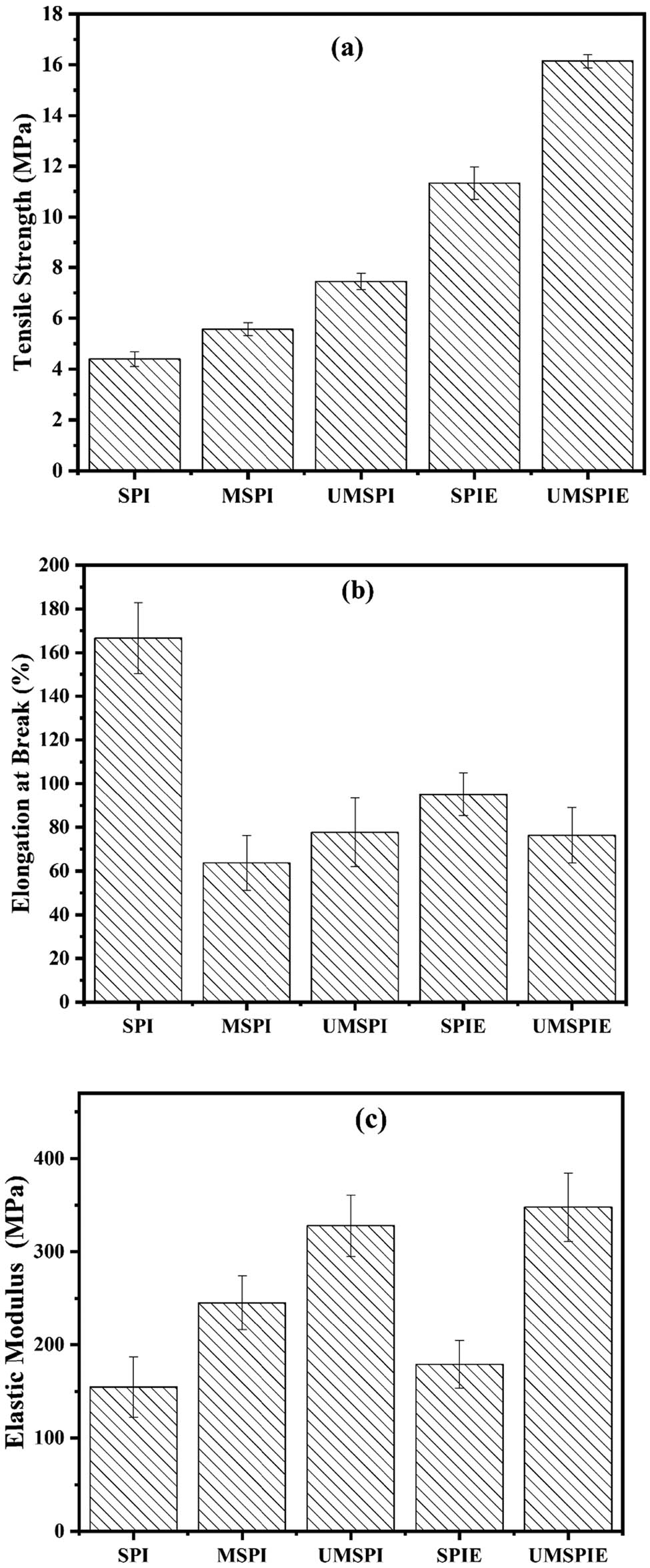
The mechanical properties of the SPI-based composite films: (a) tensile strength, (b) elongation at break, and (c) elastic modulus.
3.2 Water-resistance properties of films
The WC, MA, TSM, and WVP of SPI composite films are investigated in Table 2. SPI molecules contain a large of polar groups, such as –OH, –NH2, and –COOH. So, the pure SPI film is hydrophilic. It can be detected that the WCs of MSPI, UMSPI, SPIE, and UMSPI films have a decrement when compared with the original SPI film. The WC of the MSPI film decreased. It is because MMT interacts with SPI molecules forming hydrogen bond association. However, SPI molecules cannot greatly enter the interlayer of MMT, and a little aggregation of MMT exists in the solution. By contrast, the ultrasonic treatment can expand the interlayer spacing of MMT. Hence, UMMT has larger layer spacing, and the hydrogen bond interaction between UMMT and SPI molecules is enhanced. Thus, the UMSPI film has lower water content in contact with MSPI film. The reason for the WC decreasing of SPIE film is that the epoxy groups of EGDE molecules can react with the –NH2 of the protein molecules and their long chains are entangled with each other, reducing the exposure of polar groups. The WC of UMSPIE film declines owing to the synergistic effect of UMMT and EGDE on SPI molecules. There are different degree decreases for the TSMs, MAs, and WVPs of the SPI-based composite films except for pure SPI film. The TSM, MA, and WVP of the UMSPIE film present a decrement of 40.29%, 34.75%, and 37.0%, respectively. It is because SPI molecules not only exist hydrogen bond interaction with UMMT but also have the ring-opening reaction with EGDE. The incorporation of the nano-filler and the cross-linking agent can make the SPI composite film to form a compact network structure and discourage the invasion of water molecules.
WC, TSM, MA, and WVP of the SPI-based composite films
| Films | Water content (%) | Total soluble matter (%) | Moisture absorption (%) | Water vapor permeability (×10−15 g cm−1 s−1 MPa−1) |
|---|---|---|---|---|
| SPI | 15.5 ± 1.5 | 81.9 ± 8.8 | 86.9 ± 14.9 | 7.81 ± 1.44 |
| MSPI | 14.5 ± 1.7 | 68.7 ± 7.0 | 82.0 ± 9.9 | 6.42 ± 0.84 |
| UMSPI | 13.8 ± 1.1 | 64.6 ± 11.7 | 77.2 ± 12.0 | 6.03 ± 1.36 |
| SPIE | 13.2 ± 0.7 | 49.6 ± 11.3 | 62.0 ± 7.8 | 5.08 ± 1.31 |
| UMSPIE | 12.3 ± 1.5 | 48.9 ± 3.7 | 56.7 ± 2.9 | 4.92 ± 0.64 |
3.3 FTIR spectra of films
FTIR was used to investigate the chemical structure of SPI-based films. Figure 2 showed the FTIR spectra of SPI, MSPI, SPEI, and UMSPIE films. For all protein films, they were presenting similar spectra. Three characteristic amide bands at 1,629, 1,536, and 1,237 cm−1 represented amide I (C═O stretching vibration), amide II (N–H bending vibration), and amide III (C–N and N–H stretching vibration), respectively (18). The strong absorption band at 3,277 cm−1 was assigned to hydrogen bonding of SPI molecules and glycerol (19). Compared to the native SPI film, after the incorporation of MMT, UMMT, and EGDE into SPI matrix, the absorption bands at 3,600–3,000 cm−1 became broader and stronger (Figure 2; MSPI, SPIE, and UMSPIE). The variation was ascribed to strengthen the hydrogen bonding between MMT, EGDE, and SPI matrix. The absorption peak at 1,043 cm−1 was attributed to C–O–C asymmetric stretching vibration, and it was weakened in the SPIE film and the UMSPIE film. The result corresponded to the previous study (17), demonstrating the occurrence of ring opening between EGDE and SPI molecules. The cross-linking mechanism between MMT, EGDE, and SPI chains was provided in Scheme 1.
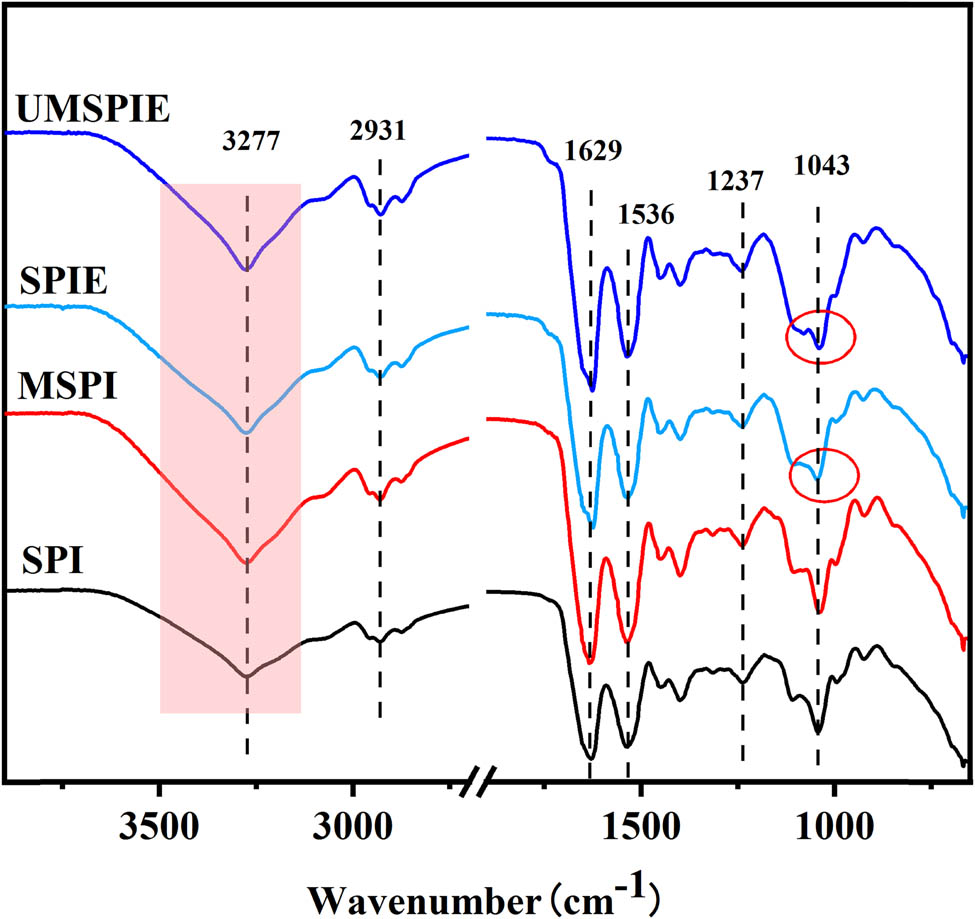
FTIR spectra of the SPI-based composite films.
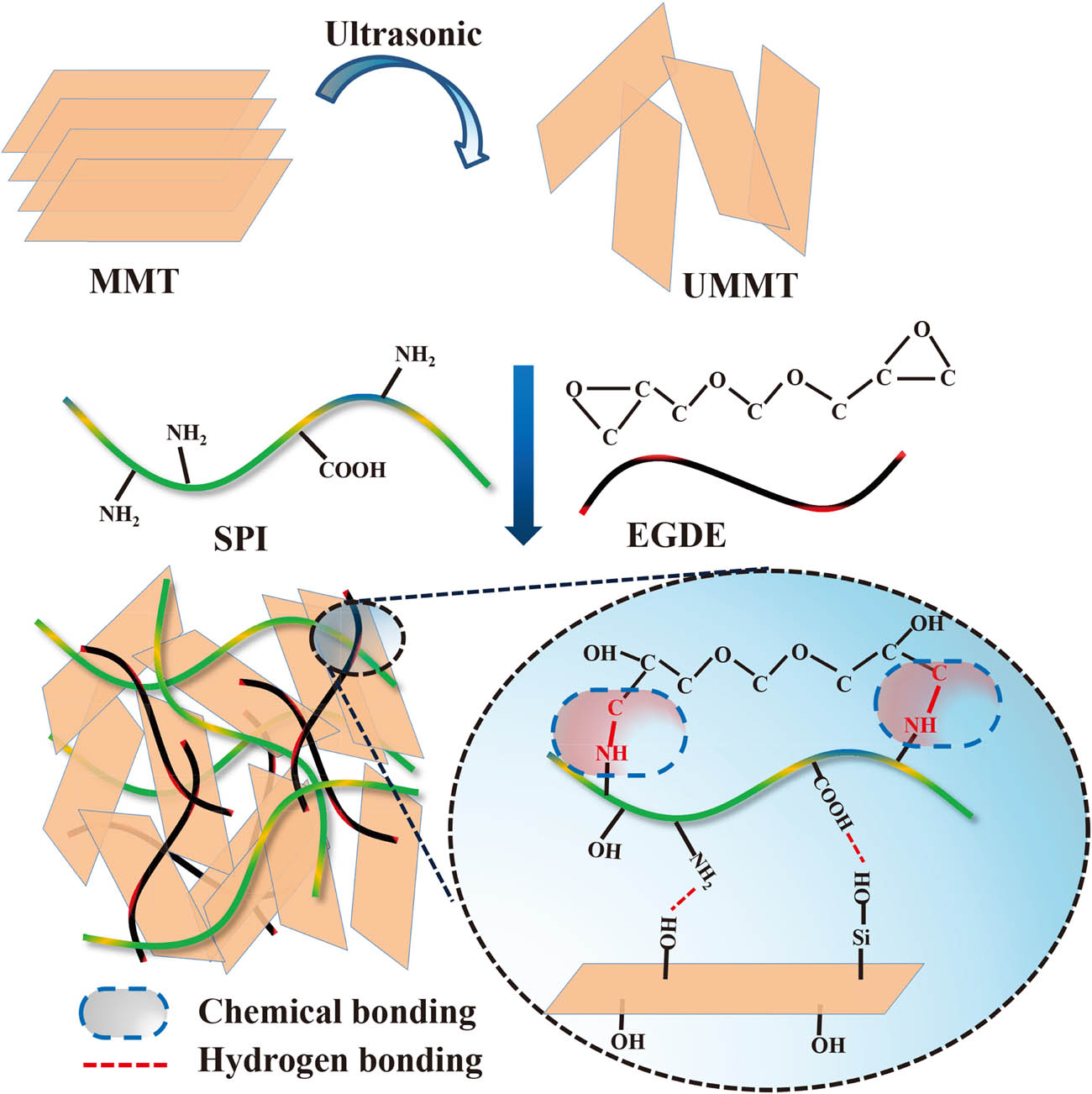
Formation mechanism of the UMSPIE composite film.
3.4 XRD patterns of films
Figure 3 shows the XRD pattern of MMT and SPI powders as well as SPI-based composite films. The XRD diagram for pure MMT revealed many sharp peaks, following previous results from other studies (20,21). The disappearance of the peaks meant the destruction of the layered structure. Two peaks at 2θ = 8.8° and 21.2° appeared in the SPI powder, suggesting that there were some ordered structures due to the α-spiral crystal structure and β-folded crystal structure of the SPI molecules (22). Compared with pure MMT, some sharp diffraction peaks disappeared for the MSPI film, indicating that the MMT structure has changed. It was ascribed that the MMT was intercalated by SPI molecules partially. However, when the ultrasonic-treated MMT contacts with the protein matrix, the sharp diffraction peaks of UMSPI practically vanish. The result implied that ultrasonic treatment destroyed the MMT platelets and even exfoliated them, the crystal plane spacing became wide, and the layered structure disappeared. After the addition of EGDE, the peak at 8.8° disappeared in the patterns of SPIE and UMSPIE, indicating that such ordered structures were destroyed by the crosslinking reaction. The crystallinity of the protein increased with the addition of MMT or UMMT. When UMMT and EGDE were added, the α-spiral crystal structure disappeared and the β-folded crystal structure widened.
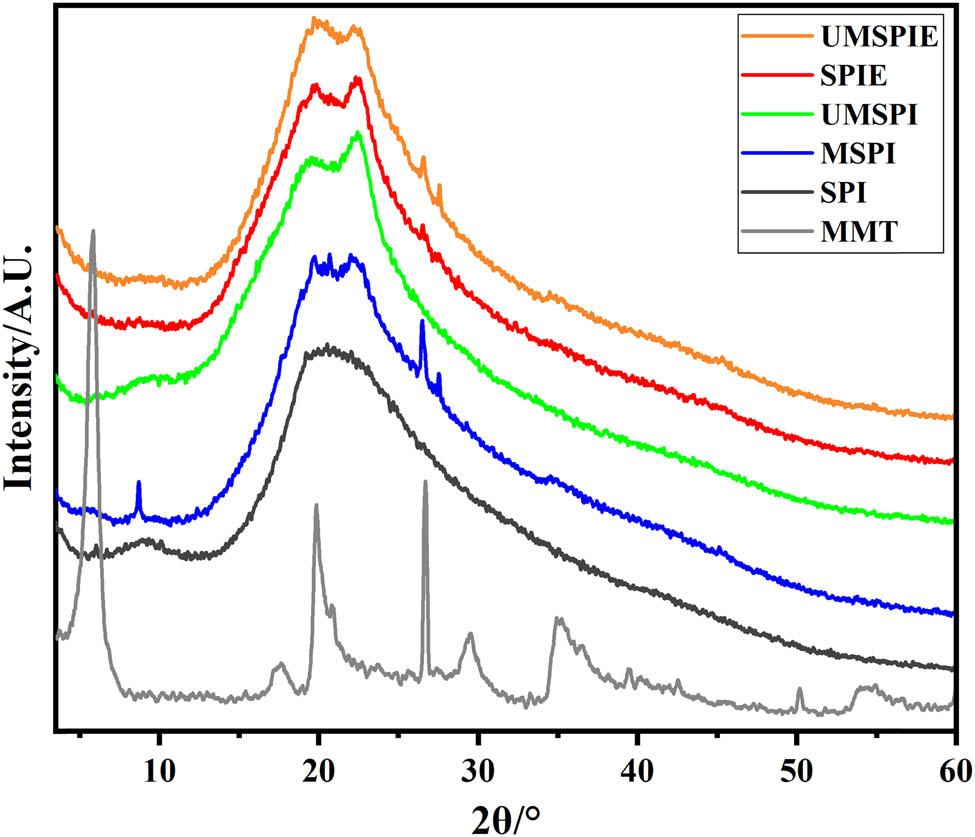
X-ray diffraction patterns of MMT and the SPI-based composite films.
3.5 Thermal stabilities of films
The thermal stability of different SPI-based composite films was examined with TG analyses. The typical weight-loss trends and derivative TG (DTG) curves of all composite films were observed; the data are detailed in Figure 4a and b and Table 3; the testing temperature was in the range from 30°C to 600°C. Three obvious weight losses of the SPI-based composite films were observed at the range of 30–150°C, 150–260°C, and 260–500°C, assigned to the evaporation of adsorbed water, the degradation of glycerol, and the thermal degradation of protein chains, respectively (23). At the third stage, the maximum temperature at the maximum degradation rate of the SPI film was 301.09°C and the SPIE film was 317.88°C. The raising was attributable to the occurrence of the ring-opening reaction between SPI and EGDE chains. In contrast with the virgin SPI film, the addition of nanoparticles increased the residual weight of composite films (MSPI or UMSPI), as montmorillonite contained non-volatile silicon or aluminum remaining in the films’ decomposition residuum.
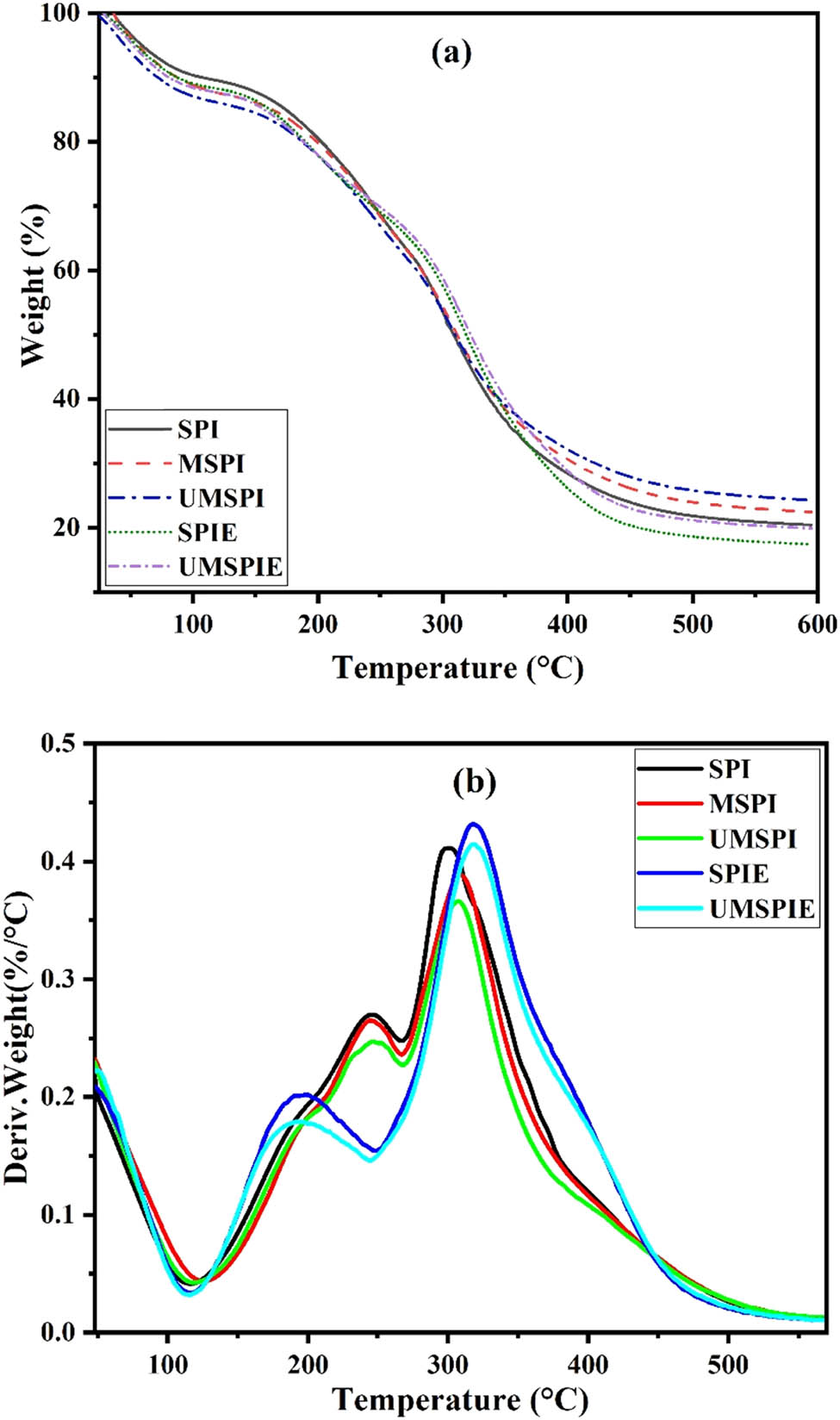
(a) Thermogravimetric analysis (TG) and (b) DTG patterns of the SPI-based composite films.
Thermal degradation data of the SPI-based composite films
| Samples | T i1 (°C)a | T max1 (°C)b | T i2 (°C)a | T max2 (°C)b |
|---|---|---|---|---|
| SPI | 116 | 246 | 267 | 301 |
| MSPI | 125 | 245 | 266 | 308 |
| UMSPI | 118 | 246 | 267 | 307 |
| SPIE | 116 | 199 | 248 | 317 |
| UMSPIE | 115 | 194 | 244 | 318 |
- a
T i, degradation onset temperature.
- b
T max, temperature at the maximum degradation rate.
3.6 Surface morphologies of films
The SEM images of cross-sections of SPI-based composite films are shown in Figure 5. The rough surface containing cavities was observed at the fracture section of the pure SPI film, likely caused by the evaporation of gas (24). And there are some tiny cracks due to the complete dryness of the pure SPI film (Figure 5a). For the MSPI film, the tiny cracks disappeared. This was attributed to the hydrogen bond interaction between MMT and SPI molecules, which made the MSPI film internal closely. However, MMT layers were observed to scatter unevenly in the SPI matrix (Figure 5b) demonstrating that the compatibility between MMT and the SPI matrix was bad and only a bit of MMT layers was intercalated by SPI chains. Compared with MSPI film, the treated MMT was more evenly dispersed in the SPI matrix, which indicated that the ultrasonic treatment causes the MMT layer spacing to enlarge or the MMT plates to exfoliate. The SPI chains were more easily intercalated into the treated MMT layers (Figure 5c). After EGDE cooperates with the SPI matrix, the cross-section of the SPIE film becomes denser, with significantly lower roughness (Figure 5d). There was a close cross-linked network between EGDE and SPI molecules due to the occurrence of the ring-opening reaction, which reduced the roughness of the SPI composite film. When UMMT and EGDE were added to the SPI matrix as filler particles and crosslinker, respectively, synergistically acting on the UMSPIE film makes its cross-section denser (Figure 5e).
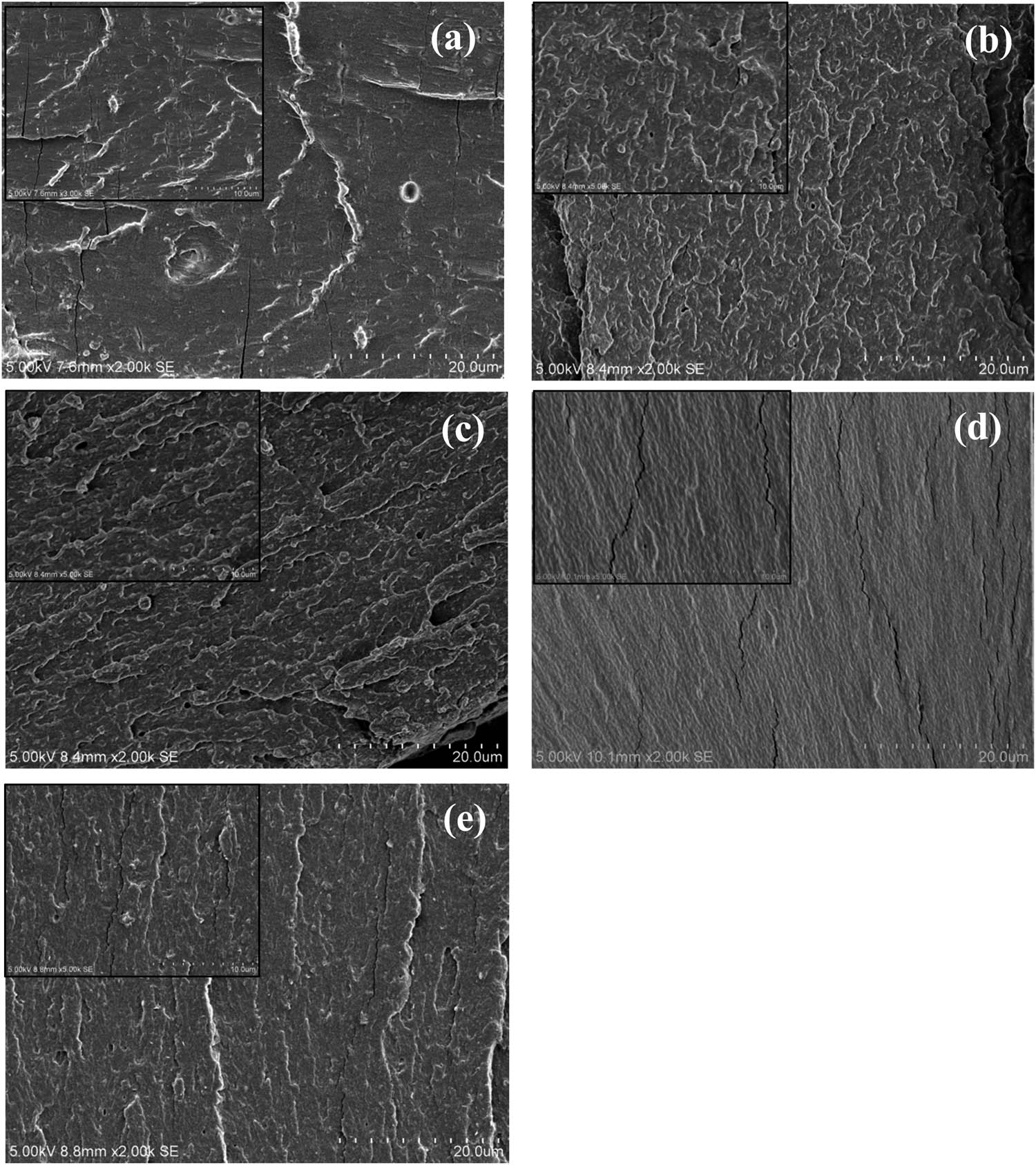
Cross-sectional scanning electron microscopy images of the SPI-based composite films: (a) SPI, (b) MSPI, (c) UMSPI, (d) SPIE, and (e) UMSPIE.
4 Conclusion
In this paper, a series of novel SPI-based composite films were prepared by the routine solution casting method. And, the effects of UMMT and EGDE on the protein-based film mechanical properties, moisture content, hygroscopicity, total dissolved substances, and water vapor transmittance were investigated. The results established that ultrasonic treatment could destroy the layered structure of MMT, which facilitated the intercalation of SPI molecules. Numerous MMT single layers were uniformly dispersed in SPI composite films.
The hydrogen bond interaction between MMT and SPI molecules and then crosslinked by EGDE made SPI film becoming compact. The incorporation of the ultrasonic-modified montmorillonite and the crosslinking of EGDE significantly improved the tensile strength of the composite film. Besides, the SPI-based composites that contained modified montmorillonite and EGDE had improvements in barrier properties as well. Based on these facts, ultrasonic-modified montmorillonite combining EGDE reinforced SPI-based composites may be an appropriate candidate in the food packaging over the coming years.
-
Funding information: This research was supported by the Innovation-Driven Project Funds of Guangxi (AA17204087-15) and the Fundamental Research Funds for the National Natural Science Foundation of China (Project 31790188).
-
Author contributions: Hua He: writing – original draft, writing – review and editing, methodology, formal analysis; Rui-jing Jia: writing – original draft, formal analysis, visualization; Kai-qiang Dong: formal analysis, data curation; Jia-wen Huang: writing – review and editing, supervision; Zhi-yong Qin: resources, project administration, conceptualization.
-
Conflict of interest: Authors state no conflict of interest.
-
Data availability statement: All relevant data are presented in the manuscript.
References
(1) Thakur S, Chaudhary J, Sharma B, Verma A, Tamulevicius S, Thakur VK. Sustainability of bioplastics: opportunities and challenges. Curr Opin Green Sust. 2018;13:68–75. 10.1016/j.cogsc.2018.04.013.Search in Google Scholar
(2) Arif U, Haider S, Haider A, Khan N, Alghyamah AA, Jamila N. Biocompatible polymers and their potential biomedical applications: a review. Curr Pharm Design. 2019;25:3608–19. 10.2174/1381612825999191011105148.Search in Google Scholar PubMed
(3) Zubair M, Ullah A. Recent advances in protein derived bionanocomposites for food packaging applications. Crit Rev Food Sci. 2020;60:406–34. 10.1080/10408398.2018.1534800.Search in Google Scholar PubMed
(4) Hu H, Wu JH, Li-Chan ECY, Zhu L, Zhang F, Xu XY. Effects of ultrasound on structural and physical properties of soy protein isolate (SPI) dispersions. Food Hydrocolloids. 2013;30:647–55. 1010.1016/j.foodhyd.2012.08.001.Search in Google Scholar
(5) Park SK, Bae DH, Rhee KC. Soy protein biopolymers cross-linked with glutaraldehyde. J Am Oil Chem Soc. 2000;77:879–83. 10.1007/s11746-000-0140-3.Search in Google Scholar
(6) Jiang Y, Tang CH, Wen QB, Li L, Yang XQ. Effect of processing parameters on the properties of transglutaminase-treated soy protein isolate films. Innov Food Sci Emerg. 2007;8:218–25. 10.1016/j.ifset.2006.11.002.Search in Google Scholar
(7) Qin ZY, Mo LT, Liao MR, He H, Sun JP. Preparation and characterization of soy protein isolate-based nanocomposite films with cellulose nanofibers and nano-silica via silane grafting. Polymers-Basel. 2019;11:1835. 10.3390/polym11111835.Search in Google Scholar PubMed PubMed Central
(8) Afsharian Z, Khosravi-Darani K. Application of nanoclays in food packaging. Biointerface Res App. 2020;10:4790–802. 10.33263/Briac101.790802.Search in Google Scholar
(9) Song SX, Xia S, Liu Y, Lv X, Sun SL. Effect of Na + MMT-ionic liquid synergy on electroactive, mechanical, dielectric and energy storage properties of transparent PVDF-based nanocomposites. Chem Eng J. 2020;384:123365. 10.1016/j.cej.2019.123365.Search in Google Scholar
(10) Xu JS, Cheng LH, Zhang Z, Zhang L, Xiong C, Huang WS. Highly exfoliated montmorillonite clay reinforced thermoplastic polyurethane elastomer: in situ preparation and efficient strengthening. Rsc Adv. 2019;9:8184–96. 10.1039/c8ra10121c.Search in Google Scholar PubMed PubMed Central
(11) Zhou LH, He Y, Gou SH, Zhang Q, Liu L, Tang L. Efficient inhibition of montmorillonite swelling through controlling flexibly structure of piperazine-based polyether Gemini quaternary ammonium salts. Chem Eng J. 2020;383:123190. 10.1016/j.cej.2019.123190.Search in Google Scholar
(12) Xue YJ, Shen MX, Zeng SH, Zhang W, Hao LY, Yang L. A novel strategy for enhancing the flame resistance, dynamic mechanical and the thermal degradation properties of epoxy nanocomposites. Mater Res Express. 2019;6:125003. 10.1088/2053-1591/ab537f.Search in Google Scholar
(13) Wang W, Zhao YL, Yi H, Chen TX, Kang SC, Li HQ. Preparation and characterization of self-assembly hydrogels with exfoliated montmorillonite nanosheets and chitosan. Nanotechnology. 2018;29:025605. 10.1088/1361-6528/aa9ba4.Search in Google Scholar PubMed
(14) Tepmatee P, Siriphannon P. Effect of preparation method on structure and adsorption capacity of aluminum pillared montmorillonite. Mater Res Bull. 2013;48:4856–66. 10.1016/j.materresbull.2013.06.066.Search in Google Scholar
(15) Kaur M, Arshad M, Ullah A. In-situ nanoreinforced green bionanomaterials from natural keratin and montmorillonite (MMT)/cellulose nanocrystais (CNC). Acs Sustain Chem Eng. 2018;6:1977–87. 10.1021/acssuschemeng.7b03380.Search in Google Scholar
(16) Wang NG, Zhang LN, Gu JM. Mechanical properties and biodegradability of crosslinked soy protein isolate/waterborne polyurethane composites. J Appl Polym Sci. 2005;95:465–73. 10.1002/app.21237.Search in Google Scholar
(17) Zhang SF, Xia CL, Dong YM, Yan YT, Li JZ, Shi SQ. Soy protein isolate-based films reinforced by surface modified cellulose nanocrystal. Ind Crop Prod. 2016;80:207–13. 10.1016/j.indcrop.2015.11.070.Search in Google Scholar
(18) Zhao YT, He M, Jin HF, Zhao L, Du QY, Deng HB. Construction of highly biocompatible hydroxyethyl cellulose/soy protein isolate composite sponges for tissue engineering. Chem Eng J. 2018;341:402–13. 10.1016/j.cej.2018.02.046.Search in Google Scholar
(19) Kokoszka S, Debeaufort F, Hambleton A, Lenart A, Voilley A. Protein and glycerol contents affect physico-chemical properties of soy protein isolate-based edible films. Innov Food Sci Emerg. 2010;11:503–5. 10. 10.1016/j.ifset.2010.01.006.Search in Google Scholar
(20) Felix M, Martinez I, Romero A, Partal P, Guerrero A. Effect of pH and nanoclay content on the morphology and physicochemical properties of soy protein/montmorillonite nanocomposite obtained by extrusion. Compos Part B-Eng. 2018;140:197–203. 10.1016/j.compositesb.2017.12.040.Search in Google Scholar
(21) Prabakaran K, Mohanty S, Nayak SK. Solid state dye sensitized solar cells: Eosin-Y sensitized TiO2-ZnO/PEO-PVDF-HFP-MMT electrolytes/MWCNT-Nafion (R) counter electrode. Ceram Int. 2015;41:11824–35. 10.1016/j.ceramint.2015.05.151.Search in Google Scholar
(22) Liu HJ, Li C, Sun XXSS. Soy-oil-based waterborne polyurethane improved wet strength of soy protein adhesives on wood. Int J Adhes Adhes. 2017;73:66–74. 10.1016/j.ijadhadh.2016.09.006.Search in Google Scholar
(23) Wang Z, Kang HJ, Zhang W, Zhang SF, Li JZ. Improvement of interfacial interactions using natural polyphenol-inspired tannic acid-coated nanoclay enhancement of soy protein isolate biofilms. Appl Surf Sci. 2017;401:271–82. 10.1016/j.apsusc.2017.01.015.Search in Google Scholar
(24) Lee JE, Kim KM. Characteristics of soy protein isolate-montmorillonite composite films. J Appl Polym Sci. 2010;118:2257–63. 10.1002/app.31316.Search in Google Scholar
© 2021 Hua He et al., published by De Gruyter
This work is licensed under the Creative Commons Attribution 4.0 International License.
Articles in the same Issue
- Research Articles
- Research on the mechanism of gel accelerator on gel transition of PAN solution by rheology and dynamic light scattering
- Gel point determination of gellan biopolymer gel from DC electrical conductivity
- Composite of polylactic acid and microcellulose from kombucha membranes
- Synthesis of highly branched water-soluble polyester and its surface sizing agent strengthening mechanism
- Fabrication and characterization of poly(3-hydroxybutyrate-co-3-hydroxyhexanoate) modified with nano-montmorillonite biocomposite
- Fabrication of N-halamine polyurethane films with excellent antibacterial properties
- Formulation and optimization of gastroretentive bilayer tablets of calcium carbonate using D-optimal mixture design
- Sustainable nanocomposite films based on SiO2 and biodegradable poly(3-hydroxybutyrate-co-3-hydroxyhexanoate) (PHBH) for food packaging
- Evaluation of physicochemical properties of film-based alginate for food packing applications
- Electrically conductive and light-weight branched polylactic acid-based carbon nanotube foams
- Structuring of hydroxy-terminated polydimethylsiloxane filled by fumed silica
- Surface functionalization of nanostructured Cu/Ag-deposited polypropylene fiber by magnetron sputtering
- Influence of composite structure design on the ablation performance of ethylene propylene diene monomer composites
- MOFs/PVA hybrid membranes with enhanced mechanical and ion-conductive properties
- Improvement of the electromechanical properties of thermoplastic polyurethane composite by ionic liquid modified multiwall carbon nanotubes
- Natural rubber latex/MXene foam with robust and multifunctional properties
- Rheological properties of two high polymers suspended in an abrasive slurry jet
- Two-step polyaniline loading in polyelectrolyte complex membranes for improved pseudo-capacitor electrodes
- Preparation and application of carbon and hollow TiO2 microspheres by microwave heating at a low temperature
- Properties of a bovine collagen type I membrane for guided bone regeneration applications
- Fabrication and characterization of thermoresponsive composite carriers: PNIPAAm-grafted glass spheres
- Effect of talc and diatomite on compatible, morphological, and mechanical behavior of PLA/PBAT blends
- Multifunctional graphene nanofiller in flame retarded polybutadiene/chloroprene/carbon black composites
- Strain-dependent wicking behavior of cotton/lycra elastic woven fabric for sportswear
- Enhanced dielectric properties and breakdown strength of polymer/carbon nanotube composites by coating an SrTiO3 layer
- Analysis of effect of modification of silica and carbon black co-filled rubber composite on mechanical properties
- Polytriazole resins toughened by an azide-terminated polyhedral oligomeric silsesquioxane (OADTP)
- Phosphine oxide for reducing flammability of ethylene-vinyl-acetate copolymer
- Study on preparation and properties of bentonite-modified epoxy sheet molding compound
- Polyhedral oligomeric silsesquioxane (POSS)-modified phenolic resin: Synthesis and anti-oxidation properties
- Study on structure and properties of natural indigo spun-dyed viscose fiber
- Biodegradable thermoplastic copolyester elastomers: Methyl branched PBAmT
- Investigations of polyethylene of raised temperature resistance service performance using autoclave test under sour medium conditions
- Investigation of corrosion and thermal behavior of PU–PDMS-coated AISI 316L
- Modification of sodium bicarbonate and its effect on foaming behavior of polypropylene
- Effect of coupling agents on the olive pomace-filled polypropylene composite
- High strength and conductive hydrogel with fully interpenetrated structure from alginate and acrylamide
- Removal of methylene blue in water by electrospun PAN/β-CD nanofibre membrane
- Theoretical and experimental studies on the fabrication of cylindrical-electrode-assisted solution blowing spinning nanofibers
- Influence of l-quebrachitol on the properties of centrifuged natural rubber
- Ultrasonic-modified montmorillonite uniting ethylene glycol diglycidyl ether to reinforce protein-based composite films
- Experimental study on the dissolution of supercritical CO2 in PS under different agitators
- Experimental research on the performance of the thermal-reflective coatings with liquid silicone rubber for pavement applications
- Study on controlling nicotine release from snus by the SIPN membranes
- Catalase biosensor based on the PAni/cMWCNT support for peroxide sensing
- Synthesis and characterization of different soybean oil-based polyols with fatty alcohol and aromatic alcohol
- Molecularly imprinted electrospun fiber membrane for colorimetric detection of hexanoic acid
- Poly(propylene carbonate) networks with excellent properties: Terpolymerization of carbon dioxide, propylene oxide, and 4,4ʹ-(hexafluoroisopropylidene) diphthalic anhydride
- Polypropylene/graphene nanoplatelets nanocomposites with high conductivity via solid-state shear mixing
- Mechanical properties of fiber-reinforced asphalt concrete: Finite element simulation and experimental study
- Applying design of experiments (DoE) on the properties of buccal film for nicotine delivery
- Preparation and characterizations of antibacterial–antioxidant film from soy protein isolate incorporated with mangosteen peel extract
- Preparation and adsorption properties of Ni(ii) ion-imprinted polymers based on synthesized novel functional monomer
- Rare-earth doped radioluminescent hydrogel as a potential phantom material for 3D gel dosimeter
- Effects of cryogenic treatment and interface modifications of basalt fibre on the mechanical properties of hybrid fibre-reinforced composites
- Stable super-hydrophobic and comfort PDMS-coated polyester fabric
- Impact of a nanomixture of carbon black and clay on the mechanical properties of a series of irradiated natural rubber/butyl rubber blend
- Preparation and characterization of a novel composite membrane of natural silk fiber/nano-hydroxyapatite/chitosan for guided bone tissue regeneration
- Study on the thermal properties and insulation resistance of epoxy resin modified by hexagonal boron nitride
- A new method for plugging the dominant seepage channel after polymer flooding and its mechanism: Fracturing–seepage–plugging
- Analysis of the rheological property and crystallization behavior of polylactic acid (Ingeo™ Biopolymer 4032D) at different process temperatures
- Hybrid green organic/inorganic filler polypropylene composites: Morphological study and mechanical performance investigations
- In situ polymerization of PEDOT:PSS films based on EMI-TFSI and the analysis of electrochromic performance
- Effect of laser irradiation on morphology and dielectric properties of quartz fiber reinforced epoxy resin composite
- The optimization of Carreau model and rheological behavior of alumina/linear low-density polyethylene composites with different alumina content and diameter
- Properties of polyurethane foam with fourth-generation blowing agent
- Hydrophobicity and corrosion resistance of waterborne fluorinated acrylate/silica nanocomposite coatings
- Investigation on in situ silica dispersed in natural rubber latex matrix combined with spray sputtering technology
- The degradable time evaluation of degradable polymer film in agriculture based on polyethylene film experiments
- Improving mechanical and water vapor barrier properties of the parylene C film by UV-curable polyurethane acrylate coating
- Thermal conductivity of silicone elastomer with a porous alumina continuum
- Copolymerization of CO2, propylene oxide, and itaconic anhydride with double metal cyanide complex catalyst to form crosslinked polypropylene carbonate
- Combining good dispersion with tailored charge trapping in nanodielectrics by hybrid functionalization of silica
- Thermosensitive hydrogel for in situ-controlled methotrexate delivery
- Analysis of the aging mechanism and life evaluation of elastomers in simulated proton exchange membrane fuel cell environments
- The crystallization and mechanical properties of poly(4-methyl-1-pentene) hard elastic film with different melt draw ratios
- Review Articles
- Aromatic polyamide nonporous membranes for gas separation application
- Optical elements from 3D printed polymers
- Evidence for bicomponent fibers: A review
- Mapping the scientific research on the ionizing radiation impacts on polymers (1975–2019)
- Recent advances in compatibility and toughness of poly(lactic acid)/poly(butylene succinate) blends
- Topical Issue: (Micro)plastics pollution - Knowns and unknows (Guest Editor: João Pinto da Costa)
- Simple pyrolysis of polystyrene into valuable chemicals
- Topical Issue: Recent advances of chitosan- and cellulose-based materials: From production to application (Guest Editor: Marc Delgado-Aguilar)
- In situ photo-crosslinking hydrogel with rapid healing, antibacterial, and hemostatic activities
- A novel CT contrast agent for intestinal-targeted imaging through rectal administration
- Properties and applications of cellulose regenerated from cellulose/imidazolium-based ionic liquid/co-solvent solutions: A short review
- Towards the use of acrylic acid graft-copolymerized plant biofiber in sustainable fortified composites: Manufacturing and characterization
Articles in the same Issue
- Research Articles
- Research on the mechanism of gel accelerator on gel transition of PAN solution by rheology and dynamic light scattering
- Gel point determination of gellan biopolymer gel from DC electrical conductivity
- Composite of polylactic acid and microcellulose from kombucha membranes
- Synthesis of highly branched water-soluble polyester and its surface sizing agent strengthening mechanism
- Fabrication and characterization of poly(3-hydroxybutyrate-co-3-hydroxyhexanoate) modified with nano-montmorillonite biocomposite
- Fabrication of N-halamine polyurethane films with excellent antibacterial properties
- Formulation and optimization of gastroretentive bilayer tablets of calcium carbonate using D-optimal mixture design
- Sustainable nanocomposite films based on SiO2 and biodegradable poly(3-hydroxybutyrate-co-3-hydroxyhexanoate) (PHBH) for food packaging
- Evaluation of physicochemical properties of film-based alginate for food packing applications
- Electrically conductive and light-weight branched polylactic acid-based carbon nanotube foams
- Structuring of hydroxy-terminated polydimethylsiloxane filled by fumed silica
- Surface functionalization of nanostructured Cu/Ag-deposited polypropylene fiber by magnetron sputtering
- Influence of composite structure design on the ablation performance of ethylene propylene diene monomer composites
- MOFs/PVA hybrid membranes with enhanced mechanical and ion-conductive properties
- Improvement of the electromechanical properties of thermoplastic polyurethane composite by ionic liquid modified multiwall carbon nanotubes
- Natural rubber latex/MXene foam with robust and multifunctional properties
- Rheological properties of two high polymers suspended in an abrasive slurry jet
- Two-step polyaniline loading in polyelectrolyte complex membranes for improved pseudo-capacitor electrodes
- Preparation and application of carbon and hollow TiO2 microspheres by microwave heating at a low temperature
- Properties of a bovine collagen type I membrane for guided bone regeneration applications
- Fabrication and characterization of thermoresponsive composite carriers: PNIPAAm-grafted glass spheres
- Effect of talc and diatomite on compatible, morphological, and mechanical behavior of PLA/PBAT blends
- Multifunctional graphene nanofiller in flame retarded polybutadiene/chloroprene/carbon black composites
- Strain-dependent wicking behavior of cotton/lycra elastic woven fabric for sportswear
- Enhanced dielectric properties and breakdown strength of polymer/carbon nanotube composites by coating an SrTiO3 layer
- Analysis of effect of modification of silica and carbon black co-filled rubber composite on mechanical properties
- Polytriazole resins toughened by an azide-terminated polyhedral oligomeric silsesquioxane (OADTP)
- Phosphine oxide for reducing flammability of ethylene-vinyl-acetate copolymer
- Study on preparation and properties of bentonite-modified epoxy sheet molding compound
- Polyhedral oligomeric silsesquioxane (POSS)-modified phenolic resin: Synthesis and anti-oxidation properties
- Study on structure and properties of natural indigo spun-dyed viscose fiber
- Biodegradable thermoplastic copolyester elastomers: Methyl branched PBAmT
- Investigations of polyethylene of raised temperature resistance service performance using autoclave test under sour medium conditions
- Investigation of corrosion and thermal behavior of PU–PDMS-coated AISI 316L
- Modification of sodium bicarbonate and its effect on foaming behavior of polypropylene
- Effect of coupling agents on the olive pomace-filled polypropylene composite
- High strength and conductive hydrogel with fully interpenetrated structure from alginate and acrylamide
- Removal of methylene blue in water by electrospun PAN/β-CD nanofibre membrane
- Theoretical and experimental studies on the fabrication of cylindrical-electrode-assisted solution blowing spinning nanofibers
- Influence of l-quebrachitol on the properties of centrifuged natural rubber
- Ultrasonic-modified montmorillonite uniting ethylene glycol diglycidyl ether to reinforce protein-based composite films
- Experimental study on the dissolution of supercritical CO2 in PS under different agitators
- Experimental research on the performance of the thermal-reflective coatings with liquid silicone rubber for pavement applications
- Study on controlling nicotine release from snus by the SIPN membranes
- Catalase biosensor based on the PAni/cMWCNT support for peroxide sensing
- Synthesis and characterization of different soybean oil-based polyols with fatty alcohol and aromatic alcohol
- Molecularly imprinted electrospun fiber membrane for colorimetric detection of hexanoic acid
- Poly(propylene carbonate) networks with excellent properties: Terpolymerization of carbon dioxide, propylene oxide, and 4,4ʹ-(hexafluoroisopropylidene) diphthalic anhydride
- Polypropylene/graphene nanoplatelets nanocomposites with high conductivity via solid-state shear mixing
- Mechanical properties of fiber-reinforced asphalt concrete: Finite element simulation and experimental study
- Applying design of experiments (DoE) on the properties of buccal film for nicotine delivery
- Preparation and characterizations of antibacterial–antioxidant film from soy protein isolate incorporated with mangosteen peel extract
- Preparation and adsorption properties of Ni(ii) ion-imprinted polymers based on synthesized novel functional monomer
- Rare-earth doped radioluminescent hydrogel as a potential phantom material for 3D gel dosimeter
- Effects of cryogenic treatment and interface modifications of basalt fibre on the mechanical properties of hybrid fibre-reinforced composites
- Stable super-hydrophobic and comfort PDMS-coated polyester fabric
- Impact of a nanomixture of carbon black and clay on the mechanical properties of a series of irradiated natural rubber/butyl rubber blend
- Preparation and characterization of a novel composite membrane of natural silk fiber/nano-hydroxyapatite/chitosan for guided bone tissue regeneration
- Study on the thermal properties and insulation resistance of epoxy resin modified by hexagonal boron nitride
- A new method for plugging the dominant seepage channel after polymer flooding and its mechanism: Fracturing–seepage–plugging
- Analysis of the rheological property and crystallization behavior of polylactic acid (Ingeo™ Biopolymer 4032D) at different process temperatures
- Hybrid green organic/inorganic filler polypropylene composites: Morphological study and mechanical performance investigations
- In situ polymerization of PEDOT:PSS films based on EMI-TFSI and the analysis of electrochromic performance
- Effect of laser irradiation on morphology and dielectric properties of quartz fiber reinforced epoxy resin composite
- The optimization of Carreau model and rheological behavior of alumina/linear low-density polyethylene composites with different alumina content and diameter
- Properties of polyurethane foam with fourth-generation blowing agent
- Hydrophobicity and corrosion resistance of waterborne fluorinated acrylate/silica nanocomposite coatings
- Investigation on in situ silica dispersed in natural rubber latex matrix combined with spray sputtering technology
- The degradable time evaluation of degradable polymer film in agriculture based on polyethylene film experiments
- Improving mechanical and water vapor barrier properties of the parylene C film by UV-curable polyurethane acrylate coating
- Thermal conductivity of silicone elastomer with a porous alumina continuum
- Copolymerization of CO2, propylene oxide, and itaconic anhydride with double metal cyanide complex catalyst to form crosslinked polypropylene carbonate
- Combining good dispersion with tailored charge trapping in nanodielectrics by hybrid functionalization of silica
- Thermosensitive hydrogel for in situ-controlled methotrexate delivery
- Analysis of the aging mechanism and life evaluation of elastomers in simulated proton exchange membrane fuel cell environments
- The crystallization and mechanical properties of poly(4-methyl-1-pentene) hard elastic film with different melt draw ratios
- Review Articles
- Aromatic polyamide nonporous membranes for gas separation application
- Optical elements from 3D printed polymers
- Evidence for bicomponent fibers: A review
- Mapping the scientific research on the ionizing radiation impacts on polymers (1975–2019)
- Recent advances in compatibility and toughness of poly(lactic acid)/poly(butylene succinate) blends
- Topical Issue: (Micro)plastics pollution - Knowns and unknows (Guest Editor: João Pinto da Costa)
- Simple pyrolysis of polystyrene into valuable chemicals
- Topical Issue: Recent advances of chitosan- and cellulose-based materials: From production to application (Guest Editor: Marc Delgado-Aguilar)
- In situ photo-crosslinking hydrogel with rapid healing, antibacterial, and hemostatic activities
- A novel CT contrast agent for intestinal-targeted imaging through rectal administration
- Properties and applications of cellulose regenerated from cellulose/imidazolium-based ionic liquid/co-solvent solutions: A short review
- Towards the use of acrylic acid graft-copolymerized plant biofiber in sustainable fortified composites: Manufacturing and characterization
