Enhancing chloride resistance of freeze–thaw affected concrete through innovative nanomaterial–polymer hybrid cementitious coating
-
 ,
,

Abstract
The deterioration of concrete structures in cold marine environments presents a significant durability challenge, particularly due to the synergistic effects of chloride attack and freeze–thaw cycles. However, this problem has not been solved satisfactorily. This study explores an innovative strategy for improving concrete durability via the development of a nano- and polymer-modified cementitious coating system. The research team formulated a composite coating by incorporating precisely controlled concentrations (0.5–1.5 wt%) of nano-SiO2 or nano-CaCO3 with waterborne polyacrylate emulsion. Comprehensive experimental investigations were conducted on coated concrete specimens, including mass loss analysis, relative dynamic modulus of elasticity evaluation and Coulomb electric flux test during freeze–thaw cycles, and long-term salt solution immersion. The results demonstrate that the coating system exhibits a dual protective mechanism, effectively mitigating freeze–thaw induced damage while significantly enhancing the chloride resistance of concrete before and after freeze–thaw cycles. Microstructural analysis reveals that the synergistic combination of nanomaterials and polymer optimizes the pore structure of the coating, reducing total porosity and decreasing harmful and more harmful pore volume. Among the tested coating formulations, the 1.0 wt% nano-SiO2 composite demonstrates superior performance, showing 68% improvement in chloride resistance and 2.27 times in ultimate freeze–thaw cycles compared to uncoated concrete.
1 Introduction
With the continuous expansion of human life and production activities, an increasing number of concrete structures are being built and are functioning in complex and harsh environments. A large number of these structures are subjected to the coupling conditions of chloride attack and freeze–thaw cycles in cold marine regions, thus posing considerable risks to their long-term durability [1,2]. This problem can be partially solved if new concrete projects adopt both internal strategies – such as optimizing concrete mixture proportion and adding pozzolanic admixtures, nanomaterials, fiber materials, air entraining agents, and waste tire crumb rubber [3,4,5,6,7,8,9,10,11,12,13,14] – and external protection strategies such as hydrophobic treatment, organic film-forming coating, and cement-based coating [15,16,17,18,19,20]. For concrete projects in service, only external protection can be adopted. At present, relatively mature methods are available to protect and improve the durability performance of concrete structures under single chloride aggression or freeze–thaw cycle conditions. However, effective protection strategies against the simultaneous action of chloride ingress and freeze–thaw cycle remain elusive [21,22].
Corrosion of steel bars in concrete caused by chlorides has always been the main problem that causes the durability of concrete structures to deteriorate [23,24], while frost damage of concrete is a common durability problem of concrete structures in cold regions [2,25]. At present, many studies have been conducted on the chloride resistance or the frost resistance of concrete alone, as well as the degradation of concrete performance under salt-frost condition [2,9,10,26,27]. For example, Liu et al. [7], Bao et al. [8], Huo and Liu [9], Zhou et al. [10], and Li et al. [16] presented that the degree of frost damage of concrete under the freeze–thaw cycles of chloride or sulfate solution was higher than that of pure water, resulting in a higher mass loss ratio and a decline in the relative dynamic modulus of elasticity (RDME) of concrete. The above research mainly focuses on the effect of salts on the frost damage on concrete, while research on the effect of freeze–thaw cycles on the resistance of concrete to chloride aggression is still few and controversial. Generally, freeze–thaw cycle reduces the impermeability of concrete. For example, Jin et al. [6] indicated that the freeze–thaw cycle of concrete significantly increases the corrosion risk of steel bars in concrete mixed with granulated ground blast furnace slag and air entraining agent. Guan et al. [28] showed that the chloride ion migration coefficient and diffusion coefficient of recycled composite micro-powder concrete increase linearly with the number of freeze–thaw cycles. However, in a study by Wang et al. [3] involving 50 rapid freeze–thaw cycles and Coulomb electric flux tests on concrete containing fly ash or silica fume, it was observed that the chloride resistance of silica fume concrete exhibited a decreasing trend, whereas that of fly ash concrete improved. This discrepancy may be attributed to the complexity of concrete durability experiments, which can be influenced by factors such as raw material properties, testing methodologies, and experiment duration.
Surface treatment measures to improve the chloride resistance or the frost resistance of concrete are common durability protection measures for concrete structures [29,30,31,32,33,34]. Common surface treatments include various organic film-forming coatings, hydrophobic treatments, and cement-based coatings. Organic film-forming coating can form a layer of impervious and continuous dense film on the surface of concrete through the solidification and hardening of various organic resins to separate water or other aggressive media from the substrate concrete. Hydrophobic treatment involves applying silane, siloxane, or organo-silane hydrophobic agents to achieve a certain depth of superficial concrete hydrophobic and thus inhibit the entry of water and aggressive media into concrete. Cement-based coating involves using cement material as the main body to add auxiliary materials to improve its density and thus block the entry of water and aggressive media [35]. In these three methods, the film-forming coating usually offers the best protection against moisture and corrosive media penetration, followed by hydrophobic treatment, and the cement-based coating usually has a relatively low protection effect because of its low density. However, organic film-forming coatings are organic materials, which have various aging problems, and silane and silicone hydrophobic agents have abrasion problems, resulting in great shortcomings in their long-term durability [23,29,30]. As inorganic materials, cement-based coatings have excellent aging resistance and can guarantee sufficient service life [1,2].
The emergence of waterborne polymers and nanomaterials has brought light to the improvement of the protection performances of cement-based coatings [36,37,38,39,40,41,42]. Through a field investigation of a concrete bridge deck in cold regions, Ariyadasa et al. [1] found that compared with plain silane coating, 2.5% nano-clay or nano-SiO2 modified silane coating substantially improves the long-term chloride resistance of concrete. Leung et al. [37] pointed out that compared with untreated concrete, the inclusion of 3% nano-clay in epoxy resin can markedly enhance the coating’s barrier performance, resulting in a 93% reduction in water vapor transmission and almost negligible chloride diffusion of the coated concrete. Diamanti et al. [38] formulated two polymer-modified cement-based coatings using acrylic polymers and found that they could greatly reduce water absorption and chloride penetration of concrete. Li et al. [40] prepared a nanopolymer-modified cement-based coating using acrylic emulsion, nano-SiO2, and nano-TiO2, which substantially improved the waterproof properties and chloride resistance of coated concrete. Qu et al. [42] observed that the addition of nanomaterials not only improved the carbonation resistance and chloride resistance of waterborne epoxy resin and waterborne polyurethane coatings but also substantially improved their ultraviolet light radiation resistance. The above results indicate that nanomaterials can substantially improve the waterproof performance, the carbonation resistance, the chloride resistance, the frost resistance, and the aging resistance of coated concrete. However, the effect of nanomaterials and polymer addition in cement-based coating on the durability of coated concrete under the coupled conditions of chloride attack and freeze–thaw cycle has yet to be studied.
In light of the aforementioned issues and building upon our previous research, the authors propose the development of a durable protective coating for concrete using waterborne polyacrylate emulsion, one of three dosage levels of nano-SiO₂ or nano-CaCO3, and highly reactive cement-based materials. This strategy is designed to capitalize on the individual strengths and synergistic interactions of nanomaterials, organic polymers, and inorganic components, with the goal of mitigating the combined degrading effects of chloride ion penetration and freeze–thaw cycles. As a result, a novel protective coating has been developed that significantly enhances the chloride and frost resistance of concrete, improving its resistance to chloride ingress and freeze–thaw damage by 68 and 227%, respectively. This research holds important implications for advancing the theoretical understanding of concrete durability and providing practical guidance for the protection of concrete structures in cold marine environments.
2 Experimental
2.1 Raw materials
Raw materials for concrete specimens include binder, fine aggregate, coarse aggregate, and mixing water. P·O42.5 cement is adopted as binder; natural river sand with a fineness modulus of 2.62 and continuous graded crushed stone with a particle size of 5–20 mm are used for fine aggregate and coarse aggregate, respectively; and ordinary tap water is utilized for mixing water. The water–cement ratio of concrete is 0.6, and the concrete mixture proportion is cement:mixing water:fine aggregate:coarse aggregate = 350:210:737:1,153 (kg/m3).
Coating raw materials include powder materials, liquid materials, and nanomaterials. The powder materials are composed of a certain proportion of P·O42.5 cement, penetrative crystalline active powder (a powder material that penetrates concrete and forms insoluble crystals to block pores and cracks), 1,250 mesh talcum powder, 110–160 mesh quartz sand, and 400 mesh calcite powder. The liquid materials are composed of a certain proportion of waterborne polyacrylate emulsion, dispersing agent, modified silicone defoamer, kH-570 coupling agent, and polycarboxylate superplasticizer. Nanomaterials include nano-SiO2 and nano-CaCO3, both of which are white powders, with a purity of more than 99.9% and an average particle size of 20 nm. The above materials can be easily purchased from the market.
2.2 Specimens’ fabrication
Cylinder specimens with a size of 100 mm in diameter × 50 mm in height and cubic specimens with a size of 100 × 100 × 100 mm3 were cast for Coulomb electric flux and salt solution immersion experiments, respectively. Specimens include uncoated concrete specimens and coated concrete specimens. First, uncoated concrete specimens are fabricated, which includes a sequence of processes, such as weighing raw materials according to the concrete mixture proportion, mixing raw materials with a forced mixer, vibrating and compaction of concrete, demolding the specimens after standing for 24 h, curing the specimens in a 20°C water tank until the age of 28 days, drying the specimens in a 60°C oven for 24 h, and then taking out the specimens to cool for use. Second, coatings are prepared. These coatings include cement-based (hereinafter abbreviated as CE) coating, polymer-modified cement-based (abbreviated as PM) coating, and nanomaterial-modified PM coating. On the basis of the authors’ previous experience, the relatively optimal formulation of CE coating is powder material:water = 2:1, and the PM coating formula is powder material:liquid material:water = 2:1:1. The nanomaterial-modified PM coating is achieved by adding 0.5, 1.0, and 1.5 wt% nano-SiO2 or nano-CaCO3 of the total coating weight [40,42]. Finally, specimens with CE coating, PM coating, nano-SiO2 modified PM (abbreviated as PMS) coating, or nano-CaCO3 modified PM (abbreviated as PMC) coating are fabricated. The specific production plan of concrete specimens with different coatings is shown in Table 1.
Fabrication plan of concrete specimens
| Item | Coating category | Nanomaterials |
|---|---|---|
| 1 | Uncoated | — |
| 2 | CE | — |
| 3 | PM | — |
| 4 | PMS0.5 | 0.5 wt% nano-SiO2 |
| 5 | PMS1.0 | 1.0 wt% nano-SiO2 |
| 6 | PMS1.5 | 1.5 wt% nano-SiO2 |
| 7 | PMC0.5 | 0.5 wt% nano-CaCO3 |
| 8 | PMC1.0 | 1.0 wt% nano-CaCO3 |
| 9 | PMC1.5 | 1.5 wt% nano-CaCO3 |
In reference to the preparation process of existing nano-modified coatings [40,41,42], the preparation processes of the three types of coatings in this study mainly include the following three steps:
Powder and liquid material preparation. According to the proportion of raw material composition of the coating to be prepared, the powder or liquid material is fully mixed and prepared in advance. For pure CE coating, its liquid material is directly ordinary tap water.
High-speed mechanical mixing. A certain mass of powder material is weighed and added to the corresponding mass of liquid material (or mixing water). Then, the mixture of powder and liquid material (or mixing water) is stirred at high speed for 10 min by a mechanical mixer. CE and PM coatings are obtained after the completion of mechanical mixing.
High-frequency ultrasonic dispersing. Uniform dispersion of nanomaterials in coatings is ensured by first ultrasonically dispersing the nanomaterials in mixing water for 20 min. The nano-PM coatings can be achieved after the mixing water is mixed with the liquid material and the powder material under high-speed mechanical stirring for 10 min.
In the fabrication processes of coated concrete specimens, the surfaces of uncoated concrete specimens were first polished with an electric wire brush, and superficial dust and dirt of the specimens were removed with a moist towel. Then, the side and the bottom surfaces of specimens were painted and sealed with epoxy primer and polyurethane topcoat, leaving only one end surface to be tested. Next, the specimens’ test surfaces were painted with the prepared coating twice using a cross-painting method with a time interval of 30 min. The typical coated concrete specimens are shown in Figure 1. After coating, the specimens were left to harden for 12 h and then underwent water curing for 7 days. The coating thickness after hardening was tested and about 0.5 mm. Lastly, the specimens were placed in an indoor natural environment for 28 days before the next experiments.

Partial coated concrete specimens: (a) cylinder specimens and (b) cubic specimens.
2.3 Experimental plan
At present, no special national standard is available for testing the chloride resistance and the freeze–thaw resistance of coated concrete. In this study, the rapid freeze–thaw cycle experiment and Coulomb electric flux experiment of coated concrete specimens were conducted by referring to the national standards of “Test Method for Rapid Freezing and Thawing” and “Test Method for Coulomb Electric Flux” of ordinary concrete [43]. Specifically, the coated concrete specimens were first immersed in 20 ± 2°C water for 4 days and placed in specimen boxes in a freeze–thaw testing machine. Then, the freeze–thaw cycle experiment started. Every 50 freeze–thaw cycles, part of the specimens (three same specimens with each type of coating are taken into a group) were taken out for visual inspection and testing, and the remaining specimens continued the freeze–thaw cycle until the concrete specimens underwent freeze–thaw failure. In the process of the freeze–thaw cycle experiment, attention needs to be paid to the sealing protection of the surfaces of a specimen, except the surface to be tested. If damage occurred in advance, then the surfaces need to be recoated for protection. After the superficial water of the specimens to test was wiped, the specimens’ appearance was observed, their mass losses, ultrasonic velocities and 6 h Coulomb electric fluxes were tested, and then the mass loss ratio and RDME were calculated [11,16,44]. Before the Coulomb electric flux experiment was conducted on the specimens, the resin seal layers on the specimens’ bottom surfaces needed to be removed with an electric wire brush.
To complement and validate the findings of the Coulomb experiments, a long-term salt solution immersion test was performed on selected specimens. A 15% NaCl solution was used as the immersion medium. After 90 days of immersion, the surface coatings were removed, and concrete powder was drilled from depths of 0–5 mm, 5–10 mm, 10–15 mm, 15–20 mm, and 20–25 mm from the concrete surface. To minimize experimental errors, four powder samples were collected from the midpoints of each side of a single coated specimen, combined into one composite sample, and then immersed in distilled water for 24 h. The water-soluble chloride ion concentrations were subsequently measured using a DY-2501b chloride ion concentration meter.
The micro-pore structure and the changes of a coating during its freeze–thaw cycle were examined by sampling partially coated concrete specimens, and the mercury intrusion porosimetry (MIP) test and scanning electron microscopy (SEM) observation were conducted, respectively. The coating samples were peeled from the surface of a coated specimen by using a sharp knife and a hammer and prepared with a diameter of about 1 cm. The MicroActive AutoPore V9600 automatic mercury injection instrument and the scanning electron microscope produced by TESCAN were utilized for the MIP test and SEM test, respectively.
3 Results and discussion
3.1 Chloride resistance of coated concrete
Coulomb electric flux is one of the commonly used indicators to reflect the chloride resistance of concrete. The lower the Coulombs of concrete, the higher its chloride resistance [29,40,42]. The Coulomb electric flux of each coated concrete before freeze–thaw cycles is shown in Figure 2.

Coulomb electric fluxes of coated concrete specimens before freeze–thaw cycle: (a) no nanomaterials and (b) with nanomaterials.
Although the compactness of CE coating is not as good as that of organic film-forming coating, the application of CE coating can block the entry of Cl− and prolong the diffusion path of Cl− to a certain extent, thus improving the chloride resistance of concrete. As shown in Figure 2a, compared with uncoated concrete, the application of CE coating reduces the Coulomb electric flux of concrete by 25%. Waterborne polymer emulsion can be perfectly combined with CE materials to reduce defects in the original CE coating and improve the density of the coating [38,40]. Therefore, the Coulomb electric flux of PM-coated concrete is substantially lower than that of CE-coated concrete. Compared with uncoated concrete and CE-coated concrete, the Coulomb electric flux of PM-coated concrete is reduced by 55.4 and 40.5%, respectively.
As a result of its extremely small particles, nanomaterials can fully exert a filling effect, and the nucleation effect effectively enhances the protective performance of CE coatings and organic film-forming coatings [42,45]. With the addition of nano-SiO2 or nano-CaCO3, the Coulomb electric flux of coated concrete decreases further (Figure 2b). However, the decreasing amplitudes of Coulombs vary for different nanomaterials and dosages of coated concrete. In general, the Coulombs of PMS-coated concrete are slightly lower than those of PMC-coated concrete corresponding to the same nanomaterial content. Among 0.5, 1.0, and 1.5 wt%, the Coulombs of PMS- and PMC-coated concrete with 1.0 wt% are the lowest. These results indicate that there is an optimal dosage for nano-SiO₂ or nano-CaCO₃ when incorporated into the PM coating. Deviating from this optimal amount, either by adding excessive or insufficient quantities, negatively impacts the coating’s performance. In this article, the optimal content of nano-SiO2 or nano-CaCO3 is about 1.0 wt%. The Coulombs of PMS1.0-coated concrete are reduced by 68, 57.3, and 28.4% compared with uncoated concrete, CE-, and PM-coated concrete, respectively. The application of nano-PM coating raises the chloride resistance of the concrete to a high level [46].
The chloride ion contents of partial concrete specimens submerged in salt solution for 90 days were tested, and their chloride profiles are shown in Figure 3.

Chloride profiles of coated concrete at 90-day testing ages: (a) no nanomaterials and (b) with nano-SiO2.
As clearly shown in Figure 3a, the chloride ion contents in coated concrete specimens are significantly lower than those in the uncoated concrete at the same depth. Notably, the chloride ion concentration in PM-coated concrete is substantially lower than that in CE-coated concrete. Figure 3b further demonstrates that the addition of nanomaterials in the PM coating formulation results in an even more pronounced reduction in chloride ion penetration. These results indicate that various coatings, particularly the nano-modified versions, effectively enhance the chloride ion penetration resistance of concrete, consistent with previous research findings [37,38,39]. This conclusion aligns well with the electrical charge measurements obtained from the earlier Coulomb tests, reinforcing the observed trends in chloride ion ingress inhibition.
The diffusion behavior of chloride ions in concrete is commonly described by Fick’s laws of diffusion [40]. Leveraging the measured chloride ion concentration profiles within the concrete, nonlinear regression was conducted using the analytical solution of Fick’s second law of diffusion. The resulting fitting curves are depicted as dotted lines in Figure 3. This figure demonstrates that the chloride ion concentration distributions in the coated concrete specimens closely align with Fick’s second diffusion law. Based on these fitting curves, the chloride ion diffusion coefficients (D 0) and surface chloride ion concentrations (C s) of the coated concrete were calculated, with the results summarized in Table 2.
Calculated D 0 and C s of concrete with different coatings
| Item | Uncoated | CE | PM | PMS0.5 | PMS1.0 | PMS1.5 |
|---|---|---|---|---|---|---|
| D 0/1 × 10−12 m2/s | 10.55 | 7.23 | 6.52 | 4.52 | 3.58 | 4.37 |
| C s/% | 0.01173 | 0.00745 | 0.00445 | 0.00396 | 0.0035 | 0.00276 |
As anticipated, the application of various coatings, particularly the nano-modified ones, led to a notable decrease in both the chloride diffusion coefficients and surface chloride concentrations of concrete. Compared to the uncoated concrete, the chloride ion diffusion coefficients of concrete specimens coated with CE, PM, and PMS1.0 coatings were reduced by 31.5, 38.2, and 66.1%, respectively. These results validate that nanomodification enhances the physical barrier function of the coatings, in line with previous studies [37,38,39,40]. Among all the coated concrete specimens, the one with the 1.0% nano-SiO₂ PM coating exhibited the highest resistance to chloride ingress.
3.2 Specimens’ appearance after freeze–thaw cycles
Under the freeze–thaw cycles of concrete specimens, the accumulation of freeze–thaw damage will inevitably affect the appearance of the specimens. The appearance of partially coated concrete specimens (including uncoated concrete specimens) with different freeze–thaw cycles is shown in Figure 4.

Appearance of typical coated specimens after different freeze–thaw cycles.
From Figure 4, the surfaces of both uncoated concrete specimens and coated concrete specimens are very dense and smooth before the freeze–thaw cycle. However, after a certain number of freeze–thaw cycles, the appearance of each specimen changed to some extent. In general, more freeze–thaw cycles correspond to a higher degree of damage to the same specimen’s appearance. Meanwhile, the damage degrees of coated concrete specimens corresponding to the same freeze–thaw cycles are obviously lower than those of uncoated concrete specimens.
Specifically, corresponding to 50 rapid freeze–thaw cycles, the uncoated concrete specimen experienced appearance damage, the surface began to exhibit mortar spalling, and coarse aggregate was exposed. After 100 freeze–thaw cycles, the uncoated concrete specimen had serious cracking and festering and could not maintain its integrity, thus making it impossible to conduct the next tests. For CE-, PM-, PMS1.0-, and PMC1.0-coated concrete specimens, after 50 rapid freeze–thaw cycles, the surface of each specimen remained smooth, and its appearance was basically unchanged. This finding indicates that the application of coating helps improve the frost resistance of concrete [18,19,20].
Corresponding to 100 freeze–thaw cycles, the surface of CE-coated concrete specimens began to exhibit partial denudation, especially in the corners. The surface of PM-, PMS1.0-, and PMC1.0-coated concrete specimens did not show denudation. However, some hollowing phenomena were observed, which meant that partial coating was separated from the substrate concrete. The hollowing phenomenon of PM-coated concrete was more serious than that of PMS1.0- and PMC1.0-coated concrete.
Corresponding to 150 freeze–thaw cycles, the CE coating basically peeled off, and the substrate concrete was exposed and exhibited serious frost damage. The PM coating showed a protuberance shell, while its substrate concrete also exhibited serious frost damage. Meanwhile, the PMS1.0- and PMC1.0-coated concrete specimens showed only a slight increase in hollowing, while the coatings still maintained good integrity. In general, compared with uncoated concrete, the macroscopic frost damage of coated concrete is substantially reduced. However, the improvements in the frost resistance of concrete with different coatings are different. PMS1.0 and PMC1.0 coatings are superior to PM and CE coatings in improving the frost resistance of concrete.
3.3 Freeze–thaw resistance of coated concrete
For ordinary concrete, its mass loss ratio and RDME are important parameters to reflect the deterioration of its frost resistance [7,17,34]. A higher mass loss ratio of concrete or a higher RDME decline corresponds to greater frost damage of concrete. When the mass loss ratio of concrete reaches 5% or the RDME drops to 60%, the concrete is generally considered to have reached the failure criterion [43]. According to the tested data, the mass loss ratios of each coated concrete specimen and the development of RDME with freeze–thaw cycles are presented in Figure 5.

Mass loss and RDME of coated concrete with different freeze–thaw cycles: (a) mass loss and (b) RDME.
As the freeze–thaw cycle progresses, the mass loss of ordinary concrete gradually increases, while the RDME gradually decreases [11,12]. This finding is confirmed by the data of uncoated concrete in Figure 5a. The mass loss ratio of concrete corresponding to 50 freeze–thaw cycles reaches 4.25%, and the RDME drops to 58%. According to one of the criteria for frost failure of concrete (RDME = 60%) [43], the concrete has reached failure at this time. For coated concrete, the developments of RDME with freeze–thaw cycles are similar to those of uncoated concrete. However, the changes of mass loss ratios with freeze–thaw cycles are different from those of uncoated concrete. For example, as the freeze–thaw cycle increased from 0 to 50 cycles and then increased to 100 and 150 cycles, the RDME of CE-coated concrete gradually decreased from 100 to 89%, 72%, and 43%. However, its mass loss ratios decreased from 0% to −1.62% and −2.54%, and finally increased to 4.34%. In other words, the mass of coated concrete increases rather than decreases with the freeze–thaw cycles at the initial stage. This result is mainly due to the fact that the density, integrity, and freeze–thaw resistance of the coating are obviously better than those of the substrate concrete, which will not cause much damage to the coating at the initial stage of the freeze–thaw cycles. At the same time, even if the mortar of the superficial concrete under the coating was peeled off due to freeze–thaw cycles, it will be closed and wrapped by the coating, thus unable to cause mass loss. However, continuous freeze–thaw cycles will increase the porosity and water absorption of the coating and the inner substrate concrete, thus leading to the increase in concrete mass [17,18,19]. Corresponding to the later freeze–thaw cycles, a sudden increase in the mass loss ratio of coated concrete is often due to the serious accumulation of the coating’s damage, and the coating loses its protective effect on the substrate concrete. On the basis of the above analysis, for coated concrete, the mass loss ratio cannot accurately reflect the freeze–thaw damage of concrete, while the RDME is a powerful tool for accurately evaluating the freeze–thaw damage of coated concrete [28].
The development laws of the RDME of PM-, PMS1.0-, and PMC1.0-coated concrete with the number of freeze–thaw cycles are similar to those of CE-coated concrete, but the degradation ratios are different. The degradation ratio of CE-coated concrete is lower than that of PM-coated concrete, while those of PMS1.0- and PMC1.0-coated concrete are lower than that of CE-coated concrete. This finding indicates that the addition of polyacrylate polymer cannot effectively improve the freeze–thaw resistance of concrete with CE coating. However, after the addition of 1.0 wt% nano-SiO2 or nano-CaCO3, the freeze–thaw resistance of coated concrete improved to a certain extent. The regression fitting equation of each coated concrete can be obtained through regression fitting of the RDME that corresponds to different freeze–thaw cycles of each coated concrete (Figure 5b), as shown in Table 3.
Regression equations of RDME and number of freeze–thaw cycles of concrete with different coatings
| Coating | Regression equation | R 2 | N lim |
|---|---|---|---|
| CE | E rd = −0.0018N 2 − 0.106N + 100 | 0.999 | 122 |
| PM | E rd = −0.0029N 2 − 0.087N + 100 | 0.998 | 104 |
| PMS1.0 | E rd = −0.0011N 2 − 0.081N + 100 | 0.999 | 157 |
| PMC1.0 | E rd = −0.0012N 2 − 0.128N + 100 | 0.994 | 138 |
Note: E rd is the RDME of coated concrete (%); N and N lim are the number of freeze–thaw cycles and the limit number of freeze–thaw cycles of concrete, respectively.
The correlation coefficients R 2 of the regression equations in Table 3 between the RDME of each coated concrete and the number of freeze–thaw cycles are all above 0.99, indicating that the fitting accuracy of each equation is very high. With the RDME of concrete reaching 60% as the freeze–thaw failure criterion of concrete, combined with the RDME value of 58% for uncoated concrete after 50 freeze–thaw cycles, its limit number of freeze–thaw cycles N lim can be obtained as 48 cycles. At the same time, E rd = 60% is substituted into the equations in Table 3, and the N lim of the ultimate freeze–thaw cycles of each coated concrete can be obtained, as shown in Table 3. The ultimate numbers of freeze–thaw cycles of concrete are substantially enhanced after a coating is applied. For example, relative to uncoated concrete, the ultimate freeze–thaw cycles of CE-, PM-, PMS1.0-, and PMC1.0-coated concrete are increased by 1.54, 1.17, 2.27, and 1.88 times, respectively. Even with the least improvement of PM coating, the increase is more than double. In other words, the coating has markedly enhanced the frost resistance of concrete and extended the freeze–thaw resistance service life. In addition, PMS1.0 or PMC1.0 coatings incorporated with nano-SiO2 or nano-CaCO3 can improve the freeze–thaw resistance of concrete better than CE and PM coatings. PMS1.0 coating has the most obvious improvement effect on the freeze–thaw resistance of concrete, improving the freeze–thaw resistance by more than two times.
Notably, the CE coating cannot inhibit the entry of water 100%, and as a result of the barrier effect of the coating, the freeze–thaw damage of the coated concrete may be more serious than it looks, especially for the coatings with excellent permeability resistance. For example, the visual damage of PMS1.0- and PMC1.0-coated concrete specimens after 150 freeze–thaw cycles is still not very serious even if they have already reached or approached the freeze–thaw failure criterion. The freeze–thaw damage of coated concrete structures can be misjudged easily. Therefore, the RDME data obtained by ultrasonic detection must be combined to accurately evaluate the real degree of freeze–thaw damage.
3.4 Chloride resistance of coated concrete after freeze–thaw cycles
The freeze–thaw cycle will continuously produce damage to the coating and substrate concrete. The Coulombs of each coated concrete corresponding to different freeze–thaw cycles are presented in Figure 6.

Coulomb electric fluxes of coated concrete with different freeze–thaw cycles.
As expected, the Coulombs of each coated concrete increase nonlinearly with the freeze–thaw cycles, and more freeze–thaw cycles correspond to higher Coulombs of coated concrete. In other words, the chloride resistance of coated concrete decreases with freeze–thaw cycles, and more freeze–thaw cycles correspond to lower chloride resistance of coated concrete. Notably, the increase ratios of the Coulombs of concrete with different coatings vary with the freeze–thaw cycles. According to the regression fitting of the variation of the Coulombs of each coated concrete with the number of freeze–thaw cycles in Figure 6, the regression equations can be obtained as listed in Table 4.
Regression equations of Coulombs and freeze–thaw cycles of coated concrete
| Item | Regression equation | R 2 | Φ lim | ΔΦ |
|---|---|---|---|---|
| CE coating | Φ = 0.0761N 2 − 1.785N + 802.2 | 0.989 | 1717.1 | 14.1 |
| PM coating | Φ = 0.0823N 2 − 2.803N + 483.3 | 0.993 | 1081.9 | 10.4 |
| PMC1.0 coating | Φ = 0.046N 2 − 0.928N + 360.6 | 0.998 | 1108.6 | 8.0 |
| PMS1.0 coating | Φ = 0.031N 2 − 0.381N + 335.4 | 0.998 | 1039.7 | 6.6 |
Note: Φ is the Coulomb electric flux of concrete (C); N is the number of freeze–thaw cycles; Φ lim is the Coulomb electric flux (C) of coated concrete when it reaches its frost failure. ΔΦ is the average increase of Coulomb electric flux per freeze–thaw cycle until the frost failure of coated concrete.
In Table 4, the minimum R 2 value of the Coulomb regression equations for each coated concrete reaches 0.989, indicating very high fitting accuracy of each equation. With the increase in the number of freeze–thaw cycles, the Coulombs of each coated concrete increase substantially, that is, its chloride resistance degrades substantially. For uncoated concrete, 50 freeze–thaw cycles already achieved freeze–thaw failure. The Coulombs increased from 1,035 C to 2,316 C, an increase of 123.8%, and the average Coulombs per freeze–thaw cycle increased by 25.6 C. For CE-coated concrete, the Coulombs increased by 26.5, 68.3, and 192.9% as freeze–thaw cycles increased from 0 to 50, 100, and 150 cycles. Similarly, for PM-, PMS1.0-, and PMC1.0-coated concrete, as freeze–thaw cycles increased from 0 to 50, 100, and 150 cycles, the Coulombs of coated concrete increased by 32.7, 108.2, and 319%; 23, 79.2, and 195.5%; and 26.8, 100, and 256.8%, respectively. Evidently, the freeze–thaw cycles produce serious physical damage to the coated concrete. More freeze–thaw cycles correspond to a greater increase in the Coulombs of the coated concrete, that is, the more the chloride resistance of the coated concrete decreases.
From further observation, corresponding to the same freeze–thaw cycles, the Coulombs of each coated concrete are much lower than those of uncoated concrete. For example, corresponding to 50 freeze–thaw cycles, the Coulombs of CE-, PM-, PMS1.0-, and PMC1.0-coated concrete are only 42.4, 26.5, 17.6, and 19.4% of uncoated concrete. Even when the coated concrete reaches its freeze–thaw failure, the Coulombs of concrete remain at a low level (Table 4) [46]. The Coulombs of PM-coated concrete can reach the level of uncoated concrete before being subjected to freeze–thaw cycles. This finding indicates that the application of PM coating is beneficial to improve the chloride resistance of freeze–thaw-damaged concrete. In addition, compared with that of uncoated concrete, the average growth ratio of Coulombs per freeze–thaw cycle of each coated concrete is also substantially reduced. The improvement ratios of CE, PM, PMC1.0, and PMS1.0 coatings are 44.9, 59.4, 68.8, and 74.2%, respectively. Thus, the application of coatings can effectively improve the chloride resistance of freeze–thaw-damaged concrete, and PMS1.0 coating exhibits the best performance.
3.5 Coatings’ microscopic pore structures
For porous media, the internal pore characteristics and pore size distribution often have a crucial impact on the performance of materials [11,42]. Considering that the accumulation of damage with the progress of freeze–thaw cycles will seriously destroy the internal structure of a coating matrix, only partially coated samples before freeze–thaw cycles were tested by the MIP experiment in this article. Figure 7 shows the pore diameter distribution curves of CE, PM, and PMS1.0 coating samples before freeze–thaw cycles.

Pore size distribution curves of different coating samples: (a) differential aperture and (b) cumulative aperture.
As can be seen, the pore size distribution of the three coating samples has major differences. The CE coating has more large- and medium-diameter pores and fewer small-diameter pores (Figure 7a), and the total porosity is high (Figure 7b). With the addition of polyacrylate emulsion, the number of large- and medium-diameter pores in PM coating decreases substantially, and the total porosity also declines. With the addition of 1.0 wt% nano-SiO2, the number of large- and medium-diameter pores in the PMS1.0 coating decreases further, while the number of small-diameter pores increases a little, resulting in a lower total porosity. This result is consistent with SEM images of the three coating samples before freeze–thaw cycles.
The size of the internal pore diameter in a porous material has a key effect on its ability to resist aggressive media. Generally speaking, a pore diameter above 200 nm is more harmful, 50–200 nm is harmful, 20–50 nm is less harmful, and less than 20 nm is harmless [16,42,47]. On the basis of this classification, further analysis of the internal pores of the three coatings can obtain their pore-size distribution characteristics, as shown in Table 5.
Pore size distribution characteristics of different coatings
| Item | Porosity (%) | Average pore diameter (nm) | Harmless pore (%) | Less harmful pore (%) | Harmful pore (%) | More harmful pore (%) |
|---|---|---|---|---|---|---|
| CE coating | 32.39 | 302.1 | 1.55 | 8.26 | 10.59 | 11.95 |
| PM coating | 25.79 | 190.6 | 1.37 | 7.45 | 8.25 | 7.92 |
| PMS1.0 coating | 13.78 | 33.3 | 3.17 | 4.80 | 4.09 | 1.72 |
As can be seen from Table 5, with the application of polymers and nanomaterials, the porosity and average pore size of PM and PMS1.0 coatings are markedly reduced compared with those of CE coating. The porosity is decreased by 20.4 and 57.4%, and the average pore size is decreased by 36.9 and 89.0%, respectively. At the same time, the numbers of harmful and more harmful pores decrease evidently. The numbers of harmful and more harmful pores in PM and PMS1.0 coating decrease by 28.3 and 74.2%, respectively, compared with that in CE coating. In other words, not only the porosity and average pore size but also the number of harmful pores and more harmful pores are substantially reduced, indicating that the addition of polymers and nanomaterials effectively improved the micropore structure of the CE coating, thus playing a significant role in improving its corrosion resistance [38,40,48]. This finding is consistent with the chloride resistance of the previous coated concrete before freeze–thaw cycles.
3.6 Coatings’ micromorphology before and after freeze–thaw cycles
Some typical coating samples observed by SEM reveal the effects of polymers and nanomaterials on the protective performances of CE coatings. The SEM photos of CE, PM, and PMS1.0 coatings before freeze–thaw cycles are shown in Figure 8.
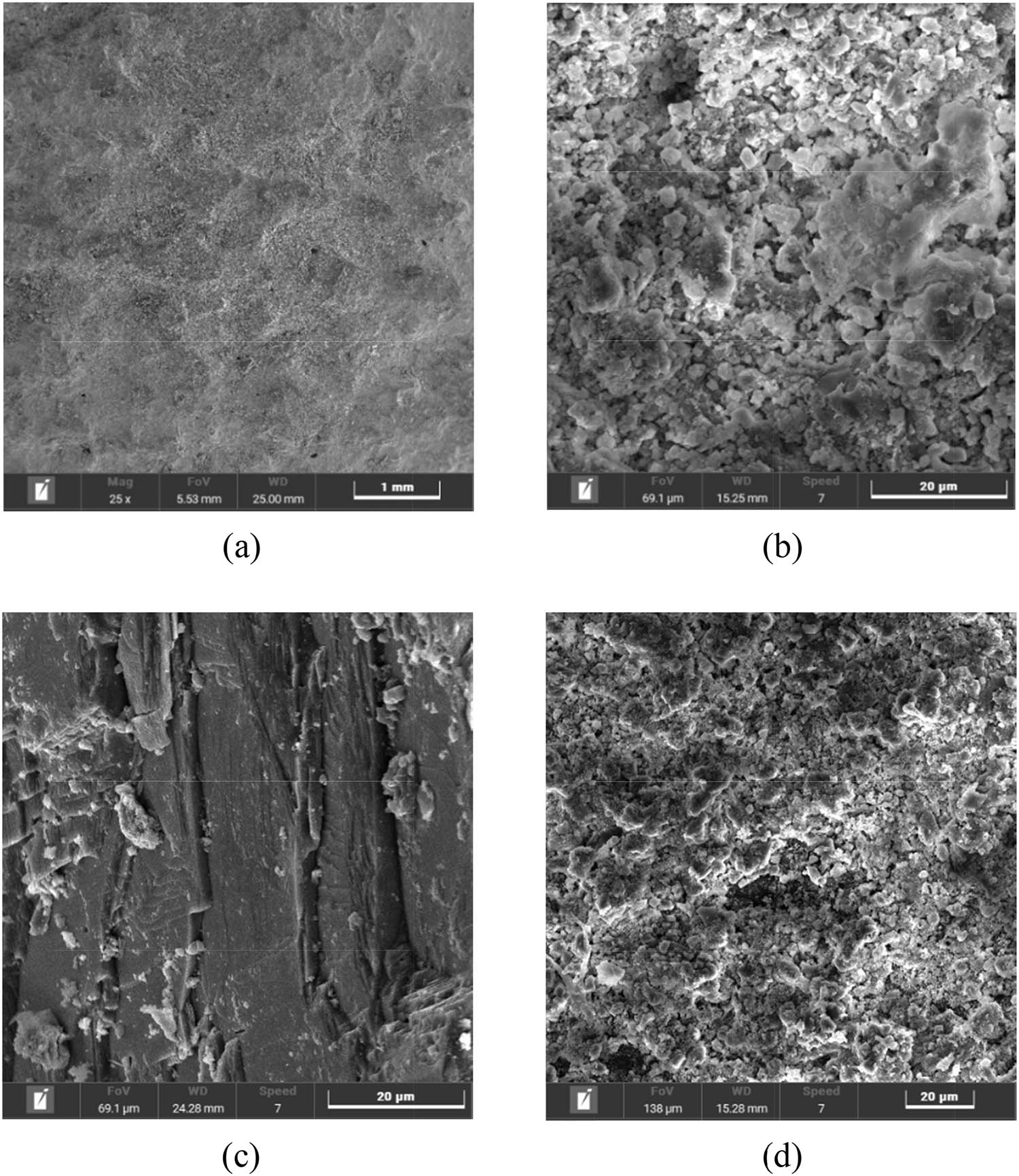
SEM images of partial coatings before frost: (a) CE coating (25×), (b) CE coating (2,000×), (c) PM coating (2,000×), and (d) PMS1.0 coating (1,000×).
The CE coating is a pure cementitious coating, thus essentially being a cement mortar with the characteristics of loose and porous CE materials [40]. Therefore, although the coating looks very dense on the macro level (Figure 8a), it cannot form a continuous, dense film like an organic film-forming coating [32,36,49], which has a large number of tiny pores (Figure 8b). With the addition of polyacrylate emulsion, latex particles can partially fill the pores inside the mortar. At the same time, with the drying and hardening of the emulsion into film, the density of the coating improves to a certain extent (Figure 8c). With its extremely small particles, nano-SiO2 has a small size and can have filling, nucleation, and volcanic ash effects on a CE coating and generate more C–S–H gel [45], thus further improving the density of the coating (Figure 8d).
CE coating is a hydrophilic material with high water absorption. After the CE coating is modified by waterborne polymer and hydrophilic nanoparticles, the obtained PM coating and the PMS1.0 coating are still hydrophilic materials with a certain degree of water absorption [11,40]. SEM photos of some coated samples after several freeze–thaw cycles are shown in Figure 9.

SEM photos of partial coatings after freeze–thaw cycles: (a) CE coating (50 cycles), (b) PM coating (50 cycles), (c) PM coating (150 cycles), and (d) PMS1.0 coating (150 cycles).
After only 50 freeze–thaw cycles, the surface of the CE coating begins to become rough, showing a granulation phenomenon, and obvious connected cracks appear inside (Figure 9a). This condition occurs mainly because the CE coating is a brittle material with a low tensile strength, which is not enough to resist the ice swelling stress that accumulates inside the coating during the continuous freeze–thaw cycles. Polyacrylates are waterborne polymer materials that have the properties of organic film-forming coatings. After the CE coating is modified with polyacrylate emulsion, the new coating changes from originally having hard and brittle characteristics to having flexible and tough characteristics, which is favorable for improving its crack resistance (Figure 9b). However, as a waterborne coating, polyacrylate emulsion has limited water resistance, which is why its surface also begins to have obvious cracks after more freeze–thaw cycles (Figure 9c). Similarly, the addition of nano-SiO2 can improve the frost resistance of CE coatings to a certain extent. However, it can only delay the emergence of cracks in the coatings (Figure 9d). With the emergence and increase in cracks in the coating, the integrity of the coating is gradually destroyed, allowing moisture and Cl− to easily pass through the coating to the substrate concrete. With the accumulation of freeze–thaw damage, the protective properties of the coating will finally completely be lost. While the application of coatings cannot completely eliminate the freeze–thaw damage of concrete or the intrusion of chloride ions, the use of coatings, particularly those incorporating nanomaterials and polymer composites, can remarkably improve the concrete’s freeze–thaw and chloride resistance.
The current study developed a nanomaterial–polymer-modified cementitious coating that effectively enhances the resistance of concrete to chloride and freeze–thaw cycles. A model was established to describe the relationship between the coated concrete’s Coulomb electrical flux and RDME under rapid freeze–thaw cycles, and the laboratory-based ultimate number of rapid freeze–thaw cycles was predicted. However, it should be noted that this article presents only preliminary laboratory-scale research. Further investigations regarding the validation of such coating’s effectiveness in practical engineering applications and the prediction of its service life will be conducted in future studies.
4 Conclusions
In this article, waterborne polyacrylate emulsion, nano-SiO2, and nano-CaCO3 were used to modify the CE coating, and then the frost performance of concrete with different coatings and the chloride resistance of coated concrete before and after freeze–thaw cycles were studied. The pore structure and microscopic morphology of partial coatings before and after freeze–thaw cycles were analyzed, and the following findings were obtained:
Freeze–thaw cycles not only produce freeze–thaw damage on concrete but also substantially reduce the chloride resistance of concrete. More freeze–thaw cycles correspond to a greater loss of the chloride resistance of concrete. Corresponding to 50 freeze–thaw cycles, the Coulomb electric flux of uncoated concrete increases by 123.8%.
The application of coatings can substantially enhance the chloride resistance of concrete before and after freeze–thaw cycles. Compared with the average Coulomb increments per freeze–thaw cycle of uncoated concrete, that of CE-, PM-, PMC1.0-, and PMS1.0-coated concrete are reduced by 44.9, 59.4, 68.8, and 74.2%, respectively.
The application of coatings can improve the freeze–thaw resistance of concrete and thus effectively extend the freeze–thaw resistance service life of coated concrete. Compared with that of uncoated concrete, the ultimate freeze–thaw cycles of concrete with CE, PM, PMC1.0, and PMS1.0 coatings increase by 1.54, 1.17, 1.88, and 2.27 times.
The composite application of polymer and nanomaterials can reduce the defects in coatings, improve the pore structure of the CE coating, reduce the porosity and average pore size, and reduce the proportion of harmful and more harmful pores in the coating, thus effectively improving the chloride and freeze–thaw resistance of coated concrete. The PMS1.0 coating offers the most comprehensive protection.
-
Funding information: This work was supported by the National Natural Science Foundation of China (grant number 51979169).
-
Author contributions: All authors have accepted responsibility for the entire content of this manuscript and approved its submission.
-
Conflict of interest: The authors state no conflict of interest.
-
Data availability statement: The datasets generated and/or analysed during the current study are available from the corresponding author on reasonable request.
References
[1] Ariyadasa LM, Bassuoni MT, Mady M, Ghazy A. Performance of plain and nano-modified coatings applied to a concrete bridge deck in cold regions. Case Stud Constr Mater. 2024;21:e03664.10.1016/j.cscm.2024.e03664Suche in Google Scholar
[2] Liu Y, Lin P, Ma J, He Z, Luo M. Research on spatial corrosion behavior and durability protection technology of concrete box girder bridge in cold regions. Constr Build Mater. 2024;441:137585.10.1016/j.conbuildmat.2024.137585Suche in Google Scholar
[3] Wang D, Zhou X, Fu B, Zhang L. Chloride ion penetration resistance of concrete containing fly ash and silica fume against combined freezing-thawing and chloride attack. Constr Build Mater. 2018;169:740–7.10.1016/j.conbuildmat.2018.03.038Suche in Google Scholar
[4] Cao Q, Gao Q, Gao R, Jia J. Chloride penetration resistance and frost resistance of fiber reinforced expansive self-consolidating concrete. Constr Build Mater. 2018;158:719–27.10.1016/j.conbuildmat.2017.10.029Suche in Google Scholar
[5] Mostofinejad D, Bahmani H, Khorshidifar A, Afsharpour R. Enhancing concrete durability with polymer impregnation: A comparative study of corrosion and freeze-thaw resistance. Dev Built Environ. 2024;18:100414.10.1016/j.dibe.2024.100414Suche in Google Scholar
[6] Jin M, Li W, Wang X, Tang J, Teng L, Ma Y, et al. Investigating the dual influence of freezing-thawing cycles and chloride ion penetration on GGBS-AEA concrete deterioration. J Build Eng. 2023;78:107759.10.1016/j.jobe.2023.107759Suche in Google Scholar
[7] Liu J, Hang M, Jiang M, Song H, Zhou X. Performance and mechanism of triethanolamine-triisopropanolamine corrosion inhibitor to deterioration of reinforced concrete under the coupling effect of freeze-thaw cycles and chloride attack. J Build Eng. 2024;98:111066.10.1016/j.jobe.2024.111066Suche in Google Scholar
[8] Bao J, Zhang H, Ding Y, Chen X, Zhang P, Xue S, et al. Salt-frost scaling resistance characteristics of nano silica-modified recycled aggregate concrete. J Build Eng. 2024;91:109674.10.1016/j.jobe.2024.109674Suche in Google Scholar
[9] Huo J, Liu D. Freezing and thawing durability of lightweight aggregate concrete improved by steel fiber. Concrete. 2009;2:76–9.Suche in Google Scholar
[10] Zhou Z, Zhang J, Shi X, et al. Research on frost and salt-frost resistance of polypropylene fiber concrete. J Water Resour Water Eng. 2014;25(1):152–60.Suche in Google Scholar
[11] Li G, Chen X, Zhang Y, Zhuang Z, Lv Y. Studies of nano-SiO2 and subsequent water curing on enhancing the frost resistance of autoclaved PHC pipe pile concrete. J Build Eng. 2023;69:106209.10.1016/j.jobe.2023.106209Suche in Google Scholar
[12] Sun S, Han X, Chen A, Zhang Q, Wang Z, Li K. Experimental analysis and evaluation of the compressive strength of rubberized concrete during freeze–thaw cycles. Int J Concr Struct Mater. 2023;17:28.10.1186/s40069-023-00592-6Suche in Google Scholar
[13] Han X, Ding N, Chen A, Wang Z, Xu Y, Feng L, et al. Experimental study on freeze-thaw failure of concrete incorporating waste tire crumb rubber and analytical evaluation of frost resistance. Constr Build Mater. 2024;439:137356.10.1016/j.conbuildmat.2024.137356Suche in Google Scholar
[14] Han X, Zhang Z, Wang D, Chen A, Ji Y, Wang Z, et al. Experimental study on freeze-thaw failure mechanism of rubberized concrete and analytical evaluation of the damage evolution. Constr Build Mater. 2025;480:141511.10.1016/j.conbuildmat.2025.141511Suche in Google Scholar
[15] Zhang SH, Guo D, Li G, Wang JW, Lv YJ. Studies of hydrophobic treatment on improving the salt-frost resistance of hydraulic concrete. Yellow River. 2021;43(1):120–4.Suche in Google Scholar
[16] Li G, Fan C, Lv Y, Fan F. Effect of hydrophobic treatments on improving the salt frost resistance of concrete. Materials. 2020;13:5361.10.3390/ma13235361Suche in Google Scholar PubMed PubMed Central
[17] Guo S, Quan J, Liu J, Deng P, Shi C, Zhu D. Influence of high performance cementitious materials coating on the mechanical performance and freeze-thaw resistance of the rubberized concrete. Constr Build Mater. 2024;452:138901.10.1016/j.conbuildmat.2024.138901Suche in Google Scholar
[18] Zhang F, He P, Wei F, Dai L. Study on effect of fluorosilicone coating on concrete performance under freeze-thaw cycles. Coat Prot. 2022;43(7):34–40.Suche in Google Scholar
[19] Meng Q. Study on frost resistance of hydraulic concrete coated with polyurethane. Heilongjiang Hydraul Sci Technol. 2022;50(12):5–7.Suche in Google Scholar
[20] Liu T. Experimental study on freeze-thaw resistance of new protective coating for hydraulic concrete. Heilongjiang Hydraul Sci Technol. 2022;50(4):1–3.Suche in Google Scholar
[21] Cao WK, Zhang KJ, Li G, Wang JW, Lv YJ, Li WH. Application of nanomaterials in concrete durability protective coatings. J North China Univ Water Resour Electr Power (Nat Sci Ed). 2023;44(4):60–8.Suche in Google Scholar
[22] Thissen P, Bogner A, Dehn F. Surface treatments on concrete: An overview on organic, inorganic and nano-based coatings and an outlook about surface modification by rare-earth oxides. RSC Sustainability. 2024;2:2092–124.10.1039/D3SU00482ASuche in Google Scholar
[23] Basheer PAM, Basheer L, Cleland DJ, Long AE. Surface treatments for concrete: assessment methods and reported performance. Constr Build Mater. 1997;11(7–8):413–29.10.1016/S0950-0618(97)00019-6Suche in Google Scholar
[24] Almusallam AA, Khan FM, Dulaijan SU, Al-Amoudi OSB. Effectiveness of surface coatings in improving concrete durability. Cem Concr Compos. 2003;25:473–81.10.1016/S0958-9465(02)00087-2Suche in Google Scholar
[25] Yu HF, Sun W, Yan LH, Wang Q. Research on freezing-thawing durability of air-entrained concrete exposed to salt lakes. J Wuhan Univ Technol. 2004;26(3):15–8.Suche in Google Scholar
[26] Ai HM, Guo JH, Yang CG, Dai BL. Durability of high fly ash content concrete under the coupling effect of freeze-thaw and chlorine salt erosion. Res Appl Build Mater. 2015;2:15–8.Suche in Google Scholar
[27] Kravanja G, Godec RF, Rozman M, Rudolf R, Ivanič A. Biomimetic superhydrophobic concrete with enhanced anticorrosive, freeze thaw, and deicing resistance. Adv Eng Mater. 2022;24(7):2101445.10.1002/adem.202101445Suche in Google Scholar
[28] Guan X, Li F, Hao X, Ji H, Hou P. Study on chloride ion penetration performance of recycled composite micro powder concrete under freeze-thaw environment. J Build Eng. 2024;98:111289.10.1016/j.jobe.2024.111289Suche in Google Scholar
[29] Soudki KA, Safiuddin M, Jeffs P, Macdonald G, Kroker M. Chloride penetration resistance of concrete sealer and coating systems. J Civ Eng Manag. 2015;21(4):492–502.10.3846/13923730.2014.890659Suche in Google Scholar
[30] Li G, Yang B, Guo C, Du J, Wu X. Time dependence and service life prediction of chloride resistance of concrete coatings. Constr Build Mater. 2015;83:19–25.10.1016/j.conbuildmat.2015.03.003Suche in Google Scholar
[31] Yu ML, Deng AZ, Sun H, Chen HH, Fan Z, Qu L. Applicability of organic protective coating for concrete in saline soil environment. N Build Mater. 2021;10:90–4.Suche in Google Scholar
[32] Zhang C, Li WH, Fan JP, Xun WJ, Chen YH. Relative method for evaluating freeze-thaw damage of coated concrete. J Build Mater. 2023;23(3):546–51.Suche in Google Scholar
[33] Pushpalal D, Danzandorj S, Narantogtokh B, Nishiwaki T, Sashka U, Erdenebat S, et al. Freezing-thawing durability and chemical characteristics of air-entrained sustainable concrete incorporated high-calcium fly ash in high-volume. J Build Eng. 2024;89:109307.10.1016/j.jobe.2024.109307Suche in Google Scholar
[34] Li G, Wei R, Li X, et al. Carbonation resistance of concrete with infiltration coatings. J South China Univ Technol (Nat Sci Ed). 2014;42(6):102–6.Suche in Google Scholar
[35] Pan X, Shi Z, Shi C, Ling TC, Li N. A review on concrete surface treatment Part I: Types and mechanisms. Constr Build Mater. 2017;132:578–90.10.1016/j.conbuildmat.2016.12.025Suche in Google Scholar
[36] Li G, Cui H, Zhou J, Hu W. Improvements of nano-TiO2 on the long-term chloride resistance of concrete with polymer coatings. Coatings. 2019;9:323.10.3390/coatings9050323Suche in Google Scholar
[37] Leung CKY, Zhu HG, Kim JK, Woo RSC. Use of polymer/organoclay nanocomposite surface treatment as water/ion barrier for concrete. J Mater Civ Eng. 2008;20(7):484–92.10.1061/(ASCE)0899-1561(2008)20:7(484)Suche in Google Scholar
[38] Diamanti MV, Brenna A, Bolzoni F, Berra M, Pastore T, Ormellese M. Effect of polymer modified cementitious coatings on water and chloride permeability in concrete. Constr Build Mater. 2013;49:720–8.10.1016/j.conbuildmat.2013.08.050Suche in Google Scholar
[39] Zheng W, Chen WG, Feng T, Li WQ, Liu XT, Dong LL, et al. Enhancing chloride ion penetration resistance into concrete by using graphene oxide reinforced waterborne epoxy coating. Prog Org Coat. 2020;138:105389.10.1016/j.porgcoat.2019.105389Suche in Google Scholar
[40] Li G, Ding Y, Gao T, Qin Y, Lv Y, Wang K. Chloride resistance of concrete containing nanoparticle-modified polymer cementitious coatings. Constr Build Mater. 2021;299:123736.10.1016/j.conbuildmat.2021.123736Suche in Google Scholar
[41] Soleimani M, Bagheri E, Mosaddegh P, Rabiee T, Fakhar A, Sadeghi M. Stable waterborne epoxy emulsions and the effect of silica nanoparticles on their coatings properties. Prog Org Coat. 2021;156:106250.10.1016/j.porgcoat.2021.106250Suche in Google Scholar
[42] Qu H, Feng M, Li M, Tian D, Zhang Y, Chen X, et al. Enhancing the carbonation and chloride resistance of concrete by nano-modified eco-friendly water-based organic coatings. Mater Today Commun. 2023;37:107284.10.1016/j.mtcomm.2023.107284Suche in Google Scholar
[43] GB/T 50082-2024. Standard for test methods of long-term performance and durability of ordinary concrete. Beijing: China Building Industry Press; 2024.Suche in Google Scholar
[44] Du J, Liu Z, Sun J, Li G, Wu X, Li G, et al. Enhancing concrete sulfate resistance by adding NaCl. Constr Build Mater. 2022;322:126370.10.1016/j.conbuildmat.2022.126370Suche in Google Scholar
[45] Zhao Z, Qi T, Zhou W, Hui D, Xiao C, Qi J, et al. A review on the properties, reinforcing effects, and commercialization of nanomaterials for cement-based materials. Nanotechnol Rev. 2020;9(1):303–22.10.1515/ntrev-2020-0023Suche in Google Scholar
[46] ASTM C1202. Standard test method for electrical indication of concrete’s ability to resist chloride ion penetration. ASTM International; 2022.Suche in Google Scholar
[47] Wu Z, Lian H. High performance concrete. Beijing: China Railway Publishing House; 1999.Suche in Google Scholar
[48] Zhang J, Bian F, Zhang Y, Fang Z, Fu C, Guo J. Effect of pore structures on gas permeability and chloride diffusivity of concrete. Constr Build Mater. 2018;163:402–13.10.1016/j.conbuildmat.2017.12.111Suche in Google Scholar
[49] Li G, Dong L, Bai Z, Lei M, Du J. Predicting carbonation depth for concrete with organic film coatings combined with ageing effects. Constr Build Mater. 2017;142:59–65.10.1016/j.conbuildmat.2017.03.063Suche in Google Scholar
© 2025 the author(s), published by De Gruyter
This work is licensed under the Creative Commons Attribution 4.0 International License.
Artikel in diesem Heft
- Research Articles
- MHD radiative mixed convective flow of a sodium alginate-based hybrid nanofluid over a convectively heated extending sheet with Joule heating
- Experimental study of mortar incorporating nano-magnetite on engineering performance and radiation shielding
- Multicriteria-based optimization and multi-variable non-linear regression analysis of concrete containing blends of nano date palm ash and eggshell powder as cementitious materials
- A promising Ag2S/poly-2-amino-1-mercaptobenzene open-top spherical core–shell nanocomposite for optoelectronic devices: A one-pot technique
- Biogenic synthesized selenium nanoparticles combined chitosan nanoparticles controlled lung cancer growth via ROS generation and mitochondrial damage pathway
- Fabrication of PDMS nano-mold by deposition casting method
- Stimulus-responsive gradient hydrogel micro-actuators fabricated by two-photon polymerization-based 4D printing
- Physical aspects of radiative Carreau nanofluid flow with motile microorganisms movement under yield stress via oblique penetrable wedge
- Effect of polar functional groups on the hydrophobicity of carbon nanotubes-bacterial cellulose nanocomposite
- Review in green synthesis mechanisms, application, and future prospects for Garcinia mangostana L. (mangosteen)-derived nanoparticles
- Entropy generation and heat transfer in nonlinear Buoyancy–driven Darcy–Forchheimer hybrid nanofluids with activation energy
- Green synthesis of silver nanoparticles using Ginkgo biloba seed extract: Evaluation of antioxidant, anticancer, antifungal, and antibacterial activities
- A numerical analysis of heat and mass transfer in water-based hybrid nanofluid flow containing copper and alumina nanoparticles over an extending sheet
- Investigating the behaviour of electro-magneto-hydrodynamic Carreau nanofluid flow with slip effects over a stretching cylinder
- Electrospun thermoplastic polyurethane/nano-Ag-coated clear aligners for the inhibition of Streptococcus mutans and oral biofilm
- Investigation of the optoelectronic properties of a novel polypyrrole-multi-well carbon nanotubes/titanium oxide/aluminum oxide/p-silicon heterojunction
- Novel photothermal magnetic Janus membranes suitable for solar water desalination
- Green synthesis of silver nanoparticles using Ageratum conyzoides for activated carbon compositing to prepare antimicrobial cotton fabric
- Activation energy and Coriolis force impact on three-dimensional dusty nanofluid flow containing gyrotactic microorganisms: Machine learning and numerical approach
- Machine learning analysis of thermo-bioconvection in a micropolar hybrid nanofluid-filled square cavity with oxytactic microorganisms
- Research and improvement of mechanical properties of cement nanocomposites for well cementing
- Thermal and stability analysis of silver–water nanofluid flow over unsteady stretching sheet under the influence of heat generation/absorption at the boundary
- Cobalt iron oxide-infused silicone nanocomposites: Magnetoactive materials for remote actuation and sensing
- Magnesium-reinforced PMMA composite scaffolds: Synthesis, characterization, and 3D printing via stereolithography
- Bayesian inference-based physics-informed neural network for performance study of hybrid nanofluids
- Numerical simulation of non-Newtonian hybrid nanofluid flow subject to a heterogeneous/homogeneous chemical reaction over a Riga surface
- Enhancing the superhydrophobicity, UV-resistance, and antifungal properties of natural wood surfaces via in situ formation of ZnO, TiO2, and SiO2 particles
- Synthesis and electrochemical characterization of iron oxide/poly(2-methylaniline) nanohybrids for supercapacitor application
- Impacts of double stratification on thermally radiative third-grade nanofluid flow on elongating cylinder with homogeneous/heterogeneous reactions by implementing machine learning approach
- Synthesis of Cu4O3 nanoparticles using pumpkin seed extract: Optimization, antimicrobial, and cytotoxicity studies
- Cationic charge influence on the magnetic response of the Fe3O4–[Me2+ 1−y Me3+ y (OH2)] y+(Co3 2−) y/2·mH2O hydrotalcite system
- Pressure sensing intelligent martial arts short soldier combat protection system based on conjugated polymer nanocomposite materials
- Magnetohydrodynamics heat transfer rate under inclined buoyancy force for nano and dusty fluids: Response surface optimization for the thermal transport
- Fly ash and nano-graphene enhanced stabilization of engine oil-contaminated soils
- Enhancing natural fiber-reinforced biopolymer composites with graphene nanoplatelets: Mechanical, morphological, and thermal properties
- Performance evaluation of dual-scale strengthened co-bonded single-lap joints using carbon nanotubes and Z-pins with ANN
- Computational works of blood flow with dust particles and partially ionized containing tiny particles on a moving wedge: Applications of nanotechnology
- Hybridization of biocomposites with oil palm cellulose nanofibrils/graphene nanoplatelets reinforcement in green epoxy: A study of physical, thermal, mechanical, and morphological properties
- Design and preparation of micro-nano dual-scale particle-reinforced Cu–Al–V alloy: Research on the aluminothermic reduction process
- Spectral quasi-linearization and response optimization on magnetohydrodynamic flow via stenosed artery with hybrid and ternary solid nanoparticles: Support vector machine learning
- Ferrite/curcumin hybrid nanocomposite formulation: Physicochemical characterization, anticancer activity, and apoptotic and cell cycle analyses in skin cancer cells
- Enhanced therapeutic efficacy of Tamoxifen against breast cancer using extra virgin olive oil-based nanoemulsion delivery system
- A titanium oxide- and silver-based hybrid nanofluid flow between two Riga walls that converge and diverge through a machine-learning approach
- Enhancing convective heat transfer mechanisms through the rheological analysis of Casson nanofluid flow towards a stagnation point over an electro-magnetized surface
- Intrinsic self-sensing cementitious composites with hybrid nanofillers exhibiting excellent piezoresistivity
- Research on mechanical properties and sulfate erosion resistance of nano-reinforced coal gangue based geopolymer concrete
- Impact of surface and configurational features of chemically synthesized chains of Ni nanostars on the magnetization reversal process
- Porous sponge-like AsOI/poly(2-aminobenzene-1-thiol) nanocomposite photocathode for hydrogen production from artificial and natural seawater
- Multifaceted insights into WO3 nanoparticle-coupled antibiotics to modulate resistance in enteric pathogens of Houbara bustard birds
- Synthesis of sericin-coated silver nanoparticles and their applications for the anti-bacterial finishing of cotton fabric
- Enhancing chloride resistance of freeze–thaw affected concrete through innovative nanomaterial–polymer hybrid cementitious coating
- Development and performance evaluation of green aluminium metal matrix composites reinforced with graphene nanopowder and marble dust
- Morphological, physical, thermal, and mechanical properties of carbon nanotubes reinforced arrowroot starch composites
- Influence of the graphene oxide nanosheet on tensile behavior and failure characteristics of the cement composites after high-temperature treatment
- Central composite design modeling in optimizing heat transfer rate in the dissipative and reactive dynamics of viscoplastic nanomaterials deploying Joule and heat generation aspects
- Double diffusion of nano-enhanced phase change materials in connected porous channels: A hybrid ISPH-XGBoost approach
- Synergistic impacts of Thompson–Troian slip, Stefan blowing, and nonuniform heat generation on Casson nanofluid dynamics through a porous medium
- Optimization of abrasive water jet machining parameters for basalt fiber/SiO2 nanofiller reinforced composites
- Enhancing aesthetic durability of Zisha teapots via TiO2 nanoparticle surface modification: A study on self-cleaning, antimicrobial, and mechanical properties
- Nanocellulose solution based on iron(iii) sodium tartrate complexes
- Combating multidrug-resistant infections: Gold nanoparticles–chitosan–papain-integrated dual-action nanoplatform for enhanced antibacterial activity
- Novel royal jelly-mediated green synthesis of selenium nanoparticles and their multifunctional biological activities
- Direct bandgap transition for emission in GeSn nanowires
- Synthesis of ZnO nanoparticles with different morphologies using a microwave-based method and their antimicrobial activity
- Numerical investigation of convective heat and mass transfer in a trapezoidal cavity filled with ternary hybrid nanofluid and a central obstacle
- Halloysite nanotube enhanced polyurethane nanocomposites for advanced electroinsulating applications
- Low molar mass ionic liquid’s modified carbon nanotubes and its role in PVDF crystalline stress generation
- Green synthesis of polydopamine-functionalized silver nanoparticles conjugated with Ceftazidime: in silico and experimental approach for combating antibiotic-resistant bacteria and reducing toxicity
- Evaluating the influence of graphene nano powder inclusion on mechanical, vibrational and water absorption behaviour of ramie/abaca hybrid composites
- Dynamic-behavior of Casson-type hybrid nanofluids due to a stretching sheet under the coupled impacts of boundary slip and reaction-diffusion processes
- Influence of polyvinyl alcohol on the physicochemical and self-sensing properties of nano carbon black reinforced cement mortar
- Advanced machine learning approaches for predicting compressive and flexural strength of carbon nanotube–reinforced cement composites: a comparative study and model interpretability analysis
- Artificial neural network-driven insights into nanoparticle-enhanced phase change materials melting for heat storage optimization
- Optical, structural, and morphological characterization of hydrothermally synthesized zinc oxide nanorods: exploring their potential for environmental applications
- Structural, optical, and gas sensing properties of Ce, Nd, and Pr doped ZnS nanostructured thin films prepared by nebulizer spray pyrolysis method
- The influence of nano-size La2O3 and HfC on the microstructure and mechanical properties of tungsten alloys by microwave sintering
- 10.1515/ntrev-2025-0187
- Review Articles
- A comprehensive review on hybrid plasmonic waveguides: Structures, applications, challenges, and future perspectives
- Nanoparticles in low-temperature preservation of biological systems of animal origin
- Fluorescent sulfur quantum dots for environmental monitoring
- Nanoscience systematic review methodology standardization
- Nanotechnology revolutionizing osteosarcoma treatment: Advances in targeted kinase inhibitors
- AFM: An important enabling technology for 2D materials and devices
- Carbon and 2D nanomaterial smart hydrogels for therapeutic applications
- Principles, applications and future prospects in photodegradation systems
- Do gold nanoparticles consistently benefit crop plants under both non-stressed and abiotic stress conditions?
- An updated overview of nanoparticle-induced cardiovascular toxicity
- Arginine as a promising amino acid for functionalized nanosystems: Innovations, challenges, and future directions
- Advancements in the use of cancer nanovaccines: Comprehensive insights with focus on lung and colon cancer
- Membrane-based biomimetic delivery systems for glioblastoma multiforme therapy
- The drug delivery systems based on nanoparticles for spinal cord injury repair
- Green synthesis, biomedical effects, and future trends of Ag/ZnO bimetallic nanoparticles: An update
- Application of magnesium and its compounds in biomaterials for nerve injury repair
- Micro/nanomotors in biomedicine: Construction and applications
- Hydrothermal synthesis of biomass-derived CQDs: Advances and applications
- Research progress in 3D bioprinting of skin: Challenges and opportunities
- Review on bio-selenium nanoparticles: Synthesis, protocols, and applications in biomedical processes
- Gold nanocrystals and nanorods functionalized with protein and polymeric ligands for environmental, energy storage, and diagnostic applications: A review
- An in-depth analysis of rotational and non-rotational piezoelectric energy harvesting beams: A comprehensive review
- Advancements in perovskite/CIGS tandem solar cells: Material synergies, device configurations, and economic viability for sustainable energy
- Deep learning in-depth analysis of crystal graph convolutional neural networks: A new era in materials discovery and its applications
- Review of recent nano TiO2 film coating methods, assessment techniques, and key problems for scaleup
- Antioxidant quantum dots for spinal cord injuries: A review on advancing neuroprotection and regeneration in neurological disorders
- Rise of polycatecholamine ultrathin films: From synthesis to smart applications
- Advancing microencapsulation strategies for bioactive compounds: Enhancing stability, bioavailability, and controlled release in food applications
- Advances in the design and manipulation of self-assembling peptide and protein nanostructures for biomedical applications
- Photocatalytic pervious concrete systems: from classic photocatalysis to luminescent photocatalysis
- Beyond science: ethical and societal considerations in the era of biogenic nanoparticles
- Corrigendum
- Corrigendum to “Synthesis and characterization of smart stimuli-responsive herbal drug-encapsulated nanoniosome particles for efficient treatment of breast cancer”
- Special Issue on Advanced Nanomaterials for Carbon Capture, Environment and Utilization for Energy Sustainability - Part III
- Efficiency optimization of quantum dot photovoltaic cell by solar thermophotovoltaic system
- Exploring the diverse nanomaterials employed in dental prosthesis and implant techniques: An overview
- Electrochemical investigation of bismuth-doped anode materials for low‑temperature solid oxide fuel cells with boosted voltage using a DC-DC voltage converter
- Synthesis of HfSe2 and CuHfSe2 crystalline materials using the chemical vapor transport method and their applications in supercapacitor energy storage devices
- Special Issue on Green Nanotechnology and Nano-materials for Environment Sustainability
- Influence of nano-silica and nano-ferrite particles on mechanical and durability of sustainable concrete: A review
- Surfaces and interfaces analysis on different carboxymethylation reaction time of anionic cellulose nanoparticles derived from oil palm biomass
- Processing and effective utilization of lignocellulosic biomass: Nanocellulose, nanolignin, and nanoxylan for wastewater treatment
- Wound healing activities of sulfur nanoparticles of Allium cepa extract embedded in a nanocream formulation: in vitro and in vivo studies
- Retraction
- Retraction of “Aging assessment of silicone rubber materials under corona discharge accompanied by humidity and UV radiation”
Artikel in diesem Heft
- Research Articles
- MHD radiative mixed convective flow of a sodium alginate-based hybrid nanofluid over a convectively heated extending sheet with Joule heating
- Experimental study of mortar incorporating nano-magnetite on engineering performance and radiation shielding
- Multicriteria-based optimization and multi-variable non-linear regression analysis of concrete containing blends of nano date palm ash and eggshell powder as cementitious materials
- A promising Ag2S/poly-2-amino-1-mercaptobenzene open-top spherical core–shell nanocomposite for optoelectronic devices: A one-pot technique
- Biogenic synthesized selenium nanoparticles combined chitosan nanoparticles controlled lung cancer growth via ROS generation and mitochondrial damage pathway
- Fabrication of PDMS nano-mold by deposition casting method
- Stimulus-responsive gradient hydrogel micro-actuators fabricated by two-photon polymerization-based 4D printing
- Physical aspects of radiative Carreau nanofluid flow with motile microorganisms movement under yield stress via oblique penetrable wedge
- Effect of polar functional groups on the hydrophobicity of carbon nanotubes-bacterial cellulose nanocomposite
- Review in green synthesis mechanisms, application, and future prospects for Garcinia mangostana L. (mangosteen)-derived nanoparticles
- Entropy generation and heat transfer in nonlinear Buoyancy–driven Darcy–Forchheimer hybrid nanofluids with activation energy
- Green synthesis of silver nanoparticles using Ginkgo biloba seed extract: Evaluation of antioxidant, anticancer, antifungal, and antibacterial activities
- A numerical analysis of heat and mass transfer in water-based hybrid nanofluid flow containing copper and alumina nanoparticles over an extending sheet
- Investigating the behaviour of electro-magneto-hydrodynamic Carreau nanofluid flow with slip effects over a stretching cylinder
- Electrospun thermoplastic polyurethane/nano-Ag-coated clear aligners for the inhibition of Streptococcus mutans and oral biofilm
- Investigation of the optoelectronic properties of a novel polypyrrole-multi-well carbon nanotubes/titanium oxide/aluminum oxide/p-silicon heterojunction
- Novel photothermal magnetic Janus membranes suitable for solar water desalination
- Green synthesis of silver nanoparticles using Ageratum conyzoides for activated carbon compositing to prepare antimicrobial cotton fabric
- Activation energy and Coriolis force impact on three-dimensional dusty nanofluid flow containing gyrotactic microorganisms: Machine learning and numerical approach
- Machine learning analysis of thermo-bioconvection in a micropolar hybrid nanofluid-filled square cavity with oxytactic microorganisms
- Research and improvement of mechanical properties of cement nanocomposites for well cementing
- Thermal and stability analysis of silver–water nanofluid flow over unsteady stretching sheet under the influence of heat generation/absorption at the boundary
- Cobalt iron oxide-infused silicone nanocomposites: Magnetoactive materials for remote actuation and sensing
- Magnesium-reinforced PMMA composite scaffolds: Synthesis, characterization, and 3D printing via stereolithography
- Bayesian inference-based physics-informed neural network for performance study of hybrid nanofluids
- Numerical simulation of non-Newtonian hybrid nanofluid flow subject to a heterogeneous/homogeneous chemical reaction over a Riga surface
- Enhancing the superhydrophobicity, UV-resistance, and antifungal properties of natural wood surfaces via in situ formation of ZnO, TiO2, and SiO2 particles
- Synthesis and electrochemical characterization of iron oxide/poly(2-methylaniline) nanohybrids for supercapacitor application
- Impacts of double stratification on thermally radiative third-grade nanofluid flow on elongating cylinder with homogeneous/heterogeneous reactions by implementing machine learning approach
- Synthesis of Cu4O3 nanoparticles using pumpkin seed extract: Optimization, antimicrobial, and cytotoxicity studies
- Cationic charge influence on the magnetic response of the Fe3O4–[Me2+ 1−y Me3+ y (OH2)] y+(Co3 2−) y/2·mH2O hydrotalcite system
- Pressure sensing intelligent martial arts short soldier combat protection system based on conjugated polymer nanocomposite materials
- Magnetohydrodynamics heat transfer rate under inclined buoyancy force for nano and dusty fluids: Response surface optimization for the thermal transport
- Fly ash and nano-graphene enhanced stabilization of engine oil-contaminated soils
- Enhancing natural fiber-reinforced biopolymer composites with graphene nanoplatelets: Mechanical, morphological, and thermal properties
- Performance evaluation of dual-scale strengthened co-bonded single-lap joints using carbon nanotubes and Z-pins with ANN
- Computational works of blood flow with dust particles and partially ionized containing tiny particles on a moving wedge: Applications of nanotechnology
- Hybridization of biocomposites with oil palm cellulose nanofibrils/graphene nanoplatelets reinforcement in green epoxy: A study of physical, thermal, mechanical, and morphological properties
- Design and preparation of micro-nano dual-scale particle-reinforced Cu–Al–V alloy: Research on the aluminothermic reduction process
- Spectral quasi-linearization and response optimization on magnetohydrodynamic flow via stenosed artery with hybrid and ternary solid nanoparticles: Support vector machine learning
- Ferrite/curcumin hybrid nanocomposite formulation: Physicochemical characterization, anticancer activity, and apoptotic and cell cycle analyses in skin cancer cells
- Enhanced therapeutic efficacy of Tamoxifen against breast cancer using extra virgin olive oil-based nanoemulsion delivery system
- A titanium oxide- and silver-based hybrid nanofluid flow between two Riga walls that converge and diverge through a machine-learning approach
- Enhancing convective heat transfer mechanisms through the rheological analysis of Casson nanofluid flow towards a stagnation point over an electro-magnetized surface
- Intrinsic self-sensing cementitious composites with hybrid nanofillers exhibiting excellent piezoresistivity
- Research on mechanical properties and sulfate erosion resistance of nano-reinforced coal gangue based geopolymer concrete
- Impact of surface and configurational features of chemically synthesized chains of Ni nanostars on the magnetization reversal process
- Porous sponge-like AsOI/poly(2-aminobenzene-1-thiol) nanocomposite photocathode for hydrogen production from artificial and natural seawater
- Multifaceted insights into WO3 nanoparticle-coupled antibiotics to modulate resistance in enteric pathogens of Houbara bustard birds
- Synthesis of sericin-coated silver nanoparticles and their applications for the anti-bacterial finishing of cotton fabric
- Enhancing chloride resistance of freeze–thaw affected concrete through innovative nanomaterial–polymer hybrid cementitious coating
- Development and performance evaluation of green aluminium metal matrix composites reinforced with graphene nanopowder and marble dust
- Morphological, physical, thermal, and mechanical properties of carbon nanotubes reinforced arrowroot starch composites
- Influence of the graphene oxide nanosheet on tensile behavior and failure characteristics of the cement composites after high-temperature treatment
- Central composite design modeling in optimizing heat transfer rate in the dissipative and reactive dynamics of viscoplastic nanomaterials deploying Joule and heat generation aspects
- Double diffusion of nano-enhanced phase change materials in connected porous channels: A hybrid ISPH-XGBoost approach
- Synergistic impacts of Thompson–Troian slip, Stefan blowing, and nonuniform heat generation on Casson nanofluid dynamics through a porous medium
- Optimization of abrasive water jet machining parameters for basalt fiber/SiO2 nanofiller reinforced composites
- Enhancing aesthetic durability of Zisha teapots via TiO2 nanoparticle surface modification: A study on self-cleaning, antimicrobial, and mechanical properties
- Nanocellulose solution based on iron(iii) sodium tartrate complexes
- Combating multidrug-resistant infections: Gold nanoparticles–chitosan–papain-integrated dual-action nanoplatform for enhanced antibacterial activity
- Novel royal jelly-mediated green synthesis of selenium nanoparticles and their multifunctional biological activities
- Direct bandgap transition for emission in GeSn nanowires
- Synthesis of ZnO nanoparticles with different morphologies using a microwave-based method and their antimicrobial activity
- Numerical investigation of convective heat and mass transfer in a trapezoidal cavity filled with ternary hybrid nanofluid and a central obstacle
- Halloysite nanotube enhanced polyurethane nanocomposites for advanced electroinsulating applications
- Low molar mass ionic liquid’s modified carbon nanotubes and its role in PVDF crystalline stress generation
- Green synthesis of polydopamine-functionalized silver nanoparticles conjugated with Ceftazidime: in silico and experimental approach for combating antibiotic-resistant bacteria and reducing toxicity
- Evaluating the influence of graphene nano powder inclusion on mechanical, vibrational and water absorption behaviour of ramie/abaca hybrid composites
- Dynamic-behavior of Casson-type hybrid nanofluids due to a stretching sheet under the coupled impacts of boundary slip and reaction-diffusion processes
- Influence of polyvinyl alcohol on the physicochemical and self-sensing properties of nano carbon black reinforced cement mortar
- Advanced machine learning approaches for predicting compressive and flexural strength of carbon nanotube–reinforced cement composites: a comparative study and model interpretability analysis
- Artificial neural network-driven insights into nanoparticle-enhanced phase change materials melting for heat storage optimization
- Optical, structural, and morphological characterization of hydrothermally synthesized zinc oxide nanorods: exploring their potential for environmental applications
- Structural, optical, and gas sensing properties of Ce, Nd, and Pr doped ZnS nanostructured thin films prepared by nebulizer spray pyrolysis method
- The influence of nano-size La2O3 and HfC on the microstructure and mechanical properties of tungsten alloys by microwave sintering
- 10.1515/ntrev-2025-0187
- Review Articles
- A comprehensive review on hybrid plasmonic waveguides: Structures, applications, challenges, and future perspectives
- Nanoparticles in low-temperature preservation of biological systems of animal origin
- Fluorescent sulfur quantum dots for environmental monitoring
- Nanoscience systematic review methodology standardization
- Nanotechnology revolutionizing osteosarcoma treatment: Advances in targeted kinase inhibitors
- AFM: An important enabling technology for 2D materials and devices
- Carbon and 2D nanomaterial smart hydrogels for therapeutic applications
- Principles, applications and future prospects in photodegradation systems
- Do gold nanoparticles consistently benefit crop plants under both non-stressed and abiotic stress conditions?
- An updated overview of nanoparticle-induced cardiovascular toxicity
- Arginine as a promising amino acid for functionalized nanosystems: Innovations, challenges, and future directions
- Advancements in the use of cancer nanovaccines: Comprehensive insights with focus on lung and colon cancer
- Membrane-based biomimetic delivery systems for glioblastoma multiforme therapy
- The drug delivery systems based on nanoparticles for spinal cord injury repair
- Green synthesis, biomedical effects, and future trends of Ag/ZnO bimetallic nanoparticles: An update
- Application of magnesium and its compounds in biomaterials for nerve injury repair
- Micro/nanomotors in biomedicine: Construction and applications
- Hydrothermal synthesis of biomass-derived CQDs: Advances and applications
- Research progress in 3D bioprinting of skin: Challenges and opportunities
- Review on bio-selenium nanoparticles: Synthesis, protocols, and applications in biomedical processes
- Gold nanocrystals and nanorods functionalized with protein and polymeric ligands for environmental, energy storage, and diagnostic applications: A review
- An in-depth analysis of rotational and non-rotational piezoelectric energy harvesting beams: A comprehensive review
- Advancements in perovskite/CIGS tandem solar cells: Material synergies, device configurations, and economic viability for sustainable energy
- Deep learning in-depth analysis of crystal graph convolutional neural networks: A new era in materials discovery and its applications
- Review of recent nano TiO2 film coating methods, assessment techniques, and key problems for scaleup
- Antioxidant quantum dots for spinal cord injuries: A review on advancing neuroprotection and regeneration in neurological disorders
- Rise of polycatecholamine ultrathin films: From synthesis to smart applications
- Advancing microencapsulation strategies for bioactive compounds: Enhancing stability, bioavailability, and controlled release in food applications
- Advances in the design and manipulation of self-assembling peptide and protein nanostructures for biomedical applications
- Photocatalytic pervious concrete systems: from classic photocatalysis to luminescent photocatalysis
- Beyond science: ethical and societal considerations in the era of biogenic nanoparticles
- Corrigendum
- Corrigendum to “Synthesis and characterization of smart stimuli-responsive herbal drug-encapsulated nanoniosome particles for efficient treatment of breast cancer”
- Special Issue on Advanced Nanomaterials for Carbon Capture, Environment and Utilization for Energy Sustainability - Part III
- Efficiency optimization of quantum dot photovoltaic cell by solar thermophotovoltaic system
- Exploring the diverse nanomaterials employed in dental prosthesis and implant techniques: An overview
- Electrochemical investigation of bismuth-doped anode materials for low‑temperature solid oxide fuel cells with boosted voltage using a DC-DC voltage converter
- Synthesis of HfSe2 and CuHfSe2 crystalline materials using the chemical vapor transport method and their applications in supercapacitor energy storage devices
- Special Issue on Green Nanotechnology and Nano-materials for Environment Sustainability
- Influence of nano-silica and nano-ferrite particles on mechanical and durability of sustainable concrete: A review
- Surfaces and interfaces analysis on different carboxymethylation reaction time of anionic cellulose nanoparticles derived from oil palm biomass
- Processing and effective utilization of lignocellulosic biomass: Nanocellulose, nanolignin, and nanoxylan for wastewater treatment
- Wound healing activities of sulfur nanoparticles of Allium cepa extract embedded in a nanocream formulation: in vitro and in vivo studies
- Retraction
- Retraction of “Aging assessment of silicone rubber materials under corona discharge accompanied by humidity and UV radiation”
