Intrinsic self-sensing cementitious composites with hybrid nanofillers exhibiting excellent piezoresistivity
-
 ,
,

Abstract
Intrinsic self-sensing cementitious composites are competitive candidates for structural health monitoring of smart civil infrastructure. Meanwhile, the hybrid nanofillers can endow cementitious composites with excellent piezoresistivity with a synergetic effect due to their various aspect ratios and particle shapes. Hence, this study presents a comprehensive investigation of intrinsic self-sensing cementitious composites containing graphene nanoplatelets, carbon nanotubes, and nanocarbon blacks (GCNs). The electrical conductivity, mechanical performances, and self-sensing properties subjected to cyclic and monotonic compression were studied. The parameters include concentration of the GCNs, water content, and ages. Mechanisms of the properties affected by the GCNs were explored in depth. The results indicate that the electrical resistivity decreased rapidly as dosages of the GCNs increasing from 4.0 to 10.0 wt%. The maximum compressive strength was reached up to 45.3 MPa under the concentration of GCNs of 2.0 wt%. Moreover, the optimum FCR and stress/strain sensitivity were −24.9 and 1.0%/MPa/95.8, respectively, corresponding to the content of the GCNs of 10.0 wt%, which were improved by 54.3% and 5,050.0%/4,360.1%, respectively, compared with the control group. This research can offer a theoretical foundation for promoting the application of intrinsic self-sensing cementitious composites toward structural health monitoring in smart infrastructure.
1 Introduction
1.1 Necessity and significance of structural health monitoring (SHM) in civil infrastructure
Concrete is a widely used manmade construction material worldwide in civil infrastructure, due to its favorable compressive strength and durability, well moldability, and inexpensive [1]. Nevertheless, many kinds of loads and environmental factors, such as impact load, earthquakes, carbonization, and acid and alkaline corrosion, can result in cracks, damage, and degradation and even cause the destruction of the concrete structures unavoidably. Thus, they will bring a threat to the safety of the public [2]. Therefore, SHM is important for assessing defects of concrete structures and evaluating their service conditions. In addition, SHM is necessary for facilitating early warning systems, prolonging the lifespan of civil infrastructure [3,4]. The sensory systems of SHM can collect insitu information of the concrete structures, for example, stress, strain, displacement, and cracks. The detected information can be utilized to recommend maintenance and strengthen the concrete structures [5,6].
In the previous research, quantity conventional sensing techniques, for example, optical fibers, strain gauges, piezoelectric ceramics, and shape memory alloys, have been utilized extensively in SHM systems [7]. However, the conventional sensors present obvious shortcomings, such as incompatible with concrete structures, low sensitivity, low survival rate, and expensive, which limit their widely applications [8,9]. Therefore, it is an urgent need to solve these issues of SHM sensory systems of civil infrastructure. As a result, intrinsic self-sensing cementitious composites possess excellent sensing properties and need to be developed urgently to address these drawbacks.
1.2 Origin and definition of intrinsic self-sensing cementitious composites
In 1993, the intrinsic self-sensing cementitious composites were first developed, and since then, these composites have been studied and applied extensively [10]. Intrinsic self-sensing cementitious composites can sense themselves, which are fabricated by adding electrical conduction fillers to cementitious composites. Self-sensing capacity is usually realized by electrical pathways and networks generated by electrical conduction fillers inside the cementitious composites, which possess structural together with sensing properties. Deformation, stress, strain, damage, and cracks can be sensed from testing the electrical resistivity of themselves during the loading process, which is also called piezoresistivity. Their mechanical performances and durability are not compromised or even enhanced [5,11,12,13]. The pathways and networks have been widely generated by the electrical conduction fillers based on percolation, field emission, and quantum tunnelling effect. They are changed when the composites are loaded or deformed, subjected to applied load or variation of environments. Thus, their electrical property will be changed [14,15]. The intrinsic self-sensing cementitious composites can provide timely data on the performance of concrete structures, monitoring potential defects. Different from conventional sensors, intrinsic self-sensing cementitious composites are compatible and have similar durability with concrete structures because of their nature cementitious properties [16].
1.3 Self-sensing property of the cementitious composites containing typical electrical conduction fillers
The electrical conduction fillers usually can be divided into non-metallic materials, for example, carbon fibers (CFs), graphene nanoplatelets (GNPs), carbon nanofibers (CNFs), nanocarbon blacks (NCBs), carbon nanotubes (CNTs), and metallic electrical conduction fillers as steel fibers, nickel powders, brass fibers, etc. In addition, the nano-electrical conduction fillers have the size and filling effect, which can enhance the electrical conduction together with the sensing property of cementitious composites [17,18].
GNPs are two-dimensional with multiple sheet-layer structures and a thickness of nanometers. The π electron involved in interlayer bonding imparts GNPs with excellent electrical conduction ability. Their large aspect ratio can offer plentiful nucleation positions for the hydration product. Thus, the nucleation effect, filling effect, and bridging effect modify the microstructures of the cementitious composites together. Thereby, both their mechanical performances and self-sensing properties can be enhanced [19,20,21]. Sun et al. studied the self-sensing capacity of cementitious composites containing GNPs under both static circular compression and dynamic loads. The effect of load amplitude and loading rate have been studied when these composites are subjected to compression. The results show that the cementitious composites containing 5 vol% GNPs present the best sensitivity, and their fractional change in electrical resistivity (FCR) is lowered to −15.6% exerted on compressive stress of 20 MPa. In addition, their stress sensitivity and strain sensitivity were achieved at 0.78%/MPa and 156, respectively [22]. Sevim et al. investigated the self-sensing property of cementitious composites containing GNPs with different types of surface area, thickness, and particle size. They indicated that the smaller particle size, together with the larger surface areas of the GNPs, cannot be dispersed effectively, thus presenting no self-sensing property. Nevertheless, the smaller surface areas together with the bigger particle size of the GNPs displayed a favorable self-sensing property [23]. Qi et al. studied the sensing capacity of the cementitious composites incorporating the GNPs with various particle sizes subjected to cyclic compression and tension loads and pointed out that these composites exhibit excellent self-sensing property. Additionally, the cementitious composites incorporating a bigger particle size of the GNPs have better stress sensitivity [24]. Dong et al. studied the self-sensing capacity of cementitious composites with GNPs subjected to impact load. They demonstrated that the maximum magnitude of FCR of the cementitious composites containing 1.0% GNPs ranged from 4.96 to 6.36, 8.31, and 10.97% under impact load with angles varied from 0° to 30°, 60°, and 90°, respectively [25]. Dong et al. investigated the self-sensing performance of the cementitious composites containing GNPs with a dosage of 3.0% under compression, and found that the FCR was approached to −30% [26].
CNTs are carbon-based tubular materials made of several layers of graphite at nanoscale, and they have a coaxial lamellar crimp structure. The CNTs possess excellent electrical conductivity, good mechanical performance, and well thermal conductivity. Thus, they can impart cementitious composites with better electrical conduction and self-sensing performances [27,28,29].
Wang et al. studied the self-sensing property of cementitious composites containing CNTs subjected to salt attacks. They pointed out that the self-sensing property greatly relies on the percolation density and the critical exponent of CNTs’ pathways around the percolation threshold. The relation of FCR and repeated compressive load without salt environments was “M” shape. In addition, the relation between electrical resistivity and strain was an exponential function [30]. Lee et al. studied the self-sensing capability of cementitious composites incorporating CNTs with different concentrations of 0.1 and 0.5 wt% withstand tensile load, and their strain sensitivity was reached up to 23.8. In addition, they embedded the composites as sensors at the tension position of the concrete beam subjected to flexural load. They also proposed empirical equations to evaluate the tensile strain of the concrete beam based on the results of FCR tested using the embedded sensor [31]. Yuan et al. coated CNTs on cement particles as electrical conduction fillers of CNTs@cement and developed cementitious composites with high sensitivity. The CNTs absorbed uniformly on the cement particles’ surface do not need a surfactant to disperse. Thus, the flowability and mechanical properties of the composites were not reduced. The FCR was lowered to −1.26% under cyclic compressive load. Additionally, the electrical conductivity of the composites with 0.1 wt% CNTs@cement was increased by two orders of magnitude [32]. Song et al. carried out an experiment on the self-sensing performance of cementitious composites incorporating CNTs by flexural, splitting tensile, and shear tests. The composites with 0.2 wt% CNTs showed a favorable self-sensing capacity for the initial crack, deflection harden or soften [33]. Mesquita et al. analyzed the self-sensing properties of cementitious composites incorporating CNTs and indicated that the FCR of the composites with 2.0% CNTs was reduced by −2.0% [34].
Because of NCBs present advantages as fine filling effect, stability at high thermal, low cost, and electrical resistivity is lowered to about 10−1 Ω·cm; thus, NCBs become attractive electrical conduction fillers. However, NCBs can tightly adhere to each other because of strong Van der Waals forces [35,36,37,38]. Li et al. developed self-sensing cementitious composites containing NCBs with particle size of 120 nm. The contents of NCBs were varied from 5.0 to 25.0 wt%, and they demonstrated that the relation between FCR and strain withstand monotonic compression is linear. The strain sensitivity is as high as 55.28, corresponding to the NCBs’ concentration of 5.0 wt% [39]. Monteiro et al. studied the sensing performance of cementitious composites containing dosages of the NCBs of 0.0–10.0 wt% subjected to repeated compression. The composites present self-sensing property when the dosage of the NCBs is higher than 7.0 wt%, and the maximum strain sensitivity is up to 30.0, corresponding to the content of NCBs of 7.0 wt% [40]. Deng and Li indicated that the electrical resistivity of cementitious composites incorporating NCBs under tension increased with the propagation of cracks, and the increase ratio under the inelastic range is higher than that under the elastic range [41]. Monteiro et al. developed self-sensing cementitious composites by adding NCBs, and then utilized them as sensors to monitor cyclic compressive loads when temperatures ranged from 15 to 45°C. A linear and repeatable self-sensing property with a strain sensitivity ranging from 40 to 60 was found. Nevertheless, the strain sensitivity was reduced by 30% when the temperature rose to 45°C, but the linearity of the strain sensitivity versus the stress was not affected [42]. Hussain et al. demonstrated that the strain sensitivity of cementitious composites containing NCBs under both monotonic and repeated compression was increased with increasing concentration of the NCBs after it reached 1.50%, and the maximum strain sensitivity was achieved at 134.32 [43,44].
To address the disadvantages of intrinsic self-sensing cementitious composites with single electrical conduction fillers, some researchers proposed hybrid electrical conduction fillers due to their synergistic effect [45,46]. Zhang et al. used the NCBs together with CNTs to develop self-sensing cementitious composites. The NCBs and CNTs with different short and long ranges can stimulate the generation of extensive conduction pathways inside the cementitious composites; thus, more distance among the electrical conduction fillers can be changed and lead to sensitive self-sensing performance subjected to whatever repeated and monotonic compressive loads. These composites with a concentration of 2.40 vol% of the hybrid NCBs and CNTs present stable sensing properties, and the maximum magnitude of FCR is reached up to 25.4% [47,48]. Qiu et al. developed self-sensing cementitious composites by using self-assembled CNTs and NCBs. The electrical resistivity of these composites was lowered to 33 Ω·cm. The maximum magnitude FCR of the beam made up of these composites containing 1.8 vol% CNTs and NCBs was about 286.0% under monotonic flexural load. Moreover, the beam incorporation of 2.0 vol% CNTs and NCBs presented the optimum self-sensing performance and obtained the maximum sensitivity of 322.7 [49]. Jawed Roshan et al. investigated the self-sensing property of cementitious composites incorporating hybrid CNTs and GNPs with concentrations of 3.0 and 4.0%. The strain, cracks, and damage of the composites were detected under cyclic compressive load [50]. Zhang et al. developed cementitious composites with CNTs together with TiO2. These composites exhibiting favorable self-sensing characteristics. Their maximum FCR and strain sensitivity were achieved at 84.09% and 317, respectively [51].
1.4 Application and challenges of the intrinsic self-sensing cementitious composites
Recently, intrinsic self-sensing cementitious composites have been applied as sensors in concrete structures for SHM. Dong et al. fabricated sensors by intrinsic self-sensing cementitious composites incorporating NCBs and embedded them into a concrete beam under flexural load. Cracks and stress of this beam in the compression zone have been detected with a slow reduction and a sudden increase in the FCR tested from the embedded sensors. At the same time, the cracks and stress of the concrete beam in the tension zone have also been detected by a slow increase and a rapid jump of the FCR. The change of the FCR of the sensors are in accordance with variation of flexural stress and presents good sensitivity when the concrete beam from loading to failure [35]. Ding et al. utilized the intrinsic self-sensing cementitious composites incorporating CFs and NCBs to detect cracks in a concrete maglev girder. They first demonstrated that the CFs and CNTs can generate wide networks in cementitious composites for the synergic effects, thus resulting in the composites exhibiting favorable self-sensing performance. Additionally, these composites presented high sensitivity to monitor the propagation of cracks and damage of the maglev girder [52]. Ding et al. fabricated sensors using cementitious composites with hybrid CNTs and NCBs and analyzed their sensing properties when embedded them in a concrete column. Sensing properties of embedded sensors with non-embedded ones have been compared, indicating that the differences in Poisson’s ratio and elastic modulus between concrete and sensors can lead to different monitoring results [53]. Sun et al. assessed self-sensing performances of cementitious strain sensors with steel fibers when embedded in concrete columns and pointed out that the damage of the concrete columns can be detected with irreversible variation of the sensor’s electrical resistivity [54]. Xiao et al. demonstrated that the intrinsic self-sensing cementitious strain sensor incorporating NCBs embedded in the central position of concrete columns presented good sensitivity. However, the sensing performance was susceptible to the embedded condition of the sensor [55].
1.5 Aims of this research
As known from the above review of the intrinsic self-sensing cementitious composites, little researches have been conducted on the mechanical performances, electrical properties, and self-sensing properties of cementitious composites incorporating hybrid electrical conduction fillers of the GNPs, CNTs, and NCBs. Moreover, some of the studies demonstrated that the hybrid electrical conduction fillers possess a cooperation effect, while they mainly focus on the cooperation effect according to microstructures or deduced from electrical conductivity. The previous studies lack systematic research on the precise characteristics and mechanisms related to how the hybrid electrical conduction fillers comprised by multi-dimension contribute to the mechanical performances, electrical property, and self-sensing property.
In this article, the hybrid electrical conduction fillers of GNPs, CNTs, and NCBs with dosages changed from 0.0 to 12.0 wt% were employed to investigate intrinsic self-sensing cementitious composites. First, the mix design and electrical conductivity using DC and AC methods with two electrodes of the composites were conducted. After that, the mechanical performances were tested. Finally, the self-sensing performances of the cementitious composites were comprehensively assessed withstanding repeated and monotonic compression loads. Furthermore, the FCR and sensitivities during the loading process were discussed to explore the mechanisms of self-sensing capacity. This research can offer a theoretical basis and promote application for intrinsic self-sensing cementitious composites containing the hybrid electrical conduction fillers in SHM of civil infrastructure.
2 Experimental program
2.1 Materials
The nanoparticles graphene nanoplatelets, carbon nanotubes, and nanocarbon blacks (GCNs), including GNPs, CNTs, and NCBs, with a mass proportion of 25%:30%:45%, were used as electrical conduction fillers in the present article, and they were purchased from Sciences Organic Chemistry Co., Ltd. (Chengdu, China). Their main properties are summarized in Table 1. 42.5 R ordinary Portland cement (Henan Yong'an Cement Co. Ltd., China) with a density of 3.1 g·cm−3 was adopted. The fly ash purchased from Henan Yulian Energy Group Co., Ltd., China, had a density of 2.4 g·cm−3, which was utilized as a binder together with cement. Moreover, the fly ash could facilitate the dispersion of the GCNs and decrease the porosity of the cementitious composites [56]. A polycarboxylic superplasticizer supplied from Zhongyan Building Materials Technology Co., Ltd. (Hunan, China) with a solid concentration of 28.0% and a specific gravity of 1.1 was used to assist cementitious composites to realize desirable workability, and it also could enhance the dispersion of GCNs. The polycarboxylate superplasticizer was effective for dispersing GCNs because the anionic and non-ionic components could effectively stabilize the GCNs [57,58,59]. Tap water was used for fabricating the samples.
Main properties of the GNPs, CNTs, and NCBs
| Properties | Nanoparticles | ||
|---|---|---|---|
| GNPs | CNTs | NCBs | |
| Proportion (wt%) | 30.0 | 25.0 | 45.0 |
| Electrical resistivity (Ω·cm) | <0.1 | <0.15 | <0.5 |
| Density (g·cm−3) | 2.0–2.2 | 0.6 | 1.7–1.9 |
| Diameter (nm) | 5.0–15.0 | 2–16 | 20–60 |
| Length (μm) | 10.0–30.0 | — | — |
| Purity (wt%) | >95 | >90 | >98 |
| Specific surface (m2/g) | 200–300 | 1.45 | 95–130 |
2.2 Sample preparation
Mixture proportion of the cementitious composites is listed in Table 2. The dosage of GCNs was determined on the mass of the binders, which was varied from 0.0 to 12.0 wt%. Numbers of samples were named as the dosage of the GCNs. For example, GCN6 represents the specimen with a content of the GCNs of 6.0 wt%. Additionally, the contents of the GCNs were designed according to the previous research combination with experimental results. As summarized in Table 3, the contents of the nanofillers of GNPs, CNTs, and NCBs incorporated in cementitious composites are in the ranges of 0.0–7.5 wt% (0.0–10.0 vol%), 0.0–2.5 wt% (0.0–5.0 vol%), and 0.0–25.0 wt%, respectively. Simultaneously, the optimum dosage of the GCNs has also been obtained in accordance with a large number of experiments, which have been conducted to explore the GCNs dispersion inside the cementitious composites, flowability, electrical conduction, mechanical performances, and piezoresistivity of the cementitious composites.
Mixture proportion of the cementitious composites
| Number | Contents of CNTs, GNPs, and NCBs | Cement | Fly ash | Water | Superplasticizer | Water-to-binder ratio (wt%) | |||
|---|---|---|---|---|---|---|---|---|---|
| Content (wt%) | CNTs (g) | GNPs (g) | NCBs (g) | (g) | (g) | (g) | (wt%) | ||
| GCN0 | 0.0 | 0.00 | 0.00 | 0.00 | 119.6 | 23.92 | 71.76 | 1.2 | 0.5 |
| GCN2 | 2.0 | 0.86 | 0.72 | 1.29 | |||||
| GCN4 | 4.0 | 1.72 | 1.44 | 2.58 | |||||
| GCN6 | 6.0 | 2.58 | 2.15 | 3.88 | |||||
| GCN8 | 8.0 | 3.44 | 2.87 | 5.17 | |||||
| GCN10 | 10.0 | 4.31 | 3.59 | 6.46 | |||||
| GCN12 | 12.0 | 5.17 | 4.31 | 7.75 | |||||
Summary of contents of nanofillers in self-sensing cementitious composites
| Numbers | Nanoparticles | Contents | Piezoresistive properties | References |
|---|---|---|---|---|
| 1 | GNPs | 0.0–10.0 vol% | The maximum FCR: 0–15.6%, Stress sensitivity: 0–0.78%/MPa, strain sensitivity: 0–156 | [22] |
| 2 | GNPs | 0.0–7.5 wt% | The maximum FCR: 0–10.0% | [23] |
| 3 | CNTs | 0.0–2.5 wt% | The maximum FCR: 0–60.0%, stress sensitivity: 0–1.23%/MPa, strain sensitivity: 7.7–169.5 | [60] |
| 4 | CNTs | 2.0 wt% | Strain sensitivity: 220 | [61] |
| 5 | NCBs | 0.0–25.0 wt% | The maximum FCR: 0–26.0%, strain sensitivity: 0–55.3 | [39] |
| 6 | NCBs | 0.0–2.0 wt% | The maximum FCR: 0–40.0%, strain sensitivity: 0–134.3 | [62] |
| 7 | NCBs and CNFs | NCBs: 0–2.0 wt%; CNFs: 0.2 wt% | The maximum FCR: 0.0–39.0%, stress sensitivity: 0.0–1.5%/MPa, strain sensitivity: 0.0–590.0 | [4] |
| 8 | CFs and CNTs | CFs: 0–5.0 vol%; CNTs: 0–5.0 vol% | The maximum FCR: 0.0–45.0%, stress sensitivity: 0.0–0.51%/MPa, strain sensitivity: 0.0–175.1 | [52] |
Similarly, the contents of superplasticizer and water were also in accordance with the mass of binders. The sample manufacturing process is shown in Figure 1, and the details are described as follows. All the materials were weighed using an electronic balance first, and then, the GNPs, CNTs, and NCBs were stirred in a plate. Later on, water together with superplasticizer were added to the mixer. After that, the fly ash and cement were slowly added to the mixer with stirring at low speed. Subsequently, the mixed GNPs, CNTs, and NCBs were added to the mixer when stirring at low speed within 2 min. The mixer stirred at high speed for 2 min when all materials had been added. Next, the mixture was cast into an oiled mold with dimensions of 20 mm × 20 mm × 40 mm, and two stainless steel mesh probes with a distance of 20 mm were inserted in the center of the mold. Finally, the molds with the poured mixture were vibrated for 40 s by a vibrator to reduce the air bubbles. The poured molds were maintained in a standard curing room with 20 ± 2°C and relative humidity of 90% for 24 h. After that, the specimens were demolded and cured in water for 28 days.

The sample manufacturing process. (a) Mixing. (b) Raw materials. (c) Pouring. (d) Vibration. (e) Curing. (f) Specimens.
To simplify the fabrication techniques and convenient application in practical engineering, as well as decrease the cost of the composites, the dispersion techniques for GCNs inside cementitious composites were only stirred by a cement paste mixer, and no other dispersion techniques were employed in this study. Nevertheless, dispersion the GCNs homogenously within the cementitious composites is a challenging work, which has a significant influence on the microstructures and performances of the composites. Therefore, it is innovative and challenging work to explore applicable and inexpensive dispersion techniques for the GCNs within cementitious composites in the future [45,63,64].
2.3 Experimental procedure
Electrical resistance of the samples was tested by two probes, DC and AC methods, using digital multimeters of Keithley 2100 (Keithley Instruments Inc., USA) and Agilent U1733C (Agilent Technologies Co., Ltd., USA), respectively. The electrical resistance was tested under seven different ages of 28, 35, 42, 49, 56, 63, and 70 days, and the photographs for testing procedures are displayed in Figure 2. In addition, the mass and its decrease ratio at different ages were measured using an electronic balance and calculated, which were used to characterize the water content variation of the specimen. The AC frequencies were varied in the range of 100 Hz to 100 kHz. Electrical resistivity was obtained from the following equation:
where

Electrical resistance measurements of the composites. (a) The DC testing method and (b) the AC testing method.
A universal testing equipment WDW-100C (Hualong Instrument Co., Ltd., China) was utilized to test the mechanical property and self-sensing property after the samples had cured for 28 days. The loading rate was 0.4 mm·min−1, and three specimens were measured for each group. The electrical resistance was measured by a two-probe DC method when testing the self-sensing property. The test arrangements were displayed in Figure 3. Two vertical sides of the samples were attached with strain gauges to obtain the strain. Plastic films were arranged at the top and bottom of the sample to insulate the specimen away from the loading plate. Two different loading regimes include (1) cyclic loading and (2) monotonic compressive loading until failure to assess the mechanical property and the self-sensing property. The stress magnitude of the cyclic loading regime is 10 MPa. Loads applied to each specimen include six repeated progressions. For repeated loading and monotonic loading, the electrical resistance and strain were measured using the digital multimeters of Keithley 2100 and Dynamic strain measurement with type DH3820N (Donghua Testing Technology Co., Ltd, China), respectively. The load, electrical resistance, and strain were obtained using an automatic data acquisition system. The sampling rate was set as 2 Hz. The FCR can be calculated as the following equation:
where

Testing setup of mechanical and self-sensing properties. (a) Testing setup and (b) testing of the specimen.
Stress and strain sensitivities are utilized to assess self-sensing capacity, which are obtained using the following equations, respectively:
where
3 Results and discussion
3.1 Electrical resistivity
3.1.1 Electrical resistivity with the DC method
The mass and its decrease ratio, DC electrical resistivity, and variation ratio of DC electrical resistivity of specimens at various ages can be seen in Figure 4. As displayed in Figure 4(a) and (b) that the mass decreases as ages increase. The variation trend of the decrease ratio is decreased quickly in the first, with the age increasing from 28 to 49 days, and then it decreases slowly. The mass decrease ratio of the specimens with different contents of the GCNs and different ages is under the range of 3.0–11.4%, which reflects the variation law of the water content changes with age. The mass decrease ratio of GCN4 is decreased under the range of 4.4–11.4% with age increasing from 28 to 70 days, while the other reduction range of mass decrease ratios is within the scope of 3.0–9.1%. This indicates that the mass decrease ratio of GCN4 is a little more quickly than that of the other specimens with age increases from 28 to 70 days, which also demonstrates that the free water in the pore structures of GCN4 is easier to evaporate. The primary reasons for this phenomenon may be attributed to the microstructures of GCN4. Moreover, it is known to us that the microstructures of cementitious composites are uneven, and they present discreteness to some extent due to the properties of raw materials, manufacturing techniques, and so on [65].

The mass variation, DC electrical resistivity, and the corresponding variation ratio of cementitious composites under various dosages of the GCNs and different ages. (a) Mass of cementitious composites containing different dosages of the GCNs and different ages. (b) Mass decrease ratio of cementitious composites containing different dosages of the GCNs and different ages. (c) The variation of the DC electrical resistivity corresponding to different dosages of the GCNs and different ages. (d) The DC electrical resistivity corresponding to different dosages of the GCNs and different ages. (e) Decrease ratio of the DC electrical resistivity compared with the control group with different ages. (f) The variation of the DC electrical resistivity with age increases under different contents of the GCNs.
The DC electrical resistivity and its variation ratio are presented in Figure 4(c)–(f). As shown in Figure 4(c) and (d), the electrical resistivity is reduced from 2.3 × 10⁶ to 28.0 Ω·cm with an increase in the concentration of the GCNs from 0.0 to 12.0 wt% under each age. Compared with GCN0, the reduction ratio of electrical resistivity is varied from 5.7% to nearly 100.0% with an increase in the dosage of the GCNs at each age, which is shown in Figure 4(e). Particularly, the electrical resistivity reduction ratio decreases quickly with the content of the GCNs increasing from 4.0 to 10.0 wt%, while it decreases slowly when the contents of the GCNs vary within the scopes of 0.0–4.0 and 10.0–12.0 wt%. The relation of electrical resistivity and concentration of the GCNs presents evident percolation characteristics, which can be divided into three parts, as shown in Figure 4(c). The first part is the dosage of the GCNs changed within the range of 0.0–4.0 wt%. The electrical resistivity of the cementitious composites in this part is high, which is reduced from 2.3 × 10⁶ to 1.7 × 10⁶ Ω·cm; thus, it is called as insulation zone. The second part corresponds to the content of the GCNs within the range of 4.0–10.0 wt%. Electrical resistivity is reduced sharply from 1.7 × 10⁶ to 40.0 Ω·cm in this part, and it is called as percolation threshold zone. While the last part of the content of GCNs is under the scope of 10.0–12.0 wt%, the electrical resistivity is decreased sharply from 140 to 28.0 Ω·cm. The cementitious composites in this part display stabilized and lower electrical resistivity, which is named as conduction zone [1]. Thus, percolation threshold zone of the GCNs cementitious composites is under the regime of 4.0–10.0 wt%. In addition, percolation threshold zone is similar to each other when the age changes from 28 to 70 days.
In particularly, there is an interesting phenomenon that electrical resistivity changes with age presents the contrary law under different content of the GCNs, as displayed in Figure 4(f). As shown in Figure 4(f), the critical dosage of the GCNs is 4.0 wt%, the electrical resistivity increases with age increasing from 28 to 70 days, when the content of the GCNs is within the scope of 0.0–4.0 wt%, and the increase ratio is within the scope of 7.4–58.3%. However, the electrical resistivity corresponding to the range of GCNs of 6.0–12.0 wt% presents the contrary changeable law, which is decreased with age increasing from 28 to 70 days, and the decrease ratio is within the scope of 5.9–52.0%.
Reasons for these performances are as follows. The GCN0, GCN2, and GCN4 present higher electrical resistivity when the dosage of the GCNs is no more than 4.0%, as shown in Figure 4(c) and (d). The distances between the neighboring electrical conductive fillers of GNPs, CNTs, and NCBs within the cementitious composites are long corresponding to the lower content of GCNs, as shown in Figure 5(a) and (b). Thus, electrical conduction pathways are hard to form by field emission, tunneling effect, and contact conduction. Meanwhile, the water content of the specimen is within the range of 3.0–11.4%, which has been demonstrated by the mass variation of the sample, as shown in Figure 4(a) and (b). Hence, ionic conduction is the primary electrical conduction way of the GCN0, GCN2, and GCN4; thus, the free water in the pores is the key factor that affects the electrical conduction of the specimen [2]. When the free water in the pores of the specimens is reduced due to the water content is reduced with age increases, thus the electrical conduction pathways in the specimen caused by the ionic conduction is decreased with increases age. Therefore, electrical resistivity increases with age increasing when the content of the GCNs is no more than 4.0%. However, electrical resistivity is reduced rapidly as the content of the GCNs is more than 6.0%, as shown in Figure 4(c) and (d). This is because the separations between the adjacent GNPs, CNTs, and NCBs within cementitious composites are shortened with an increase in the concentration of the GCNs, and some of them are even contacted with each other as the content of the GCNs increases to more than 6.0 wt%, as shown in Figure 5(c) and (d). Consequently, more electrical conduction pathways and networks have been formed, thus the tunneling effect, field emission, and contact conduction dominate the electrical conduction way of the specimen [2,66]. Hence, the free water in the pores of the specimen will prevent the formation of the electrical conduction pathways and networks. Therefore, electrical resistivity is decreased with reducing water content, accompanied by age increases, as shown in Figure 4(f).

The dispersion state of different dosages of the GCNs within cementitious composites. (a) GCN2, (b) GCN4, (c) GCN8, and (d) GCN10.
3.1.2 Electrical resistivity with the AC method
AC electrical resistivity and variation ratio of the cementitious composites change with the content of the GCNs, age, and testing frequency are displayed in Figure 6. As shown in Figure 6, the AC electrical resistivity is reduced with an increase in both dosage of the GCNs and testing frequency, corresponding to ages varying from 28 to 70 days. The AC electrical resistivity reduces from 1,982.0 to 28.8 Ω·cm as the concentration of GCNs increases from 0.0 to 12.0 wt% under the age of 28 days, as displayed in Figure 6(c). Additionally, the AC electrical resistivity reduces from 6,350.0 to 9.7 Ω·cm as the concentration of the GCNs increases from 0.0 to 12.0 wt% under the age of 70 days, as shown in Figure 6(i). The corresponding decrease ratios are within the ranges of 17.4–98.9% and 30.1–99.8%, respectively. Additionally, AC electrical resistivity is reduced fast when the GCNs are increased from 4.0 to 10.0 wt%, while it decreases slowly as content of the GCNs variation under the scopes of 0.0–4.0 wt% and 10.0–12.0 wt%. This phenomenon is consistent with the change law of the DC electrical resistivity against the concentration of the GCNs.


The AC electrical resistivity and variation ratio of the cementitious composites change with the content of the GCNs, age, and testing frequency. (a) The AC electrical resistivity variations with the content of the GCNs, age, and testing frequency. (b) The variation ratio of AC electrical resistivity changes with the content of the GCNs, age, and testing frequency. (c) The AC electrical resistivity changes with the content of the GCNs and testing frequency under the age of 28 days. (d) The AC electrical resistivity changes with the content of the GCNs and testing frequency under the age of 35 days. (e) The AC electrical resistivity changes with the content of the GCNs and testing frequency under the age of 42 days. (f) The AC electrical resistivity changes with the content of the GCNs and testing frequency under the age of 49 days. (g) The AC electrical resistivity changes with the content of the GCNs and testing frequency under the age of 56 days. (h) The AC electrical resistivity changes with the concentration of GCNs and testing frequency under the age of 63 days. (i) The AC electrical resistivity changes with the concentration of the GCNs and testing frequency under the age of 70 days.
When the testing frequencies are increased from 100 Hz to 100 kHz, the AC electrical resistivity is reduced within the scope of 6,350–5,912 and 9.6–8.2 Ω·cm, respectively, which correspond to the contents of the GCNs of 0.0 and 12.0 wt% under the age of 70 days. The reduction ratios are within the range of 6.9–15.1%. At the same time, the AC electrical resistivity is also increased with age increases when the content of the GCNs is no more than 4.0 wt%, while it is decreased with age increases when the content of the GCNs is more than 4.0 wt%, as displayed in Figure 6(b). The scopes of the increase ratio and reduction ratio are 30.0–313.9% and 3.4–66.4%, respectively.
3.2 Mechanical property
The mechanical properties of the composites studied in the present article include the curves of stress and strain, compressive strength, peak strain, and elastic modulus. Their corresponding variation ratios are presented in Figure 7. It can be seen from Figure 7(a) that the relations of stress and strain approach linearity until the stress increases to 80% of the peak stress. And then, the stress increases with strain increasing and presents obvious nonlinearity. After the peak stress, the stress reduces sharply and nonlinear with increases of strain. The failure modes of the cementitious composites present apparent brittleness, and the ductility is improved as the concentration of the GCNs increases, as shown in Figure 8. Simultaneously, compressive strength initially increases and then reduces with increasing content of the GCNs, as displayed in Figure 7(b). The maximum compressive strength is 45.3 MPa corresponding to the dosage of the GCNs of 2.0 wt%, and it is increased by 13.3% compared with GCN0, as shown in Figure 7(e). Both the compressive strength of GCN2 and GCN4 are correspondingly higher than those of GCN0. The compressive strength decreases from 35.0 to 32.4 MPa as the concentration of the GCNs increases from 6.0 to 12.0 wt%. The corresponding reduction ratio is in the range of 12.4–19.0% compared with GCN0. Additionally, the peak strain is increased from 4,598 to 5,082 με, and the elastic modulus is decreased from 10.9 to 9.2 GPa, respectively, while the concentration of the GCNs increases from 0.0 to 12.0 wt%, as displayed in Figure 7(c) and (d). The increase ratio of peak strain and reduction ratio of the elastic modulus are within the ranges of 2.4–10.5% and 3.7–16.0%, respectively, as shown in Figure 7(e). The variation law of the peak strain and elastic modulus against the concentration of GCNs reflects that the ductility improves with increasing concentration of GCNs.

The mechanical performances of the cementitious composites incorporating GCNs. (a) The stress–strain curves. (b) The compressive strength. (c) The peak strain. (d) The elastic modulus. (e) Variation ratio of the compressive strength, peak strain, and elastic modulus.

Typical failure models: (a) GCN0, (b) GCN4, and (c) GCN10.
The mechanisms of the GCNs with various contents influencing the mechanical performances of the cementitious composites are analyzed as follows. The GCNs with content less than 4.0 wt% can disperse homogenously inside the cementitious composites, which can fill the pores and nucleation by nano-size effect during the fabrication and cement hydration processes of the cementitious composites, as shown in Figure 5(a) and (b). Moreover, the evenly distributed GNPs and CNTs can also prevent the generation and expansion of the microcracks in the cementitious composites by bridging, pull-out, and pull-off effect under external force [67]. Therefore, the mechanical performances can be improved by the evenly distributed GCNs with lower contents. However, the GCNs are easy to agglomerate with each other and hard to distribute uniformly within the cementitious composites because of the strong Van der Waals force when their dosage is higher than 4.0 wt%. The agglomerations generated by the nonhomogeneous dispersed GCNs in the cementitious composites can lead to voids and defects; it can be seen from Figure 5(c) and (d), which will result in stress concentration as cementitious composites under external force [68]. Thus, the compressive strength and elastic modulus are deteriorated. Nevertheless, it has been proven that the synergetic effect of filling, nucleation, bridging, and pull out and pull off of the GCNs can enhance the peak strain of cementitious composites [69].
3.3 Self-sensing performance
3.3.1 Self-sensing performance under cyclic load
Self-sensing performance of the GCN cementitious composites subjected to repeated load is displayed in Figure 9. To ensure the deformation of the specimen subjected to the cyclic load under the range of elastic, the amplitude of cyclic stress is selected as 10 MPa, which is lower than one-third of the minimum compressive strength of 32.4 MPa, as displayed in Figure 7(b). As presented in Figure 9, the variation law of FCR is contrary to the change law of stress and strain, which is decreased upon increase of the stress and strain and increased upon reduction of the stress and strain. The repeatability and stability of time history curves of FCR-stress/strain are improved with increasing concentration of the GCNs, as shown in Figure 9(a)–(g). Nevertheless, the electrical resistivity of GCN0 and GCN2 is increased obviously upon an increase in cyclic loading numbers. Meanwhile, the maximum amplitude of FCR, stress sensitivity, and strain sensitivity are initially increased and then decreased with increasing dosage of the GCNs. Specifically, GCN10 presents the best self-sensing property, as displayed in Figure 9(h)–(k).
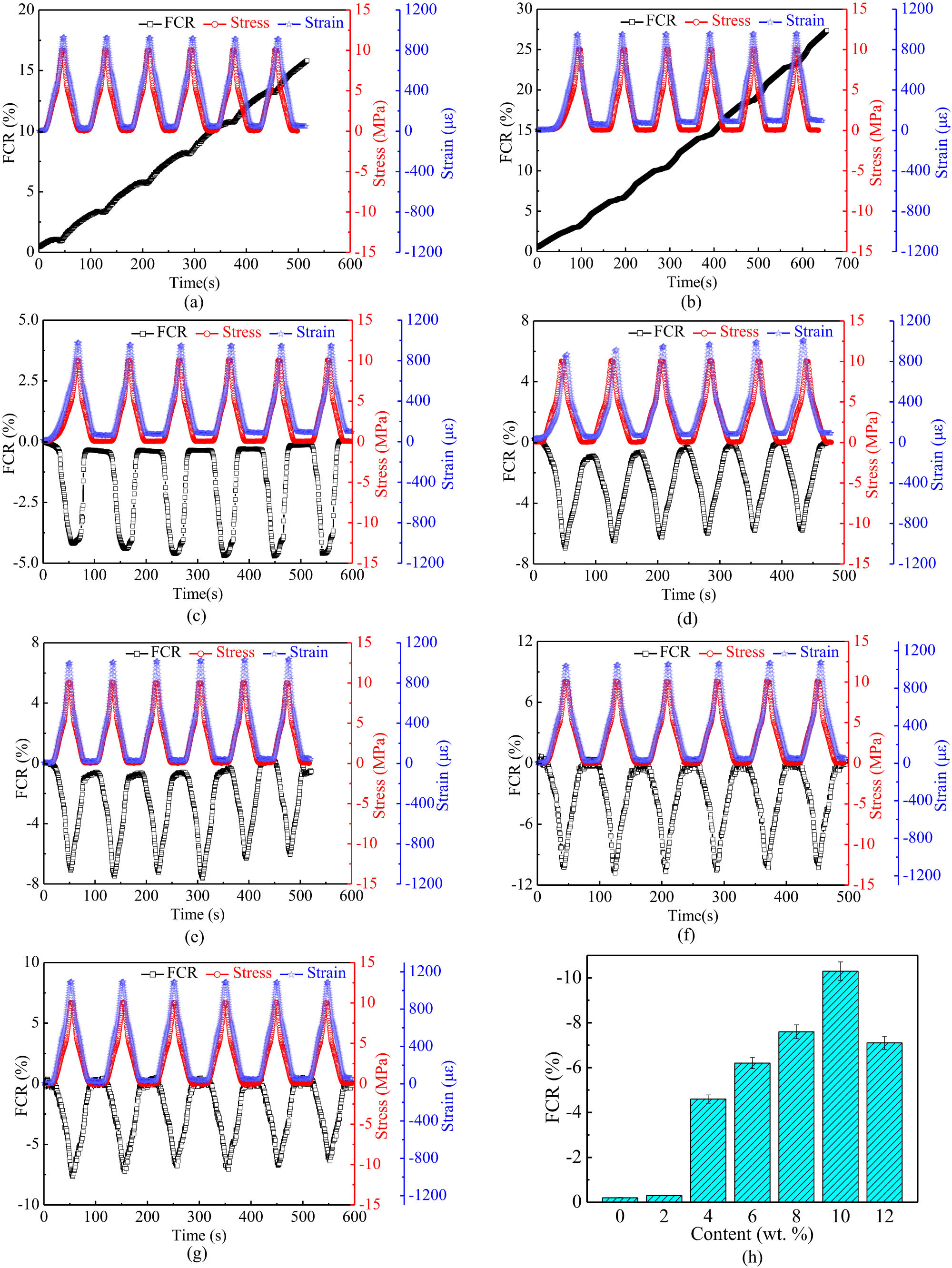

The self-sensing property subjected to cyclic load. (a) The self-sensing property of GCN0. (b) The self-sensing property of GCN2. (c) The self-sensing property of GCN4. (d) The self-sensing property of GCN6. (e) The self-sensing property of GCN8. (f) The self-sensing property of GCN10. (g) The self-sensing property of GCN12. (h) The FCR of cementitious composites with variation of GCNs. (i) The stress sensitivity with variation of GCNs. (j) The strain sensitivity with variation of GCNs. (k) Variation of FCR, stress sensitivity, and strain sensitivity compared with the reference.
The self-sensing property of the cementitious composites can be divided into three parts according to the content of the GCNs, which is similar to the change law between electrical resistivity and concentration of the GCNs. The first part with a concentration of the GCNs of 0.0–4.0 wt% is called as insulation zone. In this part, the electrical resistivity of GCN0 and GCN2 is increased obviously upon an increase in cyclic loading numbers. Additionally, the maximum absolute FCR and stress/strain sensitivity of GCN0, GCN2, and GCN4 are lower, which are in the ranges of 0.2–4.6%, 0.02–0.46%/MPa, and 2.1–46.9, respectively, as shown in Figure 9(h)–(j). Compared with GCN0, the increase ratios of the maximum absolute FCR and stress/strain sensitivity of GCN2 and GCN4 are in the ranges of 50.0–2,200.0%, 50.0–2,200.0%, and 45.9–2,058.0%, respectively, as shown in Figure 9(k). As the concentration of the GCNs increases to the second part of 4.0–10.0 wt%, which is called the percolation threshold zone, the relations between the FCR, stress, and strain with time exhibit better repeatability and reproducibility, as shown in Figure 9(d)–(f). In addition, the maximum absolute FCR and stress/strain sensitivity of GCN6, GCN8, and GCN10 are increased to the ranges of 6.2–10.3%, 0.62–1.03%/MPa, and 61.2–95.8, respectively, as shown in Figure 9(h)–(j). Compared with GCN0, the increase ratios of the maximum absolute FCR and stress/strain sensitivity of GCN6, GCN8, and GCN10 are in the scopes of 3,000.0–5,050.0%, 3,000.0–5,050.0%, and 2,749.1–4,360.1%, respectively, as shown in Figure 9(k). In particular, GCN10 presents the best self-sensing property, and its maximum absolute FCR and stress/strain sensitivity are achieved at 10.3%, 1.03%/MPa, and 95.8, respectively. Finally, as the concentration of the GCNs increases to the third part of 10.0–12.0 wt%, which belongs to the electrical conduction zone. The FCR–stress/strain time history curve of GCN12 expresses favorable stability and repeatability. Its maximum absolute FCR and stress/strain sensitivity are 7.1%, 0.71%/MPa, and 65.0, respectively, which are correspondingly lower than those of GCN10. Compared with GCN0, the increase ratios of the maximum absolute FCR and stress/strain sensitivity of GCN12 are increased by 3,450.0, 3,450.0, and 2,923.8%, respectively.
Mechanisms of the self-sensing property under cyclic load affected by the GCNs are explored in the following. The concentration of the GCNs of GCN0, GCN2, and GCN4 is low, and they belong to the insulation zone. The separations between the electrical conduction fillers of GNPs, CNTs, and NCBs are large, as shown in Figure 5(a). Thus, the electrical conduction pathway in the cementitious composites is difficult to form. Nevertheless, the pores are nearly full of free water under the age of 28 days, which is verified in Section 3.1 that the water content of the composites is within the scope of 3.0–11.4%, as shown in Figure 4(b). Moreover, it has been demonstrated by Chung [5], Han et al. [70], and Ding et al. [2] that when the dosage of electrical conduction fillers is less than percolation threshold, together with the water content of the specimen in the range of 3.3–9.9%, water filling pores can dissolve ionic from solid states, leading to ionic conduction from connected capillary pores. At the same time, it is verified in Section 3.1 that the percolation threshold zone of GCNs cementitious composites is 4.0–10.0 wt%. Therefore, the primary conduction way of the cementitious composites is ionic conduction when the concentration of the GCNs is no more than 4.0 wt%. Because of the conduction way of ionic is related to positive and negative ions move to the opposite electrodes in the pore solution, thus increase the electrical resistivity. These are the main reasons for the electrical resistivity of GCN0 and GCN2, which is obviously increased with an increase in cyclic loading numbers. Although the separations between the electrical conduction fillers of GNPs, CNTs, and NCBs are shortened when a load is applied to the specimen, the electrical conduction pathways are still hard to form within the cementitious composites due to the initial large distances between the electrical conduction fillers of GNPs, CNTs, and NCBs, leading to tunneling effect, field emission, and contact conduction hard to take place [18]. As a result, the GCN0, GCN2, and GCN4 exhibit higher electrical resistivity and lower self-sensing performance.
The GCNs’ concentration range of GCN6, GCN8, and GCN10 is 4.0–10.0 wt%, which belongs to the percolation threshold zone. Thus, the distance between the neighboring electrical conduction fillers of GNPs, CNTs, and NCBs becomes shorter with increasing content of the GCNs. Some of the electrical conduction fillers begin to touch with each other, which can be seen from Figure 5(b). Therefore, more electrical conduction pathways are formed conveniently by the tunneling effect and field emission, together with contact conduction. The former two electrical conduction ways are the primary electrical conduction ways of the cementitious composites. As a consequence, the electrical conduction pathways are easy to change when the specimen is under compression. Consequently, the GCN6, GCN8, and GCN10 present lower electrical resistivity and the optimum self-sensing property.
As the dosage of the GCNs increases to the electrical conduction zone of 10.0–12.0 wt%, the electrical conduction fillers of GNPs, CNTs, and NCBs are closer to each other; furthermore, the distances between the adjacent electrical conduction fillers are further shortened. Some of the electrical conduction fillers are even contacted with each other, which can be seen from Figure 5(d). Thus, lots of electrical conduction networks are generated stably by the tunneling effect, field emission, and contact conduction. Thus, contact conduction is the primary electrical conduction way of the composites. However, the stable electrical conduction networks are hard to change when the specimen is subjected to compression. Consequently, GCN12 presents the lowest electrical resistivity and higher self-sensing property.
Because of NCBs present advantages as fine filling effect, stability at high thermal, low cost, and electrical resistivity is lowered by about 10−1 Ω·cm; thus, NCBs become attractive electrical conduction fillers. Li et al. [4] and Hussain et al. [44] indicate that the percolation of cementitious composites containing NCBs is 1.0–2.0 wt%. For the reason that the high specific surface area, they can tightly adhere to each other and agglomerate easily within cementitious composites through the van der Waals force, resulting in defective sites inside the composites [35,36,37,38]. At the same time, the NCBs present high water absorption due to the rough surface, which can decrease the effective water-to-binder ratio of the composites. To address the disadvantages of intrinsic self-sensing cementitious composites with single electrical conduction fillers, some researchers proposed hybrid electrical conduction fillers due to their synergistic effect [45,46]. Zhang et al. used the NCBs together with CNTs to develop self-sensing cementitious composites. The NCBs and CNTs with short range and long range can stimulate the generation of extensive conduction pathways inside the cementitious composites; thus, more distance among the electrical conduction fillers can be changed and lead to sensitive self-sensing performance subjected to compression. These composites with a concentration of 2.40 vol% of the hybrid NCBs and CNTs present stable sensing properties, and the maximum magnitude of FCR is reached up to 25.4% [47,48]. Although the percolation of the GCNs in the present article is 4.0–10.0 wt%, which is higher than that in the previous research, they presented a higher single-to-noise ratio and sensitivity, as well as a simplified dispersion technique.
3.3.2 Self-sensing performance subjected to monotonic load
Figure 10 displays relations of the FCR, stress, and strain with time of the cementitious composites containing the GCNs subjected to monotonic compression load. It is illustrated in Figure 10 that FCR is reduced upon increasing the stress and strain until the stress reaches the peak value. The decrease ratio is increased upon an increase in the concentration of the GCNs. After the peak stress, the variation tendency of FCR changes with stress and strain is different, which depends on the content of the GCNs. The maximum absolute FCR and stress/strain sensitivity are initially increased and then decreased with increasing concentration of the GCNs. Similarly, GCN10 presents the best self-sensing performance subjected to the monotonic compressive load, its maximum absolute FCR and stress/sensitivity are achieved at 24.9%, 0.77%/MPa, and 49.9, respectively, and they are correspondingly increased by 54.3, 90.5, and 42.5% compared with GCN0.


Self-sensing performance subjected to monotonic load. (a) The time history of the FCR–stress–strain of GCN0. (b) The time history of the FCR–stress–strain of GCN2. (c) The time history of the FCR–stress–strain of GCN4. (d) The time history of the FCR–stress–strain of GCN6. (e) The time history of the FCR–stress–strain of GCN8. (f) The time history of the FCR–stress–strain of GCN10. (g) The time history of the FCR–stress–strain of GCN12. (h) The FCR variation with the content of the GCNs. (i) The stress sensitivity variations with the content of the GCNs. (j) The strain sensitivity variations with the content of the GCNs. (k) The variation ratio of FCR and stress/strain sensitivity containing different concentrations of the GCNs compared with the control group.
As shown in Figure 10(a)–(c), the FCR of GCN0, GCN2, and GCN4 is decreased slowly with an increase in stress and strain until the peak stress. And then, the FCR decreased rapidly under the peak stress in the first, after that, it nearly keeps at constant, as shown in Figure 10(a)–(c). The maximum absolute FCR and stress/strain sensitivity of GCN0, GCN2, and GCN4 are ranged in the scopes of 16.1–17.9%, 0.39–0.40%/MPa, and 35.0–38.1, respectively, as depicted in Figure 10(h)–(j). Compared with GCN0, the increased percentages of the maximum absolute FCR and stress/strain sensitivity of GCN2 and GCN4 are within the ranges of 0.0–11.5%, and 0.0–8.8%, respectively, as illustrated in Figure 10(k). However, the decrease ratio of FCR of GCN6, GCN8, GCN10, and GCN12 changes with dosage increases of the GCNs until the peak stress is more quickly than those of the GCN0 to GCN4. After the peak stress, the FCR increases as the stress and strain decrease, as shown in Figure 10(d)–(g). The maximum absolute FCR and stress/strain sensitivity of the GCN6, GCN8, GCN10, and GCN12 are in the scopes of 18.2–24.9%, 0.52–0.77%/MPa, and 37.3–49.9, respectively, as shown in Figure 10(h)–(j). Compared with GCN0, the increased percentages of the maximum absolute FCR and stress/strain sensitivity of GCN6, GCN8, GCN10, and GCN12 are within the ranges of 13.0–54.3, 29.0–90.5, and 6.7–42.5%, respectively, as illustrated in Figure 10(k). Therefore, the FCR decreases nearly linearly with increasing stress and strain until loading to 80% of the peak stress, and then it decreases nonlinearly with increasing stress and strain. The FCR is decreased and increased suddenly with different concentrations of the GCNs when loading to the peak stress. Hence, these characteristics can be applied in detecting and evaluating the stress, strain, and deformation conditions of concrete structures. Mechanisms of the GCNs that affect the self-sensing performance of the cementitious composites withstanding monotonic load resemble those of the cementitious composites subjected to repeated load as analyzed in Section 3.3.1.
The optimum FCR and stress/strain sensitivity are −24.9% and 1.0%/MPa/95.8, respectively, corresponding to the content of the GCNs of 10.0 wt%. Nevertheless, the compressive strength and elastic modulus of this composite are 32.4 MPa and 9.33 GPa, respectively, which are lowered down 19.0 and 14.7%, respectively, compared with the control group. This is because the higher content of the GCNs is prone to aggregate in cementitious composites, thus leading to defects generated in the microstructures [45]. On the one hand, a reasonable dispersion method should be explored to disperse the GCNs homogenously within the cementitious composites, thus counterbalancing the harmful effects of the higher concentration brought in. On the other hand, the mechanical performances of the self-sensing cementitious composites should be compatible with the monitoring of concrete structures. Therefore, an appropriate dosage of the GCNs needs to be designed as taking into account the fabrication technique, piezoresistivity, and mechanical performances according to the requirements of practical civil infrastructure [64].
4 Conclusions
This research aims to develop cementitious composites containing GCNs with excellent intrinsic self-sensing performance for application in smart civil infrastructure. The cementitious composites incorporating electrical conduction fillers of the GCNs are manufactured first. And then, the electrical resistivity, mechanical performances, and self-sensing performances are tested. Moreover, mechanisms are explored comprehensively. Conclusions of this research can be drawn as follows:
The DC electrical resistivity is reduced from 2.3 × 10⁶ to 28.0 Ω·cm with an increase in the concentration of GCNs from 0.0 to 12.0 wt%, and the decrease ratio is varied from 5.7% to nearly 100.0%. Percolation threshold zone of the composites is under the range of 4.0–10.0 wt%.
DC electrical resistivity is increased with increasing age when the content of the GCNs is within the scope of 0.0–4.0 wt%, and the increase ratio is under the scope of 7.4–58.3%. However, it is decreased with age increasing with dosage of the GCNs under the scope of 6.0–12.0 wt%, and the corresponding decrease ratio is within the range of 5.9–52.0%.
The AC electrical resistivity is reduced with an increase in both dosage of the GCNs and testing frequency, corresponding to age increases. The corresponding decrease ratios are within the ranges of 17.4–99.8% and 6.9–15.1%, respectively.
The compressive strength is initially increased and then reduced upon increasing the content of the GCNs from 0.0 to 12.0 wt%. The variation percentages are within the scope of −19.0 to 13.3%. The peak strain and elastic modulus are increased and decreased under the ranges of 2.4–10.5% and 3.7–16.0%, respectively. Additionally, the maximum compressive strength is 45.3 MPa with the concentration of the GCNs of 2.0 wt%.
Under the cyclic load, the maximum absolute FCR, stress sensitivity, and strain sensitivity are initially increased and then decreased with increasing dosage of the GCNs, and their corresponding variation values are within the scopes of 0.2–10.3%, 0.02–1.03%/MPa, and 2.1–95.8, respectively. In particular, GCN10 presents the best self-sensing property.
Subjected to the monotonic load, the FCR is reduced in the first, and then, the FCR is nearly kept at a constant level and increased, respectively, corresponding to the concentrations of the GCNs of 0.0–4.0 and 6.0–12.0 wt%, respectively. Similarly, the GCN10 displays the maximum absolute FCR and stress/strain sensitivity, which are 24.9%, 0.77%/MPa/49.9, respectively.
This research can help to understand the GCN cementitious composites systematically and promote their applications in SHM of smart civil infrastructure. In the future, the influence of moisture content and self-sensing performance under dynamic load of these composites should also be analyzed.
Acknowledgments
This study was supported by the Hunan Provincial Natural Science Foundation of China (2025JJ70685, 2025JJ50290), the National Natural Science Foundation of China (52368031), the Key Research Project of Hunan University of Arts and Science in 2024 (24ZZ04), the Major Science and Technology Research Project of the China Building Materials Federation (2023JBGS10-02), the Excellent Youth Research Project of Hunan Provincial Department of Education (23B0652, 24B0636), the Young Backbone Teachers of Ordinary Universities in Hunan Province of 2023 ([2023], No. 318, documents issued by the Education Department of Hunan Province), and the Jiangxi Provincial Natural Science Foundation (20252BAC250115).
-
Funding information: This work has been funded by the Hunan Provincial Natural Science Foundation of China (2025JJ70685, 2025JJ50290), the National Natural Science Foundation of China (52368031), the Key Research Project of Hunan University of Arts and Science in 2024 (24ZZ04), the Major Science and Technology Research Project of the China Building Materials Federation (2023JBGS10-02), the Excellent Youth Research Project of Hunan Provincial Department of Education (23B0652, 24B0636), the Young Backbone Teachers of Ordinary Universities in Hunan Province of 2023, ([2023], No. 318, documents issued by the Education Department of Hunan Province), the Jiangxi Provincial Natural Science Foundation (20252BAC250115).
-
Author contributions: Yunyang Wang: conceptualization, methodology, formal analysis, writing – original draft, writing – review and editing, and funding acquisition. Sha Liu: data curation and investigation. Liqing Zhang: conceptualization, writing – review and editing, and funding acquisition. Shengwei Sun: investigation and resources. Huaxiang Song, Xiyan Fan, and Chenggong Zhao: writing – review and editing and resources. All authors have accepted responsibility for the entire content of this manuscript and approved its submission.
-
Conflict of interest: The authors state no conflict of interest.
-
Data availability statement: The datasets generated and/or analyzed during the current study are available from the corresponding author on reasonable request.
References
[1] Han B, Ding S, Yu X. Intrinsic self-sensing concrete and structures: A review. Measurement. 2015;59:110–28.10.1016/j.measurement.2014.09.048Search in Google Scholar
[2] Ding S, Dong S, Ashour A, Han B. Development of sensing concrete: Principles, properties and its applications. J Appl Phys. 2019;126:241101.10.1063/1.5128242Search in Google Scholar
[3] Yıldırım G, öztürk O, Al-Dahawi A, Afşın Ulu A, Şahmaran M. Self-sensing capability of engineered cementitious composites: Effects of aging and loading conditions. Constr Build Mater. 2020;231:117132.10.1016/j.conbuildmat.2019.117132Search in Google Scholar
[4] Li W, Guo Y, Zhang X, Dong W, Li X, Yu T, et al. Development of self-sensing ultra-high-performance concrete using hybrid carbon black and carbon nanofibers. Cem Concr Compos. 2024;148:105466.10.1016/j.cemconcomp.2024.105466Search in Google Scholar
[5] Chung D. A critical review of electrical-resistance-based self-sensing in conductive cement-based materials. Carbon. 2023;203:311–25.10.1016/j.carbon.2022.11.076Search in Google Scholar
[6] Abebe TN, Woo BH, Kim HG, Ryou JS. Real-time monitoring of self-sensing cementitious composite incorporating hybrid silicon carbide and graphite for enhanced structural health monitoring. Cem Concr Compos. 2024;146:105404.10.1016/j.cemconcomp.2023.105404Search in Google Scholar
[7] Dong W, Li W, Tao Z, Wang K. Piezoresistive properties of cement-based sensors: Review and perspective[J]. Constr Build Mater. 2019;203:146–63.10.1016/j.conbuildmat.2019.01.081Search in Google Scholar
[8] Han B, Sun S, Ding S, Zhang L, Yu X, Ou J. Review of nanocarbon-engineered multifunctional cementitious composites. Compos Part A: Appl Sci Manuf. 2015;70:69–81.10.1016/j.compositesa.2014.12.002Search in Google Scholar
[9] Zhou G, Yao Y, Lu Z, Yang X, Han J, Wang G, et al. Self-sensing cementitious composites incorporated with botryoid hybrid nano-carbon materials for smart infrastructures. J Intell Mater Syst Struct. 2017;28(6):699–727.10.1177/1045389X16657416Search in Google Scholar
[10] Chen P, Chung DD. Carbon fiber reinforced concrete for smart structures capable of non-destructive flaw detection. Smart Mater Struct. 1993;2(1):22–30.10.1088/0964-1726/2/1/004Search in Google Scholar
[11] Chung D. A critical review of piezoresistivity and its application in electrical-resistance-based strain sensing. J Mater Sci. 2020;55(32):15367–96.10.1007/s10853-020-05099-zSearch in Google Scholar
[12] Azhari F, Banthia N. Cement-based sensors with carbon fibers and carbon nanotubes for piezoresistive sensing. Cem Concr Compos. 2012;34(7):866–73.10.1016/j.cemconcomp.2012.04.007Search in Google Scholar
[13] Wang Y, Zhang L, Sun S. Cementitious composites modified by nanocarbon fillers with cooperation effect possessing excellent self-sensing properties. Nanotechnol Rev. 2024;13(1):20230226.10.1515/ntrev-2023-0226Search in Google Scholar
[14] Wang X, Al-Tabbaa A, Haigh SK. Measurement techniques for self-sensing cementitious composites under flexure. Cem Concr Compos. 2023;142:105215.10.1016/j.cemconcomp.2023.105215Search in Google Scholar
[15] Downey A, D’Alessandro A, Ubertini F, Laflamme S, Geiger R. Biphasic DC measurement approach for enhanced measurement stability and multi-channel sampling of self-sensing multi-functional structural materials doped with carbon-based additives. Smart Mater Struct. 2017;26(6):65008.10.1088/1361-665X/aa6b66Search in Google Scholar
[16] Lee SH, Kim S, Yoo D. Hybrid effects of steel fiber and carbon nanotube on self-sensing capability of ultra-high-performance concrete. Constr Build Mater. 2018;185:530–44.10.1016/j.conbuildmat.2018.07.071Search in Google Scholar
[17] Zare Y, Rhee KY, Park S. Effects of CNT size, network fraction, and interphase thickness on the tunneling distance between neighboring carbon nanotubes (CNTs) in nanocomposites. J Ind Eng Chem. 2020;86:53–60.10.1016/j.jiec.2019.11.039Search in Google Scholar
[18] Han BG, Han BZ, Ou JP. Experimental study on use of nickel powder-filled Portland cement-based composite for fabrication of piezoresistive sensors with high sensitivity. Sens Actuators A: Phys. 2009;149(1):51–5.10.1016/j.sna.2008.10.001Search in Google Scholar
[19] Zhao Y, Liu Y, Shi T, Gu Y, Zheng B, Zhang K, et al. Study of mechanical properties and early-stage deformation properties of graphene-modified cement-based materials. Constr Build Mater. 2020;257:119498.10.1016/j.conbuildmat.2020.119498Search in Google Scholar
[20] Gdoutos EE, Konsta-Gdoutos MS, Danoglidis PA. Portland cement mortar nanocomposites at low carbon nanotube and carbon nanofiber content: A fracture mechanics experimental study. Cem Concr Compos. 2016;70:110–8.10.1016/j.cemconcomp.2016.03.010Search in Google Scholar
[21] Wu T, Sun L, Liu X, Liu Y, Yu X. Piezoresistive performance of self-sensing cement-based composites filled with multi-layer graphene. J Sustain Cement-Based Mater. 2024;13(6):815–28.10.1080/21650373.2023.2299366Search in Google Scholar
[22] Sun S, Han B, Jiang S, Yu X, Wang Y, Li H, et al. Nano graphite platelets-enabled piezoresistive cementitious composites for structural health monitoring. Constr Build Mater. 2017;136:314–28.10.1016/j.conbuildmat.2017.01.006Search in Google Scholar
[23] Sevim O, Jiang Z, Ozbulut OE. Effects of graphene nanoplatelets type on self-sensing properties of cement mortar composites. Constr Build Mater. 2022;359:129488.10.1016/j.conbuildmat.2022.129488Search in Google Scholar
[24] Qi G, Wang Q, Zhang R, Guo Z, Zhan D, Liu S. Effect of rGO/GNP on the electrical conductivity and piezoresistance of cement-based composite subjected to dynamic loading. Constr Build Mater. 2023;368:130340.10.1016/j.conbuildmat.2023.130340Search in Google Scholar
[25] Dong W, Li W, Guo Y, Wang K, Sheng D. Mechanical properties and piezoresistive performances of intrinsic graphene nanoplate/cement-based sensors subjected to impact load. Constr Build Mater. 2022;327:126978.10.1016/j.conbuildmat.2022.126978Search in Google Scholar
[26] Dong W, Li W, Wang K, Shah SP. Physicochemical and Piezoresistive properties of smart cementitious composites with graphene nanoplates and graphite plates. Constr Build Mater. 2021;286:122943.10.1016/j.conbuildmat.2021.122943Search in Google Scholar
[27] Lee NK, Tafesse M, Lee HK, Alemu AS, Kim SW, Kim HK. Electrical resistivity stability of CNT/cement composites after further hydration: A simple evaluation with an accelerated method. Constr Build Mater. 2022;317:125830.10.1016/j.conbuildmat.2021.125830Search in Google Scholar
[28] Roopa AK, Hunashyal AM, Venkaraddiyavar P, Ganachari SV. Smart hybrid nano composite concrete embedded sensors for structural health monitoring. Mater Today: Proc. 2020;27:603–9.10.1016/j.matpr.2019.12.071Search in Google Scholar
[29] Silva AA, Pinheiro RA, Trava-Airoldi VJ, Corat EJ. Influence of catalyst particles on multi-walled carbon nanotubes morphology and structure. Fullerenes Nanotubes Carbon Nanostruct. 2018;26(5):315–23.10.1080/1536383X.2018.1431217Search in Google Scholar
[30] Wang X, Feng D, Meng J, Li Q, Wang G, Ai X, et al. Double percolation phenomenon of carbon nanotube/cement composites as piezoresistivity sensing elements with exposure to salt environment. Cem Concr Compos. 2024;147:105401.10.1016/j.cemconcomp.2023.105401Search in Google Scholar
[31] Lee SH, Kim JH, Han SJ, Yi ST, Kim KS. Self-sensing capability of ultra-high performance fiber-reinforced concrete with multiwalled carbon nanotubes. J Build Eng. 2024;86:108972.10.1016/j.jobe.2024.108972Search in Google Scholar
[32] Yuan J, Lu D, Wu H, Meng J, Song H, Zhong J, et al. Carbon nanotubes-coated cement particles for cement-based sensors with excellent piezoresistivity. Smart Mater Struct. 2023;32(6):65019.10.1088/1361-665X/acd03dSearch in Google Scholar
[33] Song F, Chen Q, Zheng Q. Multifunctional ultra-high performance fibre-reinforced concrete with integrated self-sensing and repair capabilities towards in-situ structure monitoring. Compos Struct. 2023;321:117240.10.1016/j.compstruct.2023.117240Search in Google Scholar
[34] Mesquita E, Sousa I, Vieira M, Matos AM, Santos LPM, Silvestro L, et al. Investigation of the electrical sensing properties of cementitious composites produced with multi-wall carbon nanotubes dispersed in NaOH. J Build Eng. 2023;77:107496.10.1016/j.jobe.2023.107496Search in Google Scholar
[35] Dong W, Li W, Luo Z, Long G, Vessalas K, Sheng D. Structural response monitoring of concrete beam under flexural loading using smart carbon black/cement-based sensors. Smart Mater Struct. 2020;29(6):65001.10.1088/1361-665X/ab7fefSearch in Google Scholar
[36] Wen S, Chung D. Partial replacement of carbon fiber by carbon black in multifunctional cement–matrix composites. Carbon. 2007;45(3):505–13.10.1016/j.carbon.2006.10.024Search in Google Scholar
[37] Monteiro AO, Cachim PB, Costa P. Electrical properties of cement-based composites containing carbon black particles. Mater Today: Proc. 2015;2(1):193–9.10.1016/j.matpr.2015.04.021Search in Google Scholar
[38] Dong W, Li W, Wang K, Guo Y, Sheng D, Shah SP. Piezoresistivity enhancement of functional carbon black filled cement-based sensor using polypropylene fibre. Powder Technol. 2020;373:184–94.10.1016/j.powtec.2020.06.029Search in Google Scholar
[39] Li H, Xiao H, Ou J. Effect of compressive strain on electrical resistivity of carbon black-filled cement-based composites. Cem Concr Compos. 2006;28(9):824–8.10.1016/j.cemconcomp.2006.05.004Search in Google Scholar
[40] Monteiro AO, Cachim PB, Costa PM. Self-sensing piezoresistive cement composite loaded with carbon black particles. Cem Concr Compos. 2017;81:59–65.10.1016/j.cemconcomp.2017.04.009Search in Google Scholar
[41] Deng H, Li H. Assessment of self-sensing capability of carbon black engineered cementitious composites. Constr Build Mater. 2018;173:1–9.10.1016/j.conbuildmat.2018.04.031Search in Google Scholar
[42] Monteiro AO, Loredo A, Costa PMFJ, Oeser M, Cachim PB. A pressure-sensitive carbon black cement composite for traffic monitoring. Constr Build Mater. 2017;154:1079–86.10.1016/j.conbuildmat.2017.08.053Search in Google Scholar
[43] Hussain A, Yu T, Zou F. Durability analysis of nanocarbon black-based self-strain sensing ultra-high-performance concrete (UHPC): Effects of moisture content and sea-salt solution exposure. Constr Build Mater. 2025;473:141031.10.1016/j.conbuildmat.2025.141031Search in Google Scholar
[44] Hussain A, Yu T, Zou F. Nanocarbon black based ultra-high-performance seawater sea-sand concrete (UHPSSC) with self-strain sensing capability. Cem Concr Compos. 2025;157:105895.10.1016/j.cemconcomp.2024.105895Search in Google Scholar
[45] Han B, Ding S, Wang J, Ou J. Electrostatic self-assembled carbon nanotube/nano-carbon black fillers-engineered cementitious composites. In Nano-Engineered Cementitious Composites: Principles and Practices. Singapore: Springer Singapore; 2019. p. 665–707.10.1007/978-981-13-7078-6_9Search in Google Scholar
[46] Wang Y, Zhang L. Development of self-sensing cementitious composite incorporating hybrid graphene nanoplates and carbon nanotubes for structural health monitoring. Sens Actuators A: Phys. 2022;336:113367.10.1016/j.sna.2022.113367Search in Google Scholar
[47] Zhang L, Han B, Ouyang J, Yu X, Sun S, Ou J. Multifunctionality of cement based composite with electrostatic self-assembled CNT/NCB composite filler. Arch Civ Mech Eng. 2017;17(2):354–64.10.1016/j.acme.2016.11.001Search in Google Scholar
[48] Zhang L, Ding S, Li L, Dong S, Wang D, Yu X, et al. Effect of characteristics of assembly unit of CNT/NCB composite fillers on properties of smart cement-based materials. Compos Part A: Appl Sci Manuf. 2018;109:303–20.10.1016/j.compositesa.2018.03.020Search in Google Scholar
[49] Qiu L, Ding S, Wang D, Han B. Self-sensing GFRP-reinforced concrete beams containing carbon nanotube-nano carbon black composite fillers. Meas Sci Technol. 2023;34(8):84003.10.1088/1361-6501/accc20Search in Google Scholar
[50] Jawed Roshan M, Abedi M, Gomes Correia A, Fangueiro R. Application of self-sensing cement-stabilized sand for damage detection. Constr Build Mater. 2023;403:133080.10.1016/j.conbuildmat.2023.133080Search in Google Scholar
[51] Zhang L, Zheng Q, Dong X, Yu X, Wang Y, Han B. Tailoring sensing properties of smart cementitious composites based on excluded volume theory and electrostatic self-assembly. Constr Build Mater. 2020;256:119452.10.1016/j.conbuildmat.2020.119452Search in Google Scholar
[52] Ding S, Wang X, Qiu L, Ni YQ, Dong X, Cui Y, et al. Self-sensing cementitious composites with hierarchical carbon fiber-carbon nanotube composite fillers for crack development monitoring of a maglev girder. Small. 2023;19(9):2206258.10.1002/smll.202206258Search in Google Scholar PubMed
[53] Ding S, Ruan Y, Yu X, Han B, Ni YQ. Self-monitoring of smart concrete column incorporating CNT/NCB composite fillers modified cementitious sensors. Constr Build Mater. 2019;201:127–37.10.1016/j.conbuildmat.2018.12.203Search in Google Scholar
[54] Sun M, Liew RJY, Zhang MH, Li W. Development of cement-based strain sensor for health monitoring of ultra high strength concrete. Constr Build Mater. 2014;65:630–7.10.1016/j.conbuildmat.2014.04.105Search in Google Scholar
[55] Xiao H, Li H, Ou J. Self-monitoring properties of concrete columns with embedded cement-based strain sensors. J Intell Mater Syst Struct. 2011;22(2):191–200.10.1177/1045389X10396573Search in Google Scholar
[56] Dong W, Li W, Luo Z, Guo Y, Wang K. Effect of layer-distributed carbon nanotube (CNT) on mechanical and piezoresistive performance of intelligent cement-based sensor. Nanotechnology. 2020;31(50):505503.10.1088/1361-6528/abb503Search in Google Scholar PubMed
[57] Ding S, Xiang Y, Ni YQ, Thakur VK, Wang X, Han B, et al. In-situ synthesizing carbon nanotubes on cement to develop self-sensing cementitious composites for smart high-speed rail infrastructures. Nano Today. 2022;43:101438.10.1016/j.nantod.2022.101438Search in Google Scholar
[58] Dong W, Li W, Shen L, Zhang S, Vessalas K. Integrated self-sensing and self-healing cementitious composite with microencapsulation of nano-carbon black and slaked lime. Mater Lett. 2021;282:128834.10.1016/j.matlet.2020.128834Search in Google Scholar
[59] Liu L, Gao B, Wu L, Sun Y, Zhou Z. Effects of surfactant type and concentration on graphene retention and transport in saturated porous media. Chem Eng J. 2015;262:1187–91.10.1016/j.cej.2014.10.032Search in Google Scholar
[60] Li X, Feng Z, Cui Q, Wang Z, Du W, Li X. Piezoresistive behaviors of self-sensing cementitious composite with well-dispersed carbon nanotube. Constr Build Mater. 2025;474:141123.10.1016/j.conbuildmat.2025.141123Search in Google Scholar
[61] Materazzi AL, Ubertini F, D’Alessandro A. Carbon nanotube cement-based transducers for dynamic sensing of strain. Cem Concr Compos. 2013;37:2–11.10.1016/j.cemconcomp.2012.12.013Search in Google Scholar
[62] Hussain A, Xiang Y, Yu T, Zou F. Nanocarbon black-based ultra-high-performance concrete (UHPC) with self-strain sensing capability. Constr Build Mater. 2022;359:129496.10.1016/j.conbuildmat.2022.129496Search in Google Scholar
[63] Qin H, Ding S, Ashour A, Zheng Q, Han B. Revolutionizing infrastructure: The evolving landscape of electricity-based multifunctional concrete from concept to practice. Prog Mater Sci. 2024;145:101310.10.1016/j.pmatsci.2024.101310Search in Google Scholar
[64] Han BG, Yu X, Ou JP. Self-sensing concrete in smart structures[M]. Oxford, UK: Elsevier Inc; 2014.10.1016/B978-0-12-800517-0.00001-0Search in Google Scholar
[65] Han B, Zhang L, Zeng S, Dong S, Yu X, Yang R, et al. Nano-core effect in nano-engineered cementitious composites. Compos Part A: Appl Sci Manuf. 2017;95:100–9.10.1016/j.compositesa.2017.01.008Search in Google Scholar
[66] Han B, Wang Y, Sun S, Yu X, Ou J. Nanotip-induced ultrahigh pressure-sensitive composites: Principles, properties and applications. Compos Part A: Appl Sci Manuf. 2014;59:105–14.10.1016/j.compositesa.2014.01.005Search in Google Scholar
[67] Morsy MS, Alsayed SH, Aqel M. Hybrid effect of carbon nanotube and nano-clay on physico-mechanical properties of cement mortar. Constr Build Mater. 2011;25(1):145–9.10.1016/j.conbuildmat.2010.06.046Search in Google Scholar
[68] Collins F, Lambert J, Duan WH. The influences of admixtures on the dispersion, workability, and strength of carbon nanotube–OPC paste mixtures. Cem Concr Compos. 2012;34(2):201–7.10.1016/j.cemconcomp.2011.09.013Search in Google Scholar
[69] Al-Rub RKA, Ashour AI, Tyson BM. On the aspect ratio effect of multi-walled carbon nanotube reinforcements on the mechanical properties of cementitious nanocomposites. Constr Build Mater. 2012;35:647–55.10.1016/j.conbuildmat.2012.04.086Search in Google Scholar
[70] Han B, Yu X, Ou J. Effect of water content on the piezoresistivity of MWNT/cement composites. J Mater Sci. 2010;45:3714–9.10.1007/s10853-010-4414-7Search in Google Scholar
© 2025 the author(s), published by De Gruyter
This work is licensed under the Creative Commons Attribution 4.0 International License.
Articles in the same Issue
- Research Articles
- MHD radiative mixed convective flow of a sodium alginate-based hybrid nanofluid over a convectively heated extending sheet with Joule heating
- Experimental study of mortar incorporating nano-magnetite on engineering performance and radiation shielding
- Multicriteria-based optimization and multi-variable non-linear regression analysis of concrete containing blends of nano date palm ash and eggshell powder as cementitious materials
- A promising Ag2S/poly-2-amino-1-mercaptobenzene open-top spherical core–shell nanocomposite for optoelectronic devices: A one-pot technique
- Biogenic synthesized selenium nanoparticles combined chitosan nanoparticles controlled lung cancer growth via ROS generation and mitochondrial damage pathway
- Fabrication of PDMS nano-mold by deposition casting method
- Stimulus-responsive gradient hydrogel micro-actuators fabricated by two-photon polymerization-based 4D printing
- Physical aspects of radiative Carreau nanofluid flow with motile microorganisms movement under yield stress via oblique penetrable wedge
- Effect of polar functional groups on the hydrophobicity of carbon nanotubes-bacterial cellulose nanocomposite
- Review in green synthesis mechanisms, application, and future prospects for Garcinia mangostana L. (mangosteen)-derived nanoparticles
- Entropy generation and heat transfer in nonlinear Buoyancy–driven Darcy–Forchheimer hybrid nanofluids with activation energy
- Green synthesis of silver nanoparticles using Ginkgo biloba seed extract: Evaluation of antioxidant, anticancer, antifungal, and antibacterial activities
- A numerical analysis of heat and mass transfer in water-based hybrid nanofluid flow containing copper and alumina nanoparticles over an extending sheet
- Investigating the behaviour of electro-magneto-hydrodynamic Carreau nanofluid flow with slip effects over a stretching cylinder
- Electrospun thermoplastic polyurethane/nano-Ag-coated clear aligners for the inhibition of Streptococcus mutans and oral biofilm
- Investigation of the optoelectronic properties of a novel polypyrrole-multi-well carbon nanotubes/titanium oxide/aluminum oxide/p-silicon heterojunction
- Novel photothermal magnetic Janus membranes suitable for solar water desalination
- Green synthesis of silver nanoparticles using Ageratum conyzoides for activated carbon compositing to prepare antimicrobial cotton fabric
- Activation energy and Coriolis force impact on three-dimensional dusty nanofluid flow containing gyrotactic microorganisms: Machine learning and numerical approach
- Machine learning analysis of thermo-bioconvection in a micropolar hybrid nanofluid-filled square cavity with oxytactic microorganisms
- Research and improvement of mechanical properties of cement nanocomposites for well cementing
- Thermal and stability analysis of silver–water nanofluid flow over unsteady stretching sheet under the influence of heat generation/absorption at the boundary
- Cobalt iron oxide-infused silicone nanocomposites: Magnetoactive materials for remote actuation and sensing
- Magnesium-reinforced PMMA composite scaffolds: Synthesis, characterization, and 3D printing via stereolithography
- Bayesian inference-based physics-informed neural network for performance study of hybrid nanofluids
- Numerical simulation of non-Newtonian hybrid nanofluid flow subject to a heterogeneous/homogeneous chemical reaction over a Riga surface
- Enhancing the superhydrophobicity, UV-resistance, and antifungal properties of natural wood surfaces via in situ formation of ZnO, TiO2, and SiO2 particles
- Synthesis and electrochemical characterization of iron oxide/poly(2-methylaniline) nanohybrids for supercapacitor application
- Impacts of double stratification on thermally radiative third-grade nanofluid flow on elongating cylinder with homogeneous/heterogeneous reactions by implementing machine learning approach
- Synthesis of Cu4O3 nanoparticles using pumpkin seed extract: Optimization, antimicrobial, and cytotoxicity studies
- Cationic charge influence on the magnetic response of the Fe3O4–[Me2+ 1−y Me3+ y (OH2)] y+(Co3 2−) y/2·mH2O hydrotalcite system
- Pressure sensing intelligent martial arts short soldier combat protection system based on conjugated polymer nanocomposite materials
- Magnetohydrodynamics heat transfer rate under inclined buoyancy force for nano and dusty fluids: Response surface optimization for the thermal transport
- Fly ash and nano-graphene enhanced stabilization of engine oil-contaminated soils
- Enhancing natural fiber-reinforced biopolymer composites with graphene nanoplatelets: Mechanical, morphological, and thermal properties
- Performance evaluation of dual-scale strengthened co-bonded single-lap joints using carbon nanotubes and Z-pins with ANN
- Computational works of blood flow with dust particles and partially ionized containing tiny particles on a moving wedge: Applications of nanotechnology
- Hybridization of biocomposites with oil palm cellulose nanofibrils/graphene nanoplatelets reinforcement in green epoxy: A study of physical, thermal, mechanical, and morphological properties
- Design and preparation of micro-nano dual-scale particle-reinforced Cu–Al–V alloy: Research on the aluminothermic reduction process
- Spectral quasi-linearization and response optimization on magnetohydrodynamic flow via stenosed artery with hybrid and ternary solid nanoparticles: Support vector machine learning
- Ferrite/curcumin hybrid nanocomposite formulation: Physicochemical characterization, anticancer activity, and apoptotic and cell cycle analyses in skin cancer cells
- Enhanced therapeutic efficacy of Tamoxifen against breast cancer using extra virgin olive oil-based nanoemulsion delivery system
- A titanium oxide- and silver-based hybrid nanofluid flow between two Riga walls that converge and diverge through a machine-learning approach
- Enhancing convective heat transfer mechanisms through the rheological analysis of Casson nanofluid flow towards a stagnation point over an electro-magnetized surface
- Intrinsic self-sensing cementitious composites with hybrid nanofillers exhibiting excellent piezoresistivity
- Research on mechanical properties and sulfate erosion resistance of nano-reinforced coal gangue based geopolymer concrete
- Impact of surface and configurational features of chemically synthesized chains of Ni nanostars on the magnetization reversal process
- Porous sponge-like AsOI/poly(2-aminobenzene-1-thiol) nanocomposite photocathode for hydrogen production from artificial and natural seawater
- Multifaceted insights into WO3 nanoparticle-coupled antibiotics to modulate resistance in enteric pathogens of Houbara bustard birds
- Synthesis of sericin-coated silver nanoparticles and their applications for the anti-bacterial finishing of cotton fabric
- Enhancing chloride resistance of freeze–thaw affected concrete through innovative nanomaterial–polymer hybrid cementitious coating
- Development and performance evaluation of green aluminium metal matrix composites reinforced with graphene nanopowder and marble dust
- Morphological, physical, thermal, and mechanical properties of carbon nanotubes reinforced arrowroot starch composites
- Influence of the graphene oxide nanosheet on tensile behavior and failure characteristics of the cement composites after high-temperature treatment
- Central composite design modeling in optimizing heat transfer rate in the dissipative and reactive dynamics of viscoplastic nanomaterials deploying Joule and heat generation aspects
- Double diffusion of nano-enhanced phase change materials in connected porous channels: A hybrid ISPH-XGBoost approach
- Synergistic impacts of Thompson–Troian slip, Stefan blowing, and nonuniform heat generation on Casson nanofluid dynamics through a porous medium
- Optimization of abrasive water jet machining parameters for basalt fiber/SiO2 nanofiller reinforced composites
- Enhancing aesthetic durability of Zisha teapots via TiO2 nanoparticle surface modification: A study on self-cleaning, antimicrobial, and mechanical properties
- Nanocellulose solution based on iron(iii) sodium tartrate complexes
- Combating multidrug-resistant infections: Gold nanoparticles–chitosan–papain-integrated dual-action nanoplatform for enhanced antibacterial activity
- Novel royal jelly-mediated green synthesis of selenium nanoparticles and their multifunctional biological activities
- Direct bandgap transition for emission in GeSn nanowires
- Synthesis of ZnO nanoparticles with different morphologies using a microwave-based method and their antimicrobial activity
- Numerical investigation of convective heat and mass transfer in a trapezoidal cavity filled with ternary hybrid nanofluid and a central obstacle
- Halloysite nanotube enhanced polyurethane nanocomposites for advanced electroinsulating applications
- Low molar mass ionic liquid’s modified carbon nanotubes and its role in PVDF crystalline stress generation
- Green synthesis of polydopamine-functionalized silver nanoparticles conjugated with Ceftazidime: in silico and experimental approach for combating antibiotic-resistant bacteria and reducing toxicity
- Evaluating the influence of graphene nano powder inclusion on mechanical, vibrational and water absorption behaviour of ramie/abaca hybrid composites
- Dynamic-behavior of Casson-type hybrid nanofluids due to a stretching sheet under the coupled impacts of boundary slip and reaction-diffusion processes
- Influence of polyvinyl alcohol on the physicochemical and self-sensing properties of nano carbon black reinforced cement mortar
- Advanced machine learning approaches for predicting compressive and flexural strength of carbon nanotube–reinforced cement composites: a comparative study and model interpretability analysis
- Artificial neural network-driven insights into nanoparticle-enhanced phase change materials melting for heat storage optimization
- Optical, structural, and morphological characterization of hydrothermally synthesized zinc oxide nanorods: exploring their potential for environmental applications
- Structural, optical, and gas sensing properties of Ce, Nd, and Pr doped ZnS nanostructured thin films prepared by nebulizer spray pyrolysis method
- The influence of nano-size La2O3 and HfC on the microstructure and mechanical properties of tungsten alloys by microwave sintering
- 10.1515/ntrev-2025-0187
- Review Articles
- A comprehensive review on hybrid plasmonic waveguides: Structures, applications, challenges, and future perspectives
- Nanoparticles in low-temperature preservation of biological systems of animal origin
- Fluorescent sulfur quantum dots for environmental monitoring
- Nanoscience systematic review methodology standardization
- Nanotechnology revolutionizing osteosarcoma treatment: Advances in targeted kinase inhibitors
- AFM: An important enabling technology for 2D materials and devices
- Carbon and 2D nanomaterial smart hydrogels for therapeutic applications
- Principles, applications and future prospects in photodegradation systems
- Do gold nanoparticles consistently benefit crop plants under both non-stressed and abiotic stress conditions?
- An updated overview of nanoparticle-induced cardiovascular toxicity
- Arginine as a promising amino acid for functionalized nanosystems: Innovations, challenges, and future directions
- Advancements in the use of cancer nanovaccines: Comprehensive insights with focus on lung and colon cancer
- Membrane-based biomimetic delivery systems for glioblastoma multiforme therapy
- The drug delivery systems based on nanoparticles for spinal cord injury repair
- Green synthesis, biomedical effects, and future trends of Ag/ZnO bimetallic nanoparticles: An update
- Application of magnesium and its compounds in biomaterials for nerve injury repair
- Micro/nanomotors in biomedicine: Construction and applications
- Hydrothermal synthesis of biomass-derived CQDs: Advances and applications
- Research progress in 3D bioprinting of skin: Challenges and opportunities
- Review on bio-selenium nanoparticles: Synthesis, protocols, and applications in biomedical processes
- Gold nanocrystals and nanorods functionalized with protein and polymeric ligands for environmental, energy storage, and diagnostic applications: A review
- An in-depth analysis of rotational and non-rotational piezoelectric energy harvesting beams: A comprehensive review
- Advancements in perovskite/CIGS tandem solar cells: Material synergies, device configurations, and economic viability for sustainable energy
- Deep learning in-depth analysis of crystal graph convolutional neural networks: A new era in materials discovery and its applications
- Review of recent nano TiO2 film coating methods, assessment techniques, and key problems for scaleup
- Antioxidant quantum dots for spinal cord injuries: A review on advancing neuroprotection and regeneration in neurological disorders
- Rise of polycatecholamine ultrathin films: From synthesis to smart applications
- Advancing microencapsulation strategies for bioactive compounds: Enhancing stability, bioavailability, and controlled release in food applications
- Advances in the design and manipulation of self-assembling peptide and protein nanostructures for biomedical applications
- Photocatalytic pervious concrete systems: from classic photocatalysis to luminescent photocatalysis
- Beyond science: ethical and societal considerations in the era of biogenic nanoparticles
- Corrigendum
- Corrigendum to “Synthesis and characterization of smart stimuli-responsive herbal drug-encapsulated nanoniosome particles for efficient treatment of breast cancer”
- Special Issue on Advanced Nanomaterials for Carbon Capture, Environment and Utilization for Energy Sustainability - Part III
- Efficiency optimization of quantum dot photovoltaic cell by solar thermophotovoltaic system
- Exploring the diverse nanomaterials employed in dental prosthesis and implant techniques: An overview
- Electrochemical investigation of bismuth-doped anode materials for low‑temperature solid oxide fuel cells with boosted voltage using a DC-DC voltage converter
- Synthesis of HfSe2 and CuHfSe2 crystalline materials using the chemical vapor transport method and their applications in supercapacitor energy storage devices
- Special Issue on Green Nanotechnology and Nano-materials for Environment Sustainability
- Influence of nano-silica and nano-ferrite particles on mechanical and durability of sustainable concrete: A review
- Surfaces and interfaces analysis on different carboxymethylation reaction time of anionic cellulose nanoparticles derived from oil palm biomass
- Processing and effective utilization of lignocellulosic biomass: Nanocellulose, nanolignin, and nanoxylan for wastewater treatment
- Wound healing activities of sulfur nanoparticles of Allium cepa extract embedded in a nanocream formulation: in vitro and in vivo studies
- Retraction
- Retraction of “Aging assessment of silicone rubber materials under corona discharge accompanied by humidity and UV radiation”
Articles in the same Issue
- Research Articles
- MHD radiative mixed convective flow of a sodium alginate-based hybrid nanofluid over a convectively heated extending sheet with Joule heating
- Experimental study of mortar incorporating nano-magnetite on engineering performance and radiation shielding
- Multicriteria-based optimization and multi-variable non-linear regression analysis of concrete containing blends of nano date palm ash and eggshell powder as cementitious materials
- A promising Ag2S/poly-2-amino-1-mercaptobenzene open-top spherical core–shell nanocomposite for optoelectronic devices: A one-pot technique
- Biogenic synthesized selenium nanoparticles combined chitosan nanoparticles controlled lung cancer growth via ROS generation and mitochondrial damage pathway
- Fabrication of PDMS nano-mold by deposition casting method
- Stimulus-responsive gradient hydrogel micro-actuators fabricated by two-photon polymerization-based 4D printing
- Physical aspects of radiative Carreau nanofluid flow with motile microorganisms movement under yield stress via oblique penetrable wedge
- Effect of polar functional groups on the hydrophobicity of carbon nanotubes-bacterial cellulose nanocomposite
- Review in green synthesis mechanisms, application, and future prospects for Garcinia mangostana L. (mangosteen)-derived nanoparticles
- Entropy generation and heat transfer in nonlinear Buoyancy–driven Darcy–Forchheimer hybrid nanofluids with activation energy
- Green synthesis of silver nanoparticles using Ginkgo biloba seed extract: Evaluation of antioxidant, anticancer, antifungal, and antibacterial activities
- A numerical analysis of heat and mass transfer in water-based hybrid nanofluid flow containing copper and alumina nanoparticles over an extending sheet
- Investigating the behaviour of electro-magneto-hydrodynamic Carreau nanofluid flow with slip effects over a stretching cylinder
- Electrospun thermoplastic polyurethane/nano-Ag-coated clear aligners for the inhibition of Streptococcus mutans and oral biofilm
- Investigation of the optoelectronic properties of a novel polypyrrole-multi-well carbon nanotubes/titanium oxide/aluminum oxide/p-silicon heterojunction
- Novel photothermal magnetic Janus membranes suitable for solar water desalination
- Green synthesis of silver nanoparticles using Ageratum conyzoides for activated carbon compositing to prepare antimicrobial cotton fabric
- Activation energy and Coriolis force impact on three-dimensional dusty nanofluid flow containing gyrotactic microorganisms: Machine learning and numerical approach
- Machine learning analysis of thermo-bioconvection in a micropolar hybrid nanofluid-filled square cavity with oxytactic microorganisms
- Research and improvement of mechanical properties of cement nanocomposites for well cementing
- Thermal and stability analysis of silver–water nanofluid flow over unsteady stretching sheet under the influence of heat generation/absorption at the boundary
- Cobalt iron oxide-infused silicone nanocomposites: Magnetoactive materials for remote actuation and sensing
- Magnesium-reinforced PMMA composite scaffolds: Synthesis, characterization, and 3D printing via stereolithography
- Bayesian inference-based physics-informed neural network for performance study of hybrid nanofluids
- Numerical simulation of non-Newtonian hybrid nanofluid flow subject to a heterogeneous/homogeneous chemical reaction over a Riga surface
- Enhancing the superhydrophobicity, UV-resistance, and antifungal properties of natural wood surfaces via in situ formation of ZnO, TiO2, and SiO2 particles
- Synthesis and electrochemical characterization of iron oxide/poly(2-methylaniline) nanohybrids for supercapacitor application
- Impacts of double stratification on thermally radiative third-grade nanofluid flow on elongating cylinder with homogeneous/heterogeneous reactions by implementing machine learning approach
- Synthesis of Cu4O3 nanoparticles using pumpkin seed extract: Optimization, antimicrobial, and cytotoxicity studies
- Cationic charge influence on the magnetic response of the Fe3O4–[Me2+ 1−y Me3+ y (OH2)] y+(Co3 2−) y/2·mH2O hydrotalcite system
- Pressure sensing intelligent martial arts short soldier combat protection system based on conjugated polymer nanocomposite materials
- Magnetohydrodynamics heat transfer rate under inclined buoyancy force for nano and dusty fluids: Response surface optimization for the thermal transport
- Fly ash and nano-graphene enhanced stabilization of engine oil-contaminated soils
- Enhancing natural fiber-reinforced biopolymer composites with graphene nanoplatelets: Mechanical, morphological, and thermal properties
- Performance evaluation of dual-scale strengthened co-bonded single-lap joints using carbon nanotubes and Z-pins with ANN
- Computational works of blood flow with dust particles and partially ionized containing tiny particles on a moving wedge: Applications of nanotechnology
- Hybridization of biocomposites with oil palm cellulose nanofibrils/graphene nanoplatelets reinforcement in green epoxy: A study of physical, thermal, mechanical, and morphological properties
- Design and preparation of micro-nano dual-scale particle-reinforced Cu–Al–V alloy: Research on the aluminothermic reduction process
- Spectral quasi-linearization and response optimization on magnetohydrodynamic flow via stenosed artery with hybrid and ternary solid nanoparticles: Support vector machine learning
- Ferrite/curcumin hybrid nanocomposite formulation: Physicochemical characterization, anticancer activity, and apoptotic and cell cycle analyses in skin cancer cells
- Enhanced therapeutic efficacy of Tamoxifen against breast cancer using extra virgin olive oil-based nanoemulsion delivery system
- A titanium oxide- and silver-based hybrid nanofluid flow between two Riga walls that converge and diverge through a machine-learning approach
- Enhancing convective heat transfer mechanisms through the rheological analysis of Casson nanofluid flow towards a stagnation point over an electro-magnetized surface
- Intrinsic self-sensing cementitious composites with hybrid nanofillers exhibiting excellent piezoresistivity
- Research on mechanical properties and sulfate erosion resistance of nano-reinforced coal gangue based geopolymer concrete
- Impact of surface and configurational features of chemically synthesized chains of Ni nanostars on the magnetization reversal process
- Porous sponge-like AsOI/poly(2-aminobenzene-1-thiol) nanocomposite photocathode for hydrogen production from artificial and natural seawater
- Multifaceted insights into WO3 nanoparticle-coupled antibiotics to modulate resistance in enteric pathogens of Houbara bustard birds
- Synthesis of sericin-coated silver nanoparticles and their applications for the anti-bacterial finishing of cotton fabric
- Enhancing chloride resistance of freeze–thaw affected concrete through innovative nanomaterial–polymer hybrid cementitious coating
- Development and performance evaluation of green aluminium metal matrix composites reinforced with graphene nanopowder and marble dust
- Morphological, physical, thermal, and mechanical properties of carbon nanotubes reinforced arrowroot starch composites
- Influence of the graphene oxide nanosheet on tensile behavior and failure characteristics of the cement composites after high-temperature treatment
- Central composite design modeling in optimizing heat transfer rate in the dissipative and reactive dynamics of viscoplastic nanomaterials deploying Joule and heat generation aspects
- Double diffusion of nano-enhanced phase change materials in connected porous channels: A hybrid ISPH-XGBoost approach
- Synergistic impacts of Thompson–Troian slip, Stefan blowing, and nonuniform heat generation on Casson nanofluid dynamics through a porous medium
- Optimization of abrasive water jet machining parameters for basalt fiber/SiO2 nanofiller reinforced composites
- Enhancing aesthetic durability of Zisha teapots via TiO2 nanoparticle surface modification: A study on self-cleaning, antimicrobial, and mechanical properties
- Nanocellulose solution based on iron(iii) sodium tartrate complexes
- Combating multidrug-resistant infections: Gold nanoparticles–chitosan–papain-integrated dual-action nanoplatform for enhanced antibacterial activity
- Novel royal jelly-mediated green synthesis of selenium nanoparticles and their multifunctional biological activities
- Direct bandgap transition for emission in GeSn nanowires
- Synthesis of ZnO nanoparticles with different morphologies using a microwave-based method and their antimicrobial activity
- Numerical investigation of convective heat and mass transfer in a trapezoidal cavity filled with ternary hybrid nanofluid and a central obstacle
- Halloysite nanotube enhanced polyurethane nanocomposites for advanced electroinsulating applications
- Low molar mass ionic liquid’s modified carbon nanotubes and its role in PVDF crystalline stress generation
- Green synthesis of polydopamine-functionalized silver nanoparticles conjugated with Ceftazidime: in silico and experimental approach for combating antibiotic-resistant bacteria and reducing toxicity
- Evaluating the influence of graphene nano powder inclusion on mechanical, vibrational and water absorption behaviour of ramie/abaca hybrid composites
- Dynamic-behavior of Casson-type hybrid nanofluids due to a stretching sheet under the coupled impacts of boundary slip and reaction-diffusion processes
- Influence of polyvinyl alcohol on the physicochemical and self-sensing properties of nano carbon black reinforced cement mortar
- Advanced machine learning approaches for predicting compressive and flexural strength of carbon nanotube–reinforced cement composites: a comparative study and model interpretability analysis
- Artificial neural network-driven insights into nanoparticle-enhanced phase change materials melting for heat storage optimization
- Optical, structural, and morphological characterization of hydrothermally synthesized zinc oxide nanorods: exploring their potential for environmental applications
- Structural, optical, and gas sensing properties of Ce, Nd, and Pr doped ZnS nanostructured thin films prepared by nebulizer spray pyrolysis method
- The influence of nano-size La2O3 and HfC on the microstructure and mechanical properties of tungsten alloys by microwave sintering
- 10.1515/ntrev-2025-0187
- Review Articles
- A comprehensive review on hybrid plasmonic waveguides: Structures, applications, challenges, and future perspectives
- Nanoparticles in low-temperature preservation of biological systems of animal origin
- Fluorescent sulfur quantum dots for environmental monitoring
- Nanoscience systematic review methodology standardization
- Nanotechnology revolutionizing osteosarcoma treatment: Advances in targeted kinase inhibitors
- AFM: An important enabling technology for 2D materials and devices
- Carbon and 2D nanomaterial smart hydrogels for therapeutic applications
- Principles, applications and future prospects in photodegradation systems
- Do gold nanoparticles consistently benefit crop plants under both non-stressed and abiotic stress conditions?
- An updated overview of nanoparticle-induced cardiovascular toxicity
- Arginine as a promising amino acid for functionalized nanosystems: Innovations, challenges, and future directions
- Advancements in the use of cancer nanovaccines: Comprehensive insights with focus on lung and colon cancer
- Membrane-based biomimetic delivery systems for glioblastoma multiforme therapy
- The drug delivery systems based on nanoparticles for spinal cord injury repair
- Green synthesis, biomedical effects, and future trends of Ag/ZnO bimetallic nanoparticles: An update
- Application of magnesium and its compounds in biomaterials for nerve injury repair
- Micro/nanomotors in biomedicine: Construction and applications
- Hydrothermal synthesis of biomass-derived CQDs: Advances and applications
- Research progress in 3D bioprinting of skin: Challenges and opportunities
- Review on bio-selenium nanoparticles: Synthesis, protocols, and applications in biomedical processes
- Gold nanocrystals and nanorods functionalized with protein and polymeric ligands for environmental, energy storage, and diagnostic applications: A review
- An in-depth analysis of rotational and non-rotational piezoelectric energy harvesting beams: A comprehensive review
- Advancements in perovskite/CIGS tandem solar cells: Material synergies, device configurations, and economic viability for sustainable energy
- Deep learning in-depth analysis of crystal graph convolutional neural networks: A new era in materials discovery and its applications
- Review of recent nano TiO2 film coating methods, assessment techniques, and key problems for scaleup
- Antioxidant quantum dots for spinal cord injuries: A review on advancing neuroprotection and regeneration in neurological disorders
- Rise of polycatecholamine ultrathin films: From synthesis to smart applications
- Advancing microencapsulation strategies for bioactive compounds: Enhancing stability, bioavailability, and controlled release in food applications
- Advances in the design and manipulation of self-assembling peptide and protein nanostructures for biomedical applications
- Photocatalytic pervious concrete systems: from classic photocatalysis to luminescent photocatalysis
- Beyond science: ethical and societal considerations in the era of biogenic nanoparticles
- Corrigendum
- Corrigendum to “Synthesis and characterization of smart stimuli-responsive herbal drug-encapsulated nanoniosome particles for efficient treatment of breast cancer”
- Special Issue on Advanced Nanomaterials for Carbon Capture, Environment and Utilization for Energy Sustainability - Part III
- Efficiency optimization of quantum dot photovoltaic cell by solar thermophotovoltaic system
- Exploring the diverse nanomaterials employed in dental prosthesis and implant techniques: An overview
- Electrochemical investigation of bismuth-doped anode materials for low‑temperature solid oxide fuel cells with boosted voltage using a DC-DC voltage converter
- Synthesis of HfSe2 and CuHfSe2 crystalline materials using the chemical vapor transport method and their applications in supercapacitor energy storage devices
- Special Issue on Green Nanotechnology and Nano-materials for Environment Sustainability
- Influence of nano-silica and nano-ferrite particles on mechanical and durability of sustainable concrete: A review
- Surfaces and interfaces analysis on different carboxymethylation reaction time of anionic cellulose nanoparticles derived from oil palm biomass
- Processing and effective utilization of lignocellulosic biomass: Nanocellulose, nanolignin, and nanoxylan for wastewater treatment
- Wound healing activities of sulfur nanoparticles of Allium cepa extract embedded in a nanocream formulation: in vitro and in vivo studies
- Retraction
- Retraction of “Aging assessment of silicone rubber materials under corona discharge accompanied by humidity and UV radiation”
