Nanocellulose solution based on iron(iii) sodium tartrate complexes
-
 ,
,
 and
and

Abstract
This research aims to efficiently convert biomass residues like wheat and rapeseed straw into potential cellulose-based nanomaterials using the iron(iii) sodium tartrate solvent and assess their suitability for nanocellulose solutions based on the selected mechanical, physical, and optical properties of the paper. The nanocellulose solution from wheat straw achieved better general solvent properties. The burst index for kraft pulp was significantly increased from an initial 37.63 to 124.27 kPa after applying wheat nanocellulose solution, and to 121.03 kPa for rapeseed straw solution. Furthermore, the tensile index of the kraft pulp increases from 12.00 to 17.04 N m g−1 for the wheat solution and 14.39 N m g−1 for the rapeseed straw solution, which is comparable to industrial nanofibrils (14.04 N m g−1) and nanocrystals (15.88 N m g−1). This research confirms the potential of biomass residues as a valuable alternative raw material for producing a nanocellulose solution.
Graphical abstract

1 Introduction
Lignocellulosic materials are natural biocomposite polymers composed of cellulose, hemicellulose, and lignin, with proportions depending on the plant type, location, and soil conditions. The cellulose content varies widely: seeds 2–12%, biomass residues 31–59%, wood 41–53%, flax and hemp around 70%, and cotton up to 95% [1].
This study focuses on cellulose utilization from crop biomass residues, specifically wheat and rapeseed. Large amounts of residues are generated during harvest, often insufficiently used or burned, causing environmental issues such as dioxin emissions and soil damage [2]. Proper utilization can include energy recovery (biogas, bioethanol, biodiesel) or higher-value applications, such as paper production or isolation of cellulose, hemicellulose, and lignin for further use.
Nanocellulose production involves deconstructing cellulose into nanoscale fibrils or crystals. Its application spans papermaking, packaging films, biomedical materials, coatings, adhesives, and nanocomposites [3,4,5,6,7,8,9,10,11,12]. Nanocellulose exhibits exceptional mechanical properties (Young’s modulus up to 70 GPa; specific modulus 65–85 J g−1) and high aspect ratios, surface area, and hydrogen-bonding potential, enabling diverse functionalization and performance enhancements [13,14,15,16,17].
Iron(iii) sodium tartrate (FeTNa) complexes have been employed to modify cellulose properties, influencing swelling or dissolution depending on the composition, and are used for viscometric evaluation of cellulose polymerization [18,19]. Metal–complex solvents, including imidazolium-based ionic liquids, provide environmentally friendly alternatives for nanocellulose extraction from various feedstocks [15,20,21,22,23,24,25,26,27,28,29,30].
This work presents an innovative approach for producing FeTNa-derived nanocellulose solutions from wheat and rapeseed residues. By valorizing underutilized biomass, this study aims to generate high-value nanocellulose materials with potential applications in papermaking, packaging, and other industrial sectors, supporting sustainable agricultural practices.
2 Materials and methods
2.1 Materials
The two main crops used for nanocellulose production were wheat straw (Triticum aestivum) and rapeseed straw (Brassica napus L.).
For the production of the laboratory sheets, industrial pulp made from a mixture of pine and spruce supplied by Mondi Štětí, cooked using kraft technology with Kappa number 24.9, and flax pulp produced using the soda process by the Delfort Group with Kappa number 19.9 was used.
Comparative nanocellulose solutions included CNF nanofibrils (diameter 20–60 nm, length several micrometers) and CNC nanocrystals (width 10–20 nm, 50–400 nm length) obtained from CelluloseLab (Fredericton, NB, Canada).
2.2 Chemical analysis
The biomass residues from wheat and rapeseed were ground using an MF 10 BASIC knife mill IKA (Staufen, Germany).
Before chemical analysis, extractives were removed using an ethanol–toluene mixture following Tappi T5 wd-73 standard [31]. Cellulose content was determined by Seifert’s method [32], holocellulose according to Wise et al. [33], and Klason lignin following Tappi T222 om-11 [31]. Inorganic content, ash, was measured according to Tappi T211 om-02 [31].
2.3 FeTNa preparation
The FeTNa cellulose solvent FeTNa was prepared from disodium tartrate, ferric nonahydrate, and sodium hydroxide solutions. Before use, the solution was filtered using an S2 frit [34].
2.3.1 Production of nanocellulose solution
Seifert cellulose of wheat and rapeseed straw was added to 30 mL of FeTNa solvent at concentrations of 0.01, 0.02, 0.025, 0.04, and 0.05 g L−1. Grinding beads were added to achieve a 26% filling of the grinding space. Samples were shaken at 1,050 rpm for 120 h, yielding a colloidal dispersion of nanocellulose solution.
2.3.2 Testing the nanocellulose solution
Basic liquid parameters: dynamic viscosity, density, and interfacial tension were measured using a Ubbelhode viscometer, pycnometer, and stalagmometer, respectively.
The degree of polymerization (DP) was calculated according to SCAN CM 15:88 [35] and ISO 5351 [36] standards, with viscosity ratio (equation (1)), specific viscosity (equation (2)), reduced viscosity (equation (3)), and limiting viscosity number (equation (4)) determined as follows:
2.4 Production of laboratory sheets
Laboratory handsheets were prepared from soda flax and kraft conifer pulp at 70 g m−2 using a RAPID KÖTHEN RK-2A laboratory sheet former (Birkenau, Germany).
2.5 Application of nanocellulose solution
The nanocellulose solutions were applied by spraying, increasing the basis weight by 90 g m−2, resulting in the nanolayer deposition of 20 g m−2.
2.6 Artificial aging
The samples were subjected to UV irradiation based on ISO 16053-2 [37] in a Q-Lab (Cleveland, USA) for 47 h, simulating 24,000 h of natural UV radiation.
2.7 Properties of paper treated with a layer of nanocellulose solution
2.7.1 Scanning electron microscopy (SEM)
Samples were mounted on stubs, coated with gold in a JFC-1300 sputter coater (JEOL, Tokyo, Japan) under argon, and examined with a JEOL JSM-IT500HR microscope at 12 kV.
2.7.2 Optical properties
Color was measured using a Konica Minolta CM-700D spectrophotometer (Osaka, Japan) under D65 illumination at a standard viewing angle of 10° according to ISO/CIE 11664-4 [38]. Color deviation (ΔE) followed ISO 11664-6 [39], and chroma C was calculated as follows [40]:
The color change ∆E was assessed according to Zmeškal et al. [41], and the values are listed in Table 1.
∆E color differences [41]
| ∆E* | Difference | ∆E* | Difference |
|---|---|---|---|
| 0.0–0.2 | Imperceptible | ||
| 0.2–0.5 | Very faint | 0.2–1.0 | Perceptible |
| 0.5–1.5 | Faint | 1.0–2.0 | Discernible |
| 1.5–3.0 | Clearly perceptible | 2.0–4.0 | Not yet disturbing |
| 3.0–6.0 | Moderate | 4.0–8.0 | Slightly disturbing |
| 6.0–12.0 | Severe | ||
| 12.0–16.0 | Very severe | ||
| >16.0 | Disturbing |
2.7.3 Physical properties
Smoothness by Bekk and roughness by Parker were measured according to ISO/DIN 5627 [42] and ISO 8791-4 [43], respectively.
2.7.4 Statistical evaluation
Wilks’ multivariate test of significance and Tukey HSD test were used for statistical analysis, performed in software Statistica 14.1 (TIBCO Software Inc.).
2.7.5 Mechanical properties
The tensile strength was measured according to ISO 1924-2 [44] and burst strength according to ISO 2758 [45] using FRANK PTI equipment (Birkenau, Germany).
3 Results
3.1 Chemical analysis
The chemical composition of wheat and rapeseed straw is summarized in Table 2. The ash, extractives, cellulose, hemicelluloses, and lignin contents were determined, providing a basis for evaluating the potential for nanocellulose production.
Chemical composition (in mass % of oven-dried samples)
| Raw | Ash | Extractives | Cellulose | Lignin | Holocellulose |
|---|---|---|---|---|---|
| Wheat straw | 4.33 ± 0.12 | 3.54 ± 0.01 | 42.64 ± 0.06 | 28.49 ± 0.04 | 75.55 ± 0.10 |
| Rapeseed straw | 8.70 ± 0.13 | 6.83 ± 0.00 | 39.09 ± 0.01 | 27.72 ± 0.03 | 74.66 ± 0.01 |
3.2 Properties of nanocellulose solution
The general properties of the FeTNa nanocellulose solutions, including viscosity, density, interfacial tension, and DP, are listed in Table 3. Higher nanocellulose concentrations increased the polymerization and viscosity, while density showed no clear trend at the concentrations tested.
Properties of the nanocellulose solution
| Nanocellulose solution | Concentration (g L−1) | Density (kg m−3) | Dynamic viscosity (Pa s) | Interfacial tension (mN m−1) | DP |
|---|---|---|---|---|---|
| Wheat straw | 0.01 | 1237.84 | 3.37 | 72.39 | 355 |
| 0.02 | 1233.70 | 3.53 | 71.57 | 290 | |
| 0.025 | 1238.82 | 4.70 | 64.80 | 327 | |
| 0.04 | 1235.30 | 5.54 | 52.41 | 266 | |
| 0.05 | 1239.07 | 6.37 | 56.37 | 252 | |
| Rapeseed straw | 0.01 | 1235.88 | 3.17 | 66.06 | 263 |
| 0.02 | 1233.20 | 3.30 | 63.88 | 165 | |
| 0.025 | 1237.18 | 3.52 | 58.98 | 165 | |
| 0.04 | 1234.61 | 4.10 | 61.63 | 156 | |
| 0.05 | 1238.02 | 4.59 | — | 153 |
3.3 Properties of handsheet treated with a layer of nanocellulose solution
3.3.1 SEM
The SEM images (Figure 1) confirmed the formation of a continuous nanocellulose film on the pulp fibers, indicating effective deposition from the FeTNa solution.
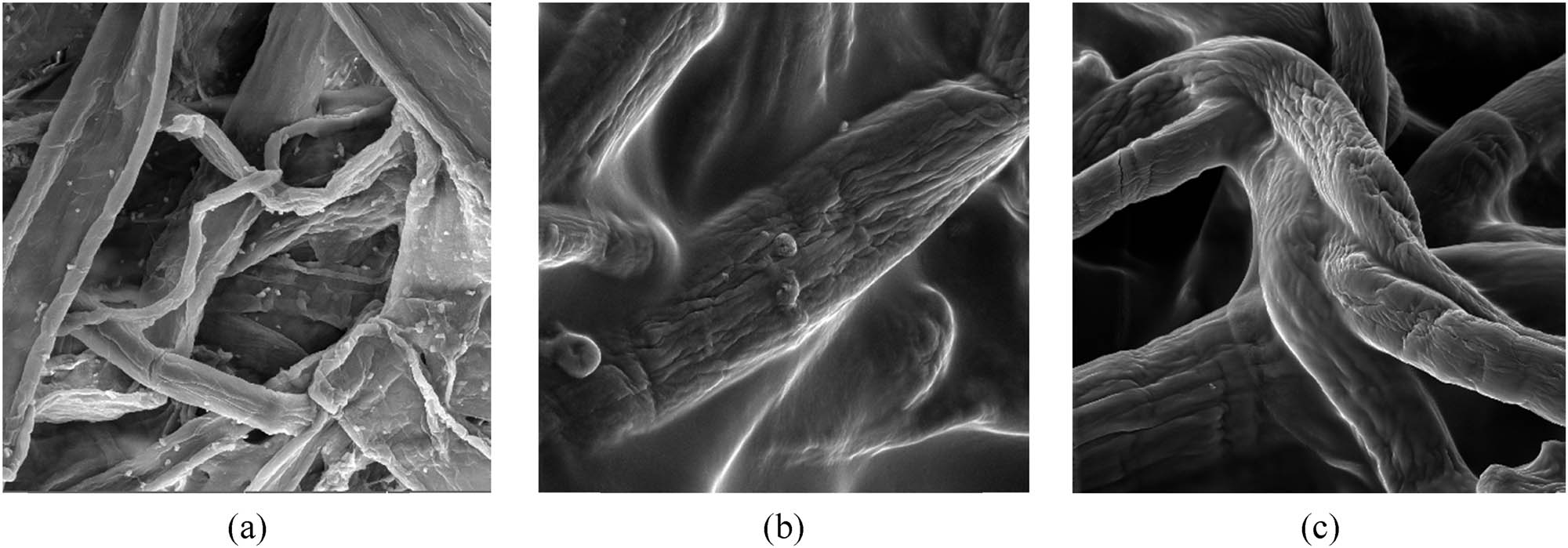
SEM images: (a) soda pulp, (b) soda pulp with rapeseed FeTNa solution, and (c) soda pulp with the wheat FeTNa solution.
3.3.2 Optical properties
The color deviation (ΔE) was measured relative to untreated reference samples and after artificial UV aging. Table 4 presents the ΔE values, alongside industrial CNF nanofibrils and CNC nanocrystals for comparison.
Optical properties
| Pulp | Type of nanomaterial | Concentration (g L−1) | ΔE – after application of the nanocellulose solution | ΔE – after UV aging | Chrome after UV aging |
|---|---|---|---|---|---|
| Soda flax pulp | Nanocellulose wheat solution | 0.01 | 19.18 ± 6.21 | 37.88 ± 5.63 | 20.97 ± 5.91 |
| 0.02 | 18.52 ± 2.73 | 41.96 ± 4.96 | 20.22 ± 5.66 | ||
| 0.025 | 20.28 ± 7.34 | 41.42 ± 4.24 | 20.56 ± 5.69 | ||
| 0.04 | 18.15 ± 6.18 | 30.44 ± 5.46 | 20.02 ± 5.39 | ||
| 0.05 | 15.93 ± 13.24 | 16.27 ± 3.75 | 17.71 ± 5.97 | ||
| Nanocellulose rapeseed solution | 0.01 | 9.65 ± 2.03 | 27.40 ± 7.75 | 19.41 ± 5.69 | |
| 0.02 | 9.38 ± 3.33 | 27.52 ± 7.50 | 18.70 ± 5.17 | ||
| 0.025 | 8.93 ± 4.04 | 12.09 ± 3.19 | 19.76 ± 3.18 | ||
| 0.04 | 9.19 ± 0.68 | 27.46 ± 7.60 | 19.34 ± 5.55 | ||
| 0.05 | 10.22 ± 1.04 | 25.48 ± 4.06 | 19.66 ± 5.53 | ||
| Nanofibrils | — | 0.70 ± 0.50 | 1.27 ± 0.85 | 2.34 ± 0.42 | |
| Nanocrystals | — | 2.14 ± 0.44 | 2.87 ± 0.53 | 6.46 ± 0.40 | |
| Kraft pulp from conifers | Nanocellulose wheat solution | 0.01 | 5.94 ± 1.00 | 17.60 ± 9.30 | 27.92 ± 5.98 |
| 0.02 | 6.06 ± 1.34 | 20.40 ± 7.56 | 27.78 ± 5.95 | ||
| 0.025 | 5.59 ± 1.44 | 17.84 ± 6.78 | 28.35 ± 5.19 | ||
| 0.04 | 4.94 ± 0.74 | 13.21 ± 6.53 | 29.27 ± 4.33 | ||
| 0.05 | 6.58 ± 1.77 | 17.99 ± 9.34 | 28.36 ± 5.48 | ||
| Nanocellulose rapeseed solution | 0.01 | 5.38 ± 2.35 | 6.53 ± 1.58 | 29.60 ± 1.33 | |
| 0.02 | 6.31 ± 1.24 | 18.38 ± 7.46 | 28.61 ± 5.50 | ||
| 0.025 | 5.30 ± 1.23 | 21.29 ± 7.66 | 27.85 ± 5.90 | ||
| 0.04 | 3.99 ± 0.74 | 14.69 ± 5.73 | 29.60 ± 4.56 | ||
| 0.05 | 5.09 ± 0.41 | 17.95 ± 6.51 | 28.30 ± 5.79 | ||
| Nanofibrils | — | 1.81 ± 0.52 | 4.39 ± 0.97 | 22.95 ± 0.44 | |
| Nanocrystals | — | 1.42 ± 0.35 | 2.21 ± 0.46 | 24.70 ± 0.66 |
The chroma values (C) were calculated as differences in color saturation after UV aging relative to the nitrocellulose-modified sample.
3.3.3 Statistical evaluation
The statistical evaluation of the color change is shown in Figures 2 and 3. Tables 5 and 6 present statistical analyses of color change using Wilks’ test and Tukey’s post-hoc analysis. Pulp type and nanocellulose material significantly affected the outcomes (p < 0.01), while concentration had a smaller but still notable influence (p = 0.02). Kraft pulp samples were generally more color-stable than soda pulp samples, and nanocellulose from rapeseed exhibited higher stability than wheat-derived nanoparticles.

Color change parameter dE after modification.

Color change parameter dE after UV aging.
Wilks’ multivariate test of significance for color parameters
| Effect | Value | F | Effect df | Error df | p | Partial eta-squared | Non-centrality | Observed power (alpha = 0.05) |
|---|---|---|---|---|---|---|---|---|
| Intercept | 0.04631 | 607.578 | 2 | 59 | 0.00000 | 0.95369 | 1215.16 | 1.00000 |
| Pulp type | 0.31699 | 63.563 | 2 | 59 | 0.00000 | 0.68301 | 127.13 | 1.00000 |
| Dissolved material | 0.63192 | 17.183 | 2 | 59 | 0.00001 | 0.36808 | 34.37 | 0.99966 |
| Concentration | 0.82491 | 1.490 | 8 | 118 | 0.16798 | 0.09175 | 11.92 | 0.64668 |
| Pulp type* dissolved material | 0.71867 | 11.548 | 2 | 59 | 0.00006 | 0.28133 | 23.10 | 0.99141 |
| Pulp type* concentration | 0.74911 | 2.292 | 8 | 118 | 0.02559 | 0.13449 | 18.34 | 0.86026 |
| Dissolved material* concentration | 0.74085 | 2.387 | 8 | 118 | 0.02021 | 0.13928 | 19.10 | 0.87646 |
| Pulp type* dissolved material* concentration | 0.70497 | 2.817 | 8 | 118 | 0.00679 | 0.16038 | 22.54 | 0.93154 |
Tukey HSD test, homogenous group, alpha = 0.05000 (non-exhaustive search) for color parameters
| Pulp type | Dissolved material | Concen-tration | dE mod mean | 1 | 2 | 3 | 4 |
|---|---|---|---|---|---|---|---|
| Kraft | Rapeseed | 0.04 | 3.98654 | **** | |||
| Kraft | Wheat | 0.04 | 4.93703 | **** | **** | ||
| Kraft | Rapeseed | 0.05 | 5.08938 | **** | **** | ||
| Kraft | Rapeseed | 0.025 | 5.30209 | **** | **** | ||
| Kraft | Rapeseed | 0.01 | 5.37861 | **** | **** | ||
| Kraft | Wheat | 0.025 | 5.58884 | **** | **** | ||
| Kraft | Wheat | 0.01 | 5.93867 | **** | **** | ||
| Kraft | Wheat | 0.02 | 6.05503 | **** | **** | ||
| Kraft | Rapeseed | 0.02 | 6.31403 | **** | **** | ||
| Kraft | Wheat | 0.05 | 6.58132 | **** | **** | ||
| Soda | Rapeseed | 0.025 | 8.93195 | **** | **** | **** | |
| Soda | Rapeseed | 0.04 | 9.18659 | **** | **** | **** | **** |
| Soda | Rapeseed | 0.02 | 9.37504 | **** | **** | **** | **** |
| Soda | Rapeseed | 0.01 | 9.64797 | **** | **** | **** | **** |
| Soda | Rapeseed | 0.05 | 10.21742 | **** | **** | **** | **** |
| Soda | Wheat | 0.05 | 15.92903 | **** | **** | **** | |
| Soda | Wheat | 0.04 | 18.14870 | **** | **** | ||
| Soda | Wheat | 0.02 | 18.52248 | **** | **** | ||
| Soda | Wheat | 0.01 | 19.18459 | **** | **** | ||
| Soda | Wheat | 0.025 | 20.27769 | **** |
3.3.4 Physical properties
Bekk smoothness and Parker roughness of the treated handsheets are reported in Table 7. The application of FeTNa nanocellulose solutions slightly altered the surface properties, with variations depending on the pulp type and the nanocellulose raw.
Physical properties
| Pulp | Type of nanomaterial | Concentration (g L−1) | Bekk smoothness [s] | Parker roughness [kPa] |
|---|---|---|---|---|
| Soda flax pulp | Nanocellulose wheat solution | 0.01 | 0.90 ± 0.17 | 7.79 ± 0.18 |
| 0.02 | 0.87 ± 0.12 | 7.89 ± 0.00 | ||
| 0.025 | 1.10 ± 0.00 | 7.74 ± 0.15 | ||
| 0.04 | 1.30 ± 0.17 | 7.81 ± 0.10 | ||
| 0.05 | 1.10 ± 0.10 | 7.60 ± 0.18 | ||
| Nanocellulose rapeseed solution | 0.01 | 1.23 ± 0.12 | 7.62 ± 0.04 | |
| 0.02 | 1.10 ± 0.26 | 7.77 ± 0.15 | ||
| 0.025 | 0.93 ± 0.12 | 7.89 ± 0.00 | ||
| 0.04 | 0.63 ± 0.06 | 7.88 ± 0.02 | ||
| 0.05 | 1.17 ± 0.06 | 7.44 ± 0.06 | ||
| Nanofibrils | — | 1.90 ± 0.10 | 7.25 ± 0.09 | |
| Nanocrystals | — | 0.80 ± 0.17 | 7.82 ± 0.08 | |
| Reference | — | 2.97 ± 0.23 | 7.11 ± 0.02 | |
| Kraft pulp from conifers | Nanocellulose wheat solution | 0.01 | 0.80 ± 0.00 | 7.89 ± 0.00 |
| 0.02 | 1.00 ± 0.00 | 7.85 ± 0.08 | ||
| 0.025 | 0.80 ± 0.00 | 7.89 ± 0.00 | ||
| 0.04 | 1.10 ± 0.20 | 7.60 ± 0.10 | ||
| 0.05 | 1.10 ± 0.26 | 7.54 ± 0.26 | ||
| Nanocellulose rapeseed solution | 0.01 | 1.87 ± 0.31 | 7.47 ± 0.12 | |
| 0.02 | 1.40 ± 0.10 | 7.89 ± 0.00 | ||
| 0.025 | 1.50 ± 0.10 | 7.33 ± 0.27 | ||
| 0.04 | 1.93 ± 0.21 | 7.03 ± 0.13 | ||
| 0.05 | 2.07 ± 0.12 | 7.16 ± 0.07 | ||
| Nanofibrils | — | 3.43 ± 0.40 | 7.07 ± 0.06 | |
| Nanocrystals | — | 1.57 ± 0.25 | 7.32 ± 0.16 | |
| Reference | — | 2.93 ± 0.15 | 5.30 ± 1.76 |
3.3.5 Mechanical properties
Tensile strength (breaking length, relative elongation, tensile index) and burst index of the treated handsheets are shown in Table 8. FeTNa-derived nanocellulose moderately improved the mechanical performance, particularly for kraft pulp.
Mechanical properties
| Pulp | Type of nanomaterials | c (g L−1) | BL (km) | ε (%) | TI (N m g−1) | BI (kPa) |
|---|---|---|---|---|---|---|
| Soda flax pulp | Nanocellulose wheat solution | 0.01 | 0.76 ± 0.03 | 2.27 ± 0.27 | 7.46 ± 0.33 | 68.50 ± 2.42 |
| 0.02 | 0.72 ± 0.00 | 2.11 ± 0.32 | 7.04 ± 0.01 | 73.63 ± 9.18 | ||
| 0.025 | 0.88 ± 0.18 | 1.76 ± 0.06 | 8.65 ± 1.80 | 64.83 ± 7.96 | ||
| 0.04 | 0.92 ± 0.22 | 1.99 ± 0.06 | 8.95 ± 2.14 | 91.60 ± 8.26 | ||
| 0.05 | 1.02 ± 0.09 | 1.85 ± 0.07 | 9.95 ± 0.85 | 65.83 ± 12.00 | ||
| Nanocellulose rapeseed solution | 0.01 | 1.11 ± 0.04 | 2.09 ± 0.51 | 10.87 ± 0.38 | 68.17 ± 8.27 | |
| 0.02 | 0.91 ± 0.09 | 2.04 ± 0.31 | 8.90 ± 0.89 | 73.70 ± 3.06 | ||
| 0.025 | 0.86 ± 0.03 | 2.12 ± 0.24 | 8.45 ± 0.32 | 65.27 ± 8.24 | ||
| 0.04 | 0.63 ± 0.02 | 2.93 ± 0.06 | 6.13 ± 0.21 | 51.60 ± 5.35 | ||
| 0.05 | 0.68 ± 0.04 | 1.63 ± 0.04 | 6.66 ± 0.45 | 66.57 ± 3.54 | ||
| Nanofibrils | — | 0.98 ± 0.06 | 0.83 ± 0.18 | 9.55 ± 0.62 | 50.53 ± 4.07 | |
| Nanocrystals | — | 2.72 ± 0.05 | 2.24 ± 0.06 | 26.63 ± 0.48 | 135.93 ± 26.19 | |
| Reference | — | 1.48 ± 0.19 | 2.08 ± 0.35 | 14.46 ± 1.82 | 73.97 ± 10.01 | |
| Kraft pulp from conifers | Nanocellulose wheat solution | 0.01 | 1.23 ± 0.13 | 3.20 ± 0.91 | 12.04 ± 1.27 | 113.63 ± 27.95 |
| 0.02 | 1.42 ± 0.15 | 3.30 ± 0.09 | 13.91 ± 1.44 | 101.06 ± 18.32 | ||
| 0.025 | 1.74 ± 0.08 | 3.50 ± 0.02 | 17.04 ± 0.76 | 124.27 ± 13.47 | ||
| 0.04 | 1.37 ± 0.21 | 3.11 ± 0.49 | 13.43 ± 2.09 | 99.30 ± 6.24 | ||
| 0.05 | 1.24 ± 0.08 | 3.67 ± 0.29 | 12.18 ± 0.79 | 88.33 ± 9.30 | ||
| Nanocellulose rapeseed solution | 0.01 | 1.47 ± 0.04 | 3.51 ± 0.50 | 14.39 ± 0.44 | 111.40 ± 15.88 | |
| 0.02 | 1.25 ± 0.09 | 3.73 ± 0.78 | 12.24 ± 0.93 | 121.03 ± 19.21 | ||
| 0.025 | 1.27 ± 0.07 | 2.74 ± 0.62 | 12.45 ± 0.69 | 103.63 ± 26.93 | ||
| 0.04 | 1.03 ± 0.23 | 2.81 ± 0.12 | 10.11 ± 2.19 | 71.77 ± 2.84 | ||
| 0.05 | 1.42 ± 0.09 | 3.59 ± 0.33 | 13.85 ± 0.92 | 103.00 ± 4.33 | ||
| Nanofibrils | — | 1.43 ± 0.08 | 2.11 ± 0.01 | 14.04 ± 0.85 | 74.93 ± 3.41 | |
| Nanocrystals | — | 1.62 ± 0.04 | 1.32 ± 0.29 | 15.88 ± 0.45 | 130.10 ± 26.15 | |
| Reference | — | 1.23 ± 0.01 | 0.81 ± 0.04 | 12.00 ± 0.08 | 37.63 ± 3.04 |
4 Discussion
4.1 Mechanical performance
The nanocellulose coating did not affect the tensile index of the soda flax pulp, but only for the nanocrystal application, similar to the burst index. For the kraft pulp, both tensile and burst indexes increased when applying cellulose spray.
According to Sharma et al. [3], the tensile strength increased from 15 to 40 N m g−1 using up to 9% CMFs (cellulose microfibrils). In this study, tensile indexes were 14.50 N m g−1 for the soda flax pulp and 12.00 N m g−1 for the kraft pulp. FeTNa-derived nanocellulose increased the tensile strength to 17.04 N m g−1 for the wheat solution and 14.39 N m g−1 for the rapeseed solution, similar to industrial nanofibrils and nanocrystals (14.04 and 15.88 N m g−1, respectively).
Benchmarking against state-of-the-art approaches shows that improvements remain moderate. Zhang et al. [4] reported tensile indexes of 25–30 N m g−1 using CNCs extracted with [Bmim]Cl. Li et al. [46] observed a 50.3% increase in the tensile strength and a 26.3% increase in elongation at break with optimized nanocellulose. Compared to these, FeTNa-derived nanocellulose shows lower absolute performance but offers sustainability and cost advantages.
Relative elongation at break, commonly used to describe maximum strength and flexibility [4], was highest with industrial nanocrystals. FeTNa-treated pulps showed more limited improvements, indicating moderate reinforcement efficiency.
Burst index increased slightly for kraft pulp with FeTNa nanocellulose. By comparison, Sharma et al. [3] reported more substantial enhancements with CMFs, highlighting the gap in absolute mechanical reinforcement, while FeTNa offers environmental and cost benefits.
4.2 Physical/optical performance
As expected, higher concentrations of nanocellulose solution increased the degree of cellulose polymerization, similar to interfacial tension. The viscosity increased with concentration, while no clear dependence was observed for density at these low concentrations.
The optical properties are shown in the figures. Higher values were obtained for the soda-treated flax pulp than for the kraft pulp, probably due to the color of the reference pulp. According to Bekk, surface smoothness did not generally improve when applying the nanocellulose solution, except for kraft pulp treated with nanocrystals. This correlates with the increased surface roughness of laboratory handsheets.
According to the statistical evaluation, all factors are significantly important (Figure 1). The pulp type and nanoparticle materials are statistically significant, with p = 0.00, and concentration is still statistically significant, but with p = 0.02. Sulfate pulp samples are more color-stable compared to sodium pulp samples. This is due to the reference color, which is bright white for sodium pulp samples, so the change after modification is more pronounced. Nanoparticles made from rapeseed input are more color-stable for both pulp types than wheat input. Different concentrations did not significantly affect color change; the changes were statistically significant in sodium pulp samples with wheat input nanoparticles.
Figure 2 shows the concentrations of 0 reference samples without surface modification after UV aging, so that they can be compared with other samples. After UV aging, most results show that sulfate pulp is more color-stable. According to Zmeškal et al. [41], color changes are considered very serious or disturbing, which was expected due to the modification of the dissolved material in the solution.
4.3 FeTNa mechanism
Recent studies have explored surface treatments and nanomaterial additives to enhance the composite performance. Feng et al. [47] demonstrated that surface modification of fibers can improve both damping and mechanical properties. Gong et al. [48] found that interfacial sliding of oriented multilayer graphene oxide significantly enhances damping properties in the composites.
The FeTNa-derived nanocellulose may interact with the fiber network to reinforce hydrogen bonding and create additional interfibrillar entanglements, partially explaining the observed moderate mechanical improvements. Combining FeTNa nanocellulose with surface modifications or nanomaterials could further enhance the mechanical and functional properties [47,48].
4.4 Strengths, limitations, and implications
Although on a laboratory scale, the spray application approach shows potential for industrial translation, it is compatible with roll-to-roll processes used in papermaking and coating lines, enabling continuous application and drying. Future work should focus on viscosity control, drying kinetics, and coating uniformity for scalability.
FeTNa offers a low-cost, sustainable alternative to ionic liquid or enzymatic extractions, making it economically viable for bulk packaging materials. Moderate mechanical and optical improvements may suffice in packaging/barrier applications, especially when combined with environmental benefits from using agricultural residues.
Limitations include lower reinforcement than commercial CNCs/CMFs, potential challenges with long-term stability, recyclability, and large-scale handling. Overall, FeTNa nanocellulose coatings provide moderate improvements but are promising for scalable, cost-efficient, and environmentally friendly industrial applications.
5 Conclusion
This work introduced an innovative and sustainable strategy for producing nanocellulose solutions from wheat and rapeseed residues using the FeTNa method. This study contributes to advancing circular and sustainable material use by converting low-value agricultural by-products into high-value nanomaterials. The FeTNa-derived nanocellulose solutions enhanced the paper’s optical and mechanical properties – especially kraft pulp – while remaining compatible with industrial papermaking processes. Although their reinforcement effect is lower than that of commercial CNCs and CNFs, the approach offers significant cost, environmental impact, and scalability advantages, making it highly relevant for packaging and other large-scale applications.
Future work should focus on tailoring particle morphology, improving coating uniformity, optimizing process parameters such as viscosity and drying kinetics, and assessing long-term stability, recyclability, and safety. Addressing these aspects will be essential for translating FeTNa-derived nanocellulose from laboratory research to industrial implementation.
-
Funding information: This research was supported by the Faculty of Forestry and Wood Sciences of the Czech University of Life Sciences Prague (Internal Grant Agency, Project No. A_03_24).
-
Author contributions: Conceptualization: J.B. and K.H.; formal analysis: J.B. and K.H.; investigation: J.B. and K.H.; methodology: J.B., K.H., and A.S.; project administration: K.H.; supervision: K.H.; validation: J.B., K.H., and A.S.; visualization: K.H. and A.S.; writing – original draft: J.B., K.H., and A.S.; writing – review and editing: J.B. and K.H. All authors have accepted responsibility for the entire content of this manuscript and approved its submission.
-
Conflict of interest: The authors state no conflict of interest.
-
Data availability statement: The datasets generated and/or analyzed during the current study are available from the corresponding author on reasonable request.
References
[1] Caballero B, Finglas P, Toldra F. Encyclopedia of food sciences and nutrition. Amsterdam: Elsevier; 2003. p. 6000.Search in Google Scholar
[2] Mihajlov L, Markova Ruzdik N. Opportunities – alternatives for application of agroecological measures and use of post-harvest residues. J Agric Plant Sci. 2023;21(1):75–82. 10.46763/JAPS23211075m.Search in Google Scholar
[3] Sharma M, Aguado R, Murtinho D, Valente AJM, De Sousa APM, Ferreira PJT. A review on cationic starch and nanocellulose as paper coating components. Int J Biol Macromol. 2020;162:578–98. 10.1016/j.ijbiomac.2020.06.131.Search in Google Scholar PubMed
[4] Zhang W, Zhang Y, Cao J, Jiang W. Improving the performance of edible food packaging films by using nanocellulose as an additive. Int J Biol Macromol. 2021;166:288–96. 10.1016/j.ijbiomac.2020.10.185.Search in Google Scholar PubMed
[5] Latifah J, Nurrul-Atika M, Sharmiza A, Rushdan I. Extraction of nanofibrillated cellulose from kelempayan (Neolamarckia Cadamba) and its use as strength additive in papermaking. J Trop Sci. 2020;32:170–8. 10.26525/jtfs32.2.170.Search in Google Scholar
[6] Balea A, Fuente E, Monte MC, Merayo N, Campano C, Negro C, et al. Industrial application of nanocelluloses in papermaking: a review of challenges, technical solutions, and market perspectives. Molecules. 2020;25(3):526. 10.3390/molecules25030526.Search in Google Scholar PubMed PubMed Central
[7] Norizan MN, Shazleen SS, Alias AH, Sabaruddin FA, Asyraf MRM, Zainudin ES, et al. Nanocellulose-based nanocomposites for sustainable applications: a review. Nanomaterials. 2022;12(19):3483. 10.3390/nano12193483.Search in Google Scholar PubMed PubMed Central
[8] Fernandes A, Cruz-Lopez L, Esteves B, Evtuguin D. Nanotechnology applied to cellulosic materials. Materials. 2023;16(8):3104. 10.3390/ma16083104.Search in Google Scholar PubMed PubMed Central
[9] Mugwagwa L, Chimphango A. Physicochemical properties and potential application of hemicellulose/pectin/nanocellulose biocomposites as active packaging for fatty foods. Food Packag Shelf Life. 2022;31:100795. 10.1016/j.fpsl.2021.100795.Search in Google Scholar
[10] Thakur V, Guleria A, Kumar S, Sharma S, Singh K. Recent advances in nanocellulose processing, functionalization and applications: a review. Mater Adv. 2021;2(6):1872–95. 10.1039/D1MA00049G.Search in Google Scholar
[11] Si Y, Lin Q, Zhou F, Qing J, Luo H, Zhang C, et al. The interaction between nanocellulose and microorganisms for new degradable packaging: A review. Carbohyd Polym. 2022;295:119899. 10.1016/j.carbpol.2022.119899.Search in Google Scholar PubMed
[12] Heidari N, Fathi M, Hamdami N, Taheri H, Siqueira G, Nyström G. Thermally insulating cellulose nanofiber aerogels from brewery residues. ACS Sustain Chem Eng. 2023;11:10698–708. 10.1021/acssuschemeng.3c01113.Search in Google Scholar
[13] Dufresne A. Nanocellulose: a new ageless bionanomaterial. Mater Today. 2013;16(6):220–7. 10.1016/j.mattod.2013.06.004.Search in Google Scholar
[14] Lim WL, Gunny AAN, Kasim FH. Overview of cellulose nanocrystals: extraction, physicochemical properties and applications. IOP Conf Ser: Mater Sci Eng. 2019;670(1):012058. 10.1088/1757-899X/670/1/012058.Search in Google Scholar
[15] Tan XY, Lai CW, Abd Hamid SB. Facile preparation of highly crystalline nanocellulose by using ionic liquid. Adv Mater Res. 2015;1087:106–10. 10.4028/www.scientific.net/AMR.1087.106.Search in Google Scholar
[16] Tan XY, Abd Hamid SB, Lai CW. Preparation of high crystallinity cellulose nanocrystals (CNCs) by ionic liquid solvolysis. Biomass Bioenerg. 2015;81:584–91. 10.1016/j.biombioe.2015.08.016.Search in Google Scholar
[17] Das AK, Islam MN, Ashaduzzaman M, Nazhad MM. Nanocellulose: its applications, consequences and challenges in papermaking. J Packag Technol Res. 2020;4(3):253–60. 10.1007/s41783-020-00097-7.Search in Google Scholar
[18] Ivanov MA, Kosoy AL. The structure of the iron(III) complex with sodium tartrate (FeTNa). Acta Crystallogr Sect B: Struct Crystallogr Cryst Chem. 1975;31(12):2843–8.10.1107/S0567740875009028Search in Google Scholar
[19] Vu-Manh H, Öztürk HB, Manian AP, Bechtold T. Mordanting of cellulosics with Iron (III) Sodium Tartrate (FeTNa) complexes for coloration with natural dyes. Lenzing Ber. 2022;97:45–9.Search in Google Scholar
[20] Shamsuri AA, Jamil SNAD, Abdan K. Nanocellulose extraction using ionic liquids: Syntheses, processes, and properties. Front Mater. 2022;9:919918. 10.3389/fmats.2022.919918.Search in Google Scholar
[21] Wang L, Zhu X, Chen X, Zhang Y, Yang H, Li Q, et al. Isolation and characteristics of nanocellulose from hardwood pulp via phytic acid pretreatment. Ind Crop Prod. 2022;182:114921. 10.1016/j.indcrop.2022.114921.Search in Google Scholar
[22] Wang Y, Wei X, Li J, Wang F, Wang Q, Zhang Y, et al. Homogeneous isolation of nanocellulose from eucalyptus pulp by high pressure homogenization. Ind Crop Prod. 2017;104:237–41. 10.1016/j.indcrop.2017.04.032.Search in Google Scholar
[23] Vinogradova Y, Chen J. Micro- and nano-cellulose fiber regenerated from ionic liquids. J Text Inst. 2015;107(4):472–6. 10.1080/00405000.2015.1040693.Search in Google Scholar
[24] Phanthong P, Karnjanakom S, Reubroycharoen P, Hao X, Abudula A, Guan G. A facile one-step way for extraction of nanocellulose with high yield by ball milling with ionic liquid. Cellulose. 2017;24(5):2083–93. 10.1007/s10570-017-1238-5.Search in Google Scholar
[25] Samsudin NA, Low FW, Yusoff Y, Shakeri M, Tan XY, Lai CW, et al. Effect of temperature on synthesis of cellulose nanoparticles via ionic liquid hydrolysis process. J Mol Liq. 2020;308:113030. 10.1016/j.molliq.2020.113030.Search in Google Scholar
[26] Babicka M, Woźniak M, Dwiecki K, Borysiak S, Ratahczak I. Preparation of nanocellulose using ionic liquids: 1-propyl-3-methylimidazolium chloride and 1-ethyl-3-methylimidazolium chloride. Molecules. 2020;25(7):1544. 10.3390/molecules25071544.Search in Google Scholar PubMed PubMed Central
[27] Babicka M, Woźniak M, Szentner K, Bartkowiak M, Peplińska B, Dwiecki K, et al. Nanocellulose production using ionic liquids with enzymatic pretreatment. Materials. 2021;14(12):3264. 10.3390/ma14123264.Search in Google Scholar PubMed PubMed Central
[28] Li P, Zhou M, Jian B, Lei H, Liu R, Zhou X, et al. Paper material coated with soybean residue nanocellulose waterproof agent and its application in food packaging. Ind Crop Prod. 2023;199:116749. 10.1016/j.indcrop.2023.116749.Search in Google Scholar
[29] Huang J, Hou S, Chen R. Ionic liquid-assisted fabrication of nanocellulose from cotton linter by high pressure homogenization. BioResources. 2019;14:7805–20. 10.15376/biores.14.4.7805-7820.Search in Google Scholar
[30] Huang J, Lin C, Chen R, Xiong W, Wen X, Luo X. Ionic liquid-assisted synthesis of nanocellulose adsorbent and its adsorption properties. Chin J Mater Res. 2020;34(9):674–82. 10.11901/1005.3093.2020.017.Search in Google Scholar
[31] Standard & Test Methods. Tappi test methods. Georgia, USA: Tappi Press Atlanta; 2007.Search in Google Scholar
[32] Seifert K. Uber ein neues Verfahren zur Schnellbestimmung Der Rein-Cellulose. Das Pap. 1956;10:301–6.Search in Google Scholar
[33] Wise LE, Murphy M, D’Addieco AA. Chlorite holocellulose, its fractionation and bearing on summative wood analysis and on studies on the hemicelluloses. Pap Trade J. 1946;122:35–43.Search in Google Scholar
[34] Kačík F, Solár R. Analytical chemistry of wood (in Slovak). Zvolen, Slovakia: Technical University in Zvolen; 1999. p. 369.Search in Google Scholar
[35] SCAN-CM 15:88. Viscosity in Cupri-Ethylenediamine (CED) solution. Stockholm, Sweden: SCAN; 1998.Search in Google Scholar
[36] ISO 5351. Pulps-determination of limiting viscosity number in Cupri-Ethylenediamine (CED) solution. Geneva, Switzerland: International Organization for Standardization; 2010.Search in Google Scholar
[37] ISO 16053-2. Paints and varnishes — Coating materials and coating systems for exterior wood. London, United Kingdom: International Organization for Standardization; 2024.Search in Google Scholar
[38] ISO/CIE 11664-4. Colorimetry–Part 4: CIE 1976 L*a*b* colour space. London, United Kingdom: International Organization for Standardization; 2019.Search in Google Scholar
[39] ISO/CIE 11664-6. Colorimetry–Part 6: CIEDE2000 colour-difference formula. London, United Kingdom: International Organization for Standardization; 2022.Search in Google Scholar
[40] Völz HG. Industrial color testing: fundamentals and techniques. Weinheim: Wiley-VCH Verlag GmbH & Co. KGaA; 2002. p. 373.Search in Google Scholar
[41] Zmeškal O, Čeppan O, Dzik P. Colour management - Colour spaces and colour management (in Czech). Brno, Czech Republic: Technical University; 2002. [online]. http://imagesci.fch.vut.cz/download/stud06_rozn02.pdf (accessed 17 June 2024).Search in Google Scholar
[42] ISO/DIN 5627. Paper and Board—Determination of smoothness according to Bekk. London, United Kingdom: International Organization for Standardization; 2025.Search in Google Scholar
[43] ISO 8791-4. Determination of roughness/smoothness (air leak methods) — Part 4: Print-surf method. London, United Kingdom: International Organization for Standardization; 2021.Search in Google Scholar
[44] ISO 1924-2. Paper and board – Determination of tensile properties. London, United Kingdom: International Organization for Standardization; 2008.Search in Google Scholar
[45] ISO 2758. Paper – Determination of bursting strength. Geneve, Switzerland: International Organization for Standardization; 2014.Search in Google Scholar
[46] Li J, Wie X, Wang Q, Chen J, Chang G, Kong L, et al. Homogeneous isolation of nanocellulose from sugarcane bagasse by high pressure homogenization. Carbohydr Polym. 2012;90(4):1609–13. 10.1016/j.carbpol.2012.07.038.Search in Google Scholar PubMed
[47] Feng J, Gao C, Safaei B, Qin Z, Wu H, Chu F, et al. Exceptional damping of CFRPs: Unveiling the impact of carbon fiber surface treatments. Comp Part B: Eng. 2025;290:111973. 10.1016/j.compositesb.2024.111973.Search in Google Scholar
[48] Gong L, Zhang F, Peng X, Scarpa F, Huang Z, Tao G, et al. Improving the damping properties of carbon fiber reinforced polymer composites by interfacial sliding of oriented multilayer graphene oxide. Comp Sci Technol. 2022;224:109309. 10.1016/j.compscitech.2022.109309.Search in Google Scholar
© 2025 the author(s), published by De Gruyter
This work is licensed under the Creative Commons Attribution 4.0 International License.
Articles in the same Issue
- Research Articles
- MHD radiative mixed convective flow of a sodium alginate-based hybrid nanofluid over a convectively heated extending sheet with Joule heating
- Experimental study of mortar incorporating nano-magnetite on engineering performance and radiation shielding
- Multicriteria-based optimization and multi-variable non-linear regression analysis of concrete containing blends of nano date palm ash and eggshell powder as cementitious materials
- A promising Ag2S/poly-2-amino-1-mercaptobenzene open-top spherical core–shell nanocomposite for optoelectronic devices: A one-pot technique
- Biogenic synthesized selenium nanoparticles combined chitosan nanoparticles controlled lung cancer growth via ROS generation and mitochondrial damage pathway
- Fabrication of PDMS nano-mold by deposition casting method
- Stimulus-responsive gradient hydrogel micro-actuators fabricated by two-photon polymerization-based 4D printing
- Physical aspects of radiative Carreau nanofluid flow with motile microorganisms movement under yield stress via oblique penetrable wedge
- Effect of polar functional groups on the hydrophobicity of carbon nanotubes-bacterial cellulose nanocomposite
- Review in green synthesis mechanisms, application, and future prospects for Garcinia mangostana L. (mangosteen)-derived nanoparticles
- Entropy generation and heat transfer in nonlinear Buoyancy–driven Darcy–Forchheimer hybrid nanofluids with activation energy
- Green synthesis of silver nanoparticles using Ginkgo biloba seed extract: Evaluation of antioxidant, anticancer, antifungal, and antibacterial activities
- A numerical analysis of heat and mass transfer in water-based hybrid nanofluid flow containing copper and alumina nanoparticles over an extending sheet
- Investigating the behaviour of electro-magneto-hydrodynamic Carreau nanofluid flow with slip effects over a stretching cylinder
- Electrospun thermoplastic polyurethane/nano-Ag-coated clear aligners for the inhibition of Streptococcus mutans and oral biofilm
- Investigation of the optoelectronic properties of a novel polypyrrole-multi-well carbon nanotubes/titanium oxide/aluminum oxide/p-silicon heterojunction
- Novel photothermal magnetic Janus membranes suitable for solar water desalination
- Green synthesis of silver nanoparticles using Ageratum conyzoides for activated carbon compositing to prepare antimicrobial cotton fabric
- Activation energy and Coriolis force impact on three-dimensional dusty nanofluid flow containing gyrotactic microorganisms: Machine learning and numerical approach
- Machine learning analysis of thermo-bioconvection in a micropolar hybrid nanofluid-filled square cavity with oxytactic microorganisms
- Research and improvement of mechanical properties of cement nanocomposites for well cementing
- Thermal and stability analysis of silver–water nanofluid flow over unsteady stretching sheet under the influence of heat generation/absorption at the boundary
- Cobalt iron oxide-infused silicone nanocomposites: Magnetoactive materials for remote actuation and sensing
- Magnesium-reinforced PMMA composite scaffolds: Synthesis, characterization, and 3D printing via stereolithography
- Bayesian inference-based physics-informed neural network for performance study of hybrid nanofluids
- Numerical simulation of non-Newtonian hybrid nanofluid flow subject to a heterogeneous/homogeneous chemical reaction over a Riga surface
- Enhancing the superhydrophobicity, UV-resistance, and antifungal properties of natural wood surfaces via in situ formation of ZnO, TiO2, and SiO2 particles
- Synthesis and electrochemical characterization of iron oxide/poly(2-methylaniline) nanohybrids for supercapacitor application
- Impacts of double stratification on thermally radiative third-grade nanofluid flow on elongating cylinder with homogeneous/heterogeneous reactions by implementing machine learning approach
- Synthesis of Cu4O3 nanoparticles using pumpkin seed extract: Optimization, antimicrobial, and cytotoxicity studies
- Cationic charge influence on the magnetic response of the Fe3O4–[Me2+ 1−y Me3+ y (OH2)] y+(Co3 2−) y/2·mH2O hydrotalcite system
- Pressure sensing intelligent martial arts short soldier combat protection system based on conjugated polymer nanocomposite materials
- Magnetohydrodynamics heat transfer rate under inclined buoyancy force for nano and dusty fluids: Response surface optimization for the thermal transport
- Fly ash and nano-graphene enhanced stabilization of engine oil-contaminated soils
- Enhancing natural fiber-reinforced biopolymer composites with graphene nanoplatelets: Mechanical, morphological, and thermal properties
- Performance evaluation of dual-scale strengthened co-bonded single-lap joints using carbon nanotubes and Z-pins with ANN
- Computational works of blood flow with dust particles and partially ionized containing tiny particles on a moving wedge: Applications of nanotechnology
- Hybridization of biocomposites with oil palm cellulose nanofibrils/graphene nanoplatelets reinforcement in green epoxy: A study of physical, thermal, mechanical, and morphological properties
- Design and preparation of micro-nano dual-scale particle-reinforced Cu–Al–V alloy: Research on the aluminothermic reduction process
- Spectral quasi-linearization and response optimization on magnetohydrodynamic flow via stenosed artery with hybrid and ternary solid nanoparticles: Support vector machine learning
- Ferrite/curcumin hybrid nanocomposite formulation: Physicochemical characterization, anticancer activity, and apoptotic and cell cycle analyses in skin cancer cells
- Enhanced therapeutic efficacy of Tamoxifen against breast cancer using extra virgin olive oil-based nanoemulsion delivery system
- A titanium oxide- and silver-based hybrid nanofluid flow between two Riga walls that converge and diverge through a machine-learning approach
- Enhancing convective heat transfer mechanisms through the rheological analysis of Casson nanofluid flow towards a stagnation point over an electro-magnetized surface
- Intrinsic self-sensing cementitious composites with hybrid nanofillers exhibiting excellent piezoresistivity
- Research on mechanical properties and sulfate erosion resistance of nano-reinforced coal gangue based geopolymer concrete
- Impact of surface and configurational features of chemically synthesized chains of Ni nanostars on the magnetization reversal process
- Porous sponge-like AsOI/poly(2-aminobenzene-1-thiol) nanocomposite photocathode for hydrogen production from artificial and natural seawater
- Multifaceted insights into WO3 nanoparticle-coupled antibiotics to modulate resistance in enteric pathogens of Houbara bustard birds
- Synthesis of sericin-coated silver nanoparticles and their applications for the anti-bacterial finishing of cotton fabric
- Enhancing chloride resistance of freeze–thaw affected concrete through innovative nanomaterial–polymer hybrid cementitious coating
- Development and performance evaluation of green aluminium metal matrix composites reinforced with graphene nanopowder and marble dust
- Morphological, physical, thermal, and mechanical properties of carbon nanotubes reinforced arrowroot starch composites
- Influence of the graphene oxide nanosheet on tensile behavior and failure characteristics of the cement composites after high-temperature treatment
- Central composite design modeling in optimizing heat transfer rate in the dissipative and reactive dynamics of viscoplastic nanomaterials deploying Joule and heat generation aspects
- Double diffusion of nano-enhanced phase change materials in connected porous channels: A hybrid ISPH-XGBoost approach
- Synergistic impacts of Thompson–Troian slip, Stefan blowing, and nonuniform heat generation on Casson nanofluid dynamics through a porous medium
- Optimization of abrasive water jet machining parameters for basalt fiber/SiO2 nanofiller reinforced composites
- Enhancing aesthetic durability of Zisha teapots via TiO2 nanoparticle surface modification: A study on self-cleaning, antimicrobial, and mechanical properties
- Nanocellulose solution based on iron(iii) sodium tartrate complexes
- Combating multidrug-resistant infections: Gold nanoparticles–chitosan–papain-integrated dual-action nanoplatform for enhanced antibacterial activity
- Novel royal jelly-mediated green synthesis of selenium nanoparticles and their multifunctional biological activities
- Direct bandgap transition for emission in GeSn nanowires
- Synthesis of ZnO nanoparticles with different morphologies using a microwave-based method and their antimicrobial activity
- Numerical investigation of convective heat and mass transfer in a trapezoidal cavity filled with ternary hybrid nanofluid and a central obstacle
- Halloysite nanotube enhanced polyurethane nanocomposites for advanced electroinsulating applications
- Low molar mass ionic liquid’s modified carbon nanotubes and its role in PVDF crystalline stress generation
- Green synthesis of polydopamine-functionalized silver nanoparticles conjugated with Ceftazidime: in silico and experimental approach for combating antibiotic-resistant bacteria and reducing toxicity
- Evaluating the influence of graphene nano powder inclusion on mechanical, vibrational and water absorption behaviour of ramie/abaca hybrid composites
- Dynamic-behavior of Casson-type hybrid nanofluids due to a stretching sheet under the coupled impacts of boundary slip and reaction-diffusion processes
- Influence of polyvinyl alcohol on the physicochemical and self-sensing properties of nano carbon black reinforced cement mortar
- Advanced machine learning approaches for predicting compressive and flexural strength of carbon nanotube–reinforced cement composites: a comparative study and model interpretability analysis
- Artificial neural network-driven insights into nanoparticle-enhanced phase change materials melting for heat storage optimization
- Optical, structural, and morphological characterization of hydrothermally synthesized zinc oxide nanorods: exploring their potential for environmental applications
- Structural, optical, and gas sensing properties of Ce, Nd, and Pr doped ZnS nanostructured thin films prepared by nebulizer spray pyrolysis method
- The influence of nano-size La2O3 and HfC on the microstructure and mechanical properties of tungsten alloys by microwave sintering
- 10.1515/ntrev-2025-0187
- Review Articles
- A comprehensive review on hybrid plasmonic waveguides: Structures, applications, challenges, and future perspectives
- Nanoparticles in low-temperature preservation of biological systems of animal origin
- Fluorescent sulfur quantum dots for environmental monitoring
- Nanoscience systematic review methodology standardization
- Nanotechnology revolutionizing osteosarcoma treatment: Advances in targeted kinase inhibitors
- AFM: An important enabling technology for 2D materials and devices
- Carbon and 2D nanomaterial smart hydrogels for therapeutic applications
- Principles, applications and future prospects in photodegradation systems
- Do gold nanoparticles consistently benefit crop plants under both non-stressed and abiotic stress conditions?
- An updated overview of nanoparticle-induced cardiovascular toxicity
- Arginine as a promising amino acid for functionalized nanosystems: Innovations, challenges, and future directions
- Advancements in the use of cancer nanovaccines: Comprehensive insights with focus on lung and colon cancer
- Membrane-based biomimetic delivery systems for glioblastoma multiforme therapy
- The drug delivery systems based on nanoparticles for spinal cord injury repair
- Green synthesis, biomedical effects, and future trends of Ag/ZnO bimetallic nanoparticles: An update
- Application of magnesium and its compounds in biomaterials for nerve injury repair
- Micro/nanomotors in biomedicine: Construction and applications
- Hydrothermal synthesis of biomass-derived CQDs: Advances and applications
- Research progress in 3D bioprinting of skin: Challenges and opportunities
- Review on bio-selenium nanoparticles: Synthesis, protocols, and applications in biomedical processes
- Gold nanocrystals and nanorods functionalized with protein and polymeric ligands for environmental, energy storage, and diagnostic applications: A review
- An in-depth analysis of rotational and non-rotational piezoelectric energy harvesting beams: A comprehensive review
- Advancements in perovskite/CIGS tandem solar cells: Material synergies, device configurations, and economic viability for sustainable energy
- Deep learning in-depth analysis of crystal graph convolutional neural networks: A new era in materials discovery and its applications
- Review of recent nano TiO2 film coating methods, assessment techniques, and key problems for scaleup
- Antioxidant quantum dots for spinal cord injuries: A review on advancing neuroprotection and regeneration in neurological disorders
- Rise of polycatecholamine ultrathin films: From synthesis to smart applications
- Advancing microencapsulation strategies for bioactive compounds: Enhancing stability, bioavailability, and controlled release in food applications
- Advances in the design and manipulation of self-assembling peptide and protein nanostructures for biomedical applications
- Photocatalytic pervious concrete systems: from classic photocatalysis to luminescent photocatalysis
- Beyond science: ethical and societal considerations in the era of biogenic nanoparticles
- Corrigendum
- Corrigendum to “Synthesis and characterization of smart stimuli-responsive herbal drug-encapsulated nanoniosome particles for efficient treatment of breast cancer”
- Special Issue on Advanced Nanomaterials for Carbon Capture, Environment and Utilization for Energy Sustainability - Part III
- Efficiency optimization of quantum dot photovoltaic cell by solar thermophotovoltaic system
- Exploring the diverse nanomaterials employed in dental prosthesis and implant techniques: An overview
- Electrochemical investigation of bismuth-doped anode materials for low‑temperature solid oxide fuel cells with boosted voltage using a DC-DC voltage converter
- Synthesis of HfSe2 and CuHfSe2 crystalline materials using the chemical vapor transport method and their applications in supercapacitor energy storage devices
- Special Issue on Green Nanotechnology and Nano-materials for Environment Sustainability
- Influence of nano-silica and nano-ferrite particles on mechanical and durability of sustainable concrete: A review
- Surfaces and interfaces analysis on different carboxymethylation reaction time of anionic cellulose nanoparticles derived from oil palm biomass
- Processing and effective utilization of lignocellulosic biomass: Nanocellulose, nanolignin, and nanoxylan for wastewater treatment
- Wound healing activities of sulfur nanoparticles of Allium cepa extract embedded in a nanocream formulation: in vitro and in vivo studies
- Retraction
- Retraction of “Aging assessment of silicone rubber materials under corona discharge accompanied by humidity and UV radiation”
Articles in the same Issue
- Research Articles
- MHD radiative mixed convective flow of a sodium alginate-based hybrid nanofluid over a convectively heated extending sheet with Joule heating
- Experimental study of mortar incorporating nano-magnetite on engineering performance and radiation shielding
- Multicriteria-based optimization and multi-variable non-linear regression analysis of concrete containing blends of nano date palm ash and eggshell powder as cementitious materials
- A promising Ag2S/poly-2-amino-1-mercaptobenzene open-top spherical core–shell nanocomposite for optoelectronic devices: A one-pot technique
- Biogenic synthesized selenium nanoparticles combined chitosan nanoparticles controlled lung cancer growth via ROS generation and mitochondrial damage pathway
- Fabrication of PDMS nano-mold by deposition casting method
- Stimulus-responsive gradient hydrogel micro-actuators fabricated by two-photon polymerization-based 4D printing
- Physical aspects of radiative Carreau nanofluid flow with motile microorganisms movement under yield stress via oblique penetrable wedge
- Effect of polar functional groups on the hydrophobicity of carbon nanotubes-bacterial cellulose nanocomposite
- Review in green synthesis mechanisms, application, and future prospects for Garcinia mangostana L. (mangosteen)-derived nanoparticles
- Entropy generation and heat transfer in nonlinear Buoyancy–driven Darcy–Forchheimer hybrid nanofluids with activation energy
- Green synthesis of silver nanoparticles using Ginkgo biloba seed extract: Evaluation of antioxidant, anticancer, antifungal, and antibacterial activities
- A numerical analysis of heat and mass transfer in water-based hybrid nanofluid flow containing copper and alumina nanoparticles over an extending sheet
- Investigating the behaviour of electro-magneto-hydrodynamic Carreau nanofluid flow with slip effects over a stretching cylinder
- Electrospun thermoplastic polyurethane/nano-Ag-coated clear aligners for the inhibition of Streptococcus mutans and oral biofilm
- Investigation of the optoelectronic properties of a novel polypyrrole-multi-well carbon nanotubes/titanium oxide/aluminum oxide/p-silicon heterojunction
- Novel photothermal magnetic Janus membranes suitable for solar water desalination
- Green synthesis of silver nanoparticles using Ageratum conyzoides for activated carbon compositing to prepare antimicrobial cotton fabric
- Activation energy and Coriolis force impact on three-dimensional dusty nanofluid flow containing gyrotactic microorganisms: Machine learning and numerical approach
- Machine learning analysis of thermo-bioconvection in a micropolar hybrid nanofluid-filled square cavity with oxytactic microorganisms
- Research and improvement of mechanical properties of cement nanocomposites for well cementing
- Thermal and stability analysis of silver–water nanofluid flow over unsteady stretching sheet under the influence of heat generation/absorption at the boundary
- Cobalt iron oxide-infused silicone nanocomposites: Magnetoactive materials for remote actuation and sensing
- Magnesium-reinforced PMMA composite scaffolds: Synthesis, characterization, and 3D printing via stereolithography
- Bayesian inference-based physics-informed neural network for performance study of hybrid nanofluids
- Numerical simulation of non-Newtonian hybrid nanofluid flow subject to a heterogeneous/homogeneous chemical reaction over a Riga surface
- Enhancing the superhydrophobicity, UV-resistance, and antifungal properties of natural wood surfaces via in situ formation of ZnO, TiO2, and SiO2 particles
- Synthesis and electrochemical characterization of iron oxide/poly(2-methylaniline) nanohybrids for supercapacitor application
- Impacts of double stratification on thermally radiative third-grade nanofluid flow on elongating cylinder with homogeneous/heterogeneous reactions by implementing machine learning approach
- Synthesis of Cu4O3 nanoparticles using pumpkin seed extract: Optimization, antimicrobial, and cytotoxicity studies
- Cationic charge influence on the magnetic response of the Fe3O4–[Me2+ 1−y Me3+ y (OH2)] y+(Co3 2−) y/2·mH2O hydrotalcite system
- Pressure sensing intelligent martial arts short soldier combat protection system based on conjugated polymer nanocomposite materials
- Magnetohydrodynamics heat transfer rate under inclined buoyancy force for nano and dusty fluids: Response surface optimization for the thermal transport
- Fly ash and nano-graphene enhanced stabilization of engine oil-contaminated soils
- Enhancing natural fiber-reinforced biopolymer composites with graphene nanoplatelets: Mechanical, morphological, and thermal properties
- Performance evaluation of dual-scale strengthened co-bonded single-lap joints using carbon nanotubes and Z-pins with ANN
- Computational works of blood flow with dust particles and partially ionized containing tiny particles on a moving wedge: Applications of nanotechnology
- Hybridization of biocomposites with oil palm cellulose nanofibrils/graphene nanoplatelets reinforcement in green epoxy: A study of physical, thermal, mechanical, and morphological properties
- Design and preparation of micro-nano dual-scale particle-reinforced Cu–Al–V alloy: Research on the aluminothermic reduction process
- Spectral quasi-linearization and response optimization on magnetohydrodynamic flow via stenosed artery with hybrid and ternary solid nanoparticles: Support vector machine learning
- Ferrite/curcumin hybrid nanocomposite formulation: Physicochemical characterization, anticancer activity, and apoptotic and cell cycle analyses in skin cancer cells
- Enhanced therapeutic efficacy of Tamoxifen against breast cancer using extra virgin olive oil-based nanoemulsion delivery system
- A titanium oxide- and silver-based hybrid nanofluid flow between two Riga walls that converge and diverge through a machine-learning approach
- Enhancing convective heat transfer mechanisms through the rheological analysis of Casson nanofluid flow towards a stagnation point over an electro-magnetized surface
- Intrinsic self-sensing cementitious composites with hybrid nanofillers exhibiting excellent piezoresistivity
- Research on mechanical properties and sulfate erosion resistance of nano-reinforced coal gangue based geopolymer concrete
- Impact of surface and configurational features of chemically synthesized chains of Ni nanostars on the magnetization reversal process
- Porous sponge-like AsOI/poly(2-aminobenzene-1-thiol) nanocomposite photocathode for hydrogen production from artificial and natural seawater
- Multifaceted insights into WO3 nanoparticle-coupled antibiotics to modulate resistance in enteric pathogens of Houbara bustard birds
- Synthesis of sericin-coated silver nanoparticles and their applications for the anti-bacterial finishing of cotton fabric
- Enhancing chloride resistance of freeze–thaw affected concrete through innovative nanomaterial–polymer hybrid cementitious coating
- Development and performance evaluation of green aluminium metal matrix composites reinforced with graphene nanopowder and marble dust
- Morphological, physical, thermal, and mechanical properties of carbon nanotubes reinforced arrowroot starch composites
- Influence of the graphene oxide nanosheet on tensile behavior and failure characteristics of the cement composites after high-temperature treatment
- Central composite design modeling in optimizing heat transfer rate in the dissipative and reactive dynamics of viscoplastic nanomaterials deploying Joule and heat generation aspects
- Double diffusion of nano-enhanced phase change materials in connected porous channels: A hybrid ISPH-XGBoost approach
- Synergistic impacts of Thompson–Troian slip, Stefan blowing, and nonuniform heat generation on Casson nanofluid dynamics through a porous medium
- Optimization of abrasive water jet machining parameters for basalt fiber/SiO2 nanofiller reinforced composites
- Enhancing aesthetic durability of Zisha teapots via TiO2 nanoparticle surface modification: A study on self-cleaning, antimicrobial, and mechanical properties
- Nanocellulose solution based on iron(iii) sodium tartrate complexes
- Combating multidrug-resistant infections: Gold nanoparticles–chitosan–papain-integrated dual-action nanoplatform for enhanced antibacterial activity
- Novel royal jelly-mediated green synthesis of selenium nanoparticles and their multifunctional biological activities
- Direct bandgap transition for emission in GeSn nanowires
- Synthesis of ZnO nanoparticles with different morphologies using a microwave-based method and their antimicrobial activity
- Numerical investigation of convective heat and mass transfer in a trapezoidal cavity filled with ternary hybrid nanofluid and a central obstacle
- Halloysite nanotube enhanced polyurethane nanocomposites for advanced electroinsulating applications
- Low molar mass ionic liquid’s modified carbon nanotubes and its role in PVDF crystalline stress generation
- Green synthesis of polydopamine-functionalized silver nanoparticles conjugated with Ceftazidime: in silico and experimental approach for combating antibiotic-resistant bacteria and reducing toxicity
- Evaluating the influence of graphene nano powder inclusion on mechanical, vibrational and water absorption behaviour of ramie/abaca hybrid composites
- Dynamic-behavior of Casson-type hybrid nanofluids due to a stretching sheet under the coupled impacts of boundary slip and reaction-diffusion processes
- Influence of polyvinyl alcohol on the physicochemical and self-sensing properties of nano carbon black reinforced cement mortar
- Advanced machine learning approaches for predicting compressive and flexural strength of carbon nanotube–reinforced cement composites: a comparative study and model interpretability analysis
- Artificial neural network-driven insights into nanoparticle-enhanced phase change materials melting for heat storage optimization
- Optical, structural, and morphological characterization of hydrothermally synthesized zinc oxide nanorods: exploring their potential for environmental applications
- Structural, optical, and gas sensing properties of Ce, Nd, and Pr doped ZnS nanostructured thin films prepared by nebulizer spray pyrolysis method
- The influence of nano-size La2O3 and HfC on the microstructure and mechanical properties of tungsten alloys by microwave sintering
- 10.1515/ntrev-2025-0187
- Review Articles
- A comprehensive review on hybrid plasmonic waveguides: Structures, applications, challenges, and future perspectives
- Nanoparticles in low-temperature preservation of biological systems of animal origin
- Fluorescent sulfur quantum dots for environmental monitoring
- Nanoscience systematic review methodology standardization
- Nanotechnology revolutionizing osteosarcoma treatment: Advances in targeted kinase inhibitors
- AFM: An important enabling technology for 2D materials and devices
- Carbon and 2D nanomaterial smart hydrogels for therapeutic applications
- Principles, applications and future prospects in photodegradation systems
- Do gold nanoparticles consistently benefit crop plants under both non-stressed and abiotic stress conditions?
- An updated overview of nanoparticle-induced cardiovascular toxicity
- Arginine as a promising amino acid for functionalized nanosystems: Innovations, challenges, and future directions
- Advancements in the use of cancer nanovaccines: Comprehensive insights with focus on lung and colon cancer
- Membrane-based biomimetic delivery systems for glioblastoma multiforme therapy
- The drug delivery systems based on nanoparticles for spinal cord injury repair
- Green synthesis, biomedical effects, and future trends of Ag/ZnO bimetallic nanoparticles: An update
- Application of magnesium and its compounds in biomaterials for nerve injury repair
- Micro/nanomotors in biomedicine: Construction and applications
- Hydrothermal synthesis of biomass-derived CQDs: Advances and applications
- Research progress in 3D bioprinting of skin: Challenges and opportunities
- Review on bio-selenium nanoparticles: Synthesis, protocols, and applications in biomedical processes
- Gold nanocrystals and nanorods functionalized with protein and polymeric ligands for environmental, energy storage, and diagnostic applications: A review
- An in-depth analysis of rotational and non-rotational piezoelectric energy harvesting beams: A comprehensive review
- Advancements in perovskite/CIGS tandem solar cells: Material synergies, device configurations, and economic viability for sustainable energy
- Deep learning in-depth analysis of crystal graph convolutional neural networks: A new era in materials discovery and its applications
- Review of recent nano TiO2 film coating methods, assessment techniques, and key problems for scaleup
- Antioxidant quantum dots for spinal cord injuries: A review on advancing neuroprotection and regeneration in neurological disorders
- Rise of polycatecholamine ultrathin films: From synthesis to smart applications
- Advancing microencapsulation strategies for bioactive compounds: Enhancing stability, bioavailability, and controlled release in food applications
- Advances in the design and manipulation of self-assembling peptide and protein nanostructures for biomedical applications
- Photocatalytic pervious concrete systems: from classic photocatalysis to luminescent photocatalysis
- Beyond science: ethical and societal considerations in the era of biogenic nanoparticles
- Corrigendum
- Corrigendum to “Synthesis and characterization of smart stimuli-responsive herbal drug-encapsulated nanoniosome particles for efficient treatment of breast cancer”
- Special Issue on Advanced Nanomaterials for Carbon Capture, Environment and Utilization for Energy Sustainability - Part III
- Efficiency optimization of quantum dot photovoltaic cell by solar thermophotovoltaic system
- Exploring the diverse nanomaterials employed in dental prosthesis and implant techniques: An overview
- Electrochemical investigation of bismuth-doped anode materials for low‑temperature solid oxide fuel cells with boosted voltage using a DC-DC voltage converter
- Synthesis of HfSe2 and CuHfSe2 crystalline materials using the chemical vapor transport method and their applications in supercapacitor energy storage devices
- Special Issue on Green Nanotechnology and Nano-materials for Environment Sustainability
- Influence of nano-silica and nano-ferrite particles on mechanical and durability of sustainable concrete: A review
- Surfaces and interfaces analysis on different carboxymethylation reaction time of anionic cellulose nanoparticles derived from oil palm biomass
- Processing and effective utilization of lignocellulosic biomass: Nanocellulose, nanolignin, and nanoxylan for wastewater treatment
- Wound healing activities of sulfur nanoparticles of Allium cepa extract embedded in a nanocream formulation: in vitro and in vivo studies
- Retraction
- Retraction of “Aging assessment of silicone rubber materials under corona discharge accompanied by humidity and UV radiation”
