Synthesis of HfSe2 and CuHfSe2 crystalline materials using the chemical vapor transport method and their applications in supercapacitor energy storage devices
-
Rashid Khan
 ,
Muhammad Imran Rafiq
,
Muhammad Imran Rafiq

Abstract
This study reports the synthesis of highly crystalline layered HfSe2 and CuHfSe2 using the chemical vapor transport method and the investigation of their supercapacitor behavior. Various characterizations were performed in order to confirm and ascertain the structure of the synthesized materials. The CuHfSe2 electrode exhibited better supercapacitor performance due to its higher conductivity, as confirmed by experimental analysis and density functional theory calculations. The semiconducting nature of HfSe2 with a 2H phase mainly impedes its electrochemical performance. Further electrochemical analyses were conducted to test the stability of both electrode materials. Moreover, these new nanocrystals can be regarded as promising supercapacitor electrode materials with good specific capacitance, excellent cycling stability, and high energy density due to the unique microstructure of such 2D materials.
1 Introduction
With increasing concerns over the use of fossil fuels for energy generation and their environmental hazards, the scientific community is now emphasizing the utilization of alternative green energy sources and storage devices. Electrochemical capacitors, also known as supercapacitors, provide an alternative energy solution that can be used in various applications, such as renewable energy generation, electrical transportation, uninterruptible power supplies, and electrical machinery [1]. This is due to their outstanding advantages, including high specific capacitance, high power density, fast charging capability, long cycling life, large-scale production, low cost, and a wide operating voltage range [2,3,4,5,6].
So far, several materials have been tested as electrode materials for supercapacitor applications, including transition metal oxides, graphene, carbon nanotubes, MXene, and composites based on a combination of multiple materials [7,8,9,10]. There are also reports on metal–organic frameworks (MoFs) and even various waste material-based efficient energy storage devices [11,12,13]. In addition, layered transition metal dichalcogenide (TMDC) materials have emerged as an auspicious material class for electrochemical energy storage devices [14,15,16]. As electrode materials, TMDCs have demonstrated promising features in various aspects, such as excellent stability when used in a single-crystal form [6], increased capacitance with phase transition [17], compatibility for on-chip integration [18], and ability to form heterostructures with other layered materials [19]. In order to further enhance the energy storage capability of layered TMDC materials, different strategies have been employed, including phase or compositional modifications [20,21], increasing active surface areas [22], and doping [23].
For example, encompassing graphene and its composites with graphene oxide and graphite oxide using the liquid-phase exfoliation technique was investigated for supercapacitor energy storage devices [24]. The authors employed a simple sonication technique for different time durations to prepare graphene, GO, and GrO composites. They found that the sample prepared with a 48-h duration showed the best results with a capacitance of 534 F/g and 94% retention due to its high conductivity and more oxygen incorporation, which led to a more dominating redox reaction phenomenon. In a recent report by Tan and coworkers [25], a reduced graphene oxide (rGO)-supported copper/manganese-based MOF composite was fabricated by adopting a low-cost technique. They tested three electrode materials, namely Cu/MnO x -rGO, Cu/MnS x -rGO, and Cu/MnC x -rGO, prepared by heating at 300°C for 3 h in air, with equal-weighted sulfur under argon and at 600°C in argon, respectively. They reported a specific capacitance of >700 F/g with 92% retention. Furthermore, Gokulsaswath et al. [26] synthesized zirconium disulfide (ZrS2) quantum dots using the chemical bath deposition (CBD) method and characterized them using XRD, scanning electron microscopy (SEM), and energy-dispersive spectroscopy (EDS) techniques for compositional and morphological analysis. Being a zero-dimensional material, ZrS2 possesses a large surface area, which is an important parameter for electrochemical supercapacitors. The authors tested their energy storage properties using cyclic voltammetry, charge–discharge curves, and impedance spectroscopy in a standard three-electrode system. The synthesized ZrS2 particles showed a specific capacitance of 101 F/g, determined using charge–discharge curves. Notably, in the aforementioned studies, the addition of carbon additives such as activated carbon and carbon black, typically comprising 10% (by mass) of the active electrode material, has become prevalent. To a certain extent, this practice obscures the true intrinsic behaviour of the materials under investigation. The addition of carbon-based additives increases conductivity, reduces voltage drop, and ultimately enhances performance significantly compared to the original value.
Among several layered TMDC materials, although hafnium diselenide (HfSe2) has been explored for several applications, it has still not been considered for energy storage applications [27,28]. In this work, we have synthesized hafnium diselenide single crystals using the chemical vapor transport (CVT) method. The grown crystals were employed as an electrochemical supercapacitor electrode material, and clear insights into their intrinsic behavior were reported without using any carbon additives. HfSe2 single crystals were further doped with copper, and comparative analysis was performed between Cu-doped (CuHfSe2) and -undoped HfSe2. The grown single crystals exhibited enhanced and stable performance with CuHfSe2 under a three-electrode measurement setup. The Cu-doped electrode expedited electronic conductivity, which in turn improved the specific capacitance and stability, demonstrating potential for this newly tested 2D TMDC material in energy storage devices.
2 Experimental
2.1 Materials synthesis and electrode preparation
The reagents utilized in this study were purchased from Sinopharm Chemical Reagent and Sigma-Aldrich and were utilized without further purification steps. For CVT growth, stoichiometric amounts of hafnium–selenide and copper–hafnium–selenide powders were mixed with 20 mg iodine as a transport agent. In the next step, powder materials were put into the quartz ampoules with an inner diameter and length of 5 mm and 25 cm, respectively. After this, ampoules were evacuated to a vacuum of 10−3 Torr and tightly sealed. Finally, the sealed tubes were placed in a double temperature zone split-type furnace and heated at 850 and 950°C for a duration of 5 days. After 5 days, the furnace was cooled to room temperature, and the ampoule tubes containing HfSe2 and CuHfSe2 crystals (ranging in size from several microns to millimeters) were obtained. It is worth mentioning that erstwhile quartz ampoules were thoroughly cleaned with diluted HNO3 and in succession washed with DI water and dried in an oven at 60°C. For the electrode preparation, bulk millimeter-sized single crystals of HfSe2 and CuHfSe2 were cleaned with IPA and then thoroughly ground to obtain a very fine powder. Then, 2 mg of this powder was added to a DI water, IPA, and Nafion combined solution in volumes of 750, 250, and 10 µl, respectively, and sonicated for several hours. Then, 5 µl of the prepared solution was placed on a working electrode (3 mm diameter) and used for measurements after drying in an oven at room temperature (Figure 1).

Schematic illustration of CVT growth setup using a double-zone furnace and the electrode preparation process.
SEM images were taken using a ZEISS Gemini Field Emission SEM, and the same was used to obtain elemental EDS spectra of the samples. X-ray photoelectron spectroscopy (XPS) was performed using an ESCALAB 250Xi X-ray photoelectron spectrometer. The crystal structure of the grown materials was analyzed with X’Pert Pro Super (Philips Co., Netherlands). For the SEM, EDS, and XPS measurements, fine powder-like samples were prepared by grinding the flakes, while for XRD characterization, one large-sized flake was selected and used after proper washing. All electrochemical measurements were conducted on a nickel foam utilizing finely ground powder of our sample materials. These measurements were performed using a Corrtest Instrument Potentiostat.
2.2 Calculation methods
First-principles calculations were performed using the CASTEP module with the Generalized Gradient Approximation. The exchange-correlation functional of Perdew, Burke, and Ernzerhof was chosen. Norm-conserving pseudopotentials with Koelling–Harmon relativistic treatment used for calculations thus improved the electronic properties, such as lattice constant, band, and partial density of states (PDOS). In this work, norm-conserving pseudopotential of 440 eV and a set of 10 × 10 × 4 k-point scheme were used for the relaxation of HfSe2 and Cu-doped HfSe2, whereas all structures were fully relaxed with a force tolerance of 0.01 eV/A.
3 Results and discussion
X-ray diffraction patterns of HfSe2 and CuHfSe2 single crystals showed major peaks along the (001), (003), (004), and (005) planes, as shown in Figure 2(a). The XRD patterns obtained showed a prominent crystalline nature of the grown HfSe2 single crystals, which retained the 2-H phase and matched well with the standard JCPDS card no. 37-1488. XRD spectra of CuHfSe2 further revealed that the peak positions shifted to lower degrees compared to HfSe2, which confirmed successful doping of Cu atoms into HfSe2. These results are in accordance with the previously reported works of TMDC doping with transition metals [29,30]. The slight shift in peaks occurred due to a mismatch in the ionic crystal radii of copper and hafnium (Cu+1 ∼ 91 pm, Hf+4 ∼ 85 pm) [31]. A new peak at around 25° also appeared in the Cu-doped HfSe2 XRD spectrum. The appearance of this peak may be attributed to a minor presence of Cu2Se in the sample; however, it did not alter or disrupt the original structure of the grown material, as evidenced by the presence of other sharp and intense diffraction peaks corresponding to CuHfSe2.
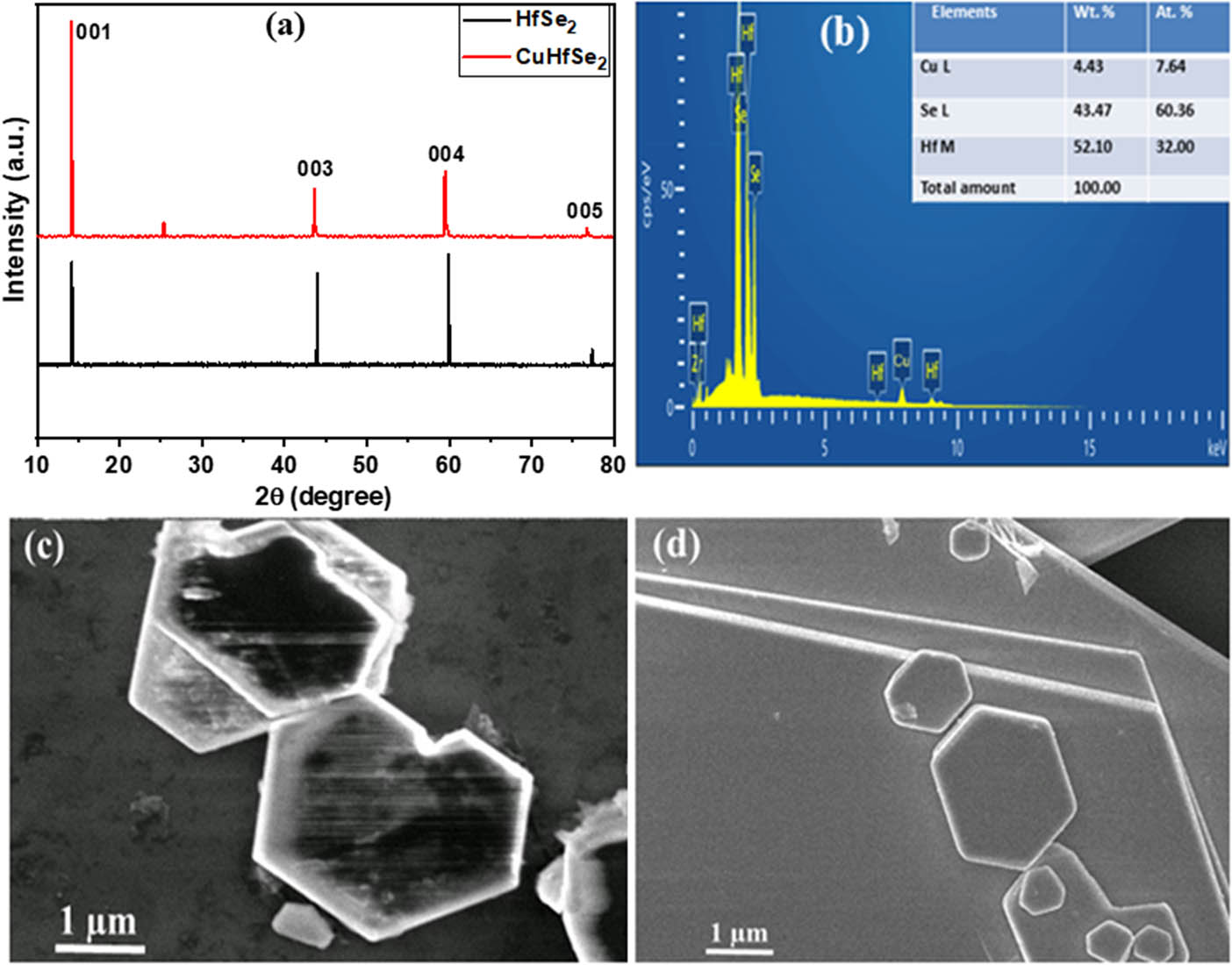
(a) XRD patterns of HfSe2 and CuHfSe2 single crystals, (b) EDS of CuHfSe2, and (c) and (d) SEM images of HfSe2 and CuHfSe2 single crystals.
The EDS was performed to study the elemental peak analysis of the CuHfSe2 material, as presented in Figure 2(b). The presence of Cu peaks clearly manifests the existence of an adequate proportion of Cu in the synthesized material.
Scanning electron microscopy images of the HfSe2 and CuHfSe2 crystals are shown in Figure 2(c) and (d), respectively. The figures revealed that most of the grown crystals are in hexagonal shape, with sizes in several microns.
Figure 3 shows the chemical composition of CuHfSe2 single crystals performed using XPS. Figure 3(a) depicts the Hf 4f spectra with two main binding energy peaks of 4f7/2 and 4f5/2 appearing around 16.1 and 18.2 eV, respectively. These two peaks correspond to HfSe2, while a small peak observed at 19.2 eV confirmed the presence of HfO x . Se 3d scan, shown in Figure 3(b), is composed of two foremost peaks, which are Se 3d3/2 (∼54.47 eV) and Se 3d5/2 (∼53.58 eV), attributed to Hf–Se bonding along with a small peak of the Se–Se bonding state in the grown sample (∼55.8 eV). Figure 3(c) illustrates the Cu 2p spectra with binding energy peaks for Cu 2p3/2 and Cu 2p1/2 appearing at around 932.5 and 952.4 eV, respectively. The occurrence of these characteristic peaks matches well with the previously reported work [28,32]. HfSe2 is known to be more prone to oxidation compared to its other counterpart TMDCs [33]. The manifestation of the HfO x phase in the XPS spectra may be due to the exposure of samples to air during characterization, but not during the growth (since the sample tubes were vacuumed and sealed for crystal growth).
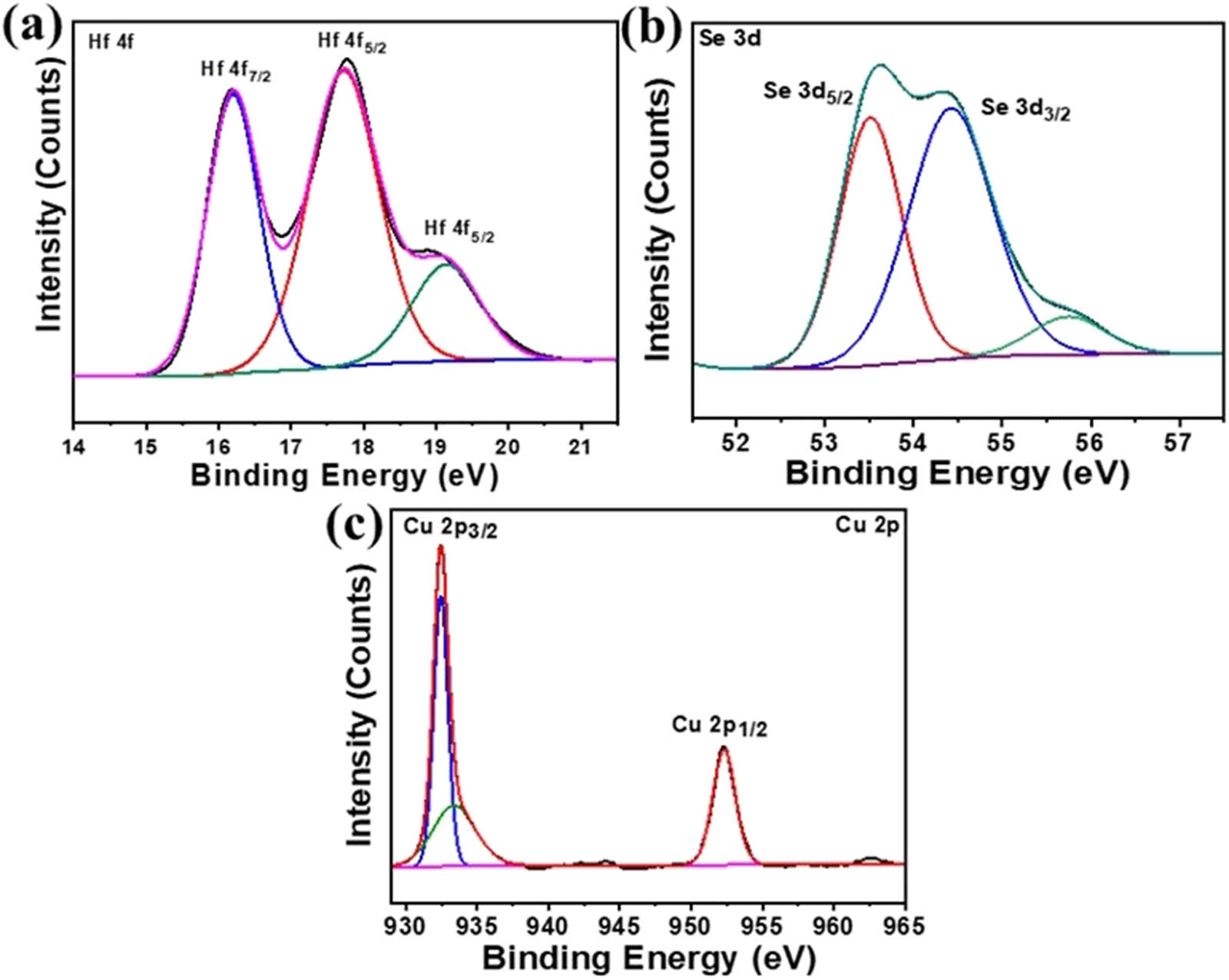
XPS spectra for the (a) Hf 4f, (b) Se 3d, and (c) Cu 2p core levels.
To unveil the electrochemical performance of the prepared electrode materials, cyclic voltammetry (CV) was performed in the potential range from 0 to 0.5 V with scan rates ranging from 10 to 200 mV s−1, as shown in Figure 4(a) and (b). The galvanostatic charge–discharge profiles of HfSe2 and CuHfSe2 are shown in Figure 4(c) and (d), respectively. The capacitance values of the prepared electrodes were calculated using CV profiles. First, the area under the CV curve was calculated by integrating the curve, whereas equation (1) was used to determine the capacitance values [8]:
where m is the mass of the electrodes, v is the scan rate, V a − V b is the potential window, and ∫I(V) dV is the integrating CV area. The highest calculated capacitance values were 44.7 and 151.83 F/g for HfSe2 and CuHfSe2 electrodes, respectively, at a scan rate of 10 mV s−1. It can be observed that all CV curves show a semi-rectangular shape at all scanning rates, exemplifying the presence of electrochemical double-layer capacitor (EDLC) behavior. CuHfSe2 electrodes exhibited significantly higher capacitance than undoped HfSe2, primarily due to improved electrical conductivity. It is well known that conductivity, surface area, porosity, functional group attachment, and interlayer spacing are the main contributing factors for efficiency enhancement. The electrode materials prepared were tested for stability with 5,000 charge–discharge cycles. Figure 5(a) depicts the stability trend of the CuHfSe2 electrode with more capacitance retention compared to the HfSe2 electrode, as shown in Figure 5(b). The initial capacitance loss observed during the early charge–discharge cycles can be attributed to the stabilization period required for the system to reach electrochemical equilibrium. Similar behavior of initial capacitance loss has also been observed in previous reports [34,35]. After preliminary cycles, the CuHfSe2 electrode showed very promising stability features with no further loss in the capacitance, while the HfSe2 electrode experienced ultimate 50% capacitance loss at the end of 5,000 cycles. It is well established that the stability of any diatomic transition metal sulfide/selenide is related to the ideal bond strength or the bond dissociation energies of its constituent elements [36,37]. It has been reported that moduli (based on the force of stretching and strain between the bonds of the transition metals and chalcogen elements) of TMDCs increase on moving from lower-number groups to the higher-number groups [38]. A similar trend was observed in our synthesized TMDC materials, i.e., compared to the undoped HfSe2, after doping with Cu, the formation of its bond with the host selenium elements by replacing the Hf atoms, the overall bond strength of CuHfSe2 is increased, which is eventually reflected in the stability test. Moreover, for the broader interest of readers, a comparison between the present work and some previously published articles is presented in Table 1.
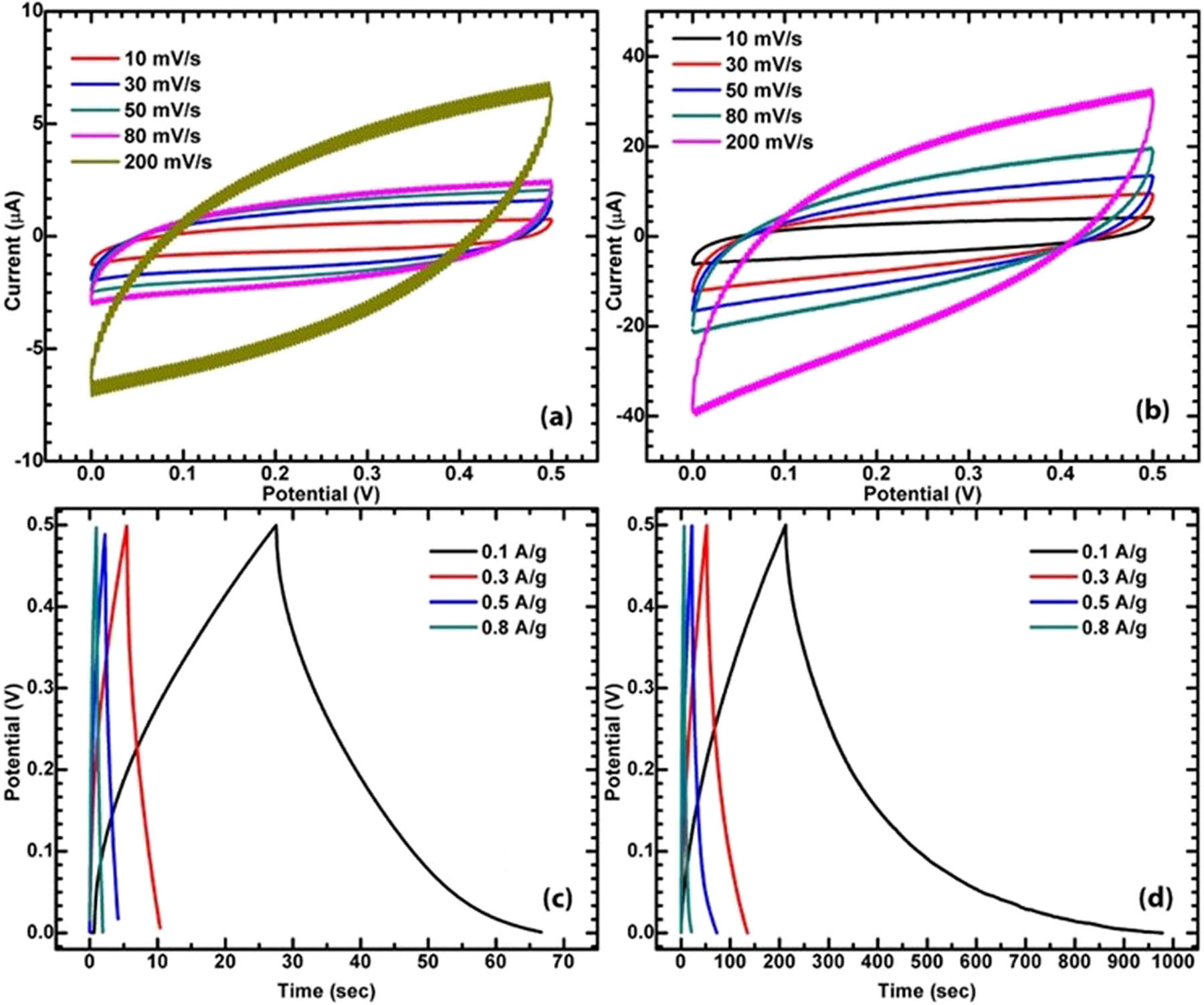
Cyclic voltammograms of (a) HfSe2 and (b) CuHfSe2. Charge–discharge profiles of (c) HfSe2 and (d) CuHfSe2 electrodes.

Capacitance retention for the (a) CuHfSe2 and (b) HfSe2 electrodes. (c) Electrochemical impedance spectroscopy and (d) specific capacitance versus scan rate curve.
Comparison of the current work with previously published articles
| Materials | Synthesis method | Additives | Electrolyte | No. of cycles | Capacitance retention (%) | Ref. |
|---|---|---|---|---|---|---|
| HfSe2–CuHfSe2 | Chemical vapor transport | None | 1 M H2SO4 | 5,000 | 85 | Present work |
| MoS2 | Hydrothermal | Carbon black | 3 M KOH | 1,000 | 70 | [45] |
| Ti3C2 | Etching and mechanical mixing | Acetylene black | 6 M KOH | 6,000 | 88 | [46] |
| MnO2 | Hydrothermal | Acetylene black | 1 M Na2SO4 | 10,000 | 85 | [47] |
| Graphene/GO/GrO nanocomposite | Ultrasonic-assisted liquid-phase exfoliation | Carbon black | 1 M KOH | 5,000 | 94 | [24] |
| Mn-doped SmCoO3 | Hydrothermal | — | 2 M KOH | 5,000 | — | [48] |
| Cu/MnX(O,S,C)-rGO | Direct oxidation, sulfidation, and carbonization | Acetylene black | 3 M KOH | 1,000 | 92 | [25] |
| Activated carbon with carbon-based composites | Mechanical mixing | C60, Carbon black, activated carbon nanofiber, SWCNTs, graphene nanoplatelets | 1 M Li2SO4 | 10,000 | 75, 82, 85, 95 | [49] |
| ZrS2 quantum dot | CBD | Carbon black | 1 M KOH | — | — | [26] |
After charging–discharging stability measurements, the morphological stability of the CuHfSe2 electrode material was further confirmed by SEM, as shown in Figure S1. It is clear from the SEM image that there are no significant changes in the morphological structure of our grown material, which shows its stable behavior; however, due to the repeated charging and discharging cycles, a very small amount of nanosized lump formation can be seen on the material’s surface. This formation may be due to the agglomeration of sulfate ions or minor sulfonation on the material surface. Moreover, XRD diffraction was performed to examine any structural changes in the tested electrode material, as shown in Figure S2. It was revealed that most of the peaks in the CuHfSe2 spectra reappeared after electrochemical measurements with no significant changes, thus confirming the stability of the electrode material. The slight peak broadening is attributed to the ion agglomeration at the material surface, which is also evident from the SEM image. To further ascertain the characteristics of the electrode materials synthesized, electrochemical impedance spectroscopy (EIS) was conducted in the applied frequency range of 0.01–1 MHz, as shown in the Nyquist plot in Figure 5(c). It is well known that the higher curve in the lower frequency range of the EIS spectra (Warburg impedance) reflects better supercapacitive behavior [39,40,41]. In this regard, the CuHfSe2 electrode illustrated better conductivity due to the addition of Cu, as compared to the undoped HfSe2 electrode, which demonstrates a lower Warburg impedance. The effect of Cu doping was further investigated by analyzing the interface (R s) and charge transfer resistance (R ct) values using the measured EIS spectra. From the experimental EIS data and its simulation fitting, it was observed that the Cu-doped HfSe2 electrode showed better conductivity with interfacial and charge transfer resistance values of 0.72 and 3.97 Ω, compared to the undoped HfSe2 electrode, whose values were 0.87 and 5.6 Ω, respectively. EIS simulation and best curve fitting circuit models were also constructed, as shown in the EIS inset images. Figure 5(d) shows the capacitance versus scan rate trend, which was obtained from the measured cyclic voltammograms of the electrodes. The graphs of both electrode materials show a decrease in the capacitance trend with increasing scan rates. The observed trend is obvious because the increasing scan rate charges are swept at faster rates, which provides fewer chances for them to interact with the active electrode material, resulting in a decrease in the electrode capacitance [42].
The ideal supercapacitor device oscillates between a capacitor in the low-frequency region and a resistor in the high-frequency region [43]. Therefore, in order to examine the capacitive behavior of the prepared electrodes, Bode plots, showing phase angle–frequency trends, are shown in Figure 6(a). It can be observed that in the low-frequency region, the Cu-doped HfSe2 electrode shows a higher phase angle compared to HfSe2, with the calculated magnitudes of around 54° and 51°, respectively, at 0.1 Hz. To further understand the intrinsic behavior of our electrode materials, the range of frequencies versus capacitance is plotted in Figure 6(b). The capacitance was calculated by using the following equation [6]:
where f is the frequency and Z″ is the imaginary impedance. It is clear from the figure that the Cu-doped electrode showed a higher magnitude of capacitance for a wide range of frequencies, contrary to the undoped electrode. These observations are in accordance with the above-mentioned CV and charge–discharge results.

(a) Phase angle versus frequency and (b) capacitance versus frequency plots.
The Ragone plot showing energy and power densities comparison for HfSe2 and CuHfSe2 electrodes is shown in Figure 7. The energy and power density values were calculated from the charge–discharge curves at current densities of 0.1–1 A/g using the following equations [44]:
and
where C and V are the specific capacitances measured from the charge/discharge curves and potential window, respectively, and ∆t is the discharge time of one cycle. It was found that at a current density of 0.1 A/g, the CuHfSe2 electrode had a highest energy density value of 5.16 W h/kg with a power density of 25 W/kg; on the other hand, the HfSe2 electrode exhibits energy and power density values of 0.340 W h/kg and 30 W/kg, respectively. Both electrodes exhibit a maximum power density value of 250 W/kg on reaching the current density value of 1 A/g, while the energy densities were 0.782 and 0.034 W h/kg for CuHfSe2 and HfSe2 electrodes, respectively.

Power and energy densities comparison for the HfSe2 and CuHfSe2 electrodes.
Among semiconductor materials, those with higher conductivity can provide a greater number of charge carriers to participate in electrochemical reactions, making them more valuable as electrode materials for electrochemical supercapacitor applications. The enhanced performance of our CuHfSe2 electrode material is related to its more conductive nature due to the addition of Cu metal, resulting in a reduction in impedance according to electrochemical impedance spectra. To further confirm this point, the role and contribution of Cu orbitals to the material’s conduction and valence band electronic states were analyzed by calculating the band structure and PDOS, as shown in Figure 8. It can be seen in Figure 8(a) that HfSe2 has a clear energy gap, which is a typical hallmark for semiconductor materials. The introduction of Cu atoms likely introduces additional states within the band gap, leading to a narrowing of the gap. As a result, the density of states of the valence band shifts and its upper edge significantly crosses the Fermi level. Figure 8(b) clearly reveals that after Cu doping, the band gap narrows and the valence band crosses the Fermi level. This implies that Cu-doped HfSe2 behaves more like a semi-metal, where the Fermi level intersects the valence band, resulting in metallic conduction at the Fermi level, rather than semiconducting behavior, as typically observed in HfSe2. The addition of Cu also increases the charge carrier density, and it also introduces additional energy levels within the band gap, effectively reducing the energy required for electrons to move from the valence band to the conduction band. These energy levels can hybridize with the existing ones, leading to a reduction in the band gap and a shift in the Fermi level. The hybridization of p-orbitals according to PDOS distributions in the valence bands is found to be a key contributor close to the Fermi level. Therefore, due to the crossing of the valence band and strong hybridization of p-orbitals near the Fermi level, it transformed toward a semimetal. The process of charge transfer became very swift in CuHfSe2, which resulted in better electrochemical performance. Ultimately, the doping of Cu into HfSe₂ modifies its electronic structure. From these findings, it can be stated that the energy gap and charge carrier concentration close to the Fermi level play a vital role in determining the electronic conductivity of the grown material. Our density functional theory (DFT) calculation results agree with the experimental findings of electrochemical impedance spectroscopy and clearly verify that the enhanced energy storage response of the CuHfSe2 material was due to its more conductive nature.
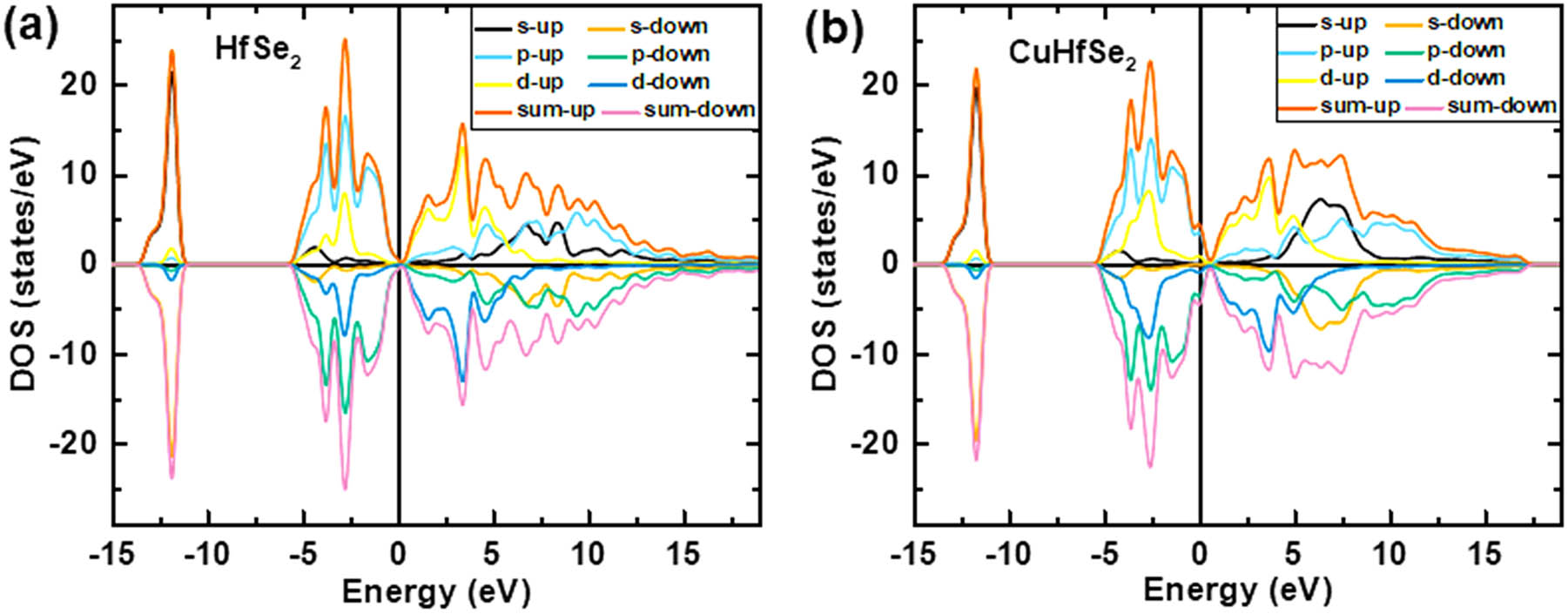
DFT-based PDOS calculations for the (a) HfSe2 and (b) CuHfSe2 materials.
4 Conclusion
In this work, we report for the first time CVT-synthesized crystalline hafnium diselenide (HfSe2) and its use for supercapacitor energy storage devices. Its potential was further explored by doping it with Cu metal (CuHfSe2), which resulted in its efficiency enhancement by threefold after doping. A specific capacitance value of 44.7 F/g was estimated for the HfSe2 electrode, and a significant increase of 151.83 F/g was observed at a scan rate of 10 mV/s after Cu doping. This enhanced capacitance value for the doped sample is due to increased layer spacing and conductivity due to Cu doping. Due to these factors, the CuHfSe2 electrode surpassed the HfSe2 electrode in terms of capacitance and stability features, as confirmed by the experimental EIS analysis and DFT calculations. It is worth mentioning that the obtained capacitance values and other electrochemical analyses presented in the study reflect the pure intrinsic features of the materials, as no carbon additives were used for the electrode preparation, contrary to a common practice. The obtained values can be further enhanced manifold after adding carbon additives. Moreover, the grown CuHfSe2 nanocrystals can be considered as a promising supercapacitor electrode material with good capacitance, stability, and energy density due to the unique microstructure of such 2D layered materials.
Acknowledgments
This work was funded by the Ongoing Research Funding program-Research Chairs (ORF-RC-2025-1502), King Saud University, Riyadh, Saudi Arabia.
-
Funding information: This work was funded by the Ongoing Research Funding program-Research Chairs (ORF-RC-2025-1502), King Saud University, Riyadh, Saudi Arabia.
-
Author contributions: All authors have accepted responsibility for the entire content of this manuscript and approved its submission.
-
Conflict of interest: The authors state no conflict of interest.
-
Data availability statement: The datasets generated and analyzed during the current study are available from the corresponding author on reasonable request.
References
[1] Winter M, Brodd RJ. What are batteries, fuel cells, and supercapacitors? Chem rev. 2004;104(10):4245–70.10.1021/cr020730kSearch in Google Scholar PubMed
[2] Wang S, Wei T, Qi Z. Supercapacitor energy storage technology and its application in renewable energy power generation system. Paper presented at: Proceedings of ISES World Congress 2007, vol. I–V, Solar Energy and Human Settlement, 2009.10.1007/978-3-540-75997-3_566Search in Google Scholar
[3] Yang P, Chao D, Zhu C, Xia X, Zhang Y, Wang X, et al. Ultrafast‐charging supercapacitors based on corn‐like titanium nitride nanostructures. Adv sci. 2016;3(6):1500299.10.1002/advs.201500299Search in Google Scholar PubMed PubMed Central
[4] Huang Y, Li Y, Hu Z, Wei G, Guo J, Liu J. A carbon modified MnO2 nanosheet array as a stable high-capacitance supercapacitor electrode. J Mater Chem A. 2013;1(34):9809–13.10.1039/c3ta12148hSearch in Google Scholar
[5] He L, Liu Y, Li C, Yang D, Wang W, Yan W, et al. A low-cost Zn-based aqueous supercapacitor with high energy density. ACS Appl Energ Mater. 2019;2(8):5835–42.10.1021/acsaem.9b00981Search in Google Scholar
[6] Habib M, Khalil A, Muhammad Z, Khan R, Wang C, Rehman Z, et al. WX2 (X = S, Se) single crystals: a highly stable material for supercapacitor applications. Electrochim Acta. 2017;258:71–9.10.1016/j.electacta.2017.10.083Search in Google Scholar
[7] Li N, Zhu X, Zhang C, Lai L, Jiang R, Zhu J. Controllable synthesis of different microstructured MnO2 by a facile hydrothermal method for supercapacitors. J Alloy Compd. 2017;692:26–33.10.1016/j.jallcom.2016.08.321Search in Google Scholar
[8] Khan R, Habib M, Gondal MA, Khalil A, Rehman ZU, Muhammad Z, et al. Facile synthesis of CuFe2O4–Fe2O3 composite for high-performance supercapacitor electrode applications. Mater Res Express. 2017;4(10):105501.10.1088/2053-1591/aa8dc4Search in Google Scholar
[9] Wang C, Liu D, Chen S, Sang Y, Haleem YA, Wu C, et al. All‐carbon ultrafast supercapacitor by integrating multidimensional nanocarbons. Small. 2016;12(41):5684–91.10.1002/smll.201601738Search in Google Scholar PubMed
[10] Irfan S, Haleem YA, Usman M, Ahmad N, Arshad M, Irshad MI, et al. Validating superior electrochemical outcome for supercapacitor application through first-principles calculations. New J Chem. 2024;48(11):4982–94.10.1039/D3NJ05075KSearch in Google Scholar
[11] Al-Enizi AM, Ubaidullah M, Ahmed J, Ahamad T, Ahmad T, Shaikh SF, et al. Synthesis of NiOx@NPC composite for high-performance supercapacitor via waste PET plastic-derived Ni-MOF. Compos Part B: Eng. 2020;183:107655.10.1016/j.compositesb.2019.107655Search in Google Scholar
[12] Al-Enizi AM, Ahmed J, Ubaidullah M, Shaikh SF, Ahamad T, Naushad M, et al. Utilization of waste polyethylene terephthalate bottles to develop metal-organic frameworks for energy applications: A clean and feasible approach. J Clean Prod. 2020;248:119251.10.1016/j.jclepro.2019.119251Search in Google Scholar
[13] Ubaidullah M, Ahmed J, Ahamad T, Shaikh SF, Alshehri SM, Al-Enizi AM. Hydrothermal synthesis of novel nickel oxide@ nitrogenous mesoporous carbon nanocomposite using costless smoked cigarette filter for high performance supercapacitor. Mater Lett. 2020;266:127492.10.1016/j.matlet.2020.127492Search in Google Scholar
[14] Habib M, Ullah S, Khan F, Rafiq MI, Salem Balobaid A, Alshahrani T, et al. Supercapacitor electrodes based on single crystal layered ZrX2 (X = S, Se) using chemical vapor transport method. Mater Sci Eng: B. 2023;298:116904.10.1016/j.mseb.2023.116904Search in Google Scholar
[15] Lin L, Lei W, Zhang S, Liu Y, Wallace GG, Chen J. Two-dimensional transition metal dichalcogenides in supercapacitors and secondary batteries. Energy Storage Mater. 2019;19:408–23.10.1016/j.ensm.2019.02.023Search in Google Scholar
[16] Habib M, Muhammad Z, Haleem YA, Farooq S, Nawaz R, Khalil A, et al. Bridging the gap: an in-depth comparison of CVT-grown layered transition metal dichalcogenides for supercapacitor applications. Mater Adv. 2024;5(3):1088–98.10.1039/D3MA00672GSearch in Google Scholar
[17] Khalil A, Liu Q, He Q, Xiang T, Liu D, Wang C, et al. Metallic 1T-WS2 nanoribbons as highly conductive electrodes for supercapacitors. RSC Adv. 2016;6(54):48788–91.10.1039/C6RA08975ESearch in Google Scholar
[18] Zhang C, Ning J, Wang B, Guo H, Feng X, Shen X, et al. Hybridized 1T/2H-MoS2/graphene fishnet tube for high-performance on-chip integrated micro-systems comprising supercapacitors and gas sensors. Nano Res. 2021;14:114–21.10.1007/s12274-020-3052-xSearch in Google Scholar
[19] Saraf M, Natarajan K, Mobin SM. Emerging robust heterostructure of MoS2–rGO for high-performance supercapacitors. ACS Appl Mater Inter. 2018;10(19):16588–95.10.1021/acsami.8b04540Search in Google Scholar PubMed
[20] Ahila M, Subramanian E. Influence of annealing on phase transformation and specific capacitance enhancement in Bi2O3. J Electroanal Chem. 2017;805:146–58.10.1016/j.jelechem.2017.10.037Search in Google Scholar
[21] Mohan M, Shetti NP, Aminabhavi TM. Phase dependent performance of MoS2 for supercapacitor applications. J Energy Storage. 2023;58:106321.10.1016/j.est.2022.106321Search in Google Scholar
[22] Roberts AJ, Slade RC. Effect of specific surface area on capacitance in asymmetric carbon/α-MnO2 supercapacitors. Electrochim Acta. 2010;55(25):7460–9.10.1016/j.electacta.2010.01.004Search in Google Scholar
[23] Sajedi‐Moghaddam A, Mayorga‐Martinez CC, Vaghasiya JV, Alduhaish O, Sofer Z, Pumera M. Structural manipulation of layered TiS2 to TiS3 nanobelts through niobium doping for high‐performance supercapacitors. Chem Electro Chem. 2020;7(24):4985–9.10.1002/celc.202000929Search in Google Scholar
[24] Zainab S, Fraz S, Awan SU, Hussain D, Rizwan S, Mehmood W. Optimized time dependent exfoliation of graphite for fabrication of Graphene/GO/GrO nanocomposite based pseudo-supercapacitor. Sci Rep-UK. 2023;13(1):14218.10.1038/s41598-023-41309-9Search in Google Scholar PubMed PubMed Central
[25] Tan S, Yao Z, Huang H, Liu Z, Guo S, Zhao X. High-performance supercapacitor electrode materials: Cu/MnXx (X = O, S, C)-rGO nanocomposites derived from CuMn-BTC metal–organic framework. J Electron Mater. 2025;53(3):1925–36.10.1007/s11664-024-11716-3Search in Google Scholar
[26] Gokulsaswath V, Suganya G, Monika S, Kalpana G. Investigation of zirconium disulphide quantum dots for supercapacitor applications. Cryst Res Technol. 2024;59(5):2300111.10.1002/crat.202300111Search in Google Scholar
[27] Skrodzki D, Molinaro M, Brown R, Moitra P, Pan D. Synthesis and bioapplication of emerging nanomaterials of Hafnium. ACS Nano. 2024;18(2):1289–324.10.1021/acsnano.3c08917Search in Google Scholar PubMed
[28] Kang M, Rathi S, Lee I, Li L, Khan MA, Lim D, et al. Tunable electrical properties of multilayer HfSe2 field effect transistors by oxygen plasma treatment. Nanoscale. 2017;9(4):1645–52.10.1039/C6NR08467BSearch in Google Scholar
[29] Habib M, Muhammad Z, Khan R, Wu C, Ur Rehman Z, Zhou Y, et al. Ferromagnetism in CVT grown tungsten diselenide single crystals with nickel doping. Nanotechnol. 2018;29(11):115701.10.1088/1361-6528/aaa63eSearch in Google Scholar PubMed
[30] Xiang Z, Zhang Z, Xu X, Zhang Q, Wang Q, Yuan C. Room-temperature ferromagnetism in Co doped MoS2 sheets. Phys Chem Chem Phys. 2015;17(24):15822–8.10.1039/C5CP01509JSearch in Google Scholar
[31] Shannon RD. Revised effective ionic radii and systematic studies of interatomic distances in halides and chalcogenides. Acta Crystall A-Crys. 1976;32(5):751–67.10.1107/S0567739476001551Search in Google Scholar
[32] Yue R, Barton AT, Zhu H, Azcatl A, Pena LF, Wang J, et al. HfSe2 thin films: 2D transition metal dichalcogenides grown by molecular beam epitaxy. ACS Nano. 2015;9(1):474–80.10.1021/nn5056496Search in Google Scholar PubMed
[33] Mirabelli G, McGeough C, Schmidt M, McCarthy EK, Monaghan S, Povey IM, et al. Air sensitivity of MoS2, MoSe2, MoTe2, HfS2, and HfSe2. J Appl Phys. 2016;120(12):125102.10.1063/1.4963290Search in Google Scholar
[34] Li H, Li H, Wu Z, Zhu L, Huang Y, Zhu X, et al. Phase engineering of Mo1-xWxS2 nanosheets for flexible supercapacitors. Scripta Mater. 2022;208:114346.10.1016/j.scriptamat.2021.114346Search in Google Scholar
[35] Cao L, Yang S, Gao W, Liu Z, Gong Y, Ma L, et al. Direct laser‐patterned micro‐supercapacitors from paintable MoS2 films. Small. 2013;9(17):2905–10.10.1002/smll.201203164Search in Google Scholar PubMed
[36] Griffith AA. The theory of rupture. Paper presented at: International Congress for Applied Mechanics, 1924.Search in Google Scholar
[37] Li J, Medhekar NV, Shenoy VB. Bonding charge density and ultimate strength of monolayer transition metal dichalcogenides. J Phys Chem C. 2013;117(30):15842–8.10.1021/jp403986vSearch in Google Scholar
[38] Sun H, Agrawal P, Singh CV. A first-principles study of the relationship between modulus and ideal strength of single-layer, transition metal dichalcogenides. Mater Adv. 2021;2(20):6631–40.10.1039/D1MA00239BSearch in Google Scholar
[39] Taberna P, Simon P, Fauvarque J-F. Electrochemical characteristics and impedance spectroscopy studies of carbon-carbon supercapacitors. J Electrochem Soc. 2003;150(3):A292.10.1149/1.1543948Search in Google Scholar
[40] Bhatt G, Singh G, Bhattacharya S. Basic principles of impedance spectroscopy. Impedance spectroscopy and its application in biological detection. Boca Raton, FL: CRC Press; 2023. p. 9–36.10.1201/9781003358091-3Search in Google Scholar
[41] Shaheen F, Ahmad R, Sharif S, Habib M, Sharif R, Fatima M, et al. Polyaniline effect on rGO@ NiPbTiO3 for enhanced supercapacitor performance. Mater Lett. 2021;284:129031.10.1016/j.matlet.2020.129031Search in Google Scholar
[42] Ghosh K, Srivastava SK. Enhanced supercapacitor performance and electromagnetic interference shielding effectiveness of CuS quantum dots grown on reduced graphene oxide sheets. ACS Omega. 2021;6(7):4582–96.10.1021/acsomega.0c05034Search in Google Scholar PubMed PubMed Central
[43] Kötz R, Carlen M. Principles and applications of electrochemical capacitors. Electrochim Acta. 2000;45(15–16):2483–98.10.1016/S0013-4686(00)00354-6Search in Google Scholar
[44] Huang K-J, Wang L, Liu Y-J, Liu YM, Wang HB, Gan T, et al. Layered MoS2–graphene composites for supercapacitor applications with enhanced capacitive performance. Int J Hydrogen Energy. 2013;38(32):14027–34.10.1016/j.ijhydene.2013.08.112Search in Google Scholar
[45] Gupta H, Chakrabarti S, Mothkuri S, Padya B, Rao T, Jain P. High performance supercapacitor based on 2D-MoS2 nanostructures. Mater Today-Proc. 2020;26:20–4.10.1016/j.matpr.2019.04.198Search in Google Scholar
[46] Cao M, Wang F, Wang L, Wu W, Lv W, Zhu J. Room temperature oxidation of Ti3C2 MXene for supercapacitor electrodes. J Electrochem Soc. 2017;164(14):A3933–42.10.1149/2.1541714jesSearch in Google Scholar
[47] Wu X, Yang F, Dong H, Sui J, Zhang Q, Yu J, et al. Controllable synthesis of MnO2 with different structures for supercapacitor electrodes. J Electroanal Chem. 2019;848:113332.10.1016/j.jelechem.2019.113332Search in Google Scholar
[48] Shehzad MF, Abdelbacki AM, Fatima J, Kumar A, Ali M, Kaur J. Development of Mn-doped SmCoO2 electrode material for supercapacitor application. Mater Sci Eng: B. 2025;311:117795.10.1016/j.mseb.2024.117795Search in Google Scholar
[49] Ayaganov Z, Pavlenko V, Haque SFB, Tanybayeva A, Ferraris J, Zakhidov A, et al. A comprehensive study on effect of carbon nanomaterials as conductive additives in EDLCs. J Energy Storage. 2024;78:110035.10.1016/j.est.2023.110035Search in Google Scholar
© 2025 the author(s), published by De Gruyter
This work is licensed under the Creative Commons Attribution 4.0 International License.
Articles in the same Issue
- Research Articles
- MHD radiative mixed convective flow of a sodium alginate-based hybrid nanofluid over a convectively heated extending sheet with Joule heating
- Experimental study of mortar incorporating nano-magnetite on engineering performance and radiation shielding
- Multicriteria-based optimization and multi-variable non-linear regression analysis of concrete containing blends of nano date palm ash and eggshell powder as cementitious materials
- A promising Ag2S/poly-2-amino-1-mercaptobenzene open-top spherical core–shell nanocomposite for optoelectronic devices: A one-pot technique
- Biogenic synthesized selenium nanoparticles combined chitosan nanoparticles controlled lung cancer growth via ROS generation and mitochondrial damage pathway
- Fabrication of PDMS nano-mold by deposition casting method
- Stimulus-responsive gradient hydrogel micro-actuators fabricated by two-photon polymerization-based 4D printing
- Physical aspects of radiative Carreau nanofluid flow with motile microorganisms movement under yield stress via oblique penetrable wedge
- Effect of polar functional groups on the hydrophobicity of carbon nanotubes-bacterial cellulose nanocomposite
- Review in green synthesis mechanisms, application, and future prospects for Garcinia mangostana L. (mangosteen)-derived nanoparticles
- Entropy generation and heat transfer in nonlinear Buoyancy–driven Darcy–Forchheimer hybrid nanofluids with activation energy
- Green synthesis of silver nanoparticles using Ginkgo biloba seed extract: Evaluation of antioxidant, anticancer, antifungal, and antibacterial activities
- A numerical analysis of heat and mass transfer in water-based hybrid nanofluid flow containing copper and alumina nanoparticles over an extending sheet
- Investigating the behaviour of electro-magneto-hydrodynamic Carreau nanofluid flow with slip effects over a stretching cylinder
- Electrospun thermoplastic polyurethane/nano-Ag-coated clear aligners for the inhibition of Streptococcus mutans and oral biofilm
- Investigation of the optoelectronic properties of a novel polypyrrole-multi-well carbon nanotubes/titanium oxide/aluminum oxide/p-silicon heterojunction
- Novel photothermal magnetic Janus membranes suitable for solar water desalination
- Green synthesis of silver nanoparticles using Ageratum conyzoides for activated carbon compositing to prepare antimicrobial cotton fabric
- Activation energy and Coriolis force impact on three-dimensional dusty nanofluid flow containing gyrotactic microorganisms: Machine learning and numerical approach
- Machine learning analysis of thermo-bioconvection in a micropolar hybrid nanofluid-filled square cavity with oxytactic microorganisms
- Research and improvement of mechanical properties of cement nanocomposites for well cementing
- Thermal and stability analysis of silver–water nanofluid flow over unsteady stretching sheet under the influence of heat generation/absorption at the boundary
- Cobalt iron oxide-infused silicone nanocomposites: Magnetoactive materials for remote actuation and sensing
- Magnesium-reinforced PMMA composite scaffolds: Synthesis, characterization, and 3D printing via stereolithography
- Bayesian inference-based physics-informed neural network for performance study of hybrid nanofluids
- Numerical simulation of non-Newtonian hybrid nanofluid flow subject to a heterogeneous/homogeneous chemical reaction over a Riga surface
- Enhancing the superhydrophobicity, UV-resistance, and antifungal properties of natural wood surfaces via in situ formation of ZnO, TiO2, and SiO2 particles
- Synthesis and electrochemical characterization of iron oxide/poly(2-methylaniline) nanohybrids for supercapacitor application
- Impacts of double stratification on thermally radiative third-grade nanofluid flow on elongating cylinder with homogeneous/heterogeneous reactions by implementing machine learning approach
- Synthesis of Cu4O3 nanoparticles using pumpkin seed extract: Optimization, antimicrobial, and cytotoxicity studies
- Cationic charge influence on the magnetic response of the Fe3O4–[Me2+ 1−y Me3+ y (OH2)] y+(Co3 2−) y/2·mH2O hydrotalcite system
- Pressure sensing intelligent martial arts short soldier combat protection system based on conjugated polymer nanocomposite materials
- Magnetohydrodynamics heat transfer rate under inclined buoyancy force for nano and dusty fluids: Response surface optimization for the thermal transport
- Fly ash and nano-graphene enhanced stabilization of engine oil-contaminated soils
- Enhancing natural fiber-reinforced biopolymer composites with graphene nanoplatelets: Mechanical, morphological, and thermal properties
- Performance evaluation of dual-scale strengthened co-bonded single-lap joints using carbon nanotubes and Z-pins with ANN
- Computational works of blood flow with dust particles and partially ionized containing tiny particles on a moving wedge: Applications of nanotechnology
- Hybridization of biocomposites with oil palm cellulose nanofibrils/graphene nanoplatelets reinforcement in green epoxy: A study of physical, thermal, mechanical, and morphological properties
- Design and preparation of micro-nano dual-scale particle-reinforced Cu–Al–V alloy: Research on the aluminothermic reduction process
- Spectral quasi-linearization and response optimization on magnetohydrodynamic flow via stenosed artery with hybrid and ternary solid nanoparticles: Support vector machine learning
- Ferrite/curcumin hybrid nanocomposite formulation: Physicochemical characterization, anticancer activity, and apoptotic and cell cycle analyses in skin cancer cells
- Enhanced therapeutic efficacy of Tamoxifen against breast cancer using extra virgin olive oil-based nanoemulsion delivery system
- A titanium oxide- and silver-based hybrid nanofluid flow between two Riga walls that converge and diverge through a machine-learning approach
- Enhancing convective heat transfer mechanisms through the rheological analysis of Casson nanofluid flow towards a stagnation point over an electro-magnetized surface
- Intrinsic self-sensing cementitious composites with hybrid nanofillers exhibiting excellent piezoresistivity
- Research on mechanical properties and sulfate erosion resistance of nano-reinforced coal gangue based geopolymer concrete
- Impact of surface and configurational features of chemically synthesized chains of Ni nanostars on the magnetization reversal process
- Porous sponge-like AsOI/poly(2-aminobenzene-1-thiol) nanocomposite photocathode for hydrogen production from artificial and natural seawater
- Multifaceted insights into WO3 nanoparticle-coupled antibiotics to modulate resistance in enteric pathogens of Houbara bustard birds
- Synthesis of sericin-coated silver nanoparticles and their applications for the anti-bacterial finishing of cotton fabric
- Enhancing chloride resistance of freeze–thaw affected concrete through innovative nanomaterial–polymer hybrid cementitious coating
- Development and performance evaluation of green aluminium metal matrix composites reinforced with graphene nanopowder and marble dust
- Morphological, physical, thermal, and mechanical properties of carbon nanotubes reinforced arrowroot starch composites
- Influence of the graphene oxide nanosheet on tensile behavior and failure characteristics of the cement composites after high-temperature treatment
- Central composite design modeling in optimizing heat transfer rate in the dissipative and reactive dynamics of viscoplastic nanomaterials deploying Joule and heat generation aspects
- Double diffusion of nano-enhanced phase change materials in connected porous channels: A hybrid ISPH-XGBoost approach
- Synergistic impacts of Thompson–Troian slip, Stefan blowing, and nonuniform heat generation on Casson nanofluid dynamics through a porous medium
- Optimization of abrasive water jet machining parameters for basalt fiber/SiO2 nanofiller reinforced composites
- Enhancing aesthetic durability of Zisha teapots via TiO2 nanoparticle surface modification: A study on self-cleaning, antimicrobial, and mechanical properties
- Nanocellulose solution based on iron(iii) sodium tartrate complexes
- Combating multidrug-resistant infections: Gold nanoparticles–chitosan–papain-integrated dual-action nanoplatform for enhanced antibacterial activity
- Novel royal jelly-mediated green synthesis of selenium nanoparticles and their multifunctional biological activities
- Direct bandgap transition for emission in GeSn nanowires
- Synthesis of ZnO nanoparticles with different morphologies using a microwave-based method and their antimicrobial activity
- Numerical investigation of convective heat and mass transfer in a trapezoidal cavity filled with ternary hybrid nanofluid and a central obstacle
- Halloysite nanotube enhanced polyurethane nanocomposites for advanced electroinsulating applications
- Low molar mass ionic liquid’s modified carbon nanotubes and its role in PVDF crystalline stress generation
- Green synthesis of polydopamine-functionalized silver nanoparticles conjugated with Ceftazidime: in silico and experimental approach for combating antibiotic-resistant bacteria and reducing toxicity
- Evaluating the influence of graphene nano powder inclusion on mechanical, vibrational and water absorption behaviour of ramie/abaca hybrid composites
- Dynamic-behavior of Casson-type hybrid nanofluids due to a stretching sheet under the coupled impacts of boundary slip and reaction-diffusion processes
- Influence of polyvinyl alcohol on the physicochemical and self-sensing properties of nano carbon black reinforced cement mortar
- Advanced machine learning approaches for predicting compressive and flexural strength of carbon nanotube–reinforced cement composites: a comparative study and model interpretability analysis
- Review Articles
- A comprehensive review on hybrid plasmonic waveguides: Structures, applications, challenges, and future perspectives
- Nanoparticles in low-temperature preservation of biological systems of animal origin
- Fluorescent sulfur quantum dots for environmental monitoring
- Nanoscience systematic review methodology standardization
- Nanotechnology revolutionizing osteosarcoma treatment: Advances in targeted kinase inhibitors
- AFM: An important enabling technology for 2D materials and devices
- Carbon and 2D nanomaterial smart hydrogels for therapeutic applications
- Principles, applications and future prospects in photodegradation systems
- Do gold nanoparticles consistently benefit crop plants under both non-stressed and abiotic stress conditions?
- An updated overview of nanoparticle-induced cardiovascular toxicity
- Arginine as a promising amino acid for functionalized nanosystems: Innovations, challenges, and future directions
- Advancements in the use of cancer nanovaccines: Comprehensive insights with focus on lung and colon cancer
- Membrane-based biomimetic delivery systems for glioblastoma multiforme therapy
- The drug delivery systems based on nanoparticles for spinal cord injury repair
- Green synthesis, biomedical effects, and future trends of Ag/ZnO bimetallic nanoparticles: An update
- Application of magnesium and its compounds in biomaterials for nerve injury repair
- Micro/nanomotors in biomedicine: Construction and applications
- Hydrothermal synthesis of biomass-derived CQDs: Advances and applications
- Research progress in 3D bioprinting of skin: Challenges and opportunities
- Review on bio-selenium nanoparticles: Synthesis, protocols, and applications in biomedical processes
- Gold nanocrystals and nanorods functionalized with protein and polymeric ligands for environmental, energy storage, and diagnostic applications: A review
- An in-depth analysis of rotational and non-rotational piezoelectric energy harvesting beams: A comprehensive review
- Advancements in perovskite/CIGS tandem solar cells: Material synergies, device configurations, and economic viability for sustainable energy
- Deep learning in-depth analysis of crystal graph convolutional neural networks: A new era in materials discovery and its applications
- Review of recent nano TiO2 film coating methods, assessment techniques, and key problems for scaleup
- Antioxidant quantum dots for spinal cord injuries: A review on advancing neuroprotection and regeneration in neurological disorders
- Rise of polycatecholamine ultrathin films: From synthesis to smart applications
- Advancing microencapsulation strategies for bioactive compounds: Enhancing stability, bioavailability, and controlled release in food applications
- Advances in the design and manipulation of self-assembling peptide and protein nanostructures for biomedical applications
- Photocatalytic pervious concrete systems: from classic photocatalysis to luminescent photocatalysis
- Corrigendum
- Corrigendum to “Synthesis and characterization of smart stimuli-responsive herbal drug-encapsulated nanoniosome particles for efficient treatment of breast cancer”
- Special Issue on Advanced Nanomaterials for Carbon Capture, Environment and Utilization for Energy Sustainability - Part III
- Efficiency optimization of quantum dot photovoltaic cell by solar thermophotovoltaic system
- Exploring the diverse nanomaterials employed in dental prosthesis and implant techniques: An overview
- Electrochemical investigation of bismuth-doped anode materials for low‑temperature solid oxide fuel cells with boosted voltage using a DC-DC voltage converter
- Synthesis of HfSe2 and CuHfSe2 crystalline materials using the chemical vapor transport method and their applications in supercapacitor energy storage devices
- Special Issue on Green Nanotechnology and Nano-materials for Environment Sustainability
- Influence of nano-silica and nano-ferrite particles on mechanical and durability of sustainable concrete: A review
- Surfaces and interfaces analysis on different carboxymethylation reaction time of anionic cellulose nanoparticles derived from oil palm biomass
- Processing and effective utilization of lignocellulosic biomass: Nanocellulose, nanolignin, and nanoxylan for wastewater treatment
- Retraction
- Retraction of “Aging assessment of silicone rubber materials under corona discharge accompanied by humidity and UV radiation”
Articles in the same Issue
- Research Articles
- MHD radiative mixed convective flow of a sodium alginate-based hybrid nanofluid over a convectively heated extending sheet with Joule heating
- Experimental study of mortar incorporating nano-magnetite on engineering performance and radiation shielding
- Multicriteria-based optimization and multi-variable non-linear regression analysis of concrete containing blends of nano date palm ash and eggshell powder as cementitious materials
- A promising Ag2S/poly-2-amino-1-mercaptobenzene open-top spherical core–shell nanocomposite for optoelectronic devices: A one-pot technique
- Biogenic synthesized selenium nanoparticles combined chitosan nanoparticles controlled lung cancer growth via ROS generation and mitochondrial damage pathway
- Fabrication of PDMS nano-mold by deposition casting method
- Stimulus-responsive gradient hydrogel micro-actuators fabricated by two-photon polymerization-based 4D printing
- Physical aspects of radiative Carreau nanofluid flow with motile microorganisms movement under yield stress via oblique penetrable wedge
- Effect of polar functional groups on the hydrophobicity of carbon nanotubes-bacterial cellulose nanocomposite
- Review in green synthesis mechanisms, application, and future prospects for Garcinia mangostana L. (mangosteen)-derived nanoparticles
- Entropy generation and heat transfer in nonlinear Buoyancy–driven Darcy–Forchheimer hybrid nanofluids with activation energy
- Green synthesis of silver nanoparticles using Ginkgo biloba seed extract: Evaluation of antioxidant, anticancer, antifungal, and antibacterial activities
- A numerical analysis of heat and mass transfer in water-based hybrid nanofluid flow containing copper and alumina nanoparticles over an extending sheet
- Investigating the behaviour of electro-magneto-hydrodynamic Carreau nanofluid flow with slip effects over a stretching cylinder
- Electrospun thermoplastic polyurethane/nano-Ag-coated clear aligners for the inhibition of Streptococcus mutans and oral biofilm
- Investigation of the optoelectronic properties of a novel polypyrrole-multi-well carbon nanotubes/titanium oxide/aluminum oxide/p-silicon heterojunction
- Novel photothermal magnetic Janus membranes suitable for solar water desalination
- Green synthesis of silver nanoparticles using Ageratum conyzoides for activated carbon compositing to prepare antimicrobial cotton fabric
- Activation energy and Coriolis force impact on three-dimensional dusty nanofluid flow containing gyrotactic microorganisms: Machine learning and numerical approach
- Machine learning analysis of thermo-bioconvection in a micropolar hybrid nanofluid-filled square cavity with oxytactic microorganisms
- Research and improvement of mechanical properties of cement nanocomposites for well cementing
- Thermal and stability analysis of silver–water nanofluid flow over unsteady stretching sheet under the influence of heat generation/absorption at the boundary
- Cobalt iron oxide-infused silicone nanocomposites: Magnetoactive materials for remote actuation and sensing
- Magnesium-reinforced PMMA composite scaffolds: Synthesis, characterization, and 3D printing via stereolithography
- Bayesian inference-based physics-informed neural network for performance study of hybrid nanofluids
- Numerical simulation of non-Newtonian hybrid nanofluid flow subject to a heterogeneous/homogeneous chemical reaction over a Riga surface
- Enhancing the superhydrophobicity, UV-resistance, and antifungal properties of natural wood surfaces via in situ formation of ZnO, TiO2, and SiO2 particles
- Synthesis and electrochemical characterization of iron oxide/poly(2-methylaniline) nanohybrids for supercapacitor application
- Impacts of double stratification on thermally radiative third-grade nanofluid flow on elongating cylinder with homogeneous/heterogeneous reactions by implementing machine learning approach
- Synthesis of Cu4O3 nanoparticles using pumpkin seed extract: Optimization, antimicrobial, and cytotoxicity studies
- Cationic charge influence on the magnetic response of the Fe3O4–[Me2+ 1−y Me3+ y (OH2)] y+(Co3 2−) y/2·mH2O hydrotalcite system
- Pressure sensing intelligent martial arts short soldier combat protection system based on conjugated polymer nanocomposite materials
- Magnetohydrodynamics heat transfer rate under inclined buoyancy force for nano and dusty fluids: Response surface optimization for the thermal transport
- Fly ash and nano-graphene enhanced stabilization of engine oil-contaminated soils
- Enhancing natural fiber-reinforced biopolymer composites with graphene nanoplatelets: Mechanical, morphological, and thermal properties
- Performance evaluation of dual-scale strengthened co-bonded single-lap joints using carbon nanotubes and Z-pins with ANN
- Computational works of blood flow with dust particles and partially ionized containing tiny particles on a moving wedge: Applications of nanotechnology
- Hybridization of biocomposites with oil palm cellulose nanofibrils/graphene nanoplatelets reinforcement in green epoxy: A study of physical, thermal, mechanical, and morphological properties
- Design and preparation of micro-nano dual-scale particle-reinforced Cu–Al–V alloy: Research on the aluminothermic reduction process
- Spectral quasi-linearization and response optimization on magnetohydrodynamic flow via stenosed artery with hybrid and ternary solid nanoparticles: Support vector machine learning
- Ferrite/curcumin hybrid nanocomposite formulation: Physicochemical characterization, anticancer activity, and apoptotic and cell cycle analyses in skin cancer cells
- Enhanced therapeutic efficacy of Tamoxifen against breast cancer using extra virgin olive oil-based nanoemulsion delivery system
- A titanium oxide- and silver-based hybrid nanofluid flow between two Riga walls that converge and diverge through a machine-learning approach
- Enhancing convective heat transfer mechanisms through the rheological analysis of Casson nanofluid flow towards a stagnation point over an electro-magnetized surface
- Intrinsic self-sensing cementitious composites with hybrid nanofillers exhibiting excellent piezoresistivity
- Research on mechanical properties and sulfate erosion resistance of nano-reinforced coal gangue based geopolymer concrete
- Impact of surface and configurational features of chemically synthesized chains of Ni nanostars on the magnetization reversal process
- Porous sponge-like AsOI/poly(2-aminobenzene-1-thiol) nanocomposite photocathode for hydrogen production from artificial and natural seawater
- Multifaceted insights into WO3 nanoparticle-coupled antibiotics to modulate resistance in enteric pathogens of Houbara bustard birds
- Synthesis of sericin-coated silver nanoparticles and their applications for the anti-bacterial finishing of cotton fabric
- Enhancing chloride resistance of freeze–thaw affected concrete through innovative nanomaterial–polymer hybrid cementitious coating
- Development and performance evaluation of green aluminium metal matrix composites reinforced with graphene nanopowder and marble dust
- Morphological, physical, thermal, and mechanical properties of carbon nanotubes reinforced arrowroot starch composites
- Influence of the graphene oxide nanosheet on tensile behavior and failure characteristics of the cement composites after high-temperature treatment
- Central composite design modeling in optimizing heat transfer rate in the dissipative and reactive dynamics of viscoplastic nanomaterials deploying Joule and heat generation aspects
- Double diffusion of nano-enhanced phase change materials in connected porous channels: A hybrid ISPH-XGBoost approach
- Synergistic impacts of Thompson–Troian slip, Stefan blowing, and nonuniform heat generation on Casson nanofluid dynamics through a porous medium
- Optimization of abrasive water jet machining parameters for basalt fiber/SiO2 nanofiller reinforced composites
- Enhancing aesthetic durability of Zisha teapots via TiO2 nanoparticle surface modification: A study on self-cleaning, antimicrobial, and mechanical properties
- Nanocellulose solution based on iron(iii) sodium tartrate complexes
- Combating multidrug-resistant infections: Gold nanoparticles–chitosan–papain-integrated dual-action nanoplatform for enhanced antibacterial activity
- Novel royal jelly-mediated green synthesis of selenium nanoparticles and their multifunctional biological activities
- Direct bandgap transition for emission in GeSn nanowires
- Synthesis of ZnO nanoparticles with different morphologies using a microwave-based method and their antimicrobial activity
- Numerical investigation of convective heat and mass transfer in a trapezoidal cavity filled with ternary hybrid nanofluid and a central obstacle
- Halloysite nanotube enhanced polyurethane nanocomposites for advanced electroinsulating applications
- Low molar mass ionic liquid’s modified carbon nanotubes and its role in PVDF crystalline stress generation
- Green synthesis of polydopamine-functionalized silver nanoparticles conjugated with Ceftazidime: in silico and experimental approach for combating antibiotic-resistant bacteria and reducing toxicity
- Evaluating the influence of graphene nano powder inclusion on mechanical, vibrational and water absorption behaviour of ramie/abaca hybrid composites
- Dynamic-behavior of Casson-type hybrid nanofluids due to a stretching sheet under the coupled impacts of boundary slip and reaction-diffusion processes
- Influence of polyvinyl alcohol on the physicochemical and self-sensing properties of nano carbon black reinforced cement mortar
- Advanced machine learning approaches for predicting compressive and flexural strength of carbon nanotube–reinforced cement composites: a comparative study and model interpretability analysis
- Review Articles
- A comprehensive review on hybrid plasmonic waveguides: Structures, applications, challenges, and future perspectives
- Nanoparticles in low-temperature preservation of biological systems of animal origin
- Fluorescent sulfur quantum dots for environmental monitoring
- Nanoscience systematic review methodology standardization
- Nanotechnology revolutionizing osteosarcoma treatment: Advances in targeted kinase inhibitors
- AFM: An important enabling technology for 2D materials and devices
- Carbon and 2D nanomaterial smart hydrogels for therapeutic applications
- Principles, applications and future prospects in photodegradation systems
- Do gold nanoparticles consistently benefit crop plants under both non-stressed and abiotic stress conditions?
- An updated overview of nanoparticle-induced cardiovascular toxicity
- Arginine as a promising amino acid for functionalized nanosystems: Innovations, challenges, and future directions
- Advancements in the use of cancer nanovaccines: Comprehensive insights with focus on lung and colon cancer
- Membrane-based biomimetic delivery systems for glioblastoma multiforme therapy
- The drug delivery systems based on nanoparticles for spinal cord injury repair
- Green synthesis, biomedical effects, and future trends of Ag/ZnO bimetallic nanoparticles: An update
- Application of magnesium and its compounds in biomaterials for nerve injury repair
- Micro/nanomotors in biomedicine: Construction and applications
- Hydrothermal synthesis of biomass-derived CQDs: Advances and applications
- Research progress in 3D bioprinting of skin: Challenges and opportunities
- Review on bio-selenium nanoparticles: Synthesis, protocols, and applications in biomedical processes
- Gold nanocrystals and nanorods functionalized with protein and polymeric ligands for environmental, energy storage, and diagnostic applications: A review
- An in-depth analysis of rotational and non-rotational piezoelectric energy harvesting beams: A comprehensive review
- Advancements in perovskite/CIGS tandem solar cells: Material synergies, device configurations, and economic viability for sustainable energy
- Deep learning in-depth analysis of crystal graph convolutional neural networks: A new era in materials discovery and its applications
- Review of recent nano TiO2 film coating methods, assessment techniques, and key problems for scaleup
- Antioxidant quantum dots for spinal cord injuries: A review on advancing neuroprotection and regeneration in neurological disorders
- Rise of polycatecholamine ultrathin films: From synthesis to smart applications
- Advancing microencapsulation strategies for bioactive compounds: Enhancing stability, bioavailability, and controlled release in food applications
- Advances in the design and manipulation of self-assembling peptide and protein nanostructures for biomedical applications
- Photocatalytic pervious concrete systems: from classic photocatalysis to luminescent photocatalysis
- Corrigendum
- Corrigendum to “Synthesis and characterization of smart stimuli-responsive herbal drug-encapsulated nanoniosome particles for efficient treatment of breast cancer”
- Special Issue on Advanced Nanomaterials for Carbon Capture, Environment and Utilization for Energy Sustainability - Part III
- Efficiency optimization of quantum dot photovoltaic cell by solar thermophotovoltaic system
- Exploring the diverse nanomaterials employed in dental prosthesis and implant techniques: An overview
- Electrochemical investigation of bismuth-doped anode materials for low‑temperature solid oxide fuel cells with boosted voltage using a DC-DC voltage converter
- Synthesis of HfSe2 and CuHfSe2 crystalline materials using the chemical vapor transport method and their applications in supercapacitor energy storage devices
- Special Issue on Green Nanotechnology and Nano-materials for Environment Sustainability
- Influence of nano-silica and nano-ferrite particles on mechanical and durability of sustainable concrete: A review
- Surfaces and interfaces analysis on different carboxymethylation reaction time of anionic cellulose nanoparticles derived from oil palm biomass
- Processing and effective utilization of lignocellulosic biomass: Nanocellulose, nanolignin, and nanoxylan for wastewater treatment
- Retraction
- Retraction of “Aging assessment of silicone rubber materials under corona discharge accompanied by humidity and UV radiation”
