Investigating the behaviour of electro-magneto-hydrodynamic Carreau nanofluid flow with slip effects over a stretching cylinder
-
 ,
,
,
,

Abstract
This study primary focus to analyses the slip flow of electro-magneto-hydrodynamic (EMHD) Carreau nanofluid across a stretching cylinder in the context of Arrhenius activation energy, chemical reactions, and variable thermal conductivity within a porous medium. To observe the effects of Brownian motion and thermophoresis, which are critical in nanofluid dynamics, Buongiorno’s model is employed. Also, the effects of changing EMHD forces on fluid flow dynamics are investigated. Due to the strong Lorentz force that is produced when electric and magnetic fields interact, it is crucial to take into account their combined effects in a variety of industrial applications. By introducing nonsimilarity variables, the partial differential equations are transformed into a system of coupled ordinary differential equations (ODEs). The bvp4c solver, a MATLAB built-in solver, is implemented to compute the solution to the resultant set of ODEs. Graphs demonstrate how various parameters influence the profiles of velocity, microorganisms, concentration, and temperature. It is observed that thermophoresis significantly influences the thermal and concentration boundary layer regions. Skin friction increases as the curvature parameter value is enhanced. The local Nusselt number rises as the Prandtl number value increases. The local Sherwood number increases with the constant thermophoresis and the Schmidt number increases. As the curvature parameter, bioconvection Schmidt number rises and the value of local motile density increases.
Nomenclature
- b
-
chemotaxis constant (m)
- C
-
nanoparticles volume fraction (–)
-
-
ambient nanoparticle volume fraction (–)
-
-
specific heat (
-
-
Brownian diffusion coefficient (
-
-
microorganism diffusion coefficient (
-
-
rate of chemical reaction (
-
-
fitted rate constant (–)
-
-
magnetic parameter
-
-
power law index (–)
-
-
ambient nanoparticle volume fraction (–)
-
-
Nusselt number
- Pr
-
Prandtl number
-
-
radiative heat flux (
-
-
nondimensional temperature (K)
-
-
temperature at bottom disk (K)
-
-
ambient temperature (K)
-
-
swimming speed of micro-organism (
-
-
velocity components
-
-
kinematic viscosity (
-
-
density of fluid (
-
-
thermal conductivity of fluid (
-
-
fluid electrical conductivity (
-
-
thermal diffusivity (
-
-
dimensionless distance (–)
-
-
permeability of the porous medium (
1 Introduction
Recent research over the past few decades highlights the growing interest in the study of non-Newtonian fluids within the field of fluid dynamics. Non-Newtonian fluid flows find extensive applications in industrial and manufacturing processes [1], including the creation of insulating materials, extrusion, hot rolling, metal spinning, and metal extrusion. Moreover, integrating heat transfer with stretching flow concepts is crucial for enhancing the efficiency of these applications [2,3]. Shear rate and shear stress have a nonlinear connection in non-Newtonian fluids. From the modelling point of view, the Carreau model is fundamental since it illustrates power-law behaviour and is frequently employed as a core predictive method. The Carreau model is a four-parameter one first put forth by Carreau [4] in 1972 and was developed in a series of many different research works. Gomathi and De investigated the effect of ion slip on the dynamics of Casson-Williamson flow and reported that an increase in viscous forces, combined with yield stress, leads to a reduction in fluid velocity [5]. In the study by Raju and Sandeep [6], the researchers conducted a study on magnetohydrodynamic (MHD) Carreau fluid using cross-diffusion over a wedge. They observed that with an increase in wedge angle parameter, the velocity field of fluid also increases. Using different flow configuration, many other researchers focus on dynamics of various non-Newtonian fluid subject to different physical conditions [7–11]. Raju and Sandeep [12] conducted a comprehensive investigation of the effects of an uncertain heat source or sink and nonlinear thermal radiation in the presence of both homogeneous and heterogeneous phenomena. They extensively studied and analysed the implications of these factors on the heat transfer characteristics and behaviour of the system. The Buongiorno model was used by Khan et al. [13] to predict the behaviour of a time-dependent Carreau fluid along a wedge. They discovered that increasing the Weissenberg number raises temperature of the fluid.
A fluid and nanoparticles are combined to form a nanofluid. In nanofluids, nanoparticles are frequently formed of metals, oxides, carbides, and carbon nanotubes. Compared to their respective base fluids, nanofluids have very distinct thermophysical characteristics. Numerous industries [14], including cooling of transformer oil, cooling of electronics, residential refrigerators and freezers, solar water heating, and engine cooling, use nanofluids [15–17]. In an experiment conducted few years ago, Choi and Eastman [18] and Choi et al. [19] introduced nanoparticles to a base fluid and looked at the thermophysical properties of the nanofluids in comparison to the base fluids. He found that the efficiency of nanofluids is improved, especially in terms of their thermal conductivity, which is much higher than that of the base fluid. Numerous scholars have engaged in theoretical and experimental works in this area since this ground-breaking experiment [9,20,21]. Microbes residing in a fluid are responsible for the occurrence of bioconvection, a phenomenon that plays a role in stabilising nanoparticles and increasing the fluid’s susceptibility to thermal and mass transport. This aspect has been studied by Kuznetsov [22]. Fields such as biomedical engineering, biological technology, and environmental systems rely on the suspension of nanoparticles and bioconvection, as highlighted by Chan et al. [23].
Static charges provide an electric field, whereas the changing motion of electric charges produces a magnetic field. MHD is the study of magnetic properties and dynamics of electrically conducting fluids. In the disciplines of engineering, transportation, and medical sciences, MHD has a broad spectrum of applications. For instance, a strong electric field could be used to control or halt the development of a brain tumour. The research conducted by Sparrow and Cess [24] presented a mathematical model that elucidates the behaviour of free convective flow in the presence of a magnetic field. The study focused on examining the specific characteristics of MHD flow under forced and free convective conditions between two parallel plates. The study conducted by Mazumder et al. [25] revealed that Hall currents have a substantial impact on heat transfer characteristics and flow. The research conducted by Raptis [26] focused on analysing the dynamics of unsteady convective flow through a porous medium. In their numerical investigation, Rudraiah et al. [27] examined the natural convective fluid flow within a rectangular enclosure. They observed that the impact of a magnetic field on the rate of heat transfer is more pronounced in a section with a small Grashof number. Certainly, the study carried out by AboEldahab [28] focused on examining the heat transfer characteristics of free convection MHD flow as it passes a stretching sheet. The analysis took into consideration the impact of radiation and buoyancy effects on flow and heat transfer phenomena in this context. Awais et al. [29] made notable observations regarding the dynamics of MHD Sisko fluid flowing towards a stretching cylinder. They discovered that velocity and temperature are affected differently depending on the magnetic field’s strength. As a result of the heating effect caused by the magnetic field, they specifically observed a drop in velocity and a rise in temperature. The movement of the electrically conducting fluids is influenced by an external magnetic field [30]. A Lorentz force results from this interaction.
The electric field [31] generates the strong Lorentz force needed for flow control in industrial applications, and Sajid and Hayat [32] examined the impact of heat radiation on boundary layer flow caused by an exponentially stretched sheet. Shehzad et al. [33] examined the 3D flow properties of an Oldroyd-B fluid with a heat source, a heat sink, and varying thermal conductivity. In the studies conducted by Waqas et al. [34] and Dogonchi and Ganji [35] the characteristics of heat transfer mechanisms are examined with respect to variable thermal conductivity and heat source/sink. Akbar et al. [36] observed and investigated the effects of heat transfer on a vertical stretching plate. The study considered the influence of variable thermal conductivity and ohmic heating on heat transmission outcomes. The least amount of energy necessary for reactants to go through a chemical reaction or physical transport is called activation energy. Due to its many uses in compound innovation, geothermal artificial lakes, the recovery of thermal lubricant, and the simmering of atomic reactors, Arrhenius energy with mass transport phenomena and chemical reactions has been extensively studied. It might be challenging to calculate the activation energy using the Arrhenius equation when the temperature varies greatly with the rate constant. Since conversions can have a variety of impacts on reactants, it is imperative to be efficient with the reaction and minimize energy waste. In their experimental study [37], they focused on the convection flow of heat transmission through the combination of chemical reactions and thermal radiation. By analysing the obtained experimental data, they successfully developed a fouling resistance-based model for heat transfer. Khan et al. [38] examined how the cone and plate in a porous medium promoted the formation of chemically reactive species and mixed convection at the MHD Williamson nanofluid.
Based on the aforementioned discussion, the primary aim of this study is to investigate the effects of changing electro-magneto-hydrodynamic (EMHD) forces on fluid flow dynamics in the slip flow of an EMHD bioconvective Carreau nanofluid over a stretching cylinder within a porous medium. In addition, the study incorporates factors such as chemical reactions, Arrhenius activation energy, and variable thermal conductivity. Microorganisms are responsible for the occurrence of bioconvection, a phenomenon that plays a role in stabilising nanoparticles and increasing the fluid’s susceptibility to thermal and mass transport. The existing literature indicates that the current constructed problem has not yet been thoroughly investigated. The outcomes of this research hold significant relevance and practical implications across multiple industries. Specifically, fields such as metallurgical procedures, blow moulding, glass fibres, and extrusion processes can benefit from the findings and insights derived from this study. A wise scope of nanofluid and non-Newtonian fluids motivated us to investigate present elaborated problem. The objective of this report is to find the answer of these questions:
What do Arrhenius activation energy, chemical reactions, and variable thermal conductivity within a porous medium have to influence dynamics of Carreau nanofluid?
What is the variation in quantities of engineering interest against involved physical involved parameters, to optimise the thermal management?
What is the role of nanoparticles thermophoresis inside the Carreau nanofluid?
The content of this article is organised as follows: Section 1 presents a detailed review of the relevant literature and the research gap. Section 2 and 3 outline the mathematical modelling and governing equations and quantities of engineering interest. Section 4 explains the numerical method employed to solve the equations. Section 5 discusses the results obtained and provides a comprehensive analysis of the findings. Finally, Section 6 concludes the study, summarising the key outcomes and suggesting potential areas for future research.
2 Mathematical formulation
By incorporating thermal radiation, Arrhenius activation energy, variable thermal conductivity, and slip boundary conditions and zero mass boundary conditions, we investigate a two-dimensional electromagnetic hydrodynamics (EMHD) system where a Carreau bio-nanofluid slip flows steadily over a stretching cylinder. In our analysis, we examine the incompressible flow of a viscous fluid while taking into account the simultaneous presence of an applied magnetic field

Problem geometry.
The expression for the stress tensor of Cauchy in the case of a Carreau fluid is expressed by:
The parameter
The second invariant strain tensor is
Equation (1) can be rewritten as follows:
For a Carreau nanofluid, the variable thermal conductivity can be described as follows:
The equations governing are given as as follows [41–44]:
where
where
The similarity transformations are defined as follows [44,46]:
In view of equation (15), the governing system of equations (7) and (14) is expressed as follows:
with boundary conditions:
where
3 Physical characteristics
3.1 Skin friction coefficient
Frictional drag on a surface is defined by the dimensionless factor
The term for shear stress is:
By adding the aforementioned equation to equation (21), we obtain
where
3.2 Local Nusselt number
To examine the heat transmission rate at the wall,
At the wall, Fourier’s law is defined as follows:
By adding the aforementioned equation to equation (24), we obtain
3.3 Local Sherwood number
The local Sherwood number
By applying Fick’s law, the mass transfer can be represented as follows:
By adding the aforementioned equation to equation (28), we obtain
3.4 Local density of motile microorganisms
The local density of motile microorganisms is given as follows:
By adding the aforementioned equation to equation (30), we obtain
4 Numerical approach
In the realm of engineering and scientific simulations, complex and higher-order differential equations find frequent application. Various mathematical approaches are available in the current literature for implementation in computational simulations. Achieving high precision and efficiency, the dimensionless observations (16)–(19) and boundary conditions (20) can be effectively addressed using the bvp4c solver provided by MATLAB’s computational tool. The utilisation of this technique is reliable, very smooth, and simple. For this present elaborated model of Carreau nanofluid across a stretching cylinder in the context of Arrhenius activation energy, chemical reactions, and variable thermal conductivity within a porous medium, the
The detailed about build-in scheme, initial guess, and convergence criteria are well explained by Ali et al. [49]. To observe the validity of present MATLAB code, we validate our current outcomes against already published numerical value for specific case. For
When analysing the variation of
|
|
Rangi et al. [50] | Hashim et al. [51] | Current result |
|---|---|---|---|
| 0 |
|
|
|
| 0.25 |
|
|
|
| 0.5 |
|
|
|
| 0.75 |
|
|
|
5 Results and discussion
This section examines the influence of various key physical parameters involved in the problem, including the magnetic parameter
Taking into account the impacts of various factors on the coefficient of skin friction when
|
|
|
We |
|
|
|
|
|
|---|---|---|---|---|---|---|---|
| 0.2 | 0.1 | 0.1 | 0.5 | 0 | 0.1 | 0.1 | 0.976474 |
| 0.5 | — | — | — | — | — | — | 1.06186 |
| 0.7 | — | — | — | — | — | — | 1.11586 |
| 0.2 | 0.3 | — | — | — | — | — | 1.00852 |
| — | 0.5 | — | — | — | — | — | 1.0682 |
| — | 0.7 | — | — | — | — | — | 1.14919 |
| — | 0.1 | 0.1 | — | — | — | — | 0.976474 |
| — | — | 0.3 | — | — | — | — | 0.971673 |
| — | — | 0.5 | — | — | — | — | 0.961282 |
| — | — | 0.1 | 0.5 | — | — | — | 0.976474 |
| — | — | — | 0.7 | — | — | — | 0.976709 |
| — | — | — | 0.9 | — | — | — | 0.976942 |
| — | — | — | 0.5 | 0 | — | — | 0.976474 |
| — | — | — | — | 0.1 | — | — | 0.974657 |
| — | — | — | — | 0.2 | — | — | 0.97287 |
| — | — | — | — | 0 | 0.1 | — | 0.976474 |
| — | — | — | — | — | 0.3 | — | 1.05377 |
| — | — | — | — | — | 0.5 | — | 1.12318 |
| — | — | — | — | — | 0.1 | 0.1 | 0.976474 |
| — | — | — | — | — | — | 0.3 | 0.776998 |
| — | — | — | — | — | — | 0.5 | 0.650122 |
Analysing the influence of multiple factors on the
|
|
|
|
|
|
Pr |
|
|
|
|---|---|---|---|---|---|---|---|---|
| 0.2 | 0.2 | 0.1 | 0.1 | 0.8 | 7 | 0.1 | 0.1 | 0.869277 |
| 0.4 | — | — | — | — | — | — | — | 0.84314 |
| 0.6 | — | — | — | — | — | — | — | 0.81526 |
| 0.2 | 0.2 | — | — | — | — | — | — | 0.869277 |
| — | 0.5 | — | — | — | — | — | — | 0.844893 |
| — | 0.7 | — | — | — | — | — | — | 0.828069 |
| — | 0.2 | 0.3 | — | — | — | — | — | 0.869277 |
| — | — | 0.5 | — | — | — | — | — | 0.869277 |
| — | — | 0.7 | — | — | — | — | — | 0.869277 |
| — | — | 0.1 | 0.1 | — | — | — | — | 0.869277 |
| — | — | — | 0.3 | — | — | — | — | 0.823928 |
| — | — | — | 0.5 | — | — | — | — | 0.783784 |
| — | — | — | 0.1 | 0.8 | — | — | — | 0.869277 |
| — | — | — | — | 1 | — | — | — | 0.800687 |
| — | — | — | — | 1.2 | — | — | — | 0.740961 |
| — | — | — | — | 0.8 | 5.5 | — | — | 0.742537 |
| — | — | — | — | — | 6.5 | — | — | 0.829494 |
| — | — | — | — | — | 6.8 | — | — | 0.853618 |
| — | — | — | — | — | 7 | 0.1 | — | 0.869277 |
| — | — | — | — | — | — | 0.3 | — | 0.393361 |
| — | — | — | — | — | — | 0.4 | — | 0.30945 |
| — | — | — | — | — | — | 0.1 | 0.1 | 0.869277 |
| — | — | — | — | — | — | — | 0.3 | 0.745021 |
| — | — | — | — | — | — | — | 0.5 | 0.577464 |
Assessing the implications of various factors influencing the local Sherwood index when
|
|
|
|
|
|
|
|
|
|
|---|---|---|---|---|---|---|---|---|
| 0.2 | 0.5 | 0.4 | 0.2 | 0.8 | 1.3 | 0.2 | 0.2 | 0.677332 |
| 0.4 | — | — | — | — | — | — | — | 0.65419 |
| 0.6 | — | — | — | — | — | — | — | 0.629095 |
| 0.2 | 0.5 | — | — | — | — | — | — | 0.677332 |
| — | 0.7 | — | — | — | — | — | — | 0.483808 |
| — | 0.9 | — | — | — | — | — | — | 0.376296 |
| — | 0.5 | 0.4 | — | — | — | — | — | 0.677332 |
| — | — | 0.6 | — | — | — | — | — | 0.991908 |
| — | — | 0.8 | — | — | — | — | — | 1.28935 |
| — | — | 0.4 | 0.2 | — | — | — | — | 0.677332 |
| — | — | — | 0.4 | — | — | — | — | 0.991908 |
| — | — | — | 0.6 | — | — | — | — | 1.28935 |
| — | — | — | 0.2 | 0.8 | — | — | — | 0.677332 |
| — | — | — | — | 1 | — | — | — | 0.673225 |
| — | — | — | — | 1.2 | — | — | — | 0.669307 |
| — | — | — | — | 0.8 | 1.3 | — | — | 0.677332 |
| — | — | — | — | — | 1.5 | — | — | 0.668738 |
| — | — | — | — | — | 1.7 | — | — | 0.668159 |
| — | — | — | — | — | 1.3 | 0.2 | — | 0.677332 |
| — | — | — | — | — | — | 0.4 | — | 0.669307 |
| — | — | — | — | — | — | 0.6 | — | 0.669307 |
| — | — | — | — | — | — | 0.2 | 0.2 | 0.677332 |
| — | — | — | — | — | — | — | 0.4 | 0.673121 |
| — | — | — | — | — | — | — | 0.6 | 0.676453 |
Taking into account the influence of various factors on motile microorganisms when
|
|
|
|
|
|
|---|---|---|---|---|
| 0.2 | 0.9 | 0.2 | 0.2 | 0.390263 |
| 0.4 | — | — | — | 0.448539 |
| 0.6 | — | — | — | 0.521424 |
| 0.2 | 0.9 | — | — | 0.390263 |
| — | 1.2 | — | — | 0.65271 |
| — | 1.4 | — | — | 0.731399 |
| — | 0.9 | 0.2 | — | 0.390263 |
| — | — | 0.4 | — | 0.506205 |
| — | — | 0.6 | — | 0.491207 |
| — | — | 0.2 | 0.2 | 0.438326 |
| — | — | — | 0.4 | 0.38609 |
| — | — | — | 0.7 | 0.307736 |
Figure 2 exhibits the consequence
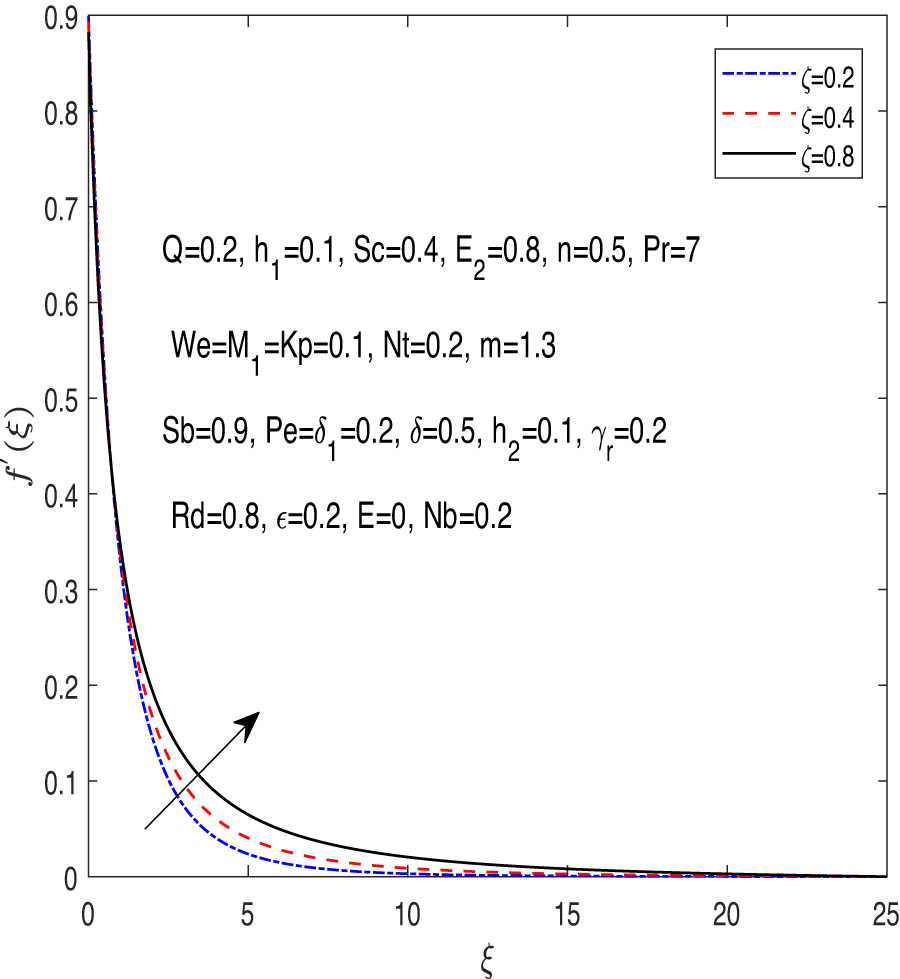
Velocity appearance against
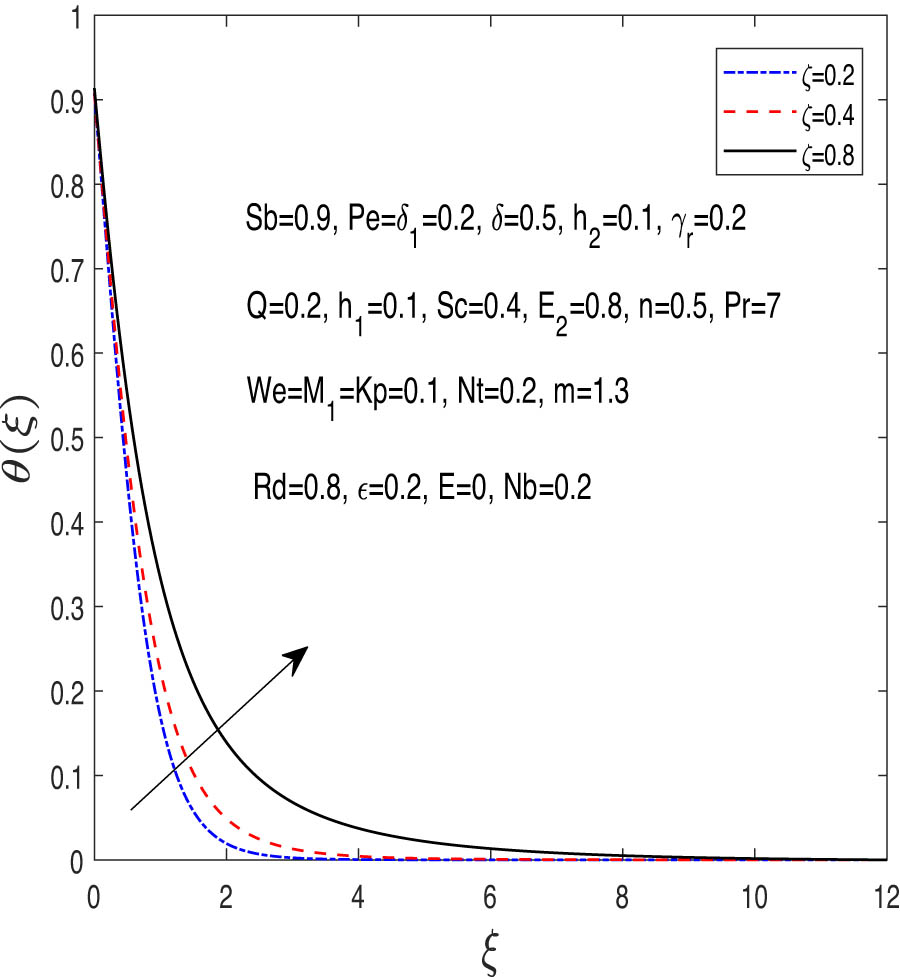
Temperature appearance against
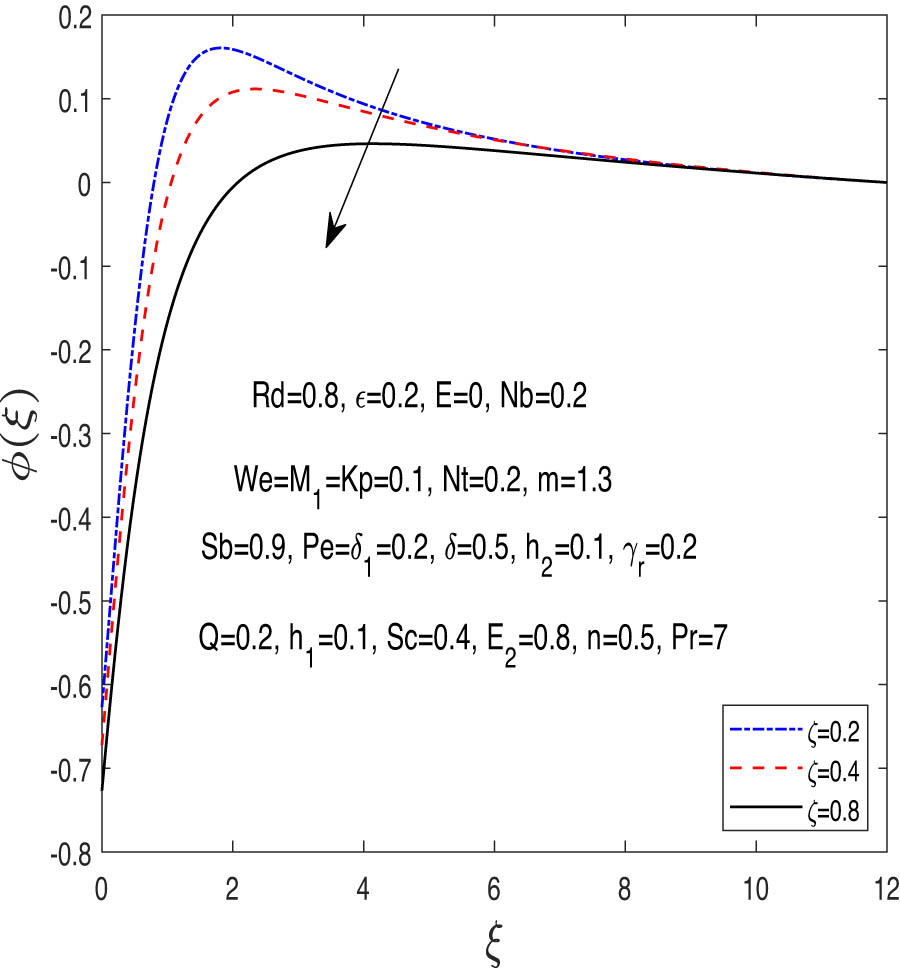
Concentration appearance against
Figure 5 illustrates that increasing the values of

Temperature appearance against

Concentration appearance against

Velocity appearance against
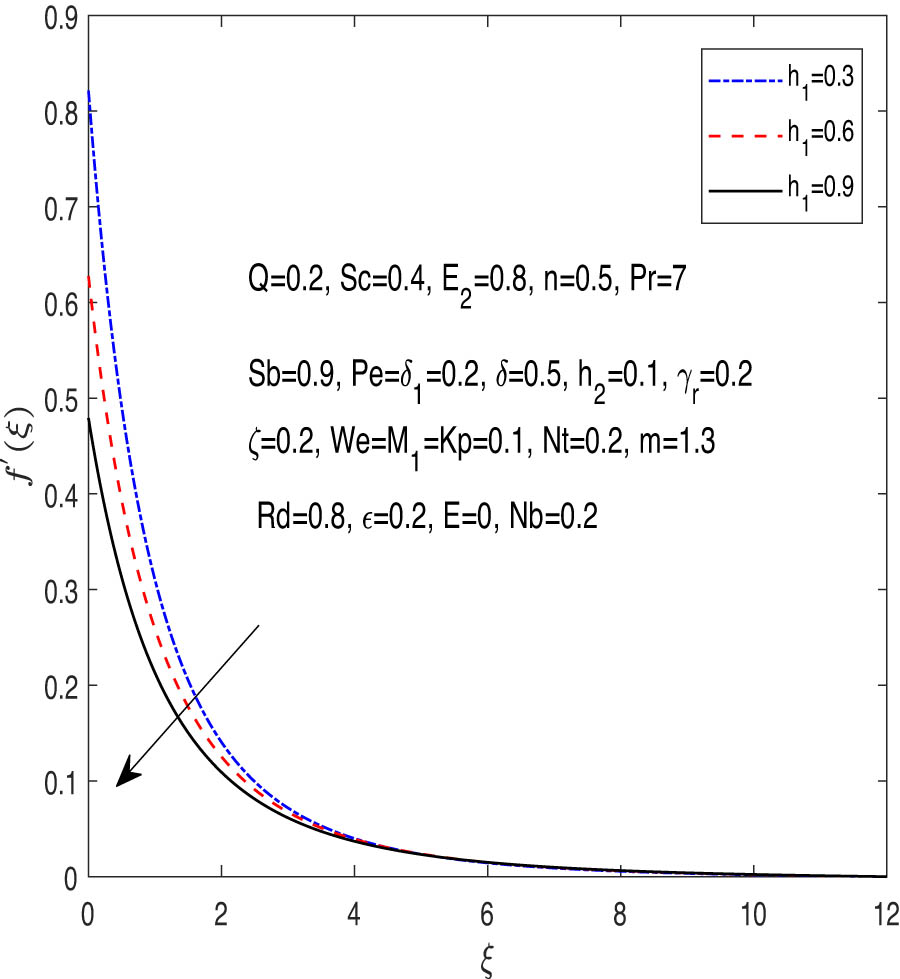
Velocity appearance against

Velocity appearance against

Temperature appearance against Pr.
Figure 11 demonstrates the influence of the radiation parameter. Fluid is heated by radiation, consequently resulting in an enhanced temperature curve. Physically, a more heat transfer is occur due to greater radiation values so temperature maximise. The temperature distribution diminishes as we boost
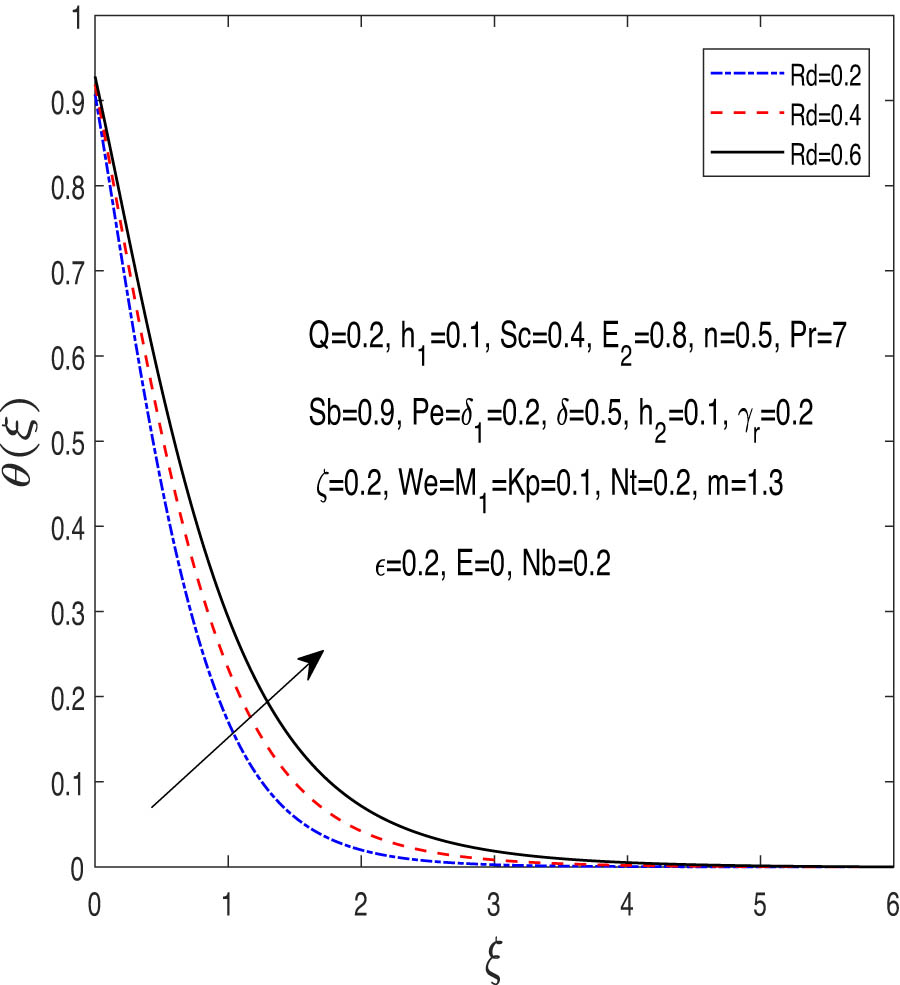
Temperature appearance against

Temperature appearance against

Concentration appearance against

Concentration appearance against
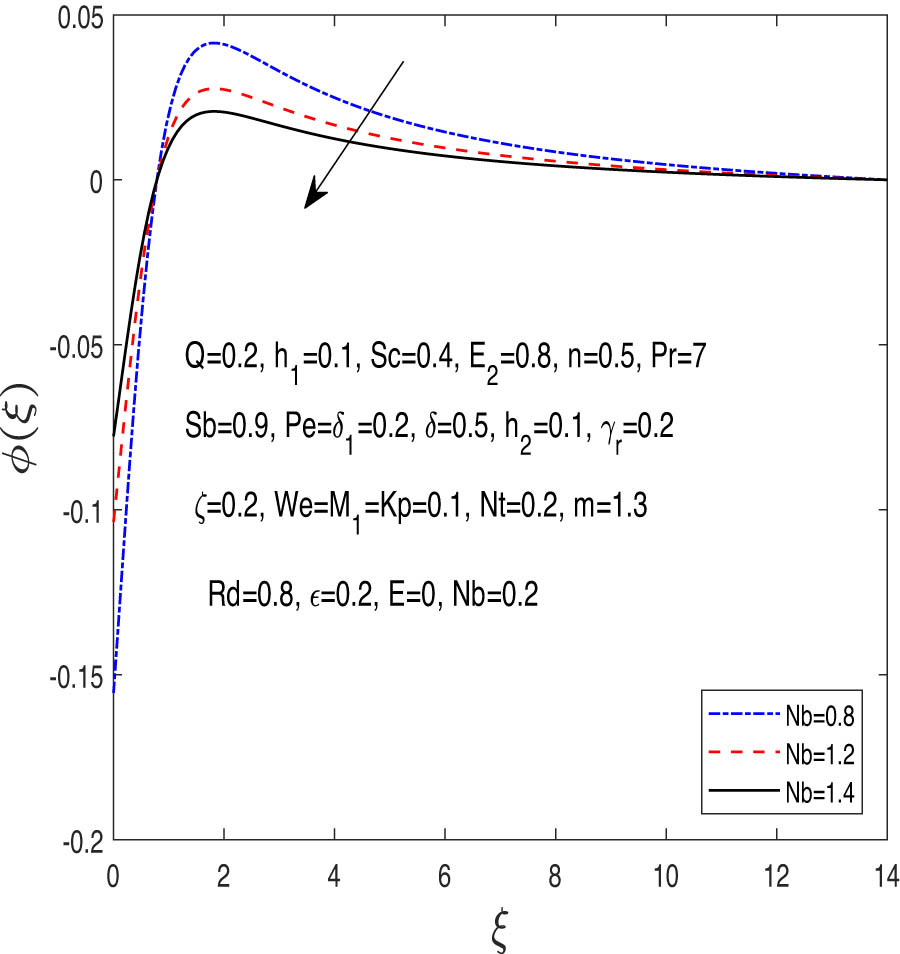
Concentration appearance against

Microorganism appearance against
6 Conclusion
This investigation primary focus to analyses the slip flow of EMHD Carreau nanofluid across a stretching cylinder in the context of Arrhenius activation energy, chemical reactions, and variable thermal conductivity within a porous medium. The study explicitly considers the consequences of chemical reactions, the presence of a porous medium, and changes in thermal conductivity. Buongiorno’s model is employed, and also, the effects of changing EMHD forces on fluid flow dynamics are investigated. By introducing nonsimilarity variables, the partial differential equations are transformed into a system of coupled ODEs. The bvp4c solver, a MATLAB built-in solver, is implemented to compute the solution to the resultant set of ODEs. The outcomes of present report would be beneficial in the fluids, which are designed for optimisation of heat transfer in various industrial zone and processing material. The present study main finding points are shown below:
The velocity profile dwindles as the porosity
The temperature profile rises with the value of curvature
As the
As
For future study, it can be extended further to optimise the host fluid temperature of different models like Casson, Ellis, Maxwell, and micropolar. In addition, these models can be expanded to incorporate hybrid nanoparticles for enhanced performance.
-
Funding information: The authors state no funding involved.
-
Author contributions: All authors have accepted responsibility for the entire content of this manuscript and approved its submission. Conceptualization; Muhammad Afzal, Imran Siddique, Mohammed M. M. Jaradat and Bagh Ali. Methodology; Imran Siddique and Badar E Alam, Funding acquisition; Mohammed M. M. Jaradat. Investigation; Bagh Ali. Validation; Binjian Ma. Data curation; Badar E Alam and Faiza Zahid. Writing – original draft preparation; Faiza Zahid and Bagh Ali. Software; Bagh Ali and Mohammed M. M. Jaradat. Writing – review and editing; Muhammad Afzal, Imran Siddique and Bagh Ali. Supervision; Binjian Ma.
-
Conflict of interest: The authors state no conflict of interest.
-
Data availability statement: The datasets generated and/or analysed during the current study are available from the corresponding author on reasonable request.
References
[1] Sharma BK, Kumar A, Gandhi R, Bhatti M. Exponential space and thermal-dependent heat source effects on electro-magneto-hydrodynamic Jeffrey fluid flow over a vertical stretching surface. Int J Modern Phys B. 2022;36(30):2250220. 10.1142/S0217979222502204Search in Google Scholar
[2] Hashim, Hamid A, Khan M. Transient flow and heat transfer mechanism for Williamson-nanomaterials caused by a stretching cylinder with variable thermal conductivity. Microsyst Tech. 2019;25:3287–97. 10.1007/s00542-019-04364-9Search in Google Scholar
[3] Senbagaraja P, De P. Dual solution of EMHD Tangent hyperbolic nanofluid with viscous dissipation and suction. Int J Fluid Mech Res. 2024;51(4):17–41. 10.1615/InterJFluidMechRes.2024052375Search in Google Scholar
[4] Carreau PJ. Rheological equations from molecular network theories. Trans Soc Rheol. 1972;16(1):99–127. 10.1122/1.549276Search in Google Scholar
[5] Gomathi N, De P. Impact of hall currents and ion slip on mixed convective Casson Williamson nanofluid flow with viscous dissipation through porous medium. Nanosci Tech Int J. 2024;15(1):65–86. 10.1615/NanoSciTechnolIntJ.2023047611Search in Google Scholar
[6] Raju C, Sandeep N. Falkner-Skan flow of a magnetic-Carreau fluid past a wedge in the presence of cross diffusion effects. Europ Phys J Plus. 2016;131:1–13. 10.1140/epjp/i2016-16267-3Search in Google Scholar
[7] Shah Z, Asghar A, Ying TY, Lund LA, Alshehri A, Vrinceanu N. Numerical investigation of sodium alginate-alumina/copper radiative hybrid nanofluid flow over a power law stretching/shrinking sheet with suction effect: a study of dual solutions. Results Eng. 2024;21:101881. 10.1016/j.rineng.2024.101881Search in Google Scholar
[8] Fadhel MA, Asghar A, Lund LA, Shah Z, Vrinceanu N, Tirth V. Dual numerical solutions of Casson SA-hybrid nanofluid toward a stagnation point flow over stretching/shrinking cylinder. Nanotech Rev. 2024;13(1):20230191. 10.1515/ntrev-2023-0191Search in Google Scholar
[9] Yasmin H, Mahnashi AM, Hamali W, Lone SA, Raizah Z, Saeed A. A numerical analysis of the blood-based Casson hybrid nanofluid flow past a convectively heated surface embedded in a porous medium. Open Phys. 2024;22(1):20230193. 10.1515/phys-2023-0193Search in Google Scholar
[10] Yasmin H, Shahab S, Lone SA, Raizah Z, Saeed A. Convective flow of a magnetohydrodynamic second-grade fluid past a stretching surface with Cattaneo-Christov heat and mass flux model. Open Phys. 2024;22(1):20230204. 10.1515/phys-2023-0204Search in Google Scholar
[11] Kumar A, Sharma BK, Gandhi R, Mishra NK, Bhatti M. Response surface optimisation for the electromagnetohydrodynamic Cu-polyvinyl alcohol/water Jeffrey nanofluid flow with an exponential heat source. J Magnetism Magnetic Materials. 2023;576:170751. 10.1016/j.jmmm.2023.170751Search in Google Scholar
[12] Raju C, Sandeep N. Unsteady three-dimensional flow of Casson-Carreau fluids past a stretching surface. Alexandr Eng J. 2016;55(2):1115–26. 10.1016/j.aej.2016.03.023Search in Google Scholar
[13] Khan M, Azam M, Munir A. On unsteady Falkner-Skan flow of MHD Carreau nanofluid past a static/moving wedge with convective surface condition. J Mol Liquids. 2017;230:48–58. 10.1016/j.molliq.2016.12.097Search in Google Scholar
[14] Gandhi R, Sharma B, Khanduri U. Electromagnetohydrodynamics Casson pulsatile nanofluid flow through a bifurcated stenosed artery: Magnetically targeted drug delivery. J Appl Phys. 2023;134(18):184701. 10.1063/5.0172553Search in Google Scholar
[15] Abdal S, Mariam A, Ali B, Younas S, Ali L, Habib D. Implications of bioconvection and activation energy on Reiner-Rivlin nanofluid transportation over a disk in rotation with partial slip. Chin J Phys. 2021;73:672–83. 10.1016/j.cjph.2021.07.022Search in Google Scholar
[16] Ali L, Wu YJ, Ali B, Abdal S, Hussain S. The crucial features of aggregation in TiO2-water nanofluid aligned of chemically comprising microorganisms: A FEM approach. Comput Math Appl. 2022;123:241–51. 10.1016/j.camwa.2022.08.028Search in Google Scholar
[17] Kumar Sharma B, Gandhi R. Entropy-driven optimisation of radiative Jeffrey tetrahybrid nanofluid flow through a stenosed bifurcated artery with Hall effects. Phys Fluids. 2023;35(12):121903. 10.1063/5.0179798Search in Google Scholar
[18] Choi SU, Eastman JA. Enhancing thermal conductivity of fluids with nanoparticles. Argonne National Lab.(ANL), Argonne, IL (United States); 1995. Search in Google Scholar
[19] Choi S, Zhang ZG, Yu W, Lockwood F, Grulke E. Anomalous thermal conductivity enhancement in nanotube suspensions. Appl Phys Lett. 2001;79(14):2252–4. 10.1063/1.1408272Search in Google Scholar
[20] Rajeswari PM, De P. Multi-stratified effects on stagnation point nanofluid flow with gyrotactic microorganisms over porous medium. J Porous Media. 2024;27(5):67–84.10.1615/JPorMedia.2023050040Search in Google Scholar
[21] Yasmin H, Lone SA, Alrabaiah H, Raizah Z, Saeed A. A numerical investigation of the two-dimensional magnetohydrodynamic water-based hybrid nanofluid flow composed of Fe3O4 and Au nanoparticles over a heated surface. Nanotech Rev. 2024;13(1):20240010. 10.1515/ntrev-2024-0010Search in Google Scholar
[22] Kuznetsov AV. Nanofluid bioconvection in water-based suspensions containing nanoparticles and oxytactic microorganisms: oscillatory instability. Nanoscale Res Lett. 2011;6:1–13. 10.1186/1556-276X-6-100Search in Google Scholar PubMed PubMed Central
[23] Chan SQ, Aman F, Mansur S. Sensitivity analysis on thermal conductivity characteristics of a water-based bionanofluid flow past a wedge surface. Math Problems Eng. 2018;2018(1):9410167. 10.1155/2018/9410167Search in Google Scholar
[24] Sparrow E, Cess R. The effect of a magnetic field on free convection heat transfer. Int J Heat Mass Transfer. 1961;3(4):267–74. 10.1016/0017-9310(61)90042-4Search in Google Scholar
[25] Mazumder B, Gupta A, Datta N. Hall effects on combined free and forced convective hydromagnetic flow through a channel. Int J Eng Sci. 1976;14(3):285–92. 10.1016/0020-7225(76)90045-8Search in Google Scholar
[26] Raptis A. Flow through a porous medium in the presence of a magnetic field. Int J Energy Res. 1986;10(1):97–100. 10.1002/er.4440100112Search in Google Scholar
[27] Rudraiah N, Barron R, Venkatachalappa M, Subbaraya C. Effect of a magnetic field on free convection in a rectangular enclosure. Int J Eng Sci. 1995;33(8):1075–84. 10.1016/0020-7225(94)00120-9Search in Google Scholar
[28] AboEldahab EM. Radiation effect on heat transfer in an electrically conducting fluid at a stretching surface with a uniform free stream. J Phys D Appl Phys. 2000;33(24):3180. 10.1088/0022-3727/33/24/310Search in Google Scholar
[29] Awais M, Malik M, Bilal S, Salahuddin T, Hussain A. Magnetohydrodynamic (MHD) flow of Sisko fluid near the axisymmetric stagnation point towards a stretching cylinder. Results Phys. 2017;7:49–56. 10.1016/j.rinp.2016.10.016Search in Google Scholar
[30] Sharma BK, Kumawat C, Khanduri U, Mekheimer KS. Numerical investigation of the entropy generation analysis for radiative MHD power-law fluid flow of blood through a curved artery with Hall effect. Waves Random Complex Media. 2023:1–38. 10.1080/17455030.2023.2226228.Search in Google Scholar
[31] Wakif A, Chamkha A, Animasaun I, Zaydan M, Waqas H, Sehaqui R. Novel physical insights into the thermodynamic irreversibilities within dissipative EMHD fluid flows past over a moving horizontal riga plate in the coexistence of wall suction and joule heating effects: a comprehensive numerical investigation. Arab J Sci Eng. 2020;45:9423–38. 10.1007/s13369-020-04757-3Search in Google Scholar
[32] Sajid M, Hayat T. Influence of thermal radiation on the boundary layer flow due to an exponentially stretching sheet. Int Commun Heat Mass Transfer. 2008;35(3):347–56. 10.1016/j.icheatmasstransfer.2007.08.006Search in Google Scholar
[33] Shehzad SA, Alsaedi A, Hayat T, Alhuthali MS. Three-dimensional flow of an Oldroyd-B fluid with variable thermal conductivity and heat generation/absorption. PloS One. 2013;8(11):e78240. 10.1371/journal.pone.0078240Search in Google Scholar PubMed PubMed Central
[34] Waqas M, Khan MI, Hayat T, Alsaedi A, Khan MI. On Cattaneo-Christov double diffusion impact for temperature-dependent conductivity of Powell-Eyring liquid. Chin J Phys. 2017;55(3):729–37. 10.1016/j.cjph.2017.02.003Search in Google Scholar
[35] Dogonchi A, Ganji D. Convection-radiation heat transfer study of moving fin with temperature-dependent thermal conductivity, heat transfer coefficient and heat generation. Appl Thermal Eng. 2016;103:705–12. 10.1016/j.applthermaleng.2016.04.121Search in Google Scholar
[36] Akbar NS, Tripathi D, Khan ZH, Bég OA. A numerical study of magnetohydrodynamic transport of nanofluids over a vertical stretching sheet with exponential temperature-dependent viscosity and buoyancy effects. Chem Phys Lett. 2016;661:20–30. 10.1016/j.cplett.2016.08.043Search in Google Scholar
[37] Song J, Liu Z, Ma Z, Zhang J. Experimental investigation of convective heat transfer from sewage in heat exchange pipes and the construction of a fouling resistance-based mathematical model. Energy Buildings. 2017;150:412–20. 10.1016/j.enbuild.2017.06.025Search in Google Scholar
[38] Khan M, Malik M, Salahuddin T, Rehman K, Naseer M, et al. MHD flow of Williamson nanofluid over a cone and plate with chemically reactive species. J Mol Liquids. 2017;231:580–8. 10.1016/j.molliq.2017.02.031Search in Google Scholar
[39] Sobamowo M, Yinusa A, Oluwo A. Finite element analysis of flow and heat transfer of dissipative Casson-Carreau nanofluid over a stretching sheet embedded in a porous medium. Aeron Aero Open Access J. 2018;2(5):294–308. 10.15406/aaoaj.2018.02.00064Search in Google Scholar
[40] Akbar N, Nadeem S, Haq RU, Ye S. MHD stagnation point flow of Carreau fluid toward a permeable shrinking sheet: Dual solutions. Ain Shams Eng J. 2014;5(4):1233–9. 10.1016/j.asej.2014.05.006Search in Google Scholar
[41] Khan M, Azam M, Alshomrani A. Effects of melting and heat generation/absorption on unsteady Falkner-Skan flow of Carreau nanofluid over a wedge. Int J Heat Mass Transfer. 2017;110:437–46. 10.1016/j.ijheatmasstransfer.2017.03.037Search in Google Scholar
[42] Hsiao KL. To promote radiation electrical MHD activation energy thermal extrusion manufacturing system efficiency by using Carreau-Nanofluid with parameters control method. Energy. 2017;130:486–99. 10.1016/j.energy.2017.05.004Search in Google Scholar
[43] Ali L, Wang Y, Ali B, Liu X, Din A, Al Mdallal Q. The function of nanoparticleas diameter and Darcy-Forchheimer flow over a cylinder with effect of magnetic field and thermal radiation. Case Stud Thermal Eng. 2021;28:101392. 10.1016/j.csite.2021.101392Search in Google Scholar
[44] Shah SAA, Ahammad NA, Ali B, Guedri K, Awan AU, Gamaoun F, et al. Significance of bio-convection, MHD, thermal radiation and activation energy across Prandtl nanofluid flow: A case of stretching cylinder. Int Commun Heat Mass Transfer. 2022;137:106299. 10.1016/j.icheatmasstransfer.2022.106299Search in Google Scholar
[45] Ali B, Siddique I, Khan I, Masood B, Hussain S. Magnetic dipole and thermal radiation effects on hybrid base micropolar CNTs flow over a stretching sheet: Finite element method approach. Results Phys. 2021;25:104145. 10.1016/j.rinp.2021.104145Search in Google Scholar
[46] Awan AU, Ali B, Shah SAA, Oreijah M, Guedri K, Eldin SM. Numerical analysis of heat transfer in Ellis hybrid nanofluid flow subject to a stretching cylinder. Case Stud Thermal Eng. 2023;49:103222. 10.1016/j.csite.2023.103222Search in Google Scholar
[47] Mishra A, Kumar M. Velocity and thermal slip effects on MHD nanofluid flow past a stretching cylinder with viscous dissipation and Joule heating. SN Appl Sci. 2020;2(8):1350. 10.1007/s42452-020-3156-7Search in Google Scholar
[48] Sharif H, Habib D, Ali B, et al. Bejan number and entropy generation analysis of unsteady MHD non-Newtonian micropolar squeezed trihybrid nanofluid flow. Partial Differ Equ Appl Math. 2024;10:100703. 10.1016/j.padiff.2024.100703Search in Google Scholar
[49] Ali B, Sharif H, Habib D, Ghazwani HA, Saman I, Yang H. Significance of tri-hybrid nanoparticles in thermal management subject to magnetized squeezing flow of a Boger-micropolar nanofluid between concentring disks. J Mol Liquids. 2024;397:124141. 10.1016/j.molliq.2024.124141Search in Google Scholar
[50] Rangi RR, Ahmad N. Boundary layer flow past a stretching cylinder and heat transfer with variable thermal conductivity. Appl Math. 2012;3(3):1–5. Search in Google Scholar
[51] Hashim, Khan M, Saleh Alshomrani A. Characteristics of melting heat transfer during flow of Carreau fluid induced by a stretching cylinder. Europ Phys J E. 2017;40:1–9. 10.1140/epje/i2017-11495-6Search in Google Scholar PubMed
© 2025 the author(s), published by De Gruyter
This work is licensed under the Creative Commons Attribution 4.0 International License.
Articles in the same Issue
- Research Articles
- MHD radiative mixed convective flow of a sodium alginate-based hybrid nanofluid over a convectively heated extending sheet with Joule heating
- Experimental study of mortar incorporating nano-magnetite on engineering performance and radiation shielding
- Multicriteria-based optimization and multi-variable non-linear regression analysis of concrete containing blends of nano date palm ash and eggshell powder as cementitious materials
- A promising Ag2S/poly-2-amino-1-mercaptobenzene open-top spherical core–shell nanocomposite for optoelectronic devices: A one-pot technique
- Biogenic synthesized selenium nanoparticles combined chitosan nanoparticles controlled lung cancer growth via ROS generation and mitochondrial damage pathway
- Fabrication of PDMS nano-mold by deposition casting method
- Stimulus-responsive gradient hydrogel micro-actuators fabricated by two-photon polymerization-based 4D printing
- Physical aspects of radiative Carreau nanofluid flow with motile microorganisms movement under yield stress via oblique penetrable wedge
- Effect of polar functional groups on the hydrophobicity of carbon nanotubes-bacterial cellulose nanocomposite
- Review in green synthesis mechanisms, application, and future prospects for Garcinia mangostana L. (mangosteen)-derived nanoparticles
- Entropy generation and heat transfer in nonlinear Buoyancy–driven Darcy–Forchheimer hybrid nanofluids with activation energy
- Green synthesis of silver nanoparticles using Ginkgo biloba seed extract: Evaluation of antioxidant, anticancer, antifungal, and antibacterial activities
- A numerical analysis of heat and mass transfer in water-based hybrid nanofluid flow containing copper and alumina nanoparticles over an extending sheet
- Investigating the behaviour of electro-magneto-hydrodynamic Carreau nanofluid flow with slip effects over a stretching cylinder
- Electrospun thermoplastic polyurethane/nano-Ag-coated clear aligners for the inhibition of Streptococcus mutans and oral biofilm
- Investigation of the optoelectronic properties of a novel polypyrrole-multi-well carbon nanotubes/titanium oxide/aluminum oxide/p-silicon heterojunction
- Novel photothermal magnetic Janus membranes suitable for solar water desalination
- Green synthesis of silver nanoparticles using Ageratum conyzoides for activated carbon compositing to prepare antimicrobial cotton fabric
- Activation energy and Coriolis force impact on three-dimensional dusty nanofluid flow containing gyrotactic microorganisms: Machine learning and numerical approach
- Machine learning analysis of thermo-bioconvection in a micropolar hybrid nanofluid-filled square cavity with oxytactic microorganisms
- Research and improvement of mechanical properties of cement nanocomposites for well cementing
- Thermal and stability analysis of silver–water nanofluid flow over unsteady stretching sheet under the influence of heat generation/absorption at the boundary
- Cobalt iron oxide-infused silicone nanocomposites: Magnetoactive materials for remote actuation and sensing
- Magnesium-reinforced PMMA composite scaffolds: Synthesis, characterization, and 3D printing via stereolithography
- Bayesian inference-based physics-informed neural network for performance study of hybrid nanofluids
- Numerical simulation of non-Newtonian hybrid nanofluid flow subject to a heterogeneous/homogeneous chemical reaction over a Riga surface
- Enhancing the superhydrophobicity, UV-resistance, and antifungal properties of natural wood surfaces via in situ formation of ZnO, TiO2, and SiO2 particles
- Synthesis and electrochemical characterization of iron oxide/poly(2-methylaniline) nanohybrids for supercapacitor application
- Impacts of double stratification on thermally radiative third-grade nanofluid flow on elongating cylinder with homogeneous/heterogeneous reactions by implementing machine learning approach
- Synthesis of Cu4O3 nanoparticles using pumpkin seed extract: Optimization, antimicrobial, and cytotoxicity studies
- Cationic charge influence on the magnetic response of the Fe3O4–[Me2+ 1−y Me3+ y (OH2)] y+(Co3 2−) y/2·mH2O hydrotalcite system
- Pressure sensing intelligent martial arts short soldier combat protection system based on conjugated polymer nanocomposite materials
- Magnetohydrodynamics heat transfer rate under inclined buoyancy force for nano and dusty fluids: Response surface optimization for the thermal transport
- Fly ash and nano-graphene enhanced stabilization of engine oil-contaminated soils
- Enhancing natural fiber-reinforced biopolymer composites with graphene nanoplatelets: Mechanical, morphological, and thermal properties
- Performance evaluation of dual-scale strengthened co-bonded single-lap joints using carbon nanotubes and Z-pins with ANN
- Computational works of blood flow with dust particles and partially ionized containing tiny particles on a moving wedge: Applications of nanotechnology
- Hybridization of biocomposites with oil palm cellulose nanofibrils/graphene nanoplatelets reinforcement in green epoxy: A study of physical, thermal, mechanical, and morphological properties
- Design and preparation of micro-nano dual-scale particle-reinforced Cu–Al–V alloy: Research on the aluminothermic reduction process
- Spectral quasi-linearization and response optimization on magnetohydrodynamic flow via stenosed artery with hybrid and ternary solid nanoparticles: Support vector machine learning
- Ferrite/curcumin hybrid nanocomposite formulation: Physicochemical characterization, anticancer activity, and apoptotic and cell cycle analyses in skin cancer cells
- Enhanced therapeutic efficacy of Tamoxifen against breast cancer using extra virgin olive oil-based nanoemulsion delivery system
- A titanium oxide- and silver-based hybrid nanofluid flow between two Riga walls that converge and diverge through a machine-learning approach
- Enhancing convective heat transfer mechanisms through the rheological analysis of Casson nanofluid flow towards a stagnation point over an electro-magnetized surface
- Intrinsic self-sensing cementitious composites with hybrid nanofillers exhibiting excellent piezoresistivity
- Research on mechanical properties and sulfate erosion resistance of nano-reinforced coal gangue based geopolymer concrete
- Impact of surface and configurational features of chemically synthesized chains of Ni nanostars on the magnetization reversal process
- Porous sponge-like AsOI/poly(2-aminobenzene-1-thiol) nanocomposite photocathode for hydrogen production from artificial and natural seawater
- Multifaceted insights into WO3 nanoparticle-coupled antibiotics to modulate resistance in enteric pathogens of Houbara bustard birds
- Synthesis of sericin-coated silver nanoparticles and their applications for the anti-bacterial finishing of cotton fabric
- Enhancing chloride resistance of freeze–thaw affected concrete through innovative nanomaterial–polymer hybrid cementitious coating
- Development and performance evaluation of green aluminium metal matrix composites reinforced with graphene nanopowder and marble dust
- Morphological, physical, thermal, and mechanical properties of carbon nanotubes reinforced arrowroot starch composites
- Influence of the graphene oxide nanosheet on tensile behavior and failure characteristics of the cement composites after high-temperature treatment
- Central composite design modeling in optimizing heat transfer rate in the dissipative and reactive dynamics of viscoplastic nanomaterials deploying Joule and heat generation aspects
- Double diffusion of nano-enhanced phase change materials in connected porous channels: A hybrid ISPH-XGBoost approach
- Synergistic impacts of Thompson–Troian slip, Stefan blowing, and nonuniform heat generation on Casson nanofluid dynamics through a porous medium
- Optimization of abrasive water jet machining parameters for basalt fiber/SiO2 nanofiller reinforced composites
- Enhancing aesthetic durability of Zisha teapots via TiO2 nanoparticle surface modification: A study on self-cleaning, antimicrobial, and mechanical properties
- Nanocellulose solution based on iron(iii) sodium tartrate complexes
- Combating multidrug-resistant infections: Gold nanoparticles–chitosan–papain-integrated dual-action nanoplatform for enhanced antibacterial activity
- Novel royal jelly-mediated green synthesis of selenium nanoparticles and their multifunctional biological activities
- Direct bandgap transition for emission in GeSn nanowires
- Synthesis of ZnO nanoparticles with different morphologies using a microwave-based method and their antimicrobial activity
- Numerical investigation of convective heat and mass transfer in a trapezoidal cavity filled with ternary hybrid nanofluid and a central obstacle
- Halloysite nanotube enhanced polyurethane nanocomposites for advanced electroinsulating applications
- Low molar mass ionic liquid’s modified carbon nanotubes and its role in PVDF crystalline stress generation
- Green synthesis of polydopamine-functionalized silver nanoparticles conjugated with Ceftazidime: in silico and experimental approach for combating antibiotic-resistant bacteria and reducing toxicity
- Evaluating the influence of graphene nano powder inclusion on mechanical, vibrational and water absorption behaviour of ramie/abaca hybrid composites
- Dynamic-behavior of Casson-type hybrid nanofluids due to a stretching sheet under the coupled impacts of boundary slip and reaction-diffusion processes
- Influence of polyvinyl alcohol on the physicochemical and self-sensing properties of nano carbon black reinforced cement mortar
- Advanced machine learning approaches for predicting compressive and flexural strength of carbon nanotube–reinforced cement composites: a comparative study and model interpretability analysis
- Artificial neural network-driven insights into nanoparticle-enhanced phase change materials melting for heat storage optimization
- Optical, structural, and morphological characterization of hydrothermally synthesized zinc oxide nanorods: exploring their potential for environmental applications
- Structural, optical, and gas sensing properties of Ce, Nd, and Pr doped ZnS nanostructured thin films prepared by nebulizer spray pyrolysis method
- The influence of nano-size La2O3 and HfC on the microstructure and mechanical properties of tungsten alloys by microwave sintering
- 10.1515/ntrev-2025-0187
- Review Articles
- A comprehensive review on hybrid plasmonic waveguides: Structures, applications, challenges, and future perspectives
- Nanoparticles in low-temperature preservation of biological systems of animal origin
- Fluorescent sulfur quantum dots for environmental monitoring
- Nanoscience systematic review methodology standardization
- Nanotechnology revolutionizing osteosarcoma treatment: Advances in targeted kinase inhibitors
- AFM: An important enabling technology for 2D materials and devices
- Carbon and 2D nanomaterial smart hydrogels for therapeutic applications
- Principles, applications and future prospects in photodegradation systems
- Do gold nanoparticles consistently benefit crop plants under both non-stressed and abiotic stress conditions?
- An updated overview of nanoparticle-induced cardiovascular toxicity
- Arginine as a promising amino acid for functionalized nanosystems: Innovations, challenges, and future directions
- Advancements in the use of cancer nanovaccines: Comprehensive insights with focus on lung and colon cancer
- Membrane-based biomimetic delivery systems for glioblastoma multiforme therapy
- The drug delivery systems based on nanoparticles for spinal cord injury repair
- Green synthesis, biomedical effects, and future trends of Ag/ZnO bimetallic nanoparticles: An update
- Application of magnesium and its compounds in biomaterials for nerve injury repair
- Micro/nanomotors in biomedicine: Construction and applications
- Hydrothermal synthesis of biomass-derived CQDs: Advances and applications
- Research progress in 3D bioprinting of skin: Challenges and opportunities
- Review on bio-selenium nanoparticles: Synthesis, protocols, and applications in biomedical processes
- Gold nanocrystals and nanorods functionalized with protein and polymeric ligands for environmental, energy storage, and diagnostic applications: A review
- An in-depth analysis of rotational and non-rotational piezoelectric energy harvesting beams: A comprehensive review
- Advancements in perovskite/CIGS tandem solar cells: Material synergies, device configurations, and economic viability for sustainable energy
- Deep learning in-depth analysis of crystal graph convolutional neural networks: A new era in materials discovery and its applications
- Review of recent nano TiO2 film coating methods, assessment techniques, and key problems for scaleup
- Antioxidant quantum dots for spinal cord injuries: A review on advancing neuroprotection and regeneration in neurological disorders
- Rise of polycatecholamine ultrathin films: From synthesis to smart applications
- Advancing microencapsulation strategies for bioactive compounds: Enhancing stability, bioavailability, and controlled release in food applications
- Advances in the design and manipulation of self-assembling peptide and protein nanostructures for biomedical applications
- Photocatalytic pervious concrete systems: from classic photocatalysis to luminescent photocatalysis
- Beyond science: ethical and societal considerations in the era of biogenic nanoparticles
- Corrigendum
- Corrigendum to “Synthesis and characterization of smart stimuli-responsive herbal drug-encapsulated nanoniosome particles for efficient treatment of breast cancer”
- Special Issue on Advanced Nanomaterials for Carbon Capture, Environment and Utilization for Energy Sustainability - Part III
- Efficiency optimization of quantum dot photovoltaic cell by solar thermophotovoltaic system
- Exploring the diverse nanomaterials employed in dental prosthesis and implant techniques: An overview
- Electrochemical investigation of bismuth-doped anode materials for low‑temperature solid oxide fuel cells with boosted voltage using a DC-DC voltage converter
- Synthesis of HfSe2 and CuHfSe2 crystalline materials using the chemical vapor transport method and their applications in supercapacitor energy storage devices
- Special Issue on Green Nanotechnology and Nano-materials for Environment Sustainability
- Influence of nano-silica and nano-ferrite particles on mechanical and durability of sustainable concrete: A review
- Surfaces and interfaces analysis on different carboxymethylation reaction time of anionic cellulose nanoparticles derived from oil palm biomass
- Processing and effective utilization of lignocellulosic biomass: Nanocellulose, nanolignin, and nanoxylan for wastewater treatment
- Wound healing activities of sulfur nanoparticles of Allium cepa extract embedded in a nanocream formulation: in vitro and in vivo studies
- Retraction
- Retraction of “Aging assessment of silicone rubber materials under corona discharge accompanied by humidity and UV radiation”
Articles in the same Issue
- Research Articles
- MHD radiative mixed convective flow of a sodium alginate-based hybrid nanofluid over a convectively heated extending sheet with Joule heating
- Experimental study of mortar incorporating nano-magnetite on engineering performance and radiation shielding
- Multicriteria-based optimization and multi-variable non-linear regression analysis of concrete containing blends of nano date palm ash and eggshell powder as cementitious materials
- A promising Ag2S/poly-2-amino-1-mercaptobenzene open-top spherical core–shell nanocomposite for optoelectronic devices: A one-pot technique
- Biogenic synthesized selenium nanoparticles combined chitosan nanoparticles controlled lung cancer growth via ROS generation and mitochondrial damage pathway
- Fabrication of PDMS nano-mold by deposition casting method
- Stimulus-responsive gradient hydrogel micro-actuators fabricated by two-photon polymerization-based 4D printing
- Physical aspects of radiative Carreau nanofluid flow with motile microorganisms movement under yield stress via oblique penetrable wedge
- Effect of polar functional groups on the hydrophobicity of carbon nanotubes-bacterial cellulose nanocomposite
- Review in green synthesis mechanisms, application, and future prospects for Garcinia mangostana L. (mangosteen)-derived nanoparticles
- Entropy generation and heat transfer in nonlinear Buoyancy–driven Darcy–Forchheimer hybrid nanofluids with activation energy
- Green synthesis of silver nanoparticles using Ginkgo biloba seed extract: Evaluation of antioxidant, anticancer, antifungal, and antibacterial activities
- A numerical analysis of heat and mass transfer in water-based hybrid nanofluid flow containing copper and alumina nanoparticles over an extending sheet
- Investigating the behaviour of electro-magneto-hydrodynamic Carreau nanofluid flow with slip effects over a stretching cylinder
- Electrospun thermoplastic polyurethane/nano-Ag-coated clear aligners for the inhibition of Streptococcus mutans and oral biofilm
- Investigation of the optoelectronic properties of a novel polypyrrole-multi-well carbon nanotubes/titanium oxide/aluminum oxide/p-silicon heterojunction
- Novel photothermal magnetic Janus membranes suitable for solar water desalination
- Green synthesis of silver nanoparticles using Ageratum conyzoides for activated carbon compositing to prepare antimicrobial cotton fabric
- Activation energy and Coriolis force impact on three-dimensional dusty nanofluid flow containing gyrotactic microorganisms: Machine learning and numerical approach
- Machine learning analysis of thermo-bioconvection in a micropolar hybrid nanofluid-filled square cavity with oxytactic microorganisms
- Research and improvement of mechanical properties of cement nanocomposites for well cementing
- Thermal and stability analysis of silver–water nanofluid flow over unsteady stretching sheet under the influence of heat generation/absorption at the boundary
- Cobalt iron oxide-infused silicone nanocomposites: Magnetoactive materials for remote actuation and sensing
- Magnesium-reinforced PMMA composite scaffolds: Synthesis, characterization, and 3D printing via stereolithography
- Bayesian inference-based physics-informed neural network for performance study of hybrid nanofluids
- Numerical simulation of non-Newtonian hybrid nanofluid flow subject to a heterogeneous/homogeneous chemical reaction over a Riga surface
- Enhancing the superhydrophobicity, UV-resistance, and antifungal properties of natural wood surfaces via in situ formation of ZnO, TiO2, and SiO2 particles
- Synthesis and electrochemical characterization of iron oxide/poly(2-methylaniline) nanohybrids for supercapacitor application
- Impacts of double stratification on thermally radiative third-grade nanofluid flow on elongating cylinder with homogeneous/heterogeneous reactions by implementing machine learning approach
- Synthesis of Cu4O3 nanoparticles using pumpkin seed extract: Optimization, antimicrobial, and cytotoxicity studies
- Cationic charge influence on the magnetic response of the Fe3O4–[Me2+ 1−y Me3+ y (OH2)] y+(Co3 2−) y/2·mH2O hydrotalcite system
- Pressure sensing intelligent martial arts short soldier combat protection system based on conjugated polymer nanocomposite materials
- Magnetohydrodynamics heat transfer rate under inclined buoyancy force for nano and dusty fluids: Response surface optimization for the thermal transport
- Fly ash and nano-graphene enhanced stabilization of engine oil-contaminated soils
- Enhancing natural fiber-reinforced biopolymer composites with graphene nanoplatelets: Mechanical, morphological, and thermal properties
- Performance evaluation of dual-scale strengthened co-bonded single-lap joints using carbon nanotubes and Z-pins with ANN
- Computational works of blood flow with dust particles and partially ionized containing tiny particles on a moving wedge: Applications of nanotechnology
- Hybridization of biocomposites with oil palm cellulose nanofibrils/graphene nanoplatelets reinforcement in green epoxy: A study of physical, thermal, mechanical, and morphological properties
- Design and preparation of micro-nano dual-scale particle-reinforced Cu–Al–V alloy: Research on the aluminothermic reduction process
- Spectral quasi-linearization and response optimization on magnetohydrodynamic flow via stenosed artery with hybrid and ternary solid nanoparticles: Support vector machine learning
- Ferrite/curcumin hybrid nanocomposite formulation: Physicochemical characterization, anticancer activity, and apoptotic and cell cycle analyses in skin cancer cells
- Enhanced therapeutic efficacy of Tamoxifen against breast cancer using extra virgin olive oil-based nanoemulsion delivery system
- A titanium oxide- and silver-based hybrid nanofluid flow between two Riga walls that converge and diverge through a machine-learning approach
- Enhancing convective heat transfer mechanisms through the rheological analysis of Casson nanofluid flow towards a stagnation point over an electro-magnetized surface
- Intrinsic self-sensing cementitious composites with hybrid nanofillers exhibiting excellent piezoresistivity
- Research on mechanical properties and sulfate erosion resistance of nano-reinforced coal gangue based geopolymer concrete
- Impact of surface and configurational features of chemically synthesized chains of Ni nanostars on the magnetization reversal process
- Porous sponge-like AsOI/poly(2-aminobenzene-1-thiol) nanocomposite photocathode for hydrogen production from artificial and natural seawater
- Multifaceted insights into WO3 nanoparticle-coupled antibiotics to modulate resistance in enteric pathogens of Houbara bustard birds
- Synthesis of sericin-coated silver nanoparticles and their applications for the anti-bacterial finishing of cotton fabric
- Enhancing chloride resistance of freeze–thaw affected concrete through innovative nanomaterial–polymer hybrid cementitious coating
- Development and performance evaluation of green aluminium metal matrix composites reinforced with graphene nanopowder and marble dust
- Morphological, physical, thermal, and mechanical properties of carbon nanotubes reinforced arrowroot starch composites
- Influence of the graphene oxide nanosheet on tensile behavior and failure characteristics of the cement composites after high-temperature treatment
- Central composite design modeling in optimizing heat transfer rate in the dissipative and reactive dynamics of viscoplastic nanomaterials deploying Joule and heat generation aspects
- Double diffusion of nano-enhanced phase change materials in connected porous channels: A hybrid ISPH-XGBoost approach
- Synergistic impacts of Thompson–Troian slip, Stefan blowing, and nonuniform heat generation on Casson nanofluid dynamics through a porous medium
- Optimization of abrasive water jet machining parameters for basalt fiber/SiO2 nanofiller reinforced composites
- Enhancing aesthetic durability of Zisha teapots via TiO2 nanoparticle surface modification: A study on self-cleaning, antimicrobial, and mechanical properties
- Nanocellulose solution based on iron(iii) sodium tartrate complexes
- Combating multidrug-resistant infections: Gold nanoparticles–chitosan–papain-integrated dual-action nanoplatform for enhanced antibacterial activity
- Novel royal jelly-mediated green synthesis of selenium nanoparticles and their multifunctional biological activities
- Direct bandgap transition for emission in GeSn nanowires
- Synthesis of ZnO nanoparticles with different morphologies using a microwave-based method and their antimicrobial activity
- Numerical investigation of convective heat and mass transfer in a trapezoidal cavity filled with ternary hybrid nanofluid and a central obstacle
- Halloysite nanotube enhanced polyurethane nanocomposites for advanced electroinsulating applications
- Low molar mass ionic liquid’s modified carbon nanotubes and its role in PVDF crystalline stress generation
- Green synthesis of polydopamine-functionalized silver nanoparticles conjugated with Ceftazidime: in silico and experimental approach for combating antibiotic-resistant bacteria and reducing toxicity
- Evaluating the influence of graphene nano powder inclusion on mechanical, vibrational and water absorption behaviour of ramie/abaca hybrid composites
- Dynamic-behavior of Casson-type hybrid nanofluids due to a stretching sheet under the coupled impacts of boundary slip and reaction-diffusion processes
- Influence of polyvinyl alcohol on the physicochemical and self-sensing properties of nano carbon black reinforced cement mortar
- Advanced machine learning approaches for predicting compressive and flexural strength of carbon nanotube–reinforced cement composites: a comparative study and model interpretability analysis
- Artificial neural network-driven insights into nanoparticle-enhanced phase change materials melting for heat storage optimization
- Optical, structural, and morphological characterization of hydrothermally synthesized zinc oxide nanorods: exploring their potential for environmental applications
- Structural, optical, and gas sensing properties of Ce, Nd, and Pr doped ZnS nanostructured thin films prepared by nebulizer spray pyrolysis method
- The influence of nano-size La2O3 and HfC on the microstructure and mechanical properties of tungsten alloys by microwave sintering
- 10.1515/ntrev-2025-0187
- Review Articles
- A comprehensive review on hybrid plasmonic waveguides: Structures, applications, challenges, and future perspectives
- Nanoparticles in low-temperature preservation of biological systems of animal origin
- Fluorescent sulfur quantum dots for environmental monitoring
- Nanoscience systematic review methodology standardization
- Nanotechnology revolutionizing osteosarcoma treatment: Advances in targeted kinase inhibitors
- AFM: An important enabling technology for 2D materials and devices
- Carbon and 2D nanomaterial smart hydrogels for therapeutic applications
- Principles, applications and future prospects in photodegradation systems
- Do gold nanoparticles consistently benefit crop plants under both non-stressed and abiotic stress conditions?
- An updated overview of nanoparticle-induced cardiovascular toxicity
- Arginine as a promising amino acid for functionalized nanosystems: Innovations, challenges, and future directions
- Advancements in the use of cancer nanovaccines: Comprehensive insights with focus on lung and colon cancer
- Membrane-based biomimetic delivery systems for glioblastoma multiforme therapy
- The drug delivery systems based on nanoparticles for spinal cord injury repair
- Green synthesis, biomedical effects, and future trends of Ag/ZnO bimetallic nanoparticles: An update
- Application of magnesium and its compounds in biomaterials for nerve injury repair
- Micro/nanomotors in biomedicine: Construction and applications
- Hydrothermal synthesis of biomass-derived CQDs: Advances and applications
- Research progress in 3D bioprinting of skin: Challenges and opportunities
- Review on bio-selenium nanoparticles: Synthesis, protocols, and applications in biomedical processes
- Gold nanocrystals and nanorods functionalized with protein and polymeric ligands for environmental, energy storage, and diagnostic applications: A review
- An in-depth analysis of rotational and non-rotational piezoelectric energy harvesting beams: A comprehensive review
- Advancements in perovskite/CIGS tandem solar cells: Material synergies, device configurations, and economic viability for sustainable energy
- Deep learning in-depth analysis of crystal graph convolutional neural networks: A new era in materials discovery and its applications
- Review of recent nano TiO2 film coating methods, assessment techniques, and key problems for scaleup
- Antioxidant quantum dots for spinal cord injuries: A review on advancing neuroprotection and regeneration in neurological disorders
- Rise of polycatecholamine ultrathin films: From synthesis to smart applications
- Advancing microencapsulation strategies for bioactive compounds: Enhancing stability, bioavailability, and controlled release in food applications
- Advances in the design and manipulation of self-assembling peptide and protein nanostructures for biomedical applications
- Photocatalytic pervious concrete systems: from classic photocatalysis to luminescent photocatalysis
- Beyond science: ethical and societal considerations in the era of biogenic nanoparticles
- Corrigendum
- Corrigendum to “Synthesis and characterization of smart stimuli-responsive herbal drug-encapsulated nanoniosome particles for efficient treatment of breast cancer”
- Special Issue on Advanced Nanomaterials for Carbon Capture, Environment and Utilization for Energy Sustainability - Part III
- Efficiency optimization of quantum dot photovoltaic cell by solar thermophotovoltaic system
- Exploring the diverse nanomaterials employed in dental prosthesis and implant techniques: An overview
- Electrochemical investigation of bismuth-doped anode materials for low‑temperature solid oxide fuel cells with boosted voltage using a DC-DC voltage converter
- Synthesis of HfSe2 and CuHfSe2 crystalline materials using the chemical vapor transport method and their applications in supercapacitor energy storage devices
- Special Issue on Green Nanotechnology and Nano-materials for Environment Sustainability
- Influence of nano-silica and nano-ferrite particles on mechanical and durability of sustainable concrete: A review
- Surfaces and interfaces analysis on different carboxymethylation reaction time of anionic cellulose nanoparticles derived from oil palm biomass
- Processing and effective utilization of lignocellulosic biomass: Nanocellulose, nanolignin, and nanoxylan for wastewater treatment
- Wound healing activities of sulfur nanoparticles of Allium cepa extract embedded in a nanocream formulation: in vitro and in vivo studies
- Retraction
- Retraction of “Aging assessment of silicone rubber materials under corona discharge accompanied by humidity and UV radiation”
