Magnetohydrodynamics heat transfer rate under inclined buoyancy force for nano and dusty fluids: Response surface optimization for the thermal transport
-
Usman Afzal


Abstract
The aim of this study is to analyze the heat transfer rate under inclined buoyancy force for nano and dusty fluids by incorporating key parameters such as the Prandtl number, volume fraction, fluid interaction parameter for temperature, and fluid-particle interaction parameter for velocity in the presence of magnetohydrodynamics (MHD) effects. The investigation focuses on understanding how these parameters influence velocity and heat transfer behavior in a porous medium. Nano and dusty fluids are crucial for thermal systems, environmental regulation, and materials processing. Unlike previous studies, this work examines their combined effects and employs response surface methodology (RSM) for optimization. The governing nonlinear ordinary differential equations are derived via similarity transformations and solved using bvp4c in MATLAB. RSM is employed to analyze parametric effects and determine optimal conditions for heat transfer enhancement. Higher Local Grashof number increases flow rate but decreases heat transfer rate. MHD and porosity effects significantly impact velocity and temperature. Dust-fluid interactions affect boundary layer behavior and heat transfer rates. Dusty fluid interactions influence boundary layer thickness and heat transfer. Findings are applicable in heat exchangers, electronics cooling, and industrial furnaces. The study offers a foundation for hybrid nanofluids, time-dependent flows, and fractional modeling in future research.
Nomenclature
-
-
induced magnetic field
-
-
Biot number
-
-
specific heat of the nanofluids and dust particles
-
-
skin friction
-
-
stretching sheet parameter
-
-
Eckert number
-
-
thermal conductivity
-
-
dimensionless velocity of nanofluids and dust particles
-
-
local Grashof number
-
-
acceleration due to gravity
-
-
Stokes resistance
-
-
porosity parameter
-
-
permeability of porous medium
-
-
magnetic field parameter
-
-
mass of the dust particle
-
-
number density of the dust particles
-
-
Nusselt number
-
-
Prandtl number
-
-
local Renolds number
-
-
nanoparticles temperature (K)
-
-
dust particles temperature (K)
-
-
temperature at surface (K)
-
-
ambient temperature (K)
-
-
velocity components of nanofluids
-
-
velocity components of dust phases
-
-
kinematic viscosity of nanofluids
-
-
coordinates axes
-
-
volume fraction percentage of the dust particles
-
-
density of the nanofluids
-
-
electrical conductivity
-
-
dynamic viscosity
-
-
thermal equilibrium and relaxation time of dust particles
-
-
dimensionless temperature
-
-
mass concentration of dust particles
-
-
fluid particle interaction parameter for velocity
-
-
fluid interaction parameter for temperature
-
-
ratio of specific heat of nanoparticles to dust particles
-
-
dust particles volume fraction
Homogeneity of dimensionless parameter:
1 Introduction
Fluids represent fundamental elements within both natural and engineered systems, recognized for their capacity to flow and adapt to the contours of their respective containers. They encompass both liquids and gases, distinguished by attributes such as viscosity and pressure. Varieties of fluids include ideal fluids (theoretical, devoid of viscosity), real fluids (exhibiting quantifiable viscosity), and Newtonian fluids, where the strain rate and shear stress are directly proportional, as exemplified by water and air. Non-Newtonian fluids, including blood and various polymers, display intricate behaviors characterized by stress-dependent viscosity [1]. In the field of engineering, fluids play a pivotal role in applications like hydraulic systems, turbines, and pumps, enabling power transmission, energy generation, and various industrial processes [2].
Applications for studying heat transfer and fluid flow over a stretching surface are significant in many engineering domains. Conventional fluids like oil, ethylene glycol, and water often exhibit low thermal conductivity, posing challenges in designing efficient electronic systems. To overcome this, researchers have enhanced base fluids through the integration of nanoparticles, resulting in nanofluids, or by adding micrometer-sized particles, leading to dusty fluids, both of which boost thermal conductivity. While previous studies have largely focused on nanofluids or dusty fluids separately, this investigation explores the combined momentum and thermal transfer properties of dusty nanofluids – a combination of conductive dust particles and nanoparticles. This innovative approach aims to further improve the thermal performance of base fluids for specific applications [3]. Certainly, the stability of laminar flow in fluids containing evenly spaced dust particles has been thoroughly analyzed. Subsequent studies have investigated magnetohydrodynamics (MHD) flow, examining heat and momentum exchange [4]. This work builds upon previous research by focusing on the impact of nanoparticle size on velocity, temperature, and heat transfer efficiency in dusty nanofluids [5,6]. This work explores the two-phase dusty fluid flow dynamics over a wavy surface [7]. They highlighted the enhancement of thermal properties through the use of hybrid nanofluids [8]. Additionally, the effects of non-uniform heat sources or sinks and induced magnetic fields on MHD flows across inclined surfaces have been studied [9,10]. Other significant studies have focused on thermal transfer in dusty fluids with variable properties over stretched sheets [11]. Research has also explored the effect of radiation on steady two-dimensional dusty fluid flows [12] and the dynamics of boundary layers and heat transfer in dusty fluid flows [13,14]. Inclined buoyancy forces in fluid flow result from the density variations due to temperature or concentration gradients, combined with gravity and inclination angle effects. Such forces influence flow behavior, stability, heat transfer, and boundary layer thickness, playing important roles in natural convection applications including cooling systems, solar collectors, and geophysical flows. Researchers analyzed the MHD boundary layer flow of a water-based nanofluid over a permeable inclined stretched sheet in a porous medium [15]. This study developed a framework to analyze the unstable MHD Powell-Eyring fluid flow over a slip-stretched surface, incorporating the effect of chemical reactions and nonlinear thermal radiation [16]. The researchers investigated the non-similar behavior of MHD hybrid nanofluid flow across a porous medium [17]. They numerically investigated entropy generation in MHD Casson fluid flow over a wedge [18]. Scientists examined the effect of the stratification loss parameter on fluid momentum [19] and the time-dependent, incompressible flow of a two-dimensional thin-film nanofluid under nonlinear convection and magnetic effects [20]. Additionally, it has been studied how an angled magnetic field affects a Williamson nanofluid’s mass, momentum, and heat transfer across a stretching sheet [21]. Figure 1(a) illustrates the application of inclined buoyancy forces with dust particles [22].

(a) Applications of inclined Buoyance force with dust particles. (b). Flow diagram.
According to Darcy’s law, a solid matrix makes up a medium that is porous with interconnected pores that permit fluid flow. Examples include rocks, dirt, and foams, which are used in heat transfer, groundwater flow, and filtration. They investigated the MHD dusty fluid’s peristaltic flow through a permeable layer, considering the consequence of temperature variance, heat source, and wall properties [23]. They studied the fluid flow and heat transfer characteristics of a hybrid nanofluid over stretching disks [24]. This theoretical analysis explored the dust particle velocity, fluid velocity, and skin-friction of dusty viscous fluid in a porous material while affected by a transverse magnetic field [25,26]. Using boundary layer approximations and Darcy’s law, this study investigated the impact of slip on the MHD flow of a dusty fluid through a porous stretched sheet [27,28].
Response surface methodology (RSM) constitutes the statistical methodology utilized for the optimization of processes where the interrelations among multiple input variables and one or more response variables necessitate examination [29]. This methodology proves advantageous in identifying the optimal conditions under which a process can attain peak efficiency, quality, or yield, as it encompasses various experimental designs grounded in structured knowledge and regression analysis that aim to ascertain the most favorable operational parameters. This technique is of paramount importance in the domains of engineering, manufacturing, and product design [30].
Consequently, RSM minimizes the requisite number of experiments, thus conserving both time and resources, while simultaneously serving as a critical instrument in enhancing product quality, process efficiency, innovation, and sustainable development [31]. Researchers investigated unsteady flows aligned with the axis of a micropolar fluid within an annular domain featuring a porous layer [32]. The study encompassed an analytical exploration of a three-layered composite channel that was inclined and incorporated Hall current and cobalt ferrite nanoparticles within a Darcy medium [33].
In the current study, the heat transfer rate of nano and dusty fluids is considered under the inclined buoyancy force with a magnetic field effect. This effect is examined in the current study by using the numerical method bvp4c and RSM. The following are the novelties and significance added to the present work:
The novelty of the research is to scrutinize the optimization and numerical study of nanofluid flow with dust particles,
The analysis is also done for the local Grashof number and fluid interaction parameter for temperature,
Analyze the skin friction and Nusselt number behavior,
The numerical computation of the modeled problem is computed using bvp4c tool of MATLAB along with the implementation of shooting the algorithm,
Additionally, RSM is used for the determination of statistical optimization.
2 Mathematical model
This study considers the steady, two-dimensional, laminar boundary layer flow of an incompressible, viscous, dusty nanofluid past across a vertically inclined stretching sheet. The sheet is positioned in the
Under these assumptions and employing the Boussinesq’s approximation, the governing equations are formulated as described in earlier studies [34,35].
With boundary conditions
where
Transformed governing equations are
The transformed boundary conditions are
Here
The physical quantity of interest is the skin friction coefficient
where
2.1 Numerical scheme
In our study, we employed bvp4c, a boundary value problem (BVP) solver in MATLAB that uses fourth-order collocation based on a Lobatto quadrature formula. This finite-difference-based collocation method ensures high accuracy and stability in solving BVPs. It is particularly well-suited for handling the nonlinear differential equations governing the flow and heat transfer of nano and dusty fluids. For clarity, we have explicitly mentioned that bvp4c is a fourth-order numerical method in the manuscript.
To reduce the system of higher-order nonlinear ordinary differential equations (10)–(15) into a set of first-order differential equations, we introduce the following new variables:
Using the newly introduced variables, the system of equations (10)–(15) is rewritten as
The boundary conditions for the system are set as
3 Results and discussion
The system of transformed equations (10)–(13) with conditions (14) and (15) has been analyzed numerically utilizing the built-in MATLAB function known as the bvp4c solver. Throughout the calculation

(a) Impact of
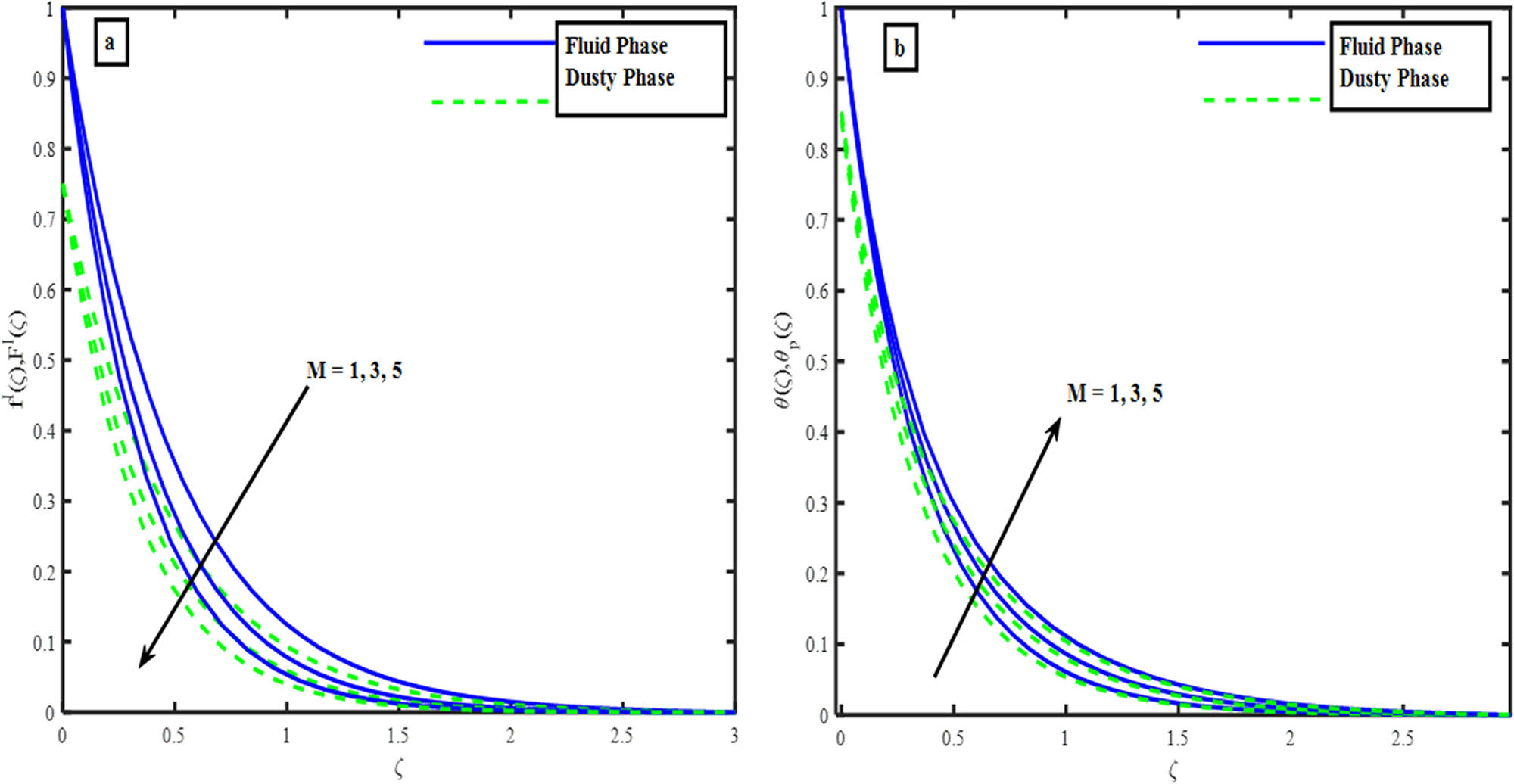
(a) Impact of

(a) Impact of

(a) Impact of

(a) Impact of

(a) Impact of
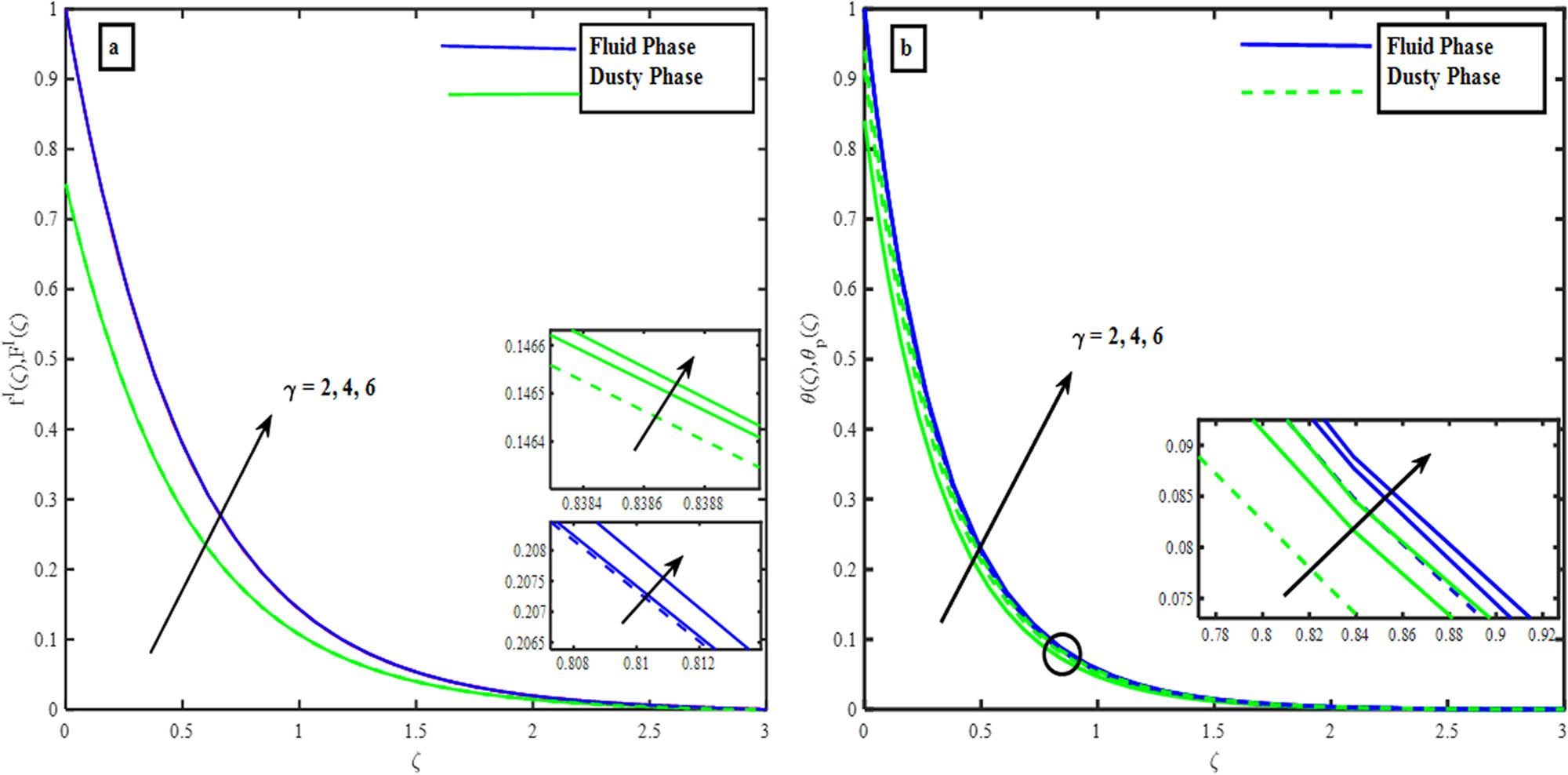
(a) Impact of

Impact of

Comparison of Case 1 and Case 2 with Nusselt number.
Figure 2(a) and (b) indicates the gradients of velocity and temperature within the nanofluid and dust phases for diverse values of
Figure 5(a) and (b) portray the fluctuations in the temperature and velocity profiles of the dust and nanofluid phases in response to alterations in
Figure 7(a) and (b) depicts the effect of dust particle volume fraction
Figure 9(a) demonstrates the effects of the interaction parameter for temperature
Figure 10 illustrates the comparison between Case 1 and Case 2 in terms of the Nusselt number across multiple runs. The figure provides a clear visualization of the differences in heat transfer characteristics between the two cases. Additionally, to further support the numerical data and enhance result interpretation. These additional figures offer a deeper and more detailed understanding of the results and validate the numerical findings effectively.
3.1 RSM
RSM represents a comprehensive collection of statistical and mathematical methodologies utilized in the realm of experimental design, aimed at the enhancement of a system’s response. The resultant output or response is typically contingent upon multiple independent variables. These input factors, commonly denoted as independent variables, frequently display interactive characteristics and may substantially affect the overall outcome, which is technically referred to as the “response.” Within the paradigm of RSM, errors are perceived as stochastic phenomena, thereby augmenting the dependability of response predictions. This methodological approach is particularly beneficial in contexts where direct evaluations, such as finite element methods or computational fluid dynamics become excessively costly and temporally demanding; as a result, it alleviates the related expenses and computational complexities. RSM lessens the influence of extrinsic disturbances on outcomes by synchronizing the optimization process with the optimal conditions of the input variables. It encompasses various design types of RSM, including Box-Behnken, central composite design, and D-Optimal; each of these designs possesses unique advantages that facilitate the efficient investigation of factor interactions, thereby supporting the optimization process.
3.1.1 RSM optimization outcomes
This investigation is comprised of three principal components, magnetic field
RSM parameters, with their key factors, symbols, and levels
| Key factors | Symbols | Levels | ||
|---|---|---|---|---|
| −1 (Low) | 0 (Medium) | 1 (High) | ||
|
|
|
1 | 3 | 5 |
|
|
|
2 | 4 | 6 |
|
|
|
1 | 4 | 8 |
Heat transfer rate experiment design and outcomes
| Runs | Coded values | Real values | Response | |||||
|---|---|---|---|---|---|---|---|---|
|
|
|
|
|
|
|
Nus1 | Nus2 | |
| 1 | −1 | −1 | −1 | 1 | 2 | 1 | 3.104788 | 0.842081 |
| 2 | 1 | −1 | −1 | 5 | 2 | 1 | 2.863469 | 0.852499 |
| 3 | −1 | 1 | −1 | 1 | 6 | 1 | 3.085273 | 0.842255 |
| 4 | 1 | 1 | −1 | 5 | 6 | 1 | 2.847711 | 0.852602 |
| 5 | −1 | −1 | 1 | 1 | 2 | 8 | 3.239577 | 0.832719 |
| 6 | 1 | −1 | 1 | 5 | 2 | 8 | 3.017428 | 0.84667 |
| 7 | −1 | 1 | 1 | 1 | 6 | 8 | 3.21768 | 0.832878 |
| 8 | 1 | 1 | 1 | 5 | 6 | 8 | 2.999941 | 0.846787 |
| 9 | −1 | 0 | 0 | 1 | 4 | 4 | 3.157547 | 0.838154 |
| 10 | 1 | 0 | 0 | 5 | 4 | 4 | 2.928464 | 0.850075 |
| 11 | 0 | −1 | 0 | 3 | 2 | 4 | 3.042509 | 0.845496 |
| 12 | 0 | 0 | 0 | 3 | 4 | 4 | 3.033439 | 0.845564 |
| 13 | 0 | 0 | −1 | 3 | 4 | 1 | 2.965272 | 0.848649 |
| 14 | 0 | 0 | 0 | 3 | 4 | 4 | 3.033439 | 0.845564 |
| 15 | 0 | 0 | 0 | 3 | 4 | 4 | 3.033439 | 0.845564 |
| 16 | 0 | 0 | 0 | 3 | 4 | 4 | 3.033439 | 0.845564 |
| 17 | 0 | 0 | 0 | 3 | 4 | 4 | 3.033439 | 0.845564 |
| 18 | 0 | 0 | 0 | 3 | 4 | 4 | 3.033439 | 0.845564 |
| 19 | 0 | 0 | 0 | 3 | 4 | 4 | 3.033439 | 0.845564 |
| 20 | 0 | 0 | 0 | 3 | 4 | 4 | 3.033439 | 0.845564 |
3.1.2 RSM graphical analysis
Figures 11–22 illustrate the variations in two-dimensional contour plots and three-dimensional surface plots related to various parameters for the Nusselt number of nanofluids
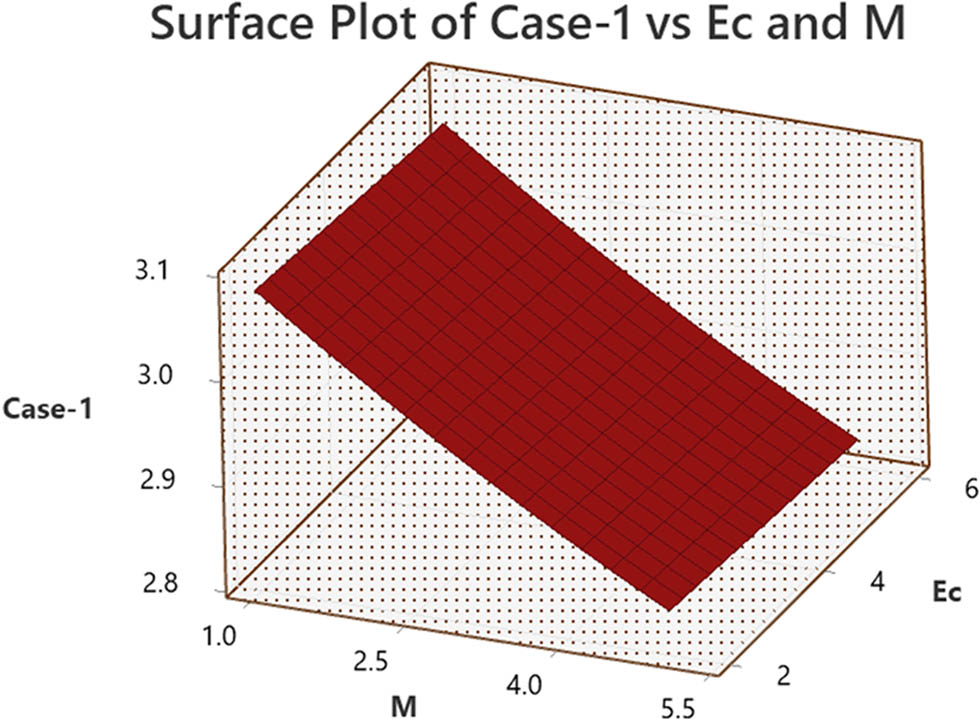
Surface plot of

Contour plot of

Surface plot of

Contour plot of

Surface plot of

Contour plot of

Surface plot of

Contour plot of

Surface plot of

Contour plot of
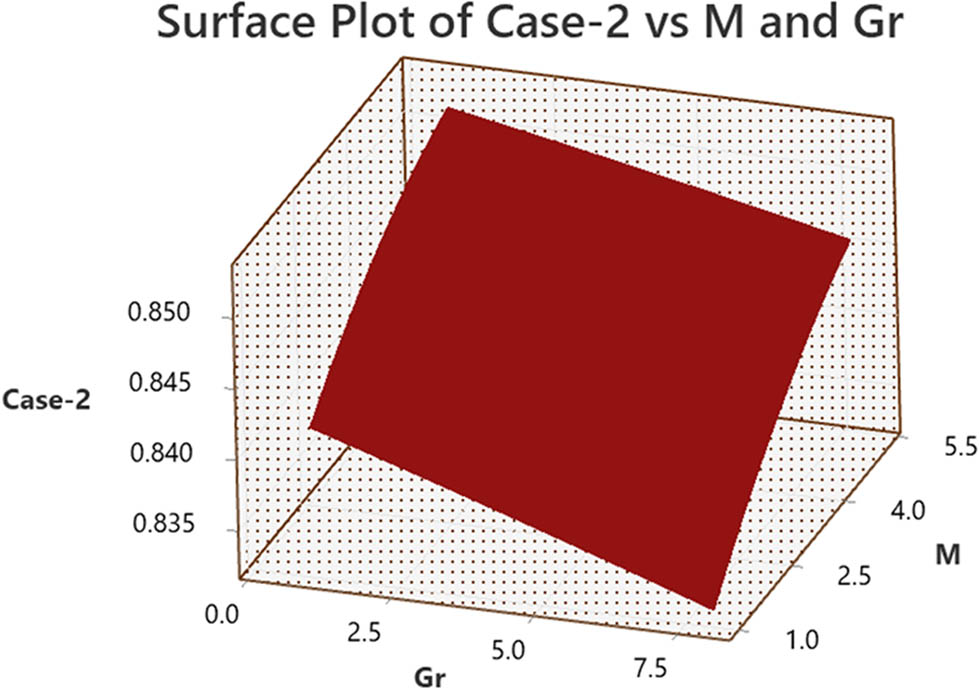
Surface plot of

Contour plot of
Tables 3 and 4 display the fluctuations in skin friction and Nusselt number for the nanofluid phase and dust phase. The magnetic field
This table shows the skin friction and nusselt number for the fluid phase case
|
|
|
|
|
|
|
|
|
|
|
|
|---|---|---|---|---|---|---|---|---|---|---|
| 1.0 | 2.072139 | 3.090882 | ||||||||
| 3.0 | 2.548240 | 2.958027 | ||||||||
| 5.0 | 2.949437 | 2.845949 | ||||||||
| 1.0 | 2.121407 | 3.616987 | ||||||||
| 3.0 | 2.484541 | 4.527131 | ||||||||
| 5.0 | 2.800470 | 5.288498 | ||||||||
| 1.0 | 1.928040 | 3.105494 | ||||||||
| 3.0 | 1.935286 | 3.128804 | ||||||||
| 5.0 | 1.937677 | 3.133205 | ||||||||
| 1.0 | 1.935102 | 3.101575 | ||||||||
| 3.0 | 1.935242 | 3.122112 | ||||||||
| 5.0 | 1.935286 | 3.128804 | ||||||||
| 2.0 | 1.935286 | 3.128804 | ||||||||
| 4.0 | 2.437805 | 2.988922 | ||||||||
| 6.0 | 2.854360 | 2.872443 | ||||||||
| 2.0 | 1.935286 | 3.128804 | ||||||||
| 4.0 | 1.935054 | 3.095965 | ||||||||
| 6.0 | 1.934967 | 3.083702 | ||||||||
| 2.0 | 1.935272 | 3.126303 | ||||||||
| 4.0 | 1.935213 | 3.116297 | ||||||||
| 6.0 | 1.935154 | 3.106292 | ||||||||
| 0.1 | 1.935286 | 3.128804 | ||||||||
| 0.3 | 2.133678 | 3.073778 | ||||||||
| 0.5 | 2.451317 | 2.985143 | ||||||||
| 1.0 | 1.866490 | 3.144675 | ||||||||
| 4.0 | 1.580726 | 3.206252 | ||||||||
| 8.0 | 1.217371 | 3.276760 |
This table represents the skin friction and nusselt number for the dusty phase case
|
|
|
|
|
|
|
|
|
|
|
|
|---|---|---|---|---|---|---|---|---|---|---|
| 1.0 | 0.750098 | 0.843008 | ||||||||
| 3.0 | 0.749996 | 0.849284 | ||||||||
| 5.0 | 0.749946 | 0.853057 | ||||||||
| 1.0 | 0.750129 | 0.838974 | ||||||||
| 3.0 | 0.750101 | 0.836746 | ||||||||
| 5.0 | 0.750082 | 0.835489 | ||||||||
| 1.0 | 0.500270 | 0.848173 | ||||||||
| 3.0 | 0.750144 | 0.840669 | ||||||||
| 5.0 | 0.833425 | 0.838265 | ||||||||
| 1.0 | 0.750142 | 0.516367 | ||||||||
| 3.0 | 0.750144 | 0.760420 | ||||||||
| 5.0 | 0.750144 | 0.840669 | ||||||||
| 2.0 | 0.750144 | 0.840669 | ||||||||
| 4.0 | 0.750013 | 0.848034 | ||||||||
| 6.0 | 0.749957 | 0.852259 | ||||||||
| 2.0 | 0.750144 | 0.840669 | ||||||||
| 4.0 | 0.750141 | 0.913477 | ||||||||
| 6.0 | 0.750136 | 0.940607 | ||||||||
| 2.0 | 0.750144 | 0.840693 | ||||||||
| 4.0 | 0.750144 | 0.840789 | ||||||||
| 6.0 | 0.750143 | 0.840884 | ||||||||
| 0.1 | 0.750144 | 0.840669 | ||||||||
| 0.3 | 0.750081 | 0.843969 | ||||||||
| 0.5 | 0.750011 | 0.848194 | ||||||||
| 1.0 | 0.750475 | 0.839640 | ||||||||
| 4.0 | 0.752507 | 0.835302 | ||||||||
| 8.0 | 0.756392 | 0.829558 |
To validate the present numerical model, Table 5 presents a comparative analysis with data from previously published research. The results exhibit a strong agreement between the values, demonstrating the reliability of the current approach.
4 Conclusion
In this study, the RSM has been applied to optimize the velocity and heat transfer of nanofluid including dust particles through inclined stretching sheet. The influence of the flow problem has been considered in terms of velocity and thermal effect. According to the computational results, nanofluid containing dust particles are extremely important and has many uses in automotive engines, heat exchangers, chillers, and other technical domains. The most important results are summarized as follows.
Velocity gradient of nanofluid and dust particles phase increases with the increment in the local Grashof number, while the temperature profile shows decreasing behavior,
On the other hand, behavior of temperature and velocity profile is opposite for magnetic field and porosity parameter,
With the rising values of dust particle volume fraction, there is a tendency for it to decelerate the velocity and increases the flow’s temperature profiles,
It is noted that for a dusty fluid, the Nusselt number increases with the increases in
The skin friction values for the dusty fluid are increased with
Additionally, the study highlights the significant role of dusty fluid interactions in controlling thermal transport properties under MHD and porous media influence. These results offer a foundation for optimizing thermal management systems and suggest avenues for future research on hybrid nanofluids, unsteady flows, and fractional modeling techniques.
Acknowledgments
The authors acknowledge the support by the Korea Institute of Energy Technology Evaluation and Planning (KETEP) and the Ministry of Trade, Industry & Energy (MOTIE) of the Republic of Korea (No. RS-2025-02315209).
-
Funding information: The support by the Korea Institute of Energy Technology Evaluation and Planning (KETEP) and the Ministry of Trade, Industry & Energy (MOTIE) of the Republic of Korea (No. RS-2025-02315209).
-
Author contributions: U.A.: data curation; software; and writing – original draft. M.D.K.: formal analysis; resources; and software. A.A.: supervision; validation; and writing – review and editing. N.A.S.: methodology; resources; and software. J.D.C.: formal analysis; validation; and writing – review and editing. All authors have accepted responsibility for the entire content of this manuscript and approved its submission.
-
Conflict of interest: The authors state no conflict of interest.
-
Data availability statement: All data generated or analyzed during this study are included in this published article.
References
[1] Cengel Y, Cimbala J. Fluid mechanics fundamentals and applications. New York, USA: Mc Graw Hill; 2013.Suche in Google Scholar
[2] Yamaguchi H. Engineering fluid mechanics. Berlin, Germany: Springer Science & Business Media; 2008.Suche in Google Scholar
[3] Saffman PG. On the stability of laminar flow of a dusty gas. J Fluid Mech. 1962;13:120–8. 10.1017/S0022112062000555.Suche in Google Scholar
[4] Chakrabarti A, Gupta AS. Hydromagnetic flow and heat transfer over a stretching sheet. Q Appl Math. 1979;37(1):73–8.10.1090/qam/99636Suche in Google Scholar
[5] Hussain M, Ali B, Awan AU, Alharthi M, Alrashedi Y. Role of nanoparticle radius for heat transfer optimization in MHD dusty fluid across stretching sheet. J Therm Anal Calorim. 2024;149(24):15179–92. 10.1007/s10973-024-13738-9.Suche in Google Scholar
[6] Singh AK, Singh NP. MHD flow of a dusty viscoelastic liquid through a porous medium between two inclined parallel plates. Proc Natl Acad Sci, India Sect A, Phys Sci. 1996;66(pt. 2):143–50.Suche in Google Scholar
[7] Siddiqa S, Abrar MN, Hossain MA, Awais M. Dynamics of two-phase dusty fluid flow along a wavy surface. Int J Nonlinear Sci Numer Simul. 2016;17(5):185–93. 10.1515/ijnsns-2015-0044.Suche in Google Scholar
[8] Abrar MN, Kosar S, Razzaq R. Thermal investigation of micro-polar tangent hyperbolic flow using a hybrid nanofluid approach. J Appl Phys. 2024;137(3):34302. 10.22541/au.171785383.38918385/v1.Suche in Google Scholar
[9] Johan NA, Mansur S. Boundary layer flow of dusty nanofluid over stretching sheet with partial slip effects. J Adv Res Fluid Mech Therm Sci. 2021;87(2):118–26.10.37934/arfmts.87.2.118126Suche in Google Scholar
[10] Konch J, Hazarika GC. Effects of variable viscosity and thermal conductivity on MHD free convection flow of dusty fluid along a vertical stretching sheet with heat generation. Int Res J Eng Technol. 2016;3(2):1029–38.Suche in Google Scholar
[11] Gireesha BJ, Ramesh GK, Lokesh HJ, Bagewadi CS. Boundary layer flow and heat transfer of a dusty fluid over a stretching vertical surface. Appl Math. 2011;2(4):475–81. 10.4236/am.2011.24061.Suche in Google Scholar
[12] Ramesh GK, Gireesha BJ. Flow over a stretching sheet in a dusty fluid with radiation effect. J Heat Transf. 2013;135(10):102702. 10.1115/1.4024587.Suche in Google Scholar
[13] Mishra SK, Rauta AK. Boundary layer flow & heat transfer of an unsteady dusty fuid over a stretching sheet. Int J Sci Eng Res. 2015;6:182–9.Suche in Google Scholar
[14] Roy NC, Saha G. Heat and mass transfer of dusty Casson fluid over a stretching sheet. Arab J Sci Eng. 2022;47(12):16091–101. 10.1007/s13369-022-06854-x.Suche in Google Scholar
[15] Bansal S, Pal J, Bisht MS, Fartyal P. Influence of nanofluids on boundary layer flow over an inclined stretching sheet in a porous media along with magnetic field. Int J Math Eng Manag Sci. 2024;9(2):267–82. 10.33889/IJMEMS.2024.9.2.014.Suche in Google Scholar
[16] Parmar A, Kumar P, Choudhary R, Garg S, Jain A. Unsteady inclined MHD Powell-Eyring fluid with microorganisms over an inclined permeable stretching sheet with zero mass flux and slip condition. Int J Appl Comput Math. 2024;10(5):148. 10.1007/s40819-024-01780-y.Suche in Google Scholar
[17] Razzaq R, Abrar MN, Sagheer S, Farooq U. Non-similar investigation of magnetohydrodynamics hybrid nanofluid flow over a porous medium with Joule heating and radiative effects. Chaos Solitons Fractals. 2024;189:115700. 10.1016/j.chaos.2024.115700.Suche in Google Scholar
[18] Abrar MN, Kosar S. Entropy generation and heat transfer characteristics in MHD Casson fluid flow over a wedge with viscous dissipation and thermal radiation. ZAMM‐Journal Appl Math Mech/Z Angew Math Mech. 2024;e202300666. 10.1002/zamm.202300666.Suche in Google Scholar
[19] Kalpana G, Saleem S. Heat transfer of magnetohydrodynamic stratified dusty fluid flow through an inclined irregular porous channel. Nanomaterials. 2022;12(19):3309. 10.3390/nano12193309.Suche in Google Scholar PubMed PubMed Central
[20] Saeed A, Kumam P, Nasir S, Gul T, Kumam W. Non-linear convective flow of the thin film nanofluid over an inclined stretching surface. Sci Rep. 2021;11(1):18410. 10.1038/s41598-021-97576-x.Suche in Google Scholar PubMed PubMed Central
[21] Srinivasulu T, Goud BS. Effect of inclined magnetic field on flow, heat and mass transfer of Williamson nanofluid over a stretching sheet. Case Stud Therm Eng. 2021;23:100819. 10.1016/j.csite.2020.100819.Suche in Google Scholar
[22] Reddy MS, Raju GSS, Reddy MS, Jayalakshmi K. Peristaltic MHD flow of a Bingham fluid through a porous medium in a channel. Afr J Sci Res. 2011;3(1):179–203.Suche in Google Scholar
[23] Sharma DK, Kirti D. MHD flow of dusty viscous fluid through a porous medium bounded by an oscillating porous plate in slip flow regime. J Emerg Technol Innov Res. 2022;9:2349–5162.Suche in Google Scholar
[24] Zada J, Khan A, Farooq M, Alsubaie AS, Rezapour S, Inc M. Computation of stretching disks fluid flow of hybrid nanofluid under the effect of variable magnetic field. ZAMM‐J Appl Math Mech/Z Angew Math Mech. 2025;105(1):e202400114. 10.1002/zamm.202400114.Suche in Google Scholar
[25] Bhatti MM, Zeeshan A, Ijaz N, Bég OA, Kadir A. Mathematical modelling of nonlinear thermal radiation effects on EMHD peristaltic pumping of viscoelastic dusty fluid through a porous medium duct. Eng Sci Technol Int J. 2017;20(3):1129–39. 10.1016/j.jestch.2016.11.003.Suche in Google Scholar
[26] Abbas Z, Hasnain J, Sajid M. Effects of slip on MHD flow of a dusty fluid over a stretching sheet through porous space. J Eng Thermo Phys. 2019;28:84–102. 10.1134/S1810232819010077.Suche in Google Scholar
[27] Ezzat MA, El-Bary AA, Morsey MM. Space approach to the hydro-magnetic flow of a dusty fluid through a porous medium. Comput Math Appl. 2010;59(8):2868–79. 10.1016/j.camwa.2010.02.004.Suche in Google Scholar
[28] Kumar MD, Ahammad NA, Raju CSK, Yook SJ, Shah NA, Tag SM. Response surface methodology optimisation of dynamical solutions of Lie group analysis for nonlinear radiated magnetised unsteady wedge: Machine learning approach (gradient descent). Alex Eng J. 2023;74:29–50. 10.1016/j.aej.2023.05.009.Suche in Google Scholar
[29] Sajjan K, Shah NA, Ahammad NA, Raju CSK, Kumar MD, Weera W. Nonlinear Boussinesq and Rosseland approximations on 3D flow in an interruption of Ternary nanoparticles with various shapes of densities and conductivity properties. AIMS Math. 2022;7(10):18416–49. 10.3934/math.20221014.Suche in Google Scholar
[30] Farooq U, Imran M, Fatima M. Computational insights into the thermal behavior of SWCNT-Fe3O4 and MWCNT-CuO hybrid nanofluids in stretching cylinder with response surface methodology. Multiscale and Multidiscip Model. Exp. and Des. 2025;8(4):221.10.1007/s41939-025-00786-3Suche in Google Scholar
[31] Shah SZH, Ayub A, Sabir Z, Adel W, Shah NA, Yook SJ. Insight into the dynamics of time-dependent cross nanofluid on a melting surface subject to cubic autocatalysis. Case Stud Therm Eng. 2021;27:101227. 10.1016/j.csite.2021.101227.Suche in Google Scholar
[32] Subray PA, Hanumagowda BN, Raju CSK, Varma SVK, Jagdish P, Yook SJ, et al. Analytical analysis of inclined three-layered composite channel with cobalt ferrite nanoparticles and Hall current in Darcy medium. Propuls Power Res. 2023;12(4):523–38. 10.1016/j.jppr.2023.11.001.Suche in Google Scholar
[33] Naramgari S, Sulochana C. MHD flow of dusty nanofluid over a stretching surface with volume fraction of dust particles. Ain Shams Eng J. 2016;7(2):709–16. 10.1016/j.asej.2015.05.015.Suche in Google Scholar
[34] Ramesh GK, Gireesha BJ, Bagewadi CS. Heat transfer in MHD dusty boundary layer flow over an inclined stretching sheet with non‐uniform heat source/sink. Adv Math Phys. 2012;2012(1):657805. 10.1155/2012/657805.Suche in Google Scholar
[35] Abel MS, Mahesha NJAMM. Heat transfer in MHD viscoelastic fluid flow over a stretching sheet with variable thermal conductivity, non-uniform heat source and radiation. Appl Math Model. 2008;32(10):1965–83. 10.1016/j.apm.2007.06.038.Suche in Google Scholar
© 2025 the author(s), published by De Gruyter
This work is licensed under the Creative Commons Attribution 4.0 International License.
Artikel in diesem Heft
- Research Articles
- MHD radiative mixed convective flow of a sodium alginate-based hybrid nanofluid over a convectively heated extending sheet with Joule heating
- Experimental study of mortar incorporating nano-magnetite on engineering performance and radiation shielding
- Multicriteria-based optimization and multi-variable non-linear regression analysis of concrete containing blends of nano date palm ash and eggshell powder as cementitious materials
- A promising Ag2S/poly-2-amino-1-mercaptobenzene open-top spherical core–shell nanocomposite for optoelectronic devices: A one-pot technique
- Biogenic synthesized selenium nanoparticles combined chitosan nanoparticles controlled lung cancer growth via ROS generation and mitochondrial damage pathway
- Fabrication of PDMS nano-mold by deposition casting method
- Stimulus-responsive gradient hydrogel micro-actuators fabricated by two-photon polymerization-based 4D printing
- Physical aspects of radiative Carreau nanofluid flow with motile microorganisms movement under yield stress via oblique penetrable wedge
- Effect of polar functional groups on the hydrophobicity of carbon nanotubes-bacterial cellulose nanocomposite
- Review in green synthesis mechanisms, application, and future prospects for Garcinia mangostana L. (mangosteen)-derived nanoparticles
- Entropy generation and heat transfer in nonlinear Buoyancy–driven Darcy–Forchheimer hybrid nanofluids with activation energy
- Green synthesis of silver nanoparticles using Ginkgo biloba seed extract: Evaluation of antioxidant, anticancer, antifungal, and antibacterial activities
- A numerical analysis of heat and mass transfer in water-based hybrid nanofluid flow containing copper and alumina nanoparticles over an extending sheet
- Investigating the behaviour of electro-magneto-hydrodynamic Carreau nanofluid flow with slip effects over a stretching cylinder
- Electrospun thermoplastic polyurethane/nano-Ag-coated clear aligners for the inhibition of Streptococcus mutans and oral biofilm
- Investigation of the optoelectronic properties of a novel polypyrrole-multi-well carbon nanotubes/titanium oxide/aluminum oxide/p-silicon heterojunction
- Novel photothermal magnetic Janus membranes suitable for solar water desalination
- Green synthesis of silver nanoparticles using Ageratum conyzoides for activated carbon compositing to prepare antimicrobial cotton fabric
- Activation energy and Coriolis force impact on three-dimensional dusty nanofluid flow containing gyrotactic microorganisms: Machine learning and numerical approach
- Machine learning analysis of thermo-bioconvection in a micropolar hybrid nanofluid-filled square cavity with oxytactic microorganisms
- Research and improvement of mechanical properties of cement nanocomposites for well cementing
- Thermal and stability analysis of silver–water nanofluid flow over unsteady stretching sheet under the influence of heat generation/absorption at the boundary
- Cobalt iron oxide-infused silicone nanocomposites: Magnetoactive materials for remote actuation and sensing
- Magnesium-reinforced PMMA composite scaffolds: Synthesis, characterization, and 3D printing via stereolithography
- Bayesian inference-based physics-informed neural network for performance study of hybrid nanofluids
- Numerical simulation of non-Newtonian hybrid nanofluid flow subject to a heterogeneous/homogeneous chemical reaction over a Riga surface
- Enhancing the superhydrophobicity, UV-resistance, and antifungal properties of natural wood surfaces via in situ formation of ZnO, TiO2, and SiO2 particles
- Synthesis and electrochemical characterization of iron oxide/poly(2-methylaniline) nanohybrids for supercapacitor application
- Impacts of double stratification on thermally radiative third-grade nanofluid flow on elongating cylinder with homogeneous/heterogeneous reactions by implementing machine learning approach
- Synthesis of Cu4O3 nanoparticles using pumpkin seed extract: Optimization, antimicrobial, and cytotoxicity studies
- Cationic charge influence on the magnetic response of the Fe3O4–[Me2+ 1−y Me3+ y (OH2)] y+(Co3 2−) y/2·mH2O hydrotalcite system
- Pressure sensing intelligent martial arts short soldier combat protection system based on conjugated polymer nanocomposite materials
- Magnetohydrodynamics heat transfer rate under inclined buoyancy force for nano and dusty fluids: Response surface optimization for the thermal transport
- Fly ash and nano-graphene enhanced stabilization of engine oil-contaminated soils
- Enhancing natural fiber-reinforced biopolymer composites with graphene nanoplatelets: Mechanical, morphological, and thermal properties
- Performance evaluation of dual-scale strengthened co-bonded single-lap joints using carbon nanotubes and Z-pins with ANN
- Computational works of blood flow with dust particles and partially ionized containing tiny particles on a moving wedge: Applications of nanotechnology
- Hybridization of biocomposites with oil palm cellulose nanofibrils/graphene nanoplatelets reinforcement in green epoxy: A study of physical, thermal, mechanical, and morphological properties
- Design and preparation of micro-nano dual-scale particle-reinforced Cu–Al–V alloy: Research on the aluminothermic reduction process
- Spectral quasi-linearization and response optimization on magnetohydrodynamic flow via stenosed artery with hybrid and ternary solid nanoparticles: Support vector machine learning
- Ferrite/curcumin hybrid nanocomposite formulation: Physicochemical characterization, anticancer activity, and apoptotic and cell cycle analyses in skin cancer cells
- Enhanced therapeutic efficacy of Tamoxifen against breast cancer using extra virgin olive oil-based nanoemulsion delivery system
- A titanium oxide- and silver-based hybrid nanofluid flow between two Riga walls that converge and diverge through a machine-learning approach
- Enhancing convective heat transfer mechanisms through the rheological analysis of Casson nanofluid flow towards a stagnation point over an electro-magnetized surface
- Intrinsic self-sensing cementitious composites with hybrid nanofillers exhibiting excellent piezoresistivity
- Research on mechanical properties and sulfate erosion resistance of nano-reinforced coal gangue based geopolymer concrete
- Impact of surface and configurational features of chemically synthesized chains of Ni nanostars on the magnetization reversal process
- Porous sponge-like AsOI/poly(2-aminobenzene-1-thiol) nanocomposite photocathode for hydrogen production from artificial and natural seawater
- Multifaceted insights into WO3 nanoparticle-coupled antibiotics to modulate resistance in enteric pathogens of Houbara bustard birds
- Synthesis of sericin-coated silver nanoparticles and their applications for the anti-bacterial finishing of cotton fabric
- Enhancing chloride resistance of freeze–thaw affected concrete through innovative nanomaterial–polymer hybrid cementitious coating
- Development and performance evaluation of green aluminium metal matrix composites reinforced with graphene nanopowder and marble dust
- Morphological, physical, thermal, and mechanical properties of carbon nanotubes reinforced arrowroot starch composites
- Influence of the graphene oxide nanosheet on tensile behavior and failure characteristics of the cement composites after high-temperature treatment
- Central composite design modeling in optimizing heat transfer rate in the dissipative and reactive dynamics of viscoplastic nanomaterials deploying Joule and heat generation aspects
- Double diffusion of nano-enhanced phase change materials in connected porous channels: A hybrid ISPH-XGBoost approach
- Synergistic impacts of Thompson–Troian slip, Stefan blowing, and nonuniform heat generation on Casson nanofluid dynamics through a porous medium
- Optimization of abrasive water jet machining parameters for basalt fiber/SiO2 nanofiller reinforced composites
- Enhancing aesthetic durability of Zisha teapots via TiO2 nanoparticle surface modification: A study on self-cleaning, antimicrobial, and mechanical properties
- Nanocellulose solution based on iron(iii) sodium tartrate complexes
- Combating multidrug-resistant infections: Gold nanoparticles–chitosan–papain-integrated dual-action nanoplatform for enhanced antibacterial activity
- Novel royal jelly-mediated green synthesis of selenium nanoparticles and their multifunctional biological activities
- Direct bandgap transition for emission in GeSn nanowires
- Synthesis of ZnO nanoparticles with different morphologies using a microwave-based method and their antimicrobial activity
- Numerical investigation of convective heat and mass transfer in a trapezoidal cavity filled with ternary hybrid nanofluid and a central obstacle
- Halloysite nanotube enhanced polyurethane nanocomposites for advanced electroinsulating applications
- Low molar mass ionic liquid’s modified carbon nanotubes and its role in PVDF crystalline stress generation
- Green synthesis of polydopamine-functionalized silver nanoparticles conjugated with Ceftazidime: in silico and experimental approach for combating antibiotic-resistant bacteria and reducing toxicity
- Evaluating the influence of graphene nano powder inclusion on mechanical, vibrational and water absorption behaviour of ramie/abaca hybrid composites
- Dynamic-behavior of Casson-type hybrid nanofluids due to a stretching sheet under the coupled impacts of boundary slip and reaction-diffusion processes
- Influence of polyvinyl alcohol on the physicochemical and self-sensing properties of nano carbon black reinforced cement mortar
- Advanced machine learning approaches for predicting compressive and flexural strength of carbon nanotube–reinforced cement composites: a comparative study and model interpretability analysis
- Review Articles
- A comprehensive review on hybrid plasmonic waveguides: Structures, applications, challenges, and future perspectives
- Nanoparticles in low-temperature preservation of biological systems of animal origin
- Fluorescent sulfur quantum dots for environmental monitoring
- Nanoscience systematic review methodology standardization
- Nanotechnology revolutionizing osteosarcoma treatment: Advances in targeted kinase inhibitors
- AFM: An important enabling technology for 2D materials and devices
- Carbon and 2D nanomaterial smart hydrogels for therapeutic applications
- Principles, applications and future prospects in photodegradation systems
- Do gold nanoparticles consistently benefit crop plants under both non-stressed and abiotic stress conditions?
- An updated overview of nanoparticle-induced cardiovascular toxicity
- Arginine as a promising amino acid for functionalized nanosystems: Innovations, challenges, and future directions
- Advancements in the use of cancer nanovaccines: Comprehensive insights with focus on lung and colon cancer
- Membrane-based biomimetic delivery systems for glioblastoma multiforme therapy
- The drug delivery systems based on nanoparticles for spinal cord injury repair
- Green synthesis, biomedical effects, and future trends of Ag/ZnO bimetallic nanoparticles: An update
- Application of magnesium and its compounds in biomaterials for nerve injury repair
- Micro/nanomotors in biomedicine: Construction and applications
- Hydrothermal synthesis of biomass-derived CQDs: Advances and applications
- Research progress in 3D bioprinting of skin: Challenges and opportunities
- Review on bio-selenium nanoparticles: Synthesis, protocols, and applications in biomedical processes
- Gold nanocrystals and nanorods functionalized with protein and polymeric ligands for environmental, energy storage, and diagnostic applications: A review
- An in-depth analysis of rotational and non-rotational piezoelectric energy harvesting beams: A comprehensive review
- Advancements in perovskite/CIGS tandem solar cells: Material synergies, device configurations, and economic viability for sustainable energy
- Deep learning in-depth analysis of crystal graph convolutional neural networks: A new era in materials discovery and its applications
- Review of recent nano TiO2 film coating methods, assessment techniques, and key problems for scaleup
- Antioxidant quantum dots for spinal cord injuries: A review on advancing neuroprotection and regeneration in neurological disorders
- Rise of polycatecholamine ultrathin films: From synthesis to smart applications
- Advancing microencapsulation strategies for bioactive compounds: Enhancing stability, bioavailability, and controlled release in food applications
- Advances in the design and manipulation of self-assembling peptide and protein nanostructures for biomedical applications
- Photocatalytic pervious concrete systems: from classic photocatalysis to luminescent photocatalysis
- Corrigendum
- Corrigendum to “Synthesis and characterization of smart stimuli-responsive herbal drug-encapsulated nanoniosome particles for efficient treatment of breast cancer”
- Special Issue on Advanced Nanomaterials for Carbon Capture, Environment and Utilization for Energy Sustainability - Part III
- Efficiency optimization of quantum dot photovoltaic cell by solar thermophotovoltaic system
- Exploring the diverse nanomaterials employed in dental prosthesis and implant techniques: An overview
- Electrochemical investigation of bismuth-doped anode materials for low‑temperature solid oxide fuel cells with boosted voltage using a DC-DC voltage converter
- Synthesis of HfSe2 and CuHfSe2 crystalline materials using the chemical vapor transport method and their applications in supercapacitor energy storage devices
- Special Issue on Green Nanotechnology and Nano-materials for Environment Sustainability
- Influence of nano-silica and nano-ferrite particles on mechanical and durability of sustainable concrete: A review
- Surfaces and interfaces analysis on different carboxymethylation reaction time of anionic cellulose nanoparticles derived from oil palm biomass
- Processing and effective utilization of lignocellulosic biomass: Nanocellulose, nanolignin, and nanoxylan for wastewater treatment
- Retraction
- Retraction of “Aging assessment of silicone rubber materials under corona discharge accompanied by humidity and UV radiation”
Artikel in diesem Heft
- Research Articles
- MHD radiative mixed convective flow of a sodium alginate-based hybrid nanofluid over a convectively heated extending sheet with Joule heating
- Experimental study of mortar incorporating nano-magnetite on engineering performance and radiation shielding
- Multicriteria-based optimization and multi-variable non-linear regression analysis of concrete containing blends of nano date palm ash and eggshell powder as cementitious materials
- A promising Ag2S/poly-2-amino-1-mercaptobenzene open-top spherical core–shell nanocomposite for optoelectronic devices: A one-pot technique
- Biogenic synthesized selenium nanoparticles combined chitosan nanoparticles controlled lung cancer growth via ROS generation and mitochondrial damage pathway
- Fabrication of PDMS nano-mold by deposition casting method
- Stimulus-responsive gradient hydrogel micro-actuators fabricated by two-photon polymerization-based 4D printing
- Physical aspects of radiative Carreau nanofluid flow with motile microorganisms movement under yield stress via oblique penetrable wedge
- Effect of polar functional groups on the hydrophobicity of carbon nanotubes-bacterial cellulose nanocomposite
- Review in green synthesis mechanisms, application, and future prospects for Garcinia mangostana L. (mangosteen)-derived nanoparticles
- Entropy generation and heat transfer in nonlinear Buoyancy–driven Darcy–Forchheimer hybrid nanofluids with activation energy
- Green synthesis of silver nanoparticles using Ginkgo biloba seed extract: Evaluation of antioxidant, anticancer, antifungal, and antibacterial activities
- A numerical analysis of heat and mass transfer in water-based hybrid nanofluid flow containing copper and alumina nanoparticles over an extending sheet
- Investigating the behaviour of electro-magneto-hydrodynamic Carreau nanofluid flow with slip effects over a stretching cylinder
- Electrospun thermoplastic polyurethane/nano-Ag-coated clear aligners for the inhibition of Streptococcus mutans and oral biofilm
- Investigation of the optoelectronic properties of a novel polypyrrole-multi-well carbon nanotubes/titanium oxide/aluminum oxide/p-silicon heterojunction
- Novel photothermal magnetic Janus membranes suitable for solar water desalination
- Green synthesis of silver nanoparticles using Ageratum conyzoides for activated carbon compositing to prepare antimicrobial cotton fabric
- Activation energy and Coriolis force impact on three-dimensional dusty nanofluid flow containing gyrotactic microorganisms: Machine learning and numerical approach
- Machine learning analysis of thermo-bioconvection in a micropolar hybrid nanofluid-filled square cavity with oxytactic microorganisms
- Research and improvement of mechanical properties of cement nanocomposites for well cementing
- Thermal and stability analysis of silver–water nanofluid flow over unsteady stretching sheet under the influence of heat generation/absorption at the boundary
- Cobalt iron oxide-infused silicone nanocomposites: Magnetoactive materials for remote actuation and sensing
- Magnesium-reinforced PMMA composite scaffolds: Synthesis, characterization, and 3D printing via stereolithography
- Bayesian inference-based physics-informed neural network for performance study of hybrid nanofluids
- Numerical simulation of non-Newtonian hybrid nanofluid flow subject to a heterogeneous/homogeneous chemical reaction over a Riga surface
- Enhancing the superhydrophobicity, UV-resistance, and antifungal properties of natural wood surfaces via in situ formation of ZnO, TiO2, and SiO2 particles
- Synthesis and electrochemical characterization of iron oxide/poly(2-methylaniline) nanohybrids for supercapacitor application
- Impacts of double stratification on thermally radiative third-grade nanofluid flow on elongating cylinder with homogeneous/heterogeneous reactions by implementing machine learning approach
- Synthesis of Cu4O3 nanoparticles using pumpkin seed extract: Optimization, antimicrobial, and cytotoxicity studies
- Cationic charge influence on the magnetic response of the Fe3O4–[Me2+ 1−y Me3+ y (OH2)] y+(Co3 2−) y/2·mH2O hydrotalcite system
- Pressure sensing intelligent martial arts short soldier combat protection system based on conjugated polymer nanocomposite materials
- Magnetohydrodynamics heat transfer rate under inclined buoyancy force for nano and dusty fluids: Response surface optimization for the thermal transport
- Fly ash and nano-graphene enhanced stabilization of engine oil-contaminated soils
- Enhancing natural fiber-reinforced biopolymer composites with graphene nanoplatelets: Mechanical, morphological, and thermal properties
- Performance evaluation of dual-scale strengthened co-bonded single-lap joints using carbon nanotubes and Z-pins with ANN
- Computational works of blood flow with dust particles and partially ionized containing tiny particles on a moving wedge: Applications of nanotechnology
- Hybridization of biocomposites with oil palm cellulose nanofibrils/graphene nanoplatelets reinforcement in green epoxy: A study of physical, thermal, mechanical, and morphological properties
- Design and preparation of micro-nano dual-scale particle-reinforced Cu–Al–V alloy: Research on the aluminothermic reduction process
- Spectral quasi-linearization and response optimization on magnetohydrodynamic flow via stenosed artery with hybrid and ternary solid nanoparticles: Support vector machine learning
- Ferrite/curcumin hybrid nanocomposite formulation: Physicochemical characterization, anticancer activity, and apoptotic and cell cycle analyses in skin cancer cells
- Enhanced therapeutic efficacy of Tamoxifen against breast cancer using extra virgin olive oil-based nanoemulsion delivery system
- A titanium oxide- and silver-based hybrid nanofluid flow between two Riga walls that converge and diverge through a machine-learning approach
- Enhancing convective heat transfer mechanisms through the rheological analysis of Casson nanofluid flow towards a stagnation point over an electro-magnetized surface
- Intrinsic self-sensing cementitious composites with hybrid nanofillers exhibiting excellent piezoresistivity
- Research on mechanical properties and sulfate erosion resistance of nano-reinforced coal gangue based geopolymer concrete
- Impact of surface and configurational features of chemically synthesized chains of Ni nanostars on the magnetization reversal process
- Porous sponge-like AsOI/poly(2-aminobenzene-1-thiol) nanocomposite photocathode for hydrogen production from artificial and natural seawater
- Multifaceted insights into WO3 nanoparticle-coupled antibiotics to modulate resistance in enteric pathogens of Houbara bustard birds
- Synthesis of sericin-coated silver nanoparticles and their applications for the anti-bacterial finishing of cotton fabric
- Enhancing chloride resistance of freeze–thaw affected concrete through innovative nanomaterial–polymer hybrid cementitious coating
- Development and performance evaluation of green aluminium metal matrix composites reinforced with graphene nanopowder and marble dust
- Morphological, physical, thermal, and mechanical properties of carbon nanotubes reinforced arrowroot starch composites
- Influence of the graphene oxide nanosheet on tensile behavior and failure characteristics of the cement composites after high-temperature treatment
- Central composite design modeling in optimizing heat transfer rate in the dissipative and reactive dynamics of viscoplastic nanomaterials deploying Joule and heat generation aspects
- Double diffusion of nano-enhanced phase change materials in connected porous channels: A hybrid ISPH-XGBoost approach
- Synergistic impacts of Thompson–Troian slip, Stefan blowing, and nonuniform heat generation on Casson nanofluid dynamics through a porous medium
- Optimization of abrasive water jet machining parameters for basalt fiber/SiO2 nanofiller reinforced composites
- Enhancing aesthetic durability of Zisha teapots via TiO2 nanoparticle surface modification: A study on self-cleaning, antimicrobial, and mechanical properties
- Nanocellulose solution based on iron(iii) sodium tartrate complexes
- Combating multidrug-resistant infections: Gold nanoparticles–chitosan–papain-integrated dual-action nanoplatform for enhanced antibacterial activity
- Novel royal jelly-mediated green synthesis of selenium nanoparticles and their multifunctional biological activities
- Direct bandgap transition for emission in GeSn nanowires
- Synthesis of ZnO nanoparticles with different morphologies using a microwave-based method and their antimicrobial activity
- Numerical investigation of convective heat and mass transfer in a trapezoidal cavity filled with ternary hybrid nanofluid and a central obstacle
- Halloysite nanotube enhanced polyurethane nanocomposites for advanced electroinsulating applications
- Low molar mass ionic liquid’s modified carbon nanotubes and its role in PVDF crystalline stress generation
- Green synthesis of polydopamine-functionalized silver nanoparticles conjugated with Ceftazidime: in silico and experimental approach for combating antibiotic-resistant bacteria and reducing toxicity
- Evaluating the influence of graphene nano powder inclusion on mechanical, vibrational and water absorption behaviour of ramie/abaca hybrid composites
- Dynamic-behavior of Casson-type hybrid nanofluids due to a stretching sheet under the coupled impacts of boundary slip and reaction-diffusion processes
- Influence of polyvinyl alcohol on the physicochemical and self-sensing properties of nano carbon black reinforced cement mortar
- Advanced machine learning approaches for predicting compressive and flexural strength of carbon nanotube–reinforced cement composites: a comparative study and model interpretability analysis
- Review Articles
- A comprehensive review on hybrid plasmonic waveguides: Structures, applications, challenges, and future perspectives
- Nanoparticles in low-temperature preservation of biological systems of animal origin
- Fluorescent sulfur quantum dots for environmental monitoring
- Nanoscience systematic review methodology standardization
- Nanotechnology revolutionizing osteosarcoma treatment: Advances in targeted kinase inhibitors
- AFM: An important enabling technology for 2D materials and devices
- Carbon and 2D nanomaterial smart hydrogels for therapeutic applications
- Principles, applications and future prospects in photodegradation systems
- Do gold nanoparticles consistently benefit crop plants under both non-stressed and abiotic stress conditions?
- An updated overview of nanoparticle-induced cardiovascular toxicity
- Arginine as a promising amino acid for functionalized nanosystems: Innovations, challenges, and future directions
- Advancements in the use of cancer nanovaccines: Comprehensive insights with focus on lung and colon cancer
- Membrane-based biomimetic delivery systems for glioblastoma multiforme therapy
- The drug delivery systems based on nanoparticles for spinal cord injury repair
- Green synthesis, biomedical effects, and future trends of Ag/ZnO bimetallic nanoparticles: An update
- Application of magnesium and its compounds in biomaterials for nerve injury repair
- Micro/nanomotors in biomedicine: Construction and applications
- Hydrothermal synthesis of biomass-derived CQDs: Advances and applications
- Research progress in 3D bioprinting of skin: Challenges and opportunities
- Review on bio-selenium nanoparticles: Synthesis, protocols, and applications in biomedical processes
- Gold nanocrystals and nanorods functionalized with protein and polymeric ligands for environmental, energy storage, and diagnostic applications: A review
- An in-depth analysis of rotational and non-rotational piezoelectric energy harvesting beams: A comprehensive review
- Advancements in perovskite/CIGS tandem solar cells: Material synergies, device configurations, and economic viability for sustainable energy
- Deep learning in-depth analysis of crystal graph convolutional neural networks: A new era in materials discovery and its applications
- Review of recent nano TiO2 film coating methods, assessment techniques, and key problems for scaleup
- Antioxidant quantum dots for spinal cord injuries: A review on advancing neuroprotection and regeneration in neurological disorders
- Rise of polycatecholamine ultrathin films: From synthesis to smart applications
- Advancing microencapsulation strategies for bioactive compounds: Enhancing stability, bioavailability, and controlled release in food applications
- Advances in the design and manipulation of self-assembling peptide and protein nanostructures for biomedical applications
- Photocatalytic pervious concrete systems: from classic photocatalysis to luminescent photocatalysis
- Corrigendum
- Corrigendum to “Synthesis and characterization of smart stimuli-responsive herbal drug-encapsulated nanoniosome particles for efficient treatment of breast cancer”
- Special Issue on Advanced Nanomaterials for Carbon Capture, Environment and Utilization for Energy Sustainability - Part III
- Efficiency optimization of quantum dot photovoltaic cell by solar thermophotovoltaic system
- Exploring the diverse nanomaterials employed in dental prosthesis and implant techniques: An overview
- Electrochemical investigation of bismuth-doped anode materials for low‑temperature solid oxide fuel cells with boosted voltage using a DC-DC voltage converter
- Synthesis of HfSe2 and CuHfSe2 crystalline materials using the chemical vapor transport method and their applications in supercapacitor energy storage devices
- Special Issue on Green Nanotechnology and Nano-materials for Environment Sustainability
- Influence of nano-silica and nano-ferrite particles on mechanical and durability of sustainable concrete: A review
- Surfaces and interfaces analysis on different carboxymethylation reaction time of anionic cellulose nanoparticles derived from oil palm biomass
- Processing and effective utilization of lignocellulosic biomass: Nanocellulose, nanolignin, and nanoxylan for wastewater treatment
- Retraction
- Retraction of “Aging assessment of silicone rubber materials under corona discharge accompanied by humidity and UV radiation”
