
Directed colimits of some flatness properties and purity of epimorphisms in S-posets
-
Xingliang Liang
 and
Roghaieh Khosravi
and
Roghaieh Khosravi

Abstract
Let S be a pomonoid. In this paper, we introduce some new types of epimorphisms with certain purity conditions, and obtain equivalent descriptions of various flatness properties of S-posets, such as strong flatness, Conditions (E), (E′), (P), (Pw), (WP), (WP)w, (PWP) and (PWP)w. Thereby, we present other equivalent conditions in the Stenström-Govorov-Lazard theorem for S-posets. Furthermore, we prove that these new epimorphisms are closed under directed colimits. Meantime, this implies that by a new approach we can show that most of flatness properties of S-posets can be transferred to their directed colimit. Finally, we prove that every class of S-posets having a flatness property is closed under directed colimits.
1 Introduction and preliminaries
Motivated by the work of Lazard and Govorov for modules over a ring, Stenström in 1971 introduced the concept of pure epimorphisms and established the Stenström-Govorov-Lazard theorem in the context of S-acts (see [1]). Based on the method of this theorem, Normak then in [2], used 1-pure epimorphisms to obtain some equivalent descriptions of Condition (E). Recently, Bailey and Renshaw in [3] continued the investigation of purity of epimorphisms. They found that there are some connections between some flatness properties of S-acts and purity of epimorphisms (for example, [3, Propositions 3.11, 3.12]). They also proved that every surjective S-act morphism is pure if and only if it is a directed colimit of split epimorphisms. Moreover, in [4] the authors proved tha every class of S-acts having a flatness property is closed under directed colimits.
In 2005, Bulman-Fleming and Laan [5] introduced the ordered analogues of pure epimorphisms and directed colimits, and extended the Stenström-Govorov-Lazard theorem to S-posets. From the Stenström-Govorov-Lazard theorem for S-posets, we see that a right S-poset AS is strongly flat, which means that AS has both Condition (P) and Condition (E), if and only if every surjective S-poset morphism BS → AS is pure. During recent years, a number of papers on flatness properties of S-posets have appeared, but vast majority of them have focused on the homological classification of pomonoids (see, for example, [6-9]). Up to now, the research on purity conditions of epimorphisms which are used to characterize flatness properties of S-posets (with the exception of strong flatness), has not been completed. The present paper addresses some versions of this matter. As applications of the results in this paper, some results on S-acts can be also obtained.
Preliminary work on flatness properties of S-posets was done by Fakhruddin in the 1980s (see [10, 11]). For background material on S-posets, the reader may consult [6, 12, 13] and the references cited therein.
Let S be a pomonoid. A nonempty poset A is called a right S-poset if there exists a right action A × S → A, (a, s) ↦ as, which satisfies that (1) the action is monotonic in each of the variables, and (2) a(st) = (as)t and a1 = a for all a ∈ A and s, t ∈ S. Left S-posets are defined analogously. The notations AS and SB will respectively denote a right and left S-poset, and ΘS = {θ} is the one-element right S-poset. By an S-poset morphism, we mean a monotone map between S-posets which preserves the S-action. We denote the category of all right (resp., left) S-posets, with S-poset morphisms between them, by Pos-S (resp., S-Pos).
Let AS be a right S-poset. An S-poset congruenceθ onAS is an S-act congruence that has the further property that the factor act A/θ can be equipped with a compatible order so that the natural map A → A/θ is an S-poset morphism. Because for a given congruence θ the factor S-act A/θ may support several different compatible orders, Bulman-Fleming and Laan in [5] provided a detailed treatment to the factor S-posets A/θ, the essential part was repeated as follows:
Suppose that α is any binary relation on AS that is reflexive, transitive, and compatible with the S-action. For a, a′ ∈ A, we write
from a to a′ exists in AS, where each ai,
The next concept will be used frequently in this paper. Let AS be a right S-poset and let H ⊆ A × A. The S-poset congruence onASinduced byH is described as follows:
where aα(H) a′ if and only if a = a′ or
for some (xi, yi) ∈ H and si ∈ S, i = 1, ⋯, n. The order relation on A/ν(H) is given by
One can show that ν(H) is the smallest congruence on AS such that [x]ν(H) ≤ [x′]ν(H) whenever (x, x′) ∈ H. The S-poset congruence onASgenerated byH is θ(H) = ν(H ∪ Hop), and as usual is the smallest congruence on AS that contains H.
A right S-poset AS is called cyclic if A = aS for some a ∈ A. It is clear that AS is cyclic if and only if AS is isomorphic to S/ρ for some right S-poset congruence ρ on SS. A congruence ρ on an S-poset AS is called finitely generated if ρ = ν(H) for some finite subset H of A × A. An S-poset AS is called finitely presented if it is isomorphic to F/ν(H) for some finitely generated free S-poset FS and some finite subset H ⊆ F × F.
Conditions (E), (P) and (Pw) are formulated below (see for example [5] and [9]).
It is clear that Condition (P) implies Condition (Pw). According to [9], an S-poset AS is said to be strongly flat if it satisfies Conditions (E) and (P). Equivalently, an S-poset AS is strongly flat if and only if it is subpullback flat and subequalizer flat [that is, the functor AS ⊗ – (from the category of left S-posets to the category of posets) preserves subpullbacks and subequalizers ].
Weak and principal weak versions of Conditions (P) and (Pw) are defined in [7] as follows. An S-poset AS is said to satisfy Condition (WP) if the corresponding ϕ is surjective for every subpullback diagram P(I, I, f, f, S), where I is a left ideal of S. An S-poset AS is said to satisfy Condition (WP)w if, for all elements s, t ∈ S, all homomorphisms f: S(Ss∪St) → SS, and all a, a′ ∈ A, af(s) ≤ a′f(t) implies a⊗s ≤ a″⊗us′ and a″⊗vt′ ≤ a′⊗t in A ⊗S (Ss ∪ St) for some a″ ∈ A, u, v ∈ S and s′, t′ ∈ {s, t} with f(us′) ≤ f(vt′). An S-poset AS is said to satisfy Condition (PWP) if the corresponding ϕ is surjective for every subpullback diagram P(Ss, Ss, f, f, S), s ∈ S. An S-poset AS is said to satisfy Condition (PWP)w if, for all a, a′ ∈ A, s ∈ S, as ≤ a′s implies a ≤ a″u, a″v ≤ a′ for some a″ ∈ A, u, v ∈ S with us ≤ vs.
The definitions of free and projective S-posets can be found, for example, in [9, 14].
By [7] and [9], the relations of the above-mentioned properties are as follows.

The rest of this paper is organized as follows. In Section 2, we first introduce the concept of 1-pure epimorphisms for S-posets, and obtain an alternative description of Condition (E) which is the ordered version of [2, Proposition 2.2]. In particular, we can give a more brief characterization for Condition (E) by using a new purity epimorphism. Further, characterizations for Condition (E) may serve as a template for Condition (E′), as we show that Condition (E′) is equivalent to certain purity conditions of epimorphisms. We also consider similar questions to Conditions (P), (Pw), (WP), (WP)w, (PWP) and (PWP)w. Thereby, we obtain other equivalent conditions in the Stenström-Govorov-Lazard theorem for S-posets. In Section 3, we initiate a study of directed colimits of purity epimorphisms for S-posets, and prove that these new epimorphisms introduced in Section 2 are closed under directed colimits. Then, we deduce that an S-poset epimorphism is pure if and only if it is a directed colimit of split epimorphisms. In Section 4, we consider the behavior of subequlizers and subpullback diagrams under directed colimits. Finally, we show that flatness properties transferred under directed colimits.
2 Purity of epimorphisms for S-posets
In this section, we give equivalent descriptions of some flatness properties of S-posets in accordance with certain purity conditions of epimorphisms.
We first recall the concept of pure epimorphisms for S-posets.
Let ψ : BS → AS be a surjective S-poset morphism. We say that ψ is a pure (m-pure) epimorphism [5] if, for every m ∈ ℕ, a1, ⋯, am ∈ A and relations
where αi, βi ∈ {1, ⋯, m} and si, ti ∈ S, there exist b1,⋯, bm ∈ B such that ψ(br) = ar for all 1 ≤ r ≤ m and bαisi ≤ bβiti for all i.
We are interested here in the cases m = 1 and m = 2. In both cases, we shall call ψ1-pure and 2-pure, respectively. It is easy to check that every 2-pure epimorphism is 1-pure, but the following example shows that the converse is not true in general.
Example 2.1
Let S = {0, 1} with the usual order. Let
with the only nontrivial order relation is z < x and z < y, and
with the discrete order. Define an S-poset epimorphismψ : BS → AS by
It is not hard to verify thatψis 1-pure. However, it is not 2-pure, sincex · 0 ≤ y · 1 but a · 0 ≰ b · 1.
We begin our investigation with Condition (E). The following proposition is an ordered analogue of [2, Proposition 2.2]. The technique of the proof is taken from the unordered case.
Proposition 2.2
Let AS be a right S-poset. Then the following assertions are equivalent.
AS has Condition (E).
Every surjectiveS-poset morphismBS → AS is 1-pure.
There exists a 1-pure epimorphismBS → AS whereBS is subequalizer flat.
Every S-poset morphismBS → AS where BS is a finitely presented cyclic S-poset may be factorized through a free S-poset.
Every S-poset morphismBS → ASwhereBS is a finitely presented cyclic S-poset may be factorized through a subequalizer flat S-poset.
The next proposition gives another description of Condition (E), whose formulation is quite brief. To do this, we require the following.
Definition 2.3
Let ψ : BS → AS be a surjectiveS-poset morphism. We say that φ is quasi-1-pure if, for every a ∈ A and as ≤ at, there exists b ∈ B such that ψ(b) = a and bs ≤ bt.
Proposition 2.4
Let AS be a right S-poset. Then the following assertions are equivalent.
AS has Condition (E).
Every surjectiveS-poset morphismBS → AS is quasi-1-pure.
There exists a quasi-1-pure epimorphismBS → ASwhereBS has Condition (E).
Proof
(1) ⇒ (2). Suppose that ψ : BS → AS is an S-poset epimorphism. Let as ≤ at in AS for a ∈ A and s, t ∈ S. Since AS satisfies Condition (E), there exist u ∈ S and a′ ∈ A such that a = a′u and us ≤ ut. Applying surjectivity of ψ, obtains b ∈ B with ψ(b) = a′. Further, we have bus ≤ but in BS, and a = a′u = ψ(bu), as required.
(2) ⇒ (3). From [5, Proposition 2.4] we know that every S-poset is isomorphic to the quotient of a free S-poset. So, without loss of generality, we can always choose an S-poset BS such that ψ : BS → AS is an S-poset epimorphism and BS satisfies Condition (E). Then by (2), ψ is quasi-1-pure.
(3) ⇒ (1). Let AS be a right S-poset. Then by (3) there exists a quasi-1-pure epimorphism ψ : BS → AS with BS satisfies Condition (E). Now assume as ≤ at in AS for a ∈ A, s, t ∈ S. Then there exists b′ ∈ B such that b′s ≤ b′t in BS, and ψ(b′) = a. Further, because BS satisfies Condition (E), from the inequality b′s ≤ b′t, yields b ∈ B and u ∈ S such that b′ = bu and us ≤ ut. Consequently, a = ψ(b′) = ψ(bu) = ψ(b)u in AS, and the proof is complete. □
Similar considerations apply to a generalization of Condition (E) for S-posets.
Definition 2.5
A rightS-posetAS satisfies Condition (E′) if, for alla ∈ A, s, s′, z ∈ S with as ≤ as′ and sz = s′z, there exista′ ∈ A, u ∈ S such thata = a′u and us ≤ us′.
It is immediate from the above definition that Condition (E) implies Condition (E′), but we will see in the sequel that the converse is not true in general.
Definition 2.6
Letψ : BS → AS be a surjective S-poset morphism. We sayψ is
1′-pure if, for everya ∈ Aand relations
there existsb ∈ B such thatψ(b) = aandbsi ≤ btifor alli;
quasi-1′-pure if, for everya ∈ Aand relations
there existsb ∈ Bsuch thatψ(b) = aand bs ≤ bt.
The following lemma is useful to characterize Condition (E′).
Lemma 2.7
A surjectiveS-poset morphismψ : BS → ASis 1′-pure if and only if for every cyclic rightS-posetS/ρand everyS-poset morphismα : S/ρ → AS, whereρ = ν(H) for some setHof the form
there exists anS-poset morphismβ : S/ρ → BSsuch that the diagram
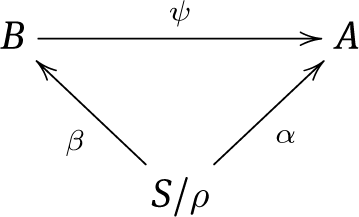
commutes.
Proof
Necessity. Suppose that ψ : BS → AS is a 1′-pure epimorphism and suppose that α : S/ρ → AS is an S-poset morphism, where ρ is an S-poset congruence on SS induced by a set of the form {(si, ti) ∈ S × S | sizi = tizi for some zi ∈ S, i = 1, 2, ⋯, n}. Then we have α([1])si ≤ α([1])ti in AS and sizi = tizi for all i. By the assumption, there is an element b ∈ B such that α([1]) = ψ(b) and bsi ≤ bti for all i. Now we define a mapping β : S/ρ → BS by β([s]) = bs. It is easy to see that β is a well-defined S-poset morphism such that α = ψβ.
Sufficiency. Let ψ : BS → AS be an S-poset epimorphism and let asi ≤ ati and sizi = tizi for a ∈ A, si, ti, zi ∈ S, i = 1, 2, ⋯, n. Consider the S-poset congruence ρ on SS induced by the set {(si, ti)| i = 1, 2, ⋯, n}. Then α : S/ρ → AS, given by α([s]) = as for s ∈ S, is a well-defined S-poset morphism. By the assumption, there exists an S-poset morphism β : S/ρ → BS such that α = ψβ. Thus, we can deduce a = α([1]) = ψ(β([1])), and β([1])si = β([si]) ≤ β([ti]) = β([1])ti in BS for all i, exactly as needed. □
For the sake of completeness we now prove the following
Proposition 2.8
For any rightS-posetAS, the following statements are equivalent.
AShas Condition (E′).
Every surjectiveS-poset morphismBS → ASis 1′-pure.
There exists a 1′-pure epimorphismBS → AS, whereBShas Condition (E′).
EveryS-poset morphismS/ρ → ASmay be factorized through a free rightS-poset, whereρis as inLemma 2.7.
Every surjectiveS-poset morphismBS → ASis quasi-1′-pure.
There exists a quasi-1′-pure epimorphismBS → AS, whereBShas Condition (E′).
Proof
(1) ⇒ (2). Let, first, ψ : BS → AS be a surjective S-poset morphism, and let asi ≤ ati and sizi = tizi for some a ∈ A and si, ti, zi ∈ S, i = 1, 2, ⋯, n. We start by applying Condition (E′) for i = 1, and obtain a1 ∈ A and u1 ∈ S with a = a1u1 and u1s1 ≤ u1t1. We substitute the expression a = a1u1 into the relation as2 ≤ at2 (for i = 2), and get a1u1s2 ≤ a1u1t2 and u1s2z2 = u1t2z2. Again using Condition (E′), yields a2 ∈ A and u2 ∈ S such that a1 = a2u2 and u2u1s2 ≤ u2u1t2, and so we have a = a2u2u1. Continuing in this way, we end up with expressions a = anun ⋯ u1 and (un ⋯ u1)sn ≤ (un ⋯ u1)tn (for i = n). Denoting u = un ⋯ u1, we have a = anu and usi ≤ uti for all i. Applying surjectivity of ψ, there exists b ∈ B with ψ(b) = an. Therefore, a = anu = ψ(bu), and busi ≤ buti in BS for all i, as desired.
The implications (2) ⇒ (3) and (5) ⇒ (6) follow from [5, Proposition 2.4].
The implications (2) ⇒ (5) and (3) ⇒ (6) are all clear.
(3) ⇒ (4). Suppose that α : S/ρ → AS is an S-poset morphism, where ρ = ν(H), for some set H = {(si, ti) ∈ S × S | sizi = tizi for some zi ∈ S, i = 1, 2, ⋯, n}. By (3) there exists a 1′-pure epimorphism ψ : BS → AS, where BS has Condition (E′). In view of Lemma 2.7, there exists an S-poset morphism β : S/ρ → BS such that α = ψβ. Then we see β([1])si ≤ β([1])ti in BS and sizi = tizi for all i. Also, as BS satisfies Condition (E′), there exist b ∈ B and u ∈ S with β([1]) = bu and usi ≤ uti for all i. So the mappings ϕ : S/ρ → SS and φ : SS → AS, defined by ϕ([s]) = us and φ(s) = ψ(bs), respectively, are S-poset morphisms such that α = φϕ, as required.
(4) ⇒ (1). Let as ≤ at and sz = tz for a ∈ A and s, t, z ∈ S. We consider the S-poset congruence ρ on SS induced by the pair (s, t). Then the mapping α : S/ρ → AS, defined by α([u]) = au, is a well-defined S-poset morphism. By assumption there are a free S-poset BS and two S-poset morphisms β : S/ρ → BS and ψ : BS → AS such that α = ψβ. Then [s] ≤ [t] implies β([1])s ≤ β([1])t in BS. Since BS is free, but it must also be Condition (E′), from the last inequality and sz = tz we obtain b ∈ B and v ∈ S with β([1]) = bv and vs ≤ vt. Therefore, we can calculate ψ(b)v = ψ(bv) = ψβ([1]) = α([1]) = a, as required.
(6) ⇒ (1). It is similar to the implication (3) ⇒ (1) of Proposition 2.4. □
As mentioned before, Condition (E′) does not imply Condition (E). The example below is illustrative of the fact.
Example 2.9
LetS = {1, x|x2 = 1} with the order ofSto be discrete. Clearly, Sis a pomonoid. Now consider anS-poset epimorphismψ : SS → ΘS. It is not hard to verify thatψis quasi-1′-pure, and soΘSsatisfies Condition (E′) by Proposition 2.8. However, ψis not quasi-1-pure, becauseθ · 1 ≤ θ · x, but there cannot exists ∈ Ssuch thatψ(s) = θand s · 1 ≤ s · x. It follows from Proposition 2.4 thatΘSdoes not satisfy Condition (E).
As we known that the situations of Conditions (P) and (Pw) are unknown since now, here we wish to consider them.
Definition 2.10
Letψ : BS → AS be a surjective S-poset morphism. We say ψ is (weakly) quasi-2-pure, if for any a, a′ ∈ A and as ≤ a′t, there exist b, b′ ∈ B such that bs ≤ b′t, a = (≤) ψ(b) and ψ(b′) = (≤) a′.
Note that, quasi-2-purity and quasi-1-purity are two unrelated notions. Indeed, on the one hand, it follows easily from Example 2.1 that quasi-1-purity does not imply quasi-2-purity. On the other hand, if S = x∗ ∪ {0}, where x∗ is the monogenic free monoid generated by x, equipped with the order in which
and 0 is isolated. Then S is a pomonoid. Consider the natural epimorphism f : SS → S/ρ(1, x), where ρ(1, x) is an S-poset congruence on SS generated by the pair (x, 1). Since xρ(x, 1) 1, this implies [1]x ≤ [1]1, but there cannot exist u ∈ S\{0} with ux ≤ u, and so f is not quasi-1-pure. But, it is easy to check that f is quasi-2-pure.
Now, we provide equivalent descriptions of Conditions (P) and (Pw).
Proposition 2.11
LetASbe a rightS-poset. Then the following assertions are equivalent.
AShas Condition (P) (Condition (Pw)).
Every surjectiveS-poset morphismBS → ASis (weakly) quasi-2-pure.
There exists a (weakly) quasi-2-pure epimorphismBS → ASwhereBShas Condition (P).
Proof
(1) ⇒ (2). We deal only with Condition (P), the proof for Condition (Pw) being similar. Now suppose that ψ : BS → AS is an S-poset epimorphism and suppose that a, a′ ∈ A, s, t ∈ S are such that as ≤ a′t in AS. Since AS satisfies Condition (P), there exist u, v ∈ S and a″ ∈ A such that a = a″u, a′ = a″v and us ≤ vt. Applying surjectivity of ψ, we obtain b ∈ B with ψ(b) = a″. Thus, we have a = a″u = ψ(bu), a′ = a″v = ψ(bv), and bus ≤ bvt in BS, as required.
(2) ⇒ (3). This is given by [5, Proposition 2.4].
(3) ⇒ (1). Let AS be a right S-poset. By (3) there exists a quasi-2-pure epimorphism ψ : BS → AS, where BS satisfies Condition (P). Now suppose that as ≤ a′t in AS for a, a′ ∈ A, s, t ∈ S. Then we see that bs ≤ b′t in BS, ψ(b′) = a′ and ψ(b) = a for some b, b′ ∈ B. Also, because BS satisfies Condition (P), from the inequality bs ≤ b′t, we obtain b″ ∈ B and u, v ∈ S with b = b″u, b′ = b″v and us ≤ vt. Consequently, a = ψ(b) = ψ(b″u) = ψ(b″)u and a′ = ψ(b′) = ψ(b″v) = ψ(b″)v in AS, and the proof is complete. □
Since 2-pure epimorphisms are quasi-2-pure, we have the following corollary, which is the S-poset version of [3, Proposition 3.12]
Corollary 2.12
LetSbe a pomonoid and letψ : BS → ASbe anS-poset epimorphism in whichBShas Condition (P). Ifψis 2-pure thenAShas Condition (P).
From [9] we remark that Condition (P) implies Condition (Pw). But we can show that this implication is strict by using an example of a purity epimorphism.
Example 2.13
LetS = {1, x|x2 = x} with the order ofSto be discrete. LetA = {a, b|a · 1 = a, a · x = b · x = b · 1 = bwith the ordera < b. Define anS-poset epimorphism f : SS → ASbyf(1) = aandf(x) = b. Since a · 1 ≤ b · x, and we want to reach 1 · 1 ≤ x · x, but this is impossible. Hencefis not quasi-2-pure, and so by Proposition 2.11, ASfails to satisfy Condition (P). However, it is easy to see thatfis weakly quasi-2-pure, and soASsatisfies Condition (Pw) by Proposition 2.11.
Bulman-Fleming and Laan in [5] established the Stenström-Govorov-Lazard Theorem in the context of S-posets. Further, synthesizing Propositions 2.2, 2.4 and 2.11, we can deduce the following
Corollary 2.14
LetASbe a rightS-poset. Then the following assertions are equivalent.
ASis strongly flat.
AShas Conditions (P) and (E).
Every surjectiveS-poset morphismBS → ASis pure.
EveryS-poset morphismBS → ASwhereBSis finitely presented factors through a finitely generated, freeS-poset.
ASis isomorphic to a directed colimit of a family of finitely generated, freeS-posets.
ASis subpullback flat and subequalizer flat.
Every surjectiveS-poset morphismBS → ASis 2-pure.
There exists a 2-pure epimorphismBS → ASwhereBSis strongly flat.
Every surjectiveS-poset morphismBS → ASis quasi-2-pure and (quasi-)1-pure.
There exists a quasi-2-pure and (quasi-)1-pure epimorphismBS → ASwhereBSis strongly flat.
We make immediate use of the above ideas to the next propositions, which describe Conditions (WP), (WP)w, (PWP) and (PWP)w by certain purity epimorphisms.
Definition 2.15
Letψ : BS → ASbe a surjectiveS-poset morphism. We sayψis
(weakly) quasi-w-2-pure if, for all elementsa, a′ ∈ A, s, t ∈ S, allS-poset morphisms f : S(Ss ∪ St) → SS, andaf(s) ≤ a′f(t), there existb, b′ ∈ Band s′, t′ ∈ {s, t} such thatbf(s′) ≤ b′f(t′), a ⊗ s = (≤) ψ(b) ⊗ s′ andψ(b′) ⊗ t′ = (≤) a′ ⊗ tin A ⊗S (Ss ∪ St).
(weakly) quasi-pw-2-pure if, for anya, a′ ∈ Aandas ≤ a′s, there existb, b′ ∈ Bsuch that bs ≤ b′s, a = (≤) ψ(b) andψ(b′) = (≤) a′.
Clearly, quasi-w-2-purity implies weakly quasi-w-2-purity, and quasi-pw-2-purity implies weakly quasi-pw-2-purity. But, it follows easily from Example 2.13 that these two implications are strict.
Notice from the proof of Proposition 2.11 that we can deduce the following results.
Proposition 2.16
LetASbe a rightS-poset. Then the following assertions are equivalent.
AShas Condition (WP) (Condition (WP)w).
Every surjectiveS-poset morphismBS → ASis (weakly) quasi-w-2-pure.
There exists a (weakly) quasi-w-2-pure epimorphismBS → ASwhereBShas Condition (WP).
Proposition 2.17
LetASbe a rightS-poset. Then the following assertions are equivalent.
AShas Condition (PWP) (Condition (PWP)w).
Every surjectiveS-poset morphismBS → ASis (weakly) quasi-pw-2-pure.
There exists a (weakly) quasi-pw-2-pure epimorphismBS → ASwhereBShas Condition (PWP).
In [15], the authors introduced a generalization of Condition (P) called Condition (P′) for S-acts. In this way, we introduce Conditions (P′) and (
Definition 2.18
LetASbe a rightS-poset. We say that
ASsatisfies Condition (P′) if, for alla ∈ A, s, s′, z ∈ Swithas ≤ a′s′ andsz = s′z, there exista″ ∈ A, u, v ∈ Ssuch thata = a″u, a′ = a″vand us ≤ vs′.
ASsatisfies Condition (
Now, we define two kinds of purity conditions of epimorphisms in order to consider Conditions (P′) and (
Definition 2.19
Letψ : BS → ASbe a surjectiveS-poset morphism. We sayψ is
quasi-2′-pure if, for every a, a′ ∈ A and relations
there exist b, b′ ∈ Bsuch thata = ψ(b), ψ(b′) = a′, and bs ≤ bt.
weakly quasi-2′-pure if, for every a, a′ ∈ Aand relations
there exist b, b′ ∈ Bsuch that a ≤ ψ(b), ψ(b′) ≤ a′, and bs ≤ bt.
Similarly to the argument of Proposition 2.11 one could prove the following result.
Proposition 2.20
LetASbe a rightS-poset. Then the following assertions are equivalent.
AShas Condition (P′) (Condition (P′w)).
Every surjectiveS-poset morphismBS → ASis (weakly) quasi-2′-pure.
There exists a (weakly) quasi-2′-pure epimorphismBS → ASwhereBShas Condition (P′).
Concluding this section, we summarize in the following Table 1 the results concerning equivalent descriptions of some flatness properties for S-posets (starting with strong flatness and ending with Condition (PWP)w) by certain purity conditions of epimorphisms.
Equivalent descriptions of some flatness properties
| ⟺ | Purity conditions of epimorphisms ψ : BS → AS |
|---|---|
| AS is strongly flat | ψ is pure or 2-pure |
| AS has Condition (E) | ψ is 1-pure or quasi-1-pure |
| AS has Condition (E′) | ψ is 1′-pure or quasi-1′-pure |
| AS has Condition (P) | ψ is quasi-2-pure |
| AS has Condition (P′) | ψ is quasi-2′-pure |
| AS has Condition (Pw) | ψ is weakly quasi-2-pure |
| AS has Condition (P′w) | ψ is weakly quasi-2′-pure |
| AS has Condition (WP) | ψ is quasi-w-2-pure |
| AS has Condition (WP)w | ψ is weakly quasi-w-2-pure |
| AS has Condition (PWP) | ψ is quasi-pw-2-pure |
| AS has Condition (PWP)w | ψ is weakly quasi-pw-2-pure |
3 Directed colimits for S-posets
In this section, we show that these purity epimorphisms of S-posets introduced in Section 2 are preserved under directed colimits.
Directed colimits (also called direct limits) of families of right S-posets are introduced in [5], but note that the definition of directed colimits is omitted in that paper. For completeness, we will provide a full definition of directed colimits for S-posets.
Let I be a quasi-ordered (that is, a reflexive and transitive relation) set. A direct system in Pos-S is a collection of right S-posets (Ai)i∈I and a collection of right S-poset morphisms ϕi,j : Ai → Aj (i ≤ j) with the following properties:
ϕi,i = 1Ai for all i ∈ I;
ϕj,k ∘ ϕi,j = ϕi,k, whenever i ≤ j ≤ k.
The colimit of the system (Ai, ϕi,j) is a right S-poset AS together with right S-poset morphisms ϕi : Ai → A such that
ϕj ∘ ϕi,j = ϕi, whenever i ≤ j;
If BS is a right S-poset and αi : Ai → B are right S-poset morphisms such that αj ∘ ϕi,j = αi whenever i ≤ j, then there exists a unique S-poset morphism ψ : A → B such that the diagram
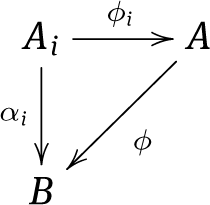
commutes for all i ∈ I.
Further, if the indexing set I satisfies the property that for all i, j ∈ I there exists k ∈ I such that k ≥ i, j, then we say that I is directed. In this case, we call the colimit (A, ϕi) is a directed colimit.
From the following lemma, we remark that in Pos-S, directed colimits of directed systems of S-posets exist.
Lemma 3.1
([5, Proposition 2.5]). The directed colimit of any directed system ((Ai)i∈I, (ϕi,j)i≤j) of rightS-posets exists, and may be represented as (A/θ, (ϕi)i∈I), where
aθa′ (a ∈ Ai, a′ ∈ Aj) if and only ifϕi,k(a) = ϕj,k(a′) inAkfor some k ≥ i, j;
[a]θ ≤ [a′]θ (a ∈ Ai, a′ ∈ Aj) if and only ifϕi,k(a) ≤ ϕj,k(a′) for some k ≥ i, j;
for eachi ∈ Ianda ∈ Ai, ϕi(a) = [a]θ.
The next result is often useful in dealing with directed colimits.
Lemma 3.2
([5, Proposition 2.6]). Let (Ai)i∈I, (ϕi,j)i≤jbe a direct system of right S-posets. Then the directed colimit (A, (ϕi)i∈I) is characterized up to isomorphism by the conditions
eachϕi : Ai → A is an S-poset morphism;
ϕj ∘ ϕi,j = ϕi, wheneveri ≤ j;
Actually, the property (4) of Lemma 3.2 states the order relation on AS, that is, ϕi (a) ≤ ϕj(a′) if and only if ϕi,k(a) ≤ ϕj,k(a′) for some k ≥ i, j. Thereby, we obtain the fact that ϕi is an order-embedding if and only if ϕi,j is an order-embedding for all i ≤ j.
Using these properties of directed colimits, the following result is obtained.
Lemma 3.3
Let (Ai, ϕi,j) be a direct system of rightS-posets with directed index setIand directed colimit (A, ϕi). For every familya1, ⋯, am ∈ Aand relations
there exist somel ∈ Iand
Proof
The technique used in [3, Lemma 2.3] will be employed. □
In order to prepare for our main results, we will introduce the concept of directed colimits of S-poset morphisms.
Suppose that (Ai, ϕi,j) and (Bi, φi,j) are direct systems of S-posets and S-poset morphisms. Suppose that for each i ∈ I there exists an S-poset morphism ψi: Ai → Bi and suppose that (A, ϕi) and (B, φi), the directed colimits of these systems, are such that the diagrams
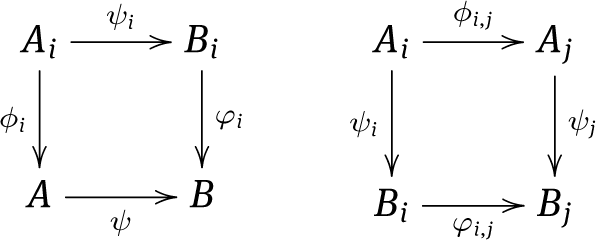
commute for all i ≤ j ∈ I. Then we shall refer to ψ as the directed colimit of theψi.
In light of Lemma 3.2, the following easily proved result is probably well-known.
Proposition 3.4
LetSbe a pomonoid. Directed colimits of (order-embeddings) epimorphisms ofS-posets are (order-embeddings) epimorphisms.
We now establish one of our main results.
Proposition 3.5
LetSbe a pomonoid. Directed colimits of pure epimorphisms of rightS-posets are pure.
Proof
Suppose that (Ai, ϕi,j) and (Bi, φi,j) are direct systems of right S-posets and S-poset morphisms. Suppose that for each i ∈ I there exists a pure epimorphism ψi: Ai → Bi and suppose that (A, ϕi) and (B, φi), the directed colimits of these systems, are such that the diagrams
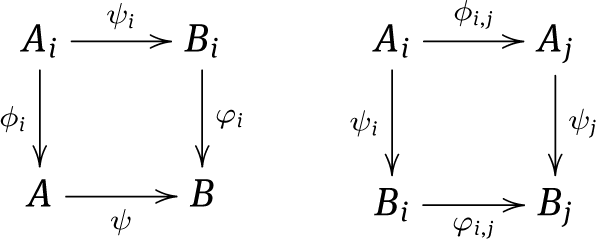
commute for all i ≤ j ∈ I.
Suppose that there are b1, ⋯, bm ∈ B, s1, ⋯, sn, t1, ⋯, tn ∈ S and relations
In view of Lemma 3.3, there exist l ∈ I and
Since ψl is a pure epimorphism, there exist a1, ⋯, am ∈ Al with ψl(aj) =
for all j, and
for all i. Hence ψ is pure. □
By the same approach, one can get
Proposition 3.6
LetSbe a pomonoid. Directed colimits of 1-pure (1′-pure) epimorphisms of rightS-posets are 1-pure (1′-pure).
In what follows, we consider the situation for quasi-2-pure epimorphisms.
Proposition 3.7
LetSbe a pomonoid. Directed colimits of quasi-2-pure epimorphisms of rightS-posets are quasi-2-pure.
Proof
Suppose that (Ai, ϕi,j) and (Bi, φi,j) are direct systems of right S-posets and S-poset morphisms. Suppose that for each i ∈ I there exists a quasi-2-pure epimorphism ψi: Ai → Bi and suppose that (A, ϕi) and (B, φi), the directed colimits of these systems, are such that the diagrams
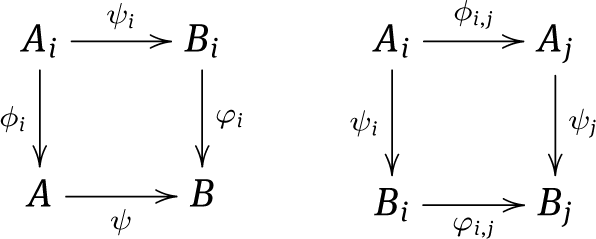
commute for all i ≤ j ∈ I.
Suppose that b1, b2 ∈ B, s, t ∈ S are such that b1s ≤ b2t. By Lemma 3.2(3), there exist i, j ∈ I, bi ∈ Bi and bj ∈ Bj with b1 = φi(bi) and b2 = φj(bj). According to the order relation on BS, we obtain k ≥ i, j with φi,k(bi)s ≤ φj,k(bj)t in Bk. Since ψk is quasi-2-pure, there exist a1, a2 ∈ Ak such that ψk(a1) = φi,k(bi), ψk(a2) = φj,k(bj) and a1s ≤ a2t. Now we can compute that ϕk(a1)s ≤ ϕk(a2)t and
In the same way, b2 = ψ(ϕk(a2)), and so ψ is quasi-2-pure. □
Note that, the situation for quasi-1-pure (resp., quasi-1′-pure, quasi-2′-pure, weakly quasi-2-pure, weakly quasi-2′-pure, quasi-w-2-pure, weakly quasi-w-2-pure, quasi-pw-2-pure and weakly quasi-pw-2-pure) epimorphisms, is similar in nature to Proposition 3.7, and so here will be omitted.
We have already seen in Section 2 that some flatness properties are equivalent to certain purity conditions of epimorphisms. And then, using Propositions 3.5, 3.6, 3.7 and the above note, the following result is immediately established.
Corollary 3.8
LetSbe a pomonoid. Every directed colimit of a direct system of rightS-posets that are strongly flat (resp., have Conditions (E), (E′), (P), (P′), (Pw), (P′ w), (WP), (WP)w, (PWP) and (PWP)w) has again these properties.
Observing the result above, by a new way we have obtained that many flatness properties of S-posets are preserved under directed colimits.
However, as for acts, the situation for projective S-posets is slightly different.
Proposition 3.9
LetSbe a pomonoid. Every directed colimit of a direct system of projective rightS-posets is projective if and only ifSis right (po-)perfect.
Proof
Necessity. In light of [14, Theorem 6.3], it suffices to show that every strongly flat right S-poset is projective, so now suppose that AS is a strongly flat S-poset. It then follows from [5, Proposition 4.4] that AS is isomorphic to a directed colimit of a family of finitely generated, free S-posets. So by assumption, AS is projective since free S-posets are projective.
Sufficiency. Let (A, ϕi) be a directed colimit of a direct system of projective right S-posets. In view of Corollary 3.8, AS is strongly flat because projective S-posets are strongly flat. Also, since S is right (po-)perfect, by [14, Theorem 6.3], AS is projective, and the proof is complete. □
From [5, Proposition 4.6], it follows that an S-poset epimorphism φ: BS → AS is pure if and only if, for every finitely presented S-poset CS and morphism η : CS → AS there exists a morphism μ : CS → BS such that φμ = η. It is easy to check that split epimorphisms are pure. But the following example from [3] shows that the converse is false. Let S = (ℕ, max) with the discrete order. Consider the one-element S-poset ΘS and note that SS → ΘS is a pure epimorphism. On the other hand, since S does not contain a fixed point then it does not split.
But, the following result is a small improvement. Its straightforward proof is omitted.
Proposition 3.10
Letψ: AS → BSbe a surjectiveS-poset morphism withBSis finitely presented. Thenψis pure if and only if it is split.
For future use, we record
Lemma 3.11
LetSbe a pomonoid, let
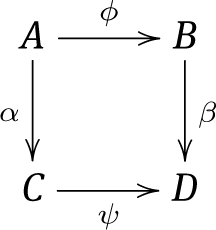
be a pullback diagram ofS-posets and suppose thatψis a pure epimorphism. Thenϕis also a pure epimorphism.
Proof
It is routine. □
Note that in the above result, if we replace “pullback diagram” by “subpullback diagram”, then this result is also valid.
As previously discussed, not every pure epimorphism splits, but every pure epimorphism is a directed colimit of split epimorphisms. The strategy for the proof the following proposition is taken from the unordered case in [3].
Proposition 3.12
LetSbe a pomonoid and letψ: AS → BSbe a surjectiveS-poset morphism. Thenψis pure if and only if it is a directed colimit of split epimorphisms.
Proof
Suppose that ψ: AS → BS is a pure epimorphism. From [5, Proposition 4.4] it follows that BS is a directed colimit of finitely presented S-posets (Bi, ϕi,j) and so let ϕi: Bi → B be the canonical morphisms. For each Bi let
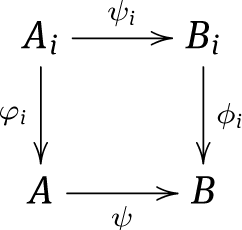
be a pullback diagram so that by Lemma 3.11ψi is pure. Because Bi is finitely presented, it follows from Proposition 3.10 that ψi splits. Notice that
ψi(bi, a) = bi and φi(bi, a) = a, and that since ψ is onto then Ai ≠ ∅.
For i ≤ j define φi,j: Ai → Aj by φi,j(bi, a) = (ϕi,j(bi), a) and notice that φjφi,j = φi and ψjφi,j = ϕi,jψi. Next we show that (A, φi) is the directed colimit of (Ai, φi,j). So assume there exist an S-poset CS and S-poset morphisms αi: Ai → C with αjφi,j = αi for all i ≤ j. We now define α : A → C by α(a) = αi(bi, a) where i and bi are chosen so that φi(bi) = ψ(a). Then α is well-defined since if ψ(a) = ϕj(bj) then there exists k ≥ i, j with ϕi,k(bi) = ϕj,k(bj) and
Then α is an S-poset morphism and clearly αφi = αi. Finally, if β: A → C is such that βφi = αi for all i, then β(a) = βφi(bi, a) = αi(bi, a) = α(a) and so α is unique. We therefore see that we have reached the desired conclusion.
The converse holds by Proposition 3.5. □
4 Directed colimits of flatness properties
From previous section, we find some flatness properties that are closed under directed colimits. But for the other flatness properties, we need to characterize the behavior of subpullbacks diagrams under directed colimits. In this section, we first prove that every directed colimit of a direct system of subequalizer flat S-posets is subequalizer flat. Then, we consider subpullbacks in order to prove that every class of S-posets having a flatness property is closed under directed colimits. First let us to recall the concept of subpullbacks and subequalizers in the category S-Pos which are defined in [5] as follows.
The categories S-Pos and Pos are poset-enriched concrete categories, where the order relation on morphism sets is defined pointwise (i.e. f ≤ g for f, g: A → B if and only if f(a) ≤ g(a) for every a ∈ A). In such categories, a diagram
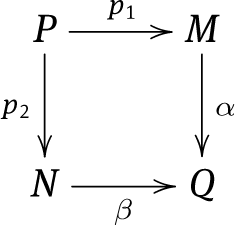
is called a subpullback diagram forαandβ if
αp1 ≤ βp2 and
for any diagram
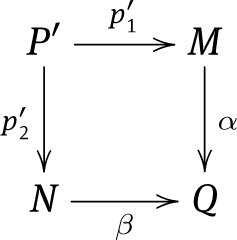
with
The first subpullback diagram is denoted by P(M, N, α, β, Q) and tensoring it by any right S-poset AS one gets the diagram
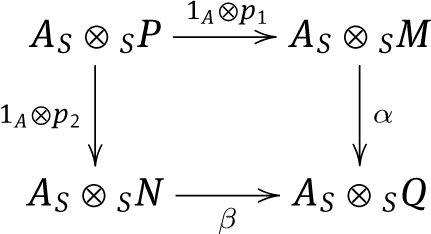
in Pos. Take
with
A subequalizer diagram for α and β
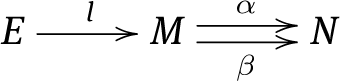
is defined similarly, where E = {m ∈ M |α(m) ≤ β(m)}. As we mentioned earlier, an S-poset AS is called subpullback flat (subequalizer flat) if the functor AS ⊗ − takes subpullbacks (subequalizers) in S-Pos to subpullbacks (subequalizers) in Pos. We begin by proving the result for subequalizer flat. Before that we need some preparations.
If AS is an S-subposet of BS and x, y are different elements not belonging to BS, then
Define an S-action
for every a ∈ BS ∖ AS, s ∈ S and w ∈ {x, y}.
The order on BS ∐ABS is given by
where {w1, w2} = {x, y} and a, b ∉ AS. For w ∈ {x, y}, b ∉ AS and a ∈ A,
It is easily checked BS ∐ABS is a right S-poset.
Lemma 4.1
Every regular monomorphismh : AS → BSin Pos-Scan be consider as the subequalizer of the diagram

Proof
Let h : AS → BS be a regular monomorphism. Define α, β: BS → BS ∐h(A)BS as
and
To show that (AS, h) is a subequalizer diagram for α and β, clearly αh ≤ βh, and consider the diagram
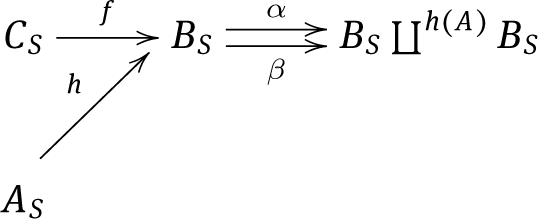
where CS and f are such that αf ≤ βf. By the construction of BS∐h(A)BS we see that f(CS) ⊆ h(AS). Now, since h is a regular monomorphism, one can define a mapping f : CS → AS by f(c) = h−1(f(c)) for c ∈ CS. Then f is a well-defined S-morphism and unique with the property f = hf. □
From the previous lemma, it follows that every subequalizer flat S-poset is po-flat. Now we are ready to consider directed colimit of a direct system of subequalizer flat S-posets.
Proposition 4.2
Let S be a pomonoid. Every directed colimit of a direct system of subequalizer flat S-posets is subequalizer flat.
Proof
Let (Ai, ϕi,j) be a direct system of S-psets and S-morphisms with directed index set I and directed colimit (A, ϕi). If every Ai is subequalizer flat, we will prove that A is subequalizer flat. Let the pair (E, l) be a subequalizer in the following diagram
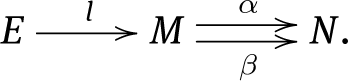
Since every subequalizer flat S-poset is po-flat, from po-flatness of AS we have the following diagram

and 1A ⊗ l is a regular monomorphism. By the definition, the subequalizer of 1A ⊗ α and 1A ⊗ β is
By the definition of the subequalizer, it is easily checked that A ⊗ E ⊆ E′, next we want to show that E′ ⊆ A ⊗ E. Let a ∈ A, m ∈ M be such that a ⊗ m ∈ E′. So a ⊗ α(m) ≤ a ⊗ β(m) in A ⊗ N implies that the existence of u1, v1, …, un, vn ∈ S, a1, …, an ∈ AS, y2, …, yn ∈ SN, n ∈ ℕ such that
Denote a by a0, then there exist aij ∈ Aij such that aj = ϕij(aij), j = 0, 1, .., n. Then we get
Since I is directed, there exists l ≥ i1, i2, …, in such that
This means that ϕi0,l(ai0) ⊗ α(m) ≤ ϕi0,l(ai0) ⊗ β(m) in Al ⊗ N. Now, from the fact that Al is subequalizer flat, and Al ⊗ E is the subequalizer of 1Al ⊗ α and 1Al ⊗ β, it follows that ϕi0,l(ai0) ⊗ m ∈ Al ⊗ E. So m ∈ E, a ⊗ m ∈ A ⊗ E and we are done.□
In the rest of this section we concentrate on subpullback diagrams. We now present two fundamental propositions that yield the main result of this section.
Lemma 4.3
Let S be a pomonoid, and (Ai, ϕi,j) be a direct system of S-posets with directed index set I and let (A, ϕi) be the directed colimit. Suppose that for each Ai the mapping ϕ corresponding to the subpullback diagram P(M, N, α, β, Q) is surjective, then for A the mapping ϕ corresponding to the subpullback diagram P(M, N, α, β, Q) is surjective.
Proof
Suppose that (x ⊗ m, y ⊗ n) belongs to the subpullback of P(A ⊗ M, A ⊗ N, 1A ⊗ α, 1A ⊗ β, A ⊗ Q), where x, y ∈ A, m ∈ M, n ∈ N. Then x ⊗ α(m) ≤ y ⊗ β(n) in A ⊗ Q. We should find a ∈ A, (m, n) ∈ P(m, N, α, β, Q) such that ϕ(A ⊗ (m, n)) = (x ⊗ m, y ⊗ n). Since x ⊗ α(m) ≤ y ⊗ β(n), there exist k ∈ ℕ and elements a1, …, ak ∈ AS, q2, …, qk ∈ SQ, u1, v1, …, uk, vk ∈ S such that
Denote x by a0 and y by ak+1, so there exist aij ∈ Aij such that aj = ϕij (
Since I is directed, there exists l ≥ i0, i1, …, ik+1 such that
Then ϕi0,l(
Acting ϕl on left column inequations and since x = ϕi0 (
Thus x ⊗ m = ϕl(a″) ⊗ m′ in A ⊗ M. Since ϕik+1,l(
Lemma 4.4
LetSbe a pomonoid, and (Ai, ϕi,j) be a direct system ofS-posets with directed index setIand let (A, ϕi) be the directed colimit. Suppose that for eachAithe mappingϕcorresponding to the subpullback diagramP(m, N, α, β, Q) is an order-embedding, then forAthe mappingϕcorresponding to the subpullback diagramP(m, N, α, β, Q) is an order-embedding.
Proof
Suppose that ϕ(a ⊗ (m, n)) ≤ ϕ(a′ ⊗ (m′, n′)) belongs to the subpullback of P(A ⊗ M, A ⊗ N, 1A ⊗ α, 1A ⊗ β, A ⊗ Q), where a, a′ ∈ A and (m, n), (m′, n′) ∈ SP. So we have α(m) ≤ β(n), α(m′) ≤ β(n′), and
We will show that a ⊗ (m, n) ≤ a′ ⊗ (m′, n′) in AS ⊗ SP. Since a ⊗ m ≤ a′ ⊗ m′ in AS ⊗ SM and a ⊗ n ≤ a′ ⊗ n′ in AS ⊗ SN, there exist p, p′ ∈ ℕ and elements ai, cj ∈ AS, m2, …, mp ∈ SM, n2, …, np′ ∈ SN, ui, vi,
By Lemma 3.3, there exist l ∈ I and
This means that
Hence
Acting ϕl on left
column inequations and since
Therefore, a ⊗ (m, n) ≤ a′ ⊗ (m′, n′) in AS ⊗ SP and the result follows. □
It is shown in [7, Theorems 2.1-2.4, 3.2, 4.1, 5.3] and [16, Definition 2.2] that most of flatness properties of S-posets over a pomonoid S are equivalent to the surjectivity or bijectivity of mappings corresponding to the subpullback diagrams in special cases. Using that results and two previous propositions we conclude the main result of this section.
Theorem 4.5
Every class ofS-posets having a flatness property such as torsion freeness, principal weak flatness, weak flatness, flatnes, pullback flatness, subpullback flatness, principal weak kernel po-flatness, weak kernel po-flatness, translation kernel po-flatness, and satisfying Conditions (P), (WP) or (PWP) is closed under directed colimits.
Acknowledgement
This research was partially supported by the Natural Science Foundation of Shaanxi Province(No.2017JQ1026) and Special Research Project of Shaanxi Department of Education (No.17JK0102).
References
[1] Stenström B., Flatness and localization over monoids, Math. Nachr., 1971, 48, 315-334.10.1002/mana.19710480124Search in Google Scholar
[2] Normak P., On equalizer-flat and pullback-flat acts, Semigroup Forum, 1987, 36, 293-313.10.1007/BF02575023Search in Google Scholar
[3] Bailey A. and Renshaw J., Covers of acts over monoids and pure epimorphisms, Proc. Edinb. Math. Soc., 2014, 57, 589-617.10.1017/S0013091513000618Search in Google Scholar
[4] Qiao H. S., Wang L. and Ma X., Every class of S-acts having a flatness property is closed under directed colimits, Bull. Iranian Math. Soc., 2016, 42(2), 341-351.Search in Google Scholar
[5] Bulman-Fleming S. and Laan V., Lazard’s theorem for S-posets, Math. Nachr., 2005, 278, 1743-1755.10.1002/mana.200310338Search in Google Scholar
[6] Bulman-Fleming S., Gutermuth D., Gilmour A., Kilp M., Flatness properties of S-posets, Comm. Algebra, 2006, 34, 1291-1317.10.1080/00927870500454547Search in Google Scholar
[7] Golchin A. and Rezaei P., Subpullbacks and flatness properties of S-posets, Comm. Algebra, 2009, 37, 1995-2007.10.1080/00927870802263273Search in Google Scholar
[8] Liang X. L. and Luo Y. F., On Condition (PWP)w for S-posets, Turk. J. Math., 2015, 39, 795-809.10.3906/mat-1410-26Search in Google Scholar
[9] Shi X. P., Strongly flat and po-flat S-posets, Comm. Algebra, 2005, 33, 4515-4531.10.1080/00927870500274853Search in Google Scholar
[10] Fakhruddin S. M., Absolute flatness and amalgams in pomonoids, Semigroup Forum, 1986, 33, 15-22.10.1007/BF02573178Search in Google Scholar
[11] Fakhruddin S. M., On the category of S-posets, Acta Sci. Math. (Szeged), 1988, 52, 85-92.Search in Google Scholar
[12] Bulman-Fleming S. and Mahmoudi M., The category of S-posets, Semigroup Forum, 2005, 71, 443-461.10.1007/s00233-005-0540-ySearch in Google Scholar
[13] Shi X. P., Liu Z. K., Wang F. and Bulman-Fleming S., Indecomposable, projective, and flat S-posets, Comm. Algebra, 2005, 33, 235-251.10.1081/AGB-200040992Search in Google Scholar
[14] Gould V. and Shaheen L., Perfection for pomonoids, Semigroup Forum, 2010, 81, 102-127.10.1007/s00233-010-9237-ySearch in Google Scholar
[15] Golchin A. and Mohammadzadeh H., On Condition (P′), Semigroup Forum, 2013, 86, 413-430.10.1007/s00233-012-9441-zSearch in Google Scholar
[16] Liang X. L. and Luo Y. F., Subpullbacks and Coproducts of S-posets, Categories and General Alg. Structure with App., 2015, 3(1), 1-20.Search in Google Scholar
© 2018 Liang and Khosravi, published by De Gruyter
This work is licensed under the Creative Commons Attribution-NonCommercial-NoDerivatives 4.0 License.
Articles in the same Issue
- Regular Articles
- Algebraic proofs for shallow water bi–Hamiltonian systems for three cocycle of the semi-direct product of Kac–Moody and Virasoro Lie algebras
- On a viscous two-fluid channel flow including evaporation
- Generation of pseudo-random numbers with the use of inverse chaotic transformation
- Singular Cauchy problem for the general Euler-Poisson-Darboux equation
- Ternary and n-ary f-distributive structures
- On the fine Simpson moduli spaces of 1-dimensional sheaves supported on plane quartics
- Evaluation of integrals with hypergeometric and logarithmic functions
- Bounded solutions of self-adjoint second order linear difference equations with periodic coeffients
- Oscillation of first order linear differential equations with several non-monotone delays
- Existence and regularity of mild solutions in some interpolation spaces for functional partial differential equations with nonlocal initial conditions
- The log-concavity of the q-derangement numbers of type B
- Generalized state maps and states on pseudo equality algebras
- Monotone subsequence via ultrapower
- Note on group irregularity strength of disconnected graphs
- On the security of the Courtois-Finiasz-Sendrier signature
- A further study on ordered regular equivalence relations in ordered semihypergroups
- On the structure vector field of a real hypersurface in complex quadric
- Rank relations between a {0, 1}-matrix and its complement
- Lie n superderivations and generalized Lie n superderivations of superalgebras
- Time parallelization scheme with an adaptive time step size for solving stiff initial value problems
- Stability problems and numerical integration on the Lie group SO(3) × R3 × R3
- On some fixed point results for (s, p, α)-contractive mappings in b-metric-like spaces and applications to integral equations
- On algebraic characterization of SSC of the Jahangir’s graph 𝓙n,m
- A greedy algorithm for interval greedoids
- On nonlinear evolution equation of second order in Banach spaces
- A primal-dual approach of weak vector equilibrium problems
- On new strong versions of Browder type theorems
- A Geršgorin-type eigenvalue localization set with n parameters for stochastic matrices
- Restriction conditions on PL(7, 2) codes (3 ≤ |𝓖i| ≤ 7)
- Singular integrals with variable kernel and fractional differentiation in homogeneous Morrey-Herz-type Hardy spaces with variable exponents
- Introduction to disoriented knot theory
- Restricted triangulation on circulant graphs
- Boundedness control sets for linear systems on Lie groups
- Chen’s inequalities for submanifolds in (κ, μ)-contact space form with a semi-symmetric metric connection
- Disjointed sum of products by a novel technique of orthogonalizing ORing
- A parametric linearizing approach for quadratically inequality constrained quadratic programs
- Generalizations of Steffensen’s inequality via the extension of Montgomery identity
- Vector fields satisfying the barycenter property
- On the freeness of hypersurface arrangements consisting of hyperplanes and spheres
- Biderivations of the higher rank Witt algebra without anti-symmetric condition
- Some remarks on spectra of nuclear operators
- Recursive interpolating sequences
- Involutory biquandles and singular knots and links
- Constacyclic codes over 𝔽pm[u1, u2,⋯,uk]/〈 ui2 = ui, uiuj = ujui〉
- Topological entropy for positively weak measure expansive shadowable maps
- Oscillation and non-oscillation of half-linear differential equations with coeffcients determined by functions having mean values
- On 𝓠-regular semigroups
- One kind power mean of the hybrid Gauss sums
- A reduced space branch and bound algorithm for a class of sum of ratios problems
- Some recurrence formulas for the Hermite polynomials and their squares
- A relaxed block splitting preconditioner for complex symmetric indefinite linear systems
- On f - prime radical in ordered semigroups
- Positive solutions of semipositone singular fractional differential systems with a parameter and integral boundary conditions
- Disjoint hypercyclicity equals disjoint supercyclicity for families of Taylor-type operators
- A stochastic differential game of low carbon technology sharing in collaborative innovation system of superior enterprises and inferior enterprises under uncertain environment
- Dynamic behavior analysis of a prey-predator model with ratio-dependent Monod-Haldane functional response
- The points and diameters of quantales
- Directed colimits of some flatness properties and purity of epimorphisms in S-posets
- Super (a, d)-H-antimagic labeling of subdivided graphs
- On the power sum problem of Lucas polynomials and its divisible property
- Existence of solutions for a shear thickening fluid-particle system with non-Newtonian potential
- On generalized P-reducible Finsler manifolds
- On Banach and Kuratowski Theorem, K-Lusin sets and strong sequences
- On the boundedness of square function generated by the Bessel differential operator in weighted Lebesque Lp,α spaces
- On the different kinds of separability of the space of Borel functions
- Curves in the Lorentz-Minkowski plane: elasticae, catenaries and grim-reapers
- Functional analysis method for the M/G/1 queueing model with single working vacation
- Existence of asymptotically periodic solutions for semilinear evolution equations with nonlocal initial conditions
- The existence of solutions to certain type of nonlinear difference-differential equations
- Domination in 4-regular Knödel graphs
- Stepanov-like pseudo almost periodic functions on time scales and applications to dynamic equations with delay
- Algebras of right ample semigroups
- Random attractors for stochastic retarded reaction-diffusion equations with multiplicative white noise on unbounded domains
- Nontrivial periodic solutions to delay difference equations via Morse theory
- A note on the three-way generalization of the Jordan canonical form
- On some varieties of ai-semirings satisfying xp+1 ≈ x
- Abstract-valued Orlicz spaces of range-varying type
- On the recursive properties of one kind hybrid power mean involving two-term exponential sums and Gauss sums
- Arithmetic of generalized Dedekind sums and their modularity
- Multipreconditioned GMRES for simulating stochastic automata networks
- Regularization and error estimates for an inverse heat problem under the conformable derivative
- Transitivity of the εm-relation on (m-idempotent) hyperrings
- Learning Bayesian networks based on bi-velocity discrete particle swarm optimization with mutation operator
- Simultaneous prediction in the generalized linear model
- Two asymptotic expansions for gamma function developed by Windschitl’s formula
- State maps on semihoops
- 𝓜𝓝-convergence and lim-inf𝓜-convergence in partially ordered sets
- Stability and convergence of a local discontinuous Galerkin finite element method for the general Lax equation
- New topology in residuated lattices
- Optimality and duality in set-valued optimization utilizing limit sets
- An improved Schwarz Lemma at the boundary
- Initial layer problem of the Boussinesq system for Rayleigh-Bénard convection with infinite Prandtl number limit
- Toeplitz matrices whose elements are coefficients of Bazilevič functions
- Epi-mild normality
- Nonlinear elastic beam problems with the parameter near resonance
- Orlicz difference bodies
- The Picard group of Brauer-Severi varieties
- Galoisian and qualitative approaches to linear Polyanin-Zaitsev vector fields
- Weak group inverse
- Infinite growth of solutions of second order complex differential equation
- Semi-Hurewicz-Type properties in ditopological texture spaces
- Chaos and bifurcation in the controlled chaotic system
- Translatability and translatable semigroups
- Sharp bounds for partition dimension of generalized Möbius ladders
- Uniqueness theorems for L-functions in the extended Selberg class
- An effective algorithm for globally solving quadratic programs using parametric linearization technique
- Bounds of Strong EMT Strength for certain Subdivision of Star and Bistar
- On categorical aspects of S -quantales
- On the algebraicity of coefficients of half-integral weight mock modular forms
- Dunkl analogue of Szász-mirakjan operators of blending type
- Majorization, “useful” Csiszár divergence and “useful” Zipf-Mandelbrot law
- Global stability of a distributed delayed viral model with general incidence rate
- Analyzing a generalized pest-natural enemy model with nonlinear impulsive control
- Boundary value problems of a discrete generalized beam equation via variational methods
- Common fixed point theorem of six self-mappings in Menger spaces using (CLRST) property
- Periodic and subharmonic solutions for a 2nth-order p-Laplacian difference equation containing both advances and retardations
- Spectrum of free-form Sudoku graphs
- Regularity of fuzzy convergence spaces
- The well-posedness of solution to a compressible non-Newtonian fluid with self-gravitational potential
- On further refinements for Young inequalities
- Pretty good state transfer on 1-sum of star graphs
- On a conjecture about generalized Q-recurrence
- Univariate approximating schemes and their non-tensor product generalization
- Multi-term fractional differential equations with nonlocal boundary conditions
- Homoclinic and heteroclinic solutions to a hepatitis C evolution model
- Regularity of one-sided multilinear fractional maximal functions
- Galois connections between sets of paths and closure operators in simple graphs
- KGSA: A Gravitational Search Algorithm for Multimodal Optimization based on K-Means Niching Technique and a Novel Elitism Strategy
- θ-type Calderón-Zygmund Operators and Commutators in Variable Exponents Herz space
- An integral that counts the zeros of a function
- On rough sets induced by fuzzy relations approach in semigroups
- Computational uncertainty quantification for random non-autonomous second order linear differential equations via adapted gPC: a comparative case study with random Fröbenius method and Monte Carlo simulation
- The fourth order strongly noncanonical operators
- Topical Issue on Cyber-security Mathematics
- Review of Cryptographic Schemes applied to Remote Electronic Voting systems: remaining challenges and the upcoming post-quantum paradigm
- Linearity in decimation-based generators: an improved cryptanalysis on the shrinking generator
- On dynamic network security: A random decentering algorithm on graphs
Articles in the same Issue
- Regular Articles
- Algebraic proofs for shallow water bi–Hamiltonian systems for three cocycle of the semi-direct product of Kac–Moody and Virasoro Lie algebras
- On a viscous two-fluid channel flow including evaporation
- Generation of pseudo-random numbers with the use of inverse chaotic transformation
- Singular Cauchy problem for the general Euler-Poisson-Darboux equation
- Ternary and n-ary f-distributive structures
- On the fine Simpson moduli spaces of 1-dimensional sheaves supported on plane quartics
- Evaluation of integrals with hypergeometric and logarithmic functions
- Bounded solutions of self-adjoint second order linear difference equations with periodic coeffients
- Oscillation of first order linear differential equations with several non-monotone delays
- Existence and regularity of mild solutions in some interpolation spaces for functional partial differential equations with nonlocal initial conditions
- The log-concavity of the q-derangement numbers of type B
- Generalized state maps and states on pseudo equality algebras
- Monotone subsequence via ultrapower
- Note on group irregularity strength of disconnected graphs
- On the security of the Courtois-Finiasz-Sendrier signature
- A further study on ordered regular equivalence relations in ordered semihypergroups
- On the structure vector field of a real hypersurface in complex quadric
- Rank relations between a {0, 1}-matrix and its complement
- Lie n superderivations and generalized Lie n superderivations of superalgebras
- Time parallelization scheme with an adaptive time step size for solving stiff initial value problems
- Stability problems and numerical integration on the Lie group SO(3) × R3 × R3
- On some fixed point results for (s, p, α)-contractive mappings in b-metric-like spaces and applications to integral equations
- On algebraic characterization of SSC of the Jahangir’s graph 𝓙n,m
- A greedy algorithm for interval greedoids
- On nonlinear evolution equation of second order in Banach spaces
- A primal-dual approach of weak vector equilibrium problems
- On new strong versions of Browder type theorems
- A Geršgorin-type eigenvalue localization set with n parameters for stochastic matrices
- Restriction conditions on PL(7, 2) codes (3 ≤ |𝓖i| ≤ 7)
- Singular integrals with variable kernel and fractional differentiation in homogeneous Morrey-Herz-type Hardy spaces with variable exponents
- Introduction to disoriented knot theory
- Restricted triangulation on circulant graphs
- Boundedness control sets for linear systems on Lie groups
- Chen’s inequalities for submanifolds in (κ, μ)-contact space form with a semi-symmetric metric connection
- Disjointed sum of products by a novel technique of orthogonalizing ORing
- A parametric linearizing approach for quadratically inequality constrained quadratic programs
- Generalizations of Steffensen’s inequality via the extension of Montgomery identity
- Vector fields satisfying the barycenter property
- On the freeness of hypersurface arrangements consisting of hyperplanes and spheres
- Biderivations of the higher rank Witt algebra without anti-symmetric condition
- Some remarks on spectra of nuclear operators
- Recursive interpolating sequences
- Involutory biquandles and singular knots and links
- Constacyclic codes over 𝔽pm[u1, u2,⋯,uk]/〈 ui2 = ui, uiuj = ujui〉
- Topological entropy for positively weak measure expansive shadowable maps
- Oscillation and non-oscillation of half-linear differential equations with coeffcients determined by functions having mean values
- On 𝓠-regular semigroups
- One kind power mean of the hybrid Gauss sums
- A reduced space branch and bound algorithm for a class of sum of ratios problems
- Some recurrence formulas for the Hermite polynomials and their squares
- A relaxed block splitting preconditioner for complex symmetric indefinite linear systems
- On f - prime radical in ordered semigroups
- Positive solutions of semipositone singular fractional differential systems with a parameter and integral boundary conditions
- Disjoint hypercyclicity equals disjoint supercyclicity for families of Taylor-type operators
- A stochastic differential game of low carbon technology sharing in collaborative innovation system of superior enterprises and inferior enterprises under uncertain environment
- Dynamic behavior analysis of a prey-predator model with ratio-dependent Monod-Haldane functional response
- The points and diameters of quantales
- Directed colimits of some flatness properties and purity of epimorphisms in S-posets
- Super (a, d)-H-antimagic labeling of subdivided graphs
- On the power sum problem of Lucas polynomials and its divisible property
- Existence of solutions for a shear thickening fluid-particle system with non-Newtonian potential
- On generalized P-reducible Finsler manifolds
- On Banach and Kuratowski Theorem, K-Lusin sets and strong sequences
- On the boundedness of square function generated by the Bessel differential operator in weighted Lebesque Lp,α spaces
- On the different kinds of separability of the space of Borel functions
- Curves in the Lorentz-Minkowski plane: elasticae, catenaries and grim-reapers
- Functional analysis method for the M/G/1 queueing model with single working vacation
- Existence of asymptotically periodic solutions for semilinear evolution equations with nonlocal initial conditions
- The existence of solutions to certain type of nonlinear difference-differential equations
- Domination in 4-regular Knödel graphs
- Stepanov-like pseudo almost periodic functions on time scales and applications to dynamic equations with delay
- Algebras of right ample semigroups
- Random attractors for stochastic retarded reaction-diffusion equations with multiplicative white noise on unbounded domains
- Nontrivial periodic solutions to delay difference equations via Morse theory
- A note on the three-way generalization of the Jordan canonical form
- On some varieties of ai-semirings satisfying xp+1 ≈ x
- Abstract-valued Orlicz spaces of range-varying type
- On the recursive properties of one kind hybrid power mean involving two-term exponential sums and Gauss sums
- Arithmetic of generalized Dedekind sums and their modularity
- Multipreconditioned GMRES for simulating stochastic automata networks
- Regularization and error estimates for an inverse heat problem under the conformable derivative
- Transitivity of the εm-relation on (m-idempotent) hyperrings
- Learning Bayesian networks based on bi-velocity discrete particle swarm optimization with mutation operator
- Simultaneous prediction in the generalized linear model
- Two asymptotic expansions for gamma function developed by Windschitl’s formula
- State maps on semihoops
- 𝓜𝓝-convergence and lim-inf𝓜-convergence in partially ordered sets
- Stability and convergence of a local discontinuous Galerkin finite element method for the general Lax equation
- New topology in residuated lattices
- Optimality and duality in set-valued optimization utilizing limit sets
- An improved Schwarz Lemma at the boundary
- Initial layer problem of the Boussinesq system for Rayleigh-Bénard convection with infinite Prandtl number limit
- Toeplitz matrices whose elements are coefficients of Bazilevič functions
- Epi-mild normality
- Nonlinear elastic beam problems with the parameter near resonance
- Orlicz difference bodies
- The Picard group of Brauer-Severi varieties
- Galoisian and qualitative approaches to linear Polyanin-Zaitsev vector fields
- Weak group inverse
- Infinite growth of solutions of second order complex differential equation
- Semi-Hurewicz-Type properties in ditopological texture spaces
- Chaos and bifurcation in the controlled chaotic system
- Translatability and translatable semigroups
- Sharp bounds for partition dimension of generalized Möbius ladders
- Uniqueness theorems for L-functions in the extended Selberg class
- An effective algorithm for globally solving quadratic programs using parametric linearization technique
- Bounds of Strong EMT Strength for certain Subdivision of Star and Bistar
- On categorical aspects of S -quantales
- On the algebraicity of coefficients of half-integral weight mock modular forms
- Dunkl analogue of Szász-mirakjan operators of blending type
- Majorization, “useful” Csiszár divergence and “useful” Zipf-Mandelbrot law
- Global stability of a distributed delayed viral model with general incidence rate
- Analyzing a generalized pest-natural enemy model with nonlinear impulsive control
- Boundary value problems of a discrete generalized beam equation via variational methods
- Common fixed point theorem of six self-mappings in Menger spaces using (CLRST) property
- Periodic and subharmonic solutions for a 2nth-order p-Laplacian difference equation containing both advances and retardations
- Spectrum of free-form Sudoku graphs
- Regularity of fuzzy convergence spaces
- The well-posedness of solution to a compressible non-Newtonian fluid with self-gravitational potential
- On further refinements for Young inequalities
- Pretty good state transfer on 1-sum of star graphs
- On a conjecture about generalized Q-recurrence
- Univariate approximating schemes and their non-tensor product generalization
- Multi-term fractional differential equations with nonlocal boundary conditions
- Homoclinic and heteroclinic solutions to a hepatitis C evolution model
- Regularity of one-sided multilinear fractional maximal functions
- Galois connections between sets of paths and closure operators in simple graphs
- KGSA: A Gravitational Search Algorithm for Multimodal Optimization based on K-Means Niching Technique and a Novel Elitism Strategy
- θ-type Calderón-Zygmund Operators and Commutators in Variable Exponents Herz space
- An integral that counts the zeros of a function
- On rough sets induced by fuzzy relations approach in semigroups
- Computational uncertainty quantification for random non-autonomous second order linear differential equations via adapted gPC: a comparative case study with random Fröbenius method and Monte Carlo simulation
- The fourth order strongly noncanonical operators
- Topical Issue on Cyber-security Mathematics
- Review of Cryptographic Schemes applied to Remote Electronic Voting systems: remaining challenges and the upcoming post-quantum paradigm
- Linearity in decimation-based generators: an improved cryptanalysis on the shrinking generator
- On dynamic network security: A random decentering algorithm on graphs
