
Restricted triangulation on circulant graphs
-
Niran Abbas Ali
 ,
Adem Kilicman
,
Adem Kilicman

Abstract
The restricted triangulation existence problem on a given graph decides whether there exists a triangulation on the graph’s vertex set that is restricted with respect to its edge set. Let G = C(n, S) be a circulant graph on n vertices with jump value set S. We consider the restricted triangulation existence problem for G. We determine necessary and sufficient conditions on S for which G admitting a restricted triangulation. We characterize a set of jump values S(n) that has the smallest cardinality with C(n, S(n)) admits a restricted triangulation. We present the measure of non-triangulability of Kn − G for a given G.
1 Introduction
A graph is an ordered pair G = (V, E), where V is a set of vertices, and E is a set of edges. An order of G is the number of its vertices while a size of G is the number of its edges. A graph is called geometric, if its edges are straight-line segments.
A triangulation Tn of a finite set of points V in the plane is a maximally connected, straight-line planar graph with vertex set V. Each bounded face is a triangle, and the triangulation includes the boundary of the convex hull.
Let n ≥ 3. A circulant graphG = C(n, S) is a graph on the vertex set V(G) = {v0, v1, …, vn − 1} such that each vertex vi is adjacent to vertices vi±a where i = 0, 1, …, n − 1 and the subscript index i ± a is reduced modulo n for all a ∈ S. That is, vivj is an edge of C(n, S) if and only if |j − i| ∈ S or n − |j − i| ∈ S. A set S ⊆ {1, 2, …, ⌊ n/2 ⌋} is called a set of jump values of G = C(n, S). When discussing circulant graphs, we will often assume that the vertices are the corners of a regular n-gon, labeled in clockwise order and the edges are straight line segments. Hence, circulant graphs can be considered as geometric graphs.
Circulant graphs include the family of cycles C(n, {1}) and the family of complete graphs Kn = C(n, {1, 2, …, ⌊ n/2⌋}). Clearly, when G1 = C(n, S1) and G2 = C(n, S2) are two circulant graphs such that |S1| < |S2|, then the size of G1 is smaller than the size of G2 (i.e., |E(G1)| < |E(G2)|). Hence, for simplicity we shall say that G1 = C(n, S1) is a smaller size circulant graph than G2 = C(n, S2) when |S1| < |S2|.
Let E be some set of edges spanned by V. We say that a triangulation Tn of V is restricted with respect to E if E(Tn) ⊆ E. The restricted triangulation existence problem, on a given graph G(V, E), is to decide whether there exists a triangulation of V that is restricted with respect to E. This problem was proven to be NP-complete (see [1, 2]). In section 2, we solve this problem for a certain geometric graph – a circulant graph. We give a characterization of a circulant graph G to admit a restricted triangulation.
Another related problem is beginning with a problem presented by Micha Perles on DIMACS Workshop on Geometric Graph Theory in 2002, which asks to determine the largest possible number h(n) such that every geometric graph on n vertices with at least
In section 3, we characterize a circulant graph G as a subgraph of a convex complete graph Kn and |E(G)| ≤ L(n) such that Kn − G allows a restricted triangulation.
We obtain a set of jump values S(n) = {a1, a2, …, aℓ} that has the smallest cardinality |S(n)| such that C(n, S(n)) admits a restricted triangulation. That is, C(n, S(n)) is the smallest size circulant graph admitting a restricted triangulation.
Let vivj be an edge in a convex graph G, the distance between vi and vj in G is the length of a shortest (vi, vj)-path in G. A span of vivj is defined as the distance between its two end points vi and vj. In other words, a natural number d = min{|j − i|, n − |j − i|} such that vivj can be written as vivi+d or vivi − d, is a span of vivj. Hence, we can see that H = C(n, {d}) is a circulant graph in which vivj ∈ E(H) and each edge in H has a span d. Let E(Tn) be a set of edges of Tn and D(Tn) be a set of spans of all edges in E(Tn).
1.1 Importance of the triangulations and circulant graphs
Circulant graphs are an important class of interconnection networks in parallel and distributed computing. It can be used in the design of local area networks (see [5, 6]). On the other hand, computing a triangulation on a given graph has several important applications in different areas such as nondense matrix computations [7], database management [8] and artificial intelligence [9]. Moreover, triangulations are used in many areas of engineering and scientific applications such as finite element methods, approximation theory, numerical computation, computer-aided geometric design, computational geometry, etc. (see [10, 11]).
2 Restricted triangulation on G
In this section, we characterize a set of jump values S* to a circulant graph C(n, S*) admitting a restricted triangulation (Theorem 2.8). Also, we define the ‘smallest’ cardinality set of jump values S(n) such that C(n, S(n)) still admits a restricted triangulation. We give a characterization of a circulant graph C(n, S) that can be redrawn to admit a restricted triangulation (Corollary 2.13). These results are then applied to determine the convex skewness of the circulant graphs G in section (2.2).
Lemma 2.1
If Tn is a restricted triangulation of a circulant graph G = C(n, S), then S contains D(Tn).
Proof
Suppose Tn is a restricted triangulation of G = C(n, S). Let d ∈ D(Tn). By definition of span of edges, there is an edge vivj in Tn such that vivj = vivi± d where d = min{|j − i|, n − |j − i|}. Since Tn is a restricted triangulation of G, then E(Tn) ⊂ E(G). Hence, vivi ± d ∈ E(G). Thus, d∈ S (by definition of S) □
The following proposition proves that any circulant graph C(n, S) does not admit a restricted triangulation unless 1, 2 ∈ S.
Proposition 2.2
Let n ≥ 4 be a natural number. Suppose the circulant graph C(n, S) admits a restricted triangulation. Then 1, 2 ∈ S.
Proof
Suppose that C(n, S) is a circulant graph. Let Tn be a restricted triangulation of C(n, S).
It is well known that any triangulation on a set of point in the plane includes the boundary of the convex hull. For our case, vivi+1 ∈ E(Tn) for each i = 0, 1, …, n − 1 which yields 1 ∈ D(Tn) and then 1 ∈ S by Lemma 2.1.
Every maximal outer planar graph (as a special case, triangulation on a convex polygone) has at least two vertices of degree 2 (see [12]). Hence, if vi+1 is a vertex of degree 2 in T, then the diagonal edge vivi+2 must be in E(Tn) because vi+1 is incident just on two edges of Tn which are the boundary edges vivi+1 and vi+1vi+2. Thus, 2 ∈ D(Tn) since 2 is the distance between vi and vi+1. Then 2 ∈ S by Lemma 2.1. □
It is not difficult to verify that the converse of Proposition 2.2 is not true. For instance, G1 = C(12, S1) where S1 = {1, 2, 3} does not admit any restricted triangulation, while each of G2 = C(12, S2) and G3 = C(12, S3) admits a restricted triangulation with S2 = {1, 2, 4} and S3 = {1, 2, 3, 5}. Note that |S2| = |S1| while S3 = S1 ∪ {5}. Hence, the question arises: what conditions on S do guarantee that C(n, S) admits a restricted triangulation and what is the smallest cardinality |S| of the set of jump values S for which C(n, S) admits a restricted triangulation?
The following proposition proves that the circulant graph C(n, Sn) admits a restricted triangulation where Sn is a set of ascending values {a1, a2, …, as} in which a1 = 1, a2 = 2, as =
Proposition 2.3
Let n ≥ 4 be a natural number. Suppose Sn is a set of ascending values {1, 2, a3, …, as} in which as =
Proof
Suppose that C(n, Sn) is a circulant graph. Since as ∈ Sn is a jump value, then v0vas and vn − asv0 are two edges in C(n, Sn). Thus, we can define G1 and G2 to be two subgraphs of C(n, Sn), induced by the vertices v0, v1, v2, …, vas and vn − as, vn − as+1, …, vn − 1, v0, respectively. See Figure 1.
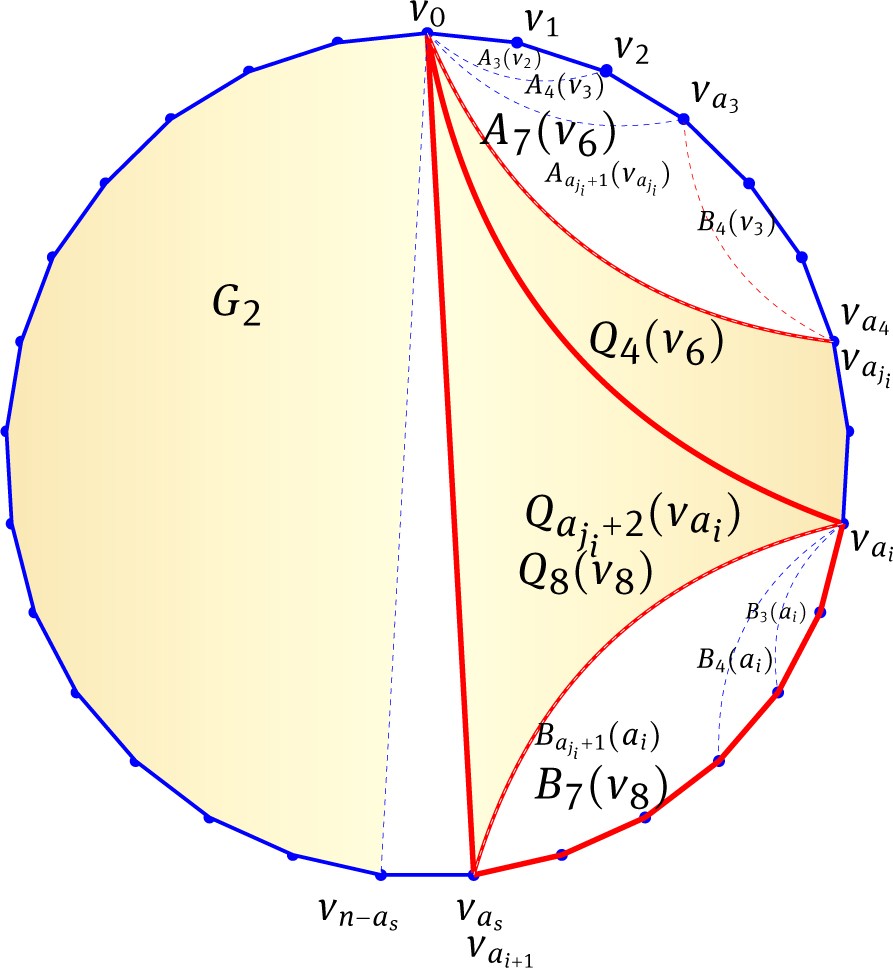
Qaji+2(ai) on G1
We shall construct the triangulation TG1 of G1, and then G2 can be triangulated in a similar way.
(∗) It is important to mention that in the following argument the property ai+1 − ai ∈ Sn, for each two consecutive values ai and ai+1 in Sn, and 1, 2 ∈ Sn, are basic tools to construct TG1.
Let ai, ai+1 be two consecutive vertices in Sn and ai+1 − ai = aji ∈ Sn for some aji ∈ {1, 2, a3, …, ai} (since Sn is a set of ascending values). Let v0vaivai+1 … vai+1v0 be a convex (aji+2)-gon in G1 denoted by Qaji+2(vai). Clearly
Note that a1 = 1, a2 = 2 and a3 ∈ {3, 4} (otherwise, if a3 = 5 then a3 − a2 = 5 − 2 = 3 ∉ Sn, a contradiction). It is easy to see that Q3(v1) ( = v0v1v2v0) is triangulated by v0v1v2v0 and when a3 = 3 we have Q3(v2) ( = v0v2v3v0) is triangulated by v0v2v3v0, and also when a3 = 4 we have that Q4(v2) ( = v0v2v3v4v0) is triangulated by the boundary edges v0v2v3v4v0 together with the diagonal edge v2v4.
Now we obtain a triangulation for Qaji+2(vai), i = 3, …, s − 1.
Let Aai+1(vai) = v0v1 … vaiv0, be a convex (ai+1)-gon in G1. Clearly, A3(v2) ( = v0v1v2v0) is a triangle that is trivially triangulated by T1 = v0v1v2v0. If i = 3, then either a3 = 3 and A4(v3) ( = v0v1v2v3v0) is a quadrilateral that is triangulated by T2 = v0v2 ∪ v0v1v2v3v0, or a3 = 4 and A5(v4) ( = v0v1v2v3v4v0) is a pentagon triangulated by T2 = v0v2v4 ∪ v0v1v2v3v4v0.
Let Baji+1(vai) = Qaji+2(vai) − v0. Then Baji+1(vai) = vaivai+1 … vai+ajivai (since ai+1 − ai = aji) which is equivalent to the convex polygon v0v1 … vajiv0 (by considering ai = 0). Thus, Baji+1(vai) is equivalent Aaji+1(vaji).
If i = 3, we have a4 − a3 = aj3 ∈ Sn for some aj3 ∈ {1, 2, a3}. Then, Baj3+1(a3) ( = va3va3+1 … va4va3 = va3va3+1 … va3+aj3va3) is equivalent to Aaj3+1(aj3) ( = v0v1 … vaj3v0) which is triangulated by T ∈ {T1, T2}. Then, Baj3+1(a3) can be triangulated by T′ equivalent to T. Hence, T3 = T′ ∪ va3v0va4 is a triangulation of Qaj3+2(va3).
Recursively, if we have i = s − 1 then as − as − 1 = ajs − 1 ∈ Sn for some ajs − 1 ∈ {1, 2, a3, …, as − 1}. Then, Bajs − 1+1(vas − 1) is equivalent to Aajs − 1+1(ajs − 1) which is triangulated by T ∈ {T1, T2, T3, …, Ts − 2} (depending on the value of ajs − 1 ∈ {1, 2, a3, …, as − 1}). Then, Bajs − 1+1(vas − 1) can be triangulated by T′ equivalent to T. Hence, Ts − 1 = T′ ∪ vas − 1v0vas is a triangulation of Qajs − 1+2(vas − 1).
Since,
Corollary 2.4
Let n ≥ 4 be a natural number. Suppose G = C(n, S) is a circulant graph. Then G admits a restricted triangulation if one of the following conditions hold.
S = {1, 2, a3, a4, …,
S = {1, 2, a3, a4, …,
Proof
In both cases a1 = 1, a2 = 2 and
Now, we shall define a smallest size circulant graph that admits a restricted triangulation. Before proceeding, we present some ingredients that will be used to prove the main results in this section.
When n is even number, then n can be written as n = t.2r′ for some positive natural number r′ and some positive odd natural number t.
Let Sα be a set of jump values obtaining by next algorithm where α =
Let S1 = {1, 2, 4, 8, …, c} with c = 2r where
If we have a set B = {b1, b2, …, bk} of positive integers, then define a.B to be {a.b1, a.b2, …, a.bk} where a ≥ 1 is an integer number.
Algorithm (A)
If α = 0, then let Sα = {β} and Stop. If α = 1, then let Sα = {1, β} and Stop. If 2 ≤ α ≤ 4, then let Sα = {1, 2, α, β} and Stop. Otherwise, let L = 0 be the number of starting level. Let S(L) = {1, 2, β}, a0 = α, and let L = L+1.
2- If a0 is odd and divisible by 3, then let a1, L =
Let S(L) = {a1, L, a2, L, a0}. Let
If 3 ∈ {a1, L, a2, L} and each of α and
Let L = 0 be the number of starting level. Let S(L) = {1, 2, 3, α − 3, α, β}, a0 = α − 3, and let L = L+1.
If a0 is odd and not divisible by 3, then let a1, L = a2, L = a0 − 3. If a0 is odd and divisible by 3, then let a1, L =
Let S(L) = {a1, L, a2, L, a0}. Let
If a1, L ≤ 3, then arrange Sα to be a set of ascending values and stop. Otherwise, let a0 = a1, L and L = L+1 and then repeat Step (ii).
If a1, L ≤ 4, then arrange Sα to be a set of ascending values and stop. Otherwise, let a0 = a1, L and L = L+1 and then repeat Step (2).
Note that, Sα that obtained by Algorithm (A) is a set of ascending values 1, 2, ai − 1, ai, ai+1, …, α, β.
Lemma 2.5
Suppose Sα = {a1, a2, …, α, β} is a set obtained by Algorithm (A). Then 1, 2 ∈ Sα and ai+1 − ai ∈ Sαfor each ai+1, ai belong to Sα.
Proof
By Algorithm (A) step (1), we get 1, 2 ∈ Sα. Suppose that, ai, ai+1 are two consecutive values belonging to Sα.
If ai+1 = a0 is an odd and divisible by 3 number, then by Algorithm (A) Step (2),
If 3 ∈ Sα and ai+1 = a0 is an odd and not divisible by 3 number, then by Algorithm (A) Step (4), ai = ai+1 − 3. Thus, ai+1 − ai = 3 ∈ Sα.
Otherwise, by Algorithm (A) Step (2),
Theorem 2.6
Let S(n) = S1 ∪ c.Sα, where n ≥ 4. Then C(n, S(n)) admits a restricted triangulation.
Proof
Suppose that C(n, S(n)) is a circulant graph and let α, β, c and t is defined as above. We shall construct a restricted triangulation Tn of C(n, S(n)).
When n is even and t = 1, S(n) = S1 (In this case, β = 1 and then Sα = {1} and then c. Sα = {c} and c ∈ S1). Then let
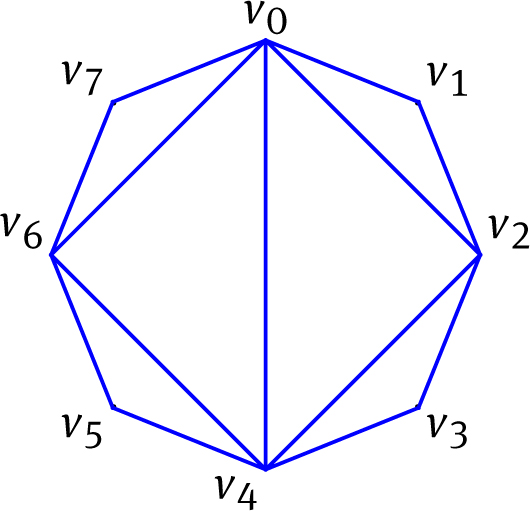
n = 8 = 23, t = 1, r = r′ − 1 = 2, T8 = {vjv(j+1), j = 0, …, 7} ∪ {v2jv2(j+1), j = 0, …, 3} ∪ {v4jv4(j+1), j = 0, 1}.
When n is even and t ≥ 3, S(n) = S1 ∪ c.Sα. In this case, and also when n is odd (which means t = n), we have t-gon which is induced by the vertices v0, vc, v2.c, …, v(t − 2).c, v(t − 1).c (the shaded part in Figure 3).
We shall triangulate this t-gon by T′ which is obtained by one of the following three cases depending on Sα. According to S1, let
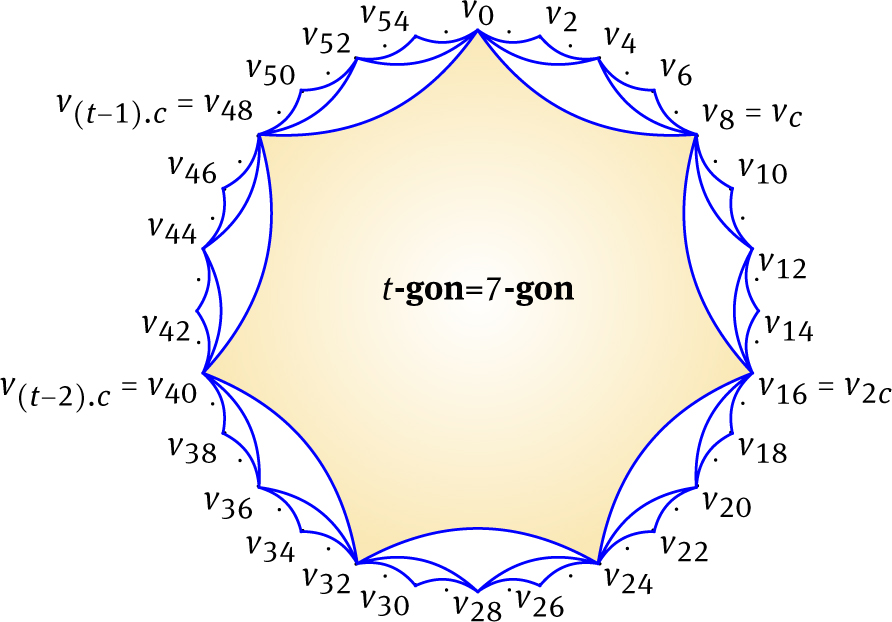
n = 56 = 7.23, t = 7, r = r′ = 3, T56 = {vjv(j+1), j = 0, …, 55} ∪ {v2jv2(j+1), j = 0, …, 27} ∪ {v4jv4(j+1), j = 0, …, 13} ∪ {v8jv8(j+1), j = 0, …, 6}.
Then, let Tn = T ∪ T′ or Tn = T′ be a triangulation to C(n, S(n)) when n is even with t ≥ 3 or when n is odd, respectively.
When α =
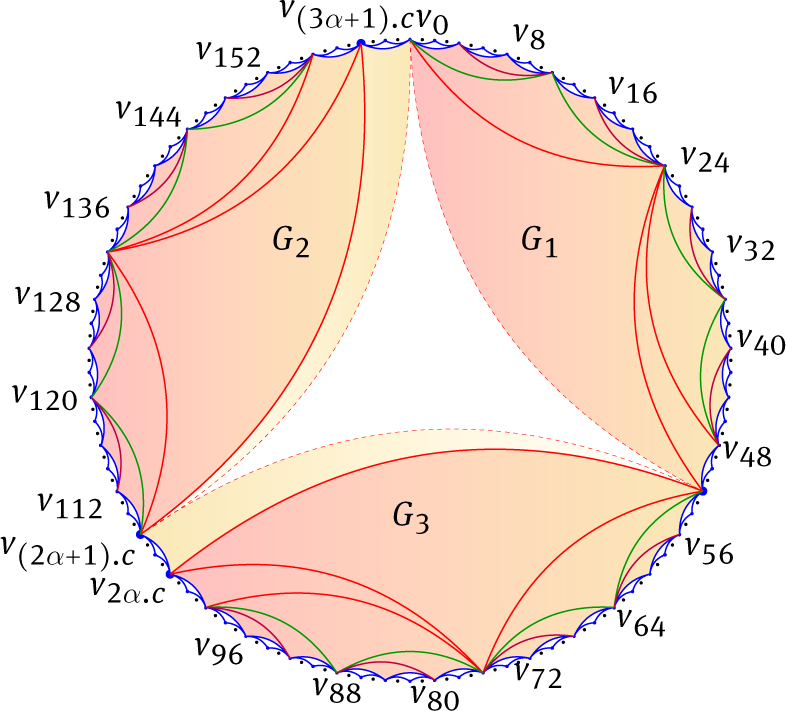 Fig. 4
n = 164, t = 41, r = 2, α = 13, and β = 14.
When α =
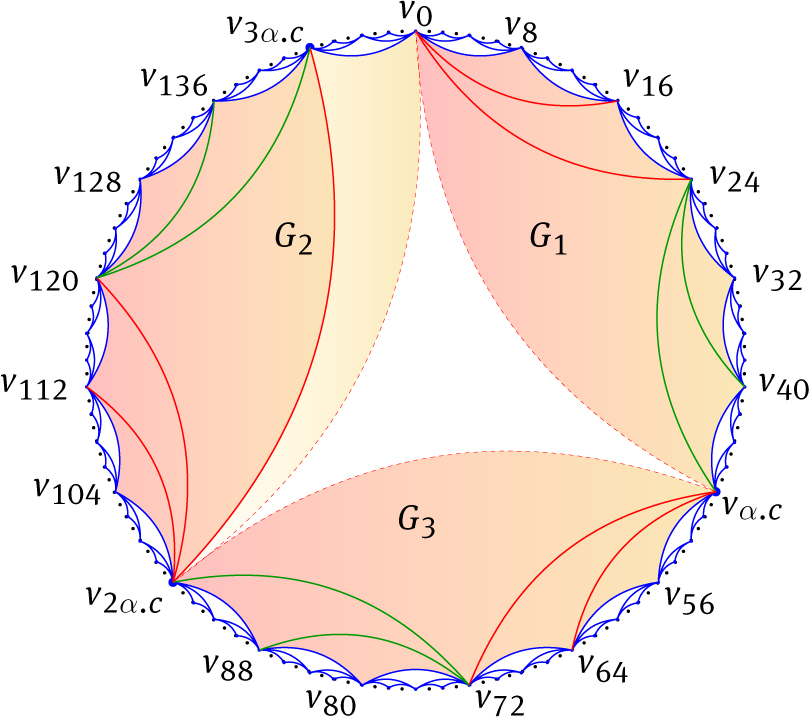 Fig. 5
n = 152, t = 19, r = 3, α = 6, and β = 7.
When α =
In each case, G1, G2 and G3 are of the same order. Suppose that R is an r-gon in Gi, for some i ∈ {1, 2, 3} such that V(R) = {vh, vh+ai, vh+ai+1, …, vh+ai+1} for some vh ∈ V(Gi) and two consecutive jump values ai and ai+1 in Sα.
Without loss of generality assume that R is a subgraph of G1 and h = 0.
By Lemma 2.5, we have 1, 2 ∈ Sα and ai+1 − ai ∈ Sα for each ai+1, ai belonging to Sα. Hence, we can use the argument (∗) of Proposition 2.3 to show that R can be triangulated by Tr. Moreover, similar as in the proof of Proposition 2.3 we can consider G1 as a finite union of such polygons. Then we can assume that TG1 is a finite union of the restricted triangulation of these polygons.
Obtain TG2 (on G2) and TG3 (on G3) by “rotating” the edges of TG1, see Figures 4, 5 and 6. Let T′ = TG1 ∪ TG2 ∪ TG3 ∪ △ for case (1) and case (2), and let T′ = TG1 ∪ TG2 ∪ TG3 for case (3).
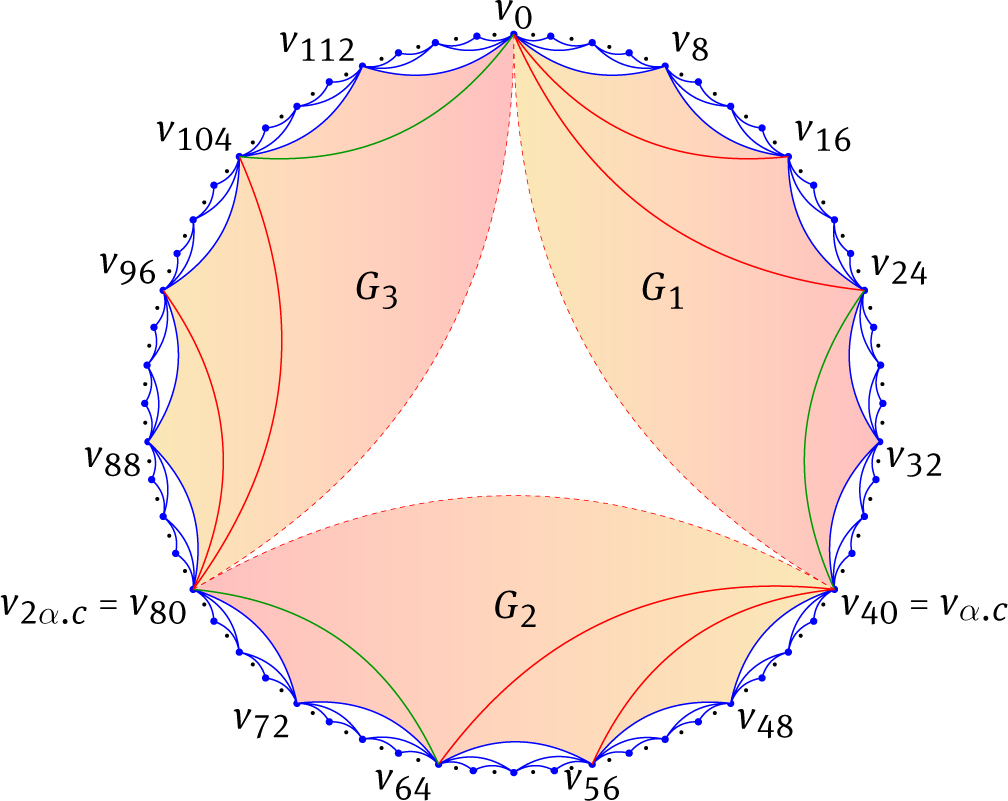 Fig. 6
n = 120, t = 15, r = 3, and α = 5.
This completes the proof.
Definition 2.7
Letn ≥ 4 andtbe defined as above, and letakbe a natural number such that ⌈
S* = {1, 2, a3, a4, …, ak},
there is {x, z} ⊂ S*such thatn = x + y + z wherey ∈ {0, ai} for somei ∈ {1, …, k},
ai+1 − ai ∈ S*for eachi = 1, …, k − 1.
It is clear that, S* = Sn when ak = ⌊
Theorem 2.8
SupposeG = C(n, S) is a circulant graph. Gadmits a restricted triangulation if and only ifScontainsS*.
Proof
Let G have a restricted triangulation Tn. We shall prove that S contains S*. By Lemma 2.1, it is enough to prove S* = D(Tn).
Arrange the spans of D(Tn) to be ascending values.
Since, the circulant graph C(n, D(Tn)) admits Tn, then by Proposition 2.2, we have {1, 2} ⊆ D(Tn).
Let |D(Tn)| = s, then ds is the maximum span in D(Tn).
(⋆) Let t be defined as before. Suppose that ds < ⌈
either e = v2dsvt which yields that its span t − 2ds ∈ D(Tr) ⊂ D(Tn); but t-2ds > ds + 1 (by above assumption, t − 2ds = ds + b + 3 > ds + 1), which is a contradiction with maximality of ds ∈ D(Tn);
or, e = vdsv3ds which yields that 3ds − ds = 2ds ∈ D(Tr) ⊂ D(Tn); but 2ds > ds, which also contradicts the maximality of ds ∈ D(Tn).
Hence, R is not triangulated by Tn which is a contradiction with C(n, S) admitting a restricted triangulation Tn. Thus, ds ≥ ⌈
Now, in order to check property (ii) of S* we have to consider two cases:
If ds =
If ⌈
To check the property (iii) of S*, assume that di and di+1, i ∈ {1, 2, …, s − 1} are two consecutive spans in D(Tn).
If ds =
If ⌈
Assume without loss of generality that vjvj+di and vjvj+di+1 are two diagonals in T1. Then, j < j + di < j + di+1 (by definitions of T1 and R). It is clear that, vjvj+di … vj+di+1vj ⊂ T1. Let Tr = T1(R) be a subgraph of T1 that triangulates R with the boundary edges vjvj+di … vj+di+1vj of R.
Suppose that vj+divj+di+1 ∉ E(Tr). Then there is di < d < di+1 such that vjvj+d ∈ E(Tr). This implies that, d ∈ D(Tr) ⊂ D(Tn), a contradiction with di and di+1 are two consecutive spans in D(Tn).
Hence, vj+divj+di+1 ∈ E(Tr) ⊂ E(Tn). Then di+1 − di ∈ D(Tn).
Thus, D(Tn) = S*. This completes the proof of the necessity.
To show the sufficiency, suppose that S* ⊆ S. Then, C(n, S*) is a subgraph of C(n, S).
Let △ = v0vxvx+yvx+y+z be a triangle (since, x + y + z = n). Clearly, E(△) ⊂ E(G). Then there are three polygons G1, G2 and G3, induced by the vertices v0, v1, v2, …, vx; vx, vx+1, …, vx+y and vx+y, vx+y+1, …, vx+y+z respectively, and G2 = ∅ where y ∈ {0, 1}.
Suppose that R is an r-gon in Gi, for some i ∈ {1, 2, 3} such that V(R) = {vh, vh+ai, vh+ai +1, …, vh+ai+1} for some vh ∈ V(Gi) and two consecutive jump values ai and ai+1 in S*.
Without loss of generality assume that R is a subgraph of G1 and h = 0.
Since S* = {1, 2, a3, a4, …, ak} and satisfies that ai+1 − ai ∈ S* for each i = 1, …, k − 1, then we can use argument (∗) of Proposition 2.3 to show that R can be triangulated by Tr. Consider G1 as a finite union of such polygons. Then we can assume that TG1 is a finite union of the restricted triangulation of those polygons.
Obtain TG2 (on G2) and TG3 (on G3) in a similar way. Then TG1 ∪ TG2 ∪ TG3 is a triangulation of C(n, S*). Since C(n, S*) is a spanning subgraph of G, then TG1 ∪ TG2 ∪ TG3 is a triangulation of G.
This completes the proof. □
Corollary 2.9
S(n) is S*.
Proof
By definition of S(n), either S(n) = S1 (when n is even and t = 1) or S(n) = Sα (when n is odd) or else S(n) = S1 ∪ c.Sα. By definition of S1, we have that S1 is a set of ascending values and contains 1, 2; also Sα is a set of ascending values by Algorithm (A) and contains 1, 2 by Lemma 2.5. Thus S(n) is a set of ascending values containing 1, 2.
Now, let ℓ denote the cardinality of S(n).
When S(n) = S1, aℓ = 2r =
When S(n) = Sα or S(n) = S1 ∪ c.Sα, we have by definition of β, aℓ = ⌈
Let ai and ai+1 be any two consecutive values in S(n). If ai, ai+1 ∈ S1, then ai = 2i and ai+1 = 2i+1 and then ai+1 − ai = 2i+1 − 2i = 2i ∈ S1. If ai = 2r, then ai is the last value in S1 and the first in c.Sα (recall that, c = 2r) and if ai, ai+1 ∈ Sα then by Lemma 2.2, ai+1 − ai ∈ Sα. Thus, ai+1 − ai ∈ S(n) for each ai+1, ai ∈ S(n).
This completes the proof. □
Corollary 2.10
Letn ≥ 4 be a natural number. SupposeG = C(n, S) is a circulant graph. ThenGadmits a restricted triangulation if one of the following conditions hold.
Whennis odd, Scontains {2} and all odd valuesai ≤ aswhere ⌈
Whennis even, Scontains {1} and all even valuesai ≤ aswhere ⌈
Proof
In both cases a1 = 1, a2 = 2 belong to a set of ascending values S, and ⌈
To show the property (2) of S* we have to consider two cases.
When n is an odd natural number. Let n ≥ 7 (When n = 5, then S = {1,2} and clearly C(5, S) admits a restricted triangulation T5 = {v0v1v2v3v4v0} ∪ {v0v2, v0v3}). If ⌈
Whether ⌈
When n is an even natural number, we have r ≥ 1 and then c(≥ 2) is even. Hence, ⌈
By Theorem 2.8, the circulant graph C(n, S) admitting a restricted triangulation.
Proposition 2.11
([13]). SupposeG = C(n, {a1, a2, …, ak}) andH = C(n, {b1, b2, …, bk}) with {a1, a2, …, ak} = q.{b1, b2, …, bk}, where the multiplication is reduced modulonandgcd(q, n) = 1. ThenGis isomorphic toH.
Example 2.12
Letn = 9 andS(n) = {1, 2, 3}.
WhenS1 = {2, 3, 4}, then we haveS1 = {2, 6, 4} = 2.{1, 3, 2} = 2.S(n).
WhenS2 = {1, 3, 4}, then we haveS2 = {8, 12, 4} = 4.{2, 3, 1} = 4.S(n).
The next corollary considers circulant graph G = C(n, S) admits a restricted triangulation when there is an integer q ≥ 1 with gcd(q, n) = 1 such that S* ⊆ q ⋅ S.
Corollary 2.13
letG = C(n, S) be a circulant graph. Suppose there is an integerq ≥ 1 withgcd(q, n) = 1 such thatS* ⊆ q.Sorq.S* ⊆ Swhere the multiplication is reduced modulon. ThenGhas a configuration that admits a restricted triangulation.
Proof
Suppose that, q ≥ 1 is an integer such that gcd(q, n) = 1 and S* ⊆ q.S or q.S* ⊆ S. Then, there is a set S′ ⊂ S such that S* = q.S′ or q.S* = S′. Thus, by Proposition 2.11, the subgraph H = C(n, S′) of C(n, S) is isomorphic to C(n, S*). By Theorem 2.8, H = C(n, S′) admits a restricted triangulation. Thus, G has a configuration that admits a restricted triangulation. This completes the proof. □
2.1 An application
The skewness of a graph G, denoted sk(G), is the minimum number of edges to be deleted from G such that the resulting graph is planar. The convex skewness of a convex graph G, denoted skc(G) is the minimum number of edges to be removed from G so that the resulting graph is a convex plane graph (see [14]).
Proposition 2.14
LetG = C(n, S) be a circulant graph and letq ≥ 1 be an integer such thatgcd(q, n) = 1. Thenskc(G) = E(G) − (2n − 3) ifS* ⊆ S, orqS* ⊆ S, orS* ⊆ qS.
Proof
If S* ⊆ S, then G = C(n, S) admits a restricted triangulation, by Theorem 2.8. If qS* ⊆ S or S* ⊆ qS, then G = C(n, S) admits a restricted triangulation, by Corollary 2.13.
It is known that, any triangulation T of a convex n-gon has 2n − 3 edges (n − 3 of them are non-boundary edges). If any new straight line segment is added to the triangulation, it will intersect with some non-boundary edge of T. Hence, we have skc(G) = E(G) − (2n − 3). □
3 Kn − G admits a restricted triangulation
In this section we turn to another question: which circulant graph G on n vertices does satisfy that Kn − G admits a restricted triangulation and what is the largest size of G such that Kn − G still admits a restricted triangulation? We answered the first question by Corollary 3.1 and Corollary 3.3. We show that C(n, S(n)) is a smallest size circulant graph that admits a restricted triangulation, in order to answer the second question by Theorem 3.5. In what follows, let 𝓝 = {1, 2, …, ⌊ n/2⌋}.
Corollary 3.1
LetG = C(n, S) be a circulant graph. ThenKn − Gadmits a restricted triangulation if one of the following conditions hold.
If there isS*such thatS ∩ S* = ∅.
Scontains all oddi of 𝓝 except {1, ⌊ n/2⌋}.
Scontains all eveniof 𝓝 except {2, ⌊ n/2⌋}.
Proof
First, it is well known that Kn − C(n, S) = C(n, 𝓝 − S).
Suppose that S ∩ S* = ∅. Then, 𝓝 − S contains S* which yields that the circulant graph C(n, 𝓝 − S) admits the restricted triangulation by Theorem 2.8, and this shows the property (1).
In (2), 𝓝 − S contains all even values of 𝓝 together with {1, ⌊ n/2⌋}. In (3), 𝓝 − S contains all odd values of 𝓝 together with {2, ⌊ n/2⌋}. By Corollary 2.4, C(n, 𝓝 − S) admits the restricted triangulation for both cases.
This completes the proof. □
Definition 3.2
([14]). LetKnbe a convex complete graph withnvertices. F is said to be potentially triangulable inKnif there exists a configuration of F inKnsuch thatKn − F admits a triangulation.
Corollary 3.3
LetG = C(n, S) be a circulant graph. SupposeS* ⊆ q.(𝓝 − S) for some an integerq ≥ 1 withgcd(q, n) = 1. ThenGis potentially triangulable inKn.
Proof
Suppose that, q ≥ 1 is an integer such that gcd(q, n) = 1 and S* ⊆ q.(𝓝 − S) for some S*. Then, there is a set S′ ⊂ 𝓝 − S such that S* = q.S′. Then by Proposition 2.11, the subgraph C(n, S′) of C(n, 𝓝 − S) is isomorphic to C(n, S*). By Theorem 2.8, C(n, S′) has a configuration that admits a restricted triangulation. Thus, C(n, 𝓝 − S) (= Kn − G) admits a restricted triangulation. This completes the proof. □
To answer the second part of the question, we shall determine the largest size L(n) of G for which Kn − G admits a restricted triangulation. Before proceeding, let first |E(C(n,S(n)))| = 𝓔ℓ where |S(n)| = ℓ. Then we deduce that,
The next result shows that whenever C(n, S) admits a restricted triangulation then |S| ≥ |S(n)|. That is, C(n, S), is not a smaller size than C(n, S(n)).
Theorem 3.4
C(n, S(n)) is the smallest size circulant graph admitting a restricted triangulation ifn ≥ 4.
Proof
Recall that, S(n) = S1 ∪ c ⋅ Sα. By Theorem 2.6, C(n, S(n)) admits a restricted triangulation. Hence, we just show that S(n) is the smallest cardinality set for which the conclusion remains true.
Assume that C(n, S) is a circulant graph that admits a restricted triangulation where S = {b1, b2, b3, …, bs} is a set of ascending jump values to C(n, S).
By Theorem 2.8, S contains S*. Thus, 1, 2 ∈ S and ⌈
In case when bi+1 is even we have, according to Sα (by Algorithm (A) step (2) where bi+1 = a0 is even) and S1 (by definition of S1), that the difference between the two consecutive values bi and bi+1 is always bi.
If j ∈ {1, …, i − 1}, then the number of values in S(n) is less than the number of values in S. If bi+1 − bi = bi ∈ S, then the number of values in S(n) is equal to the number of values in S. Thus, |S| ≥ |S(n)|.
In case when bi+1 is odd, then bj ≠ bi and there are three cases which are depending only on Sα. (by definition of S1).
bj ∈ {1, 2}.
In this case, the difference between the two consecutive values bi and bi+1 is at most 2. According to Algorithm (A), the difference between the two consecutive values is at most 2 only when bi = ⌊
For instance, take bi+1 = 13 then bi ∈ {11, 12}. Take S ∈ {S1, S2, S3, S4, S5, S6} where S1 = {1, 2, 3, 5, 10, 12, 13}, S2 = {1, 2, 3, 6, 9, 12, 13}, S3 = {1, 2, 3, 5, 6, 11, 13}, S4 = {1, 2, 3, 6, 9, 11, 13}, S5 = {1, 2, 3, 5, 10, 11, 13}, or S6 = {1, 2, 3, 4, 7, 9, 11, 13}. Then the cardinality of S is 7. By Algorithm (A) step (2):
either, bi = 7 and bi−1 = 6 and then Sα = {1, 2, 3, 6, 7, 13}. Thus, the cardinality of Sα is 6;
or, bi+2 = 25 and then bi+1 = 13 and bi = 12. Then, Sα = {1, 2, 3, 6, 12, 13, 25}. In this case, Take S ∈ {S1, S2} where S1 = {1, 2, 3, 5, 10, 12, 13, 25}, and S2 = {1, 2, 3, 6, 9, 12, 13, 25}. Note that S is of cardinality 8 while Sα is of cardinality 7.
j ∈ {3, …, i − 2}.
In Sα, this case is satisfied in step (4) of Algorithm (A) (when bi = a0 is odd and not divisible by 3). But in this case, Algorithm (A) states bi to be bi+1 − 3 which is always even. Then by step (2) when bi(= a0) is even we have that bi−1 =
For instance, take bi+1 = 23 and S = {1, 2, 3, 6, 8, 9, 17, 23}. By Algorithm (A) we have Sα = {1, 2, 3, 5, 10, 20, 23}. Note that S is of cardinality 8 while Sα is of cardinality 7.
j = i − 1.
If bi+1 is not divisible by 3, then by Algorithm (A) step (2) we have bj = bi−1 = ⌊
If bi+1 is divisible by 3, then in Sα by Algorithm (A) step (2) (where bi+1 = a0 is odd and divisible by 3). Then bi−1 =
This completes the proof.
Let L(n) =
By Theorem 3.4, we have that 𝓔ℓ is the smallest number of edges of a circulant graph that admits a restricted triangulation. The following result is to measure the non-triangulability of Kn − G.
Theorem 3.5
LetG = C(n, S) be a circulant graph. ThenKn − Gadmits no restricted triangulation if |E(G)| > L(n).
Proof
Let |E(G)| > L(n). Then |E(Kn − G)| =
References
[1] Lloyd E.L., On triangulations of a set of points in the plane, Proc. of IEEE Symposium on Foundations of Computer Science (FOCS), IEEE,(1977), 228 — 240.10.1109/SFCS.1977.21Search in Google Scholar
[2] Schulz A., The Existence of a Pseudo-triangulation in a given Geometric Graph. Proc. 22nd European Workshop on Computational Geometry, March(2006), Delphi, Greece, 17 – 20.Search in Google Scholar
[3] Černý J., Dvořa′k Z., Jelínek, and J. Ka′ra V., Noncrossing Hamiltonian paths in geometric graphs, Discrete Applied Mathematics, (2007), 155(9), 1096—1105.10.1016/j.dam.2005.12.010Search in Google Scholar
[4] Aichholzer A., Cabello S., Fabila-Monroy R., Flores-Peñaloza D., Hackl T., Huemer C., Hurtado F. and Wood D.R., Edge-removal and non-crossing configurations and geometric graph, Discrete Maths. & Theorectical Comput. Sci., (2010), 12, 75–86.10.46298/dmtcs.525Search in Google Scholar
[5] Imran M., Baig A.Q., Bokhary S.A.U.H., Javaid I., On the metric dimension of circulant graphs, Applied Mathematics Letters, (2012), 25, 320 — 325.10.1016/j.aml.2011.09.008Search in Google Scholar
[6] Basic M., Petkovic M.D., Stevanovic D., Perfect state transfer in integral circulant graphs, Applied Mathematics Letters, (2009), 22, 1117–1121.10.1016/j.aml.2008.11.005Search in Google Scholar
[7] Rose D.J., Tarjan R.E., Lueker G.S., Algorithmic aspects of vertex elimination on graphs, SIAM J. Comput. (1976), 5(2), 266–283.10.1137/0205021Search in Google Scholar
[8] Tarjan R.E., Yannakakis M., Simple linear-time algorithms to test chordality of graphs, test acyclicity of hypergraphs, and selectively reduce acyclic hypergraphs, SIAM J. Comput. (1984), 13(3), 566 – 579.10.1137/0213035Search in Google Scholar
[9] Deshpande A., Garofalakis M.N., Jordan M.I., Efficient stepwise selection in decomposable models, Proc. the Seventeenth conference on Uncertainty in artificial intelligence UAI, August 02 - 05 (2001) Seattle, Washington, 128 –135.Search in Google Scholar
[10] Aurenhammer F., Voronoi diagrams - a survey of fundamental geometric data structure, ACM Computing Surveys, (1991), 23, 345–405.10.1145/116873.116880Search in Google Scholar
[11] Floriani L., Surface representation based on triangular grids, The Visual Computer, (1987), 3, 27 – 50.10.1007/BF02153649Search in Google Scholar
[12] Harary F., Graph Theory, (Addison-Wesley, 1969).10.21236/AD0705364Search in Google Scholar
[13] Lu F., Zhang L., Wang Y., The Pfaffian property of circulant graphs, Discrete Applied Mathematics, (2015), 181, 185 -–192.10.1016/j.dam.2014.09.002Search in Google Scholar
[14] Ali N.A., Gek Chia L., Trao H.M., Kilicman A., Triangulability of Convex Graphs and Convex Skewness, arXiv:1611.09033v1 [math.CO], November (2016).Search in Google Scholar
© 2018 Ali et al., published by De Gruyter
This work is licensed under the Creative Commons Attribution-NonCommercial-NoDerivatives 4.0 License.
Articles in the same Issue
- Regular Articles
- Algebraic proofs for shallow water bi–Hamiltonian systems for three cocycle of the semi-direct product of Kac–Moody and Virasoro Lie algebras
- On a viscous two-fluid channel flow including evaporation
- Generation of pseudo-random numbers with the use of inverse chaotic transformation
- Singular Cauchy problem for the general Euler-Poisson-Darboux equation
- Ternary and n-ary f-distributive structures
- On the fine Simpson moduli spaces of 1-dimensional sheaves supported on plane quartics
- Evaluation of integrals with hypergeometric and logarithmic functions
- Bounded solutions of self-adjoint second order linear difference equations with periodic coeffients
- Oscillation of first order linear differential equations with several non-monotone delays
- Existence and regularity of mild solutions in some interpolation spaces for functional partial differential equations with nonlocal initial conditions
- The log-concavity of the q-derangement numbers of type B
- Generalized state maps and states on pseudo equality algebras
- Monotone subsequence via ultrapower
- Note on group irregularity strength of disconnected graphs
- On the security of the Courtois-Finiasz-Sendrier signature
- A further study on ordered regular equivalence relations in ordered semihypergroups
- On the structure vector field of a real hypersurface in complex quadric
- Rank relations between a {0, 1}-matrix and its complement
- Lie n superderivations and generalized Lie n superderivations of superalgebras
- Time parallelization scheme with an adaptive time step size for solving stiff initial value problems
- Stability problems and numerical integration on the Lie group SO(3) × R3 × R3
- On some fixed point results for (s, p, α)-contractive mappings in b-metric-like spaces and applications to integral equations
- On algebraic characterization of SSC of the Jahangir’s graph 𝓙n,m
- A greedy algorithm for interval greedoids
- On nonlinear evolution equation of second order in Banach spaces
- A primal-dual approach of weak vector equilibrium problems
- On new strong versions of Browder type theorems
- A Geršgorin-type eigenvalue localization set with n parameters for stochastic matrices
- Restriction conditions on PL(7, 2) codes (3 ≤ |𝓖i| ≤ 7)
- Singular integrals with variable kernel and fractional differentiation in homogeneous Morrey-Herz-type Hardy spaces with variable exponents
- Introduction to disoriented knot theory
- Restricted triangulation on circulant graphs
- Boundedness control sets for linear systems on Lie groups
- Chen’s inequalities for submanifolds in (κ, μ)-contact space form with a semi-symmetric metric connection
- Disjointed sum of products by a novel technique of orthogonalizing ORing
- A parametric linearizing approach for quadratically inequality constrained quadratic programs
- Generalizations of Steffensen’s inequality via the extension of Montgomery identity
- Vector fields satisfying the barycenter property
- On the freeness of hypersurface arrangements consisting of hyperplanes and spheres
- Biderivations of the higher rank Witt algebra without anti-symmetric condition
- Some remarks on spectra of nuclear operators
- Recursive interpolating sequences
- Involutory biquandles and singular knots and links
- Constacyclic codes over 𝔽pm[u1, u2,⋯,uk]/〈 ui2 = ui, uiuj = ujui〉
- Topological entropy for positively weak measure expansive shadowable maps
- Oscillation and non-oscillation of half-linear differential equations with coeffcients determined by functions having mean values
- On 𝓠-regular semigroups
- One kind power mean of the hybrid Gauss sums
- A reduced space branch and bound algorithm for a class of sum of ratios problems
- Some recurrence formulas for the Hermite polynomials and their squares
- A relaxed block splitting preconditioner for complex symmetric indefinite linear systems
- On f - prime radical in ordered semigroups
- Positive solutions of semipositone singular fractional differential systems with a parameter and integral boundary conditions
- Disjoint hypercyclicity equals disjoint supercyclicity for families of Taylor-type operators
- A stochastic differential game of low carbon technology sharing in collaborative innovation system of superior enterprises and inferior enterprises under uncertain environment
- Dynamic behavior analysis of a prey-predator model with ratio-dependent Monod-Haldane functional response
- The points and diameters of quantales
- Directed colimits of some flatness properties and purity of epimorphisms in S-posets
- Super (a, d)-H-antimagic labeling of subdivided graphs
- On the power sum problem of Lucas polynomials and its divisible property
- Existence of solutions for a shear thickening fluid-particle system with non-Newtonian potential
- On generalized P-reducible Finsler manifolds
- On Banach and Kuratowski Theorem, K-Lusin sets and strong sequences
- On the boundedness of square function generated by the Bessel differential operator in weighted Lebesque Lp,α spaces
- On the different kinds of separability of the space of Borel functions
- Curves in the Lorentz-Minkowski plane: elasticae, catenaries and grim-reapers
- Functional analysis method for the M/G/1 queueing model with single working vacation
- Existence of asymptotically periodic solutions for semilinear evolution equations with nonlocal initial conditions
- The existence of solutions to certain type of nonlinear difference-differential equations
- Domination in 4-regular Knödel graphs
- Stepanov-like pseudo almost periodic functions on time scales and applications to dynamic equations with delay
- Algebras of right ample semigroups
- Random attractors for stochastic retarded reaction-diffusion equations with multiplicative white noise on unbounded domains
- Nontrivial periodic solutions to delay difference equations via Morse theory
- A note on the three-way generalization of the Jordan canonical form
- On some varieties of ai-semirings satisfying xp+1 ≈ x
- Abstract-valued Orlicz spaces of range-varying type
- On the recursive properties of one kind hybrid power mean involving two-term exponential sums and Gauss sums
- Arithmetic of generalized Dedekind sums and their modularity
- Multipreconditioned GMRES for simulating stochastic automata networks
- Regularization and error estimates for an inverse heat problem under the conformable derivative
- Transitivity of the εm-relation on (m-idempotent) hyperrings
- Learning Bayesian networks based on bi-velocity discrete particle swarm optimization with mutation operator
- Simultaneous prediction in the generalized linear model
- Two asymptotic expansions for gamma function developed by Windschitl’s formula
- State maps on semihoops
- 𝓜𝓝-convergence and lim-inf𝓜-convergence in partially ordered sets
- Stability and convergence of a local discontinuous Galerkin finite element method for the general Lax equation
- New topology in residuated lattices
- Optimality and duality in set-valued optimization utilizing limit sets
- An improved Schwarz Lemma at the boundary
- Initial layer problem of the Boussinesq system for Rayleigh-Bénard convection with infinite Prandtl number limit
- Toeplitz matrices whose elements are coefficients of Bazilevič functions
- Epi-mild normality
- Nonlinear elastic beam problems with the parameter near resonance
- Orlicz difference bodies
- The Picard group of Brauer-Severi varieties
- Galoisian and qualitative approaches to linear Polyanin-Zaitsev vector fields
- Weak group inverse
- Infinite growth of solutions of second order complex differential equation
- Semi-Hurewicz-Type properties in ditopological texture spaces
- Chaos and bifurcation in the controlled chaotic system
- Translatability and translatable semigroups
- Sharp bounds for partition dimension of generalized Möbius ladders
- Uniqueness theorems for L-functions in the extended Selberg class
- An effective algorithm for globally solving quadratic programs using parametric linearization technique
- Bounds of Strong EMT Strength for certain Subdivision of Star and Bistar
- On categorical aspects of S -quantales
- On the algebraicity of coefficients of half-integral weight mock modular forms
- Dunkl analogue of Szász-mirakjan operators of blending type
- Majorization, “useful” Csiszár divergence and “useful” Zipf-Mandelbrot law
- Global stability of a distributed delayed viral model with general incidence rate
- Analyzing a generalized pest-natural enemy model with nonlinear impulsive control
- Boundary value problems of a discrete generalized beam equation via variational methods
- Common fixed point theorem of six self-mappings in Menger spaces using (CLRST) property
- Periodic and subharmonic solutions for a 2nth-order p-Laplacian difference equation containing both advances and retardations
- Spectrum of free-form Sudoku graphs
- Regularity of fuzzy convergence spaces
- The well-posedness of solution to a compressible non-Newtonian fluid with self-gravitational potential
- On further refinements for Young inequalities
- Pretty good state transfer on 1-sum of star graphs
- On a conjecture about generalized Q-recurrence
- Univariate approximating schemes and their non-tensor product generalization
- Multi-term fractional differential equations with nonlocal boundary conditions
- Homoclinic and heteroclinic solutions to a hepatitis C evolution model
- Regularity of one-sided multilinear fractional maximal functions
- Galois connections between sets of paths and closure operators in simple graphs
- KGSA: A Gravitational Search Algorithm for Multimodal Optimization based on K-Means Niching Technique and a Novel Elitism Strategy
- θ-type Calderón-Zygmund Operators and Commutators in Variable Exponents Herz space
- An integral that counts the zeros of a function
- On rough sets induced by fuzzy relations approach in semigroups
- Computational uncertainty quantification for random non-autonomous second order linear differential equations via adapted gPC: a comparative case study with random Fröbenius method and Monte Carlo simulation
- The fourth order strongly noncanonical operators
- Topical Issue on Cyber-security Mathematics
- Review of Cryptographic Schemes applied to Remote Electronic Voting systems: remaining challenges and the upcoming post-quantum paradigm
- Linearity in decimation-based generators: an improved cryptanalysis on the shrinking generator
- On dynamic network security: A random decentering algorithm on graphs
Articles in the same Issue
- Regular Articles
- Algebraic proofs for shallow water bi–Hamiltonian systems for three cocycle of the semi-direct product of Kac–Moody and Virasoro Lie algebras
- On a viscous two-fluid channel flow including evaporation
- Generation of pseudo-random numbers with the use of inverse chaotic transformation
- Singular Cauchy problem for the general Euler-Poisson-Darboux equation
- Ternary and n-ary f-distributive structures
- On the fine Simpson moduli spaces of 1-dimensional sheaves supported on plane quartics
- Evaluation of integrals with hypergeometric and logarithmic functions
- Bounded solutions of self-adjoint second order linear difference equations with periodic coeffients
- Oscillation of first order linear differential equations with several non-monotone delays
- Existence and regularity of mild solutions in some interpolation spaces for functional partial differential equations with nonlocal initial conditions
- The log-concavity of the q-derangement numbers of type B
- Generalized state maps and states on pseudo equality algebras
- Monotone subsequence via ultrapower
- Note on group irregularity strength of disconnected graphs
- On the security of the Courtois-Finiasz-Sendrier signature
- A further study on ordered regular equivalence relations in ordered semihypergroups
- On the structure vector field of a real hypersurface in complex quadric
- Rank relations between a {0, 1}-matrix and its complement
- Lie n superderivations and generalized Lie n superderivations of superalgebras
- Time parallelization scheme with an adaptive time step size for solving stiff initial value problems
- Stability problems and numerical integration on the Lie group SO(3) × R3 × R3
- On some fixed point results for (s, p, α)-contractive mappings in b-metric-like spaces and applications to integral equations
- On algebraic characterization of SSC of the Jahangir’s graph 𝓙n,m
- A greedy algorithm for interval greedoids
- On nonlinear evolution equation of second order in Banach spaces
- A primal-dual approach of weak vector equilibrium problems
- On new strong versions of Browder type theorems
- A Geršgorin-type eigenvalue localization set with n parameters for stochastic matrices
- Restriction conditions on PL(7, 2) codes (3 ≤ |𝓖i| ≤ 7)
- Singular integrals with variable kernel and fractional differentiation in homogeneous Morrey-Herz-type Hardy spaces with variable exponents
- Introduction to disoriented knot theory
- Restricted triangulation on circulant graphs
- Boundedness control sets for linear systems on Lie groups
- Chen’s inequalities for submanifolds in (κ, μ)-contact space form with a semi-symmetric metric connection
- Disjointed sum of products by a novel technique of orthogonalizing ORing
- A parametric linearizing approach for quadratically inequality constrained quadratic programs
- Generalizations of Steffensen’s inequality via the extension of Montgomery identity
- Vector fields satisfying the barycenter property
- On the freeness of hypersurface arrangements consisting of hyperplanes and spheres
- Biderivations of the higher rank Witt algebra without anti-symmetric condition
- Some remarks on spectra of nuclear operators
- Recursive interpolating sequences
- Involutory biquandles and singular knots and links
- Constacyclic codes over 𝔽pm[u1, u2,⋯,uk]/〈 ui2 = ui, uiuj = ujui〉
- Topological entropy for positively weak measure expansive shadowable maps
- Oscillation and non-oscillation of half-linear differential equations with coeffcients determined by functions having mean values
- On 𝓠-regular semigroups
- One kind power mean of the hybrid Gauss sums
- A reduced space branch and bound algorithm for a class of sum of ratios problems
- Some recurrence formulas for the Hermite polynomials and their squares
- A relaxed block splitting preconditioner for complex symmetric indefinite linear systems
- On f - prime radical in ordered semigroups
- Positive solutions of semipositone singular fractional differential systems with a parameter and integral boundary conditions
- Disjoint hypercyclicity equals disjoint supercyclicity for families of Taylor-type operators
- A stochastic differential game of low carbon technology sharing in collaborative innovation system of superior enterprises and inferior enterprises under uncertain environment
- Dynamic behavior analysis of a prey-predator model with ratio-dependent Monod-Haldane functional response
- The points and diameters of quantales
- Directed colimits of some flatness properties and purity of epimorphisms in S-posets
- Super (a, d)-H-antimagic labeling of subdivided graphs
- On the power sum problem of Lucas polynomials and its divisible property
- Existence of solutions for a shear thickening fluid-particle system with non-Newtonian potential
- On generalized P-reducible Finsler manifolds
- On Banach and Kuratowski Theorem, K-Lusin sets and strong sequences
- On the boundedness of square function generated by the Bessel differential operator in weighted Lebesque Lp,α spaces
- On the different kinds of separability of the space of Borel functions
- Curves in the Lorentz-Minkowski plane: elasticae, catenaries and grim-reapers
- Functional analysis method for the M/G/1 queueing model with single working vacation
- Existence of asymptotically periodic solutions for semilinear evolution equations with nonlocal initial conditions
- The existence of solutions to certain type of nonlinear difference-differential equations
- Domination in 4-regular Knödel graphs
- Stepanov-like pseudo almost periodic functions on time scales and applications to dynamic equations with delay
- Algebras of right ample semigroups
- Random attractors for stochastic retarded reaction-diffusion equations with multiplicative white noise on unbounded domains
- Nontrivial periodic solutions to delay difference equations via Morse theory
- A note on the three-way generalization of the Jordan canonical form
- On some varieties of ai-semirings satisfying xp+1 ≈ x
- Abstract-valued Orlicz spaces of range-varying type
- On the recursive properties of one kind hybrid power mean involving two-term exponential sums and Gauss sums
- Arithmetic of generalized Dedekind sums and their modularity
- Multipreconditioned GMRES for simulating stochastic automata networks
- Regularization and error estimates for an inverse heat problem under the conformable derivative
- Transitivity of the εm-relation on (m-idempotent) hyperrings
- Learning Bayesian networks based on bi-velocity discrete particle swarm optimization with mutation operator
- Simultaneous prediction in the generalized linear model
- Two asymptotic expansions for gamma function developed by Windschitl’s formula
- State maps on semihoops
- 𝓜𝓝-convergence and lim-inf𝓜-convergence in partially ordered sets
- Stability and convergence of a local discontinuous Galerkin finite element method for the general Lax equation
- New topology in residuated lattices
- Optimality and duality in set-valued optimization utilizing limit sets
- An improved Schwarz Lemma at the boundary
- Initial layer problem of the Boussinesq system for Rayleigh-Bénard convection with infinite Prandtl number limit
- Toeplitz matrices whose elements are coefficients of Bazilevič functions
- Epi-mild normality
- Nonlinear elastic beam problems with the parameter near resonance
- Orlicz difference bodies
- The Picard group of Brauer-Severi varieties
- Galoisian and qualitative approaches to linear Polyanin-Zaitsev vector fields
- Weak group inverse
- Infinite growth of solutions of second order complex differential equation
- Semi-Hurewicz-Type properties in ditopological texture spaces
- Chaos and bifurcation in the controlled chaotic system
- Translatability and translatable semigroups
- Sharp bounds for partition dimension of generalized Möbius ladders
- Uniqueness theorems for L-functions in the extended Selberg class
- An effective algorithm for globally solving quadratic programs using parametric linearization technique
- Bounds of Strong EMT Strength for certain Subdivision of Star and Bistar
- On categorical aspects of S -quantales
- On the algebraicity of coefficients of half-integral weight mock modular forms
- Dunkl analogue of Szász-mirakjan operators of blending type
- Majorization, “useful” Csiszár divergence and “useful” Zipf-Mandelbrot law
- Global stability of a distributed delayed viral model with general incidence rate
- Analyzing a generalized pest-natural enemy model with nonlinear impulsive control
- Boundary value problems of a discrete generalized beam equation via variational methods
- Common fixed point theorem of six self-mappings in Menger spaces using (CLRST) property
- Periodic and subharmonic solutions for a 2nth-order p-Laplacian difference equation containing both advances and retardations
- Spectrum of free-form Sudoku graphs
- Regularity of fuzzy convergence spaces
- The well-posedness of solution to a compressible non-Newtonian fluid with self-gravitational potential
- On further refinements for Young inequalities
- Pretty good state transfer on 1-sum of star graphs
- On a conjecture about generalized Q-recurrence
- Univariate approximating schemes and their non-tensor product generalization
- Multi-term fractional differential equations with nonlocal boundary conditions
- Homoclinic and heteroclinic solutions to a hepatitis C evolution model
- Regularity of one-sided multilinear fractional maximal functions
- Galois connections between sets of paths and closure operators in simple graphs
- KGSA: A Gravitational Search Algorithm for Multimodal Optimization based on K-Means Niching Technique and a Novel Elitism Strategy
- θ-type Calderón-Zygmund Operators and Commutators in Variable Exponents Herz space
- An integral that counts the zeros of a function
- On rough sets induced by fuzzy relations approach in semigroups
- Computational uncertainty quantification for random non-autonomous second order linear differential equations via adapted gPC: a comparative case study with random Fröbenius method and Monte Carlo simulation
- The fourth order strongly noncanonical operators
- Topical Issue on Cyber-security Mathematics
- Review of Cryptographic Schemes applied to Remote Electronic Voting systems: remaining challenges and the upcoming post-quantum paradigm
- Linearity in decimation-based generators: an improved cryptanalysis on the shrinking generator
- On dynamic network security: A random decentering algorithm on graphs
