
On algebraic characterization of SSC of the Jahangir’s graph 𝓙n,m
-
Zahid Raza
 and
Imran Anwar
and
Imran Anwar

Abstract
In this paper, some algebraic and combinatorial characterizations of the spanning simplicial complex Δs(𝓙n,m) of the Jahangir’s graph 𝓙n,m are explored. We show that Δs(𝓙n,m) is pure, present the formula for f-vectors associated to it and hence deduce a recipe for computing the Hilbert series of the Face ring k[Δs(𝓙n,m)]. Finally, we show that the face ring of Δs(𝓙n,m) is Cohen-Macaulay and give some open scopes of the current work.
1 Introduction
The concept of spanning simplicial complex (SSC) associated with the edge set of a simple finite connected graph is introduced by Anwar, Raza and Kashif in [1]. They revealed some important algebraic properties of SSC of a unicyclic graph. Kashif, Raza and Anwar further established the theory and explored algebraic characterizations of some more general classes of n-cyclic graphs in [10, 11]. The problem of finding the SSC for a general simple finite connected graph is not an easy task to handle. Recently in [15] Zhu, Shi and Geng discussed the SSC of another class n−cyclic graphs with a common edge.
In this article, we discuss some algebraic and combinatorial properties of the spanning simplicial complex Δs(𝓙n,m) of a certain class of cyclic graphs, 𝓙n,m. For simplicity, we fixed n = 2 in our results. Here, 𝓙n,m is the class of Jahangir’s graph defined in [12] as follows:
The Jahangir’s graphJn,m, for m ≥ 3, is a graph on nm + 1 vertices i.e., a graph consisting of a cycle Cnm with one additional vertex which is adjacent to m vertices of Cnm at distance n to each other on Cnm.
More explicitly, it consists of a cycle Cnm which is further divided into m consecutive cycles Ci of equal length such that all these cycles have one vertex common and every pair of consecutive cycles has exactly one edge common. For example the graph 𝓙2,3 is given in Figure 1. We fix the edge set of 𝓙2,m as follows:
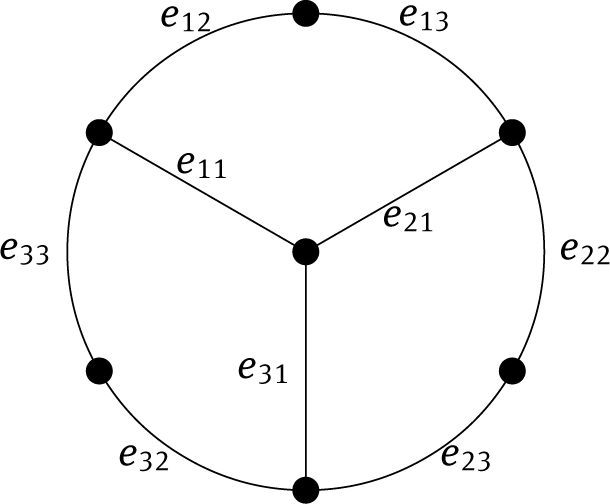
The graph 𝓙2,3
Here, {ek1, ek2, ek3, e(k+1)1} is the edge set of the cycle Ck for k ∈ {1, 2, …, m − 1} and {em1, em2, em3, e11} is the edge set of cycle Cm. Also ek1 always represents the common edge between Ck−1 and Ck for k ∈ {1, 2, …, m − 1} and e11 is the common edge between the cycle Cm and C1.
2 Preliminaries
In this section, we give some background and preliminaries of the topic and define some important notions to make this paper self-contained. However, for more details of the notions we refer the reader to [3, 4, 5, 6, 7, 13, 14].
Definition 2.1
A spanning tree of a simple connected finite graphG(V, E) is a subtree ofGthat contains every vertex ofG.
We represent the collection of all edge-sets of the spanning trees ofGbys(G), in other words;
Lemma 2.2
Let G = (V, E) be a simple finite connected graph containingmcycles. Then its spanning tree contains exactly |E| − medges.
Proof
A spanning tree of a graph is its spanning subgraph containing no cycles and no disconnection. If G is a unicyclic graph then deletion of one edge from it results in a spanning tree. If more than one edge is removed from the cycle in G then a disconnection is obtained which is not a spanning tree. Therefore, spanning tree has exactly |E| − 1 edges.
If G has m disjoint cycles in it i.e. cycles sharing no common edges, then its spanning tree is obtained by removing exactly m edges from it, one from each of its cycle. Therefore, its spanning tree has |E| − m edges in it.
If any two cycles of G share one or more common edges and remaining are disjoint cycles, then one edge is needed to be removed from each cycle of G to obtain a spanning tree. However, if a common edge between two cycles is removed then exactly one edge from non common edges must be removed of the resulting big cycle. Therefore, its spanning tree has |E| − m edges in it. This can be extended to any number of cycles in G sharing common edges. This completes the proof. □
Applying Lemma 2.2, we can obtain the spanning tree of the Jahangir’s graph 𝓙2,m by removing exactly m edges from it keeping in view the following:
Not more than one edge can be removed from the non common edges of any cycle.
If a common edge between two or more consecutive cycles is removed then exactly one edge must be removed from the resulting big cycle.
Not all common edges can be removed simultaneously.
This method is referred as the cutting-down method. For example, by using the cutting-down method for the graph 𝓙2,3 given in Fig. 1 we obtain:
s(𝓙2,3) = {{e11, e21, e31, e12, e22, e32}, {e11, e21, e31, e12, e22, e33}, {e11, e21, e31, e12, e23, e32}, {e11, e21, e31, e12, e23, e33}, {e11, e21, e31, e13, e22, e32}, {e11, e21, e31, e13, e22, e33}, {e11, e21, e31, e13, e23, e32}, {e11, e21, e31, e13, e23, e33}, {e21, e31, e32, e33, e12, e22}, {e21, e31, e32, e33, e12, e23}, {e21, e31, e32, e33, e13, e22}, {e21, e31, e32, e33, e13, e23}, {e21, e31, e12, e13, e33, e22}, {e21, e31, e12, e13, e33, e23}, {e21, e31, e12, e13, e32, e22}, {e21, e31, e12, e13, e32, e23}, {e11, e31, e12, e13, e22, e32}, {e11, e31, e12, e13, e22, e33}, {e11, e31, e12, e13, e23, e32}, {e11, e31, e12, e13, e23, e33}, {e11, e31, e22, e23, e13, e32}, {e11, e31, e22, e23, e13, e33}, {e11, e31, e22, e23, e12, e32}, {e11, e31, e22, e23, e12, e33}, {e11, e21, e23, e22, e32, e12}, {e11, e21, e23, e22, e32, e13}, {e11, e21, e23, e22, e33, e12}, {e11, e21, e23, e22, e33, e13}, {e11, e21, e32, e33, e22, e12}, {e11, e21, e32, e33, e22, e13}, {e11, e21, e32, e33, e23, e12}, {e11, e21, e32, e33, e23, e13}, {e11, e13, e22, e23, e32, e33}, {e11, e12, e22, e23, e32, e33}, {e11, e12, e13, e23, e32, e33}, {e11, e12, e13, e22, e32, e33}, {e11, e12, e13, e22, e23, e33}, {e11, e12, e13, e22, e23, e32}, {e21, e13, e22, e23, e32, e33}, {e21, e12, e22, e23, e32, e33}, {e21, e12, e13, e23, e32, e33}, {e21, e12, e13, e22, e32, e33}, {e21, e12, e13, e22, e23, e33}, {e21, e12, e13, e22, e23, e32}, {e31, e13, e22, e23, e32, e33}, {e31, e12, e22, e23, e32, e33}, {e31, e12, e13, e23, e32, e33}, {e31, e12, e13, e22, e32, e33}, {e31, e12, e13, e22, e23, e33}, {e31, e12, e13, e22, e23, e32}}.
Definition 2.3
A simplicial complexΔover a finite set [n] = {1, 2, …, n} is a collection of subsets of [n], with the property that {i} ∈ Δfor all i ∈ [n], and if F ∈ ΔthenΔwill contain all the subsets ofF (including the empty set). An element ofΔis called a face ofΔ, and the dimension of a faceFofΔis defined as |F| − 1, where |F| is the number of vertices ofF. The maximal faces ofΔunder inclusion are called facets ofΔ. The dimension of the simplicial complexΔis:
We denote the simplicial complexΔwith facets {F1, …, Fq} by
Definition 2.4
For a simplicial complexΔhaving dimensiond, its f − vector is ad + 1-tuple, defined as:
wherefidenotes the number ofi − dimensional faces ofΔ.
Definition 2.5 (Spanning Simplicial Complex)
LetG(V, E) be a simple finite connected graph ands(G) = {E1, E2, …, Et} be the edge-sets of all possible spanning trees ofG(V, E), then we defined (in [1])a simplicial complexΔs(G) onEsuch that the facets ofΔs(G) are precisely the elements ofs(G), we callΔs(G) as thespanning simplicial complex ofG(V, E). In other words;
For example, the spanning simplicial complex of the graph 𝓙2,3 given in Fig. 1 is:
Δs(𝓙2,3) = 〈 {e11, e21, e31, e12, e22, e32}, {e11, e21, e31, e12, e22, e33}, {e11, e21, e31, e12, e23, e32}, {e11, e21, e31, e12, e23, e33}, {e11, e21, e31, e13, e22, e32}, {e11, e21, e31, e13, e22, e33}, {e11, e21, e31, e13, e23, e32}, {e11, e21, e31, e13, e23, e33}, {e21, e31, e32, e33, e12, e22}, {e21, e31, e32, e33, e12, e23}, {e21, e31, e32, e33, e13, e22}, {e21, e31, e32, e33, e13, e23}, {e21, e31, e12, e13, e33, e22}, {e21, e31, e12, e13, e33, e23}, {e21, e31, e12, e13, e32, e22}, {e21, e31, e12, e13, e32, e23}, {e11, e31, e12, e13, e22, e32}, {e11, e31, e12, e13, e22, e33}, {e11, e31, e12, e13, e23, e32}, {e11, e31, e12, e13, e23, e33}, {e11, e31, e22, e23, e13, e32}, {e11, e31, e22, e23, e13, e33}, {e11, e31, e22, e23, e12, e32}, {e11, e31, e22, e23, e12, e33}, {e11, e21, e23, e22, e32, e12}, {e11, e21, e23, e22, e32, e13}, {e11, e21, e23, e22, e33, e12}, {e11, e21, e23, e22, e33, e13}, {e11, e21, e32, e33, e22, e12}, {e11, e21, e32, e33, e22, e13}, {e11, e21, e32, e33, e23, e12}, {e11, e21, e32, e33, e23, e13}, {e11, e13, e22, e23, e32, e33}, {e11, e12, e22, e23, e32, e33}, {e11, e12, e13, e23, e32, e33}, {e11, e12, e13, e22, e32, e33}, {e11, e12, e13, e22, e23, e33}, {e11, e12, e13, e22, e23, e32}, {e21, e13, e22, e23, e32, e33}, {e21, e12, e22, e23, e32, e33}, {e21, e12, e13, e23, e32, e33}, {e21, e12, e13, e22, e32, e33}, {e21, e12, e13, e22, e23, e33}, {e21, e12, e13, e22, e23, e32}, {e31, e13, e22, e23, e32, e33}, {e31, e12, e22, e23, e32, e33}, {e31, e12, e13, e23, e32, e33}, {e31, e12, e13, e22, e32, e33}, {e31, e12, e13, e22, e23, e33}, {e31, e12, e13, e22, e23, e32}〉.
3 Spanning trees of 𝓙2,m and Face ring Δs(𝓙2,m)
In this section, we give two lemmas which give an important characterization of the graph 𝓙2,m and its spanning simplicial complex s(𝓙2, m). We present a proposition which gives the f-vectors and the dimension of the 𝓙2,m. Finally, in Theorem 3.13 we give the formulation for the Hilbert series of the Face ring k[Δs(𝓙2,m)].
Definition 3.1
LetCi1, Ci2, …, Cikbe consecutive cycles in the Jahangir’s graph 𝓙2,m. Then the cycle obtained by deleting the common edges between the consecutive cyclesCi1, Ci2, …, Cikis a new cycle of the Jahangri’s graph 𝓙2,mis denoted byCi1,i2, …, ik. The cardinality count of the number of edges in the cycleCi1,i2,…,ikis denoted byβi1,i2,…,ik = |Ci1,i2,…,ik|.
The following lemma computes the total number of cycles in the Jahangir’s graph 𝓙2,m and the cardinality count of the edges in these cycles.
Lemma 3.2 (Characterization of 𝓙2,m)
Let 𝓙2,mbe the graph with the edgesEas is defined in eq. (1) andC1, C2, ⋯, Cmbe itsmconsecutive cycles of equal lengths, then the total number of cycles in the graph are
such thatβi1,i2,…,ik = 2(k + 1).
Proof
The Jahangir’s graph 𝓙2,m contains more than just m consecutive cycles. The remaining cycles can be obtained by deleting the common edges between any number (included) of consecutive cycles and getting a cycle by their remaining edges. The cycle obtained in this way by adjoining consecutive cycles Ci1, Ci2, …, Cik is denoted by Ci1,i2, …, ik. Therefore, we get the following cycles
Combining these with m cycles given we have total cycles in the graph 𝓙2,m,
such that ij+1 = ij + 1 if ij ≠ m and ij+1 = 1 if ij = m.
Now for a fixed value of k, simple counting reveals that the total number of cycles Ci1,i2,…,ik is m for ik <m. Hence the total number of cycles in 𝓙2,m is τ. Also it is clear from the construction above that Ci1,i2,…,ik is obtained by deleting common edges between consecutive cycles Ci1,Ci2,…,Cik which are k − 1 in number. Therefore, the order of the cycle Ci1,i2,…,ik is obtained by adding orders of all Ci1,Ci2, …,Cik that is, 4k and subtracting 2(k − 1) from it, since the common edges are being counted twice in sum. This implies
□
In the following results, we fix Cu1,u2,…,up, Cv1,v2,…,vq to represent any two cycles from the cycles
such that ij+1 = ij + 1 if ij ≠ m and ij+1 = 1 if ij = m, of the graph 𝓙2,m. Also we fix the notation "a → b" if b immediately proceeds a i.e., the very next in order of preferences.
Proposition 3.3
Let 𝓙2,mbe the graph with the edges E as defined ineq. (1) such that {u1, u2, …,up} ⊆ {v1,v2, …,vq} then we have
Proof
Since the cycles Cu1,u2,…,up and Cv1,v2,…,vq are obtained by deleting the common edges between cycles Cu1,Cu2, …,Cup and Cv1,Cv2, …,Cvq respectively, therefore, {u1, up} ⊈ {v1,vq} implies {u1,u2, …,up} ⊂ {v1, v2, …, vq}. Hence, the intersection Cu1,u2,…,up ⋂ Cv1,v2,…,vq will contain only the non common edges of the cycle Cu1,u2,…,up excluding its two edges common with the cycles on its each end. This gives the order of intersection in this case βu1,u2,…,up − 2. The remaining cases can be visualized in a similar manner. □
Proposition 3.4
Let 𝓙2,mbe the graph with the edges E as defined ineq. (1) such that {u1, u2, …, uσ} ⊆ {v1, v2, …, vq} andut ∈ {u1, u2, …, up} & ut−1 →utwitht ≤ σ < pthen we have
Proof
Here, the cycles Cu1, Cu2, …, Cuσ are amongst σ consecutive adjoining cycles of the cycle Cu1,u2,…,up which are also overlapping with the σ consecutive adjoining cycles of the cycle Cv1,v2,…,vq. If the adjoining cycle Cu1 of the cycle Cu1,u2,…,up overlaps with the first adjoining cycle Cv1 of the cycle Cv1,v2,…,vq and the adjoining cycles Cvq and Cu1 are consecutive then by previous proposition the order of the intersection Cu1,u2,…,up ⋂ Cv1,v2,…,vq is indeed βu1,u2, …,uσ − 1. Similarly, if the adjoining cycles Cvq and Cu1 are not consecutive then they will have no common edge and the use of proposition 3.3 gives the order of the intersection Cu1,u2,…,up ⋂ Cv1,v2,…,vq as βu1,u2, …,uσ − 2. Similar can be done for the remaining cases. □
Remark 3.5
The case when there exists at0 <σ < psuch thatut0−1 ↛ ut0in above proposition i.e., when cyclesCu1, Cu2, …, Cut0−1, Cut0, …, Cuσare not amongstσconsecutive adjoining cycles of the cycleCu1,u2,…,up, the order of the intersectionCu1,u2,…,up ⋂ Cv1,v2,…,vqcan be calculated by applyingproposition 3.4on the overlapping portions.
Proposition 3.6
Let 𝓙2,mbe the graph with the edgesEas defined in (1) such that {u1,u2, …,up} ⋂ {v1,v2, …,vq} = φandp ≤ q. Then we have
Proof
In this case the adjoining cycles of Cu1,u2,…,up and Cv1,v2,…,vq have no common cycle. However, if the adjoining cycle on one of the extreme ends of the cycle Cu1,u2,…,up is consecutive with the adjoining cycles on one of the extreme ends of the other cycle Cv1,v2,…,vq then the intersection Cu1,u2,…,up ⋂ Cv1,v2,…,vq will have only one edge. The remaining cases are easy to see. □
In the following three propositions we give some characterizations of 𝓙2,m. We fix E(T(j1i1,j2i2,…,jmim)), where jα ∈ {1, 2, …, m} and iα ∈ {1, 2, 3}, as a subset of E. s(𝓙2,m).
Proposition 3.7
A subsetE(T(j1i1,j2i2,…,jmim)ofEwithjαiα ≠ jα 1 for allαwill belong tos(𝓙2,m) if and only if
Proof
𝓙2,m is a graph with cycles C1, C2, …, Cm and e11, e21, …, em1 are the common edges between the consecutive cycles. The cutting down process explains we need to remove exactly m edges, keeping the graph connected and no cycles and no isolated edge left and no isolated vertices left in the graph. Therefore, in order to obtain a spanning tree of 𝓙2,m with none of common edges e11, e21, …, em1 to be removed, we need to remove exactly one edge from the non common edges from each cycle. This explains the proof of the proposition. □
Proposition 3.8
A subsetE(T(j1i1,j2i2,…,jmim)ofEwithjαiα = jα 1 for anyαwill belong tos(𝓙2,m) if and only if
where, {ej1i1, ej2i2, …, ejmim} will contain exactly one edge fromC(jα−1)(jα) ∖ {e(jα−1)1, e(jα+1)1} other thanejα1.
Proof
For a spanning tree of 𝓙2,m such that exactly one common edge ejα1 is removed, we need to remove precisely m-1 edges from the remaining edges using the cutting down process. However, we cannot remove more than one edge from the non common edges of the cycle C(jα−1)(jα) (since this will result a disconnected graph. This explains the proof of the above case.
Proposition 3.9
A subsetE(T(j1i1,j2i2,…,jmim)) ⊂ E, wherejαiα = jα 1 forα ∈ {r1,r2, …, rρ} ⊂ {1, 2, …, m}, will belong tos(𝓙2,m) if and only if it satisfies any of the following:
ifejr11, ejr21, …, ejrρ1are common edges from consecutive cycles then
such that {ej1i1, ej2i2, …, ejmim} will contain exactly exactly one edge fromCjr0jr1…jrρother thanejr11, ej(r2)1, …, ejrρ1, wherejr0 → jr1.
if none ofejr11, ejr21, …, ejrρ1are common edges from consecutive cycles then
such that for each edgeejrt1proposition 3.6holds.
if some ofejr11,ejr21, …, ejrρ1are common edges from consecutive cycles then
such thatproposition 3.9.1is satisfied for the common edges of consecutive cycles andproposition 3.9.2is satisfied for remaining common edges.
Proof
For the case 1, we need to obtain a spanning tree of 𝓙2,m such that |rρ − r1|m common edges must be removed from ρ consecutive cycles Cjr1, Cjr2, …, Cjrρ. The remaining m − |rρ − r1|m edges must be removed in such a way that exactly one edge is removed from the non common edges of the adjoining cycles Cjr0, Cjr1, …, Cjrρ and the remaining m − |rρ − r1|m cycles of the graph 𝓙2,m. This concludes the case.
The remaining cases of the proposition can be visualised in a similar manner using the propositions 3.7 and 3.8. This completes the proof. □
Remark 3.10
If we denote the disjoint classes of subsets ofEdiscussed inpropositions 3.7,3.8and3.9by 𝓒𝓙1, 𝓒𝓙2, 𝓒𝓙3a, 𝓒𝓙3b, 𝓒𝓙3crespectively, then, we can writes(𝓙2,m) as follows:
In our next result, we give an important characterization of the f-vectors of Δs(𝓙2,m).
Proposition 3.11
LetΔs(𝓙2,m) be a spanning simplicial complex of the graph 𝓙2,m, then thedim(Δs(𝓙2,m)) = 2m − 1 withf − vectorf(Δs(𝓙2,m)) = (f0, f1, ⋯, f2m−1) and
where 0 ≤ i ≤ 2m − 1 I = {i1i2… ik|ij ∈ {1, 2, …, m} and 1 ≤ k ≤ m such that ij+1 = ij + 1 ifij ≠ m and ij+1 = 1 ifij = m} and
Proof
Let E be the edge set of 𝓙2,m and 𝓒𝓙1, 𝓒𝓙2, 𝓒𝓙3a, 𝓒𝓙3b, 𝓒𝓙3c are disjoint classes of spanning trees of 𝓙2,m then from propositions 3.7, 3.8, 3.9 and the remark 3.10 we have
Therefore, by definition 2.5 we can write Δs (𝓙2,m) = 〈𝓒𝓙1 ⋃𝓒𝓙2 ⋃𝓒𝓙3a ⋃𝓒𝓙3b ⋃𝓒𝓙3c〉. Since each facet Ê(j1i1,j2i2,…,jmim) = E(T(j1i1,j2i2,…,jmim) is obtained by deleting exactly m edges from the edge set of 𝓙2,m, keeping in view the propositions 3.7, 3.8 and 3.9, therefore dimension of each facet is the same i.e., 2m − 1 (since |Ê(j1i1,j2i2,…,jmim)| = 2m) and hence dimension of Δs(𝓙2,m) will be 2m − 1.
Also it is clear from the definition of Δs(𝓙2,m) that it contains all those subsets of E which do not contain the given sets of cycles {ek1, ek2, ek3, e(k+1)1} for k ∈ {1, 2, …, m − 1} and {em1, em2, em3, e11} in graph as well as any other cycle in the graph 𝓙2,m.
Now by Lemma 3.2 the total cycles in the graph 𝓙2,m are
such that ij+1 = ij + 1 if ij ≠ m and ij+1 = 1 if ij = m, and their total number is τ. Let F be any subset of E of order i+1 such that it does not contain any Ci1,i2,…,ikij ∈ {1, 2, …, m} and 1 ≤ k ≤ m, in it. The total number of such F is indeed fi for 0 ≤ i ≤ 2m − 1. We use inclusion exclusion principle to find this number. Therefore, fi = Total number of subsets of E of order i + 1 not containing Ci1,i2,…,ikij ∈ {1, 2, …, m} and 1 ≤ k ≤ m such that ij+1 = ij + 1 if ij ≠ m and ij+1 = 1 if ij = m.
Therefore, using these notations and applying Inclusion Exclusion Principle we can write, fi = (Total number of subsets of E of order i + 1) −
This implies
This implies
Example 3.12
LetΔs (𝓙2,3) be a spanning simplicial complex of the Jahangir’s graph 𝓙2,mgiven inFigure 1, then thedim(Δs (𝓙2,3)) = 5 andτ = 32 = 9. Therefore, f−vectorsf(Δs (𝓙2,3)) = (f0, f1, …, f5) and
where 0 ≤ i ≤ 5.
For a simplicial complex Δ over [n], one would associate to it the Stanley-Reisner ideal, that is, the monomial ideal I𝓝(Δ) in S = k[x1, x2,…, xn] generated by monomials corresponding to non-faces of this complex (here we are assigning one variable of the polynomial ring to each vertex of the complex). It is well known that the Face ring k[Δ] = S/I𝓝(Δ) is a standard graded algebra. We refer the readers to [7] and [14] for more details about graded algebra A, the Hilbert function H(A, t) and the Hilbert series Ht(A) of a graded algebra.
Our main result of this section is as follows;
Theorem 3.13
LetΔs(𝓙2,m) be the spanning simplicial complex of 𝓙2,m, then the Hilbert series of the Face ringk[Δs(𝓙2,m)] is given by,
Proof
From [14], we know that if Δ is a simplicial complex of dimension d and f(Δ) = (f0, f1, …,fd) its f-vector, then the Hilbert series of the face ring k[Δ] is given by
By substituting the values of fi’s from Proposition 3.11 in this above expression, we get the desired result.
4 Cohen-Macaulayness of the face ring of Δs(𝓙2,m)
In this section, we present the Cohen-Macaulayness of the face ring of SSC Δs(𝓙2,m), using the notions and results from [2].
Definition 4.1
([2]). Let I ⊂ S = k[x1,x2, …,xn] be a monomial ideal. We say thatIhas linear residuals, if there exists an ordered minimal monomial system of generators {m1, m2, …,mr} ofIsuch that Res(Ii) is minimally generated by linear monomials for all 1 < i ≤ r, where Res(Ii) = {u1,u2, …, ui−1} such thatuk
Theorem 4.2
([2]). LetΔbe a simplicial complex of dimensiondover [n]. ThenΔwill be a shellable if and only ifI𝓕(Δ) has linear residuals.
Corollary 4.3
([2]). If the facet idealI𝓕(Δ) of a pure simplicial complexΔover [n] has linear residuals, then the face ringk[Δ] is Cohen Macaulay.
Here, we present the main result of this section.
Theorem 4.4
The face ring ofΔs(𝓙2,m) is Cohen-Macaulay.
Proof
By corollary 4.3, it is sufficient to show that I𝓕(Δs(𝓙2,m)) has linear residuals in S = k[x11, x12, x13, x21, x22, x23, x31, …,xm1, xm2, xm3]. By propositions 3.7, 3.8, 3.9 and the remark 3.10, we have
Therefore,
and hence we can write,
Here, I𝓕(Δs(𝓙2,m)) is a pure monomial ideal of degree 2m − 1 with xÊ(j1i1,j2i2,…,jmim) as the product of all variables in S except xj1i1, xj2i2, …, xjmim. Now we will show that I𝓕(Δs(𝓙2,m)) has linear residuals with respect to the following orders in its monomials:
More explicitly, the monomials {xÊ(j1i1,j2i2,…,jmim)∣ ir1 ≠ 1; 1 ≤ r1 ≤ m & ik = 1; k ≠ r1} in the order 2, consists of monomials of the form xÊ(11,21,…,(m−1)1,jmim), xÊ(11,21,…,j(m−1)i(m−1),m1), …, xÊ(11,j2i2,31,…,(m−1)1,m1), xÊ(j1i1,21,…,(m−1)1,m1), where ik ∈ {2,3} and 1 ≤ jk ≤ m. Similarly, other monomials in order 2. Let us put
For instance, for r1 = m in Res(xÊ(j1i1,j2i2,…,jmmim)) we have, Res(xÊ(11,21,…,(m−1)1,jmim))
Continuing the same process the order 2 of the monomials of I𝓕(Δs(𝓙2,m)) guarantees that Res(xÊ(j1i1,j2i2,…,jmim)) is minimally generated by linear monomials for all xÊ(j1i1,j2i2,…,jmim) ∈ I𝓕(Δs(𝓙2,m)). Hence, I𝓕(Δs(𝓙2,m)) has linear residuals, and by Corollary 4.3Δs(𝓙2,m) is Cohen-Macaulay. □
5 Conclusions and Scopes
We conclude this paper with some perspectives for further study as well as some constraints related to our work.
The results given in this paper can be naturally extended for any integer n ≥ 2.
The scope of SSC of a graph can be explored for some other classes of graphs like the wheel graph Wn etc. However, since finding spanning trees of a general graph is a NP-hard problem, therefore the results given here are not easily extendable for a general class of graph.
Acknowledgement
The authors are grateful to the reviewers and editor for their valuable suggestions to improve the manuscript. ZR is partially supported by the research Grant (1602144025 − P), from University of Sharjah, Sharjah, UAE.
References
[1] Anwar I., Raza Z., Kashif A., Spanning simplicial complexes of uni-cyclic graphs, Algebra Colloquium, 2015, 22-4, 707-710.10.1142/S1005386715000590Search in Google Scholar
[2] Anwar I., Kosar Z., Nazir S., An efficient algebraic criterion for shellability, submitted for publication, preprint available at https://arxiv.org/abs/1705.09537.Search in Google Scholar
[3] Bruns W., Herzog J., Cohen Macaulay rings, Vol.39, Cambridge studies in advanced mathematics, 1998.10.1017/CBO9780511608681Search in Google Scholar
[4] Faridi S., The facet ideal of a simplicial complex, Manuscripta Mathematica, 2002, 109, 159-174.10.1007/s00229-002-0293-9Search in Google Scholar
[5] Faridi S., Simplicial tree are sequentially Cohen-Macaulay, J. Pure and Applied Algebra, 2004, 190, 121-136.10.1016/j.jpaa.2003.11.014Search in Google Scholar
[6] Harary F., Graph theory, MA: Addison-Wesley, 1994.Search in Google Scholar
[7] Herzog J., Hibi T., Monomial Algebra, Springer-Verlag, New York Inc, 2009.Search in Google Scholar
[8] Imbesi M., Barbiera M.L., Vertex covers and sensor networks, submitted for publication, preprint available online at http://arxive.org/math/1211.6555v1, 2012.Search in Google Scholar
[9] Imbesi M., Barbiera M.L., Vertex covers in graphs with loops, submitted for publication, preprint available online at http://arxive.org/math/1210.8198v1. 2012.Search in Google Scholar
[10] Kashif A., Raza Z., Anwar I., On the algebraic study of spanning simplicial complex of r-cycles graphs Gn, r, ARS Combinatoria, 2014, 115, 89-99.Search in Google Scholar
[11] Kashif A., Raza Z., Anwar I., Algebraic characterization of the SSC Δs (
[12] Lourdusamy A., Jeyaseelan S.S., Mathivanan T., On pebbling jahangir graph, Gen. Math. Notes, 2011, 5-2, 42-49.Search in Google Scholar
[13] Miller E., Sturmfels B., Combinatorial commutative algebra, Springer-Verlag, New York Inc., 2005.Search in Google Scholar
[14] Villarreal R.H., Monomial algebras, Dekker, New York, 2001.10.1201/9780824746193Search in Google Scholar
[15] Zhu G., Shi F., Geng Y., Spanning simplicial complexes of n-cyclic graphs with a common edge, International Electronic Journal of Algebra, 2014, 15, 132-144.10.24330/ieja.266243Search in Google Scholar
© 2018 Raza et al., published by De Gruyter
This work is licensed under the Creative Commons Attribution-NonCommercial-NoDerivatives 4.0 License.
Articles in the same Issue
- Regular Articles
- Algebraic proofs for shallow water bi–Hamiltonian systems for three cocycle of the semi-direct product of Kac–Moody and Virasoro Lie algebras
- On a viscous two-fluid channel flow including evaporation
- Generation of pseudo-random numbers with the use of inverse chaotic transformation
- Singular Cauchy problem for the general Euler-Poisson-Darboux equation
- Ternary and n-ary f-distributive structures
- On the fine Simpson moduli spaces of 1-dimensional sheaves supported on plane quartics
- Evaluation of integrals with hypergeometric and logarithmic functions
- Bounded solutions of self-adjoint second order linear difference equations with periodic coeffients
- Oscillation of first order linear differential equations with several non-monotone delays
- Existence and regularity of mild solutions in some interpolation spaces for functional partial differential equations with nonlocal initial conditions
- The log-concavity of the q-derangement numbers of type B
- Generalized state maps and states on pseudo equality algebras
- Monotone subsequence via ultrapower
- Note on group irregularity strength of disconnected graphs
- On the security of the Courtois-Finiasz-Sendrier signature
- A further study on ordered regular equivalence relations in ordered semihypergroups
- On the structure vector field of a real hypersurface in complex quadric
- Rank relations between a {0, 1}-matrix and its complement
- Lie n superderivations and generalized Lie n superderivations of superalgebras
- Time parallelization scheme with an adaptive time step size for solving stiff initial value problems
- Stability problems and numerical integration on the Lie group SO(3) × R3 × R3
- On some fixed point results for (s, p, α)-contractive mappings in b-metric-like spaces and applications to integral equations
- On algebraic characterization of SSC of the Jahangir’s graph 𝓙n,m
- A greedy algorithm for interval greedoids
- On nonlinear evolution equation of second order in Banach spaces
- A primal-dual approach of weak vector equilibrium problems
- On new strong versions of Browder type theorems
- A Geršgorin-type eigenvalue localization set with n parameters for stochastic matrices
- Restriction conditions on PL(7, 2) codes (3 ≤ |𝓖i| ≤ 7)
- Singular integrals with variable kernel and fractional differentiation in homogeneous Morrey-Herz-type Hardy spaces with variable exponents
- Introduction to disoriented knot theory
- Restricted triangulation on circulant graphs
- Boundedness control sets for linear systems on Lie groups
- Chen’s inequalities for submanifolds in (κ, μ)-contact space form with a semi-symmetric metric connection
- Disjointed sum of products by a novel technique of orthogonalizing ORing
- A parametric linearizing approach for quadratically inequality constrained quadratic programs
- Generalizations of Steffensen’s inequality via the extension of Montgomery identity
- Vector fields satisfying the barycenter property
- On the freeness of hypersurface arrangements consisting of hyperplanes and spheres
- Biderivations of the higher rank Witt algebra without anti-symmetric condition
- Some remarks on spectra of nuclear operators
- Recursive interpolating sequences
- Involutory biquandles and singular knots and links
- Constacyclic codes over 𝔽pm[u1, u2,⋯,uk]/〈 ui2 = ui, uiuj = ujui〉
- Topological entropy for positively weak measure expansive shadowable maps
- Oscillation and non-oscillation of half-linear differential equations with coeffcients determined by functions having mean values
- On 𝓠-regular semigroups
- One kind power mean of the hybrid Gauss sums
- A reduced space branch and bound algorithm for a class of sum of ratios problems
- Some recurrence formulas for the Hermite polynomials and their squares
- A relaxed block splitting preconditioner for complex symmetric indefinite linear systems
- On f - prime radical in ordered semigroups
- Positive solutions of semipositone singular fractional differential systems with a parameter and integral boundary conditions
- Disjoint hypercyclicity equals disjoint supercyclicity for families of Taylor-type operators
- A stochastic differential game of low carbon technology sharing in collaborative innovation system of superior enterprises and inferior enterprises under uncertain environment
- Dynamic behavior analysis of a prey-predator model with ratio-dependent Monod-Haldane functional response
- The points and diameters of quantales
- Directed colimits of some flatness properties and purity of epimorphisms in S-posets
- Super (a, d)-H-antimagic labeling of subdivided graphs
- On the power sum problem of Lucas polynomials and its divisible property
- Existence of solutions for a shear thickening fluid-particle system with non-Newtonian potential
- On generalized P-reducible Finsler manifolds
- On Banach and Kuratowski Theorem, K-Lusin sets and strong sequences
- On the boundedness of square function generated by the Bessel differential operator in weighted Lebesque Lp,α spaces
- On the different kinds of separability of the space of Borel functions
- Curves in the Lorentz-Minkowski plane: elasticae, catenaries and grim-reapers
- Functional analysis method for the M/G/1 queueing model with single working vacation
- Existence of asymptotically periodic solutions for semilinear evolution equations with nonlocal initial conditions
- The existence of solutions to certain type of nonlinear difference-differential equations
- Domination in 4-regular Knödel graphs
- Stepanov-like pseudo almost periodic functions on time scales and applications to dynamic equations with delay
- Algebras of right ample semigroups
- Random attractors for stochastic retarded reaction-diffusion equations with multiplicative white noise on unbounded domains
- Nontrivial periodic solutions to delay difference equations via Morse theory
- A note on the three-way generalization of the Jordan canonical form
- On some varieties of ai-semirings satisfying xp+1 ≈ x
- Abstract-valued Orlicz spaces of range-varying type
- On the recursive properties of one kind hybrid power mean involving two-term exponential sums and Gauss sums
- Arithmetic of generalized Dedekind sums and their modularity
- Multipreconditioned GMRES for simulating stochastic automata networks
- Regularization and error estimates for an inverse heat problem under the conformable derivative
- Transitivity of the εm-relation on (m-idempotent) hyperrings
- Learning Bayesian networks based on bi-velocity discrete particle swarm optimization with mutation operator
- Simultaneous prediction in the generalized linear model
- Two asymptotic expansions for gamma function developed by Windschitl’s formula
- State maps on semihoops
- 𝓜𝓝-convergence and lim-inf𝓜-convergence in partially ordered sets
- Stability and convergence of a local discontinuous Galerkin finite element method for the general Lax equation
- New topology in residuated lattices
- Optimality and duality in set-valued optimization utilizing limit sets
- An improved Schwarz Lemma at the boundary
- Initial layer problem of the Boussinesq system for Rayleigh-Bénard convection with infinite Prandtl number limit
- Toeplitz matrices whose elements are coefficients of Bazilevič functions
- Epi-mild normality
- Nonlinear elastic beam problems with the parameter near resonance
- Orlicz difference bodies
- The Picard group of Brauer-Severi varieties
- Galoisian and qualitative approaches to linear Polyanin-Zaitsev vector fields
- Weak group inverse
- Infinite growth of solutions of second order complex differential equation
- Semi-Hurewicz-Type properties in ditopological texture spaces
- Chaos and bifurcation in the controlled chaotic system
- Translatability and translatable semigroups
- Sharp bounds for partition dimension of generalized Möbius ladders
- Uniqueness theorems for L-functions in the extended Selberg class
- An effective algorithm for globally solving quadratic programs using parametric linearization technique
- Bounds of Strong EMT Strength for certain Subdivision of Star and Bistar
- On categorical aspects of S -quantales
- On the algebraicity of coefficients of half-integral weight mock modular forms
- Dunkl analogue of Szász-mirakjan operators of blending type
- Majorization, “useful” Csiszár divergence and “useful” Zipf-Mandelbrot law
- Global stability of a distributed delayed viral model with general incidence rate
- Analyzing a generalized pest-natural enemy model with nonlinear impulsive control
- Boundary value problems of a discrete generalized beam equation via variational methods
- Common fixed point theorem of six self-mappings in Menger spaces using (CLRST) property
- Periodic and subharmonic solutions for a 2nth-order p-Laplacian difference equation containing both advances and retardations
- Spectrum of free-form Sudoku graphs
- Regularity of fuzzy convergence spaces
- The well-posedness of solution to a compressible non-Newtonian fluid with self-gravitational potential
- On further refinements for Young inequalities
- Pretty good state transfer on 1-sum of star graphs
- On a conjecture about generalized Q-recurrence
- Univariate approximating schemes and their non-tensor product generalization
- Multi-term fractional differential equations with nonlocal boundary conditions
- Homoclinic and heteroclinic solutions to a hepatitis C evolution model
- Regularity of one-sided multilinear fractional maximal functions
- Galois connections between sets of paths and closure operators in simple graphs
- KGSA: A Gravitational Search Algorithm for Multimodal Optimization based on K-Means Niching Technique and a Novel Elitism Strategy
- θ-type Calderón-Zygmund Operators and Commutators in Variable Exponents Herz space
- An integral that counts the zeros of a function
- On rough sets induced by fuzzy relations approach in semigroups
- Computational uncertainty quantification for random non-autonomous second order linear differential equations via adapted gPC: a comparative case study with random Fröbenius method and Monte Carlo simulation
- The fourth order strongly noncanonical operators
- Topical Issue on Cyber-security Mathematics
- Review of Cryptographic Schemes applied to Remote Electronic Voting systems: remaining challenges and the upcoming post-quantum paradigm
- Linearity in decimation-based generators: an improved cryptanalysis on the shrinking generator
- On dynamic network security: A random decentering algorithm on graphs
Articles in the same Issue
- Regular Articles
- Algebraic proofs for shallow water bi–Hamiltonian systems for three cocycle of the semi-direct product of Kac–Moody and Virasoro Lie algebras
- On a viscous two-fluid channel flow including evaporation
- Generation of pseudo-random numbers with the use of inverse chaotic transformation
- Singular Cauchy problem for the general Euler-Poisson-Darboux equation
- Ternary and n-ary f-distributive structures
- On the fine Simpson moduli spaces of 1-dimensional sheaves supported on plane quartics
- Evaluation of integrals with hypergeometric and logarithmic functions
- Bounded solutions of self-adjoint second order linear difference equations with periodic coeffients
- Oscillation of first order linear differential equations with several non-monotone delays
- Existence and regularity of mild solutions in some interpolation spaces for functional partial differential equations with nonlocal initial conditions
- The log-concavity of the q-derangement numbers of type B
- Generalized state maps and states on pseudo equality algebras
- Monotone subsequence via ultrapower
- Note on group irregularity strength of disconnected graphs
- On the security of the Courtois-Finiasz-Sendrier signature
- A further study on ordered regular equivalence relations in ordered semihypergroups
- On the structure vector field of a real hypersurface in complex quadric
- Rank relations between a {0, 1}-matrix and its complement
- Lie n superderivations and generalized Lie n superderivations of superalgebras
- Time parallelization scheme with an adaptive time step size for solving stiff initial value problems
- Stability problems and numerical integration on the Lie group SO(3) × R3 × R3
- On some fixed point results for (s, p, α)-contractive mappings in b-metric-like spaces and applications to integral equations
- On algebraic characterization of SSC of the Jahangir’s graph 𝓙n,m
- A greedy algorithm for interval greedoids
- On nonlinear evolution equation of second order in Banach spaces
- A primal-dual approach of weak vector equilibrium problems
- On new strong versions of Browder type theorems
- A Geršgorin-type eigenvalue localization set with n parameters for stochastic matrices
- Restriction conditions on PL(7, 2) codes (3 ≤ |𝓖i| ≤ 7)
- Singular integrals with variable kernel and fractional differentiation in homogeneous Morrey-Herz-type Hardy spaces with variable exponents
- Introduction to disoriented knot theory
- Restricted triangulation on circulant graphs
- Boundedness control sets for linear systems on Lie groups
- Chen’s inequalities for submanifolds in (κ, μ)-contact space form with a semi-symmetric metric connection
- Disjointed sum of products by a novel technique of orthogonalizing ORing
- A parametric linearizing approach for quadratically inequality constrained quadratic programs
- Generalizations of Steffensen’s inequality via the extension of Montgomery identity
- Vector fields satisfying the barycenter property
- On the freeness of hypersurface arrangements consisting of hyperplanes and spheres
- Biderivations of the higher rank Witt algebra without anti-symmetric condition
- Some remarks on spectra of nuclear operators
- Recursive interpolating sequences
- Involutory biquandles and singular knots and links
- Constacyclic codes over 𝔽pm[u1, u2,⋯,uk]/〈 ui2 = ui, uiuj = ujui〉
- Topological entropy for positively weak measure expansive shadowable maps
- Oscillation and non-oscillation of half-linear differential equations with coeffcients determined by functions having mean values
- On 𝓠-regular semigroups
- One kind power mean of the hybrid Gauss sums
- A reduced space branch and bound algorithm for a class of sum of ratios problems
- Some recurrence formulas for the Hermite polynomials and their squares
- A relaxed block splitting preconditioner for complex symmetric indefinite linear systems
- On f - prime radical in ordered semigroups
- Positive solutions of semipositone singular fractional differential systems with a parameter and integral boundary conditions
- Disjoint hypercyclicity equals disjoint supercyclicity for families of Taylor-type operators
- A stochastic differential game of low carbon technology sharing in collaborative innovation system of superior enterprises and inferior enterprises under uncertain environment
- Dynamic behavior analysis of a prey-predator model with ratio-dependent Monod-Haldane functional response
- The points and diameters of quantales
- Directed colimits of some flatness properties and purity of epimorphisms in S-posets
- Super (a, d)-H-antimagic labeling of subdivided graphs
- On the power sum problem of Lucas polynomials and its divisible property
- Existence of solutions for a shear thickening fluid-particle system with non-Newtonian potential
- On generalized P-reducible Finsler manifolds
- On Banach and Kuratowski Theorem, K-Lusin sets and strong sequences
- On the boundedness of square function generated by the Bessel differential operator in weighted Lebesque Lp,α spaces
- On the different kinds of separability of the space of Borel functions
- Curves in the Lorentz-Minkowski plane: elasticae, catenaries and grim-reapers
- Functional analysis method for the M/G/1 queueing model with single working vacation
- Existence of asymptotically periodic solutions for semilinear evolution equations with nonlocal initial conditions
- The existence of solutions to certain type of nonlinear difference-differential equations
- Domination in 4-regular Knödel graphs
- Stepanov-like pseudo almost periodic functions on time scales and applications to dynamic equations with delay
- Algebras of right ample semigroups
- Random attractors for stochastic retarded reaction-diffusion equations with multiplicative white noise on unbounded domains
- Nontrivial periodic solutions to delay difference equations via Morse theory
- A note on the three-way generalization of the Jordan canonical form
- On some varieties of ai-semirings satisfying xp+1 ≈ x
- Abstract-valued Orlicz spaces of range-varying type
- On the recursive properties of one kind hybrid power mean involving two-term exponential sums and Gauss sums
- Arithmetic of generalized Dedekind sums and their modularity
- Multipreconditioned GMRES for simulating stochastic automata networks
- Regularization and error estimates for an inverse heat problem under the conformable derivative
- Transitivity of the εm-relation on (m-idempotent) hyperrings
- Learning Bayesian networks based on bi-velocity discrete particle swarm optimization with mutation operator
- Simultaneous prediction in the generalized linear model
- Two asymptotic expansions for gamma function developed by Windschitl’s formula
- State maps on semihoops
- 𝓜𝓝-convergence and lim-inf𝓜-convergence in partially ordered sets
- Stability and convergence of a local discontinuous Galerkin finite element method for the general Lax equation
- New topology in residuated lattices
- Optimality and duality in set-valued optimization utilizing limit sets
- An improved Schwarz Lemma at the boundary
- Initial layer problem of the Boussinesq system for Rayleigh-Bénard convection with infinite Prandtl number limit
- Toeplitz matrices whose elements are coefficients of Bazilevič functions
- Epi-mild normality
- Nonlinear elastic beam problems with the parameter near resonance
- Orlicz difference bodies
- The Picard group of Brauer-Severi varieties
- Galoisian and qualitative approaches to linear Polyanin-Zaitsev vector fields
- Weak group inverse
- Infinite growth of solutions of second order complex differential equation
- Semi-Hurewicz-Type properties in ditopological texture spaces
- Chaos and bifurcation in the controlled chaotic system
- Translatability and translatable semigroups
- Sharp bounds for partition dimension of generalized Möbius ladders
- Uniqueness theorems for L-functions in the extended Selberg class
- An effective algorithm for globally solving quadratic programs using parametric linearization technique
- Bounds of Strong EMT Strength for certain Subdivision of Star and Bistar
- On categorical aspects of S -quantales
- On the algebraicity of coefficients of half-integral weight mock modular forms
- Dunkl analogue of Szász-mirakjan operators of blending type
- Majorization, “useful” Csiszár divergence and “useful” Zipf-Mandelbrot law
- Global stability of a distributed delayed viral model with general incidence rate
- Analyzing a generalized pest-natural enemy model with nonlinear impulsive control
- Boundary value problems of a discrete generalized beam equation via variational methods
- Common fixed point theorem of six self-mappings in Menger spaces using (CLRST) property
- Periodic and subharmonic solutions for a 2nth-order p-Laplacian difference equation containing both advances and retardations
- Spectrum of free-form Sudoku graphs
- Regularity of fuzzy convergence spaces
- The well-posedness of solution to a compressible non-Newtonian fluid with self-gravitational potential
- On further refinements for Young inequalities
- Pretty good state transfer on 1-sum of star graphs
- On a conjecture about generalized Q-recurrence
- Univariate approximating schemes and their non-tensor product generalization
- Multi-term fractional differential equations with nonlocal boundary conditions
- Homoclinic and heteroclinic solutions to a hepatitis C evolution model
- Regularity of one-sided multilinear fractional maximal functions
- Galois connections between sets of paths and closure operators in simple graphs
- KGSA: A Gravitational Search Algorithm for Multimodal Optimization based on K-Means Niching Technique and a Novel Elitism Strategy
- θ-type Calderón-Zygmund Operators and Commutators in Variable Exponents Herz space
- An integral that counts the zeros of a function
- On rough sets induced by fuzzy relations approach in semigroups
- Computational uncertainty quantification for random non-autonomous second order linear differential equations via adapted gPC: a comparative case study with random Fröbenius method and Monte Carlo simulation
- The fourth order strongly noncanonical operators
- Topical Issue on Cyber-security Mathematics
- Review of Cryptographic Schemes applied to Remote Electronic Voting systems: remaining challenges and the upcoming post-quantum paradigm
- Linearity in decimation-based generators: an improved cryptanalysis on the shrinking generator
- On dynamic network security: A random decentering algorithm on graphs
