Access once encountered TT&C mode based on space–air–ground integration network
-
Chao Li
 ,
Peijie Liu
,
Peijie Liu

Abstract
In order to deal with the shortage of spacecraft telemetry, tracking, and command (TT&C) resources and the high complexity of planning and scheduling in the future, based on the current situation of the TT&C network in China, the construction requirements of space–ground integration TT&C network are put forward, and the basic framework is constructed. Referring to the random access mechanism of ground cellular mobile communication system, access once encountered TT&C mode is designed. This work introduces its basic idea, gives an example of the implementation process in the new form, designs the protocol stack system of random access TT&C, and probes into the key technologies, such as spacecraft access optimization selection strategy and panoramic (airspace) multi-beam and multi-target simultaneous TT&C technology, for reference of further research.
1 Introduction
With the development of the aerospace industry, the number of satellites in orbit is increasing day by day (Mitry 2020, Chen et al. 2021, An et al. 2022). Especially in recent years, small satellites have become one of the prominent development directions due to their relatively low equipment complexity, fast emergency response, high flexibility, and short development cycle (Millan et al. 2019, Curzi et al. 2020, Serjeant et al. 2020). With the rapid increase in the number of satellites in orbit, the contradiction between the limited space telemetry, tracking, and command (TT&C) resources and the increasing demand for TT&C has gradually become prominent. In order to solve the problem of the shortage of TT&C resources, the method of adding TT&C equipment in the TT&C station is usually used to solve the multi-satellite, multitask TT&C problem. However, this solution will bring about cost increase and resource waste. At the same time, the existing ground-based aerospace TT&C network system, supplemented by sea-based and space-based systems, is facing the problems of increase in the structural complexity, complex upgrades and maintenance, poor scalability, and weak resilience.
Building a space–air–ground integrated TT&C network (SAGITN), realizing the overall planning and reorganization of TT&C resources, and establishing an open, intelligent, flexible, reliable, intensive, and efficient integrated TT&C system is an inevitable way to solve the above problems and adapt to future development trends (Mao et al. 2020, Zhao et al. 2022, Wang et al. 2021, Nei et al. 2019, Wang et al. 2021).
Currently, the TT&C network of China adopts the mode of planned access. Under the planned access TT&C mode, the satellite control center makes a tracking plan in advance according to the satellite orbit forecast, receives the plan for each device in the TT&C network, and carries out TT&C business under the schedule. It has the shortcomings of poor flexibility, high complexity, and high management cost. Therefore, based on the basic framework of SAGITN, Access Once Encountered (AOE) TT&C mode is proposed in this article.
This article proposes an AOE TT&C mode that takes advantage of the characteristics of a multi-beam antenna with wide coverage and high gain. Based on ground-based all-airspace equipment and a space-based TT&C system, the AOE TT&C mode can be implemented without preplan once the aircraft enters the coverage range. It has the advantages of high support and high reliability for multi-satellite TT&C. the main contributions of this work can be summarized as follows:
AOE TT&C mode based on space–air–ground integration network was proposed, which learn from the random access mechanism of mobile cellular networks, regard satellites and TT&C stations as mobile terminals and base stations, respectively, and regard the single-lap TT&C process as a data service between mobile terminals and base stations. Then, random access can be introduced into the TT&C network to form the TT&C mode with “on-demand autonomy, access on encountered, and seamless handover” characteristics.
The strategy of optimization selection for spacecraft access is studied. The protocol stack of the AOE TT&C mode is designed. Designing the AOE protocol stack breaks down the technical system differences between TT&C business for satellite platform or the operation for payload, ground-based or space-based. Then, integrate the space-based and ground-based TT&C resources integration.
Developed a comparison of the AOE mode with planned access mode and demonstrated it by data. First, a multi-satellite in orbit scenario was established, and the business was carried out according to the planned access TT&C mode and AOE TT&C mode, respectively. The obtained test results were analyzed and compared according to the designed indicators. Comparison is made from the following two aspects: management resource consumption and real-time performance. The results show that the AOE mode has apparent advantages over planned access for improved efficiency and saves about 193 s compared with the planned access mode, showing significantly better real-time performance.
The rest of this article is organized as follows: Section 2 introduces the space–air–ground integrated TT&C network system. In Section 3, AOE TT&C mode is proposed and the idea of realization design of the process is analyzed. The typical workflows and the critical technology for AOE TT&C mode is carried out in Section 4. Experimental verification is carried out in Section 5 and conclusion is drawn in Section 6.
2 Space–air–ground integrated TT&C network system
2.1 Current status of spacecraft TT&C network
China’s space TT&C system has experienced a development process from scratch, from weak to vigorous, and has gradually formed a space TT&C system in line with China’s national conditions. It could provide TT&C support for the launch and in-orbit operation of human-crewed spacecraft and various application satellites in different orbits, as well as for recoverable satellites. The primary development trend of China’s space TT&C network is to optimize ground-based TT&C network, build and develop space-based TT&C network, build deep space exploration TT&C network, and build the SAGITN.
The construction and development of a space-based TT&C network can fundamentally solve the problem of high coverage of TT&C and communication and the problem of high-precision orbit determination and large-capacity information transmission. This is the development trend of the world’s aerospace TT&C system. A high-level communication architecture for future space-to-ground CubeSat communication was proposed within NASA Goddard Space Flight Center. This architecture addresses CubeSat direct-to-ground TT&C and communication, using tracking data relay satellite system (TDRSS) (Sobchak et al. 2018, Wong et al. 2016, NASA space communication architecture working group SCAWG 2006). Europe has developed the European data relay satellite system (EDRS) within the advanced research in telecommunications system program (ARTES-7). EDRS became the first commercial European data relay system providing a wide range of operational services (both optical and Ka-band based) (Laux et al. 2012). In order to meet the demand of real-time data transmission of earth observation satellites, Japan launched a new data relay satellite in 2020 successfully, which adopts optical inter-satellite communication technology, the first user satellite, named ALOS-3 which is planned to be launched in 2022 (Shiro et al. 2022). Russia has also developed the “Torrent” series military relay system and the “Ray” series civil relay system. In 2017, the Russian geostationary segments of the COSPAS-SARSAT system built on the base of the relay satellites Louch-5A and Louch-5V of the multifunctional relaying space system Louch and ground stations for reception of the data from EPIRBs tests the fight performance characteristics of the relay satellites. The results show that the fight performance are considerably greater than similar equipment (Arkhangel’skiy et al. 2017). Currently, the space-based TT&C network mainly includes data relay satellite systems and navigation satellite systems. The data relay satellite system has high orbit coverage, solid real-time performance, strong data transmission capability, and high system cost-effectiveness. Navigation satellite systems can provide autonomous navigation, real-time positioning, attitude determination, and high precision time synchronization with excellent performance and simplicity for middle and low orbit spacecraft.
As mentioned above, space-based TT&C has tremendous advantages and construction value, but due to the following limitations, it cannot wholly replace ground-based TT&C in the foreseeable time:
Relay satellites work in geosynchronous orbits and are far away from micro-satellites operating in low orbits. Micro-satellites are limited by size, antenna gain and transmission power are generally small. Space-based TT&C system cannot completely manage all the satellites.
Although the current utilization rate of relay satellites is not high, with the rapid increase in the number of orbiting aircraft, its limited TT&C capabilities will become prominent. More than 120 information acquisition satellites are operating in orbit, and data need to be received nearly 1000 times a day. The first and second generation relays can only meet more than 200 laps, which is less than a quarter of the need.
Therefore, it is an inevitable development way to construct a ground-based TT&C network, integrated with space and earth, flexible and efficient, and capable of disaster tolerance and destruction resistance, mainly based on space, supplemented by ground (sea-based equipment will be considered in the ground TT&C network, which will not be explained separately below).
2.2 System composition and framework
Affected by various factors, aerospace engineering needs have long dominated the construction and development of the aerospace TT&C network. Therefore, long-term planning is insufficient. Considering the existing pattern and the frontier direction of future aerospace development, the SAGITN should have the following characteristics:
Open. The system design should be based on a long-term perspective, with substantial flexibility and scalability, and provide standard interfaces, allowing a variety of aircraft or equipment to flexibly access the network, to better meet future space rendezvous and docking, space confrontation, deep space exploration, and on-orbit scientific experiments and other diversified task requirements.
Intelligent. As the number of aircraft increases, the amount of TT&C management tasks will increase exponentially. Traditional TT&C business based on planned management, conflict resolution, and some equipment-side operations that require manual intervention have become complicated or challenging to complete. Intelligent system operation is the only way to solve it.
Low cost. As the commercial market enters the aerospace field, low cost is an inevitable development trend.
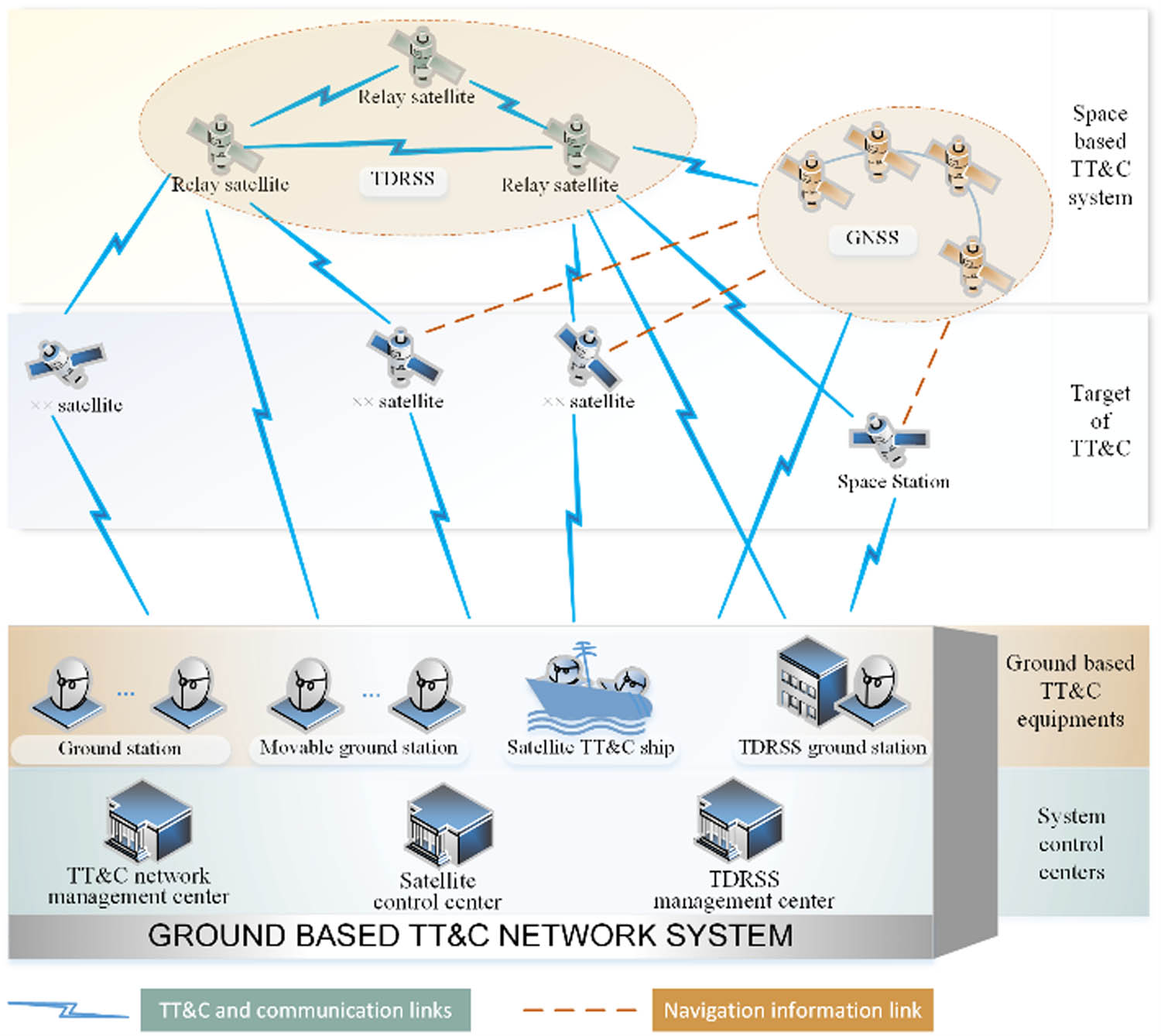
In summary, the idea of building an integrated space–ground TT&C network is shown in Figure 1.
Conceptual diagram of SAGITN.
As shown in Figure 1, the SAGITN can be divided into four levels according to a top-down system: space-based TT&C system, target for TT&C, ground-based TT&C equipment system, and system control center. The relay satellite system and the ground-based TT&C network implement the TT&C business of various aircraft. Navigation satellites provide spatial positioning information to various aircraft, allowing subsequent autonomous orbit adjustment. At the same time, navigation satellites and relay satellites operate in a self-organizing network mode, significantly improving system openness and survivability.
3 Overview of access once
3.1 Encountered TT&C mode
3.1.1 Definition and advantage
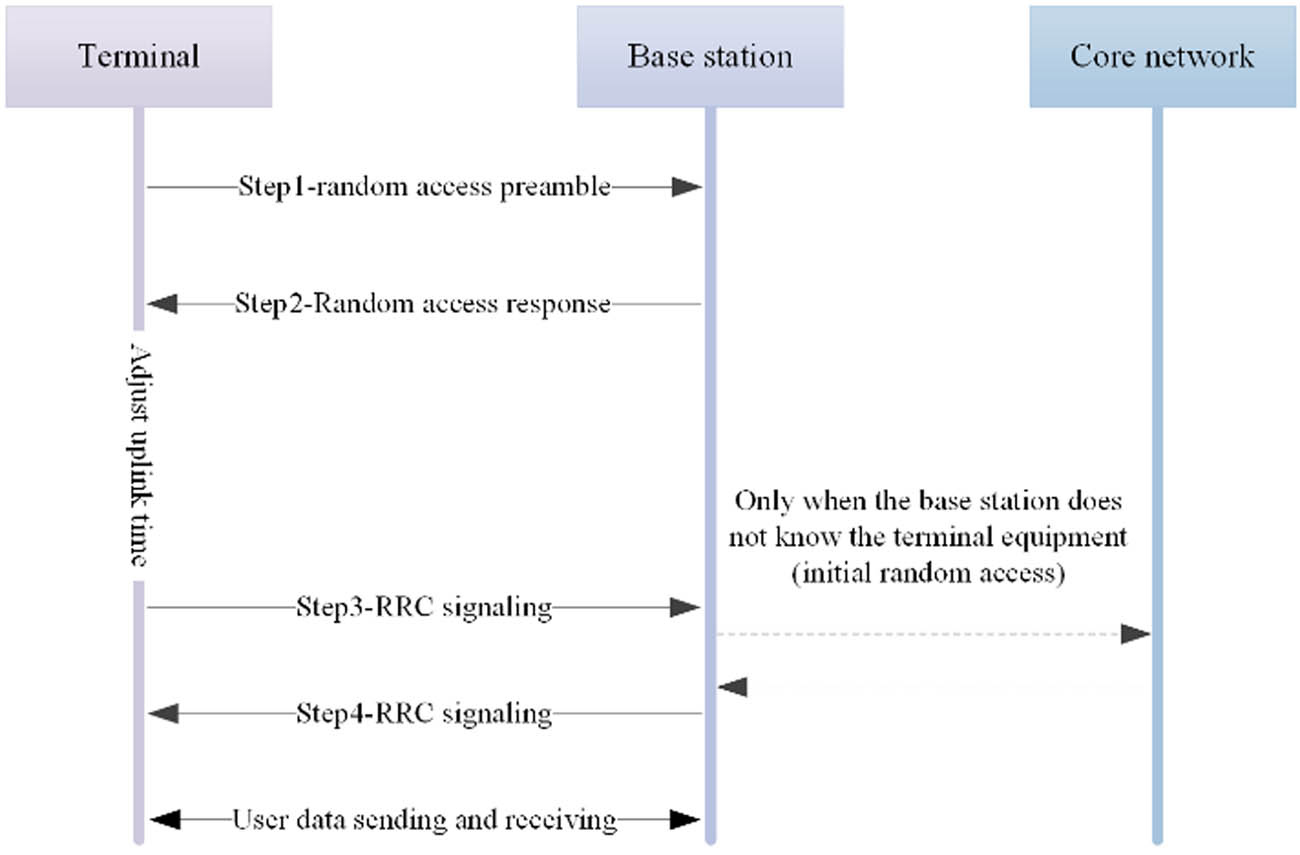
The concept of AOE TT&C mode comes from “random access,” which originated from computer networks, and is now widely used in cellular mobile communication systems (Niu et al. 2012, Tutschku 1998). It refers to the process of the user sending a random access preamble to attempt to access the network to establish an essential signaling connection with the network. As shown in Figure 2, the basic process includes the following four steps (Dahlman, Parkvall, and Sköld 2011).
Random access process of mobile cellular network.
Step 1: The transmission of the random access preamble sequence. Its primary purpose is to notify the base station that a terminal is trying to access and let the base station estimate the delay. This value will be used in the second step to adjust the terminal’s uplink transmission time.
Step 2: Random access response. The base station sends a response message to the terminal to notify the terminal of its resources and sends it a temporary identifier for further communication.
Step 3: The terminal sends radio resource control (RRC) signaling (terminal identification) to the base station, and after that, it sends the mobile terminal identification information to the base station.
Step 4: The base station sends RRC signaling (contention resolution) to the terminal. The base station notifies the terminal to resolve the contention and confirm the connection.
Learning from the random access mechanism of mobile cellular networks, satellites and TT&C stations are regarded as mobile terminals and base stations, respectively, (Manlio et al. 2018), and the single-lap TT&C process is regarded as a data service between mobile terminals and base stations. Then, random access can be introduced into the TT&C network to form the TT&C mode with “on-demand autonomy, access on encountered, and seamless handover” characteristics.
AOE TT&C refers to the condition that the space-based or ground-based TT&C mode has full airspace beam coverage. Once the spacecraft enters the beam range, it can access the TT&C equipment network for TT&C business without a predetermined plan.
Compared with the traditional planned access TT&C mode, the advantages of the AOE TT&C mode are summarized as follows:
High support for simultaneous TT&C of multiple satellites. The spacecraft can be allocated channel resources if it enters the beam range and sends an access request. Using code division multiple access (CDMA) to distinguish multiple spacecraft within the beam range can significantly increase the communication capacity of the system. Compared to a single beam with a single target, it can effectively solve the problem of insufficient TT&C resources caused by the future surge in the number of satellites.
It can reduce the complexity of resource scheduling. The mode of single cycle tracking TT&C task driven by schedule is changed into satellite autonomous AOE, which changes the situation that traditional resource scheduling is difficult to adapt to the increasingly intensive TT&C business volume.
Higher access efficiency. For AOE mode, once the spacecraft enters the range of beam of the TT&C mode, a two-way handshake is carried out to establish the control channel connection, and it is always maintained until the range of action of the node airspace is exceeded. When the TT&C demand is generated, it can quickly launch the business without going through the capture link under the traditional planned access mode, and the response speed is fast.
High reliability. The satellite can simultaneously establish a control link with more than one TT&C station and perform rapid switching when necessary. To a certain extent, it realizes multi-station redundancy backup and improves the reliability of TT&C.
Increased flexibility. The choice of satellites or equipment accessing the network can be dynamically and automatically adjusted, which can better adapt to the needs of various tasks. At the same time, it is also conducive to flexible, customized TT&C management services for commercial satellites.
High efficiency-to-cost ratio of long-term TT&C management. Compared with the method of realizing multi-spacecraft TT&C by building more new ground stations, the integration of multi-spacecraft TT&C based on AOE mode, which saves the cost of construction, management, and maintenance, can significantly improve the ratio of efficiency to cost and reduce the cost of TT&C management.
3.2 Basic idea of realization
It is easy to see that to realize AOE TT&C, the primary problem is meeting the coverage to ensure a gain. According to the basic theory of antenna gain, the beam width and gain of a single antenna cannot be guaranteed simultaneously. The solution is to use multi-beam antenna technology.
For the space-based TT&C system based on China’s TDRS, we can refer to the communication satellite also in the geosynchronous orbit to realize AOE TT&C based on S-band multiple access through multi-beam panoramic coverage of the ground (Zhang et al. 2021, Zhan et al. 2020). Related research has analyzed the method’s basic idea and system capacity (Liu et al. 2019, Zhang et al. 2021, Zhu et al. 2021), and the analysis results believe that the system can support 500 spacecrafts simultaneously. The shortcoming of this method is that the angle measurement cannot be realized, so the positioning and orbit determination can only be realized by the receiving terminal of the spacecraft’s onboard navigation system. The principle of implementing space-based AOE TT&C using TDRS is described in Figure 3.
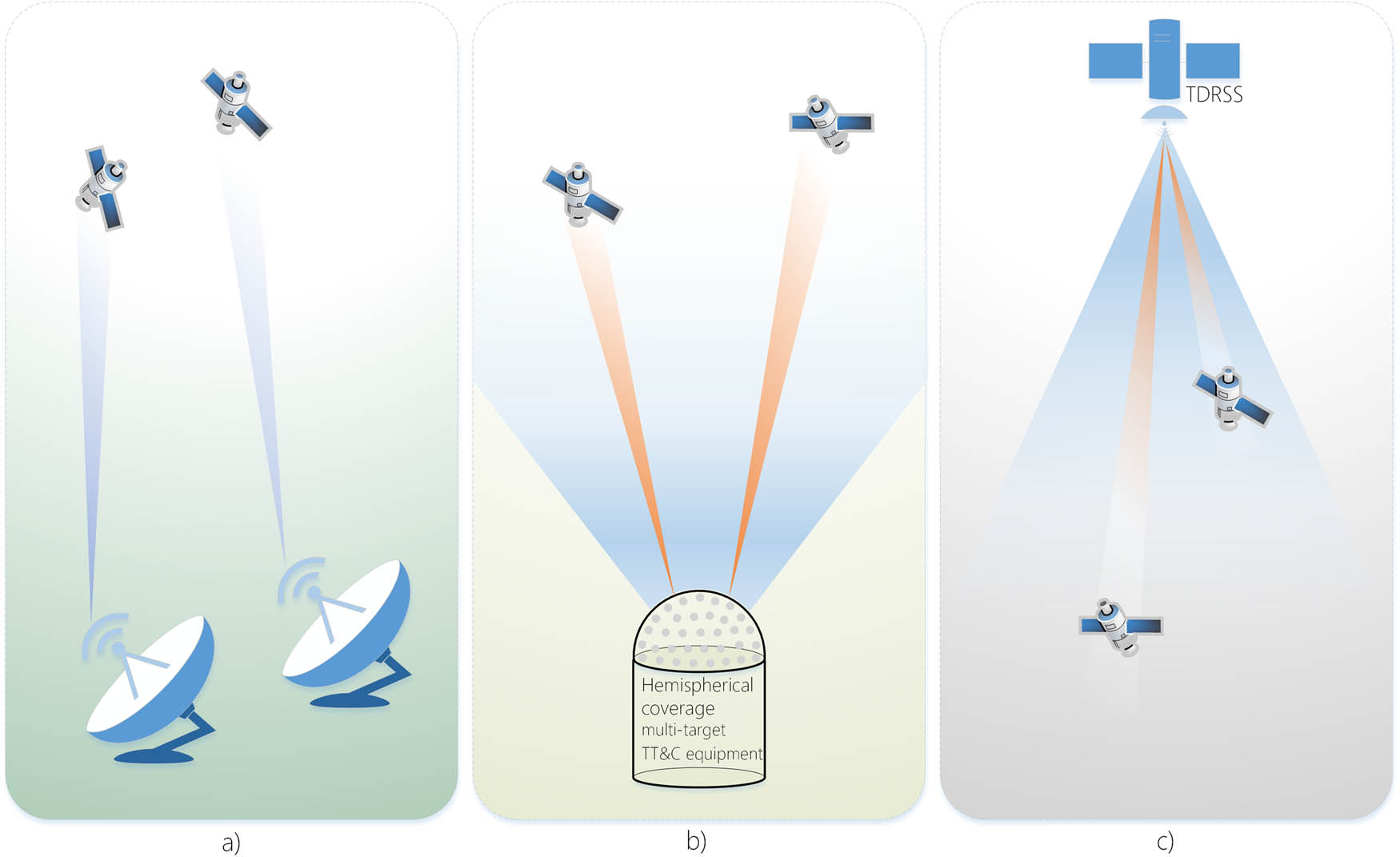
Schematic diagram of three TT&C equipment under two access modes: (a) traditional access mode, (b) ground-based AOE mode, and (c) space-based AOE mode.
For the ground-based TT&C system, the recent research on constructing multi-target TT&C equipment with hemispherical all-aerospace coverage has provided a method for AOE TT&C. Although the unified S-band (USB) system in the form of parabolic antenna is still adopted as the mainstream in China’s space TT&C network, the basic idea and implementation scheme of using phased array antenna to realize multi-beam and multi-target TT&C have been mature and developed. Currently, the direction of TT&C equipment construction in China is the research and deployment of multi-beam equipment in the whole airspace. It uses a hemispherical columnar array antenna with a beam that can cover the entire airspace. The working principle of the two devices is also described in Figure 3.
Although the hemispherical all-aerospace coverage equipment can track multiple spacecraft simultaneously, spacecraft cannot be detected immediately once it enters the visible range. Therefore, it is necessary to add a fixed airspace coverage beam based on the original TT&C tracking beam of the multi-spacecraft equipment in the entire airspace. The two can be integrated and designed in the dome hemispherical cylindrical array. The split form realizes the extensive airspace coverage to complete the target detection function, and most of the sub-arrays form the TT&C tracking beam to complete the TT&C communication function (Du et al. 2021, Li 2019). The scene is shown in Figure 4.

Schematic diagram of AOE TT&C coverage scene.
In the follow-up discussion of this article, only the ground-based TT&C system is used as the research background of the AOE TT&C mode. The related concepts are also applied to space-based TT&C, and this article will not discuss the improvement of its adaptability.
3.3 TT&C process based on AOE mode
According to the current single-lap TT&C process, the equipment of the TT&C ground station is driven by the work plan and the number of orbits issued by the satellite control center. System tasks are generally divided into five stages: system self-check, pre-task calibration, satellite capture, tracking, and post-processing.
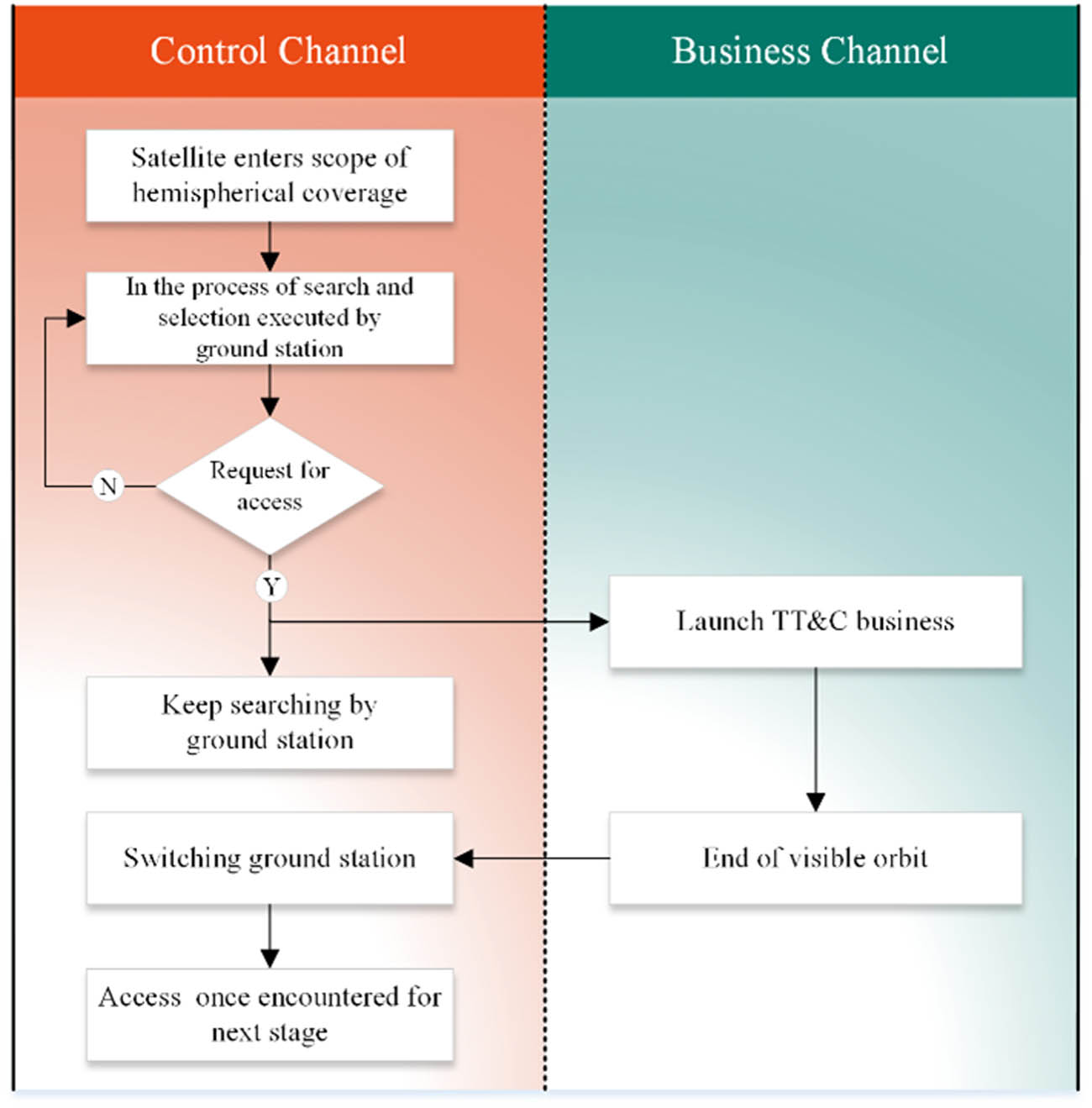
In implementing TT&C based on AOE mode, to achieve the purpose of parallel access control and data transmission, a control channel and a business channel are separately designed. Figure 5 shows the TT&C process based on the AOE mode. The typical workflow is:
The satellite enters the range of the ground-based TT&C network, and the program-controlled access system is powered on and initialized, ready to be accessed.
The access system sends a downlink inquiry signal to search TT&C ground stations and selects TT&C stations to be accessed according to the preset priority rules. The query signal contains the satellite identification code.
Send the access request to the selected TT&C ground station.
After receiving the request, the TT&C station will issue an inquiry application to the control center of the ground-based TT&C network to verify the satellite’s identity and confirm its TT&C demand level. After verification and confirmation, if the station has TT&C resources, it will directly agree to the access request and continue to meet the access process. If the channel of the station is full, it can choose to interrupt the current non-priority service or refuse the request depending on the demand level.
If the access is successful, the business channel will start the routine TT&C process, and the control channel will continue to search for other TT&C stations for switching at any time.
After the current lap TT&C service is completed (instructions are sent and executed for confirmation, or telemetry reception is completed), or when the coverage of the currently connected TT&C station is exceeded, the satellite initiates the disconnection procedure. and the satellite enters the search state or directly switches to the preselected TT&C station. The TT&C station releases channel resources to access other targets, the TT&C station can also initiate a service interruption program as appropriate.
The satellite performs the next phase of the AOE TT&C process. By continuously sending inquiry signals to all stations within the range, the satellite control center can grasp the dynamic information of the satellite’s exit and entry into the TT&C network.
TT&C process based on AOE mode.
4 Key technologies for AOE
4.1 TT&C mode
4.1.1 Access process control
The strategy of optimization selection for spacecraft access is needed to study. The coverage of TT&C stations is generally overlapped, especially in the domestic area. The spacecraft faces multiple visible TT&C stations in some business orbit section. If the coverage of TT&C stations can be reached, it is necessary to make an optimal choice. In order to consider the optimization of resources allocation and emergency response efficiency, the following rules should be followed:
For daily business, spacecraft should prioritize the measurement with long coverage orbit and close distance.
When the channel quality is required to be higher, the station with strong measurement and control ability is preferred.
The center regularly evaluates the channel saturation of the TT&C stations, and the evaluation results are uploaded to the satellite as a reference for its access decision.
Since the coverage of a single TT&C station is always limited, soft handover should be carried out to ensure uninterrupted TT&C business when the aircraft flies through the coverage area of multiple TT&C stations.
Figure 6 shows soft handover across 2 TT&C ground stations. The control center can control the handover process using the soft handover method. Besides, during the overlapping period of coverage area, downlink data is received by two ground monitoring and control stations simultaneously and then merged at the control center. As a result, the two ground stations act as backup to each other, increasing system reliability.
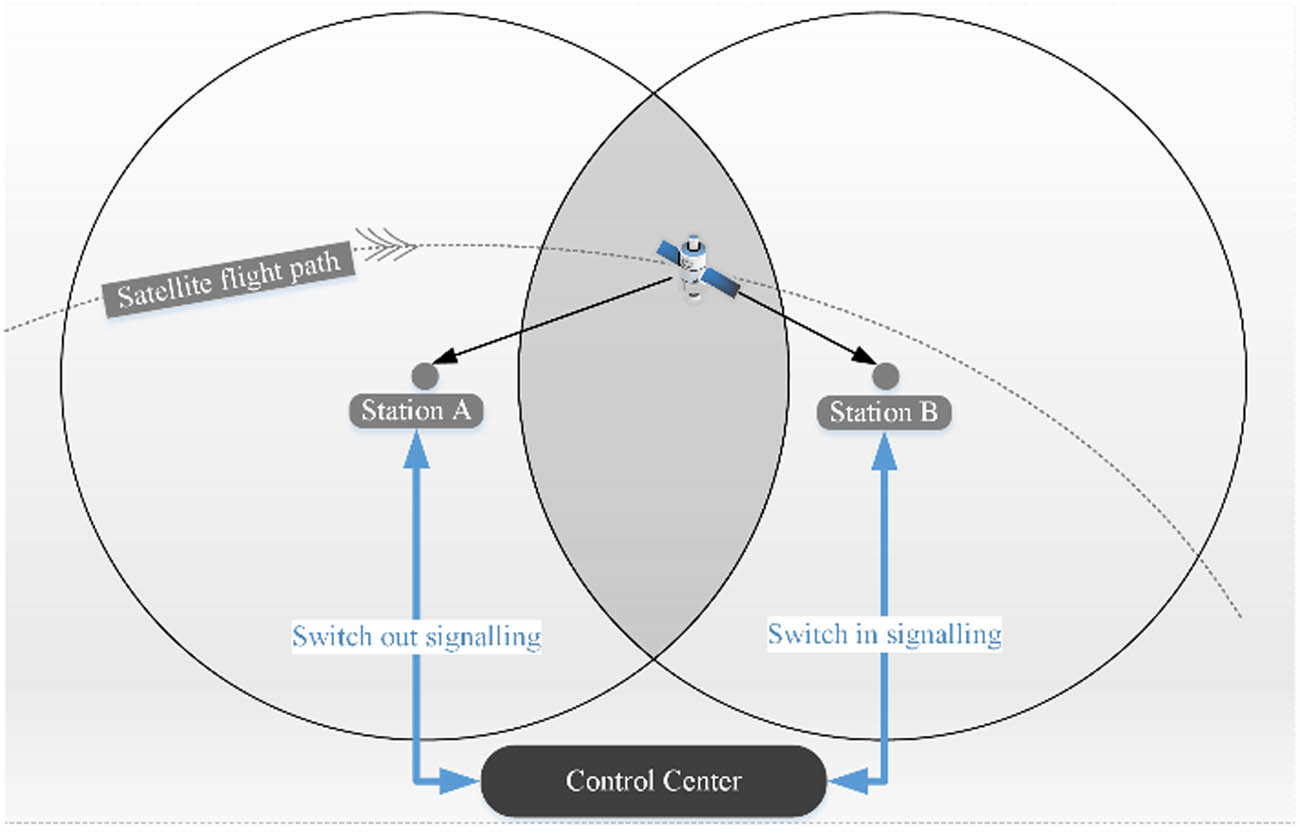
Diagram of handover across two TT&C ground stations.
Handover requires satellite and ground control stations to relay information over a control channel. The control channel is separated from the traditional TT&C business channel. Multichannel division can be carried out in three ways: time division, frequency division, and code division.
Since the control channel is required to be independent of the business channel and always in a state of connection, the real-time requirements of spacecraft TT&C are very high, time division is unsuitable. In the frequency division mode, different working frequencies are used for different targets, which requires increasing the bandwidth of the ground receiving system. While spectrum resources are limited, when the number of targets increases, there will be a limited situation. Therefore, code division is the most feasible way to reference the ground cellular mobile communication.
4.2 Design of protocol stack
Whether it is the TT&C business for satellite platform or the operation for payload, whether it is ground-based or space-based, their technical systems are quite different. With the construction process of SAGITN, “the integration of survey, operation, and control, the gradual integration of space-based and ground-based TT&C resources, and the IP-based networking of all nodes” are the inevitable development trend.
Based on the open system interconnection model (Li et al. 2011, Saxena 2014) of the Internet and the research on the protocol stack of the existing data link (Sharma et al. 2018, Fahmy 2021, Gagandeep and Kumar 2012), this work designs the AOE TT&C protocol stack into four layers: application layer, network layer, media access control (MAC) layer, and physical layer.
As shown in Figure 7, the protocol stack of the AOE TT&C mode is shown. The information interaction between different layers through user-defined packets is helpful to the realization of the whole protocol mechanism.
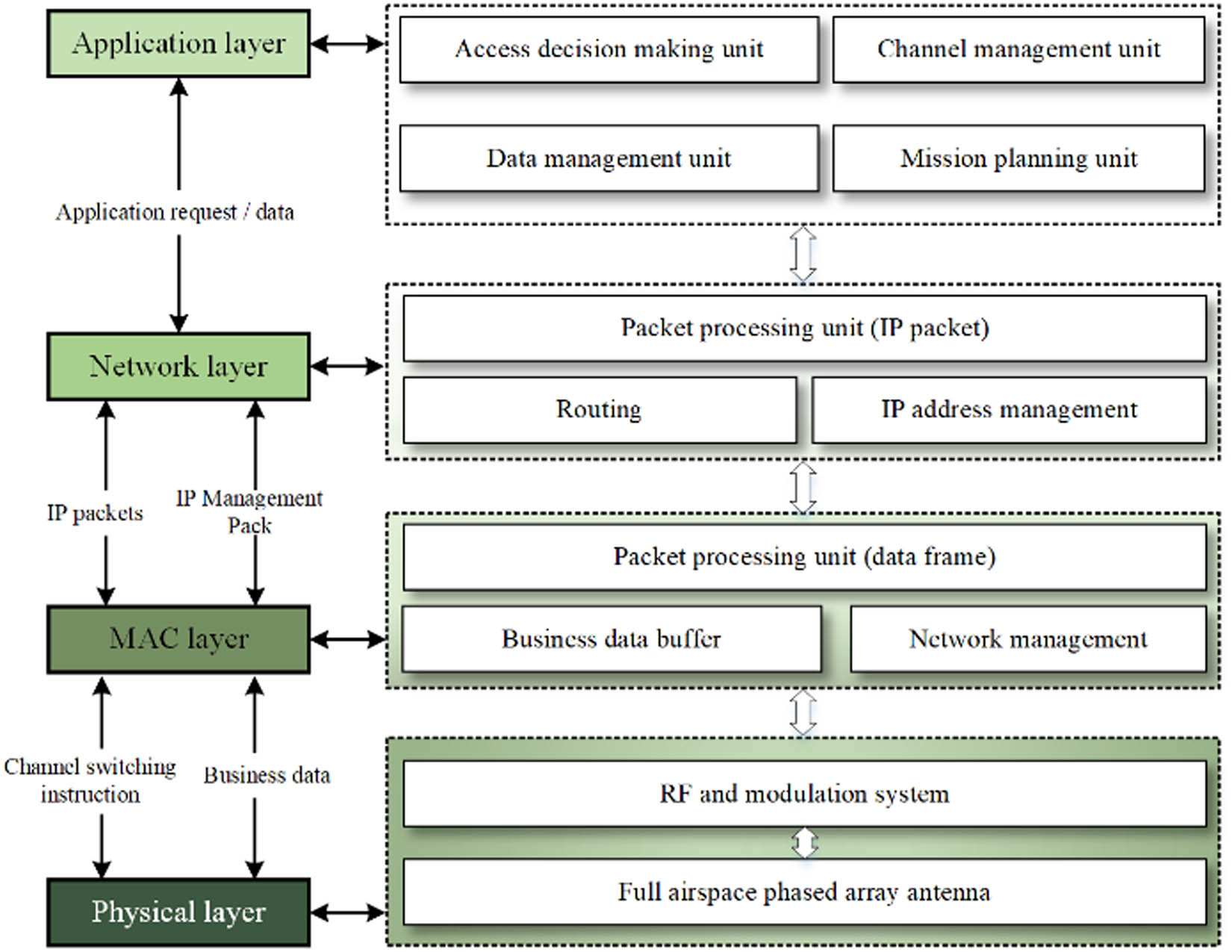
The protocol stack of the AOE TT&C mode.
The application layer is the function implementation layer, which completes the access decision, channel management, data management, and other functions – the database and integrated monitoring management system run in this layer and interacts with various users.
The network layer is the implementation layer of networking, and the processing object is IP packets. It mainly completes the encapsulation and unsealing of IP packets, IP address management, and routing selection and realizes the information interaction between the application layer and MAC layer. IP integration of different spatial protocols is completed in this layer.
The MAC layer is the communication implementation layer. The processing object is a data frame, which mainly completes the data frame group. Frame solving, frame synchronization, data buffer, error control, and channel switching mechanism are mainly implemented in this layer.
The physical layer is the signal implementation layer, which is mainly responsible for providing channels for the reliable transmission of information. Select appropriate frequency points, signal forms, and coding methods according to the channel characteristics, performing appropriate modulation, amplification, transmission, reception, demodulation, and other signal processing, and cooperate with the MAC layer to complete channel switching.
4.3 Unification of TT&C frequency spectrum resources
It is necessary to consider the unity of the spectrum resources used for either space-based or ground-based TT&C (von der Ohe 2020), to realize the spacecraft’s AOE TT&C. There are two aspects to this problem. One is that the frequency band used for spacecraft TT&C is not entirely unified. Second, the measured target may be equipped with multiple sets of different frequency bands of TT&C equipment. The analysis is carried out in turn.
Currently, there are two ground-based aerospace TT&C networks in China. The medium and low-orbit aerospace TT&C network adopts the S-band frequency, commonly used in international space operations, with an uplink frequency range of 2,025–2,110 MHz and a downlink frequency range of 2,200–2,290 MHz. The geosynchronous orbit satellite TT&C network is mainly used for geosynchronous satellite missions. The frequency band used is the international standard C-band. The uplink frequency range is 5,850–6,425 MHz, and the downlink frequency range is 3,625–4,200 MHz. With the development of technology and changes in demand, the S-band has become the main frequency band for spacecraft TT&C in recent years. At the same time, VHF/UHF, C, X, Ka, and other frequency bands are also used in aerospace in different scenarios (Zhang et al. 2021, Wei 2020, Dong et al. 2018, Li et al. 2013, Babuscia and Angkasa 2021, Xue et al. 2020). The details are shown in Table 1.
Analysis of TT&C spectrum usage of spacecraft in China
| TT&C frequency band | Frequency band usage condition | Authorized or not |
|---|---|---|
| VHF/UFH | It was used in ground-based measurement and control networks in the early days and is now commonly used in civil and commercial space measurement and control | No |
| S band | It is widely used in the TT&C of medium and low orbit spacecraft and gradually replaced the C band for geosynchronous orbit satellite TT&C, becoming the standard frequency band adopted by space TT&C; at the same time, it is used in the forward link of relay TT&C | Yes |
| C band | It was used for the measurement and control of geosynchronous orbit satellites in the early period and is now gradually eliminated | Yes |
| X band | It is the development direction of the future TT&C spectrum, with complete TT&C capabilities, and has been gradually used in TT&C scenarios such as deep space; currently, the ground is equipped with S/X dual-frequency measurement and control equipment and S/X/Ka three-frequency measurement and control equipment | Yes, but partly authorized for the civil and commercial TT&C organization |
| Ka band | As the future development direction of the integration of TT&C and data transmission, S/X/Ka three-frequency TT&C has been installed on the ground, and the Ka band is temporarily used for data transmission; used as a return link for relay TT&C | Yes |
On the other hand, some TT&C targets are equipped with multiple sets of equipment and are limited by the cost of long-term management, especially for private commercial small satellites. They often do not rely on the existing S-band aerospace TT&C network, and self-built TT&C stations for long-term control, which requires them to load at least two sets on the satellite TT&C equipment of different frequency bands; S-band TT&C equipment is used for launching into orbit section, and VHF/UHF frequency band (or other unlicensed frequency bands) is used for long-term management section. If considering the need for higher-rate data transmission, X or Ka-band TT&C equipment must be installed, which causes redundancy and waste. If the onboard TT&C spectrum can be unified, it will save precious onboard load resources and effectively reduce costs.
In summary, the S band has become the standard frequency band of aerospace TT&C networks, and from the domestic perspective, the S band will still be used as the main TT&C frequency band for a long time. At the same time, with the engineering application of the AOE TT&C mode, the long-term satellite management cost will be significantly reduced, and commercial satellites will not need to install additional frequency band TT&C equipment. Therefore, this article is designed to be the universal S band specified by the ITU, which is used for TT&C management and low-speed data transmission, and high-speed data transmission is used to build a separate receiving station. If the follow-up plan is to upgrade the TT&C frequency band as a whole, the existing AOE TT&C framework can still be used, and only the working frequency band of the equipment needs to be increased.
5 Effect verification
Compared with the traditional planned access mode, the AOE mode has the advantages of high support for multi-satellite simultaneous TT&C, low resources scheduling complexity, high reliability, high flexibility, and high effectiveness-cost ratio for long-term TT&C management.
To specify the above advantages, in this section, we compared the AOE mode with the planned access mode and demonstrated it by data. The basic idea of the comparison experiment is: first, a multi-satellite in orbit scenario was established, and the business was carried out according to the planned access TT&C mode and AOE TT&C mode, respectively. The obtained test results were analyzed and compared according to the designed indicators. Comparison is made from the following two aspects: management resources consumption and real-time performance.
5.1 Comparisons of management resource consumption
For a general TT&C system, the daily operation and management cost is represented by the consumption of management resources, which can be defined as the human resources needed for the system to work in a fixed period (Pacheco et al. 2003, Yin et al. 2022, Soma et al. 2004). The calculation methods for the two modes are as follows.
The TT&C network consists of hemispherical coverage multi-target TT&C equipment for AOE mode. Since the equipment is in operative mode all the time, there are satellites in the visible range at any time. If one person is needed to be on duty for single equipment, then the consumption of management resources in a time period of T can be expressed by T, which is a fixed value.
For the planned access mode, the TT&C network consists of USB equipment, which adopts a narrow beam parabolic antenna, and only supports single spacecraft mode. Thus, at any time, N equipment is required for N spacecraft simultaneously, while every single equipment requires one person on duty. Since the number of visible satellites is a value that changes with time, statistical methods are used. Assuming that the time period with duration T is divided into N short time intervals, there are S n satellites in the visible range in the n-th hour period (n = 1,2,…N), then in this mode, the management resource consumption is:
The length of each short time interval represents the statistical resolution ratio of the comparison method. In order to illustrate the station’s visibility with multi-spacecraft, assuming that there are four satellites within the visible range of the station at the current moment, the flight path schematic diagram is shown in Figure 8.
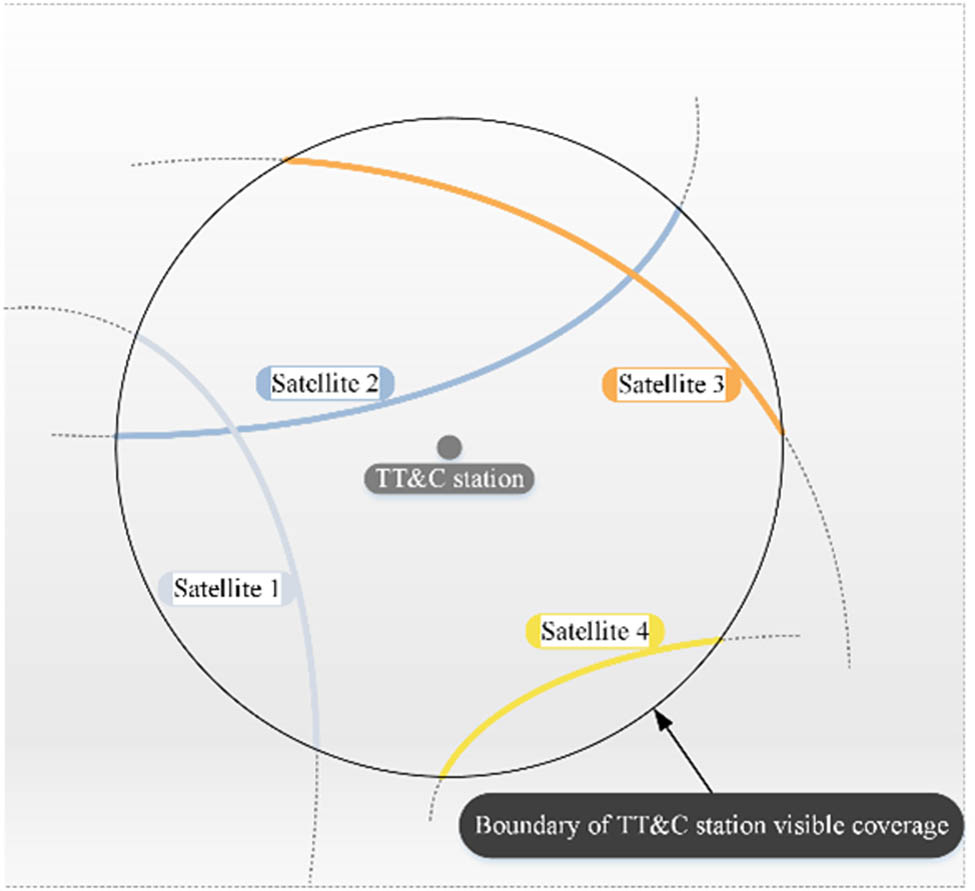
Flight path schematic diagram of four satellites in visible coverage.
If we want to calculate the management resource consumption of the planned access TT&C mode, we first need to know the number of satellites in the visible range of the site. Therefore, the following simulation is used to obtain this value.
In order to make the simulation environment close to the working situation of the real TT&C system, the scene of multi-satellite in-orbit operation is designed first. Taking the Walker constellation as the basic model, a complex constellation composed of two groups of satellite constellations with different orbital altitudes is established. Further, to investigate the effect changes in AOE mode compared with planned access mode under the total number of satellites in different constellations, we established two such complex constellations. We configured them according to the parameters shown in Table 2.
Main parameters of the complex constellation
| Constellation parameters | Constellation A | Constellation B | ||
|---|---|---|---|---|
| Number of constellation satellites | 320 | 100 | 1,280 | 200 |
| Number of orbital planes | 16 | 5 | 32 | 10 |
| Phase factor | 1 | 2 | 1 | 2 |
| Orbital altitude (km) | 550 | 3,000 | 550 | 3,000 |
| Orbital inclination (degree) | 53 | 81 | 53 | 81 |
Next the TT&C equipment system is established. In order to compare the two access modes based on different ground-based TT&C equipment more accurately, the space-based TT&C system is not considered here. Therefore, considering the influence of latitude on observability (Tang et al. 2019), three ground stations at different latitudes were designed, which were located in Jiamusi, Xiamen, and Sanya, and their location coordinates are described in Table 3.
Coordinates of stations in the simulation scene
| Coordinate parameters | Jiamusi | Xiamen | Sanya |
|---|---|---|---|
| Latitude | N 46.81° | N 24.48° | N 18.25° |
| Longitude | E 130.33° | E 118.09° | E 109.52° |
| Height | 100 m | 100 m | 100 m |
The statistical results are shown in Table 4. Among them, the calculation method of improved efficiency is shown in formula (2), where 3,600 is the management resource consumption of AOE mode in 1 h.
Simulation results of the number of visible satellites in different scenes
| Station | Complex constellation scene | Maximum number of visible satellites | Management resource consumption in 1 h | Improvement efficiency |
|---|---|---|---|---|
| Jiamusi | Constellation A | 17 | 58,860 | 15.35 |
| Constellation B | 38 | 114,570 | 30.83 | |
| Xiamen | Constellation A | 11 | 31,620 | 7.78 |
| Constellation B | 25 | 76,550 | 20.26 | |
| Sanya | Constellation A | 7 | 21,320 | 4.92 |
| Constellation B | 19 | 59,850 | 15.63 |
As can be seen from Table 4, the AOE mode has apparent advantages over planned access for improved efficiency. Otherwise, we can see:
The higher the latitude, the better the improved efficiency. That is determined by the parameters of the complex constellations in the simulation scene close to the actual situation. Therefore, TT&C stations should be built at higher latitudes in general.
The bigger the constellation, the better the improved efficiency. This indicates that the AOE mode is more suitable for the future management of giant constellations.
5.2 Comparison of real-time performance
During the execution of the TT&C business, since the distance of the communication link is fixed, the real-time performance of the two modes is consistent. However, in the period before TT&C business is carried out, the real-time performance of the two modes is different when emergency TT&C demand (for example, the ground needs to conduct rapid orbit change of satellite, satellite payload instrument switch, and other operations) arises suddenly, which is also one of the advantages of AOE mode. The comparison assumes that the satellite is within the visible range with an elevation of more than 5°.
For the AOE mode, as described above, since the control channel keeps the connection state, it is always available for business channel access immediately. All the information needed for satellite access is known in advance. It only needs to send the access instruction to the satellite through the control channel and allocate the array resources of TT&C equipment in the ground station. Only the time delay caused by one-way link distance is considered in real-time.
For the planned access mode, in addition to the one-way link distance time delay mentioned in the previous paragraph, two additional processes should be added: the capture and tracking and the manual resource scheduling process (Cui et al. 2019, Li et al. 2014, Si and Huan 2020). The typical capture and tracking process is described in Figure 9, and Table 5 shows the empirical statistics of time delay for each operation in this process. The manual resource scheduling process includes schedule generation, audit and confirmation, and plan delivery. The time they spend is also listed in Table 5. The data in the table are based on the historical business of the China satellite control center.
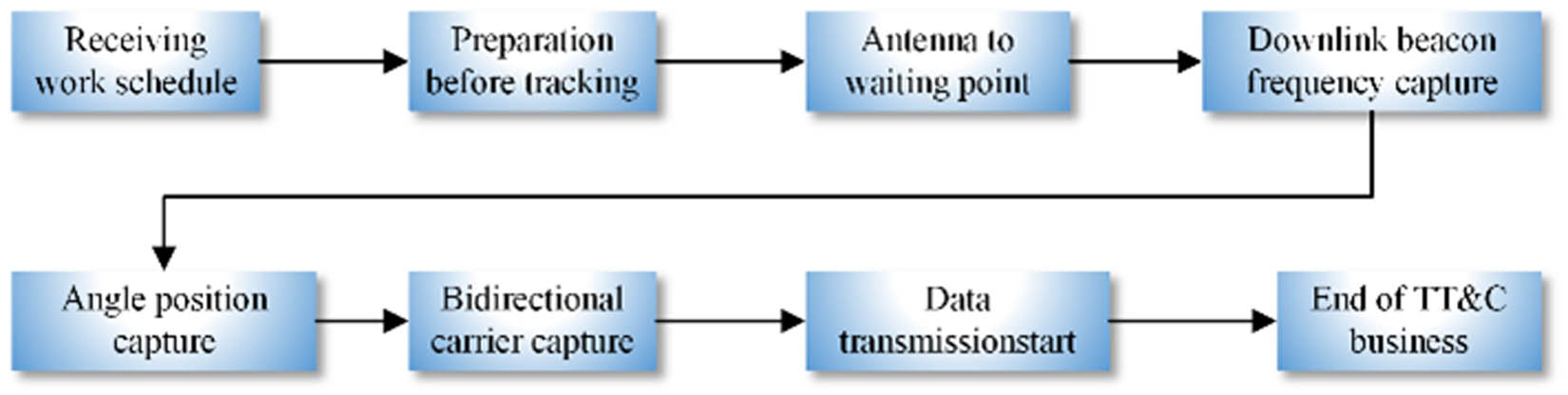
The capture and track process of planned access mode.
Statistics of additional schedule time for planned access mode
| Classification | Items | Empirical statistics (s) |
|---|---|---|
| Capture and tracking | Downlink beacon capture | 2 |
| Angle position capture | 5 | |
| Bidirectional carrier capture | 26 | |
| Manual resource scheduling | Schedule generation | 30 |
| Audit and confirmation | 120 | |
| Plan delivery and loading | 10 | |
| Total | 193 |
Therefore, according to the data statistics of the current TT&C system, when dealing with emergency TT&C tasks, the AOE mode saves about 193 s compared with the planned access mode, showing significantly better real-time performance.
6 Conclusion
With the background of the development of the aerospace industry, the construction of SAGIN has become a research hotspot and an inevitable development trend. This work proposes a scheme of AOE TT&C mode in SAGIN, which is an innovation of the current spacecraft TT&C network organization. In the future, it can show excellent real-time performance, good flexibility, and low cost when dealing with the TT&C management of giant satellite constellations. With the development of China’s SAGIN, spacecraft TT&C will become one of its basic services. The AOE TT&C mode will further develop and become an important research direction.
However, due to the lack of investigation and research on the critical technology issues of the AOE TT&C mode, the AOE TT&C mode proposed in this work still faces many technical difficulties. Given the problem, our future research will enhance the multiple access mode of AOE TT&C mode via other novel approaches based on the user communication environment constructed in our investigation. We also use artificial intelligence (AI) technology to optimize resource scheduling. It is foreseeable that soon, the effective combination of AOE TT&C mode with 5G, cloud computing, and AIwill give full play to the advantages of spatial information.
Acknowledgments
We thank the Xi’an Satellite Control Center for providing the dataset of historical business. We want to take this opportunity to thank the editors and the reviewers for their detailed comments and suggestions, which greatly helped us improve our manuscript’s clarity and presentation.
-
Funding information: This work was supported by the Beijing Science and Technology Major Project of China [Grant number Z18110400290000].
-
Author contributions: conceptualization: Chao Li; methodology: Chao Li, Peijie Liu, and Shiyuan Fu; project administration: Chao Li and Yiwen Jiao; writing original draft: Chao Li; writing review & editing: Peijie Liu; and funding acquisition: Yiwen Jiao. All authors have read and agreed to the published version of the manuscript.
-
Conflict of interest: The authors declare no conflict of interest.
-
Data availability statement: The data used to support the findings of this study are available from the corresponding author upon reasonable request.
References
An J, Li X, Zhang Z, Zhang G, Man W, Hu G, et al. 2022. Path planning for self-collision avoidance of space modular self-reconfigurable satellites. Aerospace. 9(3): 141.10.3390/aerospace9030141Suche in Google Scholar
Arkhangel’skiy VA, Dedov NV, Litvin AI, Ostanniy AI, Semin VI, Fedoseev AV, et al. 2017. Present state and main characteristics of the geostationary relay satellites of the COSPAS-SARSAT system based on the Louch-5A and Louch-5V SPACECRAFT. Rocket-Space Device Eng Inform Syst. 4(3):82–91.10.17238/issn2409-0239.2017.3.87Suche in Google Scholar
Babuscia A, Angkasa K. 2021. 11 – telemetry, tracking, and command (TT&C). In: Cappelletti C, Battistini S, Malphrus BK, editors. Cubesat handbook. Cambridge: Cambridge University Press. p. 221–235.10.1016/B978-0-12-817884-3.00011-4Suche in Google Scholar
Bacco M, De Cola T, Giambene G, Gotta A. 2019. TCP-based M2M traffic via random-access satellite links: throughput estimation. IEEE Trans Aerospace Elec Sys. 55(2):846–863.10.1109/TAES.2018.2865150Suche in Google Scholar
Chen Y, Tian G, Guo J, Huang J. 2021. Task planning for multiple-satellite space-situational-awareness systems. Aerospace. 8(3):73–89.10.3390/aerospace8030073Suche in Google Scholar
Cui W, Wang W, Zhang J, Yang J. 2019. Multicore structures and the splitting and merging of eddies in global oceans from satellite altimeter data. Ocean Sci. 15(2):413–430.10.5194/os-15-413-2019Suche in Google Scholar
Curzi G, Modenini D, Tortora P. 2020. Large constellations of small satellites: A survey of near future challenges and missions. Aerospace. 7(9):133–151.10.3390/aerospace7090133Suche in Google Scholar
Dahlman E, Parkvall S, Sköld J. 2011. Chapter 10 - downlink physical-layer processing. In: Dahlman E, Parkvall S, Sköld J, editors. 4G: LTE/LTE-advanced for mobile broadband. Oxford: Academic Press. p. 143–202.10.1016/B978-0-12-385489-6.00010-2Suche in Google Scholar
Dong GL, Li HT, Hao WH, Wang H, Zhu Z, Shi S, et al. 2018. Development and future of China’s deep space TT&C system. J Deep Space Explor. 5(2):99–114.Suche in Google Scholar
Du D, Wang WZ, Hu JZ. 2021. Introduction to angle tracking method for spherical phased array space TT&C system in hemispherical coverage. Telecommun Eng. 61(7):800–806 (in Chinese).Suche in Google Scholar
Fahmy HMA. 2021. Concepts, applications, experimentation and analysis of wireless sensor networks. Cham: Springer. p. 53.10.1007/978-3-030-58015-5Suche in Google Scholar
Gagandeep A, Kumar P. 2012. Analysis of different security attacks in MANETs on protocol stack- A review. Int J Eng Adv Technol (IJEAT). 1(5):269–275.Suche in Google Scholar
Laux O, Poncet D, Mager R, Schoenherr K. 2012. Status of the European data relay satellite system. 2012 International Conference on Space Optical Systems and Applications (ICSOS). 2012 Oct 9–12; Ajaccio, Corsica, France. ICSOS, 2012. p. 1–8.Suche in Google Scholar
Li RL, Fu G, Wu GZ. 2014. Research on software algorithm capture of spread spectrum TT&C signals. Adv Mater Res. 989–994:2418–2421.10.4028/www.scientific.net/AMR.989-994.2418Suche in Google Scholar
Li Y, Li D, Cui W. 2011. Research based on OSI model. 2011 IEEE 3rd International Conference on Communication Software and Networks (ICCSN 2011). 2011 May 27–29; Xi’an, China. IEEE, 2011. p. 554–557.10.1109/ICCSN.2011.6014631Suche in Google Scholar
Li Y, Wang Z, Tan W. 2013. The frequency spectrum management for aerospace TT&C system. 2013 5th IEEE International Symposium on Microwave, Antenna, Propagation and EMC Technologies for Wireless Communications. 2013 Oct 29–31; Chengdu, China. IEEE, 2013. p. 595–600.10.1109/MAPE.2013.6689909Suche in Google Scholar
Li ZW. 2019. Analysis of whole airspace multi-target TT&C antenna based on phased array. Mod Radar. 41(12):66–68 (in Chinese).Suche in Google Scholar
Liu Y, Zhu L. 2019. Capacity Analysis of Panoramic Multi-beam Satellite Telemetry and Command System. International Conference on Wireless and Satellite Systems. 2019 Jan 12–13; Harbin, China. Springer, 2019. p. 561–571.Suche in Google Scholar
Manlio B, Tomaso DC, Giovanni G, Alberto G. 2018. TCP-based M2M traffic via random-access satellite links: throughput estimation. IEEE Trans Aerosp Electron Syst. 55(2):846–863.10.1109/TAES.2018.2865150Suche in Google Scholar
Mao S, He S, Wu J. 2020. Joint UAV position optimization and resource scheduling in space-air-ground integrated networks with mixed cloud-edge computing. IEEE Syst J. 15(3):3992–4002.10.1109/JSYST.2020.3041706Suche in Google Scholar
Millan RM, von Steiger R, Ariel M. 2019. Small satellites for space science: A COSPAR scientific roadmap. Adv Space Res. 64(8): 1466–1517.10.1016/j.asr.2019.07.035Suche in Google Scholar
Mitry M. 2020. Routers in space: Kepler communications’ CubeSats will create an Internet for other satellites. IEEE Spectr. 57(2): 38–43.10.1109/MSPEC.2020.8976900Suche in Google Scholar
NASA Space Communication Architecture Working Group (SCAWG). 2006. NASA space communication and navigation architecture recommendations for 2005–2030. extension://idghocbbahafpfhjnfhpbfbmpegphmmp/assets/pdf/web/viewer.html?file=https%3A%2F%2Fsyzygyengineering.com%2F2007%2FSCAWG_Report.pdf.Suche in Google Scholar
Nei K, Zubair Md. F, Fengxiao T, Bomin M, Shigenori T, et al. 2019. Optimizing space-air-ground integrated networks by artificial intelligence. IEEE Wireless Communication. 26(4):140–147.10.1109/MWC.2018.1800365Suche in Google Scholar
Niu ZS, Zhou S, Zhou SD. 2012. Energy efficiency and resource optimized hyper-cellular mobile communication system architecture and its technical challenges. Sci Sin Inform. 42(10):1191–1203.Suche in Google Scholar
Pacheco E, Conte R, Mendieta FJ, Muraoka R, Medina JL, Arvizu A. 2003. The SATEX project: a Mexican effort. The development of a micro-satellite platform for space technologies knowledge and human resources preparation. Proceedings of the IEEE Aerospace Conference. 2003 Mar 8; Big Sky (MT), USA. IEEE, 2003. p. 677–686.10.1109/AERO.2003.1235477Suche in Google Scholar
Saxena P. 2014. OSI reference model-a seven layered architecture of OSI model. Int J Res. 1(10):1145–1156.Suche in Google Scholar
Serjeant S, Elvis M, Tinetti G. 2020. The future of astronomy with small satellites. Nat Astron. 4(11):1031–1038.10.1038/s41550-020-1201-5Suche in Google Scholar
Sharma C, Gondhi NK. 2018. Communication protocol stack for constrained IoT systems. 2018 3rd International Conference On Internet of Things: Smart Innovation and Usages (IoT-SIU). 2018 Feb 23; Bhimtal, India. IEEE, 2018. p. 1–6.10.1109/IoT-SIU.2018.8519904Suche in Google Scholar
Shiro Y, Yohei S, Takamasa I, Yutaka T, Shintaroh H, Yuko M, et al. 2022. LUCAS: The second-generation GEO satellite-based space data-relay system using optical link. 2022 IEEE International Conference on Space Optical Systems and Applications (ICSOS). 2022 Mar 28-31; Kyoto, Japan. p. 14–16.Suche in Google Scholar
Si W, Huan H. 2020. Receiving technology of multi-target TT&C signals using the unique PRN code. 2020 IEEE 4th Information Technology, Networking, Electronic and Automation Control Conference (ITNEC). 2020 Jun 12–14; Chongsqing, China. IEEE, 2020. p. 699–704.10.1109/ITNEC48623.2020.9084835Suche in Google Scholar
Sobchak T, Shinners DW, Shaw H. 2018. NASA space network project operations management: past, present and future for the tracking and data relay satellite constellation. 2018 Space Ops Conference. 2018 May 28; Marseille, France. AIAA, 2018. p. 1–12.10.2514/6.2018-2358Suche in Google Scholar
Soma P, Rao YP, Parimalarangan T. 2004. Scientific management and development of human resources for Indian remote sensing satellite operations. Space OPS 2004 Conference. 2004 May 17–21. Montreal (QC), Canada. AIAA, 2004. p. 514–523.10.2514/6.2004-743-514Suche in Google Scholar
Tang Q, Guo M, Liang H, Qi F, Chai Y, Wu Y. 2019. TT&C equipment site selection under complex constraints. Chinese Intelligent Systems Conference. 2019 Oct 26–27; Haikou, China. Springer, 2019. p. 664–670.10.1007/978-981-32-9698-5_74Suche in Google Scholar
Tutschku K. 1998. Demand-based radio network planning of cellular mobile communication systems. Proceedings. IEEE INFOCOM’98, the Conference on Computer Communications. Seventeenth Annual Joint Conference of the IEEE Computer and Communications Societies. Gateway to the 21st Century (Cat. No. 98). 1998 Mar 29; San Francisco (CA), USA. IEEE, 1998. p. 1054–1061.10.1109/INFCOM.1998.662915Suche in Google Scholar
von der Ohe M. 2020. Small satellite TT&C allocations below 1 GHz: outcome of ITU WRC-19. CEAS Space J. 12(4):565–571.10.1007/s12567-020-00310-ySuche in Google Scholar
Wang X, Yang LT, Meng D. 2021. Multi-UAV cooperative localization for marine targets based on weighted subspace fitting in SAGIN environment. IEEE Internet Things J. 9(8):5708–5718.10.1109/JIOT.2021.3066504Suche in Google Scholar
Wang Z, Zhang F, Yu Q. 2021. Blockchain-envisioned unmanned aerial vehicle communications in space-air-ground integrated network: A review. Intell Converged Netw. 2(4):277–294.10.23919/ICN.2021.0018Suche in Google Scholar
Wei X. 2020. Integrated TT&C technology, the future of commercial space TT&C. Satellite and Network. 5(8):42–47.Suche in Google Scholar
Wong YF, Kegege O, Schaire SH, Bussey G, Atlunc S. 2016. An optimum space-to-ground communication concept for CubeSat platform utilizing NASA Space Network and Near Earth Network. 30th Annual AIAA/USU Conference on Small Satellites. 2016 Aug 12; Logan (UT), USA. AIAA, 2016. p. 1–19.Suche in Google Scholar
Xue L, Li X, Wu W. 2020. Design of tracking, telemetry, command (TT&C) and data transmission integrated signal in TDD mode. Remote Sens. 12(20):3340.10.3390/rs12203340Suche in Google Scholar
Yin B, Chen X, Li W. 2022. An incremental software automation testing for space telemetry, track and command software systems based on domain knowledge. J Circuits Syst Computers. 31(7):2250133.10.1142/S021812662250133XSuche in Google Scholar
Zhan Y, Wan P, Jiang C. 2020. Challenges and solutions for the satellite tracking, telemetry, and command system. IEEE Wirel Commun. 27(6):12–18.10.1109/MWC.001.2000089Suche in Google Scholar
Zhang W, Li C, Wu T. 2021. Network capacity model and constraint analysis of dynamic space-based TT&C network. 2021 The 9th International Conference on Information Technology: IoT and Smart City. 2021 Dec 22–25; Guangzhou, China. ACM, 2021. p. 304–309.10.1145/3512576.3512631Suche in Google Scholar
Zhang W, Wu T, Ma H. 2021. Discussion on the Development Direction of Intelligent Integrated Space TT&C Network. 2021 7th International Conference on Computer and Communications (ICCC). 2021 Dec 10–13; Chengdu, China. IEEE, 2022. p. 459–463.10.1109/ICCC54389.2021.9674356Suche in Google Scholar
Zhao XW, Zhang Y, Qin P, Wang XQ, Geng SY, Song JY, et al. 2022. Key technologies and development trends for a space-air-ground integrated wireless optical communication network. Acta Electon Sin. 50(1): 1–17.Suche in Google Scholar
Zhu K, Yang J, Qi X. 2021. High Reliability and Wide Coverage Space-based TT&C System Based on S/Ka Dual band Wide and Narrow Beam Fusion Technology. 2021 IEEE Intl Conf on Dependable, Autonomic and Secure Computing, Intl Conf on Pervasive Intelligence and Computing, Intl Conf on Cloud and Big Data Computing, Intl Conf on Cyber Science and Technology Congress (DASC/PiCom/CBDCom/CyberSciTech). 2021 Oct 25–28; Calgary (AB), Canada. p. 782–785.10.1109/DASC-PICom-CBDCom-CyberSciTech52372.2021.00128Suche in Google Scholar
© 2022 Chao Li et al., published by De Gruyter
This work is licensed under the Creative Commons Attribution 4.0 International License.
Artikel in diesem Heft
- Research Articles
- Deep learning application for stellar parameters determination: I-constraining the hyperparameters
- Explaining the cuspy dark matter halos by the Landau–Ginzburg theory
- The evolution of time-dependent Λ and G in multi-fluid Bianchi type-I cosmological models
- Observational data and orbits of the comets discovered at the Vilnius Observatory in 1980–2006 and the case of the comet 322P
- Special Issue: Modern Stellar Astronomy
- Determination of the degree of star concentration in globular clusters based on space observation data
- Can local inhomogeneity of the Universe explain the accelerating expansion?
- Processing and visualisation of a series of monochromatic images of regions of the Sun
- 11-year dynamics of coronal hole and sunspot areas
- Investigation of the mechanism of a solar flare by means of MHD simulations above the active region in real scale of time: The choice of parameters and the appearance of a flare situation
- Comparing results of real-scale time MHD modeling with observational data for first flare M 1.9 in AR 10365
- Modeling of large-scale disk perturbation eclipses of UX Ori stars with the puffed-up inner disks
- A numerical approach to model chemistry of complex organic molecules in a protoplanetary disk
- Small-scale sectorial perturbation modes against the background of a pulsating model of disk-like self-gravitating systems
- Hα emission from gaseous structures above galactic discs
- Parameterization of long-period eclipsing binaries
- Chemical composition and ages of four globular clusters in M31 from the analysis of their integrated-light spectra
- Dynamics of magnetic flux tubes in accretion disks of Herbig Ae/Be stars
- Checking the possibility of determining the relative orbits of stars rotating around the center body of the Galaxy
- Photometry and kinematics of extragalactic star-forming complexes
- New triple-mode high-amplitude Delta Scuti variables
- Bubbles and OB associations
- Peculiarities of radio emission from new pulsars at 111 MHz
- Influence of the magnetic field on the formation of protostellar disks
- The specifics of pulsar radio emission
- Wide binary stars with non-coeval components
- Special Issue: The Global Space Exploration Conference (GLEX) 2021
- ANALOG-1 ISS – The first part of an analogue mission to guide ESA’s robotic moon exploration efforts
- Lunar PNT system concept and simulation results
- Special Issue: New Progress in Astrodynamics Applications - Part I
- Message from the Guest Editor of the Special Issue on New Progress in Astrodynamics Applications
- Research on real-time reachability evaluation for reentry vehicles based on fuzzy learning
- Application of cloud computing key technology in aerospace TT&C
- Improvement of orbit prediction accuracy using extreme gradient boosting and principal component analysis
- End-of-discharge prediction for satellite lithium-ion battery based on evidential reasoning rule
- High-altitude satellites range scheduling for urgent request utilizing reinforcement learning
- Performance of dual one-way measurements and precise orbit determination for BDS via inter-satellite link
- Angular acceleration compensation guidance law for passive homing missiles
- Research progress on the effects of microgravity and space radiation on astronauts’ health and nursing measures
- A micro/nano joint satellite design of high maneuverability for space debris removal
- Optimization of satellite resource scheduling under regional target coverage conditions
- Research on fault detection and principal component analysis for spacecraft feature extraction based on kernel methods
- On-board BDS dynamic filtering ballistic determination and precision evaluation
- High-speed inter-satellite link construction technology for navigation constellation oriented to engineering practice
- Integrated design of ranging and DOR signal for China's deep space navigation
- Close-range leader–follower flight control technology for near-circular low-orbit satellites
- Analysis of the equilibrium points and orbits stability for the asteroid 93 Minerva
- Access once encountered TT&C mode based on space–air–ground integration network
- Cooperative capture trajectory optimization of multi-space robots using an improved multi-objective fruit fly algorithm
Artikel in diesem Heft
- Research Articles
- Deep learning application for stellar parameters determination: I-constraining the hyperparameters
- Explaining the cuspy dark matter halos by the Landau–Ginzburg theory
- The evolution of time-dependent Λ and G in multi-fluid Bianchi type-I cosmological models
- Observational data and orbits of the comets discovered at the Vilnius Observatory in 1980–2006 and the case of the comet 322P
- Special Issue: Modern Stellar Astronomy
- Determination of the degree of star concentration in globular clusters based on space observation data
- Can local inhomogeneity of the Universe explain the accelerating expansion?
- Processing and visualisation of a series of monochromatic images of regions of the Sun
- 11-year dynamics of coronal hole and sunspot areas
- Investigation of the mechanism of a solar flare by means of MHD simulations above the active region in real scale of time: The choice of parameters and the appearance of a flare situation
- Comparing results of real-scale time MHD modeling with observational data for first flare M 1.9 in AR 10365
- Modeling of large-scale disk perturbation eclipses of UX Ori stars with the puffed-up inner disks
- A numerical approach to model chemistry of complex organic molecules in a protoplanetary disk
- Small-scale sectorial perturbation modes against the background of a pulsating model of disk-like self-gravitating systems
- Hα emission from gaseous structures above galactic discs
- Parameterization of long-period eclipsing binaries
- Chemical composition and ages of four globular clusters in M31 from the analysis of their integrated-light spectra
- Dynamics of magnetic flux tubes in accretion disks of Herbig Ae/Be stars
- Checking the possibility of determining the relative orbits of stars rotating around the center body of the Galaxy
- Photometry and kinematics of extragalactic star-forming complexes
- New triple-mode high-amplitude Delta Scuti variables
- Bubbles and OB associations
- Peculiarities of radio emission from new pulsars at 111 MHz
- Influence of the magnetic field on the formation of protostellar disks
- The specifics of pulsar radio emission
- Wide binary stars with non-coeval components
- Special Issue: The Global Space Exploration Conference (GLEX) 2021
- ANALOG-1 ISS – The first part of an analogue mission to guide ESA’s robotic moon exploration efforts
- Lunar PNT system concept and simulation results
- Special Issue: New Progress in Astrodynamics Applications - Part I
- Message from the Guest Editor of the Special Issue on New Progress in Astrodynamics Applications
- Research on real-time reachability evaluation for reentry vehicles based on fuzzy learning
- Application of cloud computing key technology in aerospace TT&C
- Improvement of orbit prediction accuracy using extreme gradient boosting and principal component analysis
- End-of-discharge prediction for satellite lithium-ion battery based on evidential reasoning rule
- High-altitude satellites range scheduling for urgent request utilizing reinforcement learning
- Performance of dual one-way measurements and precise orbit determination for BDS via inter-satellite link
- Angular acceleration compensation guidance law for passive homing missiles
- Research progress on the effects of microgravity and space radiation on astronauts’ health and nursing measures
- A micro/nano joint satellite design of high maneuverability for space debris removal
- Optimization of satellite resource scheduling under regional target coverage conditions
- Research on fault detection and principal component analysis for spacecraft feature extraction based on kernel methods
- On-board BDS dynamic filtering ballistic determination and precision evaluation
- High-speed inter-satellite link construction technology for navigation constellation oriented to engineering practice
- Integrated design of ranging and DOR signal for China's deep space navigation
- Close-range leader–follower flight control technology for near-circular low-orbit satellites
- Analysis of the equilibrium points and orbits stability for the asteroid 93 Minerva
- Access once encountered TT&C mode based on space–air–ground integration network
- Cooperative capture trajectory optimization of multi-space robots using an improved multi-objective fruit fly algorithm
