Checking the possibility of determining the relative orbits of stars rotating around the center body of the Galaxy
-
 ,
,

Abstract
The results of observations of selected stars orbiting the central body of our Galaxy, which, according to the latest data, has a mass of about 4 million of solar mass, are considered. Using the methods of observation and processing of binary stars used at the Pulkovo Observatory and the published exact relative positions of the star-central body obtained with the Keck and VLT telescopes, we checked the possibility of determining the preliminary orbits of the above objects in some cases from observations covering sufficient short arc in relation to the turnover period. Examples are the stars S02 and S102 with published positions and the graphical data for S27 and S4711. We attempted to calculate the assumed relativistic effects in accordance with the orbital elements obtained by Pulkovo methods. In this case, the estimates of the O–C errors for these orbits turned out to be comparable with the O–C errors for the orbits published by the Keck and VLT observers, in some cases about several milliarcseconds. The theoretical relativistic parameters also turned out to be of the same order of value with the results of these authors.
1 Introduction
Astrometric observations of binary stars have been carried out at the Pulkovo observatory for many decades, beginning with the work of V.Ya. Struve. The purpose of these observations is to study motions, determine orbits and masses, and solve many other problems associated with stellar astronomy and astrophysics. This article reflects our experience in observing and determining the orbits of binary stars with the methods developed at Pulkovo, used, among other things, to determine the orbits of stars from the S-cluster in the center of our Galaxy. We have tried to determine by the astrometric method the orbits of possible “squeezars” – stars orbiting the center of the Galaxy at close distances. An attempt was also made to estimate some of the relativistic effects that are theoretically possible for these stars. The studied objects were the stars S02, S102, S27, and the recently discovered star S4711.
Earlier, at the suggestion of Yu.N. Gnedin, using the methods used in Pulkovo to determine the orbits of binary stars, the possibility of obtaining these orbits for stars orbiting close to the center of our Galaxy was investigated (Kisselev et al. 2007). As an example, the star S02 was studied, the orbital period of which – 16 years – was the shortest at that time. For this, the results of high-precision observations with the Keck and VLT telescopes were used.
By means of apparent motion parameters (AMP) method and direct geometric method (DGM) developed in Pulkovo by Kisselev (Kisselev 1997, Kisselev et al. 2007), the orbit of the star S02 was constructed and the mass of the supermassive black hole (SMBH) was estimated. The efficiency is shown of the method of the parameters of apparent motion, based on measuring the curvature of a sufficiently short orbital arc in the presence of observational data of the relative radial velocity and parallax.
Later, publications became available with the exact positions for a number of stars, namely, the relative coordinates
In addition, the most probable values of the mass M of the central body Sgr A
Information appeared about the motion of closer stars, such as S102 with an orbital period of about 12 years, as well as about the so-called “squeezars” with even shorter orbital periods. These stars, located in a dense cluster around the SMBH in the center of our Galaxy, are considered ideal candidates for observing gravitational effects such as the periapse shift.
It was of interest to determine the orbit in an independent way for such objects, as well as for stars with exact positions relative to the central body, but ambiguous results obtained at different telescopes (Keck and VLT). In addition, it is known that for a number of cluster stars there are problems with the construction of orbits due to uncertainly determined curvature, acceleration, radial velocity, and other parameters of motion.
2 Choice of stars
We have chosen four stars from the S-cluster.
“Sgr A
In this article, some examples of star exploration S55/102, S02, S27, and the newly discovered star S4711 are given. The stars S02 and S55 (S102), which we have chosen, are conventionally referred to as “classical” objects for which there are many published positions. Therefore, we were able to select a number of fairly short intervals from which the orbits were determined for comparison.
We recalculated the orbit of S02 using relatively short orbital arc from VLT observations. Then we considered the star S102, which, according to literary data, has some discrepancies in the parameters of the orbits. The orbit from the combined Keck and VLT series has been determined by our methods.
The next star on our list is S27, and it is classified as problematic one by the authors. It possibly possesses unusual, unexpected movement parameters. There are no exact locations published for the star S27. Its positions are given on the diagram – R.A. and Decl. versus time, see Gillessen et al. (2009). Orbital elements are also given. In the article by Gillessen et al. (2017), there is no orbit for this star. The authors explain this by the uncertainty in its orbital motion due to the facts that (a) it was not possible to estimate the curvature and (b) may be an error was made in estimating the acceleration of motion.
Then the recently discovered star S4711 was considered (with the shortest orbital period of 7.6 years, which fell under the definition of “squeezars,” see Peissker et al. 2020). As well as for S27, we did not find the exact relative positions for this star and therefore used the diagrams of the movement data. The resulting orbits are shown in Table 1.
Orbital elements of S-cluster stars
| Star |
|
|
|
|
|
|
|
O–C (mas) | Ref 2000+ |
|---|---|---|---|---|---|---|---|---|---|
| S02 | 16.0 | 1033 | 0.88 | 43.2
|
71.4 | 234.5 | 2002.3 | 2.8 | Parsa17 |
| S02 | 15.5 | 995 | 0.88 | 41.4 | 68.0 | 238.3 | 2002.6 | 4.1 | Pulk22, AMP |
| S02 | 16.43 | 1038 | 0.89 | 44.7 | 40.2 | 230.1 | 2002.1 | 4.4 | Pulk22, AMP |
| S102 | 11.5 | 819 | 0.68 | 29
|
185 | 175 | 2009.5 | 10 | Meyer12 |
| S102 | 13.0 | 893 | 0.74 | 38.3
|
133.5 | 129.9 | 2009.3 | 12 | Parsa17 |
| S102 | 12.3 | 856 | 0.58 | 43.2 | 170 | 163.2 | 2009.6 | 18 | Pulk22, AMP |
| S27 | 112 | 3738 | 0.95 | 87.1
|
308.2 | 191.9 | 1947.6 | 3.4 | Gillessen09 |
| S27 | 112 | 3735 | 0.92 | 87.2 | 308.2 | 192.1 | 1945.5 | 3.1 | Pulk22, IZM |
| S4711 | 7.6 | 619 | 0.768 | 65.3
|
131.59 | 20.10 | 2003.3 | 22 | Peissker20 |
| S4711 | 7.4 | 610 | 0.89 | 71.7 | 135.8 | 37.3 | 2003.3 | 24 | Pulk22, AMP |
Comparison of the orbits obtained in this work (Pulk22) with orbits of other authors, see publications in column 10: Ref 2000+.
3 Applied methods
Three methods were applied for the study of these stars, of which two were developed by Kisselev et al. (2007): (1) the method of the AMP, which is based on the use of a high-precision dense series of relative positions, as well as trigonometric parallax and radial velocity of the components.
The method AMP uses the following initial parameters:
These parameters determine the apparent movement of B relative to A at the time of observation.
Then we used additionally:
(2) Direct geometrical method (DGM) is the geometric method, useful for determining the orbits of stars with relatively short orbital periods and where a necessary condition is the construction of a visible ellipse for the entire period of rotation. The method was present for the double star orbits (Kisselev 1997), tested on constructing the orbit of a dark satellite of ADS 15571 (Grosheva 2006) and a satellite of the asteroid Kalliope (Sokova et al. 2014). This method proposes a way for constructing a visible ellipse and determining the coordinates of the center of the areas from observations. Formulas for determining the elements of the true orbit are derived. This method was applied by us for the orbit of S02 in Kisselev et al. (2007).
(3) The third method was developed by Izmailov (IZM), see: http://izmccd.puldb.ru/PIA35.pdf, by using elements of Thiele-Innes (Izmailov 2019). A fundamental feature of the approach used is that along with the central orbit, a set of possible orbits is calculated by varying the initial data by the Monte Carlo method.
This set makes it possible to determine both the errors of the orbital elements and all quantities derived from elements. The most important quantity is the mass of the system. In complex cases, only this approach allows one to adequately estimate the errors of the derived quantities, since the elements of the calculated orbit contain complex, nonlinear correlations with each other.
4 The orbits
Tables 1 and 2 show the dynamic parameters of the true orbit: P is the period of rotation, a is the semi-major axis, e is the eccentricity, and
Orbital elements of S-cluster stars obtained by different methods
| Star |
|
|
|
|
|
|
|
O–C (mas) | Ref 2000+ |
|---|---|---|---|---|---|---|---|---|---|
| S02 | 17.91 | 931 | 0.75 | 46.15 | 216 | 15.18 | 2001.9 | 2.0 | Pulk22, AMP |
|
|
|
|
|
|
|
|
|||
| S27 | 103 | 3535 | 0.99 | 82.5 | 310.9 | 186.7 | 1959.1 | 3.0 | Pulk22, AMP |
|
|
|
|
|
|
|
|
|||
| S27 | 705.85 | 15,656 | 0.93 | 88.9 | 274.3 | 17.33 | 1974.6 | 3.0 | Pulk22, IZM |
|
|
|
|
|
|
|
|
|||
The symbol i is the inclination of the orbit to the line of sight plane, measured from the plane of the sky to the plane of the orbit in the direction of the minimum inclination angle in the range of
Tables 1 and 2 give orbital elements from the literature as well as those orbits obtained by method using the elements of Thiele-Innes, which was developed by Izmailov (2019) (IZM) and preliminary orbits using the AMP method.
For all compared orbits, we used, Ro = 8.19 kpc, except for Meyer et al. (2012), where it is 7.7 kpc. For all orbits,
We give two variants of orbit S02 (Table 1). They were determined with different observation arcs. For comparison, we give the values from some works, which is given in the last column of the table.
S02 in Table 2 is different from the orbits in Table 1 because here we used the mass sum
S27 in the last and penultimate row in Table 2 differs between themselves due to the use of different methods. The data in Table 3 for the star S27 correspond to its parameters in Table 2.
Some of our results and comparison with other orbits are given in figures. In Figure 1, the orbits for S02 obtained by the AMP method (left) and the orbit (Parsa et al. 2017 (right) method are given. The solid line is orbit (IZM) from Table 2.
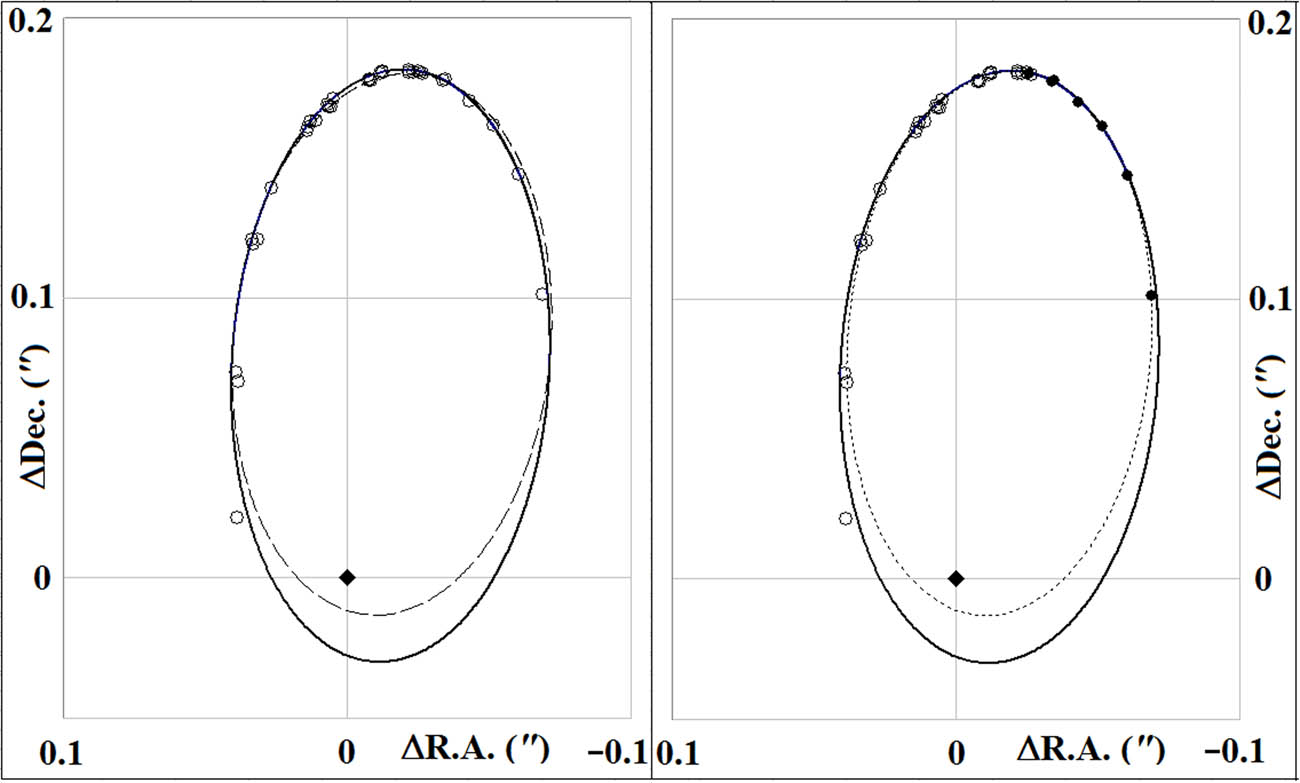
Orbits of S2.
Figure 2 shows the orbits of S102 constructed with observational data of Keck telescope (Meyer, 2012) (left panel, black squares) and VTL (Parsa, 2017) (central panel, white circles). Right panel shows the orbit constructed in the present work with the united data of Keck and VLT. See Table 1. Figure 3 shows orbit of S4711 obtained by the AMP method using graphic with median values given in the previous work (Peissker et al. 2020). Our orbit is shown by dotted line and orbit of Peissker et al. (2020) is shown by solid line.
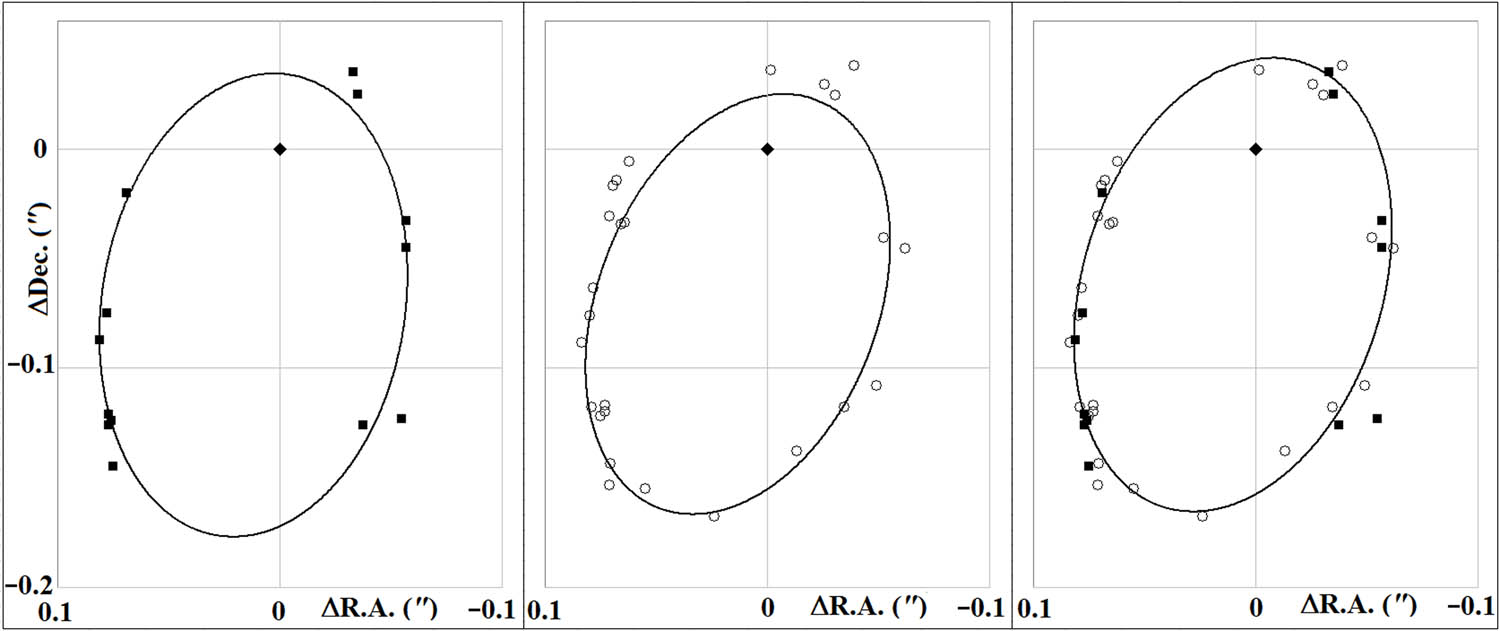
Orbits of S102.
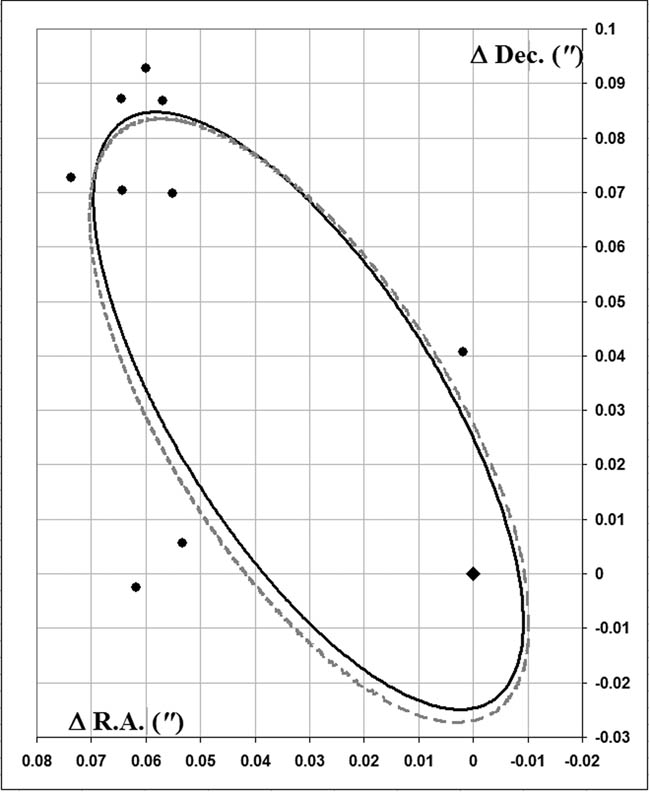
Orbits of S4711.
Figures 4 and 5 show two orbits for S27, see Table 2.
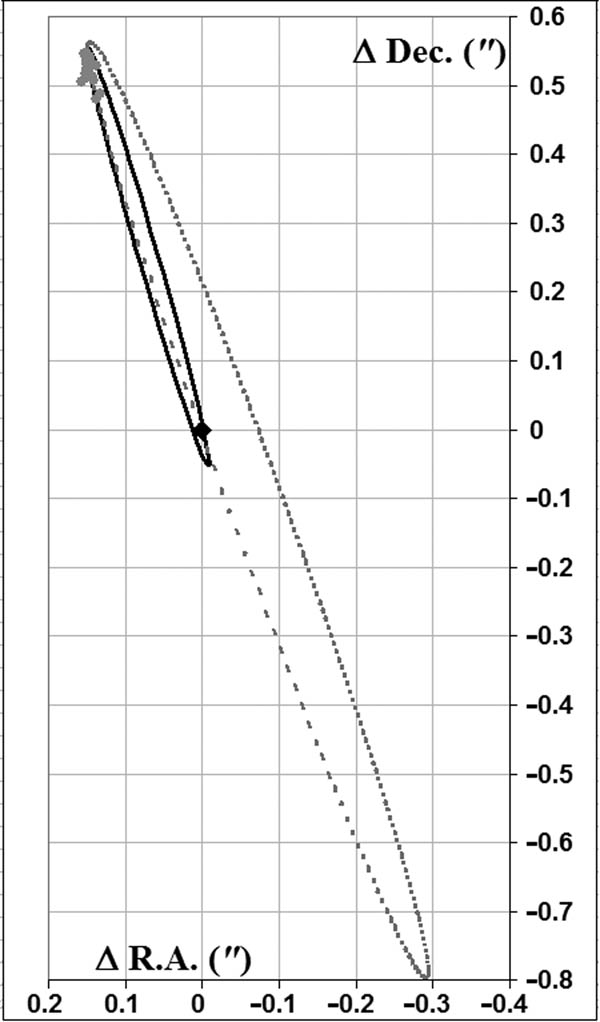
Orbits of S27.
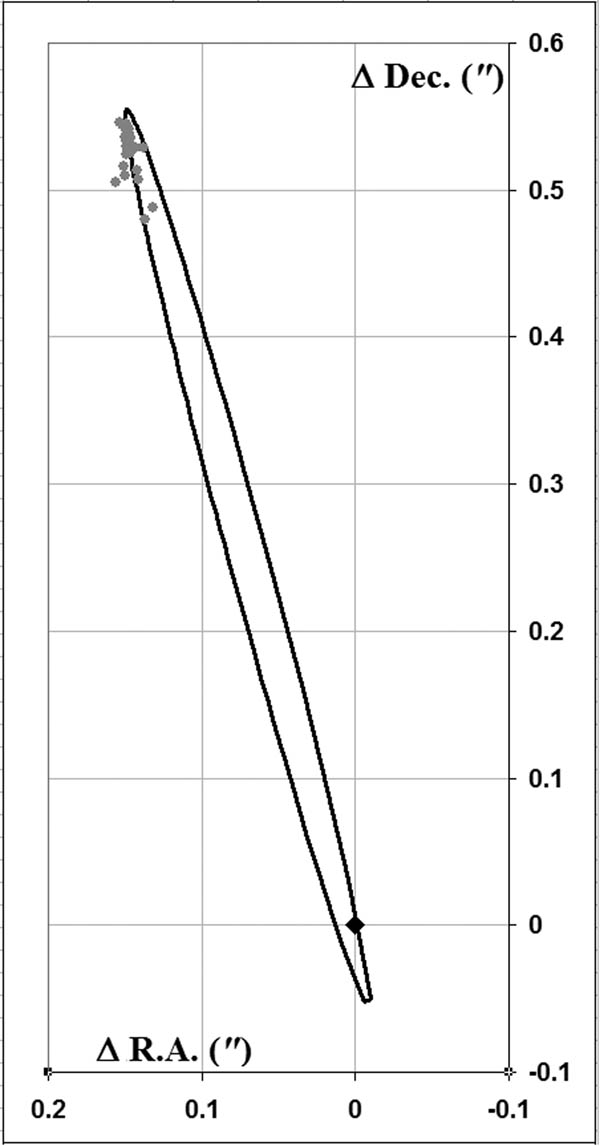
Orbit of S27.
As our analysis has shown that, when applying the method developed by Izmailov, the positions of S27 may contain errors. Presumably, even errors in identification arising from the presence of close images of overlapping stars. For S27, we used the diagram from Gillessen et al. (2009). We measured the positions
5 Relativistic parameters
At the next stage, we made an attempt to estimate the expected relativistic parameters for stars by orbital elements. We used the corresponding formulas.
Here
In Table 3 additional orbital and relativistic parameters for S4711, S27 stars in comparison with S2 star are given. From the left to the right column, we list star name, its pericenter distance
Parameters of orbits and relativistic parameters of S-cluster stars
| Star |
|
|
|
|
|
|
Ref 2000+ |
|---|---|---|---|---|---|---|---|
| S4711 | 143.7 | 1094.7 | 6,693 | 5.6 | 84.5 | 10.3 | Peissker20 |
| S02 | 119.3 | 1949.9 | 7,582 | 6.8 | 101.7 | 11.7 | Peissker20 |
| S02 | 234.6 | 1627.4 | 8,060 | 3.4 | 51.0 | 6.3 | Pulk22, IZM |
| S27 | 35 | 7,030 | 14,239 | 23 | 345 | 37.4 | Pulk22, AMP |
| S27 | 1,096 | 30,214 | 2,519 | 0.74 | 11.1 | 1.24 | Pulk22, IZM |
Data for S4711 correspond to its orbit in Table 1.
Results of theoretical values of parameters are listed in Table 3.
The relativistic components were theoretically estimated from our obtained orbital elements and assuming that the mass of the primary component is equal to 4.15 million solar mass and its distance from the Sun Ro equal to 8.19 kpc. We obtained these elements for control purposes, to check, as a first approximation, (a) whether they are comparable in order of value with the same stars in the cited publications and (b) thus assess the possibility of obtaining them from observations with the accumulation of observational material.
6 Comments
Let us note the features in the results obtained, which can be explained on the basis of more extensive material during further research. When applying the AMP method, the orbits are obtained close to the orbits published by the observers Keck and VLT. When applying the modified Thiele–Innes method to the star S27, the elements were obtained with large errors, the orbital period
As the authors of the cited works note: after many years of high-precision astrometric observations and many years of Doppler measurements of radial velocities, the accuracy of the available data has reached a level at which one could hope to detect deviations from Keplerian orbits. Such deviations may be a consequence of relativistic effects. There are examples of detecting the magnitude of
7 Conclusion
It is concluded that it is possible to use Pulkovo methods – AMP and the geometric method developed by Kisselev and colleagues, as well as the method proposed by Izmailov – to obtain preliminary orbits of S-stars of the Sgr A
We also tried to improve our orbit for S02 and calculate an orbit for S27. The orbits S02 and S27 were determined on the basis of a short arc: S02 – at six average annual points with an orbital period of 16 years and observations of more than 16 years, S27 – at 13 observation points and with an orbital period of 112 years. We made an attempt to calculate theoretical relativistic parameters for some stars according to their orbital elements (Table 3). These parameters are of the same order of value as those expected by observers at the Keck and VLT telescopes.
Acknowledgements
The reported study was funded by Russian Foundation for Basic Research (RFBR) according to the research project No. 20-02-0563A.
-
Author contributions: All authors have accepted responsibility for the entire content of this manuscript and approved its submission.
-
Conflict of interest: Authors state no conflict of interest.
References
Alexander T, Morris M. 2003. Squeezars: tidally powered stars orbiting a massive black hole. ApJ. 590:L25–L28, (4p). 10.1086/376671. Suche in Google Scholar
Gillessen S, Eisenhauer F, Trippe S, Alexander T, Genzel R, Martins F, et al. 2009. Monitoring stellar orbits around the massive black hole in the galactic center. ApJ. 692:1075–1109. 10.1088/0004-637X/692/2/1075. Suche in Google Scholar
Gillessen S, Plewa PM, Eisenhauer F, Sari R, Waisberg I, Habibi M, et al. 2017. An update on monitoring stellar orbits in the galactic center. ApJ. 837:30 (19p). 10.3847/1538-4357/aa5c41. Suche in Google Scholar
Gravity collaboration, Abuter R, Amorim A, Anugu N, Bauböck M, Benisty M, Berger JP, et al. 2018. Detection of the gravitational redshift in the orbit of the star S2 near the Galactic centre massive black hole. A&A. 615:L15 (10p). 10.1051/0004-6361/201833718. Suche in Google Scholar
Izmailov IS. 2019. The orbits of 451 wide visual double stars. Astron Let. 45(1):30–38. 10.1134/S106377371901002X. http://izmccd.puldb.ru/PIA35.pdf. Suche in Google Scholar
Grosheva EA. 2006. Periodic perturbations of relative motion in multiple system ADS 15571. Astrophysics. 49(3):397–404. 10.1007/s10511-006-0039-6. Suche in Google Scholar
Kisselev AA. 1997. A direct geometrical method for determination of the elliptic orbit of a dinary star using the projection on the celestial sphere. In: Docobo JA, Elipe A, McAlister H. Editors. Visual double stars: formation, dynamics and evolutionary tracks. Dordrecht: Kluwer Academic. p. 357. Corpus ID: 115529322. 10.1007/978-94-009-1477-3_42Suche in Google Scholar
Kisselev AA, Gnedin Yu N, Grosheva EA, Shakht NA, Gorshanov DL, Piotrovich Myu. 2007. The supermassive black hole at the center of our galaxy: determination of its main physical parameters. Astron Report. 57(2):100–108. 10.1134/S1063772907020047. Suche in Google Scholar
Meyer L, Ghez AM, Schödel R, Yelda S, Boehle A, Lu JR, et al. 2012. The shortest known period star orbiting our galaxyas supermassive black hole. Science. 338(6103):84–87. 10.1126/science.1225506. Suche in Google Scholar PubMed
Parsa M, Eckart A, Shahzamanian B, Karas V, Zajacek M, Zensus JA, et al. 2017. Investigating the relativistic motion of the stars near the supermassive black hole in the galactic center. ApJ. 845:22 (19p). 10.3847/1538-4357/aa7bf0. Suche in Google Scholar
Peissker F, Eckart A, Zajacek M, Ali B, Parsa M. 2020. S62 and S4711: Indications of a population of faint fast moving stars inside the S2 orbit S4711 on a 7.6 yr orbit around Sgr A ast. ApJ. 899:50 (19p). 10.3847/1538-4357/ab9c1c. Suche in Google Scholar
Sokova IA, Sokov EN, Roschina EA, Rastegaev DA, Kiselev AA, Balega Yu, et al. 2014. The binary Asteroid 22 Kalliope: Linus orbit determination on the basis of speckle interferometric observations. Icarus. 236:157–164. 10.1016/j.icarus.2014.04.001. Suche in Google Scholar
© 2022 Natalia A. Shakht et al., published by De Gruyter
This work is licensed under the Creative Commons Attribution 4.0 International License.
Artikel in diesem Heft
- Research Articles
- Deep learning application for stellar parameters determination: I-constraining the hyperparameters
- Explaining the cuspy dark matter halos by the Landau–Ginzburg theory
- The evolution of time-dependent Λ and G in multi-fluid Bianchi type-I cosmological models
- Observational data and orbits of the comets discovered at the Vilnius Observatory in 1980–2006 and the case of the comet 322P
- Special Issue: Modern Stellar Astronomy
- Determination of the degree of star concentration in globular clusters based on space observation data
- Can local inhomogeneity of the Universe explain the accelerating expansion?
- Processing and visualisation of a series of monochromatic images of regions of the Sun
- 11-year dynamics of coronal hole and sunspot areas
- Investigation of the mechanism of a solar flare by means of MHD simulations above the active region in real scale of time: The choice of parameters and the appearance of a flare situation
- Comparing results of real-scale time MHD modeling with observational data for first flare M 1.9 in AR 10365
- Modeling of large-scale disk perturbation eclipses of UX Ori stars with the puffed-up inner disks
- A numerical approach to model chemistry of complex organic molecules in a protoplanetary disk
- Small-scale sectorial perturbation modes against the background of a pulsating model of disk-like self-gravitating systems
- Hα emission from gaseous structures above galactic discs
- Parameterization of long-period eclipsing binaries
- Chemical composition and ages of four globular clusters in M31 from the analysis of their integrated-light spectra
- Dynamics of magnetic flux tubes in accretion disks of Herbig Ae/Be stars
- Checking the possibility of determining the relative orbits of stars rotating around the center body of the Galaxy
- Photometry and kinematics of extragalactic star-forming complexes
- New triple-mode high-amplitude Delta Scuti variables
- Bubbles and OB associations
- Peculiarities of radio emission from new pulsars at 111 MHz
- Influence of the magnetic field on the formation of protostellar disks
- The specifics of pulsar radio emission
- Wide binary stars with non-coeval components
- Special Issue: The Global Space Exploration Conference (GLEX) 2021
- ANALOG-1 ISS – The first part of an analogue mission to guide ESA’s robotic moon exploration efforts
- Lunar PNT system concept and simulation results
- Special Issue: New Progress in Astrodynamics Applications - Part I
- Message from the Guest Editor of the Special Issue on New Progress in Astrodynamics Applications
- Research on real-time reachability evaluation for reentry vehicles based on fuzzy learning
- Application of cloud computing key technology in aerospace TT&C
- Improvement of orbit prediction accuracy using extreme gradient boosting and principal component analysis
- End-of-discharge prediction for satellite lithium-ion battery based on evidential reasoning rule
- High-altitude satellites range scheduling for urgent request utilizing reinforcement learning
- Performance of dual one-way measurements and precise orbit determination for BDS via inter-satellite link
- Angular acceleration compensation guidance law for passive homing missiles
- Research progress on the effects of microgravity and space radiation on astronauts’ health and nursing measures
- A micro/nano joint satellite design of high maneuverability for space debris removal
- Optimization of satellite resource scheduling under regional target coverage conditions
- Research on fault detection and principal component analysis for spacecraft feature extraction based on kernel methods
- On-board BDS dynamic filtering ballistic determination and precision evaluation
- High-speed inter-satellite link construction technology for navigation constellation oriented to engineering practice
- Integrated design of ranging and DOR signal for China's deep space navigation
- Close-range leader–follower flight control technology for near-circular low-orbit satellites
- Analysis of the equilibrium points and orbits stability for the asteroid 93 Minerva
- Access once encountered TT&C mode based on space–air–ground integration network
- Cooperative capture trajectory optimization of multi-space robots using an improved multi-objective fruit fly algorithm
Artikel in diesem Heft
- Research Articles
- Deep learning application for stellar parameters determination: I-constraining the hyperparameters
- Explaining the cuspy dark matter halos by the Landau–Ginzburg theory
- The evolution of time-dependent Λ and G in multi-fluid Bianchi type-I cosmological models
- Observational data and orbits of the comets discovered at the Vilnius Observatory in 1980–2006 and the case of the comet 322P
- Special Issue: Modern Stellar Astronomy
- Determination of the degree of star concentration in globular clusters based on space observation data
- Can local inhomogeneity of the Universe explain the accelerating expansion?
- Processing and visualisation of a series of monochromatic images of regions of the Sun
- 11-year dynamics of coronal hole and sunspot areas
- Investigation of the mechanism of a solar flare by means of MHD simulations above the active region in real scale of time: The choice of parameters and the appearance of a flare situation
- Comparing results of real-scale time MHD modeling with observational data for first flare M 1.9 in AR 10365
- Modeling of large-scale disk perturbation eclipses of UX Ori stars with the puffed-up inner disks
- A numerical approach to model chemistry of complex organic molecules in a protoplanetary disk
- Small-scale sectorial perturbation modes against the background of a pulsating model of disk-like self-gravitating systems
- Hα emission from gaseous structures above galactic discs
- Parameterization of long-period eclipsing binaries
- Chemical composition and ages of four globular clusters in M31 from the analysis of their integrated-light spectra
- Dynamics of magnetic flux tubes in accretion disks of Herbig Ae/Be stars
- Checking the possibility of determining the relative orbits of stars rotating around the center body of the Galaxy
- Photometry and kinematics of extragalactic star-forming complexes
- New triple-mode high-amplitude Delta Scuti variables
- Bubbles and OB associations
- Peculiarities of radio emission from new pulsars at 111 MHz
- Influence of the magnetic field on the formation of protostellar disks
- The specifics of pulsar radio emission
- Wide binary stars with non-coeval components
- Special Issue: The Global Space Exploration Conference (GLEX) 2021
- ANALOG-1 ISS – The first part of an analogue mission to guide ESA’s robotic moon exploration efforts
- Lunar PNT system concept and simulation results
- Special Issue: New Progress in Astrodynamics Applications - Part I
- Message from the Guest Editor of the Special Issue on New Progress in Astrodynamics Applications
- Research on real-time reachability evaluation for reentry vehicles based on fuzzy learning
- Application of cloud computing key technology in aerospace TT&C
- Improvement of orbit prediction accuracy using extreme gradient boosting and principal component analysis
- End-of-discharge prediction for satellite lithium-ion battery based on evidential reasoning rule
- High-altitude satellites range scheduling for urgent request utilizing reinforcement learning
- Performance of dual one-way measurements and precise orbit determination for BDS via inter-satellite link
- Angular acceleration compensation guidance law for passive homing missiles
- Research progress on the effects of microgravity and space radiation on astronauts’ health and nursing measures
- A micro/nano joint satellite design of high maneuverability for space debris removal
- Optimization of satellite resource scheduling under regional target coverage conditions
- Research on fault detection and principal component analysis for spacecraft feature extraction based on kernel methods
- On-board BDS dynamic filtering ballistic determination and precision evaluation
- High-speed inter-satellite link construction technology for navigation constellation oriented to engineering practice
- Integrated design of ranging and DOR signal for China's deep space navigation
- Close-range leader–follower flight control technology for near-circular low-orbit satellites
- Analysis of the equilibrium points and orbits stability for the asteroid 93 Minerva
- Access once encountered TT&C mode based on space–air–ground integration network
- Cooperative capture trajectory optimization of multi-space robots using an improved multi-objective fruit fly algorithm
