New triple-mode high-amplitude Delta Scuti variables
-
Anton V. Khruslov


Abstract
I present a detection of four new triple-mode high-amplitude Delta Scuti variables, pulsating in the fundamental, first, and second overtone modes. This is a new addition to the ten known cases in the Galaxy. I used the data of ASAS-SN and analyzed them using the WinEfk code by V. P. Goranskij. Light elements and parameters of the light curves were obtained.
1 Introduction
By now, ten cases of triple-mode high-amplitude Delta Scuti variables, pulsating in the fundamental, first, and second overtone modes, were known in the Galaxy. They are V829 Aql (Handler et al. 1998), DO CMi (Wils et al. 2008), GSC 03144-00595 (Ulusoy et al. 2013), four stars in the OGLE project: OGLE-GD-DSCT-0021, OGLE-GD-DSCT-0033, OGLE-GD-DSCT-0048, and OGLE-GD-DSCT-0049 (Pietrukowicz et al. 2013); two cases, V803 Aur and V1647 Sco (detected by Khruslov 2014), and V761 Peg (detected in 2016 by F. Ferrante, announcement of August 20, 2016 in the AAVSO Variable Star Index, VSX,[1] Watson et al. 2007 improved periods are given by Kazarovets et al. 2020). In addition, the OGLE project detected two variables of this type in the Large Magellanic Cloud, OGLE-LMC-DSCT-0927 and OGLE-LMC-DSCT-2345 (Poleski et al. 2010).
I searched for double- and multi-mode high-amplitude Delta Scuti variables using data of the All-Sky Automated Survey for Supernovae (ASAS-SN;[2] Shappee et al. 2014, Kochanek et al. 2017). To select candidates, I used the ASAS-SN variable stars database.[3] I chose HADS stars with scattered light curves and then analyzed observations using Deeming’s method (Deeming 1975) implemented in the WinEfk code[4] by V. P. Goranskij.
In this article, I present a detection of four new triple-mode high-amplitude Delta Scuti variables, pulsating in the fundamental, first, and second overtone modes. In my search, along with these four variables, I detected about 300 double-mode stars pulsating in the fundamental and first overtone modes, about 20 stars pulsating in the first and second overtone modes, and several candidate HADS variables pulsating in higher overtones. These results are being prepared for publication in the Peremennye Zvezdy (Variable Stars) journal.
To improve the light elements for one of the stars (USNO-B1.0 1430-0092012, No. 1), the data of the Wide Angle Search for Planets (1SWASP;[5] Butters et al. 2010) were used. The 1SWASP observations are available as FITS tables, which were converted into ASCII tables using the OMC2ASCII program as described by Sokolovsky (2007); we also used the SuperWASP FITS to ASCII lightcurve conversion service.[6]
2 Results
The results are presented in Tables 1, 2, and 3. Table 1 contains general information on the studied variables: equatorial coordinates, J2000 (drawn from the Gaia DR2 catalog, Gaia Collaboration, Brown et al. 2018); star numbers from the GSC (Morrison et al. 2001), GSC2.3 (Lasker et al. 2008), USBO-A2.0 (Monet et al. 1998), and USNO-B1.0 (Monet et al. 2003) catalogs; galactic latitude
General information on the variables
| Var No. | 1 | 2 | 3 | 4 |
|---|---|---|---|---|
| RA (J2000) | 02 40 19.45 | 03 42 14.94 | 08 31 43.49 | 10 29 15.02 |
| Dec (J2000) |
|
|
|
|
| GSC | — | 04062–00915 | 06574–03433 | — |
| GSC2.3 | NBY9001324 | NAVT000282 | S5SR001526 | S4NM025687 |
| USNO-A2.0 | 1425-03724804 | — | 0600-10606808 | — |
| USNO-B1.0 | 1430-0092012 | — | 0654-0199379 | 0257-0170560 |
|
|
|
|
|
|
|
|
0.32 | 0.42 | 0.12 : | 0.45 |
|
|
0.60 | 1.02 | 0.36 | 0.92 |
Light elements
| Var No. | 1 | 2 | 3 | 4 |
|---|---|---|---|---|
|
|
0.1434321 | 0.1397658 | 0.0986740 | 0.2269221 |
|
|
0.1103740 | 0.1076944 | 0.0761993 | 0.1768946 |
|
|
0.0886368 | 0.0864041 | 0.0610775 | 0.1408972 |
|
|
0.0945 | 0.0410 | 0.0780 | 0.1230 |
|
|
0.0230 | 0.1073 | 0.0670 | 0.0820 |
|
|
0.0620 | 0.0073 | 0.0080 | 0.0890 |
|
|
0.7695 | 0.7705 | 0.7722 | 0.7795 |
|
|
0.8031 | 0.8023 | 0.8015 | 0.7965 |
|
|
— | 0.04794087 | — | 0.09940567 |
|
|
— | 0.4370714 | — | — |
Parameters of light curves
| Var No. | 1 | 2 | 3 | 4 |
|---|---|---|---|---|
| Max,
|
14.02 | 13.38 | 13.69 | 13.88 |
| Min,
|
14.46 | 13.76 | 13.95 | 14.38 |
|
|
0.41 | 0.42 | 0.49 | 0.43 |
|
|
0.41 | 0.46 | 0.40 | 0.49 |
|
|
0.50 | 0.49 | 0.48 | 0.46 |
|
|
0.057 | 0.043 | 0.036 | 0.056 |
|
|
0.065 | 0.057 | 0.046 | 0.076 |
|
|
0.033 | 0.032 | 0.021 | 0.020 |
|
|
— | 0.007 | — | 0.019 |
|
|
— | 0.011 | — | — |
Table 2 presents the light elements (period, in days, and epoch of maximum, HJD – 2457777) of individual modes (fundamental
Table 3 presents photometric parameters of the light curves: magnitudes at maximum and minimum, asymmetry parameter
Additional information for individual stars is presented in the following comments.
Comments for the stars:
Variability was detected by Jayasinghe et al. (2021) in the ASAS-SN Catalog of Variable Stars IX, type HADS,
The variability was detected by Jayasinghe et al. (2020) in the ASAS-SN Catalog of Variable Stars V, type HADS,
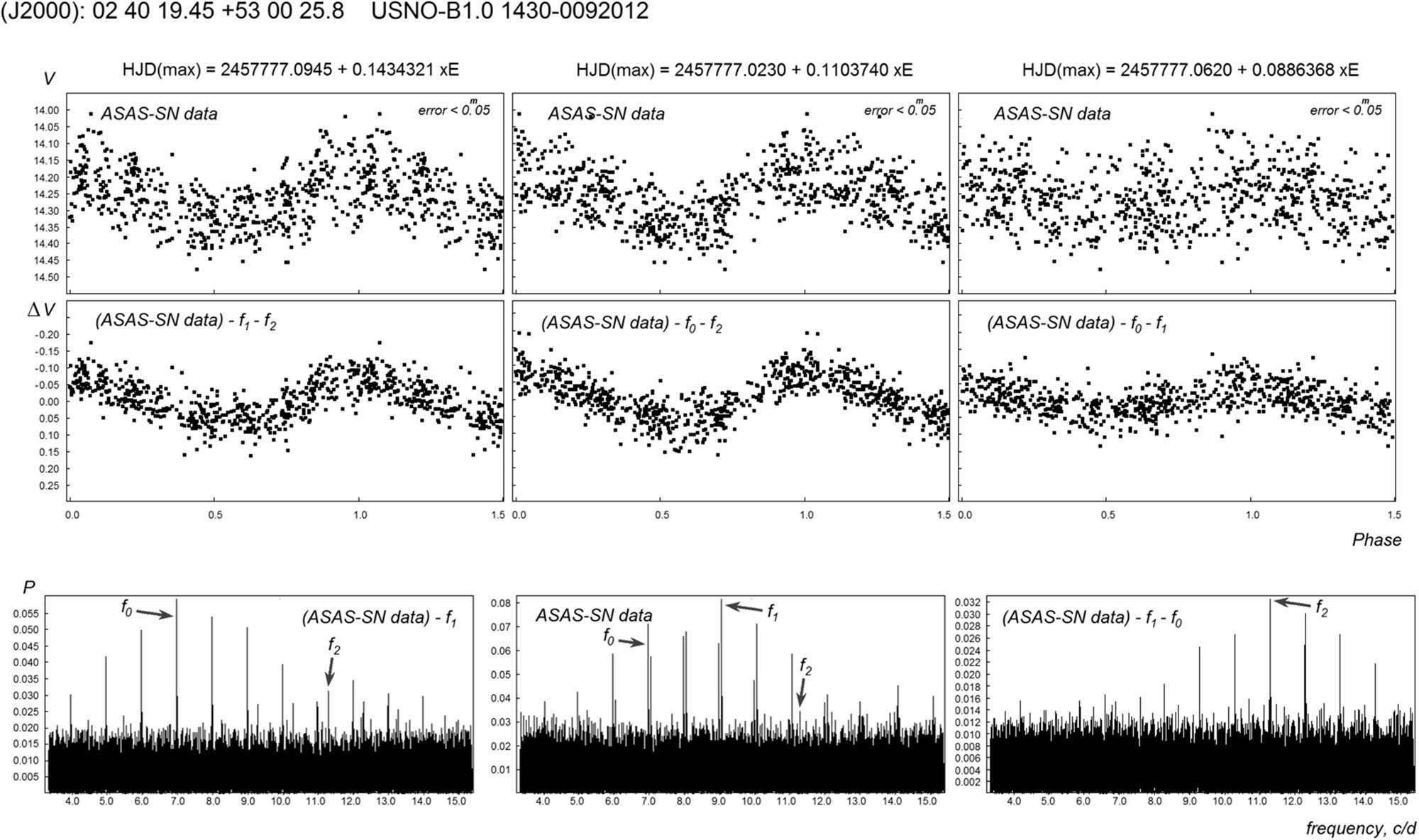
The light curves USNO-B1.0 1430-0092012 (No. 1).
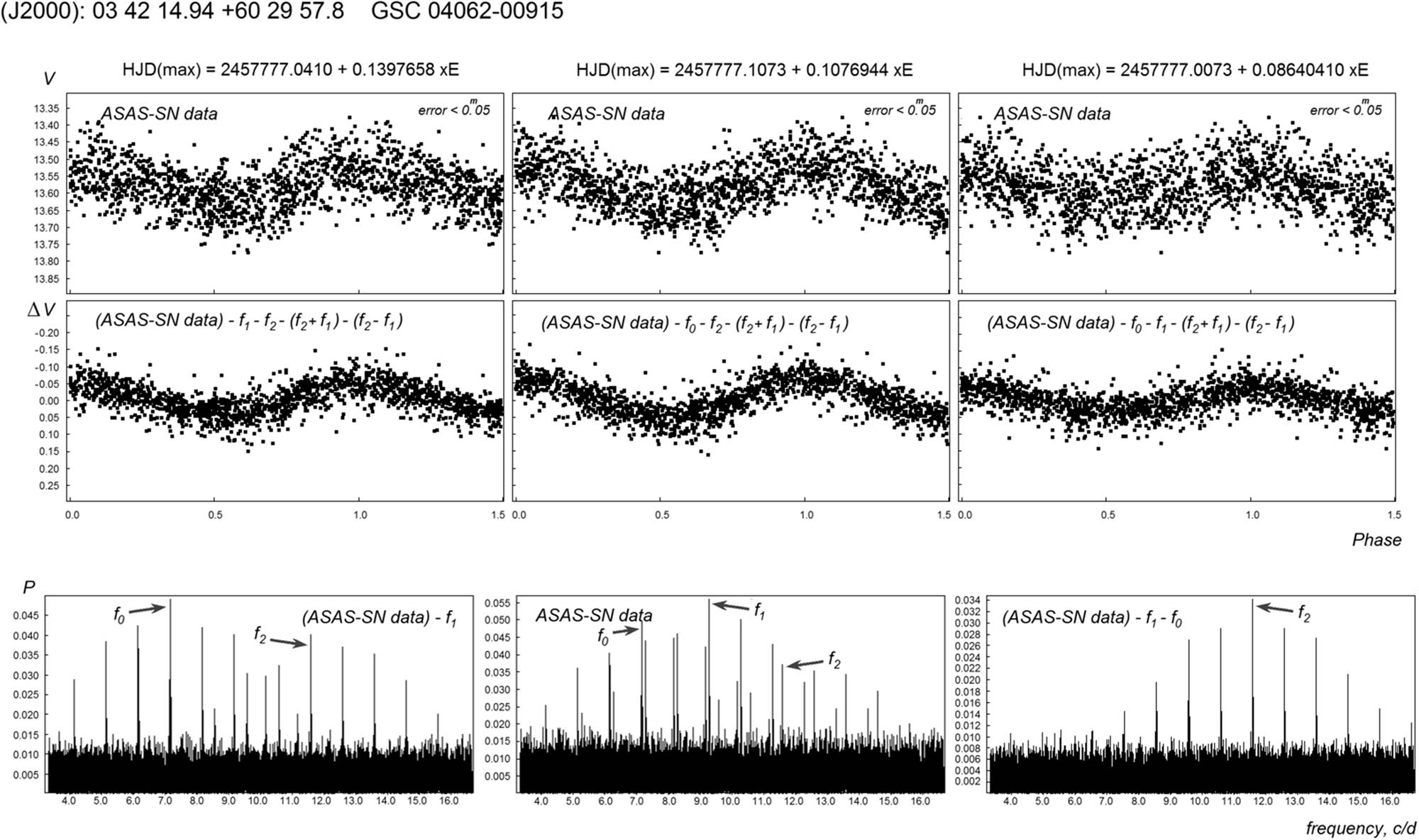
GSC 04062-00915 (No. 2).
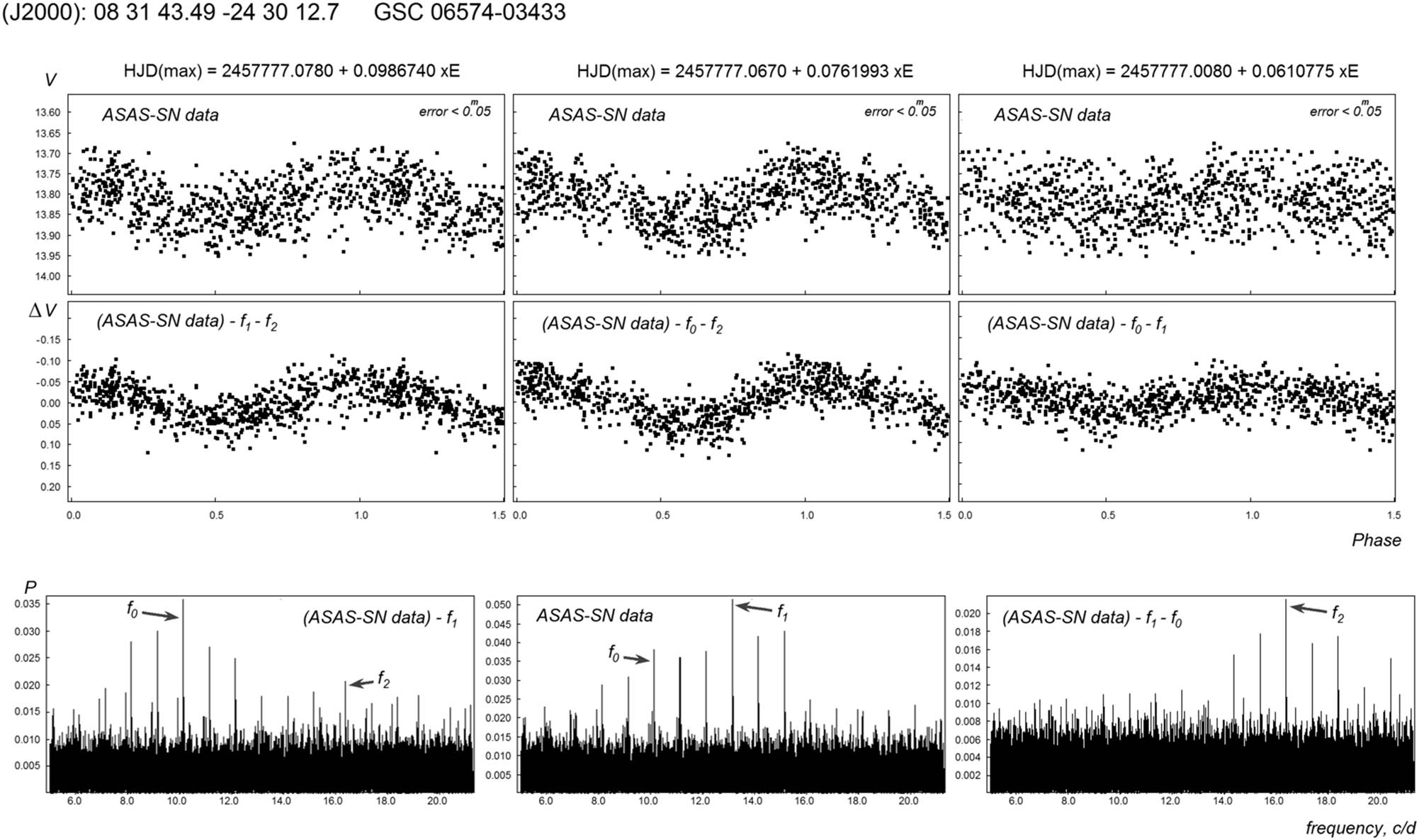
GSC 06574-03433 (No. 3).

USNO-B1.0 0257-0170560 (No. 4).
3 Conclusion
In most of the cases studied here, the period ratios
Variations of all the four stars are dominated with the first overtone mode,
Figure 5 shows the Petersen diagram for all double- and multimode HADS variables detected by me. Designations in Figure 5 are the following. PL is the longer period; PS is the shorter period; open symbols are known Galactic HADS(B) stars; filled symbols are new double- and multimode variables. Circles, triangles, and squares are double, triple, and quadruple-mode variables. The red triangles correspond to the new triple-mode HADS variables announced in this article.
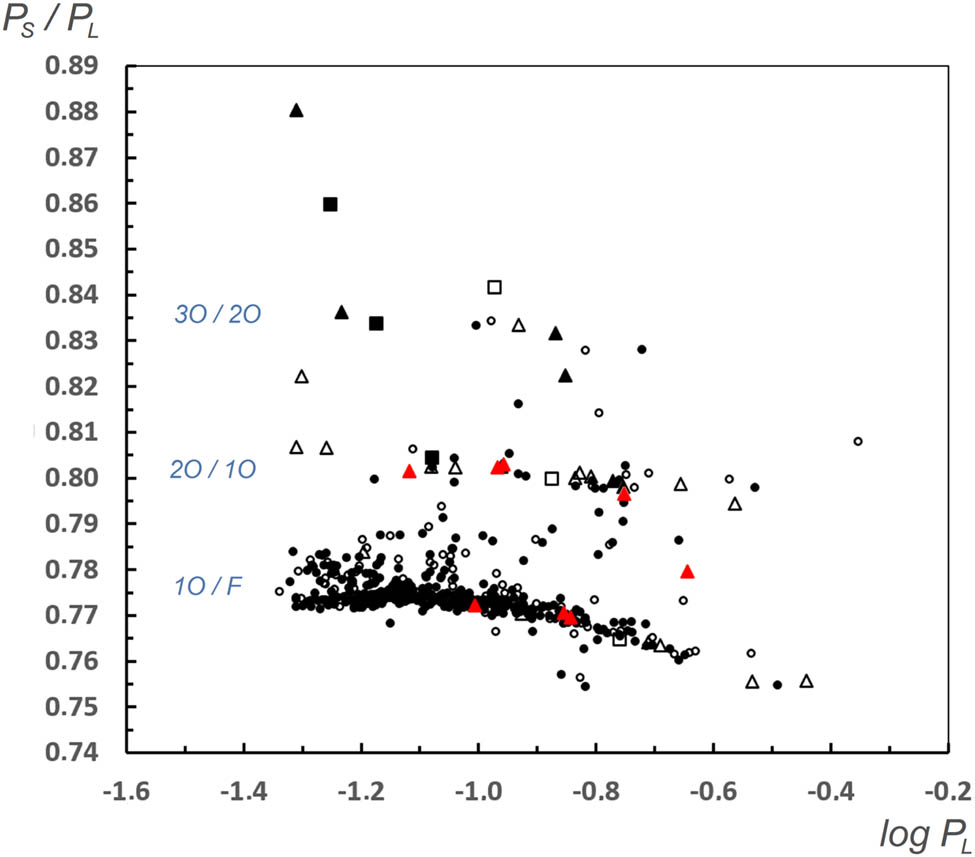
The Petersen diagram for HADS(B) stars.
Acknowledgments
The author is grateful to Dr. V. P. Goranskij for providing his light-curve analysis software.
-
Funding information: The author states no funding involved.
-
Author contributions: The author accepts responsibility for the entire content of this manuscript and approved its submission.
-
Conflict of interest: The author states no conflict of interest.
References
Butters OW, West RG, Anderson DR, Collier Cameron A, Clarkson WI, Enoch B, et al. 2010. The first WASP public data release. A&A. 520:L10.10.1051/0004-6361/201015655Search in Google Scholar
Deeming TJ. 1975. Fourier analysis with unequally-spaced data. Ap&SS. 36:137–158. 10.1007/BF00681947Search in Google Scholar
Brown AGA, Vallenari A, Prusti T, de Bruijne JHJ, Babusiaux C, Bailer-Jones CAL, et al. (Gaia collaboration). 2018. Gaia data release 2. Summary of the contents and survey properties. A&A. 616:A1.10.1051/0004-6361/201832964Search in Google Scholar
Handler G, Pikall H, Diethelm R. 1998. The nature of V829 Aql - A triple-mode radially pulsating post-main-sequence Delta Scuti star. IBVS. 4549:4. Search in Google Scholar
Heinze AN, Tonry JL, Denneau L, Flewelling H, Stalder B, Rest A. et al. 2018. A first catalog of variable stars measured by the asteroid terrestrial-impact last alert system (ATLAS). AJ. 156(5):241. 10.3847/1538-3881/aae47fSearch in Google Scholar
Jayasinghe T, Stanek KZ, Kochanek CS, Shappee BJ, Holoien TW-S, Thompson TA, et al. 2019. The ASAS-SN catalogue of variable stars - II. Uniform classification of 412 000 known variables. MNRAS. 486:1907–1943. 10.1093/mnras/stz844Search in Google Scholar
Jayasinghe T, Stanek KZ, Kochanek CS, Shappee BJ, Holoien TW-S, Thompson TA, et al. 2020. The ASAS-SN catalogue of variable stars - V. Variables in the Southern hemisphere. MNRAS. 491:13–28. 10.1093/mnras/stz2711Search in Google Scholar
Jayasinghe T, Kochanek CS, Stanek KZ, Shappee BJ, Holoien TW, Thompson TA, et al. 2021. The ASAS-SN catalogue of variable stars IX: The spectroscopic properties of Galactic variable stars. MNRAS. 503:200–235. 10.1093/mnras/stab114Search in Google Scholar
Kazarovets EV, Samus NN, Durlevich OV, Khruslov AV, Kireeva NN, Pastukhova EN. 2020. The 82nd name-list of variable stars. Part III - RA 20h to 24h and Novae. PZ. 40(6):12. 10.22444/IBVS.6261Search in Google Scholar
Khruslov AV. 2014. New elements for double- and multimode high-amplitude Delta Scuti variables. PZ Prilozh. 14:N 1.Search in Google Scholar
Kochanek CS, Shappee BJ, Stanek KZ, Holoien TW-S, Thompson TA, Prieto JL, et al. 2017. The all-sky automated survey for supernovae (ASAS-SN) light curve server v1.0. PASP. 129 (104502):8. 10.1088/1538-3873/aa80d9Search in Google Scholar
Lasker BM, Lattanzi MG, McLean BJ, Bucciarelli B, Drimmel R, Garcia J, et al. 2008. The second-generation guide star catalog: description and properties. AJ. 136:735–766. 10.1088/0004-6256/136/2/735Search in Google Scholar
Monet D, Bird A, Canzian B, Dahn C, Guetter H, Harris H, et al. 1998. USNO-A2.0, A catalog of astrometric standards. Washington, DC: U.S. Naval Observatory.Search in Google Scholar
Monet DG, Levine SE, Canzian B, Ables HD, Bird AR, Dahn CC, et al. 2003. The USNO-B Catalog AJ. 125:984–993. 10.1086/345888Search in Google Scholar
Morrison JE, Röser S, McLean B, Bucciarelli B, Lasker B. 2001. The guide star catalog, Version 1.2: An astrometric recalibration and other refinements. AJ. 121:1752–1763. 10.1086/319383Search in Google Scholar
Pasternacki T, Csizmadia Sz, Cabrera J, Eigmüller P, Erikson A, Fruth T, et al. 2011. A variable star census in a perseus field. AJ. 142(4):114.10.1088/0004-6256/142/4/114Search in Google Scholar
Petersen JO, Christensen-Dalsgaard J. 1996. Pulsation models of Delta Scuti variables. I. The high-amplitude double-mode stars. A&A. 312:463–474Search in Google Scholar
Pietrukowicz P, Dziembowski WA, Mróz P, Soszyński I, Udalski A, Poleski R, et al. 2013. Large variety of new pulsating stars in the OGLE-III galactic disk fields. Acta Astron. 63:379–404. Search in Google Scholar
Poleski R, Soszyński I, Udalski A, Szymański MK, Kubiak M, Pietrzyński G, et al. 2010. The optical gravitational lensing experiment. The OGLE-III catalog of variable stars. VI. Delta Scuti stars in the large magellanic cloud. Acta Astron. 60:1–16.Search in Google Scholar
Shappee BJ, Prieto JL, Grupe D, Kochanek CS, Stanek KZ, De Rosa G, et al. 2014. The man behind the curtain: X-Rays drive the UV through NIR variability in the 2013 active galactic nucleus outburst in NGC 2617. ApJ. 788(48):13. 10.1088/0004-637X/788/1/48Search in Google Scholar
Skrutskie MF, Cutri RM, Stiening R, Weinberg MD, Schneider S, Carpenter JM, et al. 2006. The two micron all sky survey (2MASS). AJ. 131:1163–1183. 10.1086/498708Search in Google Scholar
Sokolovsky KV. 2007. V435 Cas Observed by INTEGRAL/OMC. PZ Prilozh. 7(30).Search in Google Scholar
Ulusoy C, Ulaş B, Gülmez T, Balona LA, Stateva I, Iliev IKh, et al. 2013. Multisite photometric campaign on the high-amplitude Delta Scuti star KIC 6382916. MNRAS. 433:394–401. 10.1093/mnras/stt731Search in Google Scholar
Watson CL, Henden AA, Price A. 2007. The international variable star index (VSX). JAAVSO. 35:414. Search in Google Scholar
Wils P, Rozakis I, Kleidis S, Hambsch F-J, Bernhard K. 2008. Photometry of GSC 762-110, a new triple-mode radially pulsating star. A&A. 478:865–868. 10.1051/0004-6361:20078992Search in Google Scholar
© 2022 Anton V. Khruslov, published by De Gruyter
This work is licensed under the Creative Commons Attribution 4.0 International License.
Articles in the same Issue
- Research Articles
- Deep learning application for stellar parameters determination: I-constraining the hyperparameters
- Explaining the cuspy dark matter halos by the Landau–Ginzburg theory
- The evolution of time-dependent Λ and G in multi-fluid Bianchi type-I cosmological models
- Observational data and orbits of the comets discovered at the Vilnius Observatory in 1980–2006 and the case of the comet 322P
- Special Issue: Modern Stellar Astronomy
- Determination of the degree of star concentration in globular clusters based on space observation data
- Can local inhomogeneity of the Universe explain the accelerating expansion?
- Processing and visualisation of a series of monochromatic images of regions of the Sun
- 11-year dynamics of coronal hole and sunspot areas
- Investigation of the mechanism of a solar flare by means of MHD simulations above the active region in real scale of time: The choice of parameters and the appearance of a flare situation
- Comparing results of real-scale time MHD modeling with observational data for first flare M 1.9 in AR 10365
- Modeling of large-scale disk perturbation eclipses of UX Ori stars with the puffed-up inner disks
- A numerical approach to model chemistry of complex organic molecules in a protoplanetary disk
- Small-scale sectorial perturbation modes against the background of a pulsating model of disk-like self-gravitating systems
- Hα emission from gaseous structures above galactic discs
- Parameterization of long-period eclipsing binaries
- Chemical composition and ages of four globular clusters in M31 from the analysis of their integrated-light spectra
- Dynamics of magnetic flux tubes in accretion disks of Herbig Ae/Be stars
- Checking the possibility of determining the relative orbits of stars rotating around the center body of the Galaxy
- Photometry and kinematics of extragalactic star-forming complexes
- New triple-mode high-amplitude Delta Scuti variables
- Bubbles and OB associations
- Peculiarities of radio emission from new pulsars at 111 MHz
- Influence of the magnetic field on the formation of protostellar disks
- The specifics of pulsar radio emission
- Wide binary stars with non-coeval components
- Special Issue: The Global Space Exploration Conference (GLEX) 2021
- ANALOG-1 ISS – The first part of an analogue mission to guide ESA’s robotic moon exploration efforts
- Lunar PNT system concept and simulation results
- Special Issue: New Progress in Astrodynamics Applications - Part I
- Message from the Guest Editor of the Special Issue on New Progress in Astrodynamics Applications
- Research on real-time reachability evaluation for reentry vehicles based on fuzzy learning
- Application of cloud computing key technology in aerospace TT&C
- Improvement of orbit prediction accuracy using extreme gradient boosting and principal component analysis
- End-of-discharge prediction for satellite lithium-ion battery based on evidential reasoning rule
- High-altitude satellites range scheduling for urgent request utilizing reinforcement learning
- Performance of dual one-way measurements and precise orbit determination for BDS via inter-satellite link
- Angular acceleration compensation guidance law for passive homing missiles
- Research progress on the effects of microgravity and space radiation on astronauts’ health and nursing measures
- A micro/nano joint satellite design of high maneuverability for space debris removal
- Optimization of satellite resource scheduling under regional target coverage conditions
- Research on fault detection and principal component analysis for spacecraft feature extraction based on kernel methods
- On-board BDS dynamic filtering ballistic determination and precision evaluation
- High-speed inter-satellite link construction technology for navigation constellation oriented to engineering practice
- Integrated design of ranging and DOR signal for China's deep space navigation
- Close-range leader–follower flight control technology for near-circular low-orbit satellites
- Analysis of the equilibrium points and orbits stability for the asteroid 93 Minerva
- Access once encountered TT&C mode based on space–air–ground integration network
- Cooperative capture trajectory optimization of multi-space robots using an improved multi-objective fruit fly algorithm
Articles in the same Issue
- Research Articles
- Deep learning application for stellar parameters determination: I-constraining the hyperparameters
- Explaining the cuspy dark matter halos by the Landau–Ginzburg theory
- The evolution of time-dependent Λ and G in multi-fluid Bianchi type-I cosmological models
- Observational data and orbits of the comets discovered at the Vilnius Observatory in 1980–2006 and the case of the comet 322P
- Special Issue: Modern Stellar Astronomy
- Determination of the degree of star concentration in globular clusters based on space observation data
- Can local inhomogeneity of the Universe explain the accelerating expansion?
- Processing and visualisation of a series of monochromatic images of regions of the Sun
- 11-year dynamics of coronal hole and sunspot areas
- Investigation of the mechanism of a solar flare by means of MHD simulations above the active region in real scale of time: The choice of parameters and the appearance of a flare situation
- Comparing results of real-scale time MHD modeling with observational data for first flare M 1.9 in AR 10365
- Modeling of large-scale disk perturbation eclipses of UX Ori stars with the puffed-up inner disks
- A numerical approach to model chemistry of complex organic molecules in a protoplanetary disk
- Small-scale sectorial perturbation modes against the background of a pulsating model of disk-like self-gravitating systems
- Hα emission from gaseous structures above galactic discs
- Parameterization of long-period eclipsing binaries
- Chemical composition and ages of four globular clusters in M31 from the analysis of their integrated-light spectra
- Dynamics of magnetic flux tubes in accretion disks of Herbig Ae/Be stars
- Checking the possibility of determining the relative orbits of stars rotating around the center body of the Galaxy
- Photometry and kinematics of extragalactic star-forming complexes
- New triple-mode high-amplitude Delta Scuti variables
- Bubbles and OB associations
- Peculiarities of radio emission from new pulsars at 111 MHz
- Influence of the magnetic field on the formation of protostellar disks
- The specifics of pulsar radio emission
- Wide binary stars with non-coeval components
- Special Issue: The Global Space Exploration Conference (GLEX) 2021
- ANALOG-1 ISS – The first part of an analogue mission to guide ESA’s robotic moon exploration efforts
- Lunar PNT system concept and simulation results
- Special Issue: New Progress in Astrodynamics Applications - Part I
- Message from the Guest Editor of the Special Issue on New Progress in Astrodynamics Applications
- Research on real-time reachability evaluation for reentry vehicles based on fuzzy learning
- Application of cloud computing key technology in aerospace TT&C
- Improvement of orbit prediction accuracy using extreme gradient boosting and principal component analysis
- End-of-discharge prediction for satellite lithium-ion battery based on evidential reasoning rule
- High-altitude satellites range scheduling for urgent request utilizing reinforcement learning
- Performance of dual one-way measurements and precise orbit determination for BDS via inter-satellite link
- Angular acceleration compensation guidance law for passive homing missiles
- Research progress on the effects of microgravity and space radiation on astronauts’ health and nursing measures
- A micro/nano joint satellite design of high maneuverability for space debris removal
- Optimization of satellite resource scheduling under regional target coverage conditions
- Research on fault detection and principal component analysis for spacecraft feature extraction based on kernel methods
- On-board BDS dynamic filtering ballistic determination and precision evaluation
- High-speed inter-satellite link construction technology for navigation constellation oriented to engineering practice
- Integrated design of ranging and DOR signal for China's deep space navigation
- Close-range leader–follower flight control technology for near-circular low-orbit satellites
- Analysis of the equilibrium points and orbits stability for the asteroid 93 Minerva
- Access once encountered TT&C mode based on space–air–ground integration network
- Cooperative capture trajectory optimization of multi-space robots using an improved multi-objective fruit fly algorithm
