Integrated design of ranging and DOR signal for China's deep space navigation
-
Dezhen Xu
 ,
Lei Huang
,
Lei Huang

Abstract
An integrated ranging and differential one-way range (DOR) signal design is implemented. The design utilizes the regenerative pseudo-noise ranging scheme and one pair of dedicated DOR tones for the deep space United X Band system. To demonstrate its effectiveness, it was applied to China’s Tianwen-1 orbiter and compared with the classic and normal designs. Using the link budget and error analysis methods, the measurement accuracy and communication ability were assessed. Results show that the novel design achieves better performance compared with that of the classic and normal designs. In the applied case, the power efficiency improved by
1 Introduction
The use of Earth-based ranging and very long baseline interferometry (VLBI) techniques is fundamental for accurate deep space navigation (Thornton and Border 2003, Curkendall and Border 2013, Li et al. 2013). In China’s lunar and Mars exploration missions, the X-band transparent tone ranging (based on
According to the plans of China’s future lunar and deep space explorations, manned lunar landings, missions pertaining to the fourth phase of Lunar Exploration, interplanetary explorations, and solar system boundary exploration (Wu et al. 2019, Tian et al. 2021) will be conducted in the next decade. Spacecraft navigation with higher accuracy is required with shorter tracking arcs and weaker signals. New challenges are presented to the existing measurement scheme, whose accuracy may not be sufficient. Improving the transmitting/receiving performance of spacecraft and ground stations can achieve higher measurement accuracy, but it is subject to cost or design limitations. Adopting a higher-precision measurement scheme and an integrated design of ranging and DOR signal can improve the measurement accuracy effectively.
Regenerative pseudo-noise (PN) ranging, instead of transparent ranging, eliminates the uplink noise contributions from the downlink signal, thus increasing the signal-to-noise ratio (SNR) at the ground station and resulting in better-ranging precision (CCSDS 2014). The S-band digital transponder of the Chang’e-4 relay satellite Queqiao has been equipped with regenerative PN ranging (Zhang et al. 2019). In addition, an in-orbit test was conducted successfully in 2019; an accuracy approximately one magnitude higher than that of the sidetone range was achieved. China’s future deep space exploration missions are expected to use regenerative PN ranging. Recommendations and technical reports of the Consultative Committee for Space Data Systems (CCSDS) on radio frequency and modulation (CCSDS 2021), PN ranging (CCSDS 2014, CCSDS 2022), and Delta-DOR (CCSDS 2019) provide technical recommendations, demonstrations, and considerations from different perspectives; thus, they establish a good technical baseline for the signal design, and lay good foundations for interagency cooperation. An integrated design of PN ranging and DOR signal is important for accurate navigation of China’s future deep space explorations, but it has not been conducted.
A novel design of ranging and DOR signal is presented in this study based on the technical characteristics of regenerative PN ranging and Delta-DOR measurements. The design is then applied to China’s Tianwen-1 orbiter, a typical case of X-band deep space navigation. The measurement accuracy of the novel design is estimated and compared with the classic and normal ones, and the effectiveness and advancement of the novel design are demonstrated.
2 Basic techniques
2.1 PN ranging signal
The PN ranging proposed by CCSDS adopts the weighted-voting, balanced Tausworthe code, which is obtained by combining six periodic component codes (CCSDS 2022). According to the weight of the ranging clock component, referred to as T4B (
where
Figure 1 shows an example of the power spectrum of the signal obtained by performing linear phase modulation on the carrier by using the T4B code with a modulation index 0.70 rad. The horizontal coordinates denote the radio frequency of the signal, where
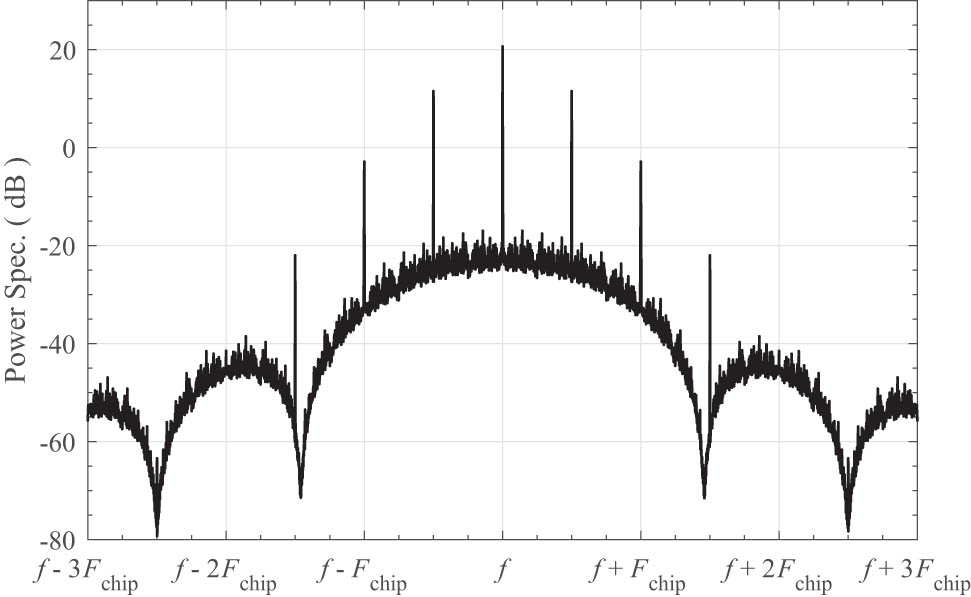
Power spectrum of the signal phase-modulated by the T4B code.
2.2 DOR signal
Delta-DOR is an application of differential VLBI to spacecraft tracking. That is, an interferometric measurement (referred to as a delay) of a quasar with accurate coordinates, is subtracted from that of the spacecraft. The result of a Delta-DOR measurement provides knowledge of the spacecraft’s angular position in the inertial reference frame defined by the quasars (CCSDS 2019).
To conduct interferometric spacecraft measurements, a set of sinusoidal tones called DOR tones are phase-modulated on the downlink carrier. That is,
where
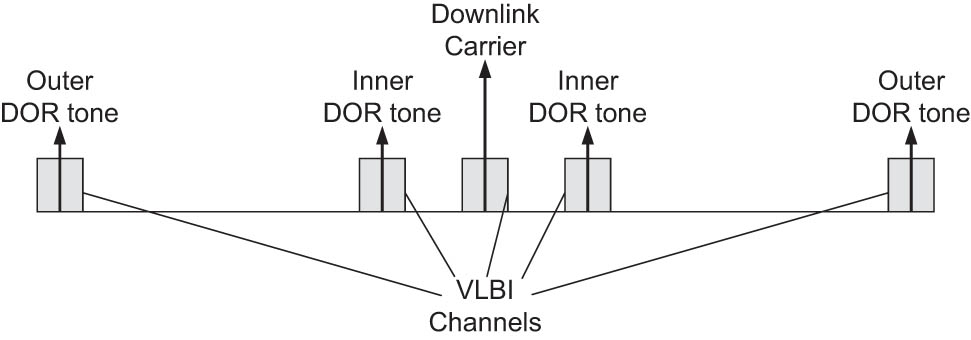
Downlink spectrum and VLBI channels for DOR measurements.
3 Integrated design
3.1 Basic principles
The integrated design of the signal adheres to the following principles:
Multiplexing: to improve the power efficiency;
Compatibility: compatible with CCSDS recommendations for interagency cooperation;
Reality: can be implemented within the current capabilities of spacecrafts and ground stations;
Inheritance: to avoid implementation risks induced by state changes of technologies;
Advancements: to improve the measurement accuracy.
3.2 Overall design
Note that the single tones of the PN ranging power spectrum (Figure 1) and the DOR tones are all spectral lines whose spectral characteristics are the same. In addition, their frequencies (approximately equal to
On this basis, an integrated signal based on PN ranging and the outer DOR tones is expressed as follows:
where the two-phase modulation items are the PN codes and the outer DOR tones, respectively,
3.3 Parameter set
According to the principles of compatibility, inheritance, and advancement, the undetermined parameters in Eq. (3) are designed as follows:
Chip rate:
This is the highest chip rate for interagency cooperation. The higher the chip rate is, the higher the achieved accuracy of range. In addition, a higher chip rate results in a larger spanned bandwidth of the PN spectral lines, which helps attain higher-precision delay measurements for ambiguity resolution of outer DOR tones.
Uplink PN code modulation index: 0.95 rad and regenerated PN code modulation index: 0.70 rad
As the uplink margin is always sufficient, increasing the modulation index of the uplink ranging signal can effectively reduce the jitter of the uplink PN ranging without affecting the quality of uplink communications. Furthermore, a large modulation index for regenerated PN code can improve further the ranging accuracy and enhance the power of the single tones; effectively, the latter improves the accuracy of delay measurements from the PN spectral lines and benefit the ambiguity resolution of the DOR tones.
DOR tone:
The frequency of the DOR tones complies with the CCSDS recommendations (approximately equal to
3.4 Power spectrum
Based on the above models and parameters, a novel design of ranging and DOR signal is obtained, whose power spectrum is shown in Figure 3(a). The horizontal coordinates denote the radio frequency
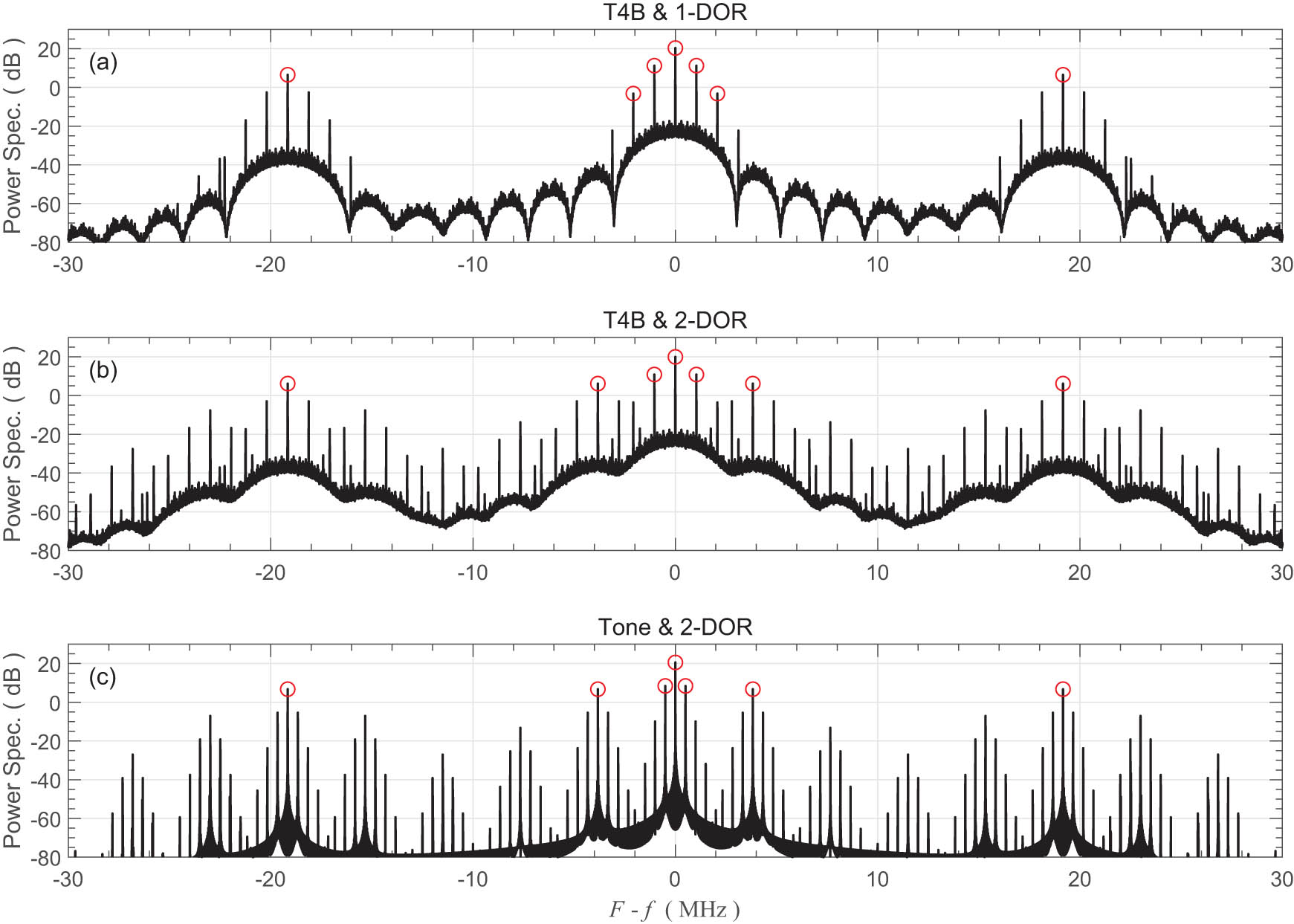
Power spectra of the novel (a), normal (b), and classic (c) designs.
4 Accuracy analysis
To verify the effectiveness of the proposed signal, the link budget is applied to the novel, normal, and classic designs in this section, based on the transmitting and receiving performance of China’s Mars probe Tianwen-1 orbiter and China’s 35 m deep space station (Xu et al. 2016, He et al. 2022). The error analyses of ranging, Doppler, and Delta-DOR measurements are performed.
4.1 Link budget
The main parameters and results of the link budget are listed in Table 1. Compared with the classic case, the novel design contains no residual command or turnaround noise and omits the inner DOR tones, thus resulting in the residual carrier, telemetry subcarrier, and DOR tones with a higher intensity (by 1.8 dB). That is, the supported telemetry data rate could be increased by approximately 50%. More importantly, the ranging signal is 4.9 dB stronger than that of the classic signal case, thus indicating a much higher accuracy. The power efficiencies of the novel and classic signals are approximately equal to 87 and 54%, respectively, thus demonstrating a 33% increase in the effective utilization of downlink power. Compared with the normal signal case, the novel one omits the inner DOR tones, thus resulting in the residual carrier, telemetry subcarrier, and DOR tones with a higher intensity (by 0.35 dB). This improvement is meaningful in deep space communication. Alternatively, this means that for solar system boundary explorations, communications amounting to several months’ flight can be further supported without decreasing data rates.
Link budget for the novel, normal, and classic design cases
| Link | Parameter | Unit | Novel | Normal | Classic |
|---|---|---|---|---|---|
| Up | Equivalent isotropically radiated power | dBW | 104.0 | ||
| Carrier frequency | MHz | 7176.00 | |||
| Range | km |
|
|||
| Modulation index of ranging | rad | 0.95 | |||
| Modulation index of command | rad | 0.95 | |||
| Gain of spacecraft antenna | dBi | 38.1 | |||
| G/T of spacecraft | dBi/K | 7.5 | |||
| Power-to-noise spectral density ratio of ranging (first order) | dBHz | 56.33 | 56.33 | 56.88 | |
| Down | Equivalent isotropically radiated power | dBW | 57.4 | ||
| Carrier frequency | MHz | 8431.08 | |||
| Range | km |
|
|||
| G/T of station | dBi/K | 49.0 | |||
| Modulation index of telemetry | rad | 0.80 | |||
| Modulation index of ranging | rad | 0.70 | 0.70 | 0.48 | |
| Modulation index of residual command | rad | — | — | 0.48 | |
| Modulation index of noise | rad | — | — | 0.59 | |
| Modulation index of inner DOR tones | rad | — | 0.40 | 0.40 | |
| Modulation index of outer DOR tones | rad | 0.40 | 0.40 | 0.40 | |
| Power-to-noise spectral density ratio of residual carrier | dBHz | 53.52 | 53.17 | 51.72 | |
| Power-to-noise spectral density ratio of telemetry | dBHz | 49.32 | 48.97 | 47.52 | |
| Power-to-noise spectral density ratio of ranging (first order) | dBHz | 47.43 | 47.07 | 42.58 | |
| Power-to-noise spectral density ratio of outer DOR tones | dBHz | 39.72 | 39.37 | 37.92 |
4.2 Error analysis
For ranging and Doppler measurements, the thermal noise error dominates the total error. Thus, only this error is considered here. Regarding the Delta-DOR measurements, there are many determining factors for the delay error, all of which should be accounted for.
4.2.1 Ranging precision
The random error (
where the PN chip rate
Key performance outcomes of the classic, normal, and novel designs in the case of Tianwen-1
| Term | Novel | Normal | Classic |
|---|---|---|---|
| Residual carrier
|
53.52 | 53.17 | 51.72 |
| Downlink power efficiency, % | 87 | 80 | 54 |
| Ranging precision (
|
0.09 | 0.10 | 0.50 |
| Doppler precision (
|
0.17 | 0.18 | 0.21 |
| Delay accuracy (
|
0.1902 | 0.1906 | 0.1924 |
4.2.2 Doppler precision
The random error (
where the Doppler integration time
4.2.3 Delay accuracy
The delay error of Delta-DOR measurements is induced by a number of factors, including radio source thermal noise, spacecraft thermal noise, clock instability, phase dispersion, station location error, earth orientation parameter (EOP) error, zenith tropospheric delay error, tropospheric jitter, ionospheric delay error, ionospheric jitter, solar plasma, radio source coordinate error, and others (CCSDS 2019). The observation scenario here is based on the current system architecture. Two widely separated stations simultaneously observe a spacecraft/quasar for Delta-DOR measurements. Quasars are angularly close to the spacecraft. The same spanned bandwidth and VLBI channels are assumed for both spacecraft and quasar observations to achieve the best cancellation of the instrumental effects.
For Delta-DOR measurements, the delay accuracy depends on the precisions of both the spacecraft and quasar delay measurements. To estimate delay errors, all parameters relevant to the measurement geometry, and random and systematic effects must be assigned. Table 3 lists the nominal parameter values for the delay error budget. It is worth mentioning that the only difference among the novel, normal, and classic signals in Delta-DOR measurements pertains to the power-to-noise spectral density of the DOR tones (
Nominal parameter values for evaluation of delay error budget
| Parameter | Value |
|---|---|
| Quasar (Q) integration time | 300 s |
| Spacecraft (S) integration time | 5 s |
| Q–S angular separation | 0.2 rad |
| Q elevation angle | 25° |
| S elevation angle | 20° |
| Min. angle between Sun and Q/S | 20° |
| Spanned bandwidth | 38.32 MHz |
| G/T for antenna | 49.0 dB/K |
| Channel sampling rate | 4,000,000 samples/s |
| Q correlated flux density | 1 Jy |
| System loss factor | 0.8 |
| Radiofrequency wavelength | 0.0356 m |
|
|
39.72/39.37/37.92 dBHz |
| Time between Q/S-scan centers | 360 s |
| Station frequency stability at 600 s |
|
| Phase ripple | 0.2° |
| Baseline coordinate | 0.05 m |
| Baseline orientation | 0.02 m |
| Zenith wet troposphere | 0.005 m |
| Zenith dry troposphere | 0.002 m |
| Fluctuating troposphere (10°) | 0.01 m |
| Daytime ionosphere model | 0.04 m |
| Nighttime ionosphere model | 0.01 m |
| Fluctuating ionosphere (10°) | 0.01 m |
| Separation of ray paths | 2000 km |
| Solar wind velocity | 400 km/s |
| Q coordinate uncertainty |
|
| Baseline onto plane-of-sky | 3,000 km |
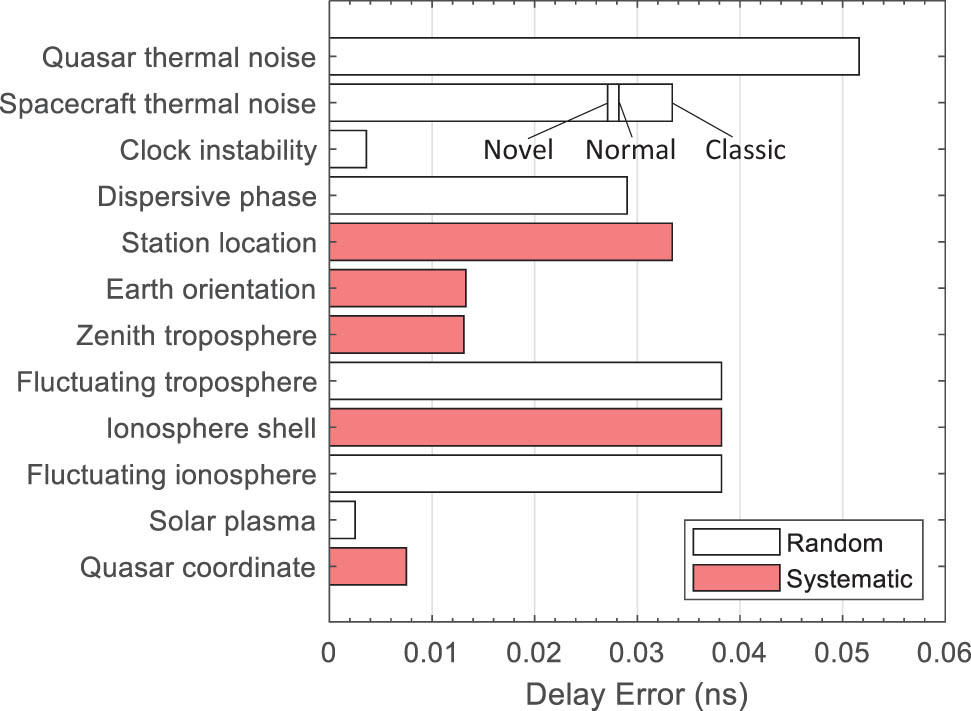
Error budget for Delta-DOR measurements of three types of signals.
Based on this, the delay measurement accuracies (
4.3 Summary
Although the accuracy is based on theoretical analyses, it is consistent with data from real mission situations when multiplied by a factor in the range of 1.5–3. Table 2 summarizes the results presented above. It can be observed that the improvement of the ranging accuracy is the most remarkable owing to the better PN ranging scheme and the minimization of power loss. Compared with the classic signal, the intensity of the residual carrier in the novel design case was increased by 1.8 dB, which supports a 50% higher telemetry data rate. The delay measurement error caused by the spacecraft thermal noise was also reduced, which contributes slightly to the overall delay measurement accuracy. Compared with the normal design case, the novel signal achieved a downlink signal with higher intensity of 0.35 dB. Although this does not correspond to profound improvements in measurement accuracy, it is meaningful for deep space communications, especially for solar system boundary explorations. A higher power efficiency of the downlink signal is achieved for the novel design, which supports a more energy-efficient design of the spacecraft.
5 Conclusion
This study proposed a novel design signal for ranging and Delta-DOR measurements based on the requirements of precise orbit determination in conditions of shorter arcs, an increased number of targets, and weaker signals for China’s future lunar and deep-space exploration missions. The effectiveness and high precision of the novel design were demonstrated by link budget and error analysis in the case of China’s Tianwen-1 orbiter. The results show that, when compared to the classic case, the energy distribution of the novel design was more concentrated, and the power efficiency and two-way ranging accuracy were remarkably improved. In addition, the downlink subcarrier was improved by 1.8 dB, led to a higher Doppler precision, and supported approximately 50% higher telemetry data rates. Compared with the normal case, the novel signal design led to a higher downlink signal (by 0.35 dB); this improvement is meaningful for deep space communications, especially for solar system boundary explorations.
The novel design is based on the inheritance and development of the current techniques and is associated with a solid foundation for implementing changes on spacecraft and in ground stations. As digital transponders are becoming increasingly used in lunar and deep space exploration missions, no more resources ought to be expended for novel signal applications. It is expected that this signal scheme will be used in the following lunar and deep space exploration missions to achieve better measurements and higher communication quality in support of successful missions.
-
Funding information: This research was funded by the National Key Research and Development Program of China (No. 2020YFC2200903).
-
Author contributions: All authors have accepted responsibility for the entire content of this manuscript and approved its submission.
-
Conflict of interest: The authors state no conflict of interest.
References
CCSDS. Pseudo-Noise (PN) Ranging Systems, CCSDS 414.0-G-2. 2014. Available from: https://public.ccsds.org/Pubs/414x0g2.pdf.Search in Google Scholar
CCSDS. Delta-DOR-Technical Characteristics and Performance, CCSDS 500.1-G-2. 2019. Available from: https://public.ccsds.org/Pubs/500x1g2.pdf.Search in Google Scholar
CCSDS. Radio Frequency and Modulation Systems-Part 1: Earth Stations and Spacecraft, CCSDS 401.0-B-31. 2021. Available from: https://public.ccsds.org/Pubs/401x0b32.pdf.Search in Google Scholar
CCSDS. Pseudo-Noise (PN) Ranging Systems, CCSDS 414.1-B-3. 2022. Available from: https://public.ccsds.org/Pubs/414x1b3.pdf.Search in Google Scholar
Curkendall DW, Border JS. 2013. Delta-DOR: The one-nanoradian navigation measurement system of the deep space network–History, architecture, and componentry, PN Progress Report 42-193. Jet Propulsion Laboratory, California Institute of Technology.Search in Google Scholar
Dong GL, Li HT, Hao WH, Wang H, Zhu ZY, Shi SB, et al. 2018. Development and future of China’s deep space TT&C system. J Deep Space Explor. 5(2):99–114 (in Chinese).Search in Google Scholar
Duan JF, Zhang Y, Cao JF, Chen L, Chen M, Xie JF. 2019. A summary of orbit determination technology for Chinese Lunar Exploration Project. J Deep Space Explor. 6(3):203–209 (in Chinese).Search in Google Scholar
He GL, Liu M, Gao X, Du XM, Zhou H, Zhu HQ. 2022. Chinese deep space stations: A brief review. IEEE Antennas Propag Mag. 64(1):102–111.10.1109/MAP.2021.3129690Search in Google Scholar
Hong XY, Zhang XZ, Zheng WM, Wang GL, Liu QH, Wang N, et al. 2020. Research progress of VLBI technology and application to China lunar exploration project. J Deep Space Explor. 7(4):321–331 (in Chinese).Search in Google Scholar
Huang Y, Chang SQ, Li PJ, Hu XG, Wang GL, Liu QH, et al. 2014. Orbit determination of Chang’E-3 and positioning of the lander and the rover. Chin Sci Bull. 59(29–30):3858–3867.10.1007/s11434-014-0542-9Search in Google Scholar
Li HT, Zhou H, Hao WH, Dong GL. 2013. Development of radio interferometry and its prospect in deep space navigation. J Spacecraft TT&C Technol. 32(6):470–478 (in Chinese).Search in Google Scholar
Li Z, Li HT, Zhang Z, Fan M, Xu DZ, Xin XS. 2021. Research on overall design technology of TT&C for lunar exploration. Aerosp Shanghai (Chin Engl). 38(2):76–86 (in Chinese).Search in Google Scholar
Liu QH, Huang Y, Shu FC, Wang GL, Zhang J, Chen Z, et al. 2022. VLBI technique for the orbit determination of Tianwen-1. Sci Sin-Phys Mech As. 52(3):239507 (in Chinese).10.1360/SSPMA-2021-0204Search in Google Scholar
Liu SH, Yan JG, Cao JF, Ye M, Li X, Li F, et al. 2021. Review of the precise orbit determination for Chinese lunar exploration projects. Earth Space Sci. 8(4):1–17. https://doi.org/10.1029/2020EA001361.Search in Google Scholar
Tian BY, Wang DY, Zhang XY, Zhou WY, Zhu AW, Huang ML, et al. 2021. Flight mission planning for solar system boundary exploration. J Astronaut. 42(3):284–294 (in Chinese).Search in Google Scholar
Thornton CL, Border JS. 2003. Radiometric tracking techniques for deep-space navigation. Hoboken, New Jersey: John Wiley & Sons. p. 1–2.10.1002/0471728454Search in Google Scholar
Wang GL, Hong XY, Liu QH, Li B, Ma J, Su Y, et al. 2020. High-precision VLBI orbit measurement technology in the Chang’E-4 mission. J Deep Space Explor. 7(4):332–339 (in Chinese).Search in Google Scholar
Wu WR, Yu DY, Huang JC, Zong QG, Wang C, Yu GB, et al. 2019. Exploring the solar system boundary. Sci Sin Inform. 49(1):1–16 (in Chinese).10.1360/N112018-00273Search in Google Scholar
Xu DZ, Dong GL, Wang GL, Li HT, Jiang W. 2016. First geodetic VLBI sessions with the Chinese deep space stations Jiamusi and Kashi. Adv Space Res. 58(9):1638–1647.10.1016/j.asr.2016.07.022Search in Google Scholar
Yang P, Huang Y, Li PJ, Wang H, Fan M, Liu SY, et al. 2021. Orbit determination of China’s first Mars probe Tianwen-1 during interplanetary cruise. Adv Space Res. 69(2):1060–1071.10.1016/j.asr.2021.10.046Search in Google Scholar
Yu ZJ, Li HT. 2021. Review on development history of TT&C system of China’s lunar and planetary exploration projects. J Deep Space Explor. 8(6):543–554. doi: 0.15982/j.issn.2096-9287.2021.20210125 (in Chinese).10.15982/j.issn.2096-9287.2021.20210125Search in Google Scholar
Zhang LH, Xiong L, Sun J, Gao S, Wang XL, Zhang AB. 2019. Technical characteristics of the relay communication satellite “Queqiao” for Chang’E-4 lunar farside exploration mission. Sci Sin Tech. 49(2):138–146 (in Chinese).10.1360/N092018-00375Search in Google Scholar
© 2022 Dezhen Xu et al., published by De Gruyter
This work is licensed under the Creative Commons Attribution 4.0 International License.
Articles in the same Issue
- Research Articles
- Deep learning application for stellar parameters determination: I-constraining the hyperparameters
- Explaining the cuspy dark matter halos by the Landau–Ginzburg theory
- The evolution of time-dependent Λ and G in multi-fluid Bianchi type-I cosmological models
- Observational data and orbits of the comets discovered at the Vilnius Observatory in 1980–2006 and the case of the comet 322P
- Special Issue: Modern Stellar Astronomy
- Determination of the degree of star concentration in globular clusters based on space observation data
- Can local inhomogeneity of the Universe explain the accelerating expansion?
- Processing and visualisation of a series of monochromatic images of regions of the Sun
- 11-year dynamics of coronal hole and sunspot areas
- Investigation of the mechanism of a solar flare by means of MHD simulations above the active region in real scale of time: The choice of parameters and the appearance of a flare situation
- Comparing results of real-scale time MHD modeling with observational data for first flare M 1.9 in AR 10365
- Modeling of large-scale disk perturbation eclipses of UX Ori stars with the puffed-up inner disks
- A numerical approach to model chemistry of complex organic molecules in a protoplanetary disk
- Small-scale sectorial perturbation modes against the background of a pulsating model of disk-like self-gravitating systems
- Hα emission from gaseous structures above galactic discs
- Parameterization of long-period eclipsing binaries
- Chemical composition and ages of four globular clusters in M31 from the analysis of their integrated-light spectra
- Dynamics of magnetic flux tubes in accretion disks of Herbig Ae/Be stars
- Checking the possibility of determining the relative orbits of stars rotating around the center body of the Galaxy
- Photometry and kinematics of extragalactic star-forming complexes
- New triple-mode high-amplitude Delta Scuti variables
- Bubbles and OB associations
- Peculiarities of radio emission from new pulsars at 111 MHz
- Influence of the magnetic field on the formation of protostellar disks
- The specifics of pulsar radio emission
- Wide binary stars with non-coeval components
- Special Issue: The Global Space Exploration Conference (GLEX) 2021
- ANALOG-1 ISS – The first part of an analogue mission to guide ESA’s robotic moon exploration efforts
- Lunar PNT system concept and simulation results
- Special Issue: New Progress in Astrodynamics Applications - Part I
- Message from the Guest Editor of the Special Issue on New Progress in Astrodynamics Applications
- Research on real-time reachability evaluation for reentry vehicles based on fuzzy learning
- Application of cloud computing key technology in aerospace TT&C
- Improvement of orbit prediction accuracy using extreme gradient boosting and principal component analysis
- End-of-discharge prediction for satellite lithium-ion battery based on evidential reasoning rule
- High-altitude satellites range scheduling for urgent request utilizing reinforcement learning
- Performance of dual one-way measurements and precise orbit determination for BDS via inter-satellite link
- Angular acceleration compensation guidance law for passive homing missiles
- Research progress on the effects of microgravity and space radiation on astronauts’ health and nursing measures
- A micro/nano joint satellite design of high maneuverability for space debris removal
- Optimization of satellite resource scheduling under regional target coverage conditions
- Research on fault detection and principal component analysis for spacecraft feature extraction based on kernel methods
- On-board BDS dynamic filtering ballistic determination and precision evaluation
- High-speed inter-satellite link construction technology for navigation constellation oriented to engineering practice
- Integrated design of ranging and DOR signal for China's deep space navigation
- Close-range leader–follower flight control technology for near-circular low-orbit satellites
- Analysis of the equilibrium points and orbits stability for the asteroid 93 Minerva
- Access once encountered TT&C mode based on space–air–ground integration network
- Cooperative capture trajectory optimization of multi-space robots using an improved multi-objective fruit fly algorithm
Articles in the same Issue
- Research Articles
- Deep learning application for stellar parameters determination: I-constraining the hyperparameters
- Explaining the cuspy dark matter halos by the Landau–Ginzburg theory
- The evolution of time-dependent Λ and G in multi-fluid Bianchi type-I cosmological models
- Observational data and orbits of the comets discovered at the Vilnius Observatory in 1980–2006 and the case of the comet 322P
- Special Issue: Modern Stellar Astronomy
- Determination of the degree of star concentration in globular clusters based on space observation data
- Can local inhomogeneity of the Universe explain the accelerating expansion?
- Processing and visualisation of a series of monochromatic images of regions of the Sun
- 11-year dynamics of coronal hole and sunspot areas
- Investigation of the mechanism of a solar flare by means of MHD simulations above the active region in real scale of time: The choice of parameters and the appearance of a flare situation
- Comparing results of real-scale time MHD modeling with observational data for first flare M 1.9 in AR 10365
- Modeling of large-scale disk perturbation eclipses of UX Ori stars with the puffed-up inner disks
- A numerical approach to model chemistry of complex organic molecules in a protoplanetary disk
- Small-scale sectorial perturbation modes against the background of a pulsating model of disk-like self-gravitating systems
- Hα emission from gaseous structures above galactic discs
- Parameterization of long-period eclipsing binaries
- Chemical composition and ages of four globular clusters in M31 from the analysis of their integrated-light spectra
- Dynamics of magnetic flux tubes in accretion disks of Herbig Ae/Be stars
- Checking the possibility of determining the relative orbits of stars rotating around the center body of the Galaxy
- Photometry and kinematics of extragalactic star-forming complexes
- New triple-mode high-amplitude Delta Scuti variables
- Bubbles and OB associations
- Peculiarities of radio emission from new pulsars at 111 MHz
- Influence of the magnetic field on the formation of protostellar disks
- The specifics of pulsar radio emission
- Wide binary stars with non-coeval components
- Special Issue: The Global Space Exploration Conference (GLEX) 2021
- ANALOG-1 ISS – The first part of an analogue mission to guide ESA’s robotic moon exploration efforts
- Lunar PNT system concept and simulation results
- Special Issue: New Progress in Astrodynamics Applications - Part I
- Message from the Guest Editor of the Special Issue on New Progress in Astrodynamics Applications
- Research on real-time reachability evaluation for reentry vehicles based on fuzzy learning
- Application of cloud computing key technology in aerospace TT&C
- Improvement of orbit prediction accuracy using extreme gradient boosting and principal component analysis
- End-of-discharge prediction for satellite lithium-ion battery based on evidential reasoning rule
- High-altitude satellites range scheduling for urgent request utilizing reinforcement learning
- Performance of dual one-way measurements and precise orbit determination for BDS via inter-satellite link
- Angular acceleration compensation guidance law for passive homing missiles
- Research progress on the effects of microgravity and space radiation on astronauts’ health and nursing measures
- A micro/nano joint satellite design of high maneuverability for space debris removal
- Optimization of satellite resource scheduling under regional target coverage conditions
- Research on fault detection and principal component analysis for spacecraft feature extraction based on kernel methods
- On-board BDS dynamic filtering ballistic determination and precision evaluation
- High-speed inter-satellite link construction technology for navigation constellation oriented to engineering practice
- Integrated design of ranging and DOR signal for China's deep space navigation
- Close-range leader–follower flight control technology for near-circular low-orbit satellites
- Analysis of the equilibrium points and orbits stability for the asteroid 93 Minerva
- Access once encountered TT&C mode based on space–air–ground integration network
- Cooperative capture trajectory optimization of multi-space robots using an improved multi-objective fruit fly algorithm
