Chemical composition and ages of four globular clusters in M31 from the analysis of their integrated-light spectra
-
Margarita Eugene Sharina
 und
Margarita Igorevna Maricheva
und
Margarita Igorevna Maricheva

Abstract
We compare the results on the chemical composition of four globular clusters (GCs) in M31 (Bol 6, Bol 20, Bol 45, and Bol 50) (Maricheva M. 2021. Study of integrated spectra of four globular clusters in M 31. Astrophys. Bull. 76:389–404. doi: https://doi.org/10.1134/S199034132104009X) to the available literature data on integrated-light spectroscopy of GCs with similar ages and chemical abundances in our Galaxy and M31 and on the chemical abundances of stars in two galaxies. The clusters and their literature analogues are of moderate metallicity
1 Introduction
The globular cluster (GC) system in the nearest to our Galaxy giant spiral, M31, has been studied in detail in the literature. However, in order to determine ages and metallicities of GCs, their colours and spectral indices were commonly used in comparison with models of stellar populations. For several objects, integrated-light spectroscopic studies were performed in order to determine their chemical composition (Colucci et al. 2014 [hereafter: C14], Sakari et al. 2016 [hereafter: S16], Sharina et al. 2018, Larsen et al. 2018) and age (C14). To date, the deepest colour-magnitude diagrams (CMDs) for clusters in M31 reach confidently the level of the horizontal branch (Federici et al. 2012, Larsen et al. 2021).
In this article, we consider the results of the analysis by Maricheva (2021) (hereafter: MMI21) of integrated-light (hereafter: IL) spectra of four GCs in M31. Our aim is the comparison of the determined ages, helium mass fraction (
2 Spectroscopic data, methods of their analysis and main results
The spectra of four GCs were obtained in 2020 with the 6-m SAO RAS telescope using the SCORPIO-1 multimode focal reducer (Afanasiev and Moiseev 2005) in the long slit mode. The used grism VPHG1200B and the long slit of 1 arcsec provide the resolution FWHM
Ages,
The abundances of the chemical elements for Bol 20, Bol 50 were derived by MMI21 for the first time. For all four objects (Bol 6, Bol 20, Bol 45, and Bol 50),
Figure 1 demonstrates a comparison between the CMDs of Bol 6 and Bol 45 (Federici et al. 2012), the CMDs of Galactic GCs from Sarajedini et al. (2007), and the evolutionary isochrones by Bertelli et al. (2008) and Pietrinferni et al. (2004) selected by MMI21 for the analysis of the IL spectra of Bol 6 and Bol 45. MMI21 concluded that there are no Galactic GCs in the library of Schiavon et al. (2005) with the spectra very similar to the spectra of four M31 GCs. The Galactic GCs with the CMDs shown in Figure 1 demonstrate that the spectra are most appropriate for the comparison. In Figure 2, we illustrate the procedure of spectra fitting. The IL spectrum of Bol 6 analysed by MMI21 is compared with the synthetic one calculated using the isochrone (Figure 1, panel a) and the chemical composition defined by MMI21 using the method by Sharina et al. (2020). The green line indicates the synthetic spectrum with the decreased abundances of C, N, Ca, and Mg.
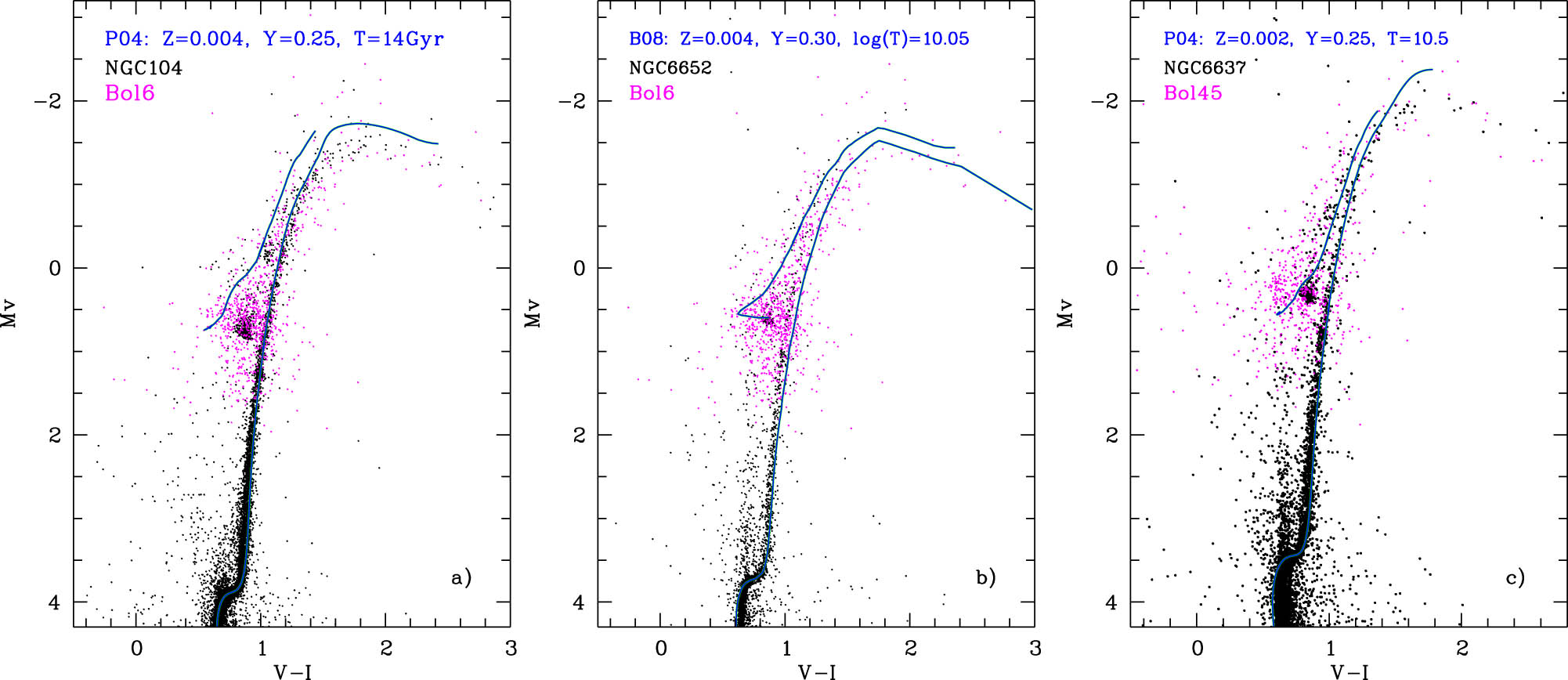
CMDs for Bol 6 (panels a and b) and Bol 45 (panel c) (Federici et al. 2012) (magenta dots) in comparison with the CMDs of Galactic GCs (Sarajedini et al. 2007) NGC 104, 6652 and 6637 (black dots) and with the evolutionary isochrones (green lines) by Bertelli et al. (2008) for Bol 6 (panel b) and Pietrinferni et al. (2004) for Bol 6 (panel a) and for Bol 45 (panel c), selected by MMI21 for the analysis of the IL spectra of the GCs.
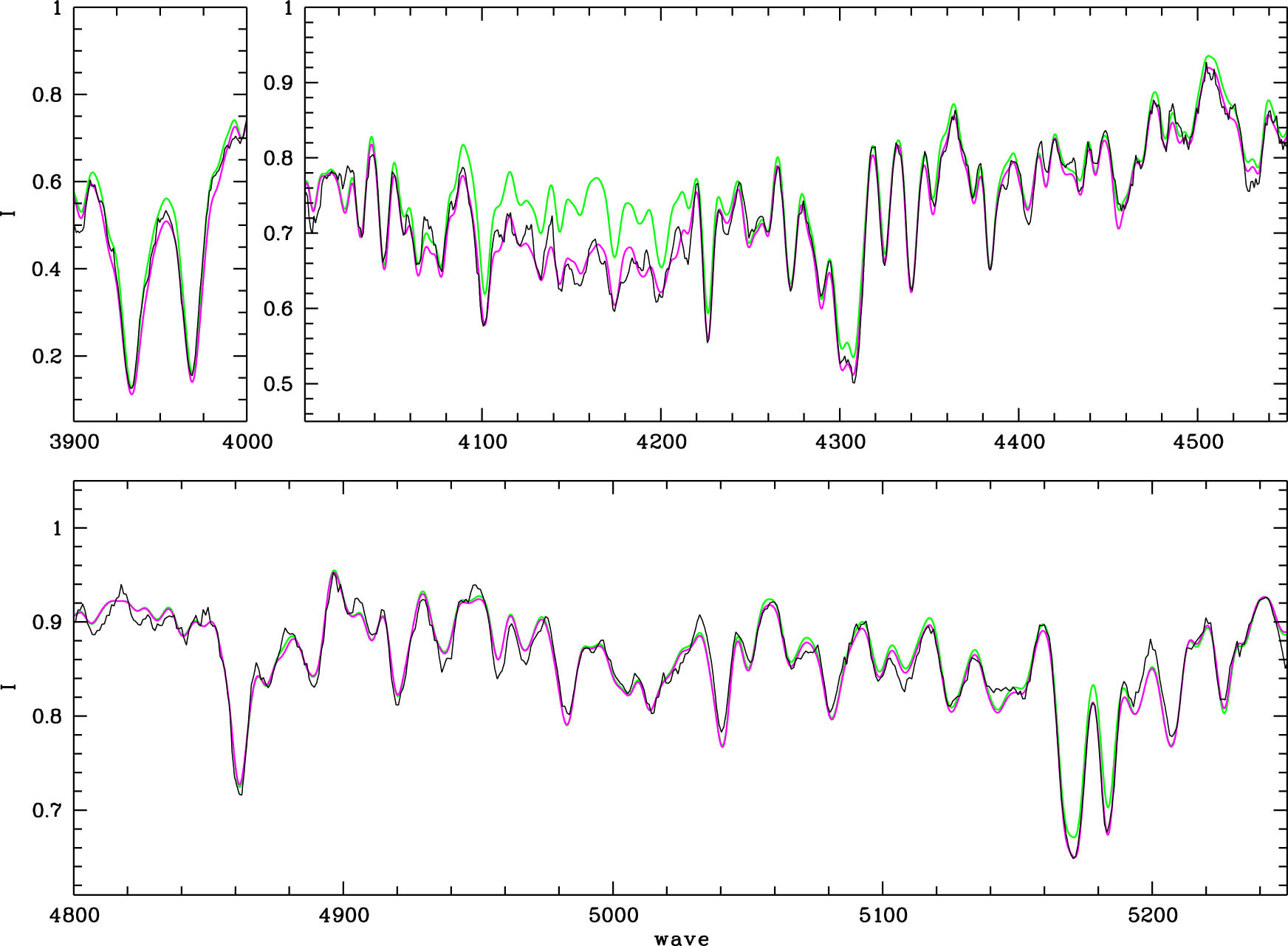
IL spectrum of Bol 6 from MMI21 (in black) in comparison with the synthetic one calculated using the isochrone from Pietrinferni et al. (2004) (see Figure 1, panel a) and the chemical composition defined by MMI21 (magenta). A synthetic spectrum with the modified chemical composition is shown in green with Ca, Mg, and C depleted by 0.2 dex and N depleted by 0.5 dex.
3 Comparison of the chemical abundances, determined by Maricheva (2021), with the abundances for GCs and field stars in our Galaxy and M31
In Figure 3, we compare [Mg/Fe], [Ca/Fe], and [Ti/Fe] abundances for Bol 6, Bol 20, Bol 45, and Bol 50 (MMI21) with the corresponding abundances for GCs in M31 from C14 (red circles). Black points represent the data for Galactic field stars from Venn et al. (2004). In Figure 4, the same abundances for the Galactic stars are accomplished by the abundances for GCs in M31 from S16 (red circles). Figures 3 and 4 represent also the abundances of
![Figure 3
Ca, Mg, and Ti abundances and [
α
\alpha
/Fe] measured by MMI21 for Bol 6, Bol 20, Bol 45, and Bol 50 (large filled circles) in comparison with that of Galactic field stars from Venn et al. (2004) (black small dots) and with that of GCs in M31 estimated by C14 (open circles).](/document/doi/10.1515/astro-2022-0015/asset/graphic/j_astro-2022-0015_fig_003.jpg)
Ca, Mg, and Ti abundances and [
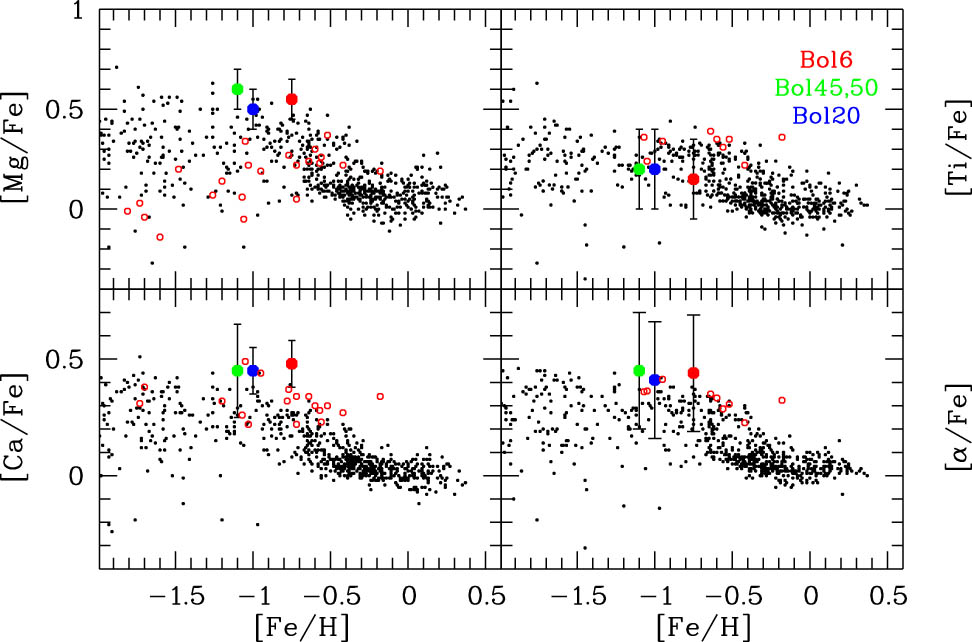
The same as in Figure 3, but the data for GCs in M31 were determined by S16.

C, N, and O abundances measured by MMI21 for Bol 6, Bol 20, Bol 45, and Bol 50 (filled circles) in comparison with that of GCs in M31 estimated by S16.
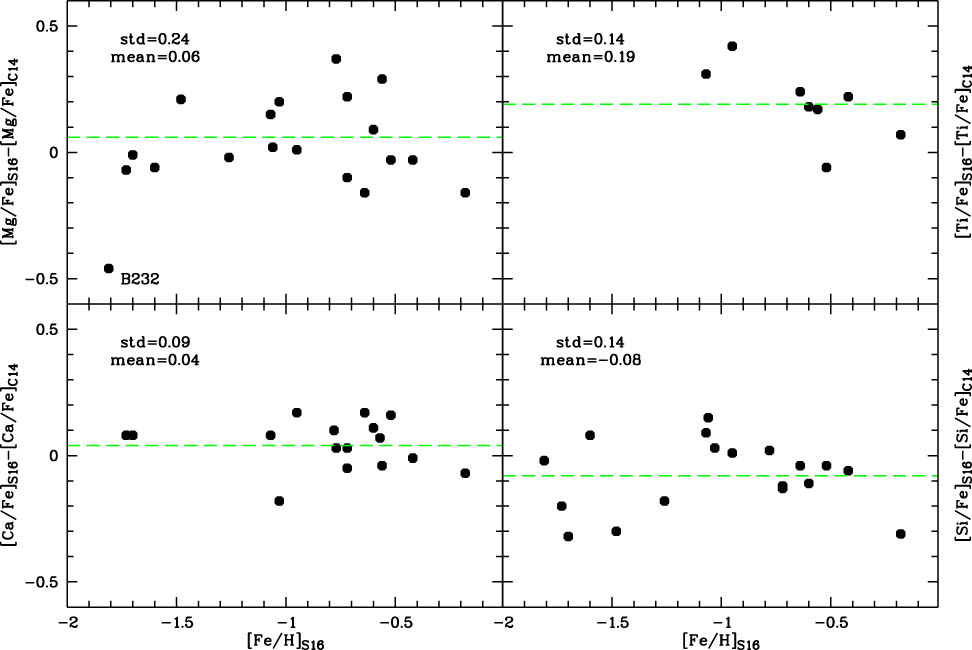
Comparison between the data from C14 and S16 for 19 common objects.
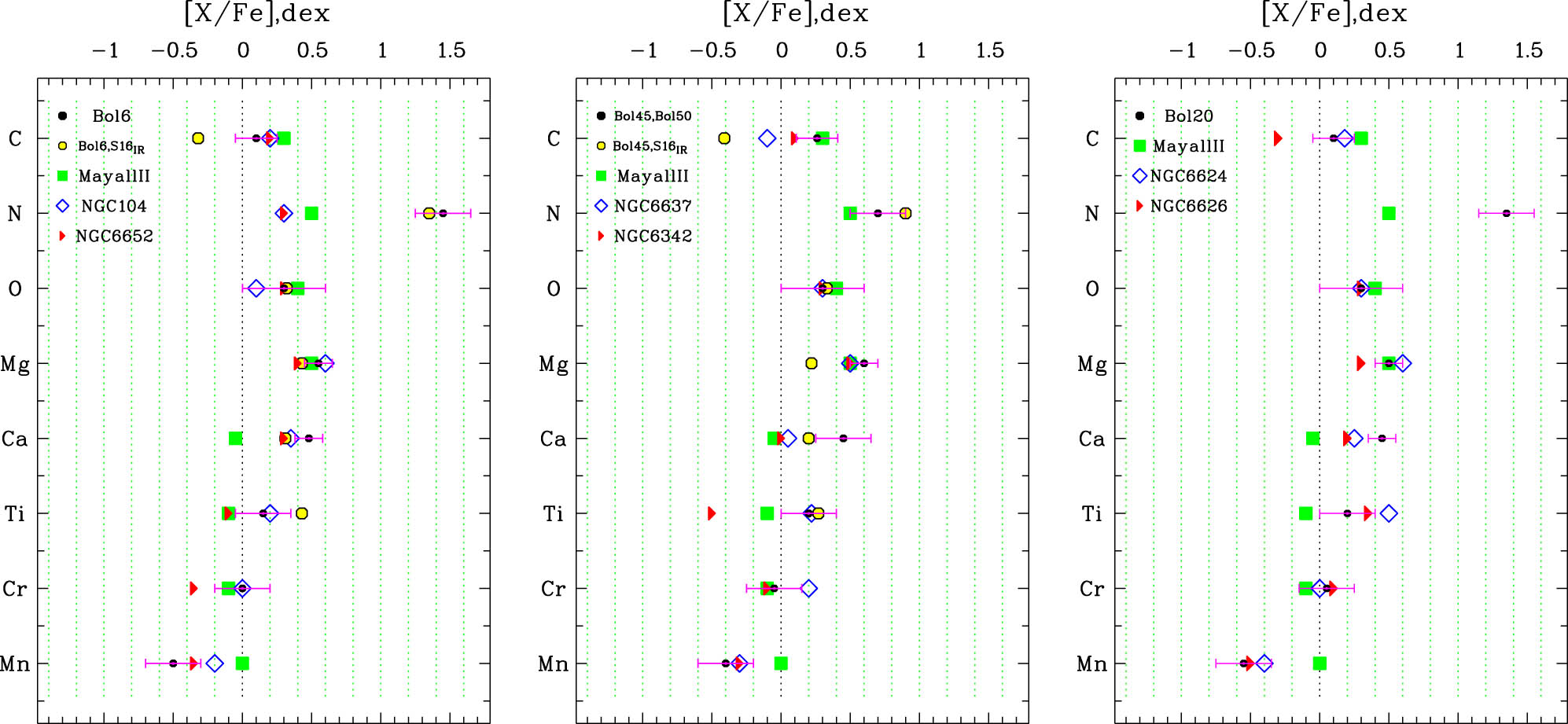
Abundances of chemical elements determined by MMI21 for Bol 6 (left panel), Bol 45 and Bol 50 (middle panel), and Bol 20 (right panel) using the method of Sharina et al. (2020) (black dots) in comparison with the high-resolution integrated-light spectroscopic abundances from S16 (open circles) and with the abundances for Galactic GCs from Sharina et al. (2018, 2020) (symbols defined in the up left corners of the plots). Note that MMI21 derived the identical abundances for Bol 45 and Bol 50.
After the inspection of Figures 3–7 one can make the following conclusions. (1) The enrichment with the
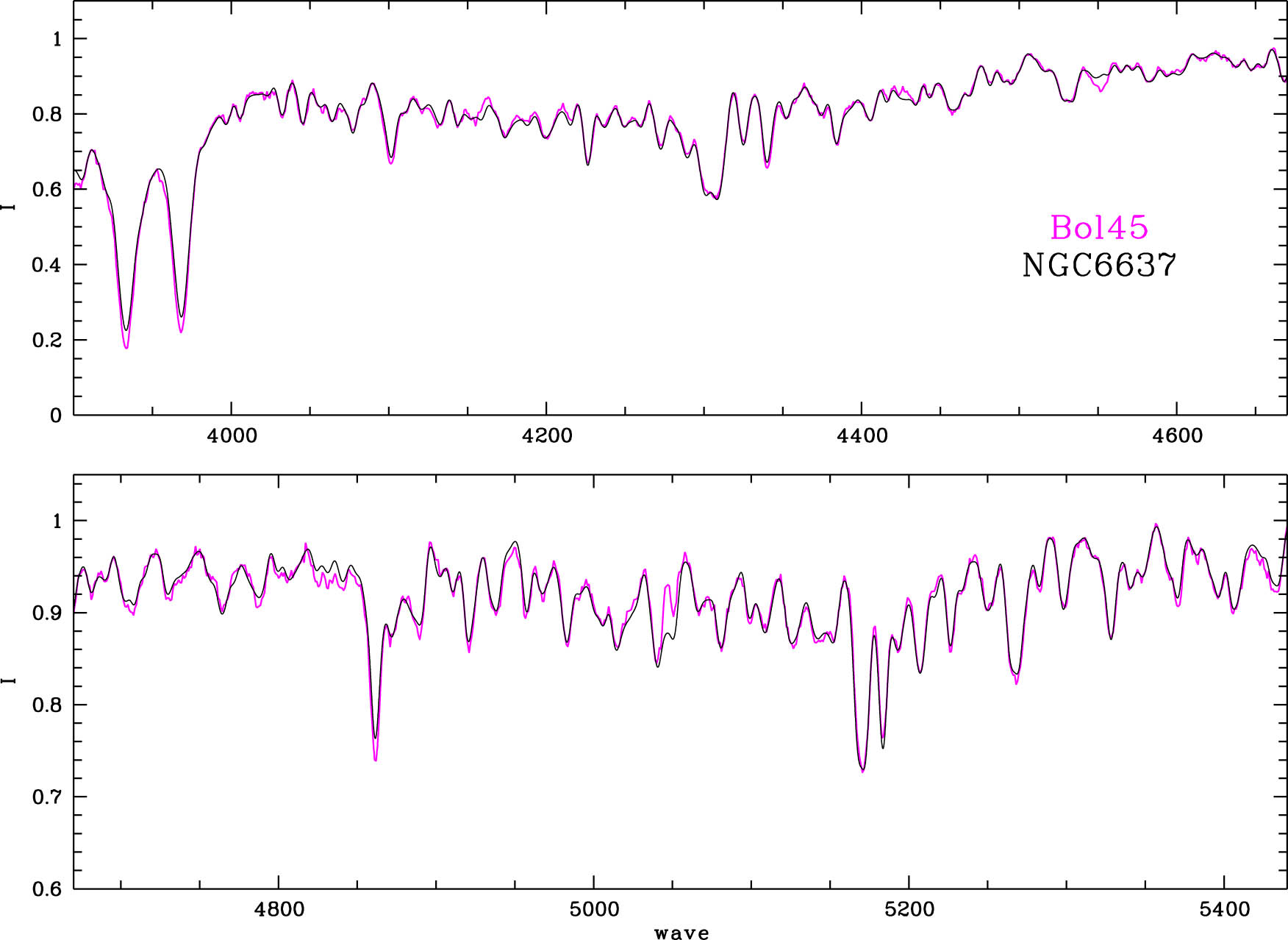
The IL spectrum of Bol 45 from MMI21 (magenta) in comparison with the spectrum of Galactic GC NGC 6637 (Schiavon et al. 2005) (black).
The presence of multiple stellar populations in GCs can reduce Mg and increase helium mass fraction, N and Ca abundances (Carretta and Bragaglia (2021) and references therein). We cannot judge unambiguously about the presence of multiple populations in Bol 6, Bol 20, Bol 45, and Bol 50 using the data from MMI21. MMI21 concluded that the obtained abundances correspond to those in the models of the chemical evolution of the Galaxy under the influence of supernovae type II (SNeII) and hypernovae (Kobayashi et al. 2006) in the metallicity range
4 Conclusion
In this article, we compared the results of MMI21 on the age,
According to MMI21, the obtained abundances of alpha-process elements in four clusters correspond to the average value for stars in the M31 inner halo at a given distance from the centre of M31. The metallicity of the studied clusters is lower than the average metallicity of red giants in the M31 halo (Gilbert et al. 2020). All these facts likely indicate that violent star forming events at the time of the GC formation lead to the high influence of SNeII on their chemical composition. The relatively low metallicities of four GCs can be the indication of the inflows of fresh intergalactic gas.
Further studies of ages and chemical composition of GCs and stars in M31 and its dwarf satellites will help to reveal the origin of GCs and the galactic subsystems they belong to.
Acknowledgements
We thank the organizing committee of the annual conference “Modern stellar astronomy” held in Moscow in 2021 in the Sternberg Astronomical Institute for the possibility to discuss these results.
-
Funding information: The authors state no funding involved.
-
Author contributions: All authors have accepted responsibility for the entire content of this manuscript and approved its submission.
-
Conflict of interest: Authors state no conflict of interest.
-
Data availability statement: The data underlying this article are available in the article.
References
Afanasiev VL, Moiseev AV. 2005. The SCORPIO universal focal reducer of the 6-m telescope. Astron Lett. 31:194–204. 10.1134/1.1883351. Suche in Google Scholar
Asplund M, Grevesse N, Sauval AJ, Scott P. 2009. The Chemical Composition of the Sun. Annu Rev Astron Astrophys. 47:481–522. 10.1146/annurev.astro.46.060407.145222. Suche in Google Scholar
Bertelli G, Girardi L, Marigo P, Nasi E. 2008. Scaled solar tracks and isochrones in a large region of the Z-Y plane. Astron Astrophys. 484(3):815–830. 10.1051/0004-6361:20079165. Suche in Google Scholar
Caldwell N, Romanowsky AJ. 2016. Star clusters in M31. VII. Global kinematics and metallicity subpopulations of the globular clusters. Astrophys J. 824(1):42. 10.3847/0004-637x/824/1/42. Suche in Google Scholar
Carretta E, Bragaglia A. 2021. Excess of Ca (and Sc) produced in globular cluster multiple populations: a first census in 77 Galactic globular clusters. Astron Astrophys. 646:35. 10.1051/0004-6361/202039392. Suche in Google Scholar
Castelli F, Kurucz RL. 2003. New grids of ATLAS9 Model atmospheres. In: Piskunov N, Weiss WW, Gray DF, Editors. Modelling of Stellar Atmospheres: Proceedings of the 210th Symposium of the International Astronomical Union. 2002 Jun 17–21; Uppsala, Sweden. IAU by the Astronomical Society of the Pacific. p. A20. 10.1017/S0074180900133248Suche in Google Scholar
Chabrier G. 2005. The initial mass function 50 years later. In: Corbelli E, Palle F, Zinnecker H, Editors. The Initial Mass Function: From Salpeter 1955 to 2005. Dordrecht: Springer. p. 41. 10.1007/978-1-4020-3407-7_5. Suche in Google Scholar
Colucci JE, Bernstein RA, Cohen JG. 2014. The detailed chemical properties of M31 star clusters. I. Fe, alpha and light elements. Astrophys J. 797(2):116. 10.1088/0004-637x/797/2/116. Suche in Google Scholar
Federici L, Cacciari C, Bellazzini M, FusiPecci F, Galleti S, Perina S. 2012. The horizontal branch luminosity vs. metallicity in M31 globular clusters. Astron Astrophys. 544:13. 10.1051/0004-6361/201219317. Suche in Google Scholar
Galleti S, Bellazzini M, Federici L, Buzzoni A, FusiPecci F. 2007. An updated survey of globular clusters in M 31. Astron Astrophys. 471:127–136. 10.1051/0004-6361:20077788. Suche in Google Scholar
Gilbert KM, Wojno J, Kirby EN, Escala I, Beaton RL, Guhathakurta P, et al. 2020. Elemental abundances in M31: Iron and alpha element abundances in M31’s outer Halo. Astron J. 160:41. 10.3847/1538-3881/ab9602. Suche in Google Scholar
Grevesse N, Sauval A. 1998. Standard solar composition. Space Sci Rev. 85:161–174. 10.1023/A:1005161325181. Suche in Google Scholar
Grevesse N, Noels A. 1993. Cosmic abundances of the elements. In: Prantzos N, Vangioni-Flam E, Cassé M. Editors. Symposium in Honour of Hubert Reeves’ 60th birthday: Origin and Evolution of the Elements. 1992 Jun 22–25; Paris, France. Cambridge University Press. p. 15–25. Suche in Google Scholar
Kobayashi C, Umeda H, Nomoto K, Tominaga N, Ohkubo T. 2006. Galactic chemical evolution: carbon through zinc. Astrophys J. 653(2):1145–1171. 10.1086/508914. Suche in Google Scholar
Larsen SS, Pugliese G, Brodie JP. 2018. Modelling of integrated-light spectra from the optical to the near-infrared: the globular cluster G280 in M31. Astron Astrophys. 617:14. 10.1051/0004-6361/201832767. Suche in Google Scholar
Larsen SS, Romanowsky AJ, Brodie JP. 2021. Hubble Space Telescope imaging of the extremely metal-poor globular cluster EXT8 in Messier 31. Astron Astrophys. 651:A102. 10.1051/0004-6361/202141046. Suche in Google Scholar
Maricheva M. 2021. Study of integrated spectra of four globular clusters in M 31. Astrophys Bull. 76:389–404. 10.1134/S199034132104009X. Suche in Google Scholar
Morton DC. 1991. Atomic data for resonance absorption lines. I. Wavelengths longward of the Lyman limit. Astron Astrophys Suppl. 77:119. 10.1086/191601. Suche in Google Scholar
Pietrinferni A, Cassisi S, Salaris M, Castelli F. 2004. A large stellar evolution database for population synthesis studies. I. Scaled solar models and isochrones. Astrophys J. 612(1):168. 10.1086/422498. Suche in Google Scholar
Sakari CM, Shetrone MD, Schiavon RP, Bizyaev D, Prieto CL, Beers TC, et al. 2016. Infrared high-resolution integrated light spectral analyses of M31 globular clusters from APOGEE. Astrophys J. 829(2):116. 10.3847/0004-637x/829/2/116. Suche in Google Scholar
Sarajedini A, Bedin LR, Chaboyer B, Dotter A, Siegel M, Anderson J, et al. 2007. The ACS survey of galactic globular clusters. I. Overview and clusters without previous hubble space telescope photometry. Astron J. 133(4):1658–1672. 10.1086/511979. Suche in Google Scholar
Schiavon RP, Rose JA, Courteau S, MacArthur LA. 2005. A library of integrated spectra of galactic globular clusters. Astrophys J Suppl. 160(1):163. 10.1086/431148. Suche in Google Scholar
Sharina ME, Shimansky VV, Shimanskaya NN. 2020. Analysis of integrated-light spectra of galactic globular clusters. Astrophys Bull. 75:247–266. 10.1134/S1990341320030116. Suche in Google Scholar
Sharina ME, Shimansky VV, Khamidullina DA. 2018. Age, helium content and chemical composition of globular clusters in the M31 neighborhood and in our galaxy. Astrophys Bull. 73:318–334. 10.1134/S1990341318030069. Suche in Google Scholar
Venn KA, Irwin M, Shetrone MD, Tout CA, Hill V, Tolstoy E. 2004. Stellar chemical signatures and hierarchical galaxy formation. Astron J. 128(3):1177–1195. 10.1086/422734. Suche in Google Scholar
© 2022 Margarita Eugene Sharina and Margarita Igorevna Maricheva, published by De Gruyter
This work is licensed under the Creative Commons Attribution 4.0 International License.
Artikel in diesem Heft
- Research Articles
- Deep learning application for stellar parameters determination: I-constraining the hyperparameters
- Explaining the cuspy dark matter halos by the Landau–Ginzburg theory
- The evolution of time-dependent Λ and G in multi-fluid Bianchi type-I cosmological models
- Observational data and orbits of the comets discovered at the Vilnius Observatory in 1980–2006 and the case of the comet 322P
- Special Issue: Modern Stellar Astronomy
- Determination of the degree of star concentration in globular clusters based on space observation data
- Can local inhomogeneity of the Universe explain the accelerating expansion?
- Processing and visualisation of a series of monochromatic images of regions of the Sun
- 11-year dynamics of coronal hole and sunspot areas
- Investigation of the mechanism of a solar flare by means of MHD simulations above the active region in real scale of time: The choice of parameters and the appearance of a flare situation
- Comparing results of real-scale time MHD modeling with observational data for first flare M 1.9 in AR 10365
- Modeling of large-scale disk perturbation eclipses of UX Ori stars with the puffed-up inner disks
- A numerical approach to model chemistry of complex organic molecules in a protoplanetary disk
- Small-scale sectorial perturbation modes against the background of a pulsating model of disk-like self-gravitating systems
- Hα emission from gaseous structures above galactic discs
- Parameterization of long-period eclipsing binaries
- Chemical composition and ages of four globular clusters in M31 from the analysis of their integrated-light spectra
- Dynamics of magnetic flux tubes in accretion disks of Herbig Ae/Be stars
- Checking the possibility of determining the relative orbits of stars rotating around the center body of the Galaxy
- Photometry and kinematics of extragalactic star-forming complexes
- New triple-mode high-amplitude Delta Scuti variables
- Bubbles and OB associations
- Peculiarities of radio emission from new pulsars at 111 MHz
- Influence of the magnetic field on the formation of protostellar disks
- The specifics of pulsar radio emission
- Wide binary stars with non-coeval components
- Special Issue: The Global Space Exploration Conference (GLEX) 2021
- ANALOG-1 ISS – The first part of an analogue mission to guide ESA’s robotic moon exploration efforts
- Lunar PNT system concept and simulation results
- Special Issue: New Progress in Astrodynamics Applications - Part I
- Message from the Guest Editor of the Special Issue on New Progress in Astrodynamics Applications
- Research on real-time reachability evaluation for reentry vehicles based on fuzzy learning
- Application of cloud computing key technology in aerospace TT&C
- Improvement of orbit prediction accuracy using extreme gradient boosting and principal component analysis
- End-of-discharge prediction for satellite lithium-ion battery based on evidential reasoning rule
- High-altitude satellites range scheduling for urgent request utilizing reinforcement learning
- Performance of dual one-way measurements and precise orbit determination for BDS via inter-satellite link
- Angular acceleration compensation guidance law for passive homing missiles
- Research progress on the effects of microgravity and space radiation on astronauts’ health and nursing measures
- A micro/nano joint satellite design of high maneuverability for space debris removal
- Optimization of satellite resource scheduling under regional target coverage conditions
- Research on fault detection and principal component analysis for spacecraft feature extraction based on kernel methods
- On-board BDS dynamic filtering ballistic determination and precision evaluation
- High-speed inter-satellite link construction technology for navigation constellation oriented to engineering practice
- Integrated design of ranging and DOR signal for China's deep space navigation
- Close-range leader–follower flight control technology for near-circular low-orbit satellites
- Analysis of the equilibrium points and orbits stability for the asteroid 93 Minerva
- Access once encountered TT&C mode based on space–air–ground integration network
- Cooperative capture trajectory optimization of multi-space robots using an improved multi-objective fruit fly algorithm
Artikel in diesem Heft
- Research Articles
- Deep learning application for stellar parameters determination: I-constraining the hyperparameters
- Explaining the cuspy dark matter halos by the Landau–Ginzburg theory
- The evolution of time-dependent Λ and G in multi-fluid Bianchi type-I cosmological models
- Observational data and orbits of the comets discovered at the Vilnius Observatory in 1980–2006 and the case of the comet 322P
- Special Issue: Modern Stellar Astronomy
- Determination of the degree of star concentration in globular clusters based on space observation data
- Can local inhomogeneity of the Universe explain the accelerating expansion?
- Processing and visualisation of a series of monochromatic images of regions of the Sun
- 11-year dynamics of coronal hole and sunspot areas
- Investigation of the mechanism of a solar flare by means of MHD simulations above the active region in real scale of time: The choice of parameters and the appearance of a flare situation
- Comparing results of real-scale time MHD modeling with observational data for first flare M 1.9 in AR 10365
- Modeling of large-scale disk perturbation eclipses of UX Ori stars with the puffed-up inner disks
- A numerical approach to model chemistry of complex organic molecules in a protoplanetary disk
- Small-scale sectorial perturbation modes against the background of a pulsating model of disk-like self-gravitating systems
- Hα emission from gaseous structures above galactic discs
- Parameterization of long-period eclipsing binaries
- Chemical composition and ages of four globular clusters in M31 from the analysis of their integrated-light spectra
- Dynamics of magnetic flux tubes in accretion disks of Herbig Ae/Be stars
- Checking the possibility of determining the relative orbits of stars rotating around the center body of the Galaxy
- Photometry and kinematics of extragalactic star-forming complexes
- New triple-mode high-amplitude Delta Scuti variables
- Bubbles and OB associations
- Peculiarities of radio emission from new pulsars at 111 MHz
- Influence of the magnetic field on the formation of protostellar disks
- The specifics of pulsar radio emission
- Wide binary stars with non-coeval components
- Special Issue: The Global Space Exploration Conference (GLEX) 2021
- ANALOG-1 ISS – The first part of an analogue mission to guide ESA’s robotic moon exploration efforts
- Lunar PNT system concept and simulation results
- Special Issue: New Progress in Astrodynamics Applications - Part I
- Message from the Guest Editor of the Special Issue on New Progress in Astrodynamics Applications
- Research on real-time reachability evaluation for reentry vehicles based on fuzzy learning
- Application of cloud computing key technology in aerospace TT&C
- Improvement of orbit prediction accuracy using extreme gradient boosting and principal component analysis
- End-of-discharge prediction for satellite lithium-ion battery based on evidential reasoning rule
- High-altitude satellites range scheduling for urgent request utilizing reinforcement learning
- Performance of dual one-way measurements and precise orbit determination for BDS via inter-satellite link
- Angular acceleration compensation guidance law for passive homing missiles
- Research progress on the effects of microgravity and space radiation on astronauts’ health and nursing measures
- A micro/nano joint satellite design of high maneuverability for space debris removal
- Optimization of satellite resource scheduling under regional target coverage conditions
- Research on fault detection and principal component analysis for spacecraft feature extraction based on kernel methods
- On-board BDS dynamic filtering ballistic determination and precision evaluation
- High-speed inter-satellite link construction technology for navigation constellation oriented to engineering practice
- Integrated design of ranging and DOR signal for China's deep space navigation
- Close-range leader–follower flight control technology for near-circular low-orbit satellites
- Analysis of the equilibrium points and orbits stability for the asteroid 93 Minerva
- Access once encountered TT&C mode based on space–air–ground integration network
- Cooperative capture trajectory optimization of multi-space robots using an improved multi-objective fruit fly algorithm
