Rheological and irreversibility analysis of ternary nanofluid flow over an inclined radiative MHD cylinder with porous media and couple stress
-
 ,
,

Abstract
This work aims to examine the influence of the shape factor on the hydrodynamic and thermal characteristics of ternary hybrid nanofluid flow over an inclined cylinder. The objective is to analyze the cumulative impacts of couple stress, porous medium, mixed convection, thermal radiation, mass suction, viscous dissipation, variable electrical conductivity, Joule heating, velocity and thermal slip conditions, and shape factor on flow dynamics, heat transfer enhancement, and entropy production. Utilize a dimensionless variable set to convert the governing partial differential equations into a system of interconnected ordinary differential equations, and then solve them numerically using the bvp4c function in MATLAB. The effects of dimensionless factors, including curvature parameter, porous medium, nanoparticle volume fraction, couple stress, inclination angle, mixed convection parameter, mass suction, Eckert number, Brinkmann number, thermal radiation, and magnetic parameters, are examined. The velocity profile and skin friction of various shapes (spherical, platelets, bricks, blades, cylinders) diminish as the couple stress parameter increases. The curvature parameter exhibits dual behavior in the velocity profile, whereas the temperature profile shows an increase. Mass suction enhances the velocity profile and diminishes the temperature profile. The Eckert number elevates the temperature profile while diminishing heat transfer. Enhancing nanoparticle values diminishes skin friction and augments heat transfer. Entropy generation escalates with higher values of nanoparticle volume fraction, Brinkman number, porous media, and radiation parameters. The morphology of platelets exhibits superior velocity profiles and enhanced heat transfer relative to other shapes. The findings of this research are very consistent with those of other studies.
Nomenclature
-
-
Gravity acceleration (m/s2)
-
-
Mass surface velocity (m/s)
-
-
Characteristic length
-
-
Ternary-hybrid nanofluid temperature (K)
-
-
Ambient temperature (K)
-
-
Variable electrical conductivity parameter
-
-
Nanoparticle volume fraction of MgO
- Ec
-
Eckert number
-
-
Mass suction parameter
-
-
Coefficient of skin friction
-
-
Prandtl number
-
-
Temperature difference parameter
-
-
Shape factor
-
-
Curvature parameter
-
-
Stretching cylinder parameter
-
-
Velocity slip parameter
-
-
porosity parameter
-
-
Dynamic viscosity of the fluid (kg/ms)
-
-
Magnesium oxide’s solid components
- MHD
-
magnetohydrodynamic
- Thnf
-
Ternary hybrid nanofluid
- 2D
-
Two-dimensional
-
-
Specific heat at constant pressure (J kg−1 K−1)
-
-
Density (kg/m3)
-
-
Thermal expansion (K−1)
-
-
At the free stream region
-
-
Components of velocity (m/s)
-
-
Constants
-
-
Reference temperature
-
-
Surface temperature of sphere (K)
-
-
Magnetic field
-
-
Nanoparticle volume fraction of Ag
-
-
Nanoparticle volume fraction of Fe3O4
-
-
Mixed convection parameter
-
-
Magnetic field parameter
-
-
Nusselt number
-
-
Brinkmann number
-
-
Free stream velocity
-
-
Thermal conductivity of the fluid (W/mK)
-
-
Angle inclination parameter
- Rd
-
Thermal radiation parameter
-
-
Thermal slip parameter
-
-
Couple stress parameter
-
-
Silver’s solid components
-
-
Iron oxide’s solid components
- ODEs
-
Ordinary differential equations
- PDEs
-
Partial differential equations
-
-
Stream function
-
-
Kinematic viscosity (m2 s−1)
-
-
Electrical conductivity (ω/m)
-
-
At wall
-
-
Shape factor sphericity
1 Introduction
The geometric configuration of nanoparticles markedly affects the viscosity and thermal conductivity of nanofluids. Because they have more surface area and contact friction, non-spherical nanoparticles like blades, platelets, or bricks often make it harder for fluids to flow than spherical nanoparticles. This is called higher viscosity. These elongated or flat geometries improve thermal conductivity by establishing more extensive percolation networks and channels for heat transmission, hence enhancing thermal performance. Spherical nanoparticles decrease viscosity while slightly enhancing heat conductivity, providing a balanced trade-off. So, picking the right form factor is important for getting the best balance between viscosity and thermal conductivity [1]. Jiang et al. [2] described the dynamics of nanofluids influenced by thermo-capillary convection resulting from five distinct nanoparticle shapes: sphere, blade, brick, cylinder, and platelet. It was found that thermo-capillary convection was strongest in nanofluids with spherical nanoparticles and weakest in those with platelet-shaped nanoparticles. Sreenivasulu and Bhuvana Vijaya [3] investigated the influence of many features, including changing viscosity, chemical reactions, heat radiation, and the form factor of nanoparticles, on the flow of a hybrid nanofluid (H₂O + MWCNT + CuO) over a flat plate.
Mixed convection flow, which is used in various technical and industrial applications like heat exchangers, solar collectors, and electronic cooling systems, happens when forced and natural convection forces work together. When buoyancy effects from temperature gradients mix with externally imposed flow fields to produce complicated thermal and fluid dynamic behavior, this flow regime becomes important [4]. The Richardson number often determines whether forced or free convection is more important, which helps to understand how strong buoyancy is compared to inertial forces. Prediction of heat and mass transfer rates in systems where thermal stratification and flow recirculation may arise depends on accurate modelling of mixed convection. Ragulkumar et al. [5] used a finite difference scheme to study how free convection nanofluid moves around an upright cone while considering magnetic fields. This mathematical model investigates magnetohydrodynamic (MHD), viscous dissipation, radiation, chemical reactions, and suction/injection processes using the heat and mass flow pattern. Ragulkumar et al. [6] presented a computational methodology for analyzing the two-dimensional boundary layer heat and mass transfer of water-based nanofluids over a vertical cone permeated by porous media, incorporating heat generation/absorption, thermal radiation, chemical reactions, the Soret–Dufour number, viscous dissipation, and a magnetic field. Ramesh et al. [7] conducted modelling and calculations to investigate the mixed convective flow of ND-Co₃O₄/EG hybrid nanoliquid via a vertical porous cylinder. The flow analysis and formulation include slip effects and the influences of homogeneous and heterogeneous reactions.
A new class of improved working fluids called ternary hybrid nanofluids suspends three distinct types of nanoparticles in a base fluid. The unique thermal and rheological features of the nanoparticles make this combination outperform typical and hybrid nanofluids in heat transfer. Incorporating a third kind of nanoparticle significantly enhances the fluid’s stability, improves its thermal conductivity, and increases its heat retention capacity. Because of this, it is ideal for use in biological applications, cooling technologies, and energy systems [8]. A recent study by Ullah et al. [9] investigated the heat transfer properties of nanofluids, ternary hybrids, and hybrids containing nanoparticles of copper (Cu), silver (Ag), and alumina (Al2O3) between two elastic spinning discs maintained at a constant distance from one another. The study evaluated how thermal radiation, a heat source, Joule heating, and Arrhenius activation energy affected the new material’s flow stability and temperature equations. Incorporating the influences of melting, mixed convection, Thomson, and Troian slip, Madhukesh and Ramesh [10] compared two base liquids (kerosene/water) with ternary nanoparticle transport over a stretched vertical cylinder. Jawad et al. [11] look into the Cattaneo-Christov model of Electromagnetohydrodynamic tri-hybrid nanofluid (THNF) flow with gyrotactic microorganisms, Arrhenius activation energy, and natural convection in wedge and cone shapes. Using a medium with varying permeability, Lone et al. [12] examined three-dimensional flows of a ternary hybrid nanofluid on a stretchable sheet. They also considered heat source and thermal radiation. Although they hold significant promise, the complex interaction among particle concentration, morphology, and base fluid characteristics needs more research to fully realize their advantages. Khan et al. [13] want to understand heat transmission better, which might affect many physical processes. Researchers are studying how the tetra hybrid Tiwari and Das nanofluid models affect fluid dynamics. By studying nanoparticle-rich fluids’ complicated behaviors, researchers hope to find potential uses. This study looks at how a sodium alginate-based Casson tetra hybrid nanofluid moves through porous materials and between two flat surfaces, including the effects of couple stress. The work by Madhukesh et al. [14] investigated the thermal and mass transport properties of two different forms of ternary hybrid nanofluids, using water and kerosene as the base liquids inside a vertically orientated cylinder. Their study was driven by the need to improve thermal performance in energy, industrial, and biomedical applications where flow control and thermal management are essential. The study integrated the processes of melting phenomena, heat radiation, and chemical reaction.
It is important to use thermal radiation when studying heat transfer, especially when nanofluid and ternary hybrid nanofluid flows are happening at high temperatures. The radiative heat flow, dictated by the Rosseland approximation, substantially affects the energy equation by including non-linear phenomena that augment heat transport [15]. The synergistic interaction among numerous nanoparticles in ternary hybrid nanofluids enhances thermal conductivity, thereby intensifying radiative heat transfer effects. Ahmad et al. [16] investigated the oblique flow and heat transfer characteristics of a micropolar ternary hybrid nanofluid across a lubricated surface, including a convective boundary condition and thermal radiation. Obalalu et al. [17] use the Galerkin-weighted residual approach to solve the modelled equations and conduct a comprehensive analysis of the energy transition to improve heat transport mechanisms in renewable energy systems using ternary nanofluid flow. The flow problem also looks at the effect of non-Fourier heat flux, multiple slips, thermal radiation, and MHDs on surfaces that are very thin. The work by Wahid et al. [18] conducted a computational investigation of the unsteady flow of a water-based ternary hybrid nanofluid (alumina, copper, and titanium dioxide) across a permeable, biaxial, shrinking sheet while accounting for the effects of heat radiation. Jamrus et al. [19] studied axisymmetric flow of a nonlinearly extending or shrinking disc using Al2O3–Cu–TiO2/H2O ternary hybrid nanofluid. The study addresses convective boundary conditions and thermal radiation. Guedri et al. [20] looked into the convective flow of a two-dimensional ternary hybrid nanofluid over a nonlinear stretching sheet. Adding Brownian motion and thermophoresis to the energy and mass equations stabilizes the new composition’s flow and thermal characteristics. The energy equation includes heat absorption, production, and nonlinear thermal radiation. The study by Khan et al. [21] seeks to provide an examination of irreversibility in the unsteady flow of viscous fluid across a vertical flat plate characterized by a ramping wall temperature and arbitrary wall shear stress while considering the effects of thermal radiation. The Darcy–Forchheimer and time-dependent flow of a Casson hybrid nanofluid composed of single-walled and multi-walled carbon nanotubes across a Riga plate subjected to velocity slip was studied by Senthilvadivu et al. [22] in their study of water and glycerin. The nonlinear thermal radiation and viscous dissipation effects are included in the energy equation. The study by Khan et al. [23] seeks to investigate the impact of wall shear stress on dust-laden fluids exhibiting fluctuating flow. The analysis is conducted between two non-conducting parallel plates subjected to thermal radiation, a magnetic field, and mixed convection. The fluid flow is induced by heat transfer. Each dust particle is assumed to be uniformly dispersed and spherical within the base fluid. The perturbation solution is derived using the Poincare–Lighthill perturbation technique. Abbas et al. [24] looked at how heat radiation affects both uniform and mixed chemical substances, along with the movement of a non-Newtonian fluid over a curved surface that expands exponentially. The study by Madhu et al. [25] investigated the effects of activation energy, quadratic, nonlinear, and linear thermal radiation on the flow of hybrid nanofluids over a cylinder. The results show that, in comparison to linear and non-linear thermal radiation situations, quadratic thermal radiation exhibits the least uniform distribution of temperatures.
For modern energy systems, ternary hybrid nanofluids’ thermal and flow characteristics are dynamic due to their electrical conductivity fluctuation. Because of the temperature-dependent conductivity and synergistic effects of several nanoparticles, ternary hybrid nanofluids exhibit complex interactions not seen in ordinary fluids. Since this variance affects the flow’s electromagnetic properties, heat transfer rate, and thermal conductivity, accurate projections need extensive research [26,27]. Understanding these processes helps nanofluid-based systems perform better in cooling, energy harvesting, and electronic thermal management. Afridi et al. [28] performed a numerical study of entropy generation in the dissipative, unstable oscillatory flow of nanofluids, distinguished by variable electrical conductivity and magnetic heating influences. Mushahary and Ontela [29] examined how electrical conductivity variations affect the irreversibility of a couple-stress hybrid nanofluid flow in a vertical porous channel. This is quadratically mixed convective flow. Reddy et al. [30] concentrate on how temperature affects electrical current and top-layer nanofluid mobility. Convective heat and mass transport affect electrical conductivity, viscosity, thermo diffusion, thermal radiation, and absorption. Copper and alumina–water nanofluids fill a cylindrical annulus.
Examining entropy formation in ternary hybrid nanofluid flow is crucial for evaluating the thermodynamic efficiency of sophisticated heat transfer systems. Production of entropy, which has a significant impact on system performance, is the result of the interaction between nanoparticles, heat conduction, and viscous dissipation. Understanding these concepts reduces irreversibility’s and boosts thermal efficiency, optimizing energy systems. A study by Hayat et al. [31] looked at how an incompressible magnetized THNF moved over a curved, porous surface. Also included are the effects of entropy formation on Darcy–Forchheimer medium and natural convection heat flow. In their study, Gireesha and Anitha [32] investigated the effects of quadratic heat radiation on convective ternary hybrid nanoliquid flow in an upright microchannel. They examine the effects on thermal performance of the Darcy-Forchheimer rule, heat source coefficient, and no-slip condition. Thermodynamic and entropy studies of oblique channel flows of ternary couple stress hybrid nanoliquids in water and couple stress hybrid nanoliquids in water were the main areas of interest for Gireesha and Anitha [33]. Their study examined the couple’s stress ternary liquid by analyzing the effects of heat flow, porous medium, buoyant force, magnetic field, and convective state. Regarding the melting point in a ternary-hybrid nanoliquid flowed under the influence of a stretched surface, Hayat et al. [34] conducted an investigation. Radiation, heat production, and heat dissipation make up the energy equation. The pace at which entropy is generated is studied. Hayat et al. [35] investigated the flow of an incompressible, magnetized, ternary nanofluid in a Darcy–Forchheimer medium, including spontaneous convection over a curved surface. These result shows that when the levels of unsteadiness and variable porosity parameters increase, entropy production improves. In response to the growing need for better heat transfer in thermal systems, Liang et al. [36] came up with a new way to use a ternary nanofluid to improve heat transfer efficiency and reduce entropy formation. Additionally, a constant pressure gradient, a magnetic field, Joule heating, and thermal radiation all have an impact on the flow dynamics. A study by Khan et al. [37] built on the concept of entropy creation in a dusty tetra hybrid nanofluid that moves freely between two vertical, parallel plates that are not moving. Both buoyant force and free convection generate the flow, which in turn transfer’s heat. Ali et al. [38] investigated the convective flow of cross fluid containing carboxymethyl cellulose in water across a stretched sheet with convective heating. The examination investigates minimizing entropy formation. The primary objective of Anitha and Gireesha [39] work is to examine the flow characteristics and irreversibility analysis of water-based CuO–Fe₃O₄ hybrid nanofluid and CuO–Fe₃O₄–Ag ternary hybrid nanofluid inside an inclined microchannel. The impact of the heat source coefficient, Hall current, nonlinear radiative heat flux, and slip condition on the flow of ternary nanofluid in a channel has been examined, taking into account buoyant force and the Buongiorno model.
1.1 Novelty of current research
This study is distinctive as it explores a research gap concerning the influence of shape factor on flow, heat transfer, and entropy generation of a ternary-hybrid nanofluid flowing past an inclined cylinder, incorporating couple stress, variable electrical conductivity, magnetic field, porous media, viscous dissipation, thermal radiation, velocity and thermal slip conditions, mixed convection, mass suction, and Joule heating at the stagnation point. The following research questions aims to address a gap in the literature by analyzing the effects of considering physical phenomena.
1.2 Research questions
The purpose of this study is to find the answers to the following conceptual problems.
In ternary-hybrid nanofluids, how does the form factor (spherical, platelets, bricks, blades, cylinders) mostly influence velocity, temperature, skin friction, heat transfer, and entropy production profiles?
How do the magnetic parameter, porous media, nanoparticle volume fraction, and mass suction influence the flow and skin friction of ternary-hybrid nanofluids with respect to form variables over an inclined cylinder?
In a ternary hybrid nanofluid flow of different shapes over an inclined cylinder, how do thermal radiation, the Eckert number, variable electrical conductivity and the thermal slip parameter affect the temperature and heat transfer?
What parameter optimizes entropy production and heat transfer in ternary-hybrid nanofluid?
1.3 Real-world applications
The study of the shape factor in ternary nanofluid flow over an inclined MHD radiative cylinder with porous media and coupling stress has important applications in high-tech systems that control heat. The main uses are to improve drilling and extraction processes, where heat transfer and magnetic effects inside porous rock formations are very important.
2 Problem formulation
This study examines the effects of buoyancy on the stagnation point flow of an Ag + MgO + Fe3O4/H2O ternary hybrid nanofluid across an inclined cylinder in a steady, incompressible MHD mixed convection situation, as shown in Figure 1. Along the axial and radial directions of the inclined cylinder, respectively, are the coordinates (x, r) formed. The problem formulation is based on the following assumptions:
The thermophysical characteristics of the ternary hybrid nanofluid are regarded as uniform, with the exception of electrical conductivity.
We assume that the surface temperature of the cylinder, denoted as
The mass transfer velocity is articulated as
The surface velocity of the cylinder is expressed as
The study incorporates Joule heating, thermal radiation, velocity and thermal slip conditions, couple stress effects, porous media, and viscous dissipation.
The influence of nanoparticle shape factors (spherical and non-spherical) for ternary hybrid nanoparticles is included.
Entropy generation is also considered in the analysis.
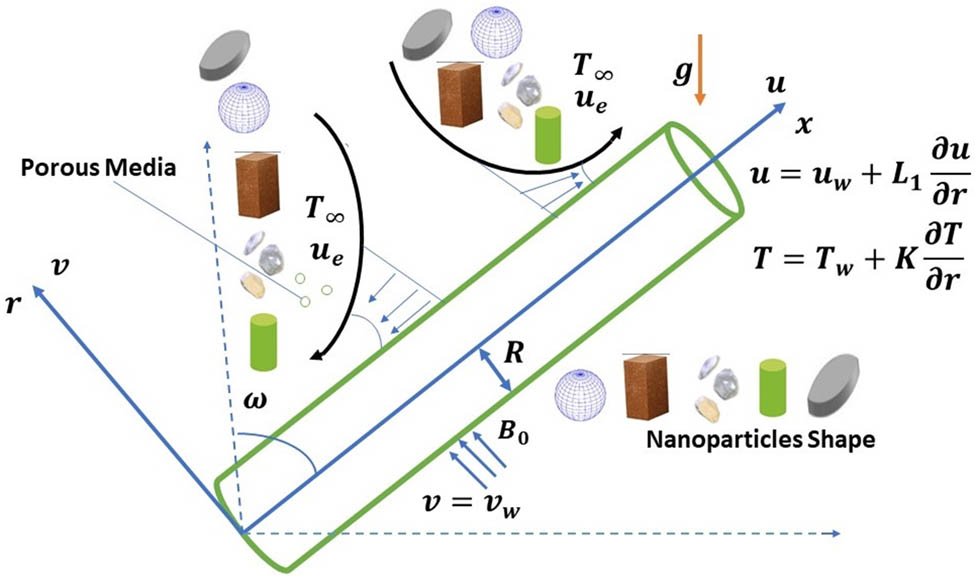
Physical conformation of an inclined cylinder.
The governing equation in dimensional form appropriate for modelling the transport phenomenon is expressed as follows (see [40]):
The following form describes the boundary conditions (see [40]):
This research uses the variables
To address the variance in electrical conductivity in the aforementioned equation, the below formula may be used (see [8]):
where
Table 1 enumerates the thermophysical properties of the base fluid (H2O) and the nanoparticles (Ag, MgO, and Fe3O4). Table 2 delineates the correlation parameters for the Ag + MgO + Fe3O4/H2O ternary hybrid nanofluid, including the form factor
| Properties | Ag (
|
MgO (
|
Fe3O4 (
|
H2O |
|---|---|---|---|---|
| ρ (kg/m3) | 10,500 | 3,560 | 5,180 | 997.1 |
| C p (J/kg K) | 235 | 955 | 670 | 4,179 |
| k (W/m K) | 429 | 45 | 9.7 | 0.613 |
| σ (Ω m)−1 | 6.3 × 10⁷ | 1 × 10⁻⁶ | 1 × 10³ | 5.5 × 10⁻⁶ |
| β (1⁄K) | 19.7 × 10⁻⁶ | 13 × 10−6 | 10 × 10−6 | 2.6 × 10⁻⁴ |
Ternary hybrid nanofluid correlation properties (see [8])
| Dynamic viscosity |
|
|
|
|
| Density |
|
| Thermal conductivity |
|
| Heat capacity |
|
| Electrical conductivity |
|
| Thermal expansion |
|
Assessment of nanoparticle morphologies and associated coefficients for viscosity augmentation (see [8])
| Nanoparticles shapes | Sphere | Bricks | Platelets | Cylinder | Blade |
|---|---|---|---|---|---|
| Shape structure |

|

|

|

|

|
| Sphericity
|
1 | 0.81 | 0.52 | 0.62 | 0.36 |
| Shape factor
|
3 | 3.7 | 5.7 | 4.8 | 8.6 |
|
|
1.9 | 37.1 | 13.5 | 14.6 | |
|
|
471.4 | 612.6 | 904.4 | 123.3 |
For similarity solutions, the application of a similarity transformation produces the following outcomes (refer to [40]):
Stream function is denoted by
The application of the similarity variables delineated in equation (6) inherently fulfils equation (1) and converts equations (2)–(4) into the following set of ordinary differential equations (ODEs):
In the above equations, the Prandtl number is
3 Engineering quantities of interest
The skin friction coefficient, which denotes flow resistance, and the local Nusselt number, which signifies the rate of heat transfer, are critical engineering metrics for assessing flow resistance and heat transfer efficiency at the surface. These quantities are represented numerically as follows:
Through similarity transformation, the aforementioned equations may be expressed as follows:
where local Reynold’s number is labeled as
3.1 Entropy generation
An important engineering metric for thermodynamic systems, including heat transmission, fluid movement, and energy dissipation, is entropy production, which measures the irreversibility. By factoring in the impacts of viscosity, Joule heating, heat conduction, and porous medium resistance, it aids in evaluating the system’s efficiency (see [8,32,33,39])
Inserting equation (6) into equation (12) yields the following outcome:
where the Brinkmann parameters and temperature difference are quantified as follows:
4 Numerical procedure for solution
Equations (7)–(9) were numerically resolved in MATLAB using the boundary value problem solver bvp4c. This solver uses the collocation formula from the three-stage Lobatto IIIa method to guarantee a continuous solution with fourth-order accuracy. An accurate initial solution estimate and an optimized boundary layer thickness for the problem parameters are the two most crucial inputs for the solver. The ‘bvp4c’ function in MATLAB is very beneficial for addressing boundary value issues because of its:
Adaptive mesh refinement automatically modifies the node distribution to meet a defined tolerance, enhancing accuracy in areas with steep slopes.
Proficiency in effectively managing stiff and non-linear systems, particularly prevalent in fluid mechanics and heat transfer issues represented by coupled ODEs.
We reformulated the governing equations using the system of first-order ODEs to facilitate the numerical solution. The computations were done with a tolerance error of 10−6. Here are the steps that outline the process:
Table 4 presents the numerical results derived from the current investigation and juxtaposes them with the findings provided by Zainal et al. [41] and Rafique et al. [42]. This comparison validates the precision and dependability of the present computational findings by contrasting them with known data from prior investigations.
Comparison of the values of
|
|
|
|||||
|---|---|---|---|---|---|---|
|
|
Rafique et al. [42] | Zainal et al. [41] | Present | Rafique et al. [42] | Zainal et al. [41] | Present |
| 0.0 | 1.232578 | 1.232588 | 1.232588 | 1.1279645 | 1.1279644 | 1.1279645 |
| 0.1 | 1.146561 | 1.146560 | 1.146561 | 1.2290655 | 1.2290656 | 1.2290658 |
| 0.2 | 1.051130 | 1.051130 | 1.051130 | 1.3260932 | 1.3260931 | 1.3260933 |
| 0.5 | 0.713295 | 0.713300 | 0.713295 | 0.7132951 | 0.7132950 | 0.7132952 |
| 1.0 | 0.000000 | 0.000000 | 0.000000 | 1.9867164 | 1.9867165 | 1.9867167 |
| 2.0 | −1.887307 | −1.887310 | −1.887307 | 2.6277197 | 2.6277196 | 2.6277194 |
| 5.0 | −10.264749 | −10.264750 | −10.264749 | 4.0153952 | 4.0153953 | 4.0153956 |
5 Results and discussion
A sequence of numerical simulations has been performed to examine the physical behavior of flow, heat transfer, and entropy formation. The results are shown via charts and tables, emphasizing the impact of different embedded factors on the governing parameter values. The following are the ranges of the considered parameters: velocity slip
Table 5 displays the numerical findings for skin friction
Skin friction for various parameters values when Pr = 6.2, Ec = B = Rd = 0.2, δ = S = 1.0, ω = 45°, λ = β = 0.5, ϕ 1 = ϕ 2 = 0.01, ϕ 3 = 0.02
|
|
Cs |
|
|
|
Bricks shape | Platelets shape | Cylinder shape | Blade shape | Spherical shape |
|---|---|---|---|---|---|---|---|---|---|
| 0.1 | 1.5 | 0.5 | 0.5 | 0.3 | 1.17859 | 2.29244 | 1.96895 | 1.17545 | 0.733162 |
| 0.3 | — | — | — | — | 0.932324 | 1.81339 | 1.55869 | 0.930338 | 0.579752 |
| 0.6 | — | — | — | — | 0.70976 | 1.38046 | 1.18742 | 0.708602 | 0.441203 |
| 1.0 | — | — | — | — | 0.538353 | 1.04706 | 0.901151 | 0.537688 | 0.334562 |
| 0.1 | 1.0 | — | — | — | 1.18633 | 2.30767 | 1.97828 | 1.1816 | 0.738732 |
| — | 1.5 | — | — | — | 1.17859 | 2.29244 | 1.96895 | 1.17545 | 0.733162 |
| — | 2.0 | — | — | — | 1.17456 | 2.2845 | 1.96403 | 1.17221 | 0.730291 |
| — | 2.5 | — | — | — | 1.17208 | 2.27962 | 1.96099 | 1.1702 | 0.728539 |
| — | 1.5 | 0.5 | — | — | 1.17859 | 2.29244 | 1.96895 | 1.17545 | 0.733162 |
| — | — | 1.0 | — | — | 1.18637 | 2.30718 | 1.99256 | 1.18774 | 0.736151 |
| — | — | 1.5 | — | — | 1.19395 | 2.32154 | 2.01518 | 1.19956 | 0.739082 |
| — | — | 2.0 | — | — | 1.20134 | 2.33556 | 2.0369 | 1.21097 | 0.741961 |
| — | — | 0.5 | 0.5 | — | 1.17859 | 2.29244 | 1.96895 | 1.17545 | 0.733162 |
| — | — | — | 1.0 | — | 1.1816 | 2.29814 | 1.97806 | 1.1802 | 0.734314 |
| — | — | — | 1.5 | — | 1.18459 | 2.30381 | 1.98709 | 1.18491 | 0.735464 |
| — | — | — | 2.0 | — | 1.18757 | 2.30947 | 1.99606 | 1.18959 | 0.736611 |
| — | — | — | 0.5 | 0.1 | 1.1783 | 2.29187 | 1.96848 | 1.17517 | 0.732979 |
| — | — | — | — | 0.3 | 1.17859 | 2.29244 | 1.96895 | 1.17545 | 0.733162 |
| — | — | — | — | 0.6 | 1.17957 | 2.29435 | 1.97054 | 1.17641 | 0.733779 |
| — | — | — | — | 1.0 | 1.18189 | 2.29887 | 1.9743 | 1.17868 | 0.73524 |
5.1 Impact of velocity slip parameter
A
on
C
f
Re
x
1
/
2
of a distinct shape factor
The reduction in skin friction
5.2 Impact of couple stress parameter (Cs) on skin friction of a distinct shape factor
The decrease in skin friction
5.3 Impact of curvature parameter
γ
on skin friction
C
f
Re
x
1
/
2
of a distinct shape factor
The intensification in
5.4 Impact of porosity parameter
ε
on skin friction of distinct shape factor
The augmentation of skin friction magnitudes with elevated porous media parameter values (
5.5 Impression of magnetic parameter
M
on skin friction of distinct shape factor
The augmentation of skin friction magnitudes with an increasing magnetic parameter (
Numerical findings of numerous important variables on the Nusselt number
Numerical values of
|
|
|
|
Ec |
|
|
Rd | Bricks shape | Platelets shape | Cylinder shape | Blade shape | Spherical shape |
|---|---|---|---|---|---|---|---|---|---|---|---|
| 0° | 0.2 | 0.5 | 0.2 | 0.5 | 1.0 | 0.2 | 3.44388 | 3.59179 | 3.39987 | 3.58844 | 3.53049 |
| 30° | — | — | — | — | — | — | 3.44389 | 3.59180 | 3.39990 | 3.58846 | 3.53051 |
| 60° | — | — | — | — | — | — | 3.44391 | 3.59182 | 3.39998 | 3.58853 | 3.53053 |
| 90° | — | — | — | — | — | — | 3.44394 | 3.59184 | 3.40008 | 3.58862 | 3.53056 |
| 45° | 0.2 | — | — | — | — | — | 3.4439 | 3.5918 | 3.39994 | 3.58849 | 3.53049 |
| — | 0.5 | — | — | — | — | — | 1.9243 | 2.02008 | 1.90749 | 2.03441 | 1.96762 |
| — | 0.8 | — | — | — | — | — | 1.33517 | 1.40519 | 1.3256 | 1.41962 | 1.36387 |
| — | 1.0 | — | — | — | — | — | 1.10885 | 1.16814 | 1.10158 | 1.18157 | 1.13225 |
| — | 0.2 | 0.5 | — | — | — | — | 3.4439 | 3.5918 | 3.39994 | 3.58849 | 3.53049 |
| — | — | 1.0 | — | — | — | — | 3.44364 | 3.59153 | 3.39964 | 3.58818 | 3.53024 |
| — | — | 1.5 | — | — | — | — | 3.44338 | 3.59126 | 3.39934 | 3.58787 | 3.53 |
| — | — | 2.0 | — | — | — | — | 3.44312 | 3.59098 | 3.39905 | 3.58757 | 3.52975 |
| — | — | 0.5 | 0.2 | — | — | — | 3.4439 | 3.5918 | 3.39994 | 3.58849 | 3.53049 |
| — | — | — | 0.5 | — | — | — | 3.18735 | 3.33423 | 2.90772 | 3.15286 | 3.37232 |
| — | — | — | 0.8 | — | — | — | 2.93057 | 3.07644 | 2.41493 | 2.71677 | 3.21403 |
| — | — | — | 1.0 | — | — | — | 2.75927 | 2.90446 | 2.08608 | 2.42579 | 3.10844 |
| — | — | — | 0.2 | 0.5 | — | — | 3.4439 | 3.5918 | 3.39994 | 3.58849 | 3.53049 |
| — | — | — | — | 1.0 | — | — | 3.50851 | 3.66352 | 3.47775 | 3.6754 | 3.59001 |
| — | — | — | — | 1.5 | — | — | 3.57482 | 3.73679 | 3.55607 | 3.76257 | 3.65175 |
| — | — | — | — | 2.0 | — | — | 3.64075 | 3.80933 | 3.632801 | 3.84766 | 3.71365 |
| — | — | — | — | 0.5 | 1.0 | — | 3.4439 | 3.5918 | 3.39994 | 3.58849 | 3.53049 |
| — | — | — | — | — | 2.0 | — | 3.44386 | 3.59176 | 3.39978 | 3.58836 | 3.53048 |
| — | — | — | — | — | 3.0 | — | 3.44381 | 3.59172 | 3.39963 | 3.58823 | 3.53047 |
| — | — | — | — | — | 4.0 | — | 3.44377 | 3.59168 | 3.39948 | 3.58811 | 3.53046 |
| — | — | — | — | — | 1.0 | 0.2 | 3.49768 | 3.58717 | 3.39994 | 3.58849 | 3.53049 |
| — | — | — | — | — | — | 0.5 | 4.10355 | 4.18437 | 3.9869 | 4.16671 | 4.1462 |
| — | — | — | — | — | — | 0.8 | 4.65961 | 4.7352 | 4.53017 | 4.70505 | 4.70883 |
| — | — | — | — | — | — | 1.0 | 5.01247 | 5.08569 | 4.87667 | 5.04947 | 5.06493 |
5.6 Impact of inclination angle parameter
ω
on Nusselt number
Nu
x
Re
x
−
1
/
2
of distinct shape factor of ternary hybrid nanofluid
The augmentation of Nusselt number magnitudes with elevated inclination angle parameter (ω = 0°, 30°, 60°, 90°) in Ag + MgO + Fe3O4/H2O ternary hybrid nanofluid flow over an inclined cylinder is attributable to the improved convective heat transfer induced by gravitational and buoyancy forces. As the
5.7 Impact of thermal slip parameter
B
on Nusselt number of distinct shape factor of ternary hybrid nanofluid
As the thermal slip parameter (
5.8 Impact of variable electrical conductivity parameter
β
on Nusselt number
Nu
x
Re
x
−
1
/
2
of distinct shape factor of ternary hybrid nanofluid
The ternary hybrid nanofluid flow over an inclined cylinder exhibits a decreasing Nusselt number magnitude as the variable electrical conductivity parameter (
5.9 Impact of Eckert number parameter Ec on
Nu
x
Re
x
−
1
/
2
of distinct shape factor of ternary hybrid nanofluid
When a ternary hybrid nanofluid flows over an inclined cylinder, the Nusselt number values go down as the Eckert number Ec goes up. This is because viscous dissipation effects are stronger than conductive heat transmission. An increased Ec enhances the transformation of kinetic energy into thermal energy by frictional heating, raising fluid temperatures inside the boundary layer, and reducing the temperature difference at the wall. This lowers the flow of heat that can be conducted, even though the ternary nanofluid is better at conducting heat because the nanoparticles work together to make it work better. The design of the inclined cylinder makes this tendency stronger by creating flow deceleration zones that collect viscous heating. This makes the thermal barrier layer thicker and reduces the ability to move heat. Nanoparticles that are not spherical, like platelets or cylinders, could mess up streamline coherence, which would make local dissipation worse and heat diffusion less effective. So, even though the hybrid nanofluid improves thermophysical properties, the high (Ec) causes a lot of thermal inertia, which lowers the Nusselt number. This indicates that energy retention is prioritized above heat transport between the wall and the fluid.
5.10 Impact of curvature parameter
γ
on the Nusselt number of distinct shape factor of ternary hybrid nanofluid
In Ag + MgO + Fe3O4/H2O ternary hybrid nanofluid flow, the Nusselt number magnitudes increase as the curvature parameter
5.11 Impression of mixed convection parameter
δ
on the Nusselt number of distinct shape factor of ternary hybrid nanofluid
As the mixed convection parameter values (
5.12 Impression of thermal radiation parameter Rd on
Nu
x
Re
x
−
1
/
2
of distinct shape factor of ternary hybrid nanofluid
The
Figure 2(a) and (b) validate the effect of varying mass suction parameter

Impact of S = 1.0, 1.5, 2.0, 2.5 on (a)
Figure 3(a) and (b) show how skin friction and Nusselt number over inclined cylinder vary with Ag + MgO + Fe3O4/H2O ternary hybrid nanofluid volume fraction

Influence of ϕ
3 = 0.005, 0.01, 0.015, 0.02 on (a)
Figure 4(a) exemplifies the consequence of the couple stress parameter (Cs) on the velocity profile

(a) Effect of Cs = 1.0, 1.3, 1.5, 1.7 on
5.13 Effect of curvature parameter
γ
on velocity
f
′
(
η
)
and temperature
θ
(
η
)
profiles of distinct shape ternary hybrid nanofluid
Figure 5(a) and (b) exhibit the impact of the parameter (

Impression of γ = 0.5, 1.0, 1.5, 2.0 on (a)
5.14 Consequence of magnetic parameter
M
on
f
′
(
η
)
and Eckert number Ec on
θ
(
η
)
profiles of distinct shape ternary hybrid nanofluid
Figure 6(a) demonstrates the influence of the magnetic parameter (

(a) Impression of M = 0.1, 0.3, 0.5, 0.7 on
5.15 Effect of nanoparticle volume fraction
(
ϕ
3
)
on velocity
f
′
(
η
)
and temperature
θ
(
η
)
profiles of distinct shape factor
Figure 7(a) and (b) portray the stimulus of the nanoparticle volume fraction (

Impression of ϕ
3 = 0.005, 0.01, 0.015, 0.02 on (a)
5.16 Effect of mass suction parameter (
S
) on velocity
f
′
(
η
)
and temperature
θ
(
η
)
profiles of distinct shape ternary hybrid nanofluid
The impact of the mass suction parameter (

Impact of S = 1.0, 1.5, 2.0, 2.5 on (a)
5.17 Effect of mixed convection parameter
(
δ
)
and radiation on temperature profiles of distinct shape ternary hybrid nanofluid
Both Figure 9(a) and (b) show how the mixed convection parameter (

(a) Bearing of δ = 0.5, 1.0, 1.5, 2.0 on
Figure 10 displays the effects of several parameters on the generation of entropy for ternary hybrid nanofluids of different shapes over an inclined cylinder. Figure 10(a) shows the effects of the Brinkmann number parameter (Br), Figure 10(b) shows the effects of the porous media parameter

(a) Impact of Br = 0.2, 0.4, 0.6, 0.8 on
5.18 Significance of shape factors (bricks, platelets, cylinders, blades, spheres) on different profiles of Ag + MgO + Fe3O4/H2O ternary hybrid nanofluid
The impression of shape factors (bricks, platelets, cylinders, blades, spheres) on the flow profiles of Ag + MgO + Fe3O4/H2O ternary hybrid nanofluids arises from the unique hydrodynamic and thermal properties of each shape. Spherical nanoparticles exhibit minimal drag due to their symmetrical geometry, facilitating higher velocity profiles than other shapes. Blade-shaped nanoparticles, possessing a greater surface area-to-volume ratio, significantly improve heat transfer efficiency, yielding the highest Nusselt number. Platelets, with their extensive contact area and increased flow resistance, result in heightened skin friction and greater entropy generation due to marked frictional and thermal irreversibility’s. This behavior underscores the intricate relationship between nanoparticle shape, flow dynamics, and heat transfer mechanisms, emphasizing the critical role of shape factors in enhancing the efficacy of nanofluid systems.
6 Conclusions
This work examined the behavior of mixed convection stagnation point flow of Ag + MgO + Fe3O4/H2O ternary hybrid nanofluid across an inclined cylinder. The influence of magnetic fields, porous media, coupling stress, velocity and thermal slip conditions, mass suction, viscosity dissipation, Joule heating, variable electrical conductivity, form factor, and thermal radiation. We numerically calculated and visually and tabulatively displayed the impacts of the dimensionless parameters on the entropy production, skin friction coefficient, and heat transfer rate at the surface. The following is a list of the summary findings:
The influence of shape factor on the flow of Ag + MgO + Fe3O4/H2O ternary hybrid nanofluids across an inclined cylinder is examined, revealing that platelet shapes surpass other geometries for Nusselt number and velocity profiles.
The velocity profile of Ag + MgO + Fe3O4/H2O ternary hybrid nanofluid flow with varying form factors diminishes as the coupling stress and nanoparticle volume fraction parameters grow, whereas the velocity profile enhances with rising mass suction, magnetic, and porous medium parameters. The curvature parameter exhibits dual behavior in the velocity profile.
The temperature profile of Ag + MgO + Fe3O4/H2O ternary hybrid nanofluid flow with varying shapes diminishes with elevated mixed convection and mass suction parameters, while it increases with higher values of radiation, Eckert number, curvature, and nanoparticle volume fraction parameters.
An Ag + MgO + Fe3O4/H2O nanofluid flow with different shaped components has an entropy generation profile that grows as the Brinkmann number, porous media, nanoparticle volume percentage, and thermal radiation parameters rise.
The skin friction of Ag + MgO + Fe3O4/H2O nanofluid flow with varying morphologies escalates with higher mass suction, curvature, porous medium, and magnetic parameters, while it diminishes with rising velocity slip parameter, coupling stress, and nanoparticle volume fraction parameters.
An Ag + MgO + Fe3O4/H2O nanofluid flow with different shapes has an increasing Nusselt number for large values of mass suction, inclination angle, nanoparticle volume fraction, curvature, and radiation parameter, and a decreasing value for large values of thermal slip, Eckert number, mixed convection, and variable electrical conductivity.
7 Future suggestions
Subsequent investigations may expand upon this work by
Examining the effects of time-dependent flow and transient heat transfer in analogous systems to investigate unsteady-state behavior.
Examining various geometries, including conical and elliptical surfaces, to evaluate the influence of form on heat transport and entropy creation.
Integrating hybrid heating methods, like variable surface heating or non-uniform magnetic fields, to improve thermal efficiency.
Investigating the interplay of chemical processes or phase change events in the ternary hybrid nanofluid to enhance industrial application.
Making use of optimization or machine learning methods to predict the right form parameters and fluid properties to improve heat transport and decrease entropy generation.
Acknowledgments
The authors acknowledge and appreciate the Ongoing Research Funding Program (ORF-2025-996), King Saud University, Riyadh, Saudi Arabia.
-
Funding information: This research was supported by the Ongoing Research Funding Program (ORF-2025-996) at King Saud University in Riyadh, Saudi Arabia.
-
Author contributions: Z. M. and K. R.: conceptualization, methodology, software, formal analysis, validation, and writing – original draft. I. L. P.: writing – original draft, investigation, visualization, data curation, and validation. A. K.: conceptualization, writing – original draft, and formal analysis and resources. M. A. A: supervision, validation, methodology, project administration, investigation, writing – review and editing, and software.
-
Conflict of interest: The authors state no conflict of interest.
-
Ethical approval: The conducted research is not related to either human or animals use.
-
Data availability statement: The datasets generated during and/or analyzed during the current study are available from the corresponding author on reasonable request.
References
[1] Asif Ali Shah S, Kanwal S, Idrees M, Mahmood A, Mahmood I, Akgul A, et al. Significance of heat transfer rate in water-based nanoparticles with magnetic and shape factors effects: Tiwari and Das model. Sci Rep. 2023;13(1):15507.10.1038/s41598-023-42480-9Search in Google Scholar PubMed PubMed Central
[2] Jiang Y, Zhou X, Wang Y. Effects of nanoparticle shapes on heat and mass transfer of nanofluid thermocapillary convection around a gas bubble. Microgravity Sci Technol. 2020;32:167–77.10.1007/s12217-019-09757-zSearch in Google Scholar
[3] Sreenivasulu M, Bhuvana Vijaya R. Influence of exponential heat source, variable viscosity and shape factor on a hybrid nanofluid flow over a flat plate when thermal radiation and chemical reaction are significant. Mod Phys Lett B. 2024;38(14):2450102.10.1142/S0217984924501021Search in Google Scholar
[4] Aslam MN, Shaheen A, Riaz A, Alshaikey S, Shaukat N, Aslam MW, et al. An ANN-PSO approach for mixed convection flow in an inclined tube with ciliary motion of Jeffrey six constant fluid. Case Stud Therm Eng. 2023;52:103740.10.1016/j.csite.2023.103740Search in Google Scholar
[5] Ragulkumar E, Palani G, Sambath P, Chamkha AJ. Dissipative MHD free convective nanofluid flow past a vertical cone under radiative chemical reaction with mass flux. Sci Rep. 2023;13(1):2878.10.1038/s41598-023-28702-0Search in Google Scholar PubMed PubMed Central
[6] Ragulkumar E, Sambath P, Suresh K, Balasubramanian S, Chamkha AJ. Soret–Dufour mass transfer effects on radiative chemically dissipative MHD plain convective water nanofluid (Al2O3, Cu, Ag, & TiO2) flow across a temperature-controlled upright cone surface with heat blow/suction. Numer Heat Transf Part A Appl. 2025;86(2):278–96.10.1080/10407782.2023.2261624Search in Google Scholar
[7] Ramesh GK, Manjunatha S, Roopa GS, Chamkha AJ. Hybrid (ND-Co3O4/EG) nanoliquid through a permeable cylinder under homogeneous-heterogeneous reactions and slip effects. J Therm Anal Calorim. 2021;146:1347–57.10.1007/s10973-020-10106-1Search in Google Scholar
[8] Mahmood Z, Rafique K, Abd-Elmonem A, Suoliman NAA, Kumar A, Mukalazi H. Analyzing thermal performance and entropy generation in time-dependent buoyancy flow of water-based over rotating sphere with ternary nanoparticle shape factor. J Comput Des Eng. 2025;12(1):80–99.10.1093/jcde/qwae111Search in Google Scholar
[9] Ullah H, Abas SA, Fiza M, Jan AU, Akgul A, Abd El-Rahman M, et al. Thermal radiation effects of ternary hybrid nanofluid flow in the activation energy: Numerical computational approach. Results Eng. 2025;25:104062.10.1016/j.rineng.2025.104062Search in Google Scholar
[10] Madhukesh JK, Ramesh GK. Effectiveness of kerosene/water conveying ternary (Cu–SiO2–Al2O3) nanoparticles flowing in vertical cylinder subjected to a melting phenomenon. J Taibah Univ Sci. 2025;19(1):2466870.10.1080/16583655.2025.2466870Search in Google Scholar
[11] Jawad M, Fu Z, Khan H, Ali M, Khan WA, Abu-Jrai A, et al. Bio-convection in tri-hybrid nanofluid flow with Arrhenius activation energy: Incorporating the Cattaneo-Christov heat flux model. J Radiat Res Appl Sci. 2025;18(1):101296.10.1016/j.jrras.2025.101296Search in Google Scholar
[12] Lone SA, AL-Essa LA, Alduais FS, Al-Bossly A, Dawar A, Saeed A. Optimization of heat transfer in bi-directional flow of sodium alginate-based ternary hybrid nanofluid over an extending heated surface with velocity slip conditions. J Therm Anal Calorim. 2025;150:1–12.10.1007/s10973-024-13872-4Search in Google Scholar
[13] Khan D, Kumam P, Suttiarporn P, Srisurat T. Fourier’s and Fick’s laws analysis of couple stress MHD sodium alginate based Casson tetra hybrid nanofluid along with porous medium and two parallel plates. South Afr J Chem Eng. 2024;47:279–90.10.1016/j.sajce.2023.12.003Search in Google Scholar
[14] Madhukesh JK, Ramesh GK, Revadakundi YB. Thermal transport analysis of ternary hybrid nanofluid flow over a vertical cylinder with thermal radiation and chemical reaction. Therm Adv. 2025;3:100040.10.1016/j.thradv.2025.100040Search in Google Scholar
[15] Ali NB, Mahmood Z, Rafique K, Khan U, Adnan, Muhammad T, et al. Exploring concentration-dependent transport properties on an unsteady Riga plate by incorporating thermal radiation with activation energy and gyrotactic microorganisms. Appl Rheol. 2024;34(1):20240019.10.1515/arh-2024-0019Search in Google Scholar
[16] Ahmad S, Khan AA, Alkarni S. Novel insight of thermal radiation and slip boundary condition on the micropolar ternary hybrid nanofluid flow over an oblique stagnation region of a lubricated surface. Mod Phys Lett B. 2024;39:2550101.10.1142/S0217984925501015Search in Google Scholar
[17] Obalalu AM, Fatunmbi EO, Alam MM, Abbas A, Khan U, Adekoya-Olowofela A, et al. Influence of thermal radiation and electromagnetic characteristics of micropolar ternary hybrid nanofluid flow over a slender surface. J Radiat Res Appl Sci. 2025;18(1):101268.10.1016/j.jrras.2024.101268Search in Google Scholar
[18] Wahid NS, Arifin NM, Yahaya RI, Khashi’ie NS, Pop I. Impact of suction and thermal radiation on unsteady ternary hybrid nanofluid flow over a biaxial shrinking sheet. Alex Eng J. 2024;96:132–41.10.1016/j.aej.2024.03.079Search in Google Scholar
[19] Jamrus FN, Ishak A, Waini I, Khan U. Radiative influence on axisymmetric ternary hybrid nanofluid flow with convective boundary conditions over a nonlinearly permeable stretching/shrinking disk. Int J Numer Methods Heat Fluid Flow. 2024;34(12):4333–61.10.1108/HFF-04-2024-0324Search in Google Scholar
[20] Guedri K, Khan A, Sene N, Raizah Z, Saeed A, Galal AM. Thermal flow for radiative ternary hybrid nanofluid over nonlinear stretching sheet subject to Darcy–Forchheimer phenomenon. Math Probl Eng. 2022;2022(1):3429439.10.1155/2022/3429439Search in Google Scholar
[21] Khan A, Ul Karim F, Khan I, Ali F, Khan D. Irreversibility analysis in unsteady flow over a vertical plate with arbitrary wall shear stress and ramped wall temperature. Results Phys. 2018;8:1283–90.10.1016/j.rinp.2017.12.032Search in Google Scholar
[22] Senthilvadivu K, Eswaramoorthi S, Loganathan K, Abbas M. Time-dependent Darcy–Forchheimer flow of Casson hybrid nanofluid comprising the CNTs through a Riga plate with nonlinear thermal radiation and viscous dissipation. Nanotechnol Rev. 2024;13(1):20230202.10.1515/ntrev-2023-0202Search in Google Scholar
[23] Khan D, Rahman AU, Ali G, Kumam P, Kaewkhao A, Khan I. The effect of wall shear stress on two phase fluctuating flow of dusty fluids by using light hill technique. Water. 2021;13(11):1587.10.3390/w13111587Search in Google Scholar
[24] Abbas MS, Shaheen A, Abbas N, Shatanawi W. Dynamic analysis of radiative chemical species with non-Newtonian fluid flow over an exponentially curved stretching sheet. Proc Inst Mech Eng Part E J Process Mech Eng. 2024;09544089241271866.10.1177/09544089241271866Search in Google Scholar
[25] Madhu J, Madhukesh JK, Sarris I, Prasannakumara BC, Ramesh GK, Shah NA, et al. Influence of quadratic thermal radiation and activation energy impacts over oblique stagnation point hybrid nanofluid flow across a cylinder. Case Stud Therm Eng. 2024;60:104624.10.1016/j.csite.2024.104624Search in Google Scholar
[26] Shaheen A, Muhammad Hussain S, Ghazwani HA, Huma Z, Siddique I. Analytical solution of non-Newtonian Williamson fluid under the effect of magnetohydrodynamics. Mod Phys Lett B. 2024;38(13):2450103.10.1142/S0217984924501033Search in Google Scholar
[27] Shaheen A, Siddique I, Huma Z, Ahsan M, Khalid Z. Comparative analysis of viscous dissipation effects on Prandtl fluid including contraction and relaxation phenomena. Heat Transf. 2024;53(7):3687–705.10.1002/htj.23107Search in Google Scholar
[28] Afridi MI, Khan MS, Qasim M, Chamkha AJ. Computational analysis of unsteady oscillatory flow of nanofluid with variable electric conductivity: gear-generalized differential quadrature approach. J Comput Des Eng. 2024;11(6):20–35.10.1093/jcde/qwae091Search in Google Scholar
[29] Mushahary P, Ontela S. Entropy analysis of mixed convective electro-magnetohydrodynamic couple-stress hybrid nanofluid flow with variable electrical conductivity in a porous channel. Phys Scr. 2024;99(11):115253.10.1088/1402-4896/ad831cSearch in Google Scholar
[30] Reddy YM, Ganteda C, Sreedhar S, Himabindu IBN, Sulaiman TA, Obulesu M, et al. Impact of variable electrical conductivity, viscosity on convective heat and mass transfer flow of CuO-and Al2O3-water nanofluids in cylindrical annulus. Mod Phys Lett B. 2024;39:2450425.10.1142/S0217984924504256Search in Google Scholar
[31] Hayat AU, Ahmad H, Gana S, Muhammad T, Eladeb A, Kolsi L. Entropy analysis in tri-hybrid nanofluid flow past a curved surface with applications of heat radiation and Lorentz force; numerical simulation. J Radiat Res Appl Sci. 2025;18(1):101276.10.1016/j.jrras.2024.101276Search in Google Scholar
[32] Gireesha BJ, Anitha L. Impact of shape dependent ternary hybrid nanoliquid flow through a microchannel with quadratic thermal radiation: Irreversibility analysis. J Appl Comput Mech. 2024;10(4):729–41.Search in Google Scholar
[33] Gireesha BJ, Anitha L. Convective flow of couple stress ternary nanoliquid flow through a permeable microchannel: irreversibility analysis. Int J Model Simul. 2024;1–18.10.1080/02286203.2024.2388117Search in Google Scholar
[34] Hayat T, Naz S, Alsaedi A, Momani S. Melting and dissipative effects about entropy induced Darcy-Forchheimer flow involving ternary-hybrid nanofluids. Case Stud Therm Eng. 2024;55:104097.10.1016/j.csite.2024.104097Search in Google Scholar
[35] Hayat AU, Khan H, Ullah I, Ahmad H, Alam MM, Bilal M. Numerical exploration of the entropy generation in tri-hybrid nanofluid flow across a curved stretching surface subject to exponential heat source/sink. J Therm Anal Calorim. 2024;149:1–13.10.1007/s10973-024-13358-3Search in Google Scholar
[36] Liang R, Hanif H, Song J, Alzahrani SS. Heat transfer and entropy generation analysis of ternary nanofluid. J Comput Des Eng. 2024;11:qwae100.10.1093/jcde/qwae100Search in Google Scholar
[37] Khan D, Kumam P, Watthayu W, Jarad F. Exploring the potential of heat transfer and entropy generation of generalized dusty tetra hybrid nanofluid in a microchannel. Chin J Phys. 2024;89:1009–23.10.1016/j.cjph.2023.10.006Search in Google Scholar
[38] Ali F, Loganathan K, Eswaramoorthi S, Prabu K, Zaib A, Chaudhary DK. Heat transfer analysis on carboxymethyl cellulose water‐based cross hybrid nanofluid flow with entropy generation. J Nanomater. 2022;2022(1):5252918.10.1155/2022/5252918Search in Google Scholar
[39] Anitha L, Gireesha BJ. Irreversibility analysis of ternary hybrid nanofluid flow through an oblique microchannel with Hall current: a comparative study. Int J Ambient Energy. 2024;45(1):2355568.10.1080/01430750.2024.2355568Search in Google Scholar
[40] Sohut FH, Khan U, Ishak A, Soid SK, Waini I. Mixed convection hybrid nanofluid flow induced by an inclined cylinder with Lorentz forces. Micromachines. 2023;14(5):982.10.3390/mi14050982Search in Google Scholar PubMed PubMed Central
[41] Zainal NA, Nazar R, Naganthran K, Pop I. MHD mixed convection stagnation point flow of a hybrid nanofluid past a vertical flat plate with convective boundary condition. Chin J Phys. 2020;66:630–44.10.1016/j.cjph.2020.03.022Search in Google Scholar
[42] Rafique K, Mahmood Z, Adnan, Khan U, Farooq U, Emam W. Computational analysis of MHD hybrid nanofluid over an inclined cylinder: Variable thermal conductivity and viscosity with buoyancy and radiation effects. Mod Phys Lett B. 2024;39:2550033.10.1142/S0217984925500332Search in Google Scholar
© 2025 the author(s), published by De Gruyter
This work is licensed under the Creative Commons Attribution 4.0 International License.
Articles in the same Issue
- Research Articles
- Lie symmetry analysis of bio-nano-slip flow in a conical gap between a rotating disk and cone with Stefan blowing
- Mathematical modelling of MHD hybrid nanofluid flow in a convergent and divergent channel under variable thermal conductivity effect
- Advanced ANN computational procedure for thermal transport prediction in polymer-based ternary radiative Carreau nanofluid with extreme shear rates over bullet surface
- Effects of Ca(OH)2 on mechanical damage and energy evolution characteristics of limestone adsorbed with H2S
- Effect of plasticizer content on the rheological behavior of LTCC casting slurry under large amplitude oscillating shear
- Studying the role of fine materials characteristics on the packing density and rheological properties of blended cement pastes
- Deep learning-based image analysis for confirming segregation in fresh self-consolidating concrete
- MHD Casson nanofluid flow over a three-dimensional exponentially stretching surface with waste discharge concentration: A revised Buongiorno’s model
- Rheological behavior of fire-fighting foams during their application – a new experimental set-up and protocol for foam performance qualification
- Viscoelastic characterization of corn starch paste: (II) The first normal stress difference of a cross-linked waxy corn starch paste
- An innovative rheometric tool to study chemorheology
- Effect of polymer modification on bitumen rheology: A comparative study of bitumens obtained from different sources
- Rheological and irreversibility analysis of ternary nanofluid flow over an inclined radiative MHD cylinder with porous media and couple stress
- Rheological analysis of saliva samples in the context of phonation in ectodermal dysplasia
- Analytical study of the hybrid nanofluid for the porosity flowing through an accelerated plate: Laplace transform for the rheological behavior
- 10.1515/arh-2025-0060
- Brief Report
- Correlations for friction factor of Carreau fluids in a laminar tube flow
- Special Issue on the Rheological Properties of Low-carbon Cementitious Materials for Conventional and 3D Printing Applications
- Rheological and mechanical properties of self-compacting concrete with recycled coarse aggregate from the demolition of large panel system buildings
- Effect of the combined use of polyacrylamide and accelerators on the static yield stress evolution of cement paste and its mechanisms
- Special Issue on The rheological test, modeling and numerical simulation of rock material - Part II
- Revealing the interfacial dynamics of Escherichia coli growth and biofilm formation with integrated micro- and macro-scale approaches
- Construction of a model for predicting sensory attributes of cosmetic creams using instrumental parameters based on machine learning
- Effect of flaw inclination angle and crack arrest holes on mechanical behavior and failure mechanism of pre-cracked granite under uniaxial compression
- Special Issue on The rheology of emerging plant-based food systems
- Rheological properties of pea protein melts used for producing meat analogues
- Understanding the large deformation response of paste-like 3D food printing inks
- Seeing the unseen: Laser speckles as a tool for coagulation tracking
- Composition, structure, and interfacial rheological properties of walnut glutelin
- Microstructure and rheology of heated foams stabilized by faba bean isolate and their comparison to egg white foams
- Rheological analysis of swelling food soils for optimized cleaning in plant-based food production
- Multiscale monitoring of oleogels during thermal transition
- Influence of pea protein on alginate gelation behaviour: Implications for plant-based inks in 3D printing
- Observations from capillary and closed cavity rheometry on the apparent flow behavior of a soy protein isolate dough used in meat analogues
- Special Issue on Hydromechanical coupling and rheological mechanism of geomaterials
- Rheological behavior of geopolymer dope solution activated by alkaline activator at different temperature
- Special Issue on Rheology of Petroleum, Bitumen, and Building Materials
- Rheological investigation and optimization of crumb rubber-modified bitumen production conditions in the plant and laboratory
Articles in the same Issue
- Research Articles
- Lie symmetry analysis of bio-nano-slip flow in a conical gap between a rotating disk and cone with Stefan blowing
- Mathematical modelling of MHD hybrid nanofluid flow in a convergent and divergent channel under variable thermal conductivity effect
- Advanced ANN computational procedure for thermal transport prediction in polymer-based ternary radiative Carreau nanofluid with extreme shear rates over bullet surface
- Effects of Ca(OH)2 on mechanical damage and energy evolution characteristics of limestone adsorbed with H2S
- Effect of plasticizer content on the rheological behavior of LTCC casting slurry under large amplitude oscillating shear
- Studying the role of fine materials characteristics on the packing density and rheological properties of blended cement pastes
- Deep learning-based image analysis for confirming segregation in fresh self-consolidating concrete
- MHD Casson nanofluid flow over a three-dimensional exponentially stretching surface with waste discharge concentration: A revised Buongiorno’s model
- Rheological behavior of fire-fighting foams during their application – a new experimental set-up and protocol for foam performance qualification
- Viscoelastic characterization of corn starch paste: (II) The first normal stress difference of a cross-linked waxy corn starch paste
- An innovative rheometric tool to study chemorheology
- Effect of polymer modification on bitumen rheology: A comparative study of bitumens obtained from different sources
- Rheological and irreversibility analysis of ternary nanofluid flow over an inclined radiative MHD cylinder with porous media and couple stress
- Rheological analysis of saliva samples in the context of phonation in ectodermal dysplasia
- Analytical study of the hybrid nanofluid for the porosity flowing through an accelerated plate: Laplace transform for the rheological behavior
- 10.1515/arh-2025-0060
- Brief Report
- Correlations for friction factor of Carreau fluids in a laminar tube flow
- Special Issue on the Rheological Properties of Low-carbon Cementitious Materials for Conventional and 3D Printing Applications
- Rheological and mechanical properties of self-compacting concrete with recycled coarse aggregate from the demolition of large panel system buildings
- Effect of the combined use of polyacrylamide and accelerators on the static yield stress evolution of cement paste and its mechanisms
- Special Issue on The rheological test, modeling and numerical simulation of rock material - Part II
- Revealing the interfacial dynamics of Escherichia coli growth and biofilm formation with integrated micro- and macro-scale approaches
- Construction of a model for predicting sensory attributes of cosmetic creams using instrumental parameters based on machine learning
- Effect of flaw inclination angle and crack arrest holes on mechanical behavior and failure mechanism of pre-cracked granite under uniaxial compression
- Special Issue on The rheology of emerging plant-based food systems
- Rheological properties of pea protein melts used for producing meat analogues
- Understanding the large deformation response of paste-like 3D food printing inks
- Seeing the unseen: Laser speckles as a tool for coagulation tracking
- Composition, structure, and interfacial rheological properties of walnut glutelin
- Microstructure and rheology of heated foams stabilized by faba bean isolate and their comparison to egg white foams
- Rheological analysis of swelling food soils for optimized cleaning in plant-based food production
- Multiscale monitoring of oleogels during thermal transition
- Influence of pea protein on alginate gelation behaviour: Implications for plant-based inks in 3D printing
- Observations from capillary and closed cavity rheometry on the apparent flow behavior of a soy protein isolate dough used in meat analogues
- Special Issue on Hydromechanical coupling and rheological mechanism of geomaterials
- Rheological behavior of geopolymer dope solution activated by alkaline activator at different temperature
- Special Issue on Rheology of Petroleum, Bitumen, and Building Materials
- Rheological investigation and optimization of crumb rubber-modified bitumen production conditions in the plant and laboratory
