Mathematical modelling of MHD hybrid nanofluid flow in a convergent and divergent channel under variable thermal conductivity effect
-
Abdulaziz H. Alharbi


Abstract
The aim of this research is to analyse the combined effect of variable thermal conductivity and nonlinear thermal radiation on magnetohydrodynamic (MHD) hybrid nanofluid flow in convergent-divergent channels. The effects of two nanoparticles (i.e.
Symbols
-
-
constants
-
-
constants
-
-
magnetic field (T)
-
-
strength of magnetic field (T)
-
-
Brinkman number
-
-
skin friction coefficient
-
-
effective specific heat of fluid
-
-
Eckert number
-
-
dimensionless velocity
- Ha
-
Hartmann number
-
-
thermal conductivity
-
-
mean absorption coefficient
-
-
Nusselt number or nonlinear term
-
-
fluid pressure
-
-
Prandtl number
-
-
heat flux radiative
-
-
radial coordinate
-
-
Reynolds number
-
-
thermal radiation parameter
- T
-
fluid temperature (K)
- T w
-
wall temperature (K)
- V c
-
rate of movement at the centreline of channel
- V max
-
maximal velocity
-
-
radial, azimuthal, axial velocity
Greek symbols
- α
-
channel half-angle
- η
-
dimensionless
- θ
-
dimensionless temperature
-
-
nanoparticle volume fraction
- µ
-
dynamic viscosity
- ν
-
kinematic viscosity
- ρ
-
density
- σ
-
electrical conductivity
-
-
Stefan–Boltzmann constant
-
-
variable thermal conductivity parameter
1 Introduction
Nanofluids have garnered attention and large numbers of investigations owing to their advantageous characteristics relative to conventional fluids. These fluids possess remarkable thermal conductivity, rendering them more advantageous for practical applications. The incorporation of uniformly distributed nanoparticles to the host fluid enhances the thermal conductivity of the resulting fluid. The improved attributes render hybrid nanofluids more effective than nanoliquids [1,2,3].
Hamilton and Crosser [4] were the pioneers in experimenting with the concept of developing an improved heat transfer fluid. They distributed micro sized particles in base liquids to enhance the thermal conductivity of the colloidal solution. The results of their experimental discoveries enhanced the thermal performance of the developed fluid; however, they identified that the issue of coagulation hindered its application in industrial contexts. Madhukesh et al. [5] introduced an innovative and thorough model for examining heat and solutal transportation in non-Newtonian flow of nanofluid over a Riga surface influenced by waste release concentration. Srinivas et al. [6] investigated the hydromagnetic flow of nanofluids in a two-dimensional permeable domain. The analysis of several parameters revealed that nanoparticle concentration is directly connected with the Brownian factor. Hemmat Esfe and Saedodin [7] examined the thermal conductivity and its influence on the heat transmission of MgO/water nanofluid. Al-Zahrani et al. [8] presented a compelling analytical investigation of (Ag-Graphene)/blood hybrid nanofluid affected by platelet cylindrical nanoparticles and Joule heating. This work is distinguished by its multidisciplinary approach, integrating nanotechnology, bio-fluid dynamics, and mathematical modelling to examine complex phenomena. Ramesh et al. [9] examined the effects of a ternary nanofluid with HS–S and permeable media in a stretched divergent/convergent channel. Fakour et al. [10] investigated the process of heat transfer mechanism as well as laminar fluid flow among two parallel porous plates. The impact of non-dimensional factors on the dimensionless velocity as well as temperature profiles was examined. Mohammadi and Nassab [11] developed complicated geometry within a cavity and analysed the effects of radiative parameters and magnetic fields under constant Rayleigh numbers. Ullah et al. [12] examined the flow of a modified hybrid nanofluid within stretching or shrinking CD channels, considering the continual heat absorption or creation, ohmic heating, and viscous dissipation. Ramesh et al. [13] analysed the flow of hybrid nanomaterials in a convergent/divergent channel. Chamkha et al. [14] examined the process of heat transfer in hybrid nanofluid flow inside a rotating structure between elastic surfaces. They found that the rate of heat transfer increases through the improvement of injection and radiation factors. Conversely, researchers have also conducted numerical studies. For example, Waini et al. [15] explained a numerical analysis of the transient flow of hybrid nanofluid over a curved stretching and shrinking surface. Furthermore, Anitha et al. [16] studied the thermal properties of a tangent hyperbolic fluid as it traverses a vertical microchannel. In addition, Anitha and Gireesha [17] investigated the irreversibility and thermal characteristics of the Jeffrey nanofluid within a vertical porous microchannel. Moreover, Chamkha [18] conducted a theoretical study on the influence of solar radiation on natural convection within a porous media in a flat-plate collector. The author determined that the Nusselt number increased with an elevation in the Prandtl number, while a decrease was observed due to enhancements in the coefficient of heat transfer, tangential distance, inverse Darcy number, and medium inertia. For more information, we refer the readers to previous studies [19,20,21,22,23,24].
The novelty and significance of this work are emphasized by the lack of prior research on this particular subject. Understanding how heat transfer behaves in flow between convergent–divergent channels with hybrid nanofluid (such as
2 Problem formulation
The study examines the effect of variable thermal conductivity on incompressible magnetohydrodynamic (MHD) flow of hybrid nanofluid in convergent and divergent channels. The geometry of the flow model is given in Figure 1.
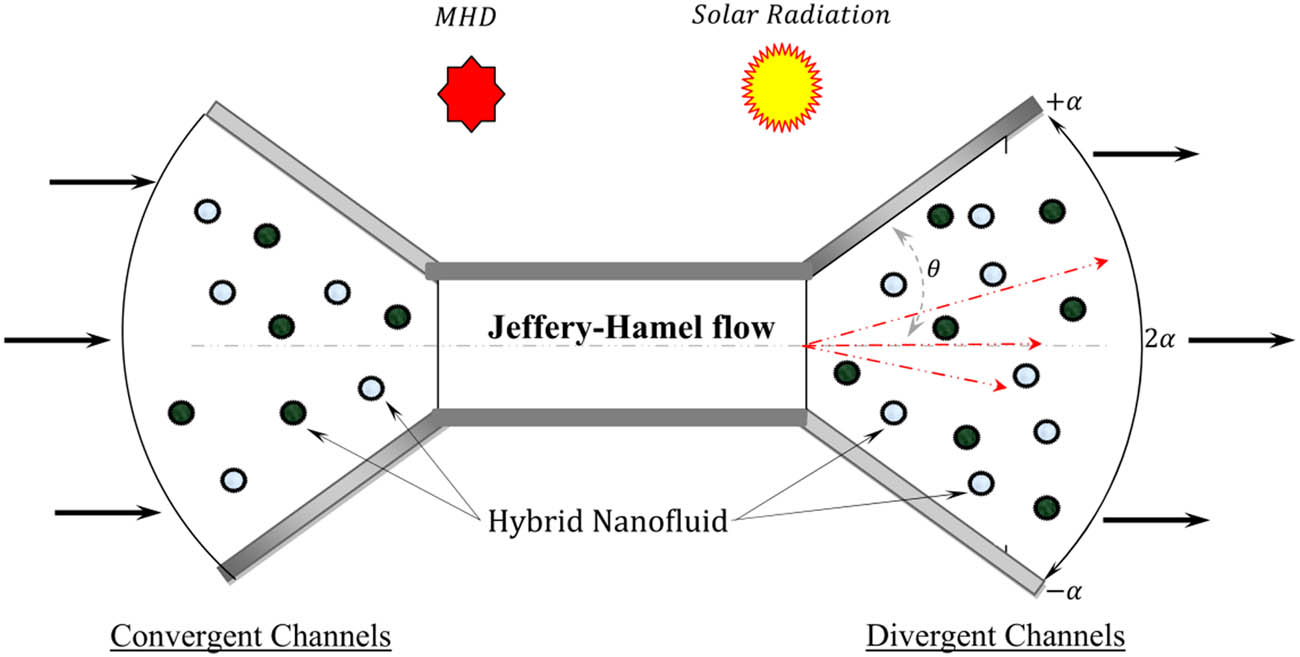
MHD Jeffery–Hamel (J-H) flow.
The Lorentz force is a force affected by the external magnetic field
According to Ohm’s Law, the constancy of electrical current is provided by
where
The continuity and N-S equations of hybrid nanofluid J-H flow for cylindrical coordinates (r, θ, z) are expressed by
And the expressions of energy equation in cylindrical coordinates under external magnetic field, radiation, and heat source are as follows:
Rosseland approximation gives
The boundary conditions are as follows:
The properties of hybrid nanofluid and the thermophysical characteristics of nanoparticles and water are expressed in Tables 1 and 2, respectively.
Characteristics of ternary nanofluids
| Dynamic viscosity |
|
| Density |
|
| Specific heat |
|
| Electrical conductivity |
|
| Thermal conductivity |
|
Thermophysical properties of nanoparticles and liquid-based
| Physical properties |
|
|
|
|
Pr |
|---|---|---|---|---|---|
|
|
997.1 | 4,179 | 0.613 | 5.5 × 10⁶ | 6.2 |
|
|
5,680 | 502 | 1.7 | 3.5 × 10⁶ |
|
|
|
2,650 | 730 | 1.5 | 3.5 × 10⁶ |
|
Introduce non-dimensional terms in the form:
Using equation (10) in (4)–(7) gives
The boundary conditions are as follows:
From equation (9), the quantities
The skin friction coefficient and Nusselt local numbers are as follows:
3 Implementation of the DTM
By using the DTM, a differential equation can be converted into a set of readily solved algebraic equations. The DTM procedure is shown in a flow chart form in Figure 2.

DTM procedure for the present problem.
4 Results and discussion
One of the goals of this research is to investigate the effect of multiple governing parameters on the dimensionless velocity, temperature distributions, and heat transfer rate inside the channel width. These parameters include variable thermal conductivity, nonlinear thermal radiation, Hartman number, and hybrid nanoparticle volume fraction, a set of values for parameters are considered as
4.1 Effect of active parameters on velocity and temperature profile
Figure 3 shows the velocity and temperature changes in divergent and converging channels with different nanoparticle concentrations. Concentration does not significantly affect velocity in both channels. Velocity towards the centre has larger values, and convergent channels have more intense velocity changes. Concentration changes significantly affect channel temperature, with more intensity towards the centre. Physically, the basic liquid becomes denser and the nanoliquid density increases when nanoparticles are added. As a result, moving through the canal is more challenging.

Figure 4 shows the effect of Reynolds parameter on velocity and temperature of the hybrid nanofluid in both channels. The Reynolds parameter increases velocity on the wall, affecting velocity variations and temperature conditions in the diverging channel, with the effect being more intense at a certain distance from the wall. In addition, the temperature decreases in the divergent channel causing the thermal boundary layer to increase. However, in a convergent channel, the velocity profile remains constant while the thickness of the momentum boundary layer drops, the thermal boundary layer raises with a significant drop in temperature magnitude.

Figure 5 shows the effect of Ha parameter on velocity and temperature of the hybrid nanofluid in both channels. As the parameter increases, the Lorentz force, a force resulting from the interaction between the magnetic field and the hybrid nanofluid, becomes more significant, causing deviations from traditional flow patterns. On the other hand, this is mainly explained by the stabilizing influence of an external magnetic field, which creates a Lorentz force opposed to the direction of flow. Consequently, the backflow phenomenon entirely vanishes at both the upper and bottom walls of divergent and convergent flow. This force also affects temperature distribution by altering thermal conductivity and heat dissipation, particularly near the walls.

Figure 6 shows the effect of variable thermal conductivity parameter ε on temperature of the hybrid nanofluid in both channels. The ε parameter increases and the temperature profile plot in the computational domain flattens, indicating a decrease in temperature gradient. The dependence of temperature on ε is stronger for divergent channels, suggesting that channel geometry influences the temperature profiles.

Figure 7 shows the effect of Br parameter on temperature profiles of the hybrid nanofluid in both channels. The temperature of the hybrid nanofluid in a divergent channel is significantly enhanced by increasing Br parameter.

Figure 8 shows the effect of thermal radiation parameter on temperature profiles of the hybrid nanofluid in both channels. This figure of the channel’s temperature leads us to the conclusion that thermal radiation has a greater effect on the temperature close to the wall. As one moves from the wall to the centre of the channel, the radiation impacts actually get smaller.

4.2 Effect of active parameters on heat transfer rate Nu
Figure 9 shows unequivocally how a rise in parameter ε values leads to an increase in the Nusselt number of the hybrid nanofluid in both channels, or in other words, with an increase in the parameter ε, Nu is seen to reduce overall hinting towards lesser fluid flow resistance and heat transfer rate in both channels. It appears that the action of thermal radiation parameter depends on variable thermal conductivity parameter, where performance of Nusselt number can be either enhanced. Possible reason seen is nonlinear thermal radiation.

Nu vs Ra and ϵ for both channels (right: Converging channel; left: Divergent channel).
The Nusselt number evolution is affected by several parameters such as magnetic field and variable thermal conductivity parameter, as shown in Figure 10. It appears that when Hartman number increases, the Nusselt number evolution increases. Furthermore, when we increase the variable thermal conductivity parameter, the Nusselt number shows a little decrease. The Nusselt number evolution is affected by several factors such as Reynolds parameter and variable thermal conductivity parameter, as shown in Figure 11. Clearly, when both the parameters increase, the Nusselt number evolution decreases.

Nu vs Ha and ϵ for both channels (right: Converging channel; left: Divergent channel).

Nu vs Re and ϵ for both channels (right: Converging channel; left: Divergent channel).
4.3 Validation and comparison
Tables 3 and 4 show the results of the comparison between the current results (i.e. both methods: analytical method [DTM] and the homotopy analysis method [HAM]) and those available in previous literature [25–28] for velocity values F when α = −5° and α = +5°, respectively. It is observed that there is an exceptional correlation of the obtained analytical outcomes through the DTM with those available in previous studies [25–28].
Comparison between DTM technique and those available in the literature for
| Re |
|
|
|
|
DTM | HAM-package |
|---|---|---|---|---|---|---|
| 10 | 1.784547 | 1.784546 | 1.78454676648462 | 1.78454676647621 | 1.78454676647543 | 1.784546766475 |
| 30 | 1.413692 | 1.413692 | 1.41369209135674 | 1.41369209136534 | 1.41369209136619 | 1.413692091366 |
| 50 | 1.121989 | 1.121989 | 1.2198919535324 | 1.21989195351279 | 1.21989195351651 | 1.219891953516 |
The bold value shows the results of the (i.e. both methods: analytical method [DTM] and the homotopy analysis method [HAM]) while the rest are values available in previous literature [25–28] for velocity values F when α = −5° and α = +5°, respectively.
Comparison between DTM technique and those available in the literature for
|
|
|
|
|
|
DTM | HAM-package |
|---|---|---|---|---|---|---|
| 10 | 2.527192 | 2.527192 | 2.5271921099786 | 2.5271921099672 | 1.78454676647431 | 1.784546766474 |
| 30 | 3.942140 | 3.942140 | 3.9421401298765 | 3.9421401298543 | 1.41369209136983 | 1.413692091369 |
| 50 | 5.869165 | 5.869165 | 5.8691652309549 | 5.8691652309231 | 1.21989195351178 | 1.219891953511 |
The bold value shows the results of the (i.e. both methods: analytical method [DTM] and the homotopy analysis method [HAM]) while the rest are values available in previous literature [25–28] for velocity values F when α = −5° and α = +5°, respectively.
5 Conclusion
This study focuses on the behaviour of variable thermal conductivity within the MHD framework, with key findings summarizing the research’s significant findings.
Both channels’ velocity is not greatly impacted by concentration, but convergent channels have more dramatic variations in velocity, and channel temperature is greatly impacted by concentration fluctuations.
The variable thermal conductivity influences flow patterns and temperature stratification in nanofluids, highlighting the importance of these parameters in practical applications.
It is noticed that the hybrid nanofluid has higher thermal conductivity and better heat transfer attributes as contrasted to the base fluid, especially at different flow rates.
The evolution of the Nusselt number increases with increase in the Hartman number, while a slight decrease occurs with an increase in the variable thermal conductivity parameter.
The numerical solution using the RKF45 method demonstrates the efficacy of the DTM in solving nonlinear differential equations, matching it precisely.
6 Future work
Future work may be extended from this work as follows:
Investigation of the impact of both variable conductivity (i.e. electrically and thermically) effects.
Artificial neural network scheme can be used to fetch the numerical solution.
-
Funding information: The author states no funding involved.
-
Author contributions: The author confirms the sole responsibility for the conception of the study, presented results, and manuscript preparation.
-
Conflict of interest: The author states no conflict of interest.
-
Ethical approval: The conducted research is not related to either human or animal use.
-
Data availability statement: The datasets generated during and/or analysed during the current study are available from the corresponding author on reasonable request.
References
[1] Khan Y, Abdal S, Hussain S, Siddique I. Numerical simulation for thermal enhancement of H₂O + ethyl glycol base hybrid nanofluid comprising GO + (Ag; AA7072; MoS₂) nano entities due to a stretched sheet. AIMS Math. 2023;8(5):11221–37.10.3934/math.2023568Search in Google Scholar
[2] Murad MA, Hamasalh FK, Ismael HF. Numerical study of stagnation point flow of Casson-Carreau fluid over a continuous moving sheet. AIMS Math. 2023 Jan;8(3):7005–20.10.3934/math.2023353Search in Google Scholar
[3] Alsharari F, Mousa MM. New application of MOL-PACT for simulating buoyancy convection of a copper-water nanofluid in a square enclosure containing an insulated obstacle. AIMS Math. 2022;7:20292–312.10.3934/math.20221111Search in Google Scholar
[4] Hamilton RL, Crosser OK. Thermal conductivity of heterogeneous two-component systems. Ind Eng Chem Fundam. 1962;1(3):187–91.10.1021/i160003a005Search in Google Scholar
[5] Madhukesh JK, Kalleshachar V, Kumar C, Khan U, Nagaraja KV, Sarris IE, et al. A model development for thermal and solutal transport analysis of non-Newtonian nanofluid flow over a riga surface driven by a waste discharge concentration. Water. 2023;15(16):2879.10.3390/w15162879Search in Google Scholar
[6] Srinivas S, Vijayalakshmi A, Ramamohan TR, Reddy AS. Hydromagnetic flow of a nanofluid in a porous channel with expanding or contracting walls. J Porous Media. 2014;17(11):953–67.10.1615/JPorMedia.v17.i11.20Search in Google Scholar
[7] Hemmat Esfe M, Saedodin S. Turbulent forced convection heat transfer and thermophysical properties of Mgo–water nanofluid with consideration of different nanoparticles diameter, an empirical study. J Therm Anal Calorim. 2015;119:1205–13.10.1007/s10973-014-4197-1Search in Google Scholar
[8] Al-Zahrani AA, Adnan MI, Ur Rahman K, Bani-Fwaz MZ, Tag-Eldin E. Analytical study of (Ag–Graphene)/blood hybrid nanofluid influenced by (platelets-cylindrical) nanoparticles and Joule heating via VIM. ACS Omega. 2023;8(22):19926–38.10.1021/acsomega.3c01903Search in Google Scholar PubMed PubMed Central
[9] Ramesh GK, Madhukesh JK, Shehzad SA, Rauf A. Ternary nanofluid with heat source/sink and porous medium effects in stretchable convergent/divergent channel. Proc Inst Mech Eng, Part E: J Process Mech Eng. 2024;238(1):134–43.10.1177/09544089221081344Search in Google Scholar
[10] Fakour M, Vahabzadeh A, Ganji DD. Study of heat transfer and flow of nanofluid in permeable channel in the presence of magnetic field. Propuls Power Res. 2015;4(1):50–62.10.1016/j.jppr.2015.02.005Search in Google Scholar
[11] Mohammadi M, Nassab SG. Combined influences of radiation and inclined magnetic field on natural convection in a cavity with complex geometry. Int Commun Heat Mass Transf. 2022;134:106030.10.1016/j.icheatmasstransfer.2022.106030Search in Google Scholar
[12] Ullah S, Algahtani OJ, Ali A. Thermal analysis of MHD‐modified hybrid nanofluid flow inside convergent/divergent channel with heat generation/absorption and viscous‐ohmic dissipation. Int J Energy Res. 2024;2024(1):3912044.10.1155/2024/3912044Search in Google Scholar
[13] Ramesh GK, Shehzad SA, Tlili I. Hybrid nanomaterial flow and heat transport in a stretchable convergent/divergent channel: a Darcy-Forchheimer model. Appl Math Mech. 2020;41:699–710.10.1007/s10483-020-2605-7Search in Google Scholar
[14] Chamkha AJ, Dogonchi AS, Ganji DD. Magneto-hydrodynamic flow and heat transfer of a hybrid nanofluid in a rotating system among two surfaces in the presence of thermal radiation and Joule heating. AIP Adv. 2019;9(2):025103.10.1063/1.5086247Search in Google Scholar
[15] Waini I, Ishak A, Pop I. Flow and heat transfer along a permeable stretching/shrinking curved surface in a hybrid nanofluid. Phys Scr. 2019;94(10):105219.10.1088/1402-4896/ab0fd5Search in Google Scholar
[16] Anitha L, Gireesha BJ, Keerthi ML. Irreversibility analysis of tangent hyperbolic fluid flow in a microchannel: a hybrid nanoparticles aspects. Phys Scr. 2023;98(3):035220.10.1088/1402-4896/acba53Search in Google Scholar
[17] Anitha L, Gireesha BJ. Convective flow of Jeffrey nanofluid along an upright microchannel with Hall current and Buongiorno model: an irreversibility analysis. Appl Math Mech. 2023;44(9):1613–28.10.1007/s10483-023-3029-6Search in Google Scholar
[18] Chamkha AJ. Solar radiation assisted natural convection in uniform porous medium supported by a vertical flat plate. J Heat Transf. 1997;119(1):89–96.10.1115/1.2824104Search in Google Scholar
[19] Latha R, Kumar BR, Makinde OD. Peristaltic flow of couple stress fluid in an asymmetric channel with partial slip. Defect Diffus Forum. 2018;387:385–402.10.4028/www.scientific.net/DDF.387.385Search in Google Scholar
[20] Shamshuddin MD, Raizah Z, Akkurt N, Patil VS, Eldin SM. Case study of thermal and solutal aspects on non-Newtonian Prandtl hybrid nanofluid flowing via stretchable sheet: multiple slip solution. Case Stud Therm Eng. 2023;49:103186.10.1016/j.csite.2023.103186Search in Google Scholar
[21] Sangeetha E, De P. Bioconvective Casson nanofluid flow toward stagnation point in non‐Darcy porous medium with buoyancy effects, chemical reaction, and thermal radiation. Heat Transf. 2023;52(2):1529–51.10.1002/htj.22753Search in Google Scholar
[22] Kouki M, Ullah I, Ullah S, Alam MM, Khan H, Abdou MM. Exploring the impact of thermal energy and exothermic-endothermic reactions on differential type fluid flow in a convergent/divergent channel. Case Stud Therm Eng. 2024;55:104163.10.1016/j.csite.2024.104163Search in Google Scholar
[23] Khan U, Ahmed N, Mohyud-Din ST. Soret and Dufour effects on Jeffery-Hamel flow of second-grade fluid between convergent/divergent channel with stretchable walls. Results Phys. 2017;7:361–72.10.1016/j.rinp.2016.12.020Search in Google Scholar
[24] Anitha L, Gireesha BJ. Irreversibility scrutiny of chemically reactive Powell–Eyring liquid flow in a microchannel with Buongiorno model: a hybrid nanoparticles aspect. Int J Ambient Energy. 2024;45(1):2310632.10.1080/01430750.2024.2310632Search in Google Scholar
[25] Turkyilmazoglu M. Extending the traditional Jeffery-Hamel flow to stretchable convergent/divergent channels. Comput Fluids. 2014;100:196–203.10.1016/j.compfluid.2014.05.016Search in Google Scholar
[26] Khan U, Ahmed N, Mohyud-Din ST. Thermo-diffusion and diffusion-thermo effects on flow of second grade fluid between two inclined plane walls. J Mol Liq. 2016;224:1074–82.10.1016/j.molliq.2016.10.068Search in Google Scholar
[27] Hamrelaine S, Kezzar M, Sari MR, Eid MR. Analytical investigation of hydromagnetic ferro-nanofluid flowing via rotating convergent/divergent channels. Eur Phys J Plus. 2022;137(11):1291.10.1140/epjp/s13360-022-03480-2Search in Google Scholar
[28] Kezzar M, Darvesh A, Tabet I, Akgül A, Sari MR, Santisteban LJ. DJM solution of MHD flow of ternary hybrid nanofluid between nonparallel porous media channels with velocity slip and radiation effects. Numer Heat Transf Part B: Fundam. 2024;1–21.10.1080/10407790.2024.2341084Search in Google Scholar
© 2025 the author(s), published by De Gruyter
This work is licensed under the Creative Commons Attribution 4.0 International License.
Articles in the same Issue
- Research Articles
- Lie symmetry analysis of bio-nano-slip flow in a conical gap between a rotating disk and cone with Stefan blowing
- Mathematical modelling of MHD hybrid nanofluid flow in a convergent and divergent channel under variable thermal conductivity effect
- Advanced ANN computational procedure for thermal transport prediction in polymer-based ternary radiative Carreau nanofluid with extreme shear rates over bullet surface
- Effects of Ca(OH)2 on mechanical damage and energy evolution characteristics of limestone adsorbed with H2S
- Effect of plasticizer content on the rheological behavior of LTCC casting slurry under large amplitude oscillating shear
- Studying the role of fine materials characteristics on the packing density and rheological properties of blended cement pastes
- Deep learning-based image analysis for confirming segregation in fresh self-consolidating concrete
- MHD Casson nanofluid flow over a three-dimensional exponentially stretching surface with waste discharge concentration: A revised Buongiorno’s model
- Rheological behavior of fire-fighting foams during their application – a new experimental set-up and protocol for foam performance qualification
- Viscoelastic characterization of corn starch paste: (II) The first normal stress difference of a cross-linked waxy corn starch paste
- An innovative rheometric tool to study chemorheology
- Effect of polymer modification on bitumen rheology: A comparative study of bitumens obtained from different sources
- Rheological and irreversibility analysis of ternary nanofluid flow over an inclined radiative MHD cylinder with porous media and couple stress
- Rheological analysis of saliva samples in the context of phonation in ectodermal dysplasia
- Analytical study of the hybrid nanofluid for the porosity flowing through an accelerated plate: Laplace transform for the rheological behavior
- Brief Report
- Correlations for friction factor of Carreau fluids in a laminar tube flow
- Special Issue on the Rheological Properties of Low-carbon Cementitious Materials for Conventional and 3D Printing Applications
- Rheological and mechanical properties of self-compacting concrete with recycled coarse aggregate from the demolition of large panel system buildings
- Effect of the combined use of polyacrylamide and accelerators on the static yield stress evolution of cement paste and its mechanisms
- Special Issue on The rheological test, modeling and numerical simulation of rock material - Part II
- Revealing the interfacial dynamics of Escherichia coli growth and biofilm formation with integrated micro- and macro-scale approaches
- Construction of a model for predicting sensory attributes of cosmetic creams using instrumental parameters based on machine learning
- Effect of flaw inclination angle and crack arrest holes on mechanical behavior and failure mechanism of pre-cracked granite under uniaxial compression
- Special Issue on The rheology of emerging plant-based food systems
- Rheological properties of pea protein melts used for producing meat analogues
- Understanding the large deformation response of paste-like 3D food printing inks
- Seeing the unseen: Laser speckles as a tool for coagulation tracking
- Composition, structure, and interfacial rheological properties of walnut glutelin
- Microstructure and rheology of heated foams stabilized by faba bean isolate and their comparison to egg white foams
- Rheological analysis of swelling food soils for optimized cleaning in plant-based food production
- Multiscale monitoring of oleogels during thermal transition
- Influence of pea protein on alginate gelation behaviour: Implications for plant-based inks in 3D printing
- Observations from capillary and closed cavity rheometry on the apparent flow behavior of a soy protein isolate dough used in meat analogues
- Special Issue on Hydromechanical coupling and rheological mechanism of geomaterials
- Rheological behavior of geopolymer dope solution activated by alkaline activator at different temperature
- Special Issue on Rheology of Petroleum, Bitumen, and Building Materials
- Rheological investigation and optimization of crumb rubber-modified bitumen production conditions in the plant and laboratory
Articles in the same Issue
- Research Articles
- Lie symmetry analysis of bio-nano-slip flow in a conical gap between a rotating disk and cone with Stefan blowing
- Mathematical modelling of MHD hybrid nanofluid flow in a convergent and divergent channel under variable thermal conductivity effect
- Advanced ANN computational procedure for thermal transport prediction in polymer-based ternary radiative Carreau nanofluid with extreme shear rates over bullet surface
- Effects of Ca(OH)2 on mechanical damage and energy evolution characteristics of limestone adsorbed with H2S
- Effect of plasticizer content on the rheological behavior of LTCC casting slurry under large amplitude oscillating shear
- Studying the role of fine materials characteristics on the packing density and rheological properties of blended cement pastes
- Deep learning-based image analysis for confirming segregation in fresh self-consolidating concrete
- MHD Casson nanofluid flow over a three-dimensional exponentially stretching surface with waste discharge concentration: A revised Buongiorno’s model
- Rheological behavior of fire-fighting foams during their application – a new experimental set-up and protocol for foam performance qualification
- Viscoelastic characterization of corn starch paste: (II) The first normal stress difference of a cross-linked waxy corn starch paste
- An innovative rheometric tool to study chemorheology
- Effect of polymer modification on bitumen rheology: A comparative study of bitumens obtained from different sources
- Rheological and irreversibility analysis of ternary nanofluid flow over an inclined radiative MHD cylinder with porous media and couple stress
- Rheological analysis of saliva samples in the context of phonation in ectodermal dysplasia
- Analytical study of the hybrid nanofluid for the porosity flowing through an accelerated plate: Laplace transform for the rheological behavior
- Brief Report
- Correlations for friction factor of Carreau fluids in a laminar tube flow
- Special Issue on the Rheological Properties of Low-carbon Cementitious Materials for Conventional and 3D Printing Applications
- Rheological and mechanical properties of self-compacting concrete with recycled coarse aggregate from the demolition of large panel system buildings
- Effect of the combined use of polyacrylamide and accelerators on the static yield stress evolution of cement paste and its mechanisms
- Special Issue on The rheological test, modeling and numerical simulation of rock material - Part II
- Revealing the interfacial dynamics of Escherichia coli growth and biofilm formation with integrated micro- and macro-scale approaches
- Construction of a model for predicting sensory attributes of cosmetic creams using instrumental parameters based on machine learning
- Effect of flaw inclination angle and crack arrest holes on mechanical behavior and failure mechanism of pre-cracked granite under uniaxial compression
- Special Issue on The rheology of emerging plant-based food systems
- Rheological properties of pea protein melts used for producing meat analogues
- Understanding the large deformation response of paste-like 3D food printing inks
- Seeing the unseen: Laser speckles as a tool for coagulation tracking
- Composition, structure, and interfacial rheological properties of walnut glutelin
- Microstructure and rheology of heated foams stabilized by faba bean isolate and their comparison to egg white foams
- Rheological analysis of swelling food soils for optimized cleaning in plant-based food production
- Multiscale monitoring of oleogels during thermal transition
- Influence of pea protein on alginate gelation behaviour: Implications for plant-based inks in 3D printing
- Observations from capillary and closed cavity rheometry on the apparent flow behavior of a soy protein isolate dough used in meat analogues
- Special Issue on Hydromechanical coupling and rheological mechanism of geomaterials
- Rheological behavior of geopolymer dope solution activated by alkaline activator at different temperature
- Special Issue on Rheology of Petroleum, Bitumen, and Building Materials
- Rheological investigation and optimization of crumb rubber-modified bitumen production conditions in the plant and laboratory
