Correlations for friction factor of Carreau fluids in a laminar tube flow


Abstract
This study presents an improved approach to correlating the Darcy friction factor for a fully developed laminar flow of Carreau fluids in circular pipes. The Carreau model stands as an essential representation of viscosity behavior and captures the complex rheological characteristics of polymeric fluids. By deriving a semi-analytical form of the Darcy friction factor, the study enables rapid and repeated evaluations across diverse flow conditions, facilitating the development of an explicit correlation. This improved correlation, built upon extensive data analysis, offers enhanced accuracy and broader applicability in predicting fluid behavior. The practical significance of this advancement is demonstrated through its successful application in calculating pressure drops for polymer melt and blood flows, highlighting its potential impact on industries ranging from materials processing to biomedical engineering. This work not only contributes to the theoretical understanding of non-Newtonian fluid dynamics but also provides a valuable tool for engineers dealing with complex fluid systems in circular pipes.
Nomenclature
-
-
Darcy friction factor
-
-
Darcy friction factor for a Newtonian fluid
-
-
Poiseuille number
-
-
intermediate function
-
-
WRM integral
-
-
approximated consistency
-
-
index in the viscosity model
-
-
apparent index
- n 2
-
modified apparent index
-
-
pressure
-
-
flow rate
-
-
core flow rate
-
-
radius
-
-
radial position
-
-
Reynolds number
-
-
normalized shear rate ratio
-
-
normalized shear rate ratio using
-
-
normalized shear rate ratio using
-
-
velocity along
-
-
mean velocity
-
-
axial position
-
-
dimensionless apparent shear rate
-
-
shear rate
-
-
apparent shear rate
-
-
wall shear rate
-
-
shear rate ratio
-
-
shear rate ratio of power law
-
-
approximate shear rate ratio using
-
-
approximate shear rate ratio using
-
-
viscosity
-
-
zero-shear viscosity
-
-
apparent viscosity (viscosity at
-
-
power law viscosity
-
-
infinite-shear viscosity
-
-
dimensionless truncation viscosity
-
-
time constant
-
-
density
-
-
shear stress
-
-
wall shear stress
-
-
viscosity ratio
-
-
viscosity ratio for the Carreau model
-
-
viscosity ratio for the power law model
1 Introduction
Laminar flow through circular tubes is a critical aspect of fluid engineering, especially in processes involving generalized Newtonian fluids (GNFs). Accurate evaluation of pressure drops is essential for the precise design of flow systems. The power law model, while effective in approximating shear thinning behavior at high shear rates, has notable limitations at low shear rates. Despite these limitations, its simplicity has facilitated extensive analytical developments and remains a cornerstone tool for designing flow systems of GNF fluids [1,2,3].
Recent advancements in simulation tools have significantly enhanced the evaluation of pressure drops in laminar flow fields, even for complex GNFs [4,5,6]. However, there is a growing need for more accurate friction factor analyses for various GNF models. A recent approach involves using the apparent power law index, determined from the instantaneous slope of the nonlinear constitutive relation in the log–log plane at the apparent shear rate [7]. This method, although applicable to various constitutive models, suffers from errors due to the loose connection between the true wall shear stress and the estimated wall shear stress [2,8].
This study aims to develop an enhanced correlation for the laminar, fully developed tube flow of Carreau fluids [9], building on the functional form proposed by the apparent index method. The Carreau model is a seminal representation of viscosity behavior, capturing the complex rheological characteristics of polymeric fluids with elegance [10,11,12]. By leveraging the Weissenberg–Rabinowitsch–Mooney (WRM) framework [13], we determine the model coefficients through a semi-analytical solution, ensuring high accuracy as long as the solutions of the involved nonlinear equations are precise [9,14].
To construct the correlation model, we introduce the shear rate ratio and viscosity ratio, along with three functions that modify the apparent index. These modifications, proven effective in previous convection analysis, are optimized through an efficient objective function [15]. The parameters of these functions are established and validated through comparison with a foundational dataset derived from the previously mentioned semi-analytical solutions. This methodology significantly lowers computational requirements compared to traditional numerical methods while also enhancing the accuracy of the solutions. As a result, it enables the generation of accurate, exhaustive solutions across a comprehensive range of parameters. The derived correlations undergo rigorous validation against the semi-analytical solutions and existing correlations. Our enhanced correlation not only improves the precision of friction factor estimations but also exhibits remarkable adaptability and real-world applicability. This is evidenced by its successful extension to modeling both polypropylene (PP) melt flow and blood flow dynamics.
2 Formulation
2.1 Pressure gradient and shear stress
Since the pressure gradient in the flow direction x,
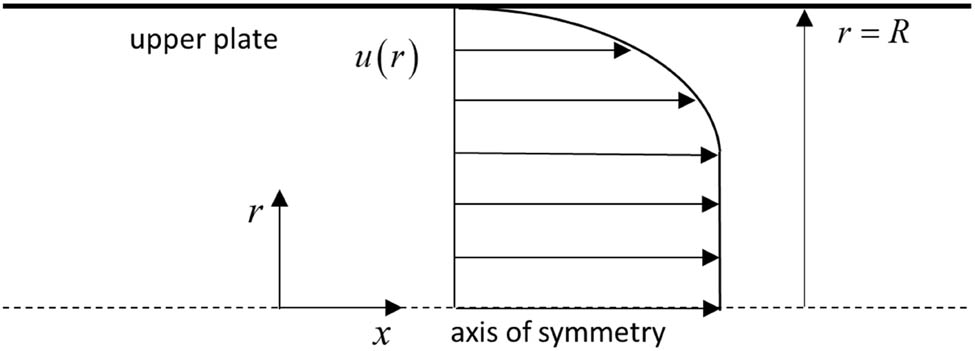
Schematic of the fully developed laminar flow in a circular, straight tube with radius R.
Then, the shear stress is
For a GNF, the shear stress is expressed as
where
2.2 Core flow rate
Considering the flow rate through a subsection with the radius, r, the flow rate through the subsection is expressed as
Let us define the above as the core flow rate at r. Integration of equation (5) by parts gives
Replacing equation (4) in the above equation using equation (2), q(r) is rewritten as
where the integration
Using
Using equation (3), equation (9) can be rewritten as
2.3 Mean velocity
At the tube wall (
The procedure given by equations (4)–(11) is called the aforementioned WRM analysis, and the details can be found in the study of Kim [9]. Now, the mean velocity is obtained by
2.4 Reynolds number
Assuming a Newtonian flow, the apparent shear rate is specified as
Then, the apparent viscosity is set as
Then, let us define the Reynolds number as
where
2.5 Darcy friction factor
The Darcy friction factor can be expressed as
which is the ratio of the wall friction force to the dynamic pressure force. Note that it is four times the Fanning friction factor. Then, the substitution of equations (14) and (15) into equation (16) gives
Then, equation (17) can be rewritten in the form of
where the shear rate ratio
Note that
2.6 Power law models
For a power law fluid, which remains the most significant GNF model [16], the viscosity is described by the equation
where K is the consistency and n is the index. For power law fluids, the ratios by equations (19) and (20) are represented in the form of
For
2.7 Carreau model
The viscosity using the Carreau model is expressed as [10]
where
where
Now, we are ready to calculate
2.8 Viscosity ratio for the Carreau model
The Darcy friction factor in an actual case can be determined with the apparent shear rate by equation (18), which can be rewritten for the Carreau model as
where
2.9 Expressions for correlations
The Carreau fluid renders a viscosity curve, as shown in Figure 2. As shown in the figure, the viscosity behaves like a Newtonian fluid in the low shear rate regime while it behaves like a power law one in the high shear regime. For the power law model, the following identity holds:

Carreau viscosity model with the shear rate.
It should be noted that both
As mentioned,
For a Carreau fluid, the above relation can be rewritten as
Replacing the above quantity into equation (23), we obtain an approximate
Since the velocity profiles by the power law and the Carreau model are different from each other, the core flow rates would be different, and thus, the friction factor. Thus, the mathematical foundation of the method seems weak and is thought to be a phenomenological methodology. Although this method yields an approximate friction factor in an efficient way, the bias from the accurate value is sometimes noticeable. To overcome this bias, this work modifies
where the coefficients
As a result, we have
Then,
The resulting Poiseuille number will be obtained by
When fully expanded, the above expression gives
2.10 Coefficient determination
Since the effects of
The variations related to
The determination procedure requires a regression with the exact data. For
Note that
is solved by using
Note that
Then, the optimization problem is described as
where
Thus, the results for validation will be presented by comparing
3 Results
3.1 Shear rate ratio
As previously discussed, the wall shear rate is used to calculate the shear rate ratio, which in turn allows for the determination of the Poiseuille number. This shear rate ratio is a critical result, providing insights into friction characteristics based on the shear rate. Figure 3 illustrates how

Shear rate ratio
As shown in Figure 3(a), when
3.2 Normalization
Figure 3 shows a similarity in the patterns of change for the parameter


S vs
It is clear that for each n, the results change similarly with respect to
Let us examine the case where n varies for the same

S vs
Despite the potential for minor inaccuracies in solving the nonlinear equation for wall shear rate, the propagation of errors through the friction factor and pressure drop calculations is not expected to be significantly amplified. The sensitivity of the friction factor to changes in the wall shear rate can be expressed as
where
Given that
3.3 Coefficient determination
The optimization process specified by equation (48) using data presented in Figure 4 was conducted. The optimization yielded a set of functions with specific coefficients, which are as follows:
Upon examination, it was observed that the function values exhibit close to unity, indicating that the optimized results do not significantly diverge from the initial
Figure 6 illustrates the comparison of S values calculated using equations (19), (35), and (38). The results demonstrate that the values obtained from equation (35) do not deviate significantly from those derived using equation (19), suggesting limited room for improvement in this approach. However, the graph clearly shows that equation (38) yields noticeably improved results, indicating a more effective solution to the problem at hand. When calculating the overall correlation across the entire range, both cases yield a value of 0.999. However, in the shear rate range of 1–100 s−1, the n
1 approximation results in a correlation of 0.985, while the n
2 approximation yields 0.999. The difference becomes more pronounced when examining maximum errors. As shown in Figure 6(a), when

3.4 Application
In this study, the PP melt, blood flow, and solvent-based coating paste were chosen as validation cases due to their representative nature as Carreau fluids. These non-Newtonian fluids exemplify shear-thinning behavior and hold significant importance in their respective fields: polymer processing for PP melt and the coating paste and biomedical applications for blood flow. These fluids offer rich experimental datasets and cover diverse ranges of viscosity and shear rates, allowing for comprehensive model validation across different conditions.
The Carreau model effectively describes the viscosity of PP melts. Studies have shown that PP melts exhibit a secondary Newtonian plateau at extremely high shear rates, typically between 106 and 107, which are impractical for most processing conditions. Therefore, it is reasonable to assume that
To illustrate the application of this model, consider the melt flow through a straight tube with a length of 1 m and a diameter of 10 mm, varying the flow rate from 10−8 to 0.001 m3/s (0.01–1,000 cm3/s). The analysis of this flow scenario yields insights into the relationship between the flow rate, friction factor, and pressure drop. As the flow rate increases from 0.01 to 1,000 cm3/s, both f and
To account for shear heating effects, it is required to consider how viscosity changes with temperature rather than relying on an isothermal viscosity model. This consideration, however, falls outside the scope of the current study. The impact of shear heating is complex, depending on multiple fluid properties, including density, thermal conductivity, and heat capacity. As a result, it becomes challenging to validate the isothermal assumption by simply examining the total heat generation, which is typically calculated as the product of pressure drop and flow rate. A more comprehensive analysis would be required to accurately assess the significance of shear heating in the system [18]. Additionally, the Reynolds number should be verified to ensure that laminar flow conditions are maintained; in this particular case, the Re values remain well below the critical threshold for turbulent flow.
Figure 7(a) illustrates that the friction factor decreases as the flow rate increases, which is a characteristic phenomenon observed in shear-thinning fluids. As a result, the rate of pressure drop increase diminishes significantly after the inflection point of viscosity. This is associated with shear thinning, which is a result of chain alignment in polymer solutions or melts. When subjected to shear forces, the long, flexible polymer chains tend to orient themselves in the direction of flow. This alignment reduces the overall resistance to flow, leading to a decrease in viscosity as the shear rate increases [19]. Furthermore, we conducted a comparison between the pressure drop obtained through direct integration and that calculated using our proposed correlation. The figure demonstrates that these two sets of results are virtually indistinguishable, exhibiting an exceptionally close match. The root mean square error of the value obtained through correlation, compared to the value obtained through integration, is 0.023%. This high degree of agreement strongly supports the accuracy and validity of the developed correlation, effectively proving its reliability for practical applications. At a shear rate of 1,000/s, a 1% error in the wall shear rate results in errors of 1.6% in the friction factor and 0.96% in the pressure drop. In contrast, at a lower shear rate of 1 s−1, the same 1% error leads to smaller errors: 0.97% in the friction factor and 0.43% in the pressure drop. These findings support the earlier assertion that the evaluation demonstrates low sensitivity to unexpected errors.
![Figure 7
Pressure drop and friction factor plotted against the flow rate for (a) the PP melt [17], (b) blood [20], and (c) coating paste with solvent fractions of 1 and 4% [21]. The left vertical axis represents the pressure drop, while the right vertical axis represents friction.](/document/doi/10.1515/arh-2025-0033/asset/graphic/j_arh-2025-0033_fig_007.jpg)
As a second case, a typical human blood, which shows the secondary Newtonian plateau, is considered (
Upon closer inspection of Figure 7(b), one can observe that near the inflection point, the line representing the integrated values passes slightly below the center of the circular markers, indicating the correlation-derived values. This minor deviation is a manifestation of the error that occurs in Figure 6(b). Nevertheless, from an engineering perspective, this discrepancy is negligible and does not introduce significant errors that would impact the practical use of the correlation. The root mean square error of the value derived from correlation, relative to the value from integration, is 0.34%. The level of accuracy remains sufficient for engineering applications. Overall, the results demonstrate that the proposed method can accurately predict flow characteristics for Carreau fluids.
Additionally, let us consider the case of transporting paste used for fiber coating. It is known that viscosity changes significantly depending on the solvent fraction. According to the literature, when the solvent fraction is 1%, the viscosity parameters are
Figure 7(c) shows that for 1% solvent, f decreases relatively linearly, while for 4% solvent, the index decreases and an inflection occurs in f due to shear thinning. As a result, at a flow rate of
The application of this correlation is limited to the fully developed, isothermal single-phase laminar flow in straight tubes with uniform diameter, which guarantees a constant pressure gradient along the flow. It is important to note that the isothermal assumption may break down in cases of substantial shear heating, potentially resulting in viscosity reduction. Therefore, the current correlation cannot be directly applied to flows that involve transience, multiphase conditions, developments, curved geometry, compressibility [22], variable diameters, and turbulence. In addition, while it is highly unlikely that shear rates outside the range presented in this study will be considered, it should be noted that caution should be exercised when using the correlation in unusual situations where n < 0.05 or
4 Conclusions
This work presents procedures for determining the Darcy friction factor for fully developed laminar flow of Carreau fluids in straight, circular tubes. In non-Newtonian flow, it has been demonstrated that the Darcy friction factor can be obtained using the ratio of the wall shear rate to the apparent shear rate. Therefore, it is necessary to accurately determine the wall shear rate under specific flow conditions.
For Carreau fluids, an equation was derived to calculate the wall shear rate for a given flow rate in a steady-state flow through circular tubes. This equation was solved iteratively for various flow rates to obtain baseline data for 19 different values of n, which were used to develop a correlation. By introducing a function that improves upon the existing method of simply using the apparent index, a new correlation was established. The correlation was found to be accurate for a wide range of shear rates. Its accuracy has been verified by applying it to the flow of the PP melt and blood flow.
The optimization technique developed in this study demonstrates significant potential for broader application across various viscosity models, offering a pathway to improve the accuracy of friction factor correlations for non-Newtonian fluids in general. By extending this method beyond Carreau fluids to encompass other models, such as Herschel–Bulkley or cross, researchers could establish more precise friction factor correlations applicable to a wider spectrum of non-Newtonian fluids. Furthermore, incorporating slip considerations into the correlation provides valuable insights for the design of flow systems, enhancing their efficiency and performance. This comprehensive approach not only advances our understanding of complex fluid behaviors but also offers practical tools for engineering applications involving non-Newtonian flows.
-
Funding information: This work was supported by NRF grants funded by the Korean government (NRF-2018R1A5A1024127 and 2020R1I1A2065650).
-
Author contribution: The author confirms the sole responsibility for the conception of the study, presented results and manuscript preparation.
-
Conflict of interest: The author declare no conflict of interest.
-
Ethical approval: The conducted research is not related to either human or animal use.
-
Data availability statement: All data generated or analyzed during this study are included in this published article.
References
[1] Skelland AHP. Non-Newtonian flow and heat transfer. New York: Wiley; 1966.Suche in Google Scholar
[2] Han C. Rheology and processing of polymeric materials: Volume 1: Polymer Rheology. Oxford: Oxford University Press; 2007.10.1093/oso/9780195187823.001.0001Suche in Google Scholar
[3] Kim SK, Kazmer DO, Colon AR, Coogan TJ, Peterson AM. Non-Newtonian modeling of contact pressure in fused filament fabrication. J Rheol. 2021;65(1):27–42.10.1122/8.0000052Suche in Google Scholar
[4] Capobianchi M, Wagner D. Heat transfer in laminar flows of extended modified power law fluids in rectangular ducts. Int J Heat Mass Transf. 2010;53:558–63.10.1016/j.ijheatmasstransfer.2009.08.003Suche in Google Scholar
[5] Hong J, Kim SK, Cho YH. Flow and solidification of semi-crystalline polymer during micro-injection molding. Int J Heat Mass Transf. 2020;153:119576.10.1016/j.ijheatmasstransfer.2020.119576Suche in Google Scholar
[6] Kim SK, Kazmer DO. Non-isothermal non-Newtonian three-dimensional flow simulation of fused filament fabrication. Addit Manuf. 2022;55:102833.10.1016/j.addma.2022.102833Suche in Google Scholar
[7] Cruz DA, Coelho PM, Alves MA. A simplified method for calculating heat transfer coefficients and friction factors in laminar pipe flow of non-Newtonian fluids. J Heat Transf. 2012;134(9):091703.10.1115/1.4006288Suche in Google Scholar
[8] Kim SK. Viscosity model based on Giesekus equation. Appl Rheol. 2024;34(1):20240004.10.1515/arh-2024-0004Suche in Google Scholar
[9] Kim SK. Flow-rate based method for velocity of fully developed laminar flow in tubes. J Rheol. 2018;62:1397–407.10.1122/1.5041958Suche in Google Scholar
[10] Carreau PJ, Dekee D, Daroux M. Analysis of the viscous behavior of polymeric solutions. Can J Chem Eng. 1979;57:135–40.10.1002/cjce.5450570202Suche in Google Scholar
[11] Kim SK. Collective viscosity model for shear thinning polymeric materials. Rheol Acta. 2020;59:63–72.10.1007/s00397-019-01180-wSuche in Google Scholar
[12] Kumar M, Mondal PK. Leveraging perturbation method for the analysis of field-driven microflow of Carreau fluid. Microfluid Nanofluid. 2023;27:51.10.1007/s10404-023-02657-0Suche in Google Scholar
[13] Kim SK. Darcy friction factor and Nusselt number in laminar tube flow of Carreau fluid. Rheol Acta. 2022;61(3):243–55.10.1007/s00397-021-01317-wSuche in Google Scholar
[14] Sochi T. Analytical solutions for the flow of Carreau and Cross fluids in circular pipes and thin slits. Rheol Acta. 2015;54:745–56.10.1007/s00397-015-0863-xSuche in Google Scholar
[15] Kim SK. Correlations for convective laminar heat transfer of Carreau fluid in straight tube flow. Energies. 2022;15(7):2368.10.3390/en15072368Suche in Google Scholar
[16] Sarma R, Gaikwad H, Mondal PK. Effect of conjugate heat transfer on entropy generation in slip-driven microflow of power law fluids. Nanoscale Microsc Thermophys Eng. 2017;21(1):26–44.10.1080/15567265.2016.1272655Suche in Google Scholar
[17] Thiébaud F, Gelin JC. Characterization of rheological behaviors of polypropylene/carbon nanotubes composites and modeling their flow in a twin-screw mixer. Compos Sci Technol. 2010;70(4):647–56.10.1016/j.compscitech.2009.12.020Suche in Google Scholar
[18] Ajeeb W, Oliveira MS, Martins N, Murshed SS. Performance evaluation of convective heat transfer and laminar flow of non-Newtonian MWCNTs in a circular tube. Therm Sci Eng Prog. 2021;25:101029.10.1016/j.tsep.2021.101029Suche in Google Scholar
[19] Parisi D, Han A, Seo J, Colby RH. Rheological response of entangled isotactic polypropylene melts in strong shear flows: Edge fracture, flow curves, and normal stresses. J Rheol. 2021;65(4):605–16.10.1122/8.0000233Suche in Google Scholar
[20] ITIS Foundation. Tissue properties [Internet]. Zurich: ITIS Foundation; 2021 [cited 2025 Feb 8]. https://itis.swiss/virtual-population/tissue-properties/database/.Suche in Google Scholar
[21] Zhao X, Stylios GK, Christie RM. Rheological behavior of polymer solutions during fabric coating. J Appl Polym Sci. 2008;107:2317–21.10.1002/app.27289Suche in Google Scholar
[22] Kazmer DO, Colon AR, Peterson AM, Kim SK. Concurrent characterization of compressibility and viscosity in extrusion-based additive manufacturing of acrylonitrile butadiene styrene with fault diagnoses. Addit Manuf. 2021;46:102106.10.1016/j.addma.2021.102106Suche in Google Scholar
© 2025 the author(s), published by De Gruyter
This work is licensed under the Creative Commons Attribution 4.0 International License.
Artikel in diesem Heft
- Research Articles
- Lie symmetry analysis of bio-nano-slip flow in a conical gap between a rotating disk and cone with Stefan blowing
- Mathematical modelling of MHD hybrid nanofluid flow in a convergent and divergent channel under variable thermal conductivity effect
- Advanced ANN computational procedure for thermal transport prediction in polymer-based ternary radiative Carreau nanofluid with extreme shear rates over bullet surface
- Effects of Ca(OH)2 on mechanical damage and energy evolution characteristics of limestone adsorbed with H2S
- Effect of plasticizer content on the rheological behavior of LTCC casting slurry under large amplitude oscillating shear
- Studying the role of fine materials characteristics on the packing density and rheological properties of blended cement pastes
- Deep learning-based image analysis for confirming segregation in fresh self-consolidating concrete
- MHD Casson nanofluid flow over a three-dimensional exponentially stretching surface with waste discharge concentration: A revised Buongiorno’s model
- Rheological behavior of fire-fighting foams during their application – a new experimental set-up and protocol for foam performance qualification
- Viscoelastic characterization of corn starch paste: (II) The first normal stress difference of a cross-linked waxy corn starch paste
- An innovative rheometric tool to study chemorheology
- Effect of polymer modification on bitumen rheology: A comparative study of bitumens obtained from different sources
- Rheological and irreversibility analysis of ternary nanofluid flow over an inclined radiative MHD cylinder with porous media and couple stress
- Rheological analysis of saliva samples in the context of phonation in ectodermal dysplasia
- Analytical study of the hybrid nanofluid for the porosity flowing through an accelerated plate: Laplace transform for the rheological behavior
- 10.1515/arh-2025-0060
- Brief Report
- Correlations for friction factor of Carreau fluids in a laminar tube flow
- Special Issue on the Rheological Properties of Low-carbon Cementitious Materials for Conventional and 3D Printing Applications
- Rheological and mechanical properties of self-compacting concrete with recycled coarse aggregate from the demolition of large panel system buildings
- Effect of the combined use of polyacrylamide and accelerators on the static yield stress evolution of cement paste and its mechanisms
- Special Issue on The rheological test, modeling and numerical simulation of rock material - Part II
- Revealing the interfacial dynamics of Escherichia coli growth and biofilm formation with integrated micro- and macro-scale approaches
- Construction of a model for predicting sensory attributes of cosmetic creams using instrumental parameters based on machine learning
- Effect of flaw inclination angle and crack arrest holes on mechanical behavior and failure mechanism of pre-cracked granite under uniaxial compression
- Special Issue on The rheology of emerging plant-based food systems
- Rheological properties of pea protein melts used for producing meat analogues
- Understanding the large deformation response of paste-like 3D food printing inks
- Seeing the unseen: Laser speckles as a tool for coagulation tracking
- Composition, structure, and interfacial rheological properties of walnut glutelin
- Microstructure and rheology of heated foams stabilized by faba bean isolate and their comparison to egg white foams
- Rheological analysis of swelling food soils for optimized cleaning in plant-based food production
- Multiscale monitoring of oleogels during thermal transition
- Influence of pea protein on alginate gelation behaviour: Implications for plant-based inks in 3D printing
- Observations from capillary and closed cavity rheometry on the apparent flow behavior of a soy protein isolate dough used in meat analogues
- Special Issue on Hydromechanical coupling and rheological mechanism of geomaterials
- Rheological behavior of geopolymer dope solution activated by alkaline activator at different temperature
- Special Issue on Rheology of Petroleum, Bitumen, and Building Materials
- Rheological investigation and optimization of crumb rubber-modified bitumen production conditions in the plant and laboratory
Artikel in diesem Heft
- Research Articles
- Lie symmetry analysis of bio-nano-slip flow in a conical gap between a rotating disk and cone with Stefan blowing
- Mathematical modelling of MHD hybrid nanofluid flow in a convergent and divergent channel under variable thermal conductivity effect
- Advanced ANN computational procedure for thermal transport prediction in polymer-based ternary radiative Carreau nanofluid with extreme shear rates over bullet surface
- Effects of Ca(OH)2 on mechanical damage and energy evolution characteristics of limestone adsorbed with H2S
- Effect of plasticizer content on the rheological behavior of LTCC casting slurry under large amplitude oscillating shear
- Studying the role of fine materials characteristics on the packing density and rheological properties of blended cement pastes
- Deep learning-based image analysis for confirming segregation in fresh self-consolidating concrete
- MHD Casson nanofluid flow over a three-dimensional exponentially stretching surface with waste discharge concentration: A revised Buongiorno’s model
- Rheological behavior of fire-fighting foams during their application – a new experimental set-up and protocol for foam performance qualification
- Viscoelastic characterization of corn starch paste: (II) The first normal stress difference of a cross-linked waxy corn starch paste
- An innovative rheometric tool to study chemorheology
- Effect of polymer modification on bitumen rheology: A comparative study of bitumens obtained from different sources
- Rheological and irreversibility analysis of ternary nanofluid flow over an inclined radiative MHD cylinder with porous media and couple stress
- Rheological analysis of saliva samples in the context of phonation in ectodermal dysplasia
- Analytical study of the hybrid nanofluid for the porosity flowing through an accelerated plate: Laplace transform for the rheological behavior
- 10.1515/arh-2025-0060
- Brief Report
- Correlations for friction factor of Carreau fluids in a laminar tube flow
- Special Issue on the Rheological Properties of Low-carbon Cementitious Materials for Conventional and 3D Printing Applications
- Rheological and mechanical properties of self-compacting concrete with recycled coarse aggregate from the demolition of large panel system buildings
- Effect of the combined use of polyacrylamide and accelerators on the static yield stress evolution of cement paste and its mechanisms
- Special Issue on The rheological test, modeling and numerical simulation of rock material - Part II
- Revealing the interfacial dynamics of Escherichia coli growth and biofilm formation with integrated micro- and macro-scale approaches
- Construction of a model for predicting sensory attributes of cosmetic creams using instrumental parameters based on machine learning
- Effect of flaw inclination angle and crack arrest holes on mechanical behavior and failure mechanism of pre-cracked granite under uniaxial compression
- Special Issue on The rheology of emerging plant-based food systems
- Rheological properties of pea protein melts used for producing meat analogues
- Understanding the large deformation response of paste-like 3D food printing inks
- Seeing the unseen: Laser speckles as a tool for coagulation tracking
- Composition, structure, and interfacial rheological properties of walnut glutelin
- Microstructure and rheology of heated foams stabilized by faba bean isolate and their comparison to egg white foams
- Rheological analysis of swelling food soils for optimized cleaning in plant-based food production
- Multiscale monitoring of oleogels during thermal transition
- Influence of pea protein on alginate gelation behaviour: Implications for plant-based inks in 3D printing
- Observations from capillary and closed cavity rheometry on the apparent flow behavior of a soy protein isolate dough used in meat analogues
- Special Issue on Hydromechanical coupling and rheological mechanism of geomaterials
- Rheological behavior of geopolymer dope solution activated by alkaline activator at different temperature
- Special Issue on Rheology of Petroleum, Bitumen, and Building Materials
- Rheological investigation and optimization of crumb rubber-modified bitumen production conditions in the plant and laboratory
