Impact of surface and configurational features of chemically synthesized chains of Ni nanostars on the magnetization reversal process
-
Sandhya Ravichandran
 and
Gobind Das
and
Gobind Das

Abstract
Magnetic nanoparticles and nanochains hold significant importance in data storage and biomedical applications due to their small size, high aspect ratio, and distinctive reversal properties. However, these properties are significantly affected by the surface morphology and fine orientational features of the particles. This study systematically examines the magnetic reversal and hysteretic properties of Ni nanostar-chains and their constituent particles, focusing on the surface characteristics and geometric configurations resulting from chemical synthesis. The investigation reveals the influence of surface roughness, manifested as spikes, on the reversal landscape. Additionally, it delves into the impact of structural properties of self-assembled nanochain clusters on the reversal behaviour. The findings offer valuable insights into fundamental magnetic phenomena in chemically synthesized magnetic nanostructures, emphasizing their morphological and geometric characteristics. This approach details minute features of nanostructures, paving the way for advancements in computer memory and biotechnology applications.
1 Introduction
In the field of nanoscience, metallic nanomaterials are substances that display remarkable physical properties at the nanoscale, generally measuring from a few nanometres to several hundred nanometres. Their unique characteristics, especially their intrinsic magnetic [1,2] and plasmonic [3,4] properties, have gained considerable interest and opened up promising applications in various fields [5,6]. Recent advancements in nanomaterial synthesis and nanofabrication techniques have enabled the creation of tailored 2-D and 3-D nanostructures [7,8,9], further broadening the potential applications. One of the key areas where magnetic nanomaterials have shown significant potential is in electronics [10,11,12,13,14]. By incorporating these materials into electronic devices, researchers can exploit their static and dynamic magnetization properties [15,16,17,18] to enhance the performance and functionality of components such as transistors [14,19] and sensors [12,20,21]. This could lead to the development of faster, smaller, and more efficient electronic devices. In addition to electronics, magnetic nanomaterials hold promise for revolutionizing data storage technologies [22,23,24]. Due to their ability to store and manipulate magnetic information at the nanoscale, these materials offer the potential for higher storage densities, faster data access speeds, and increased data retention capabilities. This makes them ideal candidates for next-generation magnetic storage devices, such as hard disk drives [25] and magnetic random-access memory (MRAM) [25,26,27]. Furthermore, magnetic nanomaterials have also attracted attention in the field of biomedical technology [28,29,30]. Researchers have been exploring their use in various biomedical applications, including targeted drug delivery [31], magnetic resonance imaging (MRI) contrast agents [32], and magnetic hyperthermia for cancer therapy [33,34]. The unique magnetic properties of these materials enable precise control and manipulation at the cellular and molecular levels, opening up new possibilities for diagnostics and therapeutics in medicine.
Nickel (Ni) is a widely studied magnetic material because of its distinctive magnetic properties and the potential for economical large-scale production [35]. It boasts high saturation magnetization (M s), notable remanence (M r), and chemical stability. Moreover, its magnetic properties are adjustable based on factors like shape, size, orientation, and surface profile, making it highly versatile for various applications. Additionally, Ni nanoparticles with rough morphology are particularly intriguing due to their elevated surface-to-volume ratio, which enhances catalytic activity and makes them suitable for composite materials. They also exhibit amplified signals in surface-enhanced Raman spectroscopy (SERS) [36,37]. In practical chemical synthesis, Ni nanoparticles often form clusters or chains, where the orientation of these chains within the cluster significantly influences the magnetic response, thus impacting their effectiveness in applications. Therefore, it is essential to gain a comprehensive understanding of the magnetic reversal mechanism in nanochains, focusing particularly on the surface and orientation properties.
In this study, we present the chemical synthesis of Ni nanochains composed of spiky nanostar-shaped particles and examine how their surface roughness and interparticle arrangement influence magnetization reversal. While most earlier studies have investigated reversal in smooth nanostructures such as hexagonal Co platelets or spherical Ni chains [18,38], most simulation work continues to assume idealized geometries with uniform shapes and perfect alignment. Such models often ignore critical features like surface notches, structural irregularities, and misalignments that are inherently present in chemically synthesized systems – limiting the accuracy and relevance of their findings. Our work bridges this gap by systematically varying both the surface spike properties and the degree of chain misalignment, analysing their influence on coercivity (H C), M r, and reversal modes through micromagnetic simulations complemented by experiments. We demonstrate that these often-overlooked morphological and structural factors have a significant impact on reversal dynamics, including the emergence of multimodal switching behaviour. By capturing these realistic features, our study provides a more complete understanding of nanomagnetic behaviour, offering valuable insights for future applications in spintronics, neuromorphic computing, biosensors, and soft magnetic devices.
2 Methods
2.1 Experimental
The synthesis of Ni nanoparticles involves a process that yields unique properties and applications in magnetism due to its enhanced surface-to-volume ratio. The production of the Ni nanostar chains can be achieved by the following method, which is illustrated in Figure 1 [38,39]. A solution comprising 45 mM of nickel chloride (NiCl2) dissolved in ethylene glycol is prepared in a cylindrical beaker, followed by the addition of 0.9 M hydrazine hydrate (N2H5OH) and 0.1 M sodium hydroxide (NaOH) to the NiCl2 solution. The reaction takes place at a controlled temperature range of 70–80°C, which influences the reaction rate and the size distribution of the resulting nanoparticles. The molar ratio between N2H5OH and NaOH is maintained at around 20. Additionally, the pH level of the solution is adjusted to approximately 10. This controlled pH environment provides the optimal conditions for the reaction to progress with desired efficiency. The solution is stirred continuously using a magnetic stirrer at a moderate speed, ensuring coherent rotational motion without inducing turbulence. The stirring produced a gentle, stable vortex, promoting uniform mixing, minimizing shear forces, and aiding in even heat distribution. After approximately 45–60 min of the reaction time, the dark-blue solution gradually transitions to a characteristic grey-black colour. This visual change occurs over a span of several minutes rather than at a distinct moment, serving as a qualitative indicator of Ni nanoparticle synthesis. Near the end of the reduction process, the reaction is gradually terminated by cooling the solution to near 0°C using an ice bath, while continuous stirring is maintained throughout the cooling phase. The synthesis and the cooling process do not employ any external magnetic field, H. From the onset of nucleation, additional Ni atoms are deposited onto existing nuclei, promoting the growth of spherical nanoparticles. As the reaction progresses, nonuniform growth initiates from localized centres on the particle surfaces, giving rise to protrusions or notch-like features, ultimately resulting in star-shaped nanostructures (nanostars). Dipole–dipole interactions among these magnetic nanoparticles promote the self-assembly of interconnected particles. During this process, the particles are suspended in the rotating, viscous solution and undergo circular motion due to continuous stirring. As a result, they experience centrifugal forces proportional to their mass, which dictate their radial positioning within the solution. The synchronized rotation of a large number of similarly sized particles along concentric paths promotes linear aggregation due to the dipolar interaction of the particles, leading to the formation of uniform chain-like assemblies with consistent particle size. With continued deposition, further growth of Ni around these assemblies reinforces and solidifies the chain morphology into a permanent structure. Here, the cooling rate plays a critical role in terminating Ni atom deposition and, consequently, in determining the final shape and morphology of the nanostructures. Rapid or gradual cooling influences how growth fronts are created or suppressed, which directly impacts the formation of distinct nanostructures such as chains or stars.
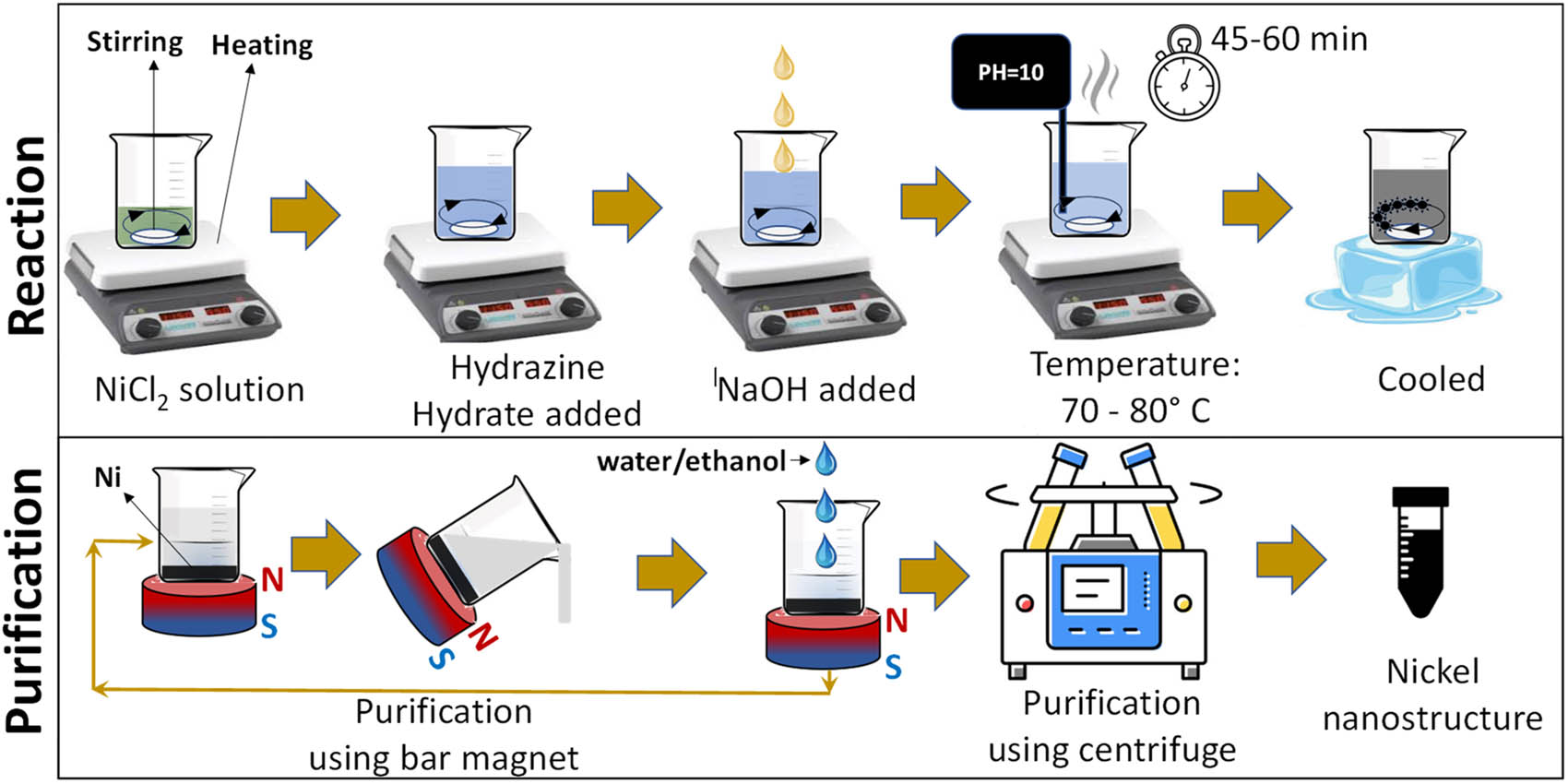
Schematic illustration of the synthesis steps for the nickel (Ni) nanostar chains.
The subsequent step involves purifying the synthesized nanoparticles. The freshly prepared particles are gently washed multiple times with distilled water and ethanol to remove any unreacted precursors or byproducts. In this process, a bar magnet is used to hold the particles inside the beaker. Following this, the particles are collected via centrifugation at 2,000 rpm. After purification, a small volume of highly diluted colloidal solution, containing linear chains of nanostar-shaped particles, is carefully drop-cast onto a pre-cleaned silicon (Si) substrate. These chains initially settle in random orientations on the substrate. An external H of 4 kOe is then applied in-plane using electromagnets. Since the nanochains remain suspended in the colloidal medium, they tend to reorient and align themselves along the direction of the applied H. This leads to partial alignment of the initially disordered chains, as mutual friction restricts free movement. As the solvent gradually evaporates, the field-induced arrangement of the chains is preserved on the substrate.
Regarding the measurement techniques, scanning electron microscopy (SEM) is employed to examine the surface morphology and spatial arrangement of nanostar chain clusters. Energy-dispersive X-ray spectroscopy (EDX) is performed to verify the elemental composition, while magnetic hysteresis characteristics are investigated using a LakeShore 8604 vibrating sample magnetometer (VSM).
2.2 Simulation
In this study, the MuMax3 micromagnetic simulation technique is utilized to investigate the hysteresis loops and reversal mechanisms of Ni nanostar particles and nanostar chains. The magnetization dynamics is governed by the Landau–Lifshitz–Gilbert (LLG) equation, which describes the precessional motion of magnetization under the influence of the effective magnetic field and damping. The LLG equation is given by
3 Results and discussion
3.1 Experimental studies
Figure 2(a) presents an SEM image illustrating the chains of the nanostar particles partially aligned under a H of 4 kOe. These particles, with a median D of 70 nm and about 15% distribution, exhibit a rough surface characterized by distinctive notches. During the chemical synthesis, the particles connect to form straight, rod-like chains, and multiple independent chains assemble into larger clusters. The chains are partially aligned with H during sample preparation, giving the cluster an overall directional characteristic. Due to the mutual friction between the rough surfaces of the chains, their movement in response to H is restricted, resulting in only partial alignment. Achieving perfect alignment would require a stronger H compared to that needed for independent nanoparticles. The inset provides a magnified view of a nanochain, clearly showing the notches that define the surface morphology of the particles. The figure provides a comprehensive visual representation of the nanostar chains and the constituent particles. Figure 2(b) shows EDX results, with peaks corresponding to Ni and Si. The Si peak originates from the Si substrate on which the nanochains are deposited, while the strong presence of Ni peaks confirms that the particles are composed of pure Ni.
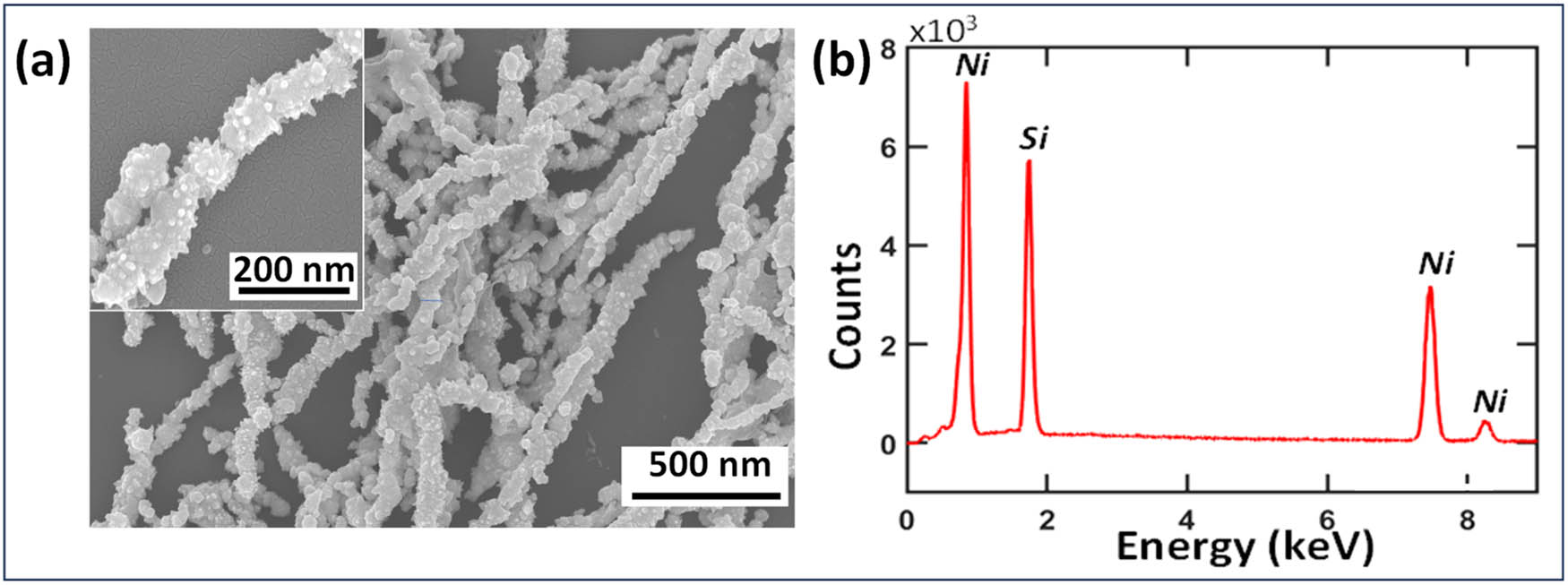
(a) SEM images and (b) EDX analysis of nickel (Ni) nanostar chains. Scale bars for the SEM images are shown in the bottom right corner of each image.
Figure 3 illustrates the magnetic hysteresis properties observed in a cluster of nanochains aligned by H. The experimental measurements are conducted on a cluster of nanochain arrays on a Si substrate, where nanostars are constituent particles overlapping each other to form a chain structure. In this setup, the easy axis aligns with the length of the chain, while any direction perpendicular to it represents the hard axis. The schematic diagram in Figure 3(a) represents a single nanostar array consisting of seven particles along with the H configuration. The black arrow running along the length of the chain denotes the easy axis, corresponding to ϕ = 0°. In contrast, the red arrow perpendicular to it signifies the hard axis, corresponding to ϕ = 90°, where ϕ denotes the angle between the direction of H and the easy axis. The curves in the figure illustrate an experimentally observed magnetic hysteresis loop using VSM at ϕ = 0°, 45°, and 90°. The inset shows an enlarged view of the hysteresis curves at H = −1 to 1 kOe, where a significant difference in the curvature of the hysteresis loops is observed. Figure 3(b) shows the H C and M r from the loops in Figure 3(a). The H C values are 0.21, 0.25, and 0.23 kOe for ϕ = 0°, 45°, and 90°, respectively, with no significant variation. The M r values, defined as the percentage of magnetization remaining relative to the M S at H = 0 during a hysteresis cycle, are measured to be 38, 29, and 16% for ϕ = 0°, 45°, and 90°, respectively. The M s remains constant at 4.0 kOe.
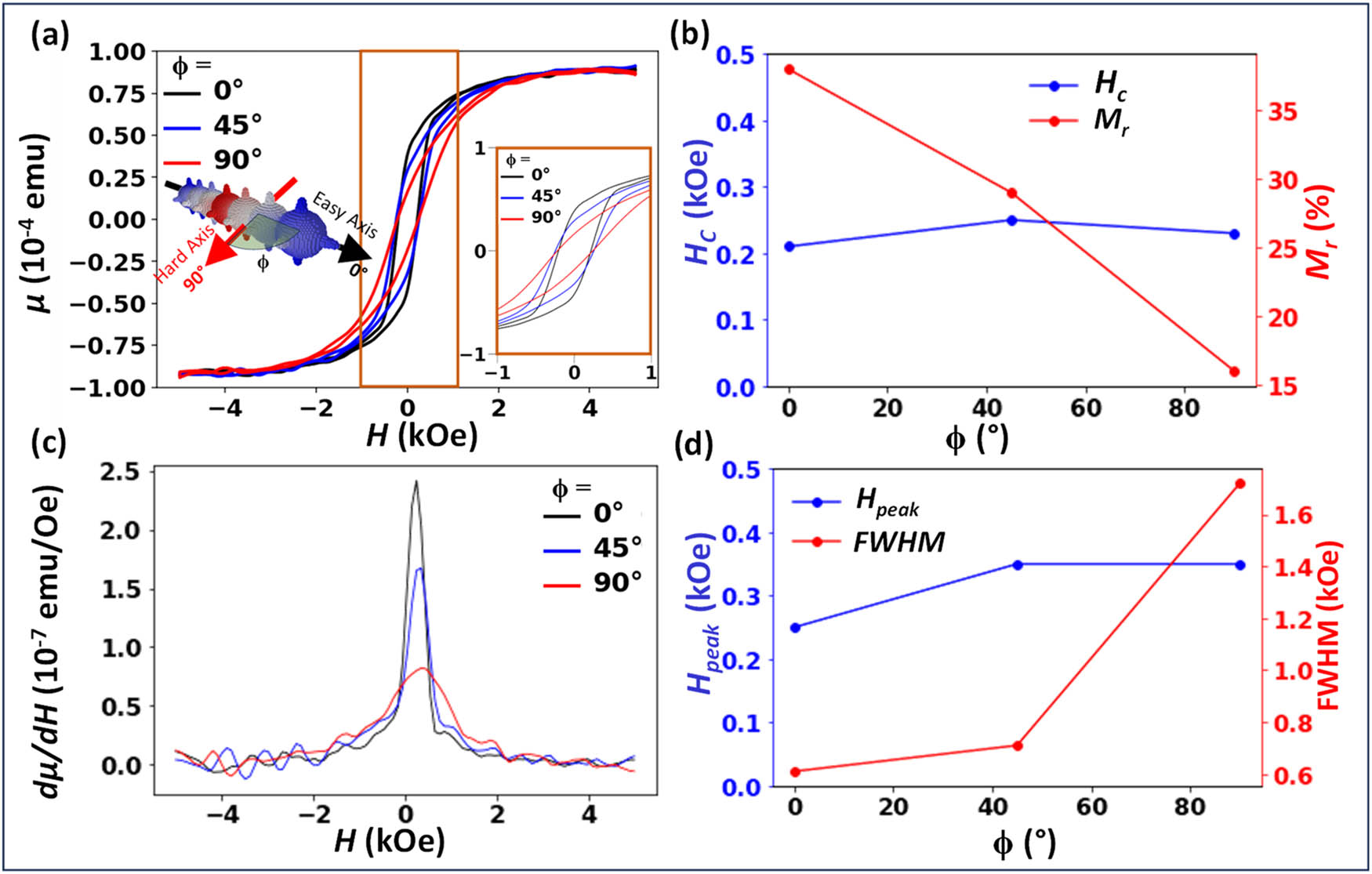
(a) Experimental hysteresis loops (magnetic moment μ vs applied magnetic field H) measured at three different field angles (ϕ = 0°, 45°, and 90°). The inset shows an enlarged view of the central region (H = –1 to 1 kOe), and the schematic of the nickel (Ni) nanostar chain illustrates the field orientation used in the measurements. (b) Coercivity (H c: left y-axis) and remanence (M r: right y-axis) plotted as a function of ϕ. (c) Differential curves (dμ/dH vs H) derived from the one-way hysteresis loops. (d) Peak field (H peak: left y-axis) and FWHM (right y-axis) of the differential curves as a function of ϕ.
The hysteresis loop’s nature is rooted in the process of magnetization reversal that can be analysed through the first derivative of the hysteresis loop. The rate of change in the magnetization with field strength is given by the first derivative of the hysteresis curve (dM/dH), which indicates how quickly a material responds to changes in H. The peaks in the differential curves mark regions of pronounced reversal and energy dissipation. A single sharp peak signifies single-domain coherent rotation, indicating high sensitivity and rapid switching. A broad peak or multiple peaks reflect reversal via multiple domain formation, with likely pinning centres and vortex formation, leading to low-sensitivity, gradual switching.
In Figure 3(c), differential hysteresis curves (one direction: H negative to positive) are analysed. Each curve displays a single peak that broadens as ϕ increases from 0° to 90°, with the highest peak at 0° gradually diminishing with angle. Figure 3(d) shows the position and width of the peaks in Figure 3(c). The peaks occur at H = 0.25, 0.35, and 0.35 kOe, showing a small variation with ϕ similar to H c (Figure 3(b)). The full width at half-maximum (FWHM), which measures the width of the curve, increases sharply with ϕ, indicating progressively slower reversal and greater hysteresis loop curvature, consistent with the reduction in M r (Figure 3(b).
The observed invariance in H C can be attributed to the presence of a characteristic disorder of the experimental system. In partially aligned nanostar-shaped Ni particle chains, the overall anisotropy is intrinsically weak due to the broad distribution of easy axes for individual chains across the ensemble. Within this framework, notches from the nanostar morphology and misalignments of particles within a chain introduce local shape anisotropy along the so-called hard axis, diluting the overall shape anisotropy of the system. Additionally, a large density of structural irregularities, such as notches, bends, shifts, and junctions along the particles, acts as random nucleation centres, where localized domains form and reverse under the influence of edge effects. This mechanism predominantly governs the reversal process, shaping H C in a manner that is largely independent of the rotation angle. The simulation study presented in Figure 5 further supports the invariance of H c with ϕ in a disordered system, as discussed later in the paper.
This variation in the loop curvature, on the other hand, arises from the demagnetizing energy (E D), which originates from dipole–dipole interactions [40,41] between the particles. At ϕ = 90°, the magnetization lies perpendicular to the chain length, leading to a larger stray field leakage and a higher E D. These stray fields are spatially nonuniform and couple through dipole–dipole interactions along the particle chain. The resulting internal fields oppose the applied field, causing different spins or particle segments to experience different effective fields. This promotes gradual, noncoherent rotation rather than sharp switching. In contrast, at ϕ = 0°, E D is lower and the stray field is weaker because the spins largely align with the anisotropy direction. Reversal then proceeds through domain wall rotation with minimal influence from the stray field effect.
3.2 Simulation studies
3.2.1 Single particles
Understanding the behaviour of a single particle is essential for explaining the dynamics of nanochain clusters. Figure 4(a) shows the hysteresis loops that individual spherical particles of different sizes exhibit. As the size increases, H c decreases. Spherical particles with D = 70 nm display the widest square-shaped loop, with H C = 1.72 kOe. For D = 90 nm, the loop becomes narrower with H C = 1.41 kOe. At D = 110 nm, a step-like reversal appears, with H C = 0.96 kOe. Increasing the size further to D = 130 nm results in a more gradual and narrower loop with H C = 0.83 kOe. As the particle diameter increases, the normalized differential curve undergoes notable changes. The single peaks shift to lower fields and broaden, with broadening measured by FWHM or, more effectively, for nonuniform peaks; in this case, by the area under the curve (A). The shift indicates that the highest rate of magnetization reversal occurs at lower fields, consistent with a reduction in H C. The increase in A corresponds to peak broadening, implying that energy dissipation is distributed over a wider field range. For particles with D = 70 nm, a single sharp peak is observed, with the smallest A (= 263 in arbitrary units), suggesting the presence of a single-domain structure. At D = 90 nm, the peak broadens (A = 302), indicating a loss of coherence and deviation from ideal single-domain behaviour. For D = 110 nm, a clear additional peak emerges at a higher field (A = 323), signifying the formation of at least two domains. Finally, D = 130 nm exhibits the broadest peak (A = 423), as reversal spans a wide field range, implying multiple domain formation and a complete loss of coherence. The E D, a key component of the magnetic energy landscape, plays a significant role in interpreting the results presented in Figure 4(a). At the saturation field, E D is determined to be 7.9 × 10⁻¹⁸, 1.7 × 10⁻¹⁷, 3.1 × 10⁻¹⁷, and 5.1 × 10⁻¹⁷ J for D = 70, 90, 110, and 130 nm, respectively, exhibiting a monotonic increase with particle size.
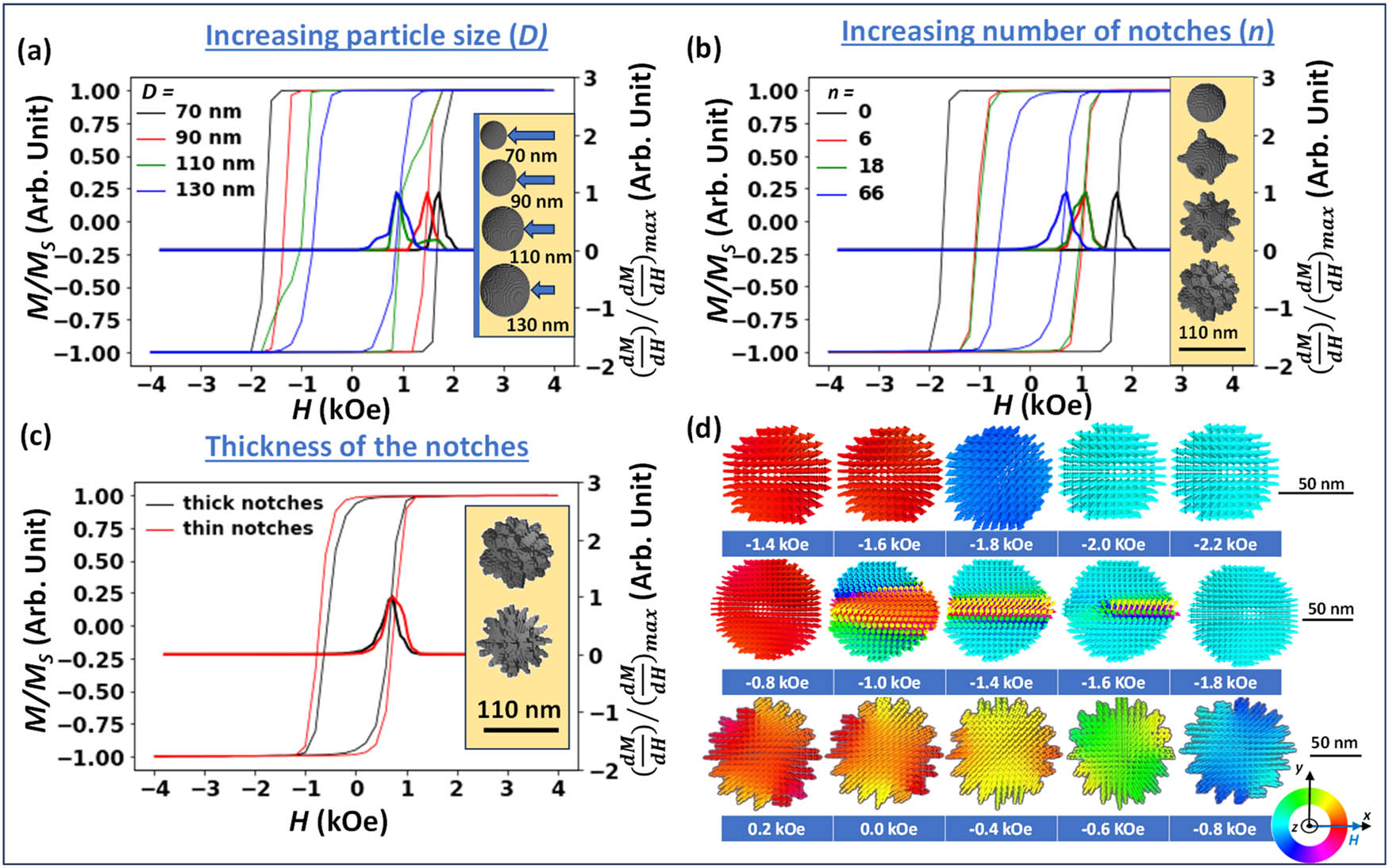
Simulated hysteresis loops (normalized magnetization, M/Mₛ vs magnetic field, H: left y-axis) and differential curves (normalized dM/dH vs. H: right y-axis) are shown for single nanoparticles with variations in (a) diameter (D), (b) number of notches (n), and (c) notch width. Panel (d) displays spin configurations at different values of H during magnetization reversal. The top, middle, and bottom rows correspond to nanoparticles of size D = 70, 110, and 70 nm with 20 nm extruded notches, respectively. Scale bars for the structures in each row are shown on the right side of the corresponding row. The colour map and field orientation are located on the bottom right corner.
Figure 4(b) presents the findings concerning the augmentation of the number of notches (n) on a spherical particle. The diameter of the core is set at 70 nm, and the notches extend 20 nm beyond the sphere’s surface. Four scenarios are explored, featuring n = 0, 6, 18, and 66 notches, respectively. These notches exhibit symmetry along the x, y, and z axes. In the initial scenario, a 70 nm nanosphere is considered. In the second case, cones are affixed atop the core along the ±x, ±y, and ±z axes to form a total of 6 notches. In the subsequent (third) scenario, 18 notches are achieved by rotating and overlaying the first configuration by 45° along each axis. Similarly, the third configuration is rotated by 22.5° along all three axes to yield the final configuration, featuring 66 notches. The result is similar to increasing the size of the particle. With the increasing number of notches, H C reduces, and the broadening of the differential curve occurs, referring to single-to-multiple-domain formation. As the density of notches increases, the structure coincides with the 110 nm sphere. However, H C is smaller, and the differential curve is wider for the notched particles as compared to the 110 nm spherical particle, indicating the role of surface roughness in domain nucleation, which aids multidomain creation. In this system, E D is measured to be 7.9 × 10⁻¹⁸, 8.3 × 10⁻¹⁸, 8.8 × 10⁻¹⁸, and 1.1 × 10⁻¹⁷ J for 0, 6, 18, and 66 notches, respectively. Figure 4(c) compares the thick to thin notch size. H C is larger, and the peak is broader for the thinner notches. This indicates that the pinning of domains is more pronounced for thinner notches.
Figure 4(d) illustrates the magnetization reversal mechanisms through spin configurations and colour mapping at H for three distinct samples. The first sample is a D = 70 nm solid sphere, the second is a D = 110 nm solid sphere, and the third is a notched nanoparticle with D = 70 nm cores and 20 nm notches. The spin configurations shown represent the cross-sectional view of the diameter in the x–y plane. In the first case, the spins rotate coherently from left to right. In the second case, we observe the formation of three distinct reversal domains (H = −1.0 kOe), creating a twisted spin structure. The upper half of the image shows an in-plane anticlockwise rotation, the bottom half shows an in-plane clockwise rotation, and the central part exhibits a vertical (out-of-plane) reversal. This indicates that a single particle demonstrates three different domain wall reversals: two in-plane with opposite chirality and one out-of-plane. The in-plane domain reversal occurs earlier, while the out-of-plane domains take longer to reverse. Initially, the central region resists reversal, but gradually the domain size decreases and eventually reverses through an out-of-plane rotation. In the third scenario, the reversal mechanism is influenced by the size of the notches. The notches aid the formation of smaller local domains, promoting the multidomain feature of reversal.
The reversal characteristics of a single particle observed in this section can be interpreted through several foundational works [42,43]. Based on the size, two different types of distinct reversal mechanisms can be observed in nanoparticles. For particles smaller than the critical diameter D c, reversal occurs through coherent spin rotation within a single domain. The reversal is thermally activated over an anisotropy energy barrier that scales with particle volume, causing H C to increase with size up to D c. When the particle size exceeds D c, multidomain states become energetically favourable. In this multidomain regime, H C decreases with size because, with a larger number of domains, reversal is energetically less costly than coherent rotation. In this regime, domains reverse independently at different field values, producing a gradual hysteresis loop and broadening of the differential curve. From the hysteresis loops (Figure 4(a)) and domain analysis (Figure 4(d)), only the 70 nm particle shows single-domain-like behaviour, while larger sizes display multidomain reversal, with the study range lying near the single-domain critical diameter and extending to the fully multidomain regime. E D increases with the particle size because larger particles generate more extensive stray fields that enhance long-range dipole–dipole coupling, facilitating the destabilization of single-domain configurations and multidomain formation. This, in turn, reduces the field required for reversal. The observed monotonic decrease in H C and an increase in A under the differential curve with increasing particle size are consistent with multidomain behaviour.
In Figure 4(b), the increase in E D from smooth to notched nanospheres is due to both geometric effects and stronger dipole–dipole interactions [40,41]. Surface notches or spikes increase the effective surface area and create regions of high curvature with locally concentrated magnetic charges, producing stronger, more nonuniform stray fields. This elevates local E D with notches that serve as preferential nucleation sites for reversal, allowing domain walls to propagate more readily and lowering coercivity. Smooth nanospheres lack these features, resulting in more coherent reversal and higher switching fields.
3.2.2 Single chains
Figure 5 shows simulated hysteresis loops for seven-particle (D = 70 nm) chains. Figure 5(a–c) illustrates particle-level surface disorder from varying notch sizes (l n = 0, 20, and 35 nm; n = 6), while Figure 5(d–f) depicts chain-level misalignment disorder, where alternate particle centres are periodically displaced by d m rather than all aligned along the chain’s long axis (d m = 0, 20, and 35 nm; l n = 20 nm and n = 6). The top row (Figure 5(a) and (d)), middle row (Figure 5(b) and (e)), and bottom row (Figure 5(c) and (f)) correspond to ϕ = 0° (easy axis), 45°, and 90° (hard axis), respectively. The black hysteresis loops in Figure 5(a)–(c) (without notches), and Figure 5(d)–(f) (aligned chains) represent the reference structures for comparing the effects of particle roughness and chain misalignment on the reversal process.
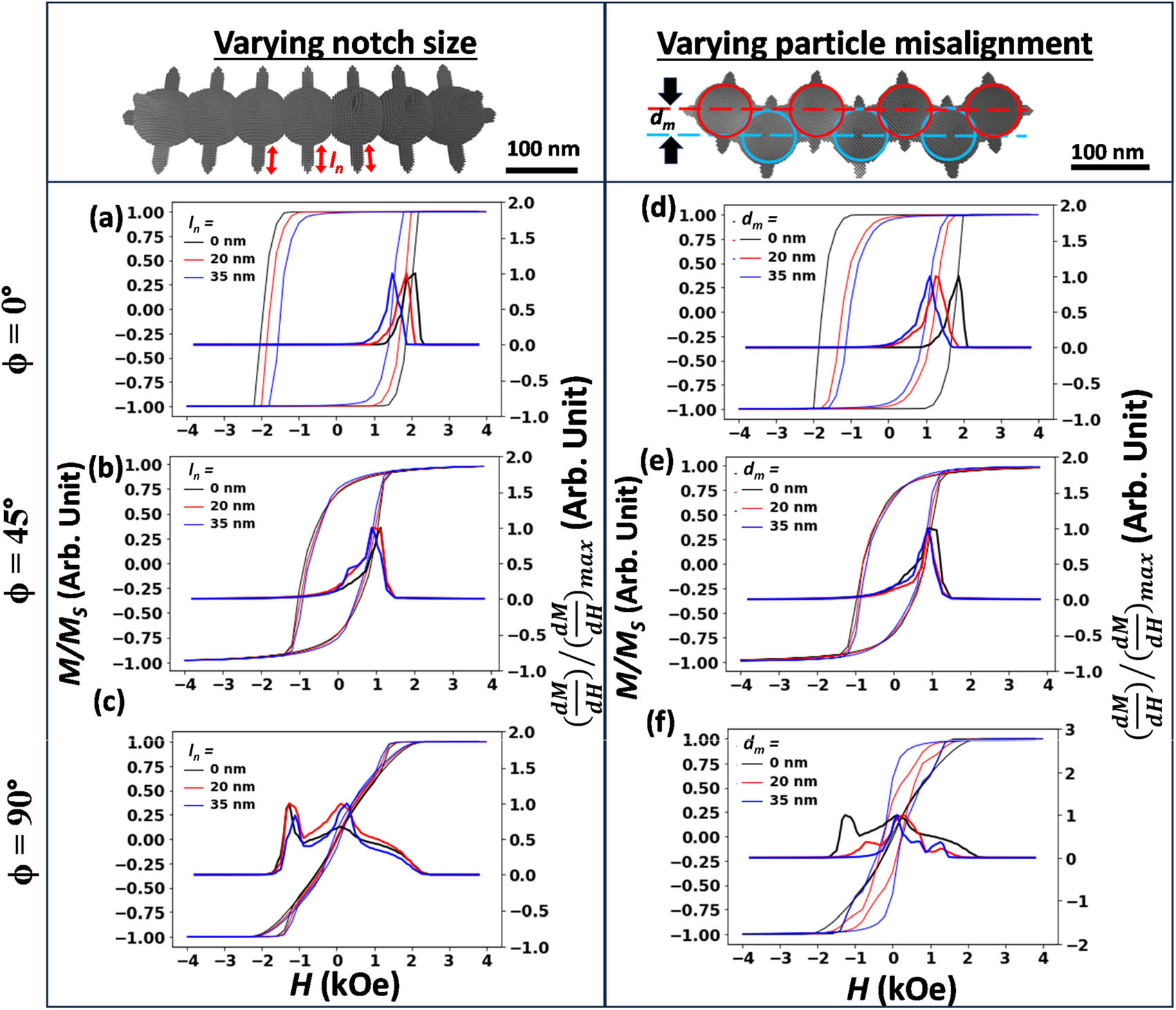
Simulated hysteresis loops (left y-axis) and corresponding differential hysteresis curves (right y-axis) for a single nanostar chain composed of seven particles. Panels (a)–(c) show the effect of varying notch size (l n), while panels (d)–(f) illustrate the effect of misalignment between neighbouring particles (d m). In each panel, the black, red, and blue curves represent field angles ϕ = 0°, 45°, and 90°, respectively.
Figure 5(a) shows hysteresis loops with H C decreasing and notch size (l n) increasing, indicating strong anisotropy along the long axis and easier switching with larger notches. The differential curves display single peaks (broader than individual particles) shifting to lower fields as the loops narrow, with A decreasing from 494 at l n = 0 to 442 at l n = 20 nm and 448 at l n = 35 nm, suggesting slightly more coherent reversal for particles with larger notches. In Figure 5(b), the loops are more curved, with H C and M r markedly lower than those in Figure 5(a) and unaffected by the notch size. The differential curves broaden compared to Figure 5(a) and develop additional modes, indicating multiple switching mechanisms. Figure 5(c) shows negligible H C and M r for the hard-axis loops, indicating a less energetically demanding reversal. The wider differential curves display two distinct modes, reflecting less uniform switching and two magnetization processes with a relative phase of rotation. Notches alter the relative intensities of these modes without shifting their positions, affecting the mode strength distribution but not the modes themselves. A comparison of Figure 5(a) and (c) shows that the contrast in H C between the easy and hard axes diminishes with the introduction of notch disorder, solely due to the reduction of H C along the easy axis relative to the reference structure.
The variation in particle misalignment (Figure 5(d)–(f)) produces effects on the hysteresis curves somewhat similar to those from varying notches (Figure 5(a)–(c)), including a reduction in H C with increasing misalignment disorder along the easy axis (Figure 5(d)) and a decrease in H C with increasing ϕ toward the hard axis (Figure 5(d)–(f)). However, notable differences emerge between the two disorder types. For the easy-axis case, unlike the notch disorder in Figure 5(a), the misalignment disorder in Figure 5(d) introduces curvature in the loop (A = 442, 650, 622 for d m = 0, 20, and 35 nm, respectively). For the hard-axis case, the notch disorder in Figure 5(c) yields negligible H C and M r, with no significant variation across disorder magnitudes. In contrast, misalignment disorder in Figure 5(f) produces marked changes, with H C increasing up to 0.26 kOe and M r zooms up to 56% from near-zero reference values. The differential curve shows complex behaviour, with multiple modes whose peak positions shift as alignment is disturbed, indicating that reversal modes are redefined independently in each case without apparent correlation. A comparison of Figure 5(d) and (f) shows that misalignment disorder greatly reduces the H C contrast between easy and hard axes, driven by both reduced H C along the easy axis and enhanced H C along the hard axis relative to the reference structure. The reduced contrast of H C between the easy and hard axes under notch and misalignment disorder discussed in Figure 5 indicates that, in the experimental system of nanostar-particle chains, multi-scale disorder significantly suppresses the angular dependence of H C, as observed in Figure 3(b).
Figure 6 illustrates the spin configuration during the magnetization reversal process of nanochain structures, with colour mapping representing the in-plane angle of the magnetization vector. The four columns, from left to right, correspond to seven-particle aligned nanochains (D = 70 nm) without notches, with smaller notches (l n = 20 nm and n = 6), larger notches (l n = 35 nm and n = 6), and a chain with misaligned particles (d m = 20 nm, l n = 20 nm and n = 6). The top and bottom rows correspond to reversal along the easy and hard axes, respectively. The colour convention for the magnetization spin configurations along with field orientation is displayed on the right side of each row.
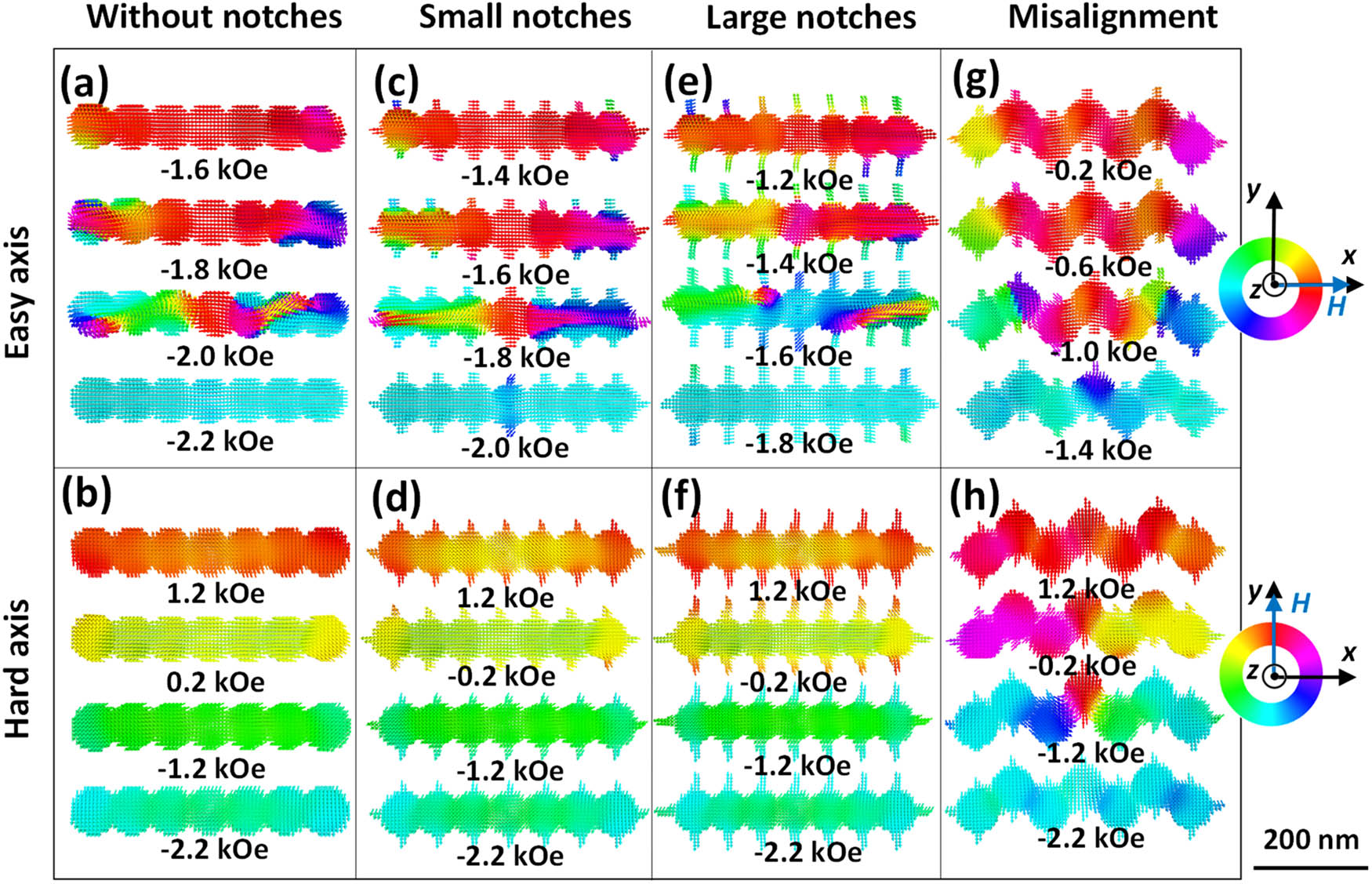
Simulated magnetization reversal behaviour of a single nanostar chain consisting of seven particles, each with a diameter D = 70 nm. Panels (a) and (b) show particles without notches; (c) and (d) with notch length l n = 20 nm; (e) and (f) with notch length l n = 35 nm; and (g) and (h) with particle misalignment d m = 35 nm. Panels (a), (c), (e), and (g), and (b), (d), (f), and (h) represent magnetization reversal along the easy and hard axes, respectively. The colour maps and field orientations for each panel row are shown on the right side of the corresponding row. Scale bars for the structures are provided in the bottom right corner of the figure.
In Figure 6(a), for the chain without notches and with the field applied along the easy axis, the reversal nucleates at the two ends of the chain. Within a short field range, it progresses inward in a spiral motion, ultimately reversing the central part. Figure 6(b) illustrates the reversal along the hard axis, occurring over a much wider field range. In the figure, at least two reversal mechanisms are observed: a smaller group of spins in the central part starts reversing earlier and finishes later, resulting in two distinct modes. With the introduction of notches in the hard-axis loop (Figure 6(d) and (f)), the share of the minority spins zooms, resulting in the variation in the intensity of the modes. The reversal in Figure 6(c) and (e) demonstrates easy-axis coherent rotation similar to Figure 6(a), but the dynamics differ in the presence of notches. In Figure 6(c), the reversal starts at the notches on the particles at the ends of the chain, then propagates through the volume of the particles, and finally, reaches the central particle. In contrast, Figure 6(e) shows that the reversal of the central particle occurs earlier, highlighting the significant role notches play in controlling reversal dynamics. The reversal of misaligned chains in the easy- and hard-axis geometry is significantly different from that in aligned chains. In both cases, a complex reversal process is observed, involving the formation of multiple domains initiated by each overlapping region of the misaligned particles (Figure 6(g) and (h)). When comparing reversals between easy and hard axes, they show more similarities than aligned ones, both with and without notches. This is also evidenced by the reduced H C in the easy-axis hysteresis curve and increased H C in the hard-axis hysteresis curve, as shown in Figure 5(d) and (f), making the loops more comparable. This misalignment effect can be utilized to make the reversal process of a system more uniform across any applied field angles.
A comparison between the experimental and simulation studies reveals that both approaches demonstrate complex domain dynamics during the reversal process, with noticeable variations in the hysteresis loop properties as a function of the field angle, showing consistent trends across both methods. The experimental sample comprises a large number of chains of nanostar particles, each featuring many notch-like protrusions, partially aligned on a 10 nm × 10 nm substrate. Given the constraints of time and computational capacity, replicating every microscopic detail of the experimental sample in simulations is impractical. Instead, key structural features, such as the particle size, notch density, notch dimensions, and particle misalignment within the chains are analysed to understand the reversal mechanism by tracking changes in spin configuration throughout a hysteretic cycle. Theoretical studies reveal that the presence of notches reduces coercivity in the easy axis, while disorders lead to an increased similarity between the easy- and hard-axis hysteresis loops. The findings align well with experimental observations.
4 Conclusions
In conclusion, this study provides an in-depth analysis of the size and surface features of Ni nanoparticles and the alignment characteristics of chains composed of connected nanostar particles, focusing on their impact on magnetization reversal dynamics. Experimental and simulation studies of hysteresis loops and reversal mechanisms are conducted for nanoparticle assembly across various field angles and geometric configurations. Special emphasis is placed on the role of surface roughness featured by symmetrically distributed notches on spherical particles, and the effect of breaking the coaxial alignment of nanochains by introducing an off-axis shift to alternate particles. A detailed investigation is carried out to examine how the notches and misalignments affect the magnetization behaviour of the system. The analysis reveals significant changes in the hysteresis characteristics, as evidenced by variations in both the hysteresis and differential hysteresis curves. Magnetic parameters, like coercivity, remanence, and features of the differential modes, exhibit notable alterations. Additionally, interesting variations in the magnetization reversal mechanisms are observed, indicating a strong sensitivity to structural and geometric properties of nanostar particles/chains. This study significantly advances the understanding of magnetization reversal dynamics in nanoparticle systems by considering more realistic surface and geometric features found in chemically synthesized particles. This improved understanding enhances control over their properties and supports a wide range of nanotechnology applications.
Acknowledgments
This work was supported by research funding from Khalifa University (CIRA 2021-071, project code: 8474000416), National Research Foundation (NRF), Singapore, for grant NRF-CRP21-2018-003, and research funding from SRMIST (SRMIST/R/AR(A)/SERI2024/174/41/342).
-
Funding information: This work was supported by research funding from Khalifa University (CIRA 2021-071, project code: 8474000416), National Research Foundation (NRF), Singapore, for grant NRF-CRP21-2018-003, and research funding from SRMIST (SRMIST/R/AR(A)/SERI2024/174/41/342).
-
Author contributions: All authors have accepted responsibility for the entire content of this manuscript and approved its submission.
-
Conflict of interest: The authors state no conflict of interest.
-
Data availability statement: All data generated or analysed during this study are included in this published article.
References
[1] Barman A, Mondal S, Sahoo S, De A. Magnetization dynamics of nanoscale magnetic materials: A perspective. J Appl Phys. 2020;128(17):170901.10.1063/5.0023993Search in Google Scholar
[2] Rana B, Mondal AK, Bandyopadhyay S, Barman A. Applications of nanomagnets as dynamical systems: I. Nanotechnology. 2021;33(6):062007.10.1088/1361-6528/ac2e75Search in Google Scholar PubMed
[3] Kasani S, Curtin K, Wu N. A review of 2D and 3D plasmonic nanostructure array patterns: fabrication, light management and sensing applications. Nanophotonics. 2019;8(12):2065–89.10.1515/nanoph-2019-0158Search in Google Scholar
[4] Das G, Battista E, Manzo G, Causa F, Netti PA, Di Fabrizio E. Large-scale plasmonic nanocones array for spectroscopy detection. ACS Appl Mater Interfaces. 2015;7(42):23597–23604.10.1021/acsami.5b06887Search in Google Scholar PubMed
[5] Barman A, Gubbiotti G, Ladak S, Adeyeye AO, Krawczyk M, Gräfe J, et al. The 2021 magnonics roadmap. J Phys: Condens Matter. 2021;33(41):413001.10.1088/1361-648X/abec1aSearch in Google Scholar PubMed
[6] de Aberasturi DJ, Serrano‐Montes AB, Liz‐Marzán LM. Modern applications of plasmonic nanoparticles: from energy to health. Adv Opt Mater. 2015;3(5):602–17.10.1002/adom.201500053Search in Google Scholar
[7] Ganguly A, Zafar H, Howells CT, Pereira MF, Das G. Controlling vertical asymmetry of nanocrystals through anisotropic etching‐assisted nanosphere lithography. Small Struct. 2024;5(3):2300300.10.1002/sstr.202300300Search in Google Scholar
[8] Ganguly A, Das G. Stretching the horizon of nanosphere lithography. In: Dipti Ranjan S, editor. Nanofabrication techniques. Rijeka: IntechOpen; 2023. p. Ch. 7.10.5772/intechopen.112026Search in Google Scholar
[9] Ganguly A, Das G. Combining azimuthal and polar angle resolved shadow mask deposition and nanosphere lithography to uncover unique nano-crystals. Nanomaterials. 2022;12(19):3464.10.3390/nano12193464Search in Google Scholar PubMed PubMed Central
[10] Singamaneni S, Bliznyuk VN, Binek C, Tsymbal EY. Magnetic nanoparticles: recent advances in synthesis, self-assembly and applications. J Mater Chem. 2011;21(42):16819–45.10.1039/c1jm11845eSearch in Google Scholar
[11] Lisjak D, Mertelj A. Anisotropic magnetic nanoparticles: A review of their properties, syntheses and potential applications. Prog Mater Sci. 2018;95:286–328.10.1016/j.pmatsci.2018.03.003Search in Google Scholar
[12] Gloag L, Mehdipour M, Chen D, Tilley RD, Gooding JJ. Advances in the application of magnetic nanoparticles for sensing. Adv Mater. 2019;31(48):1904385.10.1002/adma.201904385Search in Google Scholar PubMed
[13] Crisan O, Crisan A, Dumitrache F, Luculescu C. Hybrid nanoelectronic-magnetic device with magnetoresistive core–shell Fe/FeC nanoparticles. Appl Phys A. 2020;126(3):200.10.1007/s00339-020-3378-ySearch in Google Scholar
[14] Bedanta S, Barman A, Kleemann W, Petracic O, Seki T. Magnetic nanoparticles: a subject for both fundamental research and applications. J Nanomater. 2013;2013(1):952540.10.1155/2013/952540Search in Google Scholar
[15] Ganguly A, Zhang S, Miron IM, Kosel J, Zhang X, Manchon A, et al. Competition between chiral energy and chiral damping in the asymmetric expansion of magnetic bubbles. ACS Appl Electron Mater. 2021;3(11):4734–42.10.1021/acsaelm.1c00592Search in Google Scholar
[16] Barman S, Ganguly A, Barman A. Configuration and polarization dependent transverse domain wall motion and domain wall switching in ferromagnetic nanowire. Spin. 2013;3:1350001.10.1142/S201032471350001XSearch in Google Scholar
[17] King J, Ganguly A, Burn D, Pal S, Sallabank E, Hase T, et al. Local control of magnetic damping in ferromagnetic/non-magnetic bilayers by interfacial intermixing induced by focused ion-beam irradiation. Appl Phys Lett. 2014;104(24):242410.10.1063/1.4883860Search in Google Scholar
[18] Mahato B, Ganguly A, Rana B, Barman A. Magnetization reversal in chemically synthesized hexagonal cobalt microplatelets. J Phys Chem C. 2012;116(41):22057–62.10.1021/jp307144jSearch in Google Scholar
[19] Bogani L, Maurand R, Marty L, Sangregorio C, Altavilla C, Wernsdorfer W. Effect of sequential grafting of magnetic nanoparticles onto metallic and semiconducting carbon-nanotube devices: towards self-assembled multi-dots. J Mater Chem. 2010;20(11):2099–107.10.1039/b917111hSearch in Google Scholar
[20] Jiang B, Lian L, Xing Y, Zhang N, Chen Y, Lu P, et al. Advances of magnetic nanoparticles in environmental application: environmental remediation and (bio) sensors as case studies. Environ Sci Pollut Res. 2018;25:30863–79.10.1007/s11356-018-3095-7Search in Google Scholar PubMed
[21] Koh I, Josephson L. Magnetic nanoparticle sensors. Sensors. 2009;9(10):8130–45.10.3390/s91008130Search in Google Scholar PubMed PubMed Central
[22] Mendonsa R, Liang S, Wang J-P. Magnetic nanoparticles (MNPs) based on additively manufactured memory devices. AIP Adv. 2024;14(2):025205.10.1063/9.0000758Search in Google Scholar
[23] Koplovitz G, Primc D, Ben Dor O, Yochelis S, Rotem D, Porath D, et al. Magnetic nanoplatelet‐based spin memory device operating at ambient temperatures. Adv Mater. 2017;29(17):1606748.10.1002/adma.201606748Search in Google Scholar PubMed
[24] Jung JH, Kim S, Kim H, Park J, Oh JH. High‐performance flexible organic nano‐floating gate memory devices functionalized with cobalt ferrite nanoparticles. Small. 2015;11(37):4976–84.10.1002/smll.201501382Search in Google Scholar PubMed
[25] Nallusamy S, Venkidusamy V, Chidhambaram N, Pabba DP, Shanavas S, Thirumurugan A. Functionalized magnetic nanomaterials for data storage applications. In Nanostructured magnetic materials. Boca Raton, Florida, USA: CRC Press; 2023. p. 255–79.10.1201/9781003335580-12Search in Google Scholar
[26] Mitra A, Mohapatra J, Aslam M. Magnetic and electronic properties of anisotropic magnetite nanoparticles. Mater Res Express. 2024;11(2):022002.10.1088/2053-1591/ad2a84Search in Google Scholar
[27] Hai PN, Tanaka M. Memristive magnetic tunnel junctions with MnAs nanoparticles. Appl Phys Lett. 2015;107(12):122404.10.1063/1.4931141Search in Google Scholar
[28] Berry CC, Curtis AS. Functionalisation of magnetic nanoparticles for applications in biomedicine. J Phys D: Appl Phys. 2003;36(13):R198.10.1088/0022-3727/36/13/203Search in Google Scholar
[29] Pankhurst Q, Thanh N, Jones S, Dobson J. Progress in applications of magnetic nanoparticles in biomedicine. J Phys D: Appl Phys. 2009;42(22):224001.10.1088/0022-3727/42/22/224001Search in Google Scholar
[30] Selim MM, El-Safty S, Tounsi A, Shenashen M. A review of magnetic nanoparticles used in nanomedicine. APL Mater. 2024;12(1):010601.10.1063/5.0191034Search in Google Scholar
[31] Kianfar E. Magnetic nanoparticles in targeted drug delivery: a review. J. Supercond. Nov Magn. 2021;34(7):1709–35.10.1007/s10948-021-05932-9Search in Google Scholar
[32] Issa B, Obaidat IM. Magnetic nanoparticles as MRI contrast agents. Magn Reson Imaging. 2019;378(40):10.5772.10.5772/intechopen.84649Search in Google Scholar
[33] Włodarczyk A, Gorgoń S, Radoń A, Bajdak-Rusinek K. Magnetite nanoparticles in magnetic hyperthermia and cancer therapies: Challenges and perspectives. Nanomaterials. 2022;12(11):1807.10.3390/nano12111807Search in Google Scholar PubMed PubMed Central
[34] Farzin A, Etesami SA, Quint J, Memic A, Tamayol A. Magnetic nanoparticles in cancer therapy and diagnosis. Adv Healthc Mater. 2020;9(9):1901058.10.1002/adhm.201901058Search in Google Scholar PubMed PubMed Central
[35] Davar F, Fereshteh Z, Salavati-Niasari M. Nanoparticles Ni and NiO: synthesis, characterization and magnetic properties. J Alloy Compd. 2009;476(1–2):797–801.10.1016/j.jallcom.2008.09.121Search in Google Scholar
[36] Wang L, Wang Z, Li L, Zhang J, Liu J, Hu J, et al. Magnetic–plasmonic Ni@ Au core–shell nanoparticle arrays and their SERS properties. RSC Adv. 2020;10(5):2661–9.10.1039/C9RA10354FSearch in Google Scholar
[37] Fu Q, Wong KM, Zhou Y, Wu M, Lei Y. Ni/Au hybrid nanoparticle arrays as a highly efficient, cost-effective and stable SERS substrate. RSC Adv. 2015;5(8):6172–80.10.1039/C4RA09312GSearch in Google Scholar
[38] Rana B, Ganguly A, Barman A. Magnetic shape anisotropy in chemically synthesized chains of nickel nanoparticles. IEEE Trans Magn. 2011;47(10):2859–62.10.1109/TMAG.2011.2140364Search in Google Scholar
[39] Wu S-H, Chen D-H. Synthesis and characterization of nickel nanoparticles by hydrazine reduction in ethylene glycol. J Colloid Interface Sci. 2003;259(2):282–6.10.1016/S0021-9797(02)00135-2Search in Google Scholar PubMed
[40] Bandyopadhyay M, Dattagupta S. Memory in nanomagnetic systems: Superparamagnetism versus spin-glass behavior. Phys Rev B. 2006;74(21):214410.10.1103/PhysRevB.74.214410Search in Google Scholar
[41] Chakraverty S, Bandyopadhyay M, Chatterjee S, Dattagupta S, Frydman A, Sengupta S, et al. Memory in a magnetic nanoparticle system: Polydispersity and interaction effects. Phys Rev B. 2005;71(5):054401.10.1103/PhysRevB.71.054401Search in Google Scholar
[42] Chakraverty S, Bandyopadhyay M. Coercivity of magnetic nanoparticles: a stochastic model. J Phys: Condens Matter. 2007;19(21):216201.10.1088/0953-8984/19/21/216201Search in Google Scholar
[43] Sung Lee J, Myung Cha J, Young Yoon H, Lee J-K, Keun Kim Y. Magnetic multi-granule nanoclusters: A model system that exhibits universal size effect of magnetic coercivity. Sci Rep. 2015;5(1):12135.10.1038/srep12135Search in Google Scholar PubMed PubMed Central
© 2025 the author(s), published by De Gruyter
This work is licensed under the Creative Commons Attribution 4.0 International License.
Articles in the same Issue
- Research Articles
- MHD radiative mixed convective flow of a sodium alginate-based hybrid nanofluid over a convectively heated extending sheet with Joule heating
- Experimental study of mortar incorporating nano-magnetite on engineering performance and radiation shielding
- Multicriteria-based optimization and multi-variable non-linear regression analysis of concrete containing blends of nano date palm ash and eggshell powder as cementitious materials
- A promising Ag2S/poly-2-amino-1-mercaptobenzene open-top spherical core–shell nanocomposite for optoelectronic devices: A one-pot technique
- Biogenic synthesized selenium nanoparticles combined chitosan nanoparticles controlled lung cancer growth via ROS generation and mitochondrial damage pathway
- Fabrication of PDMS nano-mold by deposition casting method
- Stimulus-responsive gradient hydrogel micro-actuators fabricated by two-photon polymerization-based 4D printing
- Physical aspects of radiative Carreau nanofluid flow with motile microorganisms movement under yield stress via oblique penetrable wedge
- Effect of polar functional groups on the hydrophobicity of carbon nanotubes-bacterial cellulose nanocomposite
- Review in green synthesis mechanisms, application, and future prospects for Garcinia mangostana L. (mangosteen)-derived nanoparticles
- Entropy generation and heat transfer in nonlinear Buoyancy–driven Darcy–Forchheimer hybrid nanofluids with activation energy
- Green synthesis of silver nanoparticles using Ginkgo biloba seed extract: Evaluation of antioxidant, anticancer, antifungal, and antibacterial activities
- A numerical analysis of heat and mass transfer in water-based hybrid nanofluid flow containing copper and alumina nanoparticles over an extending sheet
- Investigating the behaviour of electro-magneto-hydrodynamic Carreau nanofluid flow with slip effects over a stretching cylinder
- Electrospun thermoplastic polyurethane/nano-Ag-coated clear aligners for the inhibition of Streptococcus mutans and oral biofilm
- Investigation of the optoelectronic properties of a novel polypyrrole-multi-well carbon nanotubes/titanium oxide/aluminum oxide/p-silicon heterojunction
- Novel photothermal magnetic Janus membranes suitable for solar water desalination
- Green synthesis of silver nanoparticles using Ageratum conyzoides for activated carbon compositing to prepare antimicrobial cotton fabric
- Activation energy and Coriolis force impact on three-dimensional dusty nanofluid flow containing gyrotactic microorganisms: Machine learning and numerical approach
- Machine learning analysis of thermo-bioconvection in a micropolar hybrid nanofluid-filled square cavity with oxytactic microorganisms
- Research and improvement of mechanical properties of cement nanocomposites for well cementing
- Thermal and stability analysis of silver–water nanofluid flow over unsteady stretching sheet under the influence of heat generation/absorption at the boundary
- Cobalt iron oxide-infused silicone nanocomposites: Magnetoactive materials for remote actuation and sensing
- Magnesium-reinforced PMMA composite scaffolds: Synthesis, characterization, and 3D printing via stereolithography
- Bayesian inference-based physics-informed neural network for performance study of hybrid nanofluids
- Numerical simulation of non-Newtonian hybrid nanofluid flow subject to a heterogeneous/homogeneous chemical reaction over a Riga surface
- Enhancing the superhydrophobicity, UV-resistance, and antifungal properties of natural wood surfaces via in situ formation of ZnO, TiO2, and SiO2 particles
- Synthesis and electrochemical characterization of iron oxide/poly(2-methylaniline) nanohybrids for supercapacitor application
- Impacts of double stratification on thermally radiative third-grade nanofluid flow on elongating cylinder with homogeneous/heterogeneous reactions by implementing machine learning approach
- Synthesis of Cu4O3 nanoparticles using pumpkin seed extract: Optimization, antimicrobial, and cytotoxicity studies
- Cationic charge influence on the magnetic response of the Fe3O4–[Me2+ 1−y Me3+ y (OH2)] y+(Co3 2−) y/2·mH2O hydrotalcite system
- Pressure sensing intelligent martial arts short soldier combat protection system based on conjugated polymer nanocomposite materials
- Magnetohydrodynamics heat transfer rate under inclined buoyancy force for nano and dusty fluids: Response surface optimization for the thermal transport
- Fly ash and nano-graphene enhanced stabilization of engine oil-contaminated soils
- Enhancing natural fiber-reinforced biopolymer composites with graphene nanoplatelets: Mechanical, morphological, and thermal properties
- Performance evaluation of dual-scale strengthened co-bonded single-lap joints using carbon nanotubes and Z-pins with ANN
- Computational works of blood flow with dust particles and partially ionized containing tiny particles on a moving wedge: Applications of nanotechnology
- Hybridization of biocomposites with oil palm cellulose nanofibrils/graphene nanoplatelets reinforcement in green epoxy: A study of physical, thermal, mechanical, and morphological properties
- Design and preparation of micro-nano dual-scale particle-reinforced Cu–Al–V alloy: Research on the aluminothermic reduction process
- Spectral quasi-linearization and response optimization on magnetohydrodynamic flow via stenosed artery with hybrid and ternary solid nanoparticles: Support vector machine learning
- Ferrite/curcumin hybrid nanocomposite formulation: Physicochemical characterization, anticancer activity, and apoptotic and cell cycle analyses in skin cancer cells
- Enhanced therapeutic efficacy of Tamoxifen against breast cancer using extra virgin olive oil-based nanoemulsion delivery system
- A titanium oxide- and silver-based hybrid nanofluid flow between two Riga walls that converge and diverge through a machine-learning approach
- Enhancing convective heat transfer mechanisms through the rheological analysis of Casson nanofluid flow towards a stagnation point over an electro-magnetized surface
- Intrinsic self-sensing cementitious composites with hybrid nanofillers exhibiting excellent piezoresistivity
- Research on mechanical properties and sulfate erosion resistance of nano-reinforced coal gangue based geopolymer concrete
- Impact of surface and configurational features of chemically synthesized chains of Ni nanostars on the magnetization reversal process
- Porous sponge-like AsOI/poly(2-aminobenzene-1-thiol) nanocomposite photocathode for hydrogen production from artificial and natural seawater
- Multifaceted insights into WO3 nanoparticle-coupled antibiotics to modulate resistance in enteric pathogens of Houbara bustard birds
- Synthesis of sericin-coated silver nanoparticles and their applications for the anti-bacterial finishing of cotton fabric
- Enhancing chloride resistance of freeze–thaw affected concrete through innovative nanomaterial–polymer hybrid cementitious coating
- Development and performance evaluation of green aluminium metal matrix composites reinforced with graphene nanopowder and marble dust
- Morphological, physical, thermal, and mechanical properties of carbon nanotubes reinforced arrowroot starch composites
- Influence of the graphene oxide nanosheet on tensile behavior and failure characteristics of the cement composites after high-temperature treatment
- Central composite design modeling in optimizing heat transfer rate in the dissipative and reactive dynamics of viscoplastic nanomaterials deploying Joule and heat generation aspects
- Double diffusion of nano-enhanced phase change materials in connected porous channels: A hybrid ISPH-XGBoost approach
- Synergistic impacts of Thompson–Troian slip, Stefan blowing, and nonuniform heat generation on Casson nanofluid dynamics through a porous medium
- Optimization of abrasive water jet machining parameters for basalt fiber/SiO2 nanofiller reinforced composites
- Enhancing aesthetic durability of Zisha teapots via TiO2 nanoparticle surface modification: A study on self-cleaning, antimicrobial, and mechanical properties
- Nanocellulose solution based on iron(iii) sodium tartrate complexes
- Combating multidrug-resistant infections: Gold nanoparticles–chitosan–papain-integrated dual-action nanoplatform for enhanced antibacterial activity
- Novel royal jelly-mediated green synthesis of selenium nanoparticles and their multifunctional biological activities
- Direct bandgap transition for emission in GeSn nanowires
- Synthesis of ZnO nanoparticles with different morphologies using a microwave-based method and their antimicrobial activity
- Numerical investigation of convective heat and mass transfer in a trapezoidal cavity filled with ternary hybrid nanofluid and a central obstacle
- Halloysite nanotube enhanced polyurethane nanocomposites for advanced electroinsulating applications
- Low molar mass ionic liquid’s modified carbon nanotubes and its role in PVDF crystalline stress generation
- Green synthesis of polydopamine-functionalized silver nanoparticles conjugated with Ceftazidime: in silico and experimental approach for combating antibiotic-resistant bacteria and reducing toxicity
- Evaluating the influence of graphene nano powder inclusion on mechanical, vibrational and water absorption behaviour of ramie/abaca hybrid composites
- Dynamic-behavior of Casson-type hybrid nanofluids due to a stretching sheet under the coupled impacts of boundary slip and reaction-diffusion processes
- Influence of polyvinyl alcohol on the physicochemical and self-sensing properties of nano carbon black reinforced cement mortar
- Review Articles
- A comprehensive review on hybrid plasmonic waveguides: Structures, applications, challenges, and future perspectives
- Nanoparticles in low-temperature preservation of biological systems of animal origin
- Fluorescent sulfur quantum dots for environmental monitoring
- Nanoscience systematic review methodology standardization
- Nanotechnology revolutionizing osteosarcoma treatment: Advances in targeted kinase inhibitors
- AFM: An important enabling technology for 2D materials and devices
- Carbon and 2D nanomaterial smart hydrogels for therapeutic applications
- Principles, applications and future prospects in photodegradation systems
- Do gold nanoparticles consistently benefit crop plants under both non-stressed and abiotic stress conditions?
- An updated overview of nanoparticle-induced cardiovascular toxicity
- Arginine as a promising amino acid for functionalized nanosystems: Innovations, challenges, and future directions
- Advancements in the use of cancer nanovaccines: Comprehensive insights with focus on lung and colon cancer
- Membrane-based biomimetic delivery systems for glioblastoma multiforme therapy
- The drug delivery systems based on nanoparticles for spinal cord injury repair
- Green synthesis, biomedical effects, and future trends of Ag/ZnO bimetallic nanoparticles: An update
- Application of magnesium and its compounds in biomaterials for nerve injury repair
- Micro/nanomotors in biomedicine: Construction and applications
- Hydrothermal synthesis of biomass-derived CQDs: Advances and applications
- Research progress in 3D bioprinting of skin: Challenges and opportunities
- Review on bio-selenium nanoparticles: Synthesis, protocols, and applications in biomedical processes
- Gold nanocrystals and nanorods functionalized with protein and polymeric ligands for environmental, energy storage, and diagnostic applications: A review
- An in-depth analysis of rotational and non-rotational piezoelectric energy harvesting beams: A comprehensive review
- Advancements in perovskite/CIGS tandem solar cells: Material synergies, device configurations, and economic viability for sustainable energy
- Deep learning in-depth analysis of crystal graph convolutional neural networks: A new era in materials discovery and its applications
- Review of recent nano TiO2 film coating methods, assessment techniques, and key problems for scaleup
- Antioxidant quantum dots for spinal cord injuries: A review on advancing neuroprotection and regeneration in neurological disorders
- Rise of polycatecholamine ultrathin films: From synthesis to smart applications
- Advancing microencapsulation strategies for bioactive compounds: Enhancing stability, bioavailability, and controlled release in food applications
- Advances in the design and manipulation of self-assembling peptide and protein nanostructures for biomedical applications
- Photocatalytic pervious concrete systems: from classic photocatalysis to luminescent photocatalysis
- Corrigendum
- Corrigendum to “Synthesis and characterization of smart stimuli-responsive herbal drug-encapsulated nanoniosome particles for efficient treatment of breast cancer”
- Special Issue on Advanced Nanomaterials for Carbon Capture, Environment and Utilization for Energy Sustainability - Part III
- Efficiency optimization of quantum dot photovoltaic cell by solar thermophotovoltaic system
- Exploring the diverse nanomaterials employed in dental prosthesis and implant techniques: An overview
- Electrochemical investigation of bismuth-doped anode materials for low‑temperature solid oxide fuel cells with boosted voltage using a DC-DC voltage converter
- Synthesis of HfSe2 and CuHfSe2 crystalline materials using the chemical vapor transport method and their applications in supercapacitor energy storage devices
- Special Issue on Green Nanotechnology and Nano-materials for Environment Sustainability
- Influence of nano-silica and nano-ferrite particles on mechanical and durability of sustainable concrete: A review
- Surfaces and interfaces analysis on different carboxymethylation reaction time of anionic cellulose nanoparticles derived from oil palm biomass
- Processing and effective utilization of lignocellulosic biomass: Nanocellulose, nanolignin, and nanoxylan for wastewater treatment
- Retraction
- Retraction of “Aging assessment of silicone rubber materials under corona discharge accompanied by humidity and UV radiation”
Articles in the same Issue
- Research Articles
- MHD radiative mixed convective flow of a sodium alginate-based hybrid nanofluid over a convectively heated extending sheet with Joule heating
- Experimental study of mortar incorporating nano-magnetite on engineering performance and radiation shielding
- Multicriteria-based optimization and multi-variable non-linear regression analysis of concrete containing blends of nano date palm ash and eggshell powder as cementitious materials
- A promising Ag2S/poly-2-amino-1-mercaptobenzene open-top spherical core–shell nanocomposite for optoelectronic devices: A one-pot technique
- Biogenic synthesized selenium nanoparticles combined chitosan nanoparticles controlled lung cancer growth via ROS generation and mitochondrial damage pathway
- Fabrication of PDMS nano-mold by deposition casting method
- Stimulus-responsive gradient hydrogel micro-actuators fabricated by two-photon polymerization-based 4D printing
- Physical aspects of radiative Carreau nanofluid flow with motile microorganisms movement under yield stress via oblique penetrable wedge
- Effect of polar functional groups on the hydrophobicity of carbon nanotubes-bacterial cellulose nanocomposite
- Review in green synthesis mechanisms, application, and future prospects for Garcinia mangostana L. (mangosteen)-derived nanoparticles
- Entropy generation and heat transfer in nonlinear Buoyancy–driven Darcy–Forchheimer hybrid nanofluids with activation energy
- Green synthesis of silver nanoparticles using Ginkgo biloba seed extract: Evaluation of antioxidant, anticancer, antifungal, and antibacterial activities
- A numerical analysis of heat and mass transfer in water-based hybrid nanofluid flow containing copper and alumina nanoparticles over an extending sheet
- Investigating the behaviour of electro-magneto-hydrodynamic Carreau nanofluid flow with slip effects over a stretching cylinder
- Electrospun thermoplastic polyurethane/nano-Ag-coated clear aligners for the inhibition of Streptococcus mutans and oral biofilm
- Investigation of the optoelectronic properties of a novel polypyrrole-multi-well carbon nanotubes/titanium oxide/aluminum oxide/p-silicon heterojunction
- Novel photothermal magnetic Janus membranes suitable for solar water desalination
- Green synthesis of silver nanoparticles using Ageratum conyzoides for activated carbon compositing to prepare antimicrobial cotton fabric
- Activation energy and Coriolis force impact on three-dimensional dusty nanofluid flow containing gyrotactic microorganisms: Machine learning and numerical approach
- Machine learning analysis of thermo-bioconvection in a micropolar hybrid nanofluid-filled square cavity with oxytactic microorganisms
- Research and improvement of mechanical properties of cement nanocomposites for well cementing
- Thermal and stability analysis of silver–water nanofluid flow over unsteady stretching sheet under the influence of heat generation/absorption at the boundary
- Cobalt iron oxide-infused silicone nanocomposites: Magnetoactive materials for remote actuation and sensing
- Magnesium-reinforced PMMA composite scaffolds: Synthesis, characterization, and 3D printing via stereolithography
- Bayesian inference-based physics-informed neural network for performance study of hybrid nanofluids
- Numerical simulation of non-Newtonian hybrid nanofluid flow subject to a heterogeneous/homogeneous chemical reaction over a Riga surface
- Enhancing the superhydrophobicity, UV-resistance, and antifungal properties of natural wood surfaces via in situ formation of ZnO, TiO2, and SiO2 particles
- Synthesis and electrochemical characterization of iron oxide/poly(2-methylaniline) nanohybrids for supercapacitor application
- Impacts of double stratification on thermally radiative third-grade nanofluid flow on elongating cylinder with homogeneous/heterogeneous reactions by implementing machine learning approach
- Synthesis of Cu4O3 nanoparticles using pumpkin seed extract: Optimization, antimicrobial, and cytotoxicity studies
- Cationic charge influence on the magnetic response of the Fe3O4–[Me2+ 1−y Me3+ y (OH2)] y+(Co3 2−) y/2·mH2O hydrotalcite system
- Pressure sensing intelligent martial arts short soldier combat protection system based on conjugated polymer nanocomposite materials
- Magnetohydrodynamics heat transfer rate under inclined buoyancy force for nano and dusty fluids: Response surface optimization for the thermal transport
- Fly ash and nano-graphene enhanced stabilization of engine oil-contaminated soils
- Enhancing natural fiber-reinforced biopolymer composites with graphene nanoplatelets: Mechanical, morphological, and thermal properties
- Performance evaluation of dual-scale strengthened co-bonded single-lap joints using carbon nanotubes and Z-pins with ANN
- Computational works of blood flow with dust particles and partially ionized containing tiny particles on a moving wedge: Applications of nanotechnology
- Hybridization of biocomposites with oil palm cellulose nanofibrils/graphene nanoplatelets reinforcement in green epoxy: A study of physical, thermal, mechanical, and morphological properties
- Design and preparation of micro-nano dual-scale particle-reinforced Cu–Al–V alloy: Research on the aluminothermic reduction process
- Spectral quasi-linearization and response optimization on magnetohydrodynamic flow via stenosed artery with hybrid and ternary solid nanoparticles: Support vector machine learning
- Ferrite/curcumin hybrid nanocomposite formulation: Physicochemical characterization, anticancer activity, and apoptotic and cell cycle analyses in skin cancer cells
- Enhanced therapeutic efficacy of Tamoxifen against breast cancer using extra virgin olive oil-based nanoemulsion delivery system
- A titanium oxide- and silver-based hybrid nanofluid flow between two Riga walls that converge and diverge through a machine-learning approach
- Enhancing convective heat transfer mechanisms through the rheological analysis of Casson nanofluid flow towards a stagnation point over an electro-magnetized surface
- Intrinsic self-sensing cementitious composites with hybrid nanofillers exhibiting excellent piezoresistivity
- Research on mechanical properties and sulfate erosion resistance of nano-reinforced coal gangue based geopolymer concrete
- Impact of surface and configurational features of chemically synthesized chains of Ni nanostars on the magnetization reversal process
- Porous sponge-like AsOI/poly(2-aminobenzene-1-thiol) nanocomposite photocathode for hydrogen production from artificial and natural seawater
- Multifaceted insights into WO3 nanoparticle-coupled antibiotics to modulate resistance in enteric pathogens of Houbara bustard birds
- Synthesis of sericin-coated silver nanoparticles and their applications for the anti-bacterial finishing of cotton fabric
- Enhancing chloride resistance of freeze–thaw affected concrete through innovative nanomaterial–polymer hybrid cementitious coating
- Development and performance evaluation of green aluminium metal matrix composites reinforced with graphene nanopowder and marble dust
- Morphological, physical, thermal, and mechanical properties of carbon nanotubes reinforced arrowroot starch composites
- Influence of the graphene oxide nanosheet on tensile behavior and failure characteristics of the cement composites after high-temperature treatment
- Central composite design modeling in optimizing heat transfer rate in the dissipative and reactive dynamics of viscoplastic nanomaterials deploying Joule and heat generation aspects
- Double diffusion of nano-enhanced phase change materials in connected porous channels: A hybrid ISPH-XGBoost approach
- Synergistic impacts of Thompson–Troian slip, Stefan blowing, and nonuniform heat generation on Casson nanofluid dynamics through a porous medium
- Optimization of abrasive water jet machining parameters for basalt fiber/SiO2 nanofiller reinforced composites
- Enhancing aesthetic durability of Zisha teapots via TiO2 nanoparticle surface modification: A study on self-cleaning, antimicrobial, and mechanical properties
- Nanocellulose solution based on iron(iii) sodium tartrate complexes
- Combating multidrug-resistant infections: Gold nanoparticles–chitosan–papain-integrated dual-action nanoplatform for enhanced antibacterial activity
- Novel royal jelly-mediated green synthesis of selenium nanoparticles and their multifunctional biological activities
- Direct bandgap transition for emission in GeSn nanowires
- Synthesis of ZnO nanoparticles with different morphologies using a microwave-based method and their antimicrobial activity
- Numerical investigation of convective heat and mass transfer in a trapezoidal cavity filled with ternary hybrid nanofluid and a central obstacle
- Halloysite nanotube enhanced polyurethane nanocomposites for advanced electroinsulating applications
- Low molar mass ionic liquid’s modified carbon nanotubes and its role in PVDF crystalline stress generation
- Green synthesis of polydopamine-functionalized silver nanoparticles conjugated with Ceftazidime: in silico and experimental approach for combating antibiotic-resistant bacteria and reducing toxicity
- Evaluating the influence of graphene nano powder inclusion on mechanical, vibrational and water absorption behaviour of ramie/abaca hybrid composites
- Dynamic-behavior of Casson-type hybrid nanofluids due to a stretching sheet under the coupled impacts of boundary slip and reaction-diffusion processes
- Influence of polyvinyl alcohol on the physicochemical and self-sensing properties of nano carbon black reinforced cement mortar
- Review Articles
- A comprehensive review on hybrid plasmonic waveguides: Structures, applications, challenges, and future perspectives
- Nanoparticles in low-temperature preservation of biological systems of animal origin
- Fluorescent sulfur quantum dots for environmental monitoring
- Nanoscience systematic review methodology standardization
- Nanotechnology revolutionizing osteosarcoma treatment: Advances in targeted kinase inhibitors
- AFM: An important enabling technology for 2D materials and devices
- Carbon and 2D nanomaterial smart hydrogels for therapeutic applications
- Principles, applications and future prospects in photodegradation systems
- Do gold nanoparticles consistently benefit crop plants under both non-stressed and abiotic stress conditions?
- An updated overview of nanoparticle-induced cardiovascular toxicity
- Arginine as a promising amino acid for functionalized nanosystems: Innovations, challenges, and future directions
- Advancements in the use of cancer nanovaccines: Comprehensive insights with focus on lung and colon cancer
- Membrane-based biomimetic delivery systems for glioblastoma multiforme therapy
- The drug delivery systems based on nanoparticles for spinal cord injury repair
- Green synthesis, biomedical effects, and future trends of Ag/ZnO bimetallic nanoparticles: An update
- Application of magnesium and its compounds in biomaterials for nerve injury repair
- Micro/nanomotors in biomedicine: Construction and applications
- Hydrothermal synthesis of biomass-derived CQDs: Advances and applications
- Research progress in 3D bioprinting of skin: Challenges and opportunities
- Review on bio-selenium nanoparticles: Synthesis, protocols, and applications in biomedical processes
- Gold nanocrystals and nanorods functionalized with protein and polymeric ligands for environmental, energy storage, and diagnostic applications: A review
- An in-depth analysis of rotational and non-rotational piezoelectric energy harvesting beams: A comprehensive review
- Advancements in perovskite/CIGS tandem solar cells: Material synergies, device configurations, and economic viability for sustainable energy
- Deep learning in-depth analysis of crystal graph convolutional neural networks: A new era in materials discovery and its applications
- Review of recent nano TiO2 film coating methods, assessment techniques, and key problems for scaleup
- Antioxidant quantum dots for spinal cord injuries: A review on advancing neuroprotection and regeneration in neurological disorders
- Rise of polycatecholamine ultrathin films: From synthesis to smart applications
- Advancing microencapsulation strategies for bioactive compounds: Enhancing stability, bioavailability, and controlled release in food applications
- Advances in the design and manipulation of self-assembling peptide and protein nanostructures for biomedical applications
- Photocatalytic pervious concrete systems: from classic photocatalysis to luminescent photocatalysis
- Corrigendum
- Corrigendum to “Synthesis and characterization of smart stimuli-responsive herbal drug-encapsulated nanoniosome particles for efficient treatment of breast cancer”
- Special Issue on Advanced Nanomaterials for Carbon Capture, Environment and Utilization for Energy Sustainability - Part III
- Efficiency optimization of quantum dot photovoltaic cell by solar thermophotovoltaic system
- Exploring the diverse nanomaterials employed in dental prosthesis and implant techniques: An overview
- Electrochemical investigation of bismuth-doped anode materials for low‑temperature solid oxide fuel cells with boosted voltage using a DC-DC voltage converter
- Synthesis of HfSe2 and CuHfSe2 crystalline materials using the chemical vapor transport method and their applications in supercapacitor energy storage devices
- Special Issue on Green Nanotechnology and Nano-materials for Environment Sustainability
- Influence of nano-silica and nano-ferrite particles on mechanical and durability of sustainable concrete: A review
- Surfaces and interfaces analysis on different carboxymethylation reaction time of anionic cellulose nanoparticles derived from oil palm biomass
- Processing and effective utilization of lignocellulosic biomass: Nanocellulose, nanolignin, and nanoxylan for wastewater treatment
- Retraction
- Retraction of “Aging assessment of silicone rubber materials under corona discharge accompanied by humidity and UV radiation”
