Integrating testing and modeling methods to examine the feasibility of blended waste materials for the compressive strength of rubberized mortar
-
Muhammad Nasir Amin
 ,
Roz-Ud-Din Nassar
,
Roz-Ud-Din Nassar

Abstract
This research integrated glass powder (GP), marble powder (MP), and silica fume (SF) into rubberized mortar to evaluate their effectiveness in enhancing compressive strength (
1 Introduction
The construction sector significantly contributes to global CO2 emissions, responsible for 33% of overall CO2 emissions across all construction sectors [1]. Concrete, a crucial component of construction materials, significantly contributes to CO2 emissions [2]. It is imperative to decrease the carbon footprint (CFP) resulting from concrete manufacturing to promote the growth of the sustainable building industry in developing countries. To achieve CO2 reduction and foster a circular economy, international bodies and governments are exploring strategies to curtail primary resource consumption and maximize recycling rates [3]. The United Nations (UN) proposed the theory of Industrial Symbiosis Systems (ISS), which involves utilizing the derivatives of one trade as the resource for another trade, hence facilitating resource recycling [4]. To create a circular building economy, it is crucial to establish cyclical material flows, extend building lifespans, and maximize the use of recycled waste materials in construction [5]. According to the concept of UN-ISS, the utilization of waste like marble powder (MP), rubber, silica fume (SF), plastic, glass powder (GP), etc., in building materials can effectively decrease the quantity of waste being sent to landfills and also decrease the consumption of natural resources in the construction sector.
Recently, a notable rise has been observed in the number of automobiles worldwide, leading to a large amount of wasted tires. Usually, waste rubber (WR) tires are commonly disposed of via techniques like burning and dumping [6], which can lead to the wastage of resources, environmental pollution, and safety issues. Implementing suitable treatment techniques to mitigate the risk caused by discarded tires to the environment is crucial. Employing discarded tire rubber as an alternative to natural aggregate in traditional construction materials offers significant advantages for promoting a circular economy. It is the best approach for addressing potential environmental issues. Many research studies have explored the application of rubber as an aggregate or binder in place of traditional aggregates or cement to some extent. Murali et al. [7] studied the effect of steel fibers on the properties of concrete modified with crumb rubber aggregates. Tang et al. [4] studied the CFP analysis of WR concrete through a life cycle assessment approach. Similarly, Shahjalal et al. [8] researched replacing 0–15% with the increment of 5% fine aggregates (FA) with WR. Various mechanical and physical properties, including microstructure analysis, were assessed. In their study, Su et al. [9] replaced 0–35% WR to investigate modified concrete’s tensile, toughness, compressive, and single crack tensile strength. The study of Cr and Kathirvel [10] replaced aggregates with crumb rubber, and to minimize the impact of CO2 emission, this study also substituted cement with GGBFS and SF. Meanwhile, Karimi et al. [11] examined the impact of the size and proportion of WR granules on various physical characteristics (density and slump), strength parameters (tensile and compressive), and precisely the characteristics of crack initiation and propagation (in terms of shearing, tearing modes, and opening). WR in concrete offers several benefits, such as enhancing flexibility, decreasing weight, enhancing the ability to absorb energy, boosting resistance to impact, and minimizing the tendency to shrink when dry. These advantages demonstrate the possibility of employing granular WR in concrete or mortar. However, previous studies have demonstrated that rubberized mortar can be used in nonstructural elements like precast blocks or non-load-bearing walls, as they have diminished strength than conventional mortar or concrete [5,12]. So, rubberized mortar is irreplaceable with conventional reinforced concrete.
Recently, comprehensive research has been conducted on replacing cement with supplemental cementitious materials (SCMs) such as GP, SF, MP, and other similar materials. MP is readily available in several countries and can be employed as a supplementary for cement in mortar or concrete production [13]. Because of its enduring characteristics, marble is frequently exploited for various non-structural products, like architectural decoration, cladding, sculpture, and flooring. A considerable amount of garbage is generated, mainly composed of dust particles, throughout the carving and cutting procedures for different marble applications. These materials harm natural habitats and trigger environmental degradation. MP has been utilized as a substitute for up to 60% of cement or aggregate proportion. SF, a highly pozzolanic by-product derived from the ferrosilicon industry, can enhance the durability and strength of concrete [14]. The research undertaken by Zhao and Zhang [15] suggests that substituting minor amounts of cement with SF in the concrete mix can produce high-performance concrete with exceptional mechanical characteristics. Murali et al. [16] investigated the impact resistance of ultra-high-performance geopolymer concrete enhanced with SF and GP. The inclusion of SF as an SCM in cementitious mixtures initiates a chemical makeup with calcium hydroxide due to cement hydration. The end product of this chemical makeup leads to the creation of an extra gel consisting of calcium silicate hydrate (CSH) [17]. Incorporating SF into a cementitious mixture augments the strength properties and performance of the material when subjected to loading. Comprehensive research efforts have been made on SF because of its exceptional mechanical and physical features. The findings have shown a substantial enhancement in the mechanical properties of cementitious composites, especially under higher strain rates. A previous study [17] showed that using 10% SF as an SCM is the most effective. This mixture has a compressive strength (
Compared to other waste like plastic and wood, glass exhibits chemical resilience. Glass cannot be crashed by natural activities, even when buried for an unlimited duration [18]. Consequently, the appropriate reuse of glass debris is garnering substantial worldwide attention. Repurposing glass trash into glass-based goods is a prevalent approach to recycling glass waste. To create glass products, cleaning and melting glass trash is necessary. An innovative process for reusing glass trash involves the fabrication of building materials. Glass trash can be converted into fine powder and partially replaced cement and/or aggregate in cementitious composites [19]. The utilization of crumpled glass, which is of particular aggregate size, is increasingly significant as a waste material due to its profound impact on concrete manufacturing. Replacing natural aggregates with shattered glass fragments is an appealing and noteworthy method that offers both environmental benefits and practical applications in the sustainable construction industry. Initially, it is worth noting that glass does not necessitate the process of being melted, resulting in reduced energy usage. Furthermore, glass does not necessitate cleaning and sifting, therefore simplifying the management of glass trash. Moreover, the increasing use of cement-based composites in the construction sector will lead to a higher need for glass waste. Cement-based materials provide the capacity to contain and separate dangerous glass components efficiently. Previous research has demonstrated that incorporating glass remains into cement-based compounds is a more advantageous method [20,21]. Harrison et al. [22] employed various proportions of GP fragments as an alternative for FA and cement, targeting to augment concrete’s mechanical properties. The obtained data show that strength was preserved when using 20% GP. Nevertheless, when the additions surpassed 30%, an adverse effect on its strength was detected.
Various literature studies have been conducted on GP, MP, and WR applications in regular concrete and/or mortar. Similarly, considerable studies have been undertaken to study the impact of SF on cementitious composites, compiled in a recent review article [23]. However, no prior research has examined the collective impact of these factors on cement mortar, specifically when incorporating WR as a partial replacement for FA. This work explores the collective effect of GP, MP, and SF on the
2 Methodology
2.1 Raw materials and mix design
The raw ingredients used in this research consist of accessible FA, type 1 Portland cement, and water suitable for drinking. The scrambled WR was acquired from a rubber recycling site in close proximity and subsequently passed through sieve #4 to guarantee that it adhered to the required size standards for its application as a substitute for FA. The shredded WR underwent a 24-h water soaking pretreatment before being added to the mix in a saturated surface-dry state. Pakistan’s local industrial chemical firm has been reached to procure superplasticizer (SP) and SF. The study employed CARBOPLAST G-2002 SP, intended explicitly for cement-based materials. The SPs were utilized to attain the optimum workability of the blend, thereby decreasing the ratio of water to cement (W/C). The MP was obtained from a marble factory located nearby. The GP and MP were filtered through a #200 sieve before being used as a replacement for cement. The ball mill device was used to convert glass trash into GP. Table 1 presents the precise elements, their respective quantities in kg·m−3, and their appropriate ratios. The reference sample, also called the control mix (CM), consisted of a W/C of 0.28, a binder-to-FA ratio of 1:1.5, and a 1.25% SP dosage based on the mass of the cement. WR was incorporated into mortar samples as a replacement for FA, with mass proportions of 5–25%. In light of the substantial proof that incorporating WR into cement-based composites decreases the material’s strength [29], other SCMs like GP, MP, and SF were employed in different proportions (5–25% by weight) as replacements for cement. This was conducted to determine their influence on the
Quantity of materials adopted to create rubberized mortar mixtures
| Rubber content (%) | FA (kg·m−3) | Cement (kg·m−3) | Water (kg·m−3) | Rubber (kg·m−3) | MP/SF/GP (%) | MP/SF/GP (kg·m−3) | SP (kg·m−3) |
|---|---|---|---|---|---|---|---|
| 0 | 1,240 | 825 | 231 | 0 | 0 | 0 | 10.3 |
| 5 | 1,178 | 825 | 231 | 62 | 5 | 41.25 | 10.3 |
| 10 | 1,116 | 825 | 231 | 124 | 10 | 82.5 | 10.3 |
| 15 | 1,054 | 825 | 231 | 186 | 15 | 123.75 | 10.3 |
| 20 | 992 | 825 | 231 | 248 | 20 | 165 | 10.3 |
| 25 | 930 | 825 | 231 | 310 | 25 | 206.25 | 10.3 |
2.2 Experiments
A sequence of mortar mixes was created by gradually substituting FA with WR in 5% increments, ultimately reaching a maximum replacement of 25%. The replacement is expected to cause a substantial decrease in the
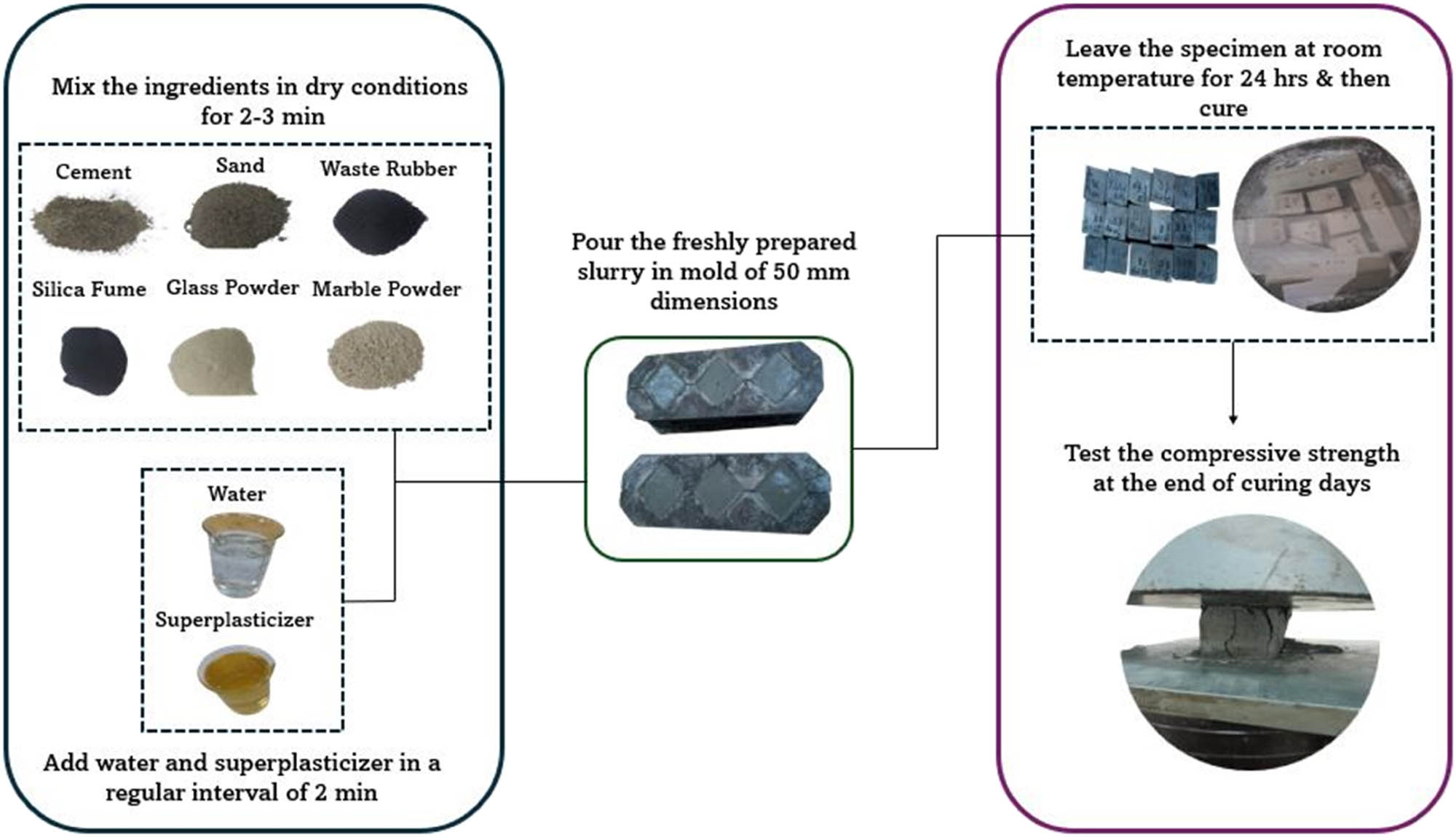
Experimental flowchart of the study.
2.3 Modeling
ML algorithms require diverse input data to predict the desired outcome [31] accurately. The
Data preprocessing is a fundamental step in developing ML models. It involves several essential tasks, including handling missing data, encoding categorical data, identifying and addressing outliers, and splitting the dataset into training and testing sets [35]. This study considered eight essential input precursors: water, FA, SP, cement, SF, WR, MP, and GP. The output parameter was the
The study’s aims were achieved by employing Python code in Orange (version: 3.36.2) and utilizing two novel ML methods. The ML techniques utilized in this research were SVM and RF. The primary purpose of ML approaches is to utilize input variables to generate estimations of desired outcomes. By employing these methodologies, it is possible to approximate the endurance, strength, and capacity to withstand variations in temperature of a given material [36]. While developing the model, the experimental data were divided into a 70% portion for testing and a 30% portion for training. This division was based on information obtained from prior studies [37,38]. The R
2 statistic of the projected result indicates the dependability of the algorithms used. The R
2 quantifies the level of disagreement; a lower number (close to 0) signifies less correlation between the forecasted and the actual results, while a higher value (close to 1) signifies a more remarkable correlation between the forecasted and the actual results [39]. The models subsequently underwent statistical analysis and error evaluation. The findings were presented for root mean square error (RMSE), objective function (OBJ), mean absolute error (MAE), scatter index (SI), mean square error (MSE), Nash Sutcliffe efficiency (NSE), and mean absolute percentage error (MAPE). Figure 2 displays a flowchart illustrating the process of the modeling approach. After the successful implication of ML models, the data were then arranged to study the impact of each variable individually on the

Procedure of ML techniques for predicting compressive strength.
SVM is a reliable and effective supervised learning algorithm frequently utilized for regression and/or classification functions [39]. SVM is considered a discriminative classifier since it can create a clear boundary within various clusters of data [40]. The intent of utilizing this method is to estimate the target variable by relying on the input values, which are comprised of K-dimensional patterns, x i pattern, and y i outcome, while also utilizing testing and training data [41]. SVM utilizes several K-functions, including radial basis, sigmoid, polynomial, or linear functions, to identify support vectors on a function’s surface throughout the training phase. The K-functions are dependent upon the specific K-class and the software being utilized. The SVM can be mathematically described as in Eq. (1) [42]
The coefficients attributed to every support vector, denoted as m i , determine their impact on modeling the decision boundary. The core function is represented by K, while o i represents the support vectors.
RF has gained significant interest in various disciplines due to its ability to effectively handle a high number of factors with relatively small quantities of data [43]. After creating the bootstrap sample, a decision tree (DT) is trained using the sample [42]. Once trained, these trees can be employed to create predictions by applying the mathematical expression, as provided in Eq. (2) [44], to assess unidentified samples. This tree predictor utilizes the outcomes of a randomly sampled vector, obtained in an unbiased manner, and applies the same distribution to all trees inside the forest. As the forest’s tree population grows, the generalization inaccuracy will gradually converge toward a limit
where N reflects the total quantity of bootstrap samples and
2.4 Hyper-tuning of models
Hyperparameters are tunable parameters that regulate the learning process of an ML model. Unlike conventional model parameters like bias and weights, hyperparameters are predetermined before training and cannot be acquired by analyzing the data. They provide essential characteristics of the model, such as its intricacy, learning pace, or kernel size. Optimizing hyperparameters substantially influences a model’s accuracy, generalization, and other performance measures [45]. Both RF and SVM rely on hyperparameters that significantly impact their performance. Key hyperparameters for RF are max-depth (which controls tree depth), n-estimators (the number of trees), max-features, and min-samples-split. The parameters mentioned above are set to limit the RF model’s complexity. For instance, the maximum tree depth is capped at 11, preventing trees from growing beyond this limit. In the SVM model, C (balancing training/testing error), kernel (boundary type), gamma (boundary shape), and degree (for polynomial kernels) govern the activation and performance of the model. However, tolerance and iteration are used as stopping criteria for ML models. The optimal values of tolerance and iteration for the SVM model are provided in Table 2. Proper tuning improves the model’s efficiency and generalization. When creating an ML algorithm, it is essential to select the hyperparameter value that allows for a minimal loss while also providing the highest accuracy [46]. Both ML algorithms were fitted with a set of customizable hyperparameters. Researchers carefully examined and evaluated all potential hyperparameter combinations to gauge the model’s effectiveness. Table 2 shows the optimum settings of the hyperparameters employed in the modeling approach.
Hyperparameters adopted for RF and SVM models
| Algorithms | Hyperparameter | Assigned value |
|---|---|---|
| RF | No. of trees | 50 |
| No. of attributes | 8 | |
| Max. tree depth | 11 | |
| Min. sample | 2 | |
| SVM | Cost (C) | 1.50 |
| Regression loss (ε) | 2.40 | |
| Kernel | Polynomial | |
| Kernel equation |
|
|
| Tolerance | 0.0010 | |
| Iteration limit | 10,000 |
2.5 Validation of models
This study employed several statistical matrices to validate the model, including R 2, MAE, OBJ, MSE, SI, NSE, MAPE, and RMSE. These statistical indicators were selected based on literature studies [33,47,48]. Many past researchers have used these techniques to quantify the performance of ML models. The R 2 matrix quantifies the level of disagreement; a lower number (close to 0) signifies less correlation between the forecasted and the actual results, while a higher value (close to 1) signifies a more remarkable correlation between the forecasted and the actual results. The statistical analysis results indicate that the developed algorithms exhibit a high level of accuracy when the overall errors are lowered. The statistical valuation of the forecasting reliability of rubberized concrete models was carried out using (3)–(9), which were obtained from previous works [39,49,50]
where O i represents the observed values during experimentation, E i represents the estimated values using the ML model, n represents the total number of data points, and E′ represents the mean/average of estimated values.
3 Results and discussion
3.1 Compressive strength of rubberized mortar
The

Compressive strength of rubberized mortar.
3.2 Compressive strength of rubberized mortar featuring SF
Figure 4 illustrates a comparative examination of the

Compressive strength of rubberized mortar containing SF as cement replacement.
3.3 Compressive strength of rubberized mortar featuring GP
GP was employed as a substitute for cement in varying proportions varying from 5 to 25% with a 5% increase to investigate its influence on the

Compressive strength of rubberized mortar containing GP as cement replacement.
3.4 Compressive strength of rubberized mortar featuring MP
MP was added as an alternative for binder in rubberized mortar to evaluate its effect on

Compressive strength of rubberized mortar containing MP as cement replacement.
3.5 Compressive strength of rubberized mortar encompassing GP, SF, and MP in combinations
The following segment documents the collective influence of industrial garbage, specifically MP, SF, and GP. GP and SF as replacements for cement were initially implemented, with mass proportions of 5–15% for each respective ingredient. Figure 7 illustrates the collective impact of SF and GP. The analysis revealed that the cumulative influence of SF and GP had a virtually comparable effect on the

Compressive strength of rubberized mortar containing SF and GP as cement replacement.
An identical method was employed to evaluate the collective impact of SF + MP and GP + MP. The

Compressive strength of rubberized mortar containing SF and MP as cement replacement.

Compressive strength of rubberized mortar containing MP and GP as cement replacement.
The effect of all three recyclable materials (GP, MP, and SF) on the

Compressive strength of rubberized mortar containing GP, MP, and SF and as cement replacement.
3.6 ML model outcomes
3.6.1 SVM model
The findings of SVM models are displayed in Figure 11. The R² value of 0.943 from Figure 11(a) reflects a robust association between the estimated and the actual data, as it is close to 1. To clarify, the model’s estimations account for nearly 94.3% of the variability observed in the experimental data. The graphical representation demonstrates the effectiveness of the SVM model in accurately forecasting the

SVM model results (a) regression plot and (b) error plot.
3.6.2 RF model
The findings of RF models are shown in Figure 12. The R
2 value of 0.983 from Figure 12(a) reflects a robust association between the estimated and the actual data, as it is close to 1. To clarify, the model’s estimations account for nearly 98.3% of the variability observed in the experimental data. The graphical representation demonstrates the effectiveness of the RF model in accurately forecasting the

RF model results (a) regression plot and (b) error plot.
3.6.3 Validation and comparison of models
This research employed an analytical matrix known as the R
2 score to evaluate the prediction capability of established ML structures. The R
2 test indicates that the RF algorithm showed a higher level of accuracy, resulting in the R
2 value of 0.983, compared to the SVM algorithm’s R
2 value of 0.943. The viability of the developed model is further validated using other statistical parameters, including MAE, OBJ, MSE, SI, MAPE, NSE, and RMSE. The findings from the error distribution are displayed in Table 3. The results indicate that the RF algorithm had excellent performance compared to the SVM algorithm, as suggested by the lower values of MAE, OBJ, MSE, SI, MAPE, NDR, and RMSE, which were measured at 0.61 MPa, 0.68 MPa, 0.56 MPa, 0.022, 1.80%, 0.983, and 0.75 MPa, respectively. The SVM model exhibits the following values for the MAE, OBJ, MSE, SI, MAPE, NDR, and RMSE: 1.13 MPa, 1.28 MPa, 1.85 MPa, 0.040, 3.40%, 0.943, and 1.36 MPa, respectively. Additionally, Figure 13 presents the study of MSE, RMSE, and MAE errors. The findings suggest that the error of the RF model encompasses a smaller area compared to the SVM model’s error. Therefore, the plot validates the precision of the RF algorithm in foreseeing the rubberized mortar’s
Summary of statistical error
| Model | MSE (MPa) | RMSE (MPa) | MAE (MPa) | OBJ (MPa) | MAPE (%) | SI | NSE |
|---|---|---|---|---|---|---|---|
| SVM | 1.85 | 1.36 | 1.13 | 1.28 | 3.40 | 0.040 | 0.943 |
| RF | 0.56 | 0.75 | 0.61 | 0.68 | 1.80 | 0.022 | 0.983 |

Graphical representation of statistical errors.
RF models excel at identifying intricate, non-linear correlations within the data. This is especially beneficial in forecasting the
3.6.4 Partial dependence plots for model insights
After the ML models were created and validated, the data were arranged for PDP analysis. This strategy is commonly utilized to examine the impact of the input variable on the expected output in ML applications. Moreover, individual conditional expectation (ICE) plots, represented by each line, illustrate the outcomes derived from altering each occurrence and examine the corresponding variation in the projected output resulting from that alteration [61]. Consequently, a PDP is derived by calculating the line’s mean generated by ICE plots.
Figure 14(a)–(f) illustrates the PDP analysis correlating cement, FA, rubber, SF, MF, and GF with the early

Partial dependence plots: (a) cement, (b) FA, (c) rubber, (d) SF, (e) MP, and (f) GP.
3.6.5 Comparative study with literature
Over the past few decades, AI-based ML models have been widely used to access construction material’s properties, particularly mortar and concrete. Since experimentally accessing the behavior of concrete by modifying it with SCMs consumes time and effort, ML models provide ease in forecasting concrete’s durability and strength-related properties. An overview of past studies on predicting the properties of mortar or concrete modified with industrial waste is provided in Table 4. Table 4 clearly demonstrates that the values of key indicators, such as RMSE and R
2, show a significant similarity between the existing models and the optimal models proposed in this work. Consequently, the proposed models can be efficiently employed to assess rubberized concrete’s
Comparison of the suggested models with previous research
| Ref. | Model | Target variable | R 2 | RMSE |
|---|---|---|---|---|
| Current study | SVM | Compressive strength | 0.943 | 1.36 |
| RF | 0.983 | 0.75 | ||
| [62] | Artificial neural network | Flexural strength | 0.955 | 0.167 |
| DT | 0.986 | 0.124 | ||
| [18] | Adoptive boosting | Compressive strength | 0.939 | 1.519 |
| DT | 0.924 | 1.747 | ||
| [63] | Adoptive boosting | Water absorption | 0.862 | 0.370 |
| Multilayer perceptron neural network | 0.738 | 0.517 | ||
| SVM | 0.776 | 0.461 |
4 Discussions
In order to neutralize CFP and reduce energy and material consumption, a sustainable industry prioritizes implementing recycling and reuse as significant actions. However, the process of recycling waste at plants requires the use of energy-intensive remelting techniques and modern technologies, which may result in the release of greenhouse gas emissions. The use of industrial waste as pozzolanic or filler substance in cement provides a practical option, reducing the requirement for remelting and the resulting CFP. Utilizing WR and other recyclable products such as GP, MP, and SF in construction presents various benefits in terms of sustainability. Figure 15 presents the inclusive insight of remolding industrial waste to create sustainable materials. This study’s findings highlight the challenges and trade-offs in improving the

Utilization of industrial waste in the construction industry.
The study’s results have practical significance for the design of rubberized mortar, especially in environmentally sustainable applications where structural strength is not the primary concern. The modified mortar utilizes waste components like WR, GP, SF, and MP, so it aligns with sustainability objectives, decreases cement and FA consumption, and offers a practical recycling option for industrial waste. Nonetheless, limits are present, especially with diminished structural integrity and the risk of alkali-silica reaction in high GP concentrations. Future research may investigate supplementary additives or treatments for WR to improve its compatibility with cement, along with the improved mortar’s long-term durability and alkali-silica reaction resistance.
The authors of this research make efforts to develop ML to accurately predict the
5 Conclusions
The objective of this investigation is to determine the effectiveness of industrial waste, including GP, SF, and MP, to improve the compressive strength (
Substituting FA with WR in mortar decreased
The utilization of GP, MP, and SF as alternatives for cement in rubberized mortar successfully controlled the decline in
Cement substitution with 15% SF, GP, or MP increased
GP, SF, and MP had comparable effects on
The ML algorithms yielded outcomes that strongly correlated with the data collected. The accuracy of RF model outputs was demonstrated to be superior to SVM, as indicated by higher R 2 values and lower error estimates. The RF and SVM models had R 2 values of 0.983 and 0.943, respectively.
The mean error computed for the RF model is 0.61 MPa, while for the SVM model is 1.13 MPa. The RF model exhibited reduced errors compared to the SVM model, suggesting that the RF technique provides superior reliability for the
Partial dependence plots indicate that increasing FA and cement improves early
The study demonstrates the potential of using waste materials to create a more sustainable rubberized mortar, particularly in applications where structural strength is not critical. While this approach offers environmental benefits, addressing limitations like reduced structural integrity and potential alkali-silica reactions is essential. Future research could focus on improving the compatibility of WR with cement and enhancing the long-term durability of the mortar.
Acknowledgments
The authors acknowledge the Deanship of Scientific Research, Vice Presidency for Graduate Studies and Scientific Research, King Faisal University, Saudi Arabia (Grant No. KFU242921). The authors extend their appreciation for the financial support that made this study possible.
-
Funding information: This work was supported by the Deanship of Scientific Research, Vice Presidency for Graduate Studies and Scientific Research, King Faisal University, Saudi Arabia (Grant No. KFU242921).
-
Author contributions: M.N.A.: funding acquisition, investigation, supervision, project administration, writing, reviewing, and editing. R-U-D.N.: data acquisition, validation, supervision, visualization, writing, reviewing, and editing. K.K.: conceptualization, funding acquisition, formal analysis, resources, writing, reviewing, and editing. S.U.A.: software, validation, formal analysis, writing-original draft, reviewing, and editing. M.K.: data acquisition, formal analysis, writing-original draft, reviewing, and editing. M.T.Q.: investigation, resources, funding acquisition, writing, reviewing, and editing All authors have accepted responsibility for the entire content of this manuscript and approved its submission.
-
Conflict of interest: The authors state no conflict of interest.
-
Data availability statement: The datasets generated and/or analyzed during the current study are available from the corresponding author upon reasonable request.
References
[1] Peng, C. Calculation of a building’s life cycle carbon emissions based on Ecotect and building information modeling. Journal of Cleaner Production, Vol. 112, 2016, pp. 453–465.10.1016/j.jclepro.2015.08.078Suche in Google Scholar
[2] Asif, U., M. F. Javed, D. M. Alsekait, D. S. AbdElminaam, and H. Alabduljabbar. Toward sustainability: Integrating experimental study and data-driven modeling for eco-friendly paver blocks containing plastic waste. Reviews on Advanced Materials Science, Vol. 63, 2024, id. 20240051.10.1515/rams-2024-0051Suche in Google Scholar
[3] Wu, Y.-F., S. M. S. Kazmi, M. J. Munir, Y. Zhou, and F. Xing. Effect of compression casting method on the compressive strength, elastic modulus and microstructure of rubber concrete. Journal of Cleaner Production, Vol. 264, 2020, id. 121746.10.1016/j.jclepro.2020.121746Suche in Google Scholar
[4] Tang, B., H. Wu, and Y.-F. Wu. Evaluation of carbon footprint of compression cast waste rubber concrete based on LCA approach. Journal of Building Engineering, Vol. 86, 2024, id. 108818.10.1016/j.jobe.2024.108818Suche in Google Scholar
[5] Mei, J., G. Xu, W. Ahmad, K. Khan, M. N. Amin, F. Aslam, et al. Promoting sustainable materials using recycled rubber in concrete: A review. Journal of Cleaner Production, Vol. 373, 2022, id. 133927.10.1016/j.jclepro.2022.133927Suche in Google Scholar
[6] Wang, Q.-Z., N.-N. Wang, M.-L. Tseng, Y.-M. Huang, and N.-L. Li. Waste tire recycling assessment: Road application potential and carbon emissions reduction analysis of crumb rubber modified asphalt in China. Journal of Cleaner Production, Vol. 249, 2020, id. 119411.10.1016/j.jclepro.2019.119411Suche in Google Scholar
[7] Murali, G., L. Poka, K. Parthiban, M. K. Haridharan, and A. Siva. Impact response of novel fibre-reinforced grouted aggregate rubberized concrete. Arabian Journal for Science and Engineering, Vol. 44, 2019, pp. 8451–8463.10.1007/s13369-019-03819-5Suche in Google Scholar
[8] Shahjalal, M., K. Islam, T. Ahmed, and R. Ahsan. Mechanical characterization of fiber-reinforced rubberized recycled concrete. Construction and Building Materials, Vol. 412, 2024, id. 134799.10.1016/j.conbuildmat.2023.134799Suche in Google Scholar
[9] Su, J.-y, G. Chen, H.-S. Pan, J.-X. Lin, J. Zhang, K.-X. Zhuo, et al. Rubber modified high strength-high ductility concrete: Effect of rubber replacement ratio and fiber length. Construction and Building Materials, Vol. 404, 2023, id. 133243.10.1016/j.conbuildmat.2023.133243Suche in Google Scholar
[10] Cr, S. B. and P. Kathirvel. Development of ternary blended rubberized cement mortar. Materials Today: Proceedings, Vol. 43, 2021, pp. 1241–1245.10.1016/j.matpr.2020.08.764Suche in Google Scholar
[11] Karimi, H. R., M. R. M. Aliha, E. Khedri, A. Mousavi, S. M. Salehi, P. J. Haghighatpour, et al. Strength and cracking resistance of concrete containing different percentages and sizes of recycled tire rubber granules. Journal of Building Engineering, Vol. 67, 2023, id. 106033.10.1016/j.jobe.2023.106033Suche in Google Scholar
[12] Moasas, A. M., M. N. Amin, K. Khan, W. Ahmad, M. N. A. Al-Hashem, A. F. Deifalla, et al. A worldwide development in the accumulation of waste tires and its utilization in concrete as a sustainable construction material: A review. Case Studies in Construction Materials, Vol. 17, 2022, id. e01677.10.1016/j.cscm.2022.e01677Suche in Google Scholar
[13] Khan, K., W. Ahmad, M. N. Amin, A. Ahmad, S. Nazar, A. A. Alabdullah, et al. Exploring the use of waste marble powder in concrete and predicting its strength with different advanced algorithms. Materials, Vol. 15, 2022, id. 4108.10.3390/ma15124108Suche in Google Scholar PubMed PubMed Central
[14] Chatbi, M., Z. R. Harrat, M. A. Benatta, B. Krour, M. Hadzima-Nyarko, E. Işık, et al. Nano-clay platelet integration for enhanced bending performance of concrete beams resting on elastic foundation: an analytical investigation. Materials, Vol. 16, 2023, id. 5040.10.3390/ma16145040Suche in Google Scholar PubMed PubMed Central
[15] Zhao, S. and Q. Zhang. Effect of silica fume in concrete on mechanical properties and dynamic behaviors under impact loading. Materials, Vol. 12, 2019, id. 3263.10.3390/ma12193263Suche in Google Scholar PubMed PubMed Central
[16] Murali, G., A. K. Nassar, M. Swaminathan, P. Kathirvel, and L. S. Wong. Effect of silica fume and glass powder for enhanced impact resistance in GGBFS-based ultra high-performance geopolymer fibrous concrete: An experimental and statistical analysis. Defence Technology, Vol. 41, 2024, pp. 59–81.10.1016/j.dt.2024.05.015Suche in Google Scholar
[17] Waqar, A., M. B. Khan, M. T. Afzal, D. Radu, T. Gălăţanu, C. E. Cazacu, et al. Investigating the synergistic effects of carbon fiber and silica fume on concrete strength and eco-efficiency. Case Studies in Construction Materials, Vol. 20, 2024, id. e02967.10.1016/j.cscm.2024.e02967Suche in Google Scholar
[18] Khan, K., W. Ahmad, M. N. Amin, M. I. Rafiq, A. M. Abu Arab, I. A. Alabdullah, et al. Evaluating the effectiveness of waste glass powder for the compressive strength improvement of cement mortar using experimental and machine learning methods. Heliyon, Vol. 9, 2023, id. e16288.10.1016/j.heliyon.2023.e16288Suche in Google Scholar PubMed PubMed Central
[19] Mohajerani, A., J. Vajna, T. H. H. Cheung, H. Kurmus, A. Arulrajah, and S. Horpibulsuk. Practical recycling applications of crushed waste glass in construction materials: A review. Construction and Building Materials, Vol. 156, 2017, pp. 443–467.10.1016/j.conbuildmat.2017.09.005Suche in Google Scholar
[20] Çelik, A. İ., Y. O. Özkılıç, Ö. Zeybek, M. Karalar, S. Qaidi, J. Ahmad, et al. Mechanical behavior of crushed waste glass as replacement of aggregates. Materials, Vol. 15, 2022, id. 8093.10.3390/ma15228093Suche in Google Scholar PubMed PubMed Central
[21] Zeybek, Ö., Y. O. Özkılıç, M. Karalar, A. İ. Çelik, S. Qaidi, J. Ahmad, et al. Influence of replacing cement with waste glass on mechanical properties of concrete. Materials, Vol. 15, 2022, id. 7513.10.3390/ma15217513Suche in Google Scholar PubMed PubMed Central
[22] Harrison, E., A. Berenjian, and M. Seifan. Recycling of waste glass as aggregate in cement-based materials. Environmental Science and Ecotechnology, Vol. 4, 2020, id. 100064.10.1016/j.ese.2020.100064Suche in Google Scholar PubMed PubMed Central
[23] Lou, Y., K. Khan, M. N. Amin, W. Ahmad, A. F. Deifalla, and A. Ahmad. Performance characteristics of cementitious composites modified with silica fume: A systematic review. Case Studies in Construction Materials, Vol. 18, 2023, id. e01753.10.1016/j.cscm.2022.e01753Suche in Google Scholar
[24] Asif, U., M. F. Javed, D. M. Alsekait, F. Aslam, and D. S. A. Elminaam. Data-driven evolutionary programming for evaluating the mechanical properties of concrete containing plastic waste. Case Studies in Construction Materials, Vol. 21, 2024, id. e03763.10.1016/j.cscm.2024.e03763Suche in Google Scholar
[25] Asif, U., M. F. Javed, M. Alyami, and A. W. A. Hammad. Performance evaluation of concrete made with plastic waste using multi-expression programming. Materials Today Communications, Vol. 39, 2024, id. 108789.10.1016/j.mtcomm.2024.108789Suche in Google Scholar
[26] Khawaja, L., M. F. Javed, U. Asif, L. Alkhattabi, B. Ahmed, and H. Alabduljabbar. Indirect estimation of resilient modulus (Mr) of subgrade soil: Gene expression programming vs multi expression programming. Structures, Vol. 66, 2024, id. 106837.10.1016/j.istruc.2024.106837Suche in Google Scholar
[27] Nazar, S., J. Yang, W. Ahmad, M. F. Javed, H. Alabduljabbar, and A. F. Deifalla. Development of the new prediction models for the compressive strength of nanomodified concrete using novel machine learning techniques. Buildings, Vol. 12, 2022, id. 2160.10.3390/buildings12122160Suche in Google Scholar
[28] Inqiad, W. B., M. F. Javed, K. Onyelowe, M. S. Siddique, U. Asif, L. Alkhattabi, et al. Soft computing models for prediction of bentonite plastic concrete strength. Scientific Reports, Vol. 14, 2024, id. 18145.10.1038/s41598-024-69271-0Suche in Google Scholar PubMed PubMed Central
[29] Hasan, K., M. M. Rahaman, M. B. Ali, M. A. J. Urmi, N. A. Fariha, M. T. Islam, et al. A comprehensive review of the application of waste tire rubber in concrete/mortar as fine aggregate replacement. Architecture, Structures and Construction, Vol. 4, 2023, pp. 91–111.10.1007/s44150-023-00102-ySuche in Google Scholar
[30] American Society for, T.; Materials. Committee, C.o.C. Standard test method for compressive strength of hydraulic cement mortars (Using 2-in. or [50-mm] Cube Specimens), ASTM International, West Conshohocken, USA, 2013.Suche in Google Scholar
[31] Asif, U., M. F. Javed, M. Abuhussain, M. Ali, W. A. Khan, and A. Mohamed. Predicting the mechanical properties of plastic concrete: An optimization method by using genetic programming and ensemble learners. Case Studies in Construction Materials, Vol. 20, 2024, id. e03135.10.1016/j.cscm.2024.e03135Suche in Google Scholar
[32] Javed, M. F., B. Siddiq, K. Onyelowe, W. A. Khan, and M. Khan. Metaheuristic optimization algorithms-based prediction modeling for titanium dioxide-Assisted photocatalytic degradation of air contaminants. Results in Engineering, Vol. 23, 2024, id. 102637.10.1016/j.rineng.2024.102637Suche in Google Scholar
[33] Asif, U., S. A. Memon, M. F. Javed, and J. Kim. Predictive modeling and experimental validation for assessing the mechanical properties of cementitious composites made with silica fume and ground granulated blast furnace slag. Buildings, Vol. 14, 2024, id. 1091.10.3390/buildings14041091Suche in Google Scholar
[34] Khan, M., J. Lao, and J.-G. Dai. Comparative study of advanced computational techniques for estimating the compressive strength of UHPC. Journal of Asian Concrete Federation, Vol. 8, 2022, pp. 51–68.10.18702/acf.2022.6.8.1.51Suche in Google Scholar
[35] Taffese, W. Z. and L. Espinosa-Leal. A machine learning method for predicting the chloride migration coefficient of concrete. Construction and Building Materials, Vol. 348, 2022, id. 128566.10.1016/j.conbuildmat.2022.128566Suche in Google Scholar
[36] Amin, M. N., W. Ahmad, K. Khan, M. N. Al-Hashem, A. F. Deifalla, and A. Ahmad. Testing and modeling methods to experiment the flexural performance of cement mortar modified with eggshell powder. Case Studies in Construction Materials, Vol. 18, 2023, id. e01759.10.1016/j.cscm.2022.e01759Suche in Google Scholar
[37] Fu, B. and D.-C. Feng. A machine learning-based time-dependent shear strength model for corroded reinforced concrete beams. Journal of Building Engineering, Vol. 36, 2021, id. 102118.10.1016/j.jobe.2020.102118Suche in Google Scholar
[38] Alkadhim, H. A., M. N. Amin, W. Ahmad, K. Khan, S. Nazar, M. I. Faraz, et al. Evaluating the strength and impact of raw ingredients of cement mortar incorporating waste glass powder using machine learning and SHapley additive ExPlanations (SHAP) methods. Materials, Vol. 15, 2022, id. 7344.10.3390/ma15207344Suche in Google Scholar PubMed PubMed Central
[39] Zhang, H., X. Li, M. N. Amin, A. A. Alawi Al-Naghi, S. U. Arifeen, F. Althoey, et al. Analyzing chloride diffusion for durability predictions of concrete using contemporary machine learning strategies. Materials Today Communications, Vol. 38, 2024, id. 108543.10.1016/j.mtcomm.2024.108543Suche in Google Scholar
[40] Abd, A. M. and S. M. Abd. Modelling the strength of lightweight foamed concrete using support vector machine (SVM). Case Studies in Construction Materials, Vol. 6, 2017, pp. 8–15.10.1016/j.cscm.2016.11.002Suche in Google Scholar
[41] Güçlüer, K., A. Özbeyaz, S. Göymen, and O. Günaydın. A comparative investigation using machine learning methods for concrete compressive strength estimation. Materials Today Communications, Vol. 27, 2021, id. 102278.10.1016/j.mtcomm.2021.102278Suche in Google Scholar
[42] Ravikanth, P., T. J. Saravanan, and K. I. S. A. Kabeer. Supervised data-driven approach to predict split tensile and flexural strength of concrete with marble waste powder. Cleaner Materials, Vol. 11, 2024, id. 100231.10.1016/j.clema.2024.100231Suche in Google Scholar
[43] Iftikhar, B., S. C. Alih, M. Vafaei, M. A. Elkotb, M. Shutaywi, M. F. Javed, et al. Predictive modeling of compressive strength of sustainable rice husk ash concrete: Ensemble learner optimization and comparison. Journal of Cleaner Production, Vol. 348, 2022, id. 131285.10.1016/j.jclepro.2022.131285Suche in Google Scholar
[44] Gayathri, R., S. U. Rani, L. Čepová, M. Rajesh, and K. Kalita. A comparative analysis of machine learning models in prediction of mortar compressive strength. Processes, Vol. 10, 2022, id. 1387.10.3390/pr10071387Suche in Google Scholar
[45] Yang, L. and A. Shami. On hyperparameter optimization of machine learning algorithms: Theory and practice. Neurocomputing, Vol. 415, 2020, pp. 295–316.10.1016/j.neucom.2020.07.061Suche in Google Scholar
[46] Yeh, I. C. and L.-C. Lien. Knowledge discovery of concrete material using genetic operation trees. Expert Systems with Applications, Vol. 36, 2009, pp. 5807–5812.10.1016/j.eswa.2008.07.004Suche in Google Scholar
[47] Amin, M. N., K. Khan, S. Nazar, and A. F. Deifalla. Application of waste recycle tire steel fibers as a construction material in concrete. Reviews on Advanced Materials Science, Vol. 62, 2023, id. 20220319.10.1515/rams-2022-0319Suche in Google Scholar
[48] Khawaja, L., U. Asif, K. Onyelowe, A. F. Al Asmari, D. Khan, M. F. Javed, et al. Development of machine learning models for forecasting the strength of resilient modulus of subgrade soil: genetic and artificial neural network approaches. Scientific Reports, Vol. 14, 2024, id. 18244.10.1038/s41598-024-69316-4Suche in Google Scholar PubMed PubMed Central
[49] Javed, M. F., M. Z. Shahab, U. Asif, T. Najeh, F. Aslam, M. Ali, et al. Evaluation of machine learning models for predicting TiO2 photocatalytic degradation of air contaminants. Scientific Reports, Vol. 14, 2024, id. 13688.10.1038/s41598-024-64486-7Suche in Google Scholar PubMed PubMed Central
[50] Jalal, F. E., M. Iqbal, W. A. Khan, A. Jamal, K. Onyelowe, and Lekhraj. ANN-based swarm intelligence for predicting expansive soil swell pressure and compression strength. Scientific Reports, Vol. 14, 2024, id. 14597.10.1038/s41598-024-65547-7Suche in Google Scholar PubMed PubMed Central
[51] Sun, S., X. Han, A. Chen, Q. Zhang, Z. Wang, and K. Li. Experimental analysis and evaluation of the compressive strength of rubberized concrete during freeze–thaw cycles. International Journal of Concrete Structures and Materials, Vol. 17, 2023, id. 28.10.1186/s40069-023-00592-6Suche in Google Scholar
[52] Wang, H. and J. Pang. Mechanical properties and microstructure of rubber concrete under coupling action of sulfate attack and dry–wet cycle. Sustainability, Vol. 15, 2023, id. 9569.10.3390/su15129569Suche in Google Scholar
[53] He, S., Z. Jiang, H. Chen, Z. Chen, J. Ding, H. Deng, et al. Mechanical properties, durability, and structural applications of rubber concrete: a state-of-the-art-review. Sustainability, Vol. 15, 2023, id. 8541.10.3390/su15118541Suche in Google Scholar
[54] El-Zohairy, A., M. Sanchez, B. Abediniangerabi, and P. Moler. Performance of rubberized concrete and the effect of temperature and stainless steel fibers. Buildings, Vol. 13, 2023, id. 280.10.3390/buildings13020280Suche in Google Scholar
[55] Jiang, Z., X. Zhang, Y. Zhang, L. Yu, X. Hu, X. Zhou, et al. Surface treatment of rubberized waste reinforced concrete. Frontiers in Built Environment, Vol. 7, 2021, id. 685067.10.3389/fbuil.2021.685067Suche in Google Scholar
[56] Ahmad, S. A., H. U. Ahmed, S. K. Rafiq, K. O. F. Mahmood, K. J. Rostam, and F. S. Jafer. A Comprehensive exploration on the effect of waste glass powder as a partial replacement of cement in mortar: a review, analysis, and modeling investigation. Arabian Journal for Science and Engineering, Vol. 49, 2023, pp. 5721–5748.10.1007/s13369-023-08432-1Suche in Google Scholar
[57] Li, T. and L. Tier. Analysis of the effect of glass powder on the printability of cement-based materials for 3D printing using ImageJ. MRS Communications, Vol. 13, 2023, pp. 1416–1422.10.1557/s43579-023-00479-3Suche in Google Scholar
[58] Sahni, S., S. Arora, and R. Singh. Influence of waste marble powder and metakaolin on strength properties of concrete: a short review. In Proceedings of the Recycled Waste Materials, Vol. 2019, Singapore, 2019, pp. 105–109.10.1007/978-981-13-7017-5_12Suche in Google Scholar
[59] Kawsar, A., N. K. Serker, and S. Afsana. Artificial intelligence-based approaches to predict concrete compressive strength, 7th International Conference on Civil Engineering for Sustainable Development (ICCESD), Khulna, Bangladesh, 2024, 586.Suche in Google Scholar
[60] Loureiro, A. A. B. and R. Stefani. Comparing the performance of machine learning models for predicting the compressive strength of concrete. Discover Civil Engineering, Vol. 1, 2024, id. 19.10.1007/s44290-024-00022-wSuche in Google Scholar
[61] Ly, H.-B., T.-A. Nguyen, and B. T. Pham. Investigation on factors affecting early strength of high-performance concrete by Gaussian Process Regression. PLOS ONE, Vol. 17, 2022, id. e0262930.10.1371/journal.pone.0262930Suche in Google Scholar PubMed PubMed Central
[62] Li, Y., G. Wang, M. N. Amin, A. Khan, M. T. Qadir, and S. U. Arifeen. Towards improved flexural behavior of plastic-based mortars: An experimental and modeling study on waste material incorporation. Materials Today Communications, Vol. 40, 2024, id. 109391.10.1016/j.mtcomm.2024.109391Suche in Google Scholar
[63] Amin, M. N., W. Ahmad, K. Khan, S. Nazar, A. M. A. Arab, and A. F. Deifalla. Evaluating the relevance of eggshell and glass powder for cement-based materials using machine learning and SHapley Additive exPlanations (SHAP) analysis. Case Studies in Construction Materials, Vol. 19, 2023, id. e02278.10.1016/j.cscm.2023.e02278Suche in Google Scholar
© 2024 the author(s), published by De Gruyter
This work is licensed under the Creative Commons Attribution 4.0 International License.
Artikel in diesem Heft
- Review Articles
- Effect of superplasticizer in geopolymer and alkali-activated cement mortar/concrete: A review
- Experimenting the influence of corncob ash on the mechanical strength of slag-based geopolymer concrete
- Powder metallurgy processing of high entropy alloys: Bibliometric analysis and systematic review
- Exploring the potential of agricultural waste as an additive in ultra-high-performance concrete for sustainable construction: A comprehensive review
- A review on partial substitution of nanosilica in concrete
- Foam concrete for lightweight construction applications: A comprehensive review of the research development and material characteristics
- Modification of PEEK for implants: Strategies to improve mechanical, antibacterial, and osteogenic properties
- Interfacing the IoT in composite manufacturing: An overview
- Advances in processing and ablation properties of carbon fiber reinforced ultra-high temperature ceramic composites
- Advancing auxetic materials: Emerging development and innovative applications
- Revolutionizing energy harvesting: A comprehensive review of thermoelectric devices
- Exploring polyetheretherketone in dental implants and abutments: A focus on biomechanics and finite element methods
- Smart technologies and textiles and their potential use and application in the care and support of elderly individuals: A systematic review
- Reinforcement mechanisms and current research status of silicon carbide whisker-reinforced composites: A comprehensive review
- Innovative eco-friendly bio-composites: A comprehensive review of the fabrication, characterization, and applications
- Review on geopolymer concrete incorporating Alccofine-1203
- Advancements in surface treatments for aluminum alloys in sports equipment
- Ionic liquid-modified carbon-based fillers and their polymer composites – A Raman spectroscopy analysis
- Emerging boron nitride nanosheets: A review on synthesis, corrosion resistance coatings, and their impacts on the environment and health
- Mechanism, models, and influence of heterogeneous factors of the microarc oxidation process: A comprehensive review
- Synthesizing sustainable construction paradigms: A comprehensive review and bibliometric analysis of granite waste powder utilization and moisture correction in concrete
- 10.1515/rams-2025-0086
- Research Articles
- Coverage and reliability improvement of copper metallization layer in through hole at BGA area during load board manufacture
- Study on dynamic response of cushion layer-reinforced concrete slab under rockfall impact based on smoothed particle hydrodynamics and finite-element method coupling
- Study on the mechanical properties and microstructure of recycled brick aggregate concrete with waste fiber
- Multiscale characterization of the UV aging resistance and mechanism of light stabilizer-modified asphalt
- Characterization of sandwich materials – Nomex-Aramid carbon fiber performances under mechanical loadings: Nonlinear FE and convergence studies
- Effect of grain boundary segregation and oxygen vacancy annihilation on aging resistance of cobalt oxide-doped 3Y-TZP ceramics for biomedical applications
- Mechanical damage mechanism investigation on CFRP strengthened recycled red brick concrete
- Finite element analysis of deterioration of axial compression behavior of corroded steel-reinforced concrete middle-length columns
- Grinding force model for ultrasonic assisted grinding of γ-TiAl intermetallic compounds and experimental validation
- Enhancement of hardness and wear strength of pure Cu and Cu–TiO2 composites via a friction stir process while maintaining electrical resistivity
- Effect of sand–precursor ratio on mechanical properties and durability of geopolymer mortar with manufactured sand
- Research on the strength prediction for pervious concrete based on design porosity and water-to-cement ratio
- Development of a new damping ratio prediction model for recycled aggregate concrete: Incorporating modified admixtures and carbonation effects
- Exploring the viability of AI-aided genetic algorithms in estimating the crack repair rate of self-healing concrete
- Modification of methacrylate bone cement with eugenol – A new material with antibacterial properties
- Numerical investigations on constitutive model parameters of HRB400 and HTRB600 steel bars based on tensile and fatigue tests
- Research progress on Fe3+-activated near-infrared phosphor
- Discrete element simulation study on effects of grain preferred orientation on micro-cracking and macro-mechanical behavior of crystalline rocks
- Ultrasonic resonance evaluation method for deep interfacial debonding defects of multilayer adhesive bonded materials
- Effect of impurity components in titanium gypsum on the setting time and mechanical properties of gypsum-slag cementitious materials
- Bending energy absorption performance of composite fender piles with different winding angles
- Theoretical study of the effect of orientations and fibre volume on the thermal insulation capability of reinforced polymer composites
- Synthesis and characterization of a novel ternary magnetic composite for the enhanced adsorption capacity to remove organic dyes
- Couple effects of multi-impact damage and CAI capability on NCF composites
- Mechanical testing and engineering applicability analysis of SAP concrete used in buffer layer design for tunnels in active fault zones
- Investigating the rheological characteristics of alkali-activated concrete using contemporary artificial intelligence approaches
- Integrating micro- and nanowaste glass with waste foundry sand in ultra-high-performance concrete to enhance material performance and sustainability
- Effect of water immersion on shear strength of epoxy adhesive filled with graphene nanoplatelets
- Impact of carbon content on the phase structure and mechanical properties of TiBCN coatings via direct current magnetron sputtering
- Investigating the anti-aging properties of asphalt modified with polyphosphoric acid and tire pyrolysis oil
- Biomedical and therapeutic potential of marine-derived Pseudomonas sp. strain AHG22 exopolysaccharide: A novel bioactive microbial metabolite
- Effect of basalt fiber length on the behavior of natural hydraulic lime-based mortars
- Optimizing the performance of TPCB/SCA composite-modified asphalt using improved response surface methodology
- Compressive strength of waste-derived cementitious composites using machine learning
- Melting phenomenon of thermally stratified MHD Powell–Eyring nanofluid with variable porosity past a stretching Riga plate
- Development and characterization of a coaxial strain-sensing cable integrated steel strand for wide-range stress monitoring
- Compressive and tensile strength estimation of sustainable geopolymer concrete using contemporary boosting ensemble techniques
- Customized 3D printed porous titanium scaffolds with nanotubes loading antibacterial drugs for bone tissue engineering
- Facile design of PTFE-kaolin-based ternary nanocomposite as a hydrophobic and high corrosion-barrier coating
- Effects of C and heat treatment on microstructure, mechanical, and tribo-corrosion properties of VAlTiMoSi high-entropy alloy coating
- Study on the damage mechanism and evolution model of preloaded sandstone subjected to freezing–thawing action based on the NMR technology
- Promoting low carbon construction using alkali-activated materials: A modeling study for strength prediction and feature interaction
- Entropy generation analysis of MHD convection flow of hybrid nanofluid in a wavy enclosure with heat generation and thermal radiation
- Friction stir welding of dissimilar Al–Mg alloys for aerospace applications: Prospects and future potential
- Fe nanoparticle-functionalized ordered mesoporous carbon with tailored mesostructures and their applications in magnetic removal of Ag(i)
- Study on physical and mechanical properties of complex-phase conductive fiber cementitious materials
- Evaluating the strength loss and the effectiveness of glass and eggshell powder for cement mortar under acidic conditions
- Effect of fly ash on properties and hydration of calcium sulphoaluminate cement-based materials with high water content
- Analyzing the efficacy of waste marble and glass powder for the compressive strength of self-compacting concrete using machine learning strategies
- Experimental study on municipal solid waste incineration ash micro-powder as concrete admixture
- Parameter optimization for ultrasonic-assisted grinding of γ-TiAl intermetallics: A gray relational analysis approach with surface integrity evaluation
- Producing sustainable binding materials using marble waste blended with fly ash and rice husk ash for building materials
- Effect of steam curing system on compressive strength of recycled aggregate concrete
- A sawtooth constitutive model describing strain hardening and multiple cracking of ECC under uniaxial tension
- Predicting mechanical properties of sustainable green concrete using novel machine learning: Stacking and gene expression programming
- Toward sustainability: Integrating experimental study and data-driven modeling for eco-friendly paver blocks containing plastic waste
- A numerical analysis of the rotational flow of a hybrid nanofluid past a unidirectional extending surface with velocity and thermal slip conditions
- A magnetohydrodynamic flow of a water-based hybrid nanofluid past a convectively heated rotating disk surface: A passive control of nanoparticles
- Prediction of flexural strength of concrete with eggshell and glass powders: Advanced cutting-edge approach for sustainable materials
- Efficacy of sustainable cementitious materials on concrete porosity for enhancing the durability of building materials
- Phase and microstructural characterization of swat soapstone (Mg3Si4O10(OH)2)
- Effect of waste crab shell powder on matrix asphalt
- Improving effect and mechanism on service performance of asphalt binder modified by PW polymer
- Influence of pH on the synthesis of carbon spheres and the application of carbon sphere-based solid catalysts in esterification
- Experimenting the compressive performance of low-carbon alkali-activated materials using advanced modeling techniques
- Thermogravimetric (TG/DTG) characterization of cold-pressed oil blends and Saccharomyces cerevisiae-based microcapsules obtained with them
- Investigation of temperature effect on thermo-mechanical property of carbon fiber/PEEK composites
- Computational approaches for structural analysis of wood specimens
- Integrated structure–function design of 3D-printed porous polydimethylsiloxane for superhydrophobic engineering
- Exploring the impact of seashell powder and nano-silica on ultra-high-performance self-curing concrete: Insights into mechanical strength, durability, and high-temperature resilience
- Axial compression damage constitutive model and damage characteristics of fly ash/silica fume modified magnesium phosphate cement after being treated at different temperatures
- Integrating testing and modeling methods to examine the feasibility of blended waste materials for the compressive strength of rubberized mortar
- Special Issue on 3D and 4D Printing of Advanced Functional Materials - Part II
- Energy absorption of gradient triply periodic minimal surface structure manufactured by stereolithography
- Marine polymers in tissue bioprinting: Current achievements and challenges
- Quick insight into the dynamic dimensions of 4D printing in polymeric composite mechanics
- Recent advances in 4D printing of hydrogels
- Mechanically sustainable and primary recycled thermo-responsive ABS–PLA polymer composites for 4D printing applications: Fabrication and studies
- Special Issue on Materials and Technologies for Low-carbon Biomass Processing and Upgrading
- Low-carbon embodied alkali-activated materials for sustainable construction: A comparative study of single and ensemble learners
- Study on bending performance of prefabricated glulam-cross laminated timber composite floor
- Special Issue on Recent Advancement in Low-carbon Cement-based Materials - Part I
- Supplementary cementitious materials-based concrete porosity estimation using modeling approaches: A comparative study of GEP and MEP
- Modeling the strength parameters of agro waste-derived geopolymer concrete using advanced machine intelligence techniques
- Promoting the sustainable construction: A scientometric review on the utilization of waste glass in concrete
- Incorporating geranium plant waste into ultra-high performance concrete prepared with crumb rubber as fine aggregate in the presence of polypropylene fibers
- Investigation of nano-basic oxygen furnace slag and nano-banded iron formation on properties of high-performance geopolymer concrete
- Effect of incorporating ultrafine palm oil fuel ash on the resistance to corrosion of steel bars embedded in high-strength green concrete
- Influence of nanomaterials on properties and durability of ultra-high-performance geopolymer concrete
- Influence of palm oil ash and palm oil clinker on the properties of lightweight concrete
Artikel in diesem Heft
- Review Articles
- Effect of superplasticizer in geopolymer and alkali-activated cement mortar/concrete: A review
- Experimenting the influence of corncob ash on the mechanical strength of slag-based geopolymer concrete
- Powder metallurgy processing of high entropy alloys: Bibliometric analysis and systematic review
- Exploring the potential of agricultural waste as an additive in ultra-high-performance concrete for sustainable construction: A comprehensive review
- A review on partial substitution of nanosilica in concrete
- Foam concrete for lightweight construction applications: A comprehensive review of the research development and material characteristics
- Modification of PEEK for implants: Strategies to improve mechanical, antibacterial, and osteogenic properties
- Interfacing the IoT in composite manufacturing: An overview
- Advances in processing and ablation properties of carbon fiber reinforced ultra-high temperature ceramic composites
- Advancing auxetic materials: Emerging development and innovative applications
- Revolutionizing energy harvesting: A comprehensive review of thermoelectric devices
- Exploring polyetheretherketone in dental implants and abutments: A focus on biomechanics and finite element methods
- Smart technologies and textiles and their potential use and application in the care and support of elderly individuals: A systematic review
- Reinforcement mechanisms and current research status of silicon carbide whisker-reinforced composites: A comprehensive review
- Innovative eco-friendly bio-composites: A comprehensive review of the fabrication, characterization, and applications
- Review on geopolymer concrete incorporating Alccofine-1203
- Advancements in surface treatments for aluminum alloys in sports equipment
- Ionic liquid-modified carbon-based fillers and their polymer composites – A Raman spectroscopy analysis
- Emerging boron nitride nanosheets: A review on synthesis, corrosion resistance coatings, and their impacts on the environment and health
- Mechanism, models, and influence of heterogeneous factors of the microarc oxidation process: A comprehensive review
- Synthesizing sustainable construction paradigms: A comprehensive review and bibliometric analysis of granite waste powder utilization and moisture correction in concrete
- 10.1515/rams-2025-0086
- Research Articles
- Coverage and reliability improvement of copper metallization layer in through hole at BGA area during load board manufacture
- Study on dynamic response of cushion layer-reinforced concrete slab under rockfall impact based on smoothed particle hydrodynamics and finite-element method coupling
- Study on the mechanical properties and microstructure of recycled brick aggregate concrete with waste fiber
- Multiscale characterization of the UV aging resistance and mechanism of light stabilizer-modified asphalt
- Characterization of sandwich materials – Nomex-Aramid carbon fiber performances under mechanical loadings: Nonlinear FE and convergence studies
- Effect of grain boundary segregation and oxygen vacancy annihilation on aging resistance of cobalt oxide-doped 3Y-TZP ceramics for biomedical applications
- Mechanical damage mechanism investigation on CFRP strengthened recycled red brick concrete
- Finite element analysis of deterioration of axial compression behavior of corroded steel-reinforced concrete middle-length columns
- Grinding force model for ultrasonic assisted grinding of γ-TiAl intermetallic compounds and experimental validation
- Enhancement of hardness and wear strength of pure Cu and Cu–TiO2 composites via a friction stir process while maintaining electrical resistivity
- Effect of sand–precursor ratio on mechanical properties and durability of geopolymer mortar with manufactured sand
- Research on the strength prediction for pervious concrete based on design porosity and water-to-cement ratio
- Development of a new damping ratio prediction model for recycled aggregate concrete: Incorporating modified admixtures and carbonation effects
- Exploring the viability of AI-aided genetic algorithms in estimating the crack repair rate of self-healing concrete
- Modification of methacrylate bone cement with eugenol – A new material with antibacterial properties
- Numerical investigations on constitutive model parameters of HRB400 and HTRB600 steel bars based on tensile and fatigue tests
- Research progress on Fe3+-activated near-infrared phosphor
- Discrete element simulation study on effects of grain preferred orientation on micro-cracking and macro-mechanical behavior of crystalline rocks
- Ultrasonic resonance evaluation method for deep interfacial debonding defects of multilayer adhesive bonded materials
- Effect of impurity components in titanium gypsum on the setting time and mechanical properties of gypsum-slag cementitious materials
- Bending energy absorption performance of composite fender piles with different winding angles
- Theoretical study of the effect of orientations and fibre volume on the thermal insulation capability of reinforced polymer composites
- Synthesis and characterization of a novel ternary magnetic composite for the enhanced adsorption capacity to remove organic dyes
- Couple effects of multi-impact damage and CAI capability on NCF composites
- Mechanical testing and engineering applicability analysis of SAP concrete used in buffer layer design for tunnels in active fault zones
- Investigating the rheological characteristics of alkali-activated concrete using contemporary artificial intelligence approaches
- Integrating micro- and nanowaste glass with waste foundry sand in ultra-high-performance concrete to enhance material performance and sustainability
- Effect of water immersion on shear strength of epoxy adhesive filled with graphene nanoplatelets
- Impact of carbon content on the phase structure and mechanical properties of TiBCN coatings via direct current magnetron sputtering
- Investigating the anti-aging properties of asphalt modified with polyphosphoric acid and tire pyrolysis oil
- Biomedical and therapeutic potential of marine-derived Pseudomonas sp. strain AHG22 exopolysaccharide: A novel bioactive microbial metabolite
- Effect of basalt fiber length on the behavior of natural hydraulic lime-based mortars
- Optimizing the performance of TPCB/SCA composite-modified asphalt using improved response surface methodology
- Compressive strength of waste-derived cementitious composites using machine learning
- Melting phenomenon of thermally stratified MHD Powell–Eyring nanofluid with variable porosity past a stretching Riga plate
- Development and characterization of a coaxial strain-sensing cable integrated steel strand for wide-range stress monitoring
- Compressive and tensile strength estimation of sustainable geopolymer concrete using contemporary boosting ensemble techniques
- Customized 3D printed porous titanium scaffolds with nanotubes loading antibacterial drugs for bone tissue engineering
- Facile design of PTFE-kaolin-based ternary nanocomposite as a hydrophobic and high corrosion-barrier coating
- Effects of C and heat treatment on microstructure, mechanical, and tribo-corrosion properties of VAlTiMoSi high-entropy alloy coating
- Study on the damage mechanism and evolution model of preloaded sandstone subjected to freezing–thawing action based on the NMR technology
- Promoting low carbon construction using alkali-activated materials: A modeling study for strength prediction and feature interaction
- Entropy generation analysis of MHD convection flow of hybrid nanofluid in a wavy enclosure with heat generation and thermal radiation
- Friction stir welding of dissimilar Al–Mg alloys for aerospace applications: Prospects and future potential
- Fe nanoparticle-functionalized ordered mesoporous carbon with tailored mesostructures and their applications in magnetic removal of Ag(i)
- Study on physical and mechanical properties of complex-phase conductive fiber cementitious materials
- Evaluating the strength loss and the effectiveness of glass and eggshell powder for cement mortar under acidic conditions
- Effect of fly ash on properties and hydration of calcium sulphoaluminate cement-based materials with high water content
- Analyzing the efficacy of waste marble and glass powder for the compressive strength of self-compacting concrete using machine learning strategies
- Experimental study on municipal solid waste incineration ash micro-powder as concrete admixture
- Parameter optimization for ultrasonic-assisted grinding of γ-TiAl intermetallics: A gray relational analysis approach with surface integrity evaluation
- Producing sustainable binding materials using marble waste blended with fly ash and rice husk ash for building materials
- Effect of steam curing system on compressive strength of recycled aggregate concrete
- A sawtooth constitutive model describing strain hardening and multiple cracking of ECC under uniaxial tension
- Predicting mechanical properties of sustainable green concrete using novel machine learning: Stacking and gene expression programming
- Toward sustainability: Integrating experimental study and data-driven modeling for eco-friendly paver blocks containing plastic waste
- A numerical analysis of the rotational flow of a hybrid nanofluid past a unidirectional extending surface with velocity and thermal slip conditions
- A magnetohydrodynamic flow of a water-based hybrid nanofluid past a convectively heated rotating disk surface: A passive control of nanoparticles
- Prediction of flexural strength of concrete with eggshell and glass powders: Advanced cutting-edge approach for sustainable materials
- Efficacy of sustainable cementitious materials on concrete porosity for enhancing the durability of building materials
- Phase and microstructural characterization of swat soapstone (Mg3Si4O10(OH)2)
- Effect of waste crab shell powder on matrix asphalt
- Improving effect and mechanism on service performance of asphalt binder modified by PW polymer
- Influence of pH on the synthesis of carbon spheres and the application of carbon sphere-based solid catalysts in esterification
- Experimenting the compressive performance of low-carbon alkali-activated materials using advanced modeling techniques
- Thermogravimetric (TG/DTG) characterization of cold-pressed oil blends and Saccharomyces cerevisiae-based microcapsules obtained with them
- Investigation of temperature effect on thermo-mechanical property of carbon fiber/PEEK composites
- Computational approaches for structural analysis of wood specimens
- Integrated structure–function design of 3D-printed porous polydimethylsiloxane for superhydrophobic engineering
- Exploring the impact of seashell powder and nano-silica on ultra-high-performance self-curing concrete: Insights into mechanical strength, durability, and high-temperature resilience
- Axial compression damage constitutive model and damage characteristics of fly ash/silica fume modified magnesium phosphate cement after being treated at different temperatures
- Integrating testing and modeling methods to examine the feasibility of blended waste materials for the compressive strength of rubberized mortar
- Special Issue on 3D and 4D Printing of Advanced Functional Materials - Part II
- Energy absorption of gradient triply periodic minimal surface structure manufactured by stereolithography
- Marine polymers in tissue bioprinting: Current achievements and challenges
- Quick insight into the dynamic dimensions of 4D printing in polymeric composite mechanics
- Recent advances in 4D printing of hydrogels
- Mechanically sustainable and primary recycled thermo-responsive ABS–PLA polymer composites for 4D printing applications: Fabrication and studies
- Special Issue on Materials and Technologies for Low-carbon Biomass Processing and Upgrading
- Low-carbon embodied alkali-activated materials for sustainable construction: A comparative study of single and ensemble learners
- Study on bending performance of prefabricated glulam-cross laminated timber composite floor
- Special Issue on Recent Advancement in Low-carbon Cement-based Materials - Part I
- Supplementary cementitious materials-based concrete porosity estimation using modeling approaches: A comparative study of GEP and MEP
- Modeling the strength parameters of agro waste-derived geopolymer concrete using advanced machine intelligence techniques
- Promoting the sustainable construction: A scientometric review on the utilization of waste glass in concrete
- Incorporating geranium plant waste into ultra-high performance concrete prepared with crumb rubber as fine aggregate in the presence of polypropylene fibers
- Investigation of nano-basic oxygen furnace slag and nano-banded iron formation on properties of high-performance geopolymer concrete
- Effect of incorporating ultrafine palm oil fuel ash on the resistance to corrosion of steel bars embedded in high-strength green concrete
- Influence of nanomaterials on properties and durability of ultra-high-performance geopolymer concrete
- Influence of palm oil ash and palm oil clinker on the properties of lightweight concrete
