Parametric simulation analysis and reliability of escalator truss
-
 and
and

Abstract
Escalators are now more and more widely used around the world. As escalator accidents occur from time to time, it is very important to analyze the structure and reliability of escalators. This paper studies the structure and reliability analysis methods of typical escalators. By applying parametric analysis methods, the efficiency and accuracy of escalator structure analysis are greatly improved. Because the failure of each structural member of the escalator truss system is dependent, this paper applies the dependent failure reliability modeling method and analyzes the reliability of the escalator truss system. The results show that the reliability analysis method of the truss system after considering the dependent failure is more reasonable. The above research work has certain reference significance for the design and analysis of escalators.
1 Introduction
With the growth of the global population, the acceleration of urbanization, and the improvement of people’s requirements for convenient life, escalators are increasingly used. In 1896, Jesse W. Reno built a machine much like an escalator at a playground. The playground was located on Coney Island in the United States because the machine provided a slope for use by tourists. In 1898 Charles Seeberger in co-operation with Otis, they produced a step with a level escalator and then in 1899 create the first commercial escalator. It won the first prize at the 1900 Paris World’s Fair [1, 2, 3].
In recent years, the global installation and retention of escalators have continued to grow steadily. Accompanied by the ever-increasing economic level in many countries, the process of continuous urbanization, and the ever-increasing quality of people’s lives, the escalator industry has been continuously growing. With the development of society, people’s requirements for modern escalators are getting higher and higher. Escalator truss is the support of the entire escalator system and is the key component of the entire escalator system. The reliability of the truss structure of the escalator directly determines safety of escalator and therefore becomes the focus of escalator research. Considering safety factors, if excessive parameters are selected in the calculation of the truss structure, excessive safety factors cause huge waste of steel materials, while not enough of them may lead to premature failure of the escalator. The cost reduction of escalators and improving product reliability have become the key to the continuous development of elevator companies [4, 5, 6, 7].
2 Escalator truss modeling and structure analysis
As a means of transportation, escalators have the ability to transport large numbers of people upstairs or downstairs in a relatively short period of time. Due to their unique advantages, escalators are commonly used in department stores, shopping malls, luxury hotels, and stations where people flow is concentrated. The escalator is used between two floors of a building, and it is a continuous conveying machine that transports passengers reciprocating back and forth with crowds of reciprocating escalators.
The escalators have obvious advantages and are thus widely used. The escalator has large transport capacity, can be reversed, can operate upwards and downwards, can continuously transport personnel, and deliver passengers with uniform flow; when power outages occur or parts need to be inspected to stop operation, they can be used as ordinary stairs. The escalators do not need to reserve additional supporting structures in the building, unlike the elevators, which need to reserve the hoistway; the overall shape of the escalator is very beautiful and very modern. It is both a means of transport and a special decoration of the building. The escalator model is shown in Figure 1.

Escalator system 1- Lower cover; 2-Handrail; 3-Guardrail; 4-Race; 5-Power; 6-Step traction sprocket; 7-Traction rails; 8-Traction chain; 9-Truss; 10-Outer trim board
2.1 Structure modeling
The escalator is a fixed-electric drive device with a cyclical rung for pitching passengers up or down, mainly by trusses, drives, braking systems, tensioners, rail systems, steps, chains, armrests and various safety devices.
The escalator metal truss is the basic member of the escalator, and is usually welded by ordinary type (angle steel, channel steel and flat steel) or square and rectangular tube. It has the function of installing and supporting various components, bearing various loads and connecting two different floors. The general escalator truss structure is shown in Figure 2, and the cross-section of the escalator truss structure is shown in Figure 3.
A model of truss system

Schematic diagram of escalator truss section
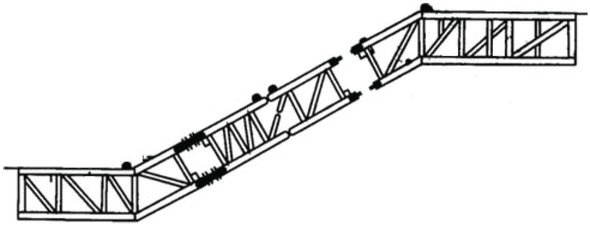
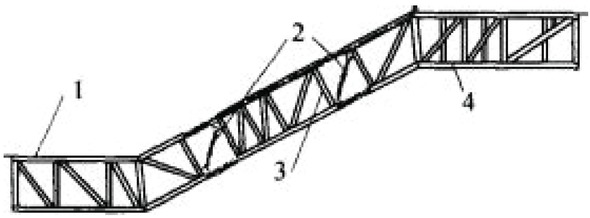
The escalator truss consists of an upper horizontal section, a lower horizontal section and a straight section. Common trusses are available in integral welded trusses (Figure 4) and split welded trusses (Figure 5). In order to facilitate manufacturing, lifting and packaging transportation, the factory generally makes the upper horizontal section and the lower horizontal section into standard sections. The length of the straight section is determined by the lifting height. In the processing, a number of standard straight sections and non-standard straight sections are often made, according to the user. The required lifting heights are assembled and welded separately to form a closed structure truss.
Front view of escalator truss

Top view escalator truss
The role of the metal truss determines that it must meet a certain stiffness, also to meet a certain degree of strength. The standard stipulates that for ordinary escalators or pedestrian crossings, the maximum deflection calculated or measured according to the passenger load shall not exceed the bearing distance; for public transport escalators or automatic pedestrian crossings, the maximum deflection calculated or measured according to the passenger load shall not be exceeding the support distance.
In order to avoid the oscillating or vibration of the metal truss on the building, damping metal and damping rubber are filled between the fulcrum of the metal structure and the building.
The parameters of the escalator truss are shown in Table 1. These dimensions can be automatically input into the finite element analysis software through the program.
Modeling parameters
| Lifting height(m) | Dip (m) | Width (m) | Lower extension (m) | Upper extension (m) | Lower truss length (m) | Number of lower truss | Upper truss length(m) | Number of upper truss | Variable segment size(m) |
|---|---|---|---|---|---|---|---|---|---|
| 6 | 30 | 0.8 | 0 | 0 | 6.527 | 4 | 5.423 | 2 | 0.89 |
For different escalators, modeling can be performed automatically.
An automatic modeling system was developed to automate the modeling and analysis of escalator trusses. Compared with the traditional system development, the system does not need to input complex parameters, and does not need to manually set the cross-section information of the member and generate complex operations such as the finite element model. It only needs to select the ladder type, height, inclination angle, etc. The basic truss parameters can automatically retrieve the relevant BOM in the database, generate modeling and analysis related files, automatically call ANSYS to realize the background calculation and analysis of the escalator truss, and present the calculation results on the system interface through fast calculation, fully realized automated analysis.
2.2 Structure analysis
Most cell types need to define material properties. The application of different material properties can be defined as linear or non-linear, isotropic, orthotropic anisotropy, or anisotropic, elastic or inelastic, not changing with temperature or as a function of temperature. Each set of material properties has a unique material reference number. A variety of materials can be used in one analysis, and correspondingly, material properties of multiple different material numbers need to be defined. The escalator truss structure uses a unit that is elastic, isotropic, and does not change with temperature. Its metal structure material is Q235 steel. The material parameters are shown in Table 2.
Material parameters
| Material | Elastic Modulus (GPa) | Poisson’s ratio | Yield strength (MPa) | Density (Kg/m3) |
|---|---|---|---|---|
| Q235 | 210 | 0.3 | 235 | 7800 |
Meshing is a very important part of the analysis process. The quality of the mesh directly determines the calculation time and calculation accuracy required for the analysis. The unqualified mesh will not only increase the calculation time, but also affect the calculation accuracy. Even because of poor meshing, it cannot be calculated. Meshing is divided into free meshing and mapping meshing. The free mesh is suitable for irregular shapes, but the calculation accuracy is not as good as the mapping mesh. The mesh after the mapping has a certain shape rule. Therefore, the best practice is to use free meshing in complex border areas, and use non-border areas to use mapping partitions. The meshed model is shown in Figure 6.
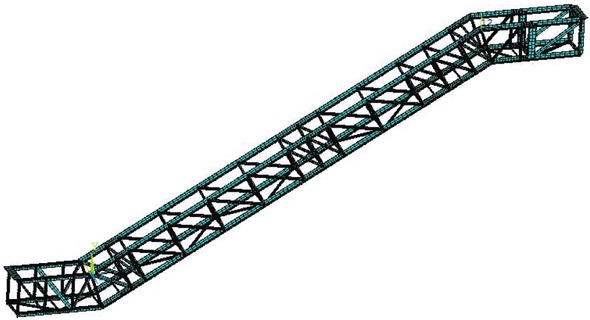
Escalator steel-framed structure meshing model
After the finite element model is generated, it cannot be calculated yet, and boundary conditions need to be applied, including applying loads and constraints. A constraint is imposed to limit the degree of freedom of the boundary node. The number of degrees of freedom applied depends on the number of degrees of freedom in which boundary nodes are limited in the display case. In this paper, the escalator truss, according to the actual situation of the force, should deal with the upper and lower ends of the full angle steel, including the X, Y, Z direction translation and rotation. If there is intermediate support, the Y-direction constraint needs to be imposed on the intermediate support.
There are two kind of loads, self loading and passenger load. The weight of the entire escalator system includes the weight of several components such as metal frame structures, steps, traction chains, stair rail systems, drive devices, tensioning devices, and handrail devices. According to the actual load situation, the key concentrated point of the two upper chords is applied in the form of equivalent
concentrated force. Passenger load is 5000N/m2. According to the length and width of the escalator, the load carried by the ladder can be calculated, which is equivalent to the concentrated load acting on the nodes of the two upper chords. The loads were applied as shown in Figure 7. Figure 8 shows the FEA result, where the max stress is 65.7MPa, which is lower than the yield stress of truss material.

Schematic diagram of loads application
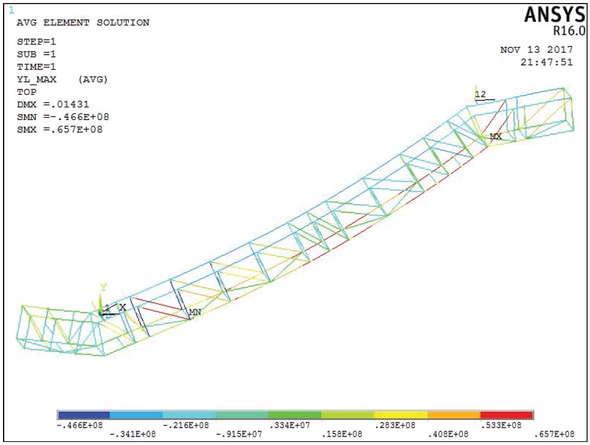
Escalator steel-framed structure stress nephogram
3 Reliability analysis
The escalator truss structure is a complex system that normally bears the effect of self-weight loads and passenger loads. The deadweight is the static load, the passenger load is the random load, the passenger load during the peak period is large, and the passenger load during the low peak period is very small. Because the truss structure bears the effect of random loads, there is a failure dependent between the truss rods and the beams. For the truss system, no structural failure is allowed. Therefore, from a reliability standpoint, the escalator truss structure is a series system [8, 9, 10].
Assuming that the probability density function of truss strength is g(s) and the distribution function is G(s), the probability density function of stress is f (δ) and the distribution function is F (δ). The escalator truss structure has k dangerous components, and the observed strength values of the components sites are s1, s2, ..., sn. The rank of these values from smallest to biggest is as follows:
From probability and statistics theory, it can be seen that s(1), s(2), s(3),...,s(n) are the order statistics.
According to the minimal order statistics theory and dependent failure theory the following formula can be obtained:
This formula reflects the dependent failure of the component. Based on the Equation (3), substituting the distribution values of g(s)~(235, 11.752)MPa and f(δ)~(65.7, 6.572)MPa, the reliability can be calculated to 99.9999%.
4 Conclusions
The truss structure is the key support system for escalators, ensuring its reliability and safety, which are extremely important. Based on the finite element method, this paper analyzes the stress distribution of a typical escalator truss structure subjected to random loads, determines the dangerous locations and stress levels of the truss structure, and establishes the theory of dependent failure due to the effect of random loads applying on the truss system. The reliability model of the truss system is analyzed and the reliability of the truss system is analyzed and calculated. The safety and reliability of the truss system and the effectiveness of the method presented in this paper are verified.
Acknowledgement
This work was partially supported by the National Natural Science Foundation of China (Grant No. 51305275, 51335003, U1708255), the Program for Liaoning Excellent Talents in University (Grant No. LR2015044) and the China Scholarship Council (Grant No. 201708210039, 201706085029).
References
[1] Liang J., Study of FEA Static Analysis Application on the Calculation of Escalator Truss, Mech. Electr. Eng. Technol., 2014, 6, 102-109.Search in Google Scholar
[2] Uimonen S., Tukia T., Siikonen M.L.,et al., Energy consumption of escalators in low traffic environment, Energy Build., 2016, 125, 287-297.10.1016/j.enbuild.2016.05.018Search in Google Scholar
[3] Bardyshev O., Popov V., Druzhinin P. et al., Expert Review of Metro Escalators Safety, Transport. Res. Procedia, 2017, 20, 31-35.10.1016/j.trpro.2017.01.007Search in Google Scholar
[4] Xie L., Liu J., Wu N., Qian W., Backwards statistical inference method for P-S-N curve fitting with small-sample experiment data, Int. J. Fatigue, 2014, 63, 62-67.10.1016/j.ijfatigue.2014.01.006Search in Google Scholar
[5] Wang Z., Xie L., Dynamic reliability model of components under random load, IEEE Trans. Reliab., 2008, 57(3), 474-479.10.1109/TR.2008.928184Search in Google Scholar
[6] Gao P., Yan S., Xie L., Dynamic reliability analysis of mechanical components based on equivalent strength degradation paths, Strojniski Vestnik-J. Mech. Eng., 2013, 59(6), 387-399.10.5545/sv-jme.2012.541Search in Google Scholar
[7] Yin X., Common Cause Failure Model of System Reliability Based on Bayesian Networks, Int. J. Perform. Eng., 2010, 6(3), 160-170.Search in Google Scholar
[8] Qian W., Yin X., Xie L., Reliability modeling and assessment of component with multiple weak sites under complex loading, Math. Probl. Eng., 2014, 2014, 1-9.10.1155/2014/583803Search in Google Scholar
[9] Qian W., Yin X., Xie L., System reliability allocation based on bayesian network, Appl. Math. Inform. Sci., 2012, 6, 681-687.Search in Google Scholar
[10] Freudenthal A.M., Carrelts M., Shinozuka M., The analysis of structural safety, J. Struct. Div., ASCE, 1966, 92, 267-325.10.1061/JSDEAG.0001383Search in Google Scholar
© 2018 X. Yin et al., published by De Gruyter
This work is licensed under the Creative Commons Attribution-NonCommercial-NoDerivatives 4.0 License.
Articles in the same Issue
- Regular Articles
- A modified Fermi-Walker derivative for inextensible flows of binormal spherical image
- Algebraic aspects of evolution partial differential equation arising in the study of constant elasticity of variance model from financial mathematics
- Three-dimensional atom localization via probe absorption in a cascade four-level atomic system
- Determination of the energy transitions and half-lives of Rubidium nuclei
- Three phase heat and mass transfer model for unsaturated soil freezing process: Part 1 - model development
- Three phase heat and mass transfer model for unsaturated soil freezing process: Part 2 - model validation
- Mathematical model for thermal and entropy analysis of thermal solar collectors by using Maxwell nanofluids with slip conditions, thermal radiation and variable thermal conductivity
- Constructing analytic solutions on the Tricomi equation
- Feynman diagrams and rooted maps
- New type of chaos synchronization in discrete-time systems: the F-M synchronization
- Unsteady flow of fractional Oldroyd-B fluids through rotating annulus
- A note on the uniqueness of 2D elastostatic problems formulated by different types of potential functions
- On the conservation laws and solutions of a (2+1) dimensional KdV-mKdV equation of mathematical physics
- Computational methods and traveling wave solutions for the fourth-order nonlinear Ablowitz-Kaup-Newell-Segur water wave dynamical equation via two methods and its applications
- Siewert solutions of transcendental equations, generalized Lambert functions and physical applications
- Numerical solution of mixed convection flow of an MHD Jeffery fluid over an exponentially stretching sheet in the presence of thermal radiation and chemical reaction
- A new three-dimensional chaotic flow with one stable equilibrium: dynamical properties and complexity analysis
- Dynamics of a dry-rebounding drop: observations, simulations, and modeling
- Modeling the initial mechanical response and yielding behavior of gelled crude oil
- Lie symmetry analysis and conservation laws for the time fractional simplified modified Kawahara equation
- Solitary wave solutions of two KdV-type equations
- Applying industrial tomography to control and optimization flow systems
- Reconstructing time series into a complex network to assess the evolution dynamics of the correlations among energy prices
- An optimal solution for software testing case generation based on particle swarm optimization
- Optimal system, nonlinear self-adjointness and conservation laws for generalized shallow water wave equation
- Alternative methods for solving nonlinear two-point boundary value problems
- Global model simulation of OH production in pulsed-DC atmospheric pressure helium-air plasma jets
- Experimental investigation on optical vortex tweezers for microbubble trapping
- Joint measurements of optical parameters by irradiance scintillation and angle-of-arrival fluctuations
- M-polynomials and topological indices of hex-derived networks
- Generalized convergence analysis of the fractional order systems
- Porous flow characteristics of solution-gas drive in tight oil reservoirs
- Complementary wave solutions for the long-short wave resonance model via the extended trial equation method and the generalized Kudryashov method
- A Note on Koide’s Doubly Special Parametrization of Quark Masses
- On right-angled spherical Artin monoid of type Dn
- Gas flow regimes judgement in nanoporous media by digital core analysis
- 4 + n-dimensional water and waves on four and eleven-dimensional manifolds
- Stabilization and Analytic Approximate Solutions of an Optimal Control Problem
- On the equations of electrodynamics in a flat or curved spacetime and a possible interaction energy
- New prediction method for transient productivity of fractured five-spot patterns in low permeability reservoirs at high water cut stages
- The collinear equilibrium points in the restricted three body problem with triaxial primaries
- Detection of the damage threshold of fused silica components and morphologies of repaired damage sites based on the beam deflection method
- On the bivariate spectral quasi-linearization method for solving the two-dimensional Bratu problem
- Ion acoustic quasi-soliton in an electron-positron-ion plasma with superthermal electrons and positrons
- Analysis of projectile motion in view of conformable derivative
- Computing multiple ABC index and multiple GA index of some grid graphs
- Terahertz pulse imaging: A novel denoising method by combing the ant colony algorithm with the compressive sensing
- Characteristics of microscopic pore-throat structure of tight oil reservoirs in Sichuan Basin measured by rate-controlled mercury injection
- An activity window model for social interaction structure on Twitter
- Transient thermal regime trough the constitutive matrix applied to asynchronous electrical machine using the cell method
- On the zagreb polynomials of benzenoid systems
- Integrability analysis of the partial differential equation describing the classical bond-pricing model of mathematical finance
- The Greek parameters of a continuous arithmetic Asian option pricing model via Laplace Adomian decomposition method
- Quantifying the global solar radiation received in Pietermaritzburg, KwaZulu-Natal to motivate the consumption of solar technologies
- Sturm-Liouville difference equations having Bessel and hydrogen atom potential type
- Study on the response characteristics of oil wells after deep profile control in low permeability fractured reservoirs
- Depiction and analysis of a modified theta shaped double negative metamaterial for satellite application
- An attempt to geometrize electromagnetism
- Structure of traveling wave solutions for some nonlinear models via modified mathematical method
- Thermo-convective instability in a rotating ferromagnetic fluid layer with temperature modulation
- Construction of new solitary wave solutions of generalized Zakharov-Kuznetsov-Benjamin-Bona-Mahony and simplified modified form of Camassa-Holm equations
- Effect of magnetic field and heat source on Upper-convected-maxwell fluid in a porous channel
- Physical cues of biomaterials guide stem cell fate of differentiation: The effect of elasticity of cell culture biomaterials
- Shooting method analysis in wire coating withdrawing from a bath of Oldroyd 8-constant fluid with temperature dependent viscosity
- Rank correlation between centrality metrics in complex networks: an empirical study
- Special Issue: The 18th International Symposium on Electromagnetic Fields in Mechatronics, Electrical and Electronic Engineering
- Modeling of electric and heat processes in spot resistance welding of cross-wire steel bars
- Dynamic characteristics of triaxial active control magnetic bearing with asymmetric structure
- Design optimization of an axial-field eddy-current magnetic coupling based on magneto-thermal analytical model
- Thermal constitutive matrix applied to asynchronous electrical machine using the cell method
- Temperature distribution around thin electroconductive layers created on composite textile substrates
- Model of the multipolar engine with decreased cogging torque by asymmetrical distribution of the magnets
- Analysis of spatial thermal field in a magnetic bearing
- Use of the mathematical model of the ignition system to analyze the spark discharge, including the destruction of spark plug electrodes
- Assessment of short/long term electric field strength measurements for a pilot district
- Simulation study and experimental results for detection and classification of the transient capacitor inrush current using discrete wavelet transform and artificial intelligence
- Magnetic transmission gear finite element simulation with iron pole hysteresis
- Pulsed excitation terahertz tomography – multiparametric approach
- Low and high frequency model of three phase transformer by frequency response analysis measurement
- Multivariable polynomial fitting of controlled single-phase nonlinear load of input current total harmonic distortion
- Optimal design of a for middle-low-speed maglev trains
- Eddy current modeling in linear and nonlinear multifilamentary composite materials
- The visual attention saliency map for movie retrospection
- AC/DC current ratio in a current superimposition variable flux reluctance machine
- Influence of material uncertainties on the RLC parameters of wound inductors modeled using the finite element method
- Cogging force reduction in linear tubular flux switching permanent-magnet machines
- Modeling hysteresis curves of La(FeCoSi)13 compound near the transition point with the GRUCAD model
- Electro-magneto-hydrodynamic lubrication
- 3-D Electromagnetic field analysis of wireless power transfer system using K computer
- Simplified simulation technique of rotating, induction heated, calender rolls for study of temperature field control
- Design, fabrication and testing of electroadhesive interdigital electrodes
- A method to reduce partial discharges in motor windings fed by PWM inverter
- Reluctance network lumped mechanical & thermal models for the modeling and predesign of concentrated flux synchronous machine
- Special Issue Applications of Nonlinear Dynamics
- Study on dynamic characteristics of silo-stock-foundation interaction system under seismic load
- Microblog topic evolution computing based on LDA algorithm
- Modeling the creep damage effect on the creep crack growth behavior of rotor steel
- Neighborhood condition for all fractional (g, f, n′, m)-critical deleted graphs
- Chinese open information extraction based on DBMCSS in the field of national information resources
- 10.1515/phys-2018-0079
- CPW-fed circularly-polarized antenna array with high front-to-back ratio and low-profile
- Intelligent Monitoring Network Construction based on the utilization of the Internet of things (IoT) in the Metallurgical Coking Process
- Temperature detection technology of power equipment based on Fiber Bragg Grating
- Research on a rotational speed control strategy of the mandrel in a rotary steering system
- Dynamic load balancing algorithm for large data flow in distributed complex networks
- Super-structured photonic crystal fiber Bragg grating biosensor image model based on sparse matrix
- Fractal-based techniques for physiological time series: An updated approach
- Analysis of the Imaging Characteristics of the KB and KBA X-ray Microscopes at Non-coaxial Grazing Incidence
- Application of modified culture Kalman filter in bearing fault diagnosis
- Exact solutions and conservation laws for the modified equal width-Burgers equation
- On topological properties of block shift and hierarchical hypercube networks
- Elastic properties and plane acoustic velocity of cubic Sr2CaMoO6 and Sr2CaWO6 from first-principles calculations
- A note on the transmission feasibility problem in networks
- Ontology learning algorithm using weak functions
- Diagnosis of the power frequency vacuum arc shape based on 2D-PIV
- Parametric simulation analysis and reliability of escalator truss
- A new algorithm for real economy benefit evaluation based on big data analysis
- Synergy analysis of agricultural economic cycle fluctuation based on ant colony algorithm
- Multi-level encryption algorithm for user-related information across social networks
- Multi-target tracking algorithm in intelligent transportation based on wireless sensor network
- Fast recognition method of moving video images based on BP neural networks
- Compressed sensing image restoration algorithm based on improved SURF operator
- Design of load optimal control algorithm for smart grid based on demand response in different scenarios
- Face recognition method based on GA-BP neural network algorithm
- Optimal path selection algorithm for mobile beacons in sensor network under non-dense distribution
- Localization and recognition algorithm for fuzzy anomaly data in big data networks
- Urban road traffic flow control under incidental congestion as a function of accident duration
- Optimization design of reconfiguration algorithm for high voltage power distribution network based on ant colony algorithm
- Feasibility simulation of aseismic structure design for long-span bridges
- Construction of renewable energy supply chain model based on LCA
- The tribological properties study of carbon fabric/ epoxy composites reinforced by nano-TiO2 and MWNTs
- A text-Image feature mapping algorithm based on transfer learning
- Fast recognition algorithm for static traffic sign information
- Topical Issue: Clean Energy: Materials, Processes and Energy Generation
- An investigation of the melting process of RT-35 filled circular thermal energy storage system
- Numerical analysis on the dynamic response of a plate-and-frame membrane humidifier for PEMFC vehicles under various operating conditions
- Energy converting layers for thin-film flexible photovoltaic structures
- Effect of convection heat transfer on thermal energy storage unit
Articles in the same Issue
- Regular Articles
- A modified Fermi-Walker derivative for inextensible flows of binormal spherical image
- Algebraic aspects of evolution partial differential equation arising in the study of constant elasticity of variance model from financial mathematics
- Three-dimensional atom localization via probe absorption in a cascade four-level atomic system
- Determination of the energy transitions and half-lives of Rubidium nuclei
- Three phase heat and mass transfer model for unsaturated soil freezing process: Part 1 - model development
- Three phase heat and mass transfer model for unsaturated soil freezing process: Part 2 - model validation
- Mathematical model for thermal and entropy analysis of thermal solar collectors by using Maxwell nanofluids with slip conditions, thermal radiation and variable thermal conductivity
- Constructing analytic solutions on the Tricomi equation
- Feynman diagrams and rooted maps
- New type of chaos synchronization in discrete-time systems: the F-M synchronization
- Unsteady flow of fractional Oldroyd-B fluids through rotating annulus
- A note on the uniqueness of 2D elastostatic problems formulated by different types of potential functions
- On the conservation laws and solutions of a (2+1) dimensional KdV-mKdV equation of mathematical physics
- Computational methods and traveling wave solutions for the fourth-order nonlinear Ablowitz-Kaup-Newell-Segur water wave dynamical equation via two methods and its applications
- Siewert solutions of transcendental equations, generalized Lambert functions and physical applications
- Numerical solution of mixed convection flow of an MHD Jeffery fluid over an exponentially stretching sheet in the presence of thermal radiation and chemical reaction
- A new three-dimensional chaotic flow with one stable equilibrium: dynamical properties and complexity analysis
- Dynamics of a dry-rebounding drop: observations, simulations, and modeling
- Modeling the initial mechanical response and yielding behavior of gelled crude oil
- Lie symmetry analysis and conservation laws for the time fractional simplified modified Kawahara equation
- Solitary wave solutions of two KdV-type equations
- Applying industrial tomography to control and optimization flow systems
- Reconstructing time series into a complex network to assess the evolution dynamics of the correlations among energy prices
- An optimal solution for software testing case generation based on particle swarm optimization
- Optimal system, nonlinear self-adjointness and conservation laws for generalized shallow water wave equation
- Alternative methods for solving nonlinear two-point boundary value problems
- Global model simulation of OH production in pulsed-DC atmospheric pressure helium-air plasma jets
- Experimental investigation on optical vortex tweezers for microbubble trapping
- Joint measurements of optical parameters by irradiance scintillation and angle-of-arrival fluctuations
- M-polynomials and topological indices of hex-derived networks
- Generalized convergence analysis of the fractional order systems
- Porous flow characteristics of solution-gas drive in tight oil reservoirs
- Complementary wave solutions for the long-short wave resonance model via the extended trial equation method and the generalized Kudryashov method
- A Note on Koide’s Doubly Special Parametrization of Quark Masses
- On right-angled spherical Artin monoid of type Dn
- Gas flow regimes judgement in nanoporous media by digital core analysis
- 4 + n-dimensional water and waves on four and eleven-dimensional manifolds
- Stabilization and Analytic Approximate Solutions of an Optimal Control Problem
- On the equations of electrodynamics in a flat or curved spacetime and a possible interaction energy
- New prediction method for transient productivity of fractured five-spot patterns in low permeability reservoirs at high water cut stages
- The collinear equilibrium points in the restricted three body problem with triaxial primaries
- Detection of the damage threshold of fused silica components and morphologies of repaired damage sites based on the beam deflection method
- On the bivariate spectral quasi-linearization method for solving the two-dimensional Bratu problem
- Ion acoustic quasi-soliton in an electron-positron-ion plasma with superthermal electrons and positrons
- Analysis of projectile motion in view of conformable derivative
- Computing multiple ABC index and multiple GA index of some grid graphs
- Terahertz pulse imaging: A novel denoising method by combing the ant colony algorithm with the compressive sensing
- Characteristics of microscopic pore-throat structure of tight oil reservoirs in Sichuan Basin measured by rate-controlled mercury injection
- An activity window model for social interaction structure on Twitter
- Transient thermal regime trough the constitutive matrix applied to asynchronous electrical machine using the cell method
- On the zagreb polynomials of benzenoid systems
- Integrability analysis of the partial differential equation describing the classical bond-pricing model of mathematical finance
- The Greek parameters of a continuous arithmetic Asian option pricing model via Laplace Adomian decomposition method
- Quantifying the global solar radiation received in Pietermaritzburg, KwaZulu-Natal to motivate the consumption of solar technologies
- Sturm-Liouville difference equations having Bessel and hydrogen atom potential type
- Study on the response characteristics of oil wells after deep profile control in low permeability fractured reservoirs
- Depiction and analysis of a modified theta shaped double negative metamaterial for satellite application
- An attempt to geometrize electromagnetism
- Structure of traveling wave solutions for some nonlinear models via modified mathematical method
- Thermo-convective instability in a rotating ferromagnetic fluid layer with temperature modulation
- Construction of new solitary wave solutions of generalized Zakharov-Kuznetsov-Benjamin-Bona-Mahony and simplified modified form of Camassa-Holm equations
- Effect of magnetic field and heat source on Upper-convected-maxwell fluid in a porous channel
- Physical cues of biomaterials guide stem cell fate of differentiation: The effect of elasticity of cell culture biomaterials
- Shooting method analysis in wire coating withdrawing from a bath of Oldroyd 8-constant fluid with temperature dependent viscosity
- Rank correlation between centrality metrics in complex networks: an empirical study
- Special Issue: The 18th International Symposium on Electromagnetic Fields in Mechatronics, Electrical and Electronic Engineering
- Modeling of electric and heat processes in spot resistance welding of cross-wire steel bars
- Dynamic characteristics of triaxial active control magnetic bearing with asymmetric structure
- Design optimization of an axial-field eddy-current magnetic coupling based on magneto-thermal analytical model
- Thermal constitutive matrix applied to asynchronous electrical machine using the cell method
- Temperature distribution around thin electroconductive layers created on composite textile substrates
- Model of the multipolar engine with decreased cogging torque by asymmetrical distribution of the magnets
- Analysis of spatial thermal field in a magnetic bearing
- Use of the mathematical model of the ignition system to analyze the spark discharge, including the destruction of spark plug electrodes
- Assessment of short/long term electric field strength measurements for a pilot district
- Simulation study and experimental results for detection and classification of the transient capacitor inrush current using discrete wavelet transform and artificial intelligence
- Magnetic transmission gear finite element simulation with iron pole hysteresis
- Pulsed excitation terahertz tomography – multiparametric approach
- Low and high frequency model of three phase transformer by frequency response analysis measurement
- Multivariable polynomial fitting of controlled single-phase nonlinear load of input current total harmonic distortion
- Optimal design of a for middle-low-speed maglev trains
- Eddy current modeling in linear and nonlinear multifilamentary composite materials
- The visual attention saliency map for movie retrospection
- AC/DC current ratio in a current superimposition variable flux reluctance machine
- Influence of material uncertainties on the RLC parameters of wound inductors modeled using the finite element method
- Cogging force reduction in linear tubular flux switching permanent-magnet machines
- Modeling hysteresis curves of La(FeCoSi)13 compound near the transition point with the GRUCAD model
- Electro-magneto-hydrodynamic lubrication
- 3-D Electromagnetic field analysis of wireless power transfer system using K computer
- Simplified simulation technique of rotating, induction heated, calender rolls for study of temperature field control
- Design, fabrication and testing of electroadhesive interdigital electrodes
- A method to reduce partial discharges in motor windings fed by PWM inverter
- Reluctance network lumped mechanical & thermal models for the modeling and predesign of concentrated flux synchronous machine
- Special Issue Applications of Nonlinear Dynamics
- Study on dynamic characteristics of silo-stock-foundation interaction system under seismic load
- Microblog topic evolution computing based on LDA algorithm
- Modeling the creep damage effect on the creep crack growth behavior of rotor steel
- Neighborhood condition for all fractional (g, f, n′, m)-critical deleted graphs
- Chinese open information extraction based on DBMCSS in the field of national information resources
- 10.1515/phys-2018-0079
- CPW-fed circularly-polarized antenna array with high front-to-back ratio and low-profile
- Intelligent Monitoring Network Construction based on the utilization of the Internet of things (IoT) in the Metallurgical Coking Process
- Temperature detection technology of power equipment based on Fiber Bragg Grating
- Research on a rotational speed control strategy of the mandrel in a rotary steering system
- Dynamic load balancing algorithm for large data flow in distributed complex networks
- Super-structured photonic crystal fiber Bragg grating biosensor image model based on sparse matrix
- Fractal-based techniques for physiological time series: An updated approach
- Analysis of the Imaging Characteristics of the KB and KBA X-ray Microscopes at Non-coaxial Grazing Incidence
- Application of modified culture Kalman filter in bearing fault diagnosis
- Exact solutions and conservation laws for the modified equal width-Burgers equation
- On topological properties of block shift and hierarchical hypercube networks
- Elastic properties and plane acoustic velocity of cubic Sr2CaMoO6 and Sr2CaWO6 from first-principles calculations
- A note on the transmission feasibility problem in networks
- Ontology learning algorithm using weak functions
- Diagnosis of the power frequency vacuum arc shape based on 2D-PIV
- Parametric simulation analysis and reliability of escalator truss
- A new algorithm for real economy benefit evaluation based on big data analysis
- Synergy analysis of agricultural economic cycle fluctuation based on ant colony algorithm
- Multi-level encryption algorithm for user-related information across social networks
- Multi-target tracking algorithm in intelligent transportation based on wireless sensor network
- Fast recognition method of moving video images based on BP neural networks
- Compressed sensing image restoration algorithm based on improved SURF operator
- Design of load optimal control algorithm for smart grid based on demand response in different scenarios
- Face recognition method based on GA-BP neural network algorithm
- Optimal path selection algorithm for mobile beacons in sensor network under non-dense distribution
- Localization and recognition algorithm for fuzzy anomaly data in big data networks
- Urban road traffic flow control under incidental congestion as a function of accident duration
- Optimization design of reconfiguration algorithm for high voltage power distribution network based on ant colony algorithm
- Feasibility simulation of aseismic structure design for long-span bridges
- Construction of renewable energy supply chain model based on LCA
- The tribological properties study of carbon fabric/ epoxy composites reinforced by nano-TiO2 and MWNTs
- A text-Image feature mapping algorithm based on transfer learning
- Fast recognition algorithm for static traffic sign information
- Topical Issue: Clean Energy: Materials, Processes and Energy Generation
- An investigation of the melting process of RT-35 filled circular thermal energy storage system
- Numerical analysis on the dynamic response of a plate-and-frame membrane humidifier for PEMFC vehicles under various operating conditions
- Energy converting layers for thin-film flexible photovoltaic structures
- Effect of convection heat transfer on thermal energy storage unit
