
An investigation of the melting process of RT-35 filled circular thermal energy storage system
-
Soroush Ebadi
 ,
Manar Al-Jethelah
,
Manar Al-Jethelah

Abstract
One of the main solutions to the issue of global warming and greenhouse gas emission caused by burning fossil fuels is storing energy in an efficient way. In this work, the detailed melting process of RT-35 as a phase change material (PCM) inside a cylindrical latent heat thermal energy storage (TES) system is investigated both numerically and experimentally. To achieve this aim, an experimental setup comprising of a transparent vertical cylindrical enclosure as a latent heat TES system, a constant temperature bath, and a temperature regulator is built. Moreover, a numerical model using COMSOL multiphysics is developed to simulate the melting process and provide a more detailed information on the flow and thermal fields. The model is able to provide the temperature and velocity fields, heat transfer behaviour, melting fraction, and the trend of solid-liquid interface at different time intervals. To validate the numerical model, a comparison between melting fraction and solid-liquid interfaces of the numerical model and experimental work is conducted which shows a good agreement between experimental and numerical results.
1 Introduction
Nowadays, the increase in the energy consumption due to the growth of population and development of industries, environmental concerns due to global warming, depletion of fossil fuel sources and increase in the price of extracting them are the main concerns regarding energy supply. These economic and environmental concerns have enforced energy providers and researchers to look for an affordable solution to remedy this issue. Storing energy in an efficient way can play a significant role to reduce the burning of fossil fuels and releasing less amount of greenhouse gas. Thermal Energy Storage (TES) systems are developed to store energy efficiently based on the heating or cooling of a specific medium. TES systems can be used in many different applications for heating/ cooling purposes including heating, ventilation, and air conditioning (HVAC) systems, solar power plants for storing thermal energy during the day and release it during the night, and residential buildings for waste heat recovery purposes. In terms of storing thermal energy, TES systems are divided into three major groups including: (i) sensible heat thermal energy storage (SHTES) system (ii) latent heat thermal energy storage (LHTES) system and (iii) thermo-chemical energy storage (TCES) system. However, LHTES systems have attracted more attention of researchers and energy suppliers due to the higher density of thermal energy storage and lower variation in operating temperature [1]. LHTES system is based on heating or cooling a phase change material (PCM) where the thermal energy is absorbed as a latent heat due to the melting process and is released due to solidification process. According to the operation temperature of TES systems, a PCM with proper melting temperature (i.e. phase change temperature) should be used. However, thermal conductivity (k), stability and the amount of latent heat (hfg) are the other characteristics of selecting a proper PCM [2]. In addition, according to the application of a TES system and the available space for installing this system, different types of geometries such as rectangular, cylindrical, and spherical can be used. Cylindrical TES systems offer the advantages of ease of manufacturing and can be installed both vertically and horizontally. Therefore, in the present investigation, the focus is to study the detailed melting (charging) process of a PCM filled cylindrical TES system. By surveying the literature, many research works can be identified regarding the use of cylindrical TES system filled with PCM.
Starting with the vertical cylindrical TES system configuration, a numerical investigation of the natural convection through a cylindrical capsule filled with a PCM is conducted by Wu and Lacroix [3]. In their study, the capsule is isothermally heated from the bottom, the top, and the sides. The stream function, vorticity, and temperature are considered in the governing equations and a method called body-fitted coordinates is used to track the irregular shape of solid-liquid phase front. It is reported that conduction is the dominant form of the heat transfer when it is heated from the top. In addition, as the melting process progresses, Nusselt number at the top surface decreases to zero which shows that conduction is dominated during the melting process. Moreover, the bottom surface had the highest rate of heat transfer where the Benard convective cells are dominated. Jones et al. [4], experimentally and numerically studied the melting process of a subcooled paraffin wax. The vertical cylindrical enclosure was isothermally heated from the sides using a hot constant temperature bath, insulated at the top, and a constant temperature condition was applied to the bottom. During the experiments, measurement of temperatures in different radial locations and capturing the melt front locations were performed. By using digital image processing technique, a method for estimating the location of the solid-liquid interface was developed. It is shown that during the melting process of PCM, pure conduction, mixed convection and conduction, convection and shrinking solid are the main heat transfer regimes. A numerical investigation of the melting process of RT-27 was conducted by Shmueli et al. [5]. In their investigation, the cylindrical model was heated isothermally from its sides, insulated from the bottom, and kept open from the top. The model was based on the enthalpy-porosity method and the effects of parameters representing mushy zone and pressure-velocity were considered. Moreover, quantitative information representing the rate of heat transfer and melting fraction was achieved by using image processing of previous experimental work. It is concluded that conduction is the main form of heat transfer at the starting of melting process. As time progresses, natural convection became the dominant form of heat transfer which changes the solid shape of PCM to a conical one. Wang et al. [6], conducted a numerical investigation on the melting process of a PCM with the aim of developing heat transfer correlations. In their study, inward and outward melting process inside a vertical cylindrical enclosure was considered and the model was compared to the previous works. A general agreement was achieved; however, there were some discrepancies due to the influence of heat losses. In addition, the transient heat transfer correlations and total stored energy for a variety of Rayleigh numbers were proposed.
Regarding horizontal cylindrical TES system, Regin et al. [7], performed a numerical and experimental study of the melting of a PCM inside a solar TES system. In their work, horizontal pipes were filled with paraffin wax and subjected to hot water from the surrounding. A numerical model based on enthalpy method was developed and results were compared to experimental investigation. It is reported that Stefan number, radius of the pipe, and range of the phase change temperature are the main dominant parameters, which control the melting process. In addition, by considering the phase change temperature and natural convection in the liquid phase, the agreement between numerical and experimental work was improved. A numerical investigation of the solid-liquid phase change interface for a horizontal cylindrical enclosure was carried out by Mahdaoui et al. [8]. In their work, constant wall temperature and constant heat flux were two main boundary conditions that were investigated. In order to solve the natural convection in the change of the phase, a numerical code based on finite element and enthalpy porosity method was used and the results were validated. It is concluded that at the beginning of melting process, conduction is the dominant form of heat transfer and the local Nusselt number is degraded as time advanced. However, as the melting process progresses, natural convection was developed which significantly affected the shape of the solid-liquid interface. Hosseini et al. [9], conducted an experimental and numerical investigation to study the heat transfer and thermal behaviour of a PCM during constrained condition filled in a shell and tube heat exchanger. Paraffin RT-50 was used as the PCM and several experiments were performed to consider the influence of the inlet temperature of working fluid on melting/solidification process. A numerical model based on an iteration and finite-volume method was developed to study the variation of the molten front with time. Their results showed that rate of heat transfer and charging (melting) time depend on the inlet temperature of working fluid, which by increasing the inlet temperature from 70°C to 80°C, the melting time was degraded by 37%. Moreover, there was a 7.3% increase in theoretical efficiency of the heat exchanger during the melting process.
According to the literature, the melting process of PCM inside a vertical cylinder insulated from the bottom, isothermally heated from sides, and kept open from the top has not been extensively investigated both experimentally and numerically. In this work, an experimental and numerical study is performed to investigate the melting process of RT-35 as a PCM filled a vertical cylindrical TES system. The lateral walls of the proposed TES system is subjected to an isothermal condition with the temperature of 45°C, while it is insulated at the bottom, and kept open from the top. To perform the investigation, an experimental setup and numerical model were developed to visualize and study the melting process of PCM. This work represents an early stage to study the possible improvements in the melting process by adding nanoparticles into pure PCM.
2 Problem description
2.1 Experimental work
In this section, a detailed description regarding vertical cylindrical TES system setup and experimental procedures are presented. To visualize the melting process of RT-35 as the PCM, a vertical cylindrical TES prototype is built. The setup consists of an acrylic pipe with an inner diameter of 4.4 cm and the height of 30 cm attached to a plastic plate vertically by using a transparent acrylic cement (manufacturer: Scigrip). The bottom part of the enclosure is insulated while it is maintained open from the top to avoid any pressure build on the top of the PCM during the melting process. Then, the cylindrical enclosure is filled with RT-35 (manufacturer: Rubitherm) with the melting temperature (Tm) in the range of 34°C – 36°C at a specific height (H) in the TES system which represents Rayleigh number (Ra) of 107 (i.e. the height of the PCM in the TES system is 8.3 cm). Subsequently, the setup was maintained at the room temperature (i.e., T0= 23° C) to initiate the solidification process gradually. Solidification in temperatures close to Tm and at a longer time provides the advantage of having less trapped air inside the TES system, leading to having fewer holes inside solid part of the PCM that happens due to the shrinkage of PCM. This offers a more uniform solid-liquid interface during melting process and leads to having a fair comparison with numerical results. Next, a transparent water tank equipped with a circulation pump and temperature regulator was used to provide isothermal boundary condition. The temperature of the water inside the tank is set to 45°C (i.e. 10°C above the Tm) and suddenly the cylindrical TES system is placed inside the hot bath to initiate the melting process. Moreover, a digital camera is used to capture the solid/liquid interface of the PCM periodically. A schematic of the experimental setup can be seen in Figure 1.
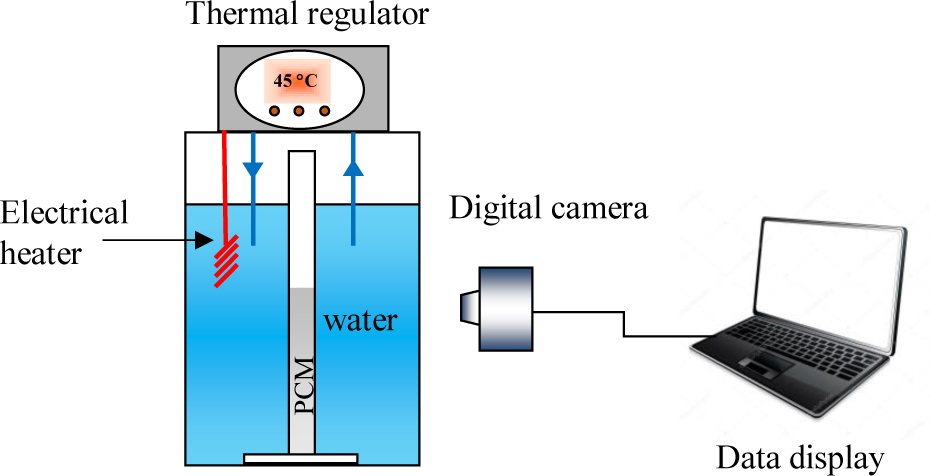
A schematic of the experimental setup
2.2 Numerical model
To investigate the flow and thermal fields, a numerical model based on the finite element approach using COMSOL multiphysics is developed. To do so, a 2-D axisymmetric model representing the cylindrical TES system having the same dimensions of the experimental TES system (i.e. inner diameter of the pipe 4.4 cm and the height of 30 cm) is developed. The model is insulated from the bottom and kept open from the top and it is assumed to be filled with RT-35 at a height of H to represent the experimental conditions. The initial temperature of PCM is assumed as T0, which is equal to room temperature and lower than Tm. The model is isothermally heated from the sides at a temperature of Th, which is 10°C above the Tm to initiate the melting process. As the melting process progresses, the liquid-solid interface appears. In this simulation,
the liquid phase of PCM is considered as Newtonian incompressible fluid. In addition, the thermo-physical properties of RT-35 is collected from the literature and the manufacturer. These properties are shown in Table 1.
| Thermo-physical properties | Value |
|---|---|
| ρs (kg/m3) – Density at solid state | 880 |
| ρl (kg/m3)– Density at liquid state | 760 |
| K (W/m⋅K) - Thermal conductivity | 0.2 |
| Cp (J/kg⋅K) - Specific heat | 2000 |
| β (1/K) - Coefficient of thermal expansion | 0.0006 |
| hfg (kJ/kg) - Latent heat of fusion | 160 |
| μ (kg/m⋅s) - Viscosity | 0.023 |
| Tm (°C) - Melting area | 35 |
| Volume expansion (%) | 12.5 |
The governing equations representing the conservation of mass, momentum and transferred energy are presented below [12]
where u and w are the components of velocity in r-direction and z- direction, respectively.
Energy equation:
where t, k, ρ, and Cp represent time, thermal conductivity, density, and the specific heat at constant pressure, respectively and the
r-momentum equation:
where μ, g, β, and T represent viscosity, gravitational acceleration and coefficient of thermal expansion and temperature, respectively. For better understanding, it is worthy to read references [13, 14, 15] that present the concept of fluid flow in fractal media and its solution techniques.
2.3 Boundary conditions
At the beginning of the simulation (t = 0), the cylindrical TES system is filled with a certain height of PCM (i.e. z = H) having a temperature of T0 which is lower than Tm. The bottom wall (i.e. z = 0) is assumed thermally insulated. In order to initiate the melting process, the lateral walls of the cylindrical TES system are subjected to Th, which is 10°C higher than Tm. A schematic of the numerical model is presented in Figure 2.
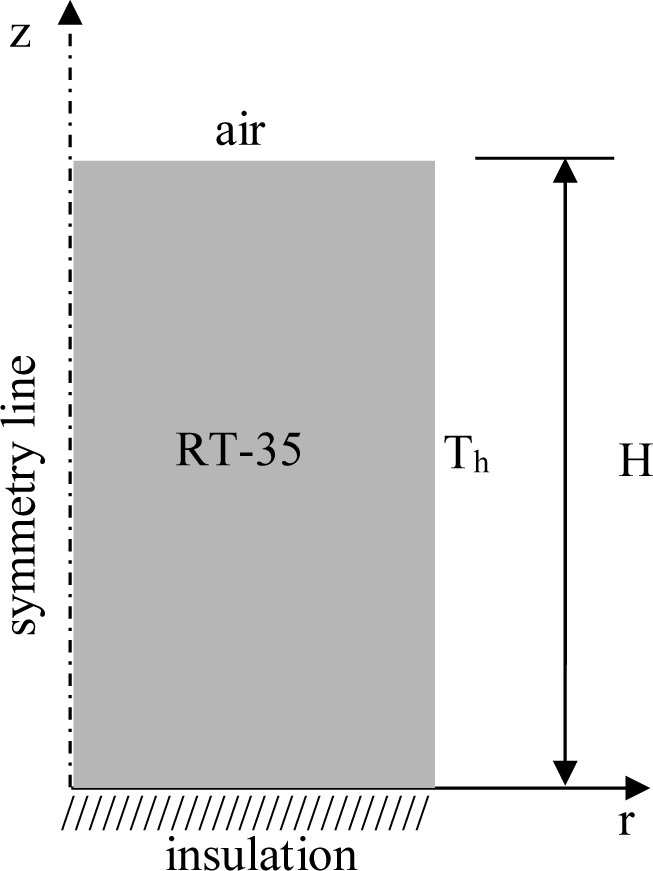
A schematic of the numerical model
2.4 Mesh independency test
Three grid sizes are tested to examine the grid dependency test. The tested grid sizes are fine mesh, number of elements = 6965, simulation time = 50 minutes; finer mesh, number of elements = 15062, simulation time = 1 hour and 38 minutes, and extra fine mesh, number of elements = 33905, simulation time = 3 hours and 47 minutes. The melting fraction is numerically calculated for different mesh sizes. Figure 3 shows that using finer mesh and extra fine mesh lead to almost identical results. However, extra fine mesh takes a longer time to complete the simulation. Therefore, considering the time and the accuracy of the simulation, the finer mesh is considered in the present study.
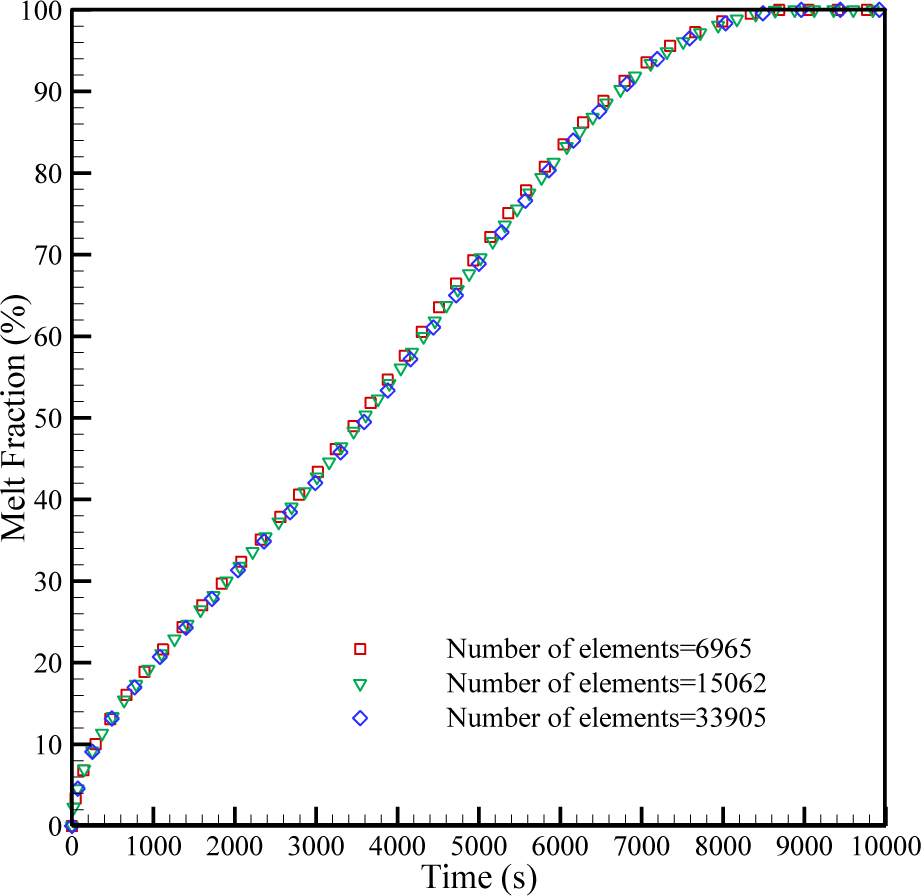
Melting fraction for the different mesh qualities
3 Results and discussion
Figure 4 shows, experimentally and numerically, the evolution of the melting process of RT-35. The melting process is tracked from time = 300 sec. to 7500 sec. The RT-35 starts melting after applying a heat source at constant temperature at the walls of the cylinder. The interface shortly appears after initiating the melting process. At 300 sec., the interface is parallel to the walls of the cylinder. The parallel interface indicates that the dominant mode of heat transfer is conduction. Between 1000 and 1800 sec., the melted RT-35 occupies more space at the upper part of the cylinder. With ongoing heating, the interface deforms, and the remaining solid RT-35 takes the shape of a cone starting from 3900 sec. to the end of the melting process. Most of the melted RT-35 occupies the upper part of the cylinder, while less amount of solid RT-35 is available at the lower part of the cylinder. The warm liquid RT-35 that has been heated through the walls of the cylinder rises up as it becomes lighter. The warm melted RT-35 accumulates at the top of the cylinder due to the thermal stratification effect. Since the melted RT-35 cannot cross the impermeable surface, the colder melted RT-35 moves downwards to give space for the warmer melted RT-35. As a result, the transferred thermal energy to the solid RT-35 gradually drops as the melted RT-35 moves downwards. As it can be seen from Figure 4, the computed numerical results are in a good agreement with the conducted experiment results.
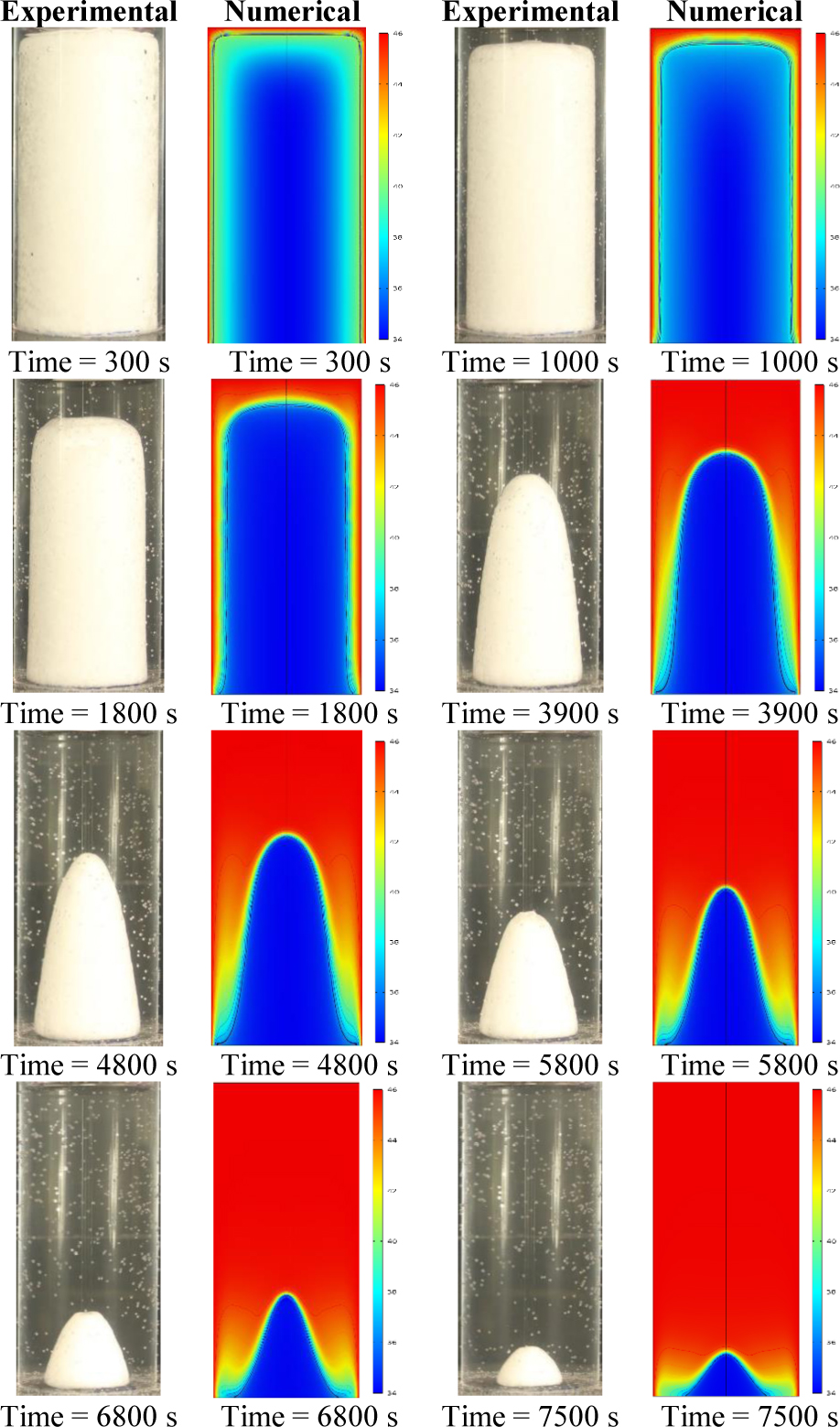
Comparison of melting pattern between the experimental and numerical results
Figure 5 shows the comparison of melting fraction with time between the experimental and numerical results. The melting fraction (MF) is calculated by using Eq. 5.
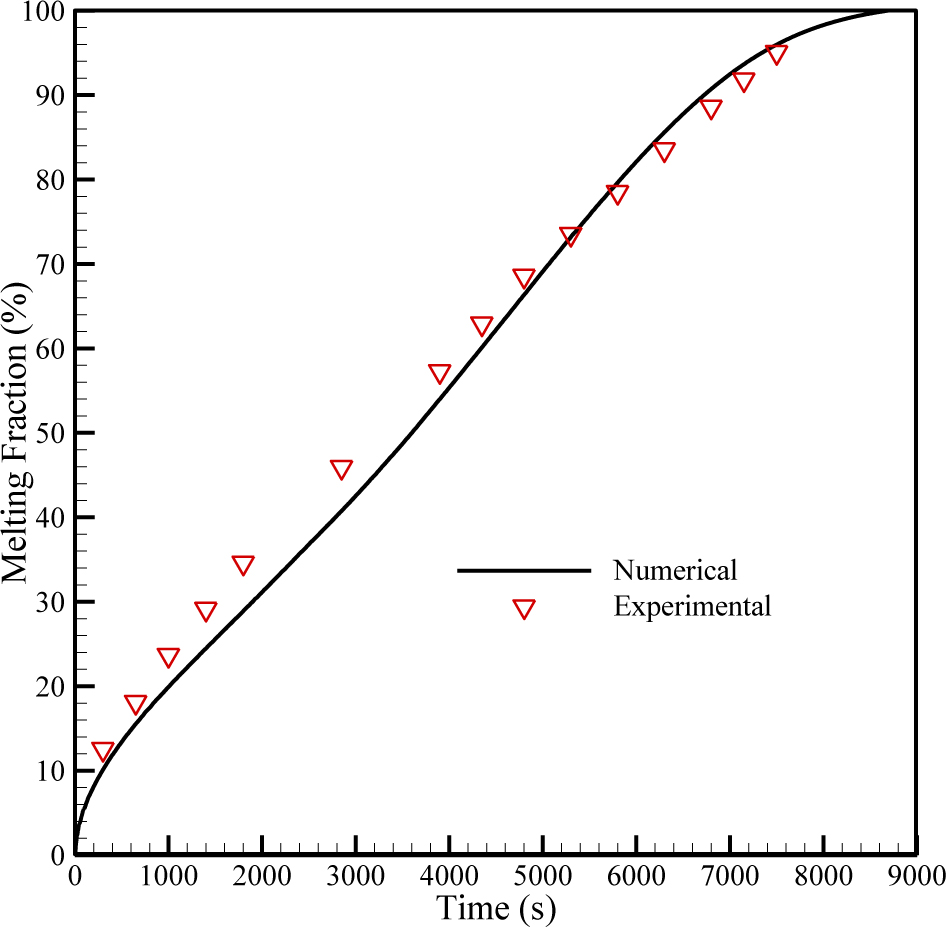
A comparison of melting fraction with time between the experimental and numerical results
In order to calculate the melting fraction for the results obtained by digital photos from experimental work, the image processing method has been used. An almost linear trend is observed between the melting fraction and time in both results with a higher melting at the beginning followed by a slower melting rate as melting progresses. At the beginning of the melting process, the temperature difference between the PCM in the TES system and the constant temperature bath is the highest and therefore, melting rate of PCM is highest. As the melting process advances, the amount of liquid PCM in the TES system increases and so does its temperature. As a result, the temperature difference between the PCM in the TES system and the constant temperature bath decreases and the melting rate of PCM decreases.
As it can be seen from Figure 5, there are some discrepancies in the value of melting fraction obtained by numerical and experimental work. The main reasons of these differences could be (i) ignoring the thermal resistance of acrylic pipe in the numerical model; (ii) improper insulation at the bottom of cylindrical TES system in the experimental work and (iii) ignoring the thermal expansion of the PCM during the melting process in the numerical model.
Figure 6 shows the amount of transferred heat flux into the TES with time. At the beginning of the melting process, the PCM which is attached to the TES wall is solid and at a lower temperature than the bath temperature. At this point, the temperature difference between the cold PCM and hot lateral walls is high which causes high heat transfer into the TES. With ongoing heating, the PCM close to the wall becomes warmer which reduces the temperature difference between inside and outside the TES. As a result, the heat transfer drops with time.
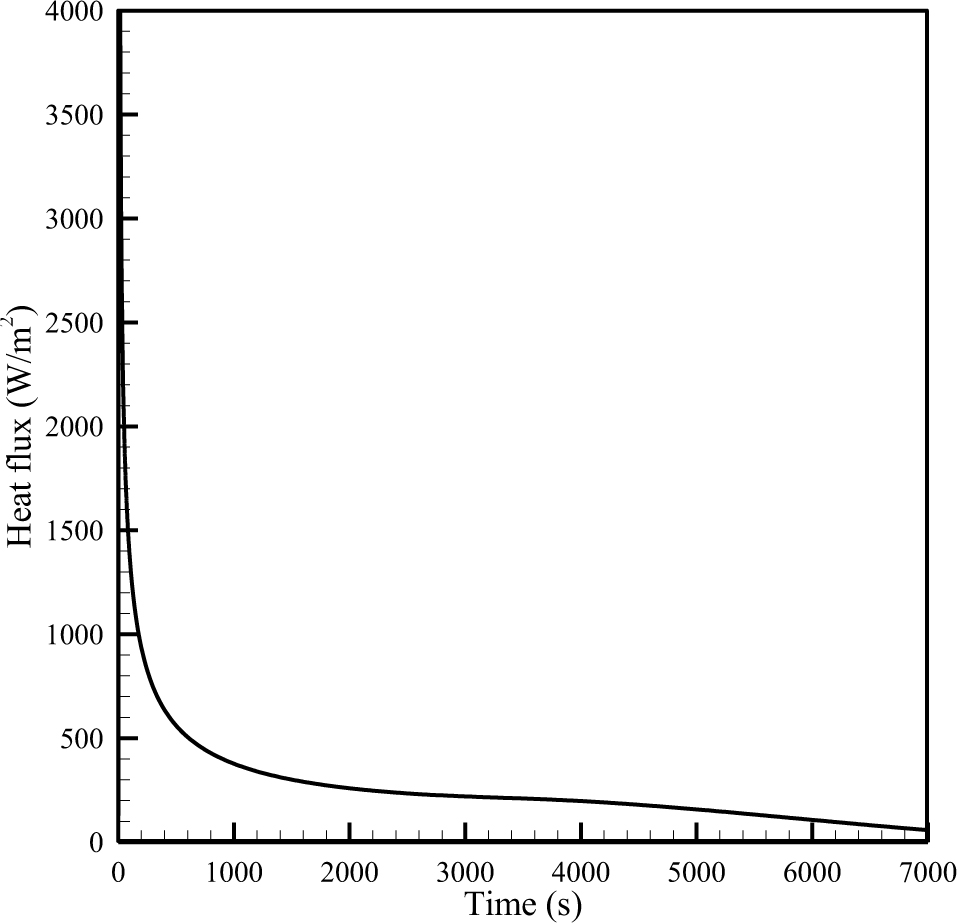
The heat flux transferred into the TES
Figure 7 shows the trend of surface averaged Nusselt number (Nu), Nu throughout the melting of RT-35. The heat transfer rate at the beginning of the melting process is high due to the high difference temperature between the hot walls of the cylinder and the cold solid RT-35. At the beginning of melting process, the magnitude of Nu number is high due to a large temperature gradient. From the initial stages onward, the magnitude of Nu number drops with time until it reaches it is minimum value as the thermal equilibrium condition is achieved.
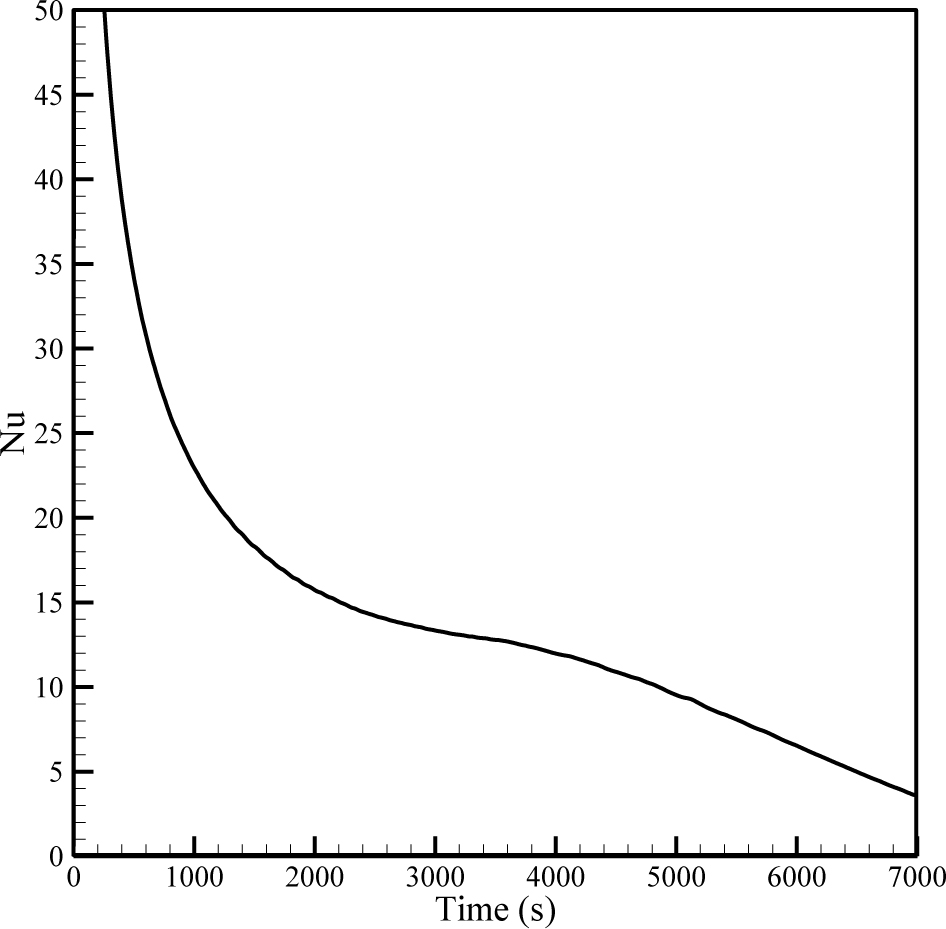
Nusselt number behavior throughout the melting process
4 Conclusion
A numerical and experimental investigation on the melting process of RT-35 filling a vertical cylindrical enclosure is conducted. The numerical model results are compared with the experimental work and good agreement is achieved. However, some discrepancy is observed. It is concluded that at the early stage of melting process, conduction is the dominant form of heat transfer from the walls. As the melting process progresses, natural convection is developed until it dominates the heat transfer process. At the early stages of the process, the heat transfer rate is high which is degraded at the later stages due to the decrease in temperature gradient between cold PCM and hot lateral walls of cylindrical TES system.
Nomenclature
- cp
specific heat at constant pressure [kJ/kg K]
- H
height of the filled PCM in TES system [cm]
- hfg
latent heat of fusion [kJ/kg]
- g
gravitational acceleration [m/s2]
- k
thermal conductivity [W/m⋅K]
- T
temperature [°C]
Greek symbols
- β
coefficient of thermal expansion [1/K]
- μ
dynamic viscosity [Pa⋅s]
- ρ
density [kg/m3]
Subscripts
- h
hot
- m
melt
- 0
initial
Abbreviations
- TES
thermal energy storage
- SHTES
sensible heat thermal energy storage
- LHTES
latent heat thermal energy storage
- TCES
thermos-chemical energy storage
- MF
melting fraction
- PCM
phase change material
- RT
Rubitherm
- Ra
Rayleigh number
References
[1] Dhaidan N.S., Khodadadi J.M., Melting and convection of phase change materials in different shape containers: A review, Renew. Sustain. Energy Rev., 2015, 43, 449–477.10.1016/j.rser.2014.11.017Search in Google Scholar
[2] Medrano M., Yilmaz M.O., Nougues M., Martorell I., Roca J., Cabeza L.F., Experimental evaluation of commercial heat exchangers for use as PCM thermal storage systems, Appl. Energy, 2009, 86, 2046-2055.10.1016/j.apenergy.2009.01.014Search in Google Scholar
[3] Wu Y.K., Lacroix M., Melting of aPCM inside a vertical cylindrical capsule, Int. J. Numer. Methods in Fluids, 1995, 20, 559-572.10.1002/fld.1650200610Search in Google Scholar
[4] Jones B.J., Sun D., Krishnan S., Garimella S.V., Experimental and numerical study of melting in a cylinder, Int. J. Heat Mass Transfer, 2006, 49, 2724-2738.10.1016/j.ijheatmasstransfer.2006.01.006Search in Google Scholar
[5] Shmueli H., Ziskind G., Letan R., Melting in a vertical cylindrical tube: numerical investigation and comparison with experiments, Int. J. Heat Mass Transfer, 2010, 53, 4082-4091.10.1016/j.ijheatmasstransfer.2010.05.028Search in Google Scholar
[6] Wang S., Faghri A., Bergman T. L., Melting in cylindrical enclosures: numerical modeling and heat transfer correlations, Numer. Heat Transfer Part A: Applications, 2012, 61, 837-859.Search in Google Scholar
[7] Regin A.F., Solanki S.C., Saini J.S., Latent heat thermal energy storage using cylindrical capsule: Numerical and experimental investigations, Renew. Energy, 2006, 31, 2025–2041.10.1016/j.renene.2005.10.011Search in Google Scholar
[8] Mahdaoui M., Kousksou T., Blancher S., Ait Msaad A., El Rhafiki T., Mouqallid M., A numerical analysis of solid–liquid phase change heat transfer around a horizontal cylinder, Appl. Math. Modelling, 2014, 38, 1101–1110.10.1016/j.apm.2013.08.002Search in Google Scholar
[9] Hosseini M. J., Rahimi M., Bahrampoury R., Experimental and computational evolution of a shell and tube heat exchanger as a PCM thermal storage system, Int. J. Heat Mass Transfer, 2014, 50, 128–136.10.1016/j.icheatmasstransfer.2013.11.008Search in Google Scholar
[10] www.rubitherm.euSearch in Google Scholar
[11] Rahimi M., Ranjbar A.A., Ganji D.D., Sedighi K., Hosseini M. J., Bahrampoury R., Analysis of geometrical and operational parameters of PCM in a fin and tube heat exchanger, Int. Comm. Heat Transfer, 2014, 53, 109-115.10.1016/j.icheatmasstransfer.2014.02.025Search in Google Scholar
[12] Bejan A., Conv. Heat Transfer., 2013, New York, Wiley10.1002/9781118671627Search in Google Scholar
[13] Yang X., Baleanu D., Tenreiro Machado J.A., Systems of Navier- Stokes equations on Cantor sets, Math. Probl. Eng., 2013, 1-8.10.1155/2013/769724Search in Google Scholar
[14] Yang X., Srivastava H.M., An asymptotic perturbation solution for a linear oscillator of free damped vibrations in fractal medium described by local fractional derivatives, Comm. Nonlinear Sci. Numer. Simul., 2015, 29, 499-504.10.1016/j.cnsns.2015.06.006Search in Google Scholar
[15] Yang X., Zhang Z., Srivastava H. M., Some new applications for heat and fluid flows via fractional derivatives without singular kernel, Thermal Sci., 2016, 20, 833-839.10.2298/TSCI16S3833YSearch in Google Scholar
© 2018 Soroush Ebadi et al., published by De Gruyter
This work is licensed under the Creative Commons Attribution-NonCommercial-NoDerivatives 4.0 License.
Articles in the same Issue
- Regular Articles
- A modified Fermi-Walker derivative for inextensible flows of binormal spherical image
- Algebraic aspects of evolution partial differential equation arising in the study of constant elasticity of variance model from financial mathematics
- Three-dimensional atom localization via probe absorption in a cascade four-level atomic system
- Determination of the energy transitions and half-lives of Rubidium nuclei
- Three phase heat and mass transfer model for unsaturated soil freezing process: Part 1 - model development
- Three phase heat and mass transfer model for unsaturated soil freezing process: Part 2 - model validation
- Mathematical model for thermal and entropy analysis of thermal solar collectors by using Maxwell nanofluids with slip conditions, thermal radiation and variable thermal conductivity
- Constructing analytic solutions on the Tricomi equation
- Feynman diagrams and rooted maps
- New type of chaos synchronization in discrete-time systems: the F-M synchronization
- Unsteady flow of fractional Oldroyd-B fluids through rotating annulus
- A note on the uniqueness of 2D elastostatic problems formulated by different types of potential functions
- On the conservation laws and solutions of a (2+1) dimensional KdV-mKdV equation of mathematical physics
- Computational methods and traveling wave solutions for the fourth-order nonlinear Ablowitz-Kaup-Newell-Segur water wave dynamical equation via two methods and its applications
- Siewert solutions of transcendental equations, generalized Lambert functions and physical applications
- Numerical solution of mixed convection flow of an MHD Jeffery fluid over an exponentially stretching sheet in the presence of thermal radiation and chemical reaction
- A new three-dimensional chaotic flow with one stable equilibrium: dynamical properties and complexity analysis
- Dynamics of a dry-rebounding drop: observations, simulations, and modeling
- Modeling the initial mechanical response and yielding behavior of gelled crude oil
- Lie symmetry analysis and conservation laws for the time fractional simplified modified Kawahara equation
- Solitary wave solutions of two KdV-type equations
- Applying industrial tomography to control and optimization flow systems
- Reconstructing time series into a complex network to assess the evolution dynamics of the correlations among energy prices
- An optimal solution for software testing case generation based on particle swarm optimization
- Optimal system, nonlinear self-adjointness and conservation laws for generalized shallow water wave equation
- Alternative methods for solving nonlinear two-point boundary value problems
- Global model simulation of OH production in pulsed-DC atmospheric pressure helium-air plasma jets
- Experimental investigation on optical vortex tweezers for microbubble trapping
- Joint measurements of optical parameters by irradiance scintillation and angle-of-arrival fluctuations
- M-polynomials and topological indices of hex-derived networks
- Generalized convergence analysis of the fractional order systems
- Porous flow characteristics of solution-gas drive in tight oil reservoirs
- Complementary wave solutions for the long-short wave resonance model via the extended trial equation method and the generalized Kudryashov method
- A Note on Koide’s Doubly Special Parametrization of Quark Masses
- On right-angled spherical Artin monoid of type Dn
- Gas flow regimes judgement in nanoporous media by digital core analysis
- 4 + n-dimensional water and waves on four and eleven-dimensional manifolds
- Stabilization and Analytic Approximate Solutions of an Optimal Control Problem
- On the equations of electrodynamics in a flat or curved spacetime and a possible interaction energy
- New prediction method for transient productivity of fractured five-spot patterns in low permeability reservoirs at high water cut stages
- The collinear equilibrium points in the restricted three body problem with triaxial primaries
- Detection of the damage threshold of fused silica components and morphologies of repaired damage sites based on the beam deflection method
- On the bivariate spectral quasi-linearization method for solving the two-dimensional Bratu problem
- Ion acoustic quasi-soliton in an electron-positron-ion plasma with superthermal electrons and positrons
- Analysis of projectile motion in view of conformable derivative
- Computing multiple ABC index and multiple GA index of some grid graphs
- Terahertz pulse imaging: A novel denoising method by combing the ant colony algorithm with the compressive sensing
- Characteristics of microscopic pore-throat structure of tight oil reservoirs in Sichuan Basin measured by rate-controlled mercury injection
- An activity window model for social interaction structure on Twitter
- Transient thermal regime trough the constitutive matrix applied to asynchronous electrical machine using the cell method
- On the zagreb polynomials of benzenoid systems
- Integrability analysis of the partial differential equation describing the classical bond-pricing model of mathematical finance
- The Greek parameters of a continuous arithmetic Asian option pricing model via Laplace Adomian decomposition method
- Quantifying the global solar radiation received in Pietermaritzburg, KwaZulu-Natal to motivate the consumption of solar technologies
- Sturm-Liouville difference equations having Bessel and hydrogen atom potential type
- Study on the response characteristics of oil wells after deep profile control in low permeability fractured reservoirs
- Depiction and analysis of a modified theta shaped double negative metamaterial for satellite application
- An attempt to geometrize electromagnetism
- Structure of traveling wave solutions for some nonlinear models via modified mathematical method
- Thermo-convective instability in a rotating ferromagnetic fluid layer with temperature modulation
- Construction of new solitary wave solutions of generalized Zakharov-Kuznetsov-Benjamin-Bona-Mahony and simplified modified form of Camassa-Holm equations
- Effect of magnetic field and heat source on Upper-convected-maxwell fluid in a porous channel
- Physical cues of biomaterials guide stem cell fate of differentiation: The effect of elasticity of cell culture biomaterials
- Shooting method analysis in wire coating withdrawing from a bath of Oldroyd 8-constant fluid with temperature dependent viscosity
- Rank correlation between centrality metrics in complex networks: an empirical study
- Special Issue: The 18th International Symposium on Electromagnetic Fields in Mechatronics, Electrical and Electronic Engineering
- Modeling of electric and heat processes in spot resistance welding of cross-wire steel bars
- Dynamic characteristics of triaxial active control magnetic bearing with asymmetric structure
- Design optimization of an axial-field eddy-current magnetic coupling based on magneto-thermal analytical model
- Thermal constitutive matrix applied to asynchronous electrical machine using the cell method
- Temperature distribution around thin electroconductive layers created on composite textile substrates
- Model of the multipolar engine with decreased cogging torque by asymmetrical distribution of the magnets
- Analysis of spatial thermal field in a magnetic bearing
- Use of the mathematical model of the ignition system to analyze the spark discharge, including the destruction of spark plug electrodes
- Assessment of short/long term electric field strength measurements for a pilot district
- Simulation study and experimental results for detection and classification of the transient capacitor inrush current using discrete wavelet transform and artificial intelligence
- Magnetic transmission gear finite element simulation with iron pole hysteresis
- Pulsed excitation terahertz tomography – multiparametric approach
- Low and high frequency model of three phase transformer by frequency response analysis measurement
- Multivariable polynomial fitting of controlled single-phase nonlinear load of input current total harmonic distortion
- Optimal design of a for middle-low-speed maglev trains
- Eddy current modeling in linear and nonlinear multifilamentary composite materials
- The visual attention saliency map for movie retrospection
- AC/DC current ratio in a current superimposition variable flux reluctance machine
- Influence of material uncertainties on the RLC parameters of wound inductors modeled using the finite element method
- Cogging force reduction in linear tubular flux switching permanent-magnet machines
- Modeling hysteresis curves of La(FeCoSi)13 compound near the transition point with the GRUCAD model
- Electro-magneto-hydrodynamic lubrication
- 3-D Electromagnetic field analysis of wireless power transfer system using K computer
- Simplified simulation technique of rotating, induction heated, calender rolls for study of temperature field control
- Design, fabrication and testing of electroadhesive interdigital electrodes
- A method to reduce partial discharges in motor windings fed by PWM inverter
- Reluctance network lumped mechanical & thermal models for the modeling and predesign of concentrated flux synchronous machine
- Special Issue Applications of Nonlinear Dynamics
- Study on dynamic characteristics of silo-stock-foundation interaction system under seismic load
- Microblog topic evolution computing based on LDA algorithm
- Modeling the creep damage effect on the creep crack growth behavior of rotor steel
- Neighborhood condition for all fractional (g, f, n′, m)-critical deleted graphs
- Chinese open information extraction based on DBMCSS in the field of national information resources
- 10.1515/phys-2018-0079
- CPW-fed circularly-polarized antenna array with high front-to-back ratio and low-profile
- Intelligent Monitoring Network Construction based on the utilization of the Internet of things (IoT) in the Metallurgical Coking Process
- Temperature detection technology of power equipment based on Fiber Bragg Grating
- Research on a rotational speed control strategy of the mandrel in a rotary steering system
- Dynamic load balancing algorithm for large data flow in distributed complex networks
- Super-structured photonic crystal fiber Bragg grating biosensor image model based on sparse matrix
- Fractal-based techniques for physiological time series: An updated approach
- Analysis of the Imaging Characteristics of the KB and KBA X-ray Microscopes at Non-coaxial Grazing Incidence
- Application of modified culture Kalman filter in bearing fault diagnosis
- Exact solutions and conservation laws for the modified equal width-Burgers equation
- On topological properties of block shift and hierarchical hypercube networks
- Elastic properties and plane acoustic velocity of cubic Sr2CaMoO6 and Sr2CaWO6 from first-principles calculations
- A note on the transmission feasibility problem in networks
- Ontology learning algorithm using weak functions
- Diagnosis of the power frequency vacuum arc shape based on 2D-PIV
- Parametric simulation analysis and reliability of escalator truss
- A new algorithm for real economy benefit evaluation based on big data analysis
- Synergy analysis of agricultural economic cycle fluctuation based on ant colony algorithm
- Multi-level encryption algorithm for user-related information across social networks
- Multi-target tracking algorithm in intelligent transportation based on wireless sensor network
- Fast recognition method of moving video images based on BP neural networks
- Compressed sensing image restoration algorithm based on improved SURF operator
- Design of load optimal control algorithm for smart grid based on demand response in different scenarios
- Face recognition method based on GA-BP neural network algorithm
- Optimal path selection algorithm for mobile beacons in sensor network under non-dense distribution
- Localization and recognition algorithm for fuzzy anomaly data in big data networks
- Urban road traffic flow control under incidental congestion as a function of accident duration
- Optimization design of reconfiguration algorithm for high voltage power distribution network based on ant colony algorithm
- Feasibility simulation of aseismic structure design for long-span bridges
- Construction of renewable energy supply chain model based on LCA
- The tribological properties study of carbon fabric/ epoxy composites reinforced by nano-TiO2 and MWNTs
- A text-Image feature mapping algorithm based on transfer learning
- Fast recognition algorithm for static traffic sign information
- Topical Issue: Clean Energy: Materials, Processes and Energy Generation
- An investigation of the melting process of RT-35 filled circular thermal energy storage system
- Numerical analysis on the dynamic response of a plate-and-frame membrane humidifier for PEMFC vehicles under various operating conditions
- Energy converting layers for thin-film flexible photovoltaic structures
- Effect of convection heat transfer on thermal energy storage unit
Articles in the same Issue
- Regular Articles
- A modified Fermi-Walker derivative for inextensible flows of binormal spherical image
- Algebraic aspects of evolution partial differential equation arising in the study of constant elasticity of variance model from financial mathematics
- Three-dimensional atom localization via probe absorption in a cascade four-level atomic system
- Determination of the energy transitions and half-lives of Rubidium nuclei
- Three phase heat and mass transfer model for unsaturated soil freezing process: Part 1 - model development
- Three phase heat and mass transfer model for unsaturated soil freezing process: Part 2 - model validation
- Mathematical model for thermal and entropy analysis of thermal solar collectors by using Maxwell nanofluids with slip conditions, thermal radiation and variable thermal conductivity
- Constructing analytic solutions on the Tricomi equation
- Feynman diagrams and rooted maps
- New type of chaos synchronization in discrete-time systems: the F-M synchronization
- Unsteady flow of fractional Oldroyd-B fluids through rotating annulus
- A note on the uniqueness of 2D elastostatic problems formulated by different types of potential functions
- On the conservation laws and solutions of a (2+1) dimensional KdV-mKdV equation of mathematical physics
- Computational methods and traveling wave solutions for the fourth-order nonlinear Ablowitz-Kaup-Newell-Segur water wave dynamical equation via two methods and its applications
- Siewert solutions of transcendental equations, generalized Lambert functions and physical applications
- Numerical solution of mixed convection flow of an MHD Jeffery fluid over an exponentially stretching sheet in the presence of thermal radiation and chemical reaction
- A new three-dimensional chaotic flow with one stable equilibrium: dynamical properties and complexity analysis
- Dynamics of a dry-rebounding drop: observations, simulations, and modeling
- Modeling the initial mechanical response and yielding behavior of gelled crude oil
- Lie symmetry analysis and conservation laws for the time fractional simplified modified Kawahara equation
- Solitary wave solutions of two KdV-type equations
- Applying industrial tomography to control and optimization flow systems
- Reconstructing time series into a complex network to assess the evolution dynamics of the correlations among energy prices
- An optimal solution for software testing case generation based on particle swarm optimization
- Optimal system, nonlinear self-adjointness and conservation laws for generalized shallow water wave equation
- Alternative methods for solving nonlinear two-point boundary value problems
- Global model simulation of OH production in pulsed-DC atmospheric pressure helium-air plasma jets
- Experimental investigation on optical vortex tweezers for microbubble trapping
- Joint measurements of optical parameters by irradiance scintillation and angle-of-arrival fluctuations
- M-polynomials and topological indices of hex-derived networks
- Generalized convergence analysis of the fractional order systems
- Porous flow characteristics of solution-gas drive in tight oil reservoirs
- Complementary wave solutions for the long-short wave resonance model via the extended trial equation method and the generalized Kudryashov method
- A Note on Koide’s Doubly Special Parametrization of Quark Masses
- On right-angled spherical Artin monoid of type Dn
- Gas flow regimes judgement in nanoporous media by digital core analysis
- 4 + n-dimensional water and waves on four and eleven-dimensional manifolds
- Stabilization and Analytic Approximate Solutions of an Optimal Control Problem
- On the equations of electrodynamics in a flat or curved spacetime and a possible interaction energy
- New prediction method for transient productivity of fractured five-spot patterns in low permeability reservoirs at high water cut stages
- The collinear equilibrium points in the restricted three body problem with triaxial primaries
- Detection of the damage threshold of fused silica components and morphologies of repaired damage sites based on the beam deflection method
- On the bivariate spectral quasi-linearization method for solving the two-dimensional Bratu problem
- Ion acoustic quasi-soliton in an electron-positron-ion plasma with superthermal electrons and positrons
- Analysis of projectile motion in view of conformable derivative
- Computing multiple ABC index and multiple GA index of some grid graphs
- Terahertz pulse imaging: A novel denoising method by combing the ant colony algorithm with the compressive sensing
- Characteristics of microscopic pore-throat structure of tight oil reservoirs in Sichuan Basin measured by rate-controlled mercury injection
- An activity window model for social interaction structure on Twitter
- Transient thermal regime trough the constitutive matrix applied to asynchronous electrical machine using the cell method
- On the zagreb polynomials of benzenoid systems
- Integrability analysis of the partial differential equation describing the classical bond-pricing model of mathematical finance
- The Greek parameters of a continuous arithmetic Asian option pricing model via Laplace Adomian decomposition method
- Quantifying the global solar radiation received in Pietermaritzburg, KwaZulu-Natal to motivate the consumption of solar technologies
- Sturm-Liouville difference equations having Bessel and hydrogen atom potential type
- Study on the response characteristics of oil wells after deep profile control in low permeability fractured reservoirs
- Depiction and analysis of a modified theta shaped double negative metamaterial for satellite application
- An attempt to geometrize electromagnetism
- Structure of traveling wave solutions for some nonlinear models via modified mathematical method
- Thermo-convective instability in a rotating ferromagnetic fluid layer with temperature modulation
- Construction of new solitary wave solutions of generalized Zakharov-Kuznetsov-Benjamin-Bona-Mahony and simplified modified form of Camassa-Holm equations
- Effect of magnetic field and heat source on Upper-convected-maxwell fluid in a porous channel
- Physical cues of biomaterials guide stem cell fate of differentiation: The effect of elasticity of cell culture biomaterials
- Shooting method analysis in wire coating withdrawing from a bath of Oldroyd 8-constant fluid with temperature dependent viscosity
- Rank correlation between centrality metrics in complex networks: an empirical study
- Special Issue: The 18th International Symposium on Electromagnetic Fields in Mechatronics, Electrical and Electronic Engineering
- Modeling of electric and heat processes in spot resistance welding of cross-wire steel bars
- Dynamic characteristics of triaxial active control magnetic bearing with asymmetric structure
- Design optimization of an axial-field eddy-current magnetic coupling based on magneto-thermal analytical model
- Thermal constitutive matrix applied to asynchronous electrical machine using the cell method
- Temperature distribution around thin electroconductive layers created on composite textile substrates
- Model of the multipolar engine with decreased cogging torque by asymmetrical distribution of the magnets
- Analysis of spatial thermal field in a magnetic bearing
- Use of the mathematical model of the ignition system to analyze the spark discharge, including the destruction of spark plug electrodes
- Assessment of short/long term electric field strength measurements for a pilot district
- Simulation study and experimental results for detection and classification of the transient capacitor inrush current using discrete wavelet transform and artificial intelligence
- Magnetic transmission gear finite element simulation with iron pole hysteresis
- Pulsed excitation terahertz tomography – multiparametric approach
- Low and high frequency model of three phase transformer by frequency response analysis measurement
- Multivariable polynomial fitting of controlled single-phase nonlinear load of input current total harmonic distortion
- Optimal design of a for middle-low-speed maglev trains
- Eddy current modeling in linear and nonlinear multifilamentary composite materials
- The visual attention saliency map for movie retrospection
- AC/DC current ratio in a current superimposition variable flux reluctance machine
- Influence of material uncertainties on the RLC parameters of wound inductors modeled using the finite element method
- Cogging force reduction in linear tubular flux switching permanent-magnet machines
- Modeling hysteresis curves of La(FeCoSi)13 compound near the transition point with the GRUCAD model
- Electro-magneto-hydrodynamic lubrication
- 3-D Electromagnetic field analysis of wireless power transfer system using K computer
- Simplified simulation technique of rotating, induction heated, calender rolls for study of temperature field control
- Design, fabrication and testing of electroadhesive interdigital electrodes
- A method to reduce partial discharges in motor windings fed by PWM inverter
- Reluctance network lumped mechanical & thermal models for the modeling and predesign of concentrated flux synchronous machine
- Special Issue Applications of Nonlinear Dynamics
- Study on dynamic characteristics of silo-stock-foundation interaction system under seismic load
- Microblog topic evolution computing based on LDA algorithm
- Modeling the creep damage effect on the creep crack growth behavior of rotor steel
- Neighborhood condition for all fractional (g, f, n′, m)-critical deleted graphs
- Chinese open information extraction based on DBMCSS in the field of national information resources
- 10.1515/phys-2018-0079
- CPW-fed circularly-polarized antenna array with high front-to-back ratio and low-profile
- Intelligent Monitoring Network Construction based on the utilization of the Internet of things (IoT) in the Metallurgical Coking Process
- Temperature detection technology of power equipment based on Fiber Bragg Grating
- Research on a rotational speed control strategy of the mandrel in a rotary steering system
- Dynamic load balancing algorithm for large data flow in distributed complex networks
- Super-structured photonic crystal fiber Bragg grating biosensor image model based on sparse matrix
- Fractal-based techniques for physiological time series: An updated approach
- Analysis of the Imaging Characteristics of the KB and KBA X-ray Microscopes at Non-coaxial Grazing Incidence
- Application of modified culture Kalman filter in bearing fault diagnosis
- Exact solutions and conservation laws for the modified equal width-Burgers equation
- On topological properties of block shift and hierarchical hypercube networks
- Elastic properties and plane acoustic velocity of cubic Sr2CaMoO6 and Sr2CaWO6 from first-principles calculations
- A note on the transmission feasibility problem in networks
- Ontology learning algorithm using weak functions
- Diagnosis of the power frequency vacuum arc shape based on 2D-PIV
- Parametric simulation analysis and reliability of escalator truss
- A new algorithm for real economy benefit evaluation based on big data analysis
- Synergy analysis of agricultural economic cycle fluctuation based on ant colony algorithm
- Multi-level encryption algorithm for user-related information across social networks
- Multi-target tracking algorithm in intelligent transportation based on wireless sensor network
- Fast recognition method of moving video images based on BP neural networks
- Compressed sensing image restoration algorithm based on improved SURF operator
- Design of load optimal control algorithm for smart grid based on demand response in different scenarios
- Face recognition method based on GA-BP neural network algorithm
- Optimal path selection algorithm for mobile beacons in sensor network under non-dense distribution
- Localization and recognition algorithm for fuzzy anomaly data in big data networks
- Urban road traffic flow control under incidental congestion as a function of accident duration
- Optimization design of reconfiguration algorithm for high voltage power distribution network based on ant colony algorithm
- Feasibility simulation of aseismic structure design for long-span bridges
- Construction of renewable energy supply chain model based on LCA
- The tribological properties study of carbon fabric/ epoxy composites reinforced by nano-TiO2 and MWNTs
- A text-Image feature mapping algorithm based on transfer learning
- Fast recognition algorithm for static traffic sign information
- Topical Issue: Clean Energy: Materials, Processes and Energy Generation
- An investigation of the melting process of RT-35 filled circular thermal energy storage system
- Numerical analysis on the dynamic response of a plate-and-frame membrane humidifier for PEMFC vehicles under various operating conditions
- Energy converting layers for thin-film flexible photovoltaic structures
- Effect of convection heat transfer on thermal energy storage unit
