Experimental investigation on optical vortex tweezers for microbubble trapping
-


Abstract
In this paper, we investigated the microbubble trapping using optical vortex tweezers. It is shown that the microbubble can be trapped by the vortex optical tweezers, in which the trapping light beam is of vortex beam. We studied a relationship between the transverse capture gradient force and the topological charges of the illuminating vortex beam. For objective lenses with numerical aperture of 1.25 (100×), the force measurement was performed by the power spectral density (PSD) roll-off method. It was shown that transverse trapping forces of vortex optical tweezers increase with the increment of the laser power for fixed topological charge. Whereas, the increase in the topological charges of vortex beam for the same laser power results in the decrease of the transverse trapping forces. The experimental results demonstrated that the laser mode (topological charge) has significant influence on the lateral trapping force.
1 Introduction
Ashkin et al. demonstrated that micro-particles can be trapped in three dimensions by laser beams, indicating that laser beams are a very powerful tool in particle trapping and manipulation [1]. Since this pioneer work, optical trapping, which is known as optical tweezers, has attracted much attention. Studies showed that the trapping force depends on particle diameter, polarization direction, depth of the optical trap and numerical aperture [2, 3, 4] In the traditional Gaussian beam-based optical tweezers, some special beams have been introduced to trap particles as well. Allen et al. found that beams with a helical phase structure, i.e. vortex beams, carry orbital angular momentum (OAM) [5]. Jixiong Pu et al. used the structured beams, generated from Devil’s vortex-lens (DVL), to trap microspheres [6]. The OAM of vortex beams can be transferred to particles and make them rotate. The influence of amplitude profile, polarization and laser power on this rotation has been investigated [7, 8, 9, 10, 11]. Owing to the phase singularity, the intensity center of vortex beams is a central dark core. It has been indicated that particles with refractive index lower than the ambient can be trapped by beams of dark core. Therefore, some studies have focused on trapping the particles with refractive index lower than the ambient by optical vortex tweezers [12, 13, 14, 15]. For vortex optical tweezers trapping the particles with refractive index lower than the ambient, to the best of our knowledge, there have been no experimental studies on the relationship between the transverse gradient force and the topological charges of vortex beams. The aim of the study is to experimentally investigate this relationship. In this paper, we used the power spectral density (PSD) method [16, 17, 18, 19, 20] to demonstrate the relationship between the transverse gradient force and the topological charge of the vortex beam.
2 Theory of force calibration
There have been several papers studying the optical tweezers for trapping particles using vortex beams. Ng et al. theoretically studied optical trapping by an optical vortex beam. They found that the trap stiffness of cylindrically symmetric optical vortex has real and imaginary numbers [21]. In our experiment, no rotation was observed in our experiment. Thus, the trap stiffness is always real. Therefore, the optical tweezers can be modeled by Hooke’s law [22].
where ki is the spring constant (trap stiffness) of the trap and xi is the displacement from the centre of the trap. The trap stiffness can be measured using the PSD method based on the OTKBFM-CAL (Thorlabs) software. According to PSD method, the equation of Brownian motion for particles in the optical trap can be described by [20, 23]:
where m is the mass of the particle, β=6 π η a is the drag coefficient, ηis the fluid viscosity, and a is the radius of the particle. F(t) is a random force, xi(t) is the displacement at time t, dxi/dt is the velocity, and d2xi/dt2 is the acceleration in the xi direction. When the inertial force can be neglected compared with the viscous force, Eq. (2) can be described by a simplified equation as follows [16, 20, 23]:
By solving the Fourier transform of the above equation, the power spectrum of the captured microsphere is expressed as [16]
where f is the frequency, kb is Boltzmann’s constant, T is the temperature, and the roll-off frequency fc is
In the experiment, the dependence of the power spectrum X2(f) on frequency f can be measured, and the roll-off frequency fc can be determined by Eq. (4). The transverse trap stiffness ki can be obtained by substituting the calculated roll-off frequency into Eq. (5) [16, 20].
3 Experimental results
The experimental setup of optical vortex tweezers was shown in Figure 1. The laser source was a single-mode laser diode with a maximum output power of P = 340 mW of a wavelength of 975 nm. Spiral phase plates (SPP) were used to transform the incident Gaussian beam into a vortex one. The topological charge of the vortex beam was determined by the phase structure of the SPP. The expanded vortex beam was focused by an objective with NA of 1.25. The particles could be trapped near the focus of the objective if the gradient force was larger than that of scattering and absorption force.
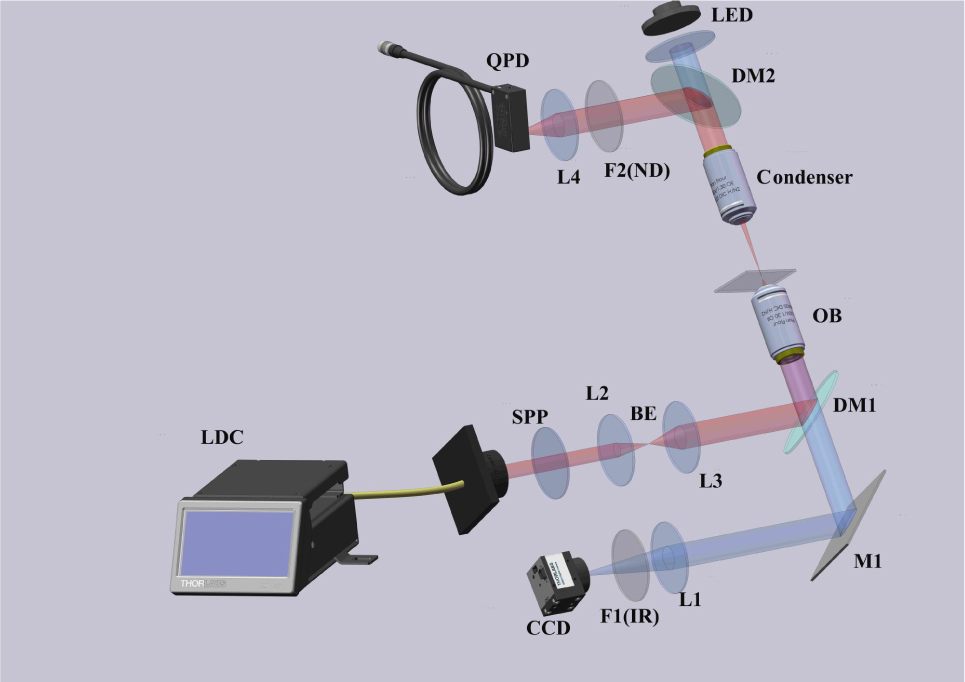
Schematic of the experimental setup. L-lens, M-reflection mirror, OB-objective lens, DM-dichroic mirror, LDC-laser diode and controller, BE-beam expander, F1(IR)-IR filters, F2(ND)-neutral density filters, CCD-charge coupled device, QPD-quadrant position detector, spp-Spiral phase plates, LED-Light-Emitting Diode.
In the PSD method, the quadrant position detector (QPD) needed a high bandwidth to record the particle Brownian motion information. To do the measurements with broad bandwidth and high-resolution, a QPD was placed in the conjugate back-focal plane of the condenser lens (Nikon 10X Air Condenser, numerical aperture of 0.25). The signal generated by the QPD was sensitive to the relative displacement of the trapping particles from the centre of the optical trap, which could be used to determine the position, stiffness, and force of the optical tweezers. The experimental data (voltage signal) from the QPD was loaded into the mechanical acquisition module OTKBFM-CAL (Thorlabs Products). The position calibration and the PSD could be obtained by the software. The work principle of the software is described as follows:
The voltage signal measured in the experiment is V(t) = ξxi(t), ξ is constant. The displacement signal V(t) was measured by QDP. Then we got V(t)-t curve from the software. According to V2(f) = ξ2X2(f)=ξ2kbT/π2β(f2+f2c) and Eq. (4), PSD function can be obtained by performing calculation with software, which is shown in Figure 2. According to Figure 2, we could get the roll-off frequency fc (corner frequency) by Lorentzian fitting PSD function, which is the abscissa value of the left blue line. Finally, the trap stiffness could be obtained by substituting fc into the Eq. (5).
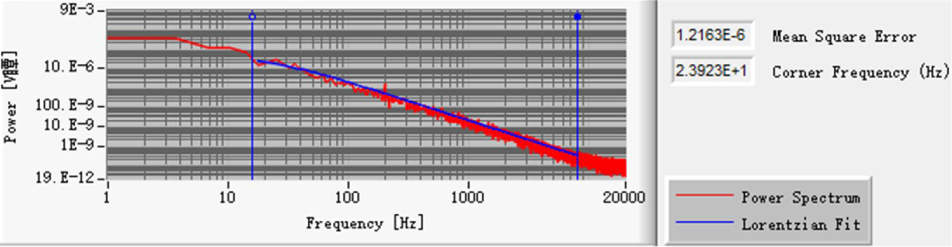
PSD as a function of frequency, for finding the roll-off frequency fc, being 2.3923 × 10 Hz
In the experiment, we focused on the transverse forces of vortex optical tweezers acting on microbubbles (F-30VS, Matsumoto Yushi-Seiyaku). The microbubble was an alkane sphere (n3 = 1.4) surrounded by a transparent dielectric spherical shell (n2 = 1.6). The radius of the microbubbles ranges between 3 to 7 μm, and that of alkane sphere ranges between 2 to 5 μm. Compared with other types of microbubbles, this type of microbubble was found to be more stable. The influence of the temperature on the shape of the microbubble could be neglected as the non-recoverable thermal expansion occurs only when the sample was heated to 80°C. In the experiment, the power of the laser was chosen to be 100 mW, which could heat the sample by approximately 1° C.
We placed the sample between two plastic slides with built-in channels. To avoid excessively concentrating the sample, we mixed it with deionized water to a dilution ratio of 1:10. The sample was placed near the focus of the objective, and the plastic slides were placed on a displacement stage with a differential regulator (MAX300 NanoMax 3-Axis Flexure Stage, Thorlabs). The displacement stage provided a 4 mm (0.16 inch) coarse stroke and 300 μm fine adjustment stroke, with coarse adjuster 10 μm graduated scale, and the micro adjuster 1 μm graduated scale. To trap particles, the light beam should be tightly focused, and the tightly focused pattern was appropriately adjusted with a NanoMax 3-Axis flexure stage. We showed that the particle in the sample could be trapped and moved by the optical tweezers, as shown in Figure 3. The trapped particle was indicated by the arrow of Figure 3.
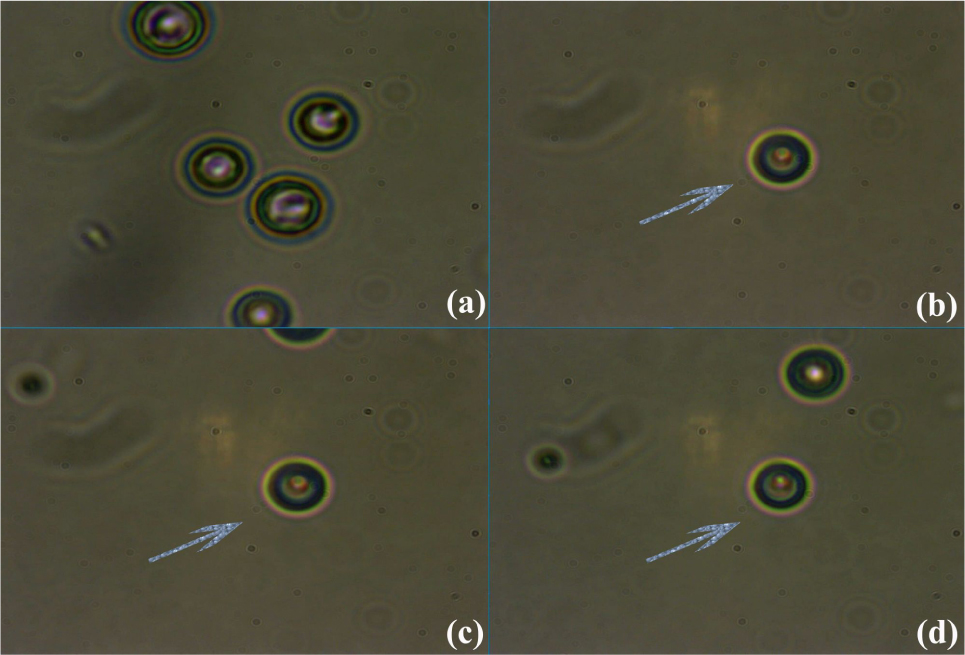
(a) A free particle; (b), (c), and (d) a captured particle (the arrow indicates the captured particle; the others are uncaptured microbubbles as a reference)
We wanted to study the influence of the topological charge of the incident light beams on the optical trapping force. The incident vortex beams with topological charge of l = 1, 2 and 3 were generated for trapping microbubbles. The transverse stiffness of optical vortex tweezers was calculated by PSD. For a vortex beam with fixed topological charge, we performed measurements ten times. Owing to that the experimental data are uncertain, we use Box-plot to express the discrete distribution of the experimental data, which is given in Figure 4. It was shown that from the experimental measurements that the transverse stiffness decreases with the increasing topological charge of the vortex beams. This was consistent with theoretical simulations [24, 25]. This result could be understood by the intensity distribution of the vortex beams. The intensity pattern of a tightly focused vortex beam was a dark core, surrounding by a bright annulus. The size of the dark core increases with the increasing topological charge of the vortex beam. Therefore, the magnitude of the intensity of the bright annulus decreased, which led to a lower stiffness.
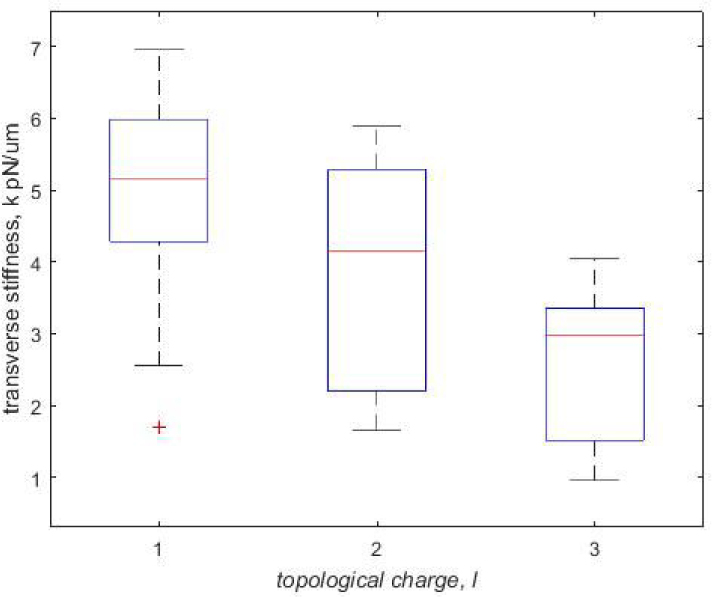
Relationship between the transverse stiffness and the topological charge. The power of the laser is 6.073 mW
In a Gaussian beam-based optical tweezers, the trapping was influenced by the power of the incident laser. In general, the trapping force increased with a higher laser power [2]. We also investigated the influence of the laser power on the optical vortex tweezers. We took the vortex beam with topological charge of l = 3 as an example. The influence of the laser power on the transverse stiffness was presented in Figure 5. It was found that the increasing laser power results in larger transverse stiffness. This result was similar to that of Gaussian beam-based optical tweezers.
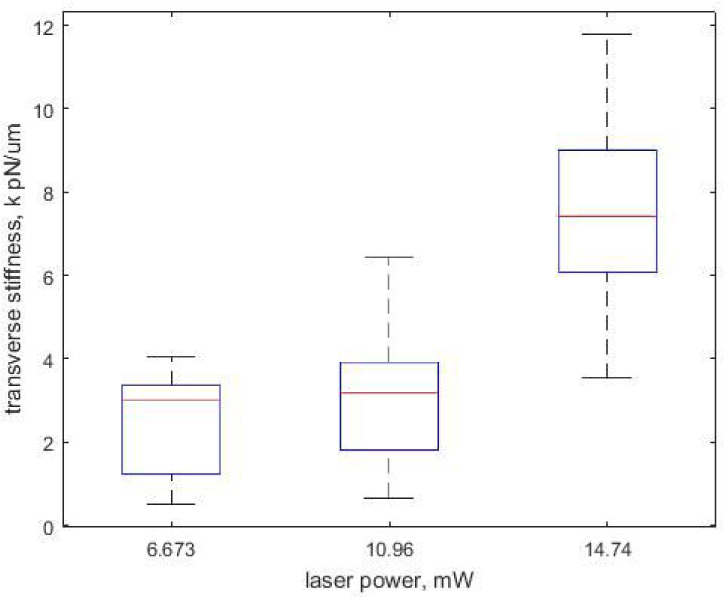
The transverse stiffness as a function of the incident laser power. The topological charge of the vortex beam was chosen as l = 3.
4 Conclusions
We had shown that the particles could be trapped and moved in an optical vortex tweezers, which was achieved by introducing a vortex beam as the incident beam. The effect of the topological charge and the power of the incident beam on the transverse stiffness was investigated. A high stiffness could be obtained by vortex beam with lower topological charge and stronger power. This finding was particularly significant for research on transverse trapping forces based on vortex beam.
Acknowledgement
This work was supported by the National Natural Science Foundation of China (Grant Nos. 61575070, 11674111, and 61505059) and the Promotion Program for Young and Middle-Aged Teachers in Science and Technology Research of Huaqiao University (ZQN-PY209)
References
[1] Ashkin A., Dziedzic J.M., Bjorkholm J.E., Chu S., Observation of a single-beam gradient force optical trap for dielectric particles, Opt. Lett., 1986, 11(5), 288.10.1364/OL.11.000288Search in Google Scholar PubMed
[2] Wright W.H., Sonek G.J., Berns M.W., Parametric study of the forces on microspheres held by optical tweezers, Appl. Opt., 1994, 33(9), 1735-48.10.1364/AO.33.001735Search in Google Scholar PubMed
[3] Zhong M., Zhou J., Wu J., Li Y., Determination of the axial stiffness of an optical trap with information entropy signals, Proceedings of SPIE, Int. Soc. Opt. Eng., 2009, 7507, 75070J-75070J-7.10.1117/12.837347Search in Google Scholar
[4] Liang Y.Z., Ou Q.R., Bo L., Liang R.Q., Improvement of transverse trapping efficiency of optical tweezers, Chinese Phys. Lett., 2008, 25(6), 2300-2302.10.1088/0256-307X/25/6/103Search in Google Scholar
[5] Allen L., Beijersbergen M.W., Spreeuw R.J., Woerdman J.P., Orbital angular momentum of light and the transformation of laguerre-gaussian laser modes, Phys. Rev. A Atom. Mol. Opt. Phys., 1992, 45(11), 8185.10.1103/PhysRevA.45.8185Search in Google Scholar PubMed
[6] Pu J., Jones P.H., Devil’s lens optical tweezers, Opt. Expr., 2015, 23(7), 8190-9.10.1364/OE.23.008190Search in Google Scholar PubMed
[7] Volkesepúlveda K., Chávezcerda S., Garcéschávez V., Dholakia K., Three-dimensional optical forces and transfer of orbital angular momentum from multiringed light beams to spherical microparticles, J. Opt. Soc. Amer. B, 2004, 21(10), 1749-1757.10.1364/JOSAB.21.001749Search in Google Scholar
[8] Kovalev A.A., Kotlyar V.V., Porfirev A.P., Optical trapping and moving of microparticles by using asymmetrical laguerre-gaussian beams, Opt. Lett., 2016, 41(11), 2426.10.1364/OL.41.002426Search in Google Scholar PubMed
[9] Li M., Yan S., Yao B., Liang Y., Zhang P., Spinning and orbiting motion of particles in vortex beams with circular or radial polarizations, Opt. Expr., 2016, 24(18), 20604-20612.10.1364/OE.24.020604Search in Google Scholar PubMed
[10] Gao H., Rotation dynamics of yeast cell in vortex optical tweezers, Chin. J. Lasers, 2011, 38(4), 0404002, (in Chinese).10.3788/CJL201138.0404002Search in Google Scholar
[11] O’Neil A.T., Padgett M.J., Axial and lateral trapping efficiency of laguerre–gaussian modes in inverted optical tweezers, Opt. Comm., 2001, 193(1), 45-50.10.1016/S0030-4018(01)01198-1Search in Google Scholar
[12] Prentice P.A., Macdonald M.P., Frank T.G., Cuschieri A., Spalding G.C., Sibbett W. et al., Manipulation and filtration of low index particles with holographic laguerre-gaussian optical trap arrays, Opt. Expr., 2004, 12(4), 593-600.10.1364/OPEX.12.000593Search in Google Scholar
[13] Swartzlander G.A., Gahagan K.T., Trapping of low-index microparticles in an optical vortex, J. Opt. Soc. Amer. B, 1998, 15(15), 524-534.10.1364/JOSAB.15.000524Search in Google Scholar
[14] Ahluwalia B.S., Løvhaugen P., Hellesø O.G., Waveguide trapping of hollow glass spheres, Opt. Lett., 2011, 36(17), 3347-9.10.1364/OL.36.003347Search in Google Scholar PubMed
[15] Fury C., Harfield C., Memoli G., Jones P.H., Stride E., Experimental characterisation of holographic optical traps for microbubbles, Proceedings of SPIE - Int. Soc. Opt. Eng., 2014, 9126, 91263L-10, 1117/12.2055889.10.1117/12.2055889Search in Google Scholar
[16] Sarshar M., Wong W.T., Anvari B., Comparative study of methods to calibrate the stiffness of a single-beam gradient-force optical tweezers over various laser trapping powers, J. Biomed. Opt., 2014, 19(11), 115001.10.1117/1.JBO.19.11.115001Search in Google Scholar PubMed PubMed Central
[17] Florin E.L., Pralle A., Ehk S., Jkh H., Photonic force microscope calibration by thermal noise analysis, Appl. Phys. A, 1998, 66(1), S75-S78.10.1007/s003390051103Search in Google Scholar
[18] Fei P., Yao B.L., Ming L., Yan S.H., Measurement of optical trapping force and stiffness of micro-particles with the drag-force method, J. Optoel. Laser, 2010, 21(1), 78-82, (in Chinese).Search in Google Scholar
[19] Neuman K.C., Block S.M., Optical trapping, Rev. Sci. Instr., 2004, 75(9), 2787-2809.10.1063/1.1785844Search in Google Scholar PubMed PubMed Central
[20] Berg-Sørensen K., Flyvbjerg H., Power spectrum analysis for optical tweezers, Rev. Sci. Instr., 2004, 75(3), 594-612.10.1063/1.1645654Search in Google Scholar
[21] Ng J., Lin Z., Chan C.T., Theory of optical trapping by an optical vortex beam, Phys. Rev. Lett., 2010, 104(10), 103601.10.1103/PhysRevLett.104.103601Search in Google Scholar PubMed
[22] Mclaren M., Sidderashaddad E., Forbes A., Accurate measurement of microscopic forces and torques using optical tweezers, S. Afr. J. Sci., 2011, 107(9/10), 67-74.10.4102/sajs.v107i9/10.579Search in Google Scholar
[23] Mazur P., On the theory of brownian motion, Physica, 1959, 25(1-6), 149-162.10.1016/S0031-8914(59)91931-7Search in Google Scholar
[24] Wang J., Ren H., Trapping forces of core-shell particles using laguerre-gaussian beams, Chinese J. Lasers, 2015, 42(6), 0608001, (in Chinese).10.3788/CJL201542.0608001Search in Google Scholar
[25] Chai H.S., Wang L.G., Improvement of optical trapping effect by using the focused high-order laguerre–gaussian beams, Micron, 2012, 43(8), 887-892.10.1016/j.micron.2012.03.004Search in Google Scholar PubMed
© 2018 Xiaoming Zhou et al., published by De Gruyter
This work is licensed under the Creative Commons Attribution-NonCommercial-NoDerivatives 4.0 License.
Articles in the same Issue
- Regular Articles
- A modified Fermi-Walker derivative for inextensible flows of binormal spherical image
- Algebraic aspects of evolution partial differential equation arising in the study of constant elasticity of variance model from financial mathematics
- Three-dimensional atom localization via probe absorption in a cascade four-level atomic system
- Determination of the energy transitions and half-lives of Rubidium nuclei
- Three phase heat and mass transfer model for unsaturated soil freezing process: Part 1 - model development
- Three phase heat and mass transfer model for unsaturated soil freezing process: Part 2 - model validation
- Mathematical model for thermal and entropy analysis of thermal solar collectors by using Maxwell nanofluids with slip conditions, thermal radiation and variable thermal conductivity
- Constructing analytic solutions on the Tricomi equation
- Feynman diagrams and rooted maps
- New type of chaos synchronization in discrete-time systems: the F-M synchronization
- Unsteady flow of fractional Oldroyd-B fluids through rotating annulus
- A note on the uniqueness of 2D elastostatic problems formulated by different types of potential functions
- On the conservation laws and solutions of a (2+1) dimensional KdV-mKdV equation of mathematical physics
- Computational methods and traveling wave solutions for the fourth-order nonlinear Ablowitz-Kaup-Newell-Segur water wave dynamical equation via two methods and its applications
- Siewert solutions of transcendental equations, generalized Lambert functions and physical applications
- Numerical solution of mixed convection flow of an MHD Jeffery fluid over an exponentially stretching sheet in the presence of thermal radiation and chemical reaction
- A new three-dimensional chaotic flow with one stable equilibrium: dynamical properties and complexity analysis
- Dynamics of a dry-rebounding drop: observations, simulations, and modeling
- Modeling the initial mechanical response and yielding behavior of gelled crude oil
- Lie symmetry analysis and conservation laws for the time fractional simplified modified Kawahara equation
- Solitary wave solutions of two KdV-type equations
- Applying industrial tomography to control and optimization flow systems
- Reconstructing time series into a complex network to assess the evolution dynamics of the correlations among energy prices
- An optimal solution for software testing case generation based on particle swarm optimization
- Optimal system, nonlinear self-adjointness and conservation laws for generalized shallow water wave equation
- Alternative methods for solving nonlinear two-point boundary value problems
- Global model simulation of OH production in pulsed-DC atmospheric pressure helium-air plasma jets
- Experimental investigation on optical vortex tweezers for microbubble trapping
- Joint measurements of optical parameters by irradiance scintillation and angle-of-arrival fluctuations
- M-polynomials and topological indices of hex-derived networks
- Generalized convergence analysis of the fractional order systems
- Porous flow characteristics of solution-gas drive in tight oil reservoirs
- Complementary wave solutions for the long-short wave resonance model via the extended trial equation method and the generalized Kudryashov method
- A Note on Koide’s Doubly Special Parametrization of Quark Masses
- On right-angled spherical Artin monoid of type Dn
- Gas flow regimes judgement in nanoporous media by digital core analysis
- 4 + n-dimensional water and waves on four and eleven-dimensional manifolds
- Stabilization and Analytic Approximate Solutions of an Optimal Control Problem
- On the equations of electrodynamics in a flat or curved spacetime and a possible interaction energy
- New prediction method for transient productivity of fractured five-spot patterns in low permeability reservoirs at high water cut stages
- The collinear equilibrium points in the restricted three body problem with triaxial primaries
- Detection of the damage threshold of fused silica components and morphologies of repaired damage sites based on the beam deflection method
- On the bivariate spectral quasi-linearization method for solving the two-dimensional Bratu problem
- Ion acoustic quasi-soliton in an electron-positron-ion plasma with superthermal electrons and positrons
- Analysis of projectile motion in view of conformable derivative
- Computing multiple ABC index and multiple GA index of some grid graphs
- Terahertz pulse imaging: A novel denoising method by combing the ant colony algorithm with the compressive sensing
- Characteristics of microscopic pore-throat structure of tight oil reservoirs in Sichuan Basin measured by rate-controlled mercury injection
- An activity window model for social interaction structure on Twitter
- Transient thermal regime trough the constitutive matrix applied to asynchronous electrical machine using the cell method
- On the zagreb polynomials of benzenoid systems
- Integrability analysis of the partial differential equation describing the classical bond-pricing model of mathematical finance
- The Greek parameters of a continuous arithmetic Asian option pricing model via Laplace Adomian decomposition method
- Quantifying the global solar radiation received in Pietermaritzburg, KwaZulu-Natal to motivate the consumption of solar technologies
- Sturm-Liouville difference equations having Bessel and hydrogen atom potential type
- Study on the response characteristics of oil wells after deep profile control in low permeability fractured reservoirs
- Depiction and analysis of a modified theta shaped double negative metamaterial for satellite application
- An attempt to geometrize electromagnetism
- Structure of traveling wave solutions for some nonlinear models via modified mathematical method
- Thermo-convective instability in a rotating ferromagnetic fluid layer with temperature modulation
- Construction of new solitary wave solutions of generalized Zakharov-Kuznetsov-Benjamin-Bona-Mahony and simplified modified form of Camassa-Holm equations
- Effect of magnetic field and heat source on Upper-convected-maxwell fluid in a porous channel
- Physical cues of biomaterials guide stem cell fate of differentiation: The effect of elasticity of cell culture biomaterials
- Shooting method analysis in wire coating withdrawing from a bath of Oldroyd 8-constant fluid with temperature dependent viscosity
- Rank correlation between centrality metrics in complex networks: an empirical study
- Special Issue: The 18th International Symposium on Electromagnetic Fields in Mechatronics, Electrical and Electronic Engineering
- Modeling of electric and heat processes in spot resistance welding of cross-wire steel bars
- Dynamic characteristics of triaxial active control magnetic bearing with asymmetric structure
- Design optimization of an axial-field eddy-current magnetic coupling based on magneto-thermal analytical model
- Thermal constitutive matrix applied to asynchronous electrical machine using the cell method
- Temperature distribution around thin electroconductive layers created on composite textile substrates
- Model of the multipolar engine with decreased cogging torque by asymmetrical distribution of the magnets
- Analysis of spatial thermal field in a magnetic bearing
- Use of the mathematical model of the ignition system to analyze the spark discharge, including the destruction of spark plug electrodes
- Assessment of short/long term electric field strength measurements for a pilot district
- Simulation study and experimental results for detection and classification of the transient capacitor inrush current using discrete wavelet transform and artificial intelligence
- Magnetic transmission gear finite element simulation with iron pole hysteresis
- Pulsed excitation terahertz tomography – multiparametric approach
- Low and high frequency model of three phase transformer by frequency response analysis measurement
- Multivariable polynomial fitting of controlled single-phase nonlinear load of input current total harmonic distortion
- Optimal design of a for middle-low-speed maglev trains
- Eddy current modeling in linear and nonlinear multifilamentary composite materials
- The visual attention saliency map for movie retrospection
- AC/DC current ratio in a current superimposition variable flux reluctance machine
- Influence of material uncertainties on the RLC parameters of wound inductors modeled using the finite element method
- Cogging force reduction in linear tubular flux switching permanent-magnet machines
- Modeling hysteresis curves of La(FeCoSi)13 compound near the transition point with the GRUCAD model
- Electro-magneto-hydrodynamic lubrication
- 3-D Electromagnetic field analysis of wireless power transfer system using K computer
- Simplified simulation technique of rotating, induction heated, calender rolls for study of temperature field control
- Design, fabrication and testing of electroadhesive interdigital electrodes
- A method to reduce partial discharges in motor windings fed by PWM inverter
- Reluctance network lumped mechanical & thermal models for the modeling and predesign of concentrated flux synchronous machine
- Special Issue Applications of Nonlinear Dynamics
- Study on dynamic characteristics of silo-stock-foundation interaction system under seismic load
- Microblog topic evolution computing based on LDA algorithm
- Modeling the creep damage effect on the creep crack growth behavior of rotor steel
- Neighborhood condition for all fractional (g, f, n′, m)-critical deleted graphs
- Chinese open information extraction based on DBMCSS in the field of national information resources
- 10.1515/phys-2018-0079
- CPW-fed circularly-polarized antenna array with high front-to-back ratio and low-profile
- Intelligent Monitoring Network Construction based on the utilization of the Internet of things (IoT) in the Metallurgical Coking Process
- Temperature detection technology of power equipment based on Fiber Bragg Grating
- Research on a rotational speed control strategy of the mandrel in a rotary steering system
- Dynamic load balancing algorithm for large data flow in distributed complex networks
- Super-structured photonic crystal fiber Bragg grating biosensor image model based on sparse matrix
- Fractal-based techniques for physiological time series: An updated approach
- Analysis of the Imaging Characteristics of the KB and KBA X-ray Microscopes at Non-coaxial Grazing Incidence
- Application of modified culture Kalman filter in bearing fault diagnosis
- Exact solutions and conservation laws for the modified equal width-Burgers equation
- On topological properties of block shift and hierarchical hypercube networks
- Elastic properties and plane acoustic velocity of cubic Sr2CaMoO6 and Sr2CaWO6 from first-principles calculations
- A note on the transmission feasibility problem in networks
- Ontology learning algorithm using weak functions
- Diagnosis of the power frequency vacuum arc shape based on 2D-PIV
- Parametric simulation analysis and reliability of escalator truss
- A new algorithm for real economy benefit evaluation based on big data analysis
- Synergy analysis of agricultural economic cycle fluctuation based on ant colony algorithm
- Multi-level encryption algorithm for user-related information across social networks
- Multi-target tracking algorithm in intelligent transportation based on wireless sensor network
- Fast recognition method of moving video images based on BP neural networks
- Compressed sensing image restoration algorithm based on improved SURF operator
- Design of load optimal control algorithm for smart grid based on demand response in different scenarios
- Face recognition method based on GA-BP neural network algorithm
- Optimal path selection algorithm for mobile beacons in sensor network under non-dense distribution
- Localization and recognition algorithm for fuzzy anomaly data in big data networks
- Urban road traffic flow control under incidental congestion as a function of accident duration
- Optimization design of reconfiguration algorithm for high voltage power distribution network based on ant colony algorithm
- Feasibility simulation of aseismic structure design for long-span bridges
- Construction of renewable energy supply chain model based on LCA
- The tribological properties study of carbon fabric/ epoxy composites reinforced by nano-TiO2 and MWNTs
- A text-Image feature mapping algorithm based on transfer learning
- Fast recognition algorithm for static traffic sign information
- Topical Issue: Clean Energy: Materials, Processes and Energy Generation
- An investigation of the melting process of RT-35 filled circular thermal energy storage system
- Numerical analysis on the dynamic response of a plate-and-frame membrane humidifier for PEMFC vehicles under various operating conditions
- Energy converting layers for thin-film flexible photovoltaic structures
- Effect of convection heat transfer on thermal energy storage unit
Articles in the same Issue
- Regular Articles
- A modified Fermi-Walker derivative for inextensible flows of binormal spherical image
- Algebraic aspects of evolution partial differential equation arising in the study of constant elasticity of variance model from financial mathematics
- Three-dimensional atom localization via probe absorption in a cascade four-level atomic system
- Determination of the energy transitions and half-lives of Rubidium nuclei
- Three phase heat and mass transfer model for unsaturated soil freezing process: Part 1 - model development
- Three phase heat and mass transfer model for unsaturated soil freezing process: Part 2 - model validation
- Mathematical model for thermal and entropy analysis of thermal solar collectors by using Maxwell nanofluids with slip conditions, thermal radiation and variable thermal conductivity
- Constructing analytic solutions on the Tricomi equation
- Feynman diagrams and rooted maps
- New type of chaos synchronization in discrete-time systems: the F-M synchronization
- Unsteady flow of fractional Oldroyd-B fluids through rotating annulus
- A note on the uniqueness of 2D elastostatic problems formulated by different types of potential functions
- On the conservation laws and solutions of a (2+1) dimensional KdV-mKdV equation of mathematical physics
- Computational methods and traveling wave solutions for the fourth-order nonlinear Ablowitz-Kaup-Newell-Segur water wave dynamical equation via two methods and its applications
- Siewert solutions of transcendental equations, generalized Lambert functions and physical applications
- Numerical solution of mixed convection flow of an MHD Jeffery fluid over an exponentially stretching sheet in the presence of thermal radiation and chemical reaction
- A new three-dimensional chaotic flow with one stable equilibrium: dynamical properties and complexity analysis
- Dynamics of a dry-rebounding drop: observations, simulations, and modeling
- Modeling the initial mechanical response and yielding behavior of gelled crude oil
- Lie symmetry analysis and conservation laws for the time fractional simplified modified Kawahara equation
- Solitary wave solutions of two KdV-type equations
- Applying industrial tomography to control and optimization flow systems
- Reconstructing time series into a complex network to assess the evolution dynamics of the correlations among energy prices
- An optimal solution for software testing case generation based on particle swarm optimization
- Optimal system, nonlinear self-adjointness and conservation laws for generalized shallow water wave equation
- Alternative methods for solving nonlinear two-point boundary value problems
- Global model simulation of OH production in pulsed-DC atmospheric pressure helium-air plasma jets
- Experimental investigation on optical vortex tweezers for microbubble trapping
- Joint measurements of optical parameters by irradiance scintillation and angle-of-arrival fluctuations
- M-polynomials and topological indices of hex-derived networks
- Generalized convergence analysis of the fractional order systems
- Porous flow characteristics of solution-gas drive in tight oil reservoirs
- Complementary wave solutions for the long-short wave resonance model via the extended trial equation method and the generalized Kudryashov method
- A Note on Koide’s Doubly Special Parametrization of Quark Masses
- On right-angled spherical Artin monoid of type Dn
- Gas flow regimes judgement in nanoporous media by digital core analysis
- 4 + n-dimensional water and waves on four and eleven-dimensional manifolds
- Stabilization and Analytic Approximate Solutions of an Optimal Control Problem
- On the equations of electrodynamics in a flat or curved spacetime and a possible interaction energy
- New prediction method for transient productivity of fractured five-spot patterns in low permeability reservoirs at high water cut stages
- The collinear equilibrium points in the restricted three body problem with triaxial primaries
- Detection of the damage threshold of fused silica components and morphologies of repaired damage sites based on the beam deflection method
- On the bivariate spectral quasi-linearization method for solving the two-dimensional Bratu problem
- Ion acoustic quasi-soliton in an electron-positron-ion plasma with superthermal electrons and positrons
- Analysis of projectile motion in view of conformable derivative
- Computing multiple ABC index and multiple GA index of some grid graphs
- Terahertz pulse imaging: A novel denoising method by combing the ant colony algorithm with the compressive sensing
- Characteristics of microscopic pore-throat structure of tight oil reservoirs in Sichuan Basin measured by rate-controlled mercury injection
- An activity window model for social interaction structure on Twitter
- Transient thermal regime trough the constitutive matrix applied to asynchronous electrical machine using the cell method
- On the zagreb polynomials of benzenoid systems
- Integrability analysis of the partial differential equation describing the classical bond-pricing model of mathematical finance
- The Greek parameters of a continuous arithmetic Asian option pricing model via Laplace Adomian decomposition method
- Quantifying the global solar radiation received in Pietermaritzburg, KwaZulu-Natal to motivate the consumption of solar technologies
- Sturm-Liouville difference equations having Bessel and hydrogen atom potential type
- Study on the response characteristics of oil wells after deep profile control in low permeability fractured reservoirs
- Depiction and analysis of a modified theta shaped double negative metamaterial for satellite application
- An attempt to geometrize electromagnetism
- Structure of traveling wave solutions for some nonlinear models via modified mathematical method
- Thermo-convective instability in a rotating ferromagnetic fluid layer with temperature modulation
- Construction of new solitary wave solutions of generalized Zakharov-Kuznetsov-Benjamin-Bona-Mahony and simplified modified form of Camassa-Holm equations
- Effect of magnetic field and heat source on Upper-convected-maxwell fluid in a porous channel
- Physical cues of biomaterials guide stem cell fate of differentiation: The effect of elasticity of cell culture biomaterials
- Shooting method analysis in wire coating withdrawing from a bath of Oldroyd 8-constant fluid with temperature dependent viscosity
- Rank correlation between centrality metrics in complex networks: an empirical study
- Special Issue: The 18th International Symposium on Electromagnetic Fields in Mechatronics, Electrical and Electronic Engineering
- Modeling of electric and heat processes in spot resistance welding of cross-wire steel bars
- Dynamic characteristics of triaxial active control magnetic bearing with asymmetric structure
- Design optimization of an axial-field eddy-current magnetic coupling based on magneto-thermal analytical model
- Thermal constitutive matrix applied to asynchronous electrical machine using the cell method
- Temperature distribution around thin electroconductive layers created on composite textile substrates
- Model of the multipolar engine with decreased cogging torque by asymmetrical distribution of the magnets
- Analysis of spatial thermal field in a magnetic bearing
- Use of the mathematical model of the ignition system to analyze the spark discharge, including the destruction of spark plug electrodes
- Assessment of short/long term electric field strength measurements for a pilot district
- Simulation study and experimental results for detection and classification of the transient capacitor inrush current using discrete wavelet transform and artificial intelligence
- Magnetic transmission gear finite element simulation with iron pole hysteresis
- Pulsed excitation terahertz tomography – multiparametric approach
- Low and high frequency model of three phase transformer by frequency response analysis measurement
- Multivariable polynomial fitting of controlled single-phase nonlinear load of input current total harmonic distortion
- Optimal design of a for middle-low-speed maglev trains
- Eddy current modeling in linear and nonlinear multifilamentary composite materials
- The visual attention saliency map for movie retrospection
- AC/DC current ratio in a current superimposition variable flux reluctance machine
- Influence of material uncertainties on the RLC parameters of wound inductors modeled using the finite element method
- Cogging force reduction in linear tubular flux switching permanent-magnet machines
- Modeling hysteresis curves of La(FeCoSi)13 compound near the transition point with the GRUCAD model
- Electro-magneto-hydrodynamic lubrication
- 3-D Electromagnetic field analysis of wireless power transfer system using K computer
- Simplified simulation technique of rotating, induction heated, calender rolls for study of temperature field control
- Design, fabrication and testing of electroadhesive interdigital electrodes
- A method to reduce partial discharges in motor windings fed by PWM inverter
- Reluctance network lumped mechanical & thermal models for the modeling and predesign of concentrated flux synchronous machine
- Special Issue Applications of Nonlinear Dynamics
- Study on dynamic characteristics of silo-stock-foundation interaction system under seismic load
- Microblog topic evolution computing based on LDA algorithm
- Modeling the creep damage effect on the creep crack growth behavior of rotor steel
- Neighborhood condition for all fractional (g, f, n′, m)-critical deleted graphs
- Chinese open information extraction based on DBMCSS in the field of national information resources
- 10.1515/phys-2018-0079
- CPW-fed circularly-polarized antenna array with high front-to-back ratio and low-profile
- Intelligent Monitoring Network Construction based on the utilization of the Internet of things (IoT) in the Metallurgical Coking Process
- Temperature detection technology of power equipment based on Fiber Bragg Grating
- Research on a rotational speed control strategy of the mandrel in a rotary steering system
- Dynamic load balancing algorithm for large data flow in distributed complex networks
- Super-structured photonic crystal fiber Bragg grating biosensor image model based on sparse matrix
- Fractal-based techniques for physiological time series: An updated approach
- Analysis of the Imaging Characteristics of the KB and KBA X-ray Microscopes at Non-coaxial Grazing Incidence
- Application of modified culture Kalman filter in bearing fault diagnosis
- Exact solutions and conservation laws for the modified equal width-Burgers equation
- On topological properties of block shift and hierarchical hypercube networks
- Elastic properties and plane acoustic velocity of cubic Sr2CaMoO6 and Sr2CaWO6 from first-principles calculations
- A note on the transmission feasibility problem in networks
- Ontology learning algorithm using weak functions
- Diagnosis of the power frequency vacuum arc shape based on 2D-PIV
- Parametric simulation analysis and reliability of escalator truss
- A new algorithm for real economy benefit evaluation based on big data analysis
- Synergy analysis of agricultural economic cycle fluctuation based on ant colony algorithm
- Multi-level encryption algorithm for user-related information across social networks
- Multi-target tracking algorithm in intelligent transportation based on wireless sensor network
- Fast recognition method of moving video images based on BP neural networks
- Compressed sensing image restoration algorithm based on improved SURF operator
- Design of load optimal control algorithm for smart grid based on demand response in different scenarios
- Face recognition method based on GA-BP neural network algorithm
- Optimal path selection algorithm for mobile beacons in sensor network under non-dense distribution
- Localization and recognition algorithm for fuzzy anomaly data in big data networks
- Urban road traffic flow control under incidental congestion as a function of accident duration
- Optimization design of reconfiguration algorithm for high voltage power distribution network based on ant colony algorithm
- Feasibility simulation of aseismic structure design for long-span bridges
- Construction of renewable energy supply chain model based on LCA
- The tribological properties study of carbon fabric/ epoxy composites reinforced by nano-TiO2 and MWNTs
- A text-Image feature mapping algorithm based on transfer learning
- Fast recognition algorithm for static traffic sign information
- Topical Issue: Clean Energy: Materials, Processes and Energy Generation
- An investigation of the melting process of RT-35 filled circular thermal energy storage system
- Numerical analysis on the dynamic response of a plate-and-frame membrane humidifier for PEMFC vehicles under various operating conditions
- Energy converting layers for thin-film flexible photovoltaic structures
- Effect of convection heat transfer on thermal energy storage unit
