Indicators of swamp buffalo business sustainability using partial least squares structural equation modelling
-
Neni Widaningsih


Abstract
The objective of this study is to analyse the effect of swamp buffalo (Bubalus bubalis carabauesis) sustainability indicators and to examine the relationship between these. The research was conducted in the central area for the development of swamp buffalo in South Kalimantan, namely, Hulu Sungai Utara Regency, in July 2022 with the participation of 145 farmers, who were identified using the multistage sampling method. There were 53 indicators with 9 latent variables, statistically modelled using the partial least squares structural equation modelling method, with evaluation of the outer and inner models. The results show that the information system and economy had a significant effect on human resources (HR), which in turn had a significant effect on the financial and business sustainability of swamp buffalo. The influence of information systems on resources was positive, while economic indicators had a negative influence. HR had a positive relationship with the financial and business sustainability of swamp buffalo. The sustainability indicators in swamp buffalo farming are complex and vary from region to region. Based on the study results, it is expected that the government as policymakers, especially the government of Hulu Sungai Utara Regency, South Kalimantan, pay special attention to the aspects of information systems, the economy, HR, and the financial and business sustainability of swamp buffalo, while also considering other indicators such as ecological, sociocultural, technological, and institutional ones.
1 Introduction
Swamp buffalo (Bubalus bubalis carabauesis) livestock are a source of local wealth in South Kalimantan, so it is vital that they are preserved. South Kalimantan has an agro-ecosystem, which is very suitable for the development of swamp buffalo, with a swamp area of 70842.43 ha, with Hulu Sungai Utara becoming the centre of development for the animals in the region. This is because it contains 46.01% of the swamp land in South Kalimantan or an area of 32594.98 ha [1]. It also has the highest population of swamp buffalo, with 9,037 heads, or 36.57% of the total population of swamp buffalo in South Kalimantan. Its location quotient value was also the highest, at 9.46, compared to other areas in South Kalimantan [2]. Swamp buffalo in the region are used as a source of meat, with the production of 188706.3 kg or 47.57% in 2022 [3]. However, they are not reared to produce milk, as this is limited and only intended for newborn calves.
The potential possessed by South Kalimantan was inversely proportional to its population development and production of swamp buffalo, which in the period 2010–2020 in fact fell by 45.22%. In 2010, the population of buffalo in South Kalimantan was 45,109 heads, while in 2020, only 24,709 cows were remaining, with the production of swamp buffalo meat having fallen by 64.17%. In 2010, production stood at 1,021,079 tons, but by 2020, this had decreased to 365,838 tons [4]. This situation is very concerning and has an impact on the sustainability of swamp buffalo development in South Kalimantan. There is even the possibility of extinction if matters are not handled more seriously and alternative solutions are found for the problems encountered in the development of the buffalo. One of these is that the research location is a very deep swamp area, with a water depth of more than 1 m, which is stagnant for between 6 and 9 months per year, and hence preventing the cultivation of food crops [5]. This makes it difficult for farmers to determine the right time to do their farming work [6]. Moreover, the government’s programmes for swamp buffalo, both central and regional, are very minimal, with routine activities performed by the government being in the form of distributing vitamins and vaccinations once a year. This is in contrast to cattle, which benefit from many programmes in their development. This situation is different from the findings of previous studies, which indicate that climate change is causing farmers to switch to cultivating buffalo as a source of income due to the low risk involved, thus leading to an increase in the livestock population [7].
The sustainability of swamp buffalo business development is influenced by many factors. Indicators in agriculture/livestock sustainability are complex and vary from region to region. Experts have developed various theoretical and practical steps in evaluating agricultural sustainability, but research on the sustainability of swamp buffalo business development has been limited, in comparison, for example, to that on other livestock such as cattle and poultry. Several studies have been conducted to measure sustainability indicators using different aspects such as a comparison of sustainable and conventional agriculture, resource efficiency, technology applications, and information and communication systems [8,9,10,11]. Most of the studies related to agricultural sustainability indicators are limited to reviewing economic, social, and environmental aspects in an integrated manner [12]. Moreover, there remains a lack of studies that include a structural representation of the indicators and an evaluation of the interconnection between sustainability indicators, especially in relation to the development of swamp buffalo. Therefore, this research is vital to obtain appropriate indicators of the sustainability of the swamp buffalo business in the province of South Kalimantan, so that the development of swamp buffalo can be sustainable and continuous.
The aims of the study are to analyse the effect of the indicators of swamp buffalo (B. bubalis carabauesis) sustainability and to analyse the relationship between these indicators in Hulu Sungai Utara Regency, South Kalimantan. The results of the study are expected to help the government, as the policymaker, in planning, developing, and conserving swamp buffalo.
2 Methodology
2.1 Study area
This study was conducted in a central area for the development of the swamp buffalo cattle business in South Kalimantan, specifically in Hulu Sungai Utara Regency. Varied information was collected to evaluate the sustainability model approach of the swamp buffalo business development, with the use of interviews assisted by tools in the form of structured questionnaires distributed to 145 farmer respondents, identified using the multistage sampling method. The questionnaires employed a Likert scale, with 1 = strongly disagree, 2 = disagree, 3 = doubtful, 4 = agree, and 5 = strongly agree. The study area is shown in Figure 1.

Research study area (Source: Google Map Arch).
2.2 Data collection
The survey method was employed for the study, with the involvement of primary and secondary data. The primary data were collected by using the interview technique, with the aid of a tool in the form of a questionnaire. Secondary data were collected from various types of literature, including books and journals, as reference material to support the primary data [12].
The research stages consisted of a literature review to develop the models; focus group discussion (FGD) with stakeholders to confirm the variables and indicators to be used; determination of the variables and indicators to be used; preparation of the questionnaires; selection of the respondents for the interviews; distribution and completion of the questionnaires; data entry and processing; and paper preparation.
The theoretical model of the study was determined in advance based on a literature review, with expert opinion sought in the FGD. A total of 53 indicators were identified and then integrated into nine latent variables for the sustainability of swamp buffalo business development, covering the aspects of ecology, economy, institutions, technology, socioculture, information systems, finance, human resources (HR), and business sustainability (Table 1). All the indicators were modelled statistically using the partial least squares (PLS) program with the structural equation modelling (SEM) method. All the indicators of swamp buffalo sustainable development were analysed with a structured model using the PLS-SEM method. PLS-based estimation is one of the main SEM methods to reveal interactions between endogenous multilevel indicators or variables [13]. PLS-SEM is an excellent method for analysing causal relationships and is widely adopted in many disciplines, such as agriculture, environment, natural resource management, forestry, food science, and psychology [14], as well as being employed for building models for the development of agriculture [15]. The path optimisation method was considered feasible as a partial model because the Agile PLS-SEM formula usually calculates the smallest correlation [16]. The research stages are presented in Figure 2, and the study model plan is presented in Figure 3.
Exogenous and endogenous dimension variables
| No. | Variable | Notation | Indicator | Notation |
|---|---|---|---|---|
| 1 | Ecology | X1 | Availability of feed/forage | X11 |
| Availability of land for buffalo cattle | X12 | |||
| Availability of buffalo herding land | X13 | |||
| Utilisation of livestock waste for fertiliser | X14 | |||
| Utilisation of agricultural waste for buffalo feed | X15 | |||
| Land use change | X16 | |||
| Availability of drinking water for the buffalo | X17 | |||
| Diseases that attack buffalo cattle | X18 | |||
| Buffalo death | X19 | |||
| 2 | Economics | X2 | Buffalo livestock business profits | X21 |
| Buffalo livestock business scale | X22 | |||
| Buffalo cattle marketing | X23 | |||
| Access to financial institutions for buffalo business | X24 | |||
| Increase in buffalo livestock production | X25 | |||
| Increase in buffalo livestock population | X26 | |||
| 3 | Institutional | X3 | Role of central and regional governments in buffalo development | X31 |
| Agricultural organisational institutions | X32 | |||
| Group dynamics | X33 | |||
| Role of extension agencies | X34 | |||
| Availability of input–output markets | X35 | |||
| Role of financial/capital institutions | X36 | |||
| Marketing institutions | X37 | |||
| 4 | Technology | X4 | Seed selection | X41 |
| Feed technology | X42 | |||
| Housing system | X43 | |||
| Livestock health | X44 | |||
| Availability of males | X45 | |||
| Technology needs | X46 | |||
| 5 | Socioculture | X5 | Family participation in buffalo business | X51 |
| Availability of labour for the buffalo business | X52 | |||
| Level of community empowerment in independence | X53 | |||
| Potential land conflicts | X54 | |||
| Collaboration/gotong royong in buffalo farming | X55 | |||
| 6 | Information system | X6 | Accessing signals from providers | X61 |
| Use of communication tools for sources of information | X62 | |||
| Application use for buffalo marketing | X63 | |||
| Use of applications for buying and selling of buffalo livestock | X64 | |||
| 7 | HR | Z | Knowledge and skills of breeders | Z11 |
| Farmers’ motivation | Z12 | |||
| Farmers’ education | Z13 | |||
| Farmers’ experience | Z14 | |||
| Farmers’ age | Z15 | |||
| 8 | Finance | Y1 | Income from buffalo farming business | Y11 |
| Savings amount | Y12 | |||
| Debt amount | Y13 | |||
| Number of buffalo calves born per year | Y14 | |||
| 9 | Sustainability of buffalo farming business | Y2 | Ownership of cages | Y21 |
| Ownership of means of transportation | Y22 | |||
| Ownership of means of communication | Y23 | |||
| Land ownership | Y24 | |||
| Residential ownership | Y25 | |||
| Number of livestock cultivated | Y26 | |||
| Ownership of venture capital for buffalo livestock | Y27 |
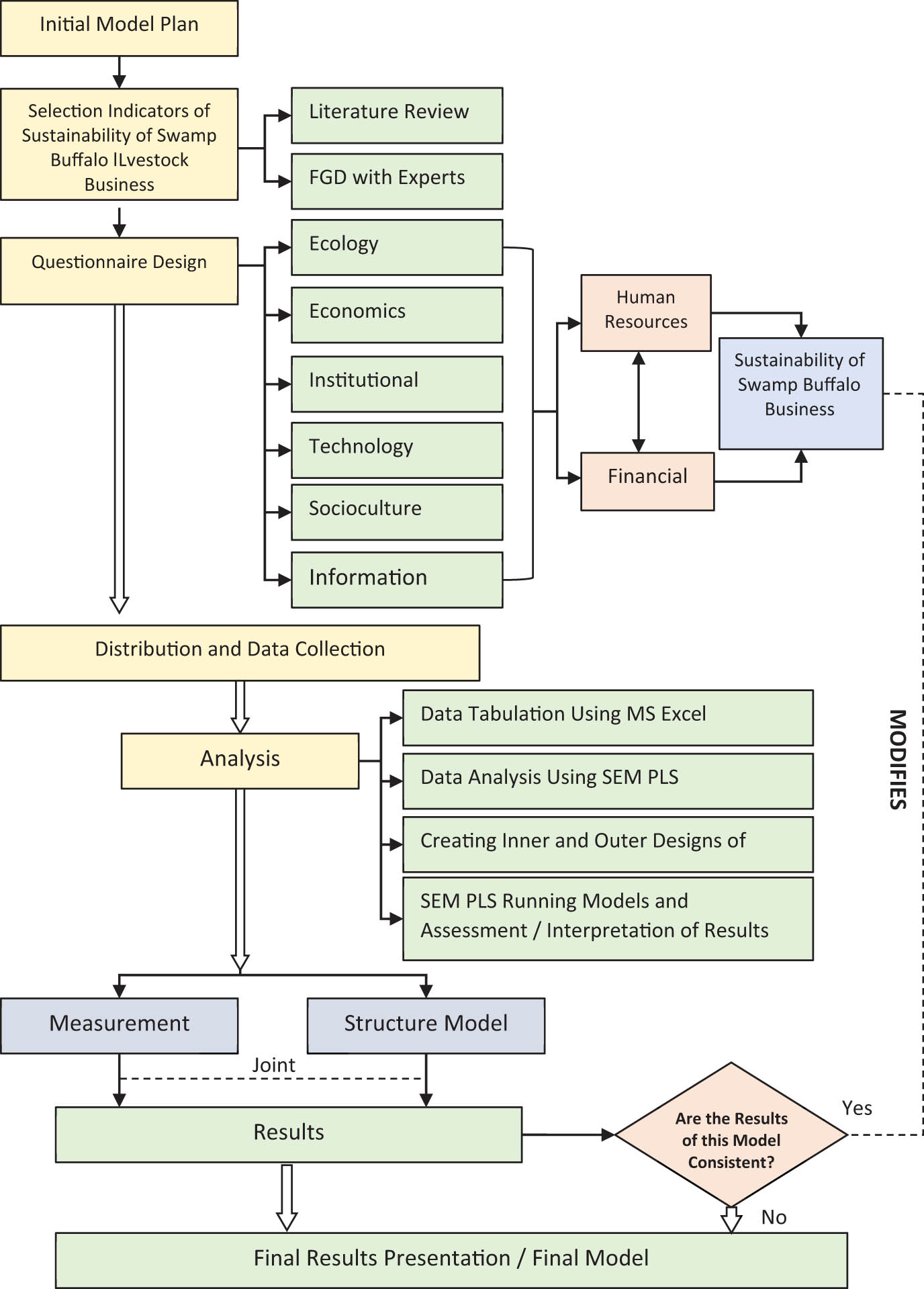
Research stages.
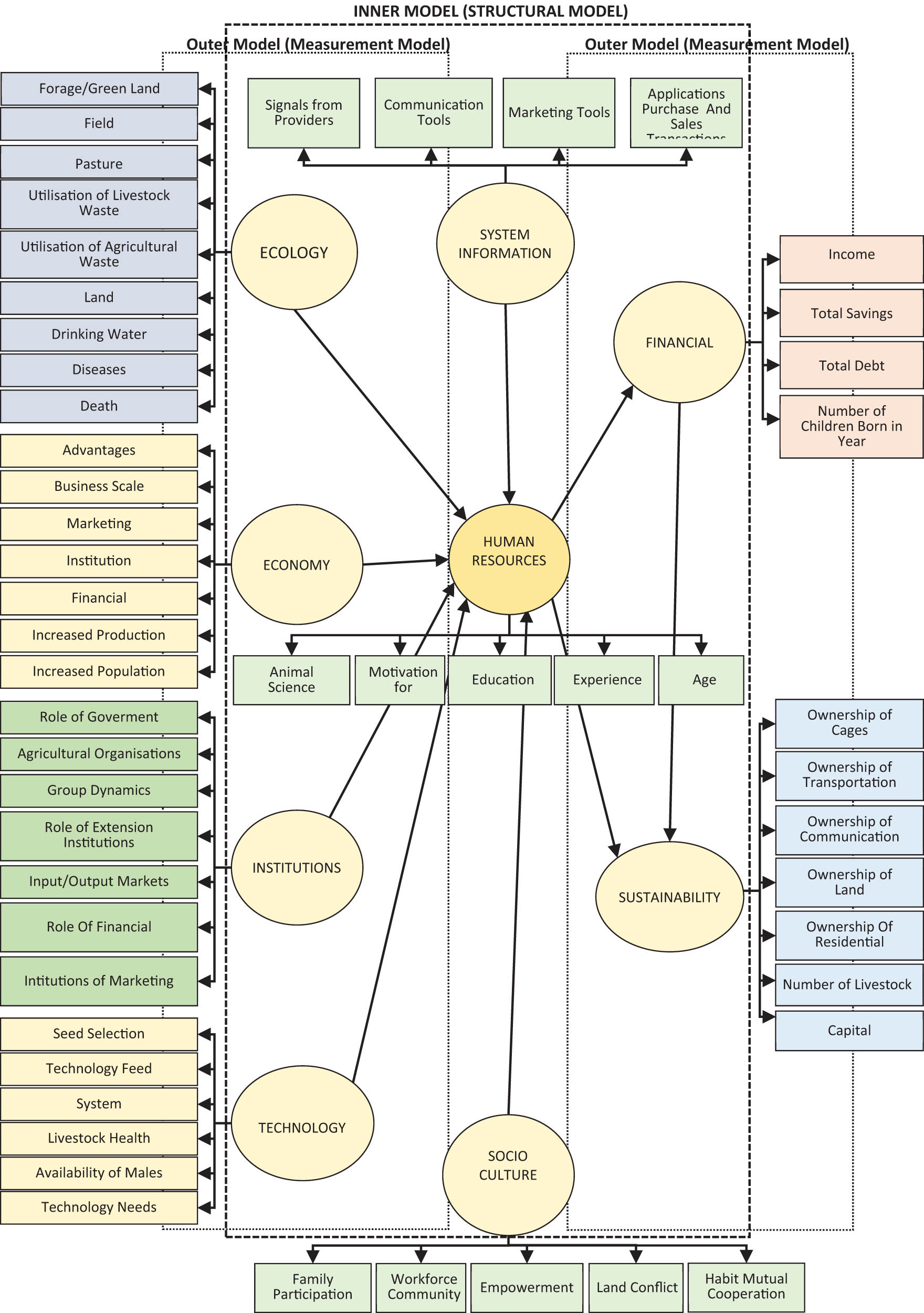
Initial model plan.
2.3 Model development
Experts have developed various theoretical and practical steps for evaluating agricultural sustainability, but research on the sustainability of swamp buffalo business is limited, compared to that on other livestock such as cattle and poultry.
Reviewing in this study has been done by previous studies, which found that there were limitations in determining indicators and integrating latent variables. In addition, the results of the sustainability model varied. Therefore, this research is important to obtain an appropriate model for the sustainability of the swamp buffalo business in the Hulu Sungai Utara Regency. Consequently, a model for such sustainability was developed through a literature review and expert opinion, with 53 indicators determined and integrated into nine latent variables. This indicator was chosen to be closely related to the sustainability of the swamp buffalo business in Hulu Sungai Utara district, South Kalimantan. The study was then conducted as described in Figures 2 and 3.
The model development was conducted by evaluation of the outer and inner models to test the study hypotheses. These were as follows:
H1: Cultural indicators affect HR.
H2: Ecological indicators affect HR.
H3: Economic indicators affect HR.
H4: Information system indicators affect HR.
H5: Institutional indicators affect HR.
H6: Technology indicators affect HR.
H7: Indicators affect finance.
H8: Indicators affect business sustainability.
2.4 Data analysis
The empirical data were obtained from the farmers’ information and after collection were recorded according to each indicator. They were then analysed using SEM-PLS, which is able to handle formative or reflective measurement styles. Reflective measures were used as endogenous structural properties and shifts in the structural model predictor (transend). Reflective indicators were drawn when single-headed arrows went from latent constructs to indicator variables. The study employed a reflective technique [17].
3 Results and discussion
3.1 Outer evaluation model
3.1.1 Convergent validity test
This study model has reflective indicators. The convergent validity test was performed using the average variance extracted (AVE) value and outer loading. In this study, an indicator was declared valid if it had a loading factor of more than 0.6 and an AVE of more than 0.5 (Table 2). The results of the path coefficient, outer loading, and R 2 are presented in Figure 4, where it can be seen that all the outer loadings were greater than 0.6. The convergent validity results are presented in Table 2.
Outer loading and AVE
| Latent variables | Indicator | Outer loading | AVE |
|---|---|---|---|
| Ecology | X11 | 0.724 | 0.524 |
| X12 | 0.762 | ||
| X13 | 0.664 | ||
| X18 | 0.741 | ||
| Economy | X21 | 0.856 | 0.596 |
| X23 | 0.736 | ||
| X25 | 0.826 | ||
| X26 | 0.654 | ||
| Institution | X31 | 0.629 | 0.545 |
| X32 | 0.817 | ||
| X34 | 0.810 | ||
| X37 | 0.679 | ||
| Technology | X41 | 0.764 | 0.512 |
| X42 | 0.681 | ||
| X43 | 0.737 | ||
| X44 | 0.675 | ||
| Socioculture | X51 | 0.759 | 0.508 |
| X52 | 0.690 | ||
| X55 | 0.688 | ||
| Information | X62 | 0.830 | 0.591 |
| X64 | 0.702 | ||
| Finance | Y12 | 0.797 | 0.603 |
| Y13 | 0.755 | ||
| Sustainability | Y23 | 0.865 | 0.663 |
| Y25 | 0.761 | ||
| HR | Z11 | 0.785 | 0.638 |
| Z12 | 0.812 |
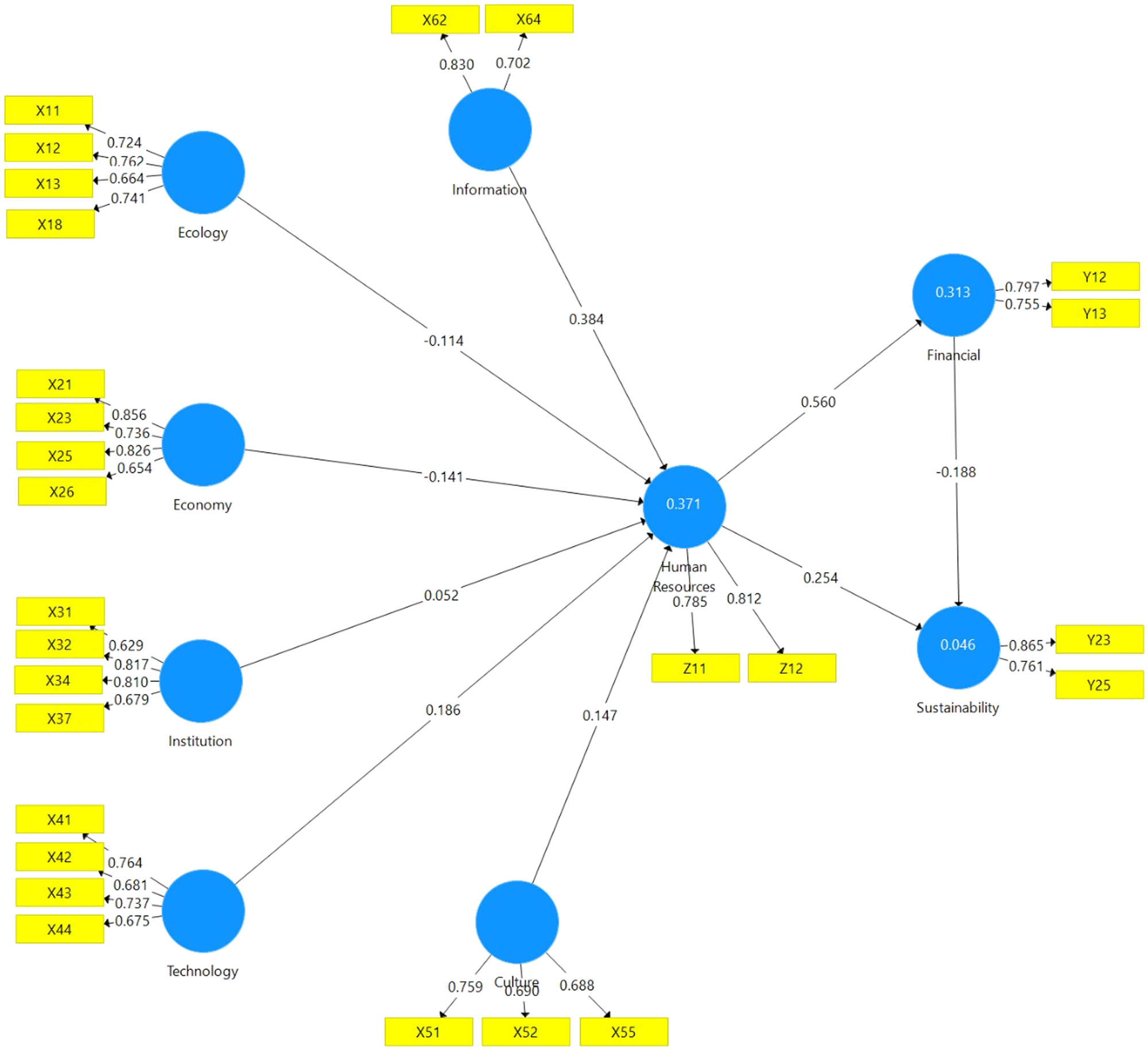
Results of the path coefficients, outer loading, and R 2.
The analysis results shown in Table 2 indicate the outer loadings and AVE values. All the variables have an AVE value >0.5, and all the indicators have an outer loading value >0.6; the AVE values meet the convergent validity requirements, namely, being greater than 0, so the model indicators have convergent validity. The results of this analysis indicate that the model shown in Figure 4 is that produced for the study. In the initial study, 53 indicators were used. The results of the analysis obtained 27 indicators that had an outer loading value of >0.6 and AVE of >0.5, which met the validity requirements (Table 2).
It was found that the ecology variables had four indicators in building the model, namely, the availability of forage, the availability of land for looking for feed, the availability of land for grazing, and diseases that attack buffalo livestock. Natural pastures are a source of food, but little attention has been paid to their sustainability due to differences in attitudes, social norms, and perceptions of landowners’ behaviour [18]. Grazing or pasture is an important factor in providing feed for livestock, which will then produce food for humans in the form of meat and milk [19]. Pasture of a sufficient land area will support the availability of feed for livestock needs. This is supported by [20], who argues that efficient and available feed is important to strengthen the three conventional pillars of sustainability (environmental, social, and economic). However, land and other natural resources are a limiting factor, so it is necessary to find more efficient ways to cultivate more animals per hectare [21]. Rusdiana et al. [22] state that infectious diseases are one of the obstacles to reproductive and production performance in buffaloes, causing enormous economic losses. This implies that disease can affect the sustainability of the livestock business.
The economic variables have two indicators to support the buffalo business sustainability model, namely, business profits and the marketing of buffalo livestock. The conditions at the study sites indicate that the profits derived from the buffalo farming business are able to support family and regional economies. The marketing of buffaloes does not experience problems even though the research location is in a remote place. This shows that the demand for buffalo meat is relatively high and of interest to consumers. Widaningsih et al. [23] found that increasing the scale of the livestock business is a good strategy to save on input costs, generate more income, and meet the market demand. The previous study found that the increased economic efficiency of the buffalo business influences on the variable profit of the breeder [24]. Female buffaloes raise cattle breeders’ profit to Rp.7,889,000/year, with a higher R/C of 1.02. The factors that influence buffalo business income are the scale of the business, the age of the breeder, and the number of calves, while the factors of the number of buffalo, education, experience, and fixed costs have no effect on income [25]. There are four marketing channel patterns for swamp buffalo in South Kalimantan: direct marketing, one-level marketing, two-level marketing, and three-level marketing [26]. The one-level marketing pattern has the highest marketing efficiency value compared to the other three. The marketing agencies that receive the highest profit are the wholesalers.
The institutional variables have four indicators with an outer loading >0.6 (Table 2), namely, the role of the central and regional governments in buffalo development, the agricultural institutions, the role of extension institutions, and marketing institutions. Conditions at the research location indicate the need to increase these roles and attributes. The support and the role of the central and regional governments in the development of buffalo livestock are vital. This is in accordance with the research of Elahi et al. [27], who showed that government support is needed for sustainable agricultural development, including by means of education, coaching, training to improve farmers’ abilities, creating agricultural development programs, helping farmers to access capital, and building facilities and infrastructure. Agricultural institutions, including livestock groups and extension institutions, marketing, and other institutions, are very supportive of the progress of agricultural development. According to Warriach et al. [28], the development of the services of extension institutions includes increasing the awareness of breeders of making better use of grazing lands to obtain sustainable grass production. Marketing institutions are also an important factor to support the sustainability of buffalo livestock business [26].
The technology variable has four attributes (Table 2), which contribute to building a sustainable model for the buffalo livestock business, namely, the selection of seed, feed technology, housing systems, and livestock health. At the research site, these were managed soberly, for seeds, breeders used existing livestock, to be developed, especially broodstock. If the parents show low productivity, they will be sold and replaced with others with good exterior characteristics. Seed selection is made by looking at the physical appearance of the offspring. The feed given is forage or grass that grows in the swamp areas, without any other additional feed. Feed processing technology is not conducted, and no use of agricultural waste is made because the region is far from the food crop centre areas and breeders believe that the forage growing in the swamp areas is sufficient. The housing system used is the kalang, which is a pen built over swamp water. The cattle are in the corral from evening to morning, after which the livestock are released to the pasture. Diseases are generally diarrhoea in young buffalo, while adult buffalo suffer from heartworms and sura. Buffalo livestock play an important role as a source of livelihood and food, but their performance is less than optimal. This was supported by Saputri et al. [29], who found that the problem of reproductive efficiency is due to poor feed management and lack of livestock selection. The use of technology in agriculture is increasingly necessary, in line with technological developments [30]. According to Prasetyia et al. [31], to improve and increase the role of buffaloes, genetic improvement technology is needed, together with the promotion of appropriate technology, infrastructure development, and assistance to breeders to overcome technical and business problems. Although currently most of the maintenance of buffaloes is conducted extensively, efforts to improve genetics need to be made, including estrus protocols and ovulation synchronisation; commercial artificial insemination; embryo transfer; in vitro embryo production; and nucleus transfer [32]. Moreover, according to Widodo et al. [33], with the rapid technological advances and climate change, raising swamp buffalo is a strategic choice to increase the income of small farmers. The development of buffalo livestock through genomic selection is a good strategy to select animals with optimal productivity and adaptability to hot and humid climates. With the availability of quality livestock breeds, quality feed, suitable cages, and disease prevention, the sustainability of the buffalo farming business can be achieved. In addition, Derks et al. [34] recommend that the government introduce small-capacity agricultural machines to small farmers to process agricultural waste, as animal feed is one of the technologies that supports business sustainability.
The sociocultural variable has three attributes, whose outer loading value is >0.6 (Table 2), namely, family participation in the buffalo business, the availability of labour, and the existence of cooperation. Conditions at the study sites indicated that both family and non-family kindergarten workers were available, who could support the sustainability of the buffalo farming business. Cooperation and mutual cooperation in agricultural and general activities were also evident, supporting business development and sustainability [35,36,37,38,39,40,41].
The HR variable has two indicators valid for the model building, namely, farmers’ knowledge/skills and farmers’ motivation. The success of sustainable agricultural development depends on the involvement of beneficiary HR and participation. Farmers’ involvement at every stage of the programme will increase its success, and those who participate optimally will receive optimal benefits [34]. Muhammad et al. [40] reported that the factors influencing sustainable agriculture are education, distance to irrigation sources, rural areas, farm income, and access to credit. Therefore, farmers need to be supported by various programmes, such as ones on counselling, farming credit, production price incentives, and the provision of good irrigation facilities. The financial variable is supported by two indicators, namely, the amount of savings and the amount of debt.
The informatics system variable also has two indicators contributing to the building of the model, namely, the use of communication tools for sources of information and the use of applications for buying and selling buffalo livestock. Currently, sources of information are being developed not only directly but also indirectly through technology. Among these, computer technology, sensors, cloud computing, machine learning, and artificial intelligence have changed several industries, making processes easier and leading to greater profits and efficiency [42]. Hence, it is necessary to explore how such advanced technology can help achieve greater efficiency and profits in animal husbandry [21].
3.1.2 Discriminant validity
In addition to convergent validity, discriminant validity was also investigated. The parameters of discriminant validity tests are known as the Fornell–Larcker criterion [43]. The Fornell–Larcker criterion results are presented in Table 3.
Fornell–Larcker criterion
| Sustainability | Culture | Ecology | Economy | Financial | Information | Institution | HR | Technology | |
|---|---|---|---|---|---|---|---|---|---|
| Sustainability | 0.814 | ||||||||
| Culture | 0.116 | 0.713 | |||||||
| Ecology | −0.184 | 0.037 | 0.724 | ||||||
| Economy | −0.008 | 0.004 | −0.020 | 0.772 | |||||
| Finance | −0.046 | 0.248 | −0.177 | −0.228 | 0.776 | ||||
| Information | 0.087 | 0.211 | −0.220 | −0.089 | 0.328 | 0.769 | |||
| Institution | 0.053 | 0.229 | −0.088 | 0.116 | 0.016 | 0.184 | 0.738 | ||
| HR | 0.149 | 0.286 | −0.189 | −0.170 | 0.560 | 0.535 | 0.151 | 0.799 | |
| Technology | 0.100 | 0.269 | 0.029 | −0.020 | 0.413 | 0.391 | 0.005 | 0.376 | 0.715 |
Table 3 illustrates that the diagonal value is greater than those below, and the Fornell–Larcker criterion was met. In addition, the indicators used to measure the variables were valid because their values have the highest compared to other indicators. Therefore, it concluded that the variables and indicators used in the study conform to discriminant validity.
3.1.3 Reliability
The parameters used to assess reliability were Cronbach’s alpha and composite reliability. According to Abdillah et al. [44], based on Chin (1995), an indicator is said to be reliable if its composite reliability value is greater than 0.7. The composite reliability results are presented in Table 4, which shows that the variables used have a composite reliability value higher than 0.7, so it can be concluded that the indicators that measure the variables are reliable.
The value of composite reliability
| Latent variable | Composite reliability |
|---|---|
| Continuous | 0.797 |
| Culture | 0.756 |
| Ecology | 0.814 |
| Economy | 0.854 |
| Finance | 0.752 |
| Information | 0.742 |
| Institution | 0.826 |
| HR | 0.779 |
| Technology | 0.807 |
3.2 Inner model evaluation
The parameters used to evaluate the inner model in PLS-SEM were determinant coefficients (R 2 test) and path coefficients, or t-values. The value of R 2 was used to measure the level of variation in changes from independent to dependent variables. The R 2 value of the variable for swamp buffalo business sustainability was 0.046 or 4.6%; the R 2 value of the financial aspect variable was 0.313 or 31.1%; and the R 2 value of the HR variable was 0.371 or 37.1%.
The Q2 value was used to calculate the overall goodness of fit (GOF), whose value was 0.588, meaning the study model was fairly good because the value was greater than 50%. After calculating the GOF, the next step was the hypothesis testing with path coefficients. The hypothesis in this study was two tailed. Therefore, it was accepted if it had a t-statistic value higher than 1.96 and a p-value of 0.05. The values of the t-statistics are presented in Figure 5.
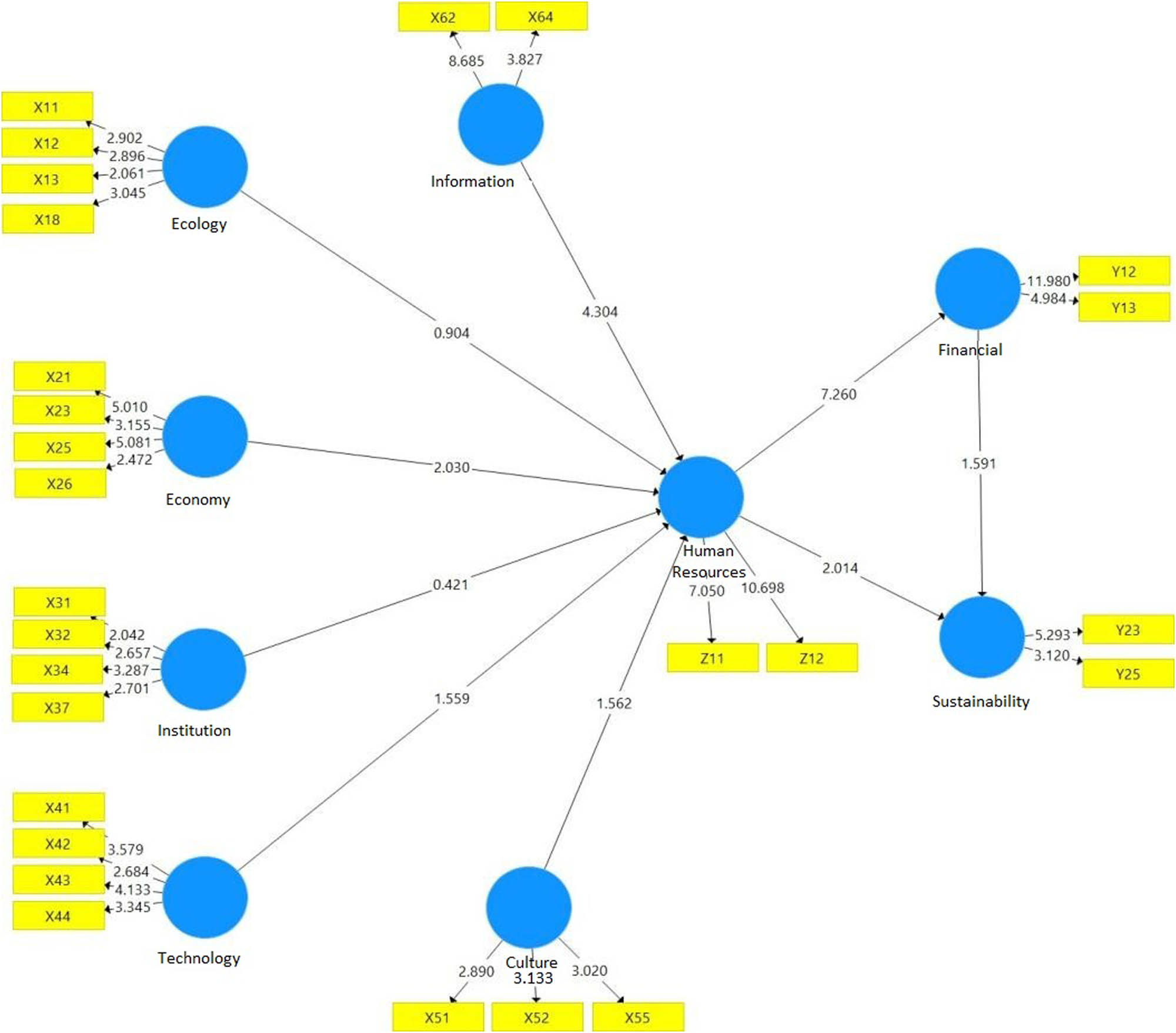
T-statistics.
The results indicate that there is a relationship between four variables. Information systems have a positive influence on HR, while economy has a negative influence on HR. However, HR have a positive relationship with finance and the business sustainability of swamp buffalo. The relationships between the variables are presented in Table 5.
Relationship between variables in swamp buffalo livestock business sustainability
| Original sample (O) | Sample mean (M) | Standard deviation (STDEV) | T statistic (|O/STDEV|) | P-value | |
|---|---|---|---|---|---|
| Culture → HR | 0.147 | 0.163 | 0.094 | 1.562 | 0.119 |
| Ecology → HR | −0.114 | −0.114 | 0.126 | 0.904 | 0.366 |
| Economy → HR | −0.141 | −0.147 | 0.070 | 2.030 | 0.043* |
| Information → HR | 0.384 | 0.358 | 0.089 | 4.304 | 0.000* |
| Institution → HR | 0.052 | 0.043 | 0.125 | 0.421 | 0.674 |
| Technology → HR | 0.186 | 0.184 | 0.119 | 1.559 | 0.120 |
| HR → Financial | 0.560 | 0.559 | 0.077 | 7.260 | 0.000* |
| HR → Sustainability | 0.254 | 0.259 | 0.126 | 2.014 | 0.045* |
| Financial → Sustainability | −0.188 | −0.198 | 0.118 | 1.591 | 0.112 |
* Level of significance P-value = 0.05.
The table shows that information systems have a significant influence on HR, with a positive effect of 0.384, meaning an increase in information systems will increase HR. Information systems are very important in the sustainability of livestock business in today’s digital era. Communication, transactions, exchange of information, and transfer of knowledge are fundamental in almost every aspect of animal husbandry, so information systems make a major contribution to the transition for sustainability in agriculture [23,45]. Farmers are faced with a weak bargaining position due to the lack of knowledge of pricing and marketing. If a farmer needs money to cover his urgent needs, his livestock will be sold at an unreasonable price. This situation can be minimised if farmers understand and employ digital marketing effectively. This is in line with the research of Moussa and El Arbi [46], who found that information systems increase the capacity and capabilities of HR. Another study by Ma and Zheng [47] demonstrates that smartphone-based information sources can help reduce the excessive use of pesticides and chemical fertilisers, preserving the environment and human health. Nyamekye et al. [48] found that the farmer-to-farmer information systems contributed the most to knowledge creation.
The indicators used in this study were considered feasible and make a contribution to the sustainable development of the swamp buffalo business in Hulu Sungai Utara Regency, South Kalimantan. The results of the statistical analysis show that four variables affected such sustainability, namely, information systems, economy, HR, and business sustainability, while the other five variables, ecology, institution, culture, technology, and finance had no statistical effect. Information systems and economy have a significant effect on HR, while HR significantly affect the financial and business sustainability of swamp buffalo. Therefore, the first four variables contribute greatly to the sustainability of swamp buffalo farming business, while the others have a factor loading, which is sufficient to contribute to such sustainability and sufficient to guarantee the effectiveness of the measured model.
A sustainability transition is defined as a long-term, multidimensional, and fundamental transformation process in which a socio-technical system shifts to more sustainable production and consumption practices, with the main objective of increasing agricultural productivity [49]. The transition to agricultural sustainability refers to structural changes related to new, more sustainable production and consumption practices. Therefore, innovative solutions and appropriate technology are needed in the form of information systems [50] and of information and communication technology that assist sustainability in agriculture, food, processing, distribution, and consumption systems, as well as integration and coordination of the food chain [11].
The results of this study enrich those of previous ones, in which information systems were proven to improve HR by empowering small-scale farmers in developing countries and increasing their connectivity [51], and empowering farmers as innovators by their access to information that leads to innovation [52]. In developing countries, information systems are widely used by extension and consulting services; for example, to access market information via short message service, smartphone applications, and integration with social media [53,54]. Farmers can access financial services such as savings, credit, insurance, payment facilities, and remittances that they need at a low cost [53,55]. Therefore, information and communication technology can improve resource efficiency and productivity in the food system [56–58].
In this study, the economic variables are shown to have a significant effect on HR, but with a negative effect of 0.141, meaning that if the economy improves, HR will decrease. This situation demonstrates that not all economic improvements will always be followed by an increase in HR. This research has focused on the condition of swamp buffalo farmers in Hulu Sungai Utara Regency, South Kalimantan. Their economic condition can have a positive effect or a negative effect, depending on how each individual reacts to it; it can be used as a motivator to increase livestock productivity or make farmers complacent about their existing welfare. If an improved economy makes farmers complacent, this will have a negative impact on the sustainability of their livestock business. Therefore, education and counselling are very important as reminders of this. So that farmers do not become negligent with what they already have and continue the effort to improve the productivity of their livestock [29], and the role of the extension worker as a facilitator is the basis for increasing the capacity of farmers by upgrading their knowledge, skills, and attitudes [30]. Extension workers have the ability to facilitate and to strive for easy access to information resources, technology, and other resources. The negative influence relationship is due to the absence of equal distribution of the results of economic improvement felt by the swamp buffalo farmers. The results of this study are in line with those of Prasetyia et al. [31], that economic growth has a negative influence on HR, which is due to the lack of equitable distribution of the benefits of economic growth, a situation especially felt by residents in rural areas. The negative influence of economic resources on HR can be viewed from another angle. Farmers who are economically well established will refuse to become wage labourers. In a village with good economic conditions, it will be difficult to find agricultural workers. In addition, there will be a fall in the interest of the younger generation to work in agriculture, including animal husbandry. This is because the agricultural sector has a less prestigious image than other sectors, with underdeveloped technology and the inability to provide adequate income [59]. The reduced interest of the younger generation in agricultural business needs to be tackled by government policies that develop the interest of the younger generation in the agricultural sector, including the strengthening of digital-based agriculture [60–62].
HR have a significant influence on finance, with a positive influence of 0.560, meaning that increased HR will improve finances. Likewise, there was a significant influence of HR on the sustainability of swamp buffalo business, with a positive effect of 0.254, meaning that an increase in HR will increase such sustainability. The results of this study enrich other research results, namely, that breeders’ HR are one of the key factors in the success of the livestock business and play a very important role in its development and sustainability. According to Amam et al. [63], high- and low-quality HR can affect the accessibility of resources in a business system. Furthermore, it has been argued that resources can increase opportunities for livestock business development [64]. Another study by Oduniyi et al. [65] found that HR factors that significantly influence the adaptive capacity of livestock to be sustainable are the use of labour and other sources of income.
The results of this study also show that sociocultural, ecological, institutional, and technological variables made a sufficient contribution to the sustainability of the development of swamp buffalo business in Hulu Sungai Utara Regency, South Kalimantan Province, although they did not affect HR. In relation to sociocultural aspects, swamp buffalo have been cultivated for generations by farmers in the regency, so their experience of raising cattle is very long. Therefore, social and cultural aspects were not the main study focus, as they were considered entrenched. This is in line with studies of Dawson et al. [66] and Adenle et al. [67], who showed that in the sustainability of agriculture in developing parts of the country, sociocultural aspects were often neglected. Sustainability in the livestock production sector relates to the ability of the system to meet the current demand for livestock products, without jeopardising the use of resources by future generations and minimising negative externalities [68]. Based on this, for a livestock system to be sustainable, it must be able to meet its economic, social, and current and long-term environment [65]. Furthermore, in terms of ecology, Hulu Sungai Utara Regency is a suitable area for the development of the swamp buffalo business, as it has a swamp area of 46.01% [1], an ecological condition that does not affect the work of breeders, as they have lived in swamp settlements for generations. From an institutional perspective, breeders in the regency have joined livestock groups and have been provided with guidance and facilities from the central/regional government. The technology for increasing the productivity of swamp buffalo is already available. This is in line with research by Alpianor et al. [69] that an important factor in the development of swamp buffalo business is that it is a hereditary business system; the experience of breeders is extensive, and buffaloes have adapted together with the existence of farmer group institutions. In addition, an opportunity factor is the availability of technology to increase the productivity of swamp buffalo.
Sociocultural, ecological, institutional, and technological indicators are strengths and opportunities, as well as challenges to the development of swamp buffalo business in the future, so they must be considered and optimised, as they make a sufficient contribution to the sustainability of such development, especially in North Hulu Sungai Regency, South Kalimantan Province.
4 Conclusion
Aspects used in this study were considered feasible and make a contribution to the sustainability of the development of swamp buffalo business in Hulu Sungai Utara Regency. Based on the results of the statistical analysis, four indicators were shown to affect such sustainability, namely, the information systems, economy, HR, and business sustainability variables. Information systems will increase HR. Information systems are also very important in the sustainability of livestock business in today’s digital era, having been proven to improve HR.
Economic variables have a significant effect on HR, but a negative one, meaning if the economy improves, HR will decrease. This situation demonstrates that not all economic improvements will be followed by an increase in HR. HR have a significant positive influence on finance, meaning that increasing HR will improve finances.
Sociocultural, ecological, institutional, and technological variables make a sufficient contribution to the sustainability of the development of swamp buffalo business in Hulu Sungai Utara Regency, although they do not affect HR. In terms of ecology, the regency was shown to be a suitable area for the development of the business.
The resulting research model for the sustainability of the buffalo livestock business was built with 9 variables and 27 indicators. The model, which is recommended for the government as policymaker, especially the government in Hulu Sungai Utara Regency, emphasises the information system variables, the economy, HR, finance, and the sustainability of the buffalo farming business, but without ignoring other variables, such as ecology, socioculture, technology, and institutions. Sociocultural, ecological, institutional, and technological indicators are strengths and opportunities, as well as challenges to the development of swamp buffalo business in the future, so must be considered and optimised.
Acknowledgments
Thanks to all those who have helped with this research before its publication. We are grateful to the Faculty of Agriculture, Islam University of Kalimantan Muhammad Arsyad Al Banjari Banjarmasin, and the Faculty of Animal Science, University of Brawijaya, Malang, East Java. We also extend thanks to the Government of Hulu Sungai Utara Regency, South Kalimantan Province, for granting permission and providing the opportunity to conduct research in the region.
-
Funding information: The authors state no funding involved.
-
Conflict of interest: The authors state no conflict of interest.
-
Data availability statement: The datasets generated during and/or analysed during the current study are available from the corresponding author on reasonable request.
References
[1] Badan Pusat Statistik Kalimantan Selatan. Provinsi Kalimantan selatan dalam angka 2020. Badan Pusat Statistik Kalimantan Selatan; 2020.Search in Google Scholar
[2] Hilmawan F, Subhan A, Hamdan A. Kerbau rawa di Kalimantan selatan: Potensi dan permasalahannya. Pros semin dan agribisnis peternak VII; 2020. p. 175–83.Search in Google Scholar
[3] Badan Pusat Statistik Kalimantan Selatan. Provinsi Kalimantan selatan dalam angka 2020. Badan Pusat Statistik Kalimantan Selatan; 2023.Search in Google Scholar
[4] Badan Pusat Statistik Kalimantan Selatan. Provinsi Kalimantan selatan dalam angka 2021. Badan Pusat Statisstik Kalimantan Selatan; 2021.Search in Google Scholar
[5] Sulaiman AA, Subagyono K, Alihamsyah T, Noor M, Hermanto, Muharam A. Membangkitkan lahan rawa, membangun lumbung pangan Indonesia. Jakarta: Iaard Press; 2018.Search in Google Scholar
[6] Sakir IM, Sriati, Saptawan A, Juniah R. Local wisdom of the wetland swamps agricultural system for a sustainable environment. Sriwijaya International Conference on Earth Science and Environmental Issue IOP Conf. Series: Earth and Environmental Science. Vol. 810, IOP Publishing; 2021. p. 012021. 10.1088/1755-1315/810/1/012021. https://iopscience.iop.org/article/10.1088/1755-1315/810/1/012021/pdf.Search in Google Scholar
[7] Escarcha JF, Lassa JA, Palacpac EP, Zander KK. Livelihoods transformation and climate change adaptation: The case of smallholder water buffalo farmers in the Philippines. Environ Dev. 2020;33:100468. 10.1016/j.envdev.2019.100468.Search in Google Scholar
[8] Lu HL, Chang YH, Wu BY. The compare organic farm and conventional farm to improve sustainable agriculture, ecosystems, and environment. Org Agric. 2020;10:409–18. 10.1007/s13165-020-00278-3.Search in Google Scholar
[9] Firth AG, Baker BH, Brooks JP, Smith R, Iglay RB, Brian Davis J. Low external input sustainable agriculture: Winter flooding in rice fields increases bird use, fecal matter and soil health, reducing fertilizer requirements. Agric Ecosyst Env. 2020;300:1–8. 10.1016/j.agee.2020.106962.Search in Google Scholar
[10] Kropp I, Nejadhashemi AP, Deb K, Abouali M, Roy PC, Adhikari U, et al. A multi-objective approach to water and nutrient efficiency for sustainable agricultural intensification. Agric Syst. 2019;173:289–302. 10.1016/j.agsy.2019.03.014.Search in Google Scholar
[11] El Bilali H, Allahyari MS. Transition towards sustainability in agriculture and food systems: Role of information and communication technologies. Inf Process Agric. 2018;5:456–64. 10.1016/j.inpa.2018.06.006.Search in Google Scholar
[12] Lynch J, Donnellan T, Finn JA, Dillon E, Ryan M. Potential development of Irish agricultural sustainability indicators for current and future policy evaluation needs. J Environ Manage. 2019;230:434–45. 10.1016/j.jenvman.2018.09.070.Search in Google Scholar PubMed
[13] Mohammed AI, Aziz ABZB, Ogunbado AF. The influence of murabahah finance on the relationship between farm credit and agricultural output in Nigeria: Aproposed framework Ahmed. Asian J Multidiscip Stud. 2016;4:93–7.Search in Google Scholar
[14] Wen L, Li Z. Driving forces of national and regional CO2 emissions in China combined IPAT-E and PLS-SEM model. Sci Total Environ. 2019;690:237–47. 10.1016/j.scitotenv.2019.06.370.Search in Google Scholar PubMed
[15] You H. Agricultural landscape dynamics in response to economic transition: Comparisons between different spatial planning zones in Ningbo region, China. Land Use Policy. 2017;61:316–28. 10.1016/j.landusepol.2016.11.025.Search in Google Scholar
[16] Wang L, Yang G, Sun Q, Ge J. An uncertain optimization method for overall ballistics based on stochastic programming and a neural network surrogate model. Eng Optim. 2018;51:663–79. 10.1080/0305215X.2018.1484122.Search in Google Scholar
[17] Hair Jr JF, Hult GT, Ringle CM, Sarstedt M, Danks NP, Ray S. Partial least squares structural equation modeling (PLS-SEM) using R: A workbook. Springer Nature; 2021.10.1007/978-3-030-80519-7Search in Google Scholar
[18] Von Keyserlingk MA, Cestari AA, Franks B, Fregonesi JA, Weary DM. Dairy cows value access to pasture as highly as fresh feed. Sci Rep. 2017;7:44953. Horn J, Isselstein J. How do we feed grazing livestock in the future? A case for knowledge-driven grazing systems. Grass Forage Sci. 2022;77:153–166. 10.1111/gfs.12577.Search in Google Scholar
[19] Makkar HPS. Smart livestock feeding strategies for harvesting triple gain – the desired outcomes in planet, people and profit dimensions: a developing country perspective. Anim Prod Sci. 2016;56(3):519–34. 10.1071/AN15557.Search in Google Scholar
[20] Neethirajan S. The role of sensors, big data and machine learning in modern animal farming. Sens Bio-Sens Res. 2020;29:100367. 10.1016/j.sbsr.2020.100367.Search in Google Scholar
[21] Villanueva MA, Mingala CN, Tubalinal GA, Gaban PB, Nakajima C, Suzuki Y. Emerging infectious diseases in water buffalo: An economic and public health concern. IntechOpen; 2018. 10.5772/intechopen.73395.Search in Google Scholar
[22] Rusdiana S, Praharani L, Sianturi RG. The economic efficiency of buffalo business (Bubalus Bubalis) with the shepherd. SOCA: J Sos Ekonomi Pertan. 2020;14(2):275–87. 10.24843/SOCA.2020.v14.i02.p08.Search in Google Scholar
[23] Widaningsih N, Hartono B, Utami HD, Rohaeni ES. Swamp buffalo marketing transformation (Bubalus bubalis carabauesis) digital-based marketing: Cases in Hulu Sungai Utara Regency, South Kalimantan Province. Adv Anim Vet Sci. 2022;10(12):2546–54. 10.17582/journal.aavs/2022/10.12.2546.2554.Search in Google Scholar
[24] Indrayani I, Rias MI, Fauziah S. Determinants of income in smallholder buffalo farms in Sijunjung, West Sumatra. In IOP Conference Series: Earth and Environmental Science, Vol. 1182, The 5th International Conference on Sustainable Agriculture and Biosystem (ICSAB 2022). 2023; IOP Conf. Ser.: Earth Environ. Sci. 012025. 10.1088/1755-1315/1182/1/012025.Search in Google Scholar
[25] Chand P, Sirohi S, Sirohi SK. Development and application of an integrated sustainability index for small-holder dairy farms in Rajasthan, India. Ecol Indic. 2015;56:23–30. 10.1016/j.ecolind.2015.03.020.Search in Google Scholar
[26] Nainggolan HL, Aritonang J, Sihombing M, Supriana T, Tafsin M. Structural modelling of rice fields-buffalo livestock based integrated agricultural systems in the context of regional development in Humbang Hasundutan, Indonesia. Future Food J Food Agric Soc. 2019;7(2):106. 10.17170/kobra-20190709595.Search in Google Scholar
[27] Elahi E, Zhang H, Lirong X, Khalid Z, Xu H. Understanding cognitive and socio-psychological factors determining farmers’ intentions to use improved grassland: Implications of land use policy for sustainable pasture production. Land Use Policy. 2021;2021:102. 10.1016/j.landusepol.2020.105250.Search in Google Scholar
[28] Warriach HM, McGill DM, Bush RD, Wynn PC, Chohan KR. A review of recent developments in buffalo reproduction — A review. Asian Australas J Anim Sci. 2015;28(3):451–5. 10.5713/ajas.14.0259.Search in Google Scholar PubMed PubMed Central
[29] Saputri RD, Anantanyu S, Wjianto A. Perkembangan kelompok tani di kabupaten Sukoharjo. J Agrista. 2016;4:341–52.Search in Google Scholar
[30] Listiana I, Sumardjo S, Sadono D, Tjiptopranoto P. Hubungan Kapasitas Penyuluh dengan Kepuasan Petani dalam Kegiatan Penyuluhan. J Penyul. 2018;14(2):244–56. 10.25015/penyuluhan.v14i2.18673.Search in Google Scholar
[31] Prasetyia F, Wulandari F, Hutama RS. Pengeluaran Sektor Publik, Pertumbuhan Ekonomi dan Kemiskinan di Indonesia. J Ekon Dan Pembang Indones. 2011;11:99–116. 10.21002/jepi.v11i2.184.Search in Google Scholar
[32] Ermetin O. Evaluation of the application opportunities of precision livestock farming (PLF) for water buffalo (Bubalus bubalis) breeding: SWOT analysis. Arch Anim Breed. 2023;66:41–50. 10.5194/aab-66-41-2023.Search in Google Scholar PubMed PubMed Central
[33] Widodo, Kamardiani DR, Utami BN. Behavioral response of breeder toward development program of Ongole crossbred cattle in Yogyakarta Special Region, Indonesia. Open Agric. 2022;7:1. 10.1515/opag-2022-0076.Search in Google Scholar
[34] Derks M, van Werven T, Hogeveen H, Kremer WDJ. Associations between farmer participation in veterinary herd health management programs and farm performance. J Dairy Sci. 2014;97:1336–47. 10.3168/jds.2013-6781.Search in Google Scholar PubMed
[35] Becskei Z, Savić M, Ćirković D, Rašeta M, Puvača N, Pajić M, et al. Assessment of water buffalo milk and traditional milk products in a sustainable production system. Sustainability. 2020;12(16):6616. 10.3390/su12166616.Search in Google Scholar
[36] Pineda PS, Flores EB, Herrera JRV, Low WY. Opportunities and challenges for improving the productivity of swamp buffaloes in southeastern Asia. Front Genet. 2021;12:629861. 10.3389/fgene.2021.629861.Search in Google Scholar PubMed PubMed Central
[37] Sanudin, Fauziyah E, Widyaningsih TS, Harianja AH, Widiyanto A. Role of actors in promoting sustainable peatland management in Kubu Raya Regency, West Kalimantan, Indonesia. Open Agric. 2023;8:1. 10.1515/opag-2022-0198.Search in Google Scholar
[38] Mardiharini M, Jamal E, Rohaeni ES, Indrawanto C, Indraningsih KC, Gunawan E, et al. Indonesian rice farmers’ perceptions of different sources of information and their effect on farmer capability. Open Agric. 2023;8:1. 10.1515/opag-2022-0200.Search in Google Scholar
[39] Herdiansyah H, Mamola R, Rokhim R. Palm oil cluster resilience to enhance indigenous welfare by innovative ability to address land conflicts: Evidence of disaster hierarchy. Open Agric. 2023;8:1. 10.1515/opag-2022-0206.Search in Google Scholar
[40] Muhammad DRA, Fibri DLN, Saputro AD, Sunarharum WB. Investigating the elicited emotion of single-origin chocolate towards sustainable chocolate production in Indonesia. Open Agric. 2022;7:1. 10.1515/opag-2022-0095.Search in Google Scholar
[41] Kuwornu JK, Khaipetch J, Gunawan E, Bannor RK, Ho TD. The adoption of sustainable supply chain management practices on performance and quality assurance of food companies. Sustainable Futures. 2023;5:100103.10.1016/j.sftr.2022.100103Search in Google Scholar
[42] Wolfert S, Ge L, Verdouw C, Bogaardt MJ. Big data in smart farming–A review. Agric Syst. 2017;153:69–80. 10.1016/j.agsy.2017.01.023.Search in Google Scholar
[43] GeSI. SMART. Enabling the low carbon economy in the information age; 2008. Smart 2020;35. http://www.smart2020.org/_assets/files/02_Smart20.Search in Google Scholar
[44] Abdillah W, Hartono J, Prabantini D. Partial least square (PLS): Alternatif structural equation modeling (SEM) dalam penelitian bisnis. Yogyakarta: Penerbit Andi. 2015;22:103–50.Search in Google Scholar
[45] Berti G, Mulligan C. ICT & The future of food and agriculture. Report. London: Imperial College; 2015.Search in Google Scholar
[46] Moussa NB, El Arbi R. The impact of Human Resources Information Systems on individual innovation capability in Tunisian companies: The moderating role of affective commitment. Eur Res Manag Bus Econ. 2020;26(1):18–25. 10.1016/j.iedeen.2019.12.001.Search in Google Scholar
[47] Ma W, Zheng H. Heterogeneous impacts of information technology adoption on pesticide and fertiliser expenditures: Evidence from wheat farmers in China. Aust J Agric Resour Econ. 2021;59:1–21. 10.1111/1467-8489.12446.Search in Google Scholar
[48] Nyamekye AB, Dewulf A, Slobbe EV, Termeer K. Information systems and actionable knowledge creation inrice-farming systems in Northern Ghana. Afr Geogr Rev. 2020;39(2):144–61. 10.1080/19376812.2019.1659153.Search in Google Scholar
[49] Markard J, Raven R, Truffer B. Sustainability transitions: An emerging field of research and its prospects. Res Policy. 2012;41:955–67. 10.1016/j.respol.2012.02.013.Search in Google Scholar
[50] Bello O, Aderbigbe F. ICT in agricultural sustainability and food security. Int J Emerg Technol Adv Eng. 2014;4(3):508–13.Search in Google Scholar
[51] Sylvester G. Success stories on information and communication technologies for agriculture and rural development. RAP Publication. 2015 (2015/02).Search in Google Scholar
[52] Uphoff N. Empowerment of farmers through ICT. InDraft paper for ECOSOC expert group meeting on promoting empowerment of people in advancing poverty eradication, social integration, and decent work for all, UN HQ, NYC 2012.Search in Google Scholar
[53] Kolshus K, Pastore A, Treinen S, Van der Elstraeten A. e-agriculture 10 year Review Report: Implementation of theWorld Summit on the Information Society (WSIS) Action Line C7. ICTApplications: e-agriculture. 2015.Search in Google Scholar
[54] da Silva JG. FAO-The future of food and agriculture: Trends and challenges. Report of the Food and Agriculture Organization of the United Nations. 2017.Search in Google Scholar
[55] ICT in agriculture connecting smallholders to knowledge, networks, and institutions. Washington, DC; 2017. 10.1596/978-1-4648-1002-2.Search in Google Scholar
[56] Svenfelt A, Zapico JL. Sustainable food systems with ICT. Advances in Computer Science Research. Atlantis Press; 2016. pp. 194–201. 10.2991/ict4s-16.2016.23.Search in Google Scholar
[57] Thöni A, Tjoa AM. Information technology for sustainable supply chain management: A literature survey. Enterp Inf Syst. 2015;11:828–58. 10.1080/17517575.2015.1091950.Search in Google Scholar
[58] Caputo F, Buhnova B, Walletzký L. Investigating the role of smartness for sustainability: Insights from the Smart Grid domain. Sustain Sci. 2018;13:1299–309. 10.1007/s11625-018-0555-4.Search in Google Scholar
[59] Arvianti EY, Masyhuri, Waluyati LR, Darwanto DH. Gambaran krisis petani muda di Indonesia. J Sos Ekonomi dan Kebijak Pertan. 2019;8:2. http://journal.trunojoyo.ac.id/agriekonomika.10.21107/agriekonomika.v8i2.5429Search in Google Scholar
[60] Muksin, Juanda I, Wahyono ND, Eliyatiningsih E, Harlianingtyas I, Purwoko D. Design of the needs model for the development of young generation interests in the agricultural sector in Banyuwangi regency. The 4th International Conference on Food and Agriculture IOP Conf. Series: Earth and Environmental Science. 980, IOP Publishing; 2022. p. 012055. 10.1088/1755-1315/980/1/012055 Search in Google Scholar
[61] Sukanya S, Roy BR, Sharma JP, Padaria RN, Sudipta P, Singh AK. Attracting and retaining youth in agriculture: Challenges and prospects. J Community Mobilization Sustain Dev. 2018;13(3):385–95. https://www.indianjournals.com/ijor.aspx?target=ijor:jcmsd&volume=13&issue=3&article=001.Search in Google Scholar
[62] Widiyanti E, Setyowati N, Ardianto DT. Young generation’s perception on the agricultural sector. International Conference on Climate Change. IOP Conf. Series: Earth and Environmental Science. IOP Publishing; 2018; Vol. 200. p. 012060. 10.1088/1755-1315/200/1/012060.Search in Google Scholar
[63] Amam A, Fanani BH, Nugroho B. Identification on resources in the system of broiler farming business. J Ilmu Ternak Dan Vet. 2019;23:135–42.10.14334/jitv.v24i3.1927Search in Google Scholar
[64] Amam A, Soetriono S. Peranan sumber daya terhadap SDM peternak dan pengembangan usaha ternak sapi perah di kawasan peternakan sapi perah nasional (KPSPN). J Peternak Indones. 2020;22:1. 10.25077/jpi.22.1.1-10.2020.Search in Google Scholar
[65] Oduniyi OS, Rubhara TT, Antwi MA. Sustainability of livestock farming in South Africa. Outlook on production constraints, climate-related events, and upshot on adaptive capacity. Sustainability. 2020;12(7):2582. 10.3390/su12072582.Search in Google Scholar
[66] Dawson N, Martin A, Camfield L. Can agricultural intensification help attain Sustainable Development Goals? Evidence from Africa and Asia. Third World Q. 2019;40:926–46. 10.1080/01436597.2019.1568190.Search in Google Scholar
[67] Adenle AA, Wedig K, Azadi H. Sustainable agriculture and food security in Africa: The role of innovative technologies and international organizations. Technol Soc. 2019;58:54. 10.1016/j.techsoc.2019.05.007.Search in Google Scholar
[68] Mendelsohn R. The impact of climate change on agriculture in developing countries. J Nat Resour Policy Res. 2008;1:5–19.10.1080/19390450802495882Search in Google Scholar
[69] Alpianor A, Biyatmoko D, Hafizianor H, Husaini M. Strategi pengembangan kawasan peternakan kerbau rawa di kabupaten hulu sungai selatan. EnviroScienteae. 2017;13:7–23.10.20527/es.v13i1.3507Search in Google Scholar
© 2023 the author(s), published by De Gruyter
This work is licensed under the Creative Commons Attribution 4.0 International License.
Articles in the same Issue
- Regular Articles
- The impact of COVID-19 pandemic on business risks and potato commercial model
- Effects of potato (Solanum tuberosum L.)–Mucuna pruriens intercropping pattern on the agronomic performances of potato and the soil physicochemical properties of the western highlands of Cameroon
- Machine learning-based prediction of total phenolic and flavonoid in horticultural products
- Revamping agricultural sector and its implications on output and employment generation: Evidence from Nigeria
- Does product certification matter? A review of mechanism to influence customer loyalty in the poultry feed industry
- Farmer regeneration and knowledge co-creation in the sustainability of coconut agribusiness in Gorontalo, Indonesia
- Lablab purpureus: Analysis of landraces cultivation and distribution, farming systems, and some climatic trends in production areas in Tanzania
- The effects of carrot (Daucus carota L.) waste juice on the performances of native chicken in North Sulawesi, Indonesia
- Properties of potassium dihydrogen phosphate and its effects on plants and soil
- Factors influencing the role and performance of independent agricultural extension workers in supporting agricultural extension
- The fate of probiotic species applied in intensive grow-out ponds in rearing water and intestinal tracts of white shrimp, Litopenaeus vannamei
- Yield stability and agronomic performances of provitamin A maize (Zea mays L.) genotypes in South-East of DR Congo
- Diallel analysis of length and shape of rice using Hayman and Griffing method
- Physicochemical and microbiological characteristics of various stem bark extracts of Hopea beccariana Burck potential as natural preservatives of coconut sap
- Correlation between descriptive and group type traits in the system of cow’s linear classification of Ukrainian Brown dairy breed
- Meta-analysis of the influence of the substitution of maize with cassava on performance indices of broiler chickens
- Bacteriocin-like inhibitory substance (BLIS) produced by Enterococcus faecium MA115 and its potential use as a seafood biopreservative
- Meta-analysis of the benefits of dietary Saccharomyces cerevisiae intervention on milk yield and component characteristics in lactating small ruminants
- Growth promotion potential of Bacillus spp. isolates on two tomato (Solanum lycopersicum L.) varieties in the West region of Cameroon
- Prioritizing IoT adoption strategies in millennial farming: An analytical network process approach
- Soil fertility and pomelo yield influenced by soil conservation practices
- Soil macrofauna under laying hens’ grazed fields in two different agroecosystems in Portugal
- Factors affecting household carbohydrate food consumption in Central Java: Before and during the COVID-19 pandemic
- Properties of paper coated with Prunus serotina (Ehrh.) extract formulation
- Fertiliser cost prediction in European Union farms: Machine-learning approaches through artificial neural networks
- Molecular and phenotypic markers for pyramiding multiple traits in rice
- Natural product nanofibers derived from Trichoderma hamatum K01 to control citrus anthracnose caused by Colletotrichum gloeosporioides
- Role of actors in promoting sustainable peatland management in Kubu Raya Regency, West Kalimantan, Indonesia
- Small-scale coffee farmers’ perception of climate-adapted attributes in participatory coffee breeding: A case study of Gayo Highland, Aceh, Indonesia
- Optimization of extraction using surface response methodology and quantification of cannabinoids in female inflorescences of marijuana (Cannabis sativa L.) at three altitudinal floors of Peru
- Production factors, technical, and economic efficiency of soybean (Glycine max L. Merr.) farming in Indonesia
- Economic performance of smallholder soya bean production in Kwara State, Nigeria
- Indonesian rice farmers’ perceptions of different sources of information and their effect on farmer capability
- Feed preference, body condition scoring, and growth performance of Dohne Merino ram fed varying levels of fossil shell flour
- Assessing the determinant factors of risk strategy adoption to mitigate various risks: An experience from smallholder rubber farmers in West Kalimantan Province, Indonesia
- Analysis of trade potential and factors influencing chili export in Indonesia
- Grade-C kenaf fiber (poor quality) as an alternative material for textile crafts
- Technical efficiency changes of rice farming in the favorable irrigated areas of Indonesia
- Palm oil cluster resilience to enhance indigenous welfare by innovative ability to address land conflicts: Evidence of disaster hierarchy
- Factors determining cassava farmers’ accessibility to loan sources: Evidence from Lampung, Indonesia
- Tailoring business models for small-medium food enterprises in Eastern Africa can drive the commercialization and utilization of vitamin A rich orange-fleshed sweet potato puree
- Revitalizing sub-optimal drylands: Exploring the role of biofertilizers
- Effects of salt stress on growth of Quercus ilex L. seedlings
- Design and fabrication of a fish feed mixing cum pelleting machine for small-medium scale aquaculture industry
- Indicators of swamp buffalo business sustainability using partial least squares structural equation modelling
- Effect of arbuscular mycorrhizal fungi on early growth, root colonization, and chlorophyll content of North Maluku nutmeg cultivars
- How intergenerational farmers negotiate their identity in the era of Agriculture 4.0: A multiple-case study in Indonesia
- Responses of broiler chickens to incremental levels of water deprivation: Growth performance, carcass characteristics, and relative organ weights
- The improvement of horticultural villages sustainability in Central Java Province, Indonesia
- Effect of short-term grazing exclusion on herbage species composition, dry matter productivity, and chemical composition of subtropical grasslands
- Analysis of beef market integration between consumer and producer regions in Indonesia
- Analysing the sustainability of swamp buffalo (Bubalus bubalis carabauesis) farming as a protein source and germplasm
- Toxicity of Calophyllum soulattri, Piper aduncum, Sesamum indicum and their potential mixture for control Spodoptera frugiperda
- Consumption profile of organic fruits and vegetables by a Portuguese consumer’s sample
- Phenotypic characterisation of indigenous chicken in the central zone of Tanzania
- Diversity and structure of bacterial communities in saline and non-saline rice fields in Cilacap Regency, Indonesia
- Isolation and screening of lactic acid bacteria producing anti-Edwardsiella from the gastrointestinal tract of wild catfish (Clarias gariepinus) for probiotic candidates
- Effects of land use and slope position on selected soil physicochemical properties in Tekorsh Sub-Watershed, East Gojjam Zone, Ethiopia
- Design of smart farming communication and web interface using MQTT and Node.js
- Assessment of bread wheat (Triticum aestivum L.) seed quality accessed through different seed sources in northwest Ethiopia
- Estimation of water consumption and productivity for wheat using remote sensing and SEBAL model: A case study from central clay plain Ecosystem in Sudan
- Agronomic performance, seed chemical composition, and bioactive components of selected Indonesian soybean genotypes (Glycine max [L.] Merr.)
- The role of halal requirements, health-environmental factors, and domestic interest in food miles of apple fruit
- Subsidized fertilizer management in the rice production centers of South Sulawesi, Indonesia: Bridging the gap between policy and practice
- Factors affecting consumers’ loyalty and purchase decisions on honey products: An emerging market perspective
- Inclusive rice seed business: Performance and sustainability
- Design guidelines for sustainable utilization of agricultural appropriate technology: Enhancing human factors and user experience
- Effect of integrate water shortage and soil conditioners on water productivity, growth, and yield of Red Globe grapevines grown in sandy soil
- Synergic effect of Arbuscular mycorrhizal fungi and potassium fertilizer improves biomass-related characteristics of cocoa seedlings to enhance their drought resilience and field survival
- Control measure of sweet potato weevil (Cylas formicarius Fab.) (Coleoptera: Curculionidae) in endemic land of entisol type using mulch and entomopathogenic fungus Beauveria bassiana
- In vitro and in silico study for plant growth promotion potential of indigenous Ochrobactrum ciceri and Bacillus australimaris
- Effects of repeated replanting on yield, dry matter, starch, and protein content in different potato (Solanum tuberosum L.) genotypes
- Review Articles
- Nutritional and chemical composition of black velvet tamarind (Dialium guineense Willd) and its influence on animal production: A review
- Black pepper (Piper nigrum Lam) as a natural feed additive and source of beneficial nutrients and phytochemicals in chicken nutrition
- The long-crowing chickens in Indonesia: A review
- A transformative poultry feed system: The impact of insects as an alternative and transformative poultry-based diet in sub-Saharan Africa
- Short Communication
- Profiling of carbonyl compounds in fresh cabbage with chemometric analysis for the development of freshness assessment method
- Special Issue of The 4th International Conference on Food Science and Engineering (ICFSE) 2022 - Part I
- Non-destructive evaluation of soluble solid content in fruits with various skin thicknesses using visible–shortwave near-infrared spectroscopy
- Special Issue on FCEM - International Web Conference on Food Choice & Eating Motivation - Part I
- Traditional agri-food products and sustainability – A fruitful relationship for the development of rural areas in Portugal
- Consumers’ attitudes toward refrigerated ready-to-eat meat and dairy foods
- Breakfast habits and knowledge: Study involving participants from Brazil and Portugal
- Food determinants and motivation factors impact on consumer behavior in Lebanon
- Comparison of three wine routes’ realities in Central Portugal
- Special Issue on Agriculture, Climate Change, Information Technology, Food and Animal (ACIFAS 2020)
- Environmentally friendly bioameliorant to increase soil fertility and rice (Oryza sativa) production
- Enhancing the ability of rice to adapt and grow under saline stress using selected halotolerant rhizobacterial nitrogen fixer
Articles in the same Issue
- Regular Articles
- The impact of COVID-19 pandemic on business risks and potato commercial model
- Effects of potato (Solanum tuberosum L.)–Mucuna pruriens intercropping pattern on the agronomic performances of potato and the soil physicochemical properties of the western highlands of Cameroon
- Machine learning-based prediction of total phenolic and flavonoid in horticultural products
- Revamping agricultural sector and its implications on output and employment generation: Evidence from Nigeria
- Does product certification matter? A review of mechanism to influence customer loyalty in the poultry feed industry
- Farmer regeneration and knowledge co-creation in the sustainability of coconut agribusiness in Gorontalo, Indonesia
- Lablab purpureus: Analysis of landraces cultivation and distribution, farming systems, and some climatic trends in production areas in Tanzania
- The effects of carrot (Daucus carota L.) waste juice on the performances of native chicken in North Sulawesi, Indonesia
- Properties of potassium dihydrogen phosphate and its effects on plants and soil
- Factors influencing the role and performance of independent agricultural extension workers in supporting agricultural extension
- The fate of probiotic species applied in intensive grow-out ponds in rearing water and intestinal tracts of white shrimp, Litopenaeus vannamei
- Yield stability and agronomic performances of provitamin A maize (Zea mays L.) genotypes in South-East of DR Congo
- Diallel analysis of length and shape of rice using Hayman and Griffing method
- Physicochemical and microbiological characteristics of various stem bark extracts of Hopea beccariana Burck potential as natural preservatives of coconut sap
- Correlation between descriptive and group type traits in the system of cow’s linear classification of Ukrainian Brown dairy breed
- Meta-analysis of the influence of the substitution of maize with cassava on performance indices of broiler chickens
- Bacteriocin-like inhibitory substance (BLIS) produced by Enterococcus faecium MA115 and its potential use as a seafood biopreservative
- Meta-analysis of the benefits of dietary Saccharomyces cerevisiae intervention on milk yield and component characteristics in lactating small ruminants
- Growth promotion potential of Bacillus spp. isolates on two tomato (Solanum lycopersicum L.) varieties in the West region of Cameroon
- Prioritizing IoT adoption strategies in millennial farming: An analytical network process approach
- Soil fertility and pomelo yield influenced by soil conservation practices
- Soil macrofauna under laying hens’ grazed fields in two different agroecosystems in Portugal
- Factors affecting household carbohydrate food consumption in Central Java: Before and during the COVID-19 pandemic
- Properties of paper coated with Prunus serotina (Ehrh.) extract formulation
- Fertiliser cost prediction in European Union farms: Machine-learning approaches through artificial neural networks
- Molecular and phenotypic markers for pyramiding multiple traits in rice
- Natural product nanofibers derived from Trichoderma hamatum K01 to control citrus anthracnose caused by Colletotrichum gloeosporioides
- Role of actors in promoting sustainable peatland management in Kubu Raya Regency, West Kalimantan, Indonesia
- Small-scale coffee farmers’ perception of climate-adapted attributes in participatory coffee breeding: A case study of Gayo Highland, Aceh, Indonesia
- Optimization of extraction using surface response methodology and quantification of cannabinoids in female inflorescences of marijuana (Cannabis sativa L.) at three altitudinal floors of Peru
- Production factors, technical, and economic efficiency of soybean (Glycine max L. Merr.) farming in Indonesia
- Economic performance of smallholder soya bean production in Kwara State, Nigeria
- Indonesian rice farmers’ perceptions of different sources of information and their effect on farmer capability
- Feed preference, body condition scoring, and growth performance of Dohne Merino ram fed varying levels of fossil shell flour
- Assessing the determinant factors of risk strategy adoption to mitigate various risks: An experience from smallholder rubber farmers in West Kalimantan Province, Indonesia
- Analysis of trade potential and factors influencing chili export in Indonesia
- Grade-C kenaf fiber (poor quality) as an alternative material for textile crafts
- Technical efficiency changes of rice farming in the favorable irrigated areas of Indonesia
- Palm oil cluster resilience to enhance indigenous welfare by innovative ability to address land conflicts: Evidence of disaster hierarchy
- Factors determining cassava farmers’ accessibility to loan sources: Evidence from Lampung, Indonesia
- Tailoring business models for small-medium food enterprises in Eastern Africa can drive the commercialization and utilization of vitamin A rich orange-fleshed sweet potato puree
- Revitalizing sub-optimal drylands: Exploring the role of biofertilizers
- Effects of salt stress on growth of Quercus ilex L. seedlings
- Design and fabrication of a fish feed mixing cum pelleting machine for small-medium scale aquaculture industry
- Indicators of swamp buffalo business sustainability using partial least squares structural equation modelling
- Effect of arbuscular mycorrhizal fungi on early growth, root colonization, and chlorophyll content of North Maluku nutmeg cultivars
- How intergenerational farmers negotiate their identity in the era of Agriculture 4.0: A multiple-case study in Indonesia
- Responses of broiler chickens to incremental levels of water deprivation: Growth performance, carcass characteristics, and relative organ weights
- The improvement of horticultural villages sustainability in Central Java Province, Indonesia
- Effect of short-term grazing exclusion on herbage species composition, dry matter productivity, and chemical composition of subtropical grasslands
- Analysis of beef market integration between consumer and producer regions in Indonesia
- Analysing the sustainability of swamp buffalo (Bubalus bubalis carabauesis) farming as a protein source and germplasm
- Toxicity of Calophyllum soulattri, Piper aduncum, Sesamum indicum and their potential mixture for control Spodoptera frugiperda
- Consumption profile of organic fruits and vegetables by a Portuguese consumer’s sample
- Phenotypic characterisation of indigenous chicken in the central zone of Tanzania
- Diversity and structure of bacterial communities in saline and non-saline rice fields in Cilacap Regency, Indonesia
- Isolation and screening of lactic acid bacteria producing anti-Edwardsiella from the gastrointestinal tract of wild catfish (Clarias gariepinus) for probiotic candidates
- Effects of land use and slope position on selected soil physicochemical properties in Tekorsh Sub-Watershed, East Gojjam Zone, Ethiopia
- Design of smart farming communication and web interface using MQTT and Node.js
- Assessment of bread wheat (Triticum aestivum L.) seed quality accessed through different seed sources in northwest Ethiopia
- Estimation of water consumption and productivity for wheat using remote sensing and SEBAL model: A case study from central clay plain Ecosystem in Sudan
- Agronomic performance, seed chemical composition, and bioactive components of selected Indonesian soybean genotypes (Glycine max [L.] Merr.)
- The role of halal requirements, health-environmental factors, and domestic interest in food miles of apple fruit
- Subsidized fertilizer management in the rice production centers of South Sulawesi, Indonesia: Bridging the gap between policy and practice
- Factors affecting consumers’ loyalty and purchase decisions on honey products: An emerging market perspective
- Inclusive rice seed business: Performance and sustainability
- Design guidelines for sustainable utilization of agricultural appropriate technology: Enhancing human factors and user experience
- Effect of integrate water shortage and soil conditioners on water productivity, growth, and yield of Red Globe grapevines grown in sandy soil
- Synergic effect of Arbuscular mycorrhizal fungi and potassium fertilizer improves biomass-related characteristics of cocoa seedlings to enhance their drought resilience and field survival
- Control measure of sweet potato weevil (Cylas formicarius Fab.) (Coleoptera: Curculionidae) in endemic land of entisol type using mulch and entomopathogenic fungus Beauveria bassiana
- In vitro and in silico study for plant growth promotion potential of indigenous Ochrobactrum ciceri and Bacillus australimaris
- Effects of repeated replanting on yield, dry matter, starch, and protein content in different potato (Solanum tuberosum L.) genotypes
- Review Articles
- Nutritional and chemical composition of black velvet tamarind (Dialium guineense Willd) and its influence on animal production: A review
- Black pepper (Piper nigrum Lam) as a natural feed additive and source of beneficial nutrients and phytochemicals in chicken nutrition
- The long-crowing chickens in Indonesia: A review
- A transformative poultry feed system: The impact of insects as an alternative and transformative poultry-based diet in sub-Saharan Africa
- Short Communication
- Profiling of carbonyl compounds in fresh cabbage with chemometric analysis for the development of freshness assessment method
- Special Issue of The 4th International Conference on Food Science and Engineering (ICFSE) 2022 - Part I
- Non-destructive evaluation of soluble solid content in fruits with various skin thicknesses using visible–shortwave near-infrared spectroscopy
- Special Issue on FCEM - International Web Conference on Food Choice & Eating Motivation - Part I
- Traditional agri-food products and sustainability – A fruitful relationship for the development of rural areas in Portugal
- Consumers’ attitudes toward refrigerated ready-to-eat meat and dairy foods
- Breakfast habits and knowledge: Study involving participants from Brazil and Portugal
- Food determinants and motivation factors impact on consumer behavior in Lebanon
- Comparison of three wine routes’ realities in Central Portugal
- Special Issue on Agriculture, Climate Change, Information Technology, Food and Animal (ACIFAS 2020)
- Environmentally friendly bioameliorant to increase soil fertility and rice (Oryza sativa) production
- Enhancing the ability of rice to adapt and grow under saline stress using selected halotolerant rhizobacterial nitrogen fixer
