Analysis and control of surface cracks in a B-bearing continuous casting blooms
-
 ,
,

Abstract
In this work, normal manufacture of a B-bearing steel was hampered by cracks in steel. In order to control these cracks, the formation mechanism has been examined through a comprehensive analysis of crack morphology, element segregation, high temperature mechanical properties, and precipitates. The high-temperature thermoplastic capabilities of the steel were found to be reduced by boron nitride particles precipitated at grain boundary. This led to the formation of a brittle zone in the straightening zone of the continuous casting process, which in turn caused cracks. Based on the formation mechanism of these cracks, the cracks were successfully controlled by adding an appropriate amount of Ti element to the steel and reducing the charging temperature of the heating furnace.
1 Introduction
Studies have demonstrated that adding a very little quantity of boron element (0.0005–0.0030%) to steel can increase its mechanical characteristics, strengthening, hardenability, and surface hardness without compromising the steel’s toughness and plasticity. As a result, steel that contains boron is frequently utilized in industries including aircraft, automotive, and bridges [1–3]. Many researches studies have been carried out on the effect of boron addition on the steel. Generally, boron not only improves the properties of steel, but also brings challenges to the steelmaking processes. Boron nitride (BN) precipitates generated by boron addition will contribute to the issue of surface fractures and finally be inherited into the steel product due to the faulty smelting and hot rolling process [4,5]. Besides, some researchers believed that the remelting phenomenon caused by boron segregation is the main reason for the quality problems of boron-bearing steel [6]. While some studies revealed that BN co-precipitates with sulfides, and improved the steel’s hot ductility [7,8].
In this study, surface cracks on hot-rolled product impeded regular production. Therefore, the goal of this study is to better understand how cracks form during the continuous casting and hot rolling process, as well as to eliminate the cracks by optimizing the operating parameters.
2 Experimental
The steel is produced via BOF-LF-VD-CC (arc-shaped)-heating furnace-hot rolling process. The chemical composition of the steel is listed in Table 1.
Chemical compositions of the investigated steel (mass fraction/%)
| C | Mn | Si | Mo | Al | B | N | Ti | P | S |
|---|---|---|---|---|---|---|---|---|---|
| 0.52 | 0.42 | 1.20 | 0.40 | 0.018 | 0.0010 | 0.0040 | — | 0.012 | 0.001 |
Specimens including cracks which sampled from the radial sections of rolled product were etched with 4% nitric acid ethanol solution for revealing the macro-morphology of cracks (Figure 1). The macro-morphology of cracks under the surface of the continuous casting (CC) round bloom was obtained by sawing the round bloom along the drawing direction with a fire cutter. The bloom was cut into a sample with a thickness of about 30 mm, and was pickled for 20 min at 333–353 K using hydrochloric acid. Thus, the subcutaneous cracks of the round bloom were observed. Thermo-Calc software was used to identify the phases and the precipitates present at a range of temperatures.
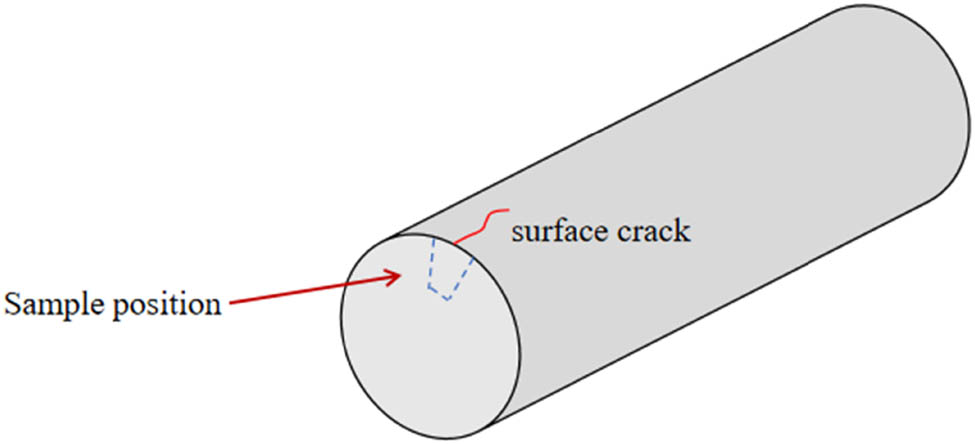
Illustration of the sample position in bloom.
The mechanical properties at high temperature were examined via hot tensile tests. Samples for the hot tensile test (10 mm in diameter and 120 mm in gauge length) were extracted from the round bloom. Tensile tests were conducted using the computerized thermal stress/strain simulator, Gleeble 3800, and the reduction of area (RA) was measured to assess the hot ductility of the steel. As illustrated in Figure 2, the specimens were rapidly heated to 1,473 K at a heating rate of 15 K/s in the first step. In the second stage, the specimens were heated to 1,573 K at a rate of 2 K/s and maintained at this temperature for 1 min before being cooled to the deformation temperature (T DT: ranging from 873 to 1,373 K, total 10 points) at a rate of 6 K/s. The specimens were held at the deformation temperature for 1 min and then strained to failure at a strain rate of 10−3/s.

Thermal profile used in hot tensile tests.
Scanning electron microscope (SEM) was performed by Model ZEISS ULTRA 55 to observe the surface morphology of cracks, the fracture surface of the hot tensile tests and the elements distribution of precipitates were identified by energy dispersive spectroscopy (EDS) analysis.
3 Results and discussion
3.1 Crack morphology
Figure 3(a) reveals that a portion of the cracks on the rolled product are situated beneath the surface, which needs polishing before these cracks can be detected. Some cracks have extended to the surface of the rolled product, showing as fine surface cracks. The overall extending direction of the cracks is parallel to the rolling direction.

(a) Surface crack and (b) subcutaneous crack morphology of hot-rolled product.
Figure 4 displays a representative microstructure of a surface crack. The direction of crack propagation is observed to be perpendicular to the surface of the rolled product. An appreciable decarburization layer is evident on the surface of the crack, suggesting that the current cracks were generated at a relatively high temperature [9]. Furthermore, the thickness of the decarburization layer is approximately 100 μm and accompanied by coarse ferrite grains, indicating that the cracks have undergone a prolonged thermal history throughout the production process. The formation of cracks is likely to have occurred in the previous rolling process, i.e., the continuous casting process.

Metallograph of a surface crack.
Figure 5 presents a low magnification image of a round bloom after pickling. It is evident that numerous fine cracks are distributed beneath the skin of the bloom, with a maximum length of 4 mm. Closer examination of the crack tip revealed that the crack originated from the grain boundary (Figure 6(a)). It was also noted that the crack deflected at the junction of the three grains, still propagating along the grain boundary (Figure 6(b)). This observation fully confirms that during the production process of the bloom, the strength of its grain boundaries is relatively low, thereby rendering it an essential site for crack initiation and development. It is the subcutaneous cracks of the bloom that cause surface cracks on the subsequent product surfaces.

Subcutaneous cracks distributed beneath bloom surface.

Crack formation (a) and deflection (b) at grain boundaries.
3.2 Hot ductility
The area reduction (RA) is a crucial index for assessing the thermoplasticity of steel, reflecting the capacity of the material to undergo uniform plastic deformation at high temperature. The RA is defined as follows [10,11]:
where A b and A a are, respectively, the original cross-sectional area of the specimen before and after fracture test.
The hot ductility and stress–strain curves of the tested steel are demonstrated in Figure 7. As illustrated in Figure 7(a), at the current test temperature, the steel exhibits two distinct brittleness ranges. The third brittleness range spans 923–1,193 K (within the current test temperature range). With the increase in deformation temperature, the RA value decreases from 73.3% at 873 K to 37.2% at 1,073 K, before gradually rebounding. When the deformation temperature reaches 1,273 K, the RA value peaks at 92.2%. Generally, RA = 60% is considered the threshold between good and poor plasticity [12]. At the current straightening temperature of the CC process (approximately 1,173 K), the steel is in the low section shrinkage region, characterized by poor plasticity, high crack sensitivity, and a high likelihood of crack formation during straightening.

(a) Hot ductility and tensile strength and (b) stress–strain curve.
With the temperature rising from 873 to 1,373 K, the tensile strength continuously decreases from 90 to 45 MPa. Furthermore, as shown in Figure 7(b), the maximum stress value on the stress–strain curve decreases gradually with the increase in test temperature. At 1,073 K, when the stress surpasses the yield strength, the stress reaches its maximum value within a small strain range (<0.2%), indicating that the plastic deformation ability of the steel grade is worst at this temperature.
Figure 8 depicts the fracture surface of the investigated steels, tensioned at temperatures ranging from 1,223 to 873 K. Notably, the current temperatures exhibit varying degrees of necking. At a tensile temperature of 1,223 K, the fracture exhibits a distinct necking phenomenon, characterized by numerous deep dimples on the cross-section. It is widely acknowledged that the size and depth of dimples are determined by the material’s relative plasticity during fracture. A larger or deeper dimple size and depth signify higher plasticity [13,14].

Tensile fracture morphology of the samples at different temperatures: (a and b) 1,223 K, (c and d) 1,173 K, (e and f) 1,073 K, (g and h) 973 K, and (i and j) 873 K.
At 1,223 K, the dimple size and depth are larger and deeper, indicating better plasticity. As the tensile temperature decreases to 1,173 K, a small amount of quasi-cleavage morphology appears on the fracture surface, besides dimples, suggesting a transition from plastic to brittle deformation. When temperature continues to decrease to 1,073 K, at which point ferrite precipitates in a film-like formation at the grain boundary. Due to the low grain boundary strength and poor plasticity, the tensile fracture assumes a rock-sugar configuration, with a cleavage surface size of approximately 200 μm. This fracture type typifies brittle intergranular fracture. At 973 K, the tensile fracture exhibits distinct cleavage plane morphology, with a significant reduction in the size and number of dimples. When the temperature reaches 873 K, the tensile section demonstrates an irregular surface, with a multitude of intracrystalline dimples of varying sizes. Given the low test temperature, a substantial amount of ferrite and pearlite has been generated, resulting in good overall plasticity.
3.3 Precipitates
Precipitates play a crucial role in the formation of cracks in microalloyed steel. Figure 9 presents the calculated equilibrium precipitation during the solidification process, utilizing the Thermo-Calc software.

Relationship between the mass fraction of balanced phases and temperature at 750–1,700 K.
The calculations reveal that various complex precipitate forms will be generated during the cooling process of this steel. As illustrated in the figure, MnS begins to precipitate and reaches its maximum amount at approximately 1,323 K, stabilizing thereafter. BN precipitation commences at 1,373 K, while AlN starts to precipitate at 1,283 K, reaching its maximum amount at 1,143 K and remaining stable. BN reaches its maximum precipitation amount at approximately 1,153 K. Subsequently, the B element stabilizes as a more robust M3B2 phase, persisting throughout subsequent cooling processes. It is evident that BN does not stabilize during the molten steel solidification process and is categorized as a transitional phase. The temperature range for BN precipitation existence spans between 1,153 and 1,373 K, with the straightening zone temperature falling within this range.
Owing to the transitional phase of BN precipitates during solidification, they only exist stably near the straightening temperature. To obtain BN precipitates, the sample is heated to its austenitizing temperature (1,173 K) and maintained for 20 min, followed by water quenching. Figure 10 displays an image of BN precipitates obtained after quenching. As can be discerned from the figure, the surface morphology of BN precipitates is irregular, characterized by sharp corners, and a non-smooth texture. BN precipitation along the grain boundary weakens the strength of the grain boundary, predisposing it to crack formation [15–17].

SEM micrographs of BN precipitates: (a) precipitates near grain boundary, (b) enlarged view of precipitates, and (c) EDS analysis results of particles in (b).
3.4 Micro-segregation of B
The boron content of the steel in this study is 10 ppm, which is relatively low. However, due to the strong grain boundary segregation characteristics of boron, it is prone to forming precipitates at grain boundaries [18,19]. In the actual solidification process, particularly at the end of solidification, segregation leads to an increase in the solute concentration of the liquid phase at the solidification front. When the concentrations of B and N elements exceed the equilibrium value, BN will be generated. In this study, the Scheil Model is employed to evaluate boron segregation.
where C B is the solid phase solute concentration, C 0 is the initial solute concentration, k is the solute equilibrium distribution coefficient (0.001 for boron, 0.48 for nitrogen element [20]), and f s is the solidification fraction.
The relationship between the segregation ratio and solidification fraction is presented in Figure 11. The results indicate that the boron element exhibits a significant segregation tendency when the solidification fraction exceeds 0.9. The segregation ratio reaches 9.9 when the solidification fraction is 0.9, and at the end of solidification, the boron content is approximately 99.5 times higher than the initial boron content. This is highly beneficial for the formation of BN precipitates.

Relationship between segregation ratio and the solidification fraction during solidification.
3.5 Formation mechanism of cracks
Through the above comprehensive analysis, the formation mechanism of cracks in boron-bearing steel can be elucidated. For the current steel, the B element forms BN precipitates with the N element, which accumulate in significant quantities along the grain boundaries, thereby weakening the ability of the grain boundaries to resist deformation. When the bloom reaches the straightening stage of continuous casting (at which BN precipitation reaches its maximum value exactly), the application of straightening stress results in the generation of small cracks perpendicular to the surface. Some of these cracks are situated below the surface of the bloom, while others have already propagated to the surface of the bloom. Subsequently, during the rolling process, these cracks are stretched and extended, ultimately forming surface cracks and subcutaneous cracks almost parallel to the rolling direction (Figure 12).

Formation mechanism of cracks.
3.6 Control of the cracks
The precipitation of compounds, such as BN, within the straightening temperature range, particularly at the grain boundary, has been identified as a crucial factor contributing to the high crack sensitivity of this steel. The longer the precipitation exists, the greater the precipitation amount, and the greater the impact on the high-temperature thermos-plasticity of steel. Consequently, the control of BN precipitates is essential for the prevention of cracks.
As illustrated in Figure 13, the addition of 150 ppm Ti to the steel results in the formation of a substantial amount of Ti(C,N). When compared with Figure 9, it becomes evident that due to the high content of Ti in the steel and its strong binding capability with N, the temperature range where BN precipitates is reduced to 1,177–1,273 K, and the maximum precipitation amount also decreases from 17 × 10−4 to 6.4 × 10⁻⁴%. Moreover, AlN only precipitates slightly below 923 K. When the Ti content increases to 250 ppm, BN does not form within the entire temperature range, and the AlN formation temperature also decreases to 873 K. This suggests that the addition of a specific amount of Ti to the steel can effectively minimize the precipitation of BN and AlN, thereby curtailing the propensity of casting blooms to develop subcutaneous cracks [21].
![Figure 13
Thermodynamic calculation results of precipitates: (a) [Ti] = 150 ppm and (b) [Ti] = 250 ppm.](/document/doi/10.1515/htmp-2022-0325/asset/graphic/j_htmp-2022-0325_fig_013.jpg)
Thermodynamic calculation results of precipitates: (a) [Ti] = 150 ppm and (b) [Ti] = 250 ppm.
The marked improvement in high-temperature plasticity resulting from the addition of Ti can be vividly observed in Figure 14. After adding 250 ppm Ti into the steel, the thermoplastic properties of the steel are significantly enhanced in the vicinity of the straightening temperature. This leads to an RA value as high as 80%, effectively minimizing the propensity for cracking during the straightening process.

Effect of Ti addition on high-temperature plasticity.
In addition, the presence of this steel as a hypoeutectoid grade leads to the intermittent or filmy distribution of pre-eutectoid ferrite along the original austenite grain boundaries, characterized by a strength of merely one-fourth that of austenite. Consequently, during heating, cracks can easily propagate along these grain boundaries [22]. The surface temperature of the bloom, from the continuous casting process to the heating furnace, was measured to be approximately 0.1 K/s cooling rate. Utilizing the JMatPro software, the continuous cooling transformation curve for this steel can be calculated (Figure 15). Clearly, from the curve, the precipitation temperature of ferrite is at 1,023 K, followed by the eutectoid transformation of austenite to pearlite at 993 K. Finally, when the temperature reaches 953 K, the pearlite transformation is completed.
To preclude the propagation of cracks originating from the grain boundaries during the hot charging process, it is imperative to decrease the charging temperature of the heating furnace below 953 K. This ensures a uniform pearlite microstructure, curtails the propagation of cracks along the grain boundaries, and mitigates the propensity for crack formation in the steel during subsequent heating processes.

Theoretical CCT diagram calculated by JMatPro software.
When titanium element (250 ppm) is added to the steel and reducing the charging temperature of heating furnace to below 953 K, the quality of the cast bloom and hot rolled products is improved. From the figure, it can be seen that the subcutaneous cracks of the casting bloom have disappeared, and no surface or subcutaneous cracks were observed on the surface of subsequent hot rolled products (Figure 16).

Macrographs of (a) bloom section and (b) hot-rolled product surface in improved process.
4 Conclusions
The present study delved into the formation mechanism of the cracks by examining the crack morphology, hot ductility, precipitates, and element segregation. The main findings are concluded as follows:
The precipitation of BN at grain boundary emerged as the main cause of cracks formation. Owing to the precipitation temperature of BN falling within the straightening temperature range of the continuous casting process, this steel is susceptible to subcutaneous cracks under the application of straightening stress. This leads to the formation of surface and subcutaneous cracks during subsequent rolling processes.
The addition of an appropriate quantity of Ti element to the steel, coupled with a reduction in the charging temperature of the heating furnace, noticeably enhances the hot ductility and crack resistance of the steel. By implementing these two measures, the crack issue in hot-rolled products has been effectively addressed.
Acknowledgments
The authors would like to express sincere thanks to Dr. Yannan Wang of the Jiangsu University, for his careful revision of this article.
-
Funding information: This study was financially supported by Materials Technology Research Institute, HBIS Group.
-
Author contributions: Wenwen Mao: writing the original draft; Jie Li, Yong Liu, Chengyu Yang, Yu Gao, Liyong Xing, Xianmin Liu, Jie Li: industry trails and analysis; Haitao Zhao: resources.
-
Conflict of interest: The authors state no conflict of interest.
References
[1] Liu, T., Y. F. Chen, and D. X. Wang. Control of surface cracks in boron containing steel billet. Contin. Cast., Vol. 5, 2022, pp. 62–68.Search in Google Scholar
[2] Sun, J., H. Y. Zhu, W. S. Wang, and Y. Q. Duan. Effect of boron segregation on the surface crack of low carbon boron-bearing steel. Results Phys, Vol. 13, 2019, id. 102153.10.1016/j.rinp.2019.02.089Search in Google Scholar
[3] Wang, X. M. and X. L. He. Effect of boron addition on structure and properties of low carbon bainitic steels. ISIJ International, Vol. 42, 2002, pp. 38–46.10.2355/isijinternational.42.Suppl_S38Search in Google Scholar
[4] Su, D. X., Q. F. Zhou, and C. D. Zou. Effect of precipitation characteristics of boron nitride on hot ductility of low carbon boron-bearing steel. Journal of Iron and Steel Research, Vol. 30, 2018, pp. 476–481.Search in Google Scholar
[5] Cho, K. C., D. J. Mun, M. H. Kang, J. S. Lee, J. K. Park, and Y. M. Koo. Effect of thermal cycle and nitrogen content on the hot ductility of boron-bearing steel. ISIJ International, Vol. 50, 2010, pp. 839–846.10.2355/isijinternational.50.839Search in Google Scholar
[6] Yin, H. B., K. Blazek, and O. Lanzi. “In-situ” observation of remelting phenomenon after solidification of Fe–B alloy and B-bearing commercial steels. ISIJ International, Vol. 49, 2009, pp. 1561–1567.10.2355/isijinternational.49.1561Search in Google Scholar
[7] Chown, L. H. and L. A. Cornish. Investigation of hot ductility in Al-killed boron steels. Materials Science and Engineering: A, Vol. 494, 2008, pp. 263–275.10.1016/j.msea.2008.04.026Search in Google Scholar
[8] Cho, K. C., D. J. Mun, J. Y. Kim, J. K. Park, J. S. Lee, and Y. M. Koo. Effect of boron precipitation behavior on the hot ductility of boron containing steel. Metallurgical and Materials Transactions A, Vol. 41, 2010, pp. 1421–1428.10.1007/s11661-010-0211-9Search in Google Scholar
[9] Antonaglia, J., X. Xie, Z. Tang, C. W. Tsai, J. W. Qiao, Y. Zhang, et al. Temperature effects on deformation and serration behavior of high-entropy alloys (HEAs). JOM, Vol. 66, 2014, pp. 839–846.10.1007/s11837-014-1130-9Search in Google Scholar
[10] Liu, W. J., J. Li, C. B. Shi, and X. D. Huo. Effect of boron and titanium addition on the hot ductility of low-carbon Nb-containing steel. High Temperature Materials and Processes, Vol. 34, 2015, pp. 813–820.10.1515/htmp-2014-0145Search in Google Scholar
[11] Kang, S. W., Y. W. Lee, M. Kim, J. W. Hong, and S. W. Han. One-pot synthesis of carbon-supported dendritic Pd–Au nanoalloys for electrocatalytic ethanol oxidation. Materials Science and Technology, Vol. 27, 2011, pp. 909–915.10.1002/asia.201000715Search in Google Scholar PubMed
[12] Zheng, Y., F. Wang, C. Li, Z. Yang, and Y. He. Effects of B on the hot ductility of Fe–36Ni invar alloy. High Temperature Materials and Processes, Vol. 38, 2019, pp. 380–388.10.1515/htmp-2018-0076Search in Google Scholar
[13] Wang, Y., S. Zhao, R. Song, and B. Hu. Hot ductility behavior of a Fe–0.3C–9Mn–2Al medium Mn steel. International Journal of Minerals, Metallurgy and Materials, Vol. 28, 2021, pp. 422–429.10.1007/s12613-020-2206-xSearch in Google Scholar
[14] Sahoo, G., B. Singh, and A. Saxena. Effect of strain rate, soaking time and alloying elements on hot ductility and hot shortness of low alloy steels. Materials Science and Engineering: A, Vol. 718, 2018, pp. 292–300.10.1016/j.msea.2018.01.084Search in Google Scholar
[15] Wang, L. J., L. Y. Sheng, and C. M. Hong. Influence of grain boundary carbides on mechanical properties of high nitrogen austenitic stainless steel. Materials & Design, Vol. 37, 2012, pp. 349–355.10.1016/j.matdes.2012.01.024Search in Google Scholar
[16] Tsai, S. P., T. C. Su, J. R. Yang, C. Y. Chen, Y. T. Wang, and C. Y. Huang. Acute macular edema and peripapillary soft exudate after pancreas transplantation with accelerated progression of diabetic retinopathy. Materials & Design, Vol. 119, 2017, pp. 319–325.10.1016/j.jcma.2017.01.004Search in Google Scholar PubMed
[17] Gavriljuk, V. G., V. A. Sirosh, Y. N. Petrov, A. I. Tyshchenko, W. Theisen, and A. Kortmann. Carbide precipitation during tempering of a tool steel subjected to deep cryogenic treatment. Metallurgical and Materials Transactions A, Vol. 45, 2014, pp. 2453–2465.10.1007/s11661-014-2202-8Search in Google Scholar
[18] Zheng, Y., F. Wang, C. Li, Y. Li, and J. Cheng. Microstructural evolution, coarsening behavior of precipitates and mechanical properties of boron bearing steel 25CrMoNbB during tempering. Materials Science and Engineering: A, Vol. 712, 2018, pp. 453–465.10.1016/j.msea.2017.11.115Search in Google Scholar
[19] Jung, W., S. Hong, S. Song, K. Sookin, and S. Chung. Formation of FeMo2B2 phase in boron containing 9Cr–1.5Mo ferritic steels. Rare Metals, Vol. 25, 2006, pp. 213–219.10.1016/S1001-0521(08)60084-4Search in Google Scholar
[20] Won, Y. M. and B. G. Thomas. Simple model of microsegregation during solidification of steels. Metallurgical and Materials Transactions A, Vol. 32, 2001, pp. 1755–1767.10.1007/s11661-001-0152-4Search in Google Scholar
[21] Qian, G. Y., G. G. Cheng, and Z. B. Hou. The influence of the induced ferrite and precipitates of Ti-bearing steel on the ductility of continuous casting slab. High Temperature Materials and Processes, Vol. 34, 2015, pp. 611–620.10.1515/htmp-2014-0087Search in Google Scholar
[22] Ma, C. X., J. Luo, and M. J. Ellis. Molecular profiling of triple negative breast cancer. Ironmaking Steelmaking, Vol. 37, 2010, pp. 73–79.Search in Google Scholar
© 2024 the author(s), published by De Gruyter
This work is licensed under the Creative Commons Attribution 4.0 International License.
Articles in the same Issue
- Research Articles
- De-chlorination of poly(vinyl) chloride using Fe2O3 and the improvement of chlorine fixing ratio in FeCl2 by SiO2 addition
- Reductive behavior of nickel and iron metallization in magnesian siliceous nickel laterite ores under the action of sulfur-bearing natural gas
- Study on properties of CaF2–CaO–Al2O3–MgO–B2O3 electroslag remelting slag for rack plate steel
- The origin of {113}<361> grains and their impact on secondary recrystallization in producing ultra-thin grain-oriented electrical steel
- Channel parameter optimization of one-strand slab induction heating tundish with double channels
- Effect of rare-earth Ce on the texture of non-oriented silicon steels
- Performance optimization of PERC solar cells based on laser ablation forming local contact on the rear
- Effect of ladle-lining materials on inclusion evolution in Al-killed steel during LF refining
- Analysis of metallurgical defects in enamel steel castings
- Effect of cooling rate and Nb synergistic strengthening on microstructure and mechanical properties of high-strength rebar
- Effect of grain size on fatigue strength of 304 stainless steel
- Analysis and control of surface cracks in a B-bearing continuous casting blooms
- Application of laser surface detection technology in blast furnace gas flow control and optimization
- Preparation of MoO3 powder by hydrothermal method
- The comparative study of Ti-bearing oxides introduced by different methods
- Application of MgO/ZrO2 coating on 309 stainless steel to increase resistance to corrosion at high temperatures and oxidation by an electrochemical method
- Effect of applying a full oxygen blast furnace on carbon emissions based on a carbon metabolism calculation model
- Characterization of low-damage cutting of alfalfa stalks by self-sharpening cutters made of gradient materials
- Thermo-mechanical effects and microstructural evolution-coupled numerical simulation on the hot forming processes of superalloy turbine disk
- Endpoint prediction of BOF steelmaking based on state-of-the-art machine learning and deep learning algorithms
- Effect of calcium treatment on inclusions in 38CrMoAl high aluminum steel
- Effect of isothermal transformation temperature on the microstructure, precipitation behavior, and mechanical properties of anti-seismic rebar
- Evolution of residual stress and microstructure of 2205 duplex stainless steel welded joints during different post-weld heat treatment
- Effect of heating process on the corrosion resistance of zinc iron alloy coatings
- BOF steelmaking endpoint carbon content and temperature soft sensor model based on supervised weighted local structure preserving projection
- Innovative approaches to enhancing crack repair: Performance optimization of biopolymer-infused CXT
- Structural and electrochromic property control of WO3 films through fine-tuning of film-forming parameters
- Influence of non-linear thermal radiation on the dynamics of homogeneous and heterogeneous chemical reactions between the cone and the disk
- Thermodynamic modeling of stacking fault energy in Fe–Mn–C austenitic steels
- Research on the influence of cemented carbide micro-textured structure on tribological properties
- Performance evaluation of fly ash-lime-gypsum-quarry dust (FALGQ) bricks for sustainable construction
- First-principles study on the interfacial interactions between h-BN and Si3N4
- Analysis of carbon emission reduction capacity of hydrogen-rich oxygen blast furnace based on renewable energy hydrogen production
- Just-in-time updated DBN BOF steel-making soft sensor model based on dense connectivity of key features
- Effect of tempering temperature on the microstructure and mechanical properties of Q125 shale gas casing steel
- Review Articles
- A review of emerging trends in Laves phase research: Bibliometric analysis and visualization
- Effect of bottom stirring on bath mixing and transfer behavior during scrap melting in BOF steelmaking: A review
- High-temperature antioxidant silicate coating of low-density Nb–Ti–Al alloy: A review
- Communications
- Experimental investigation on the deterioration of the physical and mechanical properties of autoclaved aerated concrete at elevated temperatures
- Damage evaluation of the austenitic heat-resistance steel subjected to creep by using Kikuchi pattern parameters
- Topical Issue on Focus of Hot Deformation of Metaland High Entropy Alloys - Part II
- Synthesis of aluminium (Al) and alumina (Al2O3)-based graded material by gravity casting
- Experimental investigation into machining performance of magnesium alloy AZ91D under dry, minimum quantity lubrication, and nano minimum quantity lubrication environments
- Numerical simulation of temperature distribution and residual stress in TIG welding of stainless-steel single-pass flange butt joint using finite element analysis
- Special Issue on A Deep Dive into Machining and Welding Advancements - Part I
- Electro-thermal performance evaluation of a prismatic battery pack for an electric vehicle
- Experimental analysis and optimization of machining parameters for Nitinol alloy: A Taguchi and multi-attribute decision-making approach
- Experimental and numerical analysis of temperature distributions in SA 387 pressure vessel steel during submerged arc welding
- Optimization of process parameters in plasma arc cutting of commercial-grade aluminium plate
- Multi-response optimization of friction stir welding using fuzzy-grey system
- Mechanical and micro-structural studies of pulsed and constant current TIG weldments of super duplex stainless steels and Austenitic stainless steels
- Stretch-forming characteristics of austenitic material stainless steel 304 at hot working temperatures
- Work hardening and X-ray diffraction studies on ASS 304 at high temperatures
- Study of phase equilibrium of refractory high-entropy alloys using the atomic size difference concept for turbine blade applications
- A novel intelligent tool wear monitoring system in ball end milling of Ti6Al4V alloy using artificial neural network
- A hybrid approach for the machinability analysis of Incoloy 825 using the entropy-MOORA method
- Special Issue on Recent Developments in 3D Printed Carbon Materials - Part II
- Innovations for sustainable chemical manufacturing and waste minimization through green production practices
- Topical Issue on Conference on Materials, Manufacturing Processes and Devices - Part I
- Characterization of Co–Ni–TiO2 coatings prepared by combined sol-enhanced and pulse current electrodeposition methods
- Hot deformation behaviors and microstructure characteristics of Cr–Mo–Ni–V steel with a banded structure
- Effects of normalizing and tempering temperature on the bainite microstructure and properties of low alloy fire-resistant steel bars
- Dynamic evolution of residual stress upon manufacturing Al-based diesel engine diaphragm
- Study on impact resistance of steel fiber reinforced concrete after exposure to fire
- Bonding behaviour between steel fibre and concrete matrix after experiencing elevated temperature at various loading rates
- Diffusion law of sulfate ions in coral aggregate seawater concrete in the marine environment
- Microstructure evolution and grain refinement mechanism of 316LN steel
- Investigation of the interface and physical properties of a Kovar alloy/Cu composite wire processed by multi-pass drawing
- The investigation of peritectic solidification of high nitrogen stainless steels by in-situ observation
- Microstructure and mechanical properties of submerged arc welded medium-thickness Q690qE high-strength steel plate joints
- Experimental study on the effect of the riveting process on the bending resistance of beams composed of galvanized Q235 steel
- Density functional theory study of Mg–Ho intermetallic phases
- Investigation of electrical properties and PTCR effect in double-donor doping BaTiO3 lead-free ceramics
- Special Issue on Thermal Management and Heat Transfer
- On the thermal performance of a three-dimensional cross-ternary hybrid nanofluid over a wedge using a Bayesian regularization neural network approach
- Time dependent model to analyze the magnetic refrigeration performance of gadolinium near the room temperature
- Heat transfer characteristics in a non-Newtonian (Williamson) hybrid nanofluid with Hall and convective boundary effects
- Computational role of homogeneous–heterogeneous chemical reactions and a mixed convective ternary hybrid nanofluid in a vertical porous microchannel
- Thermal conductivity evaluation of magnetized non-Newtonian nanofluid and dusty particles with thermal radiation
Articles in the same Issue
- Research Articles
- De-chlorination of poly(vinyl) chloride using Fe2O3 and the improvement of chlorine fixing ratio in FeCl2 by SiO2 addition
- Reductive behavior of nickel and iron metallization in magnesian siliceous nickel laterite ores under the action of sulfur-bearing natural gas
- Study on properties of CaF2–CaO–Al2O3–MgO–B2O3 electroslag remelting slag for rack plate steel
- The origin of {113}<361> grains and their impact on secondary recrystallization in producing ultra-thin grain-oriented electrical steel
- Channel parameter optimization of one-strand slab induction heating tundish with double channels
- Effect of rare-earth Ce on the texture of non-oriented silicon steels
- Performance optimization of PERC solar cells based on laser ablation forming local contact on the rear
- Effect of ladle-lining materials on inclusion evolution in Al-killed steel during LF refining
- Analysis of metallurgical defects in enamel steel castings
- Effect of cooling rate and Nb synergistic strengthening on microstructure and mechanical properties of high-strength rebar
- Effect of grain size on fatigue strength of 304 stainless steel
- Analysis and control of surface cracks in a B-bearing continuous casting blooms
- Application of laser surface detection technology in blast furnace gas flow control and optimization
- Preparation of MoO3 powder by hydrothermal method
- The comparative study of Ti-bearing oxides introduced by different methods
- Application of MgO/ZrO2 coating on 309 stainless steel to increase resistance to corrosion at high temperatures and oxidation by an electrochemical method
- Effect of applying a full oxygen blast furnace on carbon emissions based on a carbon metabolism calculation model
- Characterization of low-damage cutting of alfalfa stalks by self-sharpening cutters made of gradient materials
- Thermo-mechanical effects and microstructural evolution-coupled numerical simulation on the hot forming processes of superalloy turbine disk
- Endpoint prediction of BOF steelmaking based on state-of-the-art machine learning and deep learning algorithms
- Effect of calcium treatment on inclusions in 38CrMoAl high aluminum steel
- Effect of isothermal transformation temperature on the microstructure, precipitation behavior, and mechanical properties of anti-seismic rebar
- Evolution of residual stress and microstructure of 2205 duplex stainless steel welded joints during different post-weld heat treatment
- Effect of heating process on the corrosion resistance of zinc iron alloy coatings
- BOF steelmaking endpoint carbon content and temperature soft sensor model based on supervised weighted local structure preserving projection
- Innovative approaches to enhancing crack repair: Performance optimization of biopolymer-infused CXT
- Structural and electrochromic property control of WO3 films through fine-tuning of film-forming parameters
- Influence of non-linear thermal radiation on the dynamics of homogeneous and heterogeneous chemical reactions between the cone and the disk
- Thermodynamic modeling of stacking fault energy in Fe–Mn–C austenitic steels
- Research on the influence of cemented carbide micro-textured structure on tribological properties
- Performance evaluation of fly ash-lime-gypsum-quarry dust (FALGQ) bricks for sustainable construction
- First-principles study on the interfacial interactions between h-BN and Si3N4
- Analysis of carbon emission reduction capacity of hydrogen-rich oxygen blast furnace based on renewable energy hydrogen production
- Just-in-time updated DBN BOF steel-making soft sensor model based on dense connectivity of key features
- Effect of tempering temperature on the microstructure and mechanical properties of Q125 shale gas casing steel
- Review Articles
- A review of emerging trends in Laves phase research: Bibliometric analysis and visualization
- Effect of bottom stirring on bath mixing and transfer behavior during scrap melting in BOF steelmaking: A review
- High-temperature antioxidant silicate coating of low-density Nb–Ti–Al alloy: A review
- Communications
- Experimental investigation on the deterioration of the physical and mechanical properties of autoclaved aerated concrete at elevated temperatures
- Damage evaluation of the austenitic heat-resistance steel subjected to creep by using Kikuchi pattern parameters
- Topical Issue on Focus of Hot Deformation of Metaland High Entropy Alloys - Part II
- Synthesis of aluminium (Al) and alumina (Al2O3)-based graded material by gravity casting
- Experimental investigation into machining performance of magnesium alloy AZ91D under dry, minimum quantity lubrication, and nano minimum quantity lubrication environments
- Numerical simulation of temperature distribution and residual stress in TIG welding of stainless-steel single-pass flange butt joint using finite element analysis
- Special Issue on A Deep Dive into Machining and Welding Advancements - Part I
- Electro-thermal performance evaluation of a prismatic battery pack for an electric vehicle
- Experimental analysis and optimization of machining parameters for Nitinol alloy: A Taguchi and multi-attribute decision-making approach
- Experimental and numerical analysis of temperature distributions in SA 387 pressure vessel steel during submerged arc welding
- Optimization of process parameters in plasma arc cutting of commercial-grade aluminium plate
- Multi-response optimization of friction stir welding using fuzzy-grey system
- Mechanical and micro-structural studies of pulsed and constant current TIG weldments of super duplex stainless steels and Austenitic stainless steels
- Stretch-forming characteristics of austenitic material stainless steel 304 at hot working temperatures
- Work hardening and X-ray diffraction studies on ASS 304 at high temperatures
- Study of phase equilibrium of refractory high-entropy alloys using the atomic size difference concept for turbine blade applications
- A novel intelligent tool wear monitoring system in ball end milling of Ti6Al4V alloy using artificial neural network
- A hybrid approach for the machinability analysis of Incoloy 825 using the entropy-MOORA method
- Special Issue on Recent Developments in 3D Printed Carbon Materials - Part II
- Innovations for sustainable chemical manufacturing and waste minimization through green production practices
- Topical Issue on Conference on Materials, Manufacturing Processes and Devices - Part I
- Characterization of Co–Ni–TiO2 coatings prepared by combined sol-enhanced and pulse current electrodeposition methods
- Hot deformation behaviors and microstructure characteristics of Cr–Mo–Ni–V steel with a banded structure
- Effects of normalizing and tempering temperature on the bainite microstructure and properties of low alloy fire-resistant steel bars
- Dynamic evolution of residual stress upon manufacturing Al-based diesel engine diaphragm
- Study on impact resistance of steel fiber reinforced concrete after exposure to fire
- Bonding behaviour between steel fibre and concrete matrix after experiencing elevated temperature at various loading rates
- Diffusion law of sulfate ions in coral aggregate seawater concrete in the marine environment
- Microstructure evolution and grain refinement mechanism of 316LN steel
- Investigation of the interface and physical properties of a Kovar alloy/Cu composite wire processed by multi-pass drawing
- The investigation of peritectic solidification of high nitrogen stainless steels by in-situ observation
- Microstructure and mechanical properties of submerged arc welded medium-thickness Q690qE high-strength steel plate joints
- Experimental study on the effect of the riveting process on the bending resistance of beams composed of galvanized Q235 steel
- Density functional theory study of Mg–Ho intermetallic phases
- Investigation of electrical properties and PTCR effect in double-donor doping BaTiO3 lead-free ceramics
- Special Issue on Thermal Management and Heat Transfer
- On the thermal performance of a three-dimensional cross-ternary hybrid nanofluid over a wedge using a Bayesian regularization neural network approach
- Time dependent model to analyze the magnetic refrigeration performance of gadolinium near the room temperature
- Heat transfer characteristics in a non-Newtonian (Williamson) hybrid nanofluid with Hall and convective boundary effects
- Computational role of homogeneous–heterogeneous chemical reactions and a mixed convective ternary hybrid nanofluid in a vertical porous microchannel
- Thermal conductivity evaluation of magnetized non-Newtonian nanofluid and dusty particles with thermal radiation
