Determination of flow distance of the fluid metal due to fluidity in ductile iron casting by artificial neural networks approach
-
Çağatay Teke


Abstract
Ductile irons (DIs) have properties such as high strength, ductility, and toughness, as well as a low degree of melting, good fluidity, and good machining. Having these characteristics make them the most preferred among cast irons. The combination of excellent properties, especially in DI castings with a thin section, make it an alternative for steel casting and forging. But in the manufacture of thin-section parts, fluidity characteristics need to be improved and the liquid metal must fill the mold completely. The fluidity of liquid metal is influenced by many factors depending on the casting processes such as material and mold properties, casting temperature, inoculation, globalization, and grain refinement. In this study, an artificial neural network (ANN) model has been developed that allows for determining the flow distance of the liquid metal in the sand mold casting method under changing casting conditions of DI. Thus, the flow distance was estimated depending on the cross-sectional thickness during the sand casting under changing casting conditions. The experimental parameters were determined as casting temperature, liquid metal metallurgy quality, cross-sectional thickness, and filling time. Filling modeling was performed with FlowCast software. When the results were examined, it was seen that the developed ANN model has high success in predicting the flow distances of the liquid metal under different casting conditions. The calculated coefficient of determination (R 2) value of 0.986 confirms the high prediction performance of the model.
1 Introduction
Although there are many alternative materials, more than 90% of the metallic materials used today are iron alloys, which are divided into two groups steel and cast iron according to the carbon (C) content in the alloys [1]. Cast irons are iron-based alloys with a carbon content high enough to exceed their solubility in iron [2]. In comparison with steel, cast irons are known to be economical materials with relatively low melting temperatures, good fluidity, and castability [3]. The material obtained as a result of inoculation and adding small amounts of spheroidizing additives such as Mg and Ce to the molten iron before the casting process is called ductile iron (DI). It consists of sphere-shaped graphite dispersed in a matrix resembling steel. This situation has brought a different dimension to the engineering applications of cast irons [3]. The most commonly used spheroidizing element is Fe–Si–Mg alloys, which are used in an alloyed form with Fe and Si [4]. DI has a very wide range of applications in the automotive industry, such as engines, suspension components, wind turbines, wheel, bearing, gear manufacturing, pistons, and machine tool bearings [5–7]. It has properties of high strength, low melting point, ductility, toughness, and good machinability. These features are the main reason why it is the most preferred among cast irons [8,9]. DI casting, especially due to its high strength-to-density ratio, can be lighter, have better mechanical properties, and be more economical compared to aluminum alloys in the production of thin-section materials [10,11]. In addition, it is a very suitable alloy group as an alternative material for steel casting and forging in thin-section applications [12,13].
The production processes of parts by casting involve two important steps, the first is the filling of the melt into a mold, and the second stage is the process of solidification and cooling [14]. In a study conducted on the mold filling process, it was noted that the liquid metal affects the heat transfer and solidification properties, which in turn affects the fluidity of the liquid metal [15]. In addition, it was explained that the fluidity of the liquid metal during mold filling is affected by the thermal properties of the liquid metal and mold, pouring conditions, reinforcing properties, and solidification mechanisms [16]. Fluidity, in casting terminology, is the distance at which a metal will move through the mold without solidifying when casting at a certain temperature, in other words, the molten metal completely fills the inside of the mold cavity. Metals that are not sufficiently fluid can cause insufficient casting, especially in thinner sections of the casting mold [17,18]. Therefore, it is an important property for obtaining sound castings with thin sections. In addition, it is influenced by many factors, such as viscosity, oxide film, chemical composition, melting point, latent heat, melting surface tension, solidification mode, super heating, the mold surface heat transfer coefficient, specific gravity, mold conductivity, and mold temperature [19,20]. The castability of the metal is a parameter that is determined as the distance for the metal flow in the channel of the sand mold before the flow stops with the progressive solidification process [21]. Fluidity in sand molds depends not only on chemical composition but also on casting temperature, flow rate, section thickness, and metallurgical factors.
In a study on the investigation of DI fluidity, it was determined that the difference in mold material causes different flow distances of the liquid metal at different section thicknesses [22]. In a similar study, casting temperature was found to be important in the casting of thin section parts. It was also observed that the temperature drop and the increased cooling rate affected the mold filling [23]. In another study, it was reported that the flow distance and the range of solidification temperature were inversely proportional [24]. In a study of DI casting with different section thicknesses, it was observed that the flow distance of Fe–C–2Si cast iron was higher than that of Fe–C–2Al cast iron, regardless of the section thickness [25]. In a study investigating the effect of alloy addition on fluidity, casting experiments were carried out at different temperatures by adding various amounts of Cr and Ni to AISI 1040 steel. In the related study, it was determined that the most important factor in fluidity was temperature, and the addition of Cr and Ni increased the fluidity of the steel [26]. In a study examining the effect of Ni and Si contents on the fluidity of Al–Ni–Si alloys, it is understood that the fluidity of Al–Ni–Si alloys can be increased when the Si content is less than 3% by weight and the Ni content varies between 2 and 6% by weight [27]. There are various studies in the literature on the fluidity and flow distance of the liquid metal of DI and different alloys. However, there is no artificial neural network (ANN) model that evaluates the parameters of metallurgical quality, cross-sectional thickness, casting temperature, and filling time in DI together. For this reason, an ANN model has been developed in the study that estimates the flow distance of the liquid metal by considering the four related parameters.
ANNs are an artificial intelligence technology developed and inspired by the working mechanism of nerve cells in the human brain. The main purposes of use can be expressed as classification, clustering, curve fitting, forecasting, image processing, and the ability to create solutions to nonlinear problems. In addition, it has many advantages, such as the ability to work with incomplete information, have fault tolerance, process unclear information, and has distributed memory. When the literature is examined, it is seen that ANNs are used in many different fields for purposes such as prediction, diagnosis, classification, clustering, and error detection. Studies related to the field of production show that ANN is used to predict experimental results, analyze the effects of process parameters, and predict mechanical properties in manufacturing, such as casting and welding processes [28–32]. When the studies conducted in the field of production planning are examined, it is seen that the ANN is used to solve the production redistribution problem, the batch sizing problem, and the labor scheduling problem [33–35]. In addition, there are many studies in which ANN is also used in the field of finance and medicine [36–42]. On the other hand, there have been no studies in which fluidity has been examined with ANNs in the process of DI casting into sand molds. With this study, it will be possible to use ANN in new application areas by adding research in a specific casting process to the research studies in the ANN literature. In addition, the examination of fluidity using ANN will make a significant contribution to the casting process literature.
2 Materials and methods
2.1 Filling modeling
In terms of study, filling modeling was performed in the sand mold casting method under changing casting conditions of DI material. Thus, the feed distance of the liquid metal was determined depending on the cross-sectional thickness during the castings made into the sand mold under changing casting conditions. Experiment parameters have been identified as casting temperature range between 1,350 and 1,500°C, the metallurgical quality of liquid metal has a value range of 10–90%, cross-sectional thickness between 1 and 5 mm, and filling time between 3 and 9 s (Table 1).
Experimental parameters and levels
| Level no. | Cross-sectional thickness (mm) | Casting temperature (°C) | Metallurgical quality (%) | Filling time (s) |
|---|---|---|---|---|
| 1 | 1 | 1,350 | 10 | 3 |
| 2 | 3 | 1,400 | 50 | 6 |
| 3 | 5 | 1,450 | 90 | 9 |
| 4 | 1,500 |
In determining the experimental parameters and in the sand casting method, the parameters have been selected related to the fluidity properties of the alloy which have the most impact on the manufacturing process. Model geometry, a design adapted to the fluidity test model with a width of 20 mm and a length of 500 mm was carried out. In cases where the length of the liquid metal channel has changed, it has been deliberately kept long, so the liquid metal cannot fully progress, thus it is aimed to measure the flow distance of the liquid metal. In addition, it was aimed to determine which thickness castings can be made with the model criterion after the relevant simulation studies by selecting the cross-sectional thickness of 1–5 mm. Figure 1 shows the test bar measurements and the solid model image used in fluidity modeling.
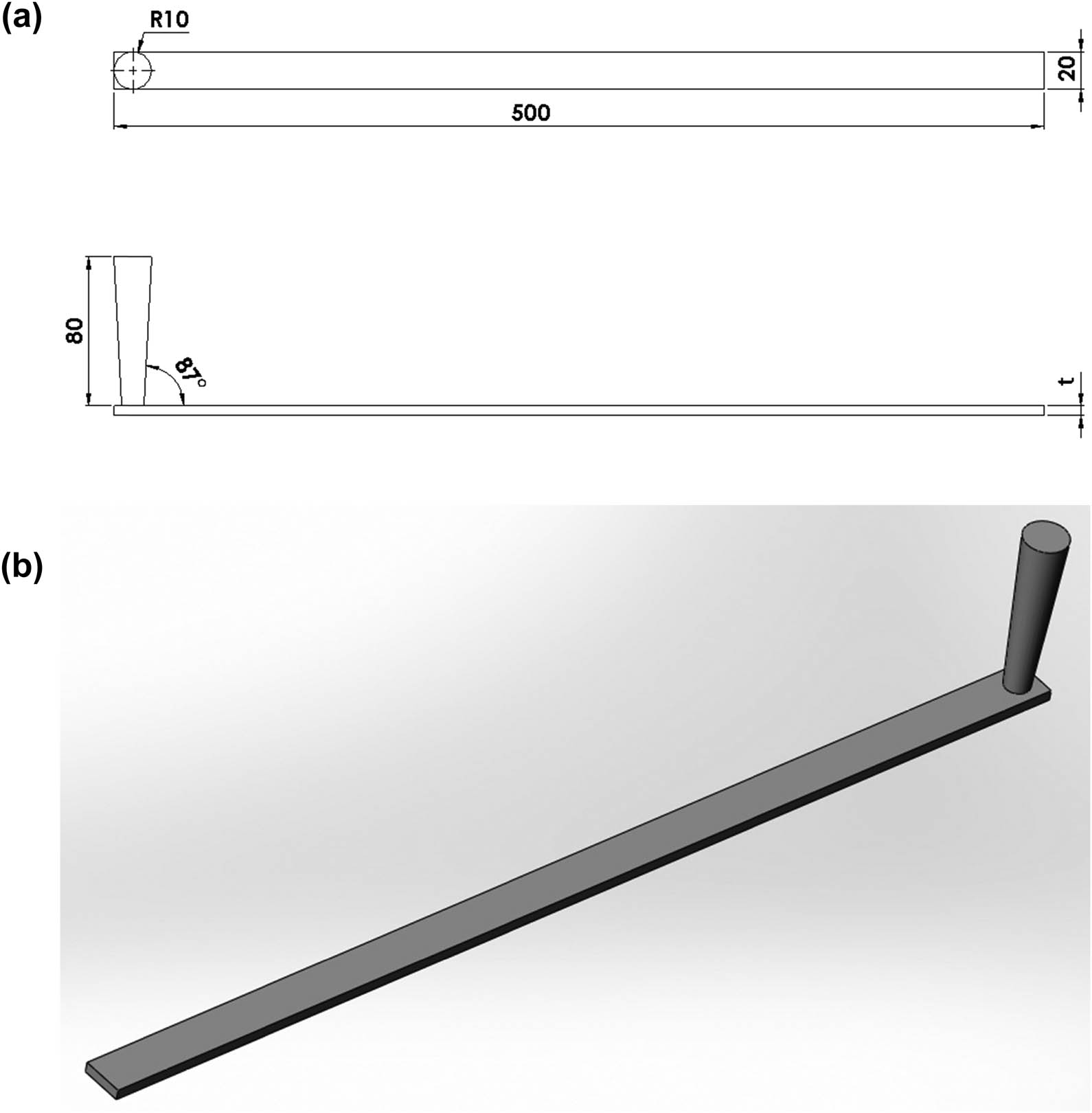
(a) Fluidity test model measurement and (b) solid model image used in fluidity modeling.
Modeling of casting processes is a necessary mathematical method that the computer can quickly and accurately predict what is happening in the mold in the duration of filling the mold and after filling it. These programs usually calculate using finite difference or finite element techniques. They have the ability to model the given casting geometry with the thermo-physical properties and boundary conditions of the materials that can also be entered by the users and contained in their own databases for different casting and mold materials. The casting geometry of the model was first created as a solid model in the SolidWorks program. Then, it was converted to STL format and transferred to the casting simulation program. In SolidCast casting simulation software, the type and thermo-physical properties of the casting alloy and mold material are defined in Table 2 according to the specified values.
Thermo-physical properties of the casting material and the mold
| Material | Thermal conductivity (W/m K) | Specific heat (J/kg K) | Freezing range (°C) | Density (kg/m3) | Latent heat of fusion (J/kg) | |
|---|---|---|---|---|---|---|
| Casting material | Perlitic DI | 25.944 | 460.24 | 44.63 | 7176.06 | 230115.6 |
| Mold | Silica sand | 0.59 | 1075.288 | — | 1521.71 | — |
The material properties of the solid model geometry are transferred to the program by granulating. It is ensured that the specified boundary conditions are solved in the simulation program for each element. The filling modeling studies were carried out with the FlowCast program running depending on the SolidCast casting simulation software. According to FlowCast fluid dynamics criteria, it also calculates factors such as turbulence, incomplete filling, cold joining, and pressure when filling liquid metal into the mold cavity. Figure 2 shows the sample images obtained as a result of FlowCast casting filling modeling.
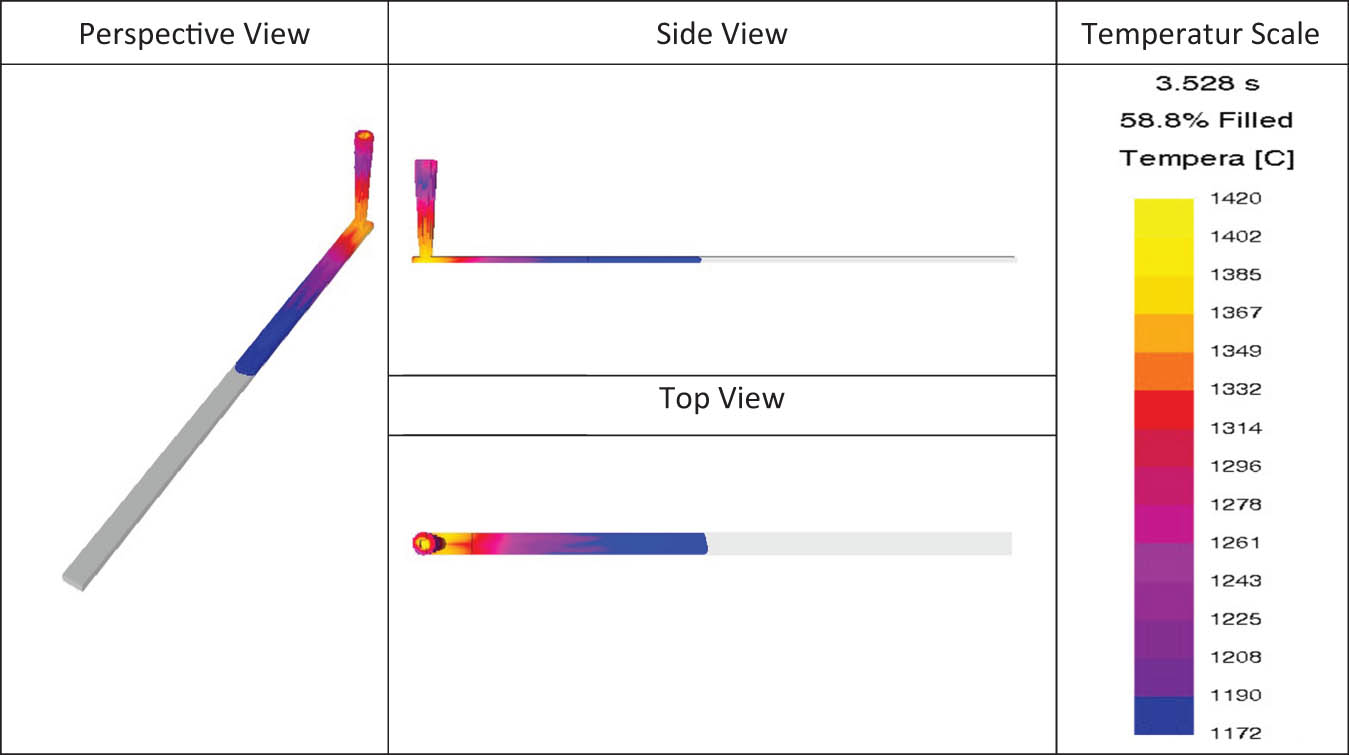
Sample image taken from FlowCast filling modeling software.
The approach in a similar study was used to determine the flow distances of the liquid metal from the casting modeling results [43]. In this context, side images were uploaded to the program and the channel length was defined as 500 mm. Subsequently, flow distances were determined.
A total of 108 experiments were carried out depending on the experimental parameters and levels. An example section of the experiment results is given in Table 3.
Variation of flow distances of the liquid metal depending on the experimental parameters
| Experiment no. | Cross-sectional thickness (mm) | Casting temperature (°C) | Metallurgical quality (%) | Filling time (s) | Experiment results |
|---|---|---|---|---|---|
| 1 | 5 | 1,400 | 10 | 6 | 200.54 |
| 2 | 5 | 1,500 | 90 | 3 | 448.1 |
| 3 | 1 | 1,450 | 10 | 3 | 148.4 |
| 4 | 3 | 1,350 | 90 | 9 | 87.92 |
| 24 | 1 | 1,450 | 90 | 6 | 121.95 |
| 25 | 5 | 1,400 | 50 | 6 | 224.05 |
| 50 | 3 | 1,450 | 90 | 6 | 161.66 |
| 51 | 1 | 1,450 | 50 | 9 | 87.92 |
| 76 | 3 | 1,450 | 90 | 9 | 119.12 |
| 77 | 5 | 1,450 | 90 | 3 | 371.53 |
| … | … | … | … | … | … |
| 106 | 1 | 1,500 | 90 | 6 | 131.59 |
| 107 | 5 | 1,450 | 10 | 6 | 235.39 |
| 108 | 1 | 1,500 | 10 | 6 | 129.34 |
2.2 Development of the ANN model
At this stage, an ANN model has been developed to predict flow distances of the liquid metal in sand mold casting processes of DI with high accuracy.
2.2.1 Determination of input and output variables
The parameters of metallurgical quality, cross-sectional thickness, casting temperature, and filling time were determined as input variables. The output variable is the flow distance of the liquid metal. The general structure of the network is shown in Figure 3.
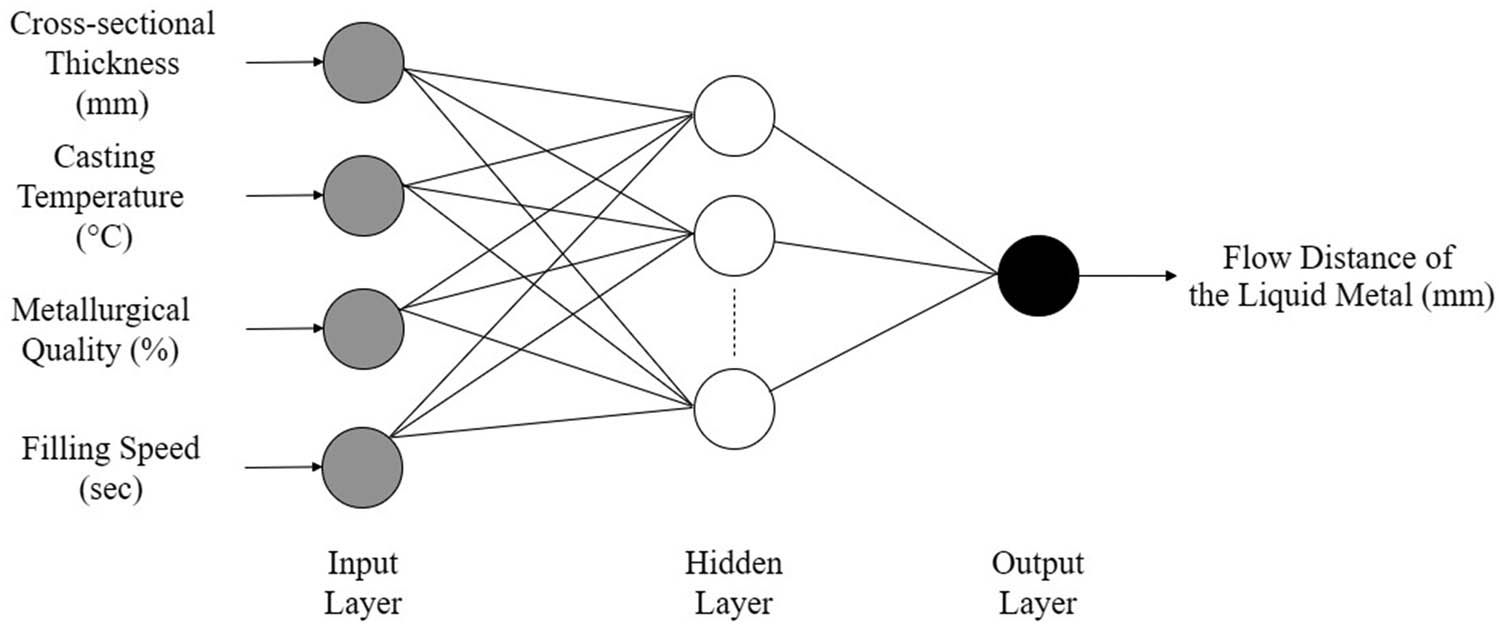
The topology of the developed ANN model.
2.2.2 Determining the type of network
Although there are many types of ANNs, it can be said that multilayer perceptron, LVQ network, ART networks, SOM networks, and Elman network are widely used. Multilayer perceptrons are also known as feed-forward back propagation network structures. This network structure has a fairly wide range of uses due to its ability to generate solutions to nonlinear problems and make generalizations [44]. For this reason, multilayer perceptrons have been preferred as the network type.
2.2.3 Determination of the training and test set
While developing ANN models, a data set related to the problem area is needed. This data set is divided into training and test set. A large number of samples in the training and test set will allow training and testing of the network with different samples, thus this will have a positive effect on the performance of the network. As for the problem area, examples may contain a number of non-numeric data. In this case, these data must be digitized. So ANNs work with numeric data [44]. Another aspect in determining the training and test set concerns the size of the training and test set. Usually, 70–80% of the total data is used in training and 20–30% is used in the testing process. This issue was also taken into account while determining the training and test set, and 86 of the total 108 experimental data were used to train the network, also 22 were used to measure the performance of the network. The data in the training and test set are subjected to normalization before being delivered to the network. The applied normalization formula is as follows:
The normalized version of the data in the training and test set is given in Tables 4 and 5.
An example section of the normalized training set
| Data no. | Cross-sectional thickness (mm) | Casting temperature (°C) | Metallurgical quality (%) | Filling time (s) | Experiment results |
|---|---|---|---|---|---|
| 1 | 1 | 1 | 1 | 0 | 1 |
| 2 | 0.5 | 0 | 1 | 1 | 0.047973991 |
| 3 | 1 | 0.333333333 | 1 | 1 | 0.407792139 |
| 30 | 1 | 0 | 0 | 0.5 | 0.257870113 |
| 31 | 0 | 0.333333333 | 0 | 0.5 | 0.097454603 |
| 53 | 0 | 1 | 1 | 1 | 0.071207676 |
| 54 | 1 | 0 | 0 | 1 | 0.13792192 |
| … | … | … | … | … | … |
| 84 | 0.5 | 1 | 0.5 | 1 | 0.1701689 |
| 85 | 0 | 1 | 1 | 0.5 | 0.163402321 |
| 86 | 1 | 0.666666667 | 0 | 0.5 | 0.437765972 |
An example section of the normalized test set
| Data no. | Cross-sectional thickness (mm) | Casting temperature (°C) | Metallurgical quality (%) | Filling time (s) | Experiment results |
|---|---|---|---|---|---|
| 1 | 1 | 0.333333333 | 0 | 0.5 | 0.465494792 |
| 2 | 0 | 0.666666667 | 0 | 0 | 0.266276042 |
| 3 | 0.5 | 0 | 1 | 0 | 0.348889803 |
| 10 | 0.5 | 0.333333333 | 1 | 0.5 | 0.203125 |
| 11 | 0 | 1 | 0 | 0.5 | 0.163274397 |
| … | |||||
| 20 | 1 | 1 | 1 | 1 | 0.620990954 |
| 21 | 1 | 1 | 0.5 | 0.5 | 0.659847862 |
| 22 | 0.5 | 0.666666667 | 0.5 | 0.5 | 0.261410362 |
2.2.4 Selection of the training algorithm and the transfer function
Although there are many different training algorithms used in the ANN, the Levenberg–Marquardt training algorithm was used because it is faster and more reliable than other training algorithms [45]. As a transfer function, the Log-Sigmoid function formula is used as given below:
2.2.5 Determination of the number of neurons in the hidden layer
Regarding the ANN, there is no clear approach that expresses what kind of network topology should be created in which situations. In multilayer perceptrons, the number of neurons in the input and output layers can be determined according to the type of problem, but the number of neurons in the hidden layer cannot be determined clearly. For this reason, the performances of multilayer perceptron models with different neuron numbers in the hidden layer have been studied. As a result of these studies, the number of neurons in the hidden layer of the model with the least error value is determined as the most appropriate neuron number of the hidden layer [44].
2.2.6 Measuring the performance of the network
The performance of a developed ANN model is measured by the correct estimation rate of the samples in the test set. In some cases, the network can predict the data in the training set with a very high accuracy rate, but this prediction rate may remain very low in the test set. In this case, it is concluded that the network memorizes instead of learning. In order to avoid such situations and to achieve high prediction accuracy, the network is tested with a test set consisting of samples that are not included in the training set. The high performance of the network depends on the minimum difference between the estimated values produced for the samples in the test set and the output values in the test set. At this stage, the performance measurement of the ANN models will be performed with Mean Absolute Percentage Error (MAPE) and R 2:
3 Results and discussion
The Matlab software was used in the development of ANN models. In order to determine the ANN model with the best prediction performance, ANN models with different hidden layer neuron numbers were created. Each ANN model was subjected to a training and testing process. The prediction performances of these models are shown in Figure 4.

MAPE values of the developed ANN models.
As Figure 4 is examined, it is seen that the prediction performance of these models changes as the number of neurons in the hidden layer of ANN models changes. Prediction performances vary approximately between 81 and 95%, and the highest prediction performance was achieved when the number of neurons in the hidden layer was six. Thus, the ANN model that gives the best prediction performance was determined, and the prediction performance of this model was determined as 95.12%. Then, regression analysis was performed for this model. The result of the analysis is included in Figure 5.
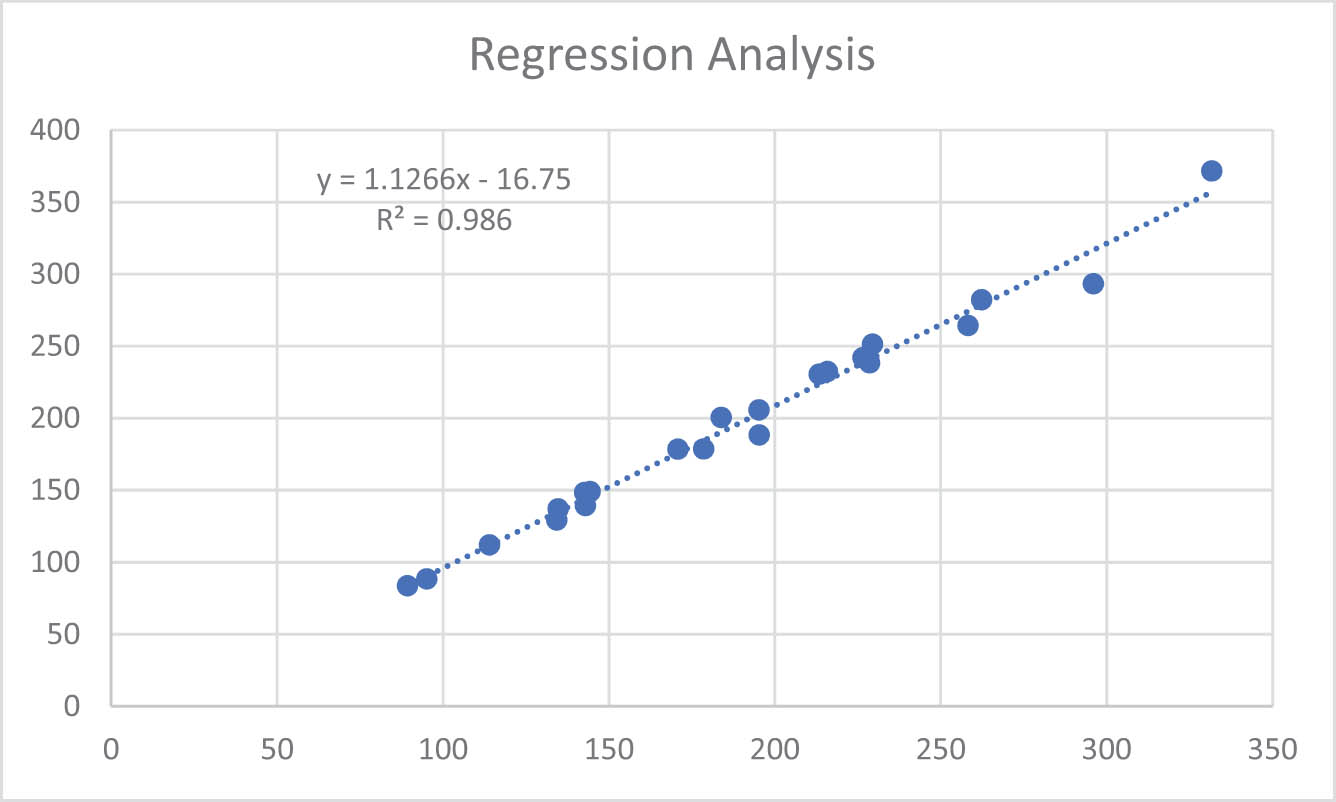
Regression analysis of the ANN model with six neurons in its hidden layer.
As a result of the analysis, the regression equation and the coefficient of determination (R 2) were obtained. The coefficient of determination calculated expresses the harmony of the actual flow distance of the liquid metal and the estimated flow distance of the liquid metal produced by the ANN model. The closer the obtained value is to one, the better the fit. Here, the R 2 value is calculated as 0.986. This obtained value emphasizes that the developed ANN model makes quite successful predictions as it was shown in some other previous works [46–54].
4 Conclusion
In this study, it is aimed to estimate the flow distance of the liquid metal in the sand casting process of DI depending on the parameters of cross-sectional thickness, casting temperature, metallurgical quality, and filling time. In this context, ANN models with different numbers of neurons in the hidden layer have been developed. The data obtained from 108 experiments were used in the training and testing processes of these models. Then, the prediction performances of the models were examined in terms of the MAPE error measure and it was determined that the ANN model with six neurons in its hidden layer had the best prediction performance. In addition, regression analysis was performed for this model. Thus, the regression equation and R 2 were obtained. The R 2 value calculated for this ANN model also confirms the high prediction consistency of the relevant model (R 2 = 0.986).
-
Funding information: This research received no external funding.
-
Conflict of interest: The author declares no conflict of interest.
-
Data availability statement: Not applicable.
-
Ethical approval: The conducted research is not related to either human or animal use.
References
[1] Ashby MF, Jones DRH. Engineering materials 2: an introduction to microstructures and processing. 4th edn. London: Butterworth Heinemann; 2013. p. 3–12.Suche in Google Scholar
[2] Han CF, Sun YF, Wu Y, Ma YH. Effects of vanadium and austempering temperature on microstructure and properties of CADI. Metallogr Microstruct Anal. 2015;4:135–45. 10.1007/s13632-015-0197-1.Suche in Google Scholar
[3] Campbell J. Casting. 2nd edn. London: Butterworth Heinemann; 2003. p. 70–231.Suche in Google Scholar
[4] Vicente ADA, Sartori Moreno JR, Santos TFDA, Espinosa DCR, Tenório JAS. Nucleation and growth of graphite particles in ductile cast iron. J Alloy Compd. 2019;775:1230–4. 10.1016/j.jallcom.2018.10.136.Suche in Google Scholar
[5] Di Cocco V, Iacoviello F. Ductile cast irons: microstructure influence on the damaging micromechanisms in overloaded fatigue cracks. Eng Fail Anal. 2017;82:340–9. 10.1016/j.engfailanal.2017.06.039.Suche in Google Scholar
[6] Yan H, Wang A, Xiong Z, Xu K, Huang Z. Microstructure and wear resistance of composite layers on a ductile iron with multicarbide by laser surface alloying. Appl Surf Sci. 2010;256(23):7001–9. 10.1016/j.apsusc.2010.05.015.Suche in Google Scholar
[7] Kamińska J, Angrecki M, Stefański Z, Palma A. Effect of wall thickness on the microstructure of ductile iron castings manufactured by the inmold process using a reaction chamber. Arch Foundry Eng. 2018;18(4):50–4. 10.24425/123632.Suche in Google Scholar
[8] Theuwissen K, Lacaze J, Laffont-Dantras L. Structure of graphite precipitates in cast iron. Carbon. 2016;96:1120–8. 10.1016/j.carbon.2015.10.066.Suche in Google Scholar
[9] Gouveia RM, Silva FJG, Paiva OC, Andrade MF, Silva L, Moselli PC, et al. Study of the heat-treatments effect on high strength ductile cast iron welded joints. Metals. 2017;7:382. 10.3390/met7090382.Suche in Google Scholar
[10] Fraś E, Górny M, Stachurski W. Problem of super-thin wall nodular cast iron castings. Found Rev. 2006;56:230.Suche in Google Scholar
[11] Torrance JW, Stefanescu DM. An investigation on the effect of surface roughness on the static mechanical properties of thin-wall ductile iron castings. AFS Trans. 2004;112:757–72.Suche in Google Scholar
[12] Dix LP, Ruxanda R, Torrance J, Fukumoto M, Stefanescu DM. Static mechanical properties of ferritic and pearlitic lightweight ductile iron castings. AFS Trans. 2003;111:1149–64.Suche in Google Scholar
[13] Ruxanda R, Stefanescu DM, Piwonka TS. Microstructure characterization of ductile thin wall iron castings. AFS Trans. 2002;110:1131–47.Suche in Google Scholar
[14] Shepel SV, Paolucci S. Numerical simulation of filling and solidification of permanent mold castings. Appl Therm Eng. 2002;22(2):229–48. 10.1016/S1359-4311(01)00068-0.Suche in Google Scholar
[15] Pathak N, Kumar A, Yadav A, Dutta P. Effects of mould filling on evolution of the solid–liquid interface during solidification. Appl Therm Eng. 2009;29(17–18):3669–78. 10.1016/j.applthermaleng.2009.06.026.Suche in Google Scholar
[16] Ravi KR, Pillai RM, Amaranathan KR, Pai BC, Chakraborty M. Fluidity of aluminum alloys and composites: a review. J Alloy Compd. 2008;456(1–2):201–10. 10.1016/j.jallcom.2007.02.038.Suche in Google Scholar
[17] Chelladurai C, Mohan NS, Hariharashayee D, Manikandan S, Sivaperumal P. Analyzing the casting defects in small scale casting industry. Mater Today. 2021;37(2):386–94. 10.1016/j.matpr.2020.05.382.Suche in Google Scholar
[18] Vignesh R, Sanjay Gandhi M, Vignesh A, Rajarajan P. Effect of squeeze cast process parameters on fluidity of aluminium LM6 alloy. Int J Adv Technol. 2016;7(2):157. 10.4172/0976-4860.1000157.Suche in Google Scholar
[19] Sabatino MD, Arnberg L. A review on the fluidity of Al based alloys. Metall Sci Technol. 2013;22:9–15.Suche in Google Scholar
[20] Saxena S, Sharma PK. Casting fluidity of metals and alloys. Int J Innov Res Sci Eng Technol. 2017;6(2):3018–31. 10.15680/IJIRSET.2017.0602171.Suche in Google Scholar
[21] Borowiecki B. Conventional flow curves of liquid cast iron put on spheroidization. Arch Foundry Eng. 2008;8(1):23–6.Suche in Google Scholar
[22] Górny M. Structure of ductile iron in thin walled castings. Arch Foundry Eng. 2007;7(4):73–8.Suche in Google Scholar
[23] Górny M. Fluidity and temperature profile of ductile iron in thin sections. J Iron Steel Res Int. 2012;19(8):52–9. 10.1016/S1006-706X(12)60139-3.Suche in Google Scholar
[24] Han Q, Xu H. Fluidity of alloys under high pressure die casting conditions. Scr Mater. 2005;53(1):7–10. 10.1016/j.scriptamat.2005.03.025.Suche in Google Scholar
[25] Haque MM. Investigation on properties and microstructures of spheroidal graphite Fe–C–2Si and Fe–C–2Al cast irons. J Mater Process Technol. 2007;191(1–3):360–3. 10.1016/j.jmatprotec.2007.03.030.Suche in Google Scholar
[26] Aslandoğan R. Dökümde akıcılık ve akıcılığı etkileyen faktörlerin araştırılması [dissertation]. Yıldız Technical University; 2009.Suche in Google Scholar
[27] Yang L, Li W, Du J, Wang K, Tang P. Effect of Si and Ni contents on the fluidity of Al-Ni-Si alloys evaluated by using thermal analysis. Thermochim Acta. 2016;645:7–15. 10.1016/j.tca.2016.10.013.Suche in Google Scholar
[28] Hu C, Wang Y. An efficient convolutional neural network model based on object-level attention mechanism for casting defect detection on radiography ımages. IEEE Trans Ind Electron. 2020;67(12):10922–30. 10.1109/TIE.2019.2962437.Suche in Google Scholar
[29] Ding S, Shi Q, Chen G. Flow stress of 6061 aluminum alloy at typical temperatures during friction stir welding based on hot compression tests. Metals. 2021;11(5):804. 10.3390/met11050804.Suche in Google Scholar
[30] Li YR, Zhang CN. A neural network prediction analysis of breakout continuous casting based on differential evolution (de). Metalurgija. 2020;59(3):291–4.Suche in Google Scholar
[31] Soundararajan R, Ramesh A, Sivasankaran S, Vignesh M. Modeling and analysis of mechanical properties of aluminium alloy (A413) reinforced with boron carbide (B4C) processed through squeeze casting process using artificial neural network model and statistical technique. Mater Today. 2017;4(2):2008–30. 10.1016/j.matpr.2017.02.047.Suche in Google Scholar
[32] Moon IY, Jeong HW, Lee HW, Kim SJ, Oh YS, Jung J, et al. Predicting high temperature flow stress of nickel alloy A230 based on an artificial neural network. Metals. 2022;12(2):223. 10.3390/met12020223.Suche in Google Scholar
[33] Pham QT, Phan TKD. Apply neural network for improving production planning at Samarang petrol mine. Int J Intell Comput Cyb. 2016;9(2):126–43. 10.1108/IJICC-09-2015-0032.Suche in Google Scholar
[34] Şenyiğit E, Atici U. Artificial neural network models for lot-sizing problem: a case study. Neural Comput Appl. 2013;22:1039–47. 10.1007/s00521-012-0863-z.Suche in Google Scholar
[35] Simeunovic N, Kamenko I, Bugarski V, Jovanovic M, Lalic B. Improving workforce scheduling using artificial neural networks model. Adv Prod Eng Manag. 2017;12(4):337–52. 10.14743/apem2017.4.262.Suche in Google Scholar
[36] Kasgari AA, Divsalar M, Javid MR, Ebrahimian SJ. Prediction of bankruptcy Iranian corporations through artificial neural network and probit-based analyses. Neural Comput Appl. 2013;23:927–36. 10.1007/s00521-012-1017-z.Suche in Google Scholar
[37] Ko PC, Lin PC. Resource allocation neural network in portfolio selection. Expert Syst Appl. 2008;35(1–2):330–7. 10.1016/j.eswa.2007.07.031.Suche in Google Scholar
[38] Haider A, Hanif MN. Inflation forecasting in Pakistan using artificial neural networks. Pak Econ Soc Rev. 2009;47(1):123–38.Suche in Google Scholar
[39] Etebari F, Najafi AA. Intelligent choice-based network revenue management. Sci Iran Trans E. 2016;23(2):747–56. 10.24200/SCI.2016.3860.Suche in Google Scholar
[40] Tsai CF, Wu JW. Using neural network ensembles for bankruptcy prediction and credit scoring. Expert Syst Appl. 2008;34(4):2639–49. 10.1016/j.eswa.2007.05.019.Suche in Google Scholar
[41] Wang N, Chen J, Xiao H, Wu L, Jiang H, Zhou Y. Application of artificial neural network model in diagnosis of Alzheimer’s disease. BMC Neurol. 2019;19:154. 10.1186/s12883-019-1377-4.Suche in Google Scholar PubMed PubMed Central
[42] Chang RI, Chiu YH, Lin JW. Two‑stage classification of tuberculosis culture diagnosis using convolutional neural network with transfer learning. J Supercomput. 2020;76:8641–56. 10.1007/s11227-020-03152-x.Suche in Google Scholar
[43] Şensoy AT, Çolak M, Kaymaz I, Dispinar D. Investigating the optimum model parameters for casting process of A356 alloy: a cross-validation using response surface method and particle swarm optimization. Arab J Sci Eng. 2020;45:9759–68. 10.1007/s13369-020-04922-8.Suche in Google Scholar
[44] Öztemel E. Yapay sinir ağları. 3rd edn. Istanbul: Papatya Publishing; 2012.Suche in Google Scholar
[45] Okkan U. Application of Levenberg-Marquardt optimization algorithm based multilayer neural networks for hydrological time series modeling. An Int J Optim Control Theor Appl. 2011;1(1):53–63. 10.11121/ijocta.01.2011.0038.Suche in Google Scholar
[46] Malidarre RB, Akkurt I, Malidarreh PB, Arslankaya S. Investigation and ANN-based prediction of the radiation shielding, structural and mechanical properties of the hydroxyapatite (HAP) bio-composite as artificial bone. Radiat Phys Chem. 2022;197:110208. 10.1016/j.radphyschem.2022.110208.Suche in Google Scholar
[47] Akkurt I, Malidarreh PB, Malidarre RB. Simulation and prediction the attenuation behavior of the KNN-LMN based lead free ceramics by fluka code and artificial neural network (ANN)-based algorithm. Environ Technol. 2021;1–15. 10.1080/09593330.2021.2008017.Suche in Google Scholar PubMed
[48] Basyigit C, Akkurt I, Kilincarslan S, Beycioglu A. Prediction of compressive strength of heavyweight concrete by ANN and FL models. Neural Comput Appl. 2010;19(4):507–13. 10.1007/s00521-009-0292-9.Suche in Google Scholar
[49] Arslankaya S. Estimation of hanging and removal times in eloxal with artificial neural networks. Emerg Mater Res. 2020;9(2):366–74. 10.1680/jemmr.19.00191.Suche in Google Scholar
[50] Arslankaya S. Estimating the effects of heat treatment on aluminum alloy with artificial neural networks. Emerg Mater Res. 2020;9(2):540–9. 10.1680/jemmr.20.00059.Suche in Google Scholar
[51] Polat TK. Forecasting of production and scrap amounts using artificial neural networks. Emerg Mater Res. 2022;11(3):1–11. 10.1680/jemmr.22.00036.Suche in Google Scholar
[52] Nar M, Arslankaya S. Passenger demand forecasting for railway systems. Open Chem. 2022;20(1):105–19. 10.1515/chem-2022-0124.Suche in Google Scholar
[53] Malidarre RB, Arslankaya S, Nar M, Kirelli Y, Erdamar IYD, Karpuz N, et al. Deep learning prediction of gamma-ray-attenuation behavior of KNN–LMN ceramics. Emerg Mater Res. 2022;11(2):276–82. 10.1680/jemmr.22.00012.Suche in Google Scholar
[54] Teke Ç, Çolak M, Kiraz A, İpek M. Prediction of critical fraction of solid in low-pressure die casting of aluminum alloys using artificial neural network. Sci Iran Trans B. 2019;26(6):3304–12. 10.24200/sci.2019.50819.1881.Suche in Google Scholar
© 2022 Çağatay Teke, published by De Gruyter
This work is licensed under the Creative Commons Attribution 4.0 International License.
Artikel in diesem Heft
- Regular Articles
- Photocatalytic degradation of Rhodamine B in aqueous phase by bimetallic metal-organic framework M/Fe-MOF (M = Co, Cu, and Mg)
- Assessment of using electronic portal imaging device for analysing bolus material utilised in radiation therapy
- A detailed investigation on highly dense CuZr bulk metallic glasses for shielding purposes
- Simulation of gamma-ray shielding properties for materials of medical interest
- Environmental impact assesment regulation applications and their analysis in Turkey
- Sample age effect on parameters of dynamic nuclear polarization in certain difluorobenzen isomers/MC800 asphaltene suspensions
- Passenger demand forecasting for railway systems
- Design of a Robust sliding mode controller for bioreactor cultures in overflow metabolism via an interdisciplinary approach
- Gamma, neutron, and heavy charged ion shielding properties of Er3+-doped and Sm3+-doped zinc borate glasses
- Bridging chiral de-tert-butylcalix[4]arenes: Optical resolution based on column chromatography and structural characterization
- Petrology and geochemistry of multiphase post-granitic dikes: A case study from the Gabal Serbal area, Southwestern Sinai, Egypt
- Comparison of the yield and purity of plasma exosomes extracted by ultracentrifugation, precipitation, and membrane-based approaches
- Bioactive triterpenoids from Indonesian medicinal plant Syzygium aqueum
- Investigation of the effects of machining parameters on surface integrity in micromachining
- The mesoporous aluminosilicate application as support for bifunctional catalysts for n-hexadecane hydroconversion
- Gamma-ray shielding properties of Nd2O3-added iron–boron–phosphate-based composites
- Numerical investigation on perforated sheet metals under tension loading
- Statistical analysis on the radiological assessment and geochemical studies of granite rocks in the north of Um Taghir area, Eastern Desert, Egypt
- Two new polypodane-type bicyclic triterpenoids from mastic
- Structural, physical, and mechanical properties of the TiO2 added hydroxyapatite composites
- Tribological properties and characterization of borided Co–Mg alloys
- Studies on Anemone nemorosa L. extracts; polyphenols profile, antioxidant activity, and effects on Caco-2 cells by in vitro and in silico studies
- Mechanical properties, elastic moduli, transmission factors, and gamma-ray-shielding performances of Bi2O3–P2O5–B2O3–V2O5 quaternary glass system
- Cyclic connectivity index of bipolar fuzzy incidence graph
- The role of passage numbers of donor cells in the development of Arabian Oryx – Cow interspecific somatic cell nuclear transfer embryos
- Mechanical property evaluation of tellurite–germanate glasses and comparison of their radiation-shielding characteristics using EPICS2017 to other glass systems
- Molecular screening of ionic liquids for CO2 absorption and molecular dynamic simulation
- Microwave-assisted preparation of Ag/Fe magnetic biochar from clivia leaves for adsorbing daptomycin antibiotics
- Iminodisuccinic acid enhances antioxidant and mineral element accumulation in young leaves of Ziziphus jujuba
- Cytotoxic activity of guaiane-type sesquiterpene lactone (deoxycynaropicrin) isolated from the leaves of Centaurothamnus maximus
- Effects of welding parameters on the angular distortion of welded steel plates
- Simulation of a reactor considering the Stamicarbon, Snamprogetti, and Toyo patents for obtaining urea
- Effect of different ramie (Boehmeria nivea L. Gaud) cultivars on the adsorption of heavy metal ions cadmium and lead in the remediation of contaminated farmland soils
- Impact of a live bacterial-based direct-fed microbial (DFM) postpartum and weaning system on performance, mortality, and health of Najdi lambs
- Anti-tumor effect of liposomes containing extracted Murrayafoline A against liver cancer cells in 2D and 3D cultured models
- Physicochemical properties and some mineral concentration of milk samples from different animals and altitudes
- Copper(ii) complexes supported by modified azo-based ligands: Nucleic acid binding and molecular docking studies
- Diagnostic and therapeutic radioisotopes in nuclear medicine: Determination of gamma-ray transmission factors and safety competencies of high-dense and transparent glassy shields
- Calculation of NaI(Tl) detector efficiency using 226Ra, 232Th, and 40K radioisotopes: Three-phase Monte Carlo simulation study
- Isolation and identification of unstable components from Caesalpinia sappan by high-speed counter-current chromatography combined with preparative high-performance liquid chromatography
- Quantification of biomarkers and evaluation of antioxidant, anti-inflammatory, and cytotoxicity properties of Dodonaea viscosa grown in Saudi Arabia using HPTLC technique
- Characterization of the elastic modulus of ceramic–metal composites with physical and mechanical properties by ultrasonic technique
- GC-MS analysis of Vespa velutina auraria Smith and its anti-inflammatory and antioxidant activities in vitro
- Texturing of nanocoatings for surface acoustic wave-based sensors for volatile organic compounds
- Insights into the molecular basis of some chalcone analogues as potential inhibitors of Leishmania donovani: An integrated in silico and in vitro study
- (1R,2S,5R)-5-Methyl-2-(propan-2-yl)cyclohexyl 4-amino-3-phenylbutanoate hydrochloride: Synthesis and anticonvulsant activity
- On the relative extraction rates of colour compounds and caffeine during brewing, an investigation of tea over time and temperature
- Characterization of egg shell powder-doped ceramic–metal composites
- Rapeseed oil-based hippurate amide nanocomposite coating material for anticorrosive and antibacterial applications
- Chemically modified Teucrium polium (Lamiaceae) plant act as an effective adsorbent tool for potassium permanganate (KMnO4) in wastewater remediation
- Efficiency analysis of photovoltaic systems installed in different geographical locations
- Risk prioritization model driven by success factor in the light of multicriteria decision making
- Theoretical investigations on the excited-state intramolecular proton transfer in the solvated 2-hydroxy-1-naphthaldehyde carbohydrazone
- Mechanical and gamma-ray shielding examinations of Bi2O3–PbO–CdO–B2O3 glass system
- Machine learning-based forecasting of potability of drinking water through adaptive boosting model
- The potential effect of the Rumex vesicarius water seeds extract treatment on mice before and during pregnancy on the serum enzymes and the histology of kidney and liver
- Impact of benzimidazole functional groups on the n-doping properties of benzimidazole derivatives
- Extraction of red pigment from Chinese jujube peel and the antioxidant activity of the pigment extracts
- Flexural strength and thermal properties of carbon black nanoparticle reinforced epoxy composites obtained from waste tires
- A focusing study on radioprotective and antioxidant effects of Annona muricata leaf extract in the circulation and liver tissue: Clinical and experimental studies
- Clinical comprehensive and experimental assessment of the radioprotective effect of Annona muricata leaf extract to prevent cellular damage in the ileum tissue
- Effect of WC content on ultrasonic properties, thermal and electrical conductivity of WC–Co–Ni–Cr composites
- Influence of various class cleaning agents for prosthesis on Co–Cr alloy surface
- The synthesis of nanocellulose-based nanocomposites for the effective removal of hexavalent chromium ions from aqueous solution
- Study on the influence of physical interlayers on the remaining oil production under different development modes
- Optimized linear regression control of DC motor under various disturbances
- Influence of different sample preparation strategies on hypothesis-driven shotgun proteomic analysis of human saliva
- Determination of flow distance of the fluid metal due to fluidity in ductile iron casting by artificial neural networks approach
- Investigation of mechanical activation effect on high-volume natural pozzolanic cements
- In vitro: Anti-coccidia activity of Calotropis procera leaf extract on Eimeria papillata oocysts sporulation and sporozoite
- Determination of oil composition of cowpea (Vigna unguiculata L.) seeds under influence of organic fertilizer forms
- Activated partial thromboplastin time maybe associated with the prognosis of papillary thyroid carcinoma
- Treatment of rat brain ischemia model by NSCs-polymer scaffold transplantation
- Lead and cadmium removal with native yeast from coastal wetlands
- Characterization of electroless Ni-coated Fe–Co composite using powder metallurgy
- Ferrate synthesis using NaOCl and its application for dye removal
- Antioxidant, antidiabetic, and anticholinesterase potential of Chenopodium murale L. extracts using in vitro and in vivo approaches
- Study on essential oil, antioxidant activity, anti-human prostate cancer effects, and induction of apoptosis by Equisetum arvense
- Experimental study on turning machine with permanent magnetic cutting tool
- Numerical simulation and mathematical modeling of the casting process for pearlitic spheroidal graphite cast iron
- Design, synthesis, and cytotoxicity evaluation of novel thiophene, pyrimidine, pyridazine, and pyridine: Griseofulvin heterocyclic extension derivatives
- Isolation and identification of promising antibiotic-producing bacteria
- Ultrasonic-induced reversible blood–brain barrier opening: Safety evaluation into the cellular level
- Evaluation of phytochemical and antioxidant potential of various extracts from traditionally used medicinal plants of Pakistan
- Effect of calcium lactate in standard diet on selected markers of oxidative stress and inflammation in ovariectomized rats
- Identification of crucial salivary proteins/genes and pathways involved in pathogenesis of temporomandibular disorders
- Zirconium-modified attapulgite was used for removing of Cr(vi) in aqueous solution
- The stress distribution of different types of restorative materials in primary molar
- Reducing surface heat loss in steam boilers
- Deformation behavior and formability of friction stir processed DP600 steel
- Synthesis and characterization of bismuth oxide/commercial activated carbon composite for battery anode
- Phytochemical analysis of Ziziphus jujube leaf at different foliar ages based on widely targeted metabolomics
- Effects of in ovo injection of black cumin (Nigella sativa) extract on hatching performance of broiler eggs
- Separation and evaluation of potential antioxidant, analgesic, and anti-inflammatory activities of limonene-rich essential oils from Citrus sinensis (L.)
- Bioactivity of a polyhydroxy gorgostane steroid from Xenia umbellata
- BiCAM-based automated scoring system for digital logic circuit diagrams
- Analysis of standard systems with solar monitoring systems
- Structural and spectroscopic properties of voriconazole and fluconazole – Experimental and theoretical studies
- New plant resistance inducers based on polyamines
- Experimental investigation of single-lap bolted and bolted/bonded (hybrid) joints of polymeric plates
- Investigation of inlet air pressure and evaporative cooling of four different cogeneration cycles
- Review Articles
- Comprehensive review on synthesis, physicochemical properties, and application of activated carbon from the Arecaceae plants for enhanced wastewater treatment
- Research progress on speciation analysis of arsenic in traditional Chinese medicine
- Recent modified air-assisted liquid–liquid microextraction applications for medicines and organic compounds in various samples: A review
- An insight on Vietnamese bio-waste materials as activated carbon precursors for multiple applications in environmental protection
- Antimicrobial activities of the extracts and secondary metabolites from Clausena genus – A review
- Bioremediation of organic/heavy metal contaminants by mixed cultures of microorganisms: A review
- Sonodynamic therapy for breast cancer: A literature review
- Recent progress of amino acid transporters as a novel antitumor target
- Aconitum coreanum Rapaics: Botany, traditional uses, phytochemistry, pharmacology, and toxicology
- Corrigendum
- Corrigendum to “Petrology and geochemistry of multiphase post-granitic dikes: A case study from the Gabal Serbal area, Southwestern Sinai, Egypt”
- Corrigendum to “Design of a Robust sliding mode controller for bioreactor cultures in overflow metabolism via an interdisciplinary approach”
- Corrigendum to “Statistical analysis on the radiological assessment and geochemical studies of granite rocks in the north of Um Taghir area, Eastern Desert, Egypt”
- Corrigendum to “Aroma components of tobacco powder from different producing areas based on gas chromatography ion mobility spectrometry”
- Corrigendum to “Mechanical properties, elastic moduli, transmission factors, and gamma-ray-shielding performances of Bi2O3–P2O5–B2O3–V2O5 quaternary glass system”
- Erratum
- Erratum to “Copper(ii) complexes supported by modified azo-based ligands: Nucleic acid binding and molecular docking studies”
- Special Issue on Applied Biochemistry and Biotechnology (ABB 2021)
- Study of solidification and stabilization of heavy metals by passivators in heavy metal-contaminated soil
- Human health risk assessment and distribution of VOCs in a chemical site, Weinan, China
- Preparation and characterization of Sparassis latifolia β-glucan microcapsules
- Special Issue on the Conference of Energy, Fuels, Environment 2020
- Improving the thermal performance of existing buildings in light of the requirements of the EU directive 2010/31/EU in Poland
- Special Issue on Ethnobotanical, Phytochemical and Biological Investigation of Medicinal Plants
- Study of plant resources with ethnomedicinal relevance from district Bagh, Azad Jammu and Kashmir, Pakistan
- Studies on the chemical composition of plants used in traditional medicine in Congo
- Special Issue on Applied Chemistry in Agriculture and Food Science
- Strip spraying technology for precise herbicide application in carrot fields
- Special Issue on Pharmacology and Metabolomics of Ethnobotanical and Herbal Medicine
- Phytochemical profiling, antibacterial and antioxidant properties of Crocus sativus flower: A comparison between tepals and stigmas
- Antioxidant and antimicrobial properties of polyphenolics from Withania adpressa (Coss.) Batt. against selected drug-resistant bacterial strains
- Integrating network pharmacology and molecular docking to explore the potential mechanism of Xinguan No. 3 in the treatment of COVID-19
- Chemical composition and in vitro and in vivo biological assortment of fixed oil extracted from Ficus benghalensis L.
- A review of the pharmacological activities and protective effects of Inonotus obliquus triterpenoids in kidney diseases
- Ethnopharmacological study of medicinal plants in Kastamonu province (Türkiye)
- Protective effects of asperuloside against cyclophosphamide-induced urotoxicity and hematotoxicity in rats
- Special Issue on Essential Oil, Extraction, Phytochemistry, Advances, and Application
- Identification of volatile compounds and antioxidant, antibacterial, and antifungal properties against drug-resistant microbes of essential oils from the leaves of Mentha rotundifolia var. apodysa Briq. (Lamiaceae)
- Phenolic contents, anticancer, antioxidant, and antimicrobial capacities of MeOH extract from the aerial parts of Trema orientalis plant
- Chemical composition and antimicrobial activity of essential oils from Mentha pulegium and Rosmarinus officinalis against multidrug-resistant microbes and their acute toxicity study
- Special Issue on Marine Environmental Sciences and Significance of the Multidisciplinary Approaches
- An insightful overview of the distribution pattern of polycyclic aromatic hydrocarbon in the marine sediments of the Red Sea
- Antifungal–antiproliferative norcycloartane-type triterpenes from the Red Sea green alga Tydemania expeditionis
- Solvent effect, dipole moment, and DFT studies of multi donor–acceptor type pyridine derivative
- An extensive assessment on the distribution pattern of organic contaminants in the aerosols samples in the Middle East
- Special Issue on 4th IC3PE
- Energetics of carboxylic acid–pyridine heterosynthon revisited: A computational study of intermolecular hydrogen bond domination on phenylacetic acid–nicotinamide cocrystals
- A review: Silver–zinc oxide nanoparticles – organoclay-reinforced chitosan bionanocomposites for food packaging
- Green synthesis of magnetic activated carbon from peanut shells functionalized with TiO2 photocatalyst for Batik liquid waste treatment
- Coagulation activity of liquid extraction of Leucaena leucocephala and Sesbania grandiflora on the removal of turbidity
- Hydrocracking optimization of palm oil over NiMoO4/activated carbon catalyst to produce biogasoline and kerosine
- Special Issue on Pharmacology and metabolomics of ethnobotanical and herbal medicine
- Cynarin inhibits PDGF-BB-induced proliferation and activation in hepatic stellate cells through PPARγ
- Special Issue on The 1st Malaysia International Conference on Nanotechnology & Catalysis (MICNC2021)
- Surfactant evaluation for enhanced oil recovery: Phase behavior and interfacial tension
- Topical Issue on phytochemicals, biological and toxicological analysis of aromatic medicinal plants
- Phytochemical analysis of leaves and stems of Physalis alkekengi L. (Solanaceae)
- Phytochemical and pharmacological profiling of Trewia nudiflora Linn. leaf extract deciphers therapeutic potentials against thrombosis, arthritis, helminths, and insects
- Pergularia tomentosa coupled with selenium nanoparticles salvaged lead acetate-induced redox imbalance, inflammation, apoptosis, and disruption of neurotransmission in rats’ brain
- Protective effect of Allium atroviolaceum-synthesized SeNPs on aluminum-induced brain damage in mice
- Mechanism study of Cordyceps sinensis alleviates renal ischemia–reperfusion injury
- Plant-derived bisbenzylisoquinoline alkaloid tetrandrine prevents human podocyte injury by regulating the miR-150-5p/NPHS1 axis
- Network pharmacology combined with molecular docking to explore the anti-osteoporosis mechanisms of β-ecdysone derived from medicinal plants
- Chinese medicinal plant Polygonum cuspidatum ameliorates silicosis via suppressing the Wnt/β-catenin pathway
- Special Issue on Advanced Nanomaterials for Energy, Environmental and Biological Applications - Part I
- Investigation of improved optical and conductivity properties of poly(methyl methacrylate)–MXenes (PMMA–MXenes) nanocomposite thin films for optoelectronic applications
- Special Issue on Applied Biochemistry and Biotechnology (ABB 2022)
- Model predictive control for precision irrigation of a Quinoa crop
Artikel in diesem Heft
- Regular Articles
- Photocatalytic degradation of Rhodamine B in aqueous phase by bimetallic metal-organic framework M/Fe-MOF (M = Co, Cu, and Mg)
- Assessment of using electronic portal imaging device for analysing bolus material utilised in radiation therapy
- A detailed investigation on highly dense CuZr bulk metallic glasses for shielding purposes
- Simulation of gamma-ray shielding properties for materials of medical interest
- Environmental impact assesment regulation applications and their analysis in Turkey
- Sample age effect on parameters of dynamic nuclear polarization in certain difluorobenzen isomers/MC800 asphaltene suspensions
- Passenger demand forecasting for railway systems
- Design of a Robust sliding mode controller for bioreactor cultures in overflow metabolism via an interdisciplinary approach
- Gamma, neutron, and heavy charged ion shielding properties of Er3+-doped and Sm3+-doped zinc borate glasses
- Bridging chiral de-tert-butylcalix[4]arenes: Optical resolution based on column chromatography and structural characterization
- Petrology and geochemistry of multiphase post-granitic dikes: A case study from the Gabal Serbal area, Southwestern Sinai, Egypt
- Comparison of the yield and purity of plasma exosomes extracted by ultracentrifugation, precipitation, and membrane-based approaches
- Bioactive triterpenoids from Indonesian medicinal plant Syzygium aqueum
- Investigation of the effects of machining parameters on surface integrity in micromachining
- The mesoporous aluminosilicate application as support for bifunctional catalysts for n-hexadecane hydroconversion
- Gamma-ray shielding properties of Nd2O3-added iron–boron–phosphate-based composites
- Numerical investigation on perforated sheet metals under tension loading
- Statistical analysis on the radiological assessment and geochemical studies of granite rocks in the north of Um Taghir area, Eastern Desert, Egypt
- Two new polypodane-type bicyclic triterpenoids from mastic
- Structural, physical, and mechanical properties of the TiO2 added hydroxyapatite composites
- Tribological properties and characterization of borided Co–Mg alloys
- Studies on Anemone nemorosa L. extracts; polyphenols profile, antioxidant activity, and effects on Caco-2 cells by in vitro and in silico studies
- Mechanical properties, elastic moduli, transmission factors, and gamma-ray-shielding performances of Bi2O3–P2O5–B2O3–V2O5 quaternary glass system
- Cyclic connectivity index of bipolar fuzzy incidence graph
- The role of passage numbers of donor cells in the development of Arabian Oryx – Cow interspecific somatic cell nuclear transfer embryos
- Mechanical property evaluation of tellurite–germanate glasses and comparison of their radiation-shielding characteristics using EPICS2017 to other glass systems
- Molecular screening of ionic liquids for CO2 absorption and molecular dynamic simulation
- Microwave-assisted preparation of Ag/Fe magnetic biochar from clivia leaves for adsorbing daptomycin antibiotics
- Iminodisuccinic acid enhances antioxidant and mineral element accumulation in young leaves of Ziziphus jujuba
- Cytotoxic activity of guaiane-type sesquiterpene lactone (deoxycynaropicrin) isolated from the leaves of Centaurothamnus maximus
- Effects of welding parameters on the angular distortion of welded steel plates
- Simulation of a reactor considering the Stamicarbon, Snamprogetti, and Toyo patents for obtaining urea
- Effect of different ramie (Boehmeria nivea L. Gaud) cultivars on the adsorption of heavy metal ions cadmium and lead in the remediation of contaminated farmland soils
- Impact of a live bacterial-based direct-fed microbial (DFM) postpartum and weaning system on performance, mortality, and health of Najdi lambs
- Anti-tumor effect of liposomes containing extracted Murrayafoline A against liver cancer cells in 2D and 3D cultured models
- Physicochemical properties and some mineral concentration of milk samples from different animals and altitudes
- Copper(ii) complexes supported by modified azo-based ligands: Nucleic acid binding and molecular docking studies
- Diagnostic and therapeutic radioisotopes in nuclear medicine: Determination of gamma-ray transmission factors and safety competencies of high-dense and transparent glassy shields
- Calculation of NaI(Tl) detector efficiency using 226Ra, 232Th, and 40K radioisotopes: Three-phase Monte Carlo simulation study
- Isolation and identification of unstable components from Caesalpinia sappan by high-speed counter-current chromatography combined with preparative high-performance liquid chromatography
- Quantification of biomarkers and evaluation of antioxidant, anti-inflammatory, and cytotoxicity properties of Dodonaea viscosa grown in Saudi Arabia using HPTLC technique
- Characterization of the elastic modulus of ceramic–metal composites with physical and mechanical properties by ultrasonic technique
- GC-MS analysis of Vespa velutina auraria Smith and its anti-inflammatory and antioxidant activities in vitro
- Texturing of nanocoatings for surface acoustic wave-based sensors for volatile organic compounds
- Insights into the molecular basis of some chalcone analogues as potential inhibitors of Leishmania donovani: An integrated in silico and in vitro study
- (1R,2S,5R)-5-Methyl-2-(propan-2-yl)cyclohexyl 4-amino-3-phenylbutanoate hydrochloride: Synthesis and anticonvulsant activity
- On the relative extraction rates of colour compounds and caffeine during brewing, an investigation of tea over time and temperature
- Characterization of egg shell powder-doped ceramic–metal composites
- Rapeseed oil-based hippurate amide nanocomposite coating material for anticorrosive and antibacterial applications
- Chemically modified Teucrium polium (Lamiaceae) plant act as an effective adsorbent tool for potassium permanganate (KMnO4) in wastewater remediation
- Efficiency analysis of photovoltaic systems installed in different geographical locations
- Risk prioritization model driven by success factor in the light of multicriteria decision making
- Theoretical investigations on the excited-state intramolecular proton transfer in the solvated 2-hydroxy-1-naphthaldehyde carbohydrazone
- Mechanical and gamma-ray shielding examinations of Bi2O3–PbO–CdO–B2O3 glass system
- Machine learning-based forecasting of potability of drinking water through adaptive boosting model
- The potential effect of the Rumex vesicarius water seeds extract treatment on mice before and during pregnancy on the serum enzymes and the histology of kidney and liver
- Impact of benzimidazole functional groups on the n-doping properties of benzimidazole derivatives
- Extraction of red pigment from Chinese jujube peel and the antioxidant activity of the pigment extracts
- Flexural strength and thermal properties of carbon black nanoparticle reinforced epoxy composites obtained from waste tires
- A focusing study on radioprotective and antioxidant effects of Annona muricata leaf extract in the circulation and liver tissue: Clinical and experimental studies
- Clinical comprehensive and experimental assessment of the radioprotective effect of Annona muricata leaf extract to prevent cellular damage in the ileum tissue
- Effect of WC content on ultrasonic properties, thermal and electrical conductivity of WC–Co–Ni–Cr composites
- Influence of various class cleaning agents for prosthesis on Co–Cr alloy surface
- The synthesis of nanocellulose-based nanocomposites for the effective removal of hexavalent chromium ions from aqueous solution
- Study on the influence of physical interlayers on the remaining oil production under different development modes
- Optimized linear regression control of DC motor under various disturbances
- Influence of different sample preparation strategies on hypothesis-driven shotgun proteomic analysis of human saliva
- Determination of flow distance of the fluid metal due to fluidity in ductile iron casting by artificial neural networks approach
- Investigation of mechanical activation effect on high-volume natural pozzolanic cements
- In vitro: Anti-coccidia activity of Calotropis procera leaf extract on Eimeria papillata oocysts sporulation and sporozoite
- Determination of oil composition of cowpea (Vigna unguiculata L.) seeds under influence of organic fertilizer forms
- Activated partial thromboplastin time maybe associated with the prognosis of papillary thyroid carcinoma
- Treatment of rat brain ischemia model by NSCs-polymer scaffold transplantation
- Lead and cadmium removal with native yeast from coastal wetlands
- Characterization of electroless Ni-coated Fe–Co composite using powder metallurgy
- Ferrate synthesis using NaOCl and its application for dye removal
- Antioxidant, antidiabetic, and anticholinesterase potential of Chenopodium murale L. extracts using in vitro and in vivo approaches
- Study on essential oil, antioxidant activity, anti-human prostate cancer effects, and induction of apoptosis by Equisetum arvense
- Experimental study on turning machine with permanent magnetic cutting tool
- Numerical simulation and mathematical modeling of the casting process for pearlitic spheroidal graphite cast iron
- Design, synthesis, and cytotoxicity evaluation of novel thiophene, pyrimidine, pyridazine, and pyridine: Griseofulvin heterocyclic extension derivatives
- Isolation and identification of promising antibiotic-producing bacteria
- Ultrasonic-induced reversible blood–brain barrier opening: Safety evaluation into the cellular level
- Evaluation of phytochemical and antioxidant potential of various extracts from traditionally used medicinal plants of Pakistan
- Effect of calcium lactate in standard diet on selected markers of oxidative stress and inflammation in ovariectomized rats
- Identification of crucial salivary proteins/genes and pathways involved in pathogenesis of temporomandibular disorders
- Zirconium-modified attapulgite was used for removing of Cr(vi) in aqueous solution
- The stress distribution of different types of restorative materials in primary molar
- Reducing surface heat loss in steam boilers
- Deformation behavior and formability of friction stir processed DP600 steel
- Synthesis and characterization of bismuth oxide/commercial activated carbon composite for battery anode
- Phytochemical analysis of Ziziphus jujube leaf at different foliar ages based on widely targeted metabolomics
- Effects of in ovo injection of black cumin (Nigella sativa) extract on hatching performance of broiler eggs
- Separation and evaluation of potential antioxidant, analgesic, and anti-inflammatory activities of limonene-rich essential oils from Citrus sinensis (L.)
- Bioactivity of a polyhydroxy gorgostane steroid from Xenia umbellata
- BiCAM-based automated scoring system for digital logic circuit diagrams
- Analysis of standard systems with solar monitoring systems
- Structural and spectroscopic properties of voriconazole and fluconazole – Experimental and theoretical studies
- New plant resistance inducers based on polyamines
- Experimental investigation of single-lap bolted and bolted/bonded (hybrid) joints of polymeric plates
- Investigation of inlet air pressure and evaporative cooling of four different cogeneration cycles
- Review Articles
- Comprehensive review on synthesis, physicochemical properties, and application of activated carbon from the Arecaceae plants for enhanced wastewater treatment
- Research progress on speciation analysis of arsenic in traditional Chinese medicine
- Recent modified air-assisted liquid–liquid microextraction applications for medicines and organic compounds in various samples: A review
- An insight on Vietnamese bio-waste materials as activated carbon precursors for multiple applications in environmental protection
- Antimicrobial activities of the extracts and secondary metabolites from Clausena genus – A review
- Bioremediation of organic/heavy metal contaminants by mixed cultures of microorganisms: A review
- Sonodynamic therapy for breast cancer: A literature review
- Recent progress of amino acid transporters as a novel antitumor target
- Aconitum coreanum Rapaics: Botany, traditional uses, phytochemistry, pharmacology, and toxicology
- Corrigendum
- Corrigendum to “Petrology and geochemistry of multiphase post-granitic dikes: A case study from the Gabal Serbal area, Southwestern Sinai, Egypt”
- Corrigendum to “Design of a Robust sliding mode controller for bioreactor cultures in overflow metabolism via an interdisciplinary approach”
- Corrigendum to “Statistical analysis on the radiological assessment and geochemical studies of granite rocks in the north of Um Taghir area, Eastern Desert, Egypt”
- Corrigendum to “Aroma components of tobacco powder from different producing areas based on gas chromatography ion mobility spectrometry”
- Corrigendum to “Mechanical properties, elastic moduli, transmission factors, and gamma-ray-shielding performances of Bi2O3–P2O5–B2O3–V2O5 quaternary glass system”
- Erratum
- Erratum to “Copper(ii) complexes supported by modified azo-based ligands: Nucleic acid binding and molecular docking studies”
- Special Issue on Applied Biochemistry and Biotechnology (ABB 2021)
- Study of solidification and stabilization of heavy metals by passivators in heavy metal-contaminated soil
- Human health risk assessment and distribution of VOCs in a chemical site, Weinan, China
- Preparation and characterization of Sparassis latifolia β-glucan microcapsules
- Special Issue on the Conference of Energy, Fuels, Environment 2020
- Improving the thermal performance of existing buildings in light of the requirements of the EU directive 2010/31/EU in Poland
- Special Issue on Ethnobotanical, Phytochemical and Biological Investigation of Medicinal Plants
- Study of plant resources with ethnomedicinal relevance from district Bagh, Azad Jammu and Kashmir, Pakistan
- Studies on the chemical composition of plants used in traditional medicine in Congo
- Special Issue on Applied Chemistry in Agriculture and Food Science
- Strip spraying technology for precise herbicide application in carrot fields
- Special Issue on Pharmacology and Metabolomics of Ethnobotanical and Herbal Medicine
- Phytochemical profiling, antibacterial and antioxidant properties of Crocus sativus flower: A comparison between tepals and stigmas
- Antioxidant and antimicrobial properties of polyphenolics from Withania adpressa (Coss.) Batt. against selected drug-resistant bacterial strains
- Integrating network pharmacology and molecular docking to explore the potential mechanism of Xinguan No. 3 in the treatment of COVID-19
- Chemical composition and in vitro and in vivo biological assortment of fixed oil extracted from Ficus benghalensis L.
- A review of the pharmacological activities and protective effects of Inonotus obliquus triterpenoids in kidney diseases
- Ethnopharmacological study of medicinal plants in Kastamonu province (Türkiye)
- Protective effects of asperuloside against cyclophosphamide-induced urotoxicity and hematotoxicity in rats
- Special Issue on Essential Oil, Extraction, Phytochemistry, Advances, and Application
- Identification of volatile compounds and antioxidant, antibacterial, and antifungal properties against drug-resistant microbes of essential oils from the leaves of Mentha rotundifolia var. apodysa Briq. (Lamiaceae)
- Phenolic contents, anticancer, antioxidant, and antimicrobial capacities of MeOH extract from the aerial parts of Trema orientalis plant
- Chemical composition and antimicrobial activity of essential oils from Mentha pulegium and Rosmarinus officinalis against multidrug-resistant microbes and their acute toxicity study
- Special Issue on Marine Environmental Sciences and Significance of the Multidisciplinary Approaches
- An insightful overview of the distribution pattern of polycyclic aromatic hydrocarbon in the marine sediments of the Red Sea
- Antifungal–antiproliferative norcycloartane-type triterpenes from the Red Sea green alga Tydemania expeditionis
- Solvent effect, dipole moment, and DFT studies of multi donor–acceptor type pyridine derivative
- An extensive assessment on the distribution pattern of organic contaminants in the aerosols samples in the Middle East
- Special Issue on 4th IC3PE
- Energetics of carboxylic acid–pyridine heterosynthon revisited: A computational study of intermolecular hydrogen bond domination on phenylacetic acid–nicotinamide cocrystals
- A review: Silver–zinc oxide nanoparticles – organoclay-reinforced chitosan bionanocomposites for food packaging
- Green synthesis of magnetic activated carbon from peanut shells functionalized with TiO2 photocatalyst for Batik liquid waste treatment
- Coagulation activity of liquid extraction of Leucaena leucocephala and Sesbania grandiflora on the removal of turbidity
- Hydrocracking optimization of palm oil over NiMoO4/activated carbon catalyst to produce biogasoline and kerosine
- Special Issue on Pharmacology and metabolomics of ethnobotanical and herbal medicine
- Cynarin inhibits PDGF-BB-induced proliferation and activation in hepatic stellate cells through PPARγ
- Special Issue on The 1st Malaysia International Conference on Nanotechnology & Catalysis (MICNC2021)
- Surfactant evaluation for enhanced oil recovery: Phase behavior and interfacial tension
- Topical Issue on phytochemicals, biological and toxicological analysis of aromatic medicinal plants
- Phytochemical analysis of leaves and stems of Physalis alkekengi L. (Solanaceae)
- Phytochemical and pharmacological profiling of Trewia nudiflora Linn. leaf extract deciphers therapeutic potentials against thrombosis, arthritis, helminths, and insects
- Pergularia tomentosa coupled with selenium nanoparticles salvaged lead acetate-induced redox imbalance, inflammation, apoptosis, and disruption of neurotransmission in rats’ brain
- Protective effect of Allium atroviolaceum-synthesized SeNPs on aluminum-induced brain damage in mice
- Mechanism study of Cordyceps sinensis alleviates renal ischemia–reperfusion injury
- Plant-derived bisbenzylisoquinoline alkaloid tetrandrine prevents human podocyte injury by regulating the miR-150-5p/NPHS1 axis
- Network pharmacology combined with molecular docking to explore the anti-osteoporosis mechanisms of β-ecdysone derived from medicinal plants
- Chinese medicinal plant Polygonum cuspidatum ameliorates silicosis via suppressing the Wnt/β-catenin pathway
- Special Issue on Advanced Nanomaterials for Energy, Environmental and Biological Applications - Part I
- Investigation of improved optical and conductivity properties of poly(methyl methacrylate)–MXenes (PMMA–MXenes) nanocomposite thin films for optoelectronic applications
- Special Issue on Applied Biochemistry and Biotechnology (ABB 2022)
- Model predictive control for precision irrigation of a Quinoa crop
