Synthesis of zeolite from fly ash and its adsorption of phosphorus in wastewater
-
Kecheng Zhang
 ,
Dongsheng He
,
Jie Deng
,
Dongsheng He
,
Jie Deng

Abstract
Using synthetic zeolite from fly ash to treat high concentration phosphorus wastewater does not only improve the utilization of fly ash as solid waste but also reduce the environmental pressure caused by eutrophication. A synthetic zeolite was prepared from coal fly ash by one-step hydrothermal synthesis and applied for phosphorus adsorption from industrial wastewater (∼8,000 mg-P/L), and its adsorption characteristics and performance were studied. The results indicated that the product was a well-crystallized Na-P1 zeolite with typical morphology of plate- and rod-shaped crystals. Compared with the original fly ash, the specific surface area and average pore volume of the synthetic zeolite were nine and six times larger than the fly ash, reaching 43.817 m2/g and 0.122 cm3/g. The results from phosphorus adsorption onto the synthetic zeolite showed that the synthetic zeolite had good phosphorus adsorption properties. The adsorption process highly conformed to the pseudo-second-order kinetic model with the regression coefficient R 2 of 0.998. Phosphorus adsorption on the synthetic zeolite was fitted to the Langmuir monolayer adsorption model, and the regression coefficient R 2 was 0.989. The maximum phosphorus adsorption capacity was 84.4 mg-P/g-zeolite.
1 Introduction
Phosphorus is not only an essential nutrient element in all organisms but also plays an important role in the development of industry and agriculture, such as the production of chemical fertilizers, pesticides, detergents, and so on [1]. Large quantities of phosphorus wastewater is produced by industries, agricultural production, and daily life of humans. When a large amount of phosphorus wastewater is discharged into natural water, which increases the phosphorus content in water to above 0.02 mg/L, eutrophication will occur [2,3]. Algae and other aquatic plant life will flourish, resulting in a significant decrease in the dissolved oxygen content and the deterioration of water quality [4]. Algal blooms also lead to foul odors and bad flavor, and toxic algae (red tide) will kill the desirable fish and shrimps and even threatens the survival of human beings [4,5]. Moreover, the growth of macrophytes and phytoplankton is stimulated principally by phosphorus and nitrogen. The growth of rooted aquatic macrophytes will interfere with navigation, aeration, and channel capacity, and the dead macrophytes and phytoplankton will cause microbial breakdown processes [4,6]. To prevent water eutrophication, the US Environmental Protection Agency (EPA) recommends that if wastewater is discharged into lakes or reservoirs, the level of
Currently, the commonly used methods for phosphorus removal can be generally divided into physicochemical methods and biological methods. Physicochemical methods include chemical precipitation [9,10,11], ion exchange [12,13,14], adsorption [15,16,17], crystallization [18,19,20], and dissolved oxygen flotation [21], and biological methods mainly include enhanced biological phosphorus removal (EBPR) [22,23], microalgae phosphorus removal [24,25,26], and so on. A feasible method is necessary for removing phosphate from water to relieve eutrophication [27]. Among these techniques, adsorption by selective adsorbents is promising and the most attractive and efficient method for purification and separation of phosphate from water and wastewater [28,29]. It has the characteristics of low cost, flexible operation, and high selectivity [30].
With the continuous development of adsorbent research, zeolite with superior performance, which is relatively cheap and easy to obtain, has been widely studied and used in wastewater treatment. Zeolite is a kind of representative aluminosilicate mineral containing water and alkali (or alkaline-earth metal) [31]. All zeolites have a framework composed of silica and alumina tetrahedra, and each
Fly ash is an industrial solid waste with large emission, and its disposal has been faced with some problems such as inadequate technology utilization, low added value of products, and occupation of large areas of land [36]. However, owing to the similar main chemical components (SiO2 and Al2O3) between fly ash and zeolite, it enables fly ash to be used in zeolite synthesis for phosphorus removal from wastewater. Many studies [37,38,39,40] show that zeolites synthesized from fly ash can show a good effect on the adsorption treatment of phosphorus wastewater. Moreover, once loaded with nutrients (such as phosphorus), zeolites can be applied as a fertilizer and a soil conditioner in agricultural industries [41,42]. It brings several associated benefits, such as increased nutrient loading capacity, cost reduction, control of the nutrient release rate, adaptability to soil conditions, and higher water retention [42]. However, the synthetic zeolite from fly ash also has some disadvantages. The mechanical strength of the synthetic zeolite is not as good as that of adsorbents in previous studies [43,44,45,46]. Industrial production of the synthetic zeolite is also difficult.
Currently, most of the studies on phosphorus adsorption by synthetic zeolite from fly ash are based on synthetic simulated phosphorus water solutions; however, there is a relatively lack of research on complex actual phosphorus wastewater adsorption. Therefore, we aim to use the synthetic zeolite from fly ash to treat actual phosphorus wastewater to preliminarily explore its adsorption characteristics of phosphorus in wastewater. This does not only improve the utilization of fly ash resources but also reduce the environmental pressure caused by eutrophication. In this paper, fly ash was taken as a raw material and NaOH solution as an activator, and the specific zeolite was synthesized by the hydrothermal method at high temperature and a certain solid–liquid ratio. The physical and chemical properties of the synthetic zeolite were studied, and its adsorption performance for phosphorus in the actual phosphorus wastewater was analyzed, so as to provide a reference for the adsorption application of synthetic zeolite fly ash in actual phosphorus wastewater.
2 Materials and methods
2.1 Materials
2.1.1 Fly ash
The fly ash used in the experiment was collected from a coal-fired power plant in Hubei Province, China. The as-received sample was blended, divided into representative sample portions, dried, and stored in sample bags. X-ray fluorescence spectrum (XRF) was performed to analyze the chemical composition of fly ash, and the results are presented in Table 1. The fly ash mainly comprised SiO2 and Al2O3 with small amounts of other impurities such as Fe2O3 and CaO [47,48,49].
Chemical composition of fly ash and synthetic zeolite (wt%)
| Element | Si | Al | Na | Fe | Ca | Ti | Zn | Other |
|---|---|---|---|---|---|---|---|---|
| Fly ash | 21.06 | 15.19 | 0.12 | 6.18 | 4.15 | 1.54 | 0.53 | 2.95 |
| Synthetic zeolite | 19.30 | 13.58 | 6.37 | 5.17 | 3.61 | 1.29 | 0.44 | 1.74 |
2.1.2 Industrial phosphorus wastewater
The water sample was acquired from a phosphorus chemical plant in Yichang, Hubei Province. The chemical composition of the water sample is presented in Table 2. The wastewater is strongly acidic (pH = 1.78) and complex. It contained high concentrations of phosphorus (about 8,000 mg/L) and other heavy metals.
Water quality composition of phosphorus wastewater
| Parameter | Concentration (mg/L) (except pH) | Determination method |
|---|---|---|
| pH | 1.78 | Glass electrode method |
| Total P | 7803.5 | Vanadomolybdophosphoric acid colorimetric method |
| F | 1,144 | IC |
| Cl | 456.5 | IC |
|
|
4124.5 | IC |
| Na | 1,056 | ICP-MS |
| Ca | 1266.9 | ICP-MS |
| Si | 200.3 | ICP-MS |
| Cr | 0.96 | ICP-MS |
| Mn | 49.9 | ICP-MS |
| Fe | 51 | ICP-MS |
| Ni | 2.47 | ICP-MS |
| Cu | 0.72 | ICP-MS |
| Zn | 8.43 | ICP-MS |
| Pb | 0.21 | ICP-MS |
2.1.3 Reagents
Additional reagents used for zeolite synthesis, chemical analysis of phosphate, and pH regulation included phenolphthalein indicator aqueous solution (1%), concentrated H2SO4 (AR, 95.0–98.0%), potassium persulfate K2S2O8 (AR, ≥99.5%), sodium hydroxide NaOH (AR, ≥96%), concentrated HCl (AR, 36.0–38.0%), ammonium molybdate (NH4)6Mo7O24·4H2O (AR, ≥99.0%), ammonium metavanadate NH4VO3 (AR, ≥99.0%), and anhydrous KH2PO4 (AR, ≥99.5%). Ultrapure water was used throughout the experiment.
2.2 Method
2.2.1 Characterization of materials and determination of phosphorus
The crystal phase composition of the fly ash and synthesized zeolite samples was determined with a Bruker D8 ADVANCE X-ray diffractometer, CuKα radiation. The scanning range and speed were 10–80° and 5°/min, respectively. The data were analyzed using MDI Jade 6.0 software.
A JSM5510LV scanning electron microscope from Japan Electronics Co., Ltd was used to study the surface morphology of the fly ash and the synthesized zeolite. The accelerating voltage of the instrument was 20 kV.
The specific surface area and pore volume of the fly ash and synthesized zeolite were determined using an ASAP 2020 HD 88 analyzer for specific surface area and porosity from American Micromeritics company. The experiment was conducted at 77.523 K with liquid nitrogen. Samples pretreatment procedure was as follows: the samples were degassed in a vacuum for 4 h at 120°C to remove the gas and water vapor adsorbed on the sample surface.
The wastewater characteristics were determined, and the results are presented in Table 2. The pH of the water sample was determined with a glass electrode method using the PHSJ-4F pH meter from Shanghai Leici. The total phosphorus concentration was determined by the ASTM ammonium molybdate method [50] and by analyzing the sample on a 752 N UV-Vis spectrophotometer from Shanghai Yidian. Dionex ICS-1500 ion chromatograph was used to analyze the concentrations of F−, Cl−, and
2.2.2 Zeolite synthesis from fly ash
The synthetic zeolite was prepared using an adapted synthesis method developed by Wu et al. [51]. 70 g of dried fly ash and 175 mL of 2 mol/L NaOH solution were placed in a 250 mL PTFE lined stainless steel autoclave reactor (solid–liquid ratio of 1 g:2.5 mL). The slurry was mixed well using a glass stirring rod, the reactor was sealed, and the hydrothermal synthesis was performed for 24 h at 120°C. After the reaction was completed, the reactor was allowed to cool naturally to room temperature, and the product was removed from the reactor and washed repeatedly with deionized water until the pH of the supernatant was nearly neutral. The slurry was filtered and the solid was dried at 105°C for 18 h. The conglomerated solid product was broken up in a mortar and pestle to obtain a well-mixed powder product.
2.2.3 Adsorption experiment of actual phosphorus wastewater
2.2.3.1 Adsorption kinetics
300 mL of the industrial phosphorus wastewater (pH value was about 1.8) and 15 g of synthetic zeolite were added into a 500 mL beaker. The slurry was stirred for 30 h at 30°C and 200 rpm. 3 mL sample was taken at different time intervals and was centrifuged in a high-speed centrifuge at 1,500 rpm. The supernatant was used to determine the total phosphorus concentration using the vanadomolybdophosphoric acid colorimetric method [50].
2.2.3.2 Adsorption isotherm
The industrial phosphorus wastewater sample was diluted in the proportion of 1, 1/2, 1/4, 1/8, and 1/16 to different initial concentrations for the adsorption process, and before adsorption, the pH values of all water samples were adjusted to be 1.8. Then, 2.5 g of synthetic zeolite was added to 50 mL of these wastewater samples at different initial concentrations in 100 mL conical flasks with grounded glass lids. The samples were shaken in a thermostatic oscillator water bath at 180 rpm and 30°C for 8 h. After adsorption, the samples were filtered, and the supernatant of each was used to determine the total phosphorus concentration by the vanadomolybdophosphoric acid colorimetric method [50].
The phosphorus removal and adsorption capacity are determined using Eqs. 1 and 2, respectively:
where R represents phosphorus removal (%); C 0 and C e are the mass concentrations of phosphorus initially and at equilibrium, respectively mg-P/L; Q is the adsorption capacity of phosphorus (mg-P/g-zeolite); V is the volume of wastewater (mL); and m is the mass of synthetic zeolite (g).
3 Results and discussion
3.1 XRD analysis of synthetic zeolite
The difference in the crystal structure between fly ash and the synthesized zeolite can be observed from the XRD patterns shown in Figure 1. The main crystalline components of raw fly ash were quartz (SiO2) and hematite (Fe2O3). After hydrothermal synthesis, most of the characteristic peaks of quartz and hematite disappeared. Among the series, diffraction peaks of synthetic zeolite, regular, sharp, and strong peaks were present at 12.5°, 17.7°, 21.7°, 28.1°, and 33.4°, which were in good agreement with the characteristic peaks of Na-P1 zeolite (Na6Al6Si10O32·12H2O). In addition, according to the comparison of characteristic peaks, the product still contained a small amount of quartz. This showed that in the alkaline medium, quartz and hematite in fly ash were dissolved, and most of the quartz and mullite were transformed into well-crystallized zeolite materials. A small amount of dissolved quartz remains after 24 h of hydrothermal synthesis.
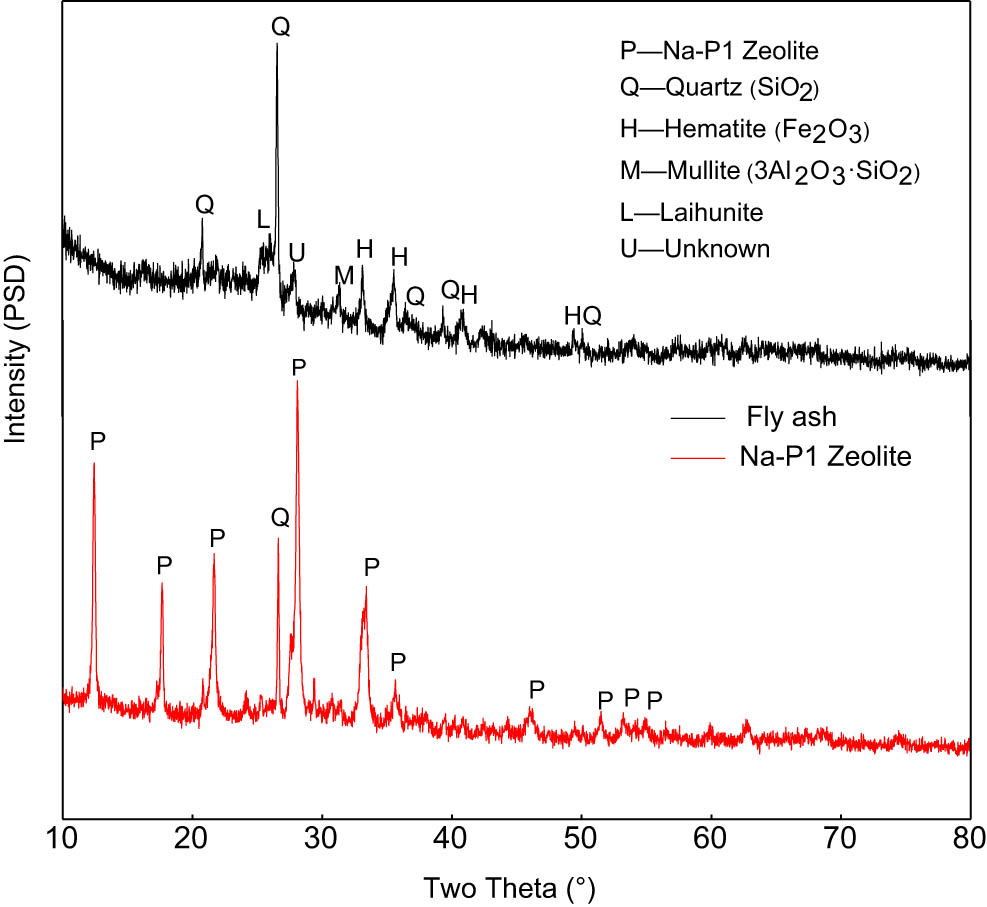
XRD patterns of fly ash and synthetic zeolite.
3.2 SEM analysis of the morphology of synthetic zeolite
The SEM pictures of fly ash and synthetic zeolite are shown in Figure 2. Fly ash particles were spherical and amorphous with the loose structure. The surfaces of these particles were rough, with either distributed pores of different sizes or adhered smaller particles. Previous studies found that during the hydrothermal synthesis process, quartz, amorphous silicon, and aluminum materials on the fly ash particle surface dissolve in the alkaline environment to form the zeolite crystal precursor and finally form zeolite crystal [52,53]. From the SEM pictures of the synthetic zeolite (Figure 2c and d), it can be observed that fly ash lost its original particle shape and the rough surface transformed into various shapes of crystals, such as plate and rod, which accorded well with the morphology of Na-P1 zeolite [54] and the phase analysis of XRD.
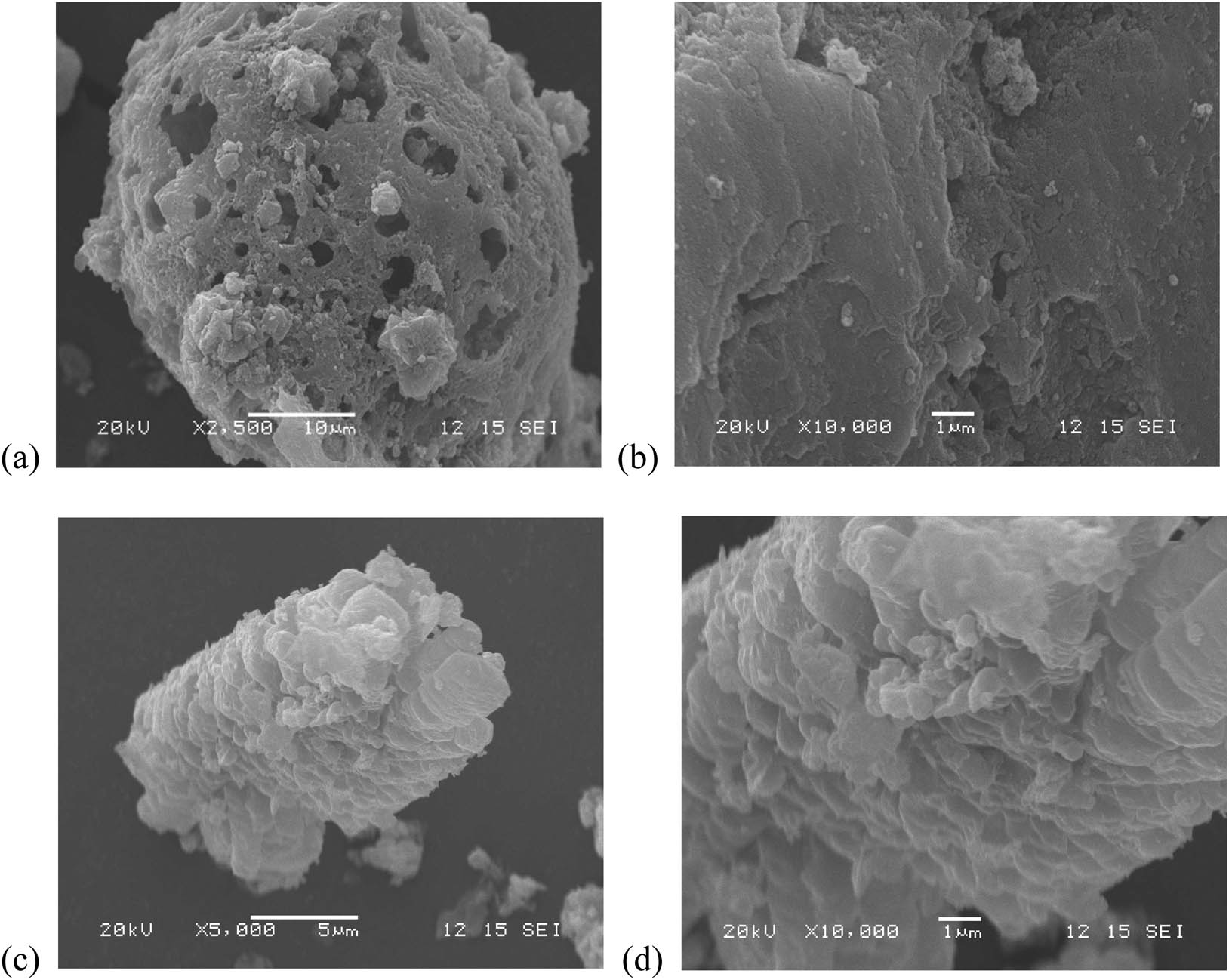
SEM photos of (a and b) fly ash and (c and d) Na-P1 zeolite at different magnifications.
3.3 Analysis of specific surface area and pore volume of synthetic zeolite
The specific surface area and pore size distribution of an adsorbent determine the contact between the target pollutants and the surface-active groups of the adsorbent, which are the key factors affecting the adsorption performance [55]. The adsorption and desorption isotherms of N2 at low temperature and pore size distribution of fly ash and Na-P1 zeolite are shown in Figure 3. Although the adsorption curves of fly ash and Na-P1 zeolite were slightly different, both conformed to the type II isotherms as per the International Union of Pure and Applied Chemistry (IUPAC) classification, which generally presented the inverse “S” shape. At low relative pressure (P/P 0 = 0–0.3), the curves rose slowly and were slightly convex upward, which the adsorption of N2 by fly ash and Na-P1 zeolite changed from monolayer to multilayer. With the relative pressure ascending (P/P 0 = 0.3–0.8), the adsorption capacity of N2 increased slowly, which showed that the interaction between the solids and N2 was weak. When the system transferred from medium to high relative pressure, the adsorption capacity had a steep rise and no adsorption saturation occurred near the saturation vapor pressure. At the same time, the adsorption curve and desorption curve did not completely coincide, but formed a hysteresis loop with a certain area, indicating that both fly ash and Na-P1 zeolite contained a certain amount of mesopores and capillary condensation occurred. Different shapes of hysteresis loops reflect certain pore structure characteristics and types. The adsorption and desorption curves of fly ash and Na-P1 zeolite were similar to the type H3 hysteresis loop, which indicated that there were slit-shaped pores aggregated by plate-like particles and other pores with various shapes, which were consistent with the morphology shown in SEM images.

Adsorption–desorption isotherms and pore size distribution of (a) fly ash and (b) Na-P1 zeolite.
Comparing the pore size distribution of fly ash and Na-P1 zeolite, it can be seen that the pore volume density of fly ash and Na-P1 zeolite reached maximum values at about 20 and 5 nm, respectively, and the peak of Na-P1 zeolite was narrower, which indicated that the pore size of the synthetic zeolite became smaller and more homogeneous. It can be seen from Table 3 that after hydrothermal synthesis, the specific surface area and average pore volume of fly ash improved significantly from 4.4713 m2/g and 0.019523 cm3/g to 43.817 m2/g and 0.122088 cm3/g, respectively, an increase of nine and six times, respectively. The increase of the specific surface area when synthetic zeolite particles are formed is beneficial to phosphate adsorption and precipitation reaction [56], which can improve the adsorption performance of the synthetic zeolite for phosphorus.
Comparison of parameters of fly ash and Na-P1 zeolite
| Parameter | Specific surface area (m2/g) | Average pore size (nm) | Average pore volume (cm3/g) |
|---|---|---|---|
| Fly ash | 4.4713 | 32.7812 | 0.019523 |
| Na-P1 zeolite | 43.8170 | 11.2567 | 0.122088 |
3.4 Effect of adsorption time on phosphorus adsorption by synthetic zeolite and the adsorption kinetics
By using the synthetic zeolite to treat actual phosphorus wastewater, the phosphorus removal performance changed with time as shown in Figure 4. The phosphorus removal efficiency and adsorption capacity of synthetic zeolite gradually increased with the extension of adsorption time. When the adsorption progressed to 8 h, the phosphorus removal efficiency of synthetic zeolite increased up to 38.3% and the corresponding phosphorus adsorption capacity increased to 59.8 mg-P/g. After 8 h, the phosphorus adsorption by the synthetic zeolite basically reached equilibrium, and the removal efficiency and adsorption capacity of phosphorus were stabilized at about 38% and 60 mg-P/g, respectively. At the beginning of the adsorption, a large amount of phosphorus was adsorbed in a short time due to the large phosphorus concentration difference at the solid–liquid interface in the system, and the resulting hydraulic mass transfer force [57], which made the phosphorus removal efficiency and adsorption capacity of the synthetic zeolite to increase rapidly. When the adsorption time was extended from 8 to 30 h, most of the adsorption sites on the synthetic zeolite were occupied and the phosphorus concentration gradient in wastewater decreased gradually, which led to the stabilization of phosphorus removal efficiency of synthetic zeolite. The observed fluctuation of the phosphorus removal effect after the adsorption equilibrium may be due to experimental environmental factors. The optimum adsorption time of synthetic zeolite was 8 h.
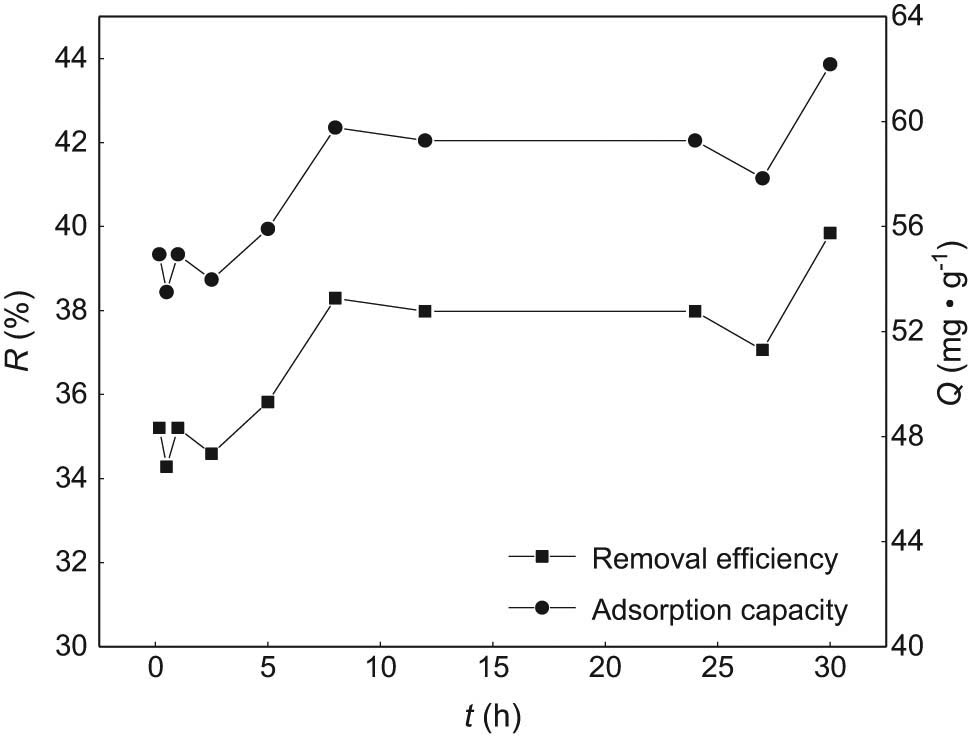
Effect of time on phosphorus removal.
Pseudo-first-order kinetics and pseudo-second-order kinetics are common kinetic models. To further evaluate the adsorption characteristics of synthetic zeolite for phosphorus removal in wastewater, this study used these two models to analyze the kinetic characteristics of the phosphorus adsorption reaction. The two model equations are shown in Eqs. 3–5.
Pseudo-first-order kinetic equation:
(3)where Q t is the adsorption capacity at a certain time (mg/g); Q e is the adsorption capacity at equilibrium (mg/g); k 1 is the adsorption rate constant of pseudo-first-order kinetics (h−1); and t is the reaction time (h).
Pseudo-second-order kinetic equation:
This kinetic equation can also be expressed as a linear equation as per Eq. 5:
where Q t is the adsorption capacity at a certain time (mg/g); Q e is the adsorption capacity at equilibrium (mg/g); k 2 is the adsorption rate constant of pseudo-second-order kinetics (g/(mg h)); t is the reaction time (h); and k 2 and theoretical Q e can be calculated by plotting t and t/Q t , respectively.
The fitted adsorption kinetics curves of phosphorus are shown in Figures 5 and 6. Table 4 presents the kinetic parameters and regression coefficients (R
2) obtained from the nonlinear fitting between the values of Q
t and t and the linear fitting between t/Q
t and t. The results showed that the adsorption of phosphorus by the synthetic zeolite was more in line with the pseudo-second-order kinetics with the regression coefficient of 0.998, and the fitted equilibrium adsorption capacity Q
e value was close to the actual adsorption value, which indicated that the adsorption process of phosphorus was controlled by chemical adsorption [58]. In this experiment, the pH value of the actual phosphorus wastewater was about 1.8, which indicated that the wastewater was strongly acidic. At this pH, the proton donating species in water were H3PO4 or
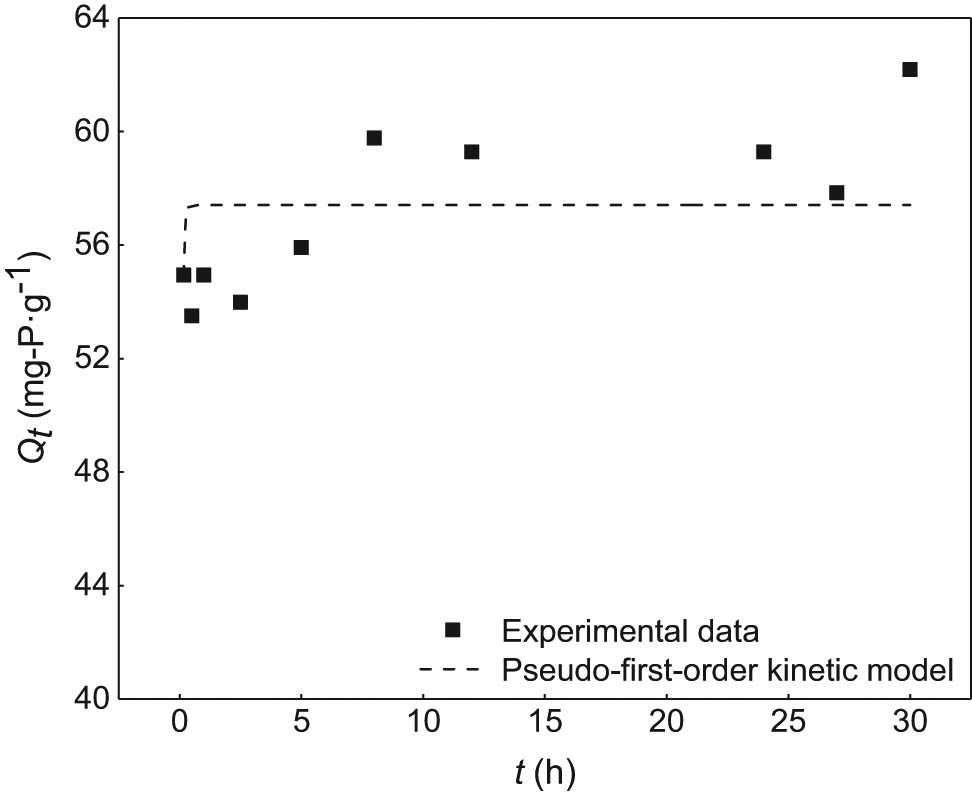
The pseudo-first-order kinetic fitting of phosphorus adsorption on synthetic zeolite.
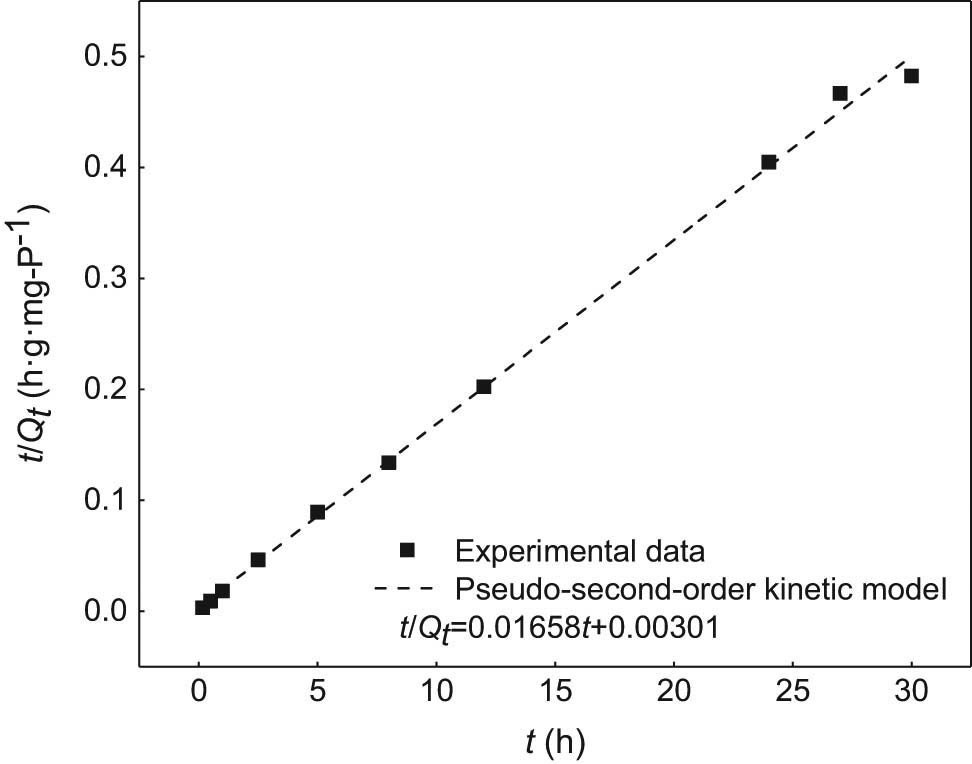
The pseudo-second-order kinetic fitting for phosphorus adsorption on synthetic zeolite.
The kinetic fitting parameters of phosphorus adsorption on synthetic zeolite
| Pseudo-first-order kinetic model | Pseudo-second-order kinetic model | ||||
|---|---|---|---|---|---|
| Q e (mg-P/g) | k 1 (h−1) | R 2 | Q e (mg-P/g) | k 2 (g/mg h) | R 2 |
| 57.41 | 18.44 | 0.072 | 60.24 | 0.09 | 0.998 |
Moreover, the metal irons (such as Ca2+, Fe3+, and Fe2+) in the synthetic zeolite will dissolve and form phosphate precipitation with H3PO4 and
3.5 Effect of initial concentration on phosphorus adsorption by synthetic zeolite and the adsorption isotherm
The phosphorus removal efficiency and adsorption capacity of the synthetic zeolite for phosphorus wastewater with different initial concentrations are shown in Figure 7. The results show that with the increase of initial phosphorus concentration, the phosphorus removal efficiency increased first and then declined, while the adsorption capacity kept increasing. Overall, the phosphorus removal efficiency by the synthetic zeolite was above 35% for 500–8,000 mg/L of phosphorus wastewater. When the initial concentration increased from 500 to 2,000 mg/L, the phosphorus removal efficiency increased up to 57.6%, and once the initial concentration changed from 2,000 to 8,000 mg/L, it decreased significantly. This indicated that the synthetic zeolite had more vacant adsorption active sites at lower initial concentration; however, if the initial concentration of phosphorus wastewater exceeded a certain value, most of the active sites were occupied, which resulted in the decline of removal efficiency.
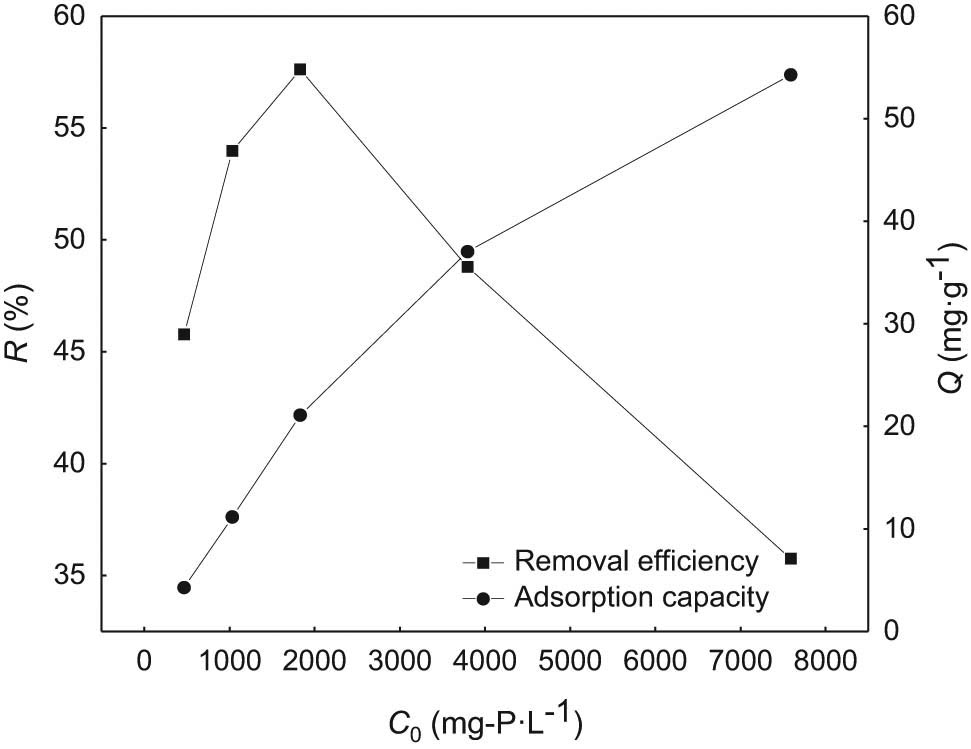
Effect of initial concentration on phosphorus removal.
To preliminarily explore the adsorption behavior and mechanism of phosphorus on synthetic zeolite, two commonly used isothermal adsorption models were considered to fit and analyze the adsorption characteristics of synthetic zeolite – the Langmuir and Freundlich adsorption isotherms. The isothermal adsorption models are specifically shown in Eqs. 8–10.
Langmuir isotherm equation:
(8)The separation constant R L of the adsorption reaction can be further obtained from the Langmuir equation:
(9)where Q e and Q m are the equilibrium and saturated adsorption capacity per unit weight of adsorbent (mg/g), respectively; C 0 and C e are the initial and equilibrium mass concentration of phosphorus in wastewater (mg/L), respectively; K L is the Langmuir constant (L/mg), which is related to the binding site affinity [54]; R L is a separation constant of dimension 1 in the Langmuir adsorption model, which is used to describe the adsorption performance of adsorbent. When R L < 1, the adsorption process is considered to be beneficial, and if R L > 1, the adsorption process is nonbeneficial.
Freundlich isotherm equation:
where K F and 1/n are the Freundlich adsorption equilibrium constants, which represent the affinity coefficient and adsorption strength, respectively. When 0 < 1/n < 1, the adsorption process is beneficial.
The fitted curves of the isothermal adsorption models are shown in Figure 8, and Table 5 presents the adsorption parameters and regression coefficients (R 2) obtained from the nonlinear fitting between the values of Q e and C e. The regression coefficients of Langmuir and Freundlich isotherms were 0.989 and 0.959, respectively. Compared with the Freundlich isotherm, the Langmuir isotherm had a higher fitting correlation. Therefore, the isothermal adsorption of phosphorus by the synthetic zeolite was better fitted to the Langmuir isotherm. The phosphorus adsorption on synthetic zeolite was a uniform monolayer, and the maximum phosphorus adsorption capacity was 84.4 mg/g. According to Table 5, the separation constant R L of the Langmuir isotherm ranged from 0.257 to 0.849 and the Freundlich isotherm constant 1/n was 0.6045, meeting the limits of 0 < R L < 1 and 0 < 1/n < 1, which indicated that the adsorption process of the synthetic zeolite for phosphorus was beneficial adsorption and the synthetic zeolite had good adsorption performance for phosphorus.

The isothermal adsorption fitting curves of phosphorus on synthetic zeolite.
The isothermal adsorption fitting parameters of Langmuir and Freundlich
| Langmuir | Freundlich | |||||
|---|---|---|---|---|---|---|
| Q m (mg-P/g) | K L | R 2 | R L | K F | 1/n | R 2 |
| 84.436 | 3.7996 × 10⁻⁴ | 0.989 | 0.257∼0.849 | 0.332 | 0.6045 | 0.959 |
Table 6 presents the maximum phosphate adsorption capacity of the zeolite adsorbent reported in the previous literature and that prepared in this study. According to Table 6, it can be roughly determined that the synthetic zeolite prepared in this study is an adsorbent with high phosphorus adsorption capacity. This indicates that the zeolite synthesized from fly ash has a broad prospect in phosphate removal from wastewater. In addition, due to the complex composition of actual phosphorus wastewater, which contains a variety of anions (such as arsenic, phosphate, and nitrite), the selectivity trend of adsorbents for these ions completely depends on the Hofmeister series. Adsorbents prefer low hydrated anions to high hydrated ones so long as the charge number of anions is equal as that pointed out in the previous studies [12,15,16,17,27,43]. Therefore, in the future research, except for studying the influence of the structure and composition of synthetic zeolite, adsorption time, and initial phosphorus concentration on the adsorption performance, other influencing factors such as coexisting ions in wastewater, pH of wastewater, and zeolite dosage should also be studied. The reusability of the synthetic zeolite also needs to be explored.
Comparison of phosphorus adsorption capacity of various zeolite adsorbents
| Material | Maximum phosphorus adsorption capacity (mg/g) | References |
|---|---|---|
| Na-ZFA | 35.31 | Wu et al. [34] |
| HC-Z | 87.51 | Ji et al. [38] |
| ZXH | 149 | Bonetti et al. [42] |
| ZFA | 11.79–47.17 | Chen et al. [56] |
| La-P1 | 58.2 | Goscianska et al. [59] |
| HUD Zeolite | 79.4 | Onyango et al. [60] |
| NaP1-FA | 57 ± 5 | Hermassi et al. [61] |
| Z-Fe | 3.4 ± 0.2 | Guaya et al. [62] |
| ZFA | 84.44 | Present study |
4 Conclusion
In this study, Na-P1 zeolite was hydrothermally synthesized from fly ash for phosphorus removal in wastewater. The adsorption kinetics and isotherm experiments were carried out to determine the adsorption performance of the synthetic zeolite. The characterization of the zeolite indicated that the crystal form of Na-P1 zeolite was intact, and its specific surface area and average pore volume increased significantly, which were nine and six times of that of fly ash, respectively. This change can improve the phosphorus adsorption performance of the synthetic zeolite. In the adsorption kinetics study, the phosphorus uptake by the synthetic zeolite increased gradually with the extension of adsorption time and stabilized after 8 h. The adsorption process was well fitted to pseudo-second-order kinetics, and the regression coefficient (R 2) was 0.998. Adsorption isotherm study showed that the equilibrium phosphorus uptake increased followed by a sharp decrease in the increase of initial concentration. The Langmuir model can well explain the phosphorus adsorption on the synthetic zeolite, and R 2 was 0.989. It indicated that the phosphorus adsorption on the synthetic zeolite was dominated by monolayer chemical adsorption. The maximum phosphorus adsorption capacity calculated was 84.4 mg/g. The synthetic zeolite in this study showed a high phosphorus adsorption capacity and was promising in phosphate removal from wastewater.
-
Funding information: This work was financially supported by Hubei Tailings (Slag) Resource Utilization Engineering Technology Research Center Project (No. 2019ZYYD070) and China Geological Survey Project (DD20190626). This work is based on the research supported in part by the National Research Foundation of South Africa (Grant No. 118907).
-
Author contributions: Kecheng Zhang: responsible for analysis and interpretation of data and writing of the paper; Lizelle van Dyk: in charge of study design, collection of data, and revision of the paper; Dongsheng He: responsible for the decision to submit the paper for publication; Jie Deng, Shuang Liu, and Hengqin Zhao: in charge of material and technical supports.
-
Conflict of interest: The authors state no conflict of interest.
References
[1] Choi JW, Lee SY, Lee SH, Kim JE, Park KY, Kim DJ, et al. Comparison of surface-modified adsorbents for phosphate removal in water. Water Air Soil Poll. 2012;223(6):2881–90. 10.1007/s11270-011-1072-6.Search in Google Scholar
[2] Ismail ZZ. Kinetic study for phosphate removal from water by recycled date-palm wastes as agricultural by-products. Int J Environ Stud. 2012;69(1):135–49. 10.1080/00207233.2012.656975.Search in Google Scholar
[3] Mallampati R, Valiyaveettil S. Apple peel-a versatile biomass for water purification. ACS Appl Mater Inter. 2013;5(10):4443–9. 10.1021/am400901e.Search in Google Scholar
[4] Zhao Y, Wang J, Luan Z, Peng X, Liang Z, Shi L. Removal of phosphate from aqueous solution by red mud using a factorial design. J Hazard Mater. 2009;165(1–3):1193–9. 10.1016/j.jhazmat.2008.10.114.Search in Google Scholar
[5] Inamori S, Sudo R. Future aspect and present conditions of water environment. Jpn Soc Precis Eng. 1992;58(1):30–7. 10.2493/jjspe.58.30.Search in Google Scholar
[6] Dennison WC, Orth RJ, Moore KA, Stevenson JC, Carter V, Kollar S, et al. Assessing water quality with submersed aquatic vegetation. Bioscience. 1993;43(2):86–94. 10.2307/1311969.Search in Google Scholar
[7] Benyoucef S, Amrani M. Adsorption of phosphate ions onto low cost Aleppo pine adsorbent. Desalination. 2011;275(1):231–6. 10.1016/j.desal.2011.03.004.Search in Google Scholar
[8] Kalmykova Y, Fedje KK. Phosphorus recovery from municipal solid waste incineration fly ash. Waste Manage. 2013;33(6):1403–10. 10.1016/j.wasman.2013.01.040.Search in Google Scholar
[9] Seo YI, Hong KH, Kim SH, Chang D, Lee KH, Kim YD. Phosphorus removal from wastewater by ionic exchange using a surface-modified Al alloy filter. J Ind Eng Chem. 2013;19(3):744–7. 10.1016/j.jiec.2012.11.008.Search in Google Scholar
[10] Clark T, Stephenson T, Pearce PA. Phosphorus removal by chemical precipitation in a biological aerated filter. Water Res. 1997;31(10):2557–63. 10.1016/S0043-1354(97)00091-2.Search in Google Scholar
[11] Sherwood LJ, Qualls RG. Stability of phosphorus within a wetland soil following ferric chloride treatment to control eutrophication. Environ Sci Technol. 2001;35(20):4126–31.10.1021/es0106366Search in Google Scholar
[12] Awual MR, Jyo A. Assessing of phosphorus removal by polymeric anion exchangers. Desalination. 2011;281:111–7. 10.1016/j.desal.2011.07.047.Search in Google Scholar
[13] Nur T, Johir MAH, Loganathan P, Nguyen T, Vigneswaran S, Kandasamy J. Phosphate removal from water using an iron oxide impregnated strong base anion exchange resin. J Ind Eng Chem. 2014;20(4):1301–7. 10.1016/j.jiec.2013.07.009.Search in Google Scholar
[14] Acelas NY, Martin BD, López DP, Jefferson B. Selective removal of phosphate from wastewater using hydrated metal oxides dispersed within anionic exchange media. Chemosphere. 2015;119:1353–60. 10.1016/j.chemosphere.2014.02.024.Search in Google Scholar
[15] Awual MR, Jyo A, Ihara T, Seko N, Tamada M, Lim KT. Enhanced trace phosphate removal from water by zirconium(iv) loaded fibrous adsorbent. Water Res. 2011;45(15):4592–600. 10.1016/j.watres.2011.06.009.Search in Google Scholar
[16] Awual MR, Shenashen MA, Jyo A, Shiwaku H, Yaita T. Preparing of novel fibrous ligand exchange adsorbent for rapid column-mode trace phosphate removal from water. J Ind Eng Chem. 2014;20(5):2840–7. 10.1016/j.jiec.2013.11.016.Search in Google Scholar
[17] Awual MR, El-Safty SA, Jyo A. Removal of trace arsenic(V) and phosphate from water by a highly selective ligand exchange adsorbent. J Environ Sci. 2011;23(12):1947–54. 10.1016/S1001-0742(10)60645-6.Search in Google Scholar
[18] Ghosh S, Lobanov S, Lo VK. An overview of technologies to recover phosphorus as struvite from wastewater: advantages and shortcomings. Environ Sci Pollut R. 2019;26:19063–77. 10.1007/s11356-019-05378-6.Search in Google Scholar PubMed
[19] Lu B, Xu JC, Zhang M, Pang WH, Xie L. Phosphorus removal and recovery from wastewater by highly efficient struvite crystallization in an improved fluidized bed reactor. Korean J Chem Eng. 2017;34(11):2879–85. 10.1007/s11814-017-0203-1.Search in Google Scholar
[20] Chen YN, Liu C, Guo L, Nie JX, Li C. Removal and recovery of phosphate anion as struvite from wastewater. Clean Technol Env. 2018;20:2375–80. 10.1007/s10098-018-1607-2.Search in Google Scholar
[21] Penetra RG, Reali MAP, Foresti E, Campos JR. Post-treatment of effluents from anaerobic reactor treating domestic sewage by dissolved air flotation. Water Sci Technol. 1999;40(8):137–43. 10.1016/S0273-1223(99)00619-8.Search in Google Scholar
[22] Arnz P, Arnold E, Wilderer PA. Enhanced biological phosphorus removal in a semi full-scale SBBR. Water Sci Technol. 2001;43(3):167–74. 10.2166/wst.2001.0133.Search in Google Scholar
[23] Bunce JT, Ndam E, Ofiteru ID, Moore A, Graham DW. A review of phosphorus removal technologies and their applicability to small-scale domestic wastewater treatment systems. Front Environ Sci. 2018;6:8. 10.3389/fenvs.2018.00008.Search in Google Scholar
[24] Brown N, Shilton A. Luxury uptake of phosphorus by microalgae in waste stabilisation ponds: current understanding and future direction. Rev Environ Sci Biol. 2014;13:321–8. 10.1007/s11157-014-9337-3.Search in Google Scholar
[25] Martínez ME, Sánchez S, Jiménez JM, Yousfi FE, Muñoz L. Nitrogen and phosphorus removal from urban wastewater by the microalga Scenedesmus obliquus. Bioresour Technol. 2000;73(3):263–72. 10.1016/S0960-8524(99)00121-2.Search in Google Scholar
[26] Shi J, Podola B, Melkonian M. Removal of nitrogen and phosphorus from wastewater using microalgae immobilized on twin layers: an experimental study. J Appl Phycol. 2007;19:417–23. 10.1007/s10811-006-9148-1.Search in Google Scholar
[27] Awual MR, Jyo A, El-Safty SA, Tamada M, Seko N. A weak-base fibrous anion exchanger effective for rapid phosphate removal from water. J Hazard Mater. 2011;188(1–3):164–71. 10.1016/j.jhazmat.2011.01.092.Search in Google Scholar
[28] Morse GK, Brett SW, Guy JA, Lester JN. Review: phosphorus removal and recovery technologies. Sci Total Environ. 1998;212(1):69–81. 10.1016/S0048-9697(97)00332-X.Search in Google Scholar
[29] Urano K, Tachikawa H. Process development for removal and recovery of phosphorus from wastewater by a new adsorbent. 1. Preparation method and adsorption capability of a new adsorbent. Ind Eng Chem Res. 1991;30(8):1893–6. 10.1021/ie00056a032.Search in Google Scholar
[30] Zuo Y, Fu XN, Chen Y, Cui GR, Liu M. Phosphorus removal from wastewater using a lanthanum oxide-loaded ceramic adsorbent. Adsorption. 2016;22:1091–8. 10.1007/s10450-016-9831-8.Search in Google Scholar
[31] Karapinar N. Application of natural zeolite for phosphorus and ammonium removal from aqueous solutions. J Hazard Mater. 2009;170(2–3):1186–91. 10.1016/j.jhazmat.2009.05.094.Search in Google Scholar
[32] Van Der Bij HE, Weckhuysen BM. Phosphorus promotion and poisoning in zeolite-based materials: synthesis, characterisation and catalysis. Chem Soc Rev. 2015;44(20):7406–28. 10.1039/C5CS00109A.Search in Google Scholar
[33] Wang SB, Peng YL. Natural zeolites as effective adsorbents in water and wastewater treatment. Chem Eng J. 2010;156(1):11–24. 10.1016/j.cej.2009.10.029.Search in Google Scholar
[34] Wu DY, Zhang BH, Li CJ, Zhang ZJ, Kong HN. Simultaneous removal of ammonium and phosphate by zeolite synthesized from fly ash as influenced by salt treatment. J Colloid Interf Sci. 2006;304(2):300–6. 10.1016/j.jcis.2006.09.011.Search in Google Scholar
[35] Shaila K, Nisha D, Pralhad P, Deepa P. Zeolite synthesis strategies from coal fly ash: a comprehensive review of literature. Int Res J Environ Sci. 2015;4(3):93–9.Search in Google Scholar
[36] Singh RP, Gupta AK, Ibrahim MH, Mittal AK. Coal fly ash utilization in agriculture: its potential benefits and risks. Rev Environ Sci Biotechnol. 2010;9(4):345–58. 10.1007/s11157-010-9218-3.Search in Google Scholar
[37] Hamdi N, Srasra E. Removal of phosphate ions from aqueous solution using Tunisian clays minerals and synthetic zeolite. J Environ Sci. 2012;24(4):617–23. 10.1016/S1001-0742(11)60791-2.Search in Google Scholar
[38] Ji X, Zhang M, Wang Y, Song Y, Ke Y, Wang Y. Immobilization of ammonium and phosphate in aqueous solution by zeolites synthesized from fly ashes with different compositions. J Ind Eng Chem. 2015;22:1–7. 10.1016/j.jiec.2014.06.017.Search in Google Scholar
[39] Wan C, Ding S, Zhang C, Tan X, Zou W, Liu X, et al. Simultaneous recovery of nitrogen and phosphorus from sludge fermentation liquid by zeolite adsorption: mechanism and application. Sep Purif Technol. 2017;180:1–12. 10.1016/j.seppur.2017.02.031.Search in Google Scholar
[40] Wang Z, Fan Y, Li YW, Qu FR, Wu DY, Kong HN. Synthesis of zeolite/hydrous lanthanum oxide composite from coal fly ash for efficient phosphate removal from lake water. Micropor Mesopor Mat. 2016;222(1):226–34. 10.1016/j.micromeso.2015.10.028.Search in Google Scholar
[41] Lateef A, Nazir R, Jamil N, Alam S, Shah R, Khan MN, et al. Synthesis and characterization of zeolite based nano-composite: an environment friendly slow release fertilizer. Micropor Mesopor Mat. 2016;232:174–83. 10.1016/j.micromeso.2016.06.020.Search in Google Scholar
[42] Bonetti B, Waldow EC, Trapp G, Hammercshmitt ME, Ferrarini SF, Pires MJR, et al. Production of zeolitic materials in pilot scale based on coal ash for phosphate and potassium adsorption in order to obtain fertilizer. Environ Sci Pollut Res. 2021;28(3):1–17. 10.1007/s11356-020-11447-y.Search in Google Scholar
[43] Awual MR, Jyo A. Rapid column-mode removal of arsenate from water by crosslinked poly(allylamine) resin. Water Res. 2009;43(5):1229–36. 10.1016/j.watres.2008.12.018.Search in Google Scholar
[44] Awual MR. A facile composite material for enhanced cadmium(ii) ion capturing from wastewater. J Environ Chem Eng. 2019;7(5):103378. 10.1016/j.jece.2019.103378.Search in Google Scholar
[45] Awual MR, Hasan MM. A ligand based innovative composite material for selective lead(ii) capturing from wastewater. J Mol Liq. 2019;294:111679. 10.1016/j.molliq.2019.111679.Search in Google Scholar
[46] Awual MR, Hasan MM, Asiri AM, Rahman MM. Cleaning the arsenic(v) contaminated water for safe-guarding the public health using novel composite material. Compos Part B Eng. 2019;171(Aug 15):294–301. 10.1016/j.compositesb.2019.05.078.Search in Google Scholar
[47] Chareonpanich M, Jullaphan O, Tang C. Bench-scale synthesis of zeolite A from subbituminous coal ashes with high crystalline silica content. J Clean Prod. 2011;19(1):58–63. 10.1016/j.jclepro.2010.08.012.Search in Google Scholar
[48] Wang CF, Li JS, Wang LJ, Sun XY. Influence of NaOH concentrations on synthesis of pure-form zeolite A from fly ash using two-stage method. J Hazard Mater. 2008;155(1–2):58–64. 10.1016/j.jhazmat.2007.11.028.Search in Google Scholar
[49] Ameh AE, Fatoba OO, Musyoka NM, Petrik LF. Influence of aluminium source on the crystal structure and framework coordination of Al and Si in fly ash-based zeolite NaA. Powder Technol. 2017;306:17–25. 10.1016/j.powtec.2016.11.003.Search in Google Scholar
[50] Eaton AD, Clesceri LS, Greenberg AE. Standard methods for the examination of water and waste water. 20th ed. Washington, DC: APHA, AWWA, WEF; 1998.Search in Google Scholar
[51] Wu DY, Sui YM, Chen XC, He SB, Wang XZ, Kong HN. Changes of mineralogical–chemical composition, cation exchange capacity, and phosphate immobilization during the hydrothermal conversion process of coal fly ash into zeolite. Fuel. 2008;87(10–11):2194–200. 10.1016/j.fuel.2007.10.028.Search in Google Scholar
[52] Murayama N, Yamamoto H, Shibata J. Mechanism of zeolite synthesis from coal fly ash by alkali hydrothermal reaction. Int J Min Process. 2002;64(1):1–17. 10.1016/S0301-7516(01)00046-1.Search in Google Scholar
[53] Wu DY, Kong HN, Zhao TG, Wang C, Ye C. Effect of synthesis conditions on the formation and quality of zeolite during the hydrothermal zeolitization processes of fly ash. J Inorg Mater. 2005;20(5):1153–8. 10.3321/j.issn:1000-324X.2005.05.022 (Chinese).Search in Google Scholar
[54] Pengthamkeerati P, Satapanajaru T, Chularuengoaksorn P. Chemical modification of coal fly ash for the removal of phosphate from aqueous solution. Fuel. 2008;87(12):2469–76. 10.1016/j.fuel.2008.03.013.Search in Google Scholar
[55] Wang LL, Zhang ZM, Ding AQ, Cheng R, Zhang MJ, Wu DL. Modification of zeolite materials and their adsorption properties for the pollutants in aqueous solution. Chem Ind Eng Prog. 2018;37(6):2269–81 (Chinese).Search in Google Scholar
[56] Chen JG, Kong HN, Wu DY, Hu ZB, Wang ZS, Wang YH. Removal of phosphate from aqueous solution by zeolite synthesized from fly ash. J Colloid Interf Sci. 2006;300(2):491–7. 10.1016/j.jcis.2006.04.010.Search in Google Scholar PubMed
[57] Lv CP. Study on adsorption characteristics of ammonia nitrogen in wastewater by fly ash zeolite, MSc Dissertation. Chongqing University, Chongqing; 2018.Search in Google Scholar
[58] Xu DY, Zhang M, Yang WW, Liu TT, Yao QF, Hong YJ. Preparation of alumina modified sludge biocharcoal particles and their adsorption characteristics for Pb(Ⅱ). Chem Ind Eng Prog. 2020;39(3):1153–66. 10.16085/j.issn.1000-6613.2019-1003 (Chinese).Search in Google Scholar
[59] Goscianska J, Ptaszkowska-Koniarz M, Frankowski M, Franus M, Panek R, Franus W. Removal of phosphate from water by lanthanum-modified zeolites obtained from fly ash. J Colloid Interf Sci. 2018;513:72–81. 10.1016/j.jcis.2017.11.003.Search in Google Scholar PubMed
[60] Onyango MS, Kuchar D, Kubota M, Matsuda H. Adsorptive removal of phosphate ions from aqueous solution using synthetic zeolite. Ind Eng Chem Res. 2007;46(3):894–900. 10.1021/ie060742m.Search in Google Scholar
[61] Hermassi M, Valderrama C, Moreno N, Font O, Querol X, Batis N, et al. Powdered Ca-activated zeolite for phosphate removal from treated waste-water. J Chem Technol Biotechnol. 2016;91(7):1962–71. 10.1002/jctb.4867.Search in Google Scholar
[62] Guaya D, Valderrama C, Farran A, Cortina JL. Modification of a natural zeolite with Fe(iii) for simultaneous phosphate and ammonium removal from aqueous solutions. J Chem Technol Biotechnol. 2016;91(6):1737–46. 10.1002/jctb.4763.Search in Google Scholar
© 2021 Kecheng Zhang et al., published by De Gruyter
This work is licensed under the Creative Commons Attribution 4.0 International License.
Articles in the same Issue
- Research Articles
- MW irradiation and ionic liquids as green tools in hydrolyses and alcoholyses
- Effect of CaO on catalytic combustion of semi-coke
- Studies of Penicillium species associated with blue mold disease of grapes and management through plant essential oils as non-hazardous botanical fungicides
- Development of leftover rice/gelatin interpenetrating polymer network films for food packaging
- Potent antibacterial action of phycosynthesized selenium nanoparticles using Spirulina platensis extract
- Green synthesized silver and copper nanoparticles induced changes in biomass parameters, secondary metabolites production, and antioxidant activity in callus cultures of Artemisia absinthium L.
- Gold nanoparticles from Celastrus hindsii and HAuCl4: Green synthesis, characteristics, and their cytotoxic effects on HeLa cells
- Green synthesis of silver nanoparticles using Tropaeolum majus: Phytochemical screening and antibacterial studies
- One-step preparation of metal-free phthalocyanine with controllable crystal form
- In vitro and in vivo applications of Euphorbia wallichii shoot extract-mediated gold nanospheres
- Fabrication of green ZnO nanoparticles using walnut leaf extract to develop an antibacterial film based on polyethylene–starch–ZnO NPs
- Preparation of Zn-MOFs by microwave-assisted ball milling for removal of tetracycline hydrochloride and Congo red from wastewater
- Feasibility of fly ash as fluxing agent in mid- and low-grade phosphate rock carbothermal reduction and its reaction kinetics
- Three combined pretreatments for reactive gasification feedstock from wet coffee grounds waste
- Biosynthesis and antioxidation of nano-selenium using lemon juice as a reducing agent
- Combustion and gasification characteristics of low-temperature pyrolytic semi-coke prepared through atmosphere rich in CH4 and H2
- Microwave-assisted reactions: Efficient and versatile one-step synthesis of 8-substituted xanthines and substituted pyrimidopteridine-2,4,6,8-tetraones under controlled microwave heating
- New approach in process intensification based on subcritical water, as green solvent, in propolis oil in water nanoemulsion preparation
- Continuous sulfonation of hexadecylbenzene in a microreactor
- Synthesis, characterization, biological activities, and catalytic applications of alcoholic extract of saffron (Crocus sativus) flower stigma-based gold nanoparticles
- Foliar applications of plant-based titanium dioxide nanoparticles to improve agronomic and physiological attributes of wheat (Triticum aestivum L.) plants under salinity stress
- Simultaneous leaching of rare earth elements and phosphorus from a Chinese phosphate ore using H3PO4
- Silica extraction from bauxite reaction residue and synthesis water glass
- Metal–organic framework-derived nanoporous titanium dioxide–heteropoly acid composites and its application in esterification
- Highly Cr(vi)-tolerant Staphylococcus simulans assisting chromate evacuation from tannery effluent
- A green method for the preparation of phoxim based on high-boiling nitrite
- Silver nanoparticles elicited physiological, biochemical, and antioxidant modifications in rice plants to control Aspergillus flavus
- Mixed gel electrolytes: Synthesis, characterization, and gas release on PbSb electrode
- Supported on mesoporous silica nanospheres, molecularly imprinted polymer for selective adsorption of dichlorophen
- Synthesis of zeolite from fly ash and its adsorption of phosphorus in wastewater
- Development of a continuous PET depolymerization process as a basis for a back-to-monomer recycling method
- Green synthesis of ZnS nanoparticles and fabrication of ZnS–chitosan nanocomposites for the removal of Cr(vi) ion from wastewater
- Synthesis, surface modification, and characterization of Fe3O4@SiO2 core@shell nanostructure
- Antioxidant potential of bulk and nanoparticles of naringenin against cadmium-induced oxidative stress in Nile tilapia, Oreochromis niloticus
- Variability and improvement of optical and antimicrobial performances for CQDs/mesoporous SiO2/Ag NPs composites via in situ synthesis
- Green synthesis of silver nanoparticles: Characterization and its potential biomedical applications
- Green synthesis, characterization, and antimicrobial activity of silver nanoparticles prepared using Trigonella foenum-graecum L. leaves grown in Saudi Arabia
- Intensification process in thyme essential oil nanoemulsion preparation based on subcritical water as green solvent and six different emulsifiers
- Synthesis and biological activities of alcohol extract of black cumin seeds (Bunium persicum)-based gold nanoparticles and their catalytic applications
- Digera muricata (L.) Mart. mediated synthesis of antimicrobial and enzymatic inhibitory zinc oxide bionanoparticles
- Aqueous synthesis of Nb-modified SnO2 quantum dots for efficient photocatalytic degradation of polyethylene for in situ agricultural waste treatment
- Study on the effect of microwave roasting pretreatment on nickel extraction from nickel-containing residue using sulfuric acid
- Green nanotechnology synthesized silver nanoparticles: Characterization and testing its antibacterial activity
- Phyto-fabrication of selenium nanorods using extract of pomegranate rind wastes and their potentialities for inhibiting fish-borne pathogens
- Hydrophilic modification of PVDF membranes by in situ synthesis of nano-Ag with nano-ZrO2
- Paracrine study of adipose tissue-derived mesenchymal stem cells (ADMSCs) in a self-assembling nano-polypeptide hydrogel environment
- Study of the corrosion-inhibiting activity of the green materials of the Posidonia oceanica leaves’ ethanolic extract based on PVP in corrosive media (1 M of HCl)
- Callus-mediated biosynthesis of Ag and ZnO nanoparticles using aqueous callus extract of Cannabis sativa: Their cytotoxic potential and clinical potential against human pathogenic bacteria and fungi
- Ionic liquids as capping agents of silver nanoparticles. Part II: Antimicrobial and cytotoxic study
- CO2 hydrogenation to dimethyl ether over In2O3 catalysts supported on aluminosilicate halloysite nanotubes
- Corylus avellana leaf extract-mediated green synthesis of antifungal silver nanoparticles using microwave irradiation and assessment of their properties
- Novel design and combination strategy of minocycline and OECs-loaded CeO2 nanoparticles with SF for the treatment of spinal cord injury: In vitro and in vivo evaluations
- Fe3+ and Ce3+ modified nano-TiO2 for degradation of exhaust gas in tunnels
- Analysis of enzyme activity and microbial community structure changes in the anaerobic digestion process of cattle manure at sub-mesophilic temperatures
- Synthesis of greener silver nanoparticle-based chitosan nanocomposites and their potential antimicrobial activity against oral pathogens
- Baeyer–Villiger co-oxidation of cyclohexanone with Fe–Sn–O catalysts in an O2/benzaldehyde system
- Increased flexibility to improve the catalytic performance of carbon-based solid acid catalysts
- Study on titanium dioxide nanoparticles as MALDI MS matrix for the determination of lipids in the brain
- Green-synthesized silver nanoparticles with aqueous extract of green algae Chaetomorpha ligustica and its anticancer potential
- Curcumin-removed turmeric oleoresin nano-emulsion as a novel botanical fungicide to control anthracnose (Colletotrichum gloeosporioides) in litchi
- Antibacterial greener silver nanoparticles synthesized using Marsilea quadrifolia extract and their eco-friendly evaluation against Zika virus vector, Aedes aegypti
- Optimization for simultaneous removal of NH3-N and COD from coking wastewater via a three-dimensional electrode system with coal-based electrode materials by RSM method
- Effect of Cu doping on the optical property of green synthesised l-cystein-capped CdSe quantum dots
- Anticandidal potentiality of biosynthesized and decorated nanometals with fucoidan
- Biosynthesis of silver nanoparticles using leaves of Mentha pulegium, their characterization, and antifungal properties
- A study on the coordination of cyclohexanocucurbit[6]uril with copper, zinc, and magnesium ions
- Ultrasound-assisted l-cysteine whole-cell bioconversion by recombinant Escherichia coli with tryptophan synthase
- Green synthesis of silver nanoparticles using aqueous extract of Citrus sinensis peels and evaluation of their antibacterial efficacy
- Preparation and characterization of sodium alginate/acrylic acid composite hydrogels conjugated to silver nanoparticles as an antibiotic delivery system
- Synthesis of tert-amylbenzene for side-chain alkylation of cumene catalyzed by a solid superbase
- Punica granatum peel extracts mediated the green synthesis of gold nanoparticles and their detailed in vivo biological activities
- Simulation and improvement of the separation process of synthesizing vinyl acetate by acetylene gas-phase method
- Review Articles
- Carbon dots: Discovery, structure, fluorescent properties, and applications
- Potential applications of biogenic selenium nanoparticles in alleviating biotic and abiotic stresses in plants: A comprehensive insight on the mechanistic approach and future perspectives
- Review on functionalized magnetic nanoparticles for the pretreatment of organophosphorus pesticides
- Extraction and modification of hemicellulose from lignocellulosic biomass: A review
- Topical Issue: Recent advances in deep eutectic solvents: Fundamentals and applications (Guest Editors: Santiago Aparicio and Mert Atilhan)
- Delignification of unbleached pulp by ternary deep eutectic solvents
- Removal of thiophene from model oil by polyethylene glycol via forming deep eutectic solvents
- Valorization of birch bark using a low transition temperature mixture composed of choline chloride and lactic acid
- Topical Issue: Flow chemistry and microreaction technologies for circular processes (Guest Editor: Gianvito Vilé)
- Stille, Heck, and Sonogashira coupling and hydrogenation catalyzed by porous-silica-gel-supported palladium in batch and flow
- In-flow enantioselective homogeneous organic synthesis
Articles in the same Issue
- Research Articles
- MW irradiation and ionic liquids as green tools in hydrolyses and alcoholyses
- Effect of CaO on catalytic combustion of semi-coke
- Studies of Penicillium species associated with blue mold disease of grapes and management through plant essential oils as non-hazardous botanical fungicides
- Development of leftover rice/gelatin interpenetrating polymer network films for food packaging
- Potent antibacterial action of phycosynthesized selenium nanoparticles using Spirulina platensis extract
- Green synthesized silver and copper nanoparticles induced changes in biomass parameters, secondary metabolites production, and antioxidant activity in callus cultures of Artemisia absinthium L.
- Gold nanoparticles from Celastrus hindsii and HAuCl4: Green synthesis, characteristics, and their cytotoxic effects on HeLa cells
- Green synthesis of silver nanoparticles using Tropaeolum majus: Phytochemical screening and antibacterial studies
- One-step preparation of metal-free phthalocyanine with controllable crystal form
- In vitro and in vivo applications of Euphorbia wallichii shoot extract-mediated gold nanospheres
- Fabrication of green ZnO nanoparticles using walnut leaf extract to develop an antibacterial film based on polyethylene–starch–ZnO NPs
- Preparation of Zn-MOFs by microwave-assisted ball milling for removal of tetracycline hydrochloride and Congo red from wastewater
- Feasibility of fly ash as fluxing agent in mid- and low-grade phosphate rock carbothermal reduction and its reaction kinetics
- Three combined pretreatments for reactive gasification feedstock from wet coffee grounds waste
- Biosynthesis and antioxidation of nano-selenium using lemon juice as a reducing agent
- Combustion and gasification characteristics of low-temperature pyrolytic semi-coke prepared through atmosphere rich in CH4 and H2
- Microwave-assisted reactions: Efficient and versatile one-step synthesis of 8-substituted xanthines and substituted pyrimidopteridine-2,4,6,8-tetraones under controlled microwave heating
- New approach in process intensification based on subcritical water, as green solvent, in propolis oil in water nanoemulsion preparation
- Continuous sulfonation of hexadecylbenzene in a microreactor
- Synthesis, characterization, biological activities, and catalytic applications of alcoholic extract of saffron (Crocus sativus) flower stigma-based gold nanoparticles
- Foliar applications of plant-based titanium dioxide nanoparticles to improve agronomic and physiological attributes of wheat (Triticum aestivum L.) plants under salinity stress
- Simultaneous leaching of rare earth elements and phosphorus from a Chinese phosphate ore using H3PO4
- Silica extraction from bauxite reaction residue and synthesis water glass
- Metal–organic framework-derived nanoporous titanium dioxide–heteropoly acid composites and its application in esterification
- Highly Cr(vi)-tolerant Staphylococcus simulans assisting chromate evacuation from tannery effluent
- A green method for the preparation of phoxim based on high-boiling nitrite
- Silver nanoparticles elicited physiological, biochemical, and antioxidant modifications in rice plants to control Aspergillus flavus
- Mixed gel electrolytes: Synthesis, characterization, and gas release on PbSb electrode
- Supported on mesoporous silica nanospheres, molecularly imprinted polymer for selective adsorption of dichlorophen
- Synthesis of zeolite from fly ash and its adsorption of phosphorus in wastewater
- Development of a continuous PET depolymerization process as a basis for a back-to-monomer recycling method
- Green synthesis of ZnS nanoparticles and fabrication of ZnS–chitosan nanocomposites for the removal of Cr(vi) ion from wastewater
- Synthesis, surface modification, and characterization of Fe3O4@SiO2 core@shell nanostructure
- Antioxidant potential of bulk and nanoparticles of naringenin against cadmium-induced oxidative stress in Nile tilapia, Oreochromis niloticus
- Variability and improvement of optical and antimicrobial performances for CQDs/mesoporous SiO2/Ag NPs composites via in situ synthesis
- Green synthesis of silver nanoparticles: Characterization and its potential biomedical applications
- Green synthesis, characterization, and antimicrobial activity of silver nanoparticles prepared using Trigonella foenum-graecum L. leaves grown in Saudi Arabia
- Intensification process in thyme essential oil nanoemulsion preparation based on subcritical water as green solvent and six different emulsifiers
- Synthesis and biological activities of alcohol extract of black cumin seeds (Bunium persicum)-based gold nanoparticles and their catalytic applications
- Digera muricata (L.) Mart. mediated synthesis of antimicrobial and enzymatic inhibitory zinc oxide bionanoparticles
- Aqueous synthesis of Nb-modified SnO2 quantum dots for efficient photocatalytic degradation of polyethylene for in situ agricultural waste treatment
- Study on the effect of microwave roasting pretreatment on nickel extraction from nickel-containing residue using sulfuric acid
- Green nanotechnology synthesized silver nanoparticles: Characterization and testing its antibacterial activity
- Phyto-fabrication of selenium nanorods using extract of pomegranate rind wastes and their potentialities for inhibiting fish-borne pathogens
- Hydrophilic modification of PVDF membranes by in situ synthesis of nano-Ag with nano-ZrO2
- Paracrine study of adipose tissue-derived mesenchymal stem cells (ADMSCs) in a self-assembling nano-polypeptide hydrogel environment
- Study of the corrosion-inhibiting activity of the green materials of the Posidonia oceanica leaves’ ethanolic extract based on PVP in corrosive media (1 M of HCl)
- Callus-mediated biosynthesis of Ag and ZnO nanoparticles using aqueous callus extract of Cannabis sativa: Their cytotoxic potential and clinical potential against human pathogenic bacteria and fungi
- Ionic liquids as capping agents of silver nanoparticles. Part II: Antimicrobial and cytotoxic study
- CO2 hydrogenation to dimethyl ether over In2O3 catalysts supported on aluminosilicate halloysite nanotubes
- Corylus avellana leaf extract-mediated green synthesis of antifungal silver nanoparticles using microwave irradiation and assessment of their properties
- Novel design and combination strategy of minocycline and OECs-loaded CeO2 nanoparticles with SF for the treatment of spinal cord injury: In vitro and in vivo evaluations
- Fe3+ and Ce3+ modified nano-TiO2 for degradation of exhaust gas in tunnels
- Analysis of enzyme activity and microbial community structure changes in the anaerobic digestion process of cattle manure at sub-mesophilic temperatures
- Synthesis of greener silver nanoparticle-based chitosan nanocomposites and their potential antimicrobial activity against oral pathogens
- Baeyer–Villiger co-oxidation of cyclohexanone with Fe–Sn–O catalysts in an O2/benzaldehyde system
- Increased flexibility to improve the catalytic performance of carbon-based solid acid catalysts
- Study on titanium dioxide nanoparticles as MALDI MS matrix for the determination of lipids in the brain
- Green-synthesized silver nanoparticles with aqueous extract of green algae Chaetomorpha ligustica and its anticancer potential
- Curcumin-removed turmeric oleoresin nano-emulsion as a novel botanical fungicide to control anthracnose (Colletotrichum gloeosporioides) in litchi
- Antibacterial greener silver nanoparticles synthesized using Marsilea quadrifolia extract and their eco-friendly evaluation against Zika virus vector, Aedes aegypti
- Optimization for simultaneous removal of NH3-N and COD from coking wastewater via a three-dimensional electrode system with coal-based electrode materials by RSM method
- Effect of Cu doping on the optical property of green synthesised l-cystein-capped CdSe quantum dots
- Anticandidal potentiality of biosynthesized and decorated nanometals with fucoidan
- Biosynthesis of silver nanoparticles using leaves of Mentha pulegium, their characterization, and antifungal properties
- A study on the coordination of cyclohexanocucurbit[6]uril with copper, zinc, and magnesium ions
- Ultrasound-assisted l-cysteine whole-cell bioconversion by recombinant Escherichia coli with tryptophan synthase
- Green synthesis of silver nanoparticles using aqueous extract of Citrus sinensis peels and evaluation of their antibacterial efficacy
- Preparation and characterization of sodium alginate/acrylic acid composite hydrogels conjugated to silver nanoparticles as an antibiotic delivery system
- Synthesis of tert-amylbenzene for side-chain alkylation of cumene catalyzed by a solid superbase
- Punica granatum peel extracts mediated the green synthesis of gold nanoparticles and their detailed in vivo biological activities
- Simulation and improvement of the separation process of synthesizing vinyl acetate by acetylene gas-phase method
- Review Articles
- Carbon dots: Discovery, structure, fluorescent properties, and applications
- Potential applications of biogenic selenium nanoparticles in alleviating biotic and abiotic stresses in plants: A comprehensive insight on the mechanistic approach and future perspectives
- Review on functionalized magnetic nanoparticles for the pretreatment of organophosphorus pesticides
- Extraction and modification of hemicellulose from lignocellulosic biomass: A review
- Topical Issue: Recent advances in deep eutectic solvents: Fundamentals and applications (Guest Editors: Santiago Aparicio and Mert Atilhan)
- Delignification of unbleached pulp by ternary deep eutectic solvents
- Removal of thiophene from model oil by polyethylene glycol via forming deep eutectic solvents
- Valorization of birch bark using a low transition temperature mixture composed of choline chloride and lactic acid
- Topical Issue: Flow chemistry and microreaction technologies for circular processes (Guest Editor: Gianvito Vilé)
- Stille, Heck, and Sonogashira coupling and hydrogenation catalyzed by porous-silica-gel-supported palladium in batch and flow
- In-flow enantioselective homogeneous organic synthesis
